Increasing prosocial behavior and reducing aggressive/rule-breaking behavior among adolescents is a major focus of both social policy and scientific research. Understanding how life experiences and personal characteristics interact to shape prosocial and aggressive/rule-breaking behavior would have great relevance to the long-term goal of informing intervention and prevention strategies for high-risk youth. Toward this end, the current study, which was guided by the theory of biological sensitivity to context (BSC; Boyce & Ellis, Reference Boyce and Ellis2005; Ellis & Boyce, Reference Ellis and Boyce2008), examined the interactive effects of family environments and psychobiologic reactivity to stress on both prosocial and aggressive/rule-breaking behavior in a large sample of Dutch adolescents. BSC theory posits that individuals with heightened reactivity (i.e., in this study we refer to increasing arousal from baseline) to stress display elevated sensitivity to their social environment, for better and for worse. We investigated the role of autonomic reactivity to social–evaluative stress in moderating the effects of family cohesion on adolescent adjustment.
The Family Environment and Adolescent Adjustment
Over the last 25 years, theory and research in the field of evolutionary–developmental psychology has come to acknowledge that, in most species, single “best” strategies for survival and reproduction are unlikely to evolve. This is because the “best” strategy varies as a function of the physical, economic, and socioemotional parameters of one's environment (Crawford & Anderson, Reference Crawford and Anderson1989), and thus a strategy that promotes success in some environmental contexts may lead to failure in others (Belsky, Steinberg, & Draper, Reference Belsky, Steinberg and Draper1991; Ellis & Boyce, Reference Ellis and Boyce2008; Meaney, Reference Meaney2010). This adaptationist perspective challenges the prevailing notion that childhood exposures to stress and adversity (together with personal or biological vulnerabilities) routinely derail normal development (i.e., induce dysregulated biological and behavioral functioning). Rather, stressful and supportive environments have both been part of the human experience throughout our evolutionary history, and thus our developmental systems have been shaped by natural selection to respond adaptively (in the evolutionary sense of the term) to a range of different contexts. When people encounter stressful environments, this does not so much disturb their development as direct or regulate it toward strategies that are adaptive under stressful conditions; conversely, when people encounter well-resourced and supportive environments, development is directed or regulated toward strategies that are adaptive in that context (Ellis, Boyce, Belsky, Bakermans-Kranenburg, & van IJzendoorn, Reference Ellis, Boyce, Belsky, Bakermans-Kranenburg and van IJzendoorn2011).
Central to this perspective is the concept of conditional adaptations: “evolved mechanisms that detect and respond to specific features of childhood environments, features that have proven reliable over evolutionary time in predicting the nature of the social and physical world into which children will mature, and entrain developmental pathways that reliably matched those features during a species' natural selective history” (Boyce & Ellis, Reference Boyce and Ellis2005; for a comprehensive treatment of conditional adaptation, see West-Eberhard, Reference West-Eberhard2003, p. 970). Conditional adaptations underpin development of contingent survival and reproductive strategies and thus enable individuals to function competently in a variety of different environments.
Viewed from within this framework, the adolescent who responds to an unstable or stressful family environment by developing insecure attachments, adopting an opportunistic interpersonal orientation, engaging in a range of externalizing behaviors, and sustaining an early sexual debut is no less functional than the adolescent who responds to a stable and supportive social environment by developing the opposing characteristics and orientations (Belsky et al., Reference Belsky, Steinberg and Draper1991; Ellis, Boyce, et al., Reference Ellis, Boyce, Belsky, Bakermans-Kranenburg and van IJzendoorn2011). For example, in tough neighborhoods, harsh and aggressive parenting styles may induce in children the belief that people are untrustworthy and should interact with each other in an aggressive way. In such neighborhoods, taking an aggressive stance when interacting with peers may be beneficial in terms of gaining status and mating opportunities and may even facilitate reproductive success. The conditional adaptation perspective is consistent with much evidence showing that more harsh or unstable family environments tend to predict higher levels of externalizing behavior, whereas more supportive and stable family environments are associated with higher levels of social competence and prosociality (e.g., Davies, Cummings, & Winter, Reference Davies, Cummings and Winter2004; Higgins & McCabe, Reference Higgins and McCabe2003; Rhoner & Britner, Reference Rhoner and Britner2002; Sentse, Veenstra, Lindenberg, Verhulst, & Ormel, Reference Sentse, Veenstra, Lindenberg, Verhulst and Ormel2009).
BSC
Although the evolutionary socialization theory seems plausible, effect sizes of family context in predicting adolescents' behavioral adjustment are typically small (e.g., Gerard & Buehler, Reference Gerard and Buehler1999; Sentse et al., Reference Sentse, Veenstra, Lindenberg, Verhulst and Ormel2009) and thus leave much behavioral variability unexplained. For example, when controlling for sex and internalizing problems, family functioning only explained an additional 4.8% (95% confidence interval [CI] = 0.00–0.09) of the variance in adolescents' externalizing problems (Gerard & Buehler, Reference Gerard and Buehler1999). A possible explanation for these small effects is that children may be differentially susceptible to their family environments. Several related evolutionary models posit that natural selection has maintained variation in susceptibility to environmental influence (Belsky, Reference Belsky1997a; Boyce & Ellis, Reference Boyce and Ellis2005; Wolf, van Doorn, & Weissing, Reference Wolf, van Doorn and Weissing2008). An implication of this differential susceptibility, as articulated by Belsky (Reference Belsky1997b), is that the small main effects of family context on child outcomes may overestimate the impact of rearing environments in some children (low susceptibility and more fixed development) and underestimate it in others (high susceptibility and more plastic development).
BSC theory proposes that heightened physiological reactivity to social challenges (e.g., stressful events) mediates heightened susceptibility to environmental influences and thus allows for different behavioral outcomes dependent upon context. Highly reactive individuals, according to the theory, are more attuned to environmental signals, for better and for worse. Hence, highly reactive individuals should be more able to benefit from supportive environments, such as detecting positive opportunities and learning to capitalize on them, seeing a teacher as a prospective mentor, or taking advice from a parent. This would enhance prosocial behavior under supportive conditions. The other side of the coin is that highly reactive individuals should be more responsive to dangerous or uncertain environments as well (e.g., by developing hostile attribution biases, exploitive interpersonal styles, or lower thresholds for detecting and acting on perceived threats). This would enhance externalizing behaviors under harsh conditions.
Evidence for BSC Theory
Stress reactivity is defined as the response of a physiological system to a stressor. In the BSC literature, it is usually operationalized as the positive difference from resting state to activity during a stress task. Different physiological systems have been the subject of studies that are relevant to BSC; the most cited study operationalized stress reactivity as cardiovascular reactivity (Boyce et al., Reference Boyce, Chesney, Alkon, Tschann, Adams and Chesterman1995) and found that high reactivity interacted with context. Boyce et al. (Reference Boyce, Chesney, Alkon, Tschann, Adams and Chesterman1995) showed that highly reactive children had better health outcomes in positive environments but worse outcomes in negative environments compared with their less reactive counterparts. This type of crossover interaction has been documented in several studies using autonomic reactivity as a moderator of the effects of rearing experiences on mental and physical health outcomes, focusing on heart rate (Boyce et al., Reference Boyce, Essex, Alkon, Goldsmith, Kraemer and Kupfer2006), the sympathetic nervous system (SNS; Ellis, Shirtcliff, Boyce, Deardorff, & Essex, Reference Ellis, Shirtcliff, Boyce, Deardorff and Essex2011; Obradovic, Bush, & Boyce, Reference Obradovic, Bush and Boyce2011; Quas, Bauer, & Boyce, Reference Quas, Bauer and Boyce2004), and the parasympathetic nervous system (PNS; Obradovic, Bush, Stamperdahl, Adler, & Boyce, Reference Obradovic, Bush, Stamperdahl, Adler and Boyce2010; Obradovic et al., Reference Obradovic, Bush and Boyce2011; Quas et al., Reference Quas, Bauer and Boyce2004).
Some research that did not specifically focus on testing BSC, however, has reported findings that are not consistent with the BSC hypothesis. For example, several studies examining PNS activity (as indexed by respiratory sinus arrhythmia; El-Sheikh, Reference El-Sheikh2001; El-Sheikh & Whitson, Reference El-Sheikh and Whitson2006; Leary & Katz, Reference Leary and Katz2004) or SNS activity (as indexed by skin conductance or preejection period reactivity; Bubier, Drabick, & Breiner, Reference Bubier, Drabick and Breiner2009; El-Sheikh, Keller, & Erath, Reference El-Sheikh, Keller and Erath2007; Erath, El-Sheikh, & Cummings, Reference Erath, El-Sheikh and Cummings2009) have reported only partial support for or contrary findings to BSC. Although the most consistent support for BSC has emerged in studies assessing children's environmental exposures and various indices of autonomic reactivity up to the age of 7 (Boyce et al., Reference Boyce, Chesney, Alkon, Tschann, Adams and Chesterman1995, Reference Boyce, Essex, Alkon, Goldsmith, Kraemer and Kupfer2006; Ellis, Shirtcliff, et al., Reference Ellis, Shirtcliff, Boyce, Deardorff and Essex2011; Essex, Armstrong, Burk, Goldsmith, & Boyce, Reference Essex, Armstrong, Burk, Goldsmith and Boyce2011; Obradovic et al., Reference Obradovic, Bush, Stamperdahl, Adler and Boyce2010, Reference Obradovic, Bush and Boyce2011; Quas et al., Reference Quas, Bauer and Boyce2004), some studies with even very young children have failed to support the BSC hypothesis (Calkins & Keane, Reference Calkins and Keane2009; Degnan, Calkins, Keane, & Hill-Soderlund, Reference Degnan, Calkins, Keane and Hill-Soderlund2008; Hastings & De, Reference Hastings and De2008; Hastings et al., Reference Hastings, Sullivan, McShane, Utendale, Coplan and Vyncke2008). Moreover, studies in which stress reactivity and environment were measured at later ages have not found full support (El-Sheikh, Harger, & Whitson, Reference El-Sheikh2001; El-Sheikh & Whitson, Reference El-Sheikh and Whitson2006). These studies on young children by Hastings, Calkins, and colleagues and on older children by El Sheikh and colleagues found instead that heightened stress reactivity (i.e., increases in arousal from baseline) operated as a protective factor in adverse contexts.
However, note that these studies were not specifically designed to test the BSC hypothesis. Instead, these studies were conducted in a developmental psychopathology framework focusing on family or parental risk and did not attempt to assess the effects of exposure to highly supportive family environments on child outcomes, as is necessary to fully test the BSC model. Moreover, most of the cited studies have small sample sizes and therefore may have been underpowered to test for higher order interactions; when sample sizes are too small, spurious interactions are common (see Aguinis, Reference Aguinis1995), which could explain many of the inconsistencies found in the literature. Another issue that remains unclear in light of BSC theory is the moderating effect of sex: in the context of marital conflict, higher SNS reactivity, as indexed by increases in skin conductance from baseline, has been associated with negative behavioral outcomes in girls, whereas lower SNS reactivity has been associated with negative outcomes in boys (El-Sheikh et al., Reference El-Sheikh, Keller and Erath2007; Erath et al., Reference Erath, El-Sheikh and Cummings2009). One exception to this was a study where higher PNS reactivity, assessed as higher vagal suppression, moderated the effect of parental drinking problems on negative behavioral outcomes in boys but not in girls (El-Sheikh, Reference El-Sheikh2001). However, a large study that specifically tested the BSC hypothesis by examining the interactive effects of family stress and PNS reactivity (i.e., vagal suppression) on a range of behavioral outcomes in 5-year-olds found no moderation by sex (Obradovic et al., Reference Obradovic, Bush, Stamperdahl, Adler and Boyce2010).
An issue that characterizes the BSC literature is the almost exclusive focus on negative behavioral and health outcomes. Although several studies have investigated the effects of positive aspects of the environment, such as parental supportiveness, paternal involvement, or teacher closeness (Boyce et al., Reference Boyce, Essex, Alkon, Goldsmith, Kraemer and Kupfer2006; Ellis, Shirtcliff, et al., Reference Ellis, Shirtcliff, Boyce, Deardorff and Essex2011; Essex et al., Reference Essex, Armstrong, Burk, Goldsmith and Boyce2011), positive behaviors, such as prosocial behavior, have rarely been chosen as outcome measures when testing BSC theory, even though ample evidence shows that more supportive and stable family environments are associated with higher levels of social competence and prosociality (Davies et al., Reference Davies, Cummings and Winter2004; Higgins & McCabe, Reference Higgins and McCabe2003; Rhoner & Britner, Reference Rhoner and Britner2002; Sentse et al., Reference Sentse, Veenstra, Lindenberg, Verhulst and Ormel2009). Obradovic et al. (Reference Obradovic, Bush, Stamperdahl, Adler and Boyce2010) were the only researchers who included prosocial behavior as an outcome in a study of BSC. They reported more prosocial behavior in young children with high parasympathetic withdrawal compared to children with low withdrawal in the absence of family adversity. In sum, support for BSC theory has been found in studies with children up to 7 years of age, but replication in adolescent samples is lacking; BSC theory shows mixed findings with regard to sex interactions; and there is a lack of focus on positive behavioral outcomes.
Present Study
The main goal of the present study was to investigate the role of autonomic nervous system reactivity in moderating associations between family cohesion and behavioral outcomes in adolescents. Based on BSC theory, we tested the hypothesis that adolescents displaying increased autonomic activity to social challenge would be more susceptible to both positive (close and cohesive) and negative (distant and conflictual) family environments. To assess stress reactivity, we used heart rate reactivity during a public speaking task. Heart rate was employed as a measure that reflects activation and withdrawal of both branches of the autonomic nervous system but does not enable parsing into parasympathetic (i.e., the rest and digest function) and sympathetic (i.e., the fight and flight function) activity. Public speaking tasks afford a socially relevant experimental context that typically produces heightened physiological stress responses (compared, for example, with mental arithmetic tasks; AlAbsi et al., Reference AlAbsi, Bongard, Buchanan, Pincomb, Licinio and Lovallo1997) such as parasympathetic cardiac withdrawal and sympathetic cardiac activation (e.g., Bosch, Berntson, Cacioppo, Dhabar, & Marucha, Reference Bosch, Berntson, Cacciopo, Dhabar and Marucha2003).
The current study tested the BSC hypothesis while building on past research in several ways. First, we employed a measure of family environment, the Family Assessment Device (Epstein, Baldwin, & Bishop, Reference Epstein, Baldwin and Bishop1983), which was designed to assess positive aspects of family functioning (e.g., warmth and communication). This extends past BSC research, which has largely focused on social adversity and its absence and thus has not adequately tested sensitivity to close, supportive environmental contexts. Second, we tested the BSC hypothesis in relation to adolescent behavioral outcomes. Almost all previous work has examined the BSC hypothesis in children. Third, given that adolescence is the life stage in which male and female brains and bodies become maximally differentiated (Weisfeld, Reference Weisfeld1999), sex was examined as a moderator in the link between family cohesion and adolescent outcomes. These analyses were exploratory in nature, because we did not have specific predictions about the extent or direction of sex moderation. Fourth, we investigated the moderating role of BSC in the link between the family environment and both prosocial and aggressive/rule-breaking behavior, using both parent reports and teacher reports of adolescent adjustment. Almost all previous BSC research has targeted negative behavioral outcomes. Fifth, we tested the BSC hypothesis in a population sample that was more than twice the size of any previous BSC study (N = 679), allowing greater power to test for two-way and three-way interactions. Among the studies reviewed above, there were many mixed findings. Although many results were based on tests of higher order interactions, large samples are required to detect interaction effects reliably in nonexperimental data. Sixth, we attempted to activate the stress response system using a relevant and valid social–evaluative stressor: public speaking (i.e., an adaptation of the Trier Social Stress Test; Kirschbaum, Pirke, & Hellhammer, Reference Kirschbaum, Pirke and Hellhammer1993).
Method
Participants
Data were collected in a general population study called the Tracking Adolescents' Individual Lives Survey (TRAILS), a large prospective population study of Dutch adolescents with bi- or triennial measurements from age 11 to at least early adulthood (Huisman et al., Reference Huisman, Oldehinkel, de Winter, Minderaa, de Bildt and Huizink2008; Oldehinkel, Hartman, De Winter, Veenstra, & Ormel, Reference Oldehinkel, Hartman, De Winter, Veenstra and Ormel2004). Parental informed consent was obtained after the procedures had been fully explained. Detailed information about sample selection and analysis of nonresponse bias has been reported elsewhere (De Winter et al., Reference De Winter, Oldehinkel, Veenstra, Brunnekreef, Verhulst and Ormel2005). The current study used data from the third measurement wave, which ran from September 2005 to December 2007. The full sample consisted of 1,816 respondents (81.4%; M age = 16.27 years, SD = 0.73 years). During the third measurement, a subsample of 744 adolescents were invited to perform a series of laboratory tasks, in addition to the usual assessments, hereafter referred to as the laboratory session. We slightly oversampled participants with high scores on frustration and fearfulness, low scores on effortful control, higher parental psychopathology (depression, anxiety, addiction, psychoses, or aggressive/rule-breaking behavior), and living in a single-parent family. In total, these higher risk adolescents represented 66% of the participants in the experimental session, whereas they represented 58% of the total TRAILS population. Lower risk TRAILS participants represented 34% of participants in the experimental session, while they represented 42% of the total TRAILS population. Independent samples t tests showed that higher risk adolescents scored significantly higher compared to lower risk adolescents on aggressive/rule-breaking problems, t (632) = –6.66, p < .001; were slightly less prosocial, t (411) = 1.99, p < .05; and came from less cohesive families, t (632) = 5.55, p < .001. The two groups did not differ on the physiological measures. Of all invited adolescents, 715 (96.1%) agreed to participate. Data from adolescents with missing or distorted stress reactivity data were discarded, leaving a sample of 679 adolescents (M age = 16.14 years, SD = 0.37 years, 49% boys) for analysis with available data on at least one outcome measure (i.e., prosocial or aggressive/rule-breaking behavior).
Procedure
During the experimental session, participants' psychophysiological responses to a variety of challenging conditions were recorded. These conditions included orthostatic stress (from supine to standing), a spatial orienting task, a gambling task, a startle reflex task, and a social stress test. The experimental protocol was approved by the Central Committee on Research Involving Human subjects. The test assistants, 16 in total, received extensive training in order to optimize standardization of the experimental session. The experimental sessions took place on weekdays, in soundproof rooms with blinded windows at selected locations in the towns where participants resided. The sessions lasted about 3.25 hr and started between 8:00 and 9:30 a.m. (morning sessions, 49%) or between 1:00 and 2:30 p.m. (afternoon sessions, 51%). Participants were asked to refrain from smoking and from using coffee, milk, chocolate, and other sugar-containing foods in the 2 hr before the session. At the start of the session, the test assistant, blind to the participants' risk status, explained the procedure and administered a short checklist on current medication use, quality of sleep, and physical activity in the last 24 hr. Participants were attached to the equipment for heart rate and blood pressure measurements at this time.
Next, participants filled out four computerized questionnaires, assessing life events in the past week, state and trait anxiety, mood states, and feelings and thoughts in the last month. The participants were asked to relax until 35 min after the start of the session. After this period of rest, heart rate and blood pressure were recorded for a period of 5 min, in which the participants had to sit still and were not allowed to speak. Subsequently, the challenges (i.e., laboratory tasks) were administered in the aforementioned order. Every task was followed by a short break, during which participants reported subjectively experienced arousal. The social stress test was the last challenge of the experimental session. Below we present detailed information about this test. Following the social stress test, the participants were debriefed about the experiment and could relax for about 40 min; during the final 5 min of that time, heart rate and blood pressure were recorded once more, and anxiety and mood were assessed again.
Measures
Prosocial behavior
Teachers rated adolescents on prosocial behavior via an adapted version of the Prosocial Behavior Questionnaire (Weir & Duveen, Reference Weir and Duveen1981). Teachers were asked to rate respondents on 11 prosocial behaviors, ranging from stopping a fight to providing emotional and practical support to peers. Teachers indicated whether adolescents never (1), almost never (2), sometimes (3), almost always (4), or always (5) displayed this behavior. Internal consistency reliability of the prosocial behavior scale was α = 0.92. In addition, teachers were asked to rate on a 0–100 scale how reliable their judgment was on the student who was rated. On average, teachers were 68.6% (SD = 17.5%) confident about their reports. In the current subsample, 413 (60.8%) adolescents were rated by a teacher. Adolescents with missing teacher reports were slightly older, t (677) = 7.87, p < .001, than participants without missing data but did not differ with regard to aggressive/rule-breaking behavior, family cohesion, and heart rate measures.
Aggressive/rule-breaking behavior
Aggressive/rule-breaking behaviors were assessed with two subscales on aggression and rule breaking with the parent-reported Child Behavior Checklist (Achenbach & Rescorla, Reference Achenbach and Rescorla2001). Parents responded on a scale from 0 (no, never) to 2 (obviously or often) whether their child displayed aggressive/rule-breaking behavior (35 items; α = 0.90). The two scales were standardized and averaged together to form a composite measure of aggressive/rule-breaking behavior.
Family cohesion
Parent-reported family cohesion was assessed via the General Functioning Scale of the McMaster Family Assessment Device (Epstein et al., Reference Epstein, Baldwin and Bishop1983). This subscale consists of 12 items with a Cronbach α of 0.88 and includes items such as “In time of crisis we can turn to each other for support” and “There are lots of bad feelings in the family.” Either mothers or fathers could rate their agreement on a 4-point scale (1 = totally disagree, 2 = disagree, 3 = agree, 4 = totally agree). Items were recoded such that low scores represented low family cohesion and high scores represented high family cohesion.
Heart rate reactivity
Heart rate reactivity was assessed in response to the Groningen Social Stress Task (GSST; see also Bouma, Riese, Ormel, Verhulst, & Oldehinkel, Reference Bouma, Riese, Ormel, Verhulst and Oldehinkel2009), a standardized protocol inspired by the Trier Social Stress Task (Kirschbaum et al., Reference Kirschbaum, Pirke and Hellhammer1993) for the induction of moderate performance-related social stress. The GSST elicits significant changes in heart rate (Benschop et al., Reference Benschop, Geenen, Mills, Naliboff, Kiecolt-Glaser and Herbert1998; Van der Pompe, Antoni, & Heijnen, Reference Van der Pompe, Antoni and Heijnen1998). During the GSST, heart rate was recorded continuously. Participants were instructed, on the spot, to prepare a 6-min speech about themselves and their lives and deliver this speech in front of a video camera. They were told that their videotaped performance would be judged on content of speech as well as on use of voice and posture, and rank ordered by a panel of peers after the experiment. The risk of being judged negatively by peers was included to induce threat of social rejection. Participants had to speak continuously for the whole period of 6 min. The test assistant watched the performance critically, without showing empathy or encouragement. After 6 min of speech, the participants were told that there was a problem with the computer and they had to sit still and be quiet. After this stress task, a 3-min period of rest, another stress task (mental arithmetic), and another 3-min period of rest, participants had to breath normally for another 5 min in a supine position. Although the GSST included both public speaking and mental arithmetic tasks, we employed reactivity to the public speaking task in the current analyses because it elicited the highest levels of reactivity, the most variation in reactivity, and is most consistent with the focus of BSC theory on social context.
Heart rate was recorded during and after the GSST in four blocks for several seconds: speech preparation (H1; 240 s), speech (H2; 360 s), mental arithmetic (H3; 360 s), and post test (H4; 300 s). A three-lead electrocardiogram was registered using 3M/RedDot Ag/AgCl electrodes (type 2255, 3M Health Care, D-41453 Neuss, Germany), while the participant was sitting and breathing normally. With a BIOPAC Amplifier-System (MP100), the signals were amplified and filtered before digitization at 250 samples/s. Dedicated software (PreCARSPAN), previously used in, for example, Dietrich et al. (Reference Dietrich, Riese, Sondeijker, Greaves-Lord, Van Roon and Ormel2007), was used to check signal stationarity (variability of the signal), to correct for artifacts (signals that are caused by external influences), to detect R-peaks, and to calculate the interbeat interval (IBI) between two heart beats. IBI is inversely related to heart rate by the equation heart rate = 60000/IBI. Heart rate was defined as the number of beats per minute (bpm). Blocks were considered invalid if they contained artifacts with duration of more than 5 s, if the total artifact duration was more than 10% of the registration period, or if the block length was less than 100 s. Missing heart rate recordings (heart rate task, n = 3; heart rate baseline, n = 6) were due to recording failure (42%) or signal-analysis failure (58%). Independent samples t test showed that there were no significant differences on the study variables between participants with missing and nonmissing heart rate recordings.
Following Obradovic et al.'s (Reference Obradovic, Bush, Stamperdahl, Adler and Boyce2010) stress reactivity calculation, heart rate reactivity scores between resting (i.e., the final 5 min during the 40 min rest assessment after the stress experiment) and task measures (i.e., the first block of 3 min during the speaking task) were calculated by regressing heart rate levels during stress on resting heart rate levels and saving the standardized residuals. These residuals were used as heart rate reactivity scores in the regression analyses. Positive scores indicate heightened reactivity, whereas negative scores indicate more blunted reactivity compared to other adolescents in the sample. Please note that only 6% (n = 41) showed an actual decrease in heart rate during the stress task compared to the resting heart rate.
Data Analysis
First, we calculated descriptive statistics of all the study variables and the correlations between them. To test for sex differences, independent sample t tests were used. Second, we used multiple linear regressions to examine the associations among prosocial behavior, aggressive/rule-breaking problem behavior, family functioning, and heart rate reactivity. In the first step, we included main effects of family functioning, heart rate reactivity, and sex. Effect sizes for individual variables were assessed by calculating squared semipartial correlations. In Step 2, we added two-way interactions between family cohesion, heart rate reactivity, and sex. Third, in Step 3 we added three-way interactions between family functioning, heart rate reactivity, and sex to the regression model. When significant interaction effects emerged, we calculated simple slopes to test whether family cohesion affected prosocial and aggressive/rule-breaking behavior at different levels of heart rate reactivity and whether these effects differed for boys and girls (Aiken & West, Reference Aiken and West1991). To reduce problems with multicollinearity and to ensure that the values in Figure 1 and Figure 2 are accurate representations of the data, we standardized the continuous independent variables (i.e., family cohesion and heart rate reactivity) to a mean of 0 and a standard deviation of 1 (see Frazier, Tix, & Barron, Reference Frazier, Tix and Barron2004). Interaction terms (i.e., product terms) were computed based on these standardized variables. A p value of .05 was used to determine the significance of the effects.
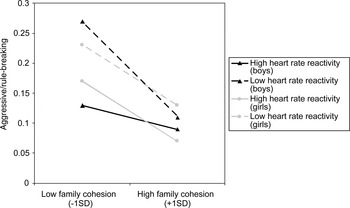
The three-way interaction among family cohesion, heart rate reactivity, and sex on parent-reported aggressive/rule-breaking behavior.

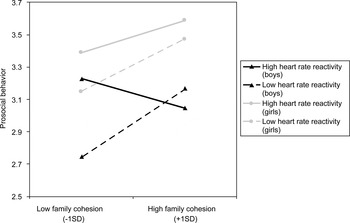
The three-way interaction among family cohesion, heart rate reactivity, and sex on teacher-reported prosocial behavior.

Results
Descriptive analyses
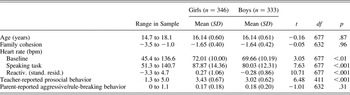
Table 1 summarizes the means, standard deviations, and range of all study variables separately for boys and girls. Independent sample t tests showed that baseline and task heart rate (as measured in beats per minute) differed significantly between boys and girls. Girls scored higher on both measures (ts >3.28, ps < .01). Moreover, girls were rated as more prosocial by teachers (t = 6.85, p < .001), whereas there were no differences in parent-reported aggressive/rule-breaking behavior between boys and girls.
Means (standard deviations), range, and sex differences of all study variables

Note: bpm, beats per minute.
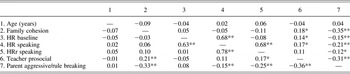
Correlations between the study variables (see Table 2) showed that family cohesion was positively associated with teacher-reported prosocial behavior, indicating that adolescents from cohesive families were rated higher on prosocial behavior. Lower family cohesion was associated with higher parent-reported aggressive/rule-breaking behavior scores. Baseline and task heart rate were strongly correlated (r = .63 for girls, r = .68 for boys). In boys, baseline and task heart rate were associated with prosocial and aggressive/rule-breaking behavior. Boys with higher heart rates were more prosocial and rated as less aggressive/rule breaking. In girls, however, only higher task heart rate was associated with lower aggressive/rule-breaking behavior ratings. In both sexes, heart rate residual scores was negatively related to aggressive/rule-breaking behavior ratings, indicating that lower physiological responsiveness to the stressful task was accompanied by higher aggressive/rule-breaking behavior ratings. Finally, prosocial and aggressive/rule-breaking ratings were negatively correlated in both boys and girls.
Correlations between all dependent and independent variables separately by sex

Note: For girls the total numbers ranged from 197 to 346 and for boys they ranged from 188 to 333. Boys are above and girls below the diagonal. HR, Heart rate; HRr, heart rate reactivity.
Regression analyses
Parent-reported aggressive/rule-breaking behavior was skewed and was therefore logarithmically transformed to represent a normal distribution of the data. Moreover, all continuous independent variables were standardized to 0 mean and 1 SD to enhance ease of interpretation of the interactions. Therefore, in Figure 1 and 2 “Low” refers to –1 SD and “High” refers to +1 SD. Age was not included as a control variable in the analyses because it did not significantly correlate with any of the other study variables. Moreover, controlling for factors associated with higher risk (i.e., difficult temperament, parental psychopathology, single-parent household, or a combination of these three) did not alter our findings.
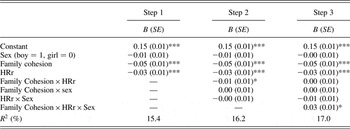
We hypothesized that the relationship between family functioning and aggressive/rule-breaking behavior ratings of adolescents would be moderated by heart rate reactivity. Table 3 summarizes the results from the regression analyses of parent-reported aggressive/rule-breaking behavior on sex, family cohesion, and heart rate reactivity. The statistically significant main effects indicated that lower family cohesion (squared semipartial correlation; sr 2= .12) and blunted heart rate reactivity (sr 2 = .04) were each associated with higher ratings of aggressive/rule-breaking behavior. In Step 2, which included all two-way interaction terms, we were specifically interested in the theoretically specified interaction between family cohesion and heart rate reactivity. As hypothesized, the relationship between family cohesion and aggressive/rule-breaking behavior depended on heart rate reactivity. Results from Step 3, which included the three-way interaction term, showed that this interaction varied as a function of sex, interaction term: b = 0.03 (95% CI = 0.01–0.05), F (624) = 18.23, p < .001. The two- and three-way interactions accounted for 1.6% of the variance (R 2 change) in aggressive/rule-breaking behavior. To interpret the small three-way interaction (sr 2 = .08), we compared the relevant interactions for boys and girls at different levels of heart rate reactivity; specifically, Figure 1 shows the slopes for boys and girls with high and low heart rate reactivity at low and high levels of family cohesion, respectively.
Regression analysis of the effects of sex, family cohesion, and HRr on parent-reported aggressive/rule-breaking behavior

Note: HRr, Heart rate reactivity.
*p < .05. ***p < .001.
For boys displaying high levels of heart rate reactivity, there was not a statistically significant effect of family cohesion on aggressive/rule-breaking behavior ratings, simple slope: b = –0.01 (95% CI = –0.04 to 0.02), t (304) = –0.91, p = .36. By contrast, for boys displaying low levels of heart rate reactivity, there was a statistically significant effect of family cohesion on aggressive/rule-breaking behavior ratings, simple slope: b = –0.08 (95% CI = –0.10 to –0.06), t (304) = –7.61, p < .001, such that low family cohesion was associated with higher rated aggressive/rule-breaking behavior. The difference between these two slopes was statistically significant, interaction term: b = 0.03 (95% CI = 0.01 to 0.05), t (304) = 3.18, p < .01.
In girls, family functioning had a statistically significant effect on aggressive/rule-breaking behavior, and this effect was equivalent in size regardless of whether girls displayed high levels of heart rate reactivity, simple slope: b = –0.04 (95% CI = –0.06 to –0.03), t (319) = –4.88, p < .001, or low levels of heart rate reactivity, simple slope: b = –0.05 (95% CI = –0.07 to –0.03), t (319) = –4.27, p < .001. That is, lower family cohesion was associated with more aggressive/rule-breaking problems independent of the level of heart rate reactivity, interaction term: b = 0.00 (95% CI = –0.01 to 0.02), t (319) = 0.58, p = .56. In total, the relationship between family cohesion and aggressive/rule-breaking behavior ratings was modified by lower heart rate reactivity in boys and by heart rate reactivity in general in girls.
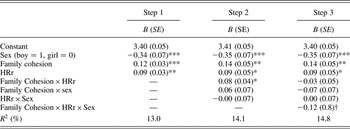
Table 4 reports the regression analysis of teacher-reported prosocial behavior on sex, family cohesion, and heart rate reactivity. The statistically significant main effects in Step 1 indicated that girls, compared with boys (sr 2 = .06), and adolescents from families with higher cohesion, compared with families with lower cohesion (sr 2 = .03), were rated higher by their teachers on prosocial behavior. Heightened heart rate reactivity (sr 2 = .02) was also significantly associated with more prosocial behavior. In Step 2, which included all two-way interaction terms, we were specifically interested in the theoretically specified interaction between family cohesion and heart rate reactivity. As hypothesized, the relationship between family cohesion and prosocial behavior depended on heart rate reactivity. However, results from Step 3, which included the three-way interaction term, indicated that this effect was marginally modified by sex, b = –0.12 (95% CI = –0.02 to 0.27), F (377) = 9.33, p = .10. The two- and three-way interactions accounted for 1.8% of the variance (R 2 change) in prosocial behavior. To interpret the marginal three-way interaction (sr 2 = .07), we compared the relevant simple interactions for boys and girls at different levels of the moderator; specifically, Figure 2 shows the slopes for boys and girls with high and low heart rate reactivity at high and low levels of family functioning, respectively. Among boys displaying high levels of heart rate reactivity, there was not a statistically significant effect of family functioning on prosocial behavior, simple slope: b = –0.09 (95% CI = –0.26 to 0.08), t (184) = –1.02, ns. By contrast, for boys displaying low levels of heart rate reactivity, there was a statistically significant effect of family functioning on prosocial behavior, simple slope: b = 0.22 (95% CI = 0.10 to 0.34), t (184) = 3.65, p < .001, such that low family cohesion was associated with less prosocial behavior. The simple slopes were significantly different from each other, interaction term: b = –0.15 (95% CI = –0.26 to –0.05), t (184) = 2.80, p < .01, indicating that the relation between family cohesion and prosocial behavior depended on heart rate reactivity.
Regression analysis of the effects of sex, family cohesion, and HRr on teacher-rated prosocial behavior

Note: HRr, Heart rate reactivity.
†p < .10. *p < .05. **p < .01. ***p < .001.
A similar pattern emerged for girls. Among girls displaying high levels of heart rate reactivity there was not a statistically significant effect of family cohesion on prosocial behavior, simple slope: b = 0.10 (95% CI = –0.02 to 0.23), t (193) = 1.67, p = .10. However, for girls displaying low levels of heart rate reactivity, this effect was statistically significant, simple slope: b = 0.17 (95% CI = 0.02 to 0.31), t (193) = 2.28, p < .05, such that lower family cohesion was associated with less prosocial behavior. However, the difference between these two slopes was not statistically significant, interaction term: b = –0.03 (95% CI = –0.13 to 0.07), t (193) = –.63, ns. In total, the relation between family cohesion and prosocial behavior of both boys and girls was only marginally dependent upon heart rate reactivity; only in boys, however, was there a statistically significant difference between adolescents who were high and low on heart rate reactivity. Adjusting the above findings for the extent to which the teachers knew their students did not alter the results in a significant way.
Discussion
In the current study we tested the BSC hypothesis in a large sample of Dutch adolescents. This hypothesis was not supported. Specifically, we found no support for the assumption that heightened physiological reactivity (i.e., increases in arousal from baseline) in adolescence enhances susceptibility to family environments. The main effects in the multivariate analyses showed that heightened reactivity operated as a protective factor, because greater reactivity was associated with lower aggression/rule breaking and more prosociality, though these main effects were small in size. Moreover, there were small- to medium-sized main effects of family cohesion on both aggressive/rule-breaking behavior (greater cohesion was associated with lower aggression/rule breaking) and prosocial behavior (greater cohesion was associated with more prosociality), showing a congruence between adolescents' social behavior and family environments in which they lived. In adolescent girls, stress reactivity and family cohesion combined additively to predict behavioral adjustment. In adolescent boys, however, these two predictors combined in a nonadditive (i.e., synergistic) manner, though the amount of variance explained by the interaction terms was very small and should not be overemphasized. Nonetheless, for boys, these interactions were consistent with a dual-risk interpretation, whereby the combination of low family cohesion (an environmental risk factor) and low physiologic reactivity (a biological risk factor) interacted to predict the lowest levels of prosocial behavior and the highest levels of aggressive/rule-breaking behavior. Whereas the behavioral adjustment of boys displaying the biological risk factor appeared to be more vulnerable to low family cohesion, other boys not possessing this risk factor appeared to be resilient against low family cohesion.
One possible interpretation of these data is that, contrary to the BSC hypothesis, low physiological stress reactivity increased susceptibility to family environment. This interpretation is unlikely, however, for both theoretical and empirical reasons. First, at a theoretical level, there is an extensive literature showing that the stress response systems encode and filter information about the organism's social environment, mediating the organism's openness to environmental inputs (Boyce & Ellis, Reference Boyce and Ellis2005; Del Giudice, Ellis, & Shirtcliff, Reference Del Giudice, Ellis and Shirtcliff2011). It is not plausible, theoretically or mechanistically, that low responsiveness of the autonomic system to social challenge (constituting a lack of biological reactivity to social context) could increase permeability to family context. Second, at an empirical level, boys displaying diminished reactivity did not display increased susceptibility to positive family environment (high cohesion); thus, there was not a general tendency for these boys to display heightened sensitivity to family context.
A more plausible explanation for these findings may be that the assessment of family cohesion in adolescence is actually a proxy of parental supervision and control. That is, in highly cohesive families, antisocial tendencies may be more suppressed by parental control, even in adolescents with little self-regulation. In contrast, adolescents with low reactivity who come from less cohesive families may be less restricted and controlled by their parents, allowing greater exposure to negative peer contexts. In girls, we found such negative associations between family cohesion and aggressive/rule-breaking behavior across the board. In boys displaying low reactivity, the effects of adverse family environments may be more severe. Blunted responses to stress are typically associated with fearlessness and sensation seeking (e.g., Ortiz & Raine, Reference Ortiz and Raine2004; Raine, Reference Raine2002). As such, these boys may be relatively fearless when it comes to undertaking risky activities (e.g., aggressive/rule-breaking behavior) and less concerned about the repercussions of their behavior. Support for this notion has also been found in girls who were confronted with harsh parenting. In these girls, low levels of fear or high levels of impulsivity were associated with more externalizing problems in adolescence (Leve, Kim, & Pears, Reference Leve, Kim and Pears2005). Conversely, in the current study, heightened reactivity to stress appeared to serve as a buffer in low cohesive families and may be more associated with stress-avoidant strategies, due to low fearlessness and concerns about the repercussions of the behavior (e.g., being rejected by peers or punishment by law enforcement).
Alternatively, “allostatic load” may be an explanation for the current findings. This explanation assumes that ongoing exposures to stress disturb normal development (i.e., maladaptation) rather than direct or regulate it toward strategies that are adaptive under stressful conditions. According to this perspective, the wear and tear of chronic stress may dysregulate or impair physiological stress responses to threatening situations (e.g., Juster, McEwen, & Lupien, Reference Juster, McEwen and Lupien2010; McEwen, Reference McEwen2007). In the current context of low family cohesion, which may produce stress over a long period of time (possibly already starting in early childhood), adolescents' stress response system may “burn out.” As such, physiological responses to potential threats (e.g., dangers involved in committing aggressive or violent acts) could become dampened in these adolescents and thus exacerbate aggressive/rule-breaking problems. Consistent with this theorizing, there is some evidence for allostatic (over)load in children and adolescents due to cumulative risk. For example, Evans, Kim, Ting, Tesher, and Shannis (Reference Evans, Kim, Ting, Tesher and Shannis2007) found that greater duration of childhood poverty was associated with elevated overnight cortisol and dampened cardiovascular reactivity to a social–cognitive stressor.
Whether physiological response profiles that support heightened aggression and rule breaking under conditions of family stress represent adaptation or maladaptation depends on definitions (and value judgments) regarding positive versus negative outcomes. As reviewed in Ellis et al. (Reference Ellis, Del Giudice, Dishion, Figueredo, Gray and Griskevicius2012), high-risk behaviors can result in net harm in terms of a person's own phenomenology and well-being (e.g., producing miserable feelings or a shortened life), the welfare of others around them, or harm to the society as a whole, but still be adaptive in an evolutionary sense. Consider, for example, aggressive behaviors that expose adolescents to danger and/or inflict harm on others but increase dominance in social hierarchies and leverage access to mates (e.g., Gallup, O'Brien, & Wilson, Reference Gallup, O'Brien and Wilson2011; Palmer & Tilley, Reference Palmer and Tilley1995; Sylwester & Pawłowski, Reference Sylwester and Pawłowski2011). Aggression in this context does not equal “maladaptive.”
Whither BSC?
As reviewed in the introductory section, support for the BSC hypothesis has only emerged in past research with young children. It may be that heightened stress reactivity plays an important role in enhancing developmental plasticity in childhood in response to rearing experiences but no longer functions in this manner by adolescence (see also Beauchaine, Reference Beauchaine2001). That is, different stress response profiles may contribute to different personalities in adolescence but are no longer moderated by differential susceptibility to environmental influence. In terms of personality, heightened stress reactivity in adolescents may facilitate stress-avoidance strategies or increased levels of fear. Therefore, it is not surprising that in adolescence, a period marked by a rise in risky behaviors (e.g., Agnew, Reference Agnew2003; Steinberg, Reference Steinberg2008), low stress reactivity is associated with aggressive/rule-breaking problems, especially in low cohesive families.
There is some support for this rationale from previous studies (e.g., El-Sheikh, Reference El-Sheikh2005; El-Sheikh, Keiley, & Hinnant, Reference El-Sheikh, Keiley and Hinnant2010; Erath et al., Reference Erath, El-Sheikh and Cummings2009). For example, Erath et al. (Reference Erath, El-Sheikh and Cummings2009) showed that harsh parenting was more strongly associated with externalizing behavior in older children (age 8–9) with low sympathetic reactivity than in highly reactive children. Moreover, these effects applied more to boys than to girls. Likewise, several studies on marital conflict as an indicator of an adverse environment have also shown that older children with low parasympathetic reactivity who were exposed to high levels of marital conflict displayed the most behavioral problems (El-Sheikh & Whitson, Reference El-Sheikh and Whitson2006; Katz, Reference Katz2007). As in the current study, these findings could reflect dual risk or gene–environment correlations (discussed below).
The recurrent finding that high family adversity and low stress reactivity converge to predict behavioral problems in middle childhood and adolescence could be explicable in terms of the adaptive calibration model of stress responsivity (ACM; Del Giudice et al., Reference Del Giudice, Ellis and Shirtcliff2011). Following BSC theory, the ACM posits that children living in dangerous or unpredictable environments initially upregulate their stress reactivity, increasing their capacity and tendency to detect and respond to environmental threats while maintaining a high level of engagement with the social and physical environment. However, in dangerous environments characterized by more severe levels and types of stress, the ACM proposes that individuals then downregulate stress responsivity, reducing sensitivity to social feedback, increasing risk taking, and promoting disruptive, exploitative patterns of social behavior. That is, in the language of the ACM, children transition from “vigilant” to “unemotional” phenotypes. This dampening of stress responses is consistent with the allostatic load model (McEwen, Reference McEwen2007). The ACM posits that this transition typically occurs around the juvenile or adolescent transition. Thus, the ACM is consistent with the present findings, and those reviewed above, showing a pattern of low responsivity and high aggressive/rule-breaking behavior among young adolescents exposed to substantial family adversity. These theories and data complement and extend past research demonstrating that individuals low on stress reactivity are at high risk for externalizing disorders, such as aggression (e.g., Lorber, Reference Lorber2004; Ortiz & Raine, Reference Ortiz and Raine2004; Sijtsema, Shoulberg, & Murray-Close, Reference Sijtsema, Shoulberg and Murray-Close2011) and conduct problems (e.g., Beauchaine, Katkin, Strassberg, & Snarr, Reference Beauchaine, Katkin, Strassberg and Snarr2001; Lorber, Reference Lorber2004).
Sex differences
Our findings may also have implications for the role of sex when explaining differences in the relationship between reactivity and family cohesion. Possible explanations for these differences come from evolutionary theories that predict moderating effects of sex on the negative end of the family functioning continuum. Belsky et al. (Reference Belsky, Steinberg and Draper1991) posit that girls in adverse family contexts are more likely to develop internalizing problems, whereas boys are more likely to develop externalizing problems, which in turn relate to sexually differentiated forms of sexual and reproductive behavior. Further, such sex differences are predicted to emerge in early adolescence (Davies & Lindsay, Reference Davies and Lindsay2004). This theorizing is consistent with the current study and previous research insofar as sex differences have not been found in BSC studies investigating young children (Boyce et al., Reference Boyce, Chesney, Alkon, Tschann, Adams and Chesterman1995, Reference Boyce, Essex, Alkon, Goldsmith, Kraemer and Kupfer2006; Hastings et al., Reference Hastings, Sullivan, McShane, Utendale, Coplan and Vyncke2008; Obradovic et al., Reference Obradovic, Bush, Stamperdahl, Adler and Boyce2010) but have emerged (although inconsistently) in older children and early adolescents with regard to low physiological reactivity (i.e., small increases or decreases in arousal from baseline) and externalizing problems in adverse contexts (El-Sheikh et al., Reference El-Sheikh, Keller and Erath2007; El-Sheikh & Whitson, Reference El-Sheikh and Whitson2006; Erath et al., Reference Erath, El-Sheikh and Cummings2009; Willemen, Schuengel, & Koot, Reference Willemen, Schuengel and Koot2009).
Limitations
Caution is warranted when drawing conclusions from these findings. First and foremost, BSC is a theory of developmental change; that is, the theory posits that greater biological sensitivity increases developmental receptivity to the environment, whereby more susceptible individuals are more likely to experience sustained developmental change in response to environmental exposures (Ellis, Boyce, et al., Reference Ellis, Shirtcliff, Boyce, Deardorff and Essex2011). The cross-sectional nature of the current study did not allow for measuring development. Thus, we were not able to test whether biological reactivity to stress moderated the influence of environmental stressors and supports on behavioral development and adjustment over time. Future longitudinal research is clearly needed to make more definitive statements about the role of BSC in moderating adolescent development.
Second, the current research was not genetically informative. A large behavior-genetic literature warns against attributing causal effects to family processes in the absence of a causally informative research design (e.g., Moffitt, Reference Moffitt2005). The apparent “effects” of family cohesion could potentially reflect active and passive gene–environment correlations. For example, a passive gene–environment correlation occurs when heritable traits transmitted from parents to offspring also affect the environment in which the child is raised (Plomin, Defries, & Loehlin, Reference Plomin, Defries and Loehlin1977). Consistent with this logic, (a) prosocial behavior, externalizing behavior, and stress reactivity are all substantially heritable (Boyce & Ellis, Reference Boyce and Ellis2005; Knafo, Israel, & Ebstein, Reference Knafo, Israel and Ebstein2011; Moffitt, Reference Moffitt2005); (b) these traits were all intercorrelated in the current study; and (c) behavioral problems in parents are associated with greater family dysfunction (e.g., Jaffee & Price, Reference Jaffee and Price2007). Accordingly, parents displaying lower prosociality, higher antisociality, and lower stress reactivity could have passed genes for these traits on to their children while also fostering less cohesive family environments. In total, we cannot rule out the possibility that gene–environment correlations contributed to the current pattern of results. Future research that incorporates experimental manipulations of the environment and/or longitudinal analysis of change in adolescent adjustment is needed to address this issue.
Third, our measure of environment was limited (i.e., it was most likely a proxy for parental supervision and control) and may not have adequately captured the range, levels, and major types of stress and support in adolescents' lives (or only captured one type of stress support). Fourth, a concern was the use of teacher reports during adolescence, given potential limitations on the extent to which teachers can judge the behavior of their students. To address this limitation, teachers reported observable prosocial behavior (mostly limited to the classroom), and we performed additional analyses in which we controlled for the reliability of the teacher reports.
Fifth, our outcome measure of aggressive/rule-breaking behavior, as reported by parents, was limited in its ability to test the BSC hypothesis. Given that the current study was conducted in a general population sample, the Child Behavior Checklist reports are more likely to capture exuberance instead of actual externalizing behavior (see Achenbach & Rescorla, Reference Achenbach and Rescorla2001). Future endeavors should therefore replicate the current study in a sample of youth who score in the clinical ranges of externalizing problems and test whether similar findings are obtained.
Sixth, all experimental studies of physiological stress reactivity are limited by the nature of the laboratory tasks that are used to activate the stress systems. Contradictory findings in the literature may be due to the different nature of challenge tasks (Obradovic et al., Reference Obradovic, Bush and Boyce2011). Obradovic et al. (Reference Obradovic, Bush and Boyce2011) made a distinction between cognitive and interpersonal challenges and showed that low reactivity to interpersonal tasks was related to more externalizing problems in families with high levels of marital conflict, whereas the opposite was true for cognitive challenges. This is consistent with the current study, where physiological reactivity to an interpersonal challenge was assessed.
Seventh, our results may be limited by the index of stress reactivity. Using heart rate reactivity, we were unable to distinguish between effects related to either parasympathetic or sympathetic activity of the nervous system. It could be that focusing on more specific measures of autonomic reactivity would yield different results, because patterns of SNS and PNS activation are associated with different vulnerabilities and behavioral dispositions (e.g., impulsivity versus emotion regulation; reviewed in Del Giudice et al., Reference Del Giudice, Ellis and Shirtcliff2011). Nevertheless, empirical evidence is far from conclusive with respect to different relations between adversity and various indices of autonomic activity.
Eighth and finally, because of the small amounts of variance accounted for by the interaction terms, caution is warranted in interpreting the current moderating effects of heart rate reactivity. However, higher order interactions are difficult to detect. As a result, ranges of explained variance from 1.6% to 1.8% are not uncommon even in large field studies such as the TRAILS study (e.g., Jaccard & Wan, Reference Jaccard and Wan1995; McClelland & Judd, Reference McClelland and Judd1993).
Strengths
Despite the aforementioned limitations, there are also a number of methodological strengths to the current study. We were able to test the BSC hypothesis in a large, representative, community-based sample of adolescents. The large sample size afforded sufficient power to test for three-way interactions, which enabled us to detect the moderating effects of sex. Another strength was the laboratory-based stress reactivity protocol. In addition to the relative ease of collecting heart rate data, our public speaking task was executed while following a protocol to ensure that the stress experience was standardized for all participants. The protocol was successful in eliciting substantial change in heart rate from baseline. Nevertheless, as suggested by Obradovic et al. (Reference Obradovic, Bush and Boyce2011), researchers should consider that physiological reactivity to stress is highly dependent upon context; different challenges reflecting social, emotional, cognitive, and physical stressors should be assessed and analyzed in future studies. Finally, the current research benefited from multiple data sources. We used teacher reports and parent reports to assess adolescent behavioral outcomes. Although there is some overlap between teacher reports, parent reports, and self-reports, there is also a high discrepancy in reporting between these different raters (Noordhof, Oldehinkel, Verhulst, & Ormel, Reference Noordhof, Oldehinkel, Verhulst and Ormel2008). Nonetheless, to avoid overreliance on one informant and shared-method biases, we used different informants and experimental measures (i.e., a public speaking task).
Future research
A key direction for future research involves determining the extent to which BSC varies within and/or across individuals over time. Research needs to address whether those who are most and least malleable in response to the environment (or particular features of the environment) early in childhood remain so later in childhood and adolescence. The ACM suggests that neurobiological susceptibility to the environment will change over time, increasing then decreasing, under conditions of severe stress. Environmentally informative studies are also needed to address potential gene–environment correlations. Compelling experimental evidence of environmental effects being moderated by BSC remains limited (but see Quas et al., Reference Quas, Bauer and Boyce2004). Experimental examination of differential susceptibility by means of intervention affords a solid basis for causal inference. Specifically, experimental designs where the environment is an intervention or control condition to which participants are randomly assigned overcome some of the limitations of correlational studies of Person × Environment interactions and allow for strong conclusions about the direction of effects.
Future research could also investigate whether blunted physiological reactivity puts children and adolescents on continuing pathways of maladjustment (in terms of conventional mental health outcomes). Because aggressive/rule-breaking behavior is predominantly limited to adolescence (Agnew, Reference Agnew2003; Moffitt, Reference Moffitt1993), the interactions found in the current study may be temporary. Nonetheless, there is a small but significant group that persists in displaying aggressive/rule-breaking behaviors, and it would be important to see to what extent this depends on interactions between growing up in adverse contexts and low physiological reactivity.
In summary, our downstream measure of physiological reactivity, which was the change in heart rate in response to social–evaluative challenge, did not operate as a mechanism of heightened susceptibility to family context in our sample of adolescents. This raises important questions about the nature of BSC in adolescence and its development over time. Our data were most consistent with heightened stress reactivity operating as a protective rather than a susceptibility factor, suggesting a dual-risk model or possible gene–environment correlations. Future research needs to carefully consider the role of both heightened and blunted stress reactivity in moderating the effects of environmental context on adolescent adjustment. What is critically needed is a more nuanced understanding of the functions of stress reactivity in the second decade of life. Such an understanding could help to predict, and ultimately explain, how different adolescents adapt to both stressful and supportive environmental conditions.