

Introduction
There has been increasing public concern about environmental issues, such as the threats of global warming, toxic materials, polluted water and unsafe air. Tempering these concerns are the substantial personal and social costs associated with environmental stewardship. We explore how regulatory policies might benefit through positive engagement of norms, capabilities and values at the household level. In this context, we seek to understand the ways in which social norms provide behavioral guidance with respect to the conflict between the costs and benefits of pro-environmental behavior. More broadly, this understanding helps define the relative role of norms in the policy mix by identifying the most influential norms and the factors most responsible for the establishment of those norms.
Our inquiry arises from a case study of the evolution and impact of norms based on US household recycling participation and beliefs. Recycling currently diverts an annual volume of material in the USA of 89 million tons (US Environmental Protection Agency, 2014), thereby reducing landfill costs and the costs of producing products compared with using virgin materials.Footnote 1 Norms are particularly relevant since norms alter the costs and benefits of recycling for the individual and the community.
A substantial literature in economics, psychology and law emphasizes the potential importance of norms both in terms of their influence on behavior and as a complement or substitute for policies that mandate particular behaviors (see, among others, Ellickson, Reference Ellickson1991; Sunstein, Reference Sunstein1996; Posner, Reference Posner1997, Reference Posner2000; McAdams & Rasmusen, Reference McAdams, Rasmusen, Polinsky and Shavell2007). Sunstein (Reference Sunstein1996) delineates the key analytic concerns regarding social norms, many of which are manifested in our analysis of recycling. First, social norms can directly influence individual pro-environmental actions, an effect that we document in the case of recycling participation. Second, the government has an important role in encouraging these pro-environmental actions, a role we identify by showing the effect of state recycling statutes. Third, social norms can alter household recycling by altering the benefit–cost calculus for its desirability, a result that is consistent with our finding that norms influence recycling. Fourth, there can be important interdependencies between norms and behavior, sometimes reflected in bandwagon and cascade effects. These we reveal by examining the causal cycle in which positive norms increase later recycling and recycling increases later norms. Fifth, the behavior of others has an important effect through the influence of descriptive norms, an influence we show by a strong effect on greater individual recycling in counties with high recycling participation rates. Finally, norms may operate either through a person's response to undesired recycling behavior or their neighbors’ response to the same behavior. We show that personal norms, reflected in whether people are upset by the poor recycling behavior of others, are more strongly related to their own behavior than the social norms arising out of the perceived upset of others.
We explore the role of state recycling laws on recycling and on norms. Such laws provide formal sanctions against waste or incentives for recycling, but are appropriately not themselves considered norms (Posner, Reference Posner1997; Nolan, Reference Nolan2017). However, norms can affect the willingness to vote for environmental candidates, and laws can positively or negatively reflect the development of norms. Our analysis will account for differences in the stringency of state laws related to recycling and assess their effects on social norms and recycling.
The paper proceeds as follows. After introducing a four-way categorization of norms, we review studies that have identified relationships between norms and pro-environmental behavior. We then present our empirical model, describe the structure of our data and provide empirical evidence regarding the interdependence of norms and pro-environmental behavior while controlling for a broad range of household, area and legal characteristics. We give evidence that norms today influence recycling tomorrow and that recycling today influences norms tomorrow, and in doing so reveal a supportive dynamic relationship between norms and recycling.
A four-way classification of norms
Researchers have defined a number of mechanisms through which norms alter behavior. In this study, we build on the relationship between household recycling and norms first developed by Cialdini et al. (Reference Cialdini, Reno and Kallgren1990). That study on littering distinguished between what had been broadly considered as social norms into categories that they term injunctive and descriptive, where injunctive norms relate to what people believe one ought to do while descriptive norms reflect what people actually do. We expand that framework by specifying whether the norms are personal or societal. A similar distinction is discussed by Farrow et al. (Reference Farrow, Grolleau and Ibanez2017), which additionally provides a helpful review of a large number of experiments from psychology and economics that test the ways norms alter environmental behavior across researchers. We make no claim to resolve the numerous ways that norms can be defined. Our focus is to show the relative importance of a select group of norms and to demonstrate the ways norms and behaviors are related to and build on each other over time.
Personal norms flow from respondents’ own emotions and previous actions while societal norms flow from the emotions and actions of others. Crossing the injunctive/descriptive classifications with the personal/societal distinctions generates the following four types of norms in our empirical analyses.
• Societal injunctive norms: would others be upset if they saw someone putting recycling in the trash (Neighbor upset)?
• Personal injunctive norms: would a person be upset to see a neighbor putting recycling in the trash (Personally upset)?
• Societal descriptive norms: what is the average four-material recycling participation rate in the respondent's county (County recycling)?
• Personal descriptive norms: does the respondent have a previous history of recycling (Recycle all four)?
It should be acknowledged that many researchers would not consider what we call a personal descriptive norm as a norm. Indeed, in the Farrow et al. (Reference Farrow, Grolleau and Ibanez2017) review, the personal descriptive norms category is notably absent. However, Festinger (Reference Festinger1957) proposes that behavior and normative beliefs need to align within an individual. If this does not occur, dissonance then creates pressure to generate change in beliefs or behavior. Self-perception theory (Bem, Reference Bem1967) similarly posits that individuals often learn their values and norms by attending to their behavior. Finally, Cialdini and Goldstein (Reference Cialdini and Goldstein2004) argue that the need to preserve one's self-image encourages conformity between actions, statements and beliefs. Thus, there is substantial evidence that just as one's perceived norms come from an awareness of the behavior of others, they can also come from awareness of one's own previous behavior.
In our case, we will show that past recycling is related to the later development of personal norms and behavior. Thus, whether individual descriptive characteristics are defined as norms or not, lagged recycling behaviors act like norms. To the extent that consistency of desired behavior is itself rewarded by others, it is a norm that expresses shared rules of conduct that are generally shared and supported by others (Elster, Reference Elster1989).
Different norms and behavior
Below, we review research demonstrating the relationships between these four classes of norms and behavior. Consistent with previous research, our findings demonstrate that societal descriptive norms are generally more predictive of behavior than injunctive ones. For most contexts in which norms are influential, people are less sensitive to what others feel they should do than what others actually do. We will also give evidence that perceived personal norms are more important than perceived societal ones. This may arise because people have a better sense of their own behavior and preferences than those of others (Brekke et al., Reference Brekke, Kipperberg and Nyborg2010). If so, societal norms offer less precise guidance to the extent that the views of others are not precisely understood and, even if they are understood, may be ignored or even arouse negative reactions.
Literature review
Cialdini et al. (Reference Cialdini, Reno and Kallgren1990) applied their distinction between descriptive and injunctive norms to littering behavior. They tested descriptive littering norms by exposing subjects to an area that was clean versus littered and by manipulating whether the subject saw a person litter in the area. Less littering occurred where the environment was clean and when actual littering was not viewed. They also demonstrated the effectiveness of injunctive norms by showing that fliers with an explicit anti-litter message or with information about an environmental topic led to less littering. Thus, they showed that both injunctive and descriptive societal norms alter behavior.
More recent field experiments on energy usage further demonstrate the influence of descriptive norms. Schultz et al. (Reference Schultz, Nolan, Cialdini, Goldstein and Griskevicius2007) examined descriptive norms in a field experiment about electricity use. Respondents received fliers with information comparing their energy consumption with that of their neighbors. These societal descriptive norms reduced consumption among those who had been using more energy. Allcott (Reference Allcott2011) found similar effects in a large sample (600,000) of US households, and the substantial long-term effects on energy usage were equivalent to the impact of a 5% rate increase. Allcott's study coupled descriptive norm information about neighbors’ behavior with societal injunctive norms generated by a “smiley face” for more efficient energy use. This simple societal injunctive cue was instrumental to discouraging low-energy users from increasing consumption when the societal descriptive norm showed that their neighbors consumed more energy. Nolan (Reference Nolan2011) found that societal descriptive norms specifying paper recycling by neighbor's increased paper recycling, showing this norm to be relevant for recycling.
Other studies have assessed the relationship between environmental behaviors and perceived descriptive or injunctive norms. Thøgersen (Reference Thøgersen2008) studied norms across several environmental actions such as separating kitchen waste for composting, choosing organic milk, buying energy-saving lightbulbs and using public transportation. Descriptive norms were measured by assessments of what the respondent believed their acquaintances did. Injunctive norms were measured by what the respondent believed their acquaintances expected one should do. Thøgersen's work showed that societal injunctive norms and societal descriptive norms were both positively correlated with pro-environmental behavior, but that the effects of societal descriptive norms were more than twice as strong as societal injunctive norms.
Halvorsen (Reference Halvorsen2008) examined a recycling survey in Norway, finding a relationship between recycling and a measure of societal injunctive norms in terms of whether respondents wanted others to consider them responsible for recycling and two measures of personal injunctive norms: whether respondents thought of themselves as responsible and whether they desired to do as they would like others to do.
The analysis of plastic water bottle recycling by Viscusi et al. (Reference Viscusi, Huber and Bell2011) introduced the two injunctive norms – Personally upset and Neighbor upset – that we will test here. The measure of the personal injunctive norm was whether a respondent would be upset by a neighbor throwing recyclable materials in the trash. The societal injunctive norm was whether the respondent expects a neighbor to be upset by that act. Using cross-sectional data, the article showed that both kinds of norms are positively associated with recycling, even after controlling for other characteristics that are associated with recycling. Moreover, the impact of the personal injunctive norm was found to be much greater than that of the societal injunctive norm.
In this paper, we extend the scope of these assessments of the impact of norms by expanding the range of social norms considered and by providing detailed longitudinal evidence. Our rich and deep data set enables us to provide answers to the following questions: do norms generate environmental behavior? Does environmental behavior reinforce the development of norms? Are either the underlying norms or behavior changing over time? Which categories of norms are most associated with household characteristics and state laws? To understand how we can answer these questions, we first characterize the nature of a somewhat unusual data set. Once that has been defined, we present expectations and insights from this analysis.
Data structure
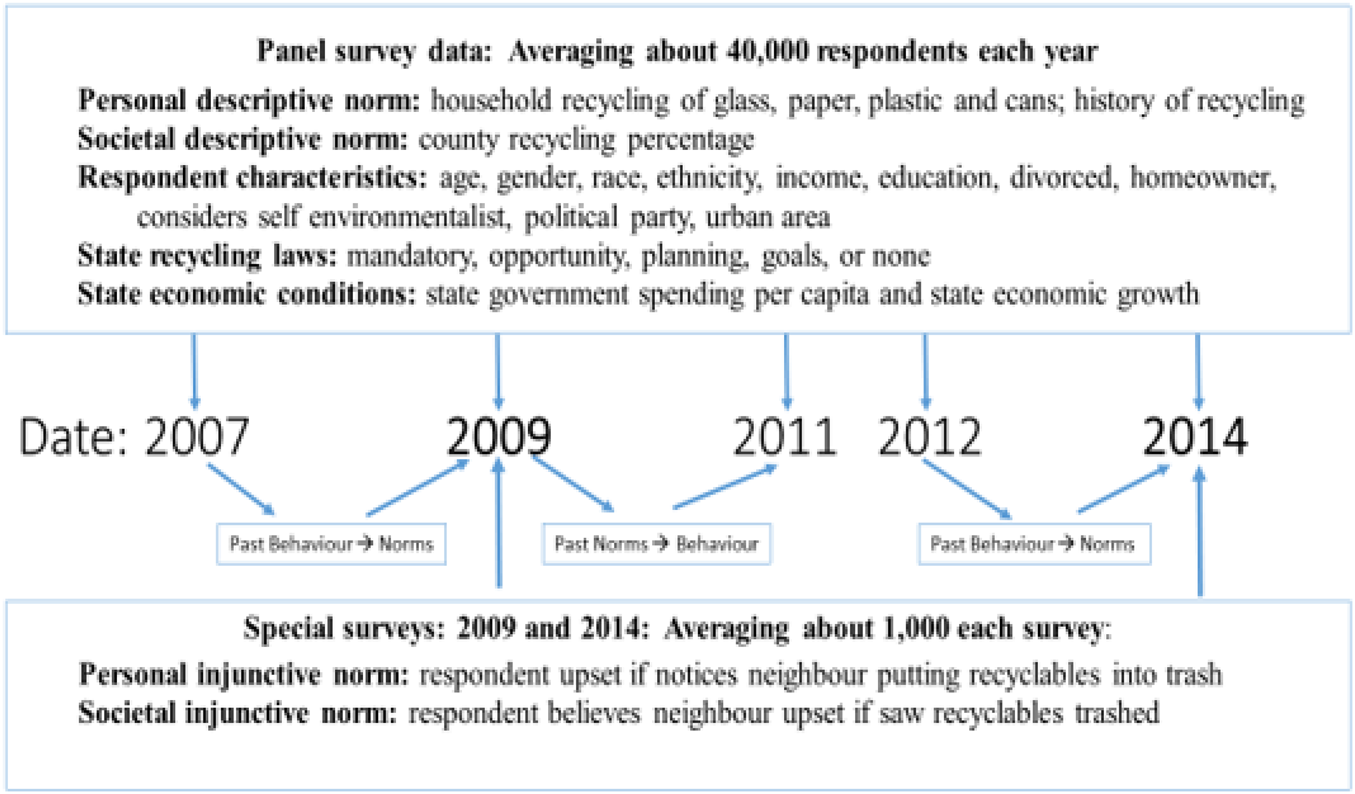
The structure of the data we use in this article is displayed in Figure 1. The US sample for this study utilizes the GfK Knowledge Panel, formerly known as Knowledge Networks. The panel of adult respondents was recruited using nationally representative probability sampling (GfK, 2013) for each year between 2007 and 2014. Two special surveys that includes the norms questions sampled 1027 respondents in 2009 and 984 respondents in 2014.
Panel and special survey data for the study.

Surveys in 2009 and 2014 collected the key injunctive norms measures. To relate those injunctive beliefs to previous and future descriptive norms, data from the full survey panel were considered two years previous to each survey as well as two years after the 2009 survey (such data were not available after the 2014 survey). The two-year lag was selected because the questions about recycling consider the 12 months previous to the survey. A one-year lag could result in an overlap of the behavior between surveys if they were not a full year apart, while a longer lag could risk greater indeterminacy about the cause of changes in behavior.
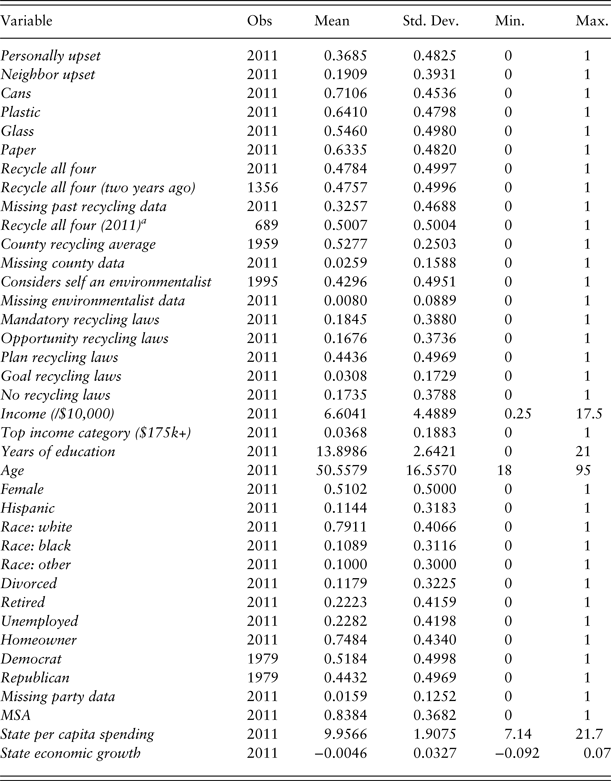
Table 1 summarizes the sample characteristics. Other variables were available from the data sets; however, the ones listed are robustly significant across a variety of analyses. Variables used in the analyses generally had observations for the n = 2011 respondents from the two special surveys that asked respondents the questions about personal and societal injunctive norms. However, there were missing data for some variables. For each of these observations, the missing variable was coded at the sample mean, and we constructed a variable to indicate missing data to confirm that there was no relationship between the fact that data were missing and any dependent variable used in an analysis. As Table 1 shows, there were few instances of missing data, excepting situations where the household needed to be matched with previous or subsequent survey data as shown in Figure 1. In each survey year, panel members indicated their recycling for glass, cans, paper and plastic: “In the past 12 months, have you … Recycled your newspapers or other papers? Recycled your cans? Recycled your glass? Recycled your plastic?” The variable constructed using this information indicates whether the respondent's household recycled all four materials, which is the basis of our 0–1 indicator variable, Recycle all four. Additionally, we considered profile surveys collected two years before and after the special surveys, from 2007, 2011 and 2012, to enable the analyses of the household's recycling before, after and during the two special surveys. The self-reported recycling participation rates are strongly correlated with objective measures of recycling volume in terms of the tonnage of materials recycled by county.Footnote 2 The panel data also include characteristics of the panelists that can be used as control variables. The joint data enable the estimation of our four-way norms variables.
Sample characteristics.

aThe variable Recycle all four (2011) is a subset of year 2009 observations for which there was a corresponding year 2011 recycling participation survey. No missing indicator was used for this analysis, as it was the dependent variable in the Table 4 regression.
Injunctive norms
The specialized 2009 and 2014 surveys each include two questions to measure personal and societal injunctive norms. For Personally upset, respondents indicated how much they agreed or disagreed with the statement: “I would be upset if I noticed someone in my neighborhood putting recyclable materials into the garbage.” For Neighbor upset, the statement was: “Other people in my neighborhood would be upset if they noticed someone putting recyclable materials in the garbage.” The empirical analysis pools the “somewhat agree” and “strongly agree” responses to construct 0–1 categorical variables for Personally upset and Neighbor upset.
Descriptive norms
Our focal descriptive norms pertain to recycling. For the personal descriptive norm, the metric is the 0–1 variable, Recycle all four, indicating that the respondent recycled paper, plastic, glass and cans in the year ending on the survey date. The data set also includes measures of the household's recycling in other survey years.
The societal descriptive norm characterizes recycling for other households in the respondent's county. In measuring County recycling, we excluded each respondent's response when calculating their county average, so that the variable reflects the average recycling participation rate of all four materials in the county undistorted by the behavior of the respondent's own household. The procedure for calculating average county recycling utilized the full panel data and thus is not limited to the subsample with detailed norms information. Instead, that variable draws from a sample of 47,378 profile surveys for 2009 and 38,883 surveys for 2014, reflecting an average of 125 observations per county in 2009 and 120 per county in 2014.
Lagged measures of behavior and norms
The longitudinal surveys also collect information on household recycling participation before each of the specialized survey years, as well as after 2009, making it possible to incorporate information on recycling before and after the 2009 survey and before the 2014 survey. These longitudinal data provide a unique way to measure, over time, the relative strengths of and relationships between the types of norms and household recycling.
Control variables
Control variables enable the statistical models to better identify the specific relationships among the norm and behavior variables, distinguished from the effects of other factors. The control variables in the analysis are those that previous research has shown to be related to recycling at either a household or a regional level.
We give evidence that diligent recyclers have characteristics associated with greater educational and economic resources and greater concern for the environment. Other control variables include gender, race, ethnic identification, work and marital status. These control variables were also found to be important in a detailed analysis of recycling in Wisconsin (Bell et al., Reference Bell, Huber and Viscusi2017) and in the USA overall (Viscusi et al., Reference Viscusi, Huber, Bell and Cecot2013).
An important measure is whether the respondent identifies as an environmentalist. The text of this question was “Would you describe yourself as an environmentalist?” with “yes” and “no” as possible answers. A self-acknowledged environmentalist should support both the importance of the environment and take a personal responsibility for it. Thus, it captures the two central requirements of Schwartz's (Reference Schwartz1977) moral norm activation theory. By including environmentalism as a covariate, our analyses test factors related to personal efficacy and moral responsibility that are central to Schwartz's theory (Hopper & Neilson, Reference Hopper and Nielsen1991; Blamey, Reference Blamey1998).
Stringency of state recycling laws
Nolan (Reference Nolan2017) categorizes state laws as “formal sanctions” to differentiate them from “informal sanctions,” and observes that the relationship between laws and social norms is complex and often debated. On the one hand, laws requiring compliance can “crowd out” moral reasons for recycling, while others have shown that laws encourage desired behavior and generally increase own guilt as well as distress at others breaking that law (Van Vugt & Samuelson, Reference Van Vugt and Samuelson1999; Nyborg & Rege, Reference Nyborg and Rege2003).
The panel data provides a state identifier, so the recycling laws that apply to a household can be assessed at that level. Our recycling legal regime variables follow the stringency of state recycling laws defined in Viscusi et al. (Reference Viscusi, Huber, Bell and Cecot2013). The most stringent measures are Mandatory recycling laws, which require household recycling and often impose fines for failure of households to properly recycle.Footnote 3 The next most stringent measures indicate whether a state has Opportunity recycling laws requiring that residents be provided with recycling opportunities.Footnote 4 These strong recycling law states are contrasted with states that either have no recycling laws, have defined goals for recycling rates or specify that municipalities have plans for recycling. States that have neither mandatory requirements nor opportunity laws comprise the omitted category of legal regimes. Viscusi et al. (Reference Viscusi, Huber and Bell2014) examined recycling participation and found greater recycling levels for a household are associated with the two strongest recycling laws.
Economic prosperity may also influence the extent to which a state publicizes and reinforces its recycling mandates. Information on state resources that could be used to support recycling come from State per capita spending (by the government) and State economic growth.Footnote 5
Empirical model
The roles of the different norms variables and the distinction between norms and other determinants of recycling can be captured with a simple model of the recycling decision. Initially, consider a household's decision with respect to our principal recycling measure – whether or not to engage in recycling all four materials, Recycle all four, or r it. Household i should choose to recycle in period t if the net benefits less costs of recycling, v it, are positive so that r it = 1 if v it > 0 and r it = 0 if v it ≤ 0.
The benefit the household derives from recycling is the benefit b it(e i, q it, r jt), where e i is a measure of the strength of recycling-related environmental preferences of household i, including influences such as Considers self an environmentalist. This variable characterizes preferences and can influence behavior, but is generally not a considered a behavioral norm. Household benefits are also a function of the personal injunctive norm, q it, Personally upset, as well as whether others recycle, r jt, which is the societal descriptive norm, County recycling. The County recycling variable may also reflect the influence of bandwagon and cascade effects.
The negative aspect of the recycling decision arises from the effort involved. Recycling imposes a time cost g(p t, r it – 2)h i, where g is a function that characterizes the amount of recycling time and h i is the value of the time and effort required for recycling by household i. Policies p t reduce the time costs of recycling, as in the case of Opportunity recycling laws, which require municipalities to provide recycling amenities. The household's previous experience with recycling, r it – 2, is a personal descriptive norm that is represented by the two-year lagged value of Recycle all four. We expect greater values of r it – 2 to reduce later recycling costs as households become more proficient recyclers over time or if previous recycling efforts reinforce the social desirability of recycling, thereby reducing the perceived time cost burden.
If the household does not recycle, it will incur two kinds of costs. There may be disapproval from the household's neighbor's, which we denote by c it and represent empirically by the societal injunctive norms variable, Neighbor upset. In addition, there may be actual or emotional costs if the household does not recycle or adhere to the legal regulatory recycling regimen, which we denote by Mandatory recycling laws, s it.
Our framework is consistent with Sunstein's (Reference Sunstein1996) hypothesis that in the presence of social norms, preferences are not exogenous, but constructed subject to the influence of social norms. Societal descriptive norms affect the benefit component of the calculation, while personal descriptive norms affect both benefits and costs and injunctive norms affect costs, making v it dependent on all four of our focal norms. The household will choose to recycle if the benefits of recycling exceed the costs, or if:
 $$b_{it} \; \left( {e_i, q_{it}, r_{\,jt}} \right) - g\left( {\,p_t, r_{it - 2}} \right)\; h_i \gt \; c_{it} + s_{it} $$
Thus, the net benefits less costs of recycling, v it, are positive if:
 $$v_{it} = b_{it} \left( {e_i, q_{it}, r_{\,jt}} \right) - g\left( {\,p_t, r_{it - 2}} \right)\; h_i - c_{it} - s_{it} \gt 0$$
Our empirical analysis consequently addresses the diverse determinants of recycling: the four social norms variables (County recycling, Recycle all four, Neighbor upset and Personally upset), the impact of laws (Mandatory recycling laws and Opportunity recycling laws) and the role of individual preferences and household differences in recycling costs (Considers self an environmentalist, Income and other demographic control variables).
While the empirical model is framed in terms of whether the household derives greater benefits than costs from recycling, this benefit–cost calculation is not directly observable. We do, however, observe recycling and, following standard economic formulations, hypothesize that the probability that the household recycles is an increasing function of the net benefits, v it. Thus, one would expect the variables that increase the benefits of recycling to increase the probability of recycling and the variables that increase the costs of recycling to decrease that probability.
The other dependent variable of interest is whether the respondent expresses the personal injunctive norm, Personally upset. To test the hypothesis that norms predict recycling and that recycling alters norms, it will be important to characterize those household characteristics that uniquely define each effect. To account for a contemporaneous relationship of variables, we report a two-stage least squares analyses with Recycle all four and Personally upset each serving as the independent variable.
In addition, we also explore the effect of q it – 2 on r it with a model that estimates the relationship of the personal injunctive norm and future recycling by testing the effect of Personally upset (2009) in the Recycle all four (2011) equation. Similarly, we also examine the effect of previous recycling r it – 2 on subsequent norms, q it.
The explanatory variables used to identify the model were selected based on the statistical tests described below. Mandatory recycling laws would be expected to positively influence Personally upset if one is likely to be more upset by neighbors’ failure to recycle if there is a law requiring it. Opportunity recycling laws would promote the household's recycling if state support makes recycling easier. As the statistical results below will indicate, other variables that facilitate recycling such as State per capita spending, Income, Age, Homeowner and MSA (metropolitan statistical area) help uniquely identify characteristics that have a substantial effect on recycling, but do not have a statistically significant relationship with injunctive norms. By contrast, Mandatory recycling laws, Unemployed, Retired, Female, Divorced and Democrat jointly predict injunctive norms, but not recycling.
Plan of analysis
We begin with simple tables and figures that characterize the focal four norms and their relationships. Multivariate analyses then examine the determinants of norms and recycling as functions of each other and household characteristics. Personally upset is modeled as a function of household characteristics and current behavior and Recycle all four is modeled as a function of household characteristics and injunctive norms. The idea is to test whether current behavior and a number of reasonable covariates predict current injunctive norms and vice versa, while accounting for the potential endogeneity of personal norms.
The final two analyses take advantage of longitudinal data. The first examines the two-year lagged effect of behavior on current norms, testing whether that variable is associated with greater norms even when current behavior is included in the model. The second analysis tests whether past norms affect current behavior. Together, these analyses illuminate contexts in which norms and behavior positively feed into one another to become stronger over time.
Simple descriptions of norms and recycling
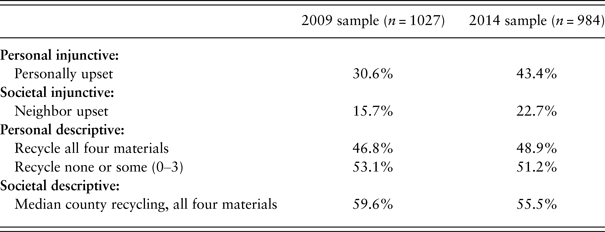
Table 2 shows the levels and changes in norms and behavior from 2009 to 2014. Over time, injunctive norms substantially increase while descriptive norms remain relatively constant. The relative stability in recycling in the face of substantial increases in injunctive norms may be due to two concurrent events that lowered the ability of municipalities to support recycling programs for their residents. First, the Great Recession beginning in 2008 generated a dramatic decline in the market value of recycled materials, dropping the average co-mingled single-stream materials price from $13.22 in 2009 to $7.36 in 2014.Footnote 6 Second, cutbacks in government spending at the state level could have limited recycling programs. Average state government spending was rising at rates greater than 6% in the two years before the 2009 survey and around 5% in 2009, but those rates dropped to a nearly no-growth level in the two years before the 2014 survey and rose to only 1.3% in 2014.Footnote 7 These factors suggest strong headwinds against increases in recycling participation between 2009 and 2014.
Respondent norms in the two survey years.

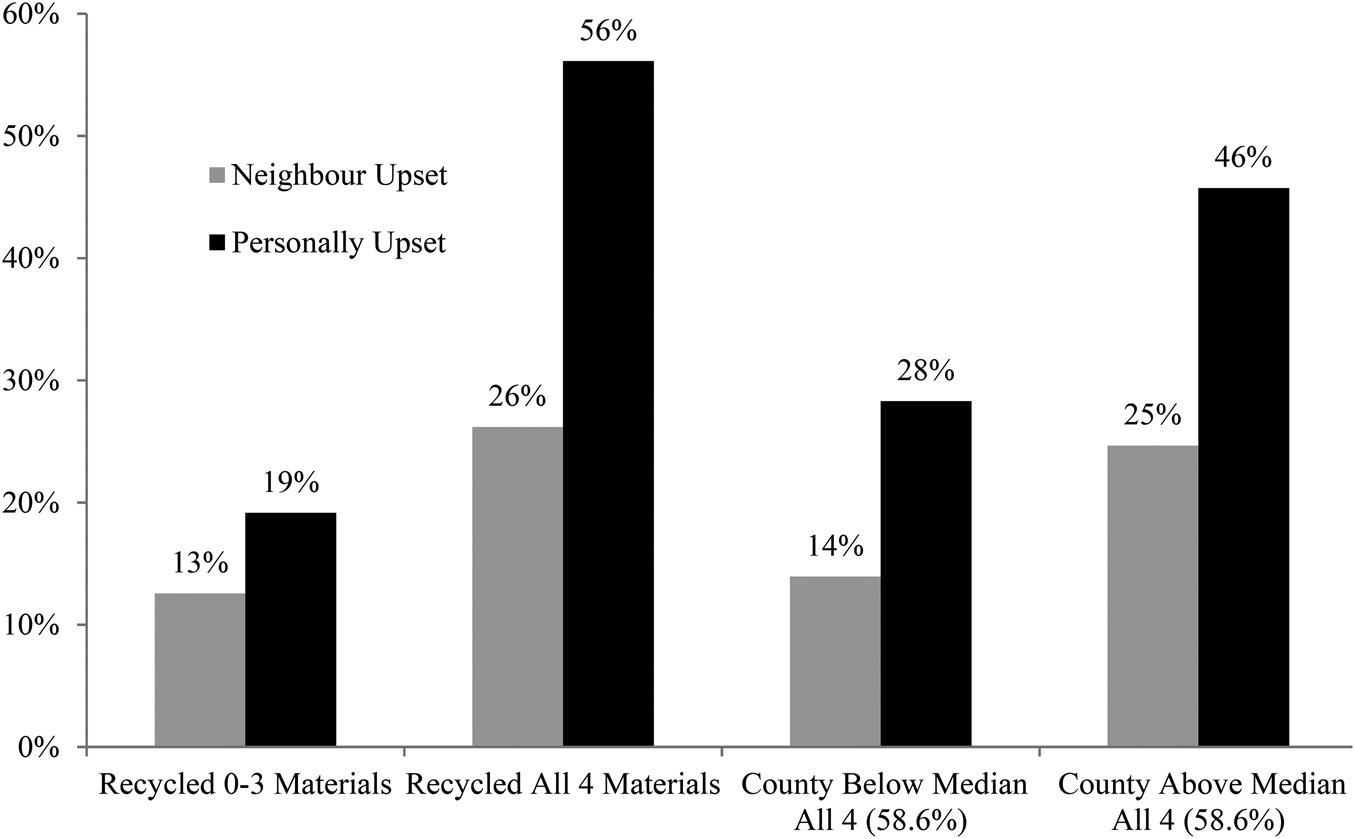
Figure 2 explores the bivariate relationship between the two injunctive measures and the two descriptive measures for our sample. First, it shows that household and county recyclingFootnote 8 differ more when a respondent is Personally upset compared to when the respondent perceives the Neighbor upset. That larger role of Personally upset will be evident in the multivariate analyses and justifies a focus on Personally upset over Neighbor upset as our focal injunctive norm measure. Second, the larger shift in injunctive norms from Recycle all four relative to Recycle 0–3 justifies a focus on Recycle all four as our critical measure of household recycling. The multivariate analyses that follow will examine these effects while controlling for household and area characteristics.
Household and county recycling conditional on injunctive norms Personally upset and Neighbor upset.

Multivariate analysis of Personally upset
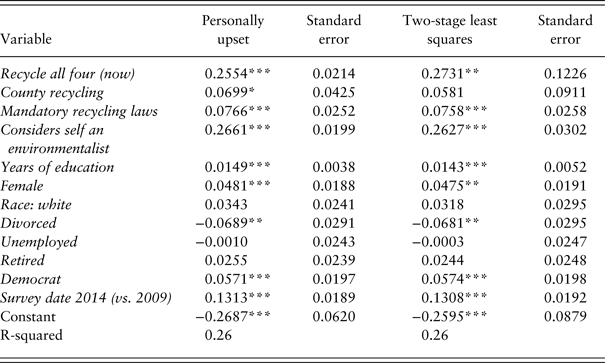
Table 3 presents a linear probability model of whether respondents in the 2009 and 2014 surveys would be Personally upset if neighbors put recyclables in the trash. The first two columns list the ordinary least squares regression coefficients including Recycle all four, but excluding attributes that uniquely predict that variable. The last two columns are the two-stage least squares results, replacing Recycle all four with the prediction from Online Appendix Table A1.Footnote 9 We made these separate runs to identify the characteristics that predict Recycle all four compared with Personally upset, while accounting for their possible co-determinacy.
Regression of the probability of personally upset on Recycle all four and household characteristics.

n = 2011. The regression also includes variables indicating missing data from County recycling, Democrat and Considers self an environmentalist. None of those missing data variables are statistically significant and are not shown above. The variables used to identify Recycle all four in the two-stage least squares regression are Opportunity recycling laws, State per capita spending, State economic growth, Income (/$10,000), Top income category ($175k+), Age, Hispanic, Homeowner and MSA.
*p < 0.10; **p < 0.05; ***p < 0.01.
Variables that predict one but not the other injunctive norm are held out as our additional instrumental variables in the two-stage analysis. The held-out instruments predicting Recycle all four are Opportunity laws, State per capita spending, State economic growth, Income (/$10,000), Top income category ($175k+), Age, Hispanic, Homeowner and MSA (does the respondent live in a Metropolitan Statistical Area versus a rural area). These variables serve as appropriate instruments, as they are highly significant predictors of Recycle all four in an ordinary least squares regression shown in Online Appendix Table A1, with an F-value of 33.35 (p < 0.01), but they do not have statistically significant predictive association with the dependent variable Personally upset (F = 1.09, p = 0.37). Additionally, the Sargan test of over-identification has an appropriately non-significant chi-square of 9.86, df = 8, p = 0.27.
The coefficients in each model in Table 3 have similar significance and magnitude. One of the primary predictors of Personally upset is whether households themselves recycle. The estimates imply that current recycling boosts the probability that the respondent is Personally upset by 0.26, increasing to 0.27 in the two-stage least squares estimates. Laws that require recycling have a positive relationship with the personal injunctive norm. The legal regime measure Mandatory recycling laws has a significant positive coefficient, showing that those types of state policies positively support Personally upset. This positive coefficient casts doubt on the possibility that laws requiring recycling might have a counterproductive effect by reducing the emotional reaction to recycling.
A number of control variables have coefficients in expected directions, including the 2014 indicator variable to account for the overall increase in Personally upset compared with 2009. A principal preference variable that should influence recycling is whether the respondent Considers self an environmentalist. This self-assessed measure of pro-environmental values boosts the household's perceived benefits from recycling and is strongly related to Personally upset. Similarly, Democrat as a political party identification variable has a significant positive coefficient as well, consistent with the greater support of environmental programs from this political party in recent decades. Other statistically significant demographic variables predicting Personally upset are the positive coefficients for Years of education and Female and a negative coefficient for Divorced. There is also a statistically significant increase in Personally upset over time, as reflected by the positive coefficient for Survey date 2014.
Online Appendix Table A2 shows a similar pair of regressions, but instead examines Neighbor upset as the dependent variable. Neighbor upset shows weaker effects and does not provide as convincing a level of support of the effect of recycling on that societal injunctive measure.
Analysis of household recycling
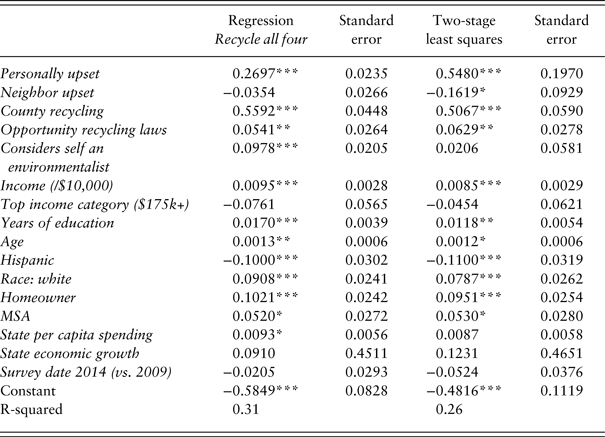
To test a possible relationship in which recycling norms might alter recycling behavior, Table 4 presents a regression analysis of the determinants of whether the household recycled all four types of materials in the past year, with Personally upset and other household characteristics as the independent variables. The regressions pool data from 2009 and 2014 as before. As in Table 3, a two-stage least squares analysis is also included in order to account for possible endogeneity between Recycle all four and Personally upset.
Regression of the probability of Recycle all four on Personally upset and household characteristics.

n = 2011. The regression also includes variables indicating missing data from County recycling and Considers self an environmentalist. Those variables are not statistically significant. The variables used to identify Personally upset in the two-stage least squares regression are Mandatory recycling laws, Female, Divorced, Unemployed, Retired, Democrat and Missing party data.
*p < 0.10; **p < 0.05; ***p < 0.01.
The first two columns of Table 4 provide the ordinary least squares coefficients excluding the instruments used to uniquely identify Personally upset. The last two columns incorporate the two-stage least squares results that estimate Personally upset with those additional instrumental variables. Those instruments are Mandatory recycling laws, Female, Divorced, Unemployed, Retired, Democrat and Missing party data. These variables are significantly related to Personally upset in an ordinary least squares regression with an F-value of 4.79 (p < 0.01), but are not significantly related to Recycle all four, with a non-significant F-value of 1.22 (p = 0.29). The Sargan test of over-identification has an appropriately non-significant chi-square of 8.53 with six degrees of freedom (p = 0.20).
The societal descriptive norm variable County recycling is especially influential in predicting recycling. Evaluated at the mean county recycling participation rate for the sample, this variable increases the Recycle all four probability for the household by 0.30 for the ordinary least squares results and by 0.27 for the two-stage results. Thus, the mean effect of the societal descriptive norm variable accounts for over half of the average household recycling participation rate for the sample of 0.48 – a dominant effect – and is informative considering the lack of statistical significance of County recycling in the personal injunctive equation for Personally upset in Table 3. Put simply, neighbors’ actions have a large impact on what a household does, but do not alter being upset at neighbors’ non-recycling behavior.
In Table 4, when predicting recycling, Opportunity recycling laws are statistically significant. In contrast, when predicting Personally upset in Table 3, Mandatory recycling laws are significant. These differences are important. Mandatory recycling laws indicate that those who recycle inappropriately are breaking the law, creating an injunctive motivation. By contrast, Opportunity recycling laws do not sanction households, but instead focus on making the recycling task more accessible, which is reflected in greater recycling where those laws are present.
Analysis including lagged effects of norms and recycling
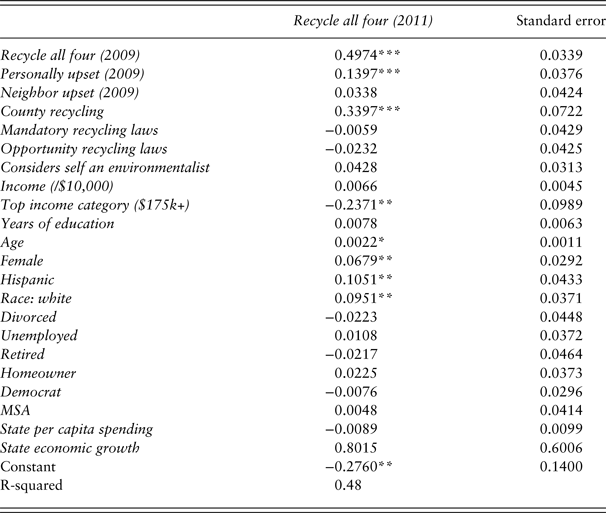
To provide greater confirmation of the distinct causal paths between norms and recycling, we examine their lagged effects in predicting each other. First, we show that norms predict recycling two years later, and then we show that recycling predicts norms two years later. Both analyses include relevant control variables. Consider first the evidence for the influence of norms on future recycling. This analysis tests whether those who report a personal injunctive norm increase their future recycling participation. The estimates in Table 5 use a single year of data – 2011 – to present regression estimates predicting Recycle all four (2011) as a function of Personally upset (2009) and Neighbor upset (2009), while controlling for Recycle all four (2009) and a series of variables in 2011.
Regression of the probability of Recycle all four (2011) on past norms and recycling history.

n = 683. The regression also includes a variable indicating missing data from County recycling. That variable is not statistically significant.
*p < 0.10; **p < 0.05; ***p < 0.01.
Recycling in 2009 has a dominant predictive relationship with recycling in 2011. But even with this inclusion, Personally upset retains a significant positive coefficient, increasing by 0.14 the probability that the household will recycle all four materials, a relatively large change given the average recycling participation rate of 0.48. Additionally, the societal descriptive norm of County recycling has a large positive coefficient for 2011 recycling of 0.34, even after taking into account the household's recycling history, with a mean effect of 0.18. This analysis does not include instrumental variables estimators for Recycle all four (2009) or Personally upset (2009). The separation of cause and effect by the two-year lag makes endogeneity less of a concern, as the lagged variables are predetermined values and cannot be influenced by future changes in recycling.
There is no statistically significant influence of either type of state recycling laws because these laws did not change over the two-year period and thus are already reflected in the household's previous recycling measured by Recycle all four (2009). Overall, this analysis verifies the critical roles of past personal injunctive norms and past societal descriptive norms in recycling participation.
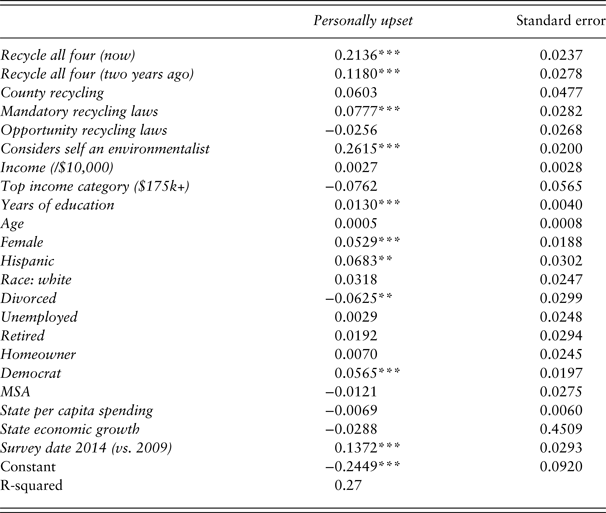
Table 6, by contrast, reports the regression results of pooling data from 2009 and 2014 to predict Personally upset as a function of current and lagged recycling behavior, Recycle all four (now) and Recycle all four (two years ago). It shows that the contemporary impact of current recycling has the largest impact, and the additional significant impact of past recycling is consistent with past norms affecting current behavior. Demographic characteristics, state and county variables largely parallel the results found in Table 3.Footnote 10
Regression of the probability of Personally upset (now) on present and past recycling.

n = 2011. The regression also includes variables indicating missing data from Recycle all four (two years ago), County recycling, Considers self an environmentalist and Democrat. None of those variables are significant.
*p < 0.10; **p < 0.05; ***p < 0.01.
Current recycling boosts the probability that the household is Personally upset, and this effect is bolstered if the household recycled two years previously, demonstrating that consistent, long-term recycling supports personal injunctive norms. Mandatory recycling laws continue to increase personal injunctive norms, indicating that violations of law-abiding behavior are personally upsetting, whereas neither County recycling nor Opportunity recycling laws alter Personally upset. Thus, the mandatory aspect of the laws plays an additional positive role in the norm's role that is not otherwise captured in the recycling history variables.
Just as Tables 3 and 4 provide evidence of the independent, contemporary impact of recycling on personal injunctive norms and evidence of those norms on behavior, Tables 5 and 6 show strong evidence supported by longitudinal data of a cascading interdependence where recycling norms predict later behavior and behavior predicts later norms. Throughout, the societal descriptive norm of County recycling is strongly related to the personal descriptive norm, but not to the personal injunctive norm when controlling for other variables.Footnote 11
Conclusion
Examination of recycling decisions and attitudes provides a valuable context for exploring the dynamic interrelationship between norms and pro-environmental behaviors. This article extends the established distinction between injunctive norms and descriptive norms to categorize and analyze four groups of social norms: the personal descriptive norm of recycling participation, personal injunctive norms, societal descriptive norms and societal injunctive norms.
We find that personal injunctive norms measured by Personally upset reliably predict personal descriptive norms of recycling participation and vice versa, even accounting for possible endogeneity. The evidence for this linkage is especially compelling given the results from the longitudinal analyses where one norm predicts the other two years later. By contrast, the societal injunctive norm, measured by Neighbor upset, has far weaker effects. The greater effect of Personally upset than Neighbor upset might arise from three factors: first, one is typically unsure about what the neighbor does feel compared to what one personally feels. Second, even with knowledge of the opinions of one's neighbors, one's personal beliefs may be more strongly held and influential than the opinions of others. Third, knowing that a neighbor would be upset can be circumvented by disguising one's actions or might even encourage antisocial behavior if one gets pleasure from upsetting a neighbor.
Both societal and personal descriptive norms are especially influential in promoting recycling. The societal descriptive norm of County recycling has a strong effect on the personal descriptive norm of recycling, but not on personal injunctive norms. The lagged variable Recycle all four has a larger impact on current recycling than either injunctive norm. These two powerful results for societal and personal descriptive norms demonstrate again the dominance of descriptive over injunctive norms.
The temporal interdependence of norms and recycling has an important influence on the evolution of personal injunctive norms, which are linked to the history of recycling and not limited to the household's current recycling efforts. Households with a previous recycling history have a higher likelihood of being Personally upset than do households that did not do so previously, even after accounting for current recycling.
Social norms thus are mechanisms for promoting recycling. The consistent influence of Personally upset suggests that policy-makers can increase recycling by supporting norms and reinforcing emotional reactions to positive behavior, perhaps by highlighting existing mandatory recycling laws or publicizing recycling activities. Also, the powerful role of societal descriptive norms indicates the importance of making it clear to citizens what their fellow citizens are doing, suggesting the value of large, visible recycling containers picked up in view of others and the use of publicity campaigns that promote the recycling achievements of effective neighborhoods.
The broader implication is that norms are strongly influential on promoting pro-environmental behavior. Part of this effect is direct, but there are also indirect influences, since norms promote recycling that, in turn, influences both future recycling and future norms. Sunstein (Reference Sunstein, Zamir and Teichman2014) discusses how social norms can serve as nudges, focusing particular attention on what we characterize as descriptive norms. Nudge-like policies can also be operative by fostering personal injunctive norms that increase personal beliefs that others should recycle, such as through publicizing mandatory recycling laws, which then bolster the norms that promote recycling. Similarly, personal descriptive norms are also influential, as a consistent recycling history boosts personal injunctive norms that, in turn, can have a powerful effect on recycling.
This strong interdependence of norms and recycling has additional ramifications. Fostering recycling will be enhanced by maintaining a consistent policy environment in order to promote norms. Temporary fluctuations in the value of recyclable materials or in community budgets may lead to cutbacks on policies that promote recycling by reducing the frequency or convenience of recycling opportunities. However, assessments of the impacts of such changes should be cognizant of their longer-term implications. The relationships are interwoven, with positive policy generating positive norms, positive norms increasing recycling and recycling increasing the value of recycling. It is important to understand, however, that such positive cycles can turn into negative ones if government support for recycling decreases or if the costs of recycling increase for its citizens. Thus, what appears to be an optimistic trajectory can reverse as easily as it has grown.
Supplementary Material
To view supplementary material for this article, please visit https://doi.org/10.1017/bpp.2017.13.