Introduction
Parasitic plants have evolved from non-parasitic or autotrophic ancestors by synchronizing their life cycles to the host species that they parasitized. This is achieved by coordinating early developmental stages with chemical signals from the hosts (Smith et al., Reference Smith, Dudley and Lynn1990). Most of the species belonging to the holoparasitic genera Orobanche and Phelipanche (broomrapes) have a narrow host spectrum and grow exclusively on perennial host plants (Schneeweiss, Reference Schneeweiss2007). A number of Orobanche and Phelipanche species have evolved to parasitize a wide range of crops in agricultural ecosystems, thus becoming noxious weeds (Joel et al., Reference Joel, Hershenhorn, Eizenberg, Aly, Ejeta, Rich, Ransom, Sauerborn, Rubiales and Janick2007; Parker, Reference Parker2009).
Strigolactones are apocarotenoids that regulate shoot branching (Gómez-Roldán et al., Reference Gómez-Roldán, Fermas, Brewer, Puech-Pages, Dun, Pillot, Letisse, Matusova, Danoun, Portais, Bouwmeester, Becard, Beveridge, Rameau and Rochange2008; Umehara et al., Reference Umehara, Hanada, Yoshida, Akiyama, Arite, Takeda-Kamiya, Magome, Kamiya, Shirasu, Yoneyama, Kyozuka and Yamaguchi2008) and are exuded by host roots, serving in mycorrhizal symbiosis to branch the mycelium toward the host root (Akiyama et al., Reference Akiyama, Matsuzaki and Hayashi2005). Orobanche and Phelipanche seeds germinate mainly in response to strigolactones (Yoneyama et al., Reference Yoneyama, Xie, Sekimoto, Takeuchi, Ogasawara, Akiyama, Hayashi and Yoneyama2008). They have evolved a complex process of parasitization that is mediated primarily by host-derived chemical signals controlling germination of the parasitic seeds. It is thus possible that the specificity of germination stimulants plays a major role in host specialization; however, there is insufficient evidence to support this hypothesis (Yoneyama et al., Reference Yoneyama, Xie, Yoneyama and Takeuchi2009). This work aims to investigate the degree of specificity in the inductor potential of strigolactones to stimulate germination of parasitic seeds of Orobanche and Phelipanche species. We studied germination responses of broomrape seeds to root exudates and to three selected strigolactones: fabacyl acetate, a strigolactone first isolated from pea root exudates (Xie et al., Reference Xie, Yoneyama, Harada, Fusegi, Yamada, Ito, Yokota, Takeuchi and Yoneyama2009) and considered to be typical of legumes (Yoneyama et al., Reference Yoneyama, Xie, Sekimoto, Takeuchi, Ogasawara, Akiyama, Hayashi and Yoneyama2008); strigol, first identified in cotton (Gossypium hirsutum) and known to be typically produced by cereals, such as maize (Zea mays), pear millet (Penisetum glaucum) and sorghum (Sorghum bicolor) (Cook et al., Reference Cook, Whichard, Wall, Egley, Coggon, Luhan and McPhail1972; Siame et al., Reference Siame, Weerasuriya, Wood, Ejeta and Butler1993); and the strigolactone synthetic analogue GR24, commonly used as a standard in broomrape germination studies (Johnson et al., Reference Johnson, Rosebery and Parker1976).
Materials and methods
Plant materials
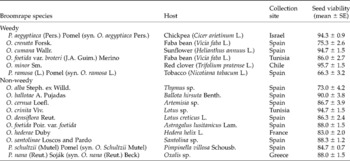
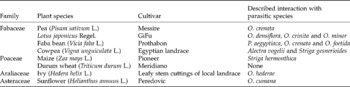
Germination was tested of seeds of 16 broomrapes belonging to 15 species in the Orobanche or Phelipanche genera (Table 1) collected from dry inflorescences using a 0.6 mm mesh-size sieve (Filtra, Barcelona, Spain) and stored dry in the dark at 4°C until use. Viability of these seeds was tested using triplicates of 100 seeds per broomrape with the 2,3,5-triphenyl tetrazolium chloride (TTC) method (Aalders and Pieters, Reference Aalders and Pieters1985). Seeds were imbibed in 1% (w/v) TTC (Sigma-Aldrich, St. Louis, Missouri, USA) solution and incubated at 37°C for 3 d. TTC solution was eliminated and seeds were immersed in a solution of 50% (w/v) sodium hypochlorite for 2–3 min, to clear the testa. Seeds were observed under a stereoscopic microscope at 30 × magnification to determine the percentage of viable seeds. Seeds were considered viable when their embryos were stained pink to red. Root exudates released by several host or non-host plants (Table 2) were collected and tested for parasitic seed germination.
Orobanche and Phelipanche species used in this study and viability of seeds

Plant materials used to obtain root exudates for broomrape seed germination tests

Strigolactones
Two natural strigolactones, fabacyl acetate (provided by Xiaonan Xie, Utsunomiya University, Japan) and strigol (provided by Kenji Mori, The University of Tokyo, Japan) and the synthetic strigolactone GR24 (provided by Binne Zwanenburg, Radboud University, The Netherlands) were used in this work.
Collection of root exudates
Twelve seeds per host or non-host plant species (Table 2) were surface sterilized with 2% (w/v) sodium hypochlorite solution containing 0.02% (v/v) Tween 20 for 5 min and then rinsed thoroughly with sterile distilled water. Seeds were grown in sterile expanded perlite (Europelita, Barcelona, Spain) for 2–3 weeks [20°C, 12/12 h dark/light (200 μmol m− 2 s− 1) photoperiod]. To collect exudates, plants were removed from the perlite and the roots were carefully washed and immersed in distilled sterile water contained in flasks (4 plants per flask) for 2 d, allowing them to release the root exudates. To perform accurate comparisons, root exudates contained in each flask were diluted with sterile distilled water to adjust the concentrations equivalent to 0.06 g root (fresh weight basis) per millilitre water.
Conditioning of broomrape seeds
Orobanche and Phelipanche seeds were surface sterilized with formaldehyde 0.2% (w/v) and 0.02% (v/v) of Tween 20, rinsed thoroughly with sterile distilled water and dried for 60 min in a laminar air flow cabinet. Approximately 100 seeds of each species were placed on 1.5-cm diameter glass fibre filter paper (GFFP; Whatman International Ltd., Brentford, UK) moistened with 120 μl of sterile distilled water. Thirty separate discs containing seeds were placed in a 10-cm sterile Petri dish and incubated in the dark at 20°C for 11 d for warm stratification to promote germination (Fernández-Aparicio et al., Reference Fernández-Aparicio, Flores and Rubiales2009).
Germination tests
The effects of strigol and fabacyl acetate on seed germination were tested at concentrations of 10− 6, 10− 7 and 10− 8 M. GR24 was tested at 10− 4, 10− 5, 10− 6, 10− 7 and 10− 8 M. After 11 d of conditioning, the 1.5-cm diameter GFFP discs containing the warm-stratified broomrape seeds were transferred to a sterile sheet of paper for 4–5 s to remove the water and transferred to a new 10-cm sterile Petri dish. Each strigolactone was dissolved in acetone and diluted with sterile Milli-Q (Millipore, Billerica, Massachusetts, USA) water to a final concentration of 0.7% acetone (119.6 μl Milli-Q water/0.84 μl acetone). Aliquots of 120 μl of strigol, fabacyl acetate or GR24 at each concentration, or aliquots of 120 μl of each root exudate, were applied to GFFP containing the conditioned seeds. Petri dishes were sealed with Parafilm (Pechiney, Chicago, Illinois, USA) and incubated in the dark at 20°C for 7 d. Milli-Q water (0.7% acetone) was used as a negative control. Germination was assessed as the percentage of seeds with an emerged radicle. The germination percentages were calibrated with the percentages of viable seeds (Table 2) (Rubiales et al., Reference Rubiales, Pérez-de-Luque, Fernández-Aparicio, Sillero, Román, Kharrat, Khalil, Joel and Riches2006). That is, the germination percentages expressed in the figures indicate the percentage of viable seeds that germinated in each treatment. Germination tests were performed in triplicate.
Statistical analysis
Experiments were performed using a completely randomized design. Percentage data were approximated to normal frequency distribution by means of angular transformation (180/π × arcsine [sqrt (%/100)] and subjected to analysis of variance (ANOVA) using SPSS software for Windows, version 15.0 (SPSS Inc., Chicago, Illinois, USA), after which residual plots were inspected to confirm data conformed to normality. The null hypothesis was rejected at the level of 0.05.
Results
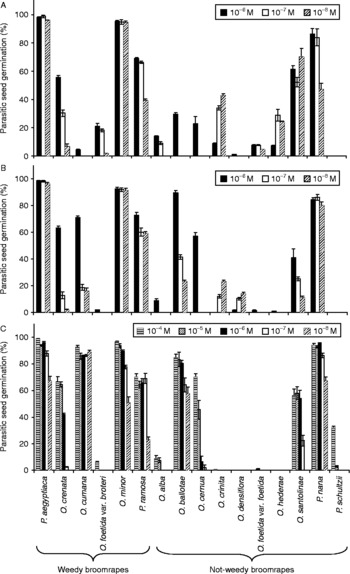
The effects of strigolactone on broomrape seed germination were significant (P < 0.001) (Fig. 1). Induction of seed germination by each strigolactone was concentration dependent (P < 0.001). In addition, there were significant interactions between the concentration tested × broomrape species (P < 0.001) and concentration tested × compound (P < 0.001). Reduction of germination at lower strigolactone concentration was not linear for all broomrape species. Even the opposite was observed for some species, such as O. crinita and O. densiflora, in which lower concentrations were more effective in the induction of seed germination.
Effects of fabacyl acetate (A), strigol (B) and GR24 (C) on seed germination of Orobanche and Phelipanche species. Strigolactones were tested at 10− 6, 10− 7 and 10− 8 M. Note that higher concentrations 10− 4 and 10− 5 M were also tested for GR24 (C). Each data point indicates mean ± SE.

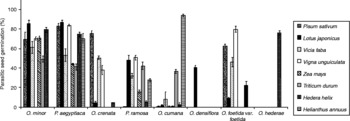
Seeds of O. minor, P. aegyptiaca and P. nana were highly responsive to all strigolactones tested (Fig. 1), exhibiting more than 70% germination for all inducers. Orobanche minor and P. aegyptiaca were also responsive to root exudates of the plant species studied (Fig. 2).
Germination of weedy broomrape seeds in the presence of root exudates from several host and non-host plants. Pisum sativum host of O. crenata; Lotus japonicus host of O. crinita, O. densiflora and O. minor; Vicia faba host of P. aegyptiaca, O. crenata and O. foetida; Vigna unguiculata host of Alectra vogelii and Striga gesnerioides; Zea mays host of Striga hermonthica; Hedera helix host of O. hederae; and Helianthus annuus host of O. cumana. In addition, Triticum durum was included as a cereal non-host of parasitic plants. Each data point indicates mean ± SE.

Germination of O. ballotae, O. crenata and O. cernua seeds was significantly dependent on the concentration of strigolactones (P < 0.001). The germination of O. ballotae decreased markedly from 30 to 0%; from 90 to 23%, and from 81 to 58% when the concentrations of fabacyl acetate, strigol and GR24 were decreased from 10− 6 M to 10− 8 M, respectively (Fig. 1). Similarly, germination of O. crenata decreased from 56 to 7% and from 63 to 2% when the concentrations of fabacyl acetate and strigol were decreased from 10− 6 M to 10− 8 M, respectively, and from 67 to 0% when the concentration of GR24 was decreased from 10− 4 M to 10− 8 M. Germination of O. cernua decreased from 23 to 0% and from 57 to 0% when the concentrations of fabacyl acetate and strigol were decreased from 10− 6 M to 10− 8 M, and from 70 to 0% when the concentration of GR24 was decreased from 10− 4 M to 10− 8 M.
For some species germination was activated by one strigolactone but not by the others. Examples were O. cumana and O. densiflora seeds, in which germination was stimulated only by strigol and not by fabacyl acetate. In contrast, seed germination of O. foetida and O. hederae was stimulated by fabacyl acetate but not by strigol. Of these four species, only O. cumana was stimulated by GR24.
Orobanche crinita seeds were induced by both strigol and fabacyl acetate, but not by GR24 (Fig. 1). Orobanche alba responded to all strigolactones tested only at low levels. Orobanche alba seeds were induced by GR24 at 10− 4 and 10− 5 M but not at lower concentrations. Phelipanche schultzii seeds germinated only at the highest concentration of GR24 tested (10− 4 M) but did not germinate in any concentrations of the strigol or fabacyl acetate tested (Fig. 1).
Average germination induced by all strigolactones was significantly higher (P < 0.001) for the weedy species (O. minor, P. aegyptiaca, P. ramosa and O. crenata) than for the non-weedy, with the exception of O. cumana and O. foetida var. broteri. Conversely, non-weedy species generally had more specific germination stimuli, with the exception of P. nana and O. santolinae (Fig. 1).
Similar results were obtained with the root exudates. For example, seed germination of some broomrape species was induced by the exudates from the majority of species tested (e.g. P. aegyptiaca and O. minor) while seed germination responses in other broomrape species were highly specific to only a few plant species tested (e.g. O. cumana, O. densiflora and O. hederae). Orobanche cumana is known to infect only sunflower (Joel et al., Reference Joel, Hershenhorn, Eizenberg, Aly, Ejeta, Rich, Ransom, Sauerborn, Rubiales and Janick2007). Consistent with previous reports, the exudate from sunflower roots induced the highest level of O. cumana germination (94%), but exudates from non-hosts such as faba bean and wheat were also able induce some, albeit low, O. cumana germination. The non-weedy species O. densiflora germinated only in the presence of root exudates from its host L. japonicus (35%). Orobanche hederae germinated in the presence of root exudates from its host, ivy (65%).
Orobanche crenata and O. foetida germinated in the presence of root exudates from the legumes pea, faba bean and cowpea, but not in the presence of those from L. japonicus. Root exudates from ivy induced moderate germination of O. foetida (18%) and low germination of O. crenata (3%). The other species included in this work did not show any stimulatory activity on O. crenata and O. foetida.
Discussion
The results of the present study are consistent with previous findings (Fernández-Aparicio et al., Reference Fernández-Aparicio, Flores and Rubiales2009) and support the idea that weedy broomrape species are less specialized in germination requirements than the non-weedy species, with the exception of O. cumana and O. foetida var. broteri. A possible explanation for the atypical host specialization of these two species is that they evolved as weedy parasitic plants relatively recently. Orobanche cumana, parasitizing sunflower exclusively, was an autochthonous species from Eastern Europe and Central Asia growing on Artemisia spp. With the introduction of sunflower as a new crop in Eastern Europe in the 19th century, O. cumana encountered the new host and became a parasitic weedy species and spread to other areas with sunflower crops (Pujadas-Salvá and Velasco, Reference Pujadas-Salvá and Velasco2000). Orobanche foetida is widely distributed in the western Mediterranean as a non-weedy species (Pujadas-Salvá et al., Reference Pujadas-Salvá, Fraga, Aguinbau, Sánchez-gullón and Molina-Mahedero2003), but only recently has been reported as weedy, infecting faba bean or vetch crops (Kharrat et al., Reference Kharrat, Halila, Linke and Haddar1992; Rubiales et al., Reference Rubiales, Sadiki and Román2005). A host specialization process, which is still in progress, has been described for O. foetida (Román et al., Reference Román, Satovic, Alfaro, Moreno, Kharrat, Pérez-de-Luque and Rubiales2007; Vaz Patto et al., Reference Vaz Patto, Díaz-Ruiz, Satovic, Román, Pujadas-Salvá and Rubiales2008). Specificity of these two species has been related to their sensitivity to non-strigolactone compounds, such as sesquiterpene lactones for O. cumana (Macías et al., Reference Macías, García-Díaz, Pérez-de-Luque, Rubiales and Galindo2009) and peagol and a polyphenol for O. foetida (Evidente et al., Reference Evidente, Fernández-Aparicio, Cimmino, Rubiales, Andolfi and Motta2009, Reference Evidente, Cimmino, Fernández-Aparicio, Andolfi, Rubiales and Motta2010). However, here we show that these two species also respond to strigolactones. Orobanche cumana responds to GR24, at levels similar to those observed for most weedy species, but also, to a minor extent, to strigol and fabacyl acetate. Orobanche foetida does not respond to GR24 but does respond to fabacyl acetate.
GR24, generally used as standard for germination tests (Mangnus et al., Reference Mangnus, Stommen and Zwanenburg1992) was not effective on some Orobanche and Phelipanche species. This is in agreement with recent reports (Fernández-Aparicio et al., Reference Fernández-Aparicio, Pérez-de-Luque, Prats and Rubiales2008b, Reference Fernández-Aparicio, Flores and Rubiales2009; Thorogood et al., Reference Thorogood, Rumsey and Hiscock2009) in which a number of non-weedy species were reported not to respond to GR24. Here, we found more non-weedy species that did not respond to GR24. We also describe non-weedy species that responded to GR24, such as P. nana, O. santolinae, O. ballotae and the non-weedy population of O. cernua used in this study. Thorogood et al. (Reference Thorogood, Rumsey and Hiscock2009) suggested that responsiveness to GR24 might be related to a broader host range. However, here we show that not only the broomrapes with a broad host range, but also host-specific broomrapes, such as O. cumana or O. ballotae, are responsive to GR24. Seeds of some of the species that are not responsive to GR24 were capable of germinating in the presence of fabacyl acetate (O. crinita, O. foetida and O. hederae) or strigol (O. densiflora). Therefore, it is difficult to relate patterns of the responsiveness to GR24 with the weedy or non-weedy status or the level of host specialization of broomrapes. GR24 is a synthetic strigolactone, which has proven to be very useful for germination testing (Mangnus et al., Reference Mangnus, Stommen and Zwanenburg1992; Rubiales et al., Reference Rubiales, Alcántara and Sillero2004) but is not present in root exudates of any plant species. It is the presence or absence of natural strigolactones, or their combination with other possible metabolites, having synergistic or antagonistic activity to strigolactones, that plays a role in host specialization.
Orobanche ballotae is a non-weedy parasitic plant which has only recently been separated from O. minor (Pujadas-Salvá, Reference Pujadas-Salvá1997). Both O. ballotae and O. minor responded to GR24 strongly. However, they responded differently to fabacyl acetate. Similarly, Thorogood et al. (Reference Thorogood, Rumsey and Hiscock2009) found that O. minor subsp. maritima differed from O. minor in capacity to respond to GR24. This suggests that host specificity in terms of seed germination may occur even between different taxa within a single species.
Phelipanche schultzii and O. alba are non-weedy species with a narrow host spectrum that responded slightly to, and only at the higher concentrations of, the three strigolactones studied here. Similarly, recent results in our laboratory suggest that other non-weedy, host-specific species, such as O. clausonis, O. gracilis and O. rapum-genistae, do not geminate in the presence of any of these strigolactones (Fernández-Aparicio, unpublished). It seems that the recognition requirements in these non-weedy species have evolved specifically for other stimulants not identified to date.
The mechanism of host recognition by each broomrape species, which is required for eliciting seed germination, might have been specialized to different combinations of strigolactones and their concentrations present in each host root exudate. Roots might exude a mixture of substances, some being stimulative and others being inhibitory to seed germination (Whitney, Reference Whitney1978; El-Halmouch et al., Reference El-Halmouch, Benharrat and Thalouarn2006). To further substantiate this, various new germination stimulants differentially affecting germination of seeds of different Orobanche species have been isolated from pea root exudates (Evidente et al., Reference Evidente, Fernández-Aparicio, Cimmino, Rubiales, Andolfi and Motta2009, Reference Evidente, Cimmino, Fernández-Aparicio, Andolfi, Rubiales and Motta2010), some of which might play a significant role in host specialization in addition to fabacyl acetate, previously reported in pea exudates (Xie et al., Reference Xie, Yoneyama, Harada, Fusegi, Yamada, Ito, Yokota, Takeuchi and Yoneyama2009). Similarly, recent studies resulted in identification of both stimulants and inhibitors of Orobanche and Phelipanche seeds in separate chromatographic fractions of fenugreek root exudates (Evidente et al., Reference Evidente, Fernández-Aparicio, Andolfi, Rubiales and Motta2007; Fernández-Aparicio et al., Reference Fernández-Aparicio, Andolfi, Evidente, Pérez-de-Luque and Rubiales2008a). Specialization could therefore be mediated by unique combinations and concentrations of signalling chemicals that are synergistic or antagonistic to strigolactone action.
Acknowledgements
This research was supported by projects P07-AGR-02883 and AGL2008-01239/AGR, co-financed by European Regional Development (FEDER) funds. M.F-A. is supported by a postdoctoral fellowship of the Spanish Ministry of Science and Innovation.