Introduction
Psychotic experiences (PEs) comprise hallucinations and delusions. (Linscott & Van Os, Reference Linscott and Van Os2013). PEs frequently occur and increase the risk of progression to psychotic disorder (Kaymaz et al., Reference Kaymaz, Drukker, Lieb, Wittchen, Werbeloff, Weiser and Van Os2012; Linscott & Van Os, Reference Linscott and Van Os2013; Werbeloff et al., Reference Werbeloff, Drukker, Dohrenwend, Levav, Yoffe, Van Os and Weiser2012), and other mental disorders (Fisher, Reference Fisher, Caspi, Poulton, Meier, Houts, Harrington and Moffitt2013; Kırlı et al., Reference Kırlı, Binbay, Drukker, van Os, Alptekin, Kayahan and Elbi2019a; McGrath et al., Reference McGrath, Saha, Al-Hamzawi, Andrade, Benjet, Bromet and Kessler2016; Werbeloff et al., Reference Werbeloff, Drukker, Dohrenwend, Levav, Yoffe, Van Os and Weiser2012). Moreover, PEs are associated with the onset of a wide range of physical disorders (Scott et al., Reference Scott, Saha, Lim, Aguilar-Gaxiola, Al-Hamzawi, Alonso and McGrath2018), disability (Navarro-Mateu et al., Reference Navarro-Mateu, Alonso, Lim, Saha, Aguilar-Gaxiola, Al-Hamzawi and Wojtyniak2017), poor perceived mental and physical health (Alonso et al., Reference Alonso, Saha, Lim, Aguilar-Gaxiola, Al-Hamzawi, Benjet and De Girolamo2019), significant deficiencies in social achievement and functioning (Rössler et al., Reference Rössler, Riecher-Rössler, Angst, Murray, Gamma, Eich and Gross2007), self-injurious behaviour (Honings, Drukker, Groen, & Van Os, Reference Honings, Drukker, Groen and Van Os2016), and onset of suicidal thoughts and behaviours (Bromet et al., Reference Bromet, Nock, Saha, Lim, Aguilar-Gaxiola, Al-Hamzawi and McGrath2017). These findings stress the impact PEs may have on the individual and society.
A systematic review and meta-analysis on PE in children and adults found a lifetime prevalence of 7.2%, based on 61 surveys, mainly conducted in Western countries (Linscott & Van Os, Reference Linscott and Van Os2013). Results of the World Mental Health (WMH) Surveys, including 18 Western and non-Western countries, and not included in abovementioned systematic review, showed an average lifetime prevalence of 5.8% and a last year prevalence of 2.0% among adults (McGrath et al., Reference McGrath, Saha, Al-Hamzawi, Alonso, Bromet, Bruffærts and de Almeida2015). Only a few studies reported incidence rates of PEs in the general population; based on six cohorts Linscott and Van Os (Reference Linscott and Van Os2013) estimated the median annual incidence at 2.5%. Although results of the few existing prospective studies indicate that PEs are mostly a transitory phenomenon, for some people PEs persist over time. In their review, based on four cohorts (one each in Great Britain and Germany and two in the Netherlands) with intervals spanning 1–8 years, Linscott and Van Os (Reference Linscott and Van Os2013) estimated the PE persistence rate at approximately 20%. A study published after this review, reported a persistence rate of 15.1% at 2-year follow-up among adults in Hong Kong (Chan et al., Reference Chan, Lee, Chan, Pang, Wong, Hui and Chen2020). Another survey, performed in the United States, reported a 12-month persistence rate of 28.1%, but this was assessed retrospectively (DeVylder, Lehmann, & Chen, Reference DeVylder, Lehmann and Chen2015).
Risk indicators
Cross-sectional studies have shown that PEs are associated with several risk indicators. The WMH Surveys found evidence for demographic correlates, including female sex, non-married, non-employed (McGrath et al., Reference McGrath, Saha, Al-Hamzawi, Alonso, Bromet, Bruffærts and de Almeida2015), and living in a non-rural area (Scott, Chant, Andrews, & McGrath, Reference Scott, Chant, Andrews and McGrath2006), prior common mental disorders (McGrath et al., Reference McGrath, Saha, Al-Hamzawi, Andrade, Benjet, Bromet and Kessler2016), vulnerability factors, including childhood adversities (McGrath et al., Reference McGrath, McLaughlin, Saha, Aguilar-Gaxiola, Al-Hamzawi, Alonso and Kessler2017a), childhood physical neglect (Stickley et al., Reference Stickley, Waldman, Sumiyoshi, Narita, Shirama, Shin and Oh2021) and traumatic events in adulthood (McGrath et al., Reference McGrath, Saha, Lim, Aguilar-Gaxiola, Alonso, Andrade and Wojtyniak2017b). Less evidence was found for prior physical disorders (Scott et al., Reference Scott, Saha, Lim, Aguilar-Gaxiola, Al-Hamzawi, Alonso and McGrath2018). Cross-sectional data of the NESARC study retrospectively confirmed the WMH Survey findings with respect to the abovementioned demographic correlates and additionally found younger age, low family income, lifetime history of suicide attempts (Bourgin et al., Reference Bourgin, Tebeka, Mallet, Mazer, Dubertret and Le Strat2020), and smoking (Mallet, Mazer, Dubertret, & Strat, Reference Mallet, Mazer, Dubertret and Strat2018) as correlates. Other studies have reported on cross-sectional associations of PEs with cannabis use (Ragazzi, Shuhama, Menezes, & Del-Ben, Reference Ragazzi, Shuhama, Menezes and Del-Ben2018), daily smoking, alcohol dependence, cannabis dependence (Saha et al., Reference Saha, Scott, Varghese, Degenhardt, Slade and McGrath2011a), bullying victimization (Catone et al., Reference Catone, Marwaha, Kuipers, Lennox, Freeman, Bebbington and Broome2015), other mental disorders, including depressive, anxiety, bipolar and post-traumatic stress disorder (Pignon et al., Reference Pignon, Schürhoff, Szöke, Geoffroy, Jardri, Roelandt and Amad2018; Varghese et al., Reference Varghese, Scott, Welham, Bor, Najman, O'Callaghan and McGrath2011b), family history of mental disorders (Varghese, Saha, Scott, Chan, & Mcgrath, Reference Varghese, Saha, Scott, Chan and Mcgrath2011a), dementia (Ballard, Reference Ballard and Oyebode1995), and psychiatric/psychological or psychopharmacological treatment (Oh, Koyanagi, DeVylder, & Leiderman, Reference Oh, Koyanagi, DeVylder and Leiderman2020).
While risk indicators for PE prevalence seem reasonably well established, information on risk indicators of PE incidence is limited. The available literature from prospective studies shows that at least some risk indicators overlap with those associated with PE prevalence. These include demographic characteristics [younger age, lower educational level and non-married; (Kırlı et al., Reference Kırlı, Binbay, Drukker, van Os, Alptekin, Kayahan and Elbi2019a), childhood adversity (Bennett, Surkan, Moulton, Fombonne, & Melchior, Reference Bennett, Surkan, Moulton, Fombonne and Melchior2020; Wiles et al., Reference Wiles, Zammit, Bebbington, Singleton, Meltzer and Lewis2006), traumatic events (Spauwen, Krabbendam, Lieb, Wittchen, & Van Os, Reference Spauwen, Krabbendam, Lieb, Wittchen and Van Os2006), smoking, a harmful pattern of drinking (Wiles et al., Reference Wiles, Zammit, Bebbington, Singleton, Meltzer and Lewis2006), bullying victimization (Catone et al., Reference Catone, Marwaha, Kuipers, Lennox, Freeman, Bebbington and Broome2015), family history of mental disorders (Kirli et al., Reference Kirli, Binbay, Drukker, Elbi, Kayahan, Gökçelli and Van Os2019b) and psychotropic medication use (Kırlı et al., Reference Kırlı, Binbay, Drukker, van Os, Alptekin, Kayahan and Elbi2019a). Living in a rural area, having a small support group, and neurotic symptoms (Wiles et al., Reference Wiles, Zammit, Bebbington, Singleton, Meltzer and Lewis2006), are also reported as risk indicators for PE.
Studies reporting on predictors of the persistence of PE in the adult population are scarce, and one study was based on predictors of retrospectively assessed persistence (DeVylder et al., Reference DeVylder, Lehmann and Chen2015). Several recent studies reported on the persistence of PEs among children and adolescents (e.g. Karcher et al., Reference Karcher, Loewy, Savill, Avenevoli, Huber, Makowski and Barch2021; Steenkamp et al., Reference Steenkamp, Tiemeier, Blanken, Hillegers, Kushner and Bolhuis2021). However, since risk factors and expression of PE differs between this young age group and adults [e.g. (e.g. Stevens, Prince, Prager, and Stern, Reference Stevens, Prince, Prager and Stern2014)], the results of these studies are not further discussed in this paper. The set of risk indicators that has been identified for PE persistence in the adult population shows overlap with those for PE prevalence and incidence, i.e., younger age, non-married, lower education (DeVylder et al., Reference DeVylder, Lehmann and Chen2015), childhood adversity (Rössler et al., Reference Rössler, Riecher-Rössler, Angst, Murray, Gamma, Eich and Gross2007; Trotta, Murray, & Fisher, Reference Trotta, Murray and Fisher2015), childhood trauma (Cougnard et al., Reference Cougnard, Marcelis, Myin-Germeys, De Graaf, Vollebergh, Krabbendam and Van Os2007), parental chronic mental and physical disorders (Rössler et al., Reference Rössler, Riecher-Rössler, Angst, Murray, Gamma, Eich and Gross2007), bullying victimization (Catone et al., Reference Catone, Marwaha, Kuipers, Lennox, Freeman, Bebbington and Broome2015), cannabis use (Cougnard et al., Reference Cougnard, Marcelis, Myin-Germeys, De Graaf, Vollebergh, Krabbendam and Van Os2007; Rössler et al., Reference Rössler, Riecher-Rössler, Angst, Murray, Gamma, Eich and Gross2007), and urbanicity exposure (Cougnard et al., Reference Cougnard, Marcelis, Myin-Germeys, De Graaf, Vollebergh, Krabbendam and Van Os2007). However, notable differences with risk indicators for PE prevalence were also reported. DeVylder et al. (Reference DeVylder, Lehmann and Chen2015) concluded that depressive, anxiety, and substance use disorders were not independently associated with PE persistence, although these disorders are common among individuals with PEs. It should be noted that these results were based on retrospectively assessed reports of PEs and therefore should be interpreted with caution Furthermore, living in an urban area appeared a risk indicator for PE prevalence (Van Os et al., Reference Van Os, Hanssen, Bijl and Vollebergh2001) and persistence (Cougnard et al., Reference Cougnard, Marcelis, Myin-Germeys, De Graaf, Vollebergh, Krabbendam and Van Os2007), while living in a rural area was associated with a higher risk for incidence of PE (Wiles et al., Reference Wiles, Zammit, Bebbington, Singleton, Meltzer and Lewis2006).
In conclusion, studying PEs and its predictors is relevant since PEs frequently occur and are associated with a wide range of adverse outcomes. The prevalence of PE and its risk indicators seem to be relatively well established. However, prospective studies on PEs are scarce which limits our knowledge on (predictors of) incident and persistent PE. More information is needed, especially on persistent PEs as associations between PEs and adverse outcomes, appear to be particularly strong for PEs that persist over time (Kalman, Bresnahan, Schulze, & Susser, Reference Kalman, Bresnahan, Schulze and Susser2019; Kirli et al., Reference Kirli, Binbay, Drukker, Elbi, Kayahan, Gökçelli and Van Os2019b). The main aim of this study is to address two questions that are relevant for clinical practice. First, although, PEs are established indicators of clinical severity, to date there is no study that has investigated PE prevalence, incidence, persistence, its risk indicators, and psychiatric comorbidity in one dataset with multiple follow-ups over time. This information is essential to give PE the right clinical meaning in clinical assessment procedures in mental health care. Second, most epidemiological studies on PE are based on self-report, but it is not sufficiently clear how this compares to the results of clinical interviews. This is important information, also given the possibility of relatively inexpensive transdiagnostic screening in clinical practice.
The main aim of the present study is to address these gaps in the literature by reporting on prevalence, incidence, and persistence of PEs and a wide range of risk indicators in one study, the Netherlands Mental Health Survey and Incidence Study-2 (NEMESIS-2). All results are presented for both self-reported and clinically validated PEs. Associations with risk indicators are studied for 3-year prevalence, -incidence and -persistence. In line with the conceptualization of psychosis as an extended phenotype, we study the full range of psychotic symptom expression, i.e. not only the subthreshold phenotype [(Van Os & Reininghaus, Reference Van Os and Reininghaus2016)].
Method
Materials and methods
NEMESIS-2 is a psychiatric epidemiological cohort study of the Dutch general population aged 18–64. It is based on a multistage, stratified random sampling of households, with one respondent randomly selected from each household. The face-to-face interviews were laptop computer assisted. In the first wave (T0), performed from November 2007 to July 2009, 6646 individuals were interviewed (response rate 65.1%). This sample was nationally representative, although younger subjects were somewhat underrepresented (de Graaf, Ten Have, & van Dorsselaer, Reference de Graaf, Ten Have and van Dorsselaer2010).
All respondents were approached for follow-up, three years (T1: n = 5303; response rate 80.4%, with those deceased excluded; duration), six years (T2: n = 4618; response rate 87.8%) and nine years (T3: n = 4007; response rate 87.7%) after baseline. Attrition between T0 and T3 was not significantly associated with PEs and all in the study assessed 12-month mental disorders at T0 after controlling for sociodemographic characteristics (Nuyen et al., Reference Nuyen, Bos, de Jonge, van Dorsselaer, Tuithof, Kleinjan and ten Have2021).
The study was approved by a medical ethics committee (the Medical Ethics Review Committee for Institutions on Mental Health Care, METIGG). After receiving information about the study aims, respondents provided written informed consent at each wave. A comprehensive description of the design can be found elsewhere (de Graaf et al., Reference de Graaf, Ten Have and van Dorsselaer2010).
Diagnostic instrument
The Composite International Diagnostic Interview (CIDI) version 3.0 was used at all waves to assess DSM-IV mood, anxiety and substance use disorders, and suicidal thoughts. At baseline lifetime occurrence was assessed, at each follow-up wave 3-year interval occurrence. The CIDI 3.0 is a fully structured lay-administered interview developed by the World Health Organization (Kessler & Üstün, Reference Kessler and Üstün2004). Clinical reappraisal interviews showed that it has generally good validity for assessing common mental disorders (Haro et al., Reference Haro, Arbabzadeh-Bouchez, Brugha, De Girolamo, Guyer, Jin and Kessler2006).
Psychotic experiences
Psychotic symptoms were assessed using a 20-item binary-response questionnaire based on the CIDI 1.1 and specifically developed for evaluating psychotic symptoms (Bijl, Van Zessen, Ravelli, De Rijk, & Langendoen, Reference Bijl, Van Zessen, Ravelli, De Rijk and Langendoen1998) (see the appendix for a description of the items) At T3, 7 very low frequent PEs were not assessed to limit respondent's interview burden, resulting in a 13-item questionnaire. At baseline, lifetime occurrence of PEs was assessed, and at each follow-up wave 3-year interval occurrence of PEs.
At each wave, individuals who endorsed at least one PE (scoring a 2 or higher on a psychotic symptom item) were contacted for reinterview over the telephone by an experienced clinician (psychologist or psychiatrist) within 8 weeks after the initial interview. Reinterviews were conducted using questions from the Structured Clinical Interview for DSM-IV (SCID-I), an instrument with proven reliability and validity in diagnosing psychotic disorders (Spitzer & Williams, Reference Spitzer and Williams1993). As an example, self-reported symptoms that needed to be redefined as hypnopompic of hypnagogic hallucinations, or convictions that did not meet the criteria of a delusional symptom, or appeared due to the use of medications, alcohol, drugs or to physical illness were not considered as PEs. Findings from all reinterviews were discussed with an experienced clinician, who also conducted and supervised the clinical reinterviews in NEMESIS-2. PEs were considered present as ‘validated PE’ when the psychotic nature of at least one of the self-reported PEs was confirmed at the follow-up interview. Validated PEs were assessed among those who participated in the clinical reinterview; those who could not be reached or refused to take part in the clinical reinterview were defined as missing (Honings et al., Reference Honings, Drukker, ten Have, de Graaf, van Dorsselaer and van Os2017).
Incidence and persistence of PE
The at-risk group for any incident PE at a certain period consisted of those who never had any PE before that period. So, the at-risk group for 3-year incidence at T1 consisted of those who never had any PE at baseline, and the at-risk group for 3-year incidence at T2 consisted of those who never had any PE at baseline and at T1.
Persistence was defined as recurrent or continued self-report of PE during follow-up among those with any lifetime PE at baseline (in line with Van Der Steen et al. (Reference Van Der Steen, Myin-Germeys, Van Nierop, Ten Have, De Graaf, Van Dorsselaer and Van Winkel2019).
Risk indicators
Most of the below-described risk indicators were previously related to prevalence, incidence, or persistence of PE (see Introduction).
Sociodemographic characteristics were sex, age, education, living situation, job status and urbanicity.
Vulnerability characteristics were: childhood abuse (whether before age 16 one had experienced emotional neglect, psychological abuse or physical abuse on ⩾2 occasions, or sexual abuse on ⩾1 occasion), parental psychopathology (⩾1 biological parent ever having been treated by a psychiatrist, or hospitalized in a mental health institution, or ever having exhibited severe depression, delusions or hallucinations, severe anxiety or phobias, alcohol abuse, drug abuse, regular problems with the police and/or suicidal behaviour) and negative life events (⩾1 of 10 negative life events, such as the death of relative or friend, divorce and financial difficulties, based on Brugha, Bebbington, Tennant, and Hurry (Reference Brugha, Bebbington, Tennant and Hurry1985).
Physical health and functioning characteristics were: chronic physical disorder (any of 17 chronic physical disorders treated or monitored by a medical doctor in the past 12 months, assessed with a standard checklist), body mass index (BMI; kg/m2), physical active (defined as weekly ⩾1 h of physical exercise/sport in the past 12 months), and physical functioning (combined SF-36 scales general health, physical health, physical functioning, and bodily pain in the past 4 weeks (Ware & Sherbourne, Reference Ware and Sherbourne1992)).
Substance use characteristics were current smoker (in the past month), alcohol use (number of drinks per week in the past 12 months) and cannabis use (in the past 12 months).
Mental health and functioning characteristics were: mood disorder (major depression, dysthymia, bipolar disorder), anxiety disorder (panic disorder, agoraphobia without panic disorder, social phobia, specific phobia, generalized anxiety disorder), alcohol use disorder (abuse and dependence), cannabis use disorder and suicidal thoughts, all assessed with the CIDI 3.0, and mental functioning [combined SF-36 scales psychological health, psychological functioning, social functioning, and vitality in the past 4 weeks (Ware & Sherbourne, Reference Ware and Sherbourne1992)].
Service use indicators were based on self-report and included at least one contact made in mental health care and psychotropic medication use in the past 12 months prescribed by a mental health professional.
Statistical analysis
Analyses were performed using Stata 16.1. First, prevalence, incidence, and persistence rates of PEs at different measurement waves were calculated (Tables 1–3), using weighted data to correct for differences in the response rates in several sociodemographic groups at all waves and differences in the probability of selection of respondents within households at T0. Second, logistic regression analyses adjusted for sex and age were performed to examine risk indicators for 3-year prevalence (Table 4), 3-year incidence (Table 5) and 3-year persistence of PEs (Table 6), for both self-reported and validated outcomes. For these analyses data from multiple measurement waves were coded into long format (i.e. each row is one time point per respondent). So, each respondent will have data in multiple rows. The cluster option is used to correct for multiple observations within subjects (in line with Guloksuz et al. (Reference Guloksuz, Rutten, Pries, Ten Have, De Graaf, Van Dorsselaer and Ioannidis2018)). As these analyses focus on association rather than on calculating rates, sampling weights were not applied [as in Honings et al. (Reference Honings, Drukker, Groen and Van Os2016)]. For Table 4, the risk indicators and outcome variables were assessed at the same wave (i.e. T1, T2 or T3). For Tables 5 and 6, the risk indicators were assessed in the wave prior to the outcome variables.
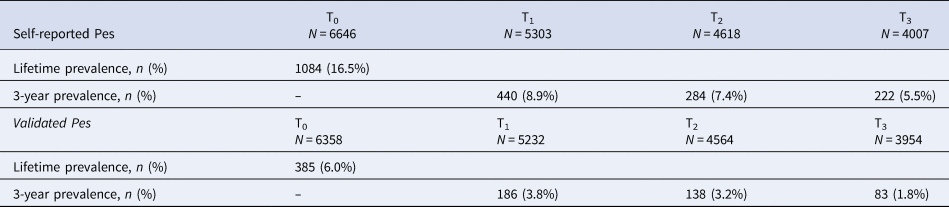
Prevalence rates of PEs at all four measurement waves, in numbers and weighted percentages

Note. At T0–T2 20 PEs were questioned, at T3 13 PEs.
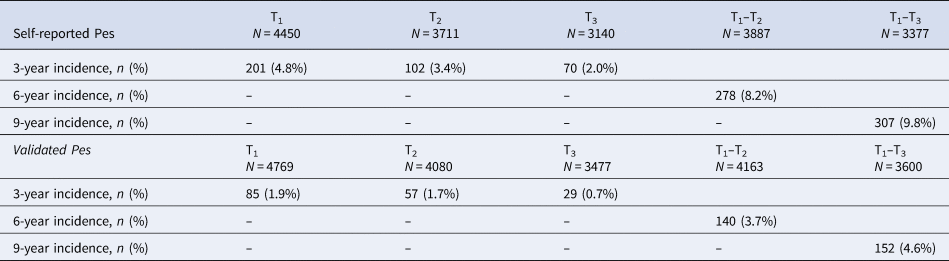
Incidence rates of PEs at the follow-up measurement waves, in numbers and weighted percentages

Note. N reflects the at-risk group for incident PEs.
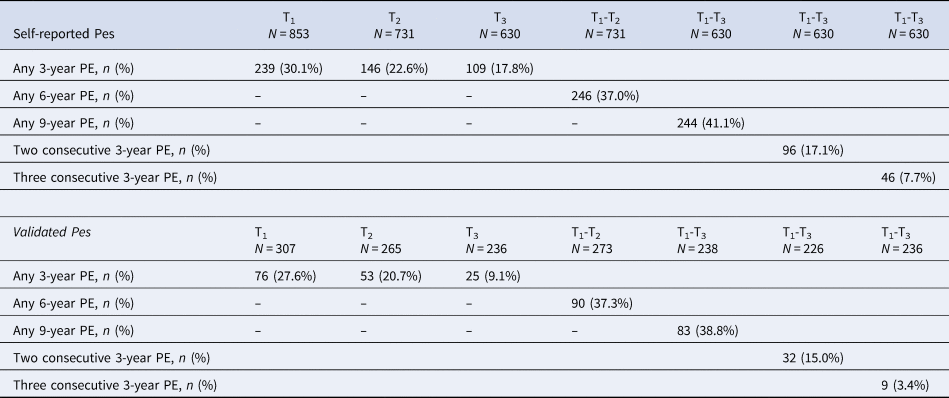
Persistence rates of PEs at the follow-up measurement waves among those with lifetime PEs at baseline, in numbers and weighted percentages

Note. N reflects those with lifetime PEs at baseline and present at follow-up.
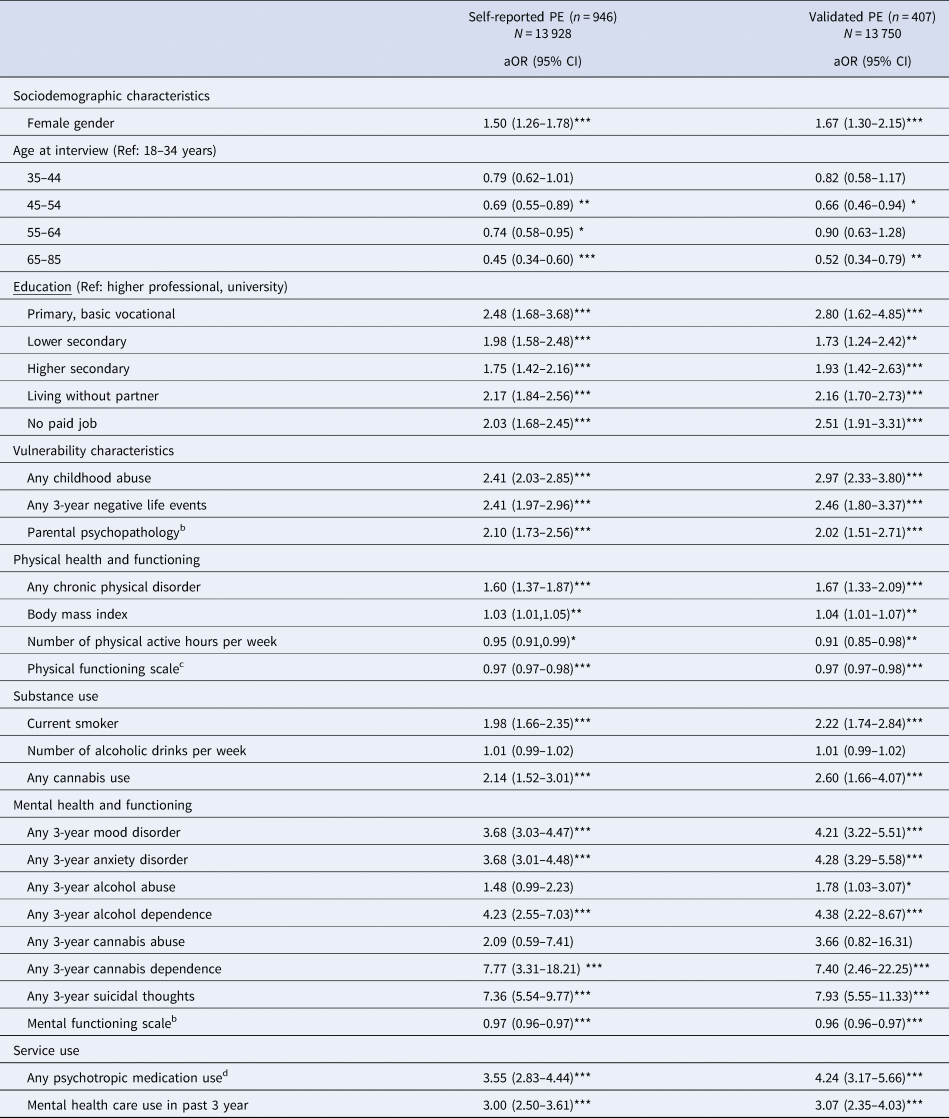
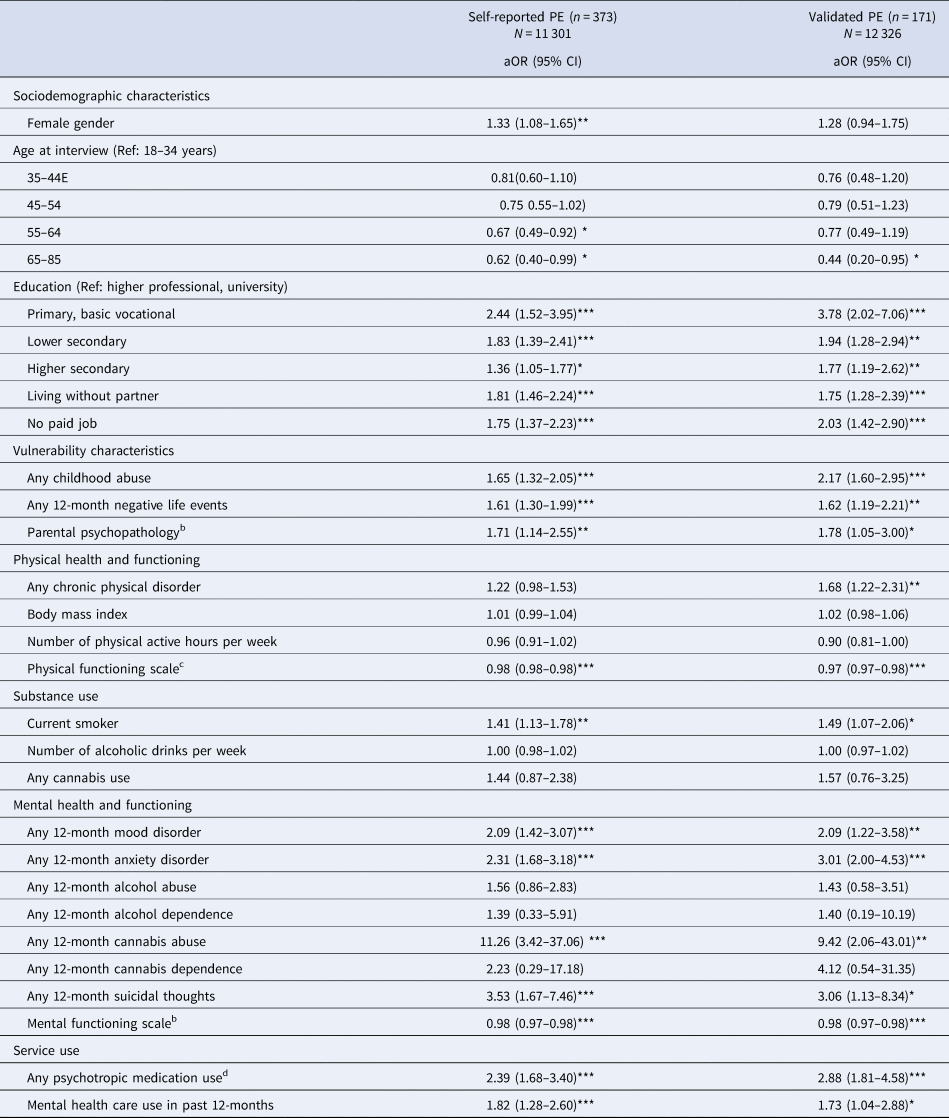
Risk-indicators of 3-year prevalence rates of PEsa, in odds ratios adjusted for sex and age (continuous variable in years) (aOR) and 95% confidence intervals

The total number of PEs in this Table corresponds to the sum of the numbers right of the vertical line in Table 1.
a Reference group: those without a corresponding self-report or validated 3-year prevalence of PEs.
b These analyses were based on data from the second wave only, because parental psychopathology was only assessed at that wave. The N was 5303 and 5232 in the analyses for self-reported PEs and validated PEs, respectively.
c This scale ranges from 0 (low functioning/ill health) up until 100 (high functioning/good health).
d This included antidepressants, antipsychotics, benzodiazepines, mood stabilizers, other anxiolytics, and sedatives.
*: p < 0.05; **: p < 0.01; ***: p < 0.001.
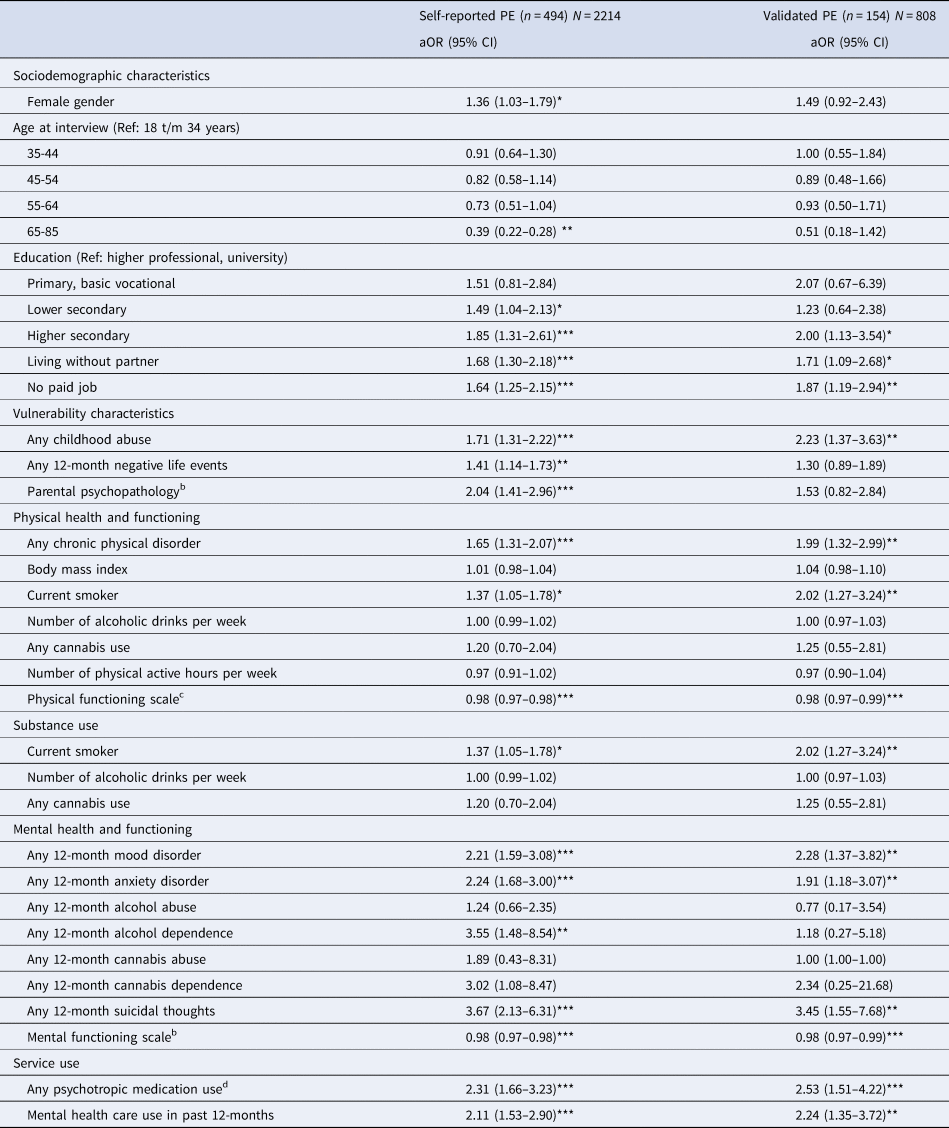
Risk-indicators of 3-year incidence rates of PEsa, in odds ratios adjusted for sex and age (continuous variable in years) (aOR) and 95% confidence intervals

The total number of PEs in this Table corresponds to the sum of the numbers left of the vertical line in Table 2.
a Reference group: those without a corresponding self-report or validated 3-year incidence of PEs.
b These analyses were based on data from the second wave only, because parental psychopathology was only assessed at that wave. The N was 3711 and 4080 in the analyses for self-reported PEs and validated PEs, respectively.
c This scale ranges from 0 (low functioning/ill health) up until 100 (high functioning/good health).
d This included antidepressants, antipsychotics, benzodiazepines, mood stabilizers, other anxiolytics, and sedatives.
*: p < 0.05; **: p < 0.01; ***: p < 0.001.
Risk-indicators of 3-year persistence rates of PEsa among those with lifetime PEs at baseline, in odds ratios adjusted for sex and age (continuous variable in years) (aOR) and 95% confidence intervals

The total number of PEs in this Table corresponds to the sum of the numbers left of the vertical line in Table 3.
a Reference group: those without a corresponding self-report or validated 3-year persistence of PEs.
b These analyses were based on data from the second wave only, because parental psychopathology was only assessed at that wave. The N was 731 and 265 in the analyses for self-reported PEs and validated PEs, respectively.
c This scale ranges from 0 (low functioning/ill health) up until 100 (high functioning/good health).
d This included antidepressants, antipsychotics, benzodiazepines, mood stabilizers, other anxiolytics, and sedatives.
*: p < 0.05; **: p < 0.01; ***: p < 0.001.
Results
Prevalence
Based on self-report, at baseline 1084 respondents (16.5%) had at least one PE in their lifetime (Table 1). The validated lifetime prevalence was 6.0%. During the 3-year after baseline, 8.9% of the respondents had experienced one or more PEs according to self-report and 3.8% according to validated PE. 3-year prevalence rates were somewhat lower at T2 (7.4% for self-reported and 3,2% for validated PEs) and further decreased at T3 (5,5% for self-reported and 1,8% for validated PEs). Among those with a 3-year prevalence of self-reported and validated PE, 41.1% and 41.3% respectively reported at least two PEs.
Incidence
Among those who never had any lifetime PE at baseline (n = 4450), 201 respondents (4.8%) reported at least one PE during the first 3-year follow-up period (T1). The 3-year incidence rate of validated PE at T1 was 1.9%.
For both self-reported and validated PEs, the 3-year incidence rates at the second and third follow-up period (T2 and T3) were somewhat lower compared to those at T1. Not surprisingly, higher 6- and 9-year incidence rates were found: among those who never had any lifetime PE at baseline, 8.2% of respondents reported at least one PE during 6-year follow up and 9.8% during 9-year follow-up. For the validated PEs, these percentages were respectively 3.7% and 4.6%.
Persistence
Among those with at least one lifetime PE at baseline, 30.1% also self-reported a PE at 3-year follow-up. Among those with lifetime PE at baseline, almost one in four (22.6%) had a PE in the second 3-year follow-up period and 17.8% in the third 3-year follow-up period. A limited number of baseline endorsers (7.7%) self-reported at least one PE in all three follow-up periods.
Differences in persistence rates between self-reported and validated PEs were small except at the third follow-up period (persistence rate was 17.8% based on self-reported and 9.1% on validated PEs) and the three-year consecutive PE (7.7% based on self-reported and 3.4% on validated PEs).
Risk indicators of prevalence, incidence, and persistence
As shown in Table 4, all putative risk indicators were associated with both self-reported and clinically validated 3-year prevalence of PE, except for living in an urban area, number of alcoholic drinks per week and any 3-year cannabis abuse. 3-year alcohol abuse was not associated with self-reported PE. The highest ORs were found for any 3-year suicidal thoughts and any 3-year cannabis dependence. The strength of the associations (in terms of point estimate of each risk indicator) for both types of PE was similar.
A great number of risk indicators were associated with both self-reported and clinically validated 3-years incidence of PE (Table 5). The highest OR was found for any 12-month cannabis abuse. Point estimates for validated and self-reported PE showed little differences. Compared to the risk indicators for the presence of PE (Table 4), fewer physical health and physical functioning risk indicators were associated with the incidence of PE.
Table 6 shows that 18 out of 26 risk indicators were associated with self-reported, and 13 out of 26 risk indicators with clinically validated 3-year persistence of PE. The highest OR was found for any 12-month suicidal thoughts. The strength of most of the associations was similar for validated PE and self-reported PE. Compared to the risk indicators for the presence of PE (Table 4), fewer physical health and physical functioning risk indicators were associated with the persistence of PE. Comparison with the risk indicators of the incidence of PE (Table 5) showed few notable differences.
Discussion
Key findings
To our knowledge, the present study is the first to analyse, in one population-based dataset, the prevalence, incidence and persistence of, and risk indicators for PEs. Moreover, results are reported for both self-reported and validated PE. This representative cohort study among the general Dutch adult population, showed that, at baseline, 16.5% had at least one self-reported PE in their lifetime. The incidence of self-reported PE at first 3-year follow-up, among those who never had any lifetime PE, was 4.8%. Among those who had at least one lifetime PE at baseline, 30.1% also self-reported a PE at 3-year follow-up. Compared to validated PE, self-report estimates of PE prevalence and incidence were two to three times higher, while differences for PE persistence were generally small. The 3-year prevalence of PE was associated with all sociodemographic, vulnerability, mental health and physical health and functioning, and service use indicators, except for urbanicity, alcohol use, cannabis abuse and alcohol abuse (self-reported). Generally, the strongest associations were found for mental health disorders. Compared to the risk indicators for the presence of PE, fewer physical health risk indicators were associated with the incidence of PE. The risk-indicator set for the persistence of PE showed few differences with that for the incidence of PE. The strength of the risk indicators for presence, incidence and persistence of PE did not differ much for self-reported and validated PE.
Discussion of research findings
The self-reported lifetime prevalence in our study (16.5%) is almost three times higher than the validated lifetime prevalence of PEs (6.0%). This corresponds to Linscott and Van Os (Reference Linscott and Van Os2013) who concluded that studies based on self-report generated rates more than three times greater than rates obtained by interview-based assessments. Although these excess cases based on self-report could be labelled as ‘false positives’, studies have shown that compared with those without PEs, ‘false positives’ display stronger associations with several negative outcomes, e.g., psychotic as well as several non-psychotic disorders, although at a lower level than the validated cases (Bak et al., Reference Bak, Delespaul, Hanssen, De Graaf, Vollebergh and Van Os2003; Van Nierop et al., Reference Van Nierop, Van Os, Gunther, Myin-Germeys, De Graaf, Ten Have and Van Winkel2012). This implies that PEs not confirmed by clinical interview may represent the softest expression of an extended psychosis phenotype that is phenotypically continuous with clinical psychosis (Van Nierop et al., Reference Van Nierop, Van Os, Gunther, Myin-Germeys, De Graaf, Ten Have and Van Winkel2012). The validated lifetime prevalence of PEs in our study (6.0%) is comparable to a meta-analytical estimate of 7.2% (Linscott & Van Os, Reference Linscott and Van Os2013). The self-reported lifetime prevalence in the present study (16.5%) is higher than that in the WMH Surveys [5.8%; (McGrath et al., Reference McGrath, Saha, Al-Hamzawi, Alonso, Bromet, Bruffærts and de Almeida2015)]. This may be due to differences in the assessment, i.e., in the present study respondents were asked to indicate the occurrence of 20 types of PE compared to 6 PE types in the WMH Surveys.
The 3-year self-reported incidence rate in our study was 4.8% and the validated 1.9%, which seems low compared to the median annual incidence of 2.5% as reported by Linscott and Van Os (Reference Linscott and Van Os2013). The self-reported PE persistence rate (30.1%) was comparable to the retrospective estimate of the WMH Surveys (28.1%), although the length of the persistence interval differed (3 v. 1 year). Two other studies reported lower persistence estimates than the present study, i.e., 21,1% (based on four cohorts, with intervals varying from 1 to 8 years [Linscott & Van Os, Reference Linscott and Van Os2013)] and 15.1% [2-year interval; Chan et al. (Reference Chan, Lee, Chan, Pang, Wong, Hui and Chen2020)]. Besides differences between studies in the length of persistence intervals, other methodological differences may account for the heterogeneity in persistence rates across studies. For example, in our study PE persistence was conditional on the lifetime prevalence of PE at baseline, while in Chan et al. (Reference Chan, Lee, Chan, Pang, Wong, Hui and Chen2020) PE persistence was conditional on a 12-month prevalence of PE at baseline.
In line with previous cross-sectional studies, this study found that demographic factors (female sex, younger age, not being highly educated, living without a partner, having no paid job), vulnerability characteristics (any childhood abuse, negative life events, parental psychopathology), substance use (smoking, cannabis use), poor mental health (mood and anxiety disorder, suicidal thoughts and alcohol and cannabis dependence) and service use (any psychotropic medication use and mental health care use in the past 12-months) were associated with the 3-year prevalence of PE (Bourgin et al., Reference Bourgin, Tebeka, Mallet, Mazer, Dubertret and Le Strat2020; Bromet et al., Reference Bromet, Nock, Saha, Lim, Aguilar-Gaxiola, Al-Hamzawi and McGrath2017; Mallet et al., Reference Mallet, Mazer, Dubertret and Strat2018; McGrath et al., Reference McGrath, Saha, Al-Hamzawi, Alonso, Bromet, Bruffærts and de Almeida2015, Reference McGrath, Saha, Al-Hamzawi, Andrade, Benjet, Bromet and Kessler2016, Reference McGrath, McLaughlin, Saha, Aguilar-Gaxiola, Al-Hamzawi, Alonso and Kessler2017a, Reference McGrath, Saha, Lim, Aguilar-Gaxiola, Alonso, Andrade and Wojtyniak2017b; Oh et al., Reference Oh, Koyanagi, DeVylder and Leiderman2020; Ragazzi et al., Reference Ragazzi, Shuhama, Menezes and Del-Ben2018; Saha, Scott, Varghese, & McGrath, Reference Saha, Scott, Varghese and McGrath2012; Stickley et al., Reference Stickley, Oh, Sumiyoshi, Narita, DeVylder, Jacob and Koyanagi2019). In addition, we found associations between PE prevalence and physical health and functioning factors, which have been scarcely studied. An Australian study found an association between PE and physical disorders (Saha, Scott, Varghese, & McGrath, Reference Saha, Scott, Varghese and McGrath2011b) and a study in the US found associations with several health conditions, including chronic pain, and sleep disorder (Oh, Waldman, Stickley, DeVylder, & Koyanagi, Reference Oh, Waldman, Stickley, DeVylder and Koyanagi2019). In the present study, no association was found between PE and urbanicity. The literature shows mixed results (Quattrone et al., Reference Quattrone, Di Forti, Gayer-Anderson, Ferraro, Jongsma, Tripoli and Rutten2019; Scott et al., Reference Scott, Chant, Andrews and McGrath2006; Van Os et al., Reference Van Os, Hanssen, Bijl and Vollebergh2001; Wiles et al., Reference Wiles, Zammit, Bebbington, Singleton, Meltzer and Lewis2006). A review on the relationship between urbanicity and psychotic disorder concluded that results are heterogenous and that multiple risk and protective factors act differently in different ethnic groups and countries (Fett, Lemmers-Jansen, & Krabbendam, Reference Fett, Lemmers-Jansen and Krabbendam2019). This complexity may also be applicable to the urbanicity-PE relationship and thereby explain the mixed findings in the literature.
Sociodemographic risk indicators associated with the prevalence were also associated with the incidence of PE, except for female sex and age at the interview for validated PE. Other studies suggest there is no association between female sex and PE incidence (Kirli et al., Reference Kirli, Binbay, Drukker, Elbi, Kayahan, Gökçelli and Van Os2019b; Linscott & Van Os, Reference Linscott and Van Os2013; Wiles et al., Reference Wiles, Zammit, Bebbington, Singleton, Meltzer and Lewis2006). The literature is mixed with respect to age, possibly due to differences in the operationalization of the age variable, i.e., continues (Linscott & Van Os, Reference Linscott and Van Os2013) or categorical (Kirli et al., Reference Kirli, Binbay, Drukker, Elbi, Kayahan, Gökçelli and Van Os2019b). All vulnerability characteristics were associated with PE incidence, which is in line with other studies finding an association between negative life events and PE incidence (Kırlı et al., Reference Kırlı, Binbay, Drukker, van Os, Alptekin, Kayahan and Elbi2019a; Spauwen et al., Reference Spauwen, Krabbendam, Lieb, Wittchen and Van Os2006; Wiles et al., Reference Wiles, Zammit, Bebbington, Singleton, Meltzer and Lewis2006), family history of mental disorder and childhood adversity (Bennett et al., Reference Bennett, Surkan, Moulton, Fombonne and Melchior2020; Kırlı et al., Reference Kırlı, Binbay, Drukker, van Os, Alptekin, Kayahan and Elbi2019a).
While all physical health and functioning characteristics were associated with the prevalence of PE, associations with PE incidence are only found for physical functioning and any chronic physical disorder (validated PE only). We found one study on this topic, which reported associations between frequent or severe headache, other chronic pain, asthma and subsequent PEs (Scott et al., Reference Scott, Saha, Lim, Aguilar-Gaxiola, Al-Hamzawi, Alonso and McGrath2018). The results of this cross-sectional study were however based on retrospectively assessed PEs and medical conditions using their age of onset (Scott et al., Reference Scott, Saha, Lim, Aguilar-Gaxiola, Al-Hamzawi, Alonso and McGrath2018).
Current smoking, but not number of alcoholic drinks and any cannabis use, was associated with the incidence of PE. This is in line with Wiles et al. (Reference Wiles, Zammit, Bebbington, Singleton, Meltzer and Lewis2006), who found that smokers had a 70% greater risk of PE incidence and found no association between any cannabis use and PE incidence. With respect to alcohol, studies using other alcohol outcome measures than the present study, i.e., weekly alcohol use (Kırlı et al., Reference Kırlı, Binbay, Drukker, van Os, Alptekin, Kayahan and Elbi2019a) and engaging in a harmful pattern of drinking (Wiles et al., Reference Wiles, Zammit, Bebbington, Singleton, Meltzer and Lewis2006), did find an association with incident PE. This is also the case for cannabis use, i.e., associations with incident PE were found for regular cannabis use (Kırlı et al., Reference Kırlı, Binbay, Drukker, van Os, Alptekin, Kayahan and Elbi2019a), (degree of) misuse (Linscott & Van Os, Reference Linscott and Van Os2013) and cannabis abuse in the present study. These findings suggest that particularly frequent or problematic alcohol and cannabis use is associated with incident PE.
Any 12-month mood, and anxiety disorder, suicidal thoughts, lower mental functioning, any psychotropic medication use, and any 12-month mental health care use were all risk indicators for the 3-year incidence of PEs. One of the few longitudinal studies on this topic also found that mood episodes and psychotropic medication use predicted incident PEs (Kırlı et al., Reference Kırlı, Binbay, Drukker, van Os, Alptekin, Kayahan and Elbi2019a).
Risk indicators for persistence were largely similar to those for incidence of PE, although some variables did not reach statistical significance, most likely due to a much smaller sample size of the group at risk for persistence. As noted earlier, very few studies have reported on risk indicators of the persistence of PE. The association with vulnerability characteristics is also reported by others (Cougnard et al., Reference Cougnard, Marcelis, Myin-Germeys, De Graaf, Vollebergh, Krabbendam and Van Os2007; Rössler et al., Reference Rössler, Riecher-Rössler, Angst, Murray, Gamma, Eich and Gross2007; Trotta et al., Reference Trotta, Murray and Fisher2015). Unlike Cougnard et al. (Reference Cougnard, Marcelis, Myin-Germeys, De Graaf, Vollebergh, Krabbendam and Van Os2007) we found no association between PE persistence and living in an urban area. Furthermore, we found PE persistence to be associated with mental health indicators, including mood and anxiety disorders, while another study did not (DeVylder et al., Reference DeVylder, Lehmann and Chen2015). However, the latter result was based on retrospectively assessed information.
Limitations
The following study limitations should be mentioned. First, the incidence estimates are based on self-reported lifetime disorders at baseline and 3-year disorders at follow-up. Especially the validity of lifetime diagnoses has been questioned on grounds of difficulty of accurate recall, resulting in underreporting of lifetime symptoms at baseline (Moffitt et al., Reference Moffitt, Caspi, Taylor, Kokaua, Milne, Polanczyk and Poulton2010; Patten, Reference Patten2009; Wittchen, Reference Wittchen1989). The presented incidence rates might therefore be somewhat overestimated and persistence rates underestimated (Chou, Mackenzie, Liang, & Sareen, Reference Chou, Mackenzie, Liang and Sareen2011). We do not expect that this has had any meaningful effect on the magnitude of the associations between PE's and risk indicators.
Second, in prospective studies, the validity of the follow-up data can be adversely affected by sample attrition (de Graaf et al., Reference de Graaf, Ten Have and van Dorsselaer2010; Eaton, Romanoski, Anthony, & Nestadt, Reference Eaton, Romanoski, Anthony and Nestadt1991; Lamers et al., Reference Lamers, Hoogendoorn, Smit, Van Dyck, Zitman, Nolen and Penninx2012). However, no such bias was found for PE and the disorders under investigation here, after controlling for demographics (Nuyen et al., Reference Nuyen, Bos, de Jonge, van Dorsselaer, Tuithof, Kleinjan and ten Have2021). We therefore assume that sample attrition had little effect on the incidence and persistence rates and risk associations reported here, also because the data were weighted for attrition due to sociodemographic characteristics.
Third, although the sample was representative of the Dutch population on most parameters, people with an insufficient mastery of Dutch, those with no permanent residential address and the institutionalized were underrepresented. Hence, our findings cannot be generalized to these groups, such as the most severely affected psychotic patients.
Fourth, our analyses on risk indicators were explorative in nature. We looked at a wide variety of possible risk indicators from different domains based on previous research. Future research is needed to gain insight into how risk indicators are related to variations in the disease course and which mechanisms play a part, i.e. by studying whether factors play a mediating or moderating role.
Conclusions
The results of our study show that a wide variety of risk indicators is associated with PE prevalence and, to a somewhat lesser extent, with PE incidence and persistence. The associations with mental health disorders were relatively strong, which underlines the importance of assessment of PE in general practice. Comparison of self-reported and clinically validated results showed few differences with respect to risk indicators. Prevalence and incidence were higher in self-report than validated results. However, previous studies have shown that self-reported cases that are not confirmed in clinical interview, are also at higher risk for psychotic as well as several non-psychotic disorders. Thus, also self-report of PE is a valuable tool in clinical practice.
Supplementary material
The supplementary material for this article can be found at https://doi.org/10.1017/S0033291722002690.
Financial support
Financial support has been received from the Ministry of Health, Welfare and Sport (VWS), with supplementary support from the Netherlands Organization for Health Research and Development (ZonMw) and the Genetic Risk and Outcome of Psychosis (GROUP) investigators.
Conflicts of interest
None.
Ethical standards
The authors assert that all procedures contributing to this work comply with the ethical standards of the relevant national and institutional committees on human experimentation and with the Helsinki Declaration of 1975, as revised in 2008.