




No CrossRef data available.
Article contents
Is the Prefrontal Cortex Necessary for Delay Task Performance? Evidence from Lesion and fMRI Data
Published online by Cambridge University Press: 22 March 2006
Abstract
Although the prefrontal cortex (PFC) is consistently found to be associated with various working memory processes, the necessity of the PFC for such processes remains unclear. To elucidate PFC contributions to storage and rehearsal/maintenance processes engaged during verbal working memory function, we assessed behavior of patients with lesions to the left or right lateral PFC, and neural activity of healthy young subjects during fMRI scanning, during performance of working memory tasks. We found that PFC lesions did not affect storage processes—which is consistent with the notion that posterior cortical networks can support simple retention of information. We also found that PFC lesions did not affect rehearsal/maintenance processes, which was in contrast to our finding that healthy subjects performing a verbal delayed recognition task showed bilateral PFC activation. These combined imaging and behavioral data suggest that working memory rehearsal/maintenance processes may depend on both hemispheres, which may have implications for recovery of function and development of rehabilitation therapies after frontal injury. (JINS, 2006, 12, 248–260.)
Keywords
Information
- Type
- SYMPOSIUM
- Information
- Journal of the International Neuropsychological Society , Volume 12 , Issue 2 , March 2006 , pp. 248 - 260
- Copyright
- © 2006 The International Neuropsychological Society
INTRODUCTION
Working memory refers to the temporary representation of information that was just experienced or just retrieved from long-term memory but is no longer accessible in the external environment (Baddeley, 1986). These internal representations are short-lived, but they can be maintained for longer periods of time through active rehearsal or maintenance strategies, and can be subjected to various operations that manipulate the information such that it becomes useful for goal-directed behavior. Working memory is a system that is critically important in cognition and seems necessary in the course of performing many other cognitive functions such as reasoning, language comprehension, planning, and spatial processing.
Jacobsen was the first to report a link between the function of the prefrontal cortex (PFC) and working memory (Hebb, 1939; Jacobsen, 1936). He interpreted the results of his experiments, impaired performance on a delayed response task in monkeys following large bilateral frontal lesions, as evidence for a memory deficit. Subsequent research, however, challenged this view, postulating instead that deficits on delayed matching-to-sample, delayed response, and delayed alternation tasks arose from deficits of encoding (Nissen et al., 1938), of distractibility (Malmo, 1942; Orbach & Fischer, 1959), of stimulus discrimination (Mishkin & Pribram, 1955, 1956), of accessing recently acquired information (despite intact long-term memory) (Gross & Weiskrantz, 1964), or of set-shifting (Mishkin, 1964). Researchers in the 1950s and 1960s, by making more circumscribed lesions and using better-controlled behavioral experiments, established clearly that PFC lesions cause mnemonic deficits in monkeys (for review, see Fuster, 1989). Importantly, monkeys with PFC lesions are not impaired on control tasks where they simply must move their eyes towards a target present on the video screen, suggesting that the deficit on delayed response tasks is mnemonic in nature and not due to deficits in bottom-up or sensorimotor processes (Funahashi et al., 1993). Results from neurophysiological studies have complemented the findings from lesion studies in that lateral PFC neurons exhibit persistent activity above baseline during the delay period when the monkey is maintaining information in memory prior to a making a motor response that is contingent on this information (e.g., Funahashi et al., 1989; Fuster & Alexander, 1971). Activity in lateral PFC in the monkey has therefore been interpreted as supporting the temporary retention of relevant information in the service of guiding behavior.
To maintain and manipulate relevant information when that information is not accessible in the environment, the brain needs (1) a storage process, (2) rehearsal or maintenance processes that can prevent the contents of the storage system from decaying, and (3) other control processes to perform manipulations on the mnemonic representations of the information being stored and rehearsed. The interaction of these three classes of processes gives rise to the behavioral phenomenon of working memory.
Although clearly not completely dissociable, these subcomponent processes can be studied with some degree of isolation using different task designs. For example, storage is measured in terms of capacity, and can be indexed in humans by span tasks (Baddeley, 1990): digit span for verbal working memory (Wechsler, 1981) and block span for visuospatial working memory (Milner, 1971). Each of these span tasks assesses how much information a subject can recall immediately. Another component process of working memory is rehearsal or maintenance, which refers to the processes necessary to keep relevant information held in working memory accessible for longer than a few seconds (Baddeley, 1986; Jonides, 1995). Delay tasks (such as delayed response and delayed recognition) can typically be considered to rely on rehearsal/maintenance processes to a greater degree than do span tasks, because they tax a subject's ability to retain information over a longer period of time than do span tasks (Awh et al., 1996; Paulesu et al., 1993).
Previously, in order to determine the role of the human PFC in working memory storage and rehearsal/maintenance processes, we reviewed published reports of performance of patients with lateral PFC lesions on simple span and delay tasks (D'Esposito & Postle, 1999). The review identified 11 studies of patients with PFC lesions that included measures of forward verbal and/or spatial span, reflecting the performance of 166 individual patients. None of these studies demonstrated a statistically significant deficit relative to healthy control subjects. This observation is consistent with the notion that the PFC is not necessary for storage processes. Surprisingly, in nine studies reporting delay tasks in patients with PFC lesions, more than half of the experiments also failed to demonstrate statistically significant deficits relative to healthy control subjects. As reviewed above, this observation in humans is inconsistent with numerous monkey lesion studies, as well as monkey physiology and human imaging studies that have demonstrated that the PFC is active during delay tasks that require rehearsal/maintenance processes to successfully retain information over time.
Prompted by the observations of our literature review (D'Esposito & Postle, 1999), we aimed in this study to investigate the role of the PFC in component processes of working memory. The inconsistency between lesion and physiological studies regarding the role of the PFC in rehearsal/maintenance processes may be explained by the different types of inferences that can be drawn from such studies. It is the nature of functional neuroimaging studies (and all methods of physiological measurement, including single-unit electrophysiology and evoked related potentials) that they support inferences about the association of a particular brain system with a cognitive process, but not about its necessity to that process (Sarter et al., 1996). That is, neuroimaging studies cannot, alone, tell us whether the function of a neural system represents a neural substrate of that function, or rather a nonessential process that is associated with that function. Therefore, only lesion studies can establish necessity. Human lesion and imaging studies thus provide complimentary evidence regarding brain-behavior relationships. In the present study, to investigate the role of PFC in working memory rehearsal/memory processes, we report functional magnetic resonance imaging (fMRI) data from healthy young adults performing a delay task, as well as behavioral data from patients with frontal lesions performing a similar task.
METHODS
Functional MRI studies
Subjects
20 young, healthy participants (Study 1: n = 9, 7 females; ages 18–32; Study 2: n = 11, 8 females; ages 21–30) gave written informed consent according to University of California guidelines. Subjects were screened for use of prescription medication, history of neurological or psychiatric disorders, blood pressure abnormality, and any other conditions that would preclude completing the study (e.g., metallic implants, difficulty with manual responses, low visual acuity). In addition, subjects were screened for current mood disturbances with the Beck Depression Inventory.
Behavioral Task
Data are reported from two fMRI studies with different subjects. Both studies employed the same verbal delayed-recognition task, which was similar to that used in the behavioral studies with patients described below. In one fMRI study (study 2), subjects performed the task in two different fMRI sessions 2 hours after oral administration of dopaminergic agonist or placebo, in which the order of the sessions was counterbalanced. Only fMRI data from the placebo session are reported here. fMRI scans were acquired while subjects performed four types of working memory trials. Two or six block capital letters were presented for 4 seconds, followed by an unfilled 12-second delay period. At the end of the delay period, a single lower case probe letter appeared for 2 seconds. The probe letter was presented either masked by a background of visual noise or unmasked. Subjects indicated whether the probe letter was a part of their memory set with a manual button press. The response period was followed by a jittered intertrial interval lasting between 8 and 12 seconds. Four trials of each of the four types were presented per 7-minute run. There were six runs, for a total of 96 trials per scanning session.
Functional MRI methods
MRI Data Acquisition. Functional and structural images were acquired with a Varian INOVA 4.0T scanner (www.varianinc.com) and a TEM send-and-receive RF head coil. Head movement was restricted using a foam cushion adjusted for each subject. Stimuli were back-projected onto a screen at the subject's waist, and viewed through a mirror mounted inside the head coil.
Functional images were acquired using a 2-shot gradient echo EPI sequence, in 18 5.0-mm thick axial slices with a .5-mm interslice gap and a TR of 2000 ms. Each slice was acquired with a 22.4 cm2 field of view with a 64 × 64 matrix size resulting in an in-plane resolution of 3.5 × 3.5 mm. This slice prescription allowed for near whole-brain coverage. Data were acquired during six runs lasting 7 minutes each. The first ten images from each run were deleted to approach steady-state tissue magnetization. High-resolution in-plane T1-weighted images were acquired using a gradient echo multislice sequence for anatomical localization. In addition, high-resolution MPFlash 3D T1- weighted scans were acquired for normalization to the Montreal Neurological Institute (MNI) reference brain.
MRI Data analysis. Functional images acquired from the scanner were reconstructed offline from k-space. Image volumes were corrected for slice timing skew using temporal sinc-interpolation and corrected for movement using rigid-body transformation parameters. Image preprocessing and statistical analyses were performed using SPM2 (Wellcome Department of Cognitive Neurology, www.fil.ion.ucl.ac.uk/spm). Images were resampled to 2×2×2 mm and then smoothed with an 8 mm FWHM Gaussian kernel. A high-pass filter was used to remove frequencies below 0.01Hz from the data.
Structural T1-weighted images were normalized to the MNI reference brain. Transformations calculated from normalizing each subject's structural images were applied to the functional images collected in each run. Data were analyzed using the general linear model (Worsley & Friston, 1995). For each subject, the BOLD signal during the encoding, delay, and retrieval/response periods in each trial type was modeled as impulses of neural activity convolved with the SPM canonical hemodynamic response function (Postle et al., 2000; Zarahn et al., 1997). We used a covariate beginning at the onset of the presentation of the letters to be remembered (first TR, 0 s) to model early encoding processes. A second covariate at the third TR (4 s) modeled late encoding activity. As encoding processes may continue into the delay period, this late encoding period is modeled to reduce noise in the estimate of the baseline, but not included in the mapwise analysis. The early and late phases of the delay period were modeled with covariates at the fifth and seventh TRs, respectively (8 and 12 s). Delay period effects reported here represent the sum of the two delay period regressors. The retrieval/response period was modeled with a covariate at the onset of the probe (ninth TR, 16 s). These covariates were then entered into the general linear model (GLM). Maps of parameter estimates were computed from the GLM to assess the magnitude of activation during each trial period. Stereotactic coordinates of peak activations were reported with respect to the MNI coordinate system.
Behavioral study
Subjects
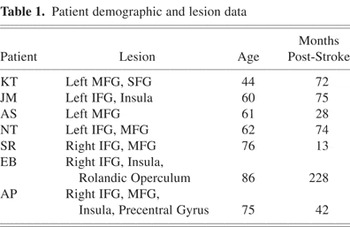
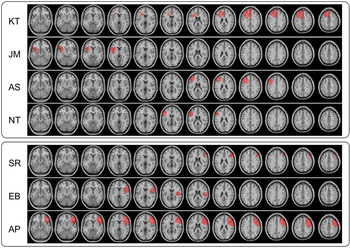
Patients. Seven patients with CT or MRI-confirmed unilateral lesions involving the lateral prefrontal cortex (Table 1, Figure 1). Four patients had left frontal lesions and three had right frontal lesions. All lesions were due to strokes and all patients were studied at least 1 year after their event. All patients were right-handed. Their mean length of education was 12 years and their age range was from 44–86 years old.
Patient demographic and lesion data


Lesion diagrams.
Control Subjects. Twenty six healthy control subjects were split into two groups to match the ages of patients with lesions (control group I, ages 55–70, mean 64 years; control group II, ages 71–85, mean 76 years). None of the control subjects exhibited evidence of depression as screened by the Beck Depression Inventory (Beck et al., 1961) or dementia as documented by a score of 27 or greater on the Mini Mental State Exam (Folstein et al., 1975) at the time of testing. The mean length of education in control group I (n = 14) was 17 years (range 14–24 years) and control group II (n = 12) was 16 years (range 12–20 years). Prior to the study, all subjects were screened for any disorders and/or medication usage that might affect cognitive functioning. All subjects reported no medical, neurological, or psychiatric disorders and were not taking medications that had central nervous system actions. This restriction included medications for heart disease, diabetes, blood pressure, psychotropic medications, and sleeping medications.
All patients and control subjects signed informed consent according to University of California guidelines and were paid for their participation.
Cognitive tasks
Immediate serial recall. Subjects viewed letters presented on a computer screen sequentially. Each letter was presented for 750 ms with no interstimulus interval. Immediately after the last letter had been presented, three question marks appeared on the screen, prompting subjects to recall aloud the letters that they seen in the order in which they had been presented. Span assessment began with the presentation of two letters, and was repeated for two trials. If both trials were performed correctly, then the subject was presented with two sequential trials of three letters. This process continued with increasing numbers of letters until the subject was unable to correctly repeat the letters for either of the two trials. The number of letters for which a subject could correctly repeat at least one trial was then defined as the subject's WM span and was used in the delay task.
Delayed recall and recognition. These were performed after completion of the span task. The generic procedure was presentation of letters to be remembered, followed by a 6500 ms delay period, followed by a response/retrieval period. During the encoding phase, each letter was presented for 750 ms with no interstimulus interval. Subjects were required to remember either one letter (low load) or as many letters as was previously defined as their working memory span (high load). During the delay period, subjects either viewed a simple fixation cross hair during the delay (without distractor) or they viewed a series of words presented at a 333 ms rate (with distraction). Subjects were instructed to view and pay attention to the words, but not to attempt to remember them because they would not be tested on them later. Words were randomly chosen from a group of common words and were repeated in a random fashion throughout the experiment. Two types of memory probes were used, recognition probes and recall probes. Recognition probes consisted of a single letter, whose membership in the present trial's memory set was indicated by the subject with a right (“match”) or left (“nonmatch”) button press. The probe letter was presented with an asterisk on either side of it, which helped to differentiate it from the letters presented during the encoding period. Recall probes were three question marks on the screen, which prompted verbal recall of encoded items in the order in which they had been presented.
The within-subject conditions were counterbalanced in the following way. There were two blocks of low load and two blocks of high load for each response condition (recognition and recall). Each block contained 40 trials of delay task. Blocks were presented in a set order alternating between low and high load, beginning with low load. All four blocks for one response condition were presented together and the order of response condition was counterbalanced across subjects. For example, one subject would first complete 40 trials of the recognition condition at low load, then 40 trials of the recognition at high load; they would then perform another recognition low load block and finally a recognition high load block before moving to the recall condition. Half of the trials in each block had distractors during the delay period and half did not. The presentation of these trials was varied randomly across the block. In total there were 320 delay trials.
RESULTS
Functional MRI studies
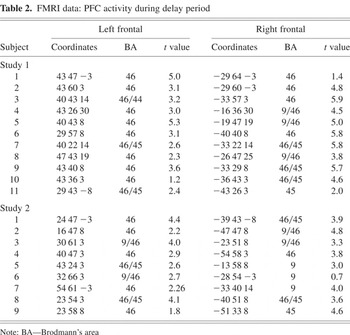
Delay-period activity was considered to reflect the recruitment of rehearsal/maintenance processes. In each of the individual 20 subjects that performed the verbal delayed response task during fMRI scanning, delay-period activity (collapsed across load and probe type) was found within lateral PFC. In all subjects, lateral PFC was typically greater in one hemisphere as compared to the other. However, in each subject, bilateral PFC activity was present. The magnitude and location of PFC activation in each subject is presented in Table 2. Although each individual subject showed some degree of bilateral PFC activity during the delay-period, as expected, the location, extent, and magnitude of this activation was extremely variable across individuals.
FMRI data: PFC activity during delay period

Analyzed in a manner to determine the location of activation that exhibited spatial overlap in at least 75% of subjects, the most consistent area of delay-period activity was lateralized to the left ventral PFC, which is consistent with several other imaging studies utilizing a similar verbal delayed response paradigm (Gruber, 2001; Paulesu et al., 1993). As illustrated in Figure 2, this location of PFC activation overlapped with the location of the frontal lesion of one of our patients (patient JM). Also illustrated in Figure 2 is a composite of the overlap of the frontal lesions of all of the patients. It can be seen that our group of patients had lesions across most of the lateral extent of the PFC in both hemispheres. The only area that was not damaged by any of our patients was anterior portion of the superior frontal gyrus in both hemispheres, and the anterior extent of the middle frontal gyrus in the left hemisphere. Importantly, this PFC region that was undamaged in our lesion patients does not overlap with the site of consistent delay-period activity across control subjects in our fMRI studies, and so it is unlikely that we missed a lesion of an important region of PFC for rehearsal/maintenance processes. Also, it is clear that the frontal lesions in each of our patients overlapped with many areas of PFC delay-period activity in our individual control subjects (Table 2).

Diagram illustrating a group fMRI map of encoding period (top-panel), delay-period (middle panel) and probe-period (bottom panel) PFC activity across healthy control subjects. The group map represents the summation of regions that were positively activated during the encoding, delay or retrieval/response period in at least 12 of the 18 subjects. The bottom panel is a diagram illustrating the overlap of frontal lesions across patients.
Also consistent with previous fMRI studies using delay tasks (e.g. D'Esposito et al., 2000; Manoach et al., 2003), lateral PFC activation was observed during the encoding and retrieval/response periods of the delay task. The location of activation that exhibited spatial overlap in at least 75% of subjects is presented in Figure 2. Like delay-period activity, it is clear that the frontal lesions in each of our patients overlapped with many areas of PFC encoding and retrieval/response-period activity in our individual control subjects.
Behavioral Study
Memory span
The mean letter span for control group I (ages 55–70) was 4.9 ± 1.1 items and for control group II (ages 71–85) was 4.8 ± 0.8 items. The letter span of each patient is listed in Table 2. None of the frontal patients had a memory span more than two standard deviations from the mean of the corresponding control group (mean span = 4 items).
Delay tasks
Accuracy on each of the behavioral conditions of the delay tasks for patients and controls is presented in Table 3. Our first analysis of behavioral performance of each of the patients, relative to their respective control group, is presented in Figure 3 In these z-score analyses, direct comparisons are made between each of the four behavioral conditions (low load with and without distraction, high load with and without distraction) in both the recall and recognition tasks. Impairment on any behavioral condition in a particular patient is defined as a mean performance that was greater than two standard deviations relative to their respective control group.
Behavioral data from span and delay tasks


Behavioral performance of patients for each of the behavioral conditions of the recall and recognition task. The gray background represents the range of two standard deviations of the mean performance of the control subjects.
Low load. Without distraction at low load (e.g., one item), performance was quite high across frontal patients in both the recall (range 92–100%, mean 97%) and recognition (range 93–100%, mean 97%) tasks. Performance on this condition did not differ from control subjects (control group 1: recall task mean 94%, recognition task mean 97%; control group 2: recall task mean 96%, recognition task mean 94%). This condition is similar to the behavioral task performed in the MRI scanner.
With delay-period distraction at low load, a slight performance decrement was observed in frontal patients relative to performance on the low load without distraction condition, in both recall (mean 94%) and recognition (mean 94%) tasks. However, performance on this condition did not differ from control subjects (control group 1: recall task mean 94%, recognition task mean 97%; control group 2: recall task mean 95%, recognition task mean 96%).
High load. Without distraction at high load (i.e., at each subjects' span), performance in patients with frontal lesions was reduced relative to the low load condition, in both recall (mean 62%) and recognition (mean 88%) tasks. However, performance on this condition did not differ from control subjects (control group 1: recall task mean 67%, recognition task mean 89%; control group 2: recall task mean 57%, recognition task mean 93%). This condition is similar to the behavioral task performed in the MRI scanner.
With distraction at high load, performance in patients with frontal lesions was also reduced relative to the low load condition, in both recall (mean 59%) and recognition tasks (mean 88%). Again, performance on this condition did not differ from control subjects (control group 1: recall task mean 58%, recognition task mean 86%; control group 2: recall task mean 48%, recognition task mean 90%).
In summary, during each of the behavioral conditions (low load, high load, with distraction, without distraction) in both the recall and recognition task, all of the patients with frontal lesions were unimpaired relative to their respective control groups.
In order to assess the effect of varying memory load, and the presence of distraction during the delay period (two factors that should tax rehearsal processes), we also compared performance calculated as a difference between high-load versus low-load conditions, and the difference between distraction-present versus distraction-absent conditions. Again, impairment on any behavioral condition in a particular patient is defined as a mean performance that was greater than two standard deviations relative to their respective control group (see Figure 4). None of the patients exhibited a significant distractor or load effect on the recall task. Also, none of the patients exhibited a load effect on the recognition task. During the recognition task, one left-frontal, and two right-frontal patients exhibited a disproportionate distractor effect only in the low-load condition.

Behavioral performance of patients for the effect of varying memory load (one item vs. subject's span) and the delay-period distraction effect (presence or absence) on the recall and recognition task. The gray background represents the range of two standard deviations of the mean performance of the control subjects.
Due to the small number of subjects, a statistical comparison could not be performed across patients with different lesions (e.g., left-frontal vs. right-frontal). However, the mean scores collapsed across each group, for each behavioral condition is presented in Table 4. Inspection of this table reveals that there is no clear difference in performance between patients with left- versus right-frontal lesions.
Behavioral performance collapsed across subject groups

DISCUSSION
The aim of this study was to examine the involvement and necessity of the PFC on certain component processes of working memory, specifically, storage and rehearsal/maintenance processes. The present findings from our imaging and behavioral data are generally consistent with the conclusions drawn from our earlier review of the literature of previously published studies of delay tasks in patients with frontal lesions (D'Esposito & Postle, 1999). That is: The ability to temporarily store and rehearse/maintain information is not significantly affected by unilateral lesions of the lateral PFC.
In his seminal report “Intelligence in man after large removals of cerebral tissue,” Hebb discussed the case of a woman with incomplete removal of a large bilateral frontal glioblastoma who retained average adult level digit span despite a constellation of stereotypically “frontal” behavioral abnormalities (Hebb, 1939). Since that time, surprisingly few human lesion studies have focused on simple span tasks as a dependent measure of primary interest, and no such lesion studies have been reported in the monkey literature. However, in our literature review of human studies published in 1999, there were eleven studies that reported span task performance of patients with PFC lesions. None of the reports of digit span reported a statistically significant deficit in patients with frontal lesions (total number of subjects from the eight studies = 115). The present study confirmed these findings with a test of immediate serial recall of letters.
The conclusion that the lateral PFC does not contribute to the short-term storage of information also derives support from psychophysical (e.g., Pasternak & Greenlee, 2005), and functional neuroimaging (e.g., Awh et al., 1996; Postle et al., 1999, 2003) studies demonstrating that the simple retention of information in the manner required for performance on a span task is supported by the posterior cortical networks. Such networks may represent, for example, lexical, phonological, and semantic information, or other types of sensory information (e.g., visuospatial). Thus, lesions in left inferior parietal cortex are associated with reduced span for auditory verbal stimuli (Della Sala & Logie, 1993; Risse et al., 1984; Vallar & Papagno, 1995; Warrington, 1979; Warrington et al., 1971), and in right inferior parietal cortex with reduced span for visuospatial stimuli (Alajouanine, 1960; DeRenzi & Nichelli, 1975; Hanley et al., 1991; Milner, 1971). The patients with parietal lobe lesions is markedly reduced span (e.g., digit span = 2.3 in a patient reported in (Shallice & Warrington, 1970) as compared with the normal span of patients with frontal lesions. Corroborating human neuroimaging evidence also implicates inferior parietal cortex as an important for mediating working memory storage processes (Jonides et al., 1998; Ravizza et al., 2004).
In addition to intact working memory storage processes, rehearsal processes also were unaffected by unilateral frontal lesions. For example, no frontal patient performed at less than 92% accuracy when required to retain a single item without distraction on either the recall or recognition task. Even when there were distracting stimuli present during the delay-period, or when the subject had to maintain multiple items, which are both conditions that increase rehearsal/maintenance demands, performance by the frontal patients was not significantly different than age-matched control subjects. This finding is consistent with other studies reported in the literature that have utilized other types of nonspatial as well as spatial delayed response tasks (e.g. (Ghent et al., 1962). However, this accumulating evidence that unilateral PFC lesions do not significantly impair rehearsal/maintenance processes, when such processes consistently increase PFC activity when measured with single-unit recording or fMRI, requires some explanation. We offer two possible explanations. First, given that physiology and imaging studies support inferences only about the association of a particular brain system with a cognitive process, the empirical findings from the lesion studies suggest that the PFC is not necessary for rehearsal/maintenance processes, which presumably can be supported by other brain systems.
Another possible explanation for this apparent discrepancy between the physiology versus lesion data is that rehearsal/maintenance processes are supported by a lateral PFC system distributed across both hemispheres. Unilateral PFC lesions are therefore not sufficient to significantly affect performance on tasks that require intact rehearsal/maintenance processes. In support of this notion is that the observation that the level of performance of patients with frontal lesions on our delay task is in stark contrast to the level of performance of monkeys with bilateral PFC lesions on similar tasks in which significant reductions in performance are observed. For example, monkeys with lateral PFC lesions perform at chance on delay tasks even with single items and short delays similar to our behavioral and fMRI studies (e.g., Brozoski et al., 1979). In contrast, in monkeys with circumscribed unilateral lesions, the deficits on delay tasks that are observed are subtle (Funahashi et al., 1993). All humans studies reported thus far that have examined performance on delay tasks have only studied patients with unilateral PFC lesions. There has been no reported study of delayed-response task performance in a human with bilateral lateral PFC damage for comparison.
Thus, these findings suggest that rehearsal/maintenance processes may depend on both hemispheres. This conclusion is further supported by the fMRI data reported in our study, as well as numerous fMRI and PET studies reported in the literature that have used delay tasks. In each of these studies, bilateral PFC activation is typically observed on such tasks (although one hemisphere is often dominant). In all the subjects reported in our study, we observed bilateral delay period activity when rehearsal/maintenance processes were recruited. Based on these findings, it is not surprising that unilateral lesions produce only subtle impairments of performance. We would not expect such lesions to produce a complete loss of function leading to a profound deficit.
It is important to note that our patients are older than the subjects in our fMRI study. A previous PET study of verbal and spatial working memory demonstrated pronounced age differences in PFC activity: in younger adults, activation was predominantly left-lateralized for verbal working memory, and right-lateralized for spatial working memory, whereas older adults showed bilateral activation for both types of memory (Reuter-Lorenz et al., 2000). Data such as these have led to the hypothesis that age-related hemispheric asymmetry reductions may have a compensatory function or they may reflect a dedifferentiation process (Cabeza, 2002). Thus, normal performance on delay tasks in our patients with unilateral PFC lesions may be due to bilateral representation of rehearsal/maintenance processes that develops as part of normal aging.
The findings from our studies and others previously published have implications for understanding the neural mechanisms supporting recovery of function and the development of targeted rehabilitation therapies of patients with frontal injury. Based on these findings, we propose that specific component processes of working memory, such as rehearsal/maintenance processes, are bilaterally represented within the lateral PFC. If so, recovery of frontal lobe function after injury should be better in patients with unilateral (as compared with bilateral) lesions. Although such outcome studies have not been performed directly assessing frontal function, in clinical experience, patients with large or bilateral cerebral lesions have been observed generally to have a poorer prognosis for recovery than patients with smaller or unilateral lesions (Ween et al., 1996). The mechanism by which patients with unilateral frontal lesions retain some capacity of working memory function may reflect functional compensation, perhaps through recruitment of the nondamaged hemisphere. For example, Chao and Knight (1998) performed an ERP study with patients with unilateral frontal lesions while performing an auditory delayed-match-to-sample task. They found that a focal reduction of frontal negativity over the region of damage in the patients as compared with control subjects. In contrast, this frontal negative component was enhanced, as compared with controls, over the non-lesioned hemisphere. These authors interpreted this finding as indicative of compensatory activity.
Future studies of frontal lobe function using patients with damage to this region, perhaps using physiological measures such as fMRI, could provide insight into the underlying mechanisms for the role of the non-damaged hemisphere in functional reorganization or compensation. Guided by this insight, it may be possible to develop cognitive or pharmacological therapies targeted at enhancing, or recruiting the nondamaged hemisphere as a means for improving lost function.
ACKNOWLEDGMENTS
This work was supported by NIH grants MH63901, AG15793, NS40813, and the Veterans Administration Research Service.
References
REFERENCES
Alajouanine, T.
(1960).
Les grandes activites du lobe occipital.
Paris:
Masson.
Awh, E.,
Jonides, J.,
Smith, E.E.,
Schumacher, E.H.,
Koeppe, R.A., &
Katz, S.
(1996).
Dissociation of storage and rehearsal in verbal working memory:
Evidence from PET.
Psychological Science,
7,
25–31.CrossRefGoogle Scholar
Baddeley, A.
(1986).
Working memory.
New York:
Oxford University Press.
Baddeley, A.D.
(1990).
Human memory: Theory and practice.
London:
Lawrence Erlbaum.
Beck, A.,
Ward, C.H.,
Mendelson, M.,
Mock, J., &
Erlbaugh, J.
(1961).
An inventory for measuring depression.
Archives of General Psychiatry,
4,
53–63.CrossRefGoogle Scholar
Brozoski, T.J.,
Brown, R.M.,
Rosvold, H.E., &
Goldman, P.S.
(1979).
Cognitive deficit caused by regional depletion of dopamine in
prefrontal cortex of rhesus monkey.
Science,
205,
929–932.CrossRefGoogle Scholar
Cabeza, R.
(2002).
Hemispheric asymmetry reduction in older adults: The HAROLD
model.
Psychology and Aging,
17,
85–100.CrossRefGoogle Scholar
Chao, L. &
Knight, R.
(1998).
Contribution of human prefrontal cortex to delay performance.
Journal of Cognitive Neuroscience,
10,
167–177.CrossRefGoogle Scholar
D'Esposito, M. &
Postle, B.R.
(1999).
The dependence of span and delayed-response performance on
prefrontal cortex.
Neuropsychologia,
37,
89–101.Google Scholar
D'Esposito, M.,
Postle, B.R., &
Rypma, B.
(2000).
Prefrontal cortical contributions to working memory: Evidence from
event-related fMRI studies.
Experimental Brain Research,
133,
3–11.CrossRefGoogle Scholar
Della Sala, S. &
Logie, R.H.
(1993).
When working memory does not work: The role of working memory in
neuropsychology. In
F. Boller &
J. Grafman (Eds.),
Handbook of neuropsychology
(Vol. 8, pp.
1–62):
Elsevier.
DeRenzi, E. &
Nichelli, P.
(1975).
Verbal and nonverbal short-term memory impairment following
hemispheric damage.
Cortex,
11,
341–354.CrossRefGoogle Scholar
Folstein, M.F.,
Folstein, S.E., &
McHugh, P.R.
(1975).
“‘Mini-Mental State’: A practical method for
grading the cognitive state of patients for the clinician.”
Journal of Psychiatric Research,
12,
189–198.CrossRefGoogle Scholar
Funahashi, S.,
Bruce, C.J., &
Goldman-Rakic, P.S.
(1989).
Mnemonic coding of visual space in the monkey's dorsolateral
prefrontal cortex.
Journal of Neurophysiology,
61,
331–349.CrossRefGoogle Scholar
Funahashi, S.,
Bruce, C.J., &
Goldman-Rakic, P.S.
(1993).
Dorsolateral prefrontal lesions and oculomotor delayed-response
performance: Evidence for mnemonic “scotomas.”
The Journal of Neuroscience,
13,
1479–1497.CrossRefGoogle Scholar
Fuster, J.
(1989).
The prefrontal cortex: Anatomy, physiology, and neuropsychology of
the frontal lobes
(2nd ed.).
Raven Press:
New York.
Fuster, J.M. &
Alexander, G.E.
(1971).
Neuron activity related to short-term memory.
Science,
173,
652–654.CrossRefGoogle Scholar
Ghent, L.,
Mishkin, M., &
Teuber, H.-L.
(1962).
Short-term memory after frontal-lobe injury in man.
Journal of Comparative and Physiological Psychology,
5,
705–709.CrossRefGoogle Scholar
Gross, C.G. &
Weiskrantz, L.
(1964).
Some changes in behavior produced by lateral frontal lesions in the
macaque. In
R.M. Warren &
K. Akert (Eds.),
The frontal granular cortex and behavior (pp.
74–98).
New York:
McGraw-Hill.
Gruber, O.
(2001).
Effects of domain-specific interference on brain activation
associated with verbal working memory task performance.
Cerebral Cortex,
11,
1047–1055.CrossRefGoogle Scholar
Hanley, J.,
Young, A., &
Pearson, N.
(1991).
Impairment of the visuospatial sketchpad.
The Quarterly Journal of Experimental Psychology,
43A,
101–125.CrossRefGoogle Scholar
Hebb, D.O.
(1939).
Intelligence in man after large removals of cerebral tissue: Report
of four left frontal lobe cases.
The Journal of General Psychology,
21,
73–87.CrossRefGoogle Scholar
Jacobsen, C.F.
(1936).
The functions of the frontal association areas in monkeys.
Comparative Psychology Monographs,
13,
1–60.Google Scholar
Jonides, J.
(1995).
Working memory and thinking. In
E.E. Smith &
D.N. Osherson (Eds.),
An invitation to cognitive science
(Vol. 3, pp.
215–265).
Cambridge, MA:
MIT Press.
Jonides, J.,
Schumacher, E.H.,
Smith, E.E.,
Koeppe, R.A.,
Awh, E.,
Reuter-Lorenz, P.A.,
Marschuetz, C., &
Willis, C.R.
(1998).
The role of parietal cortex in verbal working memory.
Journal of Neuroscience,
18,
5026–5034.CrossRefGoogle Scholar
Malmo, R.B.
(1942).
Interference factors in delayed response in monkey after removal of
the frontal lobes.
Journal of Neurophysiology,
5,
295–308.CrossRefGoogle Scholar
Manoach, D.S.,
Greve, D.N.,
Lindgren, K.A., &
Dale, A.M.
(2003).
Identifying regional activity associated with temporally separated
components of working memory using event-related functional MRI.
NeuroImage,
20,
1670–1684.CrossRefGoogle Scholar
Milner, B.
(1971).
Interhemispheric differences in the localization of psychological
processes in man.
British Medical Bulletin,
27,
272–277.CrossRefGoogle Scholar
Mishkin, M.
(1964).
Perseveration of central sets after frontal lesions in
monkeys. In
J.M. Warren &
K. Akert (Eds.),
The frontal granular cortex and behavior (pp.
219–237).
New York:
McGraw-Hill.
Mishkin, M. &
Pribram, K.H.
(1955).
Analysis of the effects of frontal lesions in the monkey. I.
Variations of delayed alternation.
Journal of Comparative and Physiological Psychology,
48,
492–495.Google Scholar
Mishkin, M. &
Pribram, K.H.
(1956).
Analysis of the effects of frontal lesions in the monkey. II.
Variations of delayed response.
Journal of Comparative and Physiological Psychology,
49,
36–40.CrossRefGoogle Scholar
Nissen, H.W.,
Riesen, A.H., &
Nowlis, V.
(1938).
Delayed response and discrimination learning by chimpanzees.
Journal of Comparative Psychology,
26,
361–386.CrossRefGoogle Scholar
Orbach, J. &
Fischer, G.S.
(1959).
Bilateral resections of frontal granular cortex.
Archives of Neurology,
1,
78–86.CrossRefGoogle Scholar
Pasternak, T. &
Greenlee, M.W.
(2005).
Working memory in primate sensory systems.
Nature Review Neuroscience,
6,
97–107.CrossRefGoogle Scholar
Paulesu, E.,
Frith, C.D., &
Frackowiak, R.S.
(1993).
The neural correlates of the verbal component of working
memory.
Nature,
362,
342–345.CrossRefGoogle Scholar
Postle, B.R.,
Berger, J.S., &
D'Esposito, M.
(1999).
Functional neuroanatomical double dissociation of mnemonic and
executive control processes contributing to working memory
performance. Proceedings of the National Academy of Sciences
(USA),
96,
12,959–12,964.CrossRefGoogle Scholar
Postle, B.R.,
Druzgal, T.J., &
D'Esposito, M.
(2003).
Seeking the neural substrates of visual working memory
storage.
Cortex,
39,
927–946.CrossRefGoogle Scholar
Postle, B.R.,
Zarahn, E., &
D'Esposito, M.
(2000).
Using event-related fMRI to assess delay-period activity during
performance of spatial and nonspatial working memory tasks.
Brain Research Protocols,
5,
57–66.CrossRefGoogle Scholar
Ravizza, S.M.,
Delgado, M.R.,
Chein, J.M.,
Becker, J.T., &
Fiez, J.A.
(2004).
Functional dissociations within the inferior parietal cortex in
verbal working memory.
NeuroImage,
22,
562–573.CrossRefGoogle Scholar
Reuter-Lorenz, P.A.,
Jonides, J.,
Smith, E.E.,
Hartley, A.,
Miller, A.,
Marshuetz, C., &
Koeppe, R.A.
(2000).
Age differences in the frontal lateralization of verbal and spatial
working memory revealed by PET.
Journal of Cognitive Neuroscience,
12,
174–187.CrossRefGoogle Scholar
Risse, G.L.,
Rubens, A.B., &
Jordan, L.S.
(1984).
Disturbances in long-term memory in aphasic patients.
Brain,
107,
605–617.CrossRefGoogle Scholar
Sarter, M.,
Bernston, G., &
Cacioppo, J.
(1996).
Brain imaging and cognitive neuroscience: Toward strong inference in
attributing function to structure.
American Psychologist,
51,
13–21.CrossRefGoogle Scholar
Shallice, T. &
Warrington, E.K.
(1970).
Independent functioning of verbal memory stores: A
neuropsychological study.
Quarterly Journal of Experimental Psychology,
22,
261–273.CrossRefGoogle Scholar
Vallar, G. &
Papagno, C.
(1995).
Neuropsychological impairments of short-term memory. In
A.D. Baddeley,
B.A. Wilson, &
F.N. Watts (Eds.),
Handbook of memory disorders (pp.
135–165).
John Wiley & Sons Ltd.
Warrington, E.K.
(1979).
Neuropsychological evidence for multiple memory systems. In
Brain and mind: Ciba foundation symposium 69 (new series)
(pp.
153–166).
Amsterdam:
Excerpta Medica.
Warrington, E.K.,
Logue, V., &
Pratt, R.T.C.
(1971).
The anatomical localisation of selective impairment of
auditory-verbal short-term memory.
Neuropsychologia,
9,
377–387.CrossRefGoogle Scholar
Wechsler, D.
(1981).
WAIS-R manual.
New York:
Psychological Corporation.
Ween, J.E.,
Alexander, M.P.,
D'Esposito, M., &
Roberts, M.
(1996).
Factors predictive of stroke outcome in a rehabilitation
setting.
Neurology,
47,
388–392.CrossRefGoogle Scholar
Worsley, K.J. &
Friston, K.J.
(1995).
Analysis of fMRI time-series revisited—again.
NeuroImage,
2,
173–182.CrossRefGoogle Scholar
Zarahn, E.,
Aguirre, G.K., &
D'Esposito, M.
(1997).
A trial-based experimental design for functional MRI.
NeuroImage,
6,
122–138.CrossRefGoogle Scholar
Patient demographic and lesion data
Lesion diagrams.
FMRI data: PFC activity during delay period
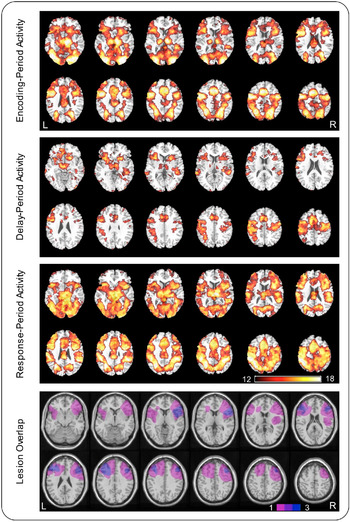
Diagram illustrating a group fMRI map of encoding period (top-panel), delay-period (middle panel) and probe-period (bottom panel) PFC activity across healthy control subjects. The group map represents the summation of regions that were positively activated during the encoding, delay or retrieval/response period in at least 12 of the 18 subjects. The bottom panel is a diagram illustrating the overlap of frontal lesions across patients.

Behavioral data from span and delay tasks
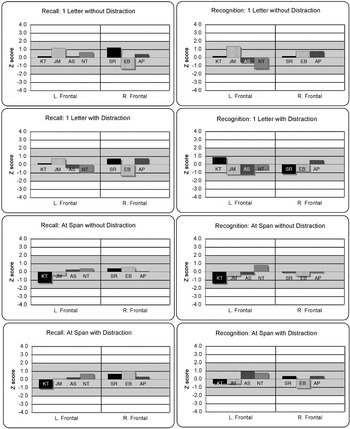
Behavioral performance of patients for each of the behavioral conditions of the recall and recognition task. The gray background represents the range of two standard deviations of the mean performance of the control subjects.
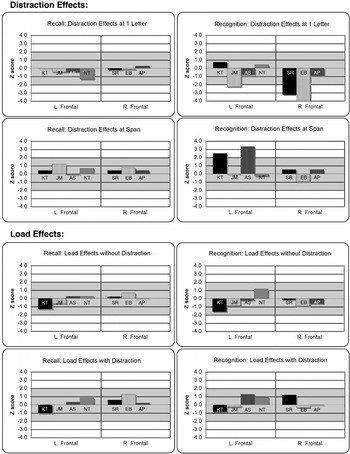
Behavioral performance of patients for the effect of varying memory load (one item vs. subject's span) and the delay-period distraction effect (presence or absence) on the recall and recognition task. The gray background represents the range of two standard deviations of the mean performance of the control subjects.
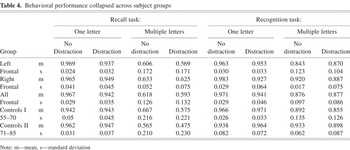
Behavioral performance collapsed across subject groups
 You have
Access
- 55
- Cited by