




No CrossRef data available.
Article contents
Transmission dynamics of Echinococcus multilocularis; its reproduction number, persistence in an area of low rodent prevalence, and effectiveness of control
Published online by Cambridge University Press: 24 March 2005
Abstract
On the basis of high prevalences of Echinococcus multilocularis in the growing fox populations in Central Europe, its total biomass may have increased significantly in the past 20 years. E. multilocularis is now also found in areas outside the known endemic area in Central Europe. Therefore, E. multilocularis, the causative agent of a serious parasitic zoonosis, might be of major concern for public health and a challenge to control. Some experimental field trials to control E. multilocularis using an anti-worm drug reduced parasite burden in a contaminated region during the control campaign, but failed to eradicate the parasite completely. It was our aim to develop a mathematical model describing the biomass of egg, larval, and adult worm stages of the E. multilocularis life-cycle, and simulate a hypothetical control campaign. Additionally, we derived the reproduction number of this parasite and explored conditions for the persistence of the parasite's life-cycle. Our model shows that while control campaigns rapidly reduce the worm burden in the definitive host, and consequently eggs in the environment, the pool of larvae in the intermediate host remains large. The parasite's life-cycle persists in a region where prevalence in the intermediate host is low (∼1%). Therefore, we conclude that the parasite is likely to re-emerge if control is discontinued on the basis of reduced worm population. Continued treatment of the definitive host is required to eradicate the larval stage of the parasite from the intermediate host population.
Information
- Type
- Research Article
- Information
- Copyright
- © 2005 Cambridge University Press
INTRODUCTION
Alveolar echinococcosis in humans is caused by a larval stage of the small fox tapeworm Echinococcus multilocularis. In Europe, approximately 100 patients are newly diagnosed with the disease over a 5-year period (Kern et al. 2003). The tapeworm requires multiple host species to complete its life-cycle. A main definitive host of the tapeworm in Europe is the red fox (Vulpes vulpes). Intermediate hosts are various small rodents, e.g. Microtus arvalis and Arvicola terrestris. Surveillance revealed that the prevalence in the fox population reached up to 65 in some parts of Europe (Tackmann et al. 1998; Hofer et al. 2000; Berke, 2001). Prevalence in intermediate hosts is generally low (1–6) (Stieger et al. 2002) compared with the prevalence in foxes in the same region (Baumeister et al. 1997; Stieger et al. 2002; Borgsteede, Tibben & van der Giessen, 2003; van der Giessen, Rombout & Teunis, 2004) although in some highly endemic spots, a higher prevalence has been recorded (Gottstein et al. 2001).
The parasite can be expelled from foxes by administration of an anthelmintic drug. Baits containing Praziquantel were distributed in endemic regions of Germany and Switzerland to reduce the parasite burden in these regions. In an area of 5000 km2 near Berlin, prevalence in foxes was reduced to less than 1 over the campaign period, but returned to pre-control level in approximately 1 year after the baiting had been discontinued (Tackmann et al. 2001). In a small area near Zurich, Switzerland, parasite prevalence in foxes was reduced to a few percent as a result of baiting for 1 year (Hegglin, Ward & Deplazes, 2003). Reduction of prevalence in foxes was followed by reduction of prevalence in the main intermediate host in the region. At the end of the campaign, eggs could still be detected in fox droppings. Anthelmintic therapy can reduce the parasite burden while the campaign lasts, but so far it has failed to permanently eradicate the parasite from an endemic region.
Mathematical and simulation models have been developed in an attempt to explain observations from field studies and to evaluate a control strategy. Fox and rodent populations are typically grouped according to whether they are susceptible, infected but not infectious, or infectious. Transmission of the disease is proportional to the number of contacts between susceptible and infected host populations. Roberts & Aubert (1995) derived the reproduction number, R0, and concluded that eradicating the parasite by drug treatment may be possible in a low endemic region. Using a spatially explicit simulation model, Hansen et al. (2003, 2004) reproduced the observed reduction in prevalence in the fox following control trials and proposed landscape heterogeneity and host immunity as possible explanations for the re-bounce in the post-control period. Others used mathematical modelling to investigate large seasonal fluctuation of host population densities (Ishikawa, Ohga & Doi, 2003). Formulation of these mathematical and simulation models is strongly influenced by the practice in field studies to monitor the disease by prevalence. However, parasite biomass in infected host species is a focus in some models of E. granulosus (Torgerson & Heath, 2003).
We developed a novel mathematical model describing the life-cycle of E. multilocularis in the environment, in definitive, and in intermediate hosts. The main variables are the number (i.e. biomass) of eggs, larva and worm in a limited region, e.g. a fox territory. The choice of variables is the main difference from the previously published models of E. multilocularis. In this regard, our model is similar in approach to those of other macroparasite infections (Anderson & May, 1991), but modified to describe the particular life-cycle of E. multilocularis. We derived a reproduction number (R0) of the parasite. It is the expected number of mature parasites produced during the life-span of a single parasite. In short, the parasite persists in an area when R0>1 and becomes extinct when R0<1. The reproduction number is an important concept in infectious disease modelling. In the published models of E. multilocularis, R0 is basically the average number of secondary infections when a single infected fox is introduced to a population consisting entirely of susceptible foxes. Although we use the same symbol R0, the reproduction number in our model compared to those of previous models is different in interpretation.
We simulated the time-course of the worm, larva, and egg biomass following a hypothetical de-worming treatment of the definitive host. This type of simulation has rarely (Hansen et al. 2003) been done for E. multilocularis. We observed that while the drug treatment rapidly kills the worm to a fraction of the original biomass, a larger pool of larvae is still present in the intermediate host population. If the treatment is discontinued on the basis of reduced worm population size, as monitored by low prevalence in foxes, the parasite is likely to re-emerge.
MATERIALS AND METHODS
Development of the model
A mathematical model representing the transmission dynamics of E. multilocularis in the sylvatic cycle, including the eggs in the environment, has been developed with the following assumptions about the host populations. (1) The mean fox density (n) and the mean rodent density (a) are constants. (2) Infected foxes and rodents neither enter nor leave the territory.
The fox population is divided into groups according to the number of worms per fox. Denoting by pi(t) the probability of a fox harbouring i worms at time t. Similarly, the rodent population is divided into groups according to the number of protoscoleces per rodent, and denoting by qi(t) the probability of a rodent harbouring i protoscoleces at time t. The mean number of worms per fox is modelled,

and the mean number of protoscoleces per rodent,

, as well as the number of eggs in the environment, G(t) (Table 1).

The model equations read,


The differentiation is indicated by the symbol

. The parameters are described in the section on the parameter estimates.
The number of eggs (Eq. 1) in the environment increases by shedding and decreases by inactivation in the environment and pick up by rodents. Foxes harbouring i worms release eggs at the rate equal to λφnipi(t), where λ is the release rate of proglottides and φ is the average number of eggs contained in a proglottis. The total egg release by all foxes in the territory is equal to the sum

. The loss term −μ3G(t) accounts for the death of eggs in the environment. The rate of egg ingestion is assumed to be proportional to the rodent density giving the loss term −β2aG(t) by ingestion.
The number of protoscoleces in an intermediate host increases by infection by eggs and decreases by hunting of rodents by foxes (Eq. 2). Following a maturation period (τ2), a single ingested egg develops into a cyst with probability π2. The cyst splits a number of times to become multiple cysts containing the number σ of protoscoleces on average per infected rodent. The total gain of protoscoleces from all the ingested eggs is equal to β2aσπ2G(t−τ2). The likelihood of a rodent ingesting an egg twice is assumed to be negligible. Total gain term is divided by the rodent density (a) to express the gain per rodent. The loss of protoscoleces occurs when a rodent dies resulting in the term −μ2L(t) and when a fox eats rodents. We assume that the hunting rate is proportional to the fox density (β1n) and the same for all rodents, giving the loss term

.
In the definitive host (Eq. 3), an ingested protoscolex develops into a single worm with probability π1 after a maturation period (τ1). The total gain of worms from all hunted rodents is equal to β1nπ1aL(t−τ1). This term is divided by the fox density n to express the gain per fox. The term −μ0M(t) accounts for the loss of worms due to the death of infected foxes.
During the baiting period a fox eats bait with the probability of α per day. The worms exposed to the drug die at the accelerated rate θ. The loss of worms due to the baiting is equal to

. Natural situation without drug treatment of the definitive host is described when α is equal to zero.
Parameter estimates
All parameters are estimated for an area of 1 km2.
Mean fox and rodent population densities (n, a)
Fox density is very difficult to estimate. In our study area in Limburg, a local expert estimated that there are 3–4 foxes per km2 in spring and 4–9 per km2 in autumn (Jaap Mulder, personal communication). The mean rodent density is estimated from the vole population that ranges from 300 to 400 voles per hectare (Patrick Giraudoux, personal communication). We assume 4 foxes per km2 and 35 000 rodents per km2.
Probability of infection in foxes (π1)
We assume that 50 to 70 of ingested protoscoleces can mature into adult worms in foxes. This figure may be lower by a factor 10 in older foxes that acquired immunity from the previous encounter with the parasite. Assuming that half of the fox population are naïve and the other half have acquired immunity, we calculate the mean probability of infection of 0·4 (≈0·7/2+0·07/2) per ingested protoscolex.
Rate of death (μ0, μ1, μ2, μ3)
The mean age of the foxes shot in the Limburg region in the Netherlands was 15 months (Mulder, Jansman & van der Giessen, 2004). The rate of death of a fox is calculated as μ0=(450 days)−1. Roberts & Aubert (1995) cited a life-span of 1·6 years for foxes and 6 months for voles. The rate of death of rodents is calculated as μ2=(182 days)−1.
The observation of E. multilocularis egg infectivity in the natural environment of southern Germany (Veit et al. 1995) fits the exponential distribution with an average egg life-expectancy of 57 days with 95 CI of 18–95 days. The rate of death of an egg is calculated as μ3=(57 days)−1.
The rate of death of adult worms was calculated based on an experimental infection study (Nonaka et al. 1996). Two red foxes were given 150 000 protoscoleces per fox and 11 and 91 worms were recovered on the 125th day post-infection. Assuming that 50 and 70 of ingested protoscoleces infected the foxes and took 30 days to mature into adult worms, we calculate the exponential death rate to be μ1=(12 days)−1.
Average number of protoscoleces per infected rodent (σ)
The total biomass of protoscoleces in 26 infected Arvicola caught around Zurich was 926 239 protoscoleces (Stieger et al. 2002). The average is 35 000 per infected rodent.
Probability of infection in rodents (π2)
In an experimental infection, nineteen C57/BL/6J mice each inoculated with 2000 E. multilocularis eggs developed 6 cysts on average per mouse after 40 days post-inoculation (Hildreth, Blunt & Oaks, 2004). Three C3H mice each inoculated with 2000 E. multilocularis eggs developed 22 cysts on average per mouse. If a single infecting egg resulted in a single cyst, the probability of infection is estimated to be

per inoculated egg.
Hunting rate (β1)
A study of the stomach contents in 90 foxes in Limburg in January and February of 2003 revealed that fox stomach contained an average 22 g of small rodents (Mulder et al. 2004). Microtus weighs approximately 30 g and we estimate the mean consumption to be 0·7 (≈22 g/30 g) rodents per fox per day. Because Arvicola species made up less than 1 of all rodents eaten, we estimate the mean consumption of Arvicola species to be 0·007 per fox per day. The hunting rate of Arvicola species is calculated as 0·007 Arvicola per fox per day per km2/35 000 Arvicola per km2=2×10⁻⁷ per fox per day.
Egg ingestion rate (β2)
Because no relevant experimental data could be found, we had to resort to indirect estimation. We argue that in an endemic area newly infected rodents fully replace the dying infected rodents. If the likelihood of ingesting the eggs twice is negligible, the egg ingestion rate is related to the other parameters by π2β2a≈ρ(β1n+μ2), where ρ is the parasite prevalence in rodents. Assuming 1 parasite prevalence in rodents (ρ=0·01), the egg ingestion rate is β2=2·3×10−7 per rodent per day.
Numerical analysis
Numerical solutions of the model equations are calculated using the software Mathematica (Wolfram Research).
RESULTS
Parasite biomass during anti-worm drug treatment of the definitive host
Time-courses of worm, larva, and egg biomass during a hypothetical de-worming campaign lasting for 2 years are shown in Fig. 1. The assumption is that an adult worm is exposed to the drug with the probability of 20 per day. Worms exposed to the drug are assumed to die in 6 h.

Fig. 1. Reduction of parasite biomass following anti-worm drug treatment of the definitive host. Simulation of a hypothetical control campaign using the parameter estimates listed in Table 2. The anti-worm drug reduces the worm biomass after 2 years of treatment, but the larval biomass remains high: solid line (worm), dashed line (egg), dotted line (larva). The biomass at the start of the treatment on day 0 is 100.

The time-course of the worm population after de-worming can be divided into 3 periods. The first, a period of rapid decrease in the number of worms, followed by a period of steady state and, finally, a period of slow decrease. In the first period, most worms present at the start of de-worming are exposed to the drug and killed in a short period within days. In the second period, new worms still mature from the existing pool of larvae in the intermediate host, but most of these worms live shorter than in the pre-control period due to de-worming. The worm biomass is stable at a reduced level. In the third period, smaller numbers of worms mature, as the pool of larvae becomes smaller. The number of worms decreases slowly again.
The time-course of the larva population can be divided into 2 periods, the initial period of steady state, followed by decrease. In the first period, the larval population is unchanged because larvae are hatching from eggs that were ingested before de-worming. The length of the first period is determined by the maturation time of eggs in the intermediate host. In the second period, the larval population decreases because fewer larvae are developing from the ever-decreasing number of eggs in the environment due to de-worming.
Life-expectancies and the mean host population densities
The duration of the control is dependent on parameters that may differ considerably from one geographical location to another. For example, the life-expectancy of rodents is typically less than 1 year, but some rodent species live for 2 years on average. We investigated how the duration of control would depend on the estimated life-expectancies of eggs, worms, rodents, and foxes (Fig. 2). The duration of control rapidly increases with the longer life-expectancy of the intermediate host. There is also a steep dependency on the life-expectancy of eggs. The life-expectancies of adult worms and fox have virtually no impact on the duration of control. We also investigated dependency on the mean fox population density. The period of control is expected to be prolonged in an area where the mean fox population density is high (Fig. 3).

Fig. 2. Dependency of parasite decay on the life-expectancy. Half time is defined as the period during which 50 of the parasite biomass is eliminated as a consequence of the hypothetical control campaign. Half time is equal to −ln[2]/s where the decay rate s is defined by Eq. 6. A longer half time means a longer control period. The horizontal dashed line corresponds to the reference half time of the hypothetical control shown in Fig. 1. Solid lines indicate departure from the reference half time as the life-expectancies change from the estimates in Table 2. Tested ranges of life-expectancies are 60–365 days (rodent), 365–730 days (fox), 18–95 days (egg), 7 to 150 days (worm).

Fig. 3. Dependency on fox population densities. The duration of control period increases with higher fox population densities. The unit of the fox population density is per km2.
Intensive and non-intensive control
Control measures are expensive and minimizing the cost is a priority. To investigate the effect of control intensity, we varied the probability of exposure to an anthelmintic drug (Fig. 4). With the probability of 0·2 per day, a fox consumes bait every 5 days on average. Less-intensive control will require a lengthy time-period to achieve the same effect and may not be cost effective in the end. On the other hand, making the control more intensive beyond a certain intensity will have little increase in effect and hence diminishes the cost benefits.

Fig. 4. Intensive and non-intensive control.
Persistence of the life-cycle
We derived the reproduction number of E. multilocularis to investigate whether the parasite population will re-emerge after severe reduction of the parasite population in egg, larva, and adult worm stage. In the derivation (Appendix), we assumed that the time-series of the worm population size has the exponential form. We did not assume a density-dependent process that limits the growth of worm population. These are reasonable assumptions when the parasite is emerging. We related the resulting reproduction number R0 with the parasite prevalence in the intermediate host population.
Based on the reproduction number R0 (Eq. 8) we illustrate that the life-cycle of the parasite can persist in a region of low rodent prevalence (Fig. 5). Field surveillance recorded that the prevalence of the intermediate host is typically 1–6 (Stieger et al. 2002). For this range of prevalence, the life-cycle of the parasite persists for a fox population density greater than ~1 per km2. The implication of this result is that an attempt to control the parasite by keeping the fox density in check will fail in most areas contaminated with this parasite. The region of persistence (R0>1) depends on the transmission parameters, in particular, on the probability of infection in the fox. If it were possible to vaccinate foxes to lower the probability of infection, the life-cycle of the parasite might become non-persistent in a place where the parasite prevalence in the population of rodents is low and the fox population density is not too high.

Fig. 5. Parasite life-cycle persists in a region of low rodent prevalence. The lines are the borderline conditions separating persistence (R0>1) and non-persistence of the parasite life-cycle. The borderline conditions are shown for 3 probabilities of infection (π1) in definitive hosts; 1 (long dashed line), 0·4 (solid line), and 0·1 (short dashed line).
Re-emergence after the treatment period
The parasite control campaign in Northern Germany reduced the prevalence in the fox population to less than 1 but the parasite recovered unexpectedly and rapidly following the end of the campaign (Tackmann et al. 2001). To mimic the situation, the hypothetical de-worming (Fig. 1) is discontinued after 2 years by setting the parameter α equal to zero. The reproduction number in the absence of control is R0=2·2. Immediately following the discontinuation, worm biomass increased rapidly, closely followed by the egg biomass in the environment (Fig. 6). Recovery of larval biomas lagged behind. At the time of the discontinuation, the parasite biomass is reduced to approximately 3 in the worm stage and 4 in the egg stage, but 15 is still present in the larval stage. The parasite control campaign in Northern Germany did reduce the worm biomass, but the parasite might have been present in its larval form to initiate the recovery of the parasite in the subsequent period.

Fig. 6. Re-emergence of parasite after the control period. The surveillance data following the baiting in Northern Germany are shown in dots (with permission from Dr Kirsten Tackmann). The treatment of the definitive host was discontinued after 2 years. Smooth lines are the model predictions as described in Fig. 1.
The predicted parasite biomass does not return to the pre-control level, but increases indefinitely. This unrealistic property stems from the lack of a density- dependent parasite growth in our model, such as reduced egg production in a heavily infected fox, increased death of heavily infected rodents, or acquiring immunity against the parasite.
DISCUSSION
Results of the hypothetical parasite control are in line with observations of real parasite control programmes. These are re-emergence of the parasite after the termination of parasite control programme in Northern Germany and delayed reduction of parasite prevalence in the intermediate host population near Zurich. The similarity between the model and the field experiments make those observations more than a collection of incidental notes, and indicates interesting possibilities to a better understanding of the disease and to designing a control plan.
In a control plan, the life-expectancy of intermediate host warrants careful consideration because it strongly influences the rate at which the parasite disappears from the control area. The shorter the rodent life-expectancy, the faster the parasite disappears. In our model the life-expectancy of Arvicola terrestris is assumed. In reality, the intermediate host will be a mixture of various small rodents being characterized by differing life-expectancies. Most rodent species live less than 1 year. However, muskrats are estimated to live 2 years on average. In an area where infected muskrats are widely found and predated, a longer control period is expected. Knowing the bio-diversity of small rodents in an area, in particular the inventory of the longest living intermediate host species, is important when setting up a control plan.
It would be advantageous to know the optimal time period of a control campaign. The simulation of the model and the observation of experimental treatment in the Zurich area demonstrated that disappearance of the parasite occurs first in the worm stage, then in the egg stage, and finally in the larval stage. A suggestion would be to stop the control when the last infected rodent dies. This event is a stochastic process. Another approach would be to estimate a time-point when the larval biomass reaches a value considered to be small enough, e.g. 99 reduction. After reaching this goal, the control period could be ended.
Re-emergence of the parasite after stopping the control is strikingly similar between the hypothetical control and the field data. However, the main purpose is to show that the parasite re-emerges due to incompletely removed larvae in rodents, and we are by no means suggesting a relationship between biomass and prevalence. To obtain such a relationship, we would have to know the worm burden of individual foxes. The rate of re-emergence in the hypothetical control depends strongly on the probability of infection by the protoscolex and by the egg. Estimates on the probability of infection in foxes and rodents are associated with large uncertainty because there are only a small number of experiments available.
A successful control measure decreases infection pressure and this could result in a larger proportion of foxes and rodents susceptible to the parasite. If herd immunity is lost by the time the control is terminated, the probability of infection in foxes could be nearly 1 instead of 0·4 that we assumed. In this case, the reproduction number of the parasite doubles and consequently the parasite re-emerges more apidly than it is shown in Fig. 6. Loss of herd immunity in the rodent population has the same effect on the rate of re-emergence in the post-control period.
Future improvement of the model includes integrating the population dynamics of the host species with the parasite transmission dynamics. Seasonal variation in the fox and rodent populations around the mean population densities can be large. Also, predator-prey relationship between fox and rodent could produce a new dynamical property of the parasite dynamics. However, based on the estimated rates of hunting and rodent death, it seems that hunting by foxes is only a minor cause of death for rodents, i.e. β1[Lt ]μ2. Another point of improvement is to treat the parameters as probability distribution instead of point estimates to produce a rage of possible parasite burdens during and after a control. To achieve this goal, it would be required to bring together expert knowledge of E. multilocularis, foxes, rodents, and mathematics.
In conclusion, we describe a mathematical model representing the transmission dynamics of E. multilocularis in the sylvatic cycle including eggs in the environment. Infectious eggs are believed to be the most important parameter related to human infection risks. Moreover, we analysed the outcome of a virtual control programme and evaluated the outcome with the outcomes of previously described experimental control programmes. Based on this model we provided more insight into the important parameters in the life-cycle of E. multilocularis, which will give direction to further control strategies.
We thank Kirsten Tackmann for granting permission to use the surveillance data. We also thank Hans Heesterbeek and Frank Hansen for critical reading of the manuscript, as well as Peter Teunis and Jaap Mulder for fruitful discussions.
APPENDIX
To derive the reproduction number of E. multilocularis, we assume that the function describing the worm population has the exponential form est, where s is the rate of change of worm population. Substituting est for M(t) we arrive at a single equation for the mean worm burden per fox. Long-time dynamics of the worm population is described by the following equation.

where

Substituting est once more for M(t), the rate s is implicitly defined by the following relationship.

The maturation times τ1 and τ2 are very long for this parasite, so these cannot be ignored when finding the rate s.
The growth rate s of the worm population is positive when,

To relate R0 with the parasite prevalence in rodents, we first set α=0 (the parasite control is absent), and argue that in an endemic region, the rate of infection of rodents by eggs balances the rate of death of infected rodents, i.e. π2β2a≈ρ(β1n+μ2), where ρ is the parasite prevalence in rodents. Underlying assumption in our argument is that the likelihood of a rodent ingesting the egg twice is negligible.
With this argument, the reproduction number is related with the rodent prevalence,

References
REFERENCES
ANDERSON, R. M. &
MAY, R. M. (
1991).
Infectious Diseases of Humans.
Oxford University Press,
New York.
BAUMEISTER, S.,
POHLMEYER, K.,
KUSCHFELDT, S. &
STOYE, M. (
1997).
Prevalence of Echinococcus multilocularis and other metacestodes and cestodes in the muskrat (Ondatra zibethicus LINK 1795) in Lower Saxony.
Deutsche Tierärztliche Wochenschrift
104,
448–452.Google Scholar
BERKE, O. (
2001).
Choropleth mapping of regional count data of Echinococcus multilocularis among red foxes in Lower Saxony, Germany.
Preventive Veterinary Medicine
52,
119–131.CrossRefGoogle Scholar
BORGSTEEDE, F. H.,
TIBBEN, J. H. &
VAN DER GIESSEN, J. W. (
2003).
The musk rat (Ondatra zibethicus) as intermediate host of cestodes in the Netherlands.
Veterinary Parasitology
117,
29–36.CrossRefGoogle Scholar
GOTTSTEIN, B.,
SAUCY, F.,
DEPLAZES, P.,
REICHEN, J.,
DEMIERRE, G.,
BUSATO, A.,
ZUERCHER, C. &
PUGIN, P. (
2001).
Is high prevalence of Echinococcus multilocularis in wild and domestic animals associated with disease incidence in humans?
Emerging Infectious Diseases
7,
408–412.Google Scholar
HANSEN, F.,
JELTSCH, F.,
TACKMANN, K.,
STAUBACH, C. &
THULKE, H. H. (
2004).
Processes leading to a spatial aggregation of Echinococcus multilocularis in its natural intermediate host Microtus arvalis.
International Journal for Parasitology
34,
37–44.CrossRefGoogle Scholar
HANSEN, F.,
TACKMANN, K.,
JELTSCH, F.,
WISSEL, C. &
THULKE, H. H. (
2003).
Controlling Echinococcus multilocularis-ecological implications of field trials.
Preventive Veterinary Medicine
60,
91–105.CrossRefGoogle Scholar
HEGGLIN, D.,
WARD, P. I. &
DEPLAZES, P. (
2003).
Anthelmintic baiting of foxes against urban contamination with Echinococcus multilocularis.
Emerging Infectious Diseases
9,
1266–1272.CrossRefGoogle Scholar
HILDRETH, M. B.,
BLUNT, D. S. &
OAKS, J. A. (
2004).
Lethal effects of freezing Echinococcus multilocularis eggs at ultralow temperatures.
Journal of Parasitology
90,
841–844.CrossRefGoogle Scholar
HOFER, S.,
GLOOR, S.,
MULLER, U.,
MATHIS, A.,
HEGGLIN, D. &
DEPLAZES, P. (
2000).
High prevalence of Echinococcus multilocularis in urban red foxes (Vulpes vulpes) and voles (Arvicola terrestris) in the city of Zurich, Switzerland.
Parasitology
120,
135–142.CrossRefGoogle Scholar
ISHIKAWA, H.,
OHGA, Y. &
DOI, R. (
2003).
A model for the transmission of Echinococcus multilocularis in Hokkaido, Japan.
Parasitology Research
91,
444–451.Google Scholar
KERN, P.,
BARDONNET, K.,
RENNER, E.,
AUER, H.,
PAWLOWSKI, Z.,
AMMANN, R. W.,
VUITTON, D. A. &
KERN, P. (
2003).
European echinococcosis registry: human alveolar echinococcosis, Europe, 1982–2000.
Emerging Infectious Diseases
9,
343–349.CrossRefGoogle Scholar
MATSUDO, K.,
INABA, T. &
KAMIYA, H. (
2003).
Detection of Echinococcus multilocularis eggs by centrifugal flotation technique: preliminary survey of soil left in the ferryboats commuting between Hokkaido Island, where E. multilocularis is endemic, and mainland Japan.
Japanese Journal of Infectious Diseases
56,
118–119.Google Scholar
MATSUMOTO, J.,
YAGI, K.,
NONAKA, N.,
OKU, Y. &
KAMIYA, M. (
1998).
Time-course of antibody response in mice against oral infection with eggs of Echinococcus multilocularis.
Parasitology
116,
463–469.CrossRefGoogle Scholar
MULDER, J. L.,
JANSMAN, H. A. H. &
VAN DER GIESSEN, J. (
2004).
Ecologisch onderzoek aan geschoten vossen in Zuid-Limburg, 2002–2003. Onderzoeksrapport vos 2004-1.
Alterra,
Wageningen.
NONAKA, N.,
IIDA, M.,
YAGI, K.,
ITO, T.,
OOI, H. K.,
OKU, Y. &
KAMIYA, M. (
1996).
Time course of coproantigen excretion in Echinococcus multilocularis infections in foxes and an alternative definitive host, golden hamsters.
International Journal for Parasitology
26,
1271–1278.CrossRefGoogle Scholar
ROBERTS, M. G. &
AUBERT, M. F. (
1995).
A model for the control of Echinococcus multilocularis in France.
Veterinary Parasitology
56,
67–74.CrossRefGoogle Scholar
STIEGER, C.,
HEGGLIN, D.,
SCHWARZENBACH, G.,
MATHIS, A. &
DEPLAZES, P. (
2002).
Spatial and temporal aspects of urban transmission of Echinococcus multilocularis.
Parasitology
124,
631–640.CrossRefGoogle Scholar
TACKMANN, K.,
LOSCHNER, U.,
MIX, H.,
STAUBACH, C.,
THULKE, H. H. &
CONRATHS, F. J. (
1998).
Spatial distribution patterns of Echinococcus multilocularis (Leuckart 1863) (Cestoda: Cyclophyllidea: Taeniidae) among red foxes in an endemic focus in Brandenburg, Germany.
Epidemiology and Infection
120,
101–109.CrossRefGoogle Scholar
TACKMANN, K.,
LOSCHNER, U.,
MIX, H.,
STAUBACH, C.,
THULKE, H. H.,
ZILLER, M. &
CONRATHS, F. J. (
2001).
A field study to control Echinococcus multilocularis-infections of the red fox (Vulpes vulpes) in an endemic focus.
Epidemiology and Infection
127,
577–587.CrossRefGoogle Scholar
TORGERSON, P. R. &
HEATH, D. D. (
2003).
Transmission dynamics and control options for Echinococcus granulosus.
Parasitology
127 (Suppl.),
S143–S158.CrossRefGoogle Scholar
VAN DER GIESSEN, J. W.,
ROMBOUT, Y. &
TEUNIS, P. (
2004).
Base line prevalence and spatial distribution of Echinococcus multilocularis in a newly recognized endemic area in the Netherlands.
Veterinary Parasitology
119,
27–35.CrossRefGoogle Scholar
VEIT, P.,
BILGER, B.,
SCHAD, V.,
SCHAFER, J.,
FRANK, W. &
LUCIUS, R. (
1995).
Influence of environmental factors on the infectivity of Echinococcus multilocularis eggs.
Parasitology
110,
79–86.CrossRefGoogle Scholar

Table 1. The variables of the mathematical model

Fig. 1. Reduction of parasite biomass following anti-worm drug treatment of the definitive host. Simulation of a hypothetical control campaign using the parameter estimates listed in Table 2. The anti-worm drug reduces the worm biomass after 2 years of treatment, but the larval biomass remains high: solid line (worm), dashed line (egg), dotted line (larva). The biomass at the start of the treatment on day 0 is 100.
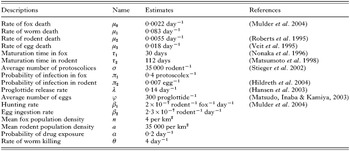
Table 2. Estimates for the parameters in the mathematical model of Echinococcus multilocularis life-cycle
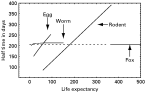
Fig. 2. Dependency of parasite decay on the life-expectancy. Half time is defined as the period during which 50 of the parasite biomass is eliminated as a consequence of the hypothetical control campaign. Half time is equal to −ln[2]/s where the decay rate s is defined by Eq. 6. A longer half time means a longer control period. The horizontal dashed line corresponds to the reference half time of the hypothetical control shown in Fig. 1. Solid lines indicate departure from the reference half time as the life-expectancies change from the estimates in Table 2. Tested ranges of life-expectancies are 60–365 days (rodent), 365–730 days (fox), 18–95 days (egg), 7 to 150 days (worm).

Fig. 3. Dependency on fox population densities. The duration of control period increases with higher fox population densities. The unit of the fox population density is per km2.
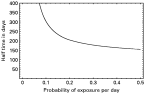
Fig. 4. Intensive and non-intensive control.
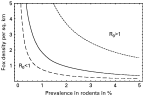
Fig. 5. Parasite life-cycle persists in a region of low rodent prevalence. The lines are the borderline conditions separating persistence (R0>1) and non-persistence of the parasite life-cycle. The borderline conditions are shown for 3 probabilities of infection (π1) in definitive hosts; 1 (long dashed line), 0·4 (solid line), and 0·1 (short dashed line).
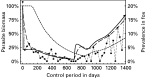
Fig. 6. Re-emergence of parasite after the control period. The surveillance data following the baiting in Northern Germany are shown in dots (with permission from Dr Kirsten Tackmann). The treatment of the definitive host was discontinued after 2 years. Smooth lines are the model predictions as described in Fig. 1.
 You have
Access
- 14
- Cited by