Title IX is best known today for increasing opportunities for women and girls in sports, but feminist activists in the early 1970s were primarily concerned with passing the law to eliminate persistent discrimination in the classroom. Feminists were excited about Title IX's potential to eliminate such inequalities, but its passage in Congress was only the first step in a very long implementation process. As a result, feminists have been lobbying education officials about Title IX's implementation since the early 1970s. In the early 2000s, they participated in a four-year debate that revised Title IX's regulations to allow schools to offer single-sex classes in public secondary and elementary schools for the first time in 31 years.
Feminist organizations' active participation in this debate reveals that rulemaking, which follows the enactment of a law in Congress, is an important component of their lobbying strategies. However, scholars know very little about the impact of feminist organizations in this process or why bureaucrats may or may not find their comments convincing. This article answers these questions by examining whether the findings from the rulemaking literature indicating that interest groups should be influential in the rulemaking process when they submit large numbers of high-quality, homogeneous comments (see Furlong and Kerwin Reference Furlong and Kerwin2005; Golden Reference Golden1998; Yackee and Yackee Reference Yackee and Yackee2006; Yackee Reference Yackee2006) also hold for feminist organizations seeking to influence rulemaking in education, a redistributive policy area. Specifically, I use open coding to analyze a sample of 170 of the 5,860 comments that the Office for Civil Rights (OCR) in the U.S. Department of Education received in 2004 to identify and describe the types of arguments that six categories of participants—feminist organizations, charter school advocates, parents, students, educators, and policy makers—submitted during this debate.
Although the existing literature suggests that feminist organizations may have been able to encourage the OCR to revise its proposed rule by submitting a large number of high-quality, homogenous comments opposing the revised rule, in fact, I find that feminists' comments did little to encourage bureaucrats at the OCR to change their proposal. Instead, the OCR's written justifications for the revised rule reflected primarily the views of charter school advocates who submitted a large number of homogenous comments that generally supported the OCR's proposal. Thus, when the OCR was confronted with two conflicting sets of relatively high-quality, homogenous comments, it emphasized charter school advocates' views because their comments supported the administration's approach to Title IX and the proposed rule.
RULEMAKING AND FEMINIST ORGANIZATIONS' ROLE IN THE PROCESS
Although the rulemaking process is relatively unfamiliar, it is an important component of the policy-making process that occurs after a law is enacted, as it allows bureaucrats to use their specific policy expertise to “fill in” the technical and minor details required to implement laws that Congress left out (Epstein and O'Halloran Reference Epstein and O'Halloran1999; Huber and Shipan Reference Huber and Shipan2002). During rulemaking, the Administrative Procedure Act of 1946 requires agencies to publish their proposed rules in the Federal Register and then to give interested citizens and/or organizations the opportunity to submit comments in response to the proposed rule (Golden Reference Golden1998). At this stage, however, bureaucrats retain considerable discretion to respond to the written comments as they see fit, and they may be hesitant to make major changes after they have already devoted a great deal of time and effort to drafting their proposed rules (Golden Reference Golden1998; Kerwin and Furlong Reference Kerwin and Furlong2011, 54; West Reference West2004, Reference West2009). When bureaucrats do respond to comments, it is often because they wish to avoid having their rules challenged in court (Kerwin and Furlong Reference Kerwin and Furlong2011).
Despite bureaucrats' considerable discretion in terms of how they respond to comments, it is an attractive policy-making venue for feminist organizations because it provides all interested citizens and organizations—not just those with access to their members of Congress—with the opportunity to participate. Agencies have promulgated 10 times as many rules as Congress has passed laws in recent decades (Yackee and Yackee Reference Yackee and Yackee2006), providing organizations with a way to create meaningful policy change even as rising levels of gridlock and partisan polarization have stalled congressional policy making (Binder Reference Binder2003; Mansbridge and Martin Reference Mansbridge and Jo Martin2013; Theriault Reference Theriault2008; Voteview 2014).Footnote 1 Hence, surveys show that between 80% and 82% of organizations participate in the rulemaking process, and 64% of them claim that participation is a top priority (Furlong Reference Furlong1997; Furlong and Kerwin Reference Furlong and Kerwin2005).
Because rulemaking has become an increasingly important component of organizations' lobbying strategies, much of the empirical literature on rulemaking analyzes comments to determine which commenters tend to convince bureaucrats to change their proposed rules. For example, Golden (Reference Golden1998) found that agencies were most likely to change their proposed rules when commenters submitted a large number of objections to the proposed rules and/or the commenters reflected a consensus on the issue. She also found that when the commenters conflicted with one another, agencies tended to “hear most clearly the voices that support the agency's position” (261). Similarly, Yackee (Reference Yackee2006) found that bureaucrats were more likely to respond to commenters' concerns when interest groups were united in their opinions. Agencies are also more likely to change their rules to match the expressed preferences of business organizations rather than other commenters because business organizations submit the majority of comments and have the technical and policy-making expertise needed to draft convincing comments that ordinary citizens lack (Yackee and Yackee Reference Yackee and Yackee2006). Finally, Shapiro (Reference Shapiro2008) found that bureaucrats were more likely to make changes to their final rules when they received a large number of comments on complex, low-salience rules. Taken together, these studies suggest that agencies tend to change their proposed rules when they receive a large number of opposing comments and when they receive relatively large numbers of high-quality, homogenous comments that suggest there is a consensus among the commenters.
FEMINIST ORGANIZATIONS AND THE RULEMAKING PROCESS
Given the increasing importance of the rulemaking process and research showing that organizations can successfully convince bureaucrats to change their final rules by submitting large numbers of opposing and/or relatively homogenous comments, more research is needed to examine whether and how this process is used to address women's policy issues. Thus far, the empirical rulemaking literature has not addressed these questions because it has been motivated largely by concerns about whether the process is biased toward business organizations (see Furlong and Kerwin Reference Furlong and Kerwin2005; Golden Reference Golden1998; Yackee and Yackee Reference Yackee and Yackee2006). As a result, the literature does not directly address the impact of feminist organizations. Instead, studies lump advocacy organizations, such as feminist groups, in with other “nonbusiness, nongovernmental” commenters, a group that also includes citizens, public interest groups, academics, professional associations, and unions (Yackee and Yackee Reference Yackee and Yackee2006). Thus, it is unclear whether previous findings suggesting that business organizations are able to influence the rulemaking process when they submit large numbers of high-quality, homogenous comments also hold for professionalized feminist organizations that may lack the power and prestige of business groups. Focusing on business organizations also means that most studies of the rulemaking process focus on policies related to the government's role in regulating the economy; they rarely examine the rulemaking process in redistributive policy areas that are related to women's traditional areas of interest in policies related to education, health care, children, and the family.Footnote 2 Therefore, this is one of the first studies to directly consider the possibility that the politics of rulemaking in a redistributive policy area, which could be tinged by partisan and/or ideological considerations, may unfold differently than the politics of rulemaking in the regulatory policy areas that are traditionally studied. Instead of assuming that partisanship does not enter into the process, I specifically examine whether salient debates about contested concepts related to equality and gender roles in redistributive policy areas change the way bureaucrats respond to comments by allowing partisan and/or ideological considerations to enter into the debate.
Although many existing studies examine whether changes to the final rules reflect commenters' recommendations (see Golden Reference Golden1998; Shapiro Reference Shapiro2008; Yackee Reference Yackee2006; West Reference West2004), the current literature rarely considers the actual content and style of the arguments that bureaucrats find convincing. Thus, the literature gives short shrift to the fact that many feminist organizations often rely on ideas and deliberative discourses about “equality” or “gender roles” as they attempt to influence rulemaking in redistributive policy areas. As Rosenthal notes, “Deliberative discourse provides insight into the political opportunity structure in which interest groups, policy recipients, public actors, and the media compete to facilitate or frustrate certain policy outcomes” (2008, 65). Ideas also help define which groups are included and excluded under a particular policy (Stone Reference Stone2001). Therefore, it is possible that ideas and deliberative discourses about equality and gender roles may determine which types of arguments bureaucrats find compelling.
Although the existing literature does not explicitly focus on the role of feminist organizations, there are reasons to believe that these organizations could uniquely benefit from participating in rulemaking. First, rulemaking provides feminist organizations with opportunities to interact with more female government officials than they would by focusing on Congress because women are more likely to serve in bureaucratic agencies than they are in Congress. For example, in 2006, women held 41% of the Senior Executive Service (SES) positions in the Education Department and 50% of SES positions in the OCR compared with only 15.3% of the seats in Congress (CAWP 2015).Footnote 3 Women who hold these SES positions are located below the department's political appointees and serve as managers and supervisors who have the authority to make policy decisions. In this case, SES members also supervised the comment readers when OCR revised the Title IX regulations.Footnote 4
Second, while the mere presence of women in bureaucratic agencies does not guarantee that these officials will actively or substantively represent or address women's policy concerns, the increased number of female bureaucrats is likely to result in women's active/substantive representation when two conditions are met: (1) when female bureaucrats have the discretion to direct policy benefits toward female constituents and (2) when female bureaucrats work on gendered policy issues (Keiser et al. Reference Keiser, Wilkins, Meier and Holland2002; Meier and Nicholson-Crotty Reference Meier and Nicholson-Crotty2006; Riccucci and Meyers Reference Riccucci and Meyers2004; Wilkins Reference Wilkins2006; Wilkins and Keiser Reference Wilkins and Keiser2006). The bureaucrats involved in the rulemaking process on a women's policy issue, such as Title IX, meet both of these conditions, particularly as they have the discretion to respond to comments as they see fit. Increasing women's descriptive representation also increases the likelihood that the full range of women's experiences will be expressed in the process (Mansbridge Reference Mansbridge1999). Thus, feminist organizations can reasonably expect that when more female bureaucrats participate in rulemaking, agencies will be more receptive to their comments. Finally, the lower levels of public scrutiny in the rulemaking process may make it easier for feminist organizations to present more controversial arguments about gender roles than they could using a legislative strategy. However, this decreased scrutiny may be a double-edged sword for feminists that could benefit them under friendly administrations but harm them under hostile ones.
THE HISTORY OF SINGLE-SEX EDUCATION UNDER TITLE IX
Title IX, passed in 1972, states that “no person in the United States, shall, on the basis of sex be excluded from participation in, be denied benefits of, or be subjected to discrimination under any education program or activity receiving federal financial assistance.” It was designed to provide protection against sex discrimination in all aspects of education, and its 1975 implementing regulations prohibited single-sex classes unless they were offered in a few narrowly defined situations, such as contact sports during physical education classes, classes on human sexuality, and choruses based on vocal range (U.S. Department of Justice 2010). Title IX allowed for single-sex academic programs in only these situations until Justice Antonin Scalia's dissent in United States v. Virginia (1996) opened the door for change by challenging the U.S. Supreme Court's opinion, which asserted that any program that uses a gender-based distinction must be narrowly tailored and provide “exceedingly persuasive justification for that action” based on a compelling government interest, and seething that the decision violated a tradition of single-sex education. Subsequently, Senator Kay Bailey Hutchison (R-TX) successfully proposed an amendment to the 2002 No Child Left Behind Act that allowed education agencies to provide single-sex classes because they were consistent with existing civil rights laws, such as Title IX.
Consistent with the Hutchison Amendment, the OCR revised Title IX's regulations to allow for single-sex programs in public schools between 2002 and 2006. Although informal discussions about providing single-sex options under Title IX started under the George H. W. Bush administration and continued through the Bill Clinton administration, the process officially began when the OCR published its notice of intent to regulate in the Federal Register on May 8, 2002.Footnote 5 The OCR's notice asked for comment on whether schools should explain the benefits of single-sex classes, whether coeducational classes should also be available, whether single-sex classes must be voluntary, and whether some classes should be prohibited from being offered in single-sex classrooms. The OCR also encouraged comments on whether it should make any special considerations for charter and/or magnet schools and whether United States v. Virginia required schools that established single-sex programs for one sex to also establish “comparable” programs for the other sex (U.S. Department of Education 2002).
The OCR considered these comments and drafted its proposed rule, which was published in the Federal Register on March 9, 2004. The proposed rule invited comments on the important governmental or educational objectives that single-sex classes serve, whether the OCR needed more information to determine whether recipients were implementing single-sex classes in an “evenhanded manner,” and whether the OCR should be required to conduct periodic evaluations of single-sex classes (U.S. Department of Education 2004). Finally, the OCR issued its final rule on October 25, 2006. The final rule stated that public elementary and secondary schools would be permitted to offer nonvocational single-sex classes or activities if “(1) the purpose of the activity is the achievement of an important governmental or educational objective and (2) the single-sex nature of the class or extracurricular activity is substantially related to that objective” (U.S. Department of Education 2006, 62,530). The final rule also required recipients to “treat male and female students in an evenhanded manner” and to always provide a “substantially equal coeducational class or activity” (62,530). The rule required completely voluntary assignments to single-sex classes and activities.
DATA AND METHODS
This article analyzes a sample of the comments that the OCR received in response to its proposed rulemaking in 2004 and the justifications that the OCR provided for its proposed and final Title IX rules when it published them in the Federal Register in 2004 and 2006, respectively.Footnote 6 The OCR received 5,860 comments totaling more than 25,000 pages in response to its proposed rule in 2004. Through the Freedom Information Act request process, I received access to the entire set of comments during a one-day visit to U.S. Department of Education.Footnote 7 During that visit, I reviewed the entire set of comments, identified six key categories of participants in the process (feminists, charter school advocates, parents, students, educators, and policy makers), and collected comments from each category of participants and coded their comments using an open coding procedure.Footnote 8
Although my limited access to the entire set of comments made it impossible to calculate the exact number of comments that each category of commenters submitted, my estimates suggest two major differences between my sample of comments and the entire set of comments. First, my sample excludes all but two of the form letters that feminist organizations solicited from their constituents, which I estimate accounted for approximately 80% of the comments that the OCR received. Second, my sample includes all of the comments that feminist organizations, charter school advocates, and policy makers submitted, but it contains only a subset of the comments that parents, students, and educators submitted, which I estimate accounted for approximately 6% of the entire set of comments.
Feminist commenters included staff members from 23 feminist organizations, including the National Organization for Women, the Feminist Majority Foundation, the National Women's Law Center, and the American Association of University Women. This study includes all 21 of the comments that staff members from these feminist organizations submitted, but it includes only two form letters from feminists' letter-writing campaigns. Because my interview with a former Education Department official indicated that bureaucrats placed relatively little weight on these form letters, I excluded them from my analysis.Footnote 9 Thus, the “feminists” category consists primarily of comments from professional staff members who worked for feminist organizations.Footnote 10 Eleven of the 14 organizations included in the “feminists” category were also members of the National Coalition for Women and Girls in Education (NCWGE), which has worked on Title IX and issues of gender equity in education since 1975. As a result, the NCWGE was well positioned to encourage its member organizations to submit comments and to develop a coordinated feminist message during this process. Because the women's policy issue network is composed of a diverse set of organizations, including chapter-based federation associations, feminist organizations, occupationally based organizations, organizations for minority women, and conservative organizations (Goss Reference Goss2013; Schreiber Reference Schreiber2002; Strolovitch Reference Strolovitch2007), it is also possible that feminists would have submitted conflicting comments without the NCWGE's coordinating work.
The second category of commenters consists of charter schools advocates who represented 11 charter schools and nonprofit organizations promoting charter school development, school autonomy, innovation, and/or an increased range of school choices. Many of these organizations provide technical assistance, training, and data analysis services to support the development and expansion of charter schools. Although this category includes commenters who differed in their approaches, the age and/or gender of the students served, and/or their focus on public or private schools, these commenters generally focused on the need for increased flexibility and school choice, which was likely to resonate with the George W. Bush administration's own approach. The study includes all 23 of the comments that charter school advocates submitted.
Parents, students, and educators also submitted hundreds of comments; this study includes a simple random sample of comments from each of these three categories of participants. To be included in the “parents” category, the commenter had to identify himself or herself as the parent of a child currently in school at any level (elementary school, secondary school, or college). Many of these commenters prefaced their remarks with the phrase, “As a parent.” The “parents” category also includes a number of commenters who discussed their children's experiences with two charter schools, the Brighter Choice Schools and the Young Women's Leadership School of East Harlem, which mobilized parents to write to the OCR.Footnote 11
The “educators” category includes commenters who identified themselves as teachers or school officials (e.g., principals, school board members, administrators) and also includes comments from four organizations that advocate on behalf of educators: the American Association of Colleges for Teacher Education, the National Education Association, the National School Boards Association, and the National PTA. Commenters in the “educators” category represented a variety of schools, including public schools, single-sex private schools, Catholic schools, and universities.
The “students” category comprises commenters who identified themselves as students in their comments. For example, one commenter began her comment by noting, “I am a junior in high school.” Similar introductions were common, as students often identified themselves in terms of the school they attended and/or their grade level. As with the “educators” category, the “students” category included comments from a wide range of schools.
Finally, the “policy makers” category includes government employees at all levels and in all branches who worked on policies related to gender equity in education. It includes members of Congress, staff members from state and local commissions on women, staff members from state-level departments of education, state legislators, and one former governor.Footnote 12 All 11 of the policy makers' comments are included in the study. Most of the members of Congress who submitted comments were Democrats who signed on to “Dear Colleague” letters that Democratic members circulated in the Senate and the House of Representatives to oppose the proposed rule. These letters suggest that this revised rulemaking process included some partisan considerations about the appropriate approach to single-sex education. Two senators also submitted their own individual comments: Senator Hutchison and Senator Hillary Clinton (D-NY).Footnote 13
Since the six categories that I developed are not mutually exclusive: there were some comments that could have been included in multiple categories because the commenters identified themselves in multiple ways (e.g., “As a parent and teacher” or “As the parent of a charter school student”). However, I assigned each comment to the one category that best captured the commenter's primary identity based on her or his language and signature. In most of the cases, commenters clearly prioritized one identity category. Because my categorization scheme heavily relies on commenters' self-identification, it does not account for commenters' multiple identities unless the commenters referred to themselves in multiple ways. Thus, while it is likely that many feminists' experiences as parents and/or students shaped their perspectives, it was impossible to account for those intersecting identities because feminists typically presented their organization's arguments without references to their own intersecting identities or experiences.
Coding
I used an open coding procedure to code all 170 comments and the OCR's justifications for the proposed and final rules that were published in the Federal Register in 2004 and 2006. The open coding procedure was designed to identify and describe all of the substantive arguments that commenters made for and against the proposed rule.Footnote 14 As previous research indicates that comment quality also effects on bureaucrats' responses to comments, I also identified the types of claims that commenters generally used to support their arguments. At this stage, I labeled each complete argument in terms of the types of claims the commenter used to support his or her argument.
The commenters typically used four types of claims to support their arguments: empirical claims, experience claims, legal claims, and opinion statements. Empirical claims referenced the existing research on single-sex education, cited specific empirical data, and/or referenced Title IX's history. Experience claims included references to an individual's own experiences with single-sex classrooms or schools, coeducational classrooms or schools, and/or discrimination. Legal claims included references to relevant U.S. Supreme Court decisions (e.g., United States v. Virginia and Brown v. Board of Education), constitutional issues (including references to the equal protection clause and the constitutionality of “substantially” equal programs), Title IX's existing requirements, and/or issues related to other relevant laws. Finally, opinion statements consisted of rather blunt assertions of an individual's own position on the revisions with little to no evidence to support it. For the most part, empirical claims and legal claims required specialized expertise about gender equity in education, education reforms, statistical research and data analysis, and/or the legal issues associated with Title IX and single-sex education more broadly. Thus, similar to Yackee and Yackee (Reference Yackee and Yackee2006), I consider comments that used empirical and legal claims to be high-quality comments relative to those that relied on experience claims and/or opinion statements.
After I coded the comments and the OCR's justifications, I compared the arguments that the OCR used to justify the proposed rule with the arguments in the comments to examine the OCR's response to the comments. I also calculated the most commonly made arguments in the sample and the degree of homogeneity present in each category of commenters' arguments to test hypotheses about why the OCR's justification was likely to cite some arguments over others.Footnote 15 Finally, I conducted a semistructured interview with a former Education Department official who worked on this Title IX rulemaking during the George W. Bush administration. This interview elicited more information about how officials at the OCR read and processed the comments.Footnote 16
Benchmark Hypotheses
Drawing on the existing literature, I expect that the OCR's justifications for its revisions will indicate that the agency was more likely to cite arguments from some categories of commenters and types of comments than others. First, given Golden's (Reference Golden1998) and Shapiro's (Reference Shapiro2008) findings, I expect the OCR to highlight feminists' large number of opposing comments in its written justifications for its proposed and final rules. Second, building on Golden's (Reference Golden1998) and Yackee's (Reference Yackee2006) findings that bureaucrats are more likely to respond to consensus among the commenters, I expect to find that the OCR incorporated some of the feminists' suggestions into its justifications and final regulations because the feminist coalition, under the leadership of the NCWGE, submitted a large number of coordinated, high-quality, homogenous comments that clearly stated its opposition to single-sex programs. Finally, building on Yackee and Yackee's (Reference Yackee and Yackee2006) finding that bureaucrats respond to business organizations because they submit relatively high-quality comments, I expect that the OCR's justifications will also refer to the relatively high-quality empirical and legal claims that feminists made in their comments.Footnote 17
RESULTS
The six categories of participants in this study submitted comments to the OCR that contained 15 main arguments. Feminists' arguments generally opposed the revisions, while charter school advocates generally supported them.
Feminists Arguments Opposing the Revised Regulations
The commenters relied on eight arguments to oppose the OCR's revisions; feminists were most likely to make seven of those eight arguments.Footnote 18 Feminists' first opposing argument claimed that the proposed rule did not provide students with “fully equal” programs. This argument addressed the OCR's question about whether school districts should be required to establish comparable single-sex programs (U.S. Department of Education 2002, 31,099). Responses cited the precedent established in Brown v. Board of Education (1954) that “separate is inherently unequal” and indicated it would be impossible to develop a set of standards that would ensure that single-sex programs were completely identical. Second, feminists claimed that the OCR lacked the legal authority to make revisions to Title IX because it already allowed for single-sex programs in carefully defined situations, and the Hutchison Amendment did not direct bureaucrats to reinterpret Title IX. Third, feminists argued that the revised regulations were unconstitutional and/or illegal because they violated Title IX and the equal protection clause by allowing single-sex programs in situations without the safeguards that would prevent them from being used in a discriminatory manner. These comments responded to the OCR's questions about how school districts that establish single-sex classes or schools could comply with United States v. Virginia (U.S. Department of Education 2002).
Fourth, feminists argued that the OCR should preserve Title IX's existing protections because a great deal of discrimination persists in education. Feminists' fifth and sixth arguments calling for more evidence demonstrating that single-sex programs are effective and for more active Title IX enforcement were closely linked. These arguments stated that single-sex programs had generally not been proved effective and encouraged the OCR to take an active role in enforcement so that schools would not be able to conduct self-evaluations that could be based on biased or incorrect understandings of sex-stereotyping. These comments directly addressed the OCR's query about what kinds of evidence should be used to explain the benefits of single-sex education (U.S. Department of Education 2002). Seventh, feminists argued that federal funding should be used to improve education more broadly by encouraging professional development for teachers, offering smaller classes, improving school safety, and improving curricula instead of creating additional single-sex programs. Students tended to make the eighth opposing argument the most. They argued that coeducational programs benefit students by exposing boys and girls to the opposite sex's learning style.
Charter School Advocates' Arguments Supporting the Revised Regulations
The comments also contained seven arguments supporting the OCR's proposed rule; charter school advocates were most likely to make five of those arguments.Footnote 19 Charter school advocates' first supporting argument claimed that single-sex classrooms would be particularly beneficial for at-risk minority boys, who were the most likely to perform poorly on many indicators of academic success. This argument answered the OCR's question about the benefits and effectiveness of single-sex education (U.S. Department of Education 2002). Second, charter school advocates argued that it is important for parents, especially low-income parents, to have a wide variety of choices in selecting the school that is best for their children. These comments addressed the OCR's question about whether it should make any special considerations for charter and/or magnet schools (U.S. Department of Education 2002).
Third, charter school advocates argued that sex differences are a scientific fact and that single-sex programs are justified because boys and girls have “biologically different” brains and develop at different rates. Fourth, charter school advocates responded to the OCR's question about whether “comparable” sex-segregated programs should be required for each sex (U.S. Department of Education 2002) by arguing that single-sex programs could be considered equal if they produced equal outcomes, even if the programs themselves were not identical. Fifth, charter school advocates argued that they needed increased flexibility to provide and benefit from diverse educational opportunities in schools because they had different forms of funding, admissions policies, management structures, and a mandate to innovate.
The supportive comments also included two arguments that other categories of commenters were the most likely to mention. First, parents (who were frequently joined by charter school advocates) argued that single-sex programs could be beneficial, particularly for boys. These arguments focused on the so-called boy crisis in education to argue that single-sex classes served an affirmative purpose by providing new programs designed to help boys improve their academic achievement, as measured through grades, dropout and graduation rates, test scores, illiteracy rates, and attention deficit disorder diagnoses, relative to girls. Second, educators argued that the OCR had the legal authority to revise Title IX's regulations because the Hutchison Amendment to the No Child Left Behind Act directed the OCR to revise the regulations to allow for single-sex classes and programs.
OCR‘S Response to Comments on the 2004 Proposed Rule
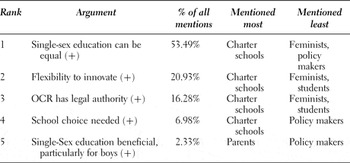
Table 1 shows that the OCR made five arguments to justify its proposed rule. It cited the argument that single-sex programs can be equal the most (53.49% of all arguments). The OCR also posited that schools need the flexibility to innovate, that it had the legal authority to revise the regulations, that parents need school choice, and that single-sex programs could be beneficial for boys.
Frequency of arguments made by the OCR in 2004 proposed rule

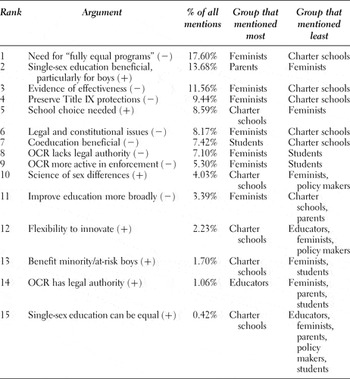
My purposive sample of comments reveals that the commenters went beyond the OCR's justifications to provide eight additional opposing arguments and two additional supporting ones.Footnote 20 Table 2 shows that the most commonly cited argument in the sample was the feminists' opposing argument that all programs must be “fully equal”; the least commonly cited argument in the sample was the charter school advocates' supporting argument that sex-segregated programs can be equal. Table 2 reveals that six of the eight most popular arguments opposed the revisions, while five of the seven least popular arguments supported them. Feminists made many of these opposing arguments, and charter school advocates rarely mentioned these issues. On the supporting side, charter school advocates' argument that sex-segregated education can be beneficial for boys was the most commonly mentioned argument in the sample, and it was the second most common argument overall. Charter school advocates were the most likely to make the other popular supporting argument—the argument that school choice is needed. Feminists never made this argument. Finally, Table 2 shows that of the OCR's four justifications for its proposed rule (listed in Table 1), commenters in the sample cited the argument that sex-segregated schools could be beneficial for boys the most. In the sample of comments, the OCR's justification that school choice was needed ranked fifth, the justification that schools needed the flexibility to innovate ranked twelfth, the justification that the OCR had the authority to revise the regulations ranked fourteenth, and the justification that single-sex schools can be equal ranked last.
Overview of arguments in the sample of comments on the 2004 proposed rule

OCR's Response to the Number of Comments
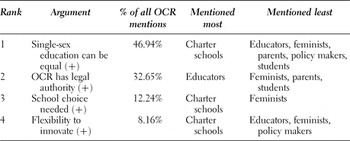
My analysis generally suggests that the OCR was more likely to cite comments that supported its proposal than the large number of opposing comments. Thus, the OCR's published justification for the final rule emphasized the relatively small number of comments from like-minded charter school advocates over the larger number of opposing comments from feminists. Table 3 shows that the OCR's justification for the final rule most often relied on charter school advocates' argument that single-sex programs can be equal, which was the least popular argument in the sample. The OCR may have focused so strongly on this issue because these comments provided additional support for its proposed rule and its claim that single-sex programs could be implemented in an “evenhanded manner” (U.S. Department of Education 2004, 11,280). The OCR also used the two charter school arguments about the need for school choice (fifth most mentioned in the sample) and the need for flexibility for schools (twelfth most mentioned in the sample) to support its final rule. The OCR's last justification that it had the legal authority to revise the regulations was also quite unpopular in the sample. Table 2 shows that although the argument that schools must be required to provide “fully equal” programs to students regardless of sex was the most frequently made argument in the sample, the OCR did not mention this argument in its justification for the final rule. Interestingly, at least one commenter from every category made this argument, although feminists made this argument the most often. A 2002 Gallup poll also showed that 67% of Americans and 74% of public school parents opposed single-sex programs in public schools (Robison Reference Robison2002). Thus, it is somewhat surprising that the OCR's published justification for the rule implied that the agency did not find this argument, which received support from multiple categories of comments and the broader public (not just feminists), worth mentioning. Instead, the OCR's justification for its final rule strongly asserted that single-sex programs could be considered equal, even though charter school advocates were the only category of commenters to make this argument.
Frequency of arguments made by OCR in 2006 final rule

The arguments that the OCR used to support its final rule did respond to feminists in one way: it dropped the argument that single-sex programs can be beneficial particularly for boys, which it had used to justify the proposed rule. My interview with a former Education Department official revealed that staff members at the OCR found new ideas particularly convincing, especially because “It's difficult to come up with a new idea on an issue that's been debated for so many years.” Thus, this argument, which was associated with parents and charter school advocates and focused on addressing boys' lower levels of academic achievement relative to girls, may have initially resonated with staffers at the OCR by providing a new spin on an older issue, but the OCR backed off this justification when it realized it was potentially controversial and divisive. Feminists never mentioned this argument, and the language about evenhanded implementation in the proposed rule further suggests that the OCR may have dropped this justification for its final rule because it hoped to avoid the perception that the revisions were designed to benefit boys rather than girls, potentially further angering the strongest opponents who might go on to challenge the rule in court. The former Education Department official revealed that the agency saw feminists' legal arguments as first drafts of the amicus briefs they would use in court challenges; therefore, feminists' comments may have presented a credible legal threat and provided the OCR with the extra incentive it needed to drop this argument.
Consensus and Homogeneity in Group Comments
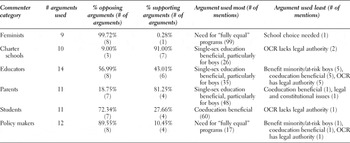
The OCR did not necessarily find the number of times a particular argument was mentioned a compelling reason to cite it, but scholars have posited that bureaucrats may consider group consensus and homogeneity as they review comments (Golden Reference Golden1998; Yackee Reference Yackee2006). However, Table 4 shows that even though 99.72% of feminists' arguments opposed the OCR's efforts to revise the Title IX regulations and they used the smallest number of arguments (nine) to express their views, the OCR's justifications did not cite their opposing arguments. On the supporting side, charter school advocates' comments were also strongly united, as 91.00% of their comments supported the proposed rule. Charter school advocates also used the second-smallest number of arguments, which may have helped their supporting position stand out to officials at the OCR. Thus, feminists and charter school advocates provided the OCR with conflicting sets of consensus comments that it could choose between to justify the revised rule. The other categories of commenters provided the OCR with more mixed messages. Policy makers (89.55%) generally opposed the proposed rule, but they used a relatively large number of arguments (12; 8 opposing and 4 supporting) to express their views. Although most of the parents' arguments (81.25%) supported the proposed revisions, 7 of the 11 arguments they used actually expressed an opposing position. Educators were also divided on the proposed rule; they offered eight opposing arguments and six supporting ones; 56.99% of educators opposed the revisions and 43.01% supported them. Given these mixed messages from other categories of commenters, it is likely that the OCR highlighted the set of homogenous comments that supported its proposed rules instead.
Consensus and homogeneity among participants' 2002 comments

Quality and Complexity of Comments
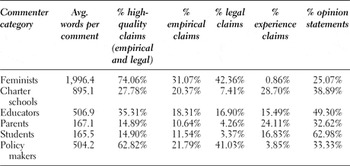
Because existing research shows that bureaucrats are more likely to respond to high-quality comments (Yackee and Yackee Reference Yackee and Yackee2006), I also considered the quality and complexity of the comments. Table 5 shows that feminists' comments were the longest and students' and parents' comments were the shortest. Feminists also relied the most heavily on high-quality empirical and legal claims, which accounted for 74.06% of all the claims they made in their comments. Comment length was highly correlated (r = 0.76) with the number of high-quality claims. Although previous research has found that bureaucrats find high-quality comments convincing because they prove that the commenters have expertise on the issue at hand (Yackee and Yackee Reference Yackee and Yackee2006), this study reveals there may also be cases in which the quality of the comments is irrelevant. In this case, a former Education Department official revealed that bureaucrats at the OCR found many of these high-quality comments unconvincing because they were too predictable. During this rulemaking, lawyers in the Office of Legal Policy read the publicly submitted comments, and many of these staffers found feminists' legal arguments relatively unconvincing because they could use their legal training to anticipate many of the issues the comments raised.Footnote 21 For example, the former Education Department official stated, “If we're just going to get legal briefs from the women's groups saying that we're watering down Title IX, we already knew they were going to say that. We weighed that view in advance.” Thus, he or she indicated that department officials saw legal comments as organizations' attempts to mobilize their constituents rather than serious attempts to work with Education Department officials to develop feasible policy solutions.
Quality and complexity of 2004 comments

Moreover, the OCR may have been less receptive to feminists' high-quality comments because it could also cite others' supportive, high-quality comments to provide support for their revisions. For example, Table 5 shows that charter school advocates also relied on high-quality claims 27.78% of the time, and they paired these high-quality claims with a relatively large number of experience claims (28.70% of their claims). Meanwhile, feminists rarely relied on experience claims, mentioning them only 0.86% of the time. Thus, the OCR may have been more likely to find high-quality comments convincing if they supported their initial proposals and if they were paired with interesting, less predictable experience claims and stories.
DISCUSSION
Although rulemaking provides feminists with an opportunity to participate in policy making and overcome women's chronic underrepresentation in Congress, this study reveals that feminist organizations' ability to influence bureaucrats to change their proposed rules may be more limited and conditional than the existing literature suggests. Although others have found that advocacy organizations can successfully encourage bureaucrats to change their proposed rules when they submit a large number of high-quality, homogenous, opposing comments (Golden Reference Golden1998; Shapiro Reference Shapiro2008; Yackee and Yackee Reference Yackee and Yackee2006; Yackee Reference Yackee2006), those findings do not necessarily hold in this case. Instead, the OCR found charter school advocates' much smaller number of high-quality supportive arguments convincing, and it proceeded with the revisions despite the fact that organizations such as the National Women's Law Center (2006) claimed that 96% of all commenters opposed the change. Therefore, this study reveals that existing findings about the influence of high-quality, homogenous comments need to be modified to account for situations in which bureaucrats have the opportunity to choose between different sets of relatively homogenous, high-quality comments. This study posits that in those cases, bureaucrats are more likely to find high-quality comments that support their initial proposals more convincing than the comments that oppose them, regardless of the numbers of those comments they receive from each side. As a result, this study is consistent with West's (Reference West2004) work, which finds that comments rarely result in meaningful change because public input occurs far too late in the process, after bureaucrats have already devoted considerable time and effort to developing proposed rules. In this case, a former Education Department official claimed that,
There's a strong tendency after you spend years preparing a regulation and you finally have at least preliminary clearance through the entire department…all the way up to the Secretary, beyond him, through the Office of Management and Budget, with the Department of Justice signing off and presumably high up within the White House (I would be surprised if the president hadn't at least been briefed on it), so there's a strong inclination to just keep pushing on with what you've got instead of making changes.Footnote 22
These findings suggest that if feminist organizations want to be truly influential in the rulemaking process, they will need to participate in the development of proposed rules long before they are published in the Federal Register. The official also remembered speaking with only one expert (a law professor) during the development of the proposed regulation. This limited contact with outsiders during the prenotification stage of the process suggests that the best way for feminists to be influential during rulemaking is to work to place feminists in these essential bureaucratic positions so they can shape proposed rules prior to notice.
This study is also one of the first to find that the rulemaking in redistributive policy areas may open the door to the kinds of partisan and/or ideological considerations that are often assumed away. Redistributive agencies produce a different kind of politics because they work on policies that allocate wealth, property, and/or rights among different social classes or groups in society (Lowi Reference Lowi and Noll1985). These redistributive policies are more likely to produce highly salient and contentious debates about the meaning of contested concepts related to equality and/or the proper roles of marginalized groups in American politics than the technically complex and low salience regulatory policies that are usually studied. Thus, redistributive rulemakings may open the door to partisan and/or ideological considerations in what is typically considered a nonpartisan process.
Although the prenotification stages of this rulemaking took place in both Democratic and Republican administrations, some partisan considerations entered into the debate once the notice and comment process began in 2002. Three of the four comments from members of Congress came from Democrats, which reveals that some Democratic members felt pressure to challenge the Republican administration's proposed rule, particularly because the Bush administration's concurrent efforts to weaken Title IX in the area of sports were shaped by Republican campaign promises in the 2000 presidential election (Rosenthal Reference Rosenthal2008). My interview with a former Education Department official also indicated that a number of high-level political appointees, including the secretary of education, high-level staff at OCR, and possibly President Bush himself, also paid careful attention this rule.
Together, these findings suggest that the Bush administration's efforts to redefine women's issues and antidiscrimination policies in partisan and ideological terms may have influenced the commenters' and the OCR's response to the comments. On a broader level, they reveal that bureaucrats may respond to comments differently in redistributive policy areas because these policies provide bureaucrats, and political appointees in particular, with more opportunities to insert their own partisan and/or ideological ideas into the debate by siding with relatively like-minded commenters, regardless of how many or few comments they submit. Because the OCR's justifications tended to side with supportive commenters over opposing ones, this study also implies that feminists may be more likely to be influential when they participate in rulemakings when there is a relatively friendly, likely Democratic, administration in power.
CONCLUSIONS
Ultimately, this article shows that while many feminist organizations participate in the rulemaking process to achieve their policy-related goals and to compensate for their underrepresentation in Congress, their ability to succeed in this policy-making venue may be strongly constrained by the administration's partisan and ideological considerations. It also posits that these partisan and ideological considerations may be more likely to enter into the bureaucrats' decisions about their proposed rules and the comments that they receive when the rule in question is related to a redistributive policy, such as education. This has important implications for Americans' understandings of equality and the roles of marginalized groups, such as women, in politics. As a result, future research should include case studies of similar rulemakings in Democratic and Republican administrations. This study also encourages scholars to revise their understandings of the role of high-quality homogenous group comments in the rulemaking process to recognize that quality and consensus in the comments may only be useful when they support bureaucrats' initial positions. Ultimately, if feminists want to influence rulemaking, they should participate in the early stages of the development of proposed rules, secure bureaucratic positions, and focus on rulemakings that occur under Democratic administrations.
SUPPLEMENTARY MATERIAL
To view supplementary material for this article, please visit http://dx.doi.org/10.1017/S1743923X16000064