Sexual activity, delinquency, and substance use escalate during adolescence, and early initiation of these behaviors is associated with persistent long-term behavior problems. According to the Youth Risk Behavior Survey (Kann et al., Reference Kann, Mcmanus, Harris, Shanklin, Flint, Hawkins and Zaza2016), 16.2% of high school students had carried a weapon, 63.2% had drunk alcohol, 38.6% had used marijuana, 32.3% had ever smoked cigarettes, 41.2% had ever had sexual intercourse, and 43.1% of sexually active high school students had not used a condom at last sexual intercourse. Studies have shown high correlations between these various risk behaviors, although most assume that delinquency emerges first and increases the risk for later substance use and risky sexual activity.
Child maltreatment is a strong predictor of these risk behaviors, and individuals with a history of maltreatment may show a distinct developmental sequence of risk behavior engagement. However, the evidence to date is conflicting and inconclusive regarding the developmental sequence of risk behavior as few studies have examined these associations longitudinally to determine the developmental pathways. Examining the risk early in development that predicts long-term difficulties is integral to understanding the development of serious problem behavior.
Adolescent Risk Behavior
Sexual activity is highly prevalent in adolescence, with 41.2% of high school students reporting that they have ever had sex, 33.1% reporting they were currently sexually active, and almost 43.1% reporting that they did not use a condom during their last sexual intercourse (Kann et al., Reference Kann, Mcmanus, Harris, Shanklin, Flint, Hawkins and Zaza2016). Sexual activity in adolescence brings with it serious consequences such as teenage pregnancy and sexually transmitted diseases. The Centers for Disease Control estimates that approximately 20 million new cases of sexually transmitted diseases occur every year, nearly half of which are among youth aged 15–24 (Centers for Disease Control and Prevention, 2016).
The latest findings from the Monitoring the Future study also show widespread substance use among adolescents in the United States (Johnston, O'Malley, Miech, Bachman, & Schulenberg, Reference Johnston, O'Malley, Miech, Bachman and Schulenberg2017). Marijuana use among high school students increased from the last survey, with over 9.4% of 8th graders and 35.6% of 12th graders reporting use in the last year while 12.8% and 44.5% reported use at some time in their life. Although alcohol use among adolescents has decreased since its peak in the mid-1990s, 17.6% of 8th graders and over 55% of 12th graders still report use in the last year (Johnston et al., Reference Johnston, O'Malley, Miech, Bachman and Schulenberg2017).
Delinquent behavior is considered somewhat normative in adolescence as teenagers experiment with their identity and test the boundaries of social conventions. There are individual differences in the onset and stability of delinquent behavior; however, childhood-onset delinquency is often pervasive and can transition to more serious criminal behavior whereas adolescence-limited delinquency is less serious both in duration and in behavior (Moffitt, Reference Moffitt1993). Research shows that for the majority of youth, delinquency peaks in middle adolescence and drops in late adolescence and young adulthood (Moffitt, Reference Moffitt1993). However, early offending can lead to criminal behaviors and incarceration in adulthood (Piquero, Farrington, Nagin, & Moffitt, Reference Piquero, Farrington, Nagin and Moffitt2010).
Co-occurrence of Risk Behavior
Adolescents are particularly prone to multiple risk behaviors due to increased reward sensitivity precipitated by hormonal-induced remodeling of the brain, coupled with immature development of brain regions controlling impulse control, emotion regulation, and delay of gratification (Steinberg, Reference Steinberg2007). The co-occurrence of delinquency, substance use, and sexual activity has often been attributed to a syndrome of problem behavior related to violation of social norms regarding appropriate adolescent behavior (Jessor, Reference Jessor1991). Problem behavior theory proposes that many norm-violating behaviors cluster together because they are all related to an underlying construct of “risk behavior” that is indicative of internal traits of risk seeking. A number of studies have documented the association between delinquency and sexual activity (Armour & Haynie, Reference Armour and Haynie2007; Caminis, Henrich, Ruchkin, Schwab-Stone, & Martin, Reference Caminis, Henrich, Ruchkin, Schwab-Stone and Martin2007; Devine, Long, & Forehand, Reference Devine, Long and Forehand1993), between substance use and sexual activity (Elliott & Morse, Reference Elliott and Morse1989; Graves & Leigh, Reference Graves and Leigh1995; Kinsman, Romer, Furstenberg, & Schwarz, Reference Kinsman, Romer, Furstenberg and Schwarz1998; Lowry et al., Reference Lowry, Holtzman, Truman, Kann, Collins and Kolbe1994; Rosenbaum & Kandel, Reference Rosenbaum and Kandel1990), and between all three behaviors (Allen, Leadbeater, & Aber, Reference Allen, Leadbeater and Aber1994).
While there is substantial cross-sectional support that delinquency, substance use, and sexual activity are correlated (Devine et al., Reference Devine, Long and Forehand1993; Loeber, White, & Burke, Reference Loeber, White, Burke, Bliesener, Beelman and Stemmler2012; White, Jackson, & Loeber, Reference White, Jackson, Loeber, Krohn, Lizotte and Hall2009), data from longitudinal studies are inconsistent as to the developmental sequence. For example, one study found that early sexual activity is a risk for delinquency 1 year later (Armour & Haynie, Reference Armour and Haynie2007), whereas others report that violent delinquency over the course of middle school is associated with higher sexual initiation rates during middle school (Caminis et al., Reference Caminis, Henrich, Ruchkin, Schwab-Stone and Martin2007), or that early childhood externalizing problems predict later sexual activity via preadolescent behavior problems (Schofield, Bierman, Heinrichs, & Nix, Reference Schofield, Bierman, Heinrichs and Nix2008). The National Youth Survey found that more males and females reported delinquency before the onset of sexual activity than after (Elliott & Morse, Reference Elliott and Morse1989) and that delinquency also preceded substance use, but changes in substance use predicted criminality (Elliott, Huizinga, & Menard, Reference Elliott, Huizinga and Menard1989). A four-wave study of high school sophomores found higher levels of delinquency associated with the earlier onset and persistence of intercourse activity and that the transition to the onset of sexual intercourse was associated with a greater acceleration of delinquent behaviors (Tubman, Windle, & Windle, Reference Tubman, Windle and Windle1996). Analysis using the 1997 US National Longitudinal Survey of Youth found substance use predicted sexual risk taking and delinquency, and in a separate model delinquency predicted sexual risk taking (Huang, Lanza, Murphy, & Hser, Reference Huang, Lanza, Murphy and Hser2012). A recent meta-analysis showed that substance use was related to unprotected sex and more sexual partners among adolescents (Ritchwood, Ford, DeCoster, Sutton, & Lochman, Reference Ritchwood, Ford, DeCoster, Sutton and Lochman2015). A study using a sample of same-sex twin pairs found that after controlling for genetic and environmental confounds, earlier age at first intercourse predicted lower levels of delinquency in early adulthood (Harden, Mendle, Hill, Turkheimer, & Emery, Reference Harden, Mendle, Hill, Turkheimer and Emery2008). While there are clearly associations between delinquency, substance use, and sexual behavior, the evidence regarding the sequence is contradictory. Although the existing evidence suggests a general developmental sequence from less serious forms of norm violating behaviors (delinquency) to more serious ones (substance use and sexual risk behavior), there are findings that contradict this sequence and few longitudinal studies have assessed the temporal associations.
Nonintercourse Sexual Behavior as a Catalyst for Risk Behavior
The existing research on co-occurring risk behavior has focused on early onset of sexual intercourse and sexual risk behaviors, as these have particularly severe consequences. However, early forms of sexual behavior (e.g., kissing and making out) may also have implications for the development of risk behaviors. During the early adolescent years, the development of romantic and sexual relationships is developmentally normative, and engagement in sexual intercourse is not necessarily deleterious. As Tolman and McClelland (Reference Tolman and McClelland2011) stated in their review of adolescent sexuality, consideration should be made for integration of positive and risk aspects of sexuality, rather than just focusing on risk dimensions. Adolescents may simultaneously be navigating the development of their sexual selves and making choices about positive and negative sexual behaviors as well as associated risk behaviors such as substance use. No prior research has conceptualized the normative development of sexuality in a developmental model with risk behaviors (e.g., delinquency and substance use) that also typically first emerge during adolescence.
The emergence of sexual behavior coincides with the increase in androgenic hormones associated with puberty (Udry, Reference Udry1988a). Studies have shown that increases in testosterone are associated with increased sexual motivation and interest (Halpern, Udry, Campbell, & Suchindran, Reference Halpern, Udry, Campbell and Suchindran1993; Halpern, Udry, & Suchindran, Reference Halpern, Udry and Suchindran1997; Persky et al., Reference Persky, Dreisbach, Miller, O'Brien, Khan, Lief and Strauss1982). It follows that this increase in sexual interest may put an adolescent into contact with peers involved with other risk behaviors (Negriff, Susman, & Trickett, Reference Negriff, Susman and Trickett2011). The contribution of preintercourse sexual behaviors to the development of delinquency and substance use as well as potential reciprocal influences across adolescence has not been investigated. This line of inquiry will contribute significantly to our understanding of the multiple developmental processes occurring during adolescence and how they may influence one another.
Cascade Models From Maltreatment to Risk Behavior
Cascade models have been used in an effort to understand developmental processes from early vulnerabilities to problematic outcomes. There are two ways in which they have been conceptualized and applied to research. In the first approach, cascade models are used to demonstrate a developmental sequence whereby early risk factors are linked to subsequent vulnerabilities, which in turn create difficulties in adequate adaptation (Rogosch, Oshri, & Cicchetti, Reference Rogosch, Oshri and Cicchetti2010). The second approach suggests that in order to understand developmental progressions as well as comorbidities between various behaviors, multiple developmental processes should be modeled simultaneously across time (Masten & Cicchetti, Reference Masten and Cicchetti2010). Herein, we use a combination of both approaches to model the developmental sequence from childhood maltreatment to risk behavior while considering covariance between delinquency, substance use, and sexual behavior simultaneously. This method provides a test of the developmental sequence from maltreatment to various risk behaviors while also examining the associations among risk behaviors.
Child maltreatment is a consistent predictor of risk behavior in adolescence and adulthood (Trickett, Negriff, Ji, & Peckins, Reference Trickett, Negriff, Ji and Peckins2011), and a number of studies have examined complex models from maltreatment to problem behavior including substance use and delinquency that encompass different theoretical foundations. Involvement with deviant peers is widely accepted as a risk factor for substance use and delinquency (Deutsch, Chernyavskiy, Steinley, & Slutske, Reference Deutsch, Chernyavskiy, Steinley and Slutske2015; Marschall-Lévesque, Castellanos-Ryan, Vitaro, & Séguin, Reference Marschall-Lévesque, Castellanos-Ryan, Vitaro and Séguin2014; Negriff, Ji, & Trickett, Reference Negriff, Ji and Trickett2009) and has been shown to predict transitions from abstinence to initiation of substance use and delinquency (Monahan, Rhew, Hawkins, & Brown, Reference Monahan, Rhew, Hawkins and Brown2014). Most of the research has evaluated these associations in normative populations, but several studies find that deviant peers are an integral factor in the developmental pathway from child maltreatment to later risk behavior. For example, one study showed maltreatment had direct effects on deviant peers and delinquency, which then predicted subsequent smoking (Topitzes, Mersky, & Reynolds, Reference Topitzes, Mersky and Reynolds2010), while another found life stress led to negative emotions, then to deviant peers, and then to risk behavior (Brody, Chen, & Kogan, Reference Brody, Chen and Kogan2010). Child maltreatment and risk behavior may also be linked though difficulties in emotion regulation. For example, a cascade model from maltreatment to cannabis use found only direct effects from maltreatment to externalizing problems and cannabis use (Rogosch et al., Reference Rogosch, Oshri and Cicchetti2010), while other findings support an ecological-transactional model wherein maltreatment leads to less adaptive personality functioning and subsequent behavior problems and substance use (Oshri, Rogosch, Burnette, & Cicchetti, Reference Oshri, Rogosch, Burnette and Cicchetti2011). Overall, these models suggest that maltreatment may put an individual on a path to risk behavior either via direct effects on behavior or via exposure to deviant peers. This study seeks to clarify peers as a mediator between maltreatment and risk behavior as well as test the developmental sequence of various risk behaviors.
The Current Study
Although delinquency, substance use, and sexual activity are established to be highly intercorrelated, the extant research provides minimal evidence in support of one particular sequence of risk behavior or on the cascade effects from maltreatment. The present study tested a longitudinal model incorporating maltreatment, deviant peers, sexual behavior, delinquency, and substance use to elucidate the sequential pathway(s) from maltreatment to each specific risk behavior across adolescence. It was hypothesized that adolescents would initiate risk behavior with the most benign forms, for example, introductory forms sexual behavior or delinquency, and that peers would act as conduits to more advanced risk behaviors (sexual behavior to delinquency or delinquency to substance use). In addition, maltreatment was expected to enhance vulnerability to risk behavior, but whether this would initiate with more advanced risk behaviors could not be specified based on extant data. Understanding the developmental pathways and potential escalation of risk behavior will yield better information to aid intervention programs.
Method
Participants
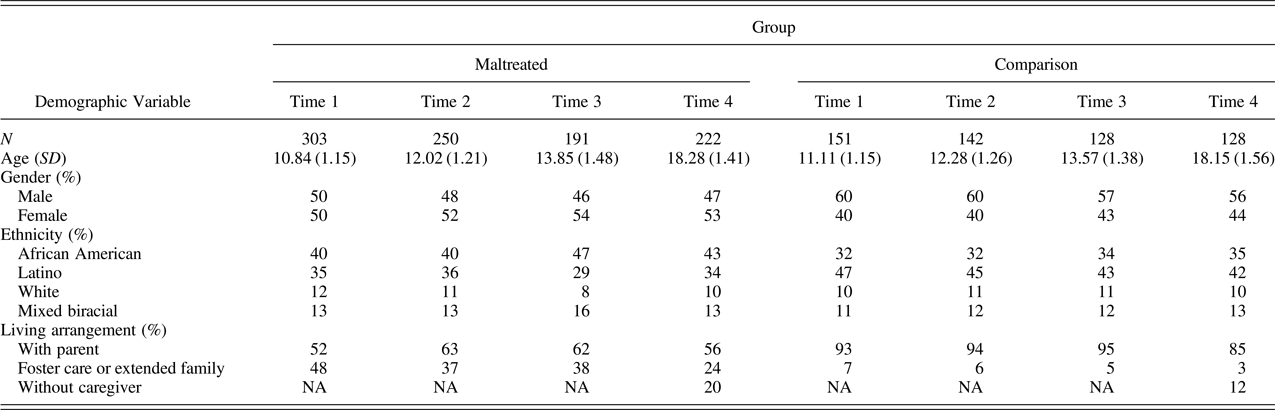
Data were from the first four assessments of an ongoing longitudinal study examining the effects of maltreatment on adolescent development. At Time 1 (T1), the sample was composed of 454 adolescents aged 9–13 years (241 males and 213 females). Time 2 (T2), Time 3 (T3), and Time 4 (T4) occurred on average 1, 2.7, and 7.2 years after baseline. Descriptives of the sample for all four time points can be found in Table 1.
Sample characteristics for Times 1, 2, 3, and 4

Recruitment
The participants in the maltreatment group (N = 303) were recruited from active cases in the Children and Family Services (CFS) of a large West Coast city. The inclusion criteria were as follows: (a) a new substantiated referral to CFS in the preceding month for any type of maltreatment (e.g., neglect, physical abuse, sexual abuse, or emotional abuse); (b) child age of 9–12 years; (c) child identified as Latino, African American, or Caucasian (non-Latino); (d) child residing in one of 10 zip codes in a designated county at the time of referral to CFS. With the approval of CFS and the institutional review board of the affiliated university, potential participants were contacted via postcard and asked to indicate their willingness to participate. Contact via mail was followed up by a phone call. Of the families referred by CFS, 77% agreed to participate.
According to information abstracted from the CFS case records, most children in the maltreated group experienced multiple forms of maltreatment and had multiple referrals as well (for details of the record abstraction see Trickett, Mennen, Kim, & Sang, Reference Trickett, Mennen, Kim and Sang2009). The majority (76.6%) of the maltreatment sample experienced neglect in some form, 51.5% experienced physical abuse and/or emotional abuse, and 19.8% experienced sexual abuse. On average, the participants had experienced two types of maltreatment and four referrals to CFS.
The comparison group (N = 151) was recruited using names from school lists of children aged 9–12 years residing in the same 10 zip codes as the maltreated sample. Caretakers of potential participants were sent a postcard and asked to indicate their interest in participating, which was followed up by a phone call. Comparison families were asked if they had any involvement with CFS to ensure they had no previous or ongoing experience with child welfare agencies. Approximately 50% of the comparison families contacted agreed to participate.
Upon enrollment in the study, the maltreatment and comparison groups were compared on a number of demographic variables (see Table 1). The two groups were similar on age, (maltreated M = 10.84 years, SD = 1.15; comparison M = 11.11, SD = 1.15), gender (53% male), race (38% African American, 39% Latino, 12% biracial, and 11% Caucasian), and neighborhood characteristics (low-income based on Census block information; Trickett et al., Reference Trickett, Mennen, Kim and Sang2009). However, they were different in terms of living arrangements. In the comparison group, 93% lived with a biological parent, whereas this was the case for only 52% of the maltreatment group. The remainder of the maltreatment group was living in foster care, which is not unusual for those adolescents involved with social services.
Retention
The retention rate between T1 and T2 was 86.1% (n = 391), between T1 and T3 was 70.9% (n = 322), and between T1 and T4 was 77.5% (n = 352). Participants not seen at T2 were more likely to be in the maltreatment group (odds ratio [OR] = 4.38, p < .01), those not seen at T3 were more likely to be Latino (OR = 3.37, p < .01) and in the maltreatment group (OR = 5.36, p < .01), and those not seen at T4 were more likely to be in the maltreatment group (OR = 2.45, p < .01) and male (OR = 1.86, p < .01).
Procedures
Assessments were conducted at an urban research university. After assent and consent were obtained from the adolescent and caretaker, respectively, the adolescent was administered questionnaires and tasks during a 4-hr protocol. The measures used in the following analyses represent a subset of the questionnaires administered during the protocol. Both the child and caretaker were given remuneration compatible with the National Institutes of Health's standard compensation rate for healthy volunteers.
Measures
Delinquency
The participants reported on their own delinquent behaviors within the past 12 months via 23 items from the Adolescent Delinquency Questionnaire (adapted from Huizinga & Elliott, Reference Huizinga and Elliott1986). Computerized administration was used to ensure participant confidentiality. For the present study, three scales were used: status offenses (6 items, e.g., “run away from home,” α = 0.72–0.74), person offenses (7 items, e.g., “carried a hidden weapon,” α = 0.77–0.83), and property offenses (10 items, e.g., “damaged or destroyed someone else's property on purpose,” α = 0.88–0.92). The three scales were summed to create a composite score for delinquency.
Sexual behavior
Sexual behavior was measured using the Sexual Activity Questionnaire for Girls and Boys (Udry, Reference Udry1988b). This questionnaire assesses series of 11 sexual activities with a current boyfriend/girlfriend as well as a past partner or with anyone. Activities begin with holding hands, continue with kissing, heavy petting, and culminate in sexual intercourse. The 11 sexual behavior items were summed (no = 0, yes = 1) to create a composite score of sexual behavior with higher scores indicating more advanced sexual behavior.
Substance use
Participants reported on their own substance use within the past 12 months via two items from the Adolescent Delinquency Questionnaire (adapted from Huizinga & Elliott, Reference Huizinga and Elliott1986). The number of times the adolescent used alcohol (0 to 5 or more) and the number of times they used marijuana were used as indicators of their substance use. The two items were summed to create a composite score of substance use.
Peer delinquency
Participants reported on the delinquency of their peers within the past 12 months. Similar to the adolescent self-report, they were asked “how many of your friends or people your age you know have done this in the past 12 months.” Answer options were 0 = none, 1 = some, 2 = a lot. Three scales of delinquency were used (status offenses 6 items, α = 0.72–0.80; person offences 7 items, α = 0.77–0.82; property offences 10 items, α = 0.85–0.90) and summed to create a composite score for peer delinquency. Studies have shown that perceived peer behavior use is strongly related to adolescents’ risk behavior, even above and beyond the variances accounted for by self-report of friends (Valente, Fujimoto, Soto, Ritt-Olson, & Unger, Reference Valente, Fujimoto, Soto, Ritt-Olson and Unger2013).
Data analyses
Preliminary analyses examined mean differences between maltreatment and comparison groups on the exogenous variables at each time point using t tests and Mann–Whitney U tests. Substantive analyses were conducted using a cross-lagged model in a structural equation modeling framework in Mplus 7.2 (Muthen & Muthen, Reference Muthen and Muthen2014). Delinquency, peer delinquency, substance use, and sexual behavior were included as manifest variables in the model at T1, T2, T3, and T4. Autoregressive effects were modeled between each time point and direct effects from all T1 to T2 variables, all T2 to T3 variables, and all T3 to T4 variables. All were allowed to covary within time point. Maltreatment status was included as a manifest variable with direct effects on all T1 variables. Covariates were T1 pubertal timing, T1 age, race (minority/Caucasian), and sex. All were included as predictors of T1 variables and covaried with maltreatment status. Full information maximum likelihood (Arbuckle, Reference Arbuckle, Marcoulides and Schumacker1996) was used to handle variable-level and longitudinal missingness and the maximum likelihood robust estimation method was used to handle the skewed nature of the risk behavior variables. Fit indices such as the chi-square (χ2) goodness of fit statistic, the root mean square error of approximation (RMSEA), and comparative fit index (CFI) were used to evaluate the fit of the model to the data. Overall, an adequate model fit is indicated by a small χ2, RMSEA of 0.08 or smaller, and CFI above 0.90 (Browne & Cudeck, Reference Browne, Cudeck, Bollen and Long1993). Significant mediation effects were determined by the bootstrapped indirect effects in Mplus (using the MODEL INDIRECT command).
Results
Descriptive statistics
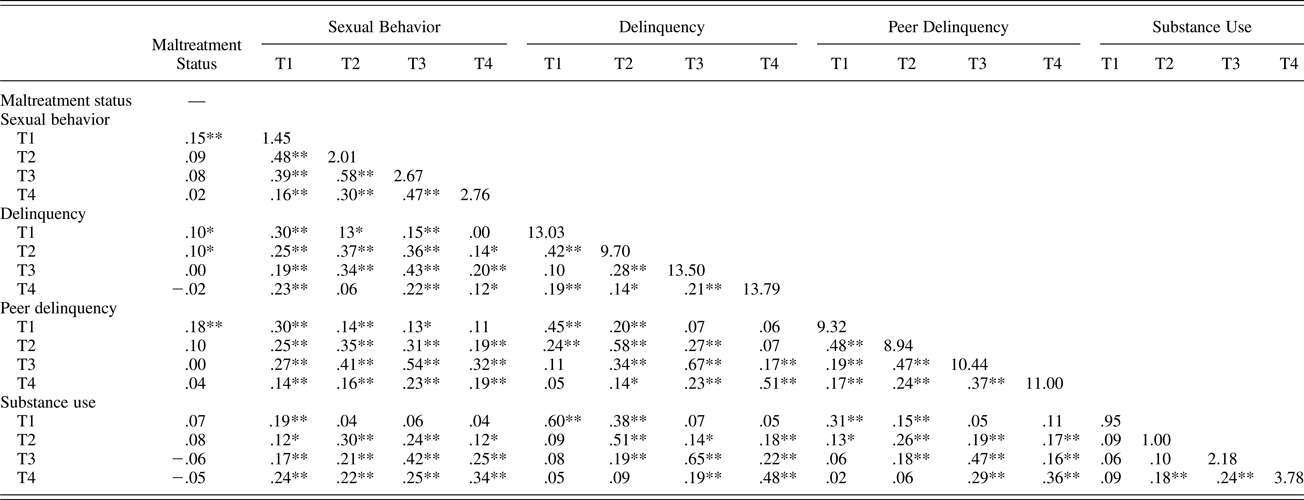
Descriptive statistics for study variables can be found in Table 2. Mean differences by maltreatment status were tested for all variables in the model using an independent samples t test and Mann–Whitney U test. Maltreated adolescents reported more sexual behavior (maltreated M = 1.01, SD = 1.59 vs. comparison M = 0.55, SD = 1.05; p < .01), delinquency at T1 (maltreated M = 6.17, SD = 14.73 vs. comparison M = 3.35, SD = 8.76, p < .05) and T2 (maltreated M = 5.77, SD = 11.20 vs. comparison M = 3.68, SD = 5.98, p < .05), and peer delinquency at T1 (maltreated M = 12.07, SD = 10.01 vs. comparison M = 8.60, SD = 7.24, p < .01) and T2 (maltreated M = 11.47, SD = 9.37 vs. comparison M = 9.61, SD = 8.05, p < .05). Correlations between study variables can be found in Table 3.
Descriptive statistics for study variables

Note: Delinquency and peer delinquency are the sum of three scales, and substance use is the sum of alcohol and marijuana use.
Correlations between study variables

Note: Maltreatment status: 0 = comparison, 1 = maltreated, Standard deviations are on the diagonal.
*p < .05. **p < .01.
Substantive analyses
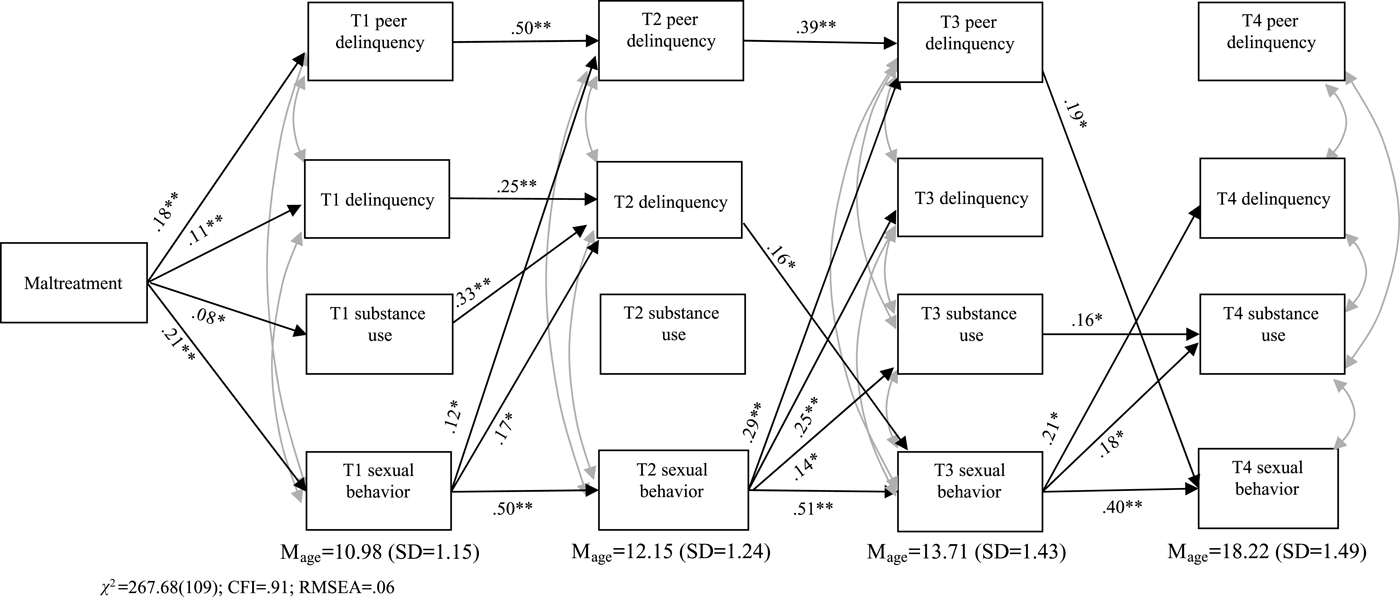
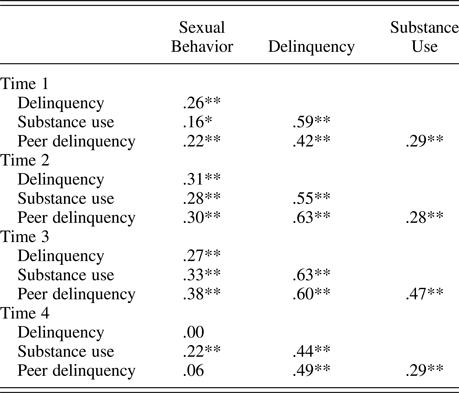
The full model fit the data well, χ2 (109) = 267.68; CFI = 0.91; RMSEA = 0.06. In terms of direct effects (see Figure 1), maltreatment predicted T1 deviant peer affiliation (β = 0.18, p < .01), T1 delinquency (β = 0.11, p < .05), T1 sexual behavior (β = 0.21, p < .01), and T1 substance use (β = 0.08, p < .05). Of the T1 variables, sexual behavior predicted T2 delinquency (β = 0.17, p < .05) and deviant peer affiliation (β = 0.12, p < .02). T1 substance use predicted T2 delinquency (β = 0.33, p < .01). T2 sexual behavior predicted T3 deviant peers (β = 0.29, p < .01), T3 delinquency (β = 0.25, p < .01), and T3 substance use (β = 0.14, p < .05). T2 delinquency predicted T3 sexual behavior (β = 0.16, p < .05). T3 deviant peers predicted T4 sexual behavior (β = 0.19, p < .05). T3 sexual behavior predicted T4 substance use (β = 0.18, p < .05) and T4 delinquency (β = 0.21, p < .05). As shown in Table 4, there were significant correlations between all variables at T1, T2, and T3. However, at T4, sexual behavior was not correlated with delinquency or deviant peer affiliation.
Cascade model from maltreatment to sexual behavior, delinquency, peer deviance, and substance use. Covariates were Time 1 age, race, sex, pubertal timing. Standardized parameter estimates are shown. Significant within-time covariances are indicated by gray arrows, and nonsignificant paths are not shown. *p < .05, **p < .01.

Within-time correlations between risk behaviors from path model

Note: Standardized coefficients.
*p < .05. **p < .01.
There was a significant mediation effect from maltreatment to T1 sexual behavior to T2 delinquency (p < .01). However, the indirect effect from maltreatment to T1 substance use to T2 delinquency was not significant. There was also a significant mediation effect from T2 sexual behavior to T3 peer deviance to T4 sexual behavior (p < .05). There were no significant longitudinal indirect effects of maltreatment on T4 outcomes (via sexual behavior and delinquency).
Discussion
The present study examined a developmental cascade model with the aim of clarifying the sequence from early maltreatment to delinquency, substance use, and sexual behavior. Overall, the findings demonstrate that there are multiple pathways to each risk behavior, which may differ for those with early maltreatment or depending on the age or developmental period. It is noteworthy that none of the risk behavior sequences initiated with delinquency, which contradicts evidence that delinquency precedes substance use and sexual activity (Caminis et al., Reference Caminis, Henrich, Ruchkin, Schwab-Stone and Martin2007; Elliott et al., Reference Elliott, Huizinga and Menard1989), but is in agreement with other findings that show sexual activity is a precursor to delinquency (Armour & Haynie, Reference Armour and Haynie2007).
There were significant direct effects of maltreatment on affiliation with deviant peers, delinquency, sexual behavior, and substance use. These main effects are not surprising as here is a robust literature that ties maltreatment to all of these risk behaviors (Horan & Widom, Reference Horan and Widom2015; Mersky & Reynolds, Reference Mersky and Reynolds2007; Salzinger, Rosario, & Feldman, Reference Salzinger, Rosario and Feldman2007; Tonmyr, Thornton, Draca, & Wekerle, Reference Tonmyr, Thornton, Draca and Wekerle2010). Of the three T1 variables predicted by childhood maltreatment, sexual behavior and substance use both had subsequent effects on T2 delinquency. Specifically, a higher level of sexual behavior at T1 was related to higher delinquency at T2, similar to the finding by Armour and Haynie (Reference Armour and Haynie2007). In addition, higher substance use at T1 predicted higher levels of delinquency at T2. However, mediation analysis showed that only the path from maltreatment to delinquency through sexual behavior was a significant indirect effect. This result supports our supposition that nonintercourse sexual behavior (e.g., holding hands, hugging, and kissing) indicates vulnerability for future risk behavior and leads to more advanced forms (i.e., delinquency and substance use). It should be noted that our measure of sexual behavior indexed the most basic forms (holding hands) to the most advanced (sexual intercourse) and is considered a normative trajectory of sexual behavior. Therefore, the behaviors at T1 are not necessarily “risky” in and of themselves. However, these “nonrisky” sexual behaviors did predict future risk behavior and is in contrast to a study of Dutch adolescents that found that a linear (normative) sexual trajectory from less intimate (e.g., kissing) to more intimate (e.g., sexual intercourse) behavior was predictive of safer sexual practices rather than risky sexual behavior (de Graaf, Vanwesenbeeck, Meijer, Woertman, & Meeus, Reference de Graaf, Vanwesenbeeck, Meijer, Woertman and Meeus2009). Our findings may suggest that even the most seemingly benign forms of sexual behavior, if initiated at too young an age, will be a catalyst for a cascade of risk behavior across adolescence. To our knowledge, there are no existing studies linking the initiation of less advanced sexual behaviors to nonsexual risk behaviors. The closest comparisons are studies that show romantic relationships in adolescence are associated with delinquency and substance use (Cui, Ueno, Fincham, Donnellan, & Wickrama, Reference Cui, Ueno, Fincham, Donnellan and Wickrama2012; Zimmer-Gembeck, Siebenbruner, & Collins, Reference Zimmer-Gembeck, Siebenbruner and Collins2001).
The results also showed reciprocal effects between sexual behavior and delinquency across the four time points. Armour and Haynie (Reference Armour and Haynie2007) also found that early sexual debut predicted delinquency 1 year later; however, the authors did not examine the reciprocal effect (delinquency to sexual debut). In the present study we used a cross-lagged model to test the possibility of both sequences (albeit with sexual behavior rather than sexual debut) and found that delinquency was predicted by sexual behavior but also predicted subsequent sexual behavior (at T3). Sexual behavior at T3 then predicted T4 delinquency and substance use. This demonstrates the long-term effect that maltreatment may have on delinquency and substance use, dovetailing with other findings that show early initiation of risk behavior predicts poorer long-term outcomes such as employment status, substance use problems, and criminal arrests (Horan & Widom, Reference Horan and Widom2015).
There were other significant risk behavior sequences in the model that did not initiate with maltreatment. We found that sexual behavior in middle adolescence (T2) predicted deviant peer affiliation, delinquency and substance use at T3, further evidence for the use of sexual behavior as a proxy for vulnerability to risk behavior. Although our findings support sexual behavior as a catalyst for risk behavior, other studies have found various sequences to the development of risk behavior. In part, this may be due to differences in study design, the operationalization of risk behaviors, or characteristics of the sample. The discrepancies may also point to the likelihood that risk behavior is multiply determined and there are multiple unique paths to each outcome, which is consistent with the concepts of equifinality and multifinality. Although the significant cross-sectional correlations between all the risk behavior variables may provide some support for problem behavior theory (Jessor, Reference Jessor1991), the longitudinal analyses clearly indicate that the mechanisms are much more complex than a single underlying “syndrome.”
Affiliation with deviant peers only influenced sexual behavior in late adolescence, which is consistent with literature supporting the associations between deviant peers and adolescent risky sexual behavior (Landsford, Dodge, Fontaine, Bates, & Pettit, Reference Landsford, Dodge, Fontaine, Bates and Pettit2014). We also found no evidence of a mediation effect between maltreatment and risk behavior via deviant peers. Some studies show a mediating effect of deviant peers on associations between maltreatment, delinquency, and substance use (Dubowitz et al., Reference Dubowitz, Thompson, Arria, English, Metzger and Kotch2016), while others show only direct effects of maltreatment. The lack of significant peer influence effects may, in part, be due to developmental differences in susceptibility to peer influence, or perhaps demonstrate that maltreatment will increase risk behavior regardless of perceptions of peers’ deviance. In terms of susceptibility to peer influence, Monahan, Steinberg, and Cauffman (Reference Monahan, Steinberg and Cauffman2009) showed developmental changes in peer influence effects with only socialization effects apparent in middle to late adolescence. While this is consistent with our findings, it contradicts the research showing early adolescence is a particularly vulnerable period for susceptibility to peers (Kelly et al., Reference Kelly, Chan, Toumbourou, O'Flaherty, Homel, Patton and Williams2012). In addition, a cross-lagged study across sixth to ninth grade found more evidence of socialization effects than selection effects across the study period (Simons-Morton & Chen, Reference Simons-Morton and Chen2006). However, a weakness of the prior work is that these models often focus on one risk behavior outcome (i.e., substance use) rather than integrating multiple problem behaviors into one model. An important contribution of the present study is the simultaneous examination of peer deviance with multiple risk behaviors. This comprehensive model may help clarify peer influence processes across adolescence.
There are a several limitations we should note. Our model may have been underpowered, leading to the inability to detect significant effects. As such, these analyses were exploratory and should be replicated. We did not include externalizing problems or parenting in the model, which have been found in other studies to influence risk behavior and affiliation with deviant peers. Our sample ranged in age at each assessment and may have encompassed slightly different developmental periods. An alternative would be to use an age-cohort design; however, due to the size of the model, this analysis would have lacked power. We also only included delinquency in the creation of our variable for peer deviance; perhaps differences may emerge if substance-using peers were included. We also chose to combine alcohol and marijuana use into one variable, which may mask differential effects. However, the model we tested already included a large number of variables, and we were limited in the number of constructs we could include given we were testing these associations across four time points. All variables (except maltreatment) were self-report, which may lead to bias in terms of the adolescent conflating the different constructs of risk behavior. As mentioned previously, the sexual behavior measure did not necessarily reflect risky sexual behavior, but it is notable that even normative sexual behavior was related to subsequent delinquency and substance use. Our findings likely would have been different if we only included sexual intercourse. Another caveat is that we did not examine specific types of maltreatment. Certain maltreatment experiences, such as physical abuse, may be more associated with delinquency and thus initiate a different cascade sequence. It is possible that sex may moderate pathways in the model; unfortunately we were restricted by our sample size and could not test multiple group models by sex, although it was included as a covariate.
Conclusions
Overall, the results support a developmental cascade from maltreatment to sexual behavior, delinquency, then substance use. Identifying this developmental sequence is critical in determining whether prevention and intervention efforts should focus on a common set of risk factors or be tailored to specific behaviors, particularly among high-risk populations. For example, the finding that sexual behavior may be the conduit to other risk behaviors would necessitate a different program for prevention than if targeted for delinquency. Specifically, early pubertal development, a strong predictor of early sexual behavior (Negriff, Brensilver, & Trickett, Reference Negriff, Brensilver and Trickett2015), may aid in identification of youth at risk. In addition, studies of risk behavior should not only focus on sexual intercourse but also consider more introductory behavior as an indication of risk, particularly if not age normative. The findings provide evidence for developmental sequence of risk behavior as well as targets for intervention.