The debate over urban decline in the later middle ages has tended to focus on the extent to which larger provincial towns contracted in demographic, economic and physical terms.Footnote 1 Yet recent studies have argued that the period saw ‘a restructuring that laid the basis for renewed urban and industrial growth’, and that ‘small towns performed relatively well in difficult times’,Footnote 2 so there is a particular need to contextualize the experience of smaller towns within the urban hierarchy and the wider economy. Unfortunately, these small towns generally lack the abundant archives produced by many larger boroughs, and the limited surviving evidence means that in many instances, it is often difficult to analyse these smaller urban centres, beyond comparisons of the numbers of taxpayers and taxable wealth.Footnote 3 John Leland, however, visited many small towns as he toured England in the 1530s and 1540s and these descriptions survive in his Itinerary.Footnote 4 This article examines three aspects of Leland's descriptions of small towns: first, the signs of growth or decline that he observed, secondly, what he suggested to be the causes and effects of these changes and thirdly, the extent to which his descriptions can be supported by other sources and historical research. By analysing the differing features of smaller towns – their markets, ports, industry, built environment and transport links – Leland's descriptions offer the opportunity to re-examine the roles of these towns within their wider economies.
A poet and antiquary, John Leland (c. 1503–52) had studied at Christ's College, Cambridge, Oxford and Paris. He cultivated the patronage of Wolsey and Cromwell, and received a royal commission in 1533 to search the libraries of monasteries across the kingdom.Footnote 5 His attentions later turned to topography, and he travelled across England and Wales from around 1539 to 1545. His notes on small towns included descriptions of important buildings, markets, bridges and industries, and remarks on their origins and development. His research notes, which now form the surviving Itinerary, were not intended for publication in that format, but instead were to provide the background for a series of works which were never produced. The notes are not complete: only fragments survive for Derbyshire, Essex, Norfolk, Suffolk, Surrey, Sussex and London. Even in counties for which more detailed notes survive, Leland did not visit every town. Nonetheless, his Itinerary provides a unique insight into Tudor England.
Significantly, Leland took an interest, arguably unparalleled by earlier writers, in the state of towns, markets and commercial and industrial ventures, which foreshadows the accounts of later travellers like Celia Fiennes and Daniel Defoe.Footnote 6 Leland relied on his own observations, manuscripts that he had studied and oral evidence. He frequently sought opinions from literate local people such as priests or merchants. Another type of oral evidence that he quoted was the ‘common voice’, or what most people in the area agreed had happened in the past, although he might add his own note of scepticism to the account.Footnote 7 On occasions, Leland used striking similes to describe changing urban fortunes: Ilchester (Som.) was ‘yn wonderful decay, as a thing in a maner rasid with men of warre’, while Bewdley (Worcs.) was depicted in terms reminsicent of the Biblical imagery of the new Jerusalem, ‘at the rysynge of the sunne from este the hole towne gliterithe, being all of new buyldinge, as it wer of gold’.Footnote 8 In attempting to explain the fortunes of towns, though, Leland emphasized factors that historians still consider significant. For example, his summary of the fortunes of late medieval Coventry, ‘The towne rose by makynge of clothe and capps, that now decayenge the glory of the city decayethe’, has been seen as encapsulating the dependence of the town's economy on cloth manufacture.Footnote 9 As Dobson has noted, ‘Leland not only encountered numerous examples of urban decay but was often prepared to explain that decay. . .in terms still acceptable to the modern local historian.’Footnote 10
While smaller towns have featured less in the debate over urban decline than their larger counterparts, there has, unsurprisingly, been little consensus in the studies undertaken. Some historians have considered that small towns weathered the demographic and economic changes of the later middle ages more readily than larger centres, while others have highlighted examples of small towns in decline. Small towns in the east midlands shrank in size after the Black Death, but the performance of those in the west midlands was more mixed, with new centres like Stourbridge (Worcs.) and Stroud (Glos.) emerging.Footnote 11 The evidence which underpins the discussion of urban fortunes is problematic to intepret. Several small towns, as well as larger centres, submitted petitions or complaints of distress to the crown or parliament requesting the reduction of fee farms and other civic dues, but fluctuations in communal income did not always represent changes in the wider urban economy.Footnote 12 Some boroughs expressed economic difficulties in their petitions to receive charters of incorporation in the 1540s and 1550s, though their motivation was often to secure former church lands or improve civic revenues.Footnote 13 Recent analyses of changes in the proportion of the population living in towns in 1377 and 1524, while not reaching any consensus on the direction or extent of change in the urban share of the population, have nonetheless all concluded that small towns were increasing their share of the total urban population, thereby creating significant change within the population profile of the whole urban hierarchy.Footnote 14
It is important at the outset to acknowledge the difficulties in applying precise definitions. Leland used ‘town’ in the sense of a settlement or place, not necessarily of urban status. He did, however, often note the possession of markets, borough privileges and industries – attributes which historians generally highlight when identifying urban settlements. A small town is usually classified as containing less than 2,000 inhabitants.Footnote 15 There is also the difficulty of defining what constitutes urban growth or decline. Trade and industry could be flourishing, but the income rendered in manorial exactions or taxation could remain static. A town could physically contract, but the remaining inhabitants might become richer. The evidence available is largely impressionistic: no figures of population size, per capita income or production of goods and services can be stated with confidence for the national economy, let alone individual towns.Footnote 16
Markets
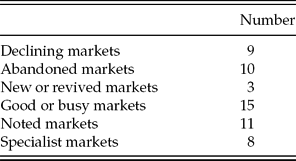
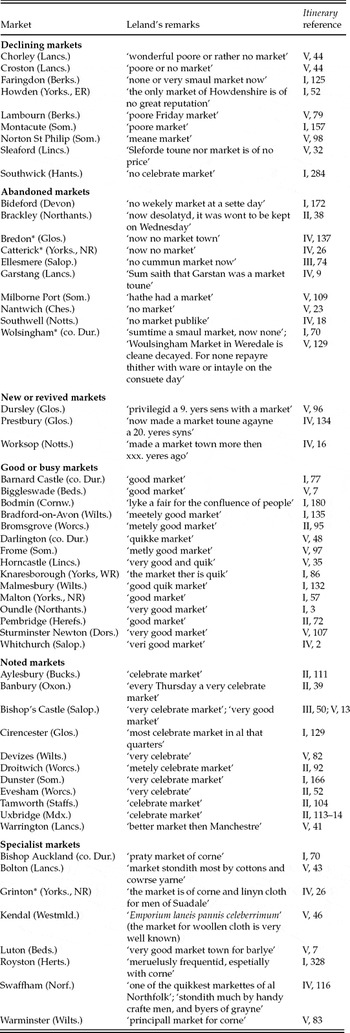
One sign of urban decline that Leland identified was declining or defunct markets. Historians have estimated that two-thirds of the markets established before the Black Death had been lost by the sixteenth century, although in some cases charters were probably obtained for markets that never actually functioned. There is also widespread evidence of falling income from market stalls and tolls, as well as examples of complete abandonment.Footnote 17 Leland encountered nine contracting and ten abandoned markets (see Appendix 1). In some settlements, it was difficult for Leland to discern whether or not the market was still being held, as at the ‘none or very smaul market’ at Faringdon (Berks.), although this market may have lingered on, as a licence to change the market day was obtained in 1594.Footnote 18 On other occasions, Leland noted the absence of markets in small towns that he had assumed would possess one, because of their size and location, such as Southwell (Notts.) with its minster, Nantwich (Ches.) with its saltworkers and Bideford (Devon) with a busy street of smiths and ships’ chandlers.Footnote 19 While there has been an assumption that markets in villages ceased, while those in towns tended to survive, Leland's evidence suggests that some town markets had also decayed.
Some small towns, though, appear to have weathered the decline in marketing by developing more specialized markets, and Leland described eight specialist markets for corn and cloth (see Appendix 1). Historians have identified a number of similar specialized markets, such as those at Royston, Enfield, Ware, Faversham and Henley, which collected grain for transport to London. Other small towns in the south-east, often at the intersection of important road and river routes, handled livestock and fuel for London markets.Footnote 20 Leland does not, however, emphasize this demand from London, which was very noticeable to Daniel Defoe, writing nearly two centuries later.
Leland also commented on the reputation of particular markets, rating some as ‘celebrate’ and others as ‘poore’ (see Appendix 1). Research has shown that individuals and institutions in late medieval England made decisions on where to make their purchases based on perceptions of the range, quality and price of goods available in different locations.Footnote 21 Leland's judgments show similar discernment as he compared different markets.
Leland made similar remarks about the fairs of some small towns. These annual trading events usually attracted a wider range of buyers and sellers than weekly markets. Leland thought that Great Torrington (Devon) possessed ‘the best fayr in al those quarters’ and highlighted the ‘great’ fairs held at Uxbridge (Mdx.), Stratford-on-Avon and Wye (Kent), where the purveyor for the Calais garrison had bought cloth in the mid-fifteenth century. Some fairs specialized in particular commodities, such as St Wilfrid's Fair at Ripon (Yorks., WR), ‘much celebratid for byenge of horses’.Footnote 22 Many fairs, like weekly markets, declined or disappeared in the later middle ages, but Leland noticed that some continued, even where markets (that had been granted during the thirteenth century) had ceased, at Old Bolingbroke (Lincs.), Ellesmere (Salop.) and Stalbridge (Dors.).Footnote 23 There was relatively greater demand for the seasonal products of pastoral farming and consumer goods in the later middle ages. Being annual rather than weekly events, and serving a wider hinterland, fairs were more suited to these types of trade than many markets.Footnote 24
While a number of town and village markets were in decay, and very few new markets were created during this period, the balance of markets that Leland described in his Itinerary were thriving (see Table 1). Such a sample may not be representative, and Leland was an imperfect observer, but it suggests that this aspect of urban decline was far from universal. Leland did not explain why some markets had ceased, unlike John Rous, the fifteenth-century Warwickshire antiquary, who attributed the destruction of markets in the west midlands to a decrease in the number of people who bought goods from craftsmen and sold foodstuffs to them.Footnote 25 Recent studies have supported Rous’ interpretation, arguing that the expansion of more specialized centres of industrial production at the expense of local manufacturers, and the development of more specialized mercantile networks, reduced the need for many weekly markets.Footnote 26 Such developments also stimulated markets specializing in particular commodities, and an investment in market infrastructure that Leland also observed.Footnote 27

Ports
Expansion and decline were also features that Leland noted among the small towns that served as ports. Focusing predominantly on the larger coastal towns, historians have pointed to the decline of the eastern ports, and the growth of those in west during the later middle ages. The larger eastern ports were hit by the dominance of London, the diminishing wool trade, the decline of the herring industry and disruption to Hanseatic trade. Silting also damaged a number of harbours in the south and east. Many of the larger western ports were able to exploit access to France, Ireland and the Iberian peninsula, and exported growing quantities of cloth, tin and fish from their hinterlands.Footnote 28 Leland's Itinerary, however, reveals a more complex combination of growth and decline along the small ports on each coastline.
The significance of competition between towns was highlighted by Leland as he toured the Yorkshire coast. At Hedon he found a town which during Edward III's reign had attracted many good ships and rich merchants, but now there were ‘but a few botes and no marchauntes of any estimation’. Leland noted that the town had suffered a damaging fire and shifting sands were choking the harbour, but the key blow had been struck, he believed, with the establishment of a rival port: ‘when Hulle began to flourish, Heddon decaied’. Leland did not acknowledge, though, that this competition had existed for over three centuries: in 1280, a jury noted that Hedon was declining in the face of competition from Hull and another small port (later completely submerged by the sea) at Ravenserodd.Footnote 29 Further north, Leland found the harbour pier at Scarborough to be ruined, but described a fishing fleet of twenty boats at Robin Hood's Bay, and a new quay and port under construction at the ‘great fischar toune’ of Whitby, suggesting that the smaller Yorkshire ports were experiencing mixed fortunes.Footnote 30
Commercial trends generally favoured the western rather than the eastern ports in this period, but even here there were losers as well as winners. Along the west country's northern coastline, Leland visited Padstow (Cornw.), ‘a good quik fischar toun’ where many small ships from Brittany came to trade goods and buy fish. Kowaleski has identified the growing importance of the overseas fish trade in a number of these ports by the late fifteenth century, focused particularly on demand from Bristol.Footnote 31 Bossiney (Cornw.) though, which had been ‘a bygge thing for a fischar toun’, possessed a large number of ruined houses, and Boscastle (Cornw.) was ‘a very filthy toun and il kept’. In Somerset, Bridgwater had gained trade from Ilchester which was sited too far up the River Parrett for access by larger boats. Leland found Ilchester in decay, but even at Bridgwater he noted that over 200 houses had become ruinous within living memory, and taxation returns suggest that Bridgwater's population may have fallen by 25 per cent between the late fourteenth and early sixteenth centuries.Footnote 32 On the southern coast, many Devon ports were profiting from fishing and tin mining, but Leland noted that Seaton had contracted in size after its estuary had become choked. While Lyme Regis (Dors.) accommodated ships and merchants from Brittany, and appeared to have recovered from French attacks and sea damage, Leland found Melcombe Regis was much reduced in size from French raids. A royal commission had reached the same conclusion in 1410, and, reflecting Melcombe's decline, the head port for Dorset was transferred to Poole in 1433.Footnote 33
Leland remarked that Poole was not a long-established town but within recent memory had ‘much encreasid with fair building and use of marchaundise’. Ships had formerly dispatched their goods close to Wareham, but the water was now too shallow and they stayed at Poole, so that Wareham had ‘felle clene to ruines’.Footnote 34 Poole appears to have expanded rapidly in the thirteenth century (the borough charter was granted c. 1248), probably as Wareham became less accessible to larger ships. Poole experienced another period of growth after it became the county's head port in 1433, and received a charter for a market and two fairs twenty years later. Poole continued to prosper until the 1580s through its diverse overseas trade and strong trading links with continental ports, particularly through the Channel Islands, which after 1483 enjoyed neutrality for trade purposes in time of war. Excavations have shown that part of the medieval foreshore close to the parish church was transformed into a residential area through reclamation beginning in the late fifteenth or early sixteenth century. This may have formed the origins of an oral tradition recounted to Leland that the majority of Poole had developed from marshland, ‘Ther be men alyve that saw almost al the town of Pole kyverid with segge and risshis.’Footnote 35
The west coast of northern England traded principally with Ireland. Leland stated that the low rate of tolls at Liverpool attracted merchants to the port; a great deal of Irish yarn was bought by Manchester traders, and business was good. Reinforcing Leland's statement, Dubliners claimed the lower dues payable at Liverpool to be a major incentive in 1533. However, Liverpool's success was at the expense of its rival Chester, while at the smaller port of Thelwall, near Warrington, Leland believed that fishgarths obstructed the harbour, making ‘the old toune now a poore village’.Footnote 36
To summarize, Leland provides tantalizing glimpses rather than detailed analyses of the smaller ports, and other evidence, to compare his descriptions against, is often limited. He offered a number of explanations for growth and decline, including examples of sea-level changes and erosion, and changing patterns of trade and fishing. He showed an awareness of competition between towns, although other sources reveal that the changes he described at Hedon and Poole took place over longer timescales than he suggested. What emerges most clearly from his descriptions of the small port towns is that signs of buoyancy and signs of decay could be found along the same stretches of coastline.
Industries
Leland provides similar evidence of both growth and decay in his descriptions of industrial production in a number of small towns. While the principal centres of English cloth production in the late fourteenth century had been the major provincial towns, notably Colchester, Coventry, Salisbury and York, when the industry began a new cycle of export-led expansion from the 1470s, production became largely concentrated in several geographical clusters of small towns and villages. Leland remarked on the prominence of cloth-making in seven small centres in Gloucestershire, eight in Somerset and six in Wiltshire.Footnote 37 These included Malmesbury, where he stated that 3,000 cloths were made annually, and Wells, where recent analysis has supported his assertion about the primacy of cloth-making, by showing that textile workers formed the largest occupational group in the city, comprising over one quarter of the burgesses.Footnote 38 Elsewhere in the region though, cloth-making had contracted. Leland found declining production not only at the larger towns of Bath and Coventry, but at Berkeley and Thornbury (Glos.), where ‘now idelnes muche reynithe’. At Bridgnorth (Salop.), ‘The towne stondithe by clothinge, and that now decayed there, the towne sorely decayethe therwith.’Footnote 39
In northern England, the main cloth-making districts lay in the West Riding of Yorkshire, with smaller centres in Lancashire and the Lake District. Leland visited the small towns of Bradford and Leeds which ‘stondith most by clothing’, and Wakefield, where ‘the hole profite of the toun stondith by course drapery’.Footnote 40 Accounts of ulnage, a tax levied on sales of cloth, show that between the 1390s and the 1470s, these three towns together with Halifax and Huddersfield had expanded at the expense of the established centres of York, Beverley and Ripon.Footnote 41 Leland noted that, ‘Ther was good cloth making at Beverle: but that is nowe much decayid’ and at Ripon, ‘idelnes is sore encresid in the toun, and clothe making almost decayed’. The vacant tenter plots which he saw in Ripon are listed in an account of 1532.Footnote 42 Across in the north-west, Leland described cloth-making around Bolton, where the market's main commodities were cottons and coarse yarn, and Kendal, where the cloth market was ‘celeberrimum’ (very well-known), and packs of cloth had been regularly transported as far as Southampton during the 1520s.Footnote 43
Some small towns benefited from the extraction and working of metals in their hinterland. The metal produced by rural forges in the midlands was finished in a cluster of small towns, each specializing in particular aspects.Footnote 44 At Deritend in Birmingham, Leland saw a street inhabited by smiths and cutlers, and ‘many smithes and bytte-makers’ inhabited Walsall. Birmingham had ‘many smithes in the towne that use to make knives and all maner of cuttynge tooles, and many lorimars that make byts, and a greate many naylors’.Footnote 45 The metal-working industry at Birmingham emerged during the fifteenth century, and had become well established by 1513–14, when five Birmingham ironmongers supplied the crown with large quantities of weapon bills, horseshoes, nails and bridle bits.Footnote 46 In Yorkshire, there were ‘many smithes and cuttelars’ in Hallamshire, and Rotherham had ‘veri good smithes for all cutting tooles’. This specialization had also developed during the later middle ages: metalworkers were recorded in several places in 1379, a reference to a Sheffield knife in Chaucer's Canterbury Tales shows that the cutlery was widely known, and the presence of a scythe-mill at Holbrook in 1489 suggests specialized manufacture.Footnote 47 Specialized metal-working was also taking place at Sherburn-in-Elmet (Yorks., WR), described by Leland as ‘a market town, wherin by many pinners’. Pin-making had become a more specialized craft in the later middle ages as the market had grown. York had a significant pin-making industry in the late fourteenth and early fifteenth centuries, but this industry showed signs of decline thereafter.Footnote 48 It may be that the industry had migrated out of the city to this smaller town, 10 miles away.
Another cluster of specialized industry was the salt-making Leland described at Droitwich (Worcs.), which produced ‘the finest salt of England’, and at Northwich, Middlewich and Nantwich (Ches.). He stated that the number of furnaces at Droitwich had increased from 300 to 400, but added that although the profits from the industry were unusually large, the majority went to the gentry, so that in the main, the townspeople were poor. This, together with the decline of the town's cloth industry, which was offered protection in a statute of 1534, may explain why Droitwich was one of the poorest communities in Worcestershire in the assessments of wealth conducted in 1522.Footnote 49 The borough accounts, though, show that a salt tax, levied on each vat of brine drawn, grew from 4s per vat at the beginning of the fifteenth century, to 5s 6d by the mid-fifteenth century, and 6s 8d by the mid-sixteenth century, confirming the ‘great avauncement of the towne’ that Leland described.Footnote 50
Leland suggested that a number of industrial areas were experiencing shortages of wood. Lead-mining in Cardiganshire in Wales had apparently ceased ‘bycawse the wood is sore wastith’, and in Lancashire blast furnaces for iron at Horwich and Bury had decayed ‘for lakke of woodde’.Footnote 51 Salt-making had seemingly created another shortage around Droitwich, and Leland thought that this deficiency was the main reason why production only took place for six months of the year. Salt-makers were forced to seek wood from around Worcester, Bromsgrove, Alvechurch and Alcester, as they consumed 6,000 loads of firewood per year. Recent analysis suggests that this figure is likely to be a fairly accurate estimate of firewood consumption by the industry, although some coal was also being used in the late fourteenth century.Footnote 52 The corporation of Worcester was sufficiently concerned to prohibit purchases of standing timber within seven miles of the city in 1496, restrict the demand of bakers and brewers for firewood in 1548 and develop a coal mine in 1565. Around Lichfield (Staffs.), Leland found that so much woodland had been felled that it was difficult to tell that the area had ever been wooded, and prices of wood had recently increased in the town.Footnote 53 While recent research has challenged a simple equation between industrial growth and depleted woodlands, the price of underwood rose by nearly 75 per cent in real terms between 1540 and 1553, which may account for the concerns that Leland describes.Footnote 54 Leland's observations suggest that some small towns shared the difficulties experienced by larger urban centres at this time such as Worcester, Cambridge and York in securing adequate supplies of firewood.Footnote 55
Demand for coal was stimulated by local shortages of timber, but only where supplies were sufficiently accessible to make the price competitive. While Leland saw plenty of woodland in the West Riding between Cawood and Rotherham, ‘yet the people burne much yerth cole, bycawse hit is plentifully found ther, and sold good chepe’. He observed mines at the small towns of Walsall and Wednesbury (Staffs.), around Bolton, Wigan, Rotherham and Wakefield, as well as in Newcastle and more rural parts of Northumberland, Weardale, Shropshire and Somerset.Footnote 56 As many of these pits were located inland, they predominantly seem to have supplied the domestic market. Leland noted that Birmingham and Sutton Coldfield consumed coal from Staffordshire pits, and that coal was brought from ‘Rayle Pitts toward the quartars of Akeland’ to Richmond in Yorkshire. Railey colliery in south Durham may have been producing 8,000–9,000 tons in 1502–03 and 1503–04.Footnote 57
Despite their size, some small towns became manufacturing centres for specialized products. Leland noted the ‘good daggers’ (hangmen's nooses) of the rope-makers at Bridport (Dors.), and the ‘many marbelers working in alabaster’ at Burton-on-Trent (Staffs.), where the craft survived the fall in demand for religious images at the Reformation.Footnote 58 Recent studies have found other examples of small towns specializing in particular crafts, including the manufacture of cutlery at Thaxted (Essex), the baking of simnel bread at High Wycombe (Bucks.) and the cultivation of saffron around Saffron Walden (Essex), which all appear to have developed in the fourteenth or fifteenth centuries at least partly in response to demand from London.Footnote 59
A prominent feature of many expanding centres of cloth-making was the concentration of production and wealth in the hands of a few individuals. A number of clothiers provided lasting legacies to the fortunes that could be made in the cloth industry, as Leland observed. In Wiltshire, clothiers Robert Long and Walter Lucas had built the church aisles at Steeple Ashton while James Terumber of Trowbridge (d. 1488) was recalled by Leland over fifty years after his death, having built an almshouse and ‘a notable fair house’. Thomas Horton (d. 1530) had constructed ‘a goodly large chirch house’ at Bradford-on-Avon and erected ‘divers fair houses of stone’ in Trowbridge. Leland also referred to clothiers Alexander and Bailey of Trowbridge, Halle and Lucas of Bradford. John Mawdleyn, ‘late a great clothiar yn Wellys’, had been assessed at £200 of moveable goods in 1524, and served four times as master of the borough of Wells.Footnote 60 William Stumpe (c. 1497–1552), ‘an exceding riche clothiar’, had bought the former abbey of Malmesbury, made the abbey church into a parish church and filled the former domestic buildings with weaving looms. Stumpe had risen from obscure origins to become one of Malmesbury's wealthiest inhabitants by 1524. He also negotiated with the city of Oxford to use the buildings of Osney Abbey for weaving, although this project was never implemented.Footnote 61 At Gloucester, Leland found that Alderman Thomas Bell had converted the house of the Blackfriars into a weaving-house. He had previously leased gardens from the friary, and he reportedly provided employment to over 300 people in 1538.Footnote 62 Other contemporary entrepreneurs in the cloth industry, not described by Leland, included John Winchcombe II (d. 1557) of Newbury, who organized production in large shops, and Thomas Paycocke (d. 1518) of Coggeshall (Essex) and Thomas Spring (c. 1456–1523) of Lavenham (Suff.), who employed large numbers of spinners and weavers in their own houses.Footnote 63
While many historians have tended to argue that landowners devoted resources to conspicuous consumption rather than investing in their estates,Footnote 64 Leland described a number of landowners who had invested in industrial activities. Abbot Blake spent 700 marks building two fulling mills at Cirencester. Abbot Selwood of Glastonbury rebuilt one street of houses at the cloth-making centre of Mells (Som.).Footnote 65 Leland also recalled landowners who were trying to exploit mineral reserves. Mr Bradshaw was exploiting cannel coal on his land at Haigh near Wigan, Lord Scrope was searching for lead near his residence at Castle Bolton in Wensleydale (Yorks., NR) and Mr Newport, a gentleman of Droitwich, organized a search for another salt spring.Footnote 66 In his brief notes on Castle Combe (Wilts.), Leland did not mention William Worcester's account of the investment that his master, Sir John Fastolf, had made to develop cloth-making there.Footnote 67 Leland did, however, remark that ‘Fairford never florishid afore the cumming of the Tames onto it’, describing how John Tame had started the ‘fair new chirch’ and Edmund had completed it. John Tame was another clothier and also the fourth largest wool exporter in the London customs accounts of 1478–79.Footnote 68
Leland described what seems to amount to regeneration work undertaken at Sutton Coldfield (Warws.) in the early sixteenth century. According to the Itinerary, Sutton Coldfield had become an important town by the earl of Warwick's time, but after his estate had passed to the crown, the place ‘stondynge in a baren soyle fell dayly to decay, and the market was clene forsaken’. John Veysey (formerly Harman), bishop of Exeter (c. 1464–1554), supported his birthplace by obtaining a new charter from Henry VIII to restore the market. He started to build and repair houses in the town, established a grammar school and added aisles and a steeple to the church. As Leland suggests, a market and fairs that had been granted in the fourteenth century and attracted food traders in the early 1400s appear to have lapsed.Footnote 69 A new market and fair were granted in 1519, and borough privileges in 1528. Veysey also built the moot hall and prison, laid out the market place, paved the town and, according to a contemporary, even attempted to establish the manufacture of Devon kerseys in Sutton. These benefactions clearly impressed Leland, who wrote ‘Thus is Southtown by Harman set at a good stay and dayly encreaseth.’Footnote 70
Recent research has highlighted the significance of investment and trading opportunities in the development of textiles and other industries during this period. Commercial links with London were particularly important, and appear to have expanded at the expense of provincial mercantile networks.Footnote 71 Terumber, Bailey, Horton and Langford, together with other Wiltshire clothiers of this period, supplied cloth to London merchants, as did producers in Devon, Kent, Suffolk and Yorkshire.Footnote 72 Leland noted that ‘Garlande a draper of London gave frely to the building of the vestiarie’ of the church at Mells. Leland's assertion that ‘Browne of London yn Limestrete’ owned Pensford (Som.) is questionable, as the settlement lay in at least neighbouring two manors, but it does suggest that the Londoner had forged prominent links with this cloth-making town.Footnote 73
Leland's analysis shows that a number of small towns, particularly in the Cotswolds and the West Riding of Yorkshire, had growing cloth industries, but in other small towns, such as Bridgnorth, Thornbury and Ripon, cloth-making had contracted. Similar developments occurred elsewhere: growth in cloth production in south-east Cornwall in the 1430s and 1440s was outpaced by subsequent development in east Devon (Leland noted that most of the inhabitants at Crediton, Pilton and Great Torrington earned their living by making cloth), and a handful of Suffolk textile towns expanded at the turn of the sixteenth century while cloth-making centres nearby contracted.Footnote 74 Historians have offered a range of explanations why industries flourished in particular locations, including the proximity to raw materials and the ability in areas of pastoral farming to combine craft work with animal husbandry.Footnote 75 Leland offered few direct explanations for the growth of industry in particular towns, although he did suggest that a shortage of firewood had restricted some industrial developments. At the larger town of Bath, he described three clothiers ‘by whom the toun of Bath then florished’, and after their deaths, ‘it hath sumwhat decayed’.Footnote 76 His focus on entrepreneurs, such as those at Bath and in the smaller Cotswold towns, and on benefactors like Veysey, suggests that he considered that their investment had enabled some small towns to prosper.
Buildings and transport links
Buildings were a marked characteristic of Leland's observations, and formed an important element in his assessment of the wealth of a town. He admired new edifices in towns that he suggested were prospering such as the ‘dyvars praty howsys of stone’ that John Veysey built at Sutton Coldfield, the ‘faire howsys’ of the woolstaplers and the chapel with a ‘goodly piramis of stone’ at King's Norton (Warws.), ‘the fair toun house of stone by the kay’ at Poole and the ‘fair houses’ at the cloth-making centres of Bradford-on-Avon, Frome and Trowbridge.Footnote 77 Manchester was not only the ‘fairest, best buildid’ town in Lancashire but also the ‘quikkest, most populus’, and only Leicester exceeded Loughborough among the market towns within its county ‘yn largeness and good building’.Footnote 78 Leland did not, however, always make a direct correlation between impressive architecture and economic success. Bridgnorth, despite its declining cloth industry, had a fine parish church and an attractive street of houses with galleries. The markets at Knaresborough (Yorks., WR) and Sturminster Newton (Dors.) were busy, even though Leland found the towns to be small and their buildings poor.Footnote 79
Leland associated a large number of ruined houses with the wider decline of a town, as he noted at Bossiney and Bridgwater, while Appleby (Westmld.) and Reculver (Kent) had contracted so significantly that they resembled villages.Footnote 80 He encountered churches that had been abandoned or demolished, reflecting the contraction of population, in the small towns of Cirencester, Hedon, Ilchester, Romney (Kent) and Wallingford (Berks.), as well as in the larger towns of Lincoln and Winchester.Footnote 81 His description of Carlisle: ‘For wher as the stretes were and great edifices, now be vacant and garden plottes’, is reflected in a mid-sixteenth-century map of the town. At Wallingford, where Leland stated that documents showed that there had been 14 parish churches, which had been reduced to 3, research has shown that the town contained 14 or 15 churches during the twelfth and thirteenth centuries, although some were chapels rather than parish churches.Footnote 82 However, the overall extent of derelict properties within towns remains hard to assess. Some 80 towns, both large and small, obtained statutes through parliament between 1534 and 1544 to rebuild ruinous houses if their owners neglected to do so. Yet the need for these statutes appears questionable as few towns actually applied the legislation before the 1570s.Footnote 83
The redistribution of land, wealth and power following the dissolution of the monasteries led to important changes in the built environment of many towns. Leland noted the alternative uses found for some urban monastic buildings, including the friaries at Gloucester which had been converted to a weaving house and brewery, the buildings at Malmesbury Abbey which housed cloth-making and Bridgwater friary which had become the customs officer's house.Footnote 84 Partly as a consequence of the dissolution, and also reflecting economic and demographic growth, a number of towns acquired greater powers of self-government, leading to a significant increase in the construction, conversion or renovation of town halls between the 1540s and 1570s. Leland saw attractive town halls at Aylesbury (Bucks.), Crewkerne (Som.), Oswestry (Salop.) and Poole, and found the town hall at Malmesbury had been converted from part of the old parish church.Footnote 85
Developing powers of self-government and the increasing value of some markets led to investment in marketing infrastructure in several small towns. While covered markets for food, grain or cloth had been found in some principal towns from the late thirteenth century,Footnote 86 by this period they were being emulated in smaller towns, particularly in the south-west midlands. Leland described in detail the octagonal market cross at Malmesbury: ‘a right fair and costely peace of worke in the market place made al of stone and curiusly voultid for poore market folkes to stande dry when rayne cummith’. He saw a similar structure at Trowbridge, a ‘fair house’ for ‘market folkes’ at Abingdon and market crosses at Bruton (Som.), Crewkerne, Glastonbury, Kidderminster and Lichfield, and a ‘right sumptuus peace of worke’ under construction at Wells by William Knight, bishop of Bath. Some of these canopied structures provided a room above, as at Wells, which formed the town hall.Footnote 87 A handful of covered market crosses survive from this period.Footnote 88 As well as a symbol of ownership, the market cross symbolized Christian moral obligations and lordly and royal power, a reminder that the market franchise was provided by the lord or townspeople, but ultimately held from the king. The construction of these market crosses and market houses also testifies to the continuing importance of weekly markets in a number of small towns.
Leland also saw that several small towns had developed infrastructure more commonly associated with larger urban settlements. He noted the paved streets in Bromsgrove (Worcs.), Liverpool, Loughborough, Morpeth (Northumb.), Warrington and Wigan, and remarked that Droitwich, where the streets were badly paved or unpaved, was ‘somewhat foule and dirty when any reyne faullythe’.Footnote 89 Some small towns had even organized a public water supply: Leland observed that conduits supplied water in Dartmouth, Frome, Lichfield, Liskeard (Cornw.), Ludlow, Petworth (Suss.), Totnes and Wells. As in larger towns, the initial supply had frequently been provided by religious houses, and extensions might be commissioned by individual citizens. Parson Edmunds ‘perceyving the great lak of water’ at Petworth had diverted the spring to supply the manor house, parsonage and main street, while, as Leland noted, the burgesses of Wells had obtained permission to draw water from the bishop of Bath's conduit in 1451.Footnote 90
Market cross, Malmesbury

Another example of major investment in small towns that Leland observed was the construction of new bridges. Bridges acted as a focus for local routes, and often trans-shipment points, and new river crossings could lead to the development of urban settlements, and the simultaneous decline of neighbouring settlements from where trade was diverted. Such processes were still underway in the fifteenth and early sixteenth centuries, although by 1530, a very large proportion of the eighteenth-century network of bridges had come into place.Footnote 91 Leland found at Bewdley (Worcs.) ‘of old tyme there was but some pore hamelet, and that apon the buildinge of a bridge there apon Severn, and the resorte of people onto it, and comoditye of the pleasaunt site, men began to inhabite there’. The settlement migrated to the riverside, and grew significantly after the first bridge was constructed in 1447; an additional market and three additional fairs were obtained in 1507. A merchant told Leland that Bewdley was ‘but a new towne’ with liberties granted by King Edward: the borough had indeed been granted incorporation in 1472.Footnote 92
The construction of new bridges, though, could be to the detriment of small towns on other routes. Leland describes how permission was granted to construct two bridges over the Isis near Abingdon (Berks.) in 1416. Following the completion of the bridge, people from Gloucestershire began to travel via Abingdon, to the great detriment of Wallingford. Wallingford, however, like Hedon, was also the victim of longer-term decline, overtaken during the twelfth century by Reading and Oxford, and also losing trade to Henley.Footnote 93
Merchants often provided capital to assist the building of bridges. Leland referred to Thomas Bell of Gloucester, who, ‘consideringe to a common-wealth’ the importance of bridges and causeways, had given land to the town to support their maintenance.Footnote 94 Stawford, a London merchant, had financed a great stone causeway with bridges linking Pilton (Devon) to Barnstaple ‘long ago’. Another London merchant, Sir Rowland Hill, had recently built a new bridge in Shropshire over the River Tern.Footnote 95 At Stratford-on-Avon, Hugh Clopton (c. 1440–96) mercer, stapler and mayor of London had built ‘the great and sumptuouse bridge apon Avon’ which greatly improved access into the town: ‘Afore the tyme of Hughe Clopton there was but a poore bridge of tymber, and no causey to come to it; whereby many poore folkys [and] othar refusyd to cum to Stratford, when Avon was up, or cominge thithar stoode in jeoperdy of lyfe.’Footnote 96 Clopton also repaired the London highway near Aylesbury and his will included bequests to mend ‘perilous bridges and weyes’ within 10 miles of Stratford.Footnote 97 Bridges were another example of significant capital investment by merchants to which Leland attributed the prosperity of some small towns.
Conclusion
Historians have struggled to summarize the experience of towns of all sizes in the later middle ages because there was no common pattern of development. As Leland's observations show, the urban sector was not a static picture: there was ample evidence of the ‘reshuffling of the existing urban hierarchy’ that Wrightson has described, in which some small towns benefited and others lost out.Footnote 98 Indeed this variety of experiences was not confined to the urban sector: while trends in population and wealth in the later middle ages can be identified at regional and sub-regional levels, at the level of individual settlements there was also a variety of local experiences, influenced by landscapes, lordship, markets and trade, from which only some common threads can be drawn.Footnote 99 The extent to which towns depended on long-distance and local trade varied considerably; international markets were volatile and commercial success could be quickly lost with competition from elsewhere.Footnote 100
Leland's writings are particularly valuable because they help to illustrate how changes in the wider economy were impacting on the roles of small towns. Their function as market centres was changing as more specialized centres of manufacture were being established, and new mercantile networks developed. Some markets were contracting or being abandoned; others were developing particular specialisms or adding new infrastructure. Those small towns that functioned as ports were affected by a variety of trends in overseas and coastal trade, fishing and sea-level changes. A number of small towns, particularly in parts of the Cotswolds, Devon, Suffolk, Yorkshire and Westmorland, were expanding as centres of cloth production, sometimes at the expense of larger provincial towns, but others saw cloth-making contract. Urban growth in this period was frequently at the expense of other towns, whether that growth was generated by cloth production, overseas trade or simply from passing traffic.Footnote 101
Some of the changes that Leland identified were very long term, having extended over several centuries, like the sea-level change and competition which had damaged Hedon and benefited Poole, while others appear to have occurred only around the time he was writing, such as the downturn in certain clothing towns. His chronology is sometimes difficult to interpret. He enthused about the modernity of St Mary's church, Nottingham, which was actually about 140 years old, although his perception was understandable given that perpendicular architecture had changed relatively little over the same period.Footnote 102 While Leland recognized the new town of Bewdley, he probably exaggerated the modernity of Poole, and he did not observe that Stourbridge, King's Norton and Minehead had acquired urban characteristics only a couple of generations before his tour.Footnote 103
Leland shows a new literary awareness of towns, their functions and their growth and decline. His observations on towns reflect his own prejudices and ideas, such as his approval of order, cleanliness and modernity, and his dislike of idleness and dirt. His interests may have arisen from his links with the royal court and contemporary political debates about landlessness, vagrancy and prices, reflected in the development of legislation to prohibit enclosures, suppress beggars and vagrants and fix prices.Footnote 104 The Itinerary seems to echo these concerns, with observations on shortages of firewood as well as admiration for benefactors like Bishop Veysey. According to William Harrison, Leland's notes on eastern England, now lost, included remarks on the engrossing of lands, the destruction of cottages, and the reduced number of householders available to contribute to taxes.Footnote 105
The changing fortunes of towns large and small had some regional trends. Expanding towns were generally found in the west country, the south and parts of East Anglia and the west midlands, while in the east midlands and the north, most towns either declined or stood still.Footnote 106 But there were always exceptions to the rule, as the decline at Ilchester or Bridgnorth and the growth in the West Riding show. Leland suggested that the investment of entrepreneurs and benefactors in developing industries, building bridges and undertaking other public works had enabled some small towns to prosper, although this emphasis may reflect his tendency to attribute complex changes to the actions of individuals. London links were prominent among this investment, even though London's demand was not as strong or as visible as it was to Defoe in the early eighteenth century. Investors probably found some of these small towns more conducive places for investment than larger provincial towns with their established mercantile networks and more tightly regulated economies.Footnote 107 Above all, Leland's observations show that the fortunes of smaller towns were every bit as complex and varied as those of their larger counterparts.
Descriptions of markets in Leland's Itinerary

*Not listed in Gazetteer