INTRODUCTION
On 25 February 1803 the Committee of the Imperial Diet passed a resolution (‘Reichsdeputationshauptschluss’) that established the basis for the secularization of ecclesiastical estates. It laid down that the secular princes and rulers of German territories who had lost land as a result of the expansion of the French Republic in the Revolutionary Wars of the Second Coalition (1799–1802) were to be ‘compensated’ by a distribution of land to the east of the Rhine. This was done by secularizing most of the ecclesiastical estates (except for the lands of parishes) and by subordinating 41 Imperial cities and the right-bank territories of the Palatine Electorate in 1803, and then in 1806 the lesser nobility, to greater princes (‘Mediatisierung’).Footnote 1
This secularization and the consequences of the French expansion produced a new political landscape. States such as Württemberg and Baden gained from their alliance with France, and in the case of Württemberg its territory not only almost doubled in size but it was transformed into a kingdom in 1806.Footnote 2 This resulted in turn in the restructuring of the state of Württemberg and of its role in matters such as health care and the development of its associated professions. It is possible to see a link between the Secularization of 1803, the bureaucratic centralization of the state and the development towards greater professionalization of medical occupations.Footnote 3 In their study of medical doctors and barber-surgeons in Württemberg, Annette Drees and Dominik Groß stressed the important role of centralization, and of new state administration and its growing control of medical matters, on the development of these occupations after 1803.Footnote 4 By eliminating the monasteries, secularization not only removed the protected work and ‘home’ environments of monks and nuns but forced them to seek new ways of earning a living, which for nuns in particular were difficult to obtain. For example, with the disappearance of the role of the abbess, women lost a position in which they could exercise power. These aspects have been recently discussed as part of the bicentennial of the Secularization.Footnote 5 But the impact on other occupations involved in the life of convents – and specifically on the role of the nun apothecary – has not yet been fully analysed. It appears that after secularization the possibility for a woman to work as an apothecary was severely curtailed.Footnote 6 The nun apothecaries who could continue practising as long as the authorities tolerated them were increasingly scrutinized by those same authorities, who were responding to an increased emphasis on academic training within the pharmaceutical profession. The nun apothecaries lost their former legitimacy and were regarded as remnants of former times who could not meet the new academic standards. They therefore suffered the loss of their former working space and associated privileges, and from the increasing controls exercised by both the pharmaceutical profession and the state. As a consequence, the proportion of female apothecaries declined significantly with the dissolution of the convents. Women were allowed access to the profession again only in 1899, when they were permitted to study pharmacy at university. Seen in the context of women's history and of women's increasing exclusion from other professions and sciences – such as midwifery, medicine, and astronomy – before 1800, this seems in line with the development of the academic professions in northwestern Europe.Footnote 7 But the process of secularization, and the consequent loss of a privileged home and work space, provides a specific example of the negative impact of professionalization on women at the beginning of the nineteenth century. Closely connected to the nuns' involvement in pharmacy was their role in rural welfare. Most of the convents discussed in this article were located in isolated rural areas and therefore played an important part in the provision of medical and social care, as will be made clear below. In fact, many contemporary defenders of this institution maintained that monastic pharmacies were of great importance for medical provision in rural areas and for poor relief.Footnote 8
This study makes a contribution to the history of the Secularization and its consequences, such as the negative impact on women and the accelerated process of state bureaucratic centralization after 1806.Footnote 9 The research is focused specifically on the impact of secularization on nuns who worked as apothecaries and concentrates in particular on the pharmacy of the convent of Gutenzell in southwest Germany, which offers insights into several aspects of the history of pharmacy and of rural welfare.Footnote 10 Reference is made to some of the other Cistercian convents in upper Swabia, such as Baindt, Heggbach, Wald, Rottenmünster, and Heiligkreuztal, and in some cases to examples from the Electorate of Bavaria.Footnote 11
The article is structured in the following way. The first section discusses the variety of factors that enabled women to acquire the necessary training to practise as apothecaries from the Middle Ages through to secularization in 1803. The discussion then turns to the training and work of nun apothecaries, focusing on the history of the Gutenzell pharmacy prior to secularization. The impact on the work of the Gutenzell pharmacy of the Secularization and of increasing supervision by state authorities in the early nineteenth century is then assessed in Section 3. The final section considers the medical care provided to the rural population by the Gutenzell pharmacy.
1. FEMALE APOTHECARIES
Women have a long tradition in medicine and the healing professions, especially within the religious and charitable spheres, as well as in ‘informal care within the household’, as Alisha Rankin has pointed out.Footnote 12 In the German-speaking countries, female apothecaries can be traced back to the Middle Ages.Footnote 13 They appear in court pharmacies, as nun apothecaries, and in town pharmacies, in the last often as a member of a male apothecary's household. In addition, women could specialize in related pharmaceutical occupations, such as those of distiller, confectioner (‘Zuckerbäckerin’), and ‘sworn’ healing-women (‘geschworene Weiber’). The latter were in some areas even allowed to keep their own in-house pharmacy (pharmacy chest).Footnote 14 Court pharmacies were established at princely courts during the sixteenth century, and before 1700 several female court apothecaries and noblewomen practising in the field can be observed.Footnote 15 Female court apothecaries might not only manage the pharmacy themselves but sometimes also gained considerable fame. Two examples from Württemberg are Helena Rückher (1523–1697), daughter of a physician, who was apothecary at the court of Duke Ludwig of Württemberg from 1585 to 1597, and Maria Andreae, née Moser (1550–1632), who ran the court pharmacy of Duchess Sibylle of Württemberg in Stuttgart in 1607–1608 and in Leonberg from 1608 to 1614.Footnote 16 At court, the sovereign personally approved the appointment of the apothecary and this made access for women possible in principle.Footnote 17 Alisha Rankin has shown that some noblewomen in the sixteenth century practised medicine themselves and even produced highly sophisticated compound medicines and tonics.Footnote 18 By thus treating family members and friends with medicines which they themselves had produced, they practised both medicine and pharmacy. The situation at court was similar to that in a convent where the abbess, often a member of an aristocratic family herself, appointed the apothecary of the convent's pharmacy.
As women can be found working as apothecaries, they must have been able to acquire the necessary training. This was made even more feasible at the beginning of the sixteenth century when women's education improved following the demands by Erasmus of Rotterdam and Martin Luther, amongst others, that girls should be educated to become good Christian housewives and mothers (‘Hausmütter’). Girls were therefore expected to receive basic training in reading and writing.Footnote 19 In a convent, nun apothecaries probably passed on their pharmaceutical knowledge to their successors, but at the beginning of the eighteenth century several cases suggest that nun apothecaries had sometimes been apprenticed in a town pharmacy before taking the veil.Footnote 20 In the Electorate of Bavaria, for example, a medical regulation of 1785 required all monastic apothecaries to pass the same examinations as their secular colleagues. This included the nun apothecaries, and surviving examination records show that they received an equal training.Footnote 21 However, although a woman was in principle able to acquire professional training in pharmacy, she was denied full recognition within the profession (outside convent walls) until 1899.Footnote 22
Although the existence of female apothecaries in German-speaking lands as such is not disputed, the situation of female apothecaries and their training remain insufficiently explained in the literature. Beisswanger and colleagues, for example, provide an excellent overview of women and pharmacy, but they do not fully explain the seeming paradox that some female apothecaries were able to practise their profession in spite of the restrictions on women in pharmacy. The restriction seems unsurprising, considering the exclusion of women from other occupations and the fact that women were also largely excluded from guilds.Footnote 23 In the literature, the ordinances of Worms and Kurpfalz are cited as having established the exclusion of women from pharmacy.Footnote 24 But prohibitions on women's participation were not necessarily included in the ordinances of other towns. Apparently, female members of apothecaries' households did work in the shop but were not allowed to be involved in dispensing.Footnote 25
There are three factors that could in theory explain the existence of female apothecaries before 1803. First, local government: female apothecaries may have profited from the specific political landscape of the German countries with their many different sovereign territories. Every territory or free city had specific rights, amongst them the right to control medical and pharmaceutical affairs. Due to the existence of these numerous territories many different ordinances concerning apothecaries (‘Apothekerordnungen’) survive from the fifteenth and the early sixteenth centuries on. In these ordinances the occupation and role of the apothecary were defined.Footnote 26 But they applied only in the territory where they were issued.Footnote 27 This implies that ordinances which, for example, explicitly barred an apothecary's wife or apprentice from dispensing any medication when the apothecary himself was absent were in force only within the territory in question.Footnote 28 And in the case of Imperial convents, for example, the abbess herself was the sovereign and was thus entitled to appoint an apothecary independently.
The second factor was occupational monopoly: female apothecaries may have benefited from the intermediate position of apothecaries in relation to the local magistracy and the guilds, and the monopoly arising from this status. Especially in the southwest German territories, most pharmacies were run as independent businesses, responsible to but not owned by the magistracy, which created their half-official and half-private character.Footnote 29 The limitation on the number of pharmacies in a town as laid down in the ordinances regulating apothecaries, and the privileges they were granted, inevitably created a monopoly for the occupation. In the context of this occupational regulation it was not possible for a woman to manage a town pharmacy on her own, as she would not be granted a licence. But a woman could operate a pharmacy as the widow of an apothecary for a certain period of time until she found a solution, that is, marrying another apothecary.Footnote 30 And above all, as I argue in this article, it was possible for a woman to be appointed by the sovereign as apothecary of a court or a convent pharmacy without getting into conflict with a guild.
Third, as the training of an apothecary basically followed the pattern of vocational training, a female member of an apothecary's household was in principle able to acquire a pharmaceutical training as the apprentice of her male relative. Therefore, female apothecaries could have been assisted by the apprenticeship system that was rooted in vocational training.Footnote 31
The training of nun apothecaries followed a particular pattern. The future apothecary nun would do an apprenticeship in a town pharmacy for three years.Footnote 32 She probably did this with the intention of taking her vows, which would have been the reason the apothecary accepted her as an apprentice in the first place. After her apprenticeship she had to take an examination. Instead of the journeymanship required of a young man, the female apprentice would then take her vows and continue in a monastic pharmacy. This might have been equivalent to a shortened journeymanship, if she received further training from the current apothecary nun.Footnote 33 This suggests that the training of a nun apothecary did not substantially differ from the training of her male colleagues. Beisswanger and colleagues and Schnabel emphasize that, according to the surviving certificates of town pharmacies, female apothecaries were indeed able to achieve the same educational level as their male colleagues from the seventeenth century on.Footnote 34 This enabled women to work as recognized apothecaries under certain conditions.
2. CONVENT PHARMACIES
Monastic status and pharmacies
When exactly monastic pharmacies in the German territories were established is difficult to determine. Medical treatment as such within cloisters goes back to the Rule of Saint Benedict itself, which regarded the treatment of the sick as an obligation of monks and required a particular monk and a specific room to be assigned for their care.Footnote 35 But when we look specifically for convent pharmacies as established complexes of rooms with at least one presiding apothecary, strong evidence exists only from the late seventeenth century.Footnote 36
To fully understand the importance of convent pharmacies, the status of nuns as opposed to that of secular women needs to be discussed. Due to their integration into monastic life, nuns and monks were regarded as having a special status in society. To become a nun a woman had to take vows of poverty, chastity, and obedience, to which she was bound for life. Depending on the religious order, nuns were sometimes expected to do work in charity, medicine, or teaching, but always to follow their religious vocation and to pray for the salvation of people's souls. With this, and their long history in charitable and medical care, nuns gained a certain amount of trust.Footnote 37 These conditions created a special status for nuns in early modern society, which in turn enabled them to enter occupations that would not otherwise have been open to them, such as that of apothecary. In addition, monastic pharmacies had both a secular and a religious dimension. The Gutenzell pharmacy, for example, performed both the pharmaceutical and the spiritual roles represented by Saints Cosmas and Damian.Footnote 38 In addition, a nun was regarded as being morally honest and was therefore entrusted with the handling of poisons – as opposed to women in general, who were eyed with suspicion if they had access to them.Footnote 39 Therefore a convent could become one of the very few places where women could practise as apothecaries. But this specific status of monastic life began to change with the Enlightenment and the rise of secular views, especially at the end of the eighteenth century. Following the Secularization of 1803, the special status of nuns and monks was, for the time being, abolished. Consequently, they not only lost their special status, trust, and privileges, and became ‘secular’ women and men again, but the monastic institutions also lost their former political status and territories.
The convent of Gutenzell
The convent of Gutenzell and its territory were situated in Upper Swabia; it was a member of the Swabian ‘Imperial Circle’ (‘Reichskreis’) within the jurisdiction of Anterior Austria (‘Vorderösterreich’), the possessions of the Habsburgs in southwest Germany. It was in the district of Biberach, about 20 kilometres east of the free city of Biberach, and 50 kilometres south of the free city of Ulm. The Benedictine monastery of Ochsenhausen was about six kilometres further south. The convent was incorporated into the Cistercian order in 1238. From the fifteenth century on, it had its own court of law and in 1521 its Imperial status was confirmed. Its religious and economic life were monitored and supervised by a father abbey, which was Salem until 1753 and then Kaisheim. In 1803 Gutenzell was secularized along with the other monastic institutions in the southwest German territories, following the resolution of the Imperial Diet in that year. In March 1803, Gutenzell was assigned to the Bavarian Count Toerring as ‘compensation’ property.Footnote 40 He secured the continued communal life of the convent with regular pensions for the nuns. The last nun at Gutenzell died in 1851. The convent's pharmacy had permission to continue after 1803 under the protection and with the financial help of the new territorial ruler. But after the death of its last apothecary, the pharmacy was finally dissolved in 1839.
Gutenzell's pharmacy
No reference to a specific date for the establishment of the pharmacy in Gutenzell survives, but the visitation records made by the father abbots make it possible to narrow down the date.Footnote 41 In 1673 a visiting abbot stressed the importance of care for the sick and stated that the mistress of the infirmary should be entrusted with the necessary house medication.Footnote 42 The acquisition of medicines to establish an in-house pharmacy was thus first demanded in this 1673 document. In addition, the appearance of the item ‘pharmacy’ within the account books from 1670 on suggests that a small assortment of medicines was at least planned. In 1677 the demand for an in-house pharmacy was explicitly repeated: ‘To which end a house pharmacy should be established following the advice and acquisitions of the doctor, which, along with other necessary remedies and tonics, is to be entrusted to the mistress of the infirmary.’Footnote 43 In 1677 the nuns and lay sisters (who assisted the nuns by doing the manual work in the convent, allowing the nuns more time for their daily choral services) complained about the still-poor nursing situation within the convent, the neglect of care for the sick, and the lack of an in-house pharmacy and infirmary.Footnote 44 In 1679 the same issues were raised again, except that the in-house pharmacy was no longer mentioned, and in 1683 the nuns complained about unequal access to medicine within the convent.Footnote 45 This strengthens the assumption that an in-house pharmacy had been established between 1677 and 1683. It was run by the mistress of the infirmary, which was again mentioned in the visitation records of 1699.Footnote 46 The first apothecary was not named on a convent list until 1749, though. This nun, Charitas Wagner, had taken the veil in 1697, but it is not clear when she actually started as the convent's apothecary.Footnote 47 With her appointment, some time after 1699, the in-house pharmacy developed into a general pharmacy. This means that the pharmacy was no longer restricted to use by the convent but expanded into an institution that could be used by the surrounding community as well.
The example of Gutenzell shows that there was a need for proper care and pharmaceutical provision within the convent. The two functions of the pharmacy as both a spiritual and a pharmaceutical institution can be well observed in Gutenzell, where the patron saints of the church were Cosmas and Damian, who became transformed during the eighteenth century from being the saints of the medical profession into the patron saints of apothecaries.Footnote 48 Similar to Heggbach, where the apothecary of Salem personally re-organized the pharmacy, the Gutenzell pharmacy came into existence due to the demands of the visiting abbots of Salem.Footnote 49 Its establishment was therefore due to a male initiative. This is significant, because the convent pharmacy would later form an important sphere for female apothecaries to practise their occupation. It is also worth noting that most Cistercian convents were located in remote rural areas and thus a considerable distance away from the nearest town pharmacy. After the secularization of the German convents and monasteries between 1782 and 1803, the monastic pharmacies were allowed to continue their existence only as long as the local authorities agreed, the monastic community still existed, and the apothecary was still alive and capable of practising. This was true for female as well as male congregations. But whereas monks had the opportunity to work outside the monastery after 1803 – for example as priests – nuns and lay sisters faced a dilemma between the absence of alternative employment and the restricted continuation of their former lives. Most decided to stay within their convent community.Footnote 50 The institutional changes after 1803 thus created a strong gender issue.
The training and work of nun apothecaries
Apart from their religious vocation, nuns had additional tasks connected with the organization of their everyday life and the convent's economic existence. One of those tasks was running the pharmacy. For the convent in Gutenzell six nuns and lay sisters can be identified as apothecaries for the period between 1699 and the pharmacy's closure in 1839. A reconstructed list of these apothecaries shows that during some periods two apothecaries at a time worked in the pharmacy, and that at no time between 1699 and 1839, with the exception of 1763–1764, was the pharmacy unoccupied.Footnote 51
At least four of the six apothecaries at Gutenzell had previously been educated in town pharmacies, possibly in order to enter the convent. They were apprenticed within the vocational system and probably received additional training within the convent instead of becoming a journeyman. In one case even the apothecary's certificate survives, and in another the woman's pharmacy training constituted the condition of her admission to the convent. During the medical inspection in 1812 the education of the two apothecaries was specifically emphasized. This suggests that the convent wanted to ensure that its pharmacy was run professionally by accepting women into the convent who had previously been apprenticed in a town pharmacy.
The working environment of a convent pharmacy was within the convent's walls: normal dispensing practice, according to the strict enclosure regulations, would have been that the physician both handed in a prescription and received the medicine only at the convent gate. However, we learn from the admonition recorded by Abbot Anselm II of Salem after his visitation in 1749 that a physician had stayed longer within the pharmacy than the abbot regarded as appropriate. Obviously the physician consulted the convent apothecary directly and probably received the medicines in the pharmacy. But Anselm had detected another infringement, since he found additional lay people, such as the local fisherman, regularly visiting the pharmacy.Footnote 52 The pharmacy was evidently providing not only the convent but also the community with medicines, and the apothecary worked closely with and for the local physician while maintaining a fairly autonomous position.
Looking at other Cistercian convents in the region, similar observations can be made. In the neighbouring convent of Heggbach, for example, at least four nun apothecaries and one lay female apothecary are recorded.Footnote 53 In the convent of Wald, three convent apothecaries are recorded, all of whom had received their training in town pharmacies.Footnote 54 The pharmacy in Wald was inspected in 1785 and received permission to continue in existence on the condition that the nun apothecary was examined in the same way as town apothecaries and that her assistants were properly trained.Footnote 55 As the pharmacy was tolerated until 1834, this leads to the conclusion that, similar to the situation in Bavaria, the nun apothecary and the pharmaceutical assistants in Wald were properly trained and examined.
3. THE IMPACT OF SECULARIZATION AND INCREASING STATE CONTROL
To understand the full impact of the Secularization and the subsequent control by the state of convent pharmacies and their operators, the case of Gutenzell will be described here, as will the situation in neighbouring convents. In 1803, as explained earlier, monastic institutions in the southwest German territories were secularized. This nevertheless often allowed for a transition period, in which nuns sometimes could continue their communal life and with it their previous occupations. Consequently, for a time some of the convent pharmacies survived the secularization. In Wald, for example, the pharmacy was tolerated until 1834, when an official medical pharmacy was established. In Heggbach, the convent pharmacy was closed in 1816–1817. In Rottenmünster, the nuns resisted the closure of their pharmacy in 1823 and it continued until the death of the last apothecary in 1831.Footnote 56 The pharmacy in Heiligkreuztal continued as well, the last nun leaving the convent in 1843 and the premises being sold in 1850.Footnote 57 Baindt also resisted the closure of its pharmacy in 1823 but it was apparently shut down in the years following.Footnote 58
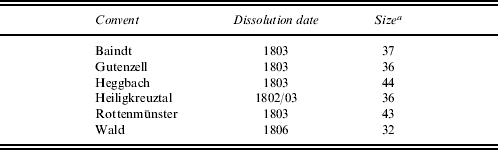
Each of these convents was in a village of around 500 inhabitants and situated within a few hours' walking distance from a city or a larger village. Only Rottenmünster was close to a city, Rottweil. Table 1 shows that the size of the convents at the time of their secularization justified the existence of an in-house pharmacy. In addition, the distance to the nearest town pharmacy made a convent pharmacy important to the surrounding villages.
The size of the convents at the time of Secularization, 1803

a Both nuns and lay sisters of the convent are included.
Sources: Landesarchiv Baden-Württemberg, internet document ‘Klöster in Baden-Württemberg’, available at http://www.kloester-bw.de; Matthias Erzberger, Die Säkularisation in Württemberg von 1802 und 1810: ihr Verlauf und ihre Nachwirkungen (Stuttgart, 1902).
The pharmacy in Gutenzell also survived secularization for a time. In preparation for the transfer of the territory to Count Toerring, the property of the convent was inventoried in 1802–1803. The intention was to assess the convent's material wealth, which would form the basis for the amount of ‘compensation’ to be assigned to the Count.Footnote 59 The pharmacy was apparently viewed as of little value: ‘The pharmacy is very insignificant and actually only for the convent's use – a great deal is prepared in outside pharmacies …’.Footnote 60 The inventory listed the vessels and instruments but not the medicines and furniture of the pharmacy. Therefore it does not give a detailed picture of the pharmacy other than that it seemed to be quite poor. The use of the term ‘insignificant’ reflects the intention that the inventory should identify only valuable items such as ‘exquisite furniture’ (‘vorzügliche Meubles’), meaning items that had pecuniary value and could be sold profitably.Footnote 61 The pharmacy's furniture was probably not regarded as valuable, especially as it was not immediately disposable.
In March 1803 not only the ownership but also the main focus of the administration of the territory changed. Count Toerring's administrator, Valentin Banghard, recorded everything worth passing on to the Count, who resided in Munich and who focused on making his new territory an efficient one. This proved to be an almost impossible task because the convent's estate faced enormous economic problems, due mainly to the Revolutionary Wars, and the Count was left with a considerable pile of debts. Nevertheless, both the Count and his administrator had a great interest in the continuation of the convent's pharmacy and planned to incorporate it into local poor-relief arrangements. The convent received an extra annual sum of 100 gulden from the Count's administration for the pharmacy, of which 50 gulden were assigned for provision of medicines for the poor.Footnote 62 With this, the convent was given the means to provide specific charity and was urged to substitute this for its traditional practice of giving out alms.Footnote 63 However, looking at the expenses of the pharmacy before 1803, it becomes apparent that this sum did not meet the needs of the institution. Between 1790–1791 and 1801–1802, for example, the expenses amounted to between 150 and 208 gulden per year.Footnote 64 After 1803 the pharmacy was assigned a sum of 100 gulden, which means that it had considerably less funds at its disposal than was previously the case.
However, the pharmacy was maintained and the district physician made use of its continued existence. He sent in prescriptions and received medicines back from the apothecary, Juliana Rundel.Footnote 65 Furthermore, her account book contains entries referring to the preparation and selling of medicines to specific residents of the community of Gutenzell.Footnote 66 It would thus appear that the convent apothecaries met the expectations of the administration to keep the pharmacy running and to provide the neighbourhood with medication using the extra funds.
But the Count did not have the actual authority to decide upon the pharmacy's future. In 1806 Count Toerring, along with other lay princes, was subordinated to the new Kingdom of Württemberg. Toerring insisted that he, as the owner of Gutenzell, should retain authority over the pharmacy, as was the former practice of the territories of the Empire. But with the establishment in Württemberg of a government department for medical issues in 1806, pharmacies became increasingly regulated and state-controlled.Footnote 67 The Count's administrator, Banghard, therefore saw himself frequently confronted with enquiries about the convent's pharmacy. The medical department in Stuttgart, Württemberg's capital, wanted at least to subordinate the monastic pharmacies to the authority of the state, as they were believed to be obsolete.Footnote 68 The future of the convent's pharmacy was therefore uncertainFootnote 69 and, in order to retain its status, the pharmacy in Gutenzell had to face several official inspections.
The inspection of 1812
In 1812 the Department of Medicine instructed the district authorities in Biberach to send Dr Joseph von Schirt, the district physician (‘Oberamtsarzt’) of Ochsenhausen, to inspect the pharmacies in Heggbach and Gutenzell. The inspection was justified on the grounds of a previous visit of the district, after which Professor Dr Authenrieth from Tübingen had reported that the convent pharmacies were causing great damage to the whole region.Footnote 70 Although he himself had not found the time to inspect these pharmacies, his opinion was regarded as sufficient reason to conduct a special inspection. A close examination of the pharmacy's rooms and interiors, inventory and stock, preparation practices and prescriptions was to be undertaken and the findings reported to Stuttgart. The inspector was ordered in particular to check whether the nuns were preparing, selling, or handing out medicines without a physician's prescription.Footnote 71
During the ensuing inspection by Joseph von Schirt, who himself came from an apothecary's family,Footnote 72 Banghard certified that the pharmacy was being administered at all times according to the pharmaceutical and medical laws of Württemberg and that it dispensed only prescriptions issued by the physician of Ochsenhausen. He stated that there were no complaints about the pharmacy and strongly defended its existence.Footnote 73 The inspector then drew up an inventory of the pharmaceutical ingredients in stock and assessed their quality and quantity. Of the entire 303 named pharmaceuticals most were rated as ‘good’, only 10 were described as being of poor quality, 4 were missing, and 90 were low in stock. Apart from this, the inspector found a considerable quantity of medicines that were unusable due to their age or method of prescription. Compared to the neighbouring convent of Heggbach, the quantity of the medicines was better.Footnote 74 Schirt also saw no reason to criticize the making and dispensing of the medicines, as the prescriptions came from the district physicians: ‘Without any medical instruction the apothecary has never dispensed anything in recent years [after 1803], also I did not come across any complaints of encroaching or of selling any kind of universal medicine in these years.’Footnote 75 Regarding the acquisition and sources of the ingredients, Schirt pointed out that they came mainly from shops and pharmacies in Biberach. Some herbs and flowers were grown in the convent's garden by the apothecaries, however.Footnote 76 The inspection record of 1812 summarized the function, legal status, and material stock of the pharmacy after 1803, the training of the apothecaries, and the use of the herb garden. The report stressed the involvement of physicians and the pharmacy's importance, thereby not only fulfilling the main requirement of the inspection but also refuting the initial attitude of the authorities prior to the inspection.
Schirt had surveyed the medical situation in the neighbouring district of Ochsenhausen in 1805 and had found that the health of the population was in a very bad, even critical, state.Footnote 77 To improve this situation, Schirt rejected the former monastic approach of giving out alms and campaigned for a new approach to poor relief with a number of recommendations, amongst them free care and medical provision for poor people.Footnote 78 With this approach in mind he must have welcomed Gutenzell's pharmacy, which was designed to give out medicines to the poor. Securing the further work of the apothecary in Gutenzell was probably, therefore, an important concern for Schirt.
The inspection of 1816
In the meantime, inspections of other pharmacies in Württemberg showed a number of deficiencies and further regulations were enacted to remedy them, such as the introduction of standardized weights,Footnote 79 the separation of poisonous substances from ordinary ones, and the replacement of lead vessels with glass, stoneware, and faience.Footnote 80 This happened in the context of introducing new and general standards in pharmaceutical matters. In 1814 a new national medical regulation was introduced on the basis of a previous one dating from 1755, and it redesigned and structured all medical matters in Württemberg.Footnote 81 The principal physician of the district (the ‘Landvogteiarzt’) was to inspect all medical institutions in his region every two years and examine them under particular rubrics in order to improve them to a uniform level.Footnote 82 Apart from a close examination of the quality and actual state of the pharmacy and dispensary, the physician was instructed also to inspect the weights and scales, the vessels and storage of poisons, the quality of the medicines and discarding of old ones, the acquisition of the ingredients, and the observance of the regulated prices.Footnote 83
This development led to another inspection in Gutenzell. In 1816, the principal physician of the district, Dr Karl Joseph Endres, carried out the required medical inspection of the entire region of Biberach.Footnote 84 He followed the 1814 instructions meticulously, and all in all the Oberamt of Biberach did not live up to his expectations. He made his discontent quite clear in the phrasing of his report. Of the two convent pharmacies, Heggbach received the better report. The sister who operated the pharmacy ran it in a much tidier fashion than Gutenzell; she had tin vessels, accurate weights and no poisons in stock. Only the herb attic and cellar were missing. But his final assessment was clear in its intentions: the pharmacy in Heggbach was an unnecessary and harmful establishment because it existed within a reasonable distance of the town apothecaries of Ochsenhausen, Biberach and Laupheim and had an adverse effect on their business. The Heggbach convent apothecary had caused a lot of damage already and the pharmacy could only continue to exist if it was remodelled into an in-house pharmacy, if all outside dispensing of medicine was prohibited, and if dangerous ingredients were removed.Footnote 85 The pharmacy was closed in 1816–1817.Footnote 86
Endres' assessment of the Gutenzell pharmacy was even more negative in that he advised shutting down the institution immediately because of its ‘corruption’ and uselessness. He stressed that he had never seen a worse dispensary. Having disqualified the pharmacy, he continued with a description of the apothecary Juliana Rundel:
It is administered by an old, crabby, entirely indolent nun, who looks just as dirty and abhorrent as the locality in which she conducts her affairs. If and how she received the consecration of the pharmaceutical art was not to be ascertained from herself or from anyone else. But if one judges knowledge and education by her conduct, appearance and arrangements, one would have to assume in her person more of an herbal-woman or a preparer of ingredients than an educated apothecary.Footnote 87
With this judgement, Endres showed severe doubt about Rundel's professional education. He went on to describe the inadequate condition of the whole establishment and meticulously demonstrated the poor quality of the weights, scales, instruments, storage rooms, labelling and ingredients, as well as the deficiencies of the apothecary's training.Footnote 88 To make matters worse, he found poisonous substances. He did not even try to describe the storage rooms on the grounds that the disorder was too great. His conclusion was, accordingly:
It is not possible to see how this pharmacy can further exist as it is lacking even the smallest thing which could be demanded of a dispensary, but the apothecary is not receptive to any instruction, admonition or direction. In the event that it should after all be tolerated and kept, then it would have to be totally reorganized and set up by a trained apothecary under the supervision of the medical office, but most of all and in order to prevent dangerous mistakes in dispensing, poisonous substances would have to be removed completely from the pharmacy and could no longer be tolerated there, while the rotten items would have to be thrown out.Footnote 89
He then added an example, which actually appertained to Heggbach. It was the case of a child with an eye illness who was treated by the apothecary there and who subsequently went completely blind.Footnote 90 With this story he obviously wanted to prove the dangers of badly kept pharmacies and wrong advice, and he left the final conclusion to the royal district authorities.
This report could hardly have been more damning. Yet Endres used similar phraseology in his reports on other medical institutions of the region and the discrepancy between the two reports, from 1812 and 1816, is striking. In 1812, Joseph von Schirt had judged generously from his standpoint as a district physician and he tried to rescue the institution for its own sake. In 1816, by contrast, Karl Joseph Endres viewed the pharmacy in relation to his municipal and scientific standards, which were largely based on the regulations issued by the Württemberg government in 1814.Footnote 91 It is, however, interesting to note that the 1812 report was not mentioned by Endres and the question remains open as to whether he took into account the earlier findings. Endres was not only the district physician but also the head physician of Ulm and an ambitious man, who would in 1818 become the ‘Kreis-Medizinalrat’ (chief medical officer) of the district government. His judgement therefore has also to be seen in the context of his professional and political ambitions.Footnote 92 Considering this, the outcome of the inspection is not surprising. Given that the regulations of 1814 were only two years old, and keeping in mind that the apothecary had probably not been briefed on the changes, there was no way she could have met the new expectations.Footnote 93 In addition, the apothecary had to run the institution with a much smaller budget than before 1803. Having been in the convent for so many years and without any new admissions of nun apothecaries, Juliana Rundel could not upgrade her professional knowledge. Therefore, according to Endres, she was no longer capable of meeting the modern standards.
The final years of Gutenzell's pharmacy
As a consequence, it was ordered that the Gutenzell pharmacy should be shut down in 1816 in order to be put into a decent state. It was only to be reopened after an inspection by the district physician.Footnote 94 Banghard was surprised by the inspection report. Without wanting to explicitly protect the apothecary, Juliana Rundel, or to excuse existing deficiencies, he stressed that its actual state did not correspond to the description given by Endres and that the report clearly showed the latter's antipathy.Footnote 95 Apart from the report, he was particularly displeased about the procedure because the Count's administration had not been notified prior to the action being taken.Footnote 96 Banghard felt that he had been ignored by the Württemberg government and stressed the importance of the pharmacy for the region, which compensated for its deficiencies. According to him, these deficiencies resulted from the fact that the medicines were handed out free to the poor and so the additional income needed for replenishing the stock was lacking. Finally, he defended Juliana Rundel, whose opinion he valued more than the physician's, and asked that her accomplishments be acknowledged even though she was ‘only female’.Footnote 97
The pharmacy was reopened after 1816 and continued to exist for a time at least. In 1821 the district physician of Ochsenhausen conducted another inspection.Footnote 98 His report shows that the pharmacy had been reopened with all the improvements required in the report of 1816. This included the re-organization of the medicines and use of standardized weights. Furthermore, no poisons were now stored in the pharmacy. Apart from a few distillates, all the medicines were purchased from the pharmacy of Ochsenhausen. Medicines were sold or handed out for free to the local poor, but none without a prescription from the district physician. Most of all, the physician praised the apothecary, Juliana Rundel, for her role in poor relief and called the pharmacy a ‘place of refuge’ for the local poor.Footnote 99 He concluded his report with a strong desire that the pharmacy should continue to exist for many years. The inspection of 1821 shows clearly not only that the convent pharmacy had undergone the necessary improvements but also that it was only tolerated on the grounds of its contribution to social welfare and provided that the apothecary no longer produced her own medicines. The pharmacy was operating but on a restricted level.
Although the district physician praised the existence of the pharmacy in Gutenzell, the public authorities continued to disapprove of the existence of monastic pharmacies in general. This became apparent with the inspection of the Rottenmünster convent pharmacy in 1823. The ‘Medizinal-Collegium’ (medical council) concluded that such remnants of former times should be abolished.Footnote 100 Although it was admitted that Gutenzell had improved since the last inspection in 1816, the district authorities in Biberach demanded a report from the administration there in 1823 concerning the grounds on which the pharmacy continued to exist and how its closure could be initiated.Footnote 101 Defending the pharmacy's existence, Banghard stressed that Juliana Rundel had never shown any negligence in her skills and diligence.Footnote 102 Finally, in 1824, it was confirmed that the pharmacy could continue on condition that it was supervised by the official physician and that as soon as any malpractice occurred or the current apothecary died the matter would be reconsidered.Footnote 103 In this way the Württemberg authorities restated their previous decision to determine the fate of the pharmacy.
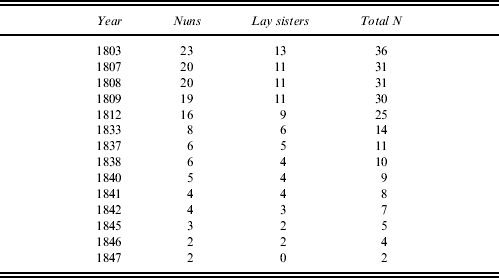
During the following years the pharmacy was able to continue without any complaints. A tax register for 1829–1839 confirms that it was paying the tax on occupations, which indicates that it sold medicines outside the convent.Footnote 104 Its active involvement can also be seen in the fact that it continuously received funds from the administration to provision the poor with medicines.Footnote 105 Given that the size of the convent declined relatively slowly during the first ten years after secularization (see Table 2), and that the ageing women needed access to medical care, the pharmacy's continuation was important for the convent itself.
The convent of Gutenzell after the 1803 Secularization, numbers of inhabitants
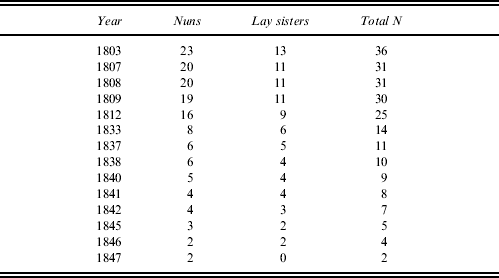
Source: Janine Maegraith, ‘Das Zisterzienserinnenkloster Gutenzell, vom Reichskloster zur geduldeten Frauengemeinschaft’ (Epfendorf, 2005), 358.
In 1838 the district authorities of Biberach were asked by the Württemberg authorities to dissolve the convent's pharmacy, keeping only enough of it for the use of the convent.Footnote 106 Shortly afterwards Rundel died, at the age of 75.Footnote 107 In 1839 the Count's administrator wrote a memorandum about her death that portrays the situation of the pharmacy during its last years:
The sale of medicines has been almost entirely restricted to the convent and the local poor during recent years, which must be ascribed to the fact that many ingredients for important recipes were not available, or if they were they had to be purchased for a higher price than in other pharmacies, even though they were also of lesser quality. Therefore it happened that with the increasing age and outdated skills of this woman the pharmacy lost the required trust, and the revenues from it actually reached zero.Footnote 108
Finally, the administrator advised the Count to shut down the pharmacy for good but to keep paying the annual 100 gulden to the convent, as it was ‘overrun’ by the needs of the local poor.Footnote 109 The payment continued but the pharmacy was dissolved for good in 1839.Footnote 110
After 1803, Gutenzell's convent pharmacy had continued to exist mainly due to the efforts of Count Toerring and his administrator, Banghard. It supplied the neighbourhood with medicines following the instructions of the regional physicians and in so doing filled a supply gap created by the considerable walking distance to the town pharmacies in Ochsenhausen (around 2 hours) and Biberach (around 4 hours). In emergencies this would have been too far away.Footnote 111 In addition, the pharmacy was given funds to supply the poor with medicines. After the closure of the pharmacy the village of Gutenzell did not get a replacement. As late as 1889 a local physician, Dr Thiermann, submitted a request to establish his own in-house pharmacy, pointing out that there still was no pharmacy in the whole region.Footnote 112
The example of Gutenzell and similar convent pharmacies provides evidence of a power struggle after 1806 between the local governments of the formerly independent territories and the Württemberg government. The formerly independent territories tried to hold on to former privileges such as the right to establish and maintain a pharmacy, while the government of Württemberg strove to centralize political matters, including medical and pharmaceutical affairs.Footnote 113 The inspections of the Gutenzell pharmacy illustrate this development of an expanding state influence in medical matters in Württemberg after 1806, and reflect the changing expectations. This is linked to the transition of pharmacy in general from its craft training tradition towards becoming an academic profession. Helmstädter and colleagues also stress the confrontation between the tradition of vocational training and the evolving scientific approach to pharmacy, with its demands for a more academic training.Footnote 114 The shift towards a scientific approach had already begun at the end of the seventeenth century and it took off in the eighteenth, altering the educational requirements for the role. In Prussia, attending lectures at the ‘Berliner Collegium Medico-Chirurgicum’ (Berlin College of Medicine and Surgery) became obligatory as early as 1725 for an apothecary to establish his own pharmacy in a town.Footnote 115 In 1808, the Electorate of Bavaria made two years of study in the medical faculty of the university compulsory for new apothecaries.Footnote 116 Accordingly, at the beginning of the nineteenth century medical regulations in a number of German states – amongst them Prussia (1801), Baden (1806), Bavaria (1808), and Württemberg (1814) – were changed in the direction of uniform state regulation.Footnote 117
4. GUTENZELL'S CONTRIBUTION TO THE MEDICAL CARE OF THE RURAL POPULATION
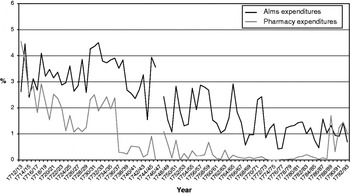
A strong argument for the continuation of Gutenzell's pharmacy after 1803 was the fact that it provided the surrounding rural area and the local poor with medication. This can also be seen at other monastic pharmacies in Württemberg which were under attack in 1823, when their remote locations formed their strongest defence.Footnote 118 But the restriction on the number of pharmacies was retained in Württemberg and reinforced in 1819 for rural areas.Footnote 119 How substantial was the contribution of the convent pharmacies to their regions, and especially to the local poor, however? On the actual benefits monastic pharmacies offered for the local poor, Rüdiger Nolte questions their importance and discusses the example of the Cistercian convent of Niederschönenfeld in the diocese of Augsburg. He calculated the convent's annual expenditure on its pharmacy and its expenditure on alms as proportions of its total expenditure, and found that the latter exceeded the former.Footnote 120 A look at Gutenzell's expenses appears to show a similar result. The alms expenditures between 1712 and 1793 amounted on average to 2.23 per cent of the convent's total spending and the pharmacy expenditures came to 0.84 per cent.Footnote 121 The cost of the pharmacy was lower than that of alms but both followed similar trends, declining over time. However, the proportion of the expenditure on the pharmacy rose again during the period of the Revolutionary Wars and even exceeded expenditure on alms (see Figure 1).Footnote 122
Percentages of the expenditures on alms and on the pharmacy out of the total expenditure of the convent of Gutenzell, 1712–1793. (Source: Kreisarchiv Biberach Klosterarchiv Gutenzell, ‘Jahresrechnungen’.)

However, the quantitative benefits of the monastic pharmacies have to be seen in the context of the following factors. It should be taken into account that at the end of the eighteenth century the convent at Gutenzell had two qualified apothecaries operating the pharmacy. They invested their time and expertise not only for the convent but also for the local poor. The pharmacy was already adequately provisioned and the cost and quantities of the medicines were, as Nolte also stresses, therefore less visible. Another issue that needs attention is whether the expenditures responded to economic crises and were therefore adapted to needs – as can be assumed for Gutenzell during the Revolutionary Wars. However, to evaluate the impact of the expenditures of alms and medicines on the rural population, a comparison with the average standard of living in Gutenzell would be necessary. The convent pharmacy retained its role in medical welfare after 1803 and the new administration ensured this financially, as was explained earlier. Although the pharmacy was financed by the local administration, it formed part of an informal welfare network that continued to exist despite attempts by the state to centralize social welfare. Monastic pharmacies more or less adjusted their prices according to the social status of the customer and even gave medicines to the poor free of charge. By doing so they came into conflict with town pharmacies, as the latter had to charge government-fixed prices.Footnote 123 But in Württemberg town pharmacies were theoretically allowed to adjust their prices to a certain extent, and under specific conditions the local magistracy paid for medicines for the registered poor.Footnote 124 This would have involved further administrative controls that were not necessarily present in a monastic pharmacy and medication was therefore more easily accessible to the poor from the latter. But this contradicted the nature of the centralized welfare policy of the state, which focused on the enhancement of ‘industriousness’ as opposed to unconditional charity. This was manifested in the foundation of the ‘Zentralleitung des Wohltätigkeitsvereins’ (‘Association for the Central Administration of Welfare’) in 1817.Footnote 125 Ironically, on the basis of this policy an ‘Industrieschule’ (school of industry) for girls was founded in Gutenzell in 1822, on the initiative of two former nuns who also became the first teachers in the new school.Footnote 126
CONCLUSION
Following the Secularization of 1803 the convent of Gutenzell lost its sovereignty and was exposed to outside control, and the nuns lost their monastic status and privileges. Gutenzell's pharmacy survived but shared a similar fate to other monastic pharmacies: they were merely tolerated, probably because they did fill a supply gap in rural areas, which again might indicate their actual importance in this respect. The nun apothecaries were usually allowed to continue until their death or the final closure of the convent. But their existence was constantly challenged. A clear illustration comes from the official inspection of 1816 in Gutenzell and its expressed distrust of the current apothecary. The lack of any future training for nun apothecaries led to a professional void in monastic pharmacies, and with the ban on new admissions the institution was doomed to die out. As mentioned earlier, only in 1899 were women again permitted to study pharmacy.Footnote 127
The treatment of the convent pharmacy in Gutenzell after 1803, and the inspections of 1812 and 1816, reveal specific ways in which the state of Württemberg dealt with pharmaceutical matters and show how further conformity with state regulations and monopolization of the profession were enforced. After 1806 the state of Württemberg, now a kingdom, underwent considerable political reforms in which its administration was reorganized and centralized to ensure better control. This was a process that stretched over several decades. In pharmaceutical matters, the administrative centralization led to a tightening of the occupational organization of apothecaries and consequently to the abolition of the niches for female apothecaries mentioned earlier. The central government subordinated territorial rulers, whose territories now became part of Württemberg, and absorbed their former rights and privileges, including the right to run a pharmacy. As a result the niches made possible by the diversity of many local governments vanished. With this came tighter control over the training of apothecaries and its development towards becoming an academic discipline. The exclusion of women from universities meant their exclusion from academic pharmacy training. With the profession's emerging scientific approach, therefore, the former possibility of acquiring training within the traditional apprenticeship system was lost. And, last but not least, the dissolution of the monasteries and convents abolished former niches such as convent pharmacies where nun apothecaries had been able to practise. Early modern society, with its diverse political and social structures, was replaced by a ‘modern’ state aiming to administer all matters centrally. The example of female apothecaries shows how the interplay of secularization and administrative and state reform, along with the process of the ‘professionalisation’ of pharmacy, proved to have a substantially negative impact on women.
Judging from this case study, the Secularization and subsequent institutional change led to the elimination of privileged work environments and the exclusion of women from pharmacy. Where, in the opinion of the representatives of the pharmaceutical profession and of the state, the institutional changes they favoured were seen as improvements in academic standards, these changes disadvantaged both women, who were excluded from this development, and the rural population, who used to benefit from the latter's informal welfare. This means that what was officially seen as ‘improvement’ had in fact distinctly negative consequences for women and their participation in the medical professions and for social welfare.
In support of this argument, it is my intention to undertake more case studies of female apothecaries during the nineteenth century, combined with a comparative study of them in other European countries. According to Schnabel's findings for the Electorate of Bavaria, 19 of the convents studied had a pharmacy, about 61 per cent, and he lists 52 examples of nun or lay-sister apothecaries during the seventeenth and eighteenth centuries. For 20 of these there is information on their training as apothecaries.Footnote 128 Given this high number of convent pharmacies and female apothecaries, further research on the situation in Württemberg would be appropriate. At a rough estimate, this would include over 50 convents that were dissolved between 1782 and 1811.Footnote 129 Even if we assume that only a few of the convents actually had a working pharmacy, the estimated number of women who may have been trained and worked as apothecaries throughout the eighteenth century is significant. Equally, this would give us an idea of how many women pharmacists disappeared after the Secularization and thus would shed new light on its impact on women.
ACKNOWLEDGEMENTS
This study is based on a chapter of my PhD thesis on the convent of Gutenzell, published as Das Zisterzienserinnenkloster Gutenzell, vom Reichskloster zur geduldeten Frauengemeinschaft vom 17. Jahrhundert bis 1851 (Epfendorf, 2006). I wish to thank Kurt Diemer, John Henderson, Danielle van den Heuvel, Elisabeth Huwer, Craig Muldrew, Sheilagh Ogilvie, Franz Quarthal, Alisha Rankin, Ulinka Rublak, the archivists of the Kreisarchiv Biberach, my parents, and especially Richard Wall and the editors and referees of Continuity and Change for their advice.