Introduction
Saccular otoliths (sagittae) are the largest otoliths found in the inner ear of teleost fishes and play a crucial role in balance and hearing functions (Schulz-Mirbach et al., Reference Schulz-Mirbach, Ladich, Plath and Heß2019), and their species-specific morphology is valuable for the taxonomy and differentiation of species among bony fishes (D’Iglio et al., Reference D’Iglio, Natale, Albano, Savoca, Famulari, Gervasi, Lanteri, Panarello, Spanò and Capillo2021; Echreshavi et al., Reference Echreshavi, Esmaeili, Teimori and Safaie2021; Mejri et al., Reference Mejri, Bakkari, Allagui, Rebaya, Jmil, Mili, Shahin, Quignard, Trabelsi and Ben Faleh2022b; Moussavou Mbadinga et al., Reference Moussavou Mbadinga, Benghorbel, Adjibayo Houeto, Tazarki, Ben Faleh, Quignard, Trabelsia, Shahin and Bouriga2024; Özpiçak et al., Reference Özpiçak, Saygın and Savaş2024). Among the morphologies of these otoliths, it has long been established that shape and size show the highest interspecies diversity in bony fishes (Bouriga et al., Reference Bouriga, Bahri, Bejaoui, Adjibayo Houeto, Shahin, Quignard, Trabelsi and Ben Faleh2023; D’Iglio et al., Reference D’Iglio, Natale, Albano, Savoca, Famulari, Gervasi, Lanteri, Panarello, Spanò and Capillo2021; Mejri et al., Reference Mejri, Bakkari, Allagui, Rebaya, Jmil, Mili, Shahin, Quignard, Trabelsi and Ben Faleh2022b; Moussavou Mbadinga et al., Reference Moussavou Mbadinga, Benghorbel, Adjibayo Houeto, Tazarki, Ben Faleh, Quignard, Trabelsia, Shahin and Bouriga2024). Therefore, their shape, size, and microstructure are the most studied among fishes because they have been influenced by many factors, including environmental factors, e.g., water depth, temperature, salinity, and substrate (Martin and Wuenschel, Reference Martin and Wuenschel2006), feeding behaviour (Cardinale et al., Reference Cardinale, Doerin-Arjes, Kastowsky and Mosegaard2004), ontogenetic development (Capoccioni et al., Reference Capoccioni, Costa, Aguzzi, Menesatti, Lombarte and Ciccotti2011), physiology, e.g., hearing and vocal communication abilities (Schulz-Mirbach et al., Reference Schulz-Mirbach, Ladich, Plath and Heß2019), and phylogeny (Torres et al., Reference Torres, Lombarte and Morales-Nin2000).
On the other hand, the difference in the morphological symmetry between the left and right otoliths’ shape and size is called fluctuating asymmetry (FA), which is related to the developmental trajectory of the otoliths, guided by the developmental regulatory processes, such as evolutionary canalization (Mahé, Reference Mahé2019). This FA results from developmental instability under environmental or genetic stress (Jawad, Reference Jawad2012) and thus can provide an index measure of stress or microenvironmental variability (Díaz-Gil et al., Reference Díaz-Gil, Palmer, Catalán, Alós, Fuiman, García, Del Mar Gil, Grau, Kang, Maneja, Mohan, Morro, Schaffler, Buttay, Riera-Batle, Tolosa and Morales-Nin2015). In addition, FA has been identified as an indicator of fish health, as it can directly affect the balance and hearing performance of the fish (Lemberget and McCormick, Reference Lemberget and McCormick2009) and can also be a functional adaptation to the environment (Jawad and Mahe, Reference Jawad and Mahe2022). Moreover, previous studies have shown that otolith mass asymmetry (OMA) is an effective parameter in fish behaviour because it plays a crucial role in vocal functions. Moreover, previous studies have shown that OMA is an effective parameter in fish behaviour because it plays a crucial role in acoustic functions (Bouriga et al., Reference Bouriga, Mejri, Dekhil, Bejaoui, Quignard and Trabelsi2021; Lychakov et al., Reference Lychakov, Rebane, Lombate, Fuiman and Takabayashi2006). This is because mathematical modelling has suggested that the relatively large values of OMA can alter acoustic functionality and may be responsible for the abnormal behaviour of fish when exposed to weightlessness during parabolic flight or space flight (Lychakov and Rebane, Reference Lychakov and Rebane2005). Furthermore, the latter authors suggested that the absolute value and the sign of OMA can change several times during the growth of the individual fish within the range from −0.2< to < +0.2 or <20%. What’s more, the relationships between OMA and fish size (length and weight) have long been controversial, and some authors have found a significant link (Al Balushi et al., Reference Al Balushi, Jawad and Al Busaidi2017; Jawad et al., Reference Jawad, Dörtbudak, Yalçin and Park2023b, Reference Jawad, Mehanna, El-Regal and Ahmed2017; Lychakov and Rebane, Reference Lychakov and Rebane2004), and others did not (Ben Labidi et al., Reference Ben Labidi, Mejri, Shahin, Quignard, Trabelsi and Ben Faleh2020b; Ben Mohamed et al., Reference Ben Mohamed, Mejri, Chalh, Shahin, Quignard, Trabelsi and Ben Faleh2023; Bouriga et al., Reference Bouriga, Mejri, Dekhil, Bejaoui, Quignard and Trabelsi2021; Dkhili et al., Reference Dkhili, Bouriga, Fatnassi, Ben Mohamed, Quignard and Trabelsi2018; Jawad, Reference Jawad2013; Jawad et al., Reference Jawad, Qasim, Farrag, Alaa, Samy-Kamal, Mehanna and Abdel-Maksoud2023a; Jawad and Sadighzadeh, Reference Jawad and Sadighzadeh2013; Kontaş et al., Reference Kontaş, Bostanci, Yedіer, Kurucu and Polat2018; Lychakov and Rebane, Reference Lychakov and Rebane2005; Lychakov et al., Reference Lychakov, Rebane, Lombate, Fuiman and Takabayashi2006; Reis et al., Reference Reis, Ateş and Jawad2023; Yedier et al., Reference Yedier, Bostancı, Kontaş, Kurucu and Polat2018).
The Komo Estuary in Gabon is known for its abundance of various fish species, including the Bonga shad, Ethmalosa fimbriata (Bowdich, 1825) (Clupeiformes, Dorosomatidae), the lesser African threadfin, Galeoides decadactylus (Bloch, 1795) (Perciformes, Polynemidae), and the Guinean tonguesole, Cynoglossus monodi (Chabanaud, 1949) (Pleuronectiformes, Cynoglossidae). Among these species, E. fimbriata is a pelagic-neritic and catadromous species (Riede, Reference Riede2004), occurring in coastal waters at depths up to 50 m (FAO-FIGIS, 2001) in the Eastern Central Atlantic Ocean, from Dakhla in Western Sahara southward to Lobito Bay in Angola (Gourène and Teugels, Reference Gourène, Teugels, Paugy, Lévêque and Teugels2003). G. decadactylus is a demersal species that lives at depths of 10–70 m (Njock, Reference Njock, Quéro, Hureau, Karrer, Post and Saldanha1990) and is found off the coasts of West Africa, from the Canary Islands and Morocco to Angola (Daget, Reference Daget, Lévêque, Paugy and Teugels2003). C. monodi is a benthic fish, living at a depth range of 10–30 m (Gabis et al., Reference Gabis, Nichols, Kelpsaite, Parkins, Castro and Barbara Somers2012), with a distribution extending from the Atlantic Ocean to the centre-east of Mauritania, then towards Pointe-Noire until Gabon.
Regarding the otolith characteristics of the three species, Moussavou Mbadinga et al. (Reference Moussavou Mbadinga, Benghorbel, Adjibayo Houeto, Tazarki, Ben Faleh, Quignard, Trabelsia, Shahin and Bouriga2024) focused on discriminating the stocks of the three species in the Lebe fishing site located in the Komo Estuary, central-western Gabon, using the otolith shape analysis. Therefore, the present study was conducted using otolith morphometry, OMA, and total length (TL) analyses to (1) examine the intra- and interspecific variation in the otolith morphometry, including length, width, perimeter, and area measurements, in E. fimbriata, G. decadactylus, and C. monodi collected from the Lebe fishing site located along the Komo Estuary, central-western Gabon, to verify whether or not the otolith morphometry differs with the living depth levels, (2) examine the FA in the otolith morphometric parameters, and (3) assess the relationship between OMA and TL.
Materials and methods
Sampling and study area
A total of 180 adult samples (60 samples each; 30 males and 30 females for each species) of the pelagic E. fimbriata, demersal G. decadactylus, and benthic C. monodi were collected from the Lebe fishing site (0°10ʹ60″ N, 9°52ʹ0″ E) located along the Komo Estuary province (0°13ʹ00″ N, 9°45ʹ00″ E), central-western Gabon (Figure 1). Samples were caught between May 2019 and August 2021 by fishing gears, including purse rotary seines, drift gillnets, surface nets, and bottom set gillnets (Moussavou Mbadinga et al., Reference Moussavou Mbadinga, Benghorbel, Adjibayo Houeto, Tazarki, Ben Faleh, Quignard, Trabelsia, Shahin and Bouriga2024). Immediately after capture, the samples were transported in a cooler to the laboratory, where species were identified using the guide developed by Gabis et al. (Reference Gabis, Nichols, Kelpsaite, Parkins, Castro and Barbara Somers2012). The sex and maturity stages of all individuals were determined by microscopy analysis of the gonads according to the Gunderson scale (Gunderson, Reference Gunderson1993). Subsequently, the total weight (TW) was recorded to the nearest 0.01 g using an electronic balance, and the TL was measured to the nearest 0.1 mm with an ichthyometer (Table S1 in Supplementary Material). For more details on the images of the three species and the shape of their otoliths, see Figures S2 and 3A–C in Supplementary Material.
Ethmalosa fimbriata Bowdich, 1825, Galeoides decadactylus Bloch, 1795, and Cynoglosus monodi Chabanaud, 1949, a map showing the Lebe fishing site (●) from which males and females of the three species were collected in the Komo Estuary, central-western Gabon.

Otolith extraction and imaging
The sagittal otoliths (sagittae) were extracted using forceps, washed with distilled water, air-dried at room temperature to remove moisture, stored in labelled plastic Eppendorf tubes, and finally kept dry for 24 h before processing (Moussavou Mbadinga et al., Reference Moussavou Mbadinga, Benghorbel, Adjibayo Houeto, Tazarki, Ben Faleh, Quignard, Trabelsia, Shahin and Bouriga2024). The left and right otoliths were positioned under a dissecting microscope at 40× magnification with a black background, oriented with the inner side, Sulcus acusticus, directed upwards, and digital images were captured using a Canon IXUS 185 digital camera, with a resolution of 20 megapixels (Figure S3A–C in Supplementary Material). After that, all images were sent to an image analyser equipped with an incorporated millimetre scale.
Otolith morphometric analysis
Otolith’s length (Lo), width (Wo), area (Ao), and perimeter (Po) were measured using Image J imaging software using a predefined scale of 1 mm (Figure S3A–C in Supplementary Material). Before statistical analyses, one-way ANOVA was used to determine whether there were any significant differences between the mean values of Lo, Wo, Po, and Ao for the left and right sides of otoliths within and among males and females of the two species. In addition, the two-way ANOVA was used to check whether there was a correlation between the otolith’s morphometric parameters and the species of origin of the males and females. Moreover, the Student’s t-test was used to analyse the differences in the four parameters between the left and right and left–left and right–right otoliths of males and females between the two species. All statistical analyses were performed using XLSTAT 2016.
FA measurement and analysis
The FA between the right and left sides of otoliths, expressed as the FAi index, was computed among males and females of the three species for each otolith morphometric parameter per individual ‘i’ by applying the formula given by Palmer and Strobeck (Reference Palmer and Strobeck1986) and as described in details by Deida et al. (Reference Deida, Gammoudi, El Ayari, Ben Faleh, Djimera, Shahin and Bouriga2024). Afterward, the interspecific differences were tested using the Student’s t-test and represented by the described statistical box plots.
Determination of OMA
The previously prepared and stored otoliths were weighed using an analytical electric balance with an accuracy of 0.0001 g. Then, the OMA (X) was calculated using the following formula described by Jawad et al. (Reference Jawad, Mehanna, El-Regal and Ahmed2017).
 \begin{equation*}X = \left( {{M_{\text{R}}} - {M_{\text{L}}}} \right)M - 1,\end{equation*}
where M R is the mass of the right otolith, M L is the mass of the left otolith, and M is the mean mass of the right and left paired otoliths. Theoretically, the X value can range between –2 and +2, and X = 0 signifies the absence of mass asymmetry, i.e., M R = M L, and X = –2 or X = 2 represents the maximal asymmetry, i.e., the lack of otolith from one of the two sides. A positive value of X means that the right otolith mass is larger than the left one, and a negative sign denotes the opposite. The absolute value of OMA across species was calculated as the mean individual value. Additionally, the relationship between the right and left OMA (X) and the TL was computed according to the following formula given by Yedier et al. (Reference Yedier, Bostancı, Kontaş, Kurucu and Polat2018) and as described by Ben Labidi et al. (Reference Ben Labidi, Mejri, Shahin, Quignard, Trabelsi and Ben Faleh2020b).
 \begin{equation*}X = a.TL + b,\end{equation*}
where a is a constant characterizing the growth rate of the otolith and b is a constant for the given species. The relationship was estimated using linear regression analysis (LRA), and the difference between X and TL from all males and females within each species was statistically tested for significance by the Student’s t-test. Moreover, the absolute value of each species’ OMA |X| was calculated as the average of all individuals’ values (Jawad and Sadighzadeh, Reference Jawad and Sadighzadeh2013).
Results
TW and TL variation
The TW and TL of E. fimbriata ranged from 72.1 to 229.1 g and 220 to 325 mm in males and from 72.1 to 282.9 g and 220 to 330 mm in females (see Table S1 in Supplementary Material). In G. decadactylus, the TW and TL varied from 101.8 to 227.4 g and 215 to 285 mm in males and from 122.4 to 293.2 g and 190 to 310 mm in females. However, the TW and TL differed between 91.1 to 517 g and 270 to 540 mm in males, whereas between 109.6 to 406 g and 304 to 505 mm in females of C. monodi.
Otolith morphometric variation
Intraspecific variability
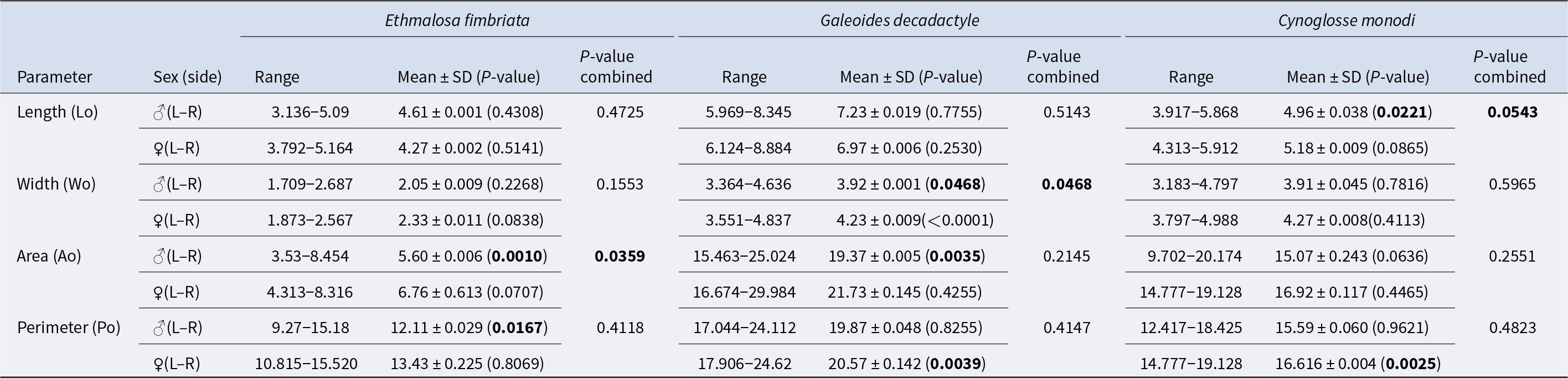
The Student’s t-test for Lo, Wo, Ao, and Po values indicated a significant difference (P < 0.05), i.e., asymmetry, in Ao and Po between left (L) and right (R) otoliths only within males of E. fimbriata (Table 2). In G. decadactylus, a significant asymmetry between the left and right otoliths was observed in Wo within males (P < 0.05) and females (P < 0.0001), Ao within males and Po within females (P < 0.05), while a significant asymmetry was found in Lo within males and Po within females (P < 0.05) in C. monodi. However, combined analysis of the otoliths Lo, Wo, Ao, and Po values between males and females using the Student’s t-test showed a significant asymmetry (P < 0.05) only in Ao between the left and right otoliths in E. fimbriata, Wo in G. decadactylus, and Lo in C. monodi. On the other hand, one-way ANOVA showed significant asymmetry (P = 0.014; < 0.05) only in Wo of left and right otoliths between males and females of G. decadactylus.
Student’s t-test analysis of biometric parameters of the left (L) and right (R) otoliths within males and females in Ethmalosa fimbriata, Galeoides decadactylus, and Cynoglossus monodi collected from the Lebe fishing site located in the Komo Estuary, central-western Gabon

SD, standard deviation. The values marked in bold are statistically significant (P < 0.05).
Interspecific variability
Combined analysis of the four morphometric parameters of the left and right otoliths between males and females of the three species, using Student’s t-test, revealed a significant asymmetry (P < 0.05) only in Wo and Ao among males and females of the three species (Table 3). Conversely, one-way ANOVA detected no significant asymmetry (P > 0.05) in any otolith morphometrics between the left and right otoliths among males and females of the three species.
Student’s t-test combined analysis of biometric parameters of the left (L) and right (R) otoliths between males and females of Ethmalosa fimbriata, Galeoides decadactylus, and Cynoglossus monodi collected from the Lebe fishing site located in the Komo Estuary province, central-western Gabon

SD, standard deviation. The values marked in bold are statistically significant (P < 0.05).
Otolith FA variation
Intraspecific variability
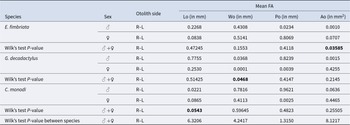
Analysis of the mean FA values between Lo, Wo, Ao, and Po of the right and left otoliths among males and females within the three species, using Wilk’s λ test, revealed a significant FA (P < 0.05) only in Ao within E. fimbriata, Wo within G. decadactylus, and Lo within C. monodi (Table 4).
Estimates of the mean values of fluctuating asymmetry (FA) between the left (L) and right (R) sagittal otoliths’ length (Lo), width (Wo), area (Ao), and perimeter (Po) within and between males (♂) and females (♀) of Ethmalosa fimbriata, Galeoides decadactylus, and Cynoglosus monodi males and females collected from the Lebe fishing site located in the Komo Estuary, central-western Gabon

The values marked in bold are statistically significant (P ≤ 0.05).
Interspecific variability
Combined analysis of the mean FA values between the right and left otoliths Lo, Wo, Ao, and Po using Wilk’s λ test showed a non-significant FA (P > 0.05) in the morphometric parameters among males and females of the three species (Table 4). In addition, the distribution of the mean values of FA in the four parameters and signs of the skewness among males and females of the three species were diagrammatically represented by a box plot chart (Figure 4).
Ethmalosa fimbriata Bowdich, 1825 (A), Galeoides decadactylus Bloch, 1795 (B), and Cynoglosus monodi Chabanaud, 1949 (C), box plots showing the distribution and signs of skewness of the mean values of fluctuating asymmetry (FA) of the left and right otoliths length (Lo), width (Wo), perimeter (Po), and area (Ao) between males and females of the three species collected from the Lebe fishing site located in the Komo Estuary, central-western Gabon. The central line is the median, the boxes indicate the first and third quartiles, and the whiskers indicate two standard deviations. Outliers are those outside the median ± 0.0–0.2 SD.

OMA and total length variation
Intraspecific variability
Student’s t-test analysis of the OMA (X) of the right and left otoliths within males and females of the three species showed a significant mass asymmetry (P < 0.05) only within females of both G. decadactylus and C. monodi, as well as between males and females of E. fimbriata and C. monodi (Table 5). In addition, the mean value of TL ranged from 251.87 mm in females to 271.63 mm in males, while the mean value of X was –0.0006 ± 0.046 in females and –0.010 ± 0.104 in males, with an average mean of –0.005 ± 0.080, in E. fimbriata (Table 5). In G. decadactylus, the mean value of TL differed from 246.03 mm in males to 265.27 mm in females, with the mean value of X ranging from –0.072 ± 0.194 in females to 0.014 ± 0.047 in males, with an average of –0.029 ± 0.149. However, in C. monodi, the mean value of TL changed from 376.67 mm in males to 416.93 mm in females, and the mean value of X was – 0.014 ± 0.0370 in females and –0.034 ± 0.107 in males, with a mean of –0.024 ± 0.080. In addition, the absolute value of the OMA |X| was 0.030 ± 0.008, 0.068 ± 0.003, and 0.038 ± 0.005 for E. fimbriata, G. decadactylus, and C. monodi, respectively. Moreover, the determination of the relationship between the X and TL among males and females of the three species using LRA revealed that there was a significant relationship (P < 0.05) between the two parameters in both E. fimbriata and G. decadactylus (Figures 5A and B) and a non-significant relationship (P > 0.05) was found in C. monodi (Figure 5C; Table 5).
Ethmalosa fimbriata Bowdich, 1825 (A), Galeoides decadactylus Bloch, 1795 (B), Cynoglosus monodi Chabanaud, 1949 (C), and between the three species (D), linear regression analysis (LRA) showing the relationship between the left and right otolith mass asymmetry (OMA) and TL within and among males and females of the three species combined collected from the Lebe fishing site located in the Komo Estuary, central-western Gabon.

Summary of the relationship between total length range (TL in mm) and otolith mass asymmetry (OMA, X)

The range and mean ± standard deviation (SD) values, the linear regression analysis (LRA) parameters, and Student’s t-test P-values between the left and right otoliths within and among males and females of the three species collected from the Lebe fishing site located in the Komo Estuary, central-western Gabon
The values marked in bold are statistically significant (P < 0.05).
Interspecific variability
As shown in Table 5, the combined analysis of the X of the right and left otoliths between males and females of the three species, using Student’s t-test, revealed a significant mass asymmetry (P < 0.0001). The mean value of TL ranged from 190 to 540 mm, while the mean value of OMA (X) was –0.0009 ± 0.008. Besides, the average absolute value of the OMA |X| was 0.045 ± 0.005. In addition, the determination of the relationship between the X and TL among males and females of the three species using LRA indicated a non-significant relationship (P > 0.05) between the two parameters (Figure 5D).
Discussion
Due to the intra- and interspecific variability of otolith morphology, it has long been used to discriminate between fish species and populations and their stocks in different habitats, as well as between sexes, age classes, and reproductive morphs (Bose et al., Reference Bose, Zimmermann, Winkler, Kaufmann, Strohmeier, Koblmüller and Sefc2020; Echreshavi et al., Reference Echreshavi, Esmaeili, Teimori and Safaie2021; Özpiçak et al., Reference Özpiçak, Saygın and Savaş2024). These morphological differences in otoliths have been investigated by comparing their shape and size characteristics across species and populations living in variable ranges of geographic environments (Adjibayo Houeto et al., Reference Adjibayo Houeto, Mejri, Bakkari, Bouriga, Chalh, Shahin, Quiganrd, Trabelsi and Ben Faleh2024; Ben Labidi et al., Reference Ben Labidi, Mejri, Shahin, Quignard, Trabelsi and Ben Faleh2020a; Ben Mohamed et al., Reference Ben Mohamed, Mejri, Chalh, Shahin, Quignard, Trabelsi and Ben Faleh2023; Bouriga et al., Reference Bouriga, Bahri, Bejaoui, Adjibayo Houeto, Shahin, Quignard, Trabelsi and Ben Faleh2023; Deida et al., Reference Deida, Gammoudi, El Ayari, Ben Faleh, Djimera, Shahin and Bouriga2024; Khedher et al., Reference Khedher, Mejri, Shahin, Quiganrd, Trabelsi and Ben Faleh2021; Mejri et al., Reference Mejri, Bakkari, Allagui, Rebaya, Jmil, Mili, Shahin, Quignard, Trabelsi and Ben Faleh2022b, Reference Mejri, Bakkari, Tazarki, Mili, Chalh, Shahin, Quignard, Trabelsi and Ben Faleh2022a; Moussavou Mbadinga et al., Reference Moussavou Mbadinga, Benghorbel, Adjibayo Houeto, Tazarki, Ben Faleh, Quignard, Trabelsia, Shahin and Bouriga2024). In addition, OMA has been reported to have a crucial impact on fish behaviour because otoliths play an essential role in hearing functions (Bouriga et al., Reference Bouriga, Mejri, Dekhil, Bejaoui, Quignard and Trabelsi2021; Lychakov et al., Reference Lychakov, Rebane, Lombate, Fuiman and Takabayashi2006). Moreover, it has been confirmed that although the mean value of otolith mass increases with the length of the fish, it does not depend on the fish length and growth rate of the otoliths, and its average value varies between –0.2 and +0.2. (Ben Labidi et al., Reference Ben Labidi, Mejri, Shahin, Quignard, Trabelsi and Ben Faleh2020b; Ben Mohamed et al., Reference Ben Mohamed, Mejri, Chalh, Shahin, Quignard, Trabelsi and Ben Faleh2023; Jawad et al., Reference Jawad, Gnohossou and Tossou2020, Reference Jawad, Mehanna, El-Regal and Ahmed2017; Lychakov et al., Reference Lychakov, Rebane, Lombarte, Demestre and Fuiman2008). Here, we examined the variations in the otolith length (Lo), width (Wo), perimeter (Po), and area (Ao) measurements to verify whether or not the otolith morphometry differs in relation to the living depth levels of E. fimbriata, G. decadactylus, and C. monodi, examine the FA in the otolith morphometric parameters, and assess the relationship between OMA and TL. In the current study, it is worth noting that the sampling collection was confined to adult fish to avoid the effect of sexual immaturity, which has been proven to modify the outlines of otoliths (Cardinale et al., Reference Cardinale, Doerin-Arjes, Kastowsky and Mosegaard2004). In addition, as the otolith outline’s complexity increases with the fish’s ontogenetic stage (Santos et al., Reference Santos, Azevedo, Albuquerque and Araújo2017), the sampling was restricted to the adult stage and a narrow range of TL in each species to limit this effect.
At the intraspecific level, the results showed an apparent asymmetry in Ao and Po between the left and right otoliths only within males of E. fimbriata, which assumes a benthic life at depths up to 50 m (FAO-FIGIS, 2001), Wo within males and females, Ao within males, and Po within females of G. decadactylus that takes a demersal life at depths of 10–70 m (Njock, Reference Njock, Quéro, Hureau, Karrer, Post and Saldanha1990), while in Lo within males and Po within females in the benthic C. monodi, living at a depth range of 10–30 m (Gabis et al., Reference Gabis, Nichols, Kelpsaite, Parkins, Castro and Barbara Somers2012). This morphometric asymmetry observed in both E. fimbriata and C. monodi is consistent with that found by Moussavou Mbadinga et al. (Reference Moussavou Mbadinga, Benghorbel, Adjibayo Houeto, Tazarki, Ben Faleh, Quignard, Trabelsia, Shahin and Bouriga2024) in the otolith shape within the two species. However, at the interspecific level, only significant asymmetry was observed in the Wo and Ao of left and right otoliths between males and females of the three species, a result that is concordant with that previously found based on the otolith shape variation (Moussavou Mbadinga et al., Reference Moussavou Mbadinga, Benghorbel, Adjibayo Houeto, Tazarki, Ben Faleh, Quignard, Trabelsia, Shahin and Bouriga2024). In comparison to other species, similar asymmetry in Wo has also been found in Pagellus erythrinus (Mejri et al., Reference Mejri, Trojette, Jmil, Ben Faleh, Chalh, Quignard and Trabelsi2020) and Boops boops (Ben Labidi et al., Reference Ben Labidi, Mejri, Shahin, Quignard, Trabelsi and Ben Faleh2020b), as well as in Lo and Wo in Rastrelliger kanagurta (Al-Mamry et al., Reference Al-Mamry, Jawad and Ambuali2011), Sardinella sindensis and Sillago sihama (Jawad et al., Reference Jawad, Sadighzadeh and Al-Mamary2012a), Lutjanus bengalensis (Jawad et al., Reference Jawad, Al-Mamry, Al-Mamari and Al-Hasani2012b), Chlorurus sordidus and Hipposcarus harid (El-Regal et al., Reference El-Regal, Jawad, Mehanna and Ahmad2016), Merlangius merlangus (Kontaş et al., Reference Kontaş, Bostanci, Yedіer, Kurucu and Polat2018), Trachurus mediterraneus (Yedier et al., Reference Yedier, Bostancı, Kontaş, Kurucu and Polat2018), and Sarotherodon melanotheron and Coptodon guineensis (Jawad et al., Reference Jawad, Gnohossou and Tossou2020). Indeed, the differential asymmetry observed here between the right and left otoliths within and among males and females of the three species can accommodate the Lo, Wo, Ao, and Po’s susceptibility to immediate environmental fluctuations. Therefore, these significant differences in these morphometric values between the three species can be used as a biomarker of stress in the Lebe environment. Among these morphometric parameters, Wo showed the lowest bilateral asymmetry values of the three species examined, suggesting that this character may be less subject to environmental stressors, including pollution, than other parameters. As reported by Jawad (Reference Jawad2003), this lower bilateral asymmetry value can be interpreted by the fact that the developmental period of the Lo may not be consistent with the adverse environmental events. In addition, the apparent effect of bilateral asymmetry on fish otoliths has long been interpreted as abnormal swimming activity and interference with correct sound localization (Helling et al., Reference Helling, Hausmann, Clarke and Scherer2003), and this results in the inability of the individuals to integrate with the environment in which the fish live (Lychakov and Rebane, Reference Lychakov and Rebane2005).
Regarding the mean values of FA in Lo, Wo, Ao, and Po left and right within and between males and females of the three species, significant FA was found only in Ao within E. fimbriata, Wo within G. decadactylus, and Lo within C. monodi. This finding is consistent with what has been reported for the shape of otoliths within E. fimbriata and C. monodi (Moussavou Mbadinga et al., Reference Moussavou Mbadinga, Benghorbel, Adjibayo Houeto, Tazarki, Ben Faleh, Quignard, Trabelsia, Shahin and Bouriga2024). However, no significant difference in FA was recorded in any of the morphometric parameters between males and females of these three species, a finding that contradicts what has been found in the shape of the otoliths among the three species (Moussavou Mbadinga et al., Reference Moussavou Mbadinga, Benghorbel, Adjibayo Houeto, Tazarki, Ben Faleh, Quignard, Trabelsia, Shahin and Bouriga2024). This discrepancy in the FA between otolith shape and morphometric parameters at the interspecific level can be attributed to the increased ability of otolith morphometry to accommodate environmental changes because they are closely related to hearing functions linked to acoustic communication more than otolith shape. In comparison with our results, similar and/or different results were obtained for several species for which data are available. Of these findings, the observed asymmetry in the length, width, and area of otoliths in P. erythrinus has been attributed to FA because of the developmental instability induced by genetic and environmental stress (Mejri et al., Reference Mejri, Trojette, Jmil, Ben Faleh, Chalh, Quignard and Trabelsi2020). In this regard, the highest level of asymmetry in the otolith width has been found by Jawad (Reference Jawad2012) in L. bengalensis, Jawad et al. (Reference Jawad, Sadighzadeh and Al-Mamary2012a) in S. sindensis and S. sihama, and Jawad et al. (Reference Jawad, Gnohossou and Tossou2020) in S. melanotheron and C. guineensis, and ascribed this asymmetry to the different pollutants present in the sampling area. In addition, Jawad et al. (Reference Jawad, Mehanna, El-Regal and Ahmed2017) assumed that the development of asymmetry on both sides of the otoliths is most likely due to the vulnerability of individuals under stress conditions. Similarly, Kontaş et al. (Reference Kontaş, Bostanci, Yedіer, Kurucu and Polat2018) declared that the otolith area exhibited the highest level of asymmetry, while length showed the lowest in M. merlangus, and that the asymmetry in these characters resulted from stress caused by various pollutants in the Black Sea. However, Chakour and Elouizgani (Reference Chakour and Elouizgani2018) attributed the significant asymmetry in the Lo, Po, and Wo in Solea lascaris populations to the environmental specificity and adaptation of each population to its environment.
As regards the environmental characteristics of the Lebe fishing site, Moussavou Mbadinga et al. (Reference Moussavou Mbadinga, Benghorbel, Adjibayo Houeto, Tazarki, Ben Faleh, Quignard, Trabelsia, Shahin and Bouriga2024) reported that the average temperature is 28.25 ± 0.45°C, salinity is 20.09 ± 5.19‰ and reached 34.31 ± 4.51‰ in June, and pH is 7.98 ± 0.37 in the rainy season and 7.44 ± 0.06 in the dry season. Besides that, they mentioned that the site is polluted with zinc, cadmium, chromium, and iron, with average concentrations of 4.37 ± 8.08, 2.35 ± 1.39, 1.31 ± 0.77, and 200 ± 65.20 μg/L, respectively. Moreover, the average total concentrations of dissolved oxygen and ammonium are 5.03 ± 0.49 and 0.57 ± 0.42 mg/L, respectively, which indeed lowers the pH of the water and promotes the solubility of trace metals (Sunda and Cai, Reference Sunda and Cai2012).
To our knowledge, no data are available on the diet content of the three species in the Gabon waters. However, Bianchi (Reference Bianchi1986) reported that the pelagic E. fimbriata feeds principally on phytoplankton, especially diatoms, and the demersal G. decadactylus feeds on invertebrates, mainly crustaceans, and small fishes (Maigret and Ly, Reference Maigret and Ly1986), while the benthic C. monodi feeds on mollusks (Schneider, Reference Schneider1990). Additionally, the demersal G. decadactylus is a protandrous hermaphrodite, with a sex change of males into females and with sizes of 17.7 cm TL for males and 18.7 cm for females at first sexual maturity (Mbega et al., Reference Mbega, Sadio, Liwouwou, Mvé Beh, Bamba, Eleng Spanian, Yedi, Cardiec and Le Loc’h2021); our samples TL ranged from 215 to 285 mm in males and 190 to 310 mm in females. As a result, the assumption of sex change can be considered a decisive factor in the observed difference in the morphometry of the otoliths between males and females of the three species. So, this observed environmental stress may arise from the pollution of water and sediments with heavy metals and organic matter found in the Lebe fishing site along the Komo Estuary. Accordingly, the pollution situation in the Lebe site has become a usual event for individuals of the three species, inhabiting different depth levels and possibly having variable diet content, which may be responsible for the differential asymmetry detected in the otolith morphometric parameters.
On the other hand, in analysing the variation in OMA (X) within and between males and females at the intra- and interspecific levels, significant mass asymmetry at the intraspecific level was found only within females of both the demersal G. decadactylus and benthic C. monodi, as well as between males and females of the pelagic E. fimbriata and benthic C. monodi. Besides that, a significant proportional relationship between the X and TL was detected only among males and females within the pelagic E. fimbriata and demersal G. decadactylus. Moreover, the X means ranged between −0.2 and +0.2, the absolute mass asymmetry |X| values were 0.030 and 0.068, and the R 2 means were 0.0003 and 0.0001 in the two species, respectively. Similar results have been observed across a wide range of species, including L. bengalensis (Jawad et al., Reference Jawad, Al-Mamry, Al-Mamari and Al-Hasani2012b), R. kanagurta (Ambuali et al., Reference Ambuali, Jawad and AL-Mamry2011), Carangoides caeruleopinnatus (Jawad, Reference Jawad2013), Liza klunzingeri (Jawad and Sadighzadeh, Reference Jawad and Sadighzadeh2013), and L. ehrenbergii (Al Balushi et al., Reference Al Balushi, Jawad and Al Busaidi2017), where they reported that the mean value of otolith mass varied between −0.2 and +0.2 and increased with fish length but has been independent of fish length and otolith growth rate. At the interspecific level, the value of X ranged from –0.045 to 0.116, with a mean of –0.0009 ± 0.008, and the value |X| was 0.045, and no significant relationship was found between X and TL among males and females of the three species combined. This finding is consistent with that found in the roundfishes (Lychakov et al., Reference Lychakov, Rebane, Lombate, Fuiman and Takabayashi2006), flatfishes (Lychakov et al., Reference Lychakov, Rebane, Lombarte, Demestre and Fuiman2008), C. sordidus, and H. harid (Jawad et al., Reference Jawad, Mehanna, El-Regal and Ahmed2017), and S. melanotheron and C. guineensis (Jawad et al., Reference Jawad, Gnohossou and Tossou2020), where otolith mass differed between −0.2 and +0.2 but increased with fish length and did not depend on fish length and otolith growth rate. Similarly, Dkhili et al. (Reference Dkhili, Bouriga, Fatnassi, Ben Mohamed, Quignard and Trabelsi2018) compared the X between the pelagic Sardina pilchardus, T. mediterraneus, and L. aurata and benthic Gobius niger, Mullus barbatus, and Trachinus draco, where they found that the X ranged from −0.0258 to 0.3379, has been independent of fish length, there has been no significant difference between the sexes, and the |X| values have been under 0.05 between the six species. However, Bouriga et al. (Reference Bouriga, Mejri, Dekhil, Bejaoui, Quignard and Trabelsi2021) also examined the same six species from the same locality, where they scored a significant difference in OMA between benthic and pelagic species, with |X| not exceeding 0.2 and no relationship between TL and OMA. In addition, Yedier et al. (Reference Yedier, Bostancı, Kontaş, Kurucu and Polat2018) reported that X varied between −0.25483 and +0.41220 and that X and |X| have no relationship with TL. Moreover, Jawad et al. (Reference Jawad, Qasim, Farrag, Alaa, Samy-Kamal, Mehanna and Abdel-Maksoud2023a) also recorded no relationship between the value of the asymmetry of the length and width of the otoliths and the total fish length in Mulloidichthys flavolineatus and Parupeneus forsskali from the fishing harbour of Hurghada on the Red Sea, Egypt. Indeed, Lychakov et al. (Reference Lychakov, Rebane, Lombate, Fuiman and Takabayashi2006) attributed the absence of a relationship between OMA and TL to possible genetic factors, small sample sizes, and the narrow range of TL of the samples. Regarding these factors in the benthic C. monodi, which exhibited no significant relationship between X and TL, it should be noted that sample sizes were 60 for both males and females, and TL ranged from 270 to 540 mm among males. Therefore, we can suggest that the absence of this relationship between males and females can be attributed to genetic factors or living depth level, a supposition that needs further investigation. According to the mathematical model proposed by Lychakov et al. (Reference Lychakov, Rebane, Lombarte, Demestre and Fuiman2008), the relatively large values of OMA can affect acoustic performance and are responsible for the erratic swimming behaviour of fish, with individuals with high OMA typically exhibiting abnormal swimming compared to those with the standard value range between −0.2 and +0.2 (Scherer et al., Reference Scherer, Helling, Clarke and Hausmann2001). In addition, as Lychakov and Rebane (Reference Lychakov and Rebane2004, Reference Lychakov and Rebane2005) stated, the OMA can decrease the acoustic and vestibular functionality of the fish’s ear. Moreover, Lychakov et al. (Reference Lychakov, Rebane, Lombate, Fuiman and Takabayashi2006) noted that in the majority of fish species, as well as those studied here, the saccular OMA is very low (|X| < 0.5), regardless of fish length. Conversely, fish with large otoliths and |X| > 0.2, in contrast to the case here, can theoretically have problems with sound processing due to the incompatibility and inconsistency in the movement of the two otoliths on both sides of the head (Lychakov and Rebane, Reference Lychakov and Rebane2005); thus, most species can avoid functional impairment by having an OMA below the critical value. Furthermore, the effect of OMA on the vestibular function of fish has been studied in light of the mathematical model and the response of the ellipsoidal otoliths to the effect of gravitational force (Lychakov and Rebane, Reference Lychakov and Rebane2004). The latter authors also calculated the difference between the static displacement of left and right ellipsoidal otoliths, where they confirmed that this difference in displacement could be a reason for the different discharge characteristics of paired otoliths and the asymmetry of functional otoliths. Therefore, we can suggest that the relatively low |X| value (0.030) recorded in the pelagic E. fimbriata is consistent and compatible with the much acoustic and vestibular functionality needed for this depth level of life compared to those in the benthic C. monodi (|X| = 0.038) and demersal G. decadactylus (|X| = 0.068).
Conclusions
The results at the intraspecific level showed significant asymmetry in Ao and Po between left and right otoliths only within males of the benthic E. fimbriata, Wo within males and females, Ao within males, and Po within females of demersal G. decadactylus, while Lo within males and Po within females in benthic C. monodi. However, at the interspecific level, only significant asymmetry was observed in Wo and Ao for left and right otoliths between males and females of the three species. Consequently, this significant asymmetry recorded between the left and right otolith morphometry within and among males and females of the three species can be attributed to the effect of sex change, environmental stress caused by pollution of water and sediments with heavy metals and organic matter, different depth levels, and possibly variable diet content. In addition, at the intraspecific level, significant OMA (X) was found only within females of both the demersal G. decadactylus and benthic C. monodi, as well as between males and females of pelagic E. fimbriata and benthic C. monodi. Moreover, a significant proportional relationship between X and TL was detected only among males and females within the pelagic E. fimbriata and demersal G. decadactylus. However, at the interspecific level, no significant relationship between X and TL was found among males and females of the three species combined. The absence of the relationship between X and TL among males and females of the benthic C. monodi or between those of the three species can be attributed to genetic factors or living depth levels, a supposition that needs further investigation. In addition, we can suggest that the relatively low |X| level recorded in the pelagic E. fimbriata is consistent and compatible with the acoustic and vestibular functionality necessary for this depth level of life compared to that in the benthic C. monodi and the demersal G. decadactylus. Accordingly, these results highlight the importance of using otolith morphometry and OMA analyses to address the relationship between fish species and their living depth levels. In addition, the results provide crucial information that can help develop fishery management measures and conservation strategies for these species along the Komo Estuary.
Supplementary material
The supplementary material for this article can be found at https://doi.org/10.1017/S0025315425100192.
Acknowledgements
The authors thank all the people and fishermen who helped us collect individuals of the three species from the Lebe fishing site located along the Komo Estuary, central-western Gabon.
Author contributions
Kecia Carmen Moussavou Mbadinga: sample collection, processing, and analysis. Marwa Mejri: conceptualization. Madel Foriane Adjibayo Houeto: sample analysis. Wided Bakkari: conceptualization. Abderraouf Ben Faleh: conceptualization. Jean-Pierre Quignard: conceptualization. Monia Trabelsi, conceptualization and supervision. Adel A. Basyouny Shahin: editing, preparing the Figures, writing, and reviewing the final manuscript. Nawzet Bouriga: conceptualization, visualization, and writing the original draft.
Funding
The authors declare that this work has not received external funding from any foundation or organization.
Competing interests
No potential conflict of interest was reported by the authors.
Data availability
Data supporting the findings of this study are available from the corresponding author upon request.
Ethical standards
The Laboratory of Ecology, Biology and Physiology of Aquatic Organisms, Faculty of Sciences of Tunis, University of Tunis El Manar, Tunis, Tunisia, has approved this research. In addition, all procedures in this study were performed following the guidelines for the Proper Conduct of Animal Experiments outlined by the University of Tunis El Manar, Tunis, Tunisia (No. 1474 certificated on 14 August 1995), as well as all applicable international, national and/or institutional guidelines for the care and use of animals in research.