INTRODUCTION
Colonial intervention in rural British Africa has been comprehensively studied since the 1980s, especially by social historians and radical populists. It is not possible to identify specific schools of thought or a dominant paradigm among the contributions. Yet – and in the current context, this is important – they tend to confuse, or rather neglect, the differences between strategies and scale of interventions on the one hand and the aims and contents of the interventions on the other. The former are researched and the latter often assumed. This has led to a temporal division that finds no support in the case of colonial Malawi (from here on referred to as Nyasaland).
In general, historians tend – indirectly or directly – to divide colonial agricultural extension services in British Africa into inter- and post-war interventions. The former are often discussed in terms of measures to combat soil erosion, and, as Berry points out in her seminal work, ‘the rise of state intervention was partly a response to emerging evidence of environmental problems’.Footnote 1 Anderson and Beinart have shown in more detail how the ideas of conservation were already introduced and diffused in southern and eastern Africa already in the early twentieth century.Footnote 2 Their work provides important information about the dynamics and contradictions of state intervention in colonial Africa. They also briefly acknowledge the short-term conflict between promoting increased production (especially of cash crops) and conservation. Anderson shows how it was argued that conservation was a pre-condition for increased production in Uganda and Tanganyika.Footnote 3 Beinart similarly reveals how anti-erosion measures in Nyasaland in the 1930s made the colonial government increasingly reluctant to support uncritically peasant-farmers' cultivation of cash crops.Footnote 4 But the discussions about conflicts in priorities are kept short and the divergences are not compared over time.
Research on post-war extension services often focuses on specific projects and programmes.Footnote 5 The contributions focus on colonial governments' attempts to institutionalize and technologically reform peasant agriculture and related rural activities. It is argued that, unlike in earlier periods, post-war intervention was to a greater extent directed by scientific and local empirical knowledge. Radical populists have also shown how the colonial regimes' attempts to control and redirect peasants' cultivation methods created a basis for social struggles against colonialism.Footnote 6 The authors share the basic assumption that the post-war period marked a qualitative change in the aim of state intervention, now mainly concerned with strategies of increasing peasant production. Kalinga, for example, writes in his article about the Master Farmers' Scheme in Nyasaland: ‘It is generally accepted that following World War II the British Government impressed upon governors in the tropical colonies the need to concentrate upon agriculture so as to increase the production of food crops’.Footnote 7 Thus, the emerging picture is that agricultural extension and colonial intervention could be divided into inter- and post-war periods in regard to the aims of the activities. In the former period, the main concern was to prevent erosion by reforming peasant agricultural methods. In the latter, the focus shifted towards transforming – institutionally and/or technologically – peasant production to increase yields.
This article provides an alternative view and shows how the focal point of agricultural extension services in Nyasaland during the colonial period was combating soil erosion. That is, the conservation paradigm prevailed throughout the colonial period. It therefore questions the idea of the Second World War as a watershed of colonial policies and state intervention. This is partly in line with the argument provided by Anderson and Throup. They show in their study of Kenya that the roots of post-war intervention can be traced to the 1930s. The Second World War disrupted already ongoing processes of intensifying state intervention rather than being a formative event.Footnote 8 This article agrees with those authors but goes one step further by showing that the aim of state intervention also remained the same throughout the period.
The idea that the development of agricultural extension services in British Africa could be divided into an inter- and a post-war period is only relevant if the focus is on the scale and strategies of intervention. Investments in agricultural extension services increased in the post-war period and the strategies of spreading information and promoting change altered. Cooper, for example, argues that in the 1950s ‘the agricultural extension agent replaced the district officer as the embodiment of colonial authoritarianism’.Footnote 9 Beinart sees the progression as having been moved ‘through the stages of piecemeal protection of the environment, then attempts to change to agricultural practices, and eventually attempts to introduce total land use planning’.Footnote 10 The Nyasaland case supports the view that strategies and intensification of agricultural extension services changed over time, but it does not imply that the focus on soil conservation altered. On the contrary, the conservation paradigm prevailed throughout the colonial period. Additionally, the article shows that agricultural extension services in the post-war period remained dependent on the colonial officials' perception of African peasants and cultivation methods rather than detailed empirical knowledge. The post-war period was not marked by a more accurate understanding of the dynamics of peasant farming. In that sense, the article provides a detailed case that supports Berry's conclusion that intervention in the post-war period in colonial Africa in general was not classified by any ‘fundamental change in administrators’ understanding of African social realities'.Footnote 11
The article shows that it is possible to identify three periods of extension in Nyasaland. The first period (1920s to early 1930s) was characterized by a reaction among the colonial administration to existing changes within rural communities, i.e. the expansion of cotton and tobacco production among peasants in the southern and central parts of the Protectorate. The central concern was not to increase production per se but to ensure the good quality of the crops through the establishment of commodity programmes. During the second period, the early 1930s to late 1940s, although constrained by the lack of financial resources, agricultural extension services slowly and modestly became an integrated part of the work of the Department of Agriculture. Yet, they were no longer linked to the question of enhancing commercial production – rather, they took measures against soil erosion. This was the beginning of the conservation paradigm. During the third period (1945–60), more funds were made available for agricultural extension services and programmes became more comprehensive. Yet the aim of intervention – to combat erosion – remained the same: that is, changes in strategy took place within the conservation paradigm.
THE ESTABLISHMENT AND EARLY DEVELOPMENTS OF EXTENSION SERVICES
Nyasaland was established as a British Protectorate in 1891. During the first two decades, most resources went to the development of law and order, works and communications, and to establishing basic infrastructure. It was not until 1908 that a Department of Agriculture was established at the request of the white planter community, and, during the department's first decade of operation, most of its resources went to supervision of the estates.Footnote 12
Just as in the rest of colonial Africa the colonial administration of Nyasaland had a pragmatic attitude and supported whichever actors proved to be the most efficient at the time in terms of creating revenues.Footnote 13 No larger financial investments from European investors or the Colonial Office in London were forthcoming. In the first two decades of the twentieth century, the role of African farmers as a source of revenues for the colonial administration became apparent. For example, in the Lower Shire Highlands in southern parts of the Protectorate, there was an increasing number of African farmers engaged in the production of cotton and, from 1906 to 1923, peasant production accounted for 50 per cent or more of Nyasaland's cotton exports.Footnote 14 These farmers soon got the reputation of being excellent taxpayers.Footnote 15 There were therefore good reasons for the colonial government to give some kind of support to them in order to create revenues for the financially weak colonial administration.
S. Simpson, the first cotton specialist in Malawi (1905–8), argued that the government should encourage African farmers rather than white settlers. The head of the Department of Agriculture and Forestry, J. Stewart McCall, agreed and stated in 1910 that ‘the future prosperity of Nyasaland is dependent on the development of native agriculture’.Footnote 16 The same year the governor, Alfred Sharpe, reported in the Journal of Royal African Society that a major problem in Nyasaland was finding ways and means of encouraging more of the seemingly conservative farmers to grow cotton.Footnote 17 This shows that there did exist an agreement among the influential policy makers in Nyasaland that cotton-producing African farmers should be supported, one way or another. Yet, there were no plans to make any investments in peasant cotton production. This is not surprising. With almost no funds and only one agricultural supervisor employed, there was little that could be done.Footnote 18 Although no money was spent, E. B. Gamblet, the first assistant agriculturalist, visited all the major cotton growing areas in 1914 to urge farmers to intensify cotton production. Overall he was very impressed by the cotton growers and reported that the future looked promising.Footnote 19
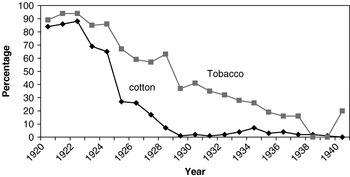
He was correct as African cultivation of cotton continued to increase and peasant production soon made up for a larger share than estate production (see Fig. 1). At the same time an increasing number of African farmers became involved in the cultivation of dark-fired tobacco. Initially tobacco-growing farmers were tenants who sold their produce to their landlords.Footnote 20 But from the mid-1920s, more and more farmers on Crown Land in Lilongwe and Dowa districts began to grow fire-cured tobacco.Footnote 21 The increase in the number of farmers growing tobacco was accompanied as well by a decline in the share produced by the white settlers, as Fig. 1 reveals. Thus, by the end of the 1920s, the cash-cropping peasant sector had become the basis of the colonial economy, which had a significant impact on the colonial administration's relationship to the sector.Footnote 22 If the African farmers were to form the basis of the colonial economy, it had to be assured that what they produced was of the highest quality, and this called for education.Footnote 23
Percentage of total cotton and tobacco produced by white farmers in colonial Malawi, 1920–1940. Source: Robin Palmer, ‘White farmers in Malawi: before and after the Depression’, African Affairs, 84 (1985), 236.

The intervention of the Department of Agriculture in regard to cotton and tobacco did not include direct supervision. It was restricted to dissemination of information (but not education) regarding, in the case of cotton, munda (dryland) cultivation instead of the existing dambo (wetland) regimes, and regarding date of planting and promotion of terracing for tobacco.Footnote 24 Cash crop production was welcomed by the colonial administration but reforming the existing farming methods was not on the agenda. Instead, the focus was on strategies to ensure that peasant production of cash crops benefited the colonial administration as much as possible. This meant that better control over the grading and marketing of the produce was needed. The 1920s were therefore marked by the establishment of commodity programmes and the work was not carried out by the Department of Agriculture.
In 1923 the British Cotton Growing Association (BCGA) was granted monopoly rights over the local trade in cotton.Footnote 25 In exchange, the BCGA had to remit half of its surpluses to the government. The official aim of giving monopoly rights to the BCGA was to stabilize prices, as the African producer ‘does not understand market fluctuations’.Footnote 26 This revealed the paternalistic view held by the colonial government. They greatly mistrusted the peasant farmers, whom they feared were more interested in quantity than quality. Over-production would lead to lower prices, thereby decreasing the revenues of the government. By granting the BCGA monopoly rights, they would further enhance the production of good-quality cotton since the BCGA would not – in contrast to the private traders – buy any crops that did not meet their standards. However, the irony was that the attempts to control markets drained resources from modest attempts to influence cultivation methods. The BCGA complained that, because of the increased attention to marketing and grading, few resources were left to allow for field visits and supervision of the farmers.Footnote 27
The expansion of tobacco production equally generated a discussion on market control and guaranteeing crop quality that resulted in the promulgation of the Tobacco Ordinance in 1926 and the establishment of the Native Tobacco Board (NTB). The Ordinance required that all tobacco growers and buyers had to be registered, and the duties of the NTB were to assist and supervise growers on Crown Lands while tenants were left to act on their own.Footnote 28 The NTB had employed more people than the Department of Agriculture. Still, in 1931, there were only nine European supervisors, all of whom were deployed in the service of 32,153 Crown Land growers in Lilongwe and Dowa in the Central Province. In the case of the southern province, a single supervisor was responsible for 10,708 growers.Footnote 29 With few staff, NTB concentrated solely on the grading and marketing of tobacco.Footnote 30
In sum, agricultural extension services were initially concentrated in a few areas and concerned a minority of the African farmers. The vision was not to transform farming methods but to ensure quality of crops and create efficient market channels in order to protect the interests of the financially weak colonial government. The colonial officials regarded African peasant agriculture as primitive and they believed that farmers lacked proper understanding of the dynamics of a market economy. By establishing commodity programmes they benefited from peasant cash-crop production without engaging in costly and risky projects to change farming methods.
THE GREAT DEPRESSION AND THE COLONIAL DEVELOPMENT ACT
By the end of the 1920s, it had become obvious to the colonial administration in Nyasaland that the estate sector was not a reliable source of revenues. In the mid-1930s, Governor Harold Kittmaster concluded that: ‘European agriculture except for tea is virtually an economic failure’.Footnote 31 Nyasaland lacked a dynamic domestic market that could absorb any large-scale estate production and was therefore not attractive for imperial capital. Instead, the Europeans who settled there consisted of families with relatively little capital, and when prices decreased during the Great Depression they were not able to survive economically and many families left Nyasaland.Footnote 32
In addition, the high levels of rural poverty and malnutrition were increasingly an embarrassment for the colonial government. In the 1926 Population Census Report it was stated that in North Nyasa, one of the poorest areas, there was an infant mortality of about 60 per cent, and throughout the Protectorate there was a latent state of malnutrition among rural households.Footnote 33 The figures should be treated with caution since any serious attempt to measure human nutrition scientifically was still in its infancy.Footnote 34 Yet the figures contradicted the agricultural reports that commonly stated there was enough food throughout the Protectorate. In that sense, they questioned the colonial officials' belief that the African peasants were poor but not hungry. For both social and economic reasons there was a need to pay closer attention to African farming.
One reason why intervention in the African farming communities remained modest throughout the 1920s was the lack of capital. Great Britain devoted very few resources to its African colonies in general, and to Nyasaland in particular. In addition, the colonial government was burdened with high expenditures for loans that had been needed for the construction of the Trans-Zambezi railway, which was regarded as a crucial investment by the colonial administration in order to spur exports.Footnote 35 Yet, in the late 1920s, the United Kingdom began to change its policies in British Africa towards a more interventionist strategy. In 1929 the Labour government passed the Colonial Development Act with the aim of releasing metropolitan capital for economic development in the colonies.Footnote 36 The Act established a fund of up to £1 million a year to be spent on colonial development, and a Colonial Development Advisory Committee was established to consider schemes submitted by the colonial governments.Footnote 37 Its official aims were to increase the standard of living among Africans, not necessarily because of a concern about levels of poverty but in order to increase their taxable capacity, and to invest in infrastructure to support increased exports of peasant production and thereby increase revenues.Footnote 38 Both aims required additional support for African farming. However, not everyone agreed that African farmers should be given increased attention. Some estate owners expressed fear that the peasant farmers would expand cultivation of tobacco and cotton even further if they were to be extensively supervised and hence create an overstocked market.Footnote 39 But the colonial government was no longer willing to focus solely on the estates, whose political influence on the colonial administration had been seriously reduced because of the Depression.
During the life span of the Colonial Development Act, 1929–39, Nyasaland submitted 39 applications for funding, of which 27 were granted, with a total value of £3,331,558.Footnote 40 However, the basic idea that the colonies should finance the lion's share of their own projects was not dropped. In 1935, the Secretary of State for Colonies, Cunliffe-Lister, even vetoed several of the projects proposed by Governor Kittmaster and claimed that ‘the most rigid economies’ must be practised.Footnote 41 Despite the lack of investment, the discussions about how African farmers could be supported were intensified. In 1932, a Board of Agriculture was established in Nyasaland with the aim of looking closer at farming methods, soil erosion, deforestation and over-grazing. A year later, the Board established two sub-committees, the Alternative Crops Committee and the Native Agriculture Committee, which focused on African farming methods and how they could be improved, especially focusing on the impact on soil erosion, over-grazing and deforestation.Footnote 42 The sub-committee concluded that cultivation on steep slopes should be discouraged in all areas of Nyasaland and that farmers should be educated in the ‘evils of shifting cultivation’.Footnote 43
Regardless of the organizational changes, extension work continued to deal primarily with dissemination of information, while legislation was kept to a minimum with a focus on ‘fair dealing in the market’.Footnote 44 There was no mass education or legislation. The Department of Agriculture was hampered by a lack of staff. In the populous southern region there was one instructor in each of the two cotton districts (Port Herald and Chikwawa) but they had no means of running their own demonstration plots. By the early 1930s, three agricultural officers were employed by the NTB in the tobacco-growing Lilongwe district. In the northern part of Nyasaland there were no instructors employed at all.Footnote 45 Agricultural extension therefore depended on showcasing the results of new methods in selected African gardens, school gardens and experimental stations. The idea was to use the Native Authorities to spread information to the villages. This was to be done by training chiefs and the village headmen at the Jeannes Training Centre at Domasi in southern Malawi.Footnote 46 It meant that chiefs had to adjust to the new situation by becoming the instrument for regulating African farming methods as decreed by the colonial government.
It would be an exaggeration to claim that the modesty of the intervention in rural areas was solely caused by lack of funds. Of equal importance was the fact that there existed no clear idea of how African agriculture should be promoted. The colonial administration lacked detailed local surveys and laboratories and hence had only vague ideas about local environments, which prevented any coherent strategy for agricultural development.Footnote 47 The Director of Agriculture stated in 1931 that he was not sure that the ‘native systems can and must be improved, but they are worthy of study which will show how best they can develop along their own lines and in accordance with their own principles’.Footnote 48 Thus, twenty years after the first call for support of peasant agriculture, the lack of ideas about what should and could be done was obvious.
The lack of a strategy was noticed in the relative inactivity of the Board of Agriculture and its sub-committees. During the first two years, they met and discussed issues such as water supplies and the need for geological surveys. But, already in 1935, meetings were cancelled because of ‘lack of interesting business to discuss’.Footnote 49 The absence of a policy on African agriculture was criticized by the Colonial Office.Footnote 50 The complaints led the Director of Agriculture, Dr Small, to take action and form the Native Welfare Committee, which was officially established in 1936. The aim of the Native Welfare Committee was to advise directly to the government on social and economic policies, regarding the welfare of the African population.Footnote 51
The findings reveal an ambiguous view held by the colonial administration. The need to increase cultivation of peasant cash crops was basically caused by financial concerns, but there existed no real ideas or visions of how peasant agriculture could be supported. Extension work was still restricted to dissemination of information and a few demonstrations, but there was a slow change from simply reacting to already existing changes towards using extension as a means to – if not transform, then, at least – reform African farming methods.
PRODUCTION VERSUS CONSERVATION
There were two major concerns regarding African agricultural methods. First, there was an overall criticism of existing methods in terms of land inefficiency, especially the use of shifting cultivation in less populous areas, and the lack of crop rotation in densely populated areas.Footnote 52 Second, it was argued that the methods had contributed to soil erosion. In 1930, the Governor wrote to the Secretary of State for Colonies, Lord Passfield, that education in agriculture for African farmers was of crucial importance and that such education should focus on the use of shifting cultivation and the promotion of soil conservation.Footnote 53
In 1936, it was formally decided that the work of the Department of Agriculture should focus on: (i) soil conservation (terracing, draining, contour planting and contour ridging); (ii) land fertility (encouraging the use of cattle manure, compost, mudding and systems of rotation); (iii) regulation of land use (protecting stream banks and steep hill slopes, maintenance of forest, preservation of natural vegetation on poorer soils).Footnote 54 In reality, however, soil conservation was given priority.
Soil conservation work had already begun in the 1920s when the Department of Agriculture initiated regulations for cultivation on sensitive hillsides, and the regulations were extended to include protection of stream banks in the early 1930s.Footnote 55 From the mid-1930s, soil conservation was no longer restricted to a few identified areas. Instead, it was hoped that, again by the use of propaganda, anti-erosion measures would be applied throughout the Protectorate. The focus was on persuading African farmers to construct ridges, and on preventing cultivation on steep slopes and stream banks. The issue of conservation was considered so serious by the 1930s that the Director of Agriculture and the Native Welfare Committee argued for the employment of a soil conservation officer, and one was employed two years later.Footnote 56
The work on conservation was not limited to the Department of Agriculture. In order to develop a comprehensive policy it was necessary to give guidelines to the NTB, which, in terms of personnel, was still a powerful body. In 1936 the Director of Agriculture reported that the primary aim of the NTB was to propagate and support conservation of soils on peasant farms ‘by all means at the disposal of all men’.Footnote 57 This was a quite outstanding change. The NTB was no longer going to give their main attention to the quantity and quality of tobacco crops but to how tobacco could be grown without causing soil erosion. The change did not meet any resistance within the Board. Hence, by 1936, it could be reported that the official policy was that all supervision in Nyasaland would mainly focus on the issues concerned with soil conservation.Footnote 58
The focus on soil conservation had two important implications. First, it drained the already limited number of staff available at the Department of Agriculture and the NTB away from supervising the growth of high-quality crops.Footnote 59 Second, it led to an expansion of the geographical areas that came under closer supervision. The NTB continued to work mainly in the tobacco-growing areas in the central parts of Nyasaland, and the Department of Agriculture carried out experiments with cotton in Port Herald and North Nyasa.Footnote 60 Meanwhile, most of the demonstration plots on which the Department of Agriculture practised ridge cultivation and contour bunds were located in the populous parts of the southern region and not in the commercial centres.Footnote 61
Scholars like Beinart, Anderson and Throup, and Grove have shown how the idea of conservation spread from the USA to Africa in the 1920s. In eastern and southern Africa, the emphasis on soil conservation was affected to a great extent by the economic depression, the experience of the Dust Bowl on the southern plains of North America, population growth and the appearance of drought conditions.Footnote 62 However, the case of Nyasaland points to the importance of additional local factors, namely lack of resources and capacity to influence peasant production.
In the 1930s, it became increasingly embarrassing that so few farmers were prepared to follow the recommendations of early planting and rotation of cotton, as well as terracing and early planting of tobacco.Footnote 63 The conclusion was that propaganda was not enough and that more resources should be allocated to demonstration plots.Footnote 64 Still, if more resources were going to be spent on the promotion of cash-crop production, it had to continue to create enough revenues for the colonial administration to pay its railway debts. Yet, already in 1939, the Financial Commissioner, Robert Bell, reported that the revenues created by the sales of peasants' cash crops were not enough to pay the debt.Footnote 65 The paradox was that the colonial government decided not to give any further direct support to peasant commercial production, despite the fact that the production of both cotton and tobacco continued to increase. By the late 1930s, almost all extension work directly focused on cotton and tobacco cultivation had ceased.Footnote 66
The first steps towards a more interventionist approach by the Department of Agriculture were thus characterized by a shift from promoting cash-crop production to a general concern about soil conservation, which was regarded as a necessary pre-condition for any successful cultivation of cash crops. The paradox is that the shift occurred at a time when the colonial government's financial dependency on the peasant sector was growing.
AGRICULTURAL EXTENSION SERVICES IN THE COLONIAL ‘DEVELOPMENT DECADES’
The general view of the decades following the Second World War in British Africa is that it was marked by increased state intervention and planned development guided partly by scientific knowledge. This period has thus been referred to as the ‘second colonial occupation’.Footnote 67 It is true that state intervention increased in intensity and scale in British Africa. However, these shifts do not automatically imply that the focus of agricultural extension work changed.
The Second World War had increased the burdens of the British colonies, which were still shaken by the experience of the Great Depression. Colonial sterling funds were held in London, and during the war many of the funds were used to finance British military purchases from the United States.Footnote 68 Furthermore, the drain of labour affected both the African farming communities and the colonial governments as Africans were recruited as soldiers. The latter was a great problem for the officials in Nyasaland as they were already having difficulties with formal and informal migration to South Africa and Southern and Northern Rhodesia. During 1940–5 the Department of Agriculture was seriously drained of staff, including both African instructors and European supervisors.Footnote 69 At the same time, the Colonial Office had established several commissions and committees in the 1930s with the aim of investigating the economic situation in the colonies.Footnote 70 The general conclusion drawn from these reports was that many of the colonies did not have enough resources to make the investments required to spur economic and/or social development. The reports pointed to a crucial problem: funds for development could not be based on local revenues, but depended on overseas investments.
The view that colonial services should be financed by funds generated from within the colonies had not been abandoned, despite the passing of the Colonial Development Act of 1929. By 1940 there was a shift in approach when the House of Parliament passed the Colonial Development and Welfare Act of 1940. The Act made provision for sums of £5 million a year for development schemes, i.e. five times more than the former Act.Footnote 71 In 1945, the Act was renewed and it was decided that the fund would increase from £5 million to £12 million per year over a ten-year period.Footnote 72 The Colonial Office had finally accepted that the colonies would no longer be able to develop without assistance from abroad and it was no longer regarded as necessary to keep the budget in balance in the short run. Hence the Act brought Keynesian ideas to the colonies.
The Nyasaland government also pinned some hope on the formation of the Central Africa Federation in 1953.Footnote 73 They believed that the Colonial Office would pay more attention to the Federation than it did to Nyasaland. Revenues would also increase as the Federation made the people of Nyasaland equity shareholders in the more diverse Rhodesian economy.Footnote 74 But, contrary to these hopes, the British government foresaw how the Federation would ease its economic obligations to Nyasaland, which was still heavily in debt. Table 1 shows that the Agricultural Department of Nyasaland actually benefited relatively little from joining. In terms of strategies for agricultural extension services and African farming, it had no impact, since it was decided that only European agriculture would be a federal issue.Footnote 75 The Colonial Development and Welfare Act, on the other hand, created new opportunities for the Nyasaland government to increase its investments in agricultural extension services.
Net benefit to Nyasaland from formation of the CAF, 1954–1963 (£ million)Footnote 76

Source: Sindima, Malawi's First Republic, 62.
Scholars such as Oliver and Atmore claim that the new sources ‘revolutionised the activities of colonial governments during the post-war period’.Footnote 77 The Malawi case supports the view that investments increased. But in terms of the actual contents and aims of strategies, continuity rather than change characterized the post-war period. The conservation paradigm prevailed as will be revealed further below.
In the first plan, the colonial government in Nyasaland applied for grants totalling about £7.5 million from the Colonial Development and Welfare Fund. Concerning the Department of Agriculture, the initial application consisted of funds to increase the number of employees to 500, including an assistant soil conservation officer.Footnote 78 In 1946, it was made clear that Nyasaland would be granted considerably less than was initially applied for, i.e. £2 million instead of £7 million. As a consequence of the reduced grant, the allocation to agriculture decreased from £768,000 in total to £406,000.Footnote 79 The immediate effect on manpower was the reduction of staff from 500 to 200 and the shelving of the idea to hire an Assistant Soil Conservation Officer and a Surveyor.Footnote 80 Still, the new funds considerably increased the money available for agricultural extension that was to be applied to African agriculture.
To ensure the focus on African agriculture, a Native Development and Welfare Fund, as well as a Natural Resource Board, had already been established in 1944 and 1946, respectively.Footnote 81 With the new funds made available by the Colonial Development and Welfare Act of 1945, a whole set of projects related to African agriculture was established in the early 1950s. The number of extension workers continuously increased, and in 1949 the first Agricultural Officer in the Northern Province was employed.Footnote 82 A central research station was established near Lilongwe and two stations were opened in the Southern Province. The first farming school was established in 1954, and within two years 1,000 farmers had attended its courses.Footnote 83
Agricultural advice was no longer going to be limited to local geographical areas. Instead every district was required to draw up a land usage plan. It was intended that the plans would constitute a framework for agricultural extension work in each district, with action being tailored to suit needs.Footnote 84 Initially, it was intended that the land usage plans would be based on comprehensive surveys of environmental, economic and social conditions in the rural areas. The latter marked a slight change in the way of thinking within the Department of Agriculture. The Director, C. B. Garnett, even claimed that: ‘[i]t is apparent that the problem of African agriculture cannot be solved by the technician alone. The political and sociological factors are equally fundamental and complex’.Footnote 85 However, the reduction in grants by the Colonial Development and Welfare Scheme did not allow for such activities to take place, which implies that many of the plans continued to be based on scanty information about the local settings.Footnote 86
CHANGING STRATEGIES AND LASTING AIMS
The 1950s were characterized by an increased use of enforcement, the replacement of propaganda by ambitious programmes that focused on both farming systems and the institutional settings of rural societies (in some cases also including resettlement), and the establishment of a special programme designed to support individual so-called ‘progressive farmers’.Footnote 87 The use of enforcement was considered necessary since soil conservation work in general progressed slowly, and African farmers showed great reluctance in making ridges or following the restrictions on stream bank cultivation and cultivation on steep slopes.Footnote 88 The lack of enthusiasm was viewed as a result of lazy farmers that ‘drink too much beer’ rather than of the weakness of the advice given.Footnote 89 Hence the Natural Resource Ordinance (1946) gave the Natural Resource Board the right to litigate against farmers who broke the regulations. A first-time offender could be sent to prison for one month or could be fined £25. If he was convicted a second time, he could be sent to prison for three months or be liable to a fine of £50.Footnote 90 The notorious use of force was later characterized as ‘the darkest era in the history of agricultural extension service in Malawi’.Footnote 91 Not surprisingly the repressive methods led to a steady increase in farmers following the regulations.Footnote 92 In parallel to these repressive measures, the Department of Agriculture tried to generate acceptance for the regulations by moving the demonstration gardens from state lands to selected African farms.Footnote 93
At the same time the possibility of giving extended support to identified individuals and/or communities was discussed within the Department of Agriculture. In 1946, Sir Sidney Abraham, Chair of the Nyasaland Land Commission, published the Land Commission report. The report concluded that there was a need to resettle Africans from congested areas in the Southern Region by buying estate land.Footnote 94 The government accepted the need for resettlement and thus set up a committee to examine the possibilities.Footnote 95 One advantage of the newly acquired land was the opportunity it presented for planning in accordance with the framework of agricultural extension work, i.e. forming Village Land Improvement Schemes. Such plans included consolidation of land holdings and concentration of village sites. The resettlement thus enabled institutional change initiated from above.Footnote 96
The Village Land Improvement Scheme began with a small pilot project at Nsalu near Lilongwe in 1954 (including not more than eight families).Footnote 97 The government viewed it as successful and consequently expanded the scheme to include congested areas in Chikwawa, Blantyre and Lower Shire districts. By 1955, there was a total of 13 schemes in Lilongwe and 4 in the Southern Region.Footnote 98 All land in the new villages was consolidated in order to improve agricultural production and make extension work easier.Footnote 99
Parallel to the work with villages, the Department of Agriculture in 1950 launched the Master Farmers' Scheme. The aim of the scheme was to identify and support individual farmers who were selected according to their willingness to follow the regulations and advice concerning agricultural methods.Footnote 100 By giving them support in terms of credit, marketing information and intensified education in farming methods, there was hope that these ‘progressive’ farmers would act as role models for others. In order to be appointed a Master Farmer one had to follow rigid conditions, including having a consolidated land holding of not less than 3·2 hectares, to adopt soil conservation measures and to practise good farming methods.Footnote 101 Approved farmers under this programme received credit and education, in addition to a bonus of £1–2 annually per acre under cultivation.Footnote 102 Owing to the rigid conditions, only a few farmers could apply and, by 1961, the last year of the programme, there were only 508 Master Farmers.Footnote 103
Neither the Village Land Improvement nor the Master Farmers' Scheme (MFS) were as successful as initially hoped. In 1962 the MFS was brought to an end, and the last resettlement scheme was closed down.Footnote 104 Examining the reasons for failure is not within the scope of this article. Instead the focal issue is whether these changes in the strategies of agricultural extension services signalled a change in the aim and contents of intervention.
Initially it looked like the aim of agricultural extension services was about to change. In 1949 the Director of Agriculture, Kettlewell, claimed that there was a need to:
make a complete change in its agricultural policies within the very near future unless it is to meet disaster. The population increases and there is yet no sign that the African cultivator is willing or able to change his ways … A method of mass attack must be found and put into operation quickly.Footnote 105
He was responding to the fact that Nyasaland, in the same year, had experienced the worst famine since the establishment of the Protectorate, caused by the lack or shortage of rain in the Southern Region.Footnote 106 This made it obvious that more had to be done in order to spur agricultural growth in general, and increase food production in particular. In the review of Nyasaland's development plan from 1950 it was stated that: ‘The Department of Agriculture is planning to redirect intervention during these five years (1951–55) from soil conservation to soil fertility’.Footnote 107
It was not only the consequences of the famine that had Kettlewell worried. Of equal concern were the increasing numbers of farmers who left their villages to work in neighbouring countries, especially Southern Rhodesia and South Africa. Kettlewell concluded that there was an ‘overall culture among natives to leave the farms in order to earn money’.Footnote 108 W. H. Chinn, the Social Advisor to the Secretary of State for the Colonies, went even further. On a tour of Nyasaland in 1953, he warned the colonial government that increasing urbanization would have ‘disturbing effects on tribal life’ and that the ‘social problems deriving from de-tribalisation [were] evident’.Footnote 109 ‘Africans should stay in their villages’ was the message, which demanded the development of new income opportunities for the farmers by increasing their production capacities. The question was, how was this going to be achieved.
Institutional change – that is, changes in property regimes – was discussed, but it was concluded that it was not an option as long as local chiefs would not agree to such alterations.Footnote 110 The introduction of new mechanical and biological technology was also considered. Yet it was concluded that inorganic fertilizers were too expensive and that African farmers lacked the skills to use them properly.Footnote 111 Mechanical inputs such as ploughs and even tractors were also on the agenda, but it was believed that the average acreage under cultivation per household was too small to make such technologies beneficial.Footnote 112
In practice, the support to increase peasant production never left the discussion stage, and a few years later the whole idea of shifting focus had been abandoned. In 1954, Kettlewell stressed that the main aim of the land usage plans was instead to identify the most suitable strategies for combating soil erosion. It was again argued that conservation was a pre-condition for any strategy for promoting peasant production.Footnote 113 The importance of conservation was also noted in the increased use of force to promote construction of ridges and bunds, while adherence to the scant advice concerning the issue of increasing production (early preparation, early planting and early weeding) was voluntary. It is therefore not surprising that Kettlewell could conclude in 1956 that there was ‘good improvement in land conservation but little (or no) improvement of farming methods’.Footnote 114
The ironic conclusion was that the African farming system already was, as stated by the Director of Agriculture, Kettlewell, efficient ‘within its own limits’, and that there was no reason to engage in costly projects to introduce new technologies.Footnote 115 Peasant farmers were seen as both efficient and inefficient. This contradictory view was a result of continuing poor knowledge of local farming methods and a lack of financial resources. In that sense it was very much a remainder of the situation in the 1930s. Consequently, agricultural extension services continued to focus on combating soil erosion although the activities were intensified.
As opposed to general extension work, the Village Land Improvement Schemes included institutional change (consolidation) and technological change (introduction of tractors). One could argue that resettlement, as such, was a strategy to increase agricultural production, since it often implied that farmers were relocated to more productive land. Yet the main aim of resettlement was to prevent further soil erosion, hence it was part of the conservation paradigm, and the introduction of tractors was aimed at facilitating labour for conservation works, i.e. the creation of ridges and bunds.Footnote 116
The making of ridges had been accepted by a great number of farmers by the mid-1950s, except those settled in the Lower Shire in the Southern Region and Mzimba District in the Northern region. But construction of bunds continued to be heavily opposed in most parts of Nyasaland, despite the use of force. The reason was that it was even more labour-intensive than the making of ridges and, in addition, had the effect of reducing the size of arable land.Footnote 117 By the mid-1950s, the agricultural staff had realized this and no longer attributed reluctance to a resistance to conservatism but recognized that it stemmed from its effect on labour and land supply.Footnote 118 As a response, in 1954, 25 resettled families were offered the possibility of hiring a tractor to increase labour productivity. A family was charged £7.10 per plot of land for use of the tractor, which was a considerable amount of money for a family.Footnote 119 However, very few could take advantage of the opportunity, and by the late 1950s it was concluded that it was uneconomic to provide tractors and the programme was ended.Footnote 120
The aims of the Master Farmers' Scheme differed from those of the Land Usage and the Village Land Improvement Schemes, in that it was directly linked to the question of developing a new form of cash-oriented peasant class. That is, production was the focal point of the scheme, in the belief that new opportunities for increased production would create institutional change from below. By being appointed a Master Farmer, one had a priori proven that one followed the recommended/enforced farming methods, i.e. the conservation issues were expected to be solved before the farmers were targeted. There is no reason to believe that the selected Master Farmers did not follow the stipulated regulations in terms of crop rotation, consolidation, construction of ridges and bunds. The extension staff could therefore focus their advice on measures to increase production. By the late 1950s, about 500 selected farmers in Nyasaland were linked to the issue of increasing agricultural production and enhancing rural capital accumulation, while approximately 1·5 million farmers received advice, mostly indirectly, on issues concerned with land conservation.Footnote 121 Hence, the conservation paradigm remained dominant in the post-war period.
CONCLUDING SUMMARY
This article deals with the content of the agricultural extension services in colonial Malawi. Historical research that has focused on state intervention and rural communities in British Africa has commonly identified a break between the inter- and post-war periods. The former was marked by a focus on conservation while the latter emphasized measures to transform peasant agriculture in order to spur production. This article questions such a division and has argued that it stemmed from a confusion of the strategies and methods of intervention with the aims and contents of the same. This article shows that there has been a continuity in the content of agricultural extension services, marked by a focus on combating soil erosion. Strategies for doing so changed over time, from modest intervention based on propaganda in the 1930s to a coherent national strategy, which included the use of force, in the 1950s. Nevertheless, conservation remained the core of the ideology of state intervention. That is, the conservation paradigm prevailed throughout the colonial period.
Additionally, this article shows that the colonial government's knowledge about peasant agriculture and its capacity to influence the same remained limited throughout the period. Agricultural extension services were directed by the ambiguous aims of creating revenues without threatening the social order. Strategies were based on colonial officials' perceptions about African farmers, rather than detailed empirical knowledge. The article shows the continued weaknesses of the colonial administration, which managed to intensify extension activities mainly because of increased funding from the Colonial Office. It is only if we take this into consideration that we can understand the meagre results of colonial agricultural extension services in terms of increasing peasant production.