Introduction
The prevalence of anxiety and mood disorders in adolescents is a growing public health concern given the associated risk for significant impairment, morbidity, and mortality. Research worldwide indicates that first onset of psychiatric disorders occurs by mid-adolescence for about 50% of individuals, and by the mid-20s for 75% of adult sufferers (Kessler et al. Reference Kessler, Amminger, Aguilar-Gaxiola, Alonso, Lee and Üstün2007). Anxiety disorders are among the most common disorders of childhood and adolescence, with prevalence rates ranging from 6% to 20% over a number of large epidemiological studies (Anderson, Reference Anderson, Ollendick, King and Yule1994; Costello et al. Reference Costello, Egger and Angold2005). Epidemiological studies indicate that mood disorders are also common, with up to a 25% lifetime prevalence by the end of adolescence (Kessler et al. Reference Kessler, Avenevoli and Ries Merikangas2001). Both anxiety and mood disorders show impairment in academic and social functioning predictive of adult difficulties (Pine et al. Reference Pine, Cohen, Gurley, Brook and Ma1998), and demonstrate a chronic course with a high risk of relapse (Kaufman & Charney, Reference Kaufman and Charney2000). Therefore, the importance of delivering timely access to services for young people cannot be understated.
Despite the efficacy of cognitive behavioral therapy (CBT) for anxiety and mood disorders (King et al. Reference King, Heyne and Ollendick2005), many young people do not engage in treatment (Gearing et al. Reference Gearing, Schwalbe, Dweck and Berkowitz2012). Treatment adherence has been defined as the extent to which a person's behavior – such as taking medication or carrying out lifestyle changes – is congruent with agreed recommendations with a health care provider (Sabaté, Reference Sabaté2003). Mental health professionals are faced with problems with treatment adherence on a regular basis (Chanut et al. Reference Chanut, Brown and Dongier2005). Treatment attendance is often cited as a proxy for engagement and is associated with positive treatment outcomes (Orlinsky et al. Reference Orlinsky, Grawe and Parks1994). A recent meta-analytic review found that treatment (e.g. perceived relevance of treatment) and therapist (e.g. therapeutic relationship) variables were stronger predictors of mental health treatment drop-out than pre-treatment adolescent (e.g. diagnosed with externalizing disorder) and family (e.g. lower socio-economic status) variables (de Haan et al. Reference de Haan, Boon, de Jong, Hoeve and Vermeiren2013). Another review of treatment adherence in chronically ill adolescents highlighted both developmental factors (e.g. desire for freedom) and external factors (e.g. clinician communication) as barriers to adherence (Hanghøj & Boisen, Reference Hanghøj and Boisen2014). As such, a collaborative approach, with a focus on supporting autonomy and motivation for treatment, appears warranted in adolescent psychiatric settings.
Motivational Interviewing (MI) has been described as ‘a collaborative conversation style for enhancing a person's own motivation and commitment to change’ (Miller & Rollnick, Reference Miller and Rollnick2013). Several meta-analyses and reviews have demonstrated strong support for the use of MI in the areas of addictive behavior, health behavior, and treatment adherence (Hettema et al. Reference Hettema, Steele and Miller2005; Lundahl et al. Reference Lundahl, Moleni, Burke, Butters, Tollefson, Butler and Rollnick2013; Romano & Peters, Reference Romano and Peters2015). MI has met the American Psychological Association's criteria for promising treatments of adolescent substance use (Macgowan & Engle, Reference Macgowan and Engle2010), with a meta-analytic review demonstrating an overall small effect size of MI in this age group (Jensen et al. Reference Jensen, Cushing, Aylward, Craig, Sorell and Steele2011). MI with a focus on behavior change has also shown promise in enhancing health outcomes for adolescents with chronic medical conditions, such as HIV (Naar-King et al. Reference Naar-King, Outlaw, Green-Jones, Wright and Parsons2009, Reference Naar-King, Parsons and Johnson2012) and diabetes (Channon et al. Reference Channon, Huws-Thomas, Rollnick, Hood, Cannings-John, Rogers and Gregory2007).
While MI is often used as a stand-alone treatment for addictive behaviors and health behavior change, it is gaining support as a pre-treatment intervention for psychological disorders, with the aim being to improve treatment gains from treatment provided subsequent to MI (Arkowitz et al. Reference Arkowitz, Westra, Miller and Rollnick2015). However, few studies have distinguished between MI for behavior change in general and MI for engagement more specifically. Studies with MI protocols targeting readiness for treatment directly address factors associated with being willing to commit to treatment attendance (e.g. therapy characteristics) (Daley et al. Reference Daley, Salloum, Zuckoff, Kirisci and Thase1998; Grote et al. Reference Grote, Zuckoff, Swartz, Bledsoe and Geibel2007).
A recent meta-analysis concluded that treatment engagement is a potential pathway through which MI enhances treatment for psychiatric disorders (Romano & Peters, Reference Romano and Peters2015). A number of studies also point to readiness to change (Saunders et al. Reference Saunders, Wilkinson and Phillips1995; Barnett et al. Reference Barnett, Sussman, Smith, Rohrbach and Spruijt-Metz2012), and MI fidelity as key factors in treatment attendance (Romano & Peters, Reference Romano and Peters2015). Few studies assessing the efficacy of MI have measured fidelity to treatment (Gayes & Steele, Reference Gayes and Steele2014), or used active control groups (Romano & Peters, Reference Romano and Peters2015), and as such it is difficult to attribute any observed change to MI specifically, or to additional contact time in general.
Aim
The main aim of this study was to assess whether MI, as a brief engagement session, will enhance treatment engagement in a standard therapy setting [group CBT (gCBT)] for adolescents with anxiety and mood disorders. More specifically, the study assesses whether participants receiving MI attend a greater mean number of standard therapy sessions, initiate attendance more frequently, and rate readiness for treatment more highly than participants in an active control condition (befriending).
Ethical standards
The authors assert that all procedures contributing to this work comply with the ethical standards of the relevant national and institutional committees on human experimentation and with the Helsinki Declaration of 1975, as revised in 2008.
Method
Study population
The sample of 96 adolescents (aged 13–18 years) was recruited from May 2012 to April 2014. The study was conducted at two publicly funded outpatient mental health services in a large metropolitan city – Wellington, New Zealand. Case managers informed eligible participants of this study, and provided them with an information sheet outlining the research. The study adopted the standard diagnostic processes used at the clinic, which are based on clinical assessment and guided by the DSM-IV system (APA, 2000). Eligible diagnoses for this study included: mood disorders [major depressive disorder/dysthymia, bipolar disorder (I, II and subthreshold)]; anxiety disorders (panic disorder, agoraphobia without panic, specific phobia, social phobia, post-traumatic stress disorder, generalized anxiety disorder, obsessive compulsive disorder). For those willing to participate, an appointment was made to meet with the researcher for 90 min. Written consent was obtained from parents and participants aged ⩾16 years. Participants aged <16 were required to provide written assent. Participants were ineligible if their diagnosis of an anxiety or mood disorder was secondary to another diagnosis (e.g. intellectual disability, active substance use), or if they did not speak English.
Research procedures
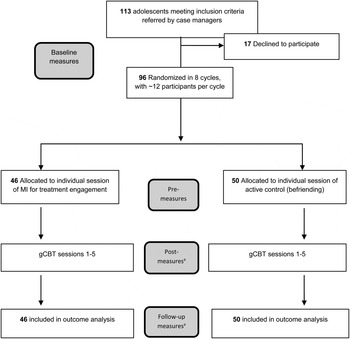
Fig. 1 depicts the study design and participant flow for this two-arm, randomized clinical trial. One hundred and thirteen eligible young people were referred to the study, with 96 participants agreeing to take part in the study and randomized to the intervention (MI) or active control (befriending) conditions.
Flow of study participants. Eight cycles of the recruitment process took place between May 2012, and April 2014, with an average of 12 participants randomized to each set of groups.* Post and follow-up measures not reported in this paper.

The study protocol was approved by the New Zealand Health and Disability Ethics Committee on 16 February, 2012. The interventions were delivered at the outpatient child and adolescent mental health services. Treatment readiness ratings were completed at baseline, and post-intervention (but prior to start of standard therapy of gCBT); attendance was recorded at all gCBT sessions.
Participants were randomly assigned to receive either one session of MI or one session of befriending, up to 50 min in duration, as a prelude to gCBT. The gCBT consisted of five sessions of up to 120 min each. Two sets of group therapy sessions were run in the same 5-week cycle, with the primary facilitator blind to the pre-group intervention received by participants. All participants within each group received the same intervention. The researcher, a registered (licensed) clinical psychologist with postgraduate training in MI, conducted the individual MI and befriending (active control) sessions. A mental health professional and staff member (registered nurse, registered psychologist, or registered occupational therapist) at the mental health service acted as the primary facilitators for the gCBT, with the support of the researcher. Each recruitment cycle occurred over a 3-week period, with eight cycles of the recruitment process over the 2-year study period. There were 16 CBT groups in total, with an average of six participants in each group. Pairs of groups were run in parallel.
Randomization
A statistician not involved in the implementation of the trial randomly generated randomization schedules for both sites, allocating participants to the intervention (MI) or attention control (befriending) conditions, using a computer-based random number generator. The pre-group intervention received by participants was concealed from the primary gCBT facilitators.
Interventions
All participants received usual care as provided by the outpatient child and adolescent mental health service in addition to gCBT and the research intervention (MI) or active control (befriending). Standard care included case management as well as specialist input as required (e.g. medication review or occupational therapy).
Motivational interviewing
The MI intervention used in this study was based on the premise that motivation for treatment includes, but is not limited to, motivation for change (Daley et al. Reference Daley, Salloum, Zuckoff, Kirisci and Thase1998; Grote et al. Reference Grote, Zuckoff, Swartz, Bledsoe and Geibel2007). Explicit attention was paid to participants hopes and previous experience with mental health treatment, as well as practical and psychological barriers (Grote et al. Reference Grote, Zuckoff, Swartz, Bledsoe and Geibel2007), including potential external difficulties (e.g. transport) and internal barriers (e.g. social anxiety) to attending the gCBT.
The key processes of MI in the current study comprised engaging the participant in a mutually respectful relationship, focusing on an agenda in a collaborative manner, evoking the participant's intrinsic motivation for attending treatment, and if ready, developing a plan for attending treatment. Consistent with respect for each adolescent's autonomy, participants were asked permission before providing information (e.g. regarding the content and logistics of the gCBT), and then were asked their point of view regarding the information provided. Acceptance, compassion, partnership and evocation were emphasized throughout all sessions, and formed the foundation for what has been described as the ‘spirit’ of MI (Miller & Rollnick, Reference Miller and Rollnick2002). The MI session concluded with summarizing the young person's perspective, and if appropriate, eliciting commitment to treatment.
Befriending (active control)
Befriending, the active control intervention, involved similar contact time as the MI intervention, and was based on a protocol developed by researchers in Melbourne, Australia (Bendall et al. Reference Bendall, Killackey, Jackson and Gleeson2003), as a control psychotherapy for clinical trials. Designed to be a nonspecific and nondirective intervention, befriending sessions focused on neutral topics (Sensky et al. Reference Sensky, Turkington, Kingdon, Scott, Scott, Siddle, O'Carroll and Barnes2000). Befriending of mentally unwell individuals as a form of social support has a long history (Bradshaw & Haddock, Reference Bradshaw and Haddock1998) and has demonstrated a modest effect on emotional distress in varied clinical populations (Mead et al. Reference Mead, Lester, Chew-Graham, Gask and Bower2010). It was first used as a control treatment in a randomized controlled trial for CBT for treatment-resistant psychosis (Sensky et al. Reference Sensky, Turkington, Kingdon, Scott, Scott, Siddle, O'Carroll and Barnes2000), and has been used as a comparison to usual care and active treatments in a number of psychotherapy trials (Mead et al. Reference Mead, Lester, Chew-Graham, Gask and Bower2010). Participants in this condition were given an opportunity to ask questions and were provided with information about the group therapy.
Group therapy
The ‘Managing Emotions’ protocol offered as standard therapy in this study consisted of five sessions of gCBT. The protocol was based on the ‘Unified Protocol for Trans-diagnostic Treatment of Emotional Disorders’ (Barlow et al. Reference Barlow, Farchione, Fairholme, Ellard, Boisseau, Allen and May2011), which is an emotion-focused CBT paradigm. Trans-diagnostic treatment protocols aim to incorporate a single set of therapeutic principles relevant to anxiety and mood disorders. In this intervention, attention was placed on the adaptive nature of emotional experiences, as well as awareness of the role of cognitions, physical sensations and behaviors in these experiences. The identification and altering of maladaptive reactions to these experiences is also an important component of this protocol.
Modifications to Barlow's unified protocol in the current study included: condensing the content from seventeen sessions to five sessions with age appropriate simplification of content, delivery in a group format, the addition of a discussion on stigma associated with mental health diagnoses, and the inclusion of sleep hygiene as a core component. The latter was included as sleep problems in adolescence are associated with mental health difficulties and poor quality of life (Lofthouse et al. Reference Lofthouse, Gilchrist and Splaingard2009, Shochat et al. Reference Shochat, Cohen-Zion and Tzischinsky2014), while the internalization of stigma is associated with reduced self-esteem, hope, and quality of life, increased severity of symptoms (Livingston & Boyd, Reference Livingston and Boyd2010), and is a well-established barrier to seeking treatment (Gulliver et al. Reference Gulliver, Griffiths and Christensen2010).
Measures
Participation in gCBT served as the primary outcome measure. The mean number of group therapy sessions attended per person was calculated for each group therapy cluster, and treatment initiation (whether any gCBT sessions were attended) was determined for each participant. A readiness ruler was used to assess level of readiness for treatment. This consisted of a visual analog scale, with equidistant points from 0 to 10 (0 = not ready, 10 = very ready) and written statements reflecting readiness to attend treatment. The readiness ruler has demonstrated good psychometric properties (Biener & Abrams, Reference Biener and Abrams1991; Heather et al. Reference Heather, Smailes and Cassidy2008), and has been found to be a good predictor of treatment adherence (Maher et al. Reference Maher, Wang, Zuckoff, Wall, Franklin, Foa and Simpson2012) and treatment outcome (LaBrie et al. Reference LaBrie, Quinlan, Schiffman and Earleywine2005).
Treatment fidelity was established for the delivery of both the MI and gCBT in this study. The Motivational Interviewing Treatment Integrity code (MITI 3.1.1; Moyers et al. Reference Moyers, Martin, Manuel, Hendrickson and Miller2005) was utilized to assess the fidelity of the MI intervention, with 20% of the sessions coded. The MITI 3.1.1 comprises ratings of clinician behavior from which summary scores can be calculated for MI spirit (evocation, collaboration, and autonomy/support) and for behavior counts (reflections, questions, and MI-adherent behavior). MITI coding was undertaken by a registered clinical psychologist and member of the Motivational Interviewing Network of Trainers (MINT), who has had MITI coding training and regularly reviews inter-coder reliability. Ten percent of befriending sessions were also randomly selected and blind-coded using the MITI 3.1.1 to check for a distinction in delivery of interventions. The Cognitive Therapy Scale – Revised (CTS-R; Blackburn et al. Reference Blackburn, James, Milne, Reichelt, Garland, Baker, Standart and Claydon2001) was used to monitor gCBT fidelity. Another registered clinical psychologist and CBT lecturer rated 20% of audio-recorded gCBT sessions using the CTS-R and calculated proficiency ratings.
Statistical analysis
As group dynamics were to likely play a large part in the variation of attendance, the study was designed to allow the attendance outcome to be treated as clustered according to the therapy group attended (that is, number of attendances for an individual within a particular group will not be independent from the attendances of other individuals in that same group). Data analysis proceeded by producing summary statistics for each group (mean number of attendances per person, for each group), and then comparing the mean of these group-level summary statistics between the two study arms using an unpaired t test (Campbell et al. Reference Campbell, Donner and Klar2007; Kerry & Bland, Reference Kerry and Bland1998).
Analysis of readiness for treatment ratings at baseline and post-MI/befriending session was conducted using the individual participants as the units of analysis, as at that stage the participants had no group interactions and the impact of intervention can be considered independent of the group which the participant was to later attend. A one-way ANCOVA was conducted to estimate differences between readiness ratings according to intervention received, controlling for pre-treatment readiness rating.
Both analyses were conducted using SPSS v. 21 (IBM Corporation, USA) Estimates of means and mean differences are presented with 95% confidence intervals (CIs); hypothesis tests were conducted using an alpha of 0.05 for describing statistical significance.
Sample size calculations
Sample size calculations for the primary outcome (mean number of sessions attended per study arm) were calculated using a simulation based approach, with an expected average of 3.65 sessions for control groups, and 4.4 sessions for the MI groups (the procedure is given in detail in the Supplementary material). Analysis of each simulated dataset followed the plan described in the statistical analysis above, using a paired t test to compare group means of attendance between study arms. The simulation process was iterated to find the number of paired groups required to provide ⩾80% power for the paired t test under the assumptions above, which gave a final target of eight pairs of groups (eight MI, eight active control) with six participants on average allocated to each group.
Results
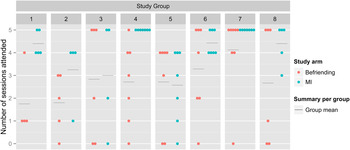
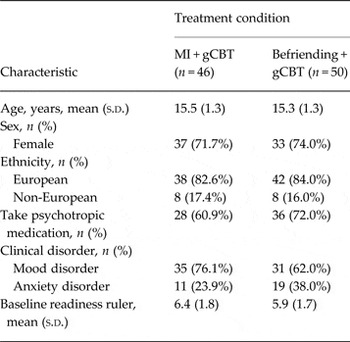
As shown in Fig. 1, 113 participants were referred for the study, with 96 attending the single intervention session and completing baseline assessments. Intervention and control participants were comparable at baseline on demographic and clinical characteristics (Table 1). Fig. 2 shows the number of sessions attended by each participant by study arm and group pair, along with mean attendance per group. Participants randomized to MI as a pre-treatment intervention attended significantly more therapy sessions (mean across group means = 4.0, range of group means 2.6–5.0) compared to those in the active control condition (mean across group means = 2.7, range of group means 1.8–4.1; mean difference = 1.3, 95% CI 0.4–2.2, t 14 = 3.0, p = 0.010). The MI group participants were also more likely to initiate treatment (96%) than the befriending group participants (80% attending at least one session) [χ2(1, N = 96) = 5.37, p = 0.02] (Table 2). The MI pre-treatment intervention also produced higher mean readiness ratings following the pre-treatment, after controlling for pre-treatment readiness scores (mean difference = 0.5, 95% CI 0.1–0.9, F 1,93 = 6.80, p = 0.01) (Table 2).
Dotplot of number of sessions attended by study arm and study group (with mean number of attended sessions per group). MI, Motivational Interviewing.

Demographic and clinical characteristics for 96 adolescents a

gCBT, Group cognitive behavior therapy; MI, motivational interviewing.
a Unless otherwise indicated, data are expressed as number (percentage) of patients.
Treatment initiation and readiness ruler ratings by condition

CI, Confidence interval.
a Readiness ruler mean ratings are post-scores adjusted for pre-score.
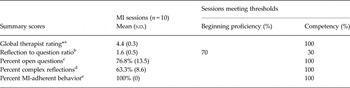
Summary scores for all coded MI sessions met competency thresholds, with the exception of the reflection to question ratio which met beginning proficiency (Table 3).
Motivational interviewing fidelity scoring using the MITI 3.1.1 code

* Mean of the global scores across three dimensions rated on five-point scales: evocation, collaboration, and autonomy/support.
a Beginning proficiency for scores at 3.5; competency for scores at 4.
b Beginning proficiency for a ratio of at least 1:1; competency for a ratio of at least 2:1.
c Beginning proficiency for at least 50%; competency for at least 70%.
d Beginning proficiency for at least 40%; competency for at least 50%.
e Beginning proficiency for at least 90%; competency for at least 100%.
Discussion
Findings from this study demonstrate that MI, as a pre-treatment intervention for engagement, leads to greater mean attendance, higher treatment initiation, and higher readiness for treatment ratings compared with an active control (befriending). As a brief pre-treatment intervention MI may be a feasible approach to include in adolescent psychiatric settings to support a collaborative relationship with young people, and improve engagement in evidence-based interventions such as CBT. Enhancing treatment engagement for adolescents with anxiety and mood disorders will allow for optimal use of scarce service resources, and enhance uptake of evidence-based treatment. Given that we know that such treatments are effective (Ehrenreich-May & Chu, Reference Ehrenreich-May and Chu2014; Hofmann et al. Reference Hofmann, Asnaani, Vonk, Sawyer and Fang2012) increasing attendance should reduce suffering, potential developmental disruption and risk in this vulnerable age group at a key intervention stage.
The results provide further empirical support for the development of MI guidelines with a focus on enhancing motivation for treatment engagement (Grote et al. Reference Grote, Zuckoff, Swartz, Bledsoe and Geibel2007), rather than the traditional focus on motivation for behavior change stemming from addictions and health behavior change research. Given that trans-diagnostic interventions are gaining support as a pragmatic approach to psychotherapy with potential to increase access for individuals with a range of anxiety and mood and possibly other psychiatric disorders (McEvoy et al. Reference McEvoy, Nathan and Norton2009; Bilek & Ehrenreich-May, Reference Bilek and Ehrenreich-May2012), MI may have the capacity to facilitate uptake of such evidenced based approaches, particularly when delivered in a group format.
To date research on MI with adolescent mental health treatment has been rare, and has generally yielded small and inconsistent effect sizes (Gayes & Steele, Reference Gayes and Steele2014). This may, in part, be due to varied intervention formats (e.g. individual, group, internet) and designs (e.g. pre-treatment adjunct, providing feedback, post-treatment) (Barnett et al. Reference Barnett, Sussman, Smith, Rohrbach and Spruijt-Metz2012). In addition, failure to measure MI fidelity in many studies limits the conclusions which can be made regarding the effectiveness of MI (Gayes & Steele, Reference Gayes and Steele2014). A strength of this study was the inclusion of an active control group, as well as MI fidelity measure, allowing for effects to be attributed to the MI component, rather than to additional contact time alone. Established adherence to MI in this study provides support for existing literature highlighting MI fidelity as a key factor in improving treatment attendance (Romano & Peters, Reference Romano and Peters2015). Another strength was the assessment of readiness for treatment, as measured by a simple visual analog scale, supporting its use as a predictor of treatment adherence (Maher et al. Reference Maher, Wang, Zuckoff, Wall, Franklin, Foa and Simpson2012).
A limitation of this study was the reliance on the clinical opinion of referring mental health professionals to provide accurate information regarding participant diagnoses, and to make appropriate referrals. However, this decision was made to allow for generalizability of findings to secondary mental health services, and is important given that lack of consideration of external validity is one of the most frequent criticisms of randomized controlled trials (Rothwell, Reference Rothwell2005).
Conclusions
As a brief pre-treatment intervention, MI can be embedded into psychiatric care as a complement to, and means of facilitating engagement in, evidence-based psychotherapies, thereby enhancing efficiencies in services, and improving outcomes for clients, reducing costs to the psychiatric services and client. While ongoing coaching in MI, and post-training is required to develop and maintain MI skillfulness (Lundahl & Burke, Reference Lundahl and Burke2009), the benefits of this are likely to outweigh the costs to psychiatric services and the client when there is lack of engagement with evidenced based treatments. Future studies should investigate the utility of MI for engagement in treatment across a broad range of adolescent psychiatric disorders.
Supplementary material
For supplementary material accompanying this paper visit http://dx.doi.org/10.1017/S0033291716000568.
Acknowledgements
Recruitment and data collection were supported by Capital and Coast District Health Board. We thank everyone who worked on the different parts of this trial for all their hard work. In particular, we thank Lauren Heath, RN, Ruth Schlüter, NZROT, Kathryn Fletcher, PGDipChFamPsyc, and Jessica Mitchell, DClinPsy, with the Capital and Coast District Health Board for facilitating the group therapy (gCBT), and Miriam Swanson, PGDipClinPsyc, and Jenny Maley, PGDipClinPsyc, for supporting the research as team leaders at these services.
Declaration of Interest
None.