

I. Introduction: Land, Law and Global Value Chains
‘Good climate and fertile soil are commonly required for the beginning of [a global value] chain.’Footnote 1 This statement may sound evident and obvious. However, the link between land, law and global production is often overlooked by lawyers and non-lawyers, including by those interested in redressing human rights violations and forms of exploitations that take place all over the world. This article aims to take this connection seriously and explores its implications by reflecting on the so called ‘blood sugar’ chain,Footnote 2 a case of forced evictions and violations of fundamental rights that is at the same time deeply rooted in one place (the land in the Koh Kong Province of Cambodia) and connected with businesses and consumers all over the world.
In particular, the purpose is to dialogue with legal scholars and practitioners who are already investigating law’s capacity to adapt to the evolving nature of transnational production and to contribute to the emerging conversation around the hegemonic and counter-hegemonic role that legal structures play in defining the form, content, geography and distributive implications of global value chains.Footnote 3 Without any presumption of universality, this article utilizes the enclosure of land in Cambodia to reinforce the idea that attacks and deprivations of rights that take place on the ground are not only defined by the society and legal frameworks in which the rights-holders operate. On the contrary, commodity chains are such that rights and absence of them are increasingly defined by a dense network of legal and quasi-legal institutions and socio-economic arrangements that operate elsewhere and that are connected through the invisible (or visible) linkages of production, logistics and consumption.Footnote 4
The focus here is on the implications of considering global value chains as non-linear legal constructions that coordinate and keep together the territoriality of the enclosures and the transnationality of production and consumption.Footnote 5 When this connection becomes evident, it is possible to move beyond a theoretically and legally fragmented approach to human rights violations and realize that these are the dynamic outcome of legal and quasi-legal structures that belong to different geographies and different times. The case of Cambodia was thus selected because of the work that was done through time and jurisdictions by local communities, legal advocates and non-governmental organizations. Their actions, as much as those of other human rights advocacy communities working throughout the world, lucidly expose the links between the localism of violence, the enclosure of land in the framework of the global restructuring of the corporate food regime,Footnote 6 and the global character of capital accumulation. As a matter of fact, the ‘blood sugar chain’ is deeply rooted in a specific geography and in a specific soil, but has also geographical and financial structures that are dispersed throughout multiple jurisdictions and solidly linked to the core of contemporary supply chain capitalism.
In addition, approaching human rights violations through the lenses of global chains of production offers something more than a better understanding of the existing connections and offers an opportunity to systematically engage with the human sufferance and transnational production. For human rights lawyers and practitioners, some of whom are already adopting a similar approach, it means identifying spaces of intervention and legal challenge that can be leveraged and connected in a truly transnational strategy of advocacy. In this sense, the evictions that took place in the Koh Kong province offer a useful analytical tool. When sugar is followed from the land in Cambodia to the final consumers all over the world, we encounter a low level of vertical integration and few intermediaries. Despite that, multiple actions were launched – in different jurisdictions and in different times – to obtain justice and restoration.Footnote 7
If less complex chains like that of ‘blood sugar’ already give the opportunity to reason about multiple spaces of legal intervention, this should be even more true in the case of extremely dense and multi-layered chains like that of conflict minerals, where one transnational corporation recently declared more than 40,000 suppliers.Footnote 8 In both cases, the glocal nature of extraction, circulation and accumulation of value are at the same time linked to specific places and geographies and are part of a specific commodity chain and affected by the broader and dispersed legal and economic elements that compose the whole network of production. Once these elements are mapped and made visible, a critical assessment of their function, role and impact on power, value and rights can be provided, along with an identification of jurisdictions and quasi-jurisdictional spaces that can be leverage to change the way in which extraction, production and distribution of value take place. I call these points of intervention ‘legal chokeholds’ and present them in the last section of this article.
In conclusion, this article combines an interest in human rights with a critical engagement towards global production and the political nature of mapping.Footnote 9 The aim is to offer an innovative perspective of research and investigation that should be experimented by scholars and practitioners interested in pursuing ‘global justice’ by means of theoretical reflection and judiciary action. In particular, it utilizes the ideas of network and transnational production to locate the violations that occurred in Cambodia as the point of departure of a multi-territorial combination of diverse legal actions that twists the global and diverse nature of the ‘blood sugar’ value chain in order to multiply the forms of intervention and their individual relevance.
In order to achieve its objective, the article is structured as follows. Section II introduces the idea of critical legal chain analysis and discusses some essential theoretical elements and concepts. Section III moves the focus on the evictions that took place in Koh Kong and provides the factual background that is utilized to discuss the shift from global value chain as a form of management to global value chain as a form of critical legal investigation and intellectual engagement. Section IV presents and elaborates the notion of critical legal mapping and discusses the importance of ‘reading’ local violations through the systemic structure of global chains of production. Finally, Section V introduces the notion of ‘legal chokehold’ and offers some concluding remarks on the legal and political interactions between the deciphering of the chains’ legal complexity and the recognition of new spaces of legal intervention against transnational exploitation. The AnnexFootnote 10 published online contains a detailed chronology of the main events concerning the ‘blood sugar chain’ and the legal and quasi-legal actions that were undertaken to defend families and their land.
II. Critical Engagement with Law as Global Chains
Together with a group of scholars gathered around the Institute for Global Law and Policy, I was recently involved in the publication of a multi-disciplinary Manifesto on Law in Global Production that considers legal structures not only as instruments of governance and connection between different elements of the commodity chains.Footnote 11 In our opinion, law is a central element in the construction, reproduction and existence of each node of the chain, but also crucial in the allocation of bargaining power among the different actors (state, capital, labour), and in the production of non-internalized externalities.Footnote 12 More interestingly, law is not a neutral instrument that can be deployed in order to shape and redefine the chain, but is the outcome of social struggles and the instrument to exercise force and domination.
Overall, the Law in Global Production research group operates in a theoretical framework that is defined by the seminal work of Robert Hale and other legal realist institutional economistsFootnote 13 and that is deeply informed by the contributions that critical legal scholars have offered to the consolidation of the idea ‘that rules of property, contract, and tort law’ (along with the criminal law rules that reinforce them in some cases) are ‘rules of the game of economic struggle.’Footnote 14
As we discuss in the Manifesto, legal structures are crucial in the distribution of bargaining power among stakeholders at the micro-level and determine the way in which value is generated and allocated at the macro-level. There is nothing natural and predetermined, for example, in the hyper-mobility of capital, the indeterminacy of the territorial framework occupied by states’ jurisdictions, the diffusion of private system of governance as mechanisms of discipline, and the hierarchical relationships between different layers of law.
Similarly, we are convinced that looking at law in global chains does not mean to describe which legal institutions intervene in the ‘tangible and intangible links that structure the transformation of raw materials into final products’.Footnote 15 Conversely, an engagement with law and chains of production is useful because it offers the opportunity to think about injustice and inequality as linked to spaces and legal frameworks that go beyond national legal orders and cut across jurisdictions as much as legal spaces. Dispossession, evictions, violence, exploitation and other forms of subordination are not only the product of the legal order in which they are immediately embedded, i.e., of the local context and of its historical construction by means of social struggle; they are the outcome of multiple levels of legal coercion that operate throughout the space of the chain and determine the final allocation of value and power. Certainly complex and intellectually demanding, a global chain approach to law and inequality has several advantages and stimulating implications.
For example, among the most interesting ideas proposed by critical value chain analysis, there is the fact that this new wave of scholarship is problematizing the indistinct use of ‘legality’, which is not accepted as a neutral datum but questioned in its essence. Moreover, these critical reconstructions tend to blur the distinction between private and public and to focus on law, coercion and the impacts on global distribution. Furthermore, they recognize the power of mapping and the importance of defining chains according to objectives of equality and justice, along with the fact that obtaining justice at one point of the chain can generate inequality at another level of the chain. At the same time, these scholars are aware of the indeterminacy of law, of the structural bias of the capitalist society and of the power of interpretation. Also, they use and challenge economic notions such as systemic risk and unexpected consequences, stressing the importance of taking into consideration the inevitable spillover effects of any legal intervention. Finally, they invite reconsideration of the geography of law and jurisdiction as dynamics fields characterized by overlapping, tensions, appropriations, and whose crystallization in the framework of the Westphalian State is deeply inadequate.
In conclusion, the application of a critical global chain method to law and justice recognizes that legal structures are central to the generation, extraction, allocation and appropriation of value that happens at the level of any single node of the chain. However, it also explores the idea of re-mapping law in global production to link the local dispossession with the broader legal and geographical scope of value chains and with the wider allocation of resources that takes place. In this way, lawyers and legal scholars can operate like cartographers, i.e., they can create a new map of commodity chains by looking at their geographical complexity through the lenses of law and space. When legal structures are identified and put in connection, it becomes visible which legal structures contribute to the allocation of rights, power and resources among states, firms, financial institutions, workers, local communities and the worldwide collectivity (that benefits, for example, by the reduction of greenhouse gases emission connected to deforestation or long-distance transportation). Finally, a critical legal chain approach recognizes the historical dependency and the social construction of legal structures, together with their intrinsic relationship with power and the fact that several violations of human rights take place under the cover of the law.
If global capital accumulation is the product of multiple local acts of alienation and appropriation, a local-global approach to law and justice can be utilized for the short-term objective of understanding and redefining the positions of power within each node, and also to design and implement systemic reforms and alternatives to the current world economy.Footnote 16 If this approach is extended to human rights and their violations, the respect or absence of rights that characterizes one level of the chain cannot be fully understood and challenged without a systemic approach that considers the totality of the chain as the legal space of reference.
III. Beyond Territorial Entrapment: Mapping the Global Legal Construction of Cambodian ‘Blood Sugar’
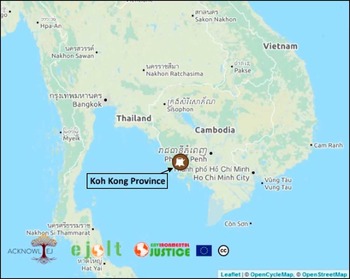
On 20 March 2006 the Cambodian Council of Ministers agreed in principle to issue two Economic Land Concessions (ELCs) in favour of Koh Kong Sugar Industries Co. Ltd (KSI) and Koh Kong Plantation Co. Ltd (KKP), both of which were owned by a Taiwanese company.Footnote 17 According to the agreement, the two beneficiaries of the concessions would have engaged in sugar cane plantation and refinery operations in Botum Sakor and Sre Ambel Districts, in Koh Kong Province, Cambodia (see Fig. 1 below). As reported by several non-governmental organizations and the local population, on 19 May agents and armed military police cleared the land of three villages (Chikor, Chhuk and Trapeng) without prior warning, allegedly for the purpose of complying with the ELCs.Footnote 18
The Koh Kong Province and the site of the struggle for land (source EJOLT: Environmental Justice Organizations, Liabilities and Trade).

According to the information produced by local and international actors, the immediate consequence of the government’s intervention was the eviction of thousands of people: no notice was given, no compensation was offered or allocated, and violence was deployed. Homes and land had to be abandoned to ‘clear’ the land from any encumber and make space for sugar production. In August 2006, the Ministry of Agriculture, Forests and Fisheries of Cambodia eventually awarded the ELCs to KKP and KSI.Footnote 19 The two areas, each one slightly smaller than the legal limit of 10,000 hectares,Footnote 20 overlapped with the area that had been violently enclosed in May.
From a legal perspective, the two ELCs identified the land on which sugar cane was going to be produced, and thus legitimized the evictions, the appropriation of water for industrial production, and – more generally – the transformation of small-scale farming into large-scale plantations agriculture. As in many similar cases of land grabbing organized by the state as a broker of public land, these two concessions can be considered as the spatial and chronological origin of what was later called the ‘blood sugar’ chain. From a human rights perspective, the events that took place in Koh Kong trigger similar concerns to those that characterize the ‘widespread, rapid increase of commercial land transactions that involve the acquisition or long-term lease of large areas of land by investors’.Footnote 21 The right to access land, the right to food and water, the right to self-development and the right to decent livelihood are usually among the most affected. Similarly, these deals may significantly impact traditional property rights, the life of women, children and elders, along with the special protections that should be enjoyed by ethnic minorities and indigenous communities.
In response to the violence and the violations, in early 2007 a civil and a criminal action were immediately filed before the Koh Kong Province Court to ask for the modification (and then the cancellation) of the concessions and to identify criminal responsibilities in the process.Footnote 22 However, no satisfaction was obtained despite the evidence that violations of domestic and international laws took place.Footnote 23 On the contrary, the transnational production chain was set up and Cambodian land fully integrated in the global market: sugar cane was produced on the enclosed land, transformed in a mill that occupies communities’ land, loaded on cargos that cross the Gulf of Aden and delivered to its final destination in the United Kingdom.
Despite the failure in preventing the evictions and the establishment of the chain, the Koh Kong is important because it represents a unique attempt by local communities and international legal activists to strategically embed the local human rights violations into the broader frame of a global sugar chain made of multiple territories and actors. Instead of limiting their scope of action to the traditional framework of State–investor–communities, they understood that the integration into a chain of production offered the possibility to identify legal, economic and social connections with points of the chain located throughout the world. More precisely, victims and stakeholders followed sugar and capital outside the spatial framework of the Cambodian rural areas and were capable of redefining the value chain in terms of multiple legal and economic connections that are not otherwise visible if we consider production chains as mere sets of exchanges and economic operators disposed along a line that links the raw material to the moment of final consumption.
As I discuss in the following sections, the communities and their supporters traced what I call a ‘critical legal map’ of transnational sugar production and gave visibility to political and legal responsibilities that would have otherwise remained obscure. In this way, they enriched the territorial and local character of enclosure and forced evictions, combined them with the global nature of production and discovered opportunities for transnational network of action and intervention. Before presenting the critical legal chain of ‘blood sugar’ (Section IV) and the way in which it leverages the territorial ramifications and the fragilities of transnational production, in the next sub-section I briefly identify the main elements of the chain as they would normally be described from a global commodity chain perspective. This should make it easier to realize the importance and innovative nature of multi-territorial legal mapping and the construction of a transnational structure of legal intervention that challenges injustices addressing their systemic character.
A. The Sugar Chain from a Governance Perspective: Human Rights Implications
Figure 1 is useful because it geographically locates the districts of Botum Sakor and Sre Ambel, in the Koh Kong province, South-West Cambodia. It is there where sugar cane is grown and picked (generally by hand and in limited cases by the use of machine) within the two ELCs issued by the Cambodian government in 2006. Once the canes are harvested, they are transformed into raw sugar by a mill located in the same area, which is owned and operated by KSI, one of the two recipients of the concessions. After that, part of the raw sugar is shipped to the United Kingdom, where it is refined in the Thames Refinery (London, UK), the largest cane sugar brand in the United Kingdom and has been owned and operated by Tate & Lyle Sugars Limited (TLS) since 1878. Once Cambodian raw sugar is transformed into higher value products, it is combined with sugar sourced in several other parts of the world and transformed into hundreds of ingredients which go into thousands of different products ‘which are enjoyed by millions of consumers around the world’.Footnote 24
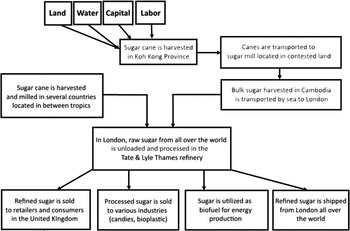
If we were to adopt the approach to global value chains that is used by scholars and practitioners interested in commodity chains’ management and governance, the series of passages that I described above would be represented by the simplified chain presented in Fig. 2: this is a schematic reconstruction of a sugar chain that helps portray the different tiers of the chain and allows the opportunity to identify those logistics and governance-related hubs that are generally considered relevant. On the basis of this representation, it would be possible to identify the leading firm, investigate the distribution of power and think of the way in which property and contract intervene at different levels of the chain in order to keep its structure together.Footnote 25 On this latter point, we may focus on the property rules that govern the access and use of land in Cambodia, the temporary contracts concluded with the farmworkers, the contract of purchase of sugar concluded between Tate & Lyle and KSI, or the equity relationships that characterize the link between parent companies and subsidiaries. Similarly, if we were interested in the link between international trade and the dispersed nature of global production, we would be looking at the rules of international economic law that define, enhance and limit the way in which goods and services can move from one point on the map to another one, especially if they are located in different countries.Footnote 26 In that case, a state-to-state perspective would be adopted and the way in which private and public actors contributed in transforming Cambodian land into a factor of global production would be moved to the background.
A simplified representation of the Koh Kong ‘blood sugar’ chain.

Although this approach to global production networks is useful and offers some ideas on how law reacts to global value chains, it nonetheless appears limited in its consideration of the way in which property, contracts, trade and other legal structures contribute to actively defining the space, trajectories, content and the redistributive patterns of global production. More specifically, a human rights approach to land grabbing that focuses on states, investors and communities may offer some tools to challenge and redress the injustices produced by the grabbing and the evictions, but would fall short in the understanding of the role of law in contributing to these events and would hardly address the root causes of these violations and their systemic nature.Footnote 27 In response, a more complex analysis and engagement with the legal complexity of global production appears to be needed: one that not only identifies law as an intra-chain managerial tool, a controller of products circulation or a provider of solutions against exploitation. New analytical tools have to be developed that recognize legal structures as central in the establishment of complex and transnational forms of production and in the allocation of power and resources. When dispersed legal elements become visible and are connected, they can be twisted against themselves.
B. From Global Value Chains to Critical Legal Chains
Using the case of ‘blood sugar’ as a methodological laboratory, there are several entry points that can be adopted in order to critically engage with rights, law and production chains. Similarly, there are multiple legal areas that appear relevant to the definition of the geography of production and distribution of rights and duties throughout its hubs and connectors. For example, we could look at the content and enforcement of labour regulation in each phase and see whether or how global production is squeezing the part of value that remains with workers. This would require focusing on the positive datum of the legal framework, and also on the content of individual contracts, the enforcement by courts, and the internal system of corporate social responsibility (when it is in place). Moreover, the working conditions could be confronted with the system of international human rights law and considered on the basis of compliance and responsibilities of employers and state actors.
Another pattern of inquiry could concern the property regime that applies at all levels and determines how the use value of the land is distributed between capital, local communities and the public administration, possibly with the intention of convincing the latter of the need to exercise more coercive authority over the capital returns.Footnote 28 In addition, the attention could go to the legal relationships between all the actors involved in the chain, and in particular to the way in which contract and property allocate resources (for example between the Tate & Lyle refinery and a global retailer or a factory that utilizes sugar ingredients for its products) with the objective of redefining their content. The decision to intervene in one area rather than another would depend on strategic, legal and political considerations, and will certainly have a redistributive outcome. The way in which local or international interventions may impact the allocation of rights and power throughout the chain is, however, indeterminate and non-linear.Footnote 29
Potentially, the legal rewriting of the value chain could be endless: each element could be unpacked in multiple dynamics and dissected into the underlying power relationships that shape it and that it tends to crystallize. For this reason, it is not worth trying to offer a descriptive analysis of all the possible legal variables that emerge when looking at the global chain of Cambodian sugar produced in the districts of Botum Sakor and Sre Ambel. On the contrary, each critical legal map will be drafted depending on the objective that the cartographers are pursuing, the time and resources at their disposal, and the possibility of fruitfully leveraging specific elements rather than other. Similarly, cartographers will have to keep in mind that their maps should be constantly amended and redefined, so to be constantly representative of power dynamics and of the existing opportunities.
As this article demonstrates, the case of ‘blood sugar’ offers an example of mapping as a tool for critical legal engagement with transnational sugar production and consumption and as an ally in the identification of global legal advocacy to redress the violations of land rights. Starting from 2006, local communities, activists, national and international lawyers, courts and UN bodies have been drafting an alternative map of Cambodian ‘blood sugar’ by means of activism, politics, legal praxis and ongoing actions undertaken at different levels of the chain. The map still originates in the districts of Botum Sakor and Sre Ambel but its ramifications go far beyond the three phases of extraction, refining and distribution that are generally presented by global value chains’ analysts.
This multi-territorial map of spaces of interventions brings to light unexpected connections between productive and financial capital, domestic law and international human rights treaties, regional courts and the international criminal court, and private regulation and trade regime. Moreover, it traces a myriad of threads between the enclosures of land and the final beneficiaries, i.e., it offers the opportunity to investigate the root causes of human rights violations and to reveal hidden connections as much as the possible venues where they can be challenged.Footnote 30 At the same time, it is constantly developing and mutating: as such, it recognizes that it does not exist as an optimal or unique way of mapping. On the contrary, politics and socio-economic conditions are closely interrelated.
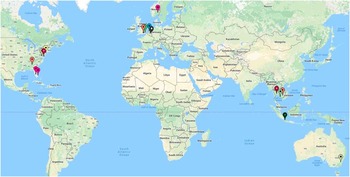
Figure 3 aims to visually represent the different points of intervention that were identified in the case of the ‘blood sugar’ chain and that became the building blocks of a critical legal ‘blood sugar’ chain. Although static, the map is a useful contribution because it provides a systemic representation of all the major interventions that have been activated in relation to the ongoing dispute in support of the rights of the thousands of people who lost their homes and farms in the districts of Botum Sakor and Sre Ambel.Footnote 31 In particular, each flag represents an action – legal or ‘quasi-legal’Footnote 32 – that was launched after the two ELCs were issued. Interestingly, actions that operated in different spaces and at different times were connected by the desire to redress violations that occurred at a specific time and in a specific moment.Footnote 33 The interventions are dispersed throughout the world, brought by different actors [although mainly by the Community Legal Education Center (CLEC) with the support of different partners], and rely on the substantive and procedural diversity of the multiple legal structures that make the ‘blood sugar’ chain possible. However, they have a central element in common that keeps them all together: they are all united by the intention to utilize the transnational nature of production to address and challenge the injustice and sufferance experienced by the inhabitants of these villages at the moment of the enclosure of their land and of their forced eviction.
Transnational reach of Cambodian sugar conflict (ZeeMaps – produced by the author)

The approach adopted in the case of Koh Kong (and in other circumstances around the world) goes beyond what could be called a ‘traditional human rights approach to land grabbing’ and offers a solution to what I consider to be two main and interconnected limitations. Firstly, by exclusively focusing on the triangular relation between state, investors and communities, a traditional human rights approach would be territorially limited to Cambodia and incapable of properly assessing the structural causes of evictions and the responsibilities that lie elsewhere in the value chain. Secondly, it would offer short-term solutions that may uphold the rights of the victims of the violations, but would not challenge the intrinsic violence of the current system of production. Moreover, a multi-territorial approach appears to be more resilient than forms of legal advocacy (like the use of the Alien Tort Statute in the USA) that identify one space of intervention and are often dependent on the responses of one court. Finally, the contemporary intervention in multiple jurisdictions and through a multiplicity of tools would offer a possibility to counterbalance corporate forum shopping when it comes to identifying jurisdictions that are more convenient in terms of disclosure and accountability.
Therefore, justice for the communities in Koh Kong was pursued (and is still pursued) by strategically constructing different legal and political arguments, connecting different spaces of debate and legal engagement, addressing different actors and trying to utilize the space of the global value chain as the space where accountability can be sought and remedies found.Footnote 34 What emerges is that when the series of events is combined with a multi-territorial understanding of local forms of exploitation, some geographical and legal implications emerge and give a sense of what it means to try to twist the global system of production against itself.
To give a sense of the transnational legal endeavour that was established around the case of Koh Kong, the enclosures of land were pursued in judicial and quasi-judicial spaces located throughout the world but united by their belonging to the same commodity chain. At first, a civil and a criminal case were filed before the Koh Kong Provincial Court in Cambodia, but never obtained a proper judicial response.Footnote 35 Successively, the violations were raised before the Association of Southeast Asian Nations (ASEAN) Human Rights Mechanism, which is currently known as the ASEAN Intergovernmental Commission on Human Rights (AICHR), because of the responsibility of the Thai investorFootnote 36 and Thailand, where in 2010 the CLEC filed a complaint with the National Human Rights Commission of Thailand (NHRC) for human rights violations committed by the Thai mother-company Khon Kaen Sugar Industry Public Limited (KSL) through its Cambodian subsidiaries KKP and KSI.Footnote 37 Following sugar through continents, a case was brought in the United Kingdom, where the raw sugar is received by Tate & Lyle, a UK company. This was sued for the tort of conversion on the basis of the circumstance that the sugar had been obtained from stolen land and therefore any form of disposition without the consent of the lawful owner was contrary to the law.Footnote 38 Then, the Organization for Economic Co-operation and Development (OECD) Guidelines were mobilized and an action began before the US National Contact Point,Footnote 39 the one with jurisdiction because of the nationality of the US company that had recently bought the British refiner.Footnote 40 Similarly, the case saw the intervention of Bonsucro, the certification scheme for sugar producers, which first suspended Tate & Lyle and from which the company decided to withdraw.Footnote 41 Moreover, the violations of rights allegedly suffered by the Cambodian farmers were also reconstructed in a communication to the Public Prosecutor of the International Criminal Court, and therefore an action established in The Hague, the Netherlands, and in a series of complaints sent to the European Commission in Brussels on the basis of the link between the Everything But Arms trade preferences and the increased pressure on Cambodian land by investors.Footnote 42 Finally, the focus was extended to financial capital and to the role that a Norwegian pension fundFootnote 43 and a German private equity fundFootnote 44 had in financially supporting the sugar operations on the ground.
From a legal perspective, the actions that were started in defence of the rights of the displaced communities demonstrate the irrelevance and artificiality of the distinction between private and public law and of the multiple legal orders whose coerciveness is crucial to the continuous process of dispossession, accumulation and allocation of power among communities, companies, governments, financiers, donors, etc.Footnote 45 The same actions, i.e., the forced evictions and the violations of multiple rights, have been reconstructed and presented in terms of violation of civil law provisions, criminal law, European trade law, regional human rights conventions, international human rights conventions, UK domestic tort law, privately generated voluntary guidelines (Bonsucro), quasi-private system of transnational corporate social responsibility, international criminal law, and also of the Code of Ethics of financial investors. In each intervention, the violation of the rights is framed and legally constructed differently, but there is a constant referral to the other actions and a continuous circulation of information, data and expertise. When land is enclosed and embedded in the global stream of production, the challenge to the coercion of law and the deprivation of rights that take place locally can become, therefore, polycentric.
The combination of the geographies of intervention and the variety of actions that were proposed (and that do not represent a final list) reveal the existence of an extremely dense and complex legal structure lying underneath the managerial map of supply chain capitalism. Law in global production is much more than a governance mechanism that links value adding operations. Law is not only an instrument of coordination and control. On the contrary, this approach reveals the constitutive role of law and the non-linear and complex way in which legal structures contribute to the consolidation of transnationalism while, at the same time, being connected with local actions and dynamics.
My idea is that such vision can overcome the limits of fragmented legal structures that reproduce dichotomies between private and public, human rights law and trade law, politics and economics, and favour the construction of a multi-territorial strategy of social justice that follows the value chain wherever it operates (and even where it sources financial capital)Footnote 46 and thus reduce the ability of transnational corporations to utilize territories and frontiers to hide from accountability and operate under impunity.Footnote 47 In light of the aforementioned, the next section looks at theories and reflections that lie outside of the traditional boundaries of law and offers an opportunity to encounter with ideas and perspective that can strengthen the need for a shift from global value chains to critical legal chains analysis.
IV. Critical Legal Mapping: Visibility, Heterogeneity and Vulnerability of Supply Chain Capitalism
Anna Tsing discusses the importance of global value chains as a method of analysis of contemporary capitalism. She recognizes that:
‘[t]hinking through supply chain capitalism […] is particularly useful in addressing two important sets of questions. First, how can we imagine the “bigness” of global capitalism (that is, both its generality and its scale) without abandoning attention to its heterogeneity? Supply chains offer a model for thinking simultaneously about global integration, on the one hand, and the formation of diverse niches, on the other. Supply chains stimulate both global standardization and growing gaps between rich and poor, across lines of color and culture, and between North and South. Supply chains refocus critical analysis of diversity in relation to local and global capitalist development.’Footnote 48
The combination between the global and the local is thus useful because it enriches the Universalist (and masculine) vision of capital accumulation as homogeneous with the diversity and complexity that is proper of feminist studies. Looking at the world through this combination will ‘help us imagine forms of globally interconnected diversity: a capitalism that is big yet unpredictably heterogeneous’.Footnote 49
Although this perspective may not be familiar to human rights lawyers and scholars, Tsing is not alone in underlining the glocal nature of global value chains and the implications that it has in terms of struggles for rights and value redistribution. For example, Cowen, Chua and Barnes have been looking at the expansion of global logistics and the capacity of disruptive techniques that take place outside the workplace – like blockades of ports and occupations of highways – to subvert the existing balance of power and temporarily suspend private accumulation that occurs to the detriment of workers rights and the protection of the environment.Footnote 50 In their opinion, the speed and geography of global logistics are such that tactical local interventions are possible and their effect may be compounded. The occupation of ports in Oakland, Hong Kong, Chile, Marseille, Durban and Karachi,Footnote 51 for example, can destabilize the entire chain and create spillover effects throughout the whole productive system. Tsing defines these possibilities as ‘openings’ that radical critics and activists have to use, whereas Chua calls them ‘logistics chokepoints’.Footnote 52
Similarly to occupations and local acts of civil disobedience, the case of Koh Kong and the construction of a transnational network of local interventions prove that a combination of legal structures can be utilized in a strategic way that has similarities with these disruptive techniques. In particular, it is my opinion that these actions may not only redress violations that have already happened but may also give space to ‘redistributive openings’ and lead to a challenge of the underlying assumptions of global production. As a matter of fact, ‘legal elements’ that belong to multiple frameworks and jurisdictions define local practices of production, distribution, transformation and consumption, but also the overarching flow of capital, circulation of goods, provision of services and the overall structure of chains. This geographical and legal ‘multiplication’ may be due to patterns of extraction or logistics (the places where raw material is extracted, transformed, shipped, sold, recycled, etc. may be different and chosen for multiple reasons), but also to other factors such as the place of incorporation or the connection with national or international financial institutions.
From a critical legal perspective, the multiplication of spaces of production that characterizes today’s capitalism means the multiplication of sites of possible interventions and resistance: I call them ‘legal chokeholds’ or ‘legal chokepoints’. Similarly to the logistic chokepoints discussed by Cowen and others, legal chokeholds offer the possibility to victims, activists and lawyers to address local and specific violations of rights while at the same recognizing the transnational nature of production and the need to organize legal resistance beyond the specific geography where extraction, production and distribution materially take place.
Crucial to this new approach is the identification of these ‘transnational bottlenecks’ and of ways in which the legal links between global capitalism and the localism of the territory can be strategically harnessed. In this way, the ‘hidden’ legal structures underneath the global value chain are made visible and are transformed into present or possible leverage points where legal pressure can be exercised.Footnote 53 As the ‘blood sugar’ critical map reveals, the joint effort of communities, lawyers, activists, international organizations and other interested parties can lead to the production of alternative maps that expose the points of ambiguity and indeterminacy of the value chain so that they can be combined, pressured and partially balance the spatial and territorial advantage of transnational capital.Footnote 54 Maps are political instruments and as such can be used to challenge current patterns of enclosure and exploitation.
More generally, critical mapping should bring to light all the legal orders and actors that are directly or indirectly intersected with the system of production. Without a critical map and a systematic approach to production, the farmers evicted in Cambodia are confined within their territorial framework: they would be peasants evicted for an economic concession and not farmers evicted to supply sugar to the worldwide market. Similarly, tea pickers who work on the Knuckles Mountain in Sri Lanka would only be employees and co-workers, incapable of being perceived as the starting point of a long chain that links their operation with the afternoon ritual of millions of people around the world. It is only through this form of mapping that the deprivation of land and workers’ rights become legible and understood as the product of a series of non-linear legal and political interventions that may be geographically removed from each other.
In this way, the loss of land or not operating in proper working conditions are no more confined processes that only concern employers and employees, host States and corporations, but part of a much broader network that involves multiple workers, places, capitals and geographies. In this way, the extraction and allocation of labour, nature and capital are defined and relevant both at the global and at the local level. The outcome of legal structures and bargaining asymmetries are historically shaped and progressively distance work from its owner and value from its geographical origin.Footnote 55 Visibility, locality and heterogeneity can thus lead to trans-chain solidarity (legal and non-legal) and unexpected opportunities to destabilize the current system of production. Instead of pursuing a short-term protection of rights along bilateralism of right and obligations, innovative and dynamic forms of legal dialog can be structured and leveraged in order to harness complexity of production and aim to long-term solutions.
In addition, this shift means that human rights actors and institutions that are operating at the local level can be brought together with actors and institutions that are operating throughout the chain. These would not be exclusively based on litigation but should certainly imply the drafting of new regulation, the proposal of concrete policy interventions, the redaction of reports and the provision of legal arguments to support political campaigns throughout the chain. In general, once maps are drafted of the legal chokeholds identified, they can be used to highlight those legal structures that – alone or in combination with others – have the potential to reallocate bargaining power among the parties, internalize negative externalities, and more generally redefine the way in which value is generated and produced throughout the chain.
Needless to say, the fact that legal interventions can exercise pressure at some points of the production chain does not imply that these kinds of actions have to be considered sufficient or that they should take place outside of an appropriate social and political environment. Moreover, it is not my intention to suggest that legal liberalism can provide the solution to structural problems of exploitation and marginalization.Footnote 56 On the contrary, a focus on law as a possible instrument of social change does not discount the fact that law is coercive, indeterminate, and structurally biased in favour of power. In addition, critical lawyers should not overlook the systemic implications of legal interventions and the unexpected consequences – both in terms of generation of positive spillovers and negative externalities – that legal interventions can produce.Footnote 57
To conclude, the example of Cambodia should be read and understood with a series of caveats. Each situation is linked to specific socio-political circumstance and open to indeterminate outcomes. The complexity and interconnection of the chain require lawyers to deal with multiple distributive futures and try to anticipate them. In particular, modifications of bargaining power at a certain point of the chain may lead to a squeeze in value distribution elsewhere – like in the case of increased food standards and the higher cost for small-scale producers.Footnote 58 In some circumstances, regional interventions may be more effective because they reduce the risk of regulatory competition. Elsewhere, unilateral legal destabilizations occurring in core countries may be extremely powerful but also critical in their quasi-imperial implications. Critical lawyers should map and utilize legal chokepoints to create political spaces that local movements, affected communities, workers, etc. can occupy to pursue their own struggles and that should not be seen as an end in themselves.
V. A Critical Legal Chain Engagement with Supply Chains: from Business and Human Rights to Global Value Chains and Human Rights?
This article has discussed the case of two sugar cane plantations currently operating in Koh Kong, Cambodia, to reflect on the possibilities of legal analysis and intervention to redress the violation of land rights by mapping and leveraging the transnational nature of supply chain capitalism and its multiple territorial components. With a combination between legal institutionalism, critical geography and value chains analysis, the different sections have challenged the idea that value chains are an objective and stable representation of the current system of production that only requires better governance or a redefinition of the rules concerning the movement of goods and services. On the contrary, this article has proved that the distribution of rights at every level of the chain and across it are constantly redefined by the non-linear interaction of legal and non-legal structures that often operate at a distance and are unaware of each other, but are connected by the tangible and intangible network of transnational production.
Differently from the traditional approach on of business and human rights, and differently from managerial attitudes towards global chains of production, this article looked at the possibilities that delocalization, outsourcing and the construction of multi-national forms of production offer to identify new spaces to analyse, decipher, contest and redefine the construction of transnational production, the distribution of value and the generation of socio-economic inequalities. In particular, the geographical, economic and legal complexity of contemporary capitalism (that operates in multiple places, mixes productive capital with non-productive financial resources and is constantly interacting with multiple legal framework) has been simplified with the use of the case of Cambodian ‘blood sugar’ chain and the critical legal map that has been created by local communities, legal activists and non-governmental organizations who have stood up against evictions and appropriations.
Moreover, the notion of ‘legal chokeholds’ has been introduced to identify the mobile and unsettled points of contact between the ‘global’ nature of the chain and the ‘territoriality’ of specific legal (or quasi-legal) structures. It is there, I claim, that legal and political interventions have been realized in the past and could be realized in the future in order to open possibilities to redefine which rights, value, bargaining power and resources are allocated. Often, this is realized without the need to rely on the extraterritorial application of law or on the framework of international human rights law, but simply by ‘intercepting’ the chain wherever it ‘touches ground’.Footnote 59 What is different compared with the previous approaches to law in global production is the invitation to create alternative maps of value chains that go beyond the stream of logistics and the materiality of commodities’ circulation. Some of the legal, financial, social and political structures may not be immediately evident when the focus is exclusively on describing and governing processes, but they become central when the aim is the identification of the systemic violations of rights at the roots of several global chains and the identification of spaces for legal intervention.
However, chain-based legal approaches to global production should not be considered as the magic bullet to redefine the structural economic and social inequalities that characterizes some forms of production. On the contrary, multi-territoriality must be based on the recognition that contemporary capitalism is an increasingly intricate architecture that requires a systemic and holistic approach, an intellectual and pragmatic engagement capable of giving visibility (i.e., making legible) to the various opportunities that derive from its transnational nature and the increase in the number of actors involved.
As the case of the Koh Kong plantations reveals, an effective form of critical legal chains analysis may require more than the identification of the actors that are present on the ground or of the legal structures within which they operate (property law, contract, international human rights conventions signed by the host state). Human rights scholars may have to look beyond the geography of the enclosure, reverse-engineer the chain of production, identify beneficiaries and relevant legal structures, follow the financial flows, investigate private mechanisms of certification and codes of conduct, interact with UN bodies or other legally irrelevant human rights courts: the redistributive content of local practices and the trajectories of global dynamics may well be defined by decisions and interventions made by each of these spaces and by their interactions.
Human rights scholars and practitioners (perhaps with the support of law clinics) should engage with the local nature of violations and redefine their territoriality by embedding them into the complexity of transnational production and consumption. These actions would give visibility to the hidden chokeholds and activate dormant legal gateways, but also lead to imagining new legal structures that could be linked, connected, combined and that can curb spaces for non-legal intervention and confrontation. More importantly, a shift from business and human rights to global value chains and human rights may lead to the establishment of multiple actions that are territorially dispersed but strategically organized. This, in my opinion, would offer a unique opportunity to counterbalance the multi-territoriality of capital, i.e., the fact that ‘capital can fight us in every place at once’ while ‘we fight in particular locations and moments – here, there, now, then.’Footnote 60 Although it is important to accept the partiality of perspective and of the objectives that each one is following, the creation of a multi-territorial legal struggle (joined with non-legal actions and political awareness) can reduce the imbalance of power that currently characterizes global supply capitalism and redefine the way in which rights, power and value are currently distributed.