During the past 2 decades, Brazil has reformed its healthcare system, with the aim of providing universal access to comprehensive health care for all citizens. The public program currently covers more than 70 percent of the Brazilian population and includes access to necessary pharmaceuticals free of charge under the National Health System (Sistema Único de Saúde - SUS). According to the Brazilian Constitution, citizens have the “right to receive the best available treatment” from the national health system at no cost (article 196 of the 1988’ Brazilian Constitution). Under a decentralized structure, healthcare and drug delivery are supported by the three levels of the state: federal, state, and municipal.
As part of the reform, Brazil has restructured its national policy for dispensing highly expensive medication. The costs of medicines are covered using public resources of the three levels through a regular federal to state reimbursement. High-cost medicines are co-funded by the Ministry and state levels based on demand. Basic health care and essential medicines are provided and co-funded by the three levels based on the number of inhabitants. High-cost drugs are provided by the state level (the State Health Secretariats). The pharmaceuticals and healthcare procedures to be covered are stated in lists of procedures and a comprehensive drug formulary.
The changes, with their increased access to drugs, have brought greater and greater attention to the efficacy, safety, and costs of drugs. As part of healthcare reform, health technology assessment (HTA) has developed rapidly in Brazil to support a more rational decision-making process at both clinical and policy levels. These developments have been described in recent publications (Reference Banta and Almeida1;Reference Paim, Travassos, Almeida, Bahia and Macinko2).
The successful experience in providing access to necessary drugs for all is illustrated by the Brazilian National AIDS Program, which has provided HIV drugs to all those infected since 1989 (Reference Levi and Vitória3), but the extent of the AIDS program has challenged the Brazilian healthcare system. An important implication has been that the success of the AIDS program has visibly encouraged advocates for other diseases such as cystic fibrosis, hepatitis B and C, and Gaucher disease, among others, to seek expanded coverage. One consequence has been that, in the past decade, there have been several judicial actions against the Brazilian health authorities demanding that they provide access for all to high-cost drugs for several diseases (Reference Biehl, Petryna, Gertner, Amon and Picon4). Many of the treatments sought by these judicial actions have not been supported by evidence of efficacy and safety and can lead to distortions in health care by the introduction of a new and often expensive technology to the list of public health priorities (Reference Schwartsmann and Picon5).
The costs of the Brazilian Program for high-cost medicines have increased rapidly, from less than USD100 million in 1997 to more than USD1.6 billion in 2010 (Reference Beltrame6). Such an increase was expected as part of increasing access, but they have stimulated efforts to ensure efficacy and safety. Without such efforts, the costs might have been much greater. HTA can give the information needed for evidence-based decisions. However, it cannot ensure that this information is used. Because of this fact, the issue of “implementation” of HTA results has become more prominent (7). The development and use of evidence-based clinical guidelines is one method that may encourage the implementation of evidence. Clinical guidelines require a systematic process for gathering evidence to ensure minimization of bias and maximal integrity (Reference Murray and Frenk8).
Aware of an international consensus that clinical guidelines could improve health care, the Brazilian public health authorities began a process of developing and implementing national evidence-based guidelines in March 2000. In 2002, the Brazilian Ministry of Health (MOH) released a manual covering thirty-one guidelines for the treatment of selected diseases that need high-cost drugs to provide guidance for a rational use of medicines (Reference Picon and Beltrame9). In 2009, The Ministry of Health, considering the successes of the first set of guidelines, decided to fund the project through the national partnership of the Ministry of Health and Hospital Alemão Oswaldo Cruz in São Paulo, which made possible both the updating of previous guidelines and the development of new national guidelines (Reference Picon, Gadelha and Beltrame10). That book was translated into English in an electronic version (Reference Picon, Gadelha, Beltrame and Banta11).
The aim of evidence-based practice is to integrate current best evidence from research with clinical policy and practice (Reference Haynes and Haines12;Reference Pronovost, Berenholtz and Needham13). Authorship of guidelines also has an impact on doctors’ acceptance for a new recommendation. The position of the Brazilian Ministry of Health, as the top health authority in the country, should help make guidelines credible. We decided to focus on the system rather than on individual patients, using interdisciplinary teams to ensure the use of best possible information. We also created a centralized support and a collaborative culture within the units at state level encouraging local implementation of the recommendations (Reference Pronovost, Berenholtz and Needham13;Reference Schwamm, Fayad and Acker14). From the beginning, we recognized that the challenges would be producing guidelines based on the best available evidence and gaining consensus in a country full of disparities, while following accepted methods in developing guidelines (Reference Shaneyfelt, Mayo-Smith and Rothwangl15). The guidelines also had to be prepared by those with no conflict of interest (no financial involvement with the pharmaceutical industry) (16–Reference Montaner, O'Shaughnessy and Schechter20).
THE PROCESS OF CREATION OF THE BRAZILIAN GUIDELINES FOR HIGH-COST DRUGS
The process of preparing the Brazilian Guidelines for publication involved the following steps:
1. An Executive Group for Guidelines Creation was formed to oversee the development of the guidelines. Professor Paulo D. Picon (PDP) was named to chair the technical part of the Executive Group, which included two clinicians and two pharmacists nominated by Professor PDP who were able to declare no conflict of interest concerning the pharmaceutical industry. All members of this technical group were well trained in evidence-based medicine and epidemiology.
2. For each guideline, one or two physicians chosen for their recognized expertise in that particular area prepared a comprehensive review of the literature about the disease and its treatment. The question at this point was: “What does the evidence allow you to recommend as an ideal treatment in that specific clinical situation?” Because a guideline require answers to multiple scientific questions, complete systematic reviews were not considered feasible within a reasonable time frame.
3. The first draft guideline supported by the best available evidence was then prepared and submitted to an advisor, which was always a national or international authority in that specific area and who was also able to declare no conflict of interest.
4. After the changes of that specialist, the draft was discussed by the Executive Group. Then a first draft was submitted to the health authorities.
5. That first draft was discussed by a technical multidisciplinary group at the Ministry of Health, composed of clinicians, epidemiologists, pharmacists, and decision makers. The main question was what best-evidence recommendations are feasible in the Brazilian public health system? After this discussion and subsequent editing, the first complete draft of the guideline was prepared. At this time, cost/effectiveness estimates were included whenever inclusion of a new drug or treatment strategy was recommended.
6. This first complete version of the guideline was then published in the Brazilian Official Diary as Public Consultancy. In that publication the Ministry of Health requested the Brazilian Scientific Community to present comments and criticisms of the guideline. They were requested to send only evidence-based comments within 30 to 90 days.
7. Many comments were received. In many cases, these comments were not evidence-based. The Executive Group reviewed the guideline, paying special attention to evidence-based contributions and those dealing with cost/effectiveness, and developed a final text. This text was submitted to the chair of the responsible department in the MOH.
8. This version of the guideline was then published in the Brazilian Official Diary as the final decision of the Brazilian Minister of Health.
DISSEMINATION STRATEGIES
The first thirty-one guidelines were published in 2002 (Reference Picon and Beltrame9. Three thousand copies were sent free to all local state health authorities and their healthcare providers. All of the guidelines were also available at the Web sites of OPAS (http//www.opas.org.br/medicamentos/docs/pcdt/) and of the Brazilian Ministry of Health (http:///www.saude.gov.br). In 2010, a second book with thirty-three guidelines was published (10,000 copies), first in the Brazilian Official Government Journal and then in book form that has been widely distributed in Brazil (in Portuguese) (Reference Picon, Gadelha and Beltrame10). An English-language version of this book was published in 2011 (Reference Picon, Gadelha, Beltrame and Banta11).
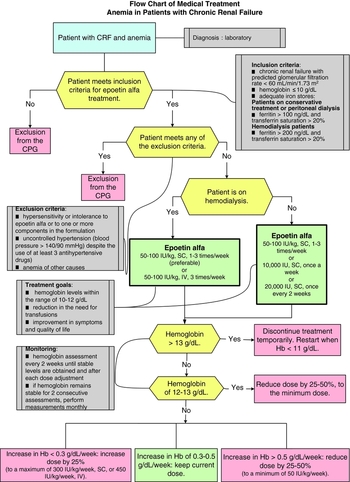
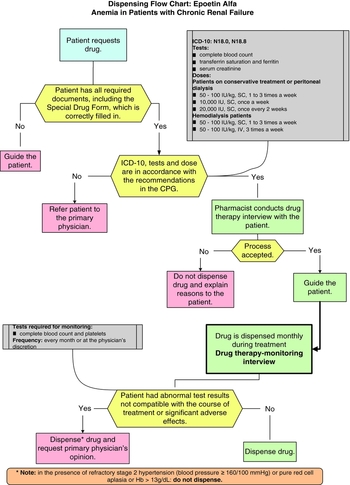
In each guideline medical flow charts showing the necessary medical decision process were given along with pharmaceutical flow charts (Figures 1 and 2), hoping to stimulate the multidisciplinary approach that has been intended throughout the public health system. Pharmaceutical guidelines included a pharmaceutical data collection form based on individual patient data, side effects, and relevant clinical endpoints that could be obtained on pharmaceutical interview and a patient/caregiver orientation guide.
Example of a flow chart of medical treatment from the Clinical Practice Guidelines (CPG) for Anemia in Chronic Renal Failure (CRF), Epoetin Alfa.

Example of a dispensing flow chart from the Guidelines for Anemia in Patients with Chronic Renal Failure, Epoetin Alfa.

The authors of each guideline took part in conferences and meetings in several states all over the country to discuss the usefulness of the guidelines. Authors also took part in courses on guidelines usage given to doctors, pharmacists, nurses, and health administrators directly involved with patient care inside the health system. Members of the Executive Group also presented the guidelines in several meetings with different parts of the Brazilian Judiciary System. Meetings were also scheduled whenever the public health authorities were asked to provide care in a relevant specific clinical situation.
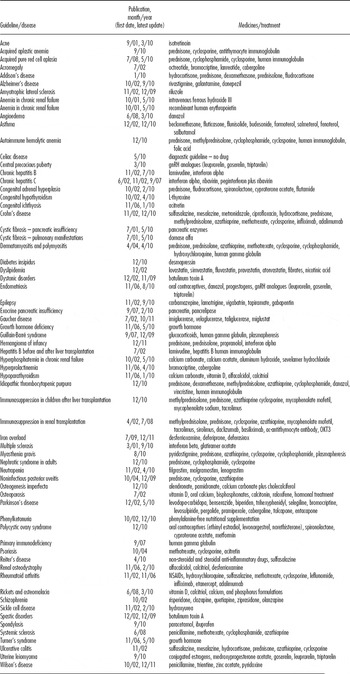
Table 1 gives the subjects of all the guidelines (disease, month/year of the publications, and medicines/treatment) completed up to December 2011.
Guidelines Published at The Brazilian Official Daily Journal (Diário Oficial da União) from March 2000 to December 2011

ACHIEVEMENTS OBTAINED: SOME EXAMPLES
The project has run, as described, since March 2000 and continues with updating, policy actions, and implementation strategies.
For reasons of cost-effectiveness and rational use of medicines, the guidelines recommended that state health authorities create local Reference Centers (RC) for some diseases. The RC might be a highly qualified university center or a small center with a multidisciplinary team trained to make guidelines-oriented-decisions. RCs were also encouraged to create a pharmaceutical attention team with the aim of developing a data base on adherence, side effects, and relevant clinical endpoints on follow-up visits. The RCs have also been an important source of clinical trials and clinical effectiveness research conducted by our group (21–23).
In June 2000, Brazil was the first country to establish a national guideline and funding of treatment with interferon alpha plus ribavirin for patients with chronic hepatitis C presenting compensated cirrhosis (24). This guideline included a scoring scheme for disease severity to assist the treatment duration decision. The guideline also recommended treatment for patients with AIDS as co-morbidity. In 2002, the guideline was modified to include peg-interferon. Again, Brazil was the first country to recommend in a national guideline the combination of peg-interferon plus ribavirin for patients with genotype 1 hepatitis C virus and conventional interferon alpha plus ribavirin for other genotypes (25). An NIH Consensus report published in August 2002 made a similar recommendation (26).
Brazil also had the first national guideline to recommend low-dose treatment (15 U/kg every 15 days) with imiglucerase for Gaucher disease. For patients with chronic hepatitis B and cirrhosis submitted to liver transplantation, the Brazilian guideline was the first to recommend the use of low dose of hepatitis B human immunoglobulin (800 IU i.m.) in combination with lamivudine. Other “firsts” in the guidelines was a recommendation against COX inhibitors in the rheumatoid arthritis guideline published in 2002 due to the association with myocardial infarction and recommendations on iron supplementation and subcutaneous administration of erythropoietin to optimize the dose of erythropoietin in the guideline on the treatment of anemia in chronic renal failure.
At the time of the publication of the first guideline for neutropenia, doctors generally prescribed only filgrastim for the treatment of neutropenia, but the guideline also included both molgramostim and lenograstim to allow local health state authorities to stimulate price competition. The same situation obtained in the prescription of sulfasalazine for ulcerative colitis, so the guideline included mesalazine. Doctors also generally prescribed interferon beta for multiple sclerosis, but the guidelines recommended glatiramer acetate as a second choice drug for adults and as the first choice for younger patients. The dyslipidemia guideline stated that different types of statins had equivalent efficacy so that local health state authorities could also stimulate price competition and give simvastatin (the most cost-effective choice) the chance of being most used.
Perhaps the most dramatic experience was with the guideline for treatment of Alzheimer's disease with cholinesterase inhibitors. After publication of the guideline, the State of Rio Grande do Sul inaugurated a plan to use the guidelines as part of a system to control the treatment. A special expert committee was set up to review all prescriptions, beginning in 2005. It was observed from the applications for payment for treatment that 75 percent of the prescriptions were not in accord with the guidelines. Those prescriptions were not reimbursed. Use of the guidelines improved greatly, but the number of prescriptions dropped by almost 10 percent (Reference Picon, Camozzato and Lapporte27). The State of Rio Grande do Sul felt that this was a very worthwhile experience. Subsequently, the published guidelines are used more conscientiously in Rio Grande do Sul than in other states of Brazil (Reference Krug, Schwartz and Lopes de Oliveira21).
The local authorities have shown increasing interest in the guidelines and often express appreciation, indicating that they are very useful. In addition, the guidelines have often been used as evidence in judicial claims for drug treatment.
FURTHER DEVELOPMENTS
In 2011, the Brazilian Parliament passed a new Brazilian Federal law on HTA and National Clinical Practice Guidelines. The law requires that a clinical practice guideline, including an economic analysis, be published for every new technology listed by the public health system. It also stated that the guidelines must be updated by the Ministry of Health.
The new law is still being implemented. The development of the law was encouraged by the experience of the guideline project. However, there are difficulties in implementing the law, including a lack of expertise in government at all levels, but particularly at the local level, continued legal challenges, and great pressure from some university authorities whose budgets are dependent on support from pharmaceutical companies (conflicts of interest).
Some states, notably Rio Grande do Sul, where the project has been quite visible, have begun to aggressively implement the guidelines (Reference Krug, Schwartz and Lopes de Oliveira21;Reference Picon, Guarany and Socal23;Reference Picon, Camozzato and Lapporte27). Payment for specific pharmaceuticals is linked to the guidelines, and payment is not granted unless the guideline is followed. However, the national experience is quite different. Use of drugs continues to be quite variable around the country, and compliance with the guidelines is not satisfactory.
Although there is no consensus on what implementation and dissemination strategies can achieve the best results in changing clinical practice toward better choice of interventions (Reference Grimshaw, Thomas and MacLennan28;Reference Francke, Smit, de Veer and Mistiaen29), the literature suggests that impact is related to relevance, clarity and specificity of the recommendation (Reference Michie and Johnston30;Reference Rashidian, Eccles and Russell31). In addition to attempting to conform to this advice, we have used a few strategies that seemed reasonable, but much more should be done to achieve clinical impact and maximize benefits to the population.
In theory, the national government could impose a system of payment based on the guidelines, as in the case of Alzheimer's disease in Rio Grande do Sul. However, in addition to the problems already mentioned, the data systems available do not allow monitoring of prescriptions and feedback to ensure compliance and control of prescribing.
CONCLUSIONS
This was the first project on the translation of evidence-based medicine into practice in the Brazilian public health medicines’ policy. It is a strategy that other countries could use.
The final result of this work was the creation of an extensive set of evidence-based clinical guidelines that has been the basis of a national public health medicines’ policy. We have shown that the guidelines when implemented had a strong impact both on quality of medical care and reduction of the variability and costs of medical management of those diseases (Reference Murray and Frenk8;Reference Haynes and Haines12).
However, the present situation is far from optimal, as indicated. While great progress has been made, there is still a long way to go. There are problems with compliance with the guidelines across the country. We have faced many challenges such as strong marketing encouraging prescription of the more expensive drugs or the higher doses of an expensive medication. Prescriptions of expensive medicines for situations not tested in randomized clinical trials or not registered in the Brazilian Agency of Surveillance are seen. The efficacy of the guidelines in the long run needs continued monitoring. Nevertheless, we are optimistic that the final goals of the project will be achieved. However, it will require continued and consistent work in HTA and clinical guidelines and action from the different levels of government. These changes are under way, and the results should be seen during the next years.
This Brazilian effort may be an example for other developing countries where resources are especially limited. The expertise required is affordable, and the results are visible and worthwhile. Strong political support is needed, combined with expertise in evidence-based medicine and HTA. The process must the strong and independent to withstand the attempts by special interest groups, especially corporate interests, to unduly influence the recommendations. HTA is an important tool to rationalize the use of limited resources, and clinical guidelines have promise as a path to implement HTA. The use of payment in conjunction with guidelines can be a strong method for implementing the use of HTA.
CONTACT INFORMATION
Paulo D. Picon, (paulopicon@gmail.com), Department of Internal Medicine, Federal University of Rio Grande do Sul, Chair of the Technical Group for Creation of Brazilian Guidelines for High-cost Medicines, Porto Alegre, Brazil
Alberto Beltrame, Former Secretary of Health Care, Brazilian Ministry of Heal, Instituto de Cardiologia of Rio Grande do Sul, Management Department, Porto Alegre, Rio Grande do Sur, Brazil
David Banta, MD, MPH, University of Maastricht, Maastricht, the Netherlands
CONFLICTS OF INTEREST
Paulo Picon has received a consulting fee from Fundação Medica do Rio Grande do Sul. The other authors report no potential conflicts of interest.
ACKNOWLEDGEMENTS
The Brazilian Group for Creation of National Guidelines for High-Cost Drugs were formed by national and international renewed specialists that worked as advisors for every guideline mentioned in Tables 1–3 and not published in this study. The pioneers of the project were the formers Brazilian Minister of Health Mr. Jose Serra and Barjas Negri, The Secretary of Health Assistance Dr. Renilson R. de Souza, and the Chief of the Department of Assistance Systems and Networks Dr. Alberto Beltrame. The authors acknowledge for their dedicated work the group that worked as co-editors of the first book: Andry F. Costa MD MSc, Guilherme Becker Sander MD PhD, Bárbara C. Krug Pharm MSc, Karine M. Amaral Pharm MSc, and all the advisors (disease): Ajácio Bandeira de Mello Brandão MD MSc (Hepatitis B in liver transplantation), Alex Gules Mello MD (Asthma), Ângelo Alves de Mattos MD PhD (Wilson's Disease), Ari Zimran MD (Gaucher Disease, Israel), Carisi Anne Polanczyk MD PhD (Cost-Effectiveness Coordinator, Dyslipidemia, Alzheimer's Disease, Anemia in Chronic Renal Failure, Schizophrenia, Osteoporosis, Chronic Hepatitis C), Carlos Alberto Issa Musse MD MSc (Spastic Disorders), Carlos Alberto von Mühlen MD PhD (Rheumatoid Arthritis), Carlos Fernando Magalhães Francesconi MD PhD (Crohn's Disease and Ulcerative Colitis), Carlos Roberto de Mello Rieder MD PhD (Parkinson's Disease and Spastic and Dystonic Disorders), Cristina Karohl MD (Anemia in Chronic Renal Failure), Emilio H. Moriguchi, MD PhD (Dyslipidemia), Ernest Beutler MD PhD (hon) (Gaucher Disease-USA), Fernando Saldanha Thomé MD PhD (Anemia in Chronic Renal Failure), Francisco Telechea Rotta MD (Amyotrophic Lateral Sclerosis), Frederico Arthur Dahne Kliemann MD (Epilepsy and Dystonic Disorders), Gerson Penna MD MPH (Acne), Henrique Neves da Silva Bittencourt MD PhD (Neutropenia), José Augusto Sisson de Castro MD PhD (Osteoporosis), Jussara Fiterman MD PhD (Asthma), Lúcia Mariano da Rocha Silla MD PhD (Sickle Cell Disease), Luiz Edmundo Mazzoleni MD PhD (Chronic Hepatitis B), Márcia Lorena Fagundes Chaves MD PhD (Alzheimer's Disease), Mauro Antônio Czepielewski MD PhD (Acromegaly and Osteoporosis), Patricia Ashton Prolla MD PhD (Gaucher Disease), Paula Vargas MD (Phenylketonuria and Congenital Hypothyroidism), Paulo de Tarso Roth Dalcin MD PhD (Asthma), Paulo Silva Belmonte de Abreu MD PhD (Schizophrenia), Rafael Maffessoni MD (Asthma, Chronic Hepatitis B and Hyperphosphatemia in Chronic Renal Failure), Ricardo de Souza Kuchenbecker MD MSc (Cost-Effectiveness Analysis for Dyslipidemia, Alzheimer's Disease, Anemia in Chronic Renal Failure, Schizophrenia, Osteoporosis and Chronic Hepatitis C), Roberto Ceratti Manfro MD PhD (Immunosuppression in Renal Transplantation and Hyperphosphatemia in Chronic Renal Failure), Sandro Cadaval Gonçalves MD MSc (Acne and Sickle Cell Disease), Sérgio Haussen MD (Multiple Sclerosis), Tânia Weber Furlanetto MD PhD (Congenital Adrenal Hyperplasia), and Thaís Lampert Monte MD MSc (Epilepsy).
(**)For his dedication and the achievements of this project, Professor Paulo D. Picon was honored in 2002 with the title of “Commendator of the Medical Order of Merit” given by The Brazilian Government. For his achievements as Chief of Department and lately Secretary of Health Assistance Dr. Alberto Beltrame also honored with the title of Grand Master of Medical Order of Merit.
For the second book and further Guidelines publications, the authors also acknowledge former Brazilian Ministry of Health José Gomes Temporão, the Secretary of Health Assistance Alberto Beltrame, and the Chief of the Department of Specialized Attention Maria Inez Pordeus Gadelha, who also worked as co-editor of the second book. We also thank to Dr. José Miguel do Nascimento Junior, Chair for the Department of Pharmaceutical Assistance, Brazilian Ministry of Health, and to the Co-Chair Dr. Rodrigo Alexandre and all the staff of the Department for the contributions on the texts and dissemination strategies. All Pharmaceutical orientation texts were final elaborated and edited by Barbara C. Krug Pharm MSc and Karine M. Amaral, Pharm PhD. We thank Mauro Medeiros Borges MD who was the Manager and Director of Resources of the Project Partnership of Hospital Alemão Oswaldo Cruz. We also thank for the dedicated work as authors (disease) to: Carolina da Fonte Pithan MD MSc, and Henrique Neves da Silva Bittencourt MD PhD (Aplastic anemia), Jane Mattei MD, and Gustavo Adolpho Moreira Faulhaber MD PhD (autoimmune hemolytic anemia), Maria Angélica Pires Ferreira MD PhD, Gilberto Bueno Fisher MD, Leila Beltrami Moreira MD PhD, and José Roberto Lapa e Silva MD PhD (Asthma), José Miguel Dora MD PhD, and Rossana Corbo Ramalho de Mello MD PhD (Diabetes Insipidus), Márcia Lorena Fagundes Chaves MD PhD and Paulo D. Picon MD PhD (Alzheimer's disease), Guilherme Becker Sander MD PhD, and Carlos Fernando de Magalhães Francesconi MD PhD (Crohn's disease), José Augusto Bragatti MD, and Márcia Lorena Fagundes Chaves MD PhD (Epilepsy), Alessandro Finkelsztejn MD MSc, and Márcia Lorena Fagundes Chaves MD PhD (Multiple Sclerosis), Beatriz Antunes de Mattos MD, José Miguel Dora MD PhD, and Luiz Roberto de Fraga Brusch MD (Spondylosis), Claudia Mengarda MD MSc, and José Geraldo Lopes Ramos MD PhD (Uterine Leiomyoma), Cristiane Kopacek MD PhD, and Regina Helena Elnecave MD PhD (Osteogenesis Imperfecta), Guilherme Geib MD, Jane Mattei MD, and Gustavo Adolpho Moreira Faulhaber MD PhD (Idiopathic thrombocytopenic purpura), Andry Fiterman Costa MD MSc, and Poli Mara Spritzer MD PhD (Polycystic ovary syndrome), Francisco José Veríssimo Veronese MD PhD, José Vanildo Morales MD PhD, and Elvino José Guardão Barros MD PhD (Nephrotic Syndrome in Adults), Beatriz Antunes de Mattos and Ida Vanessa Doederlein Schwartz (Phenylketonuria), Themis Reverbel da Silveira MD PhD, and Carlos Oscar Kieling MD PhD (Liver Transplantation in Children), Ida Vanessa Doderline Shwartz MD PhD, and Paulo D. Picon MD PhD (Gaucher disease).