Due to the high nutrient content of milk, it is an optimal medium for the growth of several microorganisms (Barbano et al. Reference Barbano, Ma and Santos2006). Consumption of raw milk, if not heat-treated or pasteurized, can be particularly problematic and is responsible for many disease outbreaks worldwide. Outbreaks are also associated with improperly pasteurized milk, and dairy products made from unpasteurized milk (Wang et al. Reference Wang, Zhao and Doyle1997; Vernozy-Rozand et al. Reference Vernozy-Rozand, Montet, Berardin, Bavai and Beutin2005).
Escherichia coli O157:H7 was first identified as a human pathogen in 1982 when outbreaks of bloody diarrhea and severe abdominal cramps occurred in the USA (Riley et al. Reference Riley, Remis, Helgerson, McGee, Wells, Davis, Hebert, Olcott, Johnson, Hargrett, Blake and Cohen1983). The majority of affected individuals are children and the elderly, who can develop complications including haemorrhagic diarrhoea, haemolytic uremic syndrome, and thrombotic thrombocytopenic purpura (Griffin, Reference Griffin, Blaser, Smith, Ravdin, Greenberg and Guerrant1995). Though only a small percentage of raw milk samples have been found to be Esch. coli O157:H7 positive (Duncan & Hackney, Reference Duncan and Hackney1994), contamination with this pathogen has resulted in several milk-borne outbreaks of gastroenteritis (Chapman et al. Reference Chapman, Wright and Higgins1993). Since Esch. coli O157 is an ordinary inhabitant of the bovine intestinal tract, the route of contamination with Esch. coli is through faecal contact with feedstuffs, or during milking without strict hygiene practices (Hussein & Sakuma, Reference Hussein and Sakuma2005).
To date, the milk industry has successfully tackled issues of milk safety through various intervention strategies. Pasteurization has proved to be an effective measure in ensuring the safety of milk and dairy products. While unpasteurized raw milk can pose a public health concern, post-pasteurization contamination with Esch. coli O157 should also be noted. Faulty on-farm pasteurizers have also resulted in an outbreak of Esch. coli O157 (Goh et al. Reference Goh, Newman, Knowles, Bolton, Hollyoak and Richards2002). Incidentally, microbial growth has been shown to be greater in pasteurized samples of whey than its unpasteurized counterpart at a range of storage temperatures (Marek et al. Reference Marek, Nair, Hoagland and Venkitarayanan2004). Therefore, effective pasteurization and avoiding post-pasteurization cross-contamination in the fridge environment are both necessary to ensure the safety of milk and milk products (Heuvelink et al. Reference Heuvelink, Bleumink, van den Biggelaar, Te Giffel, Beumer and de Boer1998).
Although human pathogen outbreaks associated with milk are relatively rare, it is important to minimise this threat to maintain consumer confidence in dairy products and to protect the dairy industry. To date, no studies have examined the metabolic activity of Esch. coli O157:H7 in different types of milk during storage, an important evaluator of the pathogen's potential infectivity (Jawhara & Mordon, Reference Jawhara and Mordon2004). The aim of this study was to improve our understanding of the pathogen's behaviour in milk through studying both its survival and metabolic activity in raw and different types of pasteurized milk under ambient (20°C) and refrigeration (4°C) conditions. To do this, a bioluminescent (lux-marked) strain of Esch. coli O157:H7 (strain 3704 Tn5 luxCDABE; Ritchie et al. Reference Ritchie, Campbell, Shepherd, Beaton, Jones, Killham and Artz2003) was used. Measuring bioluminescence in relative light units (RLU) indicates the degree of cellular metabolic activity (Ritchie et al. Reference Ritchie, Campbell, Shepherd, Beaton, Jones, Killham and Artz2003), and has proved to be useful in improving our understanding of the pathogen in a range of contrasting environments (e.g. Jawhara & Mordon, Reference Jawhara and Mordon2004; Williams et al. Reference Williams, Gordon, Jones, Strachan, Avery and Killham2008a, Reference Williams, McGregor, Killham and Jonesb; Thorn et al. Reference Thorn, Quilliam, Williams, Malham, Cooper, Reynolds and Jones2011).
Materials and Methods
Preparation of milk
Raw milk was collected from the tank of a dairy farm located in Bangor, North Wales. The samples were kept at 4°C in sterile ice bags during transportation. Milk was used within 3 h after arrival at the laboratory. Part of the raw milk remained unpasteurized, whilst part was heat-treated in glass containers to 63·5°C (30 min) to prepare laboratory-pasteurized milk. Fresh full-fat commercially-pasteurized and full-fat microfiltered pasteurized milk (Cravendale) were purchased from Arla Foods UK Ltd (Leeds, UK).
Screening milk samples for Esch. coli O157:H7
Milk samples were tested for the presence of Esch. coli O157 before inoculation. Isolation and detection of Esch. coli O157 involved enrichment followed by immunomagnetic separation (IMS). To start with, 5 ml of each milk samples were mixed with 45 ml of modified Tryptone Soy Broth (mTSB) (Oxoid CM 0989; Oxoid Ltd., Basingstoke, UK) and incubated at 37°C for 6 h. Afterwards, 1 ml of the enriched sample was analysed by Dynamag™-2 IMS (Invitrogen Dynal A.S., Oslo, Norway) with 0·02 ml of Captivate® Esch. coli O157 immunomagnetic beads (Lab M Ltd, Bury, UK) and incubated at 25°C for 30 min. After IMS, the beads were washed three times using phosphate buffered saline with 0·05% Tween 20 as wash buffer, and resuspended in 0·1 ml of the same buffer. They were then spread equally on three SMAC plates (sorbitol MacConkey agar plates (SMAC; Oxoid CM813) supplemented with cefixime (0·05 mg/l) and potassium telluride (2·5 mg/l) CT-SMAC), and incubated at 37°C for 18 to 24 h.
Inoculation of milk samples with Esch. coli O157:H7
An inoculum was prepared from a fresh overnight culture (LB broth; Difco Ltd, Teddington, Surrey, UK; 18 h, 37°C, 150 rev./min) of Esch. coli O157:H7 (Ritchie et al. Reference Ritchie, Campbell, Shepherd, Beaton, Jones, Killham and Artz2003) in stationary growth phase. Cells were washed and concentrated by centrifugation as described in Avery et al. (Reference Avery, Killham and Jones2005). An inoculum (1 ml) of the mixture at the appropriate dilution was added to 99 ml of each milk type and mixed thoroughly in sterilised screw-cap bottles to obtain the desired final concentration of approximately 103 CFU/ml. All bottles of inoculated milk and uninoculated milk (control) were incubated at 4 and 20°C.
Survival and metabolic activity of Esch. coli O157:H7
Esch. coli O157 cells were enumerated at 0 (immediately after inoculation), 1, 2, 4, 6, 8, 10, 12 and 14 d post-inoculation. Milk samples were serially diluted in Ringer solution (Oxoid), and serial dilutions were plated onto CT-SMAC and incubated at 37°C for 18 to 24 h. Non-sorbitol fermenting Esch. coli O157:H7 colonies were confirmed by agglutination with a latex test kit (Oxoid DR0620).
A parallel experiment was designed to assess variations in the activity of Esch. coli O157 among the different milk types (raw, laboratory-pasteurized, full-fat commercially-pasteurized, and microfiltered pasteurized). Bioluminescence of bacteria in milk was measured at 0 (immediately after inoculation), 1, 2, 4, 6, 8, 10, 12 and 14 d post-inoculation. At each time-point, a 1-ml aliquot from samples used for the enumeration study detailed above was placed into a plastic luminometer cuvette and its luminescence (RLU) was determined using a SystemSURE plus Pi-102 Luminometer (Hygiena International Ltd, UK).
Aerobic plate counts and pH
Aerobic plate counts (APC) were determined from uninoculated milk samples (control) at 0 (immediately after inoculation), 1, 2, 4, 6, 8, 10, 12 and 14 d. The uninoculated samples were serially diluted in Ringer solution, and serial dilutions (1:10) were plated onto plate count agar (PCA; Oxoid) and incubated at 30°C for 48 h.
Samples’ pH values were determined with a standard pH meter (Hanna instruments pH 211). Calibration was performed using two standard buffer solutions at pH 4·0 and 7·0.
Statistical analysis
Outcomes in the experiment were changes in Esch. coli O157:H7 cell counts and cell activity (bioluminescence), aerobic plate counts, and pH values during the 14 d incubation period. Log (y+1) transformation was performed on Esch. coli O157:H7 cell counts and cell activity, aerobic plate counts, which together with pH data were subjected to ANOVA tests and Tukey's test with significance at P<0·05 using SPSS 18·0 software (SSPS Inc, Chicago, Illinois, USA).
Results
Screening milk samples for Esch. coli O157:H7
No Esch. coli O157:H7 was detected by the IMS method in any of the milk samples before inoculation.
Survival and metabolic activity of Esch. coli O157:H7
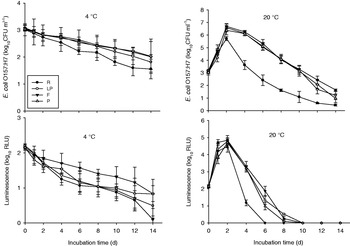
Survival and metabolic activity of Esch. coli O157:H7 at both 4 and 20°C are shown in Fig. 1. At 4°C, Esch. coli O157:H7 populations declined steadily and continuously by 1·0–1·5 log10 CFU/ml in all samples over 14 d incubation. While log cell count reduction was greatest in raw milk (1·5 log10 CFU/ml), between-sample variations in survival of Esch. coli O157:H7 were not significant between all samples at this temperature (P>0·05). Metabolic activity of Esch. coli O157:H7 continuously and steadily reduced (by 1·3–2·07 log10 RLU) over the 14 d, with activity in raw milk diminishing near to zero. Cell activity in the microfiltered milk was significantly higher than that in raw milk (P<0·05), while no significant difference was seen among laboratory-pasteurized, commercially-pasteurized and raw milk (P>0·05).
Survival and metabolic activity of Esch. coli O157:H7 in milk samples stored at 4 and 20°C (R=raw milk, LP=laboratory-pasteurized milk, F=microfiltered pasteurized milk and P=commercially-pasteurized milk). Values represent means±sem (n=3).

At 20°C, Esch. coli O157:H7 cell counts in all milk samples showed a dramatic initial increase, peaking at day 2 (2·7–3·6 log10 CFU/ml), then progressively declined until the end of the 14 d incubation. Cell counts in raw milk samples decreased most (about 2·5-log cell count reduction using day 0 as baseline) and the count reduction was significantly higher (P<0·001) in raw milk compared with pasteurized samples. Counts did not statistically differ between the different types of pasteurized milk. Further ANOVA tests revealed that temperature was a significant factor moderating survival in all samples, with higher environmental temperatures leading to higher pathogen counts (P<0·001). Metabolic activity of Esch. coli O157:H7 at 20°C in all milk samples increased significantly on day 1, which continued to rise and peak (2·3–2·75 log10 RLU) at day 2. Cell activity dropped significantly afterwards in all samples, reaching zero in raw milk at day 6 and at day 10 in pasteurized milk samples (Fig. 1). Cell activity in the three pasteurized milk samples was significantly higher than that in raw milk (P<0·05). Further ANOVA analysis indicated that temperature was an important influence on Esch. coli O157:H7 cell activity, with the higher temperature inducing a peak at day 2 which was not observed at the low temperature.
Aerobic plate counts and pH
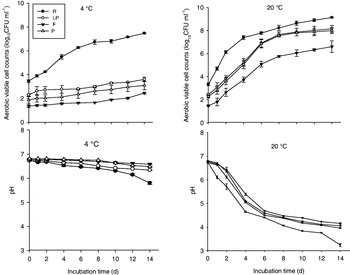
Changes in APC (measured in log10 CFU/ml) and pH values are shown in Fig. 2. At 4°C, average APC increased significantly more in raw (around 3·9 log count growth) than in pasteurized milk (<1·35 log count growth) (all P<0·001, mean counts: raw>laboratory-pasteurized>commercially-pasteurized>microfiltered). At 20°C, APC increased approximately 5–6 log10 CFU/ml in all milk samples after 14 d of incubation. APC in raw milk were significantly higher (P<0·001) than that in the three types of pasteurized milk, with values in microfiltered milk being significantly lower than those in the other pasteurized milk types (P<0·001). In the ANOVA test, temperature was found to be a significant factor in aerobic cell growth in the pasteurized milk samples. The growth rates in pasteurized samples were significantly higher under room temperature than under refrigeration temperature; although growth slowed down from day 8. In all, there was a final increase of around 6 log10 CFU/mL in APC from day 0 to 14.
Changes in aerobic plate counts (measured in log10 CFU/ml) and pH in milk samples stored at 4 and 20°C (R=raw milk, LP=laboratory-pasteurized milk, F=microfiltered pasteurized milk and P=commercially-pasteurized milk). Values represent means±sem (n=3).

At 4°C, no substantial changes in pH were observed in the pasteurized milk samples (Fig. 2), staying between 6·5 and 6·7; however pH values in raw milk exhibited a gradual decrease to 5·7. Over 14 d at 20°C, pH values decreased rapidly in all samples, from an average of 6·7 to 3·3 in raw milk, and to around 4·0–4·2 in pasteurized milk samples. Over the course of the experiment, there were significant differences in pH among the four types of milk (all P<0·001, pH mean: microfiltered>commercially-pasteurized>laboratory-pasteurized>raw). Changes in pH values were negatively associated with the increase in APC, with higher numbers of aerobic microorganisms leading to lower pH values.
Discussion
Pasteurized and unpasteurized milk may be contaminated with Esch. coli O157:H7 when inadequate farm hygiene measures (milking and milk handling) are present or post-pasteurization contamination occurs. Given the low infective dose of Esch. coli O157:H7 (Chart, Reference Chart2000) and the association of milk with past infections, it is important to understand the behaviour of the organism in dairy products. Whilst others have previously studied changes in numbers of the organism in dairy products (e.g. Wang et al. Reference Wang, Zhao and Doyle1997; Mamani et al. Reference Mamani, Quinto, Simal-Gandara and Mora2003; Marek et al. Reference Marek, Nair, Hoagland and Venkitarayanan2004), this is the first study to concurrently monitor the pathogen's metabolic activity. Given the association between metabolic activity and infectivity, this paper presents novel findings of interest to dairy microbiology and food safety.
The present study confirmed that temperature is an important factor that influences the survival and activity of Esch. coli O157:H7. We observed that Esch. coli O157:H7 could not grow under refrigeration conditions in any type of milk, which was largely consistent with results from previous studies on a limited range of milk types (Wang et al. Reference Wang, Zhao and Doyle1997). Previous studies have recommended that milk be kept at ⩽5°C as even at 7°C, Esch. coli O157 can grow at a significant rate (Heuvelink et al. Reference Heuvelink, Bleumink, van den Biggelaar, Te Giffel, Beumer and de Boer1998). Whilst other studies have also found the organism to survive and proliferate at room temperatures (Wang et al. Reference Wang, Zhao and Doyle1997; Mamani et al. Reference Mamani, Quinto, Simal-Gandara and Mora2003), this study additionally revealed a corresponding increase in the pathogen's metabolic activity at elevated temperatures.
Esch. coli O157:H7 numbers and metabolic activity consistently decreased at a greater rate in raw milk than in the three types of pasteurized milk. Greater APC values were recovered from raw milk and this is expected to result in elevated competition with, and/or antagonism against the pathogen, as reported elsewhere (Wang et al. Reference Wang, Zhao and Doyle1997; Elwell & Barbano, Reference Elwell and Barbano2006). Storage of raw milk at 20°C also reduced pH considerably, most probably due to lactic acid production by the elevated counts of background micro-organisms (Kuippers et al. Reference Kuippers, Buist and Kok2000). Acidic conditions (pH<3·5, Fig. 2) are likely be detrimental to survival of Esch. coli O157:H7; however it should be noted that the pathogen was not found to be eliminated at these low pH values, consistent with previous studies that show its acid resistance and adaptation in acidic environments (Leyer et al. Reference Leyer, Wang and Johnson1995; Mamani et al. Reference Mamani, Quinto, Simal-Gandara and Mora2003; Carter et al. Reference Carter, Brandl, Louie, Kyle, Carychao, Cooley, Parker, Bates and Mandrell2011). In addition, raw milk may also contain several compounds with bioactive components (e.g. lactoferrin, lactoperoxidase and lysozyme) that can reduce or eliminate populations of pathogenic bacteria; however these will be lost during heat treatment (IDF, 1991).
To conclude, examining the role of incubation temperature has practical significance in understanding how Esch. coli O157:H7 and other aerobic cells behave in the food chain, from retailer fridge storage to the consumer home where the greatest risk of human infection occurs. We have shown that allowing contaminated milk to reach room temperature for even a space of 2 h can induce a transient proliferation of Esch. coli O157:H7 numbers and metabolic activity. Microfiltering milk did not have a significant effect on pathogen proliferation in comparison to normal pasteurization procedures and especially in comparison to the importance of storage temperate. Although pasteurization represents an effective measure to reduce pathogenic risks and improves the microbial quality of milk, consistent hygiene quality standards must be observed both pre- and post-pasteurization to guard against any possible pathogen and spoilage microorganisms.
This work was undertaken using funds provided by the UK Rural Economy and Land Use Programme (RES-229-25-0012).