The last decade of the twentieth century brought a global revolution in the industrial organization of infrastructure industries such as telecommunications, electricity, and gas. Considered “natural monopolies,” until the late 1980s these utilities were generally provided by a single firm in each country that was owned by the state nearly everywhere except in North America, where they were regulated private monopolies. In the late 1980s many governments began privatizing stateowned firms, and by the year 2000 worldwide revenues from privatization exceeded $1 trillion.1
Megginson and Netter, “From State to Market.”
The United States, meanwhile, began large-scale deregulation of firms in the same industries.
2 Liberalization in modern telecommunications began in the late 1950s when the U.S. Federal Communications Commission (FCC) allowed large firms to bypass AT&T, the monopoly telecom provider, with microwave transmission for long-distance service. See Crandall and Waverman, “Talk is Cheap.” Reforms have continued to increase competition, and appear to be improving telecom service. See Noll, “Telecommunications Reform”; Petrazzini, “Political Economy”; Ros, “Does Ownership”; Wallsten, “Econometric Analysis”; and Wellenius and Stern, “Implementing Reforms.”
In most cases, privatization and deregulation have been coupled with attempts to introduce competition.
Conventional wisdom holds that technological change and a better understanding of the costs of regulation now make competition possible where previously it was not. Most research on telecommunications reforms begins its study of the sector with the 1980s, concurrent with the start of the new liberalization era, but tends not to explore market structure and institutions on early telephone development, when private provision and competition were common.3
Some authors have tested various theories of regulation using historical data. Kanazawa and Noll, in “Origins” for example, find general support for a “public interest” theory explaining the implementation of early railroad regulation, although voters in communities that did not yet have service appeared worried that regulation would prevent rail expansion to their towns.
This oversight is unfortunate because early experiences may provide important insights into today's debates.
Indeed, recent reforms actually often represent a return to an industrial organization that existed nearly a century earlier, and today's debates mirror those in the late nineteenth and early twentieth centuries: Should the government run infrastructure utilities, and if not, what restrictions, if any, should it place on private firms that run them?4
See, for example, Foreman-Peck and Millward, Public and Private Ownership on the development of network industries in the United Kingdom; Glaeser, “Public Ownership” on the municipalization of some city services in the United States; Troesken, Why Regulate Utilities, on the gas industry in Chicago; and Troesken and Geddes, “Municipalization,” and Crocker and Masten, “Prospects for Private Water,” on waterworks in the United States.
Even in the United States the question of ownership and competition was unsettled,
5 See, for example, Judson, Selected Articles. See The National Civic Federation, “Shall the Government?”
with the U.S. Post Office lobbying for a government takeover of the telephone and telegraph.
6 Post Office Department, “Government Ownership.”
In this article I test the effects of ownership, competition, and regulation in the context of the nascent telephone sector across Europe at the turn of the twentieth century. Two features of the European telephone industry make it ideal for the analysis. First, the structure of the telephone industry varied considerably across Europe, ranging from state-owned monopolies to firms facing intense competition to private firms operating under the threat of asset expropriation.
Second, the variation in telephone provision and the novelty of the technology in the early twentieth century were of great interest to researchers at the time, and they collected copious amounts of data on telephone penetration, prices, and services across Europe.7
Bennett, Telephone Systems. See also Casson, History; Holcombe, “Telephone,” “Municipal Ownership,” and Public Ownership; Kingsbury, Telephone; and Webb, Development.
Britain's telephone network, in particular, inspired research because the system was so poor despite England's status as the wealthiest country in the world. Nearly everyone agreed that this predicament resulted in part from a monopoly firm operating under the threat of expropriation, but could not agree on the solution. A. N. Holcombe argued in the
Quarterly Journal of Economics that service would improve if government operated the telephone system.
8 Holcombe, “Telephone” and “Municipal Ownership.”
A. R. Bennett believed the answer was to eliminate all monopolies, government or private.
9 Bennett, Telephone Systems.
Although these authors lacked today's econometric tools, their efforts make it possible now to empirically test their hypotheses.
A few studies examine competition in early U.S. telephone development, finding that the network expanded more rapidly under competition than when the Bell system operated as a monopoly.10
The competitive era was roughly from 1894, when the Bell patent expired, to approximately 1920 when Bell had essentially quashed and acquired its competitors. Gabel, “Competition”; Gabel, “Early Competitive Era”; Jayakar, “Local Exchange Competition,” pp. 375–87; and Mueller, “Telephone War.”
Only two contemporary works, to my knowledge, empirically examine determinants of historical telephone expansion across countries. Witold Henisz, studying political institutions and infrastructure development, finds that countries where policy change is difficult—and government commitments thus more credible—adopted telephone and electricity earlier.
11 Henisz, “Institutional Environment.”
James Foreman-Peck uses a cross-country dataset to test the effects of government ownership in 1913, finding that government ownership was associated with increasingly worse telephone penetration as per capita income increased.
12 Foreman-Peck, “Competition,” pp. 215–28.
Because the datasets I use include this 1913 data I will discuss this result in more detail in what follows, before moving on to analyses that include regulation, rural service, prices, and panel data.
This article combines historical data from several sources to test the effects of competition, government monopoly ownership and regulation on telephone provision. Econometric analysis of cross-sectional data from 33 countries in 1913 and unbalanced panel data on European countries from 1892 to 1914 reveal that telephone penetration was highest in countries with competitive regimes and lower when provided by a state monopoly or by private firms operating under restrictive concessions, even controlling for per capita income and year fixed effects. The countries with the most liberal policies towards private provision and competitive markets—Norway, Sweden, and Denmark—had the highest telephone penetration in Europe through the entire sample period. Moreover, rural areas, which many people today worry would not be served in a competitive environment, were more likely to have telephone service under competitive private provision than under government monopoly. Prices, meanwhile, were lowest under competitive regimes, somewhat higher under state provision, and much higher when service was provided by private firms operating under stringent concessions.
THE TELEPHONE AND THE TELEGRAPH
Conventional wisdom holds that an early belief that telephone service was a natural monopoly led countries to prefer that one firm provide telephone service.13
Network externalities mean that the total benefits of each new connection exceed the benefits that accrue to the newly connected person because everyone else can now reach that person. The full benefit is obtained only if each subscriber can connect with all other subscribers. However, it is not clear that there were economies of scale in supply early on. The number of possible connections increased exponentially with the number of telephones on the network, making manual switching increasingly costly with network size. See Mueller, Universal Service.
Beliefs about telephone service as a natural monopoly, however, played little if any role in determining early sector structure. Only much later was the concept of natural monopoly used to justify monopoly telephone service.
14 Helgesson, Making a Natural Monopoly.
Instead, the industry's structure tended to be determined by how countries had organized telegraph service and how they viewed telephony relative to telegraphy. That is, because the telephone threatened the telegraph, governments were more open to competition and private ownership in the telephone industry when they did not have a financial stake in the telegraph.
Like the telephone, however, the structure of the telegraph industry was, in part, determined by earlier events. The first telegraph systems were optical, not electrical, and came into widespread use in Europe in the late eighteenth century. An optical telegraph system consists of visual signaling stations placed as far apart as one could see with a telescope. At each station a lookout would watch the neighboring station through a telescope, read the message being signaled, and relay it to the next station. The French government provided the first public funds—to Claude Chappe—for building an optical telegraph in 1793. The system quickly proved its usefulness, as the military used it to inform Paris of battle outcomes.15
Holzmann and Pehrson, Early History.
Napoleon recognized the usefulness of high-speed information transfers for military campaigns and invested heavily in the new technology.16
Field, “French Optical Telegraphy,” pp. 315–47, provides a fascinating and detailed analysis of the optical telegraph and its implementation and administration in France.
By 1842 the French War Department operated a 3,000-mile optical telegraph network that was off-limits to the public. In 1833 a private firm opened an optical telegraph to the public in France, but the government shut it down and in 1837 declared telegraphy to be a state monopoly.
17 Some people immediately grasped the potential commercial value of high-speed information flows, as well. Between 1834 and 1836 two bankers bribed telegraph operators to transmit stock information from Paris to Bordeaux through coded errors in regular transmissions. See Holzmann and Pehrson, Early History; Standage, Victorian Internet. Field, “Telegraphic Transmission,” pp. 145–94, provides a detailed analysis of the telegraph's role in financial development and economic growth more generally.
This law was then applied to the state's electrical telegraph, which opened in 1845. The French public had no telegraph access until 1850.
18 Holcombe, Public Ownership.
Across Europe, governments built electrical telegraph systems in the 1850s for military use and to keep in touch with remote colonies, though laws did not always explicitly prohibit private ownership. Denmark and Sweden were notable exceptions to state ownership of telegraph. The Swedish government did not give itself a legal right to provide monopoly telegraph service.
19 Though the Danish state did retain that right, it granted the Great Northern Telegraph Company a 30-year concession.
20 Andersson-Skog, “National Patterns,” pp. 30–46.
Throughout Europe the relationship between the state and the telegraph system would become a crucial determinant of how the state approached telephony. Herbert Webb succinctly summed up the general story of Europe's initial experience with the telephone: “The telephone was taken to the Government Telegraph departments and offered for sale, but the Telegraph departments declined to take the risk of developing a totally new business. At the same time, however, they assumed control over the telephone and issued licenses to companies formed to exploit the new invention, these licenses being generally for restricted periods and surrounded by the most onerous conditions.”21
Alexander Graham Bell, for example, took his newly invented telephone to England in 1878, but found little government interest in it.22
Britain's Postmaster General told Parliament that year that “it is evident that the instrument is at present unsuitable for the purposes of public telegraphy, and I do not, therefore, propose to introduce it in that branch of the Postal Telegraph Service.”
23 Telegraph departments tended to view the telephone as a “scientific toy.”
24 Many governments, including those of Britain, Austria, Belgium, and France, granted private concessions in the early 1880s.
25 Bennett, Telephone Systems.
But once public demand for the new technology was obvious, telegraph agencies recognized the revenue threat, and governments extended telegraph laws to also guarantee state control over the telephone. Austria and Belgium nationalized their private providers soon after granting concessions, and France took over all private exchanges by force in 1889 when the firms refused to hand over their assets.26
Bennett, Telephone Systems.
Some countries that had not yet allowed any substantial telephone investment, including Bulgaria, Germany, Switzerland, and Luxembourg established state-owned monopolies.
THE DIFFERING STRUCTURE OF THE TELEPHONE SECTOR
The first experiences with the telephone resulted in different sector structures across Europe. Some countries cautiously allowed private firms to provide service under strict concessionary agreements. Other countries—Scandinavian in particular—encouraged private sector investment and allowed firms the freest hand in building their networks. The remaining countries provided telephone service through state monopolies. Governments that operated monopolies ranged from those such as France that showed little interest in telephony to those such as Germany and Switzerland that saw the potential benefits of telephony. The sections that follow detail these different approaches.
Private Service Under Harsh Concessions: Britain, Italy, Spain
Some countries allowed private firms to operate under stringent conditions, typically retaining the right to appropriate firms' assets with no compensation. Here I provide more detail for Britain, Italy, and Spain.
Bell and Edison subsidiaries in Britain merged in 1880 to form the United Telephone Company (UTC).27
Foreman-Peck, “Competition,” pp. 215–28, provides a rich history of telecommunications in Britain; and Foreman-Peck and Millward, Public and Private Ownership, provide an excellent and detailed analysis of British industry at this time, including telecommunications.
Though it held a monopoly concession, the firm operated in a harsh political environment. The British government had nationalized the telegraph system in 1871 and was concerned about recouping its investment.
28 Bertho-Lavenir, “Telephone,” pp. 69–104. Foreman-Peck and Millward, Public and Private Ownership.
As a result, UTC's license allowed it to build lines only to two to five miles from any city center, required a royalty of 10 percent of gross receipts, and allowed the government to buy the system at an undefined “fair price” in 1890. When telegraph revenues decreased in 1882 the government further restricted the concession: UTC was prohibited from building public call boxes while the post office was given the right to purchase as many telephones from UTC as it wanted on terms fixed by arbitration. The public, however, strongly favored telephone development, and in 1884 Parliament revised the regulatory structure in hopes of stimulating competition. While UTC's concession remained the same, the new rules allowed municipalities to receive additional concessions.
29 Unfortunately, only six out of a possible 1,334 municipalities set up telephone exchanges under this new system.30
Holcombe, “Municipal Ownership.”
Several reasons appear to explain this failure. First, the UTC, reorganized as the National Telephone Company (“NTC”), made competition difficult. Many of the NTC's regional concessions covered multiple municipalities, meaning that cities felt they had to organize service collectively to compete. Second, the NTC and other lobbyists were engaged in ongoing fights regarding rights-of-way and interconnection of trunk lines, which the government ultimately nationalized.
31 Foreman-Peck and Millward, Public and Private Ownership.
In addition, all concessions were to expire in 1911, with no agreement as to what would happen afterwards. In 1904 the NTC warned that it would not sign up new customers because it had to recoup all of its investments by 1911. By the end of 1904 10,000 people were on the waiting list for telephone service.
32 Italy allowed private operation of telephony, though the state was careful to protect telegraph revenues. The telegraph authority “reserved the right to require the telephone companies to make alterations when they should deem it necessary for the protection of the telegraph service at the companies' own expense.”33
Webb, Development, pp. 366–67.
Moreover, although concessions were granted for up to 25 years, the government could suspend them whenever it wanted and could completely revoke the concession after 12 years. At the end of the concession all the equipment would revert to the state without payment.
34 Bennett, Telephone Systems.
Spain began with a remarkably progressive approach to telephony. Although an 1884 law made telephony the exclusive domain of the government, the state reversed itself in 1886, declaring that “so long as the telephonic service is administered by the State it can never develop and attain the proportions demanded by the necessities of modern life. Private enterprise, on the other hand, while adapting itself to public requirements, will find in this novel means of communication a vast field for activity in which apt initiative will be repaid by satisfactory development.”35
Bennett, Telephone Systems, p. 323.
In a move ahead of its time, Spain auctioned concessions, where companies bid on the royalty they would pay the state, with a minimum allowed bid of 10 percent. The state ultimately granted 35 concessions, with the winning bids being a 10 percent royalty in the towns of Valladolid, Seville, Granada, and Alicante, 20 percent in Madrid and Saragossa, 31.5 percent in Valencia, 33.75 percent in Barcelona, and 34 percent in Bilboa. Unfortunately, the state also decreed that at the end of the 20-year concessions the entire system would revert to the state without compensation.
36 Bennett, Telephone Systems.
These conditions raise the question of why firms would invest in these countries in the first place. Keefer explores this issue in the context of Spain, and concludes that firms invested under the threat of expropriation when they were allowed to earn very high profits, meaning that their investments were rational in an expectations sense.37
Keefer, “Protection,” pp. 170–92.
Indeed, as we will see, prices in countries with this institutional setup were much higher than elsewhere.
Private Service in an Open Environment: Scandinavia
At the beginning of the twenty-first century Scandinavia is widely recognized as a global leader in telephone innovation and use. It is less widely recognized today that Scandinavia was a global leader by the beginning of the twentieth century. Bennett exclaimed that
“… there would seem to something in the Scandinavian blood … which renders the possession of many telephones an essential to their owners' happiness. Wherever two or three Swedes, or Norwegians, or Danes, or Finns of Scandinavian descent, are gathered together, they almost infallibly proceed to immediately establish a church, a school, and a telephone exchange. Whatever else in life that is worth having generally comes after.”38
Bennett, Telephone Systems, p. 130.
While perhaps best left to future research to test “the Scandinavian blood,” Scandinavian telecommunication public policies appear to have been well-designed to promote telephony. For example, Sweden, Norway, and Finland charged no royalties on private firms operating telephone networks.39
And in an interesting twist on later divisions between local and long-distance service, the Swedish, Danish, and Finnish governments built and operated trunk lines connecting the many local independent private exchanges.
The Danish government initially stayed out of telephony altogether, and Bell opened the first exchange in Copenhagen in 1880. In 1882 Bell sold the enterprise to the Copenhagen Telephone Company.40
Bennett, Telephone Systems.
Although the state possessed a legal right to a monopoly in telegraph and telephones, it allowed municipalities and other local authorities to grant private concessions as they wished. The state built long-distance lines (in competition with the larger private firms), but otherwise stayed out of telephony.
The Norwegian story is similar. In 1880 Bell established exchanges in Christiana (the capital) and Drammen. The Christiana Telephone Company soon bought out Bell in that city. Bell also sold its Drammen operations to the Drammen Uplands Telephone Company, which then began extending its lines to rural areas outside the town. Bennett noted that “the company has shown how a large tract of sparsely populated country, containing nothing larger than a village, can be telephoned and maintained year after year at a handsome profit.”41
Bennett, Telephone Systems, p. 281.
The Norwegian government was not entirely accommodating at first, but ultimately did not block private telephone development. Although an 1881 law gave the government the right to a monopoly in telegraph and telephone, it was also allowed to grant private concessions. The government made some early attempts to protect its telegraph system, mandating that telephone systems had to remain within 11 kilometers of a city center and prohibiting cities' telephone systems from coming within two kilometers of each other.
42 But these laws quickly broke down as firms found ways around the restrictions. Indeed, the telegraph service began using telephone lines for telegraphy rather than build new lines.
The most detailed information exists for Sweden. There the government had no legal monopoly on telegraph, and the Bell company opened exchanges in Stockholm, Gothenburg, and Malmo in 1881. Local cooperatives began setting up almost immediately thereafter, and by 1920 Sweden had almost 200 private telephone networks.43
On cooperatives, see Casson, History. On private networks, see Andersson-Skog, “National Patterns,” pp. 30–46.
Stockholm undoubtedly saw the greatest benefits from competition. The General Telephone Company emerged as a major Bell competitor in Stockholm, and soon bought out the Bell operation. After the General Telephone Company bought out Bell, the state opened a competing exchange in Stockholm. Parliament, apparently concerned about the dangers of monopoly, prohibited the state firm from buying the General Telephone Company until 1918.
44 Andersson-Skog, “National Patterns,” pp. 30–46.
With multiple telephone providers in Stockholm, interconnection became an important local issue.45
Helgesson, Making a Natural Monopoly. All the information in this paragraph comes from Helgesson's fascinating book.
Just as today, the debate was contentious, with competing groups, including the private firm, the state-owned firm, the Stockholm city council, and the national government, expressing opinions. Perhaps because both the private and the state-owned firms had significant market share, both firms desired interconnection. The most contentious issue was an interconnection fee. The city council opposed any fee, but the firms believed a fee was necessary. In 1890 the two firms agreed to charge each other a 0.10 Krona per call interconnection fee.
46 Initially the rate for an interurban interconnection call was 0.20 Krona, but that rate was soon reduced to 0.10 as well. See Helgesson, Making a Natural Monopoly.
Public pressure for interconnection caused the city to agree.
The Stockholm city council's motivation for free interconnection is today not clear. There are (at least) two possible motivations. One is political: passing rents to constituents is appealing to politicians. A second is more sophisticated: perhaps the council recognized that an interconnection fee could be a convenient vehicle for the two firms to collude in increasing consumer prices. If so, the city council exercised remarkable foresight in considering issues that economists would not formally recognize for some time.
Nonetheless, this agreement expired in 1901, and the two firms never connected again. The failure to extend interconnection seemed not the fault of the firms—on several occasions after 1901 they reached interconnection agreements. Rather, sometimes the city government rejected the agreements as it opposed the interconnection fee, and sometimes the national government opposed the agreements for varying reasons. Some legislators opposed the idea that a state-owned firm would negotiate over prices with a private firm, whereas others wanted the government to buy the private firm outright.
Even absent a continuous interconnection regime, residents of Stockholm benefited from intense competition in the early 1900s between the state firm and General Telephone. By 1914 Stockholm boasted 24 telephones per hundred people. This penetration rate compared to, for example, an average of 11.3 telephones per hundred people in the 12 largest U.S. cities, 6.6 in Berlin, 3.5 in London, and 3.2 in Paris.47
The penetration rate may be a somewhat inflated measure of true penetration if, absent interconnection, many may have needed two telephones—one to connect to each system. However, telephone penetration is more than twice the level of similarly wealthy cites and, moreover, Noam notes that during this time Stockholm witnessed both technical and service innovations not seen elsewhere, as well as prices that fell by nearly 75 percent during this super-competitive era.
48 Noam, Telecommunications.
Government Ownership
Countries in which the government provided monopoly telephone service typically made telephony part of the telegraph agency.49
The telegraph agency was typically part of the postal service, which led to the phrase “PTT”—Post, Telegraph, and Telephone.
As discussed previously, governments generally, but not always, viewed the telephone as a threat to the telegraph and its revenues. France, for example, as early as 1884 rejected one private concession because it did not provide “an adequate safeguard for the revenues from the public telegraph.” The concessions that the French government did grant were short—typically four years long—and restrictive.
50 Bertho-Lavenir, “Telephone.”
The government seized all private networks by force in 1889. Penetration remained low and prices high. In 1895 the French national telephone authority justified its high telephone rates as necessary to “act as a ‘dike’ against an inconveniently rapid increase of subscribers and … have to be maintained until more ample facilities should be available,” according to A. Lebon, the French minister in charge of telephone service.
51 Holcombe, Public Ownership. The French government was also a strict employer. Apparently, operators were not allowed to marry without the Postmaster General's permission, and were forbidden from marrying a “mayor, a policeman, a cashier, [or] a foreigner, lest they betray the secrets of the switchboard.” Casson, History.
The French government, however, allocated little money to build those facilities. Instead, cities that wanted telephone networks were required to pay the national government, which would then build the network. In practice, chambers of commerce pressured local banks to make funds available for network development. The businesses responsible for such organization, however, generally wanted a line to Paris, not a local network.52
Bertho-Lavenir, “Telephone in France,” pp. 69–104.
Telephone development in France remained underdeveloped. Whereas Denmark, Sweden, and Norway had 4.5, 4.1, and 3.4 telephones per hundred people by 1914, France could muster only 0.8.
But not all governments that operated public telephone networks were so myopic. Germany and Switzerland operated state-owned networks, and policymakers there recognized potential benefits of telephony, viewing it as complementing, rather than competing with, the telegraph. Indeed, both countries saw telephone service as a way to extend their telegraph lines and favored early investment for that purpose.53
Holcombe, Public Ownership; and Webb, Development.
Germany first introduced telephone service in 1877 as an “auxiliary telegraph apparatus,” intended to bring telegraph service to suburban and rural areas. In 1879 Bell asked for a concession to build true telephone service, but the Post Office declared the telephone to be “technically immature and therefore incompatible with the technically more sophisticated system of the telegraph, and backers of state intervention, who stressed the threat to the Reich finance and danger of a loss of political and economic control to a foreign company, … decided to interpret the legal situation of the telephone as being part of the existing state monopoly on telegraphy that was fixed by the Constitution.”54
Thomas, “Politics,” p. 183.
Telephone service thus languished, with little investment from the state beyond its complementary use for telegraphy.
Because it was primarily a means of enhancing long-distance telegraphy, penetration and local service suffered. As late as the mid-1890s the local exchange in Berlin operated only from 7:00AM until 10:00PM, whereas other major cities had around-the-clock service.55
Bennett, Telephone Systems.
Nor were individuals allowed to share service, which could have increased demand: German law made it illegal to lease a phone to neighbors, punishable by six months in jail.
56 Finally, service suffered when the state delayed introducing new technologies. Webb noted that “single wire overhead line plant was largely maintained in service in Germany long after metallic circuit working and underground cable distribution has been generally adopted in other countries.”
57 Webb, Development, p. 64.
Governments around the world, and in Europe in particular, took various approaches to introducing telephone service. In the remainder of this article I use this variation and data from this early period to test empirically the effects of competition, government monopoly provision, and regulation on telephone service.
DATA AND EMPIRICAL ANALYSIS
The goal of this article is to explore the effects of market structure on development of the telephone sector. The data come from several sources. AT&T published statistics on telephone penetration by country in 1912, 1913, and 1914. Several contemporary scholarly works provide earlier penetration data as well as detailed institutional information on concessions, product offerings, and ownership.58
AT&T's 1912 and 1913 reports document figures as of 1 January of those years. See American Telephone and Telegraph, “Telephone Statistics” and “Telephone and Telegraph Statistics.” Kingsbury, Telephone, reproduced the 1914 figures. The 1913 and 1914 reports also provide penetration data separately for cities with populations exceeding 100,000 and for areas outside those cities in selected (primarily European) countries. I pieced together earlier data from scholarly works, including Bennett, Telephone Systems; Holcombe, “Telephone,” “Municipal Ownership,” and Public Ownership; Casson, History; Webb, Development; and Kingsbury, Telephone. These sources also provided information on ownership and concessions to private firms in many European countries. Bennett, Telephone Systems proved an especially rich source: in addition to data on telephone penetration and descriptions of the sector structure across countries, he also compiled data on services and prices. Bennett's efforts allow me to test empirically the effects of the market structure on prices as well as on penetration.
Though the specifics of government ownership and conditions under which private firms operated differed by country, as discussed previously, for analytical purposes there were essentially three states of the world: nationwide government-owned monopolies; private firms operating under harsh concessions in which the retained the right to take over the firm's assets—called “capricious regulations” in the analysis that follows; and private firms competing with each other and sometimes with the government in a relatively open environment.
Of course, the real world did not fit precisely this simplistic model. Some countries with multiple firms, for example, granted those firms regional monopolies, which meant that those firms faced benchmark competition at best rather than head-on competition. Unfortunately I do not have any consistent information on this phenomenon. There is also one exception to the “monopolies-were-always-run-by-the-government” rule: the United Kingdom had a national private monopoly until the state took it over in 1911. However, the United Kingdom's 1884 regulation attempted to entice municipal competition, so the national telephone company faced the threat of potential competition across the country, and actual competition in a few cities. A more important issue in the United Kingdom, as mentioned previously, however, may have been the restrictive concessions, which introduced substantial risk into telephone investment.
Finally, I do not have detailed cross-country information on regulations. This lack of information is, in part, because telephones were new and telecom regulations, as we think of them today, scarce. But this scarcity in some ways makes the empirical analysis simpler because the most important regulation was likely the concessions under which private firms operated. For the purposes of this article I note whether a country had “capricious” regulations, which I define as whether the country had the right to appropriate the firm's assets without compensation. The countries in the sample with such rules include Spain, Italy, and the United Kingdom (prior to 1911).59
Concessions in the United Kingdom did not actually allow the government to take over the system without compensation at the end of the concessionary period. Instead, the issue was that the government was not planning on renewing the concession after 1911 and had as late as 1904 made no statement as to what would happen after that date.
Telephone Penetration and State vs. Private Provision
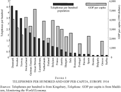
Figure 1 shows telephone penetration per hundred people and GDP per capita in European countries in 1914.60
The figure does not show the United States, which had far more telephones per capita than any European country at the time. There are several reasons for U.S. dominance. First, the telephone was invented and first used in the United States, giving the United States a head start. Second, telegraph service was private in the United States (Western Union), meaning that the government did not face strong protectionist pressure from government agencies. Finally, once the Bell patents expired in 1894, thousands of competing telephone exchanges popped up around the country. Recent research demonstrates large increases in U.S. telephone investment after the patents expired as Bell competitors emerged around the country. See Gabel, “Competition”; Gabel, “Early Competitive Era”; and Jayakar, “Local Exchange Competition.”
The dominance of the Scandinavian countries in telephone penetration is clear, despite not being substantially wealthier than other European countries. Great Britain—the wealthiest country in Europe—lagged far behind the leaders.
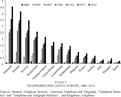
Figure 2 shows that telephone penetration per hundred people grew more quickly in the Scandinavian countries than in other European countries from 1885 through 1914.
FIGURE 1 TELEPHONES PER HUNDRED AND GDP PER CAPITA, EUROPE 1914
FIGURE 2 TELEPHONES PER CAPITA: EUROPE, 1885–1914
The figures suggest that the countries that allowed competition had higher telephone penetration. I next test the effects of market structure on the development of the telephone by estimating several versions of equation 1.
As discussed previously, telephone penetration is the share of population with a telephone.61
Even today this measure is the best available indicator of telephone access in a country.
is a dummy variable that equals one if a state-owned firm is the monopoly telephone company.
Capricious regulations is a dummy variable that equals one if a private firm operates under a concession that allows the government to appropriate the firm's capital or withdraw the firm's license without compensation.
Finally, it is important to control for other factors affecting telephone supply and demand. The most important determinant of telephone demand, even today, is income (gdp per capita). I thus obtained historical estimates of per capita income from the work of Angus Maddison.62
Measuring the cost of providing service (supply) at a country level is more difficult—a problem that cross-country work on contemporary telecom reforms typically does not deal with adequately. I use
population density (provided in the AT&T reports) to proxy for costs, under the assumption that it is cheaper per capita to wire countries with higher population densities.
63 Political factors, too, can affect investment and industrial development. The POLCON database, created by Henisz, is a unique source of quantitative historical data on political conditions across countries. The POLCON variable measures the number of veto points in a government. Policy is considered to be more stable when more people or institutions have veto power. This variable, however, did not affect the empirical results, was never significant, and was difficult to interpret. I thus exclude that variable from the analyses presented here. See Henisz, “Institutional Environment.”
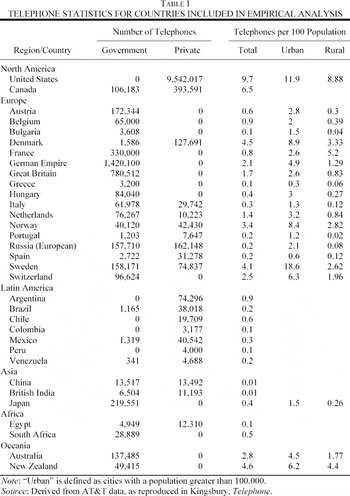
lists the countries in this analysis and some relevant data.
64 Whereas American Telephone and Telegraph, “Telephone and Telegraph Statistics,” provides information on more countries, GDP data was available for only those 33 countries.
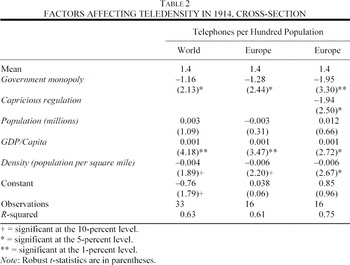
I first estimate the equation using cross sectional data from 33 countries around the world in 1913. In this case I omit the capricious regulation variable because I do not have that information for countries outside Europe. The first column of Table 2 shows the results of this regression. As expected, per capita income is positive and statistically significant: richer countries have more telephones, as is still the case today. The coefficient on the government monopoly variable is negative and significant. Controlling for per capita income, countries with government monopolies had, on average, almost 1.2 fewer phones per hundred people. This is a large difference, as the average worldwide penetration rate (in this sample) was only about 1.4 phones per hundred.
Foreman-Peck runs a similar regression using this 1913 data.65
Foreman-Peck, “Competition.”
He uses a dummy variable for exclusive state ownership and interacts state ownership with per capita income. The coefficient on the state ownership variable is positive and on the interaction term is negative. The magnitudes of the coefficients, however, mean that at all levels of observed income state ownership would have provided worse outcomes.
For lack of additional data, however, his empirical analysis does not include regulation, rural coverage, prices, or changes over time.
To begin focusing empirically on Europe, where I have more complete information, I first run the same regression using only the European countries in my sample. The second column of Table 2 shows those results, which are consistent with the results discussed previously. The coefficient on the variable of interest, govmonop, suggests that state-owned monopolies are correlated with worse telephone penetration—almost 1.3 fewer phones per hundred, on average.
The third column of Table 2 shows the results of this estimation when including the “capricious regulation” variable, indicating the state's right to expropriate the firm's assets. The coefficient on this variable is negative and significant, as is the coefficient on the government monopoly variable, which also increases in magnitude, from negative 1.3 without the regulation variable to approximately negative 1.9 with it. Private firms operating under stringent conditions performed just as poorly as the state-owned monopolies: the coefficient on this variable is also about negative 1.9.
Although the results on the right of expropriation variable are sensible—no rational firm would invest much if its investment is likely to be seized—they should nonetheless be viewed carefully here. In practice, for 1913 this variable applies only to Italy and Spain, where other factors may have inhibited telephone development. The panel analysis later in the article will deal somewhat with this issue.
The results on some of the control variables are also of interest. Per capita income is positive and significant, as one would expect. Surprisingly, however, population density is negative and significant, implying that telephone penetration was higher in more sparsely populated countries, all else equal. Although the market structure variables that are the primary focus of this article are robust to including or excluding population density, this result is worth further discussion. The result is consistent, whether the sample includes all countries in the world for which there are data or just Europe. Population density, rather than proxying for costs as I had hoped, may be picking up other factors in this relatively small sample. In Europe, the result is driven primarily by the Scandinavian countries, which have low population densities and high telephone penetration. The negative coefficient on this variable is probably picking up this fact, suggesting that factors specific to those countries other than those captured elsewhere in the equation also affected telephone development.
Thus, although it is unlikely that a negative coefficient on population density really means that thinly populated countries have an advantage, it may indicate the presence of public policies in these countries that aided telephone development. The presence of rural cooperatives, for example, helped increase teledensity, and perhaps sparsely populated countries were more likely to allow them. Another possibility in the case of Europe, as noted previously, is the fact that governments in several Scandinavian countries operated trunk lines connecting various local (and often private) systems. In sum, the density variable, while a poor proxy for costs, may be an indicator of the presence of other public policies in these countries that facilitated development of the telephone.
Rural Service
An important part of the question of telecom reforms today is who will receive service under a liberalized market environment. One rationale for monopoly provision both today and in the past is that rural areas would not be served in a competitive market. The AT&T data separates telephone penetration information for each country into the average penetration rate in cities of over 100,000 people and the penetration rate outside the cities.66
American Telephone and Telegraph, “Telephone and Telegraph Statistics.”
Although the rate outside those cities might include suburban areas, which we would today not call rural, I use the rate outside the cities as a measure of rural penetration, and run the same regressions as above.
Table 3 shows the results of these regressions. Again, the regressions reveal a strongly negative effect of state monopoly telephone provision. The concern that rural areas would not be served under competitive regimes seems unfounded; indeed it was the state monopolies that did not serve them. The main reason for this result is probably the large number of local cooperatives that formed in rural areas to provide service when it was allowed. Service provided by cooperatives was often not of high quality, though presumably low-quality telephony was better than no telephony. In any event, it casts doubt on the argument that rural areas would be underserved in a competitive environment.
Telephone Penetration: Panel Data 1892–1914
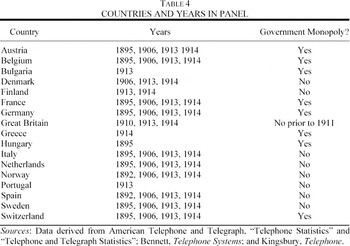
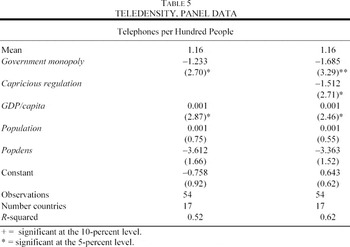
One potential shortcoming with the preceding regressions is that they use cross-sectional data. Panel data allow me to explore how market structure affects growth over time. They also allow greater variation in the market structure variables. In particular, the “capricious regulation” variable applies only to Italy and Spain in the 1913 regressions. In the panel dataset it also includes the United Kingdom because prior to 1911 a private firm operated under the assumption that its assets would essentially be confiscated in that year. The unbalanced panel includes 17 countries for certain years 1892–1914, yielding 54 country-year observations.
Table 4 lists the countries included in the panel and the years for which data are available.
Perhaps the biggest improvement in the panel data comes from the ability to control for trends over time through year fixed effects. Time trend controls are important for two reasons. First, telephone penetration was trending up everywhere, and it is important to control for this trend and not misattribute it to some aspect of market structure. Second, telephone technology, from switching to powering the system to the cables themselves, was improving quickly.67
See Foreman-Peck, “International Technology Transfer,” for an excellent discussion of technological change in early telephony.
Although detailed data on technological upgrades to telephone systems a century ago is not consistently available, year fixed effects help control for changing technology over time.
The panel, though an improvement over the cross section in some respects, does not contain as much information as I hoped. Ideally, the analysis would also control for country fixed effects, as unobservable country-specific variables must affect telephone development. Adding country fixed effects, unfortunately, turns out to be impractical—there is not enough time variation across important variables. Another reasonable approach with panel data is to assume a random effects model—that the individual-specific constant terms are randomly distributed across countries:
A random effects model, however, assumes that ui is uncorrelated with the independent variables and is normally distributed. There is no reason to believe either assumption is correct, meaning that the coefficients are likely to be biased. Instead, I estimate the model assuming the errors are correlated within each country but not across countries. This method will not be fully efficient, but should be consistent.68
As a robustness check, I also estimate the model using random effects. The results are qualitatively identical whether I use random effects or the clustered errors. Because I believe the clustered approach is superior here—completely sacrificing consistency for a small efficiency gain does not seem worthwhile—I report the results using the clustered approach.
Table 5 shows the results of estimating equation 1 with the panel data, and including year fixed effects to control for time trends and changing technology. The results are essentially the same as in the cross-section: government monopolies and harsh concessions both are correlated with lower telephone provision. In other words, even controlling for time trends (and thus at least some element of technological change), telephone penetration grew more quickly under competitive regimes than under either state ownership or private firms operating under the threat of expropriation.
Prices and Services
As mentioned before, Bennett compiled copious information on services and prices for European telephony.69
Bennett, Telephone Systems.
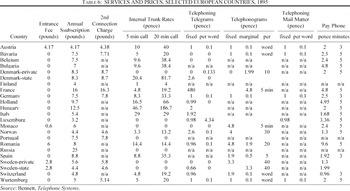
shows some basic prices for European countries, including prices for connection, subscription, and other services.
70 The additional services in many countries included, for example, telephonograms (as defined by Bennett, Telephone Systems, “a message telephoned by a subscriber to the central office to be written down and delivered by messenger to a non-subscriber”), telephoning of mail (a subscriber calls the central office where an operator writes down the message and mails it as a letter or postcard), and telephoning of telegrams.
The multiple possible combinations of products and services make price comparisons today difficult, to say the least. Such comparisons were scarcely easier a hundred years ago, as
Table 6 suggests.
Nonetheless, it is possible to compare long-distance prices using data from a table published by Bennett, though using these data requires making some assumptions and manipulations.71
Bennett, Telephone Systems.
First, some countries charge by the minute, whereas others charge in three-or five-minute increments. To facilitate the comparison I imputed each country's per-minute charge. Second, the price typically depended on the call distance, with prices increasing nonlinearly with mileage and at different increments across countries. Third, the maximum possible distance of an intranational long-distance call differs by country, because countries are different sizes. Finally, Bennett undoubtedly also had to make assumptions to create his table, but it is not possible to know what those were.
72 Bennett, Telephone Systems.
With these points in mind, I derive the pence-per-minute prices of domestic long-distance calls by distance.
Figure 3 presents the data graphically by market structure. The figure shows prices by distance for countries with a state monopoly firm, private firms operating under the threat of expropriation, and competitive markets. The chart shows the highest prices in countries where firms faced a risk of expropriation, the lowest prices in countries that allowed competition, and prices somewhere in between in countries with a government monopoly.
FIGURE 3 AVERAGE LONG-DISTANCE PRICES BY MARKET STRUCTURE AND DISTANCE
Many other factors besides market structure could affect prices. As in the analysis of telephone penetration, I now turn to econometric analysis to more rigorously look at the effects of market structure and regulations on prices. In particular, I use the long-distance price data to estimate several versions of equation 2.
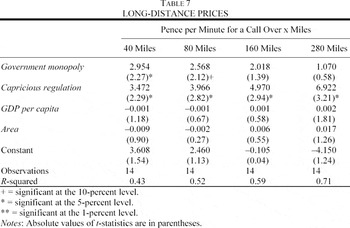
The main difference between equation 2 and equation 1 is that here I include each country's area in thousands of square miles because larger countries may face political pressure to keep longer distance prices down. I estimate this equation four times: once with the dependent variable defined as the per-minute price of a 40-mile call, once for an 80-mile call, once for a 160-mile call, and once for a 280-mile call.
Table 7 shows the results of this series of regressions. In this case, per capita income and area are not significant. Long-distance prices under state-owned monopolies are higher, on average, than under service provided in countries with private service and competition. This coefficient, however, quickly becomes insignificant and decreases in magnitude as the distance grows. That is, as call distance increases, there is less and less of a difference between government monopoly rates and those under competition. Firms operating under the threat of expropriation appeared to charge higher prices across the board, and this difference increased markedly with greater distances. This result is not surprising: a firm that must recoup all of its costs—marginal and fixed—in a short period of time will have to charge higher prices in the short time it has. The result is also consistent with Keefer's results: firms were willing to invest under the threat of expropriation when they were able to recoup their investment quickly.73
Endogeneity
An empirical issue I have not explicitly considered is endogeneity. One might believe, for example, that government ownership was more likely in areas where service was more costly to provide. In this case government ownership could be correlated with lower telephone penetration because government was stepping in where the private sector would not invest. The data and analyses, however, do not support this contention. First, the analyses all control for population density to proxy for cost. Second, less densely populated countries were more likely to allow competition, whereas more densely populated countries were more likely to have government monopolies, contrary to this alternate hypothesis.
Another reason to doubt reverse-causality is the history of the telephone industry discussed here. As the institutional story describes, sector structure was largely determined by the state's interest in the telegraph industry, which had little to do with outcomes in the telephone industry. In other words, unlike today, where telecom performance influences changes in ownership and regulatory regime, when the telephone industry was new and sector structure followed from the telegraph industry, it is clearer that ownership and regulatory regime affected outcomes, but not vice-versa. I believe that in this context it is largely correct to assume exogeneity of sector structure and regulatory regime.
SUMMARY AND CONCLUSION
This article explores the effects of ownership, competition, and regulation on early telephone provision in Europe. In particular, I compile data from several sources to conduct empirical tests of the effects of government monopoly ownership and regulation on telephone penetration and long distance prices at the turn of the twentieth century. Analysis of cross-sectional and panel data reveals that telephone penetration was higher in countries that allowed firms to compete than in countries where service was provided by state-owned monopolies or in countries that allowed private firms to operate only under restrictive concessions (where the state retained the right to take over the firm's plant and equipment with no compensation). The analysis also reveals that rural service was worse under state monopoly provision than under competition. Finally, long-distance prices were lowest in competitive regimes and highest when private firms were operating under the threat of expropriation.
It is worth emphasizing that these results do not show benefits of private telephone provision, per se. Instead, they show benefits of competition and public policies that were friendly to the industry's development. The fiercest competition in Europe took place in Stockholm, between a private firm and a state-owned operator, leading to telephone development that, for a time, even exceeded that in U.S. cities. Indeed, this is the one example outside the United States where multiple firms competed within the same geographic region, to the great benefit of its residents.
This analysis is directly relevant for today's questions of ownership, competition, and regulation in many industries, not just telecommunications. To a large extent the literature on industry reforms has ignored the origins of the industry being studied. Although today's reforms must deal with many problems that did not exist a century (or more) ago, we should not pass up the valuable information that can be gained from exploring how societies dealt with the exact same questions and how industries evolved as a result of those decisions.
I am grateful for thoughtful comments from Fredrik Andersson, Luke Haggarty, Knick Harley, Ioannis Kessides, Rohit Malik, John Mayo, Bob Millward, Roger Noll, Harold Rinde, Greg Rosston, Bennet Zelner, participants in the Georgetown University IO Seminar and the Wharton Applied Economics Seminar, and two anonymous referees. All errors, omissions, and misinterpretations are my own.