Gastroesophageal reflux disease (GERD) is a prevalent chronic gastrointestinal condition and an increasingly important public health concern worldwide(Reference Vakil, van Zanten and Kahrilas1,Reference Katz, Gerson and Vela2) . Based on the Global Burden of Disease Study 2021, the number of prevalent GERD cases worldwide increased from approximately 450·76 million in 1990 to 825·60 million in 2021, and GERD accounted for 6·34 million disability-adjusted life years in 2021(Reference Mo, Liu and Cao3,Reference Chen, Yang and Hu4) . Given its substantial and increasing burden, as well as its chronic and recurrent nature, identifying modifiable lifestyle factors associated with GERD risk is essential for population-level prevention strategies.
Diet represents a key modifiable exposure that may influence GERD development through its effects on body weight, metabolic health and gastrointestinal function(Reference Argyrou, Legaki and Koutserimpas5). A growing body of epidemiological research has suggested associations between dietary intake and GERD, with higher consumption of energy-dense, high-fat or highly processed foods generally linked to increased reflux risk, whereas diets rich in fruits, vegetables, whole grains and plant-based foods have been associated with fewer reflux symptoms(Reference Zhang, Hou and Huang6–Reference Rizzo, Baroni and Bonetto11). However, many existing studies have focused on individual foods or nutrients, which may not adequately capture the complexity of habitual dietary intake.
Dietary pattern analysis provides an integrated approach to characterising overall diet quality and has become increasingly important in nutritional epidemiology. Several cross-sectional studies have reported inverse associations between adherence to healthier dietary patterns – such as the Mediterranean diet (MED) and Dietary Approaches to Stop Hypertension (DASH) – and GERD prevalence(Reference Mone, Kraja and Bregu12–Reference Mirjalili, Darand and Fallah-Aliabadi14), while pro-inflammatory dietary patterns, as assessed by the Energy-adjusted Diet Inflammatory Index (E-DII), have been associated with higher GERD risk(Reference Shivappa, Hebert and Anderson15,Reference Zhai, Hu and Yuan16) . Nevertheless, prospective evidence remains limited, and findings across studies have been inconsistent(Reference Wang, Hodge and Dashti17). Moreover, few studies have systematically compared multiple dietary pattern scores within the same population, limiting the ability to evaluate the relative importance of different dietary patterns for GERD prevention. Therefore, we selected nine established dietary pattern scores to capture complementary dietary dimensions hypothesised to be relevant to GERD pathophysiology, including overall diet quality and cardiometabolic health (MED, Mediterranean-Dietary Approaches to Stop Hypertension Diet Intervention for Neurodegenerative Delay (MIND), Alternative Healthy Eating Index-2010 (AHEI-2010) and DASH), plant-based eating (healthful Plant-Based Index (hPDI)), macronutrient composition (Healthy Low-Carbohydrate Diet (HLCD) and Healthy Low-Fat Diet (HLFD)), gut microbiota–related dietary features (dietary index for gut microbiota (DI-GM)) and dietary inflammatory potential (E-DII). These dimensions may influence GERD through pathways related to obesity, metabolic dysfunction, gastric emptying and postprandial reflux, gut microbiota, oxidative stress and systemic inflammation(Reference Herdiana18,Reference Guan, Cheng and Zhang19) .
Beyond observational associations, the mechanisms linking overall diet quality to GERD risk are not fully understood. Emerging evidence suggests that GERD is associated with systemic metabolic alterations, and diet is a major determinant of circulating metabolic profiles(Reference Mohammadi, Ramezani Jolfaie and Alipour20,Reference Shi, Zhang and Huang21) . Advances in high-throughput metabolomics offer new opportunities to characterise diet-related metabolic signatures at the population level and to explore potential intermediate pathways linking dietary patterns to disease outcomes(Reference Noerman and Landberg22–Reference Fan, Hu and Xie24). However, such approaches have rarely been applied to GERD in large prospective cohorts. In the present study, we prospectively examined the associations between nine dietary pattern scores and incident GERD in the UK Biobank and further explored whether systemic metabolomic profiles may partly mediate these associations. Our findings suggest that healthier dietary patterns are generally associated with lower GERD risk, whereas a pro-inflammatory dietary pattern is associated with higher risk, with diet-related metabolomic signatures providing potential mechanistic insights into these associations.
Methods
Design of the study and population
The UK Biobank is an ongoing, population-based prospective cohort study comprising over 500 000 participants recruited from twenty-two assessment centres across England, Scotland and Wales between 2006 and 2010. Baseline data collection included comprehensive assessments of socio-demographic factors, lifestyle behaviours and medical history, obtained via touchscreen questionnaires, verbal interviews and linkage to electronic health records. Physical measurements and biological samples were collected using standardised procedures. Our proposed study has been approved by the UK Biobank Scientific Committee. More information on the UK Biobank study protocol may be found here (https://www.ukbiobank.ac.uk).
Individuals who completed at least one online 24-h dietary assessment were eligible for inclusion in the present analysis. We excluded participants who were pregnant at baseline, refused to participate in follow-up, reported implausible total energy intake (<500 or >3500 kcal/d for women; <800 or >4200 kcal/d for men) or had a history of oesophageal-related diseases at baseline, including oesophagitis, GERD, other oesophageal diseases, peptic ulcer disease, gastritis or duodenitis. Participants with more than 20 % missing values in covariates were also excluded. After these exclusions, a total of 183 878 participants remained for the analysis of associations between nine dietary pattern scores and incident GERD. Among these participants, those with available metabolomic data were further included, yielding a subsample of 98 669 individuals for analyses of diet-related metabolomic signatures and their potential mediating roles (Figure S1).
Assessment of dietary pattern score
Participants who provided a valid email address were invited to complete the Oxford WebQ questionnaire on up to five separate occasions between April 2009 and June 2012. The Oxford WebQ is a web-based 24-h dietary assessment that captures information on the consumption of 206 food items and thirty-two beverages(Reference Greenwood, Hardie and Frost25). Energy and macronutrient intakes for each food item were estimated using the UK Nutrient Databank food composition tables. Individual dietary intakes were averaged across all available 24-h dietary assessments for each participant. Based on these averaged intakes, nine established dietary pattern scores were calculated, including the MED score(Reference Martínez-González, Corella and Salas-Salvadó26,Reference Shannon, Ranson and Gregory27) , MIND adherence score(Reference Cornelis, Agarwal and Holland28,Reference Chen, Dhana and Huang29) , AHEI-2010 adherence score(Reference Cornelis, Agarwal and Holland28,Reference Chiuve, Fung and Rimm30) , DASH adherence score(Reference Fung, Chiuve and McCullough31,Reference Mompeo, Freidin and Gibson32) , hPDI(Reference Satija, Bhupathiraju and Spiegelman33,Reference Heianza, Zhou and Sun34) , E-DII score(Reference Cavicchia, Steck and Hurley35,Reference Shivappa, Steck and Hurley36) , HLCD score, HLFD score(Reference Shan, Guo and Hu37) and DI-GM(Reference Kase, Liese and Zhang38,Reference Li, Liu and Li39) . Detailed descriptions of the components and scoring criteria for each dietary pattern are provided in the Supplementary Methods and Tables S1–S9.
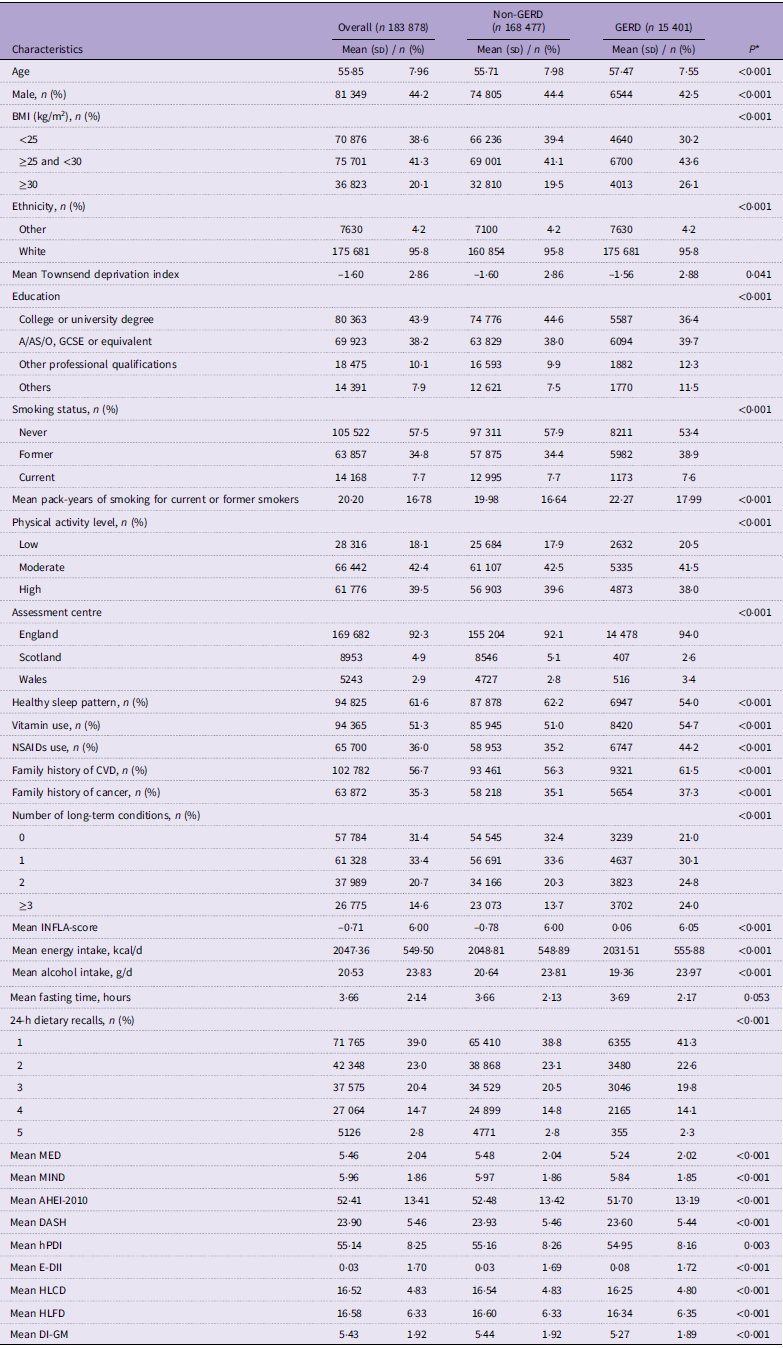
Basic characteristics of participants

Table 1. Long description
A table comparing characteristics of participants with and without GERD. The table has 45 rows and 5 columns. Column headers are Overall (n 183878), Non-GERD (n 168477), GERD (n 15401), and P. Row labels include Age, Male, BMI (kg/m2), Ethnicity, Mean Townsend deprivation index, Education, Smoking status, Mean pack-years of smoking for current or former smokers, Physical activity level, Assessment centre, Healthy sleep pattern, Vitamin use, NSAID use, Family history of CVD, Family history of cancer, Number of long-term conditions, Mean INFLA-score, Mean energy intake, Mean alcohol intake, Mean fasting time, 2-h dietary recalls, Mean MED, Mean MIND, Mean AHEI-2010, Mean DASH, Mean hPDI, Mean E-DII, Mean HLCD, Mean HLFD, and Mean DI-GM. Each row provides mean and standard deviation values for each group and a P-value indicating statistical significance. Notable trends include differences in age, BMI, education level, smoking status, physical activity level, and dietary intake between the GERD and non-GERD groups.
GERD, gastroesophageal reflux disease; NSAIDs, non-steroidal anti-inflammatory drugs; INFLA-score, low-grade inflammation score; MED, Mediterranean diet; MIND, Mediterranean-Dietary Approaches to Stop Hypertension Diet Intervention for Neurodegenerative Delay; AHEI-2010, Alternative Healthy Eating Index-2010; DASH, Dietary Approaches to Stop Hypertension; hPDI, healthful Plant-Based Index; E-DII, Energy-adjusted Diet Inflammatory Index; HLCD, Healthy Low-Carbohydrate Diet; HLFD, Healthy Low-Fat Diet; DI-GM, dietary index for gut microbiota.
Note: *Continuous variables with approximately normal distributions are presented as mean ± standard deviation, and categorical variables are shown as percentages. Group comparisons were conducted using Student’s t test for continuous variables and the χ 2 test for categorical variables.
Metabolomic profiling and data processing
A high-throughput targeted NMR metabolomics platform (Nightingale Health Plc.) was used to perform metabolomic profiling of baseline EDTA plasma samples from approximately 280 000 UK Biobank participants. The platform quantified 249 metabolic measures per sample, including 168 directly measured metabolites in absolute concentrations (mmol/L) and eighty-one derived ratio measures. These biomarkers covered a broad range of metabolic pathways, including lipids, detailed lipoprotein subclasses, fatty acids, amino acids, ketone bodies and glycolysis-related metabolites. Sample preparation and NMR spectroscopy were conducted under standardised procedures with rigorous quality control, and detailed protocols have been described elsewhere(Reference Julkunen, Cichońska and Tiainen40).
To minimise the influence of extreme values, metabolite concentrations exceeding four interquartile ranges from the median were considered outliers and set to missing. Participants with more than 20 % of metabolites missing and metabolites missing in more than 10 % of participants were excluded from subsequent analyses. Remaining missing values were imputed using the impute package (version 1.64.0). To account for potential batch effects related to NMR spectrometers, metabolite concentrations were log1p-transformed and adjusted using linear regression models with spectrometer as the predictor. Scaled residuals from these models were used in all downstream analyses. Finally, metabolite values were standardised to z-scores prior to statistical analysis.
Ascertainment of outcomes
Incident GERD was ascertained using the UK Biobank first occurrence variables, which integrate disease information from multiple linked data sources, including hospital inpatient records, primary care records, death registries and self-reported medical conditions, and provide the earliest recorded date of diagnosis for each participant. GERD was defined according to the International Classification of Diseases, 10th Revision, code K21. Follow-up time was calculated from the date of baseline assessment to the date of first occurrence of GERD, death or the end of available follow-up, whichever came first. Follow-up was completed through 31 October 2022 in England, 31 August 2022 in Scotland and 31 May 2022 in Wales.
Statistical analysis
Baseline characteristics were summarised according to incident GERD status or tertiles of dietary pattern scores. Continuous variables are presented as means ± standard deviations and categorical variables as percentages. The proportion of missing values across covariates ranged from 0·00 to 15·1 % (Table S10). Missing data were handled using multiple imputation by chained equations, generating five imputed datasets under the missing at random assumption. Dose–response relationships between the nine dietary pattern scores and the risk of incident GERD were examined using restricted cubic splines with three knots placed at the 10th, 50th and 90th percentiles of each dietary score. Associations were evaluated using Cox proportional hazards regression models, and results are reported as hazard ratios (HR) with 95 % CI. Estimates across the five imputed datasets were combined using Rubin’s rules. The proportional hazards assumption was assessed using Schoenfeld residuals and log–log survival plots, and no substantial violations were detected.
Dietary pattern scores were analysed both as continuous variables and as categorical variables based on tertiles, with the lowest tertile serving as the reference group. Two multivariable models were constructed with sequential adjustment for covariates. Model 1 was age (continuous) and sex (male or female), ethnicity (White or other) and assessment centre (England, Scotland or Wales). Model 2 was further adjusted BMI (<25, ≥25 and <30, and ≥30 kg/m2), Townsend deprivation index (continuous), education level (college or university degree, A/AS/O, General Certificate of Secondary Education (GCSE) or equivalent, other professional qualifications or others), smoking status (current, former or never), pack-years of smoking (continuous), physical activity level (low, moderate or high), healthy sleep pattern (yes or no), vitamin and mineral supplements use (yes or no), NSAIDs use (yes or no), low-grade inflammation score (INFLA-score; continuous), family history of CVD (yes or no), family history of cancer (yes or no) and number of long-term conditions (none, one, two, three and more). For dietary pattern scores that did not include alcohol or total energy intake, models were additionally adjusted for alcohol and total energy intake (continuous). Detailed descriptions of covariate assessment are provided in the Supplementary Methods and Tables S11–S12. Potential effect modification was assessed using likelihood ratio tests by including interaction terms between dietary pattern scores and subgroup variables, including age, sex, Townsend deprivation index, smoking status, physical activity, BMI, education level, sleep pattern and number of co-morbidities.
Given the high dimensionality and biological correlations among circulating metabolites, we used Elastic Net regression to identify metabolomic biomarkers associated with each dietary pattern score. Elastic Net combines the L1 penalty of least absolute shrinkage and selection operator (LASSO), which performs variable selection, with the L2 penalty of ridge regression, which stabilises coefficient estimation when predictors are correlated. This approach is therefore suitable for selecting diet-related metabolomic biomarkers from correlated NMR metabolomics data.
Elastic Net regression was performed using the glmnet R package (version 4.1-8). For each dietary pattern, the standardised dietary pattern score was used as the dependent variable, and the 168 pre-processed and standardised metabolomic biomarkers were included as penalised predictors. The same covariates as those in the fully adjusted Cox model were included as unpenalised variables, with additional adjustment for fasting time. The model was fitted with a fixed mixing parameter α = 0·5, balancing LASSO and ridge penalties. To improve the stability of metabolite selection, the modelling procedure was repeated 100 times. In each repetition, 80 % of participants were randomly selected as the training set, and the optimal penalty parameter λ was selected using 10-fold cross-validation based on the minimum mean squared error. Metabolites with non-zero coefficients at the optimal λ were recorded in each repetition. Only metabolites selected in all 100 repetitions were retained as robust diet-related metabolomic biomarkers. For each dietary pattern, a metabolomic signature score was then calculated as the weighted sum of the selected standardised metabolite concentrations, with the median Elastic Net coefficient across the 100 repetitions used as the weight.
Causal mediation analysis was conducted to evaluate the potential mediating role of diet-related metabolomic signatures in the association between dietary pattern scores and incident GERD, using the regmedint R package. Analyses were performed within the counterfactual framework. Briefly, linear regression models were used to assess the associations between dietary pattern scores and metabolomic signatures (exposure–mediator models), and Cox proportional hazards models were used to estimate the associations of dietary pattern scores and metabolomic signatures with incident GERD (outcome models). All mediation models were additionally adjusted for fasting time. Natural direct effects (NDE) and natural indirect effects (NIE) were estimated, and corresponding HRs were derived. The proportion mediated (PM) was calculated as: PM = (HR_NDE × (HR_NIE − 1))/(HR_NDE × HR_NIE − 1).
To evaluate the robustness of the primary findings, multiple sensitivity analyses were conducted. First, a complete-case analysis was performed by excluding participants with missing values in any variable. Second, a Fine–Gray subdistribution hazards model was applied to account for death as a competing risk. Third, to minimise potential reverse causality, participants diagnosed with GERD within 2 or 5 years after recruitment were excluded. Fourth, individuals reporting non-typical dietary intake on any 24-h dietary recall day were excluded to improve the validity of habitual diet assessment. Fifth, analyses were restricted to participants who completed two or more 24-h dietary recalls to enhance the reliability of dietary exposure measurement. Finally, participants with baseline cancer were additionally excluded, and cancer was removed from the count of long-term chronic conditions.
All statistical analyses were conducted using R software (version 4.5.2). A two-sided P value of <0·05 was considered statistically significant.
Result
Participants and characteristics
Baseline characteristics of the 183 878 participants included in the analysis are presented in Table 1, stratified by incident GERD status. During a median follow-up of 13·2 years (interquartile range: 12·5–14·0 years), corresponding to 2 338 021 person-years, 15 401 incident GERD cases were documented. As shown in Table 1, participants who developed GERD had a higher BMI, higher low-grade inflammation, more frequent use of NSAIDs and vitamin supplements and a greater burden of long-term chronic conditions. They were also characterised by lower levels of physical activity, poorer sleep quality, lower educational attainment and slightly lower dietary pattern scores. Baseline characteristics across tertiles of the nine dietary pattern scores are summarised in Tables S13-S21. Overall, participants with higher adherence to most healthy dietary patterns tended to have higher educational attainment, higher physical activity levels, lower BMI and lower INFLA-scores at baseline. In contrast, higher E-DII scores were observed more frequently among men and current smokers and were associated with higher INFLA-scores.
Associations between dietary pattern scores and incident gastroesophageal reflux disease
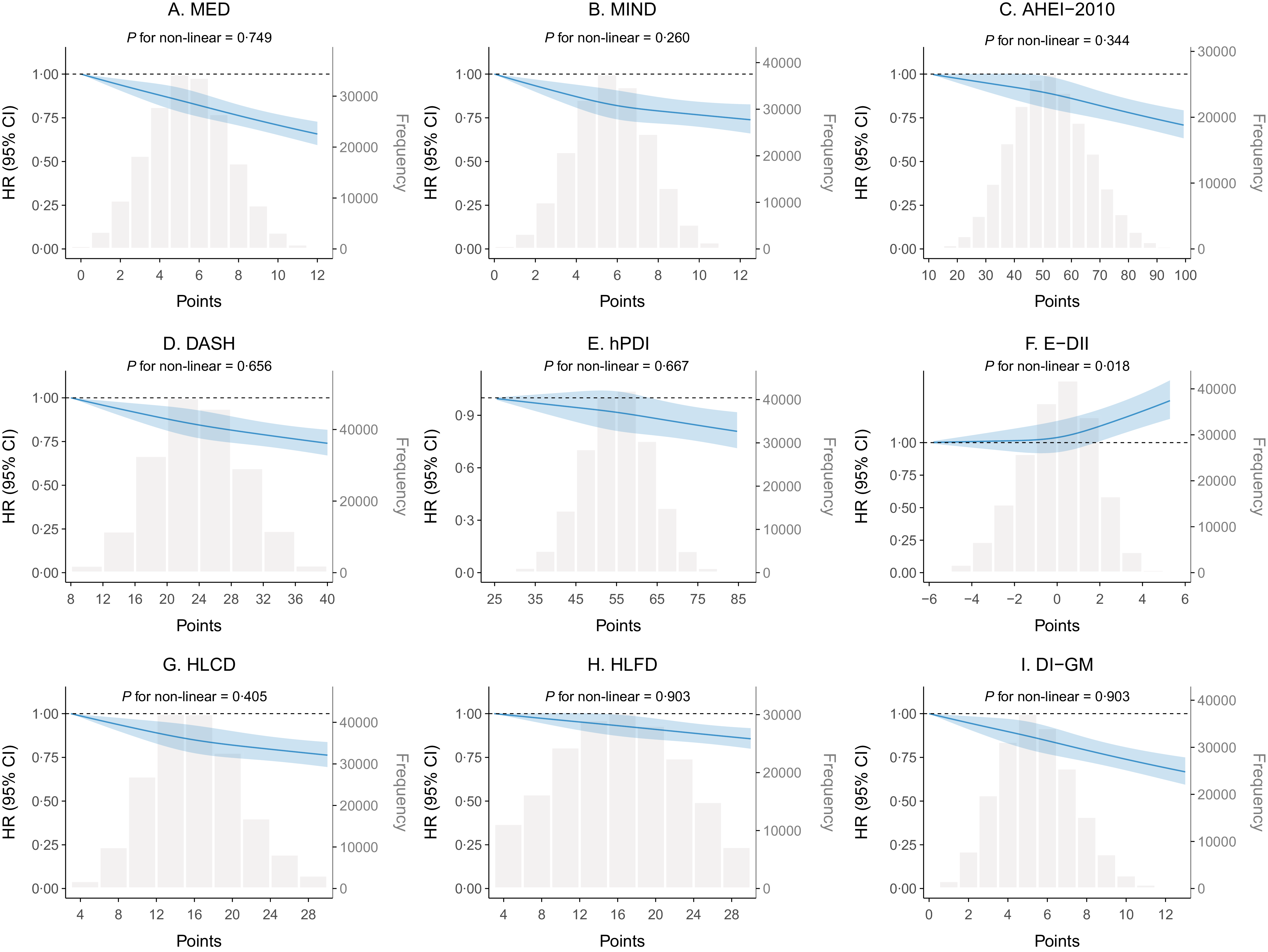
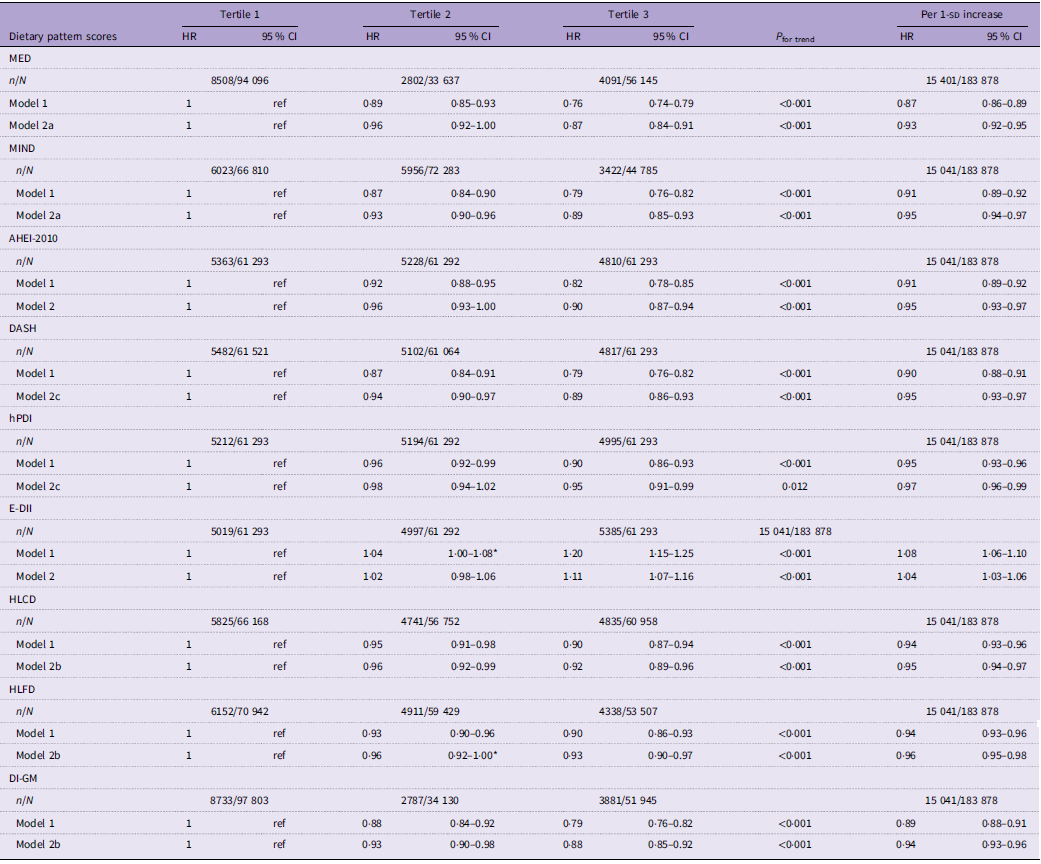
Figure 1 shows the dose–response relationships between the nine dietary pattern scores and the risk of incident GERD based on restricted cubic spline analyses. Overall, no strong evidence of non-linearity was observed for most dietary pattern scores (all P for non-linearity > 0·05), whereas a significant nonlinear association was observed for the E-DII (P for non-linearity = 0·018), with higher E-DII values associated with an increasing risk of GERD. In multivariable-adjusted Cox regression analyses (Table 2), higher adherence to most healthy dietary patterns was consistently associated with a lower risk of incident GERD. Compared with participants in the lowest tertile, those in the highest tertile had significantly lower risks of GERD for MED (HR 0·87; 95 % CI 0·84–0·91), MIND (HR 0·89; 95 % CI 0·85–0·93), DASH (HR 0·89; 95 % CI 0·86–0·93), HLCD (HR 0·92; 95 % CI 0·89–0·96), HLFD (HR 0·93; 95 % CI 0·90–0·97) and DI-GM (HR 0·88; 95 % CI 0·85–0·92). Similar inverse associations were observed for AHEI-2010 and hPDI. All dietary pattern scores showed statistically significant linear trends across tertiles (P for trend < 0·001). For several dietary pattern scores, including MIND, DASH, HLCD, HLFD and DI-GM, risk reductions were already evident at intermediate levels of adherence, as reflected by significantly lower risks in the second tertile compared with the first tertile. When modelled as continuous variables, each 1-sd increase in these healthy dietary pattern scores was associated with an approximately 3–7 % lower risk of incident GERD in fully adjusted models. In contrast, participants in the highest tertile of E-DII had a significantly higher risk of GERD compared with those in the lowest tertile (HR 1·11; 95 % CI 1·07–1·16), and each 1-sd increase in E-DII was associated with an approximately 4 % higher risk of incident GERD in fully adjusted models.
Dose–response relationships between nine dietary pattern scores and incident GERD. Restricted cubic spline plots of multivariable-adjusted hazard ratios (HRs) (solid lines) and 95 % CIs (shaded areas) for GERD according to dietary pattern scores. The reference value was set at the minimum value of each dietary score. The risk estimates were adjusted for age, sex, ethnicity, assessment centre, BMI, Townsend deprivation index, education level, smoking status, pack-years of smoking, physical activity level, healthy sleep pattern, vitamin and mineral supplements use, NSAIDs use, INFLA-score, family history of CVD, family history of cancer, number of long-term conditions, total energy intake and alcohol consumption. GERD, gastroesophageal reflux disease; NSAIDs, non-steroidal anti-inflammatory drugs; INFLA-score, low-grade inflammation score; MED, Mediterranean diet; MIND, Mediterranean-Dietary Approaches to Stop Hypertension Diet Intervention for Neurodegenerative Delay; AHEI-2010, Alternative Healthy Eating Index-2010; DASH, Dietary Approaches to Stop Hypertension; hPDI, healthful Plant-Based Index; E-DII, Energy-adjusted Diet Inflammatory Index; HLCD, Healthy Low-Carbohydrate Diet; HLFD, Healthy Low-Fat Diet; DI-GM, dietary index for gut microbiota.

Figure 1. Long description
Multivariable-adjusted restricted cubic spline curves display hazard ratios and 95% confidence intervals for incident GERD across nine dietary pattern scores.
Association between dietary pattern scores and risk of GERD: hazard ratios (95 % CIs) across tertiles and per sd increase (N 183 878)

Table 2. Long description
The table presents the association between various dietary pattern scores and the risk of GERD, with hazard ratios (HR) and 95% confidence intervals (CI) across tertiles and per 1-standard deviation (sd) increase. The dietary patterns include MED, MIND, AHEI-2010, DASH, hPDI, E-DII, HLCD, HLFD, and DI-GM. Each dietary pattern is analyzed using two models: Model 1 and Model 2a. The table shows the number of participants (n/N) in each tertile and the corresponding HR and CI values. Notable trends include lower HR values for higher adherence to healthy dietary patterns like MED, MIND, DASH, and others, indicating a lower risk of GERD. In contrast, higher adherence to the E-DII pattern is associated with a higher risk of GERD. The table also includes P values for trend across tertiles and HR values per 1-sd increase for each dietary pattern.
GERD, gastroesophageal reflux disease; HR, hazard ratio; MED, Mediterranean diet; N, number of participants; n, number of cases; MIND, Mediterranean-Dietary Approaches to Stop Hypertension Diet Intervention for Neurodegenerative Delay; AHEI-2010, Alternative Healthy Eating Index-2010; DASH, Dietary Approaches to Stop Hypertension; hPDI, healthful Plant-Based Index; E-DII, Energy-adjusted Diet Inflammatory Index; HLCD, Healthy Low-Carbohydrate Diet; HLFD, Healthy Low-Fat Diet; DI-GM, dietary index for gut microbiota.
Note: Estimates are hazard ratios (95 % CIs), obtained from Cox regression models. *P < 0·05.
Model 1 was adjusted for age (continuous) and sex (male or female), ethnicity (White or other) and assessment centre (England, Scotland or Wales).
Model 2 was further adjusted for BMI (<25, ≥25 and <30, and ≥30 kg/m2), Townsend deprivation index (continuous), education level (college or university degree, A/AS/O, GCSE or equivalent, other professional qualifications or others), smoking status (current, former or never), pack-years of smoking (continuous), physical activity level (low, moderate or high), healthy sleep pattern (yes or no), vitamin and mineral supplements use (yes or no), NSAIDs use (yes or no), low-grade inflammation score (continuous), family history of CVD (yes or no), family history of cancer (yes or no) and number of long-term conditions (none, one, two, three and more).
Model 2a was further adjusted for model 2 + total energy intake (continuous).
Model 2b was further adjusted for model 2 + alcohol consumption (continuous).
Model 2c was further adjusted for model 2 + total energy intake (continuous) and alcohol consumption (continuous).
P for trend was calculated using the median value within each tertile of the diet quality score as a continuous variable.
For individual food groups, higher consumption of fruits, vegetables, whole grains and seafood was generally associated with a lower risk of incident GERD, whereas higher consumption of refined grains, sugary drinks and fast/fried foods was associated with an increased risk (Table S22).
Dietary pattern–related metabolomic signatures and mediation of gastroesophageal reflux disease risk
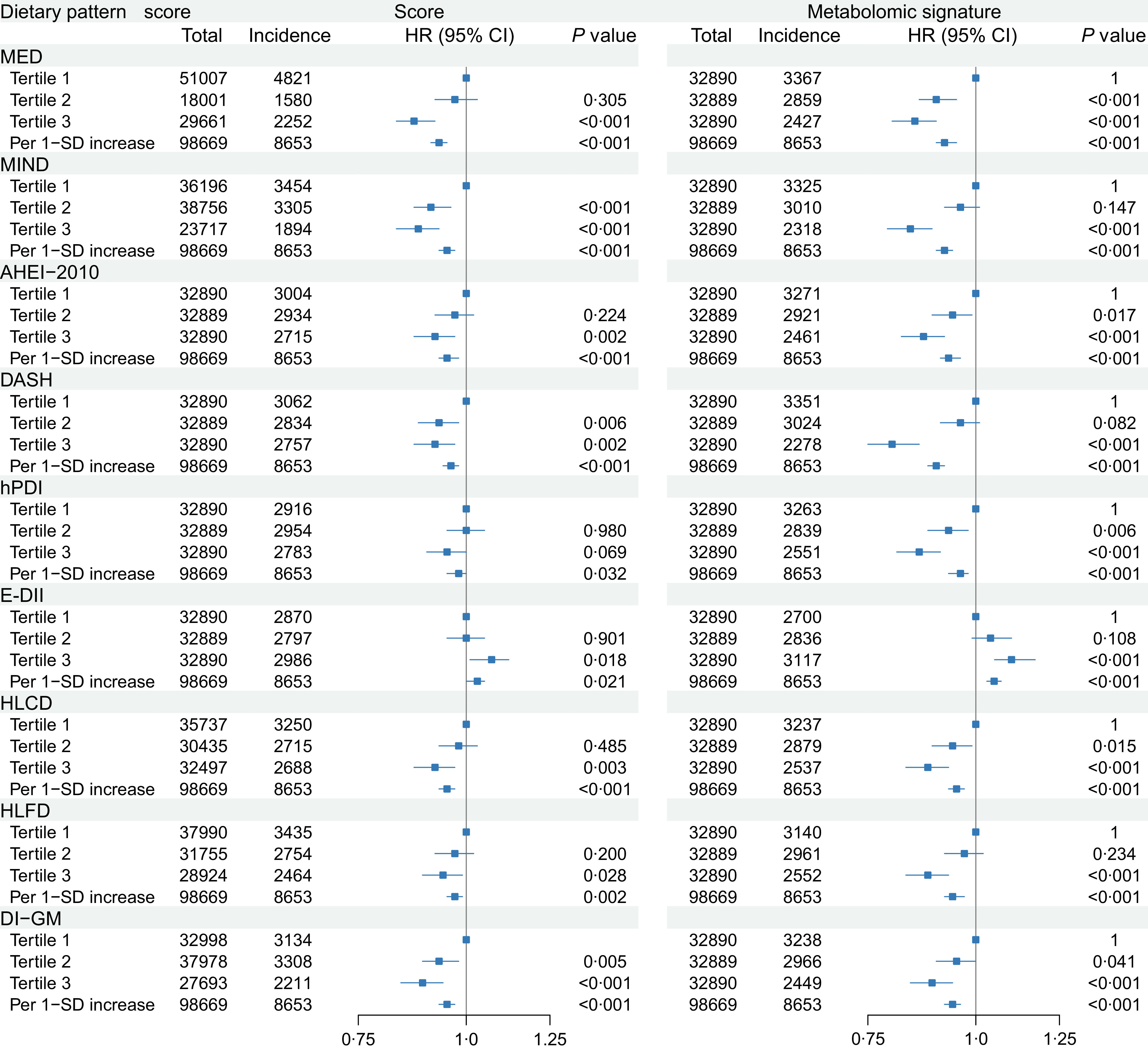
Among participants with available metabolomic data (N 98 669), dietary pattern–related metabolomic signatures were constructed using Elastic Net regression. From the 168 directly measured metabolites (Table S23), between 56 and 105 metabolites were identified for each dietary pattern and incorporated into the corresponding metabolomic signature (Figure S2). As shown in Figure 2, dietary pattern scores remained significantly associated with GERD risk in this sub-cohort, with directions and magnitudes largely consistent with those observed in the full cohort (Table S24). Notably, the metabolomic signature scores for all nine dietary patterns were also significantly associated with GERD risk after multivariable adjustment. Higher metabolomic signature scores corresponding to healthy dietary patterns were associated with lower risks of GERD, whereas higher E-DII–related metabolomic signature scores were associated with an increased risk of GERD (Table S25).
Associations of nine dietary pattern scores and diet-related metabolomic signature scores with GERD risk (N 98 669). HRs and 95 % CIs were estimated by Cox regression (two-sided Wald test). The grey solid line represents the null (HR = 1). Each point shows the point estimate of HR from Cox regression. Bars show 95 % CIs. The model was adjusted for age, sex, ethnicity, assessment centre, BMI, Townsend deprivation index, education level, smoking status, pack-years of smoking, physical activity level, healthy sleep pattern, vitamin and mineral supplements use, NSAIDs use, INFLA-score, family history of CVD, family history of cancer, number of long-term conditions, fasting time, total energy intake and alcohol consumption. GERD, gastroesophageal reflux disease; HR, hazard ratio; NSAIDs, non-steroidal anti-inflammatory drugs; INFLA-score, low-grade inflammation score; MED, Mediterranean diet; MIND, Mediterranean-Dietary Approaches to Stop Hypertension Diet Intervention for Neurodegenerative Delay; AHEI-2010, Alternative Healthy Eating Index-2010; DASH, Dietary Approaches to Stop Hypertension; hPDI, healthful Plant-Based Index; E-DII, Energy-adjusted Diet Inflammatory Index; HLCD, Healthy Low-Carbohydrate Diet; HLFD, Healthy Low-Fat Diet; DI-GM, dietary index for gut microbiota. Detailed HRs, 95 % CIs and P-values are summarised in Tables S24 and S25.

Figure 2. Long description
Cox regression estimates show hazard ratios and 95% confidence intervals for GERD risk associated with dietary pattern scores and corresponding diet-related metabolomic signature scores.
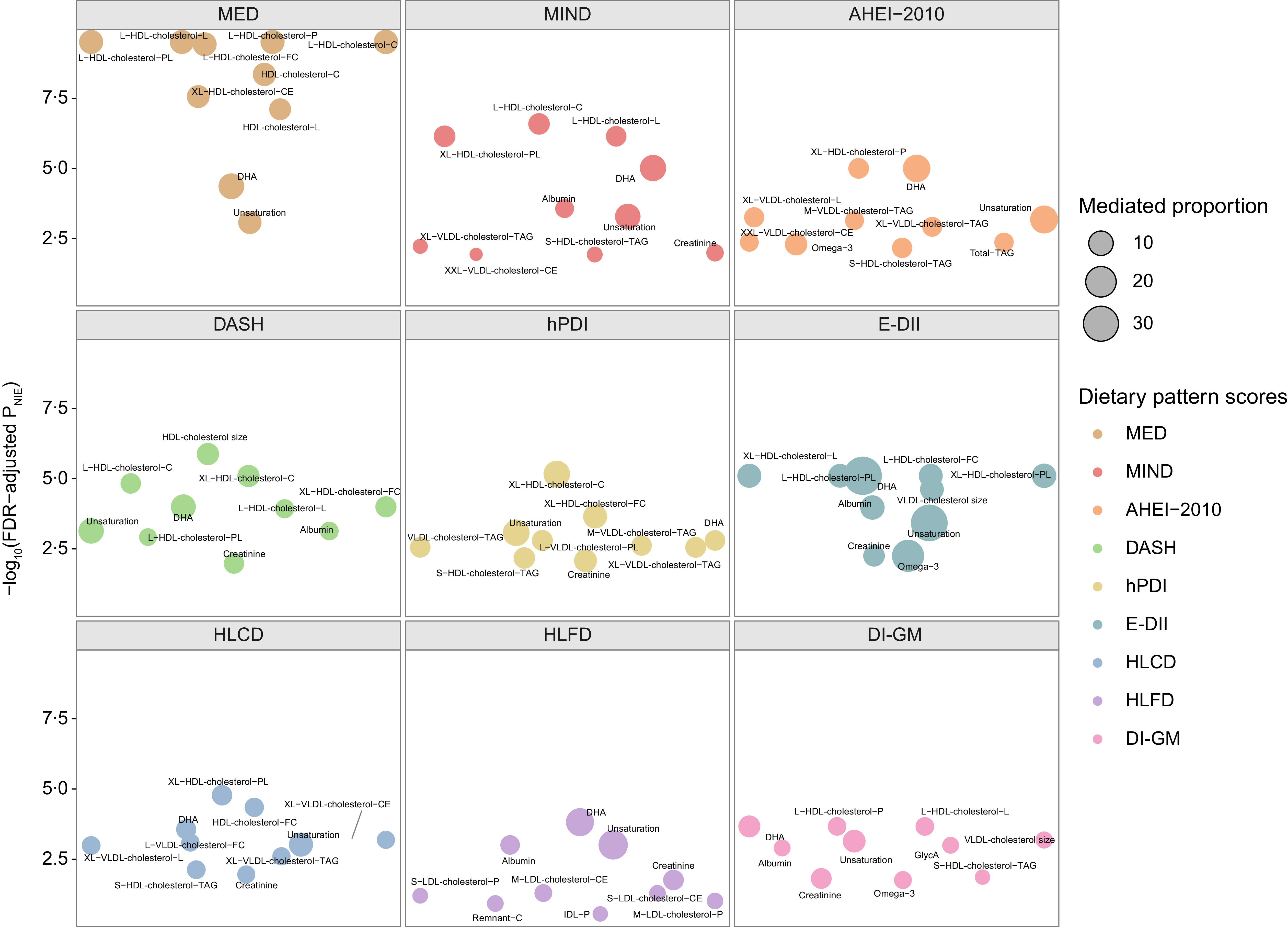
The associations of individual dietary pattern–related metabolites identified by Elastic Net regression with the risk of incident GERD are shown in Table S26. Across dietary patterns, between 31 and 62 Elastic Net–identified metabolites were associated with incident GERD in multivariable-adjusted analyses. We further assessed the mediating roles of dietary pattern–related metabolomic signatures in the associations between dietary pattern scores and incident GERD (Table S27). Statistically significant NIEs were observed for all dietary patterns, indicating partial mediation by metabolomic signatures. The proportions mediated ranged from 11·1 to 27·8 % for dietary patterns inversely associated with GERD risk, whereas for the pro-inflammatory E-DII, metabolomic signatures mediated 32·2 % of the positive association with GERD risk. A total of 17–39 metabolites significantly mediated the associations between nine dietary pattern scores and the risk of GERD (Table S28). Specifically, fatty acid–related markers showed the most consistent mediation effects, with degree of unsaturation and DHA ranking among the top mediators across all nine dietary patterns, exhibiting mediated proportions ranging from approximately 2·8 to 5·1 %. HDL-cholesterol-related lipid measures were also prominent mediators. Metabolites reflecting HDL-cholesterol content and particle composition, including large HDL-cholesterol, large HDL-cholesterol phospholipids, extra-large HDL-cholesterol-related traits and small HDL-cholesterol TAG, were frequently observed among the top mediators and generally mediated around 2–10 % of the associations. In addition, a small number of non-lipid metabolites, including creatinine, albumin and GlycA, were repeatedly identified among the top mediators, but showed comparatively smaller mediated proportions (Figure 3).
The estimated proportion of mediation for the top-ranked metabolites in the associations between dietary pattern scores and GERD risk (N 98 669). Bubble plots showing the top-ranked metabolites mediating the associations between dietary pattern scores and GERD risk. The y-axis represents −log10(FDR-adjusted P NIE), and bubble size represents the estimated mediated proportion. Analyses were adjusted for age, sex, ethnicity, assessment centre, BMI, Townsend deprivation index, education level, smoking status, pack-years of smoking, physical activity level, healthy sleep pattern, vitamin and mineral supplements use, NSAIDs use, INFLA-score, family history of CVD, family history of cancer, number of long-term conditions, fasting time, total energy intake and alcohol consumption. GERD, gastroesophageal reflux disease; FDR, false discovery rate; NIE, natural indirect effect; NSAID, non-steroidal anti-inflammatory drugs; INFLA-score, low-grade inflammation score; MED, Mediterranean diet; MIND, Mediterranean-Dietary Approaches to Stop Hypertension Diet Intervention for Neurodegenerative Delay; AHEI-2010, Alternative Healthy Eating Index-2010; DASH, Dietary Approaches to Stop Hypertension; hPDI, healthful Plant-Based Index; E-DII, Energy-adjusted Diet Inflammatory Index; HLCD, Healthy Low-Carbohydrate Diet; HLFD, Healthy Low-Fat Diet; DI-GM, dietary index for gut microbiota. Metabolite abbreviations: HDL, high-density lipoprotein; LDL, low-density lipoprotein; IDL, intermediate-density lipoprotein; VLDL, very-low-density lipoprotein; XL, very large; L, large; M, medium; S, small; C, cholesterol; FC, free cholesterol; CE, cholesteryl esters; PL, phospholipids; TAG, triacylglycerol; P, particle concentration; DHA, docosahexaenoic acid; GlycA, glycoprotein acetyls. A full description of the metabolites is provided in Table S23.

Figure 3. Long description
Faceted bubble plots display top-ranked metabolites for each dietary pattern score. The y-axis shows −log10(FDR-adjusted PNIE), and bubble size represents the estimated mediated proportion.
Subgroup and sensitivity analyses
Subgroup analyses indicated that the associations between dietary pattern scores and incident GERD were generally consistent across strata of Townsend deprivation index, BMI, healthy sleep pattern and the number of long-term conditions. Significant effect modification by age was observed for hPDI and DI-GM (all P for interaction < 0·05), with stronger associations detected among participants aged ≥60 years. In addition, smoking status significantly modified the associations for MED, MIND, AHEI-2010, hPDI, E-DII, HLFD and DI-GM (all P for interaction < 0·05), with more pronounced associations observed among current or former smokers compared with never smokers (Table S29). Multiple sensitivity analyses were conducted to assess the robustness of the primary findings (Tables S30-S36). Overall, the associations between dietary pattern scores and incident GERD remained largely consistent across all sensitivity analyses. When analyses were restricted to participants who completed at least two 24-h dietary recalls, the associations for most dietary pattern scores were slightly attenuated but remained directionally consistent. In contrast, excluding participants who self-reported a non-typical diet generally resulted in stronger associations.
Discussion
In this large prospective cohort study of UK Biobank participants, we systematically evaluated the associations between nine established dietary pattern scores and the risk of incident GERD. Higher adherence to most healthy dietary patterns was consistently associated with a lower risk of GERD, whereas greater adherence to a pro-inflammatory dietary pattern, as reflected by the E-DII, was associated with an increased risk. Although baseline characteristics differed between participants with and without incident GERD and across dietary pattern groups, the observed associations persisted after comprehensive adjustment for demographic, socio-economic, lifestyle, dietary, medication-related, inflammatory and co-morbidity-related factors. These associations were robust across multiple sensitivity analyses and largely consistent across population subgroups. Importantly, dietary pattern–related metabolomic signatures were also significantly associated with GERD risk and statistically accounted for a proportion of the observed associations, suggesting that metabolic profiles linked to overall diet quality may be relevant to GERD risk at the population level.
Our findings are broadly consistent with existing epidemiological evidence supporting the role of diet quality in GERD. Previous cross-sectional studies have reported inverse associations between adherence to healthier dietary patterns, such as the MED and the DASH diet, and GERD prevalence or reflux-related symptoms(Reference Mone, Kraja and Bregu12,Reference Beigrezaei, Sasanfar and Nafei13) . Other observational studies have implicated dietary composition and eating-related behaviours, including higher fat intake, lower fibre intake and less healthy meal patterns – in relation to reflux symptoms and GERD-related outcomes(Reference El-Serag, Satia and Rabeneck41,Reference Esmaillzadeh, Keshteli and Feizi42) . Conversely, diets with greater inflammatory potential have been associated with increased risk of reflux-related oesophageal conditions, as demonstrated in population-based studies using the dietary inflammatory index(Reference Shivappa, Hebert and Anderson15) and more recently in a UK Biobank analysis reporting a positive association between E-DII and incident GERD(Reference Zhai, Hu and Yuan16). By demonstrating consistent directions of association in a large prospective cohort, our study extends prior findings beyond cross-sectional settings and strengthens the evidence for a relationship between overall diet quality and GERD risk. The present study advances the literature in several important ways. First, rather than focusing on a single dietary index, we simultaneously evaluated and compared nine widely used dietary pattern scores capturing both healthy and pro-inflammatory dietary dimensions within the same population. This head-to-head comparison within a single cohort improves internal comparability by minimising heterogeneity in population characteristics, outcome definitions, dietary assessment methods and covariate adjustment strategies, which has been a major challenge in previous studies. Second, the prospective design, long follow-up period and lagged analyses excluding early incident cases help to mitigate concerns regarding reverse causation, whereby individuals may modify their diet in response to preclinical symptoms. Together, these strengths enhance confidence in the temporal direction of the observed associations. Nevertheless, not all prospective studies have reported significant associations between healthy dietary patterns and GERD. For example, the Melbourne Collaborative Cohort Study found no significant associations between MED or AHEI-2010 and incident GERD(Reference Wang, Hodge and Dashti17). Such discrepancies may reflect differences in population characteristics, statistical power, GERD ascertainment (symptom-based v. clinically recorded diagnoses), dietary assessment instruments and confounder control. In particular, variability in the ability of dietary tools to capture long-term habitual intake may influence sensitivity to detect modest diet–disease associations. Compared with earlier studies, the large sample size, repeated 24-h dietary assessments and comprehensive adjustment for lifestyle, socio-economic and health-related factors in the present study may have improved the ability to detect relatively small but potentially meaningful associations.
Several pathways may underlie the observed associations between dietary patterns and GERD. Healthier dietary patterns rich in fruits, vegetables, whole grains and unsaturated fats are consistently associated with lower overall and central adiposity, which may reduce intra-abdominal pressure and thereby lower reflux propensity(Reference Nam, Choi and Ryu43,Reference Siboni, Bonavina and Rogers44) . Obesity has been linked to increased postprandial transient lower oesophageal sphincter relaxations and greater oesophageal acid exposure, providing a physiological link between excess adiposity and reflux events(Reference Zhang, Lehmann and Rigda45,Reference Wu, Mui and Cheung46) . In addition, dietary composition may influence postprandial reflux through effects on gastric distension and oesophageal motility, while higher dietary fibre intake has been associated with improvements in oesophageal motor function and reductions in reflux symptoms(Reference Holloway, Hongo and Berger47,Reference Morozov, Isakov and Konovalova48) . Beyond these mechanical pathways, dietary patterns may also influence GERD risk through non-mechanical mechanisms related to oxidative stress and inflammation. Diets rich in fruits and vegetables provide antioxidants and bioactive compounds that may attenuate oxidative stress and low-grade inflammation, processes increasingly recognised in reflux-related mucosal injury(Reference Lukić, Segec and Segec49–Reference Song, Han and Kim52). In contrast, pro-inflammatory dietary patterns characterised by higher intake of processed and energy-dense foods may promote weight gain, exacerbate postprandial reflux triggers and contribute to a more adverse inflammatory milieu(Reference Clemente-Suárez, Beltrán-Velasco and Redondo-Flórez53), consistent with evidence linking high-fat and fried foods to reflux symptoms(Reference Tack, Tornblom and Tan54).
Beyond these mechanical and inflammatory pathways, our study identifies a measurable intermediate layer – circulating metabolic signatures – that may partly bridge habitual dietary patterns and GERD risk. By integrating large-scale NMR-based metabolomics, we showed that diet-related metabolomic signatures significantly mediated the associations between dietary patterns and incident GERD, accounting for approximately 11 to 32 % of the observed associations. This partial mediation suggests that metabolic alterations represent an important, but not exclusive, biological pathway through which habitual diet influences GERD risk, extending beyond effects attributable to adiposity and other traditional lifestyle factors. Among the identified mediators, fatty acid–related measures were the most consistent contributors across dietary patterns. Markers reflecting a higher degree of fatty acid unsaturation and higher circulating DHA repeatedly accounted for part of the protective associations observed for healthier dietary patterns. Long-chain n-3 PUFA (including DHA and EPA) are known to modulate inflammatory signalling – through effects on eicosanoid pathways, cytokine production and leukocyte–endothelial interactions – which provides biological plausibility for their role as intermediates linking diet quality to inflammatory tone(Reference Calder55). In addition, mechanistic reviews suggest that DHA may influence cellular antioxidant defences via redox-sensitive transcriptional programmes and related signalling pathways(Reference Borgonovi, Iametti and Di Nunzio56). Because oxidative stress and inflammation are increasingly implicated in reflux-related mucosal injury and symptom generation, these lipid-related metabolic features may represent a plausible non-mechanical route through which habitual dietary patterns influence GERD risk(Reference Yoshida57,Reference Oh, Lee and Ahn58) . HDL-cholesterol-related lipid traits – particularly the cholesterol and phospholipid content of large and very large HDL-cholesterol particles – also emerged as frequent mediators in our analysis. Beyond reverse cholesterol transport, HDL-cholesterol has long been recognised to exert anti-inflammatory actions (e.g. limiting endothelial adhesion molecule expression and leukocyte recruitment) and to participate in antioxidative defense, partly through HDL-cholesterol-associated enzymes and apolipoproteins(Reference Barter, Nicholls and Rye59,Reference Soran, Schofield and Durrington60) . Moreover, HDL-cholesterol-associated bioactive lipids, including apoM-bound sphingosine-1-phosphate, can engage endothelial-protective signalling and contribute to vascular barrier homeostasis, supporting a broader role of HDL-cholesterol functionality in regulating tissue resilience under inflammatory stress(Reference Christoffersen, Obinata and Kumaraswamy61,Reference Wu, Liu and Ma62) . Taken together, dietary patterns associated with more favourable HDL-cholesterol-related profiles may reflect a systemic milieu characterised by lower oxidative/inflammatory burden, which could indirectly support epithelial integrity in the setting of reflux exposure. Nevertheless, given that mediation analyses in observational data cannot establish causality and that HDL-cholesterol-related traits may also capture broader cardiometabolic context, these mechanistic inferences should be interpreted cautiously and warrant targeted experimental validation.
Strengths and limitations
This study has several notable strengths. The large sample size and prospective design of the UK Biobank provided substantial statistical power to detect modest but potentially meaningful associations between dietary patterns and incident GERD, while reducing recall bias and concerns about reverse causation through long-term follow-up. In addition, the head-to-head evaluation of nine widely used dietary pattern scores within the same cohort enabled an internally consistent comparison across both healthy and pro-inflammatory dietary dimensions. The integration of high-throughput NMR metabolomics with dietary data, including the derivation of diet-related metabolomic signatures using penalised regression and subsequent mediation analyses, further strengthened the biological interpretability of the findings. Extensive adjustment for socio-demographic factors, lifestyle behaviours and co-morbidities, together with multiple sensitivity analyses, supports the robustness of the observed associations.
Several limitations should also be acknowledged. Dietary intake was assessed using self-reported 24-h dietary recalls and is therefore subject to measurement error and may not fully capture long-term habitual intake, although repeated assessments were used to improve reliability. In addition, although incident GERD was ascertained using UK Biobank first occurrence variables integrating multiple linked data sources, mild or self-medicated GERD cases may still have been under-ascertained, leading to potential outcome misclassification. As with all observational studies, residual confounding cannot be entirely excluded despite comprehensive covariate adjustment. Metabolomic measurements were obtained at a single baseline time point, precluding evaluation of longitudinal changes in metabolic profiles. Because dietary intake and blood samples for NMR metabolomics were both collected at baseline, these mediation findings should be interpreted as suggestive of potential metabolic pathways rather than definitive causal mediation. In addition, mediation estimates rely on assumptions that are not directly testable, including no unmeasured mediator–outcome confounding. Finally, the study population primarily comprised middle-aged and older adults of European ancestry from the UK, and the findings were not externally validated in independent cohorts. Future studies in independent and more diverse populations are warranted to validate these findings and further assess their generalisability.
Conclusions
In summary, this large prospective study provides evidence that greater adherence to healthier dietary patterns is associated with a lower risk of incident GERD, whereas pro-inflammatory dietary patterns are associated with increased risk. Diet-related metabolomic signatures were significantly associated with GERD risk and partially accounted for these associations, highlighting the potential relevance of metabolic profiles in the diet–GERD relationship. Collectively, these findings underscore overall diet quality as a modifiable target for GERD prevention and support further investigation into metabolomics-informed strategies for population health.
Supplementary material
For supplementary material/s referred to in this article, please visit https://doi.org/10.1017/S0007114526108162.
Data availability statement
The data used in this study are available from the UK Biobank upon reasonable request and subject to approval of an application (www.ukbiobank.ac.uk/).
Acknowledgements
We thank all the participants and the management team of the UK Biobank. This research was conducted using the UK Biobank Resource under application no. 81680.
Authorship
L. Z.: Conceptualisation; investigation; writing – original draft; methodology; writing – review and editing; formal analysis. C. M.: Methodology; writing – original draft. Y. C.: Methodology and writing – review & editing. Z. L.: Formal analysis and validation. H. H.: Formal analysis and validation. F. H.: Data curation, funding acquisition and writing – review & editing. All authors read and approved the final manuscript.
Financial Support
This work was supported by the Medicine Plus Program of Shenzhen University (grant no.: 2024YG014).
Competing interests
The authors declare no conflict of interest.