I. INTRODUCTION
Negative temperature coefficient (NTC) thermistors are thermally sensitive resistors whose resistance decreases with increasing temperature, which are increasingly used in various industrial and domestic applications, for example, elements for the suppression of in-rush current and temperature measurement and control.Reference Fagan and Amarkoon1, Reference Wang, Liu, Gao and Tian2 Spinel oxides based on transition metals such as Ni and Mn are widely used to prepare NTC thermistor. NiMn2O4 is spinel with AB2O4 formula. In the spinel, oxygen ions are cubic close-packed and cations are situated at the tetrahedral (A) sites and octahedral (B) sites, whose electrical conduction is generally described by thermally activated phonon-assisted hoping mechanism.Reference Brabers and Terhell3–Reference Park, Lee, Kim, Seo, Cho, Lee and Nahm6
The primary problem arising in NTC thermistors is a drift in resistivity after soldering or during use. It has been reported that the resistivity drift is due to the cationic migrations and electronic changes originating from the disproportion of [Mn3+]/[Mn4+] ions in the octahedral sites.Reference Metzmacher, Mikkenie and Groen7–Reference Jagtap, Rane, Aiyer, Gosavi and Amalnerkar11 It is well known that the variation of the electrical resistivity ρ with temperature T follows the Arrhenius law described by ρ = ρ oexp(B/T) (B = E a/k B), where ρ o is the resistivity at infinite temperature, B is the temperature coefficient of resistivity, which is used to characterize the sensitivity of the device over a given temperature, and E a is the activation energy for electrical conduction. Park et al.Reference Park, Kim, Kim and Nahm12 found that the addition of Mg into Mn–Ni–Co oxides increased their electrical resistivity, B 25/85, and activation energy. The task of addressing the instability problem has not been solved completely yet, owing to its complication. Infrared (IR) spectroscopy is a powerful technique to investigate the ionic distribution.Reference Gillot, Lorimier, Bernard, Nivoix, Douard and Tailhades8, Reference Kustova, Burgina, Volkova, Yurieva and Plyasova13 Wang et al.Reference Wang, Zhao, Yang, Winnubst and Chen14 investigated IR spectra of FexMn2.34−xNi0.66O4 (0 < x < 1) NTC ceramics and found that Fe3+ ions occupied both A- and B-site when x < 0.6 and then entered into B-site when x > 0.6. In the present study, MgO was added into NiMn2O4 ceramics to improve their electrical properties and their corresponding mechanisms were proposed.
II. EXPERIMENTAL
NiMn2−xMgxO4 (where x = 0, 0.1, 0.2, 0.3, and 0.4) ceramics were prepared by using sol-gel derived powders. Starting materials used to prepare NiMn2−xMgxO4 powders were manganese nitrate (Mn(NO3)2), nickel nitrate (Ni(NO3)2), magnesium nitrate (Mg(NO3)2), and citric acid. The nominal amounts of Mn(NO3)2, Ni(NO3)2, and Mg(NO3)2 were first dissolved in appropriate amounts of H2O and citrate acid with stirring at 90 °C until the solution became transparent then cooled down to room temperature. The pH value of the mixed solution was adjusted to about 6 with ammonia. The resulting Mn–Ni–Mg solution became transparent sols at 50 –60 °C and then formed gels at 80–90 °C. The gels were crushed and ground by ball-milling with ethanol for 24 h to obtain fine powders. The obtained NiMn2−xMgxO4 powders were pressed into disc-shaped pellets with a diameter of 10 mm. The pellets were subsequently sintered at 1200 °C for 2 h in air.
Phase compositions of NiMn2−xMgxO4 ceramics were determined by powder x-ray diffraction (XRD; Bruker D8 Advanced, Karsruhe, Germany) using CuK α radiation operated at 40 kV and 40 mA. To determine the electrical properties of the samples, the sintered ceramics were polished. Silver paste was added to both faces of the disks, which were then fired at 600 °C as electrodes. The temperature dependence of resistivity (ρ-T) of the NiMn2−xMgxO4 ceramics was measured by using a two-probe technique with a 34401A digital multimeter (Agilent, Palo Alto, CA). The aging coefficient of the samples was characterized by the relative variation (R − R 0)/R 0 × 100%, in which R 0 was the resistance value measured at 25 °C before annealing and R was the resistance value measured at 25 °C after annealing at 150 °C for 1000 h. The oxidation behavior of the as-sintered NiMn2O4 and NiMn1.8Mg0.2O4 samples was analyzed by using a thermogravimetric analyzer (TGA; Model STA449C, Netzsch, Germany) at a heating rate of 2 °C/min in flow air. To observe the oxidation behaviors, the ceramics were ground into powders and then sieved with a 400-meshsieve. IR spectra of the crushed powders were recorded using a VECTOR-22 spectrometer (Bruker, Karsruhe, Germany) in KBr medium.
III. RESULTS AND DISCUSSION
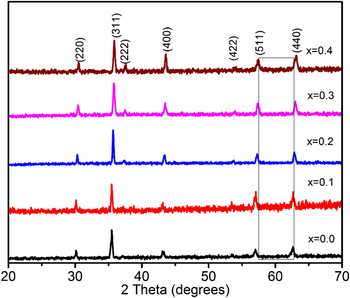
Crystal structure of the as-sintered NiMn2−xMgxO4 ceramics was analyzed using XRD. The XRD patterns of NiMn2−xMgxO4 samples sintered at 1200 °C for 2 h are presented in Fig. 1. It can be seen that all compositions are single-phase with spinel structure, indicating that Mg ions enter into the spinel crystal lattice. It was ever reported by Park et al. that Mn- or Ni-rich solid solutions are observed in Mn1.4Ni1.2Co0.4−xMgxO4 ceramics.Reference Park, Kim, Kim and Nahm12 However, this phenomenon is not observable in our present work, which is probably due to the detection limit of XRD. In addition, the diffraction peaks are shifted toward high angle with increasing the concentration of Mg (as shown in Fig. 1), indicating that the lattice parameter slightly decreased with increasing the concentration of Mg. The decrease of lattice parameter will be discussed in the following sections.
X-ray diffraction patterns of NiMn2−xMgxO4 ceramics with x = 0, 0.1, 0.2, 0.3, and 0.4 sintered at 1200 °C for 2 h.

According to the cation distribution of  for Ni0.8Mn2.2O4 reported by Fritsch et al.,Reference Fritsch, Sarrias, Brieu, Couderc, Baudour, Snoeck and Rousset15 we propose a cation distribution of
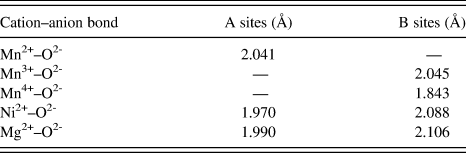
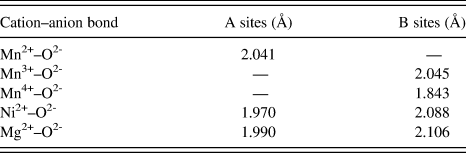
 for NiMn2−xMgxO4. PoixReference Poix16 ever pointed out the invariable character of the “anion–cation” distance for a particular site in spinel. Thus, d A and d B are defined as the mean values of the “anion–cation” distances in tetrahedral and octahedral sites, respectively. The “cation–anion” distances in A and B sites,
 and
 , determined by Poix,Reference Poix16 are given in Table I. At low Mg concentration, Mg2+ ions enter into A-site. Since
 is smaller than
 (as shown in Table I), Mg2+ substitution leads to shrinkage of crystal cells. As the concentration of Mg increases, a small amount of Mg2+ ions occupy the B-site. Meanwhile, to maintain the neutrality of electrical charge, Mn3+ ions are oxidized into Mn4+ ions in octahedral (B) sites of the spinel lattice.Reference Gillot, Guendouzi, Kharroubi, Tailhades, Metz and Rousset17, Reference Metzmacher, Mikkenie and Groen18 As shown in Table I, the sum of
 and
 is smaller than that of
 and
 , which is responsible for lattice shrinkage.
“Cation–anion” distances determined by PoixReference Poix16 (±0.002 Å).
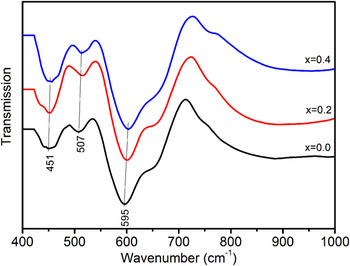
IR spectroscopy is a powerful technique to investigate the cation distribution. Figure 2 shows room temperature IR absorption spectra of NiMn2−xMgxO4 ceramics with x = 0, 0.2, and 0.4 in the range of 400–1000 cm−1. Based on group theory, WaldronReference Waldron19 explained four IR active modes, which were marked as ν 1, ν 2, ν 3, and ν 4 from high frequency to lower frequency. ν 1 and ν 2 are assigned to tetrahedral and octahedral group complexes, respectively. The absorption bands at 451, 507, and 595 cm−1 are assigned to Ni–O6, Mn–O6 and Mn–O4 vibration, respectively. The frequency of Ni–O6 vibration is slower than that of Mn–O6 vibration because nickel is heavier than manganese, which is in a good agreement with the results reported by Ferreira et al.Reference Ferreira, Baptista, Kamba and Petzelt20 It can be seen that ν 1 significantly increases with increasing the concentration of Mg, whereas ν 2 slightly increases. This observation indicates that Mg2+ ions occupy mainly A-site and partly B-site of the spinel lattice.Reference Wang, Zhao, Yang, Winnubst and Chen14
Infrared spectra of NiMn2−xMgxO4 ceramics with x = 0, 0.2, and 0.4 sintered at 1200 °C.

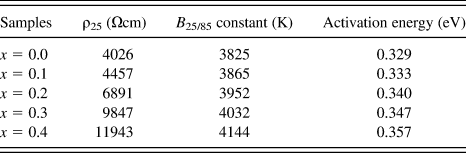
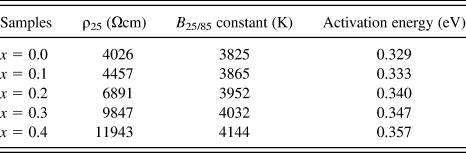
The electrical resistivity at 25 °C (ρ 25), B 25/85, and activation energy are summarized in Table II. The B 25/85 can be calculated by the following equation: B 25/85 = (lnρ 25 − lnρ 85)/(1/T 25 − 1/T 85), where ρ 25 and ρ 85 are the resistivity measured at 25 and 85 °C, and B is the temperature coefficient of resistivity. The ρ 25, B 25/85, and activation energy of NTC ceramics with different compositions are 4026–11943 Ωcm, 3825–4144 K, and 0.329–0.357 eV, respectively. This indicates that the electrical properties of the NTC ceramics can be adjusted by changing their composition. It is also clear that the B 25/85 progressively increases with increasing the concentration of Mg, indicating an improvement in the thermistor sensitivity. Similar result was obtained in Mn1.4Ni1.2Co0.4−xMgxO4Reference Park, Kim, Kim and Nahm12 and Ni0.75Mn2.25−x−yCrxFeyO4Reference Varghese, Seema and Dayas21 systems. In addition, the activation energy of hopping also increases with respect to Mg concentration. It can be explained that Mn3+ ions are oxidized into Mn4+ ions in octahedral sites of the spinel lattice, which gives rise to a reduction in the ratio of Mn3+/Mn4+ ions on the octahedral sites. As a result, it results in an increase of the activation energy of hopping.
ρ 25, B 25/85, and activation energy of NiMn2−xMgxO4 NTC ceramics.
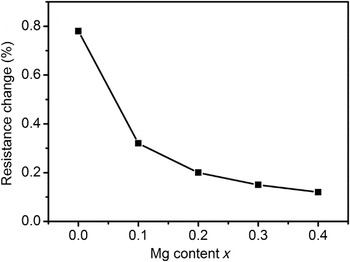
The electrical stability properties of NiMn2−xMgxO4 (0 ≤ x ≤ 0.4) NTC thermistors are dependent on the concentration of Mg2+, as shown in Fig. 3. As the concentration of Mg2+ increases from 0.0 to 0.4, the aging coefficient ΔR/R decreases from 0.78 to 0.12%, which improves remarkably the electrical stability of NTC thermistors. In spite of much controversy on the aging mechanisms, it is widely accepted that the aging of NTC thermistors originates from redistribution of cations between sublattices of spinel at an elevated temperature.Reference Dorris and Mason22 As the concentration of Mg increases, it inhibits the oxidation–reduction reactions and restrains the formation of cation vacancies.
Resistance change (%) as a function of Mg content for NiMn2−xMgxO4 NTC ceramics.

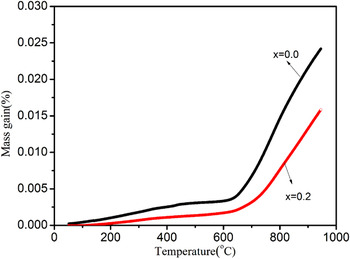
To further understand its origin, the effect of MgO additive on the tolerance of the oxidation is investigated by using TGA. As shown in Fig. 4, a pronounced mass gain of NiMn2O4 powder occurs at ∼620 °C, while that of NiMn1.8Mg0.2O4 powder appears until at ∼670 °C, implying that the former is more easily oxidized than the latter. Furthermore, in the oxidation temperature range below 620 °C, the overall mass gain of the former is much higher than that of the latter. The difference of oxidation behavior is ascribed to its different chemical compositions. The Mg2+ substitution enhances the tolerance of the oxidation in air. During the oxidation process, oxygen atom enters into spinel lattice and then occupies the site of oxygen.Reference Basu, Brinkman and Schmidt23 Thus, the cationic vacancies are formed, which can be denoted as

Thermogravimetric analysis of (a) NiMn2O4 and (b) NiMg0.2Mn1.8O4 powders at a heating rate of 2 °C/min in flow air.

It is reasonable that the formed cation vacancies lower the activation energy of the migration of cations between the sublattices. Therefore, the cation vacancies act as an energetically preferable path for the cation redistribution, and the consequent aging occurs at a lower temperature of ∼150 °C.Reference Metz24 As the concentration of Mg2+ increases, cation vacancies are reduced and the energetically preferable path for the cation redistribution is blocked, which enhances the tolerance of the oxidation for NiMn2−xMgxO4 (0 ≤ x ≤ 0.4) samples. Thus, the electrical stability is improved remarkably.
IV. CONCLUSION
NiMn2−xMgxO4 ceramics are all single-phase with spinel structure, indicating that Mg2+ ions enter into A- and B-site of spinel lattice. IR spectroscopy results indicate that Mg2+ substitution inhibits the formation of cation vacancies, which causes a reduction in the ratio of Mn3+/Mn4+ ions. Mg2+ substitution enhances the tolerance of the oxidation in air. As a result, Mg substitution results in a significant increase in ρ 25, B 25/85, and activation energy, which improves the aging property of NiMn2−xMgxO4 NTC thermistors. This indicates that the Mg-substituted NiMn2−xMgxO4 NTC thermistors have good electrical stability in comparison to the Mg-free NiMn2−xMgxO4 NTC thermistors.
ACKNOWLEDGMENTS
This research was financially supported by the Zhejiang Provincial Science Foundation (No. Y6110475) and the Zhejiang Provincial Fund of Science and Technology (Grant No. 2007C21003).