The overarching research question in the field of substantive representation is whether female representatives act in the interests of women and influence policy outputs promoting women's interests. However, given women's diverse experiences, these interests are not homogenous. In fact, recent contributions to gender and politics scholarship point to a complexity of women's substantive representation (Celis et al. Reference Celis, Childs, Kantola and Krook2014; Schwindt-Bayer and Taylor-Robinson Reference Schwindt-Bayer and Taylor-Robinson2011). The act of representing women is multifaceted. Women might be represented by diverse actors (Celis and Erzeel Reference Celis and Erzeel2015; Childs and Krook Reference Childs and Krook2009), inside and outside parliament (Saward Reference Saward2010; Squires Reference Squires2008; Weldon Reference Weldon2011). This article adds to the scholarly debates on the topic by examining a Central/Eastern European country.
The study of women's substantive representation in Poland is particularly interesting. This is because of the political context (the current parliament is dominated by the right, with no left party represented), culture (Catholicism), and women's mass mobilization (Black Protests). The 2015 parliamentary elections saw the victory of the right-wing populist Law and Justice party (Prawo i Sprawiedliwość), which formed a single-party majority government. Soon after taking office, the Law and Justice government was accused of authoritarian tendencies because of its disregard for the constitution, the rule of law, parliamentary procedures, and citizens’ rights (Ekiert Reference Ekiert2017). Whereas Poland was considered to be a well-functioning and consolidated democracy before 2015 (Gwiazda Reference Gwiazda2016), illiberalism and populism are on the rise, and deconsolidation is taking place (Foa and Mounk Reference Foa and Mounk2017).
Moreover, Poland is a traditionally Catholic country where the church influences politics and values. The Catholic Church played a significant role in the 2015 elections, conveying obvious partisan preferences for the Law and Justice party (Markowski Reference Markowski2016). Research shows that the historical prevalence of Catholicism promotes more traditional attitudes toward women and their role as homemakers and mothers (Inglehart and Norris Reference Inglehart and Norris2003, 50). Given the political and cultural context, important questions for women's substantive representation can be raised: What interests are represented? Who represents women? And where does substantive representation take place?
In order to explore these questions further, this article examines the 2016 abortion debate in Poland. There is no denying that the subject can attract extreme views, but at the same time, this episode provides an opportunity for analysis of women's interests in a situation in which their discussion is almost absent in parliament (Interview 4). Moreover, this episode reveals the unprecedented mass mobilization of women in the form of so-called Black Protests that took place in October 2016. Demonstrators, wearing black, protested a proposed abortion ban and, at the same time, wanted to raise awareness about the encroachment on women's rights in Poland under the new Law and Justice government. The name of the protests referred to the events of 1975 in Iceland, where women stopped working and marched through Reykjavik dressed in black, demanding equality and fair wages. The large scale of women's mobilization in Poland was puzzling because it is a country with usually very low levels of civic participation (see Gwiazda Reference Gwiazda2016) and feminist activism (see Korolczuk Reference Korolczuk2016).Footnote 1 So how can we explain the Black Protests?
Case study research is best suited to an in-depth country-specific analysis (Gerring Reference Gerring2004; Landman Reference Landman2002; Lijphart Reference Lijphart1971), in particular the study of women's interests (Celis et al. Reference Celis, Childs, Kantola and Krook2014). According to Lijphart (Reference Lijphart1971, 691), case studies contribute to “the establishment of general propositions and thus to theory building.” This study is an example of a hypothesis-generating case study (see Lijphart Reference Lijphart1971). Hence, to explore substantive representation, this article follows inductive theory building. It starts with an empirical observation, followed by the generation of hypotheses. This in-depth analysis of women's representation in Poland is based on primary and secondary data. Primary sources include transcripts of parliamentary debates and interviews with female deputies and researchers dealing with women's issues conducted in Warsaw in June and July 2017. Secondary sources include published reports and the scholarly literature.
This article is an important contribution to the research on women's substantive representation, for several reasons. Conceptually, it revisits the existing understandings of substantive representation. It adopts a broad, thick understanding to encompass a diversity of interests, actors, and sites. This is in contrast to a thin understanding, that is, feminist substantive representation (see Mackay Reference Mackay2008). The main question that is addressed is: What is the substantive representation of women? Theoretically, this article offers new insights into substantive representation. Drawing on the existing literature, specifically Saward's (Reference Saward2010) representative claim and Childs and Lovenduski's (Reference Childs, Lovenduski, Waylen, Celis, Kantola and Weldon2013) analytical framework, it generates a number of hypotheses that can be tested in other settings. Empirically, the unique contribution of this article is to show how women's interests are defined and represented in Polish politics, which is dominated by the right. The case of Poland allows for an in-depth exploration of conservative claims, but at the same time, it is vital to understand whether feminist interests are present too. If so, how are they voiced and by whom? It also explains unprecedented women's mobilization. Thus, this article provides a unique opportunity to explore political representation at the intersection of formal institutions and women's mass mobilization in extraparliamentary sites. To the best of my knowledge, it is the first study of women's substantive representation in Poland.
The remainder of this article is divided into four sections. The first section reviews the literature on women's substantive representation. The second section presents the case of Poland, specifically looking at the 2016 abortion debate. The third section puts forward hypotheses and contributes to the theoretical discussion, in addition to proposing a definition of women's substantive representation. Finally, the conclusion summarizes the findings.
THE LITERATURE ON WOMEN'S SUBSTANTIVE REPRESENTATION
Research on this subject considers several important aspects, including the meaning of women's interests and issues and the agents, sites, and methods of representation (Celis Reference Celis2009; Celis et al. Reference Celis, Childs, Kantola and Krook2008, Reference Celis, Childs, Kantola and Krook2014; Childs and Krook Reference Childs and Krook2009; Childs and Lovenduski Reference Childs, Lovenduski, Waylen, Celis, Kantola and Weldon2013; Dahlerup Reference Dahlerup, Escobar-Lemmon and Taylor-Robinson2014; Reingold and Swers Reference Reingold and Swers2011; Wängnerud Reference Wängnerud2009). I briefly address these next.
Hanna Pitkin defined substantive representation as “acting in the interest of the represented, in a manner responsive to them” (Reference Pitkin1967, 209). Substantive representation is also discussed in terms of the promotion of women's interests (Franceschet and Piscopo Reference Franceschet and Piscopo2008) and women's policy concerns (Celis et al. Reference Celis, Childs, Kantola and Krook2008). These definitions raise important questions concerning the operationalization of substantive representation. Childs and Lovenduski (Reference Childs, Lovenduski, Waylen, Celis, Kantola and Weldon2013) propose to examine interests, which women are represented, who acts in the interests of women, where the representation of women takes place, and how it is done, in addition to evaluating the quality of representation.
Although scholars agree that the substantive representation of women is about women's interests, they disagree on what this means, simply because women as a heterogeneous category are likely to have at least some different interests (Celis and Childs Reference Celis and Childs2012, Reference Celis, Childs, Celis and Childs2014). There are three main approaches to examining women's interests. The first approach focuses exclusively on feminist claims. Wängnerud (Reference Wängnerud2009) points to the fact that the substantive representation of women has a feminist focus. Likewise, for Williams (Reference Williams2000), overcoming discrimination is a central concern of women's interests. The second approach is the analysis of both conservative and feminist interests. Celis and Childs (Reference Celis, Childs, Celis and Childs2014) argue that nonfeminist women might also represent claims for women. Hence, a more encompassing approach is to examine conservative interests, in addition to feminist claims. The third approach goes even further and proposes an endogenous approach to women's interests in which these are “socially constructed, politically contested, and empirically contingent” (Reingold and Swers Reference Reingold and Swers2011, 430). Here women are to define their own conceptions of their interests and issues. According to Dahlerup (Reference Dahlerup, Escobar-Lemmon and Taylor-Robinson2014), an a priori definition of women's interests is not needed for empirical analyses. This approach is in line with Saward's (Reference Saward2010, 36) representative claim framework, which helps redefine political representation as “an ongoing process of making and receiving, accepting and rejecting claims—in, between, and outside electoral cycles.”
Although some scholars use women's interests and issues interchangeably,Footnote 2 there is a difference between the two. Issues refer to policies, or women's policies to be more precise, whereas interests are more specific and tainted with an ideological stance. Celis and Childs (Reference Celis, Childs, Celis and Childs2014, 4) observe that some women's issues, meaning “the broad policy category of issues that concern women,” might be universal, but interests, which mean “the content given to issues,” are not likely to be shared by all women. Women's issues refer to public policies concerning women. They might range from policies regarding women’s traditional role as “dispensers of care”Footnote 3 to those such as health care, care taking, education, gender equality, combatting violence against women, sexual harassment, and reproduction (Dodson and Carrol Reference Dodson and Carrol1991; Mazur Reference Mazur2002; Schwindt-Bayer and Mishler Reference Schwindt-Bayer and Mishler2005).
Who are the agents of women's representation? Phillips's (Reference Phillips1995) theory of the politics of presence suggests that female politicians are best equipped to represent the interests of women, and hence their presence should be enhanced. In fact, her theory predicts a link between descriptive and substantive representation. The presence of women in parliaments makes a difference, because a substantial number of women—a critical mass—can result in the enactment of women-friendly policies (Dahlerup Reference Dahlerup2009; Reingold Reference Reingold2006; Thomas Reference Thomas1991). However, some scholars have criticized the concept of critical mass and instead argue that critical actors are more important. These are individuals or agencies who initiate policy proposals and often encourage others to take steps to promote women's policy concerns, even when there are few women (Celis et al. Reference Celis, Childs, Kantola and Krook2008; Childs and Krook Reference Childs and Krook2006; Childs and Withey Reference Childs and Withey2006). Celis and Erzeel (Reference Celis and Erzeel2015, 45) argue that “non-left, male, and non-feminist members of parliament” can also represent women.
Finally, Saward (Reference Saward2010) distinguishes between elective and nonelective representation. Elective representation, occurring through free and fair elections, is formal, regular, public, and transparent, which ensures the strength for representative claims. In contrast, nonelective representation offers “different sorts of representative claims which may resonate well with specific audiences” (Saward Reference Saward2010, 85). Saward proposes to incorporate a broader range of actors than traditional theories of political representation would suggest. In summary, representative claims may be made by elected and nonelected actors, including state agencies, social movements, and international organizations (Celis et al. Reference Celis, Childs, Kantola and Krook2008, Reference Celis, Childs, Kantola and Krook2014; Lovenduski Reference Lovenduski2005; Saward Reference Saward2010; Squires Reference Squires2008; Weldon Reference Weldon2011).
There is a body of literature on the study of substantive representation that concerns itself with sites where it can occur. Childs and Lovenduski (Reference Childs, Lovenduski, Waylen, Celis, Kantola and Weldon2013, 501) argue that “representation occurs in institutions.” In fact, most studies emphasize the role of parliamentary representation and parliaments as sites of representation. Conversely, Saward (Reference Saward2010) argues that, in addition to parliaments, other sites of representation should be considered. Some scholars have looked at executives, agencies, parties, and social organizations of various kinds (see Childs and Lovenduski Reference Childs, Lovenduski, Waylen, Celis, Kantola and Weldon2013). Weldon (Reference Weldon2002) regards women's public policy agencies and women's movements as effective avenues of expression for women. Likewise, Squires (Reference Squires2008) includes the extraparliamentary arenas of women's policy agencies and feminist nongovernmental organizations.
Finally, the method of representation refers to how the substantive representation of women occurs. Franceschet and Piscopo (Reference Franceschet and Piscopo2008) differentiate between substantive representation as a process, in which female representatives change the legislative agenda, and substantive representation as an outcome, in which women succeed in passing women-friendly laws. While the former focuses on introducing women's issues during parliamentary debates, committee proceedings, and question time, the latter specifically focuses on policy outcomes. Legislation that meets women's interests is considered to be the key element of women's substantive representation (Celis Reference Celis2009).
Regarding Central and Eastern Europe, research on this topic is still in its infancy. Waylen (Reference Waylen2008) analyzes how far feminist representation has been improved during democratization. Erzeel and Rashkova (Reference Erzeel and Rashkova2017) examine whether the radical right parties include women and women's concerns, and Rashkova and Zankina (Reference Rashkova and Zankina2017) analyze women in the radical right parties in Bulgaria. Chiva (Reference Chiva2018) discusses the role of feminist women's movements and whether they have shaped policy processes during democratization. Finally, there are a few studies which examine gender equality policies (e.g., Bego Reference Bego2015). However, the literature uses a thin definition of substantive representation and does not unpack the concept and hence does not fully engage with its complexity. This article shows that the study of substantive representation is a complex endeavor that requires a focused analysis of different aspects concerning diverse interests, sites, and actors. Asking questions about what, where, and who is vital for shedding more light on acting in the interests of women.
THE 2016 ABORTION DEBATE IN POLAND
Women's substantive representation is examined in the context of a parliamentary debate on abortion held in the autumn of 2016. Poland has one of the strictest abortion laws in Europe. The Act of 7 January 1993 on family planning, protection of human fetuses, and conditions of abortionFootnote 4 allows termination only if the pregnancy is the result of a crime, if the fetus is defective, or if the mother's life is in danger.Footnote 5 Although abortion was legal under communism, the democratic transition brought restrictions because of the central role played by the Catholic Church in politics (Fuszara Reference Fuszara, Funk and Mueller1993; Heinen and Portet Reference Heinen and Portet2009). Since 1993, there have been some attempts by both pro-life and pro-choice campaigners to reopen the abortion debate, but the law remains unchanged (see Graf and Korolczuk Reference Graf, Korolczuk, Kuhar and Paternotte2017; Heinen and Portet Reference Heinen and Portet2009).
In Catholic democracies, the conflicts between religious orthodoxy and women's rights in abortion have been particularly divisive (Blofield Reference Blofield2008). Yet recent developments in Catholic countries, such as Chile and Ireland, show that pro-choice activists have succeeded in the liberalization of abortion laws. Conversely, in Poland, pro-life (anti-choice) movements have gained more ground recently, a development accompanied by anti-gender discourse and movements. Elements within the Catholic Church and conservative groups fight any gender-related initiatives, gender studies, and gender equality education in order to protect, they argue, the traditional Polish family (Graf and Korolczuk Reference Graf, Korolczuk, Kuhar and Paternotte2017; Korolczuk Reference Korolczuk2016).
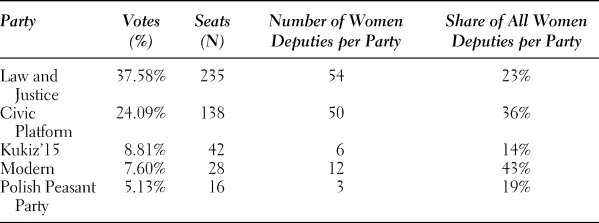
Because the 2016 abortion debate took place in the lower chamber of the Polish parliament, the Sejm, the partisan composition of parliament should be presented (see Table 1). The right-wing populist Law and Justice party won the 2015 parliamentary elections and formed a single-party majority government (see Marcinkiewicz and Stegmaier Reference Marcinkiewicz and Stegmaier2016; Markowski Reference Markowski2016; Szczerbiak Reference Szczerbiak2017). The centrist Civic Platform and the agrarian Polish Peasant Party, which were in government for two terms from 2007 to 2015, lost support and are now in opposition. Kukiz'15 and Modern (Nowoczesna) are two new political parties: while the former is a populist anti-system party, the latter is a liberal party. The parties of the left did not pass the electoral threshold, and they are not represented in parliament at all.Footnote 6
Results of parliamentary elections of October 25, 2015, including the number and percentage of women deputies for each political party in the Sejm

Source: State Electoral Commission, 2015.
In the current Sejm, there are 125 female deputies (out of a total of 460), constituting 27% of all deputies. In the past, women were significantly underrepresented. Since legislative gender quotas were introduced in 2011, there has been a slight increase in the number of women in parliament (see Gwiazda Reference Gwiazda2017). Table 1 shows the numbers and percentages of women in each party. Conservative female deputies currently dominate the Sejm.
The parliamentary procedure on changing the abortion law started with the submission of two citizens’ legislative proposals. In Poland, citizens can submit legislative initiatives. Article 118 of the 1997 Constitution specifies that the right to introduce legislation belongs to deputies, to the Senate, to the president of the republic, and to the Council of Ministers, in addition to a group of at least 100,000 citizens who have the right to vote in elections to the Sejm. A Citizens’ Legislative Initiative Committee, consisting of at least 15 members, is responsible for preparing the bill, promoting the cause, and collecting the signatures. It represents the citizens who signed the draft bill and submits the bill to parliament, which then examines it following standard legislative procedures.Footnote 7 In Poland, the number of initiatives constitutes only about 1% of all bills, and although their success rate is not high, it is considered a good method of increasing the role played by civil society (see Gwiazda Reference Gwiazda2016).
The two citizens’ legislative proposals were completely different from each other: one was ultraconservative and one was feminist. The ultraconservative proposal (Bill No. 784), titled Amendments to Law of 7 January 1993, stipulated a total prohibition on abortion and its criminalization. The Catholic organization Ordo Iuris gathered 450,000 signatures in support of the bill and established a Citizens’ Legislative Initiative Committee called “Stop Abortion” to present it in parliament. Article 1 of the bill stated that everybody has a right to life from the moment of conception, and hence abortion is banned. The bill also proposed amendments to the penal code stating that those who kill an unborn child would be imprisoned for a period of three months to five years. The justification of the bill stressed the rights of unborn children and mother's rights (rather than women's rights).Footnote 8 Conversely, the feminist proposal (Bill No. 830), titled “Women's Rights and Conscious Parenting,” envisaged the liberalization of abortion policy. It was a citizens’ legislative initiative, signed by 215,000 citizens, presented in parliament by the Citizens’ Legislative Initiative Committee called “Save the Women.”Footnote 9 The bill allowed unlimited abortion within the first 12 weeks (Article 8), provided for sex education in schools (Article 6), and allowed access to information about reproductive rights policies (Article 5). The justification of the bill stipulated that it was prepared following the postulates of nongovernmental organizations promoting women's rights. It emphasized that the 1993 law did not provide for full reproductive rights for women because of restrictive abortion, blatant violations of reproductive rights, and self-determination in procreation, sex education, and modern family planning methods.Footnote 10
The two bills were tabled for a first reading in the Sejm on September 22–23, 2016. The parliamentary debate opened with speeches given by the representatives of the two Citizens’ Legislative Initiative Committees. Joanna Banasiuk, representing the Stop Abortion committee, said that abortion was a slaughter of children, a hell for women, and a moral disgrace for men, and thus it should be stopped. She believed that Poland had an opportunity to show higher standards for human rights and choose life for the welfare of women and children.Footnote 11 Conversely, Barbara Nowacka,Footnote 12 representing the Save the Women committee, supported a women's right to choose and decide about their lives. She also emphasized the importance of full care during pregnancy, providing for sex education at school, and full access to contraception. She argued that the 1993 law should be liberalized in order to give back freedom to women.Footnote 13
Political parties then presented their policy positions. One of the governing Law and Justice male deputies confirmed that the party did not support the feminist proposal. His female colleague added that abortion not only is the murder of unborn children but also causes harm to women. Kukiz'15 deputies largely opted for the rejection of the feminist bill and supported the idea of further discussing the ultraconservative bill. The leader of the Polish Peasant Party supported the 1993 law as the best means of protecting life. He criticized the feminist proposal to allow abortion on request, which is incompatible with Catholic Church teachings, and hence supported the rejection of the feminist bill. Civic Platform critically assessed restricting abortion as presented in the ultraconservative bill and opted for keeping the 1993 law. One of the Civic Platform female deputies said that although the 1993 law was not satisfactory, the majority of Polish citizens supported it. Deputies of the Modern party strongly opposed the ultraconservative bill because it ignored women's voices and public opinion, and they believed that imprisonment for abortion is unacceptable in the twenty-first century. They instead supported the feminist proposal being moved to the committee stage to discuss liberalization.Footnote 14
Following the parliamentary debate during the first reading, the two bills were voted on. The majority of deputies, including all Law and Justice deputies, Kukiz'15, and the Polish Peasant Party, voted against rejecting the ultraconservative bill, which was moved to Sejm committees for further deliberation. Modern and Civic Platform voted to reject the ultraconservative bill.Footnote 15 Conversely, the feminist bill was rejected in the first reading by the votes of the Law and Justice party, Kukiz'15, and the Polish Peasant Party. By contrast, most Civic Platform and Modern deputies voted against the rejection of the feminist bill.Footnote 16
Against the backdrop of the vote, on October 3, 2016, tens of thousands of Polish women (and some men), many wearing black, took to the streets to protest the proposed abortion ban. The Black Protests were widespread across Poland. There were more than 140 demonstrations, in large cities but also in towns, with a total of 100,000 to 150,000 participants (CBOS 2016; Korolczuk Reference Korolczuk2016). The biggest demonstrations took place in Warsaw, Wrocław, and Poznań. For example, the Warsaw authorities estimated that the largest demonstration gathered between 22,000 and 30,000 people in the capital's historic Castle Square (Kość Reference Kość2016). The Polish Women's Strike and other civil society associations actively participated in organizing the Black Protests, mostly through social media, which also provided a forum for discussions and exchanging ideas.
It is worth mentioning that women's activism had already started in the spring of 2016, but its biggest manifestation was the Black Protests.Footnote 17 They represented a new logic of protest action: informal, decentralized, and networked, in which the sense of community is built on a personalized exchange, rather than through a traditional organization with a coherent collective identity (Korolczuk Reference Korolczuk2016). Other Black Protests took place on October 24, when the resistance to abortion restriction was framed in a broader context of gender equality, including a call for combating violence against women (CBOS 2016).
The parliamentary process continued with the ultraconservative bill being submitted for a second reading on October 6. The Sejm committee recommended rejecting the bill. In a debate preceding the vote, Jarosław Kaczyński, leader of Law and Justice, confirmed that having analyzed the social situation and dissatisfaction, the party had decided to withdraw its support for the abortion ban.Footnote 18 Another party member also admitted that the Black Protests made Law and Justice reconsider its initial position (Foreign Policy 2016). Despite the initial support from Law and Justice, most of its deputies voted to reject the bill altogether. In fact, one of the interviewees pointed out that Law and Justice was divided over the issue (Interview 1). On the one hand, there was a Christian faction, linked to Radio Maryja (Radio Virgin Mary), supporting an ultraconservative bill. Radio Maryja is a very conservative Catholic radio station, openly engaged in politics, run by Father Tadeusz Rydzyk.Footnote 19 On the other hand, some deputies supported the 1993 law. A female deputy from Law and Justice said that the party leadership thought that neither bill should be supported because the 1993 law was the best compromise. Yet Kaczyński also wanted to appease some party members who sided with Radio Maryja to restrict abortion, and hence he initially supported the ultraconservative bill (Interview 5).
Although deputies voted overwhelmingly to reject the ultraconservative bill, a few deputies from Law and Justice, Kukiz'15, and the Polish Peasant Party voted against rejection.Footnote 20 An interviewee from the Polish Peasant Party confirmed that she supported the 1993 law, but the majority of her colleagues wanted to restrict abortion because conservatism and traditional values dominated in the party (Interview 2). A female deputy from Kukiz'15 also admitted that the party was divided, but because she was representing a conservative constituency, she supported restricting abortion, in particular eugenic abortion (Interview 3). With the rejection of the bill, the legislative process came to an end. The episode described here raises important questions for women's substantive representation, which the subsequent section elaborates.
DISCUSSION OF WOMEN'S SUBSTANTIVE REPRESENTATION: INTERESTS, AGENTS, AND SITES
Against the background of the 2016 abortion debate, this article reflects on women's interests, agents, and sites of representation. The objective is to contribute to the literature on women's substantive representation.
Interests
The endogenous approach to women's interests means that women define their own conceptions of interests and issues. By examining debates in parliament and interviews with women representatives, it was possible to identify these. The Polish case shows that both conservative and feminist interests are present. It has been confirmed that, in general, Law and Justice, Kukiz'15, and the Polish Peasant Party support conservative women's interests, whereas Modern and some Civic Platform deputies support feminist interests.
However, a more nuanced, in-depth analysis allowed for a differentiation of types of conservatism and feminism and identification of intraparty variations. Conservatism has two faces in Poland: ultraconservative and moderate. The ultraconservative agenda setter opted for banning abortion, whereas moderate conservatism embraced the status quo. Although the majority of interests represented in the Sejm were moderate-conservative, the ultraconservative interests were also represented by a few deputies—those who voted against the rejection of the ultraconservative bill.
Feminism also has several guises. The interviews confirmed that the two main types are liberal and left (social). Liberal feminism refers to women and men having equal rights. It is a perspective of the political, economic, and social equality of both genders. The right to abortion belongs to women's rights. This type is present in parliament and is well represented by ModernFootnote 21 and some Civic Platform female deputies. Instead, left feminism is present outside parliament, mostly because the parties of the left have no representation in parliament. This type of feminism is more concerned with social equality and fighting discrimination against women in rural areas, in small towns, or from disadvantaged backgrounds. Therefore, the right to abortion is seen more as an expression of social justice for the disadvantaged. The feminist agenda setter came from this group. Finally, one female deputy from the governing party admitted that she represented the feminists of the right, incorporating liberal feminist, traditional, and nationalist ideas. She supported women's rights and equal opportunities but also Law and Justice's family policy, siding with moderate conservatives on the abortion issue, that is, supporting the status quo. Moreover, she emphasized the role of women in the Polish struggle for independence in the early twentieth century (Interview 5).
This study demonstrates the diversity of women's interests and generates a hypothesis on the representation of women's interests in parliament.
H1:
If parliament is dominated by parties of the right, conservative interests will dominate.
This article points to conservative activism. Reingold and Swers (Reference Reingold and Swers2011) argue that the rising activism of conservative women and their relationship to their parties and their views on women's issues remain poorly understood. The Polish case shows that a parliament dominated by conservative women indeed promotes conservative interests. Hence, this finding contributes to the most recent strand in the literature on gender and conservatism (Celis and Childs Reference Celis and Childs2018).
When discussing interests, women's issues (policies) are also considered. These tend to be traditional when parties of the right dominate. The 2016 abortion debate showed a clash between reproductive rights policy and family policy based on traditional conceptions of women's social roles and of the family. The feminist proposal was framed as reproductive rights. One of the interviewees from Modern confirmed that the party supported the abortion liberalization bill because it was an opportunity to discuss reproductive rights policy (Interview 1). A feminist interviewee also highlighted defending reproductive rights because there is no social consensus for restricting abortion (Interview 7). Conversely, the conservative issue concerns family policy. The governing Law and Justice party overtly supported traditional family policy with its extremely popular flagship “500 plus” child subsidy program for the first child of poorer households and every subsequent child in all families (see Marcinkiewicz and Stegmaier Reference Marcinkiewicz and Stegmaier2016). When the ultraconservative abortion bill was rejected, Law and Justice passed legislation on additional provisions available to pregnant women and children who have been diagnosed with severe and irreversible impairment or an incurable, life-threatening illness that originated during the prenatal period or during labor.Footnote 22 At the same time, the Law and Justice government limited the scope of feminist policies. It restricted access to emergency contraception, abandoned financing for in vitro fertilization, and supported calls to withdraw from the convention on preventing domestic violence and refused to support victims of domestic abuse (Korolczuk Reference Korolczuk2016).
Agents
Who are the agents of women's representation? They are actors who represent women and their interests. The Polish case shows that deputies, political parties, civil society (civic organizations and social movements), and individuals can be agents of representation. They can be elected or nonelected (Saward Reference Saward2010). Deputies and political parties belong to elected actors. They were very vocal in expressing their opinions and represented diverse women's interests. Although elected representatives derive the strength of their claims from the democratic process, the electoral game might result in distorted popular will as votes are translated into seats as a consequence of electoral and political party systems (Saward Reference Saward2010). Indeed, after the 2015 elections, the parties of the left did not pass the electoral threshold, and as a result, some 12% of voters did not gain representation.Footnote 23 Consequently, there was an overrepresentation of interests promoted by the governing party of the right.
H2:
When elected representatives do not represent substantively all interests and try to restrict already confirmed rights, nonelected representatives will become more vocal.
The Polish case shows the importance of nonelected actors in the form of “Women in Black.” Some of them supported the status quo, some expressed more radical views, but all of them were strongly against the ultraconservative proposal. Women were concerned that their rights were being threatened and mobilized on an unprecedented scale. According to Waylen (Reference Waylen2008), in Eastern Europe women had no tradition of grassroots activism of struggling to achieve or defend rights and did not play an active role in the postcommunist period. The Black Protests demonstrated that this is changing. The Black Protests were grassroots efforts supported by many civil society organizations (Interview 4), but they also included many women who did not formally belong to any group. This is an example of women's self-representation. According to Saward (Reference Saward2010, 101), self-representation is a type of nonelected representation in which “in a range of ways and on a range of matters citizens could rightly attempt to represent themselves; to say, as one often hears, that ‘my voice is not being heard or represented’ and attempt to make good the perceived shortfall.” In the Polish case, self-representation was a powerful tool for expressing grievances against the situation and a lack of representation of all interests in parliament.
When discussing the agents of representation, agenda setters need to be considered. They were two civic organizations represented by Citizens’ Legislative Initiative Committees: Stop Abortion, representing ultraconservative interests, and Save the Women, representing feminist interests. In general, an agenda setter defines the problem and generates awareness of an issue (Knill and Tosun Reference Knill and Tosun2012; Parsons Reference Parsons1995). The definition of “agenda setter” used here includes all actors who have a constitutional power to propose legislation.
H3:
Agenda setters succeed in promoting their interests if they get the support of the parliamentary majority. Public opinion matters, too.
None of the agenda setters was supported. Law and Justice has the majority and can pass or reject any bill requiring a simple majority. Although the Law and Justice party initially supported further restrictions, it clearly changed preferences during the process and, in the end, rejected the ultraconservative bill. This was a response to public opinion and voters’ support for the status quo, as confirmed by Law and Justice leader Kaczyński (Interview 4). Opinion polls show that Poles largely oppose the prohibition and criminalization of abortion. More than half of respondents (58%) want to keep the 1993 law. If the law were to change, it should be toward liberalization (25%) rather than further restriction (7%), with men and women responding likewise—for men, 55%, 28%, and 7% and for women, 61%, 27%, and 6%, respectively (CBOS 2016). Proponents of the abortion ban are practicing Catholics, attending church several times a week (36%), and identify themselves with the right (14%). Support for liberalization is increasing with political views on the left and a decrease in the frequency of religious practices (CBOS 2016). In sum, a majority of Poles support the status quo.
Sites
Where does women's representation take place? The parliament is an obvious answer. In fact, to date, most studies have emphasized the role of elected parliaments (Childs and Lovenduski Reference Childs, Lovenduski, Waylen, Celis, Kantola and Weldon2013). Phillips's politics of presence (Reference Phillips1995) is about presence in parliaments. According to Saward (Reference Saward2010, 123), focusing exclusively on parliaments when considering representation is “to privilege the notion of ‘representative government’ over that of ‘political representation’ and thus to impose a stipulative and undue narrowing of focus.” Likewise, Squires (Reference Squires2008) acknowledges that more attention should be given to alternative sites of political representation, including women's policy agencies and feminist nongovernmental organizations. However, little attention is paid to informal channels such as demonstrations in the streets.
H4:
If parliament is unrepresentative of some interests and tries to limit already confirmed rights, stronger extraparliamentary representation is expected.
Women's interests were represented by the Black Protests. The Polish case confirms that “making present” is not limited to parliament. A Civic Platform deputy confirmed that she was a feminist, but most feminists are outside the Sejm (Interview 6). There is more extraparliamentary representation when not all voices are heard in representative institutions. This article shows the importance of representing women's interests through informal channels rather than formal parliamentary channels.
The four hypotheses presented here provide a theoretical framework for analyzing women's substantive representation. In addition, based on the aforementioned analysis, a thick definition can be presented. Women's substantive representation means the representation of diverse women's interests, by multiple actors, in parliamentary and extraparliamentary sites.
CONCLUSIONS
This article has examined the substantive representation of women in Poland. By analyzing the abortion debate in the parliament and the unprecedented women's mass mobilization in the form of the Black Protests, it has reflected on women's interests, actors, and sites of representation. The main finding is that elected representatives in Poland do not substantively represent all interests. Thus, nonelected actors have become vocal. This article has demonstrated that conservative interests dominate in parliament, but feminist interests are voiced, too, especially by nonelected agents in extraparliamentary sites. The unprecedented mobilization of women resulted from a threat that already confirmed rights might be taken away because the state encroaches on women's rights.
The Black Protests were important for women's activism and democracy. Instigated by the parliamentary debate over the ultraconservative bill, they united women of different standings and political preferences and provided a sense of empowerment in the context where there is no room for dissent through formal parliamentary channels. The right-wing populist Law and Justice party had already limited the scope of feminist policies, including withdrawing funding for in vitro fertilization and funding for combating domestic abuse. Moreover, its disregard for the constitution, the rule of law, parliamentary procedures, and citizens’ rights, in addition to state media control, have further demonstrated that illiberalism is on the rise, which can further threaten women's rights. Women's activism in 2016 was a consequence of these developments. In illiberal democracies, extraparliamentary sites remain important channels of representation and communication. The street and social media provide forums for deliberation where citizens can express their opinions, represent their interests, increase awareness of women's rights, and defend them.
This article has contributed to the scholarly literature in several respects. First, it shows a variety of conservative and feminist interests and confirms that women's interests are diverse in a traditionally Catholic country dominated by the right. Second, it points to the importance of extraparliamentary representation in a case in which parliament is unrepresentative. Third, it highlights the significance of nonelected representatives. Women's interests were represented by civil society organizations and through women's self-representation. Taken together, these observations gave rise to theorizing by proposing hypotheses that can be tested in other contexts. The conceptual contribution consists of proposing a thick definition of substantive representation. In sum, the findings based on the analysis of the original empirical data taken from qualitative interviews and parliamentary debates in Poland make a valuable contribution to the study of substantive representation from a comparative perspective and of women's representation in Central and Eastern Europe.
This article has discussed women's interests in the context of the abortion debate. However, women's issues are not limited to abortion, and hence further research could focus on the identification of all women's issues in order to understand what public policies are of prime importance to women. Moreover, this new type of mass mobilization, which is informal and decentralized, and its impact on politics, merits scholarly attention. In addition, women's self-representation could be further examined. When and under what conditions can individuals voice representative claims? Future research should also explore the intersections of conservatism, feminism, and women's issues and interests. Finally, the hypotheses presented in this article could be tested in other settings because findings produced through comparative analysis improve generalizability.
The abortion debate is ongoing in Poland. More Black Protests took place in March 2018.Footnote 24 Further research should investigate the second stage of the abortion debate. In the first stage, women's mobilization halted a total ban on abortion. The mass political activism of women is unprecedented in Poland, but it remains to be seen whether it will be transformed into long-lasting women's alliances and networks. For the time being, women's civic participation and greater awareness of women's issues have enhanced women's substantive representation.
LIST OF INTERVIEWSFootnote 25
Interview 1. Interview with a female deputy from Modern, June 14, 2017
Interview 2. Interview with a female deputy from the Polish Peasant Party, June 20, 2017
Interview 3. Interview with a female deputy from Kukiz'15, June 21, 2017
Interview 4. Interview with a journalist dealing with women's issues, June 26, 2017
Interview 5. Interview with a female deputy from Law and Justice, July 21, 2017
Interview 6. Interview with a female deputy from Civic Platform, July 21, 2017
Interview 7. Interview with a feminist activist from the left party not represented in the Sejm, July 26, 2017