Introduction
It is estimated that up to 30% of adults above 65 years of age is affected by a mild neurocognitive decline.Reference DeCarli 1 Mild cognitive impairment (MCI) in particular is a syndrome characterized by a loss of cognitive function, which is not as severe as to impact daily functioning.Reference Petersen, Smith, Waring, Ivnik, Tangalos and Kokmen 2 , Reference Petersen, Caracciolo, Brayne, Gauthier, Jelic and Fratiglioni 3 . MCI is generally considered a pre-clinical or prodromal stage of dementia,Reference Petersen and Negash 4 since conversion rates are estimated between 17.5% and 34% in community samples.Reference Bennett, Wilson and Schneider 5 , Reference Hu, Yu, Sun, Zhang, Wang and Qin 6 To date, there is no pharmacological treatment available to stop the progression from MCI to dementia, yet this pre-clinical state may be more amenable to disease-modifying interventions than the clinical stages of dementia, when brain damage is too severe and pharmacological treatments only result in suboptimal benefits.Reference Langbaum, Fleisher and Chen 7 Therefore, one substantial health challenge is to find novel approaches to treat this condition.
Recently, noninvasive brain stimulation has gained popularity among clinicians and scientists due to its potential to enhance cognitive functioning by directly affecting or modulating brain activity. In particular, transcranial direct current stimulation (tDCS) involves the delivery of weak electrical currents (usually ranging from 1 to 2 mA) to the scalp by means of at least 2 electrodes, a positively charged anode and a negatively charged cathode. The current is thought to cause a subthreshold modulation of the resting membrane potential of neurons depending on the polarity of the electrode, such that anodal stimulation usually induces depolarization of the membrane potential and increases cortical excitability, and cathodal stimulation induces hyperpolarization and decreases cortical excitability.Reference Nitsche and Paulus 8 The rapidly growing interest for this technique is linked to its potential to improve the cognitive functions associated with the stimulated brain regions, as shown across multiple cognitive domains in healthy, older and neuropsychiatric populations.Reference Kuo, Paulus and Nitsche 9
The application of tDCS has also shown interesting results with respect to other conditions closely related to forms of cognitive impairments, more specifically in the domains of executive functions and working memory, such as substance use disorder and craving.Reference Martinotti, Lupi and Montemitro 10 - Reference Feyzi, Vahed, Nikraftar and Arezoomandan 12
Furthermore, tDCS is safe and easy to use, which makes it suitable for applications at home even for patients with cognitive decline.Reference Park, Oh, Chung, Kim, Kim and Park 13 tDCS studies on individuals with MCI demonstrated a beneficial effect of single or repeated administrations of anodal tDCS on a wide range of outcome variables, from subjective memory,Reference Yun, Song and Chung 14 to episodic verbal memory abilities, language, and global cognitive functioning.Reference Meinzer, Lindenberg, Phan, Ulm, Volk and Flöel 15 - Reference Manenti, Sandrini, Gobbi, Binetti and Cotelli 19
It is reasonable to assume that the beneficial effects of tDCS may be even stronger when anodal tDCS is combined with cognitive training, since targeting a neural circuit while actively engaged should induce more beneficial effects than resting-state stimulation.Reference Miniussi, Harris and Ruzzoli 20 However, evidence of this synergistic effect so far remains controversial in both healthy and pathological populations. In MCI patients, studies have generally found a lack of combined effects of cognitive training and anodal stimulation compared to cognitive training and sham stimulation. Three studies compared the combination of cognitive training over 3–5 weeks with either anodal tDCS to the left dorsolateral prefrontal cortex (DLPFC) or sham tDCS.Reference Martin, Mohan and Alonzo 21 , Reference Gonzalez, Fong and Brown 22 The results showed general improvements in global cognitive functioning and specific cognitive abilities in both conditions, but no advantage of the combined intervention. In one study, the combined intervention led to detrimental effects.Reference Das, Spence and Aslan 23 Overall, this is consistent with the findings obtained on AD patientsReference Cotelli, Manenti and Brambilla 24 and the results of a recent meta-analysis which showed no benefit of combining cognitive training and noninvasive brain stimulation in MCI or AD.Reference Chu, Li and Brunoni 25 To the best of our knowledge, only 2 studies found an advantage of the combined intervention compared to cognitive training alone. Both studies delivered anodal tDCS to the lateral temporal cortex, either for 4 weeksReference Lu, Chan, Chan, Lin, Cheng and Linda Chiu Wa 26 or 3 days,Reference de Sousa, Grittner, Rujescu, Külzow and Flöel 27 and found post-intervention improvements in trained domains.
It is unclear why some studies on MCI individuals found beneficial effects of combining tDCS with cognitive training and others did not. One possible reason relates to the site of stimulation, since the benefits of the combined treatments were observed when the stimulation was delivered to the temporal cortex,Reference Lu, Chan, Chan, Lin, Cheng and Linda Chiu Wa 26 , Reference de Sousa, Grittner, Rujescu, Külzow and Flöel 27 but not to the PFC.Reference Martin, Mohan and Alonzo 21 - Reference Das, Spence and Aslan 23 Yet, the stimulation of the PFC alone—without any concurrent treatment—improved global and specific cognitive functioning in several studies.Reference Yun, Song and Chung 14 , Reference Murugaraja, Shivakumar, Sivakumar, Sinha and Venkatasubramanian 16 , Reference Gomes, Akiba, Gomes, Trevizol, de and Dias 18 This observation invites an investigation into how the combination of cognitive training and active tDCS over the PFC compares not only with the effects of cognitive training alone, as assessed in previous studies, but also with the administration of PFC tDCS alone.
Evidence from numerous studies over the past 10 years, as well as from our clinical practice, has shown that anodal tDCS stimulation, with the anode placed on the left dorsolateral prefrontal cortex has the potential to improve cognitive functioning as well as to limit the progression of cognitive decline when administered for at least 2 weeks.Reference Sanches, Stengel and Godard 28 More specifically, anodal stimulation increases cortical excitability; excitatory stimulation at the DLPFC level has effects on memory and modulation of the default mode network.Reference Fregni, El-Hagrassy and Pacheco-Barrios 29 , Reference Chu, Li and Brunoni 30
To this aim, in this naturalistic study, we compared 3 interventions, each consisting of 20 daily sessions, in 3 groups of MCI patients: anodal tDCS alone, anodal tDCS in combination with cognitive training and cognitive training alone. Our outcome measures were verbal short-term memory, visuospatial memory, verbal fluency and global cognitive functioning.
Methods
Participants
Participants were recruited from a pool of patients who attended the Institute of Neuroscience (Florence, Italy) due to subjective memory complaints or were referred by a specialist between October 2018 and July 2021. Inclusion criteria were assessed with an on-site clinical interview. They were i) presence of subjective memory complaints, ii) absence of manifest dementia, iii) absence of depression as measured by the Patient Health Questionnaire-9 (PHQ-9),Reference Kroenke, Spitzer and Williams 31 with a cut-off score of 5, and iv) preserved daily functioning. Exclusion criteria were: previous or current diagnosis of neurological disorders such as stroke, brain tumor, cerebral hemorrhage, or head injuries; psychiatric disorders like bipolar disorder, major depressive disorder, pervasive developmental disorder, and schizophrenia; recent or current substance abuse; concurrent medication likely to affect mental performance (e.g., benzodiazepines); change in centrally active drugs in the last 12 months. All participants provided their informed consent to take part in the study. The study was approved by the institutional review board and was conducted in compliance with the Declaration of Helsinki.
Study design
This was a controlled 3-parallel-group study. Included participants were allocated to 3 groups: i) anodal tDCS only, ii) cognitive training (CT) only, and iii) anodal tDCS+CT. Group allocation was not random but depended on the availability of the treatment at the time of data collection. All participants attended the Institute of Neuroscience for 20 consecutive days to receive the allocated intervention.
tDCS protocol
Direct current was provided through a battery-driven wireless 8-channel StarStim stimulator (NE Neuroelectrics) through a pair of 25 cm2 saline-soaked sponge electrodes. The anode electrode was placed on site F3, and the cathode electrode was placed on F4. The position of the electrodes was carried out using a neoprene cap pre-drilled based on the positions of the 10/10 EEG system. In both the tDCS and the tDCS+CT group tDCS was delivered with a constant current of 2 mA for a total of 20 minutes per session with a fade-in time of 20 seconds. During the stimulation, participants in the tDCS+CT group were engaged in cognitive training (see “Cognitive training” section), whereas participants in the tDCS group performed routine activity (completing self-administered questionnaires).
Cognitive training
In both groups, cognitive training consisted of cognitive exercises devised for the rehabilitation of dementia.Reference Bergamaschi, Iannizzi, Mondini and Mapelli 32 The exercises encompassed 5 cognitive domains, each tested with 4 worksheets: orientation, attention, memory, language, and executive functions. Each subject completed all worksheets for each domain across the 20 sessions. Exercises were administered with the same order. Each cognitive training session lasted approximately 20 minutes and the end of the training corresponded to the end of the stimulation for individuals in the combined intervention group.
The types of exercises proposed by the worksheets are summarized below:
-
• Orientation training: memorizing and recalling dates and holidays, environmental spatial orientation, geographical orientation, and exercises to stimulate orientation based on spatial coordinates.
-
• Attentional training: auditory selective attention and auditory memory exercises, barrage, visual selective attention, visual–spatial search stimulation exercises, and nonverbal selective attention, sustained attention.
-
• Memory training: memorization and recall with interference tasks, memorization and graphic reproduction from memory, stimulation of learning by reading and recalling information, memorization of sequences of actions.
-
• Language training: naming, semantic verbal fluencies, phonemic verbal fluencies, semantic categorization, lexical access.
-
• Executive functions training: Go/No-go exercises, puzzles, crosswords, cognitive estimates, logical sequences to be completed.
Statistical analyses
We measured pre-post intervention gains on 4 outcome variables. The mini mental state examination (MMSE)Reference Folstein 33 was used to measure general cognitive functioning. We also used the forward digit spanReference Wambach, Lamar, Swenson, Penney, Kaplan and Libon 34 to measure verbal short-term memory, the Corsi block-tapping testReference De Renzi and Nichelli 35 to measure short-term visuospatial memory and verbal phonemic fluency.Reference Novelli 36 Pre-intervention (T0) scores were collected on day 1 before the start of the first stimulation session and post-intervention (T1) scores were collected on day 20 after the last stimulation session. Where necessary, scores were corrected for age and level of education for the analyses. We examined differences between pre- and post-treatment scores across the 3 groups using a mixed-model ANOVA with the between-subjects factor group (3 levels: tDCS, CT, tDCS+CT) and the within-subjects factor time (2 levels: pre-intervention, post-intervention), for each outcome measure. Fifty-four participants in total were needed to detect with 90% power (α = 0.05) an effect size of f = 0.25, found in previous studies contrasting pre- and post-treatment scores of global cognition in MCI patients,Reference Liu, Rau, Gallagher, Rajji, Lanctôt and Herrmann 37 using a mixed-model ANOVA with 3 groups and 2 measurements. The sample size was adjusted upwards to account for dropouts. Significant interactions were decomposed with Bonferroni-corrected independent samples t-tests comparing the 3 groups on intervention gains (measured as the difference between post-intervention and pre-intervention).
Results
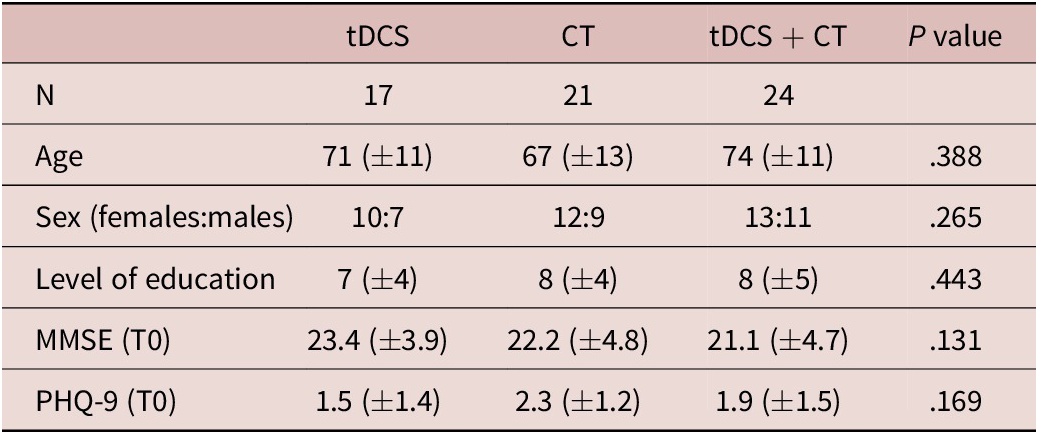
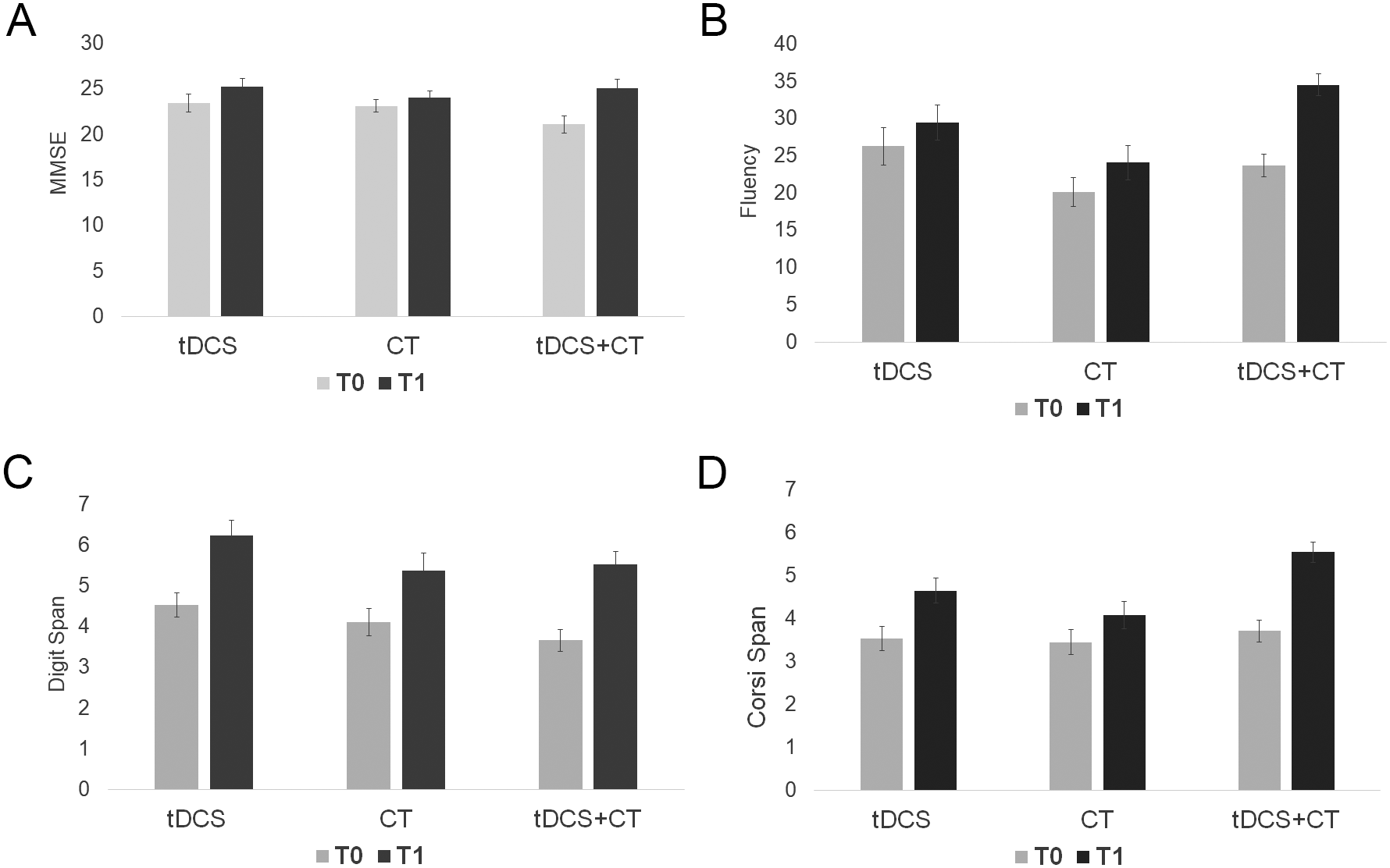
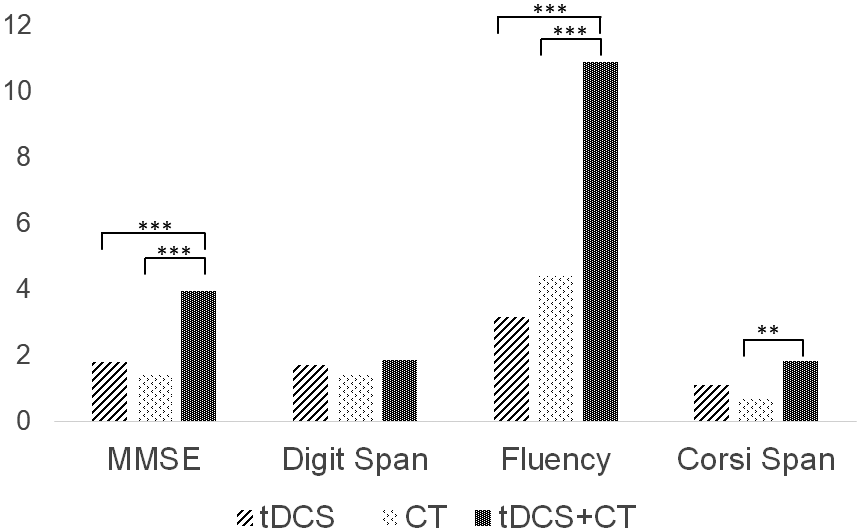
Sixty-two participants have been enrolled in the study (see Table 1 for demographics). Seventeen patients were allocated to the tDCS group, 21 patients were allocated to the CT group, and 24 patients were allocated to the tDCS+CT group. There was no pre-intervention difference across the 3 groups in age, sex, years of education, depression scores, and global cognitive status, as emerging from one-way ANOVAs (Table 1). Figure 1 displays the scores for all outcome measures in T0 and T1, showing an improvement for all measures. This visual impression was confirmed by the ANOVA, which showed a main effect of time for the MMSE (F 1,59 = 119.0, P < .001, = 0.669), digit span (F 1,59 = 62.2, P < .001, = 0.513), Corsi block-tapping test (F 1,59 = 55.7, P < .001, = 0.486), and verbal fluency (F 1,59 = 87.9, P < .001, = 0.599). Crucially, the interaction between group and time was significant for the MMSE (F 2,59 = 21.6, P < .001, = 0.423), Corsi block-tapping test (F 2,59 = 6.61, P = .003, = 0.183), and verbal fluency (F 2,59 = 18.6, P < .001, = 0.387). Post-docs on the 3 outcome measures showed that the tDCS+CT group had larger gains compared to the tDCS group for MMSE and verbal fluency (both P < 0.001), but not for the Corsi block-tapping test (P = .279) (Figure 2). The tDCS+CT group had larger gains compared to the CT group for the MMSE (P < .001), verbal fluency (P < .001) and the Corsi block-tapping task (P = .003). There was no difference between the tDCS and the CT groups (all P > .138).
Demographics and clinical characteristics

Note: Standard deviations are displayed in parentheses; CT, cognitive training; MMSE, mini mental state examination; PHQ-9, patient health questionnaire-9.
Change from T0 to T1 in the 3 groups for the (A) MMSE, (B) fluency, (C) digit span, and (D) Corsi span. Error bars display standard errors; CT, cognitive training.

Intervention gains (difference between post-intervention and pre-intervention) for all outcome measures. CT, cognitive training. **P < .01; ***P < .001.

Discussion
We found that anodal tDCS to the left DLPFC, cognitive training or a combined intervention consisting of both improved global cognitive functioning, verbal short-term memory, visuospatial working memory, and verbal fluency in individuals with MCI. Crucially, the group that received the combined intervention showed larger intervention gains in global cognitive functioning and verbal fluency compared to the group who received tDCS alone or cognitive training alone. The group that received the combined intervention also showed larger intervention gains in visuospatial memory, but only in comparison with the cognitive training group. The effects of the 3 interventions on digit span performance show no differences between them
The finding that anodal tDCS administered over the DLPFC enhanced MMSE scores is in line with studies showing that the stimulation of this brain region across multiple sessions enhances general cognitive statusReference Yun, Song and Chung 14 - Reference Fileccia, Di Stasi and Poda 17 in MCI individuals. Previous studies using multiple sessions of DLPFC stimulation also showed an improvement of verbal fluency, along with subjective memory, short- and long-term recall and figure naming.Reference Yun, Song and Chung 14 , Reference Murugaraja, Shivakumar, Sivakumar, Sinha and Venkatasubramanian 16 - Reference Gomes, Akiba, Gomes, Trevizol, de and Dias 18 The DLPFC is a central processing hub for cognitive functionsReference Miller and Cohen 38 and it is therefore reasonable to assume that the repeated stimulation of this brain region may lead to enhancements in a wide range of cognitive functions. Furthermore, our finding that the group that received cognitive training alone improved in all outcome measures is consistent with previous work showing that cognitive training improves cognitive functioning in MCI.Reference Gonzalez, Fong and Brown 22 - Reference Lu, Chan, Chan, Lin, Cheng and Linda Chiu Wa 26 However, we show that the combination of anodal tDCS and cognitive training leads to the largest gains in cognitive status and verbal fluency. This is consistent with the notion of state-dependency of tDCS effects. tDCS-induced effects are sensitive to the state of the network and modulate the firing of those neurons that are already activated by a given task.Reference Miniussi, Harris and Ruzzoli 20
Our results of larger effects of the combined intervention on global cognitive functioning and verbal fluency are at odds with a number of previous studies,Reference Martin, Mohan and Alonzo 21 - Reference Das, Spence and Aslan 23 and a recent meta-analysisReference Chu, Li and Brunoni 25 showing no advantage of combining cognitive training with anodal PFC tDCS in individuals with MCI or AD. The discrepancy with those studies may be due to the number of sessions/intervals between sessions. Our study involved 20 daily administrations, whereas previous studies administered 2 (see Ref. Reference Das, Spence and Aslan23) or 3 (see Refs. Reference Martin, Mohan and Alonzo21,Reference Gonzalez, Fong and Brown22) sessions weekly. Although the optimal repetition interval for tDCS protocols has not been established yet, our data may suggest that the combination of tDCS and cognitive training may be more beneficial when delivered across several consecutive days, at least in MCI participants.
Alternatively, the combined intervention could be particularly beneficial for some cognitive functions or be more evident using some outcome measures and not others. Indeed, we showed that the 3 groups showed similar intervention gains for the digit span and Corsi block-tapping test scores. This may suggest that the left DLPFC site, although sufficient to induce effects of tDCS alone, failed to incrementally improve short-term span performance above that achieved by tDCS or training alone. It could also be that superior intervention gains of the combined approach are more evident when the outcome measures are closer to the cognitive functions that received anodal tDCS during training. Our cognitive training included a wide range of cognitive functions, including language. However, it did not include any short-term memory span task, either verbal or visuospatial. This may suggest that the effects of combined tDCS and CT interventions decrease linearly with the distance between the trained task and the outcome measure. Further studies are needed to demonstrate which cognitive function shows larger improvements following a combined tDCS and CT intervention.
Conclusion
Our study showed how tDCS to the left DLPFC, cognitive training or a combined intervention consisting of both, represent a valid treatment to improve cognitive functioning in individuals with MCI. Three limitations of the current study are worth mentioning. First, we did not include a sham tDCS group. Although a sham tDCS condition would have allowed us to control for the effects of tDCS, we did not find differences between the tDCS alone and cognitive training alone group. Any placebo effect induced by the stimulation would have resulted in larger gains in both tDCS groups compared to the cognitive training alone group. Another limitation is that group allocation was not random, therefore our results could be subject to allocation bias. The fact that the three groups did not differ at baseline in terms of key demographic characteristics and cognitive status suggests that any impact of allocation bias on the outcome is possibly limited. Future studies will also need to consider individual differences at baseline, including genetic factors and anatomical differences that impact the electric field generated by tDCS. Our data suggest that the reduced practicality of the administration of tDCS combined with cognitive training is justified by increased effectiveness of the combined treatment. These encouraging results also shed light on the possibility of further investigating the effectiveness of tDCS, considering its feasibility as an at-home treatment.
Author Contributions
S.P. developed the idea. All authors made a substantial contribution to the development and writing of this article. S.P. had the final responsibility for the decision to submit for publication.
Disclosures
The authors declare none.
Data Availability Statement
The current study has not been preregistered. Data, analytic methods, and study materials are available to other researchers if requested by email to the corresponding author.