Approximately 370,000 patients undergo coronary artery bypass graft (CABG) surgery annually in US hospitals, 1 with 0.3% to 0.6% of patients subsequently developing deep-chest surgical site infection (SSI), or mediastinitis, following the procedure.Reference ElBardissi, Aranki, Sheng, O’Brien, Greenberg and Gammie 2 – Reference Edwards, Peterson and Mu 4 Patients with mediastinitis experience higher mortality and morbidity, including longer length of stay, greater need for reoperation, more intensive care unit admissions, and more hospital readmissions.Reference Osnabrugge, Speir and Head 3 , Reference Hollenbeak, Murphy, Koenig, Woodward, Dunagan and Fraser 5 – Reference Kirkland, Briggs, Trivette, Wilkinson and Sexton 7 The estimated additional costs associated with mediastinitis range from $19,000 to $56,000 per case.Reference Osnabrugge, Speir and Head 3 , Reference LaPar, Crosby and Rich 8
In 2008, the Centers for Medicare and Medicaid Services (CMS) implemented the “Hospital-Acquired Conditions (HAC) and Present on Admission (POA) Indicator Reporting” program as mandated by the 2005 Deficit Reduction Act. 9 This HAC POA program applies to all hospitals subject to the Inpatient Prospective Payment System (IPPS) and ties its financial penalties to hospital-submitted billing codes. Specifically, it ceases Medicare payments for the additional care required as a result of selected HACs, including mediastinitis following CABG. 10 Prior research on the impact of the 2008 Medicare HAC POA program found that nonpayment for multiple healthcare-associated infections (HAIs), including mediastinitis following CABG, was associated with a decrease in billing code–derived HAI rates, while HAI rates based on standardized surveillance data submitted to the National Healthcare Safety Network (NHSN) did not change.Reference Calderwood, Kleinman and Soumerai 11 – Reference Lee, Kleinman and Soumerai 13 In 2010, the CMS increased the scope of financial penalties tied to hospital HAI rates both by expanding the Medicare HAC POA program to include Medicaid patients and by developing the Value Based Purchasing (VBP) and HAC Reduction programs. 14 – 16 The Medicaid HAC POA program began targeting mediastinitis following CABG for nonreimbursement in 2012, while the VBP and HAC Reduction programs did not introduce any additional financial penalties for this outcome after their implementation in 2014.
The objective of this study was to evaluate the impact of the 2012 Medicaid HAC POA program on reported mediastinitis rates based on prospective surveillance data from the NHSN. We also assessed reported rates of deep-space SSI after knee replacement as a comparison condition not targeted by the program. We hypothesized that the Medicaid HAC POA program would have minimal to no impact on NHSN-reported rates of mediastinitis following CABG and no impact on reported rates of deep-space SSI after knee replacement. This hypothesis was based on the lack of observed impact of the prior 2008 Medicare HAC POA program,Reference Calderwood, Kleinman and Soumerai 11 along with the rarity of mediastinitis events at baseline and minimal nature of anticipated financial penalties incurred as a result of the program.Reference Sorensen, Jarrett, Tant, Bernard and McCall 17
METHODS
Study Population
We obtained prospective NHSN surveillance data from nonfederal acute-care hospitals subject to the Inpatient Prospective Payment System (IPPS) rule and enrolled in the Preventing Avoidable Infectious Complications by Adjusting Payment (PAICAP) study. 18 We included any enrolled hospital reporting mediastinitis following CABG or deep-space SSI after knee replacement to the Centers for Disease Control and Prevention’s (CDC) NHSN using standardized CDC/NHSN surveillance definitions from January 1, 2009, through June 30, 2017.Reference Horan, Andrus and Dudeck 19 For CABG, we included all reported SSI cases classified as mediastinitis. For deep-space SSI after knee replacement, which functioned as our comparison condition, we included all reported SSI cases classified as osteomyelitis, periprosthetic joint infection, or infection of the joint space or bursa. 20 To minimize potential confounding in comparison condition analyses, we explicitly excluded hospitals in states participating in a campaign to improve adherence to evidence-based SSI prevention bundles after knee or hip replacement that was ongoing during the study period.Reference Schneider, Sorbero and Haas 21
To understand whether the NHSN hospitals included in our study are representative of the general population of hospitals performing CABG in the United States, we compared the characteristics of NHSN study hospitals with those reporting CABG outcomes to the Society of Thoracic Surgeons (STS) Adult Cardiac Surgery Database. 22 The STS Adult Cardiac Surgery Database is the world’s premier clinical registry for cardiac surgery, representing approximately 95% of the centers that perform CABG in the United States and capturing 98% of CABG procedures billed to Medicare in 2012.Reference Shahian 23 For the comparison, we included STS hospitals subject to the IPPS rule that reported CABG procedures to the registry between 2013 and 2016 (all available years). We compared hospital characteristics for STS and NHSN study hospitals by linking to the 2011 American Hospital Association Annual Survey Database. 24
Study Design
We used a quasi-experimental interrupted time-series design with comparison group to examine the impact of the Medicaid HAC POA program on reported rates of mediastinitis and deep-space SSI after knee replacement before and after the program, adjusting for secular trends. Inclusion of a comparison condition that affects a similar population but is not anticipated to change in response to program implementation is an accepted method in quasi-experimental study design to combat threats to study validity.Reference Shadish, Cook and Campbell 25 In the primary analysis, we assessed the level and the slope of quarterly rates of both mediastinitis and deep-space SSI of the knee per 1,000 procedures before and after a program implementation “roll-in period.” Given that hospitals may have initiated their response to the program soon after publication of the CMS Final Rule on June 6, 2011, 14 we considered the year prior to the program’s July 1, 2011 enforcement date to be the roll-in period (July 1, 2011 through June 30, 2012), and we did not assess risk of infection during this time in the primary analysis.Reference Lopez Bernal, Cummins and Gasparrini 26 Correspondingly, the preprogram period ranged from January 1, 2009, to June 30, 2011, and the postprogram period ranged from July 1, 2012, through June 30, 2017. The Harvard Pilgrim Health Care Institute Institutional Review Board approved this study.
Statistical Analysis
We used generalized estimating equations with robust sandwich variance estimators to assess whether there was a change in both level and trend for quarterly rates of infection after program implementation. Our models included time (to adjust for secular trends), an indicator of the postprogram implementation period (after July 1, 2012, allowing for evaluation of an immediate program effect), and a 2-way interaction term to determine whether the program resulted in a change in the trend. Finally, for the mediastinitis outcome, we performed a series of sensitivity analyses that (1) treated the Medicaid HAC POA program implementation as a single time point without a preceding roll-in period, (2) limited the analysis to hospitals reporting data to NHSN in both the first and last years of the study period, (3) included effect modification by hospital safety-net status or hospital teaching status, and (4) adjusted for hospital characteristics, including bed size, hospital ownership, and teaching status. When considering program implementation as a single time point, we defined the preprogram period to be January 1, 2009, through June 30, 2012, and the postprogram period to be July 1, 2012, through June 30, 2017. For the deep-space SSI after knee replacement outcome, we performed 2 sensitivity analyses that (1) limited the analysis to hospitals that also reported CABG outcomes and (2) limited the analysis to hospitals that reported knee replacement outcomes in both the first and last years of the study period. We considered P<.05 to be statistically significant, and we did not adjust for multiple comparisons. All analyses were performed using SAS version 9.4 software (SAS Institute, Cary, NC).
RESULTS
Study Population
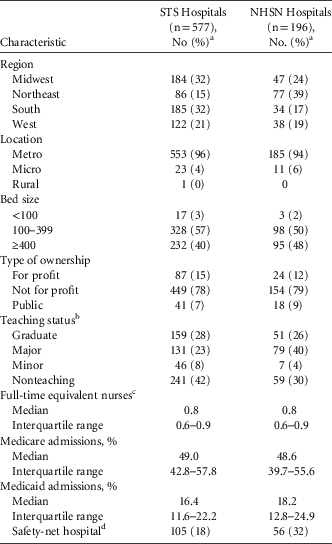
Among the 622 hospitals participating in the PAICAP study between January 1, 2009, and June 30, 2017, and meeting IPPS criteria, 196 hospitals from 35 states reported CABG data to the NHSN. These hospitals reported 273,984 CABG procedures to NHSN during the study period, and mediastinitis occurred following 970 procedures (3.5 cases per 1,000 procedures). In total, 108 hospitals (55%) reported mediastinitis surveillance data to NHSN in both the first and last years of the study period. Table 1 shows the characteristics of hospitals included in the study compared to IPPS hospitals reporting CABG outcomes to the STS Adult Cardiac Surgery Database. Compared to STS Database hospitals, a higher proportion of NHSN study hospitals were located in the Northeast and were major teaching centers or safety-net hospitals. The 2 groups of hospitals were otherwise generally comparable.
Characteristics of Society of Thoracic Surgeons (STS) Adult Cardiac Surgery Registry Hospitals and National Healthcare Safety Network (NHSN) Hospitals Performing Coronary Artery Bypass Graft (CABG) in Our Study Population

NOTE. Data are no. (%) unless otherwise noted.
a Of the 588 hospitals reporting CABG outcomes to the STS Adult Cardiac Surgery Registry, 577 met Inpatient Prospective Payment System (IPPS) criteria.
b All hospitals were placed into 1 of 4 categories based on their response to the American Hospital Association survey: major teaching hospitals (those that are members of the Council of Teaching Hospitals [COTH]), graduate teaching hospitals (non-COTH members with a residency training program approved by the Accreditation Council for Graduate Medical Education), minor teaching hospitals (non-COTH members with a medical school affiliation reported to the American Medical Association), and nonteaching hospitals (all other institutions).
c No. per 100 patient days.
d Safety-net hospitals are defined as those with Disproportionate Share Hospital (DSH) index in the highest quartile out of all US IPPS hospitals reporting into the Centers for Medicare and Medicaid Services 2014 Historic Impact File. Hospital safety-net status was not available for 69 of the STS hospitals and 21 of NHSN study hospitals.
Hospital procedure volume ranged from 1 to 243 CABGs per quarter (median, 41; interquartile range, 22–70). Overall, 168 hospitals (86%) had an average annual surgical volume of ≥50 CABG procedures, which is NHSN threshold for inclusion in the calculation of the standardized infection ratio (SIR), the primary summary measure used for public reporting of HAIs. 27 Mediastinitis is a rare outcome; among the 5,361 hospital-quarters during the study period, 4,615 (86%) reported zero cases and 577 (11%) reported a single case. Most mediastinitis cases were identified on hospital readmission (729, 75%) or postdischarge surveillance (25; 3%), rather than the index surgical admission (216, 22%).
Within the study period, 347 hospitals participating in the PAICAP study met IPPS criteria and reported deep-space SSI after knee replacement outcomes to the NHSN. To reduce confounding in comparison group analyses, we excluded 53 hospitals from states participating in a campaign to improve adherence to evidence-based SSI prevention bundles after knee or hip replacement.Reference Schneider, Sorbero and Haas 21 After the exclusion of campaign-state hospitals, 294 study hospitals remained and were included in comparison group analyses. Included study hospitals reported 555,395 knee replacement procedures during the study period, with 1,751 resulting in deep-space SSIs of the knee (3.2 cases per 1,000 procedures). Just more than half of the hospitals reporting knee replacement outcomes also reported mediastinitis after CABG (167, 57%), and 126 of 294 (43%) of the hospitals reported knee replacement outcomes in both the first and last years of the study period. Furthermore, 40 hospitals (14%) had an average annual surgical volume of ≥50 knee replacement procedures. Like mediastinitis after CABG, most deep-space SSIs after knee replacement cases were identified on hospital readmission (1,565, 89%) or postdischarge surveillance (160, 9%) rather than the index surgical admission (26, 1%).
Impact of the Medicaid HAC POA Program on Reported HAI Rates
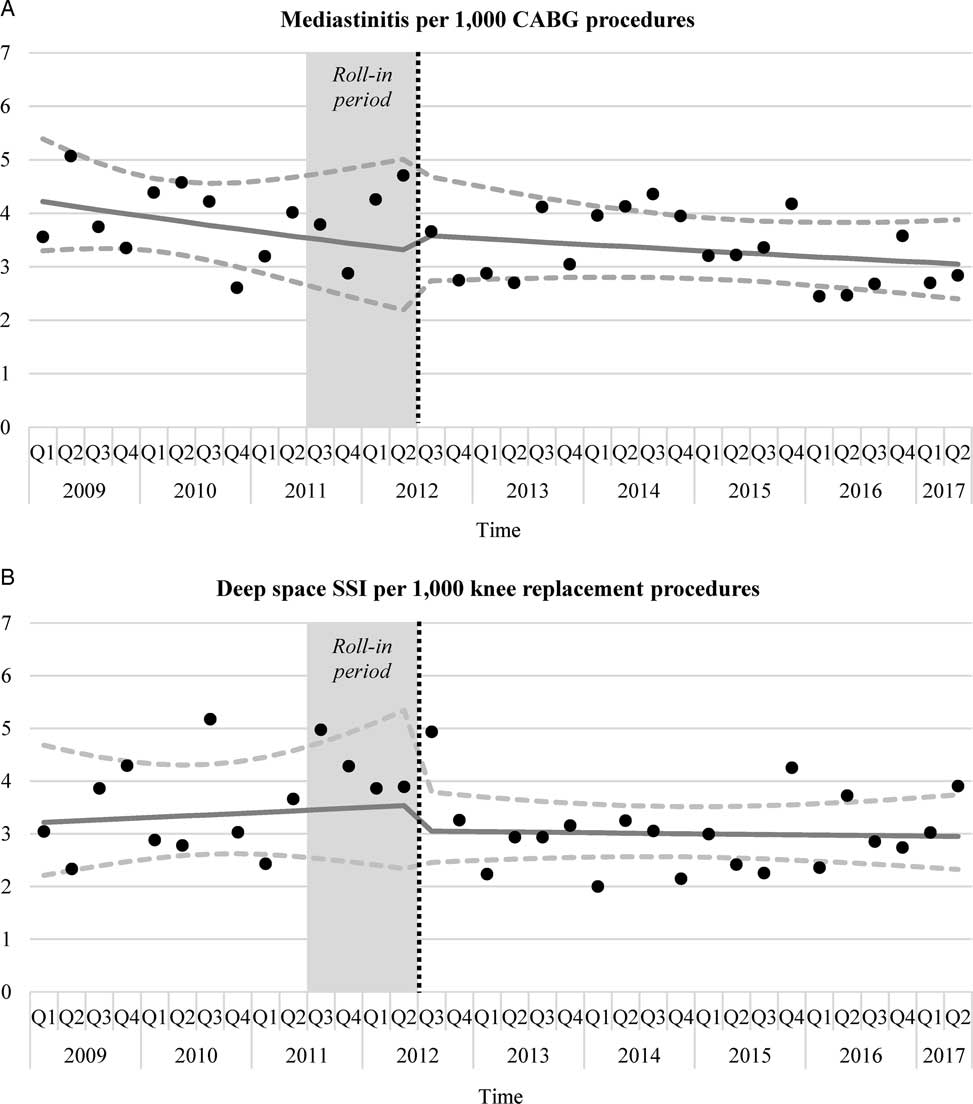
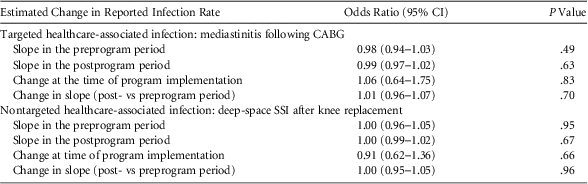
Figure 1A shows a plot of quarterly mediastinitis rates for study hospitals reporting CABG data to the NHSN, demonstrating no visible effect of the Medicaid HAC POA program on reported rates of mediastinitis in NHSN study hospitals. Our model showed no measurable effect of the Medicaid HAC POA program on either trend in the postprogram versus preprogram period (odds ratio [OR], 1.01; 95% confidence interval [CI], 0.96–1.07) or an immediate program effect (OR, 1.06; 95% CI, 0.64–1.75) (Table 2). The risk of mediastinitis remained constant throughout the study period; the odds ratios for the time trend were 0.98 (95% CI, 0.94–1.03) during the preprogram period and 0.99 (95% CI, 0.97–1.02) during the postprogram period.
Reported quarterly rates of infections per 1,000 procedures based on prospective National Healthcare Safety Network surveillance data in all study hospitals. Black circles depict observed infection rates aggregated for all hospitals by quarter. The dark-grey solid line shows predicted values based on models, with 95% upper and lower confidence limits depicted with lighter-grey dashed lines. The vertical black dotted line indicates the start of Medicaid HAC POA program enforcement in July 2012, and it is preceded by a shaded area depicting the program “roll-in period” between the month following program announcement in July 2011 and enforcement. NOTE. CABG, coronary artery bypass graft; Q, quarter; SSI, surgical site infection; HAC, hospital-associated condition; POA, present on admission.

Changes in Reported Quarterly Rates of Mediastinitis Following Coronary Artery Bypass Graft (CABG) and Deep-Space Surgical Site Infection (SSI) after Knee ReplacementFootnote a Over Time

NOTE. CI, confidence interval.
a Deep-space SSI after knee replacement includes infections of the joint or bursa, osteomyelitis, or periprosthetic joint infection.
When we examined deep-space SSIs after knee replacement (Figure 1B), we similarly found no measurable change in trend in the postprogram versus preprogram periods (OR, 1.00; 95% CI, 0.95–1.05) or an immediate decrease in infections coincident with implementation of the Medicaid HAC POA program (OR, 0.91; 95% CI, 0.62–1.36) (Table 2). Likewise, the risk of deep-space SSI after knee replacement remained constant throughout the study period, with no significant trends in the preprogram implementation period (OR, 1.00; 95% CI, 0.96–1.05) or the postprogram period (OR, 1.00; 95% CI, 0.99–1.02).
Sensitivity Analysis
The results of sensitivity analyses performed for mediastinitis following CABG were consistent with the primary analysis. When we treated Medicaid HAC POA program implementation as a single time point rather than incorporating a roll-in period, mediastinitis models showed no measurable effect of the program on either trend in the postprogram versus preprogram period (OR, 0.99; 95% CI, 0.96–1.04; P=.79), an immediate program effect (OR, 0.94; 95% CI, 0.69–1.28; P=.68), or secular trend in either the preprogram implementation period (OR, 1.00; 95% CI, 0.97–1.03) or the postprogram period (OR, 0.99; 95% CI, 0.97–1.01). There continued to be no measurable effect of the program and no significant secular trend when we restricted our analysis to hospitals reporting in both the first and last years of the study period, when we incorporated effect modification by hospital safety-net or teaching status, or when we adjusted for hospital size, teaching status, and type of ownership (data not shown).
The results of our sensitivity analyses performed for deep-space SSIs after knee replacement were also consistent with the primary analysis for this outcome. There continued to be no measurable effect of the Medicaid HAC POA program and no significant secular trend for deep-space SSI after knee replacement when we restricted our analysis to only those hospitals also reporting CABG outcomes or when we restricted our analysis to hospitals reporting in both the first and last years of the study period (data not shown).
DISCUSSION
In this study, we evaluated the impact of the CMS 2012 extension of the 2008 HAC POA program from Medicare to Medicaid on rates of mediastinitis following CABG using prospectively collected surveillance data from 196 hospitals reporting to the CDC’s NHSN. We found that the Medicaid program did not have an impact, either positive or negative, on mediastinitis rates or rates of a comparison condition not targeted by the program. Our results were robust to multiple sensitivity analyses, including adjustment for hospital characteristics, restriction of hospitals to those with more consistent participation in the NHSN during the study period, and incorporation of a policy implementation roll-in period.
While elimination of additional payment for preventable complications occurring during hospitalization may improve the value of inpatient care by reducing unnecessary spending, the Medicare and Medicaid HAC POA programs have failed to demonstrate any direct influence on reductions in preventable harm.Reference Calderwood, Kleinman and Soumerai 11 , Reference Lee, Kleinman and Soumerai 13 , Reference Kwong, Weng and Finnegan 28 For mediastinitis following CABG, there are a number of possible explanations for why the HAC POA programs did not lead to demonstrable decreases in reported rates of this complication. First, both the Medicare and Medicaid HAC POA programs targeted mediastinitis for nonreimbursement during the index surgical admission for CABG. However, our analysis and prior work suggest that most cases of mediastinitis following CABG are identified on readmission, when a hospital would continue to receive full reimbursement for the costs related to the treatment of this complication.Reference Calderwood, Kleinman and Soumerai 11 Second, the HAC POA program attempts to align quality and payment by linking financial penalties to a hospital’s submission of a billing code for a complication that would allow for higher level of reimbursement. While the HAC POA programs may lead to elimination of additional payments for HACs, it does not align incentives for a hospital to redesign care delivery given the incomplete overlap between billing and surveillance rates of complications.Reference Calderwood, Kleinman and Soumerai 11 This disconnect allows hospitals caring for the highest-risk patients with the most comorbid conditions to avoid incurring a net negative financial effect due to nonpayment for mediastinitis following CABG, as more complex patients who develop mediastinitis will have additional billable attributes that allow hospital coders to achieve equivalently high billing groups, even when they are unable to be reimbursed for mediastinitis.
In addition, the highly variable nature of prevalence estimates for extremely rare outcomes like mediastinitis also calls into question their appropriateness as value-based incentive policy targets. Depending on surgical volume, a hospital’s rate of a rare outcome in any given reporting period may not be an accurate representation of the quality of care provided. For example, a rate of 0 mediastinitis cases per 1,000 CABGs is much more meaningful for a surgical center performing 1,000 procedures per year than for a center performing 100 procedures per year. Moreover, longitudinal analyses of hospital claims data for rare HAI outcomes, including mediastinitis following CABG, demonstrate that hospital performance rankings based on the tracking of these outcomes may be highly unstable from year to year.Reference Calderwood, Kleinman, Huang, Murphy, Yokoe and Platt 29 As pay-for-performance and value-based payment policies proliferate, these rankings yield increasing reputational and financial repercussions for hospitals and should be chosen for their reliability and demonstrated association with overall quality of care.
This study has several potential limitations. First, the PAICAP hospitals included in the study represent a subset of all US hospitals performing CABG and reporting mediastinitis outcomes to the NHSN. However, our PAICAP hospitals were generally similar to the hospitals reporting to the STS Adult Cardiac Surgery Database, with the exceptions of region of the country and major teaching status. Furthermore, sensitivity analyses including adjustment for hospital characteristics did not influence model results. Second, the NHSN does not capture information about insurance status for individual patients or patient-level information for surgical procedures that do not result in an HAI. Therefore, we were unable to conduct analyses to determine potential HAC POA program impact within the Medicaid population alone, to risk-adjust infection rates, or to assess unintended consequences of nonreimbursement, such as avoidance of Medicaid or other clinically high-risk patients as surgical candidates. Finally, the rare nature of mediastinitis following CABG presents a challenge in interpreting a negative study on the impact of reimbursement changes, as we may not have had sufficient power to detect small changes over time. In addition, the lack of impact of the program we studied may not be generalizable to more common conditions, which hospitals may deem higher priority for prevention efforts. When monitoring for improvements or complications within hospitals, infection control units often adopt measurement approaches that allow for increased power to detect change over time, such as G charts to track the number of CABG surgeries between rare mediastinitis events.Reference Provost and Murray 30 Due to limitations in the type of data collected by NHSN, we were unable to alter our study design in order to increase power to detect small changes in infection rates.
In conclusion, we found no impact of the 2012 Medicaid program that eliminated additional payments for mediastinitis following CABG on rates of mediastinitis as reported to the NHSN. The advent of public reporting of HACs and their linkage to hospital rankings and reimbursement has increased national awareness of these potentially preventable conditions. Despite the intent by policy makers to improve care value and to reduce preventable harm, our findings provide additional evidence that employing claims-based measures to align quality and payment has yet to translate effectively to decreasing HACs at the hospital level. In addition, our findings highlight the importance of considering the rarity of the outcome targeted for reduction when developing a value-based incentive policy, as well as whether the targeted outcome and the metric directly linked to the policy typically occur within the same hospital admission.
ACKNOWLEDGMENTS
We thank the following hospitals participating in the Preventing Avoidable Infectious Complications by Adjusting Payment (PAICAP) study that provided data for this analysis: Altoona Regional Health System, Altoona, Pennsylvania; Advocate Sherman Hospital, Elgin, Illinois; Bon Secours St Francis Health System, Greenville, South Carolina; Boston Medical Center, Boston, Massachusetts; Capital Region Medical Center, Jefferson City, Missouri; Florida Hospital Carrollwood, Tampa, Florida; Florida Hospital Tampa, Tampa, Florida; INTEGRIS Baptist Medical Center, Oklahoma City, Oklahoma; Maine Medical Center, Portland, Maine; Massachusetts General Hospital, Boston, Massachusetts; Portsmouth Regional Hospital, Portsmouth, New Hampshire; and University of California Irvine Health, Orange, California. All other hospitals contributing data wished to remain anonymous.
Additionally, we are grateful to the members of the PAICAP Scientific Advisory Board for their guidance and input, including Neil Fishman, MD; Patricia Grant, RN, BSN, MS, CIC, FAPIC; Ashish Jha, MD, MPH; Richard Platt, MD, MSc; and Steve Soumerai, ScD.
The views expressed in this article represent those of the authors and not necessarily the views of the Centers for Medicare and Medicaid Services. or the Agency for Healthcare Research and Quality.
Financial support: This project was supported by the Agency for Healthcare Research and Quality (grant nos. T32HS000063 to H.E.H. and K08HS025008 to C.R.). G.M.L. received support from the Agency for Healthcare Research and Quality (grant no. 2R01HS018414-06).
Potential conflicts of interest: None of the authors have any conflicts of interest or financial relationships to disclose.