Introduction
It is widely documented that poor nutrition in childhood has devastating consequences for child growth. Compared with well-nourished children, malnourished children have a weaker immune system, higher risk of mortality and morbidity, reduced physical ability and a deceased chance of reaching their maximum potential height (United Nations Children’s Fund, 2013). Chronic malnutrition in childhood impairs brain development and has inevitable effects on child growth, such as a reduced height-for-age (stunting) for the rest of their life. A child’s poor nutritional status has been linked to poor school performance, which in turn lowers future employment opportunities and income generation, with inter-generational consequences (United Nations Children’s Fund et al., 2012).
Worldwide, undernutrition, including vitamin and mineral deficiencies, contributes to about one-third of all under-5 child deaths, and impairs healthy development and lifelong productivity (United Nations Children’s Fund, 2013). A key indicator of chronic malnutrition is stunting, when children are short for their age group compared with WHO child growth standards. Worldwide, more than 165 million children are stunted, with the highest stunting rates being in Africa and Asia. Wasting – a severe form of malnutrition – is responsible for the death of more than 1.5 million children annually, with the highest prevalence among the poor (United Nations Children’s Fund et al., 2012).
Egypt has the largest number of children under 5 years who are moderately or severely stunted in the Middle East and North Africa, and is 11th worldwide (United Nations Children’s Fund, 2013). According to the 2008 Egypt Demographic and Health Survey (DHS), the child stunting rate in the country reached 29%, with 14% being severely stunted. Statistics reveal significant disparities in child health outcomes by region and economic and socio-demographic characteristics in Egypt (Sharaf & Rashad, Reference Sharaf and Rashad2017).
A growing literature has emerged examining the determinants of child nutritional status in a wide range of countries, and using different econometric methodologies (see, for example, Bassolé, Reference Bassolé2007; Bomela, Reference Bomela2009; Kabubo-Mariara et al., Reference Kabubo-Mariara, Ndenge and Mwabu2009; Mazumdar, Reference Mazumdar2010; Fenske et al., Reference Fenske, Burns, Hothorn and Rehfuess2013; Sweeney et al., Reference Sweeney, Davenport and Grace2013). Previous studies have mostly used linear regression methods to examine the correlates of the conditional mean of the HAZ. Standard linear regressions, like Ordinary Least Squares (OLS) analysis, estimate the effect of different covariates of the conditional mean of the HAZ. This average effect may over- or underestimate the influence of the covariates at different points across the HAZ distribution. Also, this approach may be less informative if the association between the demographic and socioeconomic determinants and the HAZ varies significantly across the HAZ distribution.
Another group of studies has examined the correlates of nutritional status using binary regression models. The shortcoming of these models is that they treat observations that are below or above a threshold level equally, and ignore the intensity of the deviations from that threshold level. Consequently, there could be a statistical loss of information that may be relevant for intervention and health promotion measures. For example, individuals may respond differently to the factors causing nutritional deficiencies, depending on their location in the HAZ distribution. Accordingly, the current study used a quantile regression framework to characterize the heterogeneous association across the different percentiles of the HAZ distribution. This is of particular importance in nutrition research, where attention is focused on certain segments of the HAZ distributions, i.e. the tail ends of the distributions. For example, individuals in the lower percentiles of the HAZ distribution, both moderately stunted and severely stunted, are of more interest to policies aimed at reducing malnutrition and improving children health outcomes.
In a related study, Bassolé (Reference Bassolé2007) used a quantile regression and found a heterogeneous impact of access to public infrastructure, i.e. safe water and health facilities, on child nutritional status in Senegal. In particular, the effect of health facilities was more important to the lowest quantile and was decreasing, and safe water improved child nutritional status up to the 10th percentile at the national level. However, in rural areas, only health facilities had a positive and significant effect on child nutritional status. Fenske et al. (Reference Fenske, Burns, Hothorn and Rehfuess2013) analysed, using cross-sectional data, the determinants of child stunting in India, and examined whether the established focus on the linear effects of single risks was appropriate. They modelled linear, non-linear, spatial and age-varying effects of the stunting determinants using additive quantile regression for four quantiles of the Z-score of standardized height-for-age, and logistic regression for stunting and severe stunting. They found that the differential effects of the child stunting determinants across the HAZ distribution did not play a major role.
In a cross-country study, Bomela (Reference Bomela2009) used cross-sectional data from the DHS, and binary logistic regression analysis to examine the effect of social, economic, health and environmental characteristics on the nutritional status of children in three Central Asian countries: Uzbekistan, Kyrgyzstan and Kazakhstan. The study found that the household size and wealth, birth weight, age of the child, knowledge of oral rehydration therapy, maternal education, number of children under the age of 5 years and source of drinking water were strong predictors of child nutritional status in these countries. Using data from India, and a decomposition analysis, Mazumdar (Reference Mazumdar2010) investigated the linkage between poverty, measured using the wealth index, and inequality in malnutrition. Poverty was found to have a considerable impact on the average rates of malnutrition, explaining more than half of the inequality in malnutrition.
Using pooled data from the DHS, Kabubo-Mariara et al. (Reference Kabubo-Mariara, Ndenge and Mwabu2009) analysed the determinants of children’s nutritional status in Kenya. They found that boys suffered more malnutrition than girls, and children of multiple births were more likely to be malnourished than singletons. They also found that maternal education, the use of public health services and household assets were important determinants of child nutritional status. Liu et al. (Reference Liu, Fang and Zhao2013) examined the degrees of health and nutritional disparities between urban and rural children in China and found that on average urban children had 0.29 higher HAZ scores and 0.19 greater weight-for-age Z-scores than rural children. Urban children were 40% less likely to be stunted or underweight during the period 1989–2006. They also found that the urban–rural health and nutritional disparities have been declining significantly over time.
The objective of this paper was to examine, using data from the 2014 Egypt DHS, the association between demographic and socioeconomic factors and child nutritional status in Egypt, on which limited research has been conducted. The height-for-age Z-score (HAZ) was used to measure child growth and the effect of demographic and socioeconomic factors was examined using quantile regression analysis. The findings of this study should help in the design of effective intervention measures aimed at combating child malnutrition and improving child health outcomes.
Methods
Data
Data were from a nationally representative sample of 13,682 children aged 0–4 years from the most recent round of the Egypt DHS conducted in 2014. The DHS is an international survey conducted in 85 countries. The survey has data on a rich set of indicators in the areas of population, health and nutrition. It has a complex survey design that involves stratification based on the level of urbanization and clustering, where villages are the primary sampling unit for rural areas and districts/towns are the primary sampling unit for urban areas (Ministry of Health and Population et al., 2015).
The multivariate analyses included a set of HAZ determinants commonly used in the literature. These included child characteristics such as age and sex, and maternal and household-level factors, along with other socioeconomic determinants related to the affordability of purchasing nutrition-rich food and living in a healthy environment. In particular, the analyses included child sex, age and weight at birth, whether the child was a twin; mother’s age, level of education, employment status, BMI, access to regular health care during pregnancy and whether a mother was pregnant; household economic status measured by the wealth index, access to piped water, health insurance coverage and region of residence. All analyses were population weighted using the sampling weights provided in the DHS survey, and the survey design was considered in the analysis.
Analysis
The outcome variable of interest was the HAZ score, which is a measure of child growth. There are three key anthropometric indexes for child growth: height-for-age, weight-for-age and weight-for-height. Height-for-age measures a child’s body height relative to age, which reflects cumulative linear growth. Weight-for-age measures body weight relative to age, while weight-for-height measures body weight relative to height. A low height-for-age is referred to as ‘stunting’, and reflects inadequate nutrition for an extended period or chronic malnutrition. Unlike height, body weight is sensitive to short-term changes in diet; thus, it reflects current nutritional status. A low weight-for-height is referred to as ‘wasting’, which is a result of starvation, or illness, and a low weight-for-age is referred to as underweight (O’Donnell et al., Reference O’Donnell and Wagstaff2008).
There are three main approaches to assessing child nutritional status. First, the Z-score is calculated by dividing the difference between the child’s height or weight and the median values for the reference population, at the corresponding age and sex, by the standard deviation (SD) of the reference population. A child with a Z-score less than −2SD is malnourished. The Egyptian DHS uses the WHO’s reference as the reference population. This reference is based on the anthropometric measures of the children of six countries: Brazil, Oman, Ghana, India, USA and Norway (De Haen et al., Reference De Haen, Klasen and Qaim2011). Next, the ‘Percentage of Median’ is calculated by dividing the child’s height or weight by the median value of the reference population at the corresponding age and sex. Finally, the ‘Percentile’ gives the rank of a child with respect to the reference population. The percentile is expressed in terms of what percentage of the reference population a child’s height or weight falls into or exceeds.
Unlike percentiles, the Z-score can be used to generate means and standard deviations. Furthermore, it is a continuous variable, which is fully observed, and could be incorporated directly into regression models. Accordingly, the Z-score is the most convenient and widely adopted measure of child nutritional status.
In this study, the HAZ score was used as a measure of child growth. It is constructed as follows:
 $${\rm HAZ}_{i} {\equals}{{h_{i} {\minus}\bar{h}_{j} } \over {\sigma _{j} }}$$
where h
i
is the observed height of child i , and
 $\bar{h}_{j} $
and
 $\sigma _{j} $
are the median and standard deviations, respectively, of the height of reference group j with corresponding age and sex.
To examine the disparities in child nutritional status by demographic and socioeconomic factors at different points of the conditional HAZ distribution, the following quantile regression was estimated:
 $$Q_{{{\rm HAZ}}} \left( {\mu {\rm \,\mid\,SES}_{i} ,{\rm }X_{i} } \right){\equals}\alpha \left( \mu \right){\plus}{\rm SES}_{i} {\rm }\beta \left( \mu \right){\plus}X_{i} {\rm }\gamma (\mu )$$
where
 $Q_{{{\rm HAZ}}} \left( {\mu {\rm \,\mid\,SES}_{{\rm i}} ,{\rm }X_{i} } \right)$
is the
 $\mu ^{{{\rm th}}} $
conditional HAZ quantile function and
 $\mu $
represents a quantile;
 ${\rm SES}$
denotes parental and household-level socioeconomic status (SES), including mother’s age, employment status, level of education, pregnancy status, nutritional status of the mother, whether the mother had a ‘risky’ birth interval defined as a birth-to-birth interval of less than 24 months and household economic status measured by the wealth index. The symbol X is a vector of other covariates, which includes: child characteristics such as child age, sex and weight at birth; whether the child was a twin, access to piped water, delivery in a health facility, parental health care visits, region of residence, access to health care insurance and whether there were other children under the age of 5 in the household.
Results
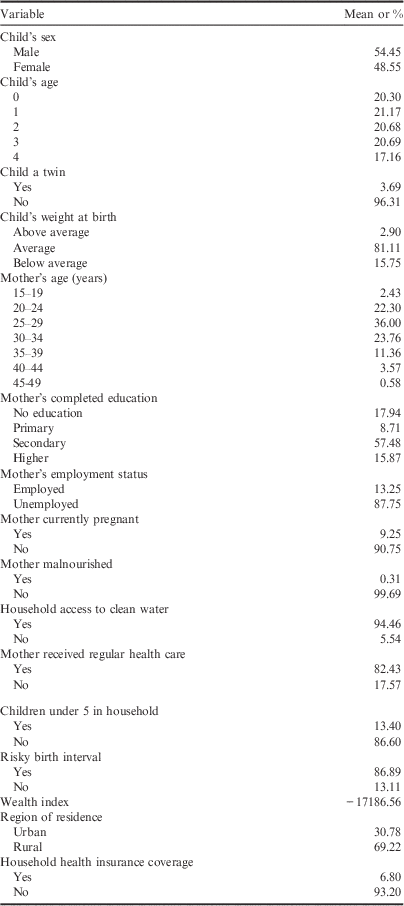
Table 1 presents a summary of the characteristics of the study sample. The mean HAZ score was −0.57, which indicates that, on average, Egyptian children were more than a half standard deviation shorter than the WHO reference population. Of the total sample, 54.5% were boys, 41.47% were aged 1 year or less, 3.7% were twins and 15.75% had a weight at birth that was less than average. As for the mother’s characteristics, about 25% of the mothers were below the age of 24, 36% were aged between 25 and 29 years and 4% were aged between 40 and 49 years. About 88% were unemployed, 9.25% were pregnant at the time of the interview, 0.31% were malnourished, about 18% did not receive regular health care during pregnancy and 87% had a risky birth interval, defined as a birth-to-birth interval of less than 24 months. For mother’s educational level, 18% of the mothers were illiterate, 8.71% had completed primary education, 57.5% had completed secondary education and 16% had more than secondary education. As for the household SES and living environment, about 14% of the households had more than one child under the age of 5, about 6% had no access to clean water, 69.2% lived in rural regions, 93.2% had no health insurance coverage and the average wealth index was −17186.56.
Percentage distribution of the characteristics of the study sample of children aged 0–4 years, Egypt DHS 2014, N=13,682
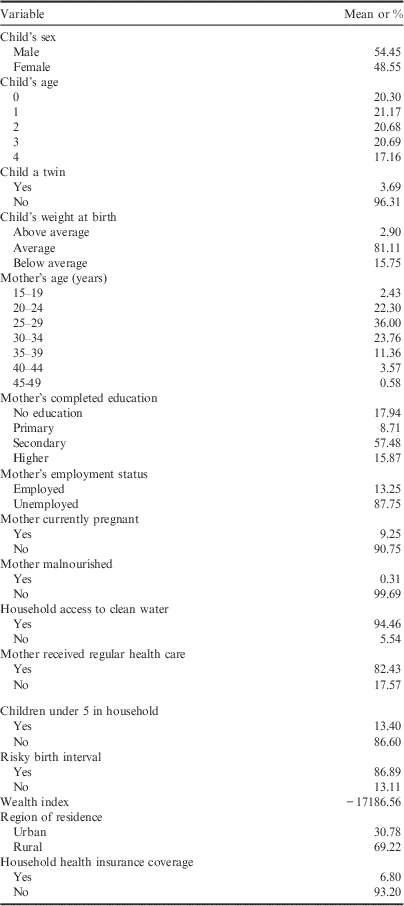
All statistics were population weighted using the sampling weights in the Egypt DHS.
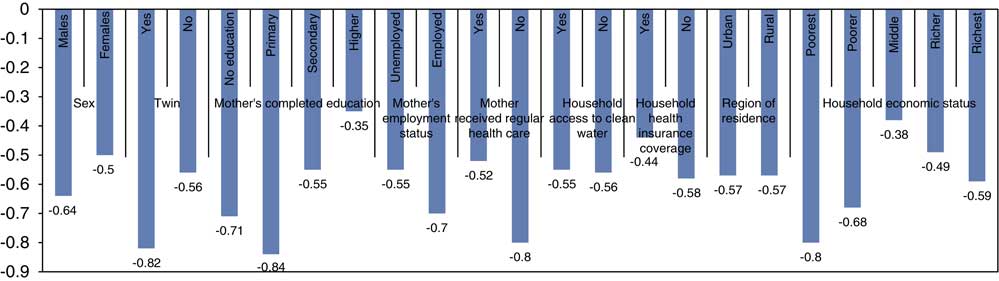
Figure 1 shows the disparities in the HAZ score by selected demographic and socioeconomic characteristics. According to this unconditional analysis, boys had a greater height disadvantage compared with girls. The figure also shows the standard SES gradient in child health, where children from households with higher SES have a lower height disadvantage when compared with children from households with lower SES. For example, the height disadvantage decreased with mother’s level of education: higher education (−0.355), secondary education (−0.548) and primary education (−0.843). The relationship between household income level and HAZ had an inverted U-shape pattern, with the biggest height disadvantage for children from the poorest households and the lowest disadvantage for children from the middle-income class. Figure 1 also shows that there were no statistically significant differences in the HAZ scores between urban and rural children. The height disadvantage, relative to the reference population, was lower for children with access to clean water and health insurance coverage, and for those whose mothers received regular health care during pregnancy and whose mothers were unemployed.
Disparities in the HAZ score by selected demographic and socioeconomic characteristics. Source: authors’ calculations based on data from the 2014 Egypt DHS.
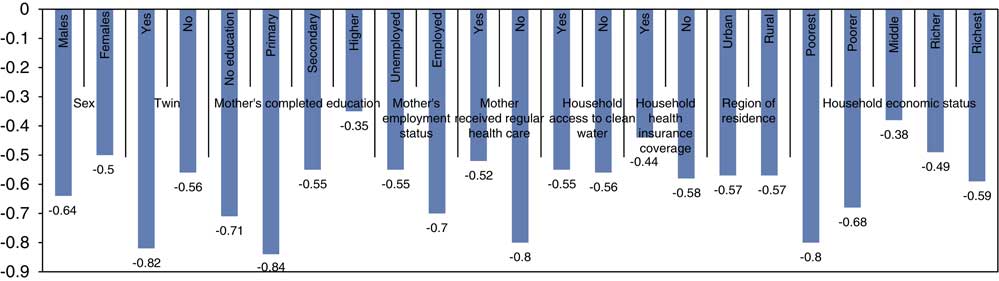
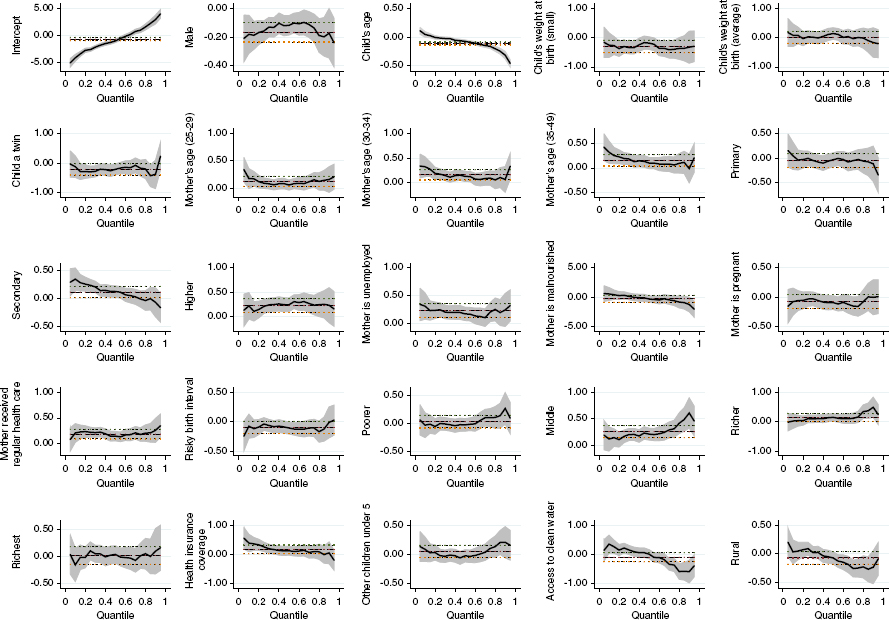
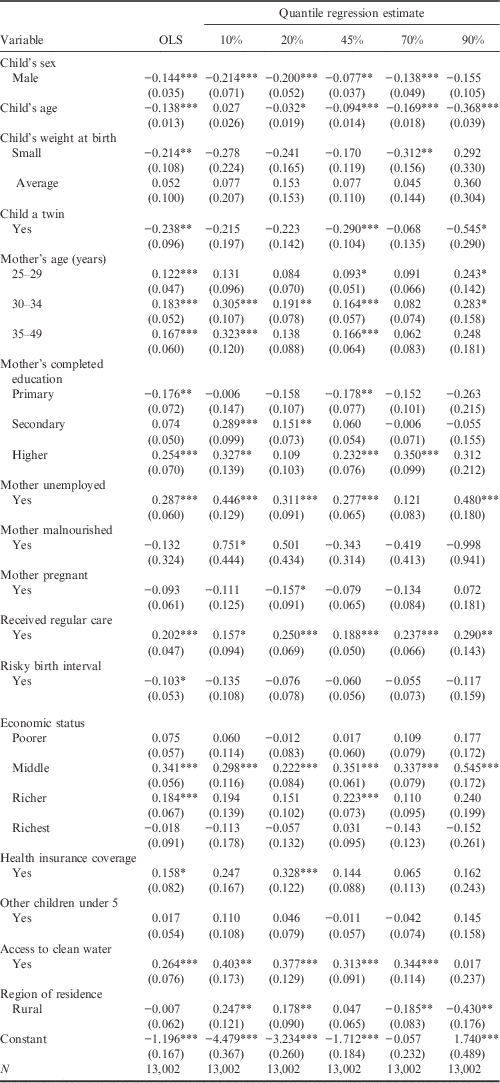
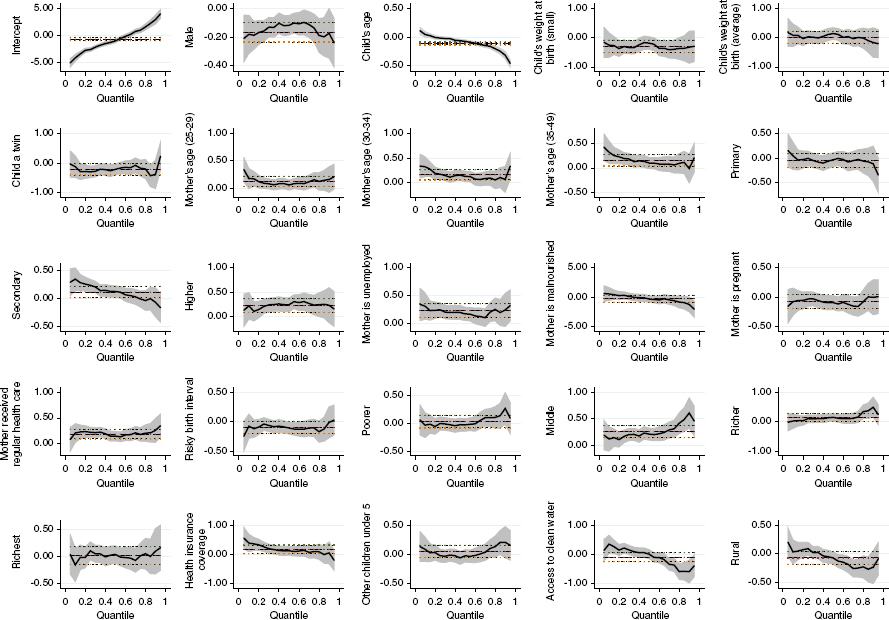
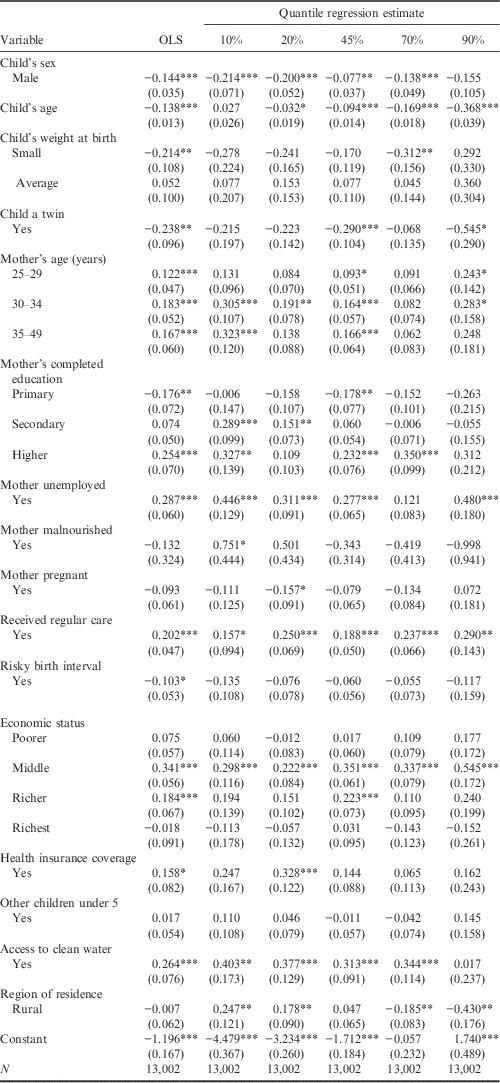
Table 2 presents the results of the OLS model as a baseline, as well as the quantile regression estimates at five selected percentile levels (10%, 20%, 45%, 70% and 90%). Based on the cumulative probability distribution of the HAZ score, these percentile cut-offs were selected to correspond to the WHO child growth references. Specifically, the selected percentiles corresponded to each standard deviation (SD) unit from the mean age–sex standardized HAZ of the well-nourished WHO reference population. In the sample, 9.91% of the children were severely stunted (HAZ<−3), 11% were moderately stunted (−3<HAZ<−2), 22% were marginally stunted (−2≤HAZ≤−1), 25% were well-nourished (−1<HAZ<0) and 20% had a HAZ score of between 0 and +2. In addition to the selected percentiles in Table 2, Fig. 2 shows the heterogenous effect of the demographic and socioeconomic determinants across the entire conditional HAZ distribution.
Ordinary Least Squares (OLS) and quantile regression estimates for HAZ determinants
Results of OLS and quantile regression analysis of the demographic and socioeconomic determinants of child nutritional status (dependent variable HAZ), Egypt DHS 2014
Standard errors are in parentheses. The estimates are population weighted using the Egypt DHS sampling weight.
***p<0.01; **p<0.05; *p<0.1.
The results of the baseline OLS model showed that, on average, boys had a 0.14 SD disadvantage over girls in terms of height. There was a statistically significant negative association between HAZ and child’s age. As the age of a child increased by one extra year, the HAZ decreased by 0.13 SD. Older children had a worse HAZ, which could be because the height disadvantage of Egyptian children relative to the international standard increases over time. Twin children were 0.23 SD shorter compared with non-twin children. A child’s weight at birth was also significantly associated with their HAZ, where small children were 0.21 SD shorter than big children.
Having health insurance was also found to have a statistically significant positive association with HAZ, where children from households with health insurance coverage were 0.15 SD taller than those from households with no health insurance.
The results of the OLS showed that mother’s malnourishment and pregnancy status had a negative, though not statistically significant, association with child height. This was, in general, similar to the results of the quantile regression. However, the quantile regression showed that the coefficient of mother’s pregnancy status was negative and statistically significant at the 10th percentile, and the coefficients of mother’s malnourishment had a positive sign at lower percentiles (10% and 20%), and switched sign at higher percentiles, but still all the coefficients were not statistically significant at all the percentiles. While rather surprising and counterintuitive, the positive sign of the mother’s malnourishment dummy at the lower percentiles could be attributed to the very small percentage of mothers who were malnourished in the sample (about 0.3%), which could lead to an inaccurate estimate of the effect of mother’s nutritional status.
Both the OLS and quantile regression models showed that a risky birth interval had a negative association with child HAZ, which highlights the importance of birth spacing and family planning measures. Consistent with the results of the OLS, the quantile regression estimates showed a positive association between health insurance and HAZ. However, this was only statistically significant at the 20th percentile, indicating that adequate health insurance coverage could be an effective measure to combat child stunting. As for the effect of maternal level of education, children whose mothers had a higher education were 0.25 SD taller than children whose mothers were illiterate. Children whose mothers were unemployed were 0.28 SD taller than children whose mothers were employed. Mother’s age had a statistically significant positive association with HAZ; children whose mothers were older (25–29, 30–34 and 35–49 years) had a higher HAZ than younger mothers (15–24 years old). Compared with mothers who were between 15 and 24 years old, women in the age ranges 25–29 and 30–34 years had children who were taller: 0.12 and 0.18 SD respectively. Receiving regular health care during pregnancy was positively and significantly associated with HAZ. Women who received regular health care during pregnancy had children who were 0.20 SD taller than those who did not receive regular health care.
Studies have shown that household income is an important determinant of child health. Wealthier households can afford better medical care and more nutritious food and can provide a healthier living environment. Consistent with this, both the OLS and quantile regression results showed a positive association between household economic status and HAZ. Children from middle-income and richer households had higher HAZ scores compared with those from the poorest households. In particular, children from middle-income and richer households had a 0.34 and 0.18 SD advantage in terms of height over children from the poorest households. To capture the effect of healthy environment, a dummy for whether the household has access to clean water was included. The results showed that children with access to clean water were, on average, 0.26 SD taller than children with no access to clean water.
Figure 2 displays the OLS and quantile regression estimates for the HAZ determinants across the entire HAZ distribution. The quantile regression reveals the heterogeneous responses of a child’s HAZ to the various socioeconomic and demographic characteristics at different tails of the HAZ distribution. The figure shows that the OLS model understated (overstated) the effects of access to clean water, region of residence, mother’s nutritional status and access to health insurance on the HAZ at the lower (higher) quantiles of the conditional HAZ distribution.
Although child’s age was found to have a statistically significant negative association with HAZ score, the extent of this association varied across the different segments of the conditional HAZ distribution. The age coefficient increased in absolute value for children at higher points of the conditional HAZ distribution. For example, the age coefficient at the 90th percentile was almost eleven times the estimate at the 20th percentile. Also, though the results of both the OLS and quantile regression showed that access to clean water was positively associated with the HAZ score, the extent of this association also varied across the conditional HAZ distribution. The coefficient of the access to clean water variable decreased in magnitude on moving to higher points of the conditional HAZ distribution. This suggests that access to clean water would help reduce the child stunting rate in Egypt.
As for place of residence, the OLS model showed no statistically significant difference in the HAZ score between urban and rural children, though the coefficient of the rural dummy variable was negative. However, the quantile regression showed statistically significant regional differences in the HAZ score in favour of the rural (urban) children at lower (higher) percentiles of the conditional HAZ distribution. While it might be less clear as to why rural children had a height advantage over urban children at lower percentiles of the conditional HAZ distribution, this result was mainly derived by the way the place of residence variable was construted in the DHS. The DHS pools all urban areas in Upper and Lower Egypt, and the main urban governorates (Alexandria, Cairo, Port Said, Suez) into one category. However, the two-category classification of place of residence into urban versus rural may mask important regional differences between Upper and Lower Egypt. For example, the prevalence of stunting in the urban areas of Upper Egypt was about 30%, compared with 19% in the main urban governorates (Alexandria, Cairo, Port Said, Suez), 17% in rural areas in Lower Egypt and 25% in rural areas in Upper Egypt.
Socioeconomic status, usually measured by income and education level, has been consistently linked to nutritional status. Level of income affects the amount of financial resources available for healthy and nutritious food. Educational attainment affects nutritional knowledge and awareness about the benefits of physical activity. In line with the unconditional analysis, results from the OLS and quantile regressions revealed a SES gradient in HAZ, where children from high-income families, and those whose mothers had a higher level of education, had higher HAZ scores compared with those from lower SES families. The extent of this SES gradient varied across the different percentiles of the conditional HAZ distribution. As for the association between economic status and the HAZ score, the results were mixed. Consistent with the results of the OLS model, the quantile regression showed no statistically significant difference in HAZ score between children from the poorer and richest households and children from the poorest families. However, children from middle-income and richer households had higher HAZ scores compared with children from the poorest households. This is consistent with earlier evidence that income level matters, to a certain degree, in health disparities. The quantile regression showed that children from richer families had a statistically significant height advantage over the poorest children only at the 45th percentile of the conditional HAZ distribution.
Discussion
There is a substantial literature examining the determinants of child nutritional status in a wide range of countries, and using different econometric methods. However, previous studies have mostly used standard multiple linear or logistic regressions. The use of these estimation methods may lead to incorrect policy intervention measures if the association between child nutritional status and the different demographic and socioeconomic determinants is heterogeneous at the different percentiles of the nutritional distribution. To overcome this limitation, this study utilized a quantile regression model to investigate the disparities in child nutritional status by demographic and socioeconomic factors in Egypt at different points of the conditional HAZ distribution. The results of the conditional and unconditional analyses showed the existence of a socioeconomic gradient in child nutritional status, in which children of low income/education families had worse HAZ scores than children from high income/education households. Significant disparities in child nutritional status by demographic and social characteristics were also found. The quantile regression results showed that the association between the demographic and socioeconomic determinants and HAZ differed along the conditional HAZ distribution.
Several reasons have been presented in the literature to explain the observed disparities in child nutritional status by demographic and socioeconomic characteristics (see e.g. Kabubo-Mariara et al., Reference Kabubo-Mariara, Ndenge and Mwabu2009; Chen & Li, Reference Chen and Li2009). For example, it has been suggested that educational attainment affects nutritional knowledge and awareness about the risks associated with inadequate nutrition. Previous studies have found that educated mothers could feed their children better, as they are more skilled and could benefit more effectively from health care providers and health care information, and they are more aware of nutrition-rich food and the importance of a hygienic living environment. In an earlier study, Chen and Li (Reference Chen and Li2009), using data on a large sample of adopted children from China, found that mother’s education had a causal nurturing effect on the health of adopted children, as measured by HAZ.
Wealth status, a key socioeconomic determinant, has been consistently linked to health outcomes such as malnutrition, as it is directly related to the affordability of nutrition-rich food, living in a healthy environment and access to health care services. Consistent with this earlier evidence, both the OLS and quantile regression results in the present study showed a positive association between household economic status and HAZ. Children from middle-income and richer households had higher HAZ scores when compared with the poorest households. A lack of satisfactory sanitation and safe water supply expose children to the risk of diseases and infections.
In a recent study, Rashad and Sharaf (Reference Rashad and Sharaf2016) found that child- and household-level characteristics, including child age, sex, birth interval of the child, parental education and household economic status were more important than aggregate economic conditions (as proxied by economic growth and the Gini Index of income inequality) in explaining malnutrition rates in Egypt.
The present results showed that receiving regular health care during pregnancy was positively and significantly associated with HAZ. Studies have shown that antenatal care is negatively associated with child malnutrition, as it can treat and protect mothers and babies from iron deficiency, anaemia and other diseases. Also, it helps to identify whether a mother needs special care during delivery. Delivery at a health facility helps prevent harmful health consequences like infections and pregnancy complications. Also, it provides necessary information for adequate food intake for the baby and the mother.
Access to health insurance has been consistently linked to better health outcomes. In line with this, the study results showed that health insurance was positively associated with HAZ. The lack of efficient universal health insurance coverage exposes a substantial fraction of the Egyptian population to financial risks in the case of illness. According to the 7th round of the Egyptian Family Observatory Survey, 80% of households have at least one member covered by public health insurance. Nonetheless, only 25% of households are benefiting from it, due to the low quality of services and excessive red tape. Households with no adequate health care insurance rely on out-of-pocket health payments (OOP) to finance health care spending, which could expose them to financial catastrophe if these payments are excessive and for prolonged periods (Rashad & Sharaf, Reference Rashad and Sharaf2015a,Reference Rashad and Sharafb). Statistics show that OOP account for 60% of the health spending in Egypt. In a recent study, Rashad and Sharaf (Reference Rashad and Sharaf2015b) found that OOP affect households severely in Egypt, pushing more than 20% of the population into a financial catastrophe and a significant proportion of the population into extreme poverty.
Both the unconditional and conditional analyses showed that boys had a greater height disadvantage compared with girls, which is consistent with the findings of several previous studies. In a meta-analysis of sixteen DHS, Wamani et al. (Reference Wamani, Åstrøm, Peterson, Tumwine and Tylleskär2007) examined whether there were systematic sex differences in stunting rates in children under 5 years of age in sub-Saharan Africa, where male children of this age are more likely to become stunted than females. The pooled estimates for mean Z-scores were −1.59 for boys and −1.46 for girls, and the difference was statistically significant. They also found that the sex differences in stunting were more pronounced in the lowest SES groups.
The analysis showed that children of unemployed mothers were taller than those of employed mothers. This finding is in line with the findings of several previous studies. For example, using an Instrumental Variable Two Stage Least Squares approach and propensity score matching, Rashad and Sharaf (Reference Rashad and Sharaf2017) found that maternal employment had a robust negative impact on child nutritional status as measured by the HAZ score in Egypt. Maternal employment increases family income, which could enable a family to afford rich-nutritious food, and hence it enhances child nutritional status. However, maternal employment could have a negative effect on the nutritional status of children as it decreases the time mothers can devote to their children’s care, feeding, breast-feeding, preparation of nutrition-rich food and taking their children regularly to health care providers. Also, maternal employment not only reduces the quantity of maternal time but could also reduce the quality of it. If mothers are engaged in stressful working conditions with long working hours, they are subject to exhaustion and stress, which in turn affects the quality of maternal time (Cawley & Liu, Reference Cawley and Liu2012).
The results of the quantile regression showed statistically significant regional differences in the HAZ score in favour of urban children at higher segments of the conditional HAZ distribution. The height advantage of urban children is consistent with the findings of several earlier studies. For example, using a Blinder–Oaxaca decomposition analysis, Sharaf and Rashad (Reference Sharaf and Rashad2016) investigated the underlying factors that account for the regional disparities in child malnutrition in Egypt, Jordan and Yemen. They found that income inequality between urban and rural households explained most of the malnutrition gap.
The results of the OLS and quantile regression showed that child-specific characteristics were important and significant determinants of nutritional status. In particular, boys, older children and children whose weight at birth was small had a nutritional disadvantage in height compared with their counterparts. Also, being a twin was found to be inversely related to children’s nutritional status, suggesting competition for food among siblings. Also, children’s nutritional status improved with the age of the mother, highlighting the importance of reducing teenage births. Mother’s nutritional status was also associated, though not statistically significantly, with children’s nutrition, indicating the importance of genetics and phenotype in influencing the stature of children.
Household economic status, measured by the wealth index, portrayed a statistically significant inverted U-shaped relationship with children’s height, implying that nutritional outcomes improve at a decreasing rate with wealth. Several studies have documented a similar inverted U-shaped relationship between household income and body weight. This inverted U-shaped relationship has been explained by the offsetting effects of the demand for food, and the demand for an ideal nutritional outcome (Lakdawalla & Philipson, Reference Lakdawalla and Philipson2009). As income increases, individuals increase their demand for food, and consequently their weight increases. After a certain income threshold, rich households either consume higher quality foods that are more nutritious or pursue health-related activities, and the income–weight relation becomes negative (Akee et al., Reference Akee, Simeonova, Copeland, Angold and Costello2013). Several theoretical models have been presented in the literature to explain this relationship. For example, Philipson and Posner (Reference Philipson and Posner2003) developed a theoretical model and argued that the weight–income relation will have an inverted U-shape only when the effect of food consumption on the marginal disutility of weight gains rises with income. When food prices are low, people face a trade-off between increasing their calorie intake and having an ideal weight. If high-income individuals care more about their health and hence weight, they limit their weight more. When food prices are high relative to incomes, low-income individuals are underweight because they cannot afford a sufficient caloric intake, while wealthier individuals forgo other consumption to maintain or gain weight (Philipson & Posner, Reference Philipson and Posner2003). Since the fraction of income spent on food differs across income levels, and based on Philipson and Posner (Reference Philipson and Posner2003) model, within a country children of low-income families who face relatively high food prices will have a positive relation between wealth level and nutritional outcomes, while children of rich families who face relatively low food prices will have a negative relationship between wealth and nutritional outcomes.
One limitation of the current study was the cross-sectional design of the DHS dataset. This limits the ability to infer causality and does not allow for the control of unobserved factors that may affect a child’s nutritional status. This calls for further research using longitudinal data.
Understanding how underlying demographic and socioeconomic determinants affect the nutritional status of children helps to identify target groups for nutrition promotion policies aimed at combating child malnutrition. Intervention measures need to take into account the heterogeneous effect of the determinants of child nutritional status along the different percentiles of the HAZ distribution. There is no one-size-fits-all policy to combat child malnutrition; a multifaceted approach and targeted intervention measures are required to address this problem effectively. For example, increasing families’ awareness of appropriate feeding practices, through the media and other community nutrition programmes, as well as subsidizing the cost of nutrition-rich food and implementing universal health care coverage, could be helpful in combating child malnutrition, especially among households in low socioeconomic strata.
Acknowledgment
The authors would like to thank the anonymous reviewers and editor of this journal for their invaluable comments and suggestions, which substantially improved the manuscript.
Ethical Approval. The authors assert that all procedures contributing to this work comply with the ethical standards of the relevant national and institutional committees on human experimentation and with the Helsinki Declaration of 1975, as revised in 2008.
Conflicts of Interest. The authors have no conflicts of interest to declare.
Funding. This research received no specific grant from any funding agency, commercial entity or not-for-profit organization.