Restoring contact between families separated by humanitarian crises is at the heart of the International Red Cross and Red Crescent Movement's identity. The Movement's founder, Henry Dunant, wrote of taking a message from dying soldier Claudius Mazuet to his parents in A Memory of Solferino. Footnote 1 Since then, the Movement has developed a worldwide Family Links Network of National Societies and International Committee of the Red Cross (ICRC) delegations, led and coordinated by the Central Tracing AgencyFootnote 2 (CTA), a permanently established division of the ICRC. Restoring family links (RFL) and clarifying the fate of missing persons are cornerstones of the Movement's work.
However, the contexts in which these services are delivered have undergone significant changes in the past 150 years, and particularly over the last two decades. The ICRC has gone from being the world's principal international humanitarian organisation to being one actor among many on an increasingly crowded humanitarian stage. United Nations (UN) bodies, non-governmental organisations (NGOs), and government agencies have arrived in significant numbers in the field of humanitarian work.Footnote 3 In addition, as situations of protracted crises have become the norm, and the intrinsic links between poverty and security better identified, the spheres of humanitarian relief and long-term development have become increasingly linked.Footnote 4 Concurrently, information and communication technologies have developed at a rapid pace, changing fundamentally the way people communicate and share data. Many of the new humanitarian actors bring expertise and promotion of new tools, and are continually seeking new ways to apply them to the humanitarian field.
Amidst this changing landscape, the ICRC is increasingly challenged to carve out its place in a crowded and fast-moving environment, and to identify how it can most effectively provide needed support to beneficiaries amidst and in coordination with other actors. This challenge is particularly evident in the context of the ICRC's work to respond to the needs of families separated by humanitarian crises.
This article will examine the way in which the ICRC has adapted the tools it uses to restore and maintain contact, and has tried to make the most of technological advances when these tools can better fulfil a humanitarian need than the old tools. It will also show how the ICRC has adapted its policy and approach, in line with the growing recognition that humanitarian relief and development are inextricably linked, and that humanitarian relief can lay the foundation for effective and sustainable development.Footnote 5 This is particularly evident in the ICRC's work with families for whom it is not possible to restore contact or to clarify the fate of a missing family member. In this area, programming has expanded in response to the recognition that families’ needs extend beyond immediate post-conflict support, and that addressing these longer-term issues can help form the foundation of a more stable and peaceful community. The article concludes that in order to adapt and evolve, the ICRC will need to place a continued emphasis on its traditional strengths, but also explore avenues of cooperation with other actors in order to fill gaps, develop the most efficient technologies, and work to connect the ICRC's immediate humanitarian relief with longer-term responses and development efforts.
RFL tools and technology
I must have sent nearly 500,000 Red Cross Messages. But that was Georgia soon after the Georgia/Abkhazia conflict. There were no means for families to communicate with their beloved ones, left on the other side. Twice a week I was waiting for the Red Cross Messages to arrive, it was fascinating. And what is the Central Tracing Agency now? What do people need us for when most people have a phone and access to the internet and social networks? It's all changed.Footnote 6
From the Red Cross Messages to video calls, the ICRC has worked since its creation to put people in touch with their loved ones during times of conflict or natural disaster. Helping loved ones connect with their families during times of crisis is a valuable service that can serve to bring some measure of stability and comfort to the lives of people who are otherwise experiencing significant trauma. Working to prevent separation, and when it does occur to reconnect and if possible reunite families, is an important step in alleviating suffering and, in the long term, bringing a measure of stability back to society, and for this reason RFL services have always been at the core of the ICRC's work.
Over the past few decades, the landscape of communications has changed significantly with the advent of new technologies. This has necessarily changed the ICRC's approach to RFL services. The ICRC now uses three key tools to restore family links: Red Cross Messages (RCMs), telephone calls, and the RFL website.Footnote 7 These three examples demarcate three clear steps in the history of communication, and also demonstrate different ways in which the ICRC has adapted in order to stay relevant and useful: in the first case, by limiting the use of an ‘old tool’ to specific contexts; in the second case, by introducing a ‘new’ tool; and in the third case, by establishing a new online capacity amid a growing number of digital ‘competitors’. Technology is increasingly offering new and better ways to connect with beneficiaries, and questions have arisen about whether the ICRC is using these new technologies and tools as effectively as possible. Ultimately, this section concludes that while it is critical for the ICRC to adopt and utilise new tools as much as possible, in some cases the most efficient way to do this may not be working to grow in-house capacity, but might instead be developing cooperative relationships with other actors who already possess technological expertise.
The Red Cross Message
The birth of the Red Cross Message as we know it today can be traced back to a series of bodies established by the ICRC over the course of the early twentieth century, beginning with the Information Bureau of the International Agency for Relief to the Wounded and Sick, established in response to the Franco-Prussian War of 1870.Footnote 8 Set up in the neutral city of Basel, this bureau compiled lists of prisoners to share between the sides and helped prisoners to send letters to their families. A similar effort was undertaken several years later in the Balkans, when in 1912 the ICRC organised the International Agency of Belgrade that worked to help families send packages to family members who were being held as prisoners. During the First World War, the ICRC set up the International Agency of Prisoners of War as provided for by the 1907 Hague Convention. By the close of the war, the Agency had handled seven million records, including exchange of letters, packages, and tracing requests.Footnote 9
Following this, the ICRC established the Central Prisoners of War Agency (hereinafter the Central Agency) during the Second World War. The Central Agency was set up to receive and record data on prisoners of war from belligerent governments and to use this information to respond to enquiries from the prisoners’ families, who wanted news of their loved ones. It also acted as an intermediary for the transmission of letters, messages, photographs, and other documents. By the end of 1946, the Agency had ‘received and forwarded more than twenty million letters and cards addressed to prisoners of war and interned civilians’.Footnote 10
In response to the massive workload, the Central Agency introduced several standardised message forms – the telegraphic message, the express message, and the civilian message.Footnote 11 The first two were available only to prisoners of war and interned civilians, while the third was available to civilians separated from their loved ones. Telegraphic messages, although theoretically offering the most efficient means of communication, had limited utility since prisoners of war were rarely granted permission to send telegrams. Express messages, for their part, worked more effectively. These messages were available to prisoners of war who had not had news from their family for more than three months. They were printed on airmail paper with the ICRC heading and were forwarded by the fastest means possible. In countries where this service was permitted, the censor also prioritised these messages over ordinary mail. Finally, civilian messages were 25-word messages available for civilians wishing to correspond with family living in enemy territory, distributed and collected by the National Societies, who then sent them to the Central Agency. When a message could not be delivered because the person had moved, the National Society would make an enquiry as to the whereabouts of that person.Footnote 12
Red Cross Messages are processed at the Central Agency during the Second World War, 1943. © ICRC photo library.

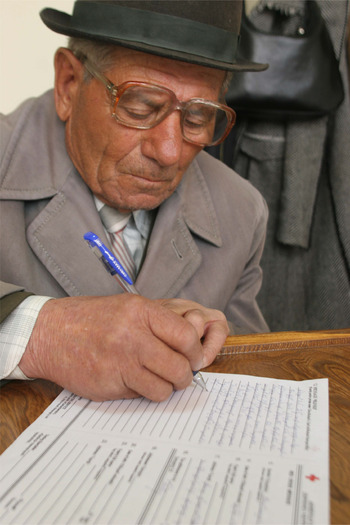
A Red Cross Message is filled in by an Armenian father looking for his son, 2005. © ICRC/Boris Heger.

Although the layout has changed, today's RCM is still a simple standardised form used to record basic information about the sender and addressee, with space for a personal message. Filled in by hand and transmitted between offices of the ICRC and/or National Societies via national postal and courier services, the RCM is still very much the same as it has always been. The question, then, is how relevant are RCMs today? What value can a system based on ‘snail mail’ add in today's technological age?
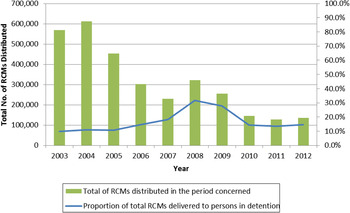
The ICRC's data, displayed in Chart 1, show that the use of RCMs has steadily fallen over the past decade. However, they have not disappeared altogether. This is arguably because there are two notable scenarios in which RCMs remain singularly useful.
Total number of Red Cross Messages distributed, 2003–2012. Also showing the proportion of total RCMs delivered to detainees, 2003–2012. Source: ICRC Protection Data.

The first scenario is detention. While the total number of RCMs distributed has decreased since 2003, the number of RCMs being distributed to persons in detention has not decreased at the same rate; the percentage share has increased from around 10 to 15 per cent since 2003. This suggests that, at least in some detention facilities, RCMs continue to be the method of choice for passing family news. The fact remains today that, for some detainees visited by the ICRC, family communication is not facilitated, either due to a lack of resources or to a lack of willingness on the part of the detaining authorities. In such cases, RCMs may be the only way for detainees to communicate with the outside world. In addition, RCMs offer a number of advantages to detaining authorities in comparison to telephones, including the fact that they are open letters and can be censored. Therefore, RCMs may be better received than telephone calls as a method of communicating family news in situations where there is a high level of distrust between the detained persons and the detaining authorities.
Even where other options would be permitted by the authorities, RCMs may remain useful when the families of detainees have limited access to other forms of communication. For example, the ICRC reported in 2004 that, in Sierra Leone, ‘[a]lthough detainees were allowed family visits and telephone contact with relatives, their need for the RCM service remained significant, particularly for up-country or distant destinations’.Footnote 13 Indeed, the materiality of the RCM – its paper format – is often something that persons detained for long periods of time or in solitary confinement praise. Detainees may read the RCMs repeatedly throughout their period of detention, and often return home with all of the RCMs they have received. As a former Guantanamo detainee explains:
Another thing I will never forget is the first time I received a Red Cross message … with the handwriting of my family and drawings from my children. Tears were streaming from my eyes. I could not believe that I was actually holding a message from them. Even though these messages were mostly censored by the authorities, sometimes so heavily that I could read only a few lines, they were still reassuring and always brightened my day.Footnote 14
Another scenario where RCMs remain useful is in areas lacking communication infrastructure. A good example of this is the Democratic Republic of the Congo (DRC). According to data compiled by the International Telecommunication Union, in 2011 less than 2 per cent of the DRC's population used the InternetFootnote 15. Meanwhile, according to the Universal Postal Union, as of 2011 less than 1 per cent of the population was served by a post office.Footnote 16 The data also show that while mobile phone ownership has steeply increased in recent years, the percentage of the population using mobile phones is still relatively low at 28 per cent.Footnote 17 At the same time, while the number of RCMs collected in the DRC has fallen, the decline has been at a much slower pace than the global trend,Footnote 18 and the total number remains high. This correlation would suggest that, at least for the moment, paper RCMs are filling a communication gap.
In some cases RCMs have been transmitted electronically, thus keeping an old form and adapting it to utilise new technology. This allows the messages to be transmitted more quickly and in some cases at less cost. However, in line with what has been referred to as the ‘last mile’ theory in those contexts where RCMs are still useful, it may not be the long-distance transmission which is time-consuming, but rather the journey from the nearest ICRC or National Red Cross or Red Crescent Society office to the last known address. For example, as discussed in the case of the DRC, the addresses tend to be in remote villages located in areas which are difficult to access. Thus, the idea is that complete transfer to e-RCMs would not provide a notable increase in efficiency that would justify the expenditure of the shift. Based on the trend shown in the DRC data, it is foreseeable that this ‘last mile’ will eventually be closed as the telecommunication infrastructure expands across the world and as technology develops, allowing data to be collected offline and then automatically synchronised. In the meantime, however, the paper RCM remains a useful tool in these contexts.
Beyond the RCM
Humanitarian organisations are increasingly turning to new technologies to aid their efforts – with the advent of the Internet, the current proliferation of mobile phones, and the related innovations of the digital age, a range of new tools has come into play. These tools present new opportunities to more efficiently and effectively support beneficiaries. This is particularly true in RFL work, as these services involve at their foundation communication between families, and as tools for communication rapidly change, so too does the most effective way to do this work.Footnote 19
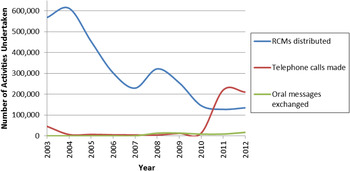
Returning to the ICRC data, just as the number of RCMs has reached its lowest, there has been a sharp increase in the use of telephone calls, with the total number of calls made for RFL purposes increasing from 3,958 to 210,096 between 2008 and 2012.Footnote 20 This widespread use of telephones is undoubtedly a step forward for the ICRC, and one which is long overdue.
The ICRC's recent recognition of telephone calls as a tool for responding to humanitarian crises was clearly demonstrated in 2011 when the ICRC opened a delegation in Libya to respond to the escalating violence, mass displacement, and widespread destruction of communication infrastructure. Despite the lack of infrastructure, the figures demonstrate a commitment to and recognition of the efficacy of telecommunications, and show that in response to the crisis, just one RCM was collected and delivered by ICRC. Conversely, even ‘[w]here telecommunications networks were dysfunctional, as for a time between eastern and western Libya and in conflict-damaged cities, Libyans and foreigners, including detainees …, had help to contact relatives, where necessary by satellite phone’.Footnote 21 The same year, the ICRC facilitated 23,400 family telephone calls in Libya alone.Footnote 22
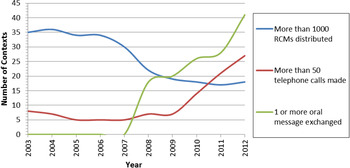
The use of telephone calls as a tool for restoring family contact is not limited to isolated emergencies. Chart 2 shows that the policy has quickly been rolled out to a wide number of contexts across the world. Telephones are being used for ICRC RFL responses in an increasing number of situations, with the total number of countries increasing from seven to twenty-seven since 2008.Footnote 23
For beneficiaries in detention, an additional tool introduced in 2008 is shown in Charts 2 and 3: oral messages. The use of these messages demonstrates a pragmatic response to two obstacles to instant communications between families via technology – censorship and lack of connectivity. These short messages are taken on behalf of detainees, transcribed by ICRC delegates, checked and censored by the detaining authorities where necessary, and then transmitted to the family by phone, rather than delivered by hand. Where implemented, this new tool allows detainees to benefit from the advantages of telephone calls (speed, efficiency, and so on) while maintaining the trust of the detaining authorities. In some contexts, the oral greeting model is also being used for situations which do not involve detention. For example, in certain refugee camps in Ethiopia where there is no phone network coverage, ICRC delegates have been transcribing short messages and taking them to the capital, where they can be transmitted to family members by telephone.Footnote 24
Total number of RCMs distributed, telephone calls made and oral messages exchanged, 2003–2012. Source: ICRC Protection Data, as recorded in the Prot5 Database.

Global spread of RCM distribution, telephone calls, and oral messages. Source: ICRC Protection Data, as recorded in the Prot5 Database.

In a limited number of contexts, beneficiaries also have access to video calls. Two well-known examples are the detention facilities at Guantanamo and Bagram:
Persons interned at the Detention Facility in Parwan (DFIP) at Bagram Airbase were able to communicate with their relatives by means of a video call system between January 2008 and March 2013. The video link, set up by the US authorities with the cooperation of the ICRC, enabled detainees to see and talk to their loved ones for 20 minutes at a time. Detainees were allowed one video call every three to four months. By the end of 2012, over 14,000 video calls had been placed from this facility.Footnote 25
Concerns have been raised that prison officials could seek to replace or diminish the frequency of actual family visits with video calls, which the officials may view as both more secure and less expensive.Footnote 26 This is a challenge of which ICRC field officers should be aware, and vigilance to ensure that family visits remain an option will be important. In contrast to telephone calls, video calls have not been widely rolled out as a tool used by the ICRC.
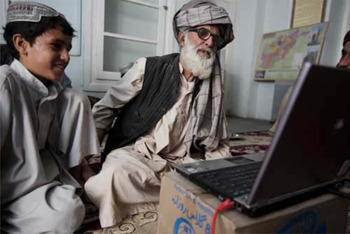
ICRC office, Kandahar. Relatives talk to a detainee in Guantanamo via a video telephone link. © ICRC/K. Holt.

Looking more broadly at the International Red Cross and Red Crescent Movement, there are a small number of documented examples where National Societies have adopted the use of video calls. In the Republic of Korea, for example, the Korean Red Cross organises ‘video meetings’ for families separated between North and South as a result of the Korean War.Footnote 27
For now, telephone calls are the obvious choice for quick restoration of contact following an emergency. However, particularly when separation becomes protracted due to detention or other reasons, the case for video calls is strong. They provide a higher level of intimacy and both verbal and non-verbal communication. Families of detainees can see for themselves the physical condition of their loved one, and can be reassured that the voice they are hearing is genuine. Separated children can reconnect with their parents or care-givers prior to a family reunification, and the parents can see how the child has changed, perhaps lessening any shock upon arrival. With these benefits in mind, it will be important for the ICRC to work hard to offer these services as extensively as possible. This is an area in which the ICRC could improve its services going forward, and an area in which some might say that it is lagging behind. It is a way to provide beneficiaries with needed support, especially in longer-term situations of separation.
The RFL Strategy for the Movement (2008–2018) and new technologies: an opportunity for cooperation
The advent of the Internet in the 1980s and subsequent spread of access, combined with the proliferation of mobile phones and new tools and methods for collecting and using information transmitted via mobile technology, have presented a host of new opportunities to change the way humanitarian work is done. This is particularly relevant to work that is at its heart a matter of communications.
The ICRC sought to utilise the Internet early on for RFL purposes, first launching a dedicated website in 1996 in response to the conflict in the former Yugoslavia. At that time, the site simply listed the names of persons reported missing and invited families to contact the ICRC if they could identify a loved one in the list of names. Similar ad hoc lists were published online for conflicts in Nepal, Angola and Somalia, as well as the Iraq War of 2003.Footnote 28 A significant number of upgrades were made to the website in its early years, including a ‘self-registration’ functionality added in 1999, allowing beneficiaries to register their missing loved ones directly on the website or to register themselves as being ‘safe and well’. However, this early development did not maintain its initial pace, and by the mid-2000s the website had become fairly outdated.
In 2008, in collaboration with the International Federation of Red Cross and Red Crescent Societies, and National Societies themselves, the ICRC drafted a new RFL Strategy for the Movement (hereinafter the Strategy). In a discussion of the external environment, the Strategy notes a range of external forces impacting the work of RFL, including technology:
The work of restoring family links takes place in an ever-changing environment to which the Movement must constantly adapt. The changing nature of armed conflict and other situations of violence, the increase in the number of natural and man-made disasters, massive population movements and forgotten social cases, and the emergence of new technologies all affect the environment in which the Movement undertakes RFL.
The Strategy sets forth goals related to the use of technology, noting that part of strengthening RFL capacity and performance will involve building ‘the capacity to assess, adapt and incorporate technology for greater programme efficiency’.Footnote 29 Notably, the Strategy also recognises the importance of greater cooperation with other actors as well as within the Movement, and emphasises the need for capacity-building among the National Societies.Footnote 30 This need for cooperation is particularly relevant with respect to adaptation and the use of new technologies, as this is an area where a larger and long-established institution such as the ICRC will likely not be able to keep up with the pace of development and use of these technologies.
The Strategy recognises that ‘[t]he corporate sector – especially software companies – is increasingly itself taking RFL action or supporting others in this realm during high-profile natural and man-made disasters’. The Strategy asks the ICRC to ‘assess, by 2012, the feasibility of cooperation with private companies to further develop technical tools and provide support materials in accordance with Movement standards’.Footnote 31 While actors focused on technology such as software companies are working to develop the most efficient tools, the ICRC is well positioned to ask important questions about the most effective and safest ways to use these tools to reach beneficiaries.
Online humanitarian response in action: Haiti 2010
In January 2010, a devastating earthquake hit the island of Haiti. The international community responded quickly to provide emergency assistance and launch search-and-rescue missions. The Haiti earthquake was one of the first major crises in which new tools developed to utilise mobile technologies to facilitate humanitarian action were rolled out on a large scale. Alongside the traditional disaster response system, humanitarian responders began to utilise crowdsourcing and crisis-mapping platforms to facilitate their work. Crowdsourcing can be defined as ‘the practice of obtaining needed services, ideas, or content by soliciting contributions from a large group of people and especially from the online community rather than from traditional employees or suppliers’.Footnote 32 Crisis-mapping involves then geographically mapping received information in order to identify where particular needs are originating and what issues are most prevalent in which regions, and generally to gain an understanding of the large picture of emerging needs. Information may be received via text message or pulled from social media platforms such as Twitter and Facebook.Footnote 33
In Haiti, this model was used extensively to communicate the needs of beneficiaries to humanitarian actors. A group of NGOs worked to secure and distribute information about a free telephone number to which beneficiaries could send text messages expressing urgent needs,Footnote 34 including requests to locate lost family members. This information was then made accessible to a range of humanitarian actors to use as needed.
Similarly, Google launched Person Finder,Footnote 35 an open-source web application which allows individuals to register themselves and/or their missing loved ones associated with a particular crisis. This is similar to the lists of names the ICRC had posted on its RFL website, but on a larger scale. Person Finder also pulls together data from other agencies’ websites and lists and compiles this information with the data entered by individuals. Since the earthquake in Haiti, the number and variety of crowdsourced humanitarian responses has mushroomed, and the responses have certainly proved to be successful in terms of the number of persons using them. Japan's Person Finder website, for example, available one hour after the devastating earthquake in 2011, had around 250,000 records as of March 2011.Footnote 36
With respect to family separation, these types of tools allow humanitarian actors to quickly communicate with families regarding missing relatives. As time is often of the essence in locating missing persons, speedy notification of a separation can be very useful. In addition, these tools can allow beneficiaries to more easily reach the ICRC, as they can simply communicate via mobile phone as opposed to travelling to an ICRC or National Society office. However, the crowdsourcing model raises several questions which have been the subject of debate in the humanitarian sphere, and which are of particular relevance to the ICRC's work.
The first issue is that of security and data protection.Footnote 37 The crowdsourcing model assumes certain things about beneficiaries – for example, that they understand the implications and possible risks of sharing information on an open forum. In other words, the assumption is that beneficiaries will not share information that might put them in danger, and that there is no need therefore to limit the information which is being shared.Footnote 38 These assumptions are immediately brought into question for some of the ICRC's ‘typical’ beneficiaries, particularly children and those living in conflict areas. The ICRC has sought to develop responses to this issue through the new RFL website and in the development of its new Professional Standards for Protection Work, both discussed below.
Another issue is that of response: can crowdsourced data provide the type and quality of information that can enhance or improve a humanitarian response? As one humanitarian actor put it:
Let's say that I have a sufficient number of staff … and they've checked every one of those requests. Now what? There are around 3000 individual ‘incidents’ in the database, but most of those contain little to no detail about the people sending them. How many are included in the request, how many women, children and old people are there, what are their specific medical needs, exactly where they are located now – this is the vital information that aid agencies need to do their work, and it simply isn't there …Footnote 39
Additionally, the argument has been made that perhaps only a small fraction of people will communicate information through these methods, and thus these types of reports cannot be seen as representative of needs on a broader scale and cannot then form the basis of large-scale programming. Finally, many humanitarian organisations have expressed concerns about the veracity and accuracy of information collected through crowdsourcing, particularly when using sources such as Facebook and Twitter.Footnote 40
While the best ways to ensure the accuracy of this information, and the most effective ways to utilise crisis maps, are still being determined by the larger humanitarian organisations,Footnote 41 with respect to RFL work, the need is for individual reports. The ability to more easily connect with beneficiaries and the ability to receive individual reports of missing persons are both beneficial to RFL work. The ICRC can use these reports in combination with the work and knowledge of its field staff to accurately assess and respond to RFL needs. The technology is valuable as a way to supplement the ICRC's traditional methods of collecting information. This is thus an area where the ICRC can work with the organisations developing this technology and seek to use it first in RFL work, thus perhaps developing a greater understanding of its potential uses and benefits in broader programming.
Moving forward: the new RFL website
The ICRC launched a new website in 2012 focused on RFL. The website has two main components. The first is a compilation of country-by-country information on the RFL services provided by the Movement across the world, including contact details for National Society offices in each country. This is crucial for connecting beneficiaries with the aspect of the service that makes it unique: the humans behind the technology. Each webpage describes a service that is delivered by real staff and volunteers who have made a commitment to responding to the enquiries they receive.
The second component of the website is the emergency function. As with other websites, this function can be launched in response to a specific crisis, allowing people to register themselves and lost family members. The key difference between this website and others is that the data submitted will be subject to a number of checks and controls. Each person who registers creates an account; this means that they can change or delete their details easily and quickly. They can also choose what information they would like to make public and what can only be seen by the ICRC. Finally, the ICRC can make decisions, based on its knowledge of the context, about the kind of information that should be displayed. This means that if, in a given context, it is deemed that publishing the beneficiaries’ towns of residence or ethnic origin might raise protection concerns for those individuals, the ICRC can choose not to make that information public. This provides a greater level of protection for beneficiaries than Google's Person Finder, but of course also means that information is not available as quickly.
Of course, as with any internet resource, the RFL website has to be used in order for it to be a success, and the real challenge will come when the ICRC is faced with a major disaster. However, the website can be fairly described as a step forward for the ICRC in technological terms for RFL. Rather than trying to compete with other actors, the ICRC has played to its strengths – the human response and its commitment to beneficiary protection. This commitment is demonstrated beyond the realm of RFL through the publication of a revised edition of the Professional Standard for Protection Work.Footnote 42 This is a set of minimum standards for humanitarian and human rights actors who engage in protection work. The revised 2013 edition added a specific section on the risks and advantages that new technologies and new methodologies offer for collecting information from afar.Footnote 43 This section was developed in collaboration with the crisis-mapping community.Footnote 44 This dialogue between young tech volunteers and a 150-year-old institution has been recognised.Footnote 45 Now that the ICRC has publicly positioned itself, it will be interesting to see if it can sustain the pace of innovation of the tech-driven world and maintain its relevance.
An increasingly multidisciplinary approach
In cases where family contact cannot be restored, the ICRC continues its efforts to clarify the fate and whereabouts of the missing person, but is also increasingly providing support to the families of missing persons. The ICRC's work on the missingFootnote 46 historically consisted of a few core activities, primarily dissemination of the rules of international humanitarian law (IHL), which require that states work to prevent disappearances, and bilateral interventions requesting parties to the conflict to search for and provide information, after separation, in accordance with IHL.Footnote 47 Other core activities included detention visits, RFL services, and collection and processing of tracing requests.Footnote 48 If and when these failed to clarify the fate and whereabouts of the missing person, the ICRC had few remaining options to offer to the families.
However, in light of a deeper understanding of the lasting repercussions of the problem of missing persons and an awareness that the problem is growing, the ICRC has over the past two decades been reassessing and expanding its services in this area. This work, like the work of restoring family contact, has been impacted by the proliferation of actors in the field as well as by the development of new technologies, and reflects a newly emerging focus on long-term involvement in this area. The evolution of the ICRC's work from the start of the armed conflict in the former Yugoslavia, which is a particularly significant moment in the recent history of humanitarian work, is a good example of how this re-evaluation began and how it continued over the years.
The armed conflict in the former Yugoslavia
The conflict in the former Yugoslavia in the 1990s brought into sharp relief the fact that the world of humanitarian aid (and intervention) had changed. After initially keeping the conflict at arm's length, Western powers were pushed to intervene when the events of the Srebrenica massacre came to light.Footnote 49 With the international community's eye on the region, numerous aid organisations became involved, from the UN (which had been present from the start) to a plethora of NGOs and other humanitarian actors that arrived on the scene as funding for relief and development work in the region became available. Bosnia and Herzegovina has reportedly received more foreign aid than any European country previously, even considering the Marshall Plan, and the effects of that assistance have been the subject of much debate and study.Footnote 50
With regard to separated families and missing persons in this context, the ICRC first focused on negotiating the release and transfer of prisoners detained in connection with the conflict before turning its attention to providing the families of persons still missing with information about the fate and whereabouts of their relatives.Footnote 51 To this end, the ICRC proposed the establishment of the Working Group on the Process for Tracing Persons Unaccounted for in Connection with the Conflict on the Territory of Bosnia and Herzegovina (hereinafter the Working Group), a mechanism created in 1996 by the parties to the conflict in order to exchange information about missing persons.Footnote 52 Through chairing the Working Group, the ICRC had close contact with the families of missing persons, giving staff greater first-hand insight into the complex challengesFootnote 53 faced by these families. The ICRC saw an increased demand for the use of newly developed forensic technology in Bosnia and Herzegovina. Victims called for exhumations of mass graves across the region,Footnote 54 and the ICRC began to recognise the importance of developing forensic expertise so as to facilitate and advise such processes.
As time went on, the ICRC began to provide additional services in support of its work on the missing in the former Yugoslavia on an ad hoc basis – implementing early psychosocial support programmes, assisting in drafting relevant legislation, and (later) exploring how it might support the use of new forensic technology.Footnote 55 The evolution of the organisation's services in this conflict reflected the growing recognition within the ICRC that the problem of missing persons required more than the services traditionally provided. The ICRC's experience in the Former Republic of Yugoslavia then ultimately acted as a catalyst, prompting the organisation to assess the efficacy of its actions on missing persons more generally. As the ICRC adopted methods that addressed not only the question of clarifying the fate and whereabouts of missing persons but also the well-being of their families, often in the long term (in the form of laws on missing persons, for example, and support to families), it became clear that these efforts needed to be more uniform across contexts, and needed to be assessed and implemented with greater expertise and planning.Footnote 56
The 2003 conference on the missing and new services
With this goal in mind, in 2002 the ICRC launched a process to better address the plight of missing persons and their families by reviewing existing methodology and agreeing on common operational practices. The first step of the process was a series of workshops and studies carried out in collaboration with numerous experts and institutions, which resulted in a series of recommendations. As a second step, the ICRC organised an international conference of governmental and non-governmental experts in order to share and discuss these findings.Footnote 57 This conference was held in February 2003 and was entitled ‘The missing: action to resolve the problem of people unaccounted for as a result of armed conflict or internal violence and to assist their families’. The observations and recommendations adopted at this conference put an emphasis on the need for clarification of the fate and whereabouts of missing persons and for continued efforts to prevent people from going missing, but also recognised the importance of several newer areas of support, including forensic services (identification of the dead and management of human remains) and support to families of missing persons (in the form of psychosocial support as well as assistance with legal, financial, or administrative needs).Footnote 58
These new areas of emphasis took a more long-term view of, and arguably even a post-conflict development-oriented approach to, the ICRC's work on missing persons. The concern became not only that governments and armed groups fulfil their obligations under IHL with respect to missing persons, but also that the families of the missing be able to survive and cope with the difficult period of uncertainty, and to find support while doing so.
The 2003 conference demonstrated the ICRC's commitment to supporting the families of the missing and the recognition that the file required input from a range of different operations and services within the ICRC. The proposal of a so-called multidisciplinary or holistic approach to the problem of missing persons was a significant step forward, not only for this particular area of the ICRC's work but for the institution as a whole. Indicative of this commitment was, among other things, the incorporation of forensic services into the work of the ICRC's Assistance Division.
Progress since 2003
Since the 2003 conference, its recommendations have been taken on board across the ICRC to varying degrees. With the input and commitment of staff working in protection, and in cooperation with the legal, economic security, health, forensics, and other departments of the organisation, new policies and actions have been developed on a range of issues related to missing persons. These developments include the drafting and dissemination of model laws on the missing, the creation of the ICRC forensic services unit,Footnote 59 and the publication of a handbook on how to support families through a model of ‘accompaniment’, all of which are explored in more detail below. These new efforts are illustrative of the ICRC's endeavour to combine a commitment to sustainable change with a focus on areas in which the organisation has traditionally excelled.
Legislative support
The ICRC's engagement with the mechanism of the Working Group on the Process for Tracing Persons Unaccounted for in Connection with the Conflict on the Territory of Bosnia and Herzegovina paved the way for the development of a law on the missing. The law was drafted by a working group made up of representatives of the authorities, the ICRC, and the International Commission on Missing Persons (ICMP). The law ‘regulates a number of points, including the families’ right to know, legal status of the missing persons and financial support to families of the missing, as well as penal provisions for non-compliance’, and was adopted by the Bosnia and Herzegovina Parliament in 2004.Footnote 60
In 2007, building on this experience, the ICRC published a model law on the missing, as a tool to ‘assist States and their national authoritative bodies with the adoption of legislation that will address, prevent and resolve situations of missing persons’,Footnote 61 as well as guidelines for engagement with a range of mechanisms that address issues related to missing persons.Footnote 62 The creation of these resources represents something more than just the ICRC's traditional promotion of IHL; they are also contributions to efforts to restore the rule of law and stability in a post-conflict society.
The ICRC's forensic services
Following its establishment in 2003, the ICRC forensic services unit quickly became a respected authority in the field of forensic science and humanitarian action. In 2011, the ICRC was awarded a special prize by the International Association of Forensic Sciences ‘in recognition of the organization's contribution to the development and promotion of applied forensic sciences worldwide’.Footnote 63 The institutional Forensic Strategy, revised in 2009, highlights the importance of long-term goals such as capacity-building at the domestic level and within National Societies, and recognises the added value of the ICRC for its ability to disseminate best practices and set standards in the field.Footnote 64 The ICRC forensic unit today ‘provides advice, support and training to local authorities and forensic practitioners in searching for, recovering, analyzing, identifying, and managing large numbers of unidentified remains’,Footnote 65 in disasters, along migration routes, and as part of efforts to help clarify the fate of missing persons.
This is an area of work in which the ICRC has made good use of technology by creating the ante-mortem/post-mortem (AMPM) database. A key part of clarifying the fate of missing persons is to compare information gathered from the relatives and belongings of the missing person (ante-mortem data) with that collected from unidentified human remains and the sites where they were found (post-mortem data). The ICRC recognised the important role technology could potentially play in this process, and the need to create a specialised tool: ‘Standardization, centralization and easy exchange of large quantities of data among numerous actors are key to an effective data management strategy, and electronic tools can greatly contribute to a thorough and efficient data management and analysis process.’Footnote 66 Thus, in 2008 it launched the AMPM database, an electronic data management tool that is configurable to a wide range of contexts and is provided by the ICRC to third parties free of charge. It has been successfully rolled out to a range of users, including ‘medico-legal institutes, governmental structures [and] non-governmental organizations’.Footnote 67 Designing such a tool for use by national third parties again demonstrates the institutional drive towards sustainable solutions, as well as a commitment to cooperating with other actors in the field in order to provide better services to beneficiaries.
The ICRC's Accompaniment Programme
The emphasis on sustainability and recognition of the importance of long-term impact and engagement with other actors is also evident in the ICRC's new Accompaniment Programme. This programme seeks to build the capacity of local actors to support families of the missing over time. Support can come in the form of counselling and community groups focused on psychosocial support, or as assistance with legal and administrative matters that families of missing persons may need to attend to in the absence of a relative (such as having someone legally declared missing so that family members are eligible to receive any benefits or support the government might be offering).
In 2013, the ICRC produced a handbook entitled Accompanying the Families of Missing Persons, which is targeted at ‘all individuals or groups of individuals – associations of various kinds, National Red Cross and Red Crescent Societies, governmental actors, non-governmental organisations, international organisations, ICRC delegates, etc. – wishing to accompany … families whose relatives have gone missing’.Footnote 68 The target audience is thus quite broad, and the hope is that, by building not only its internal capacity to support families of missing persons but also that of external actors, the ICRC can create a sustainable network of support that will exist even after its mission in a particular context comes to an end.
Many of these efforts go beyond what is strictly understood to be direct humanitarian relief, but they nonetheless draw on the ICRC's history and expertise with this type of work. For example, the ICRC is uniquely positioned to propose legal solutions to problems relating to missing persons, due to its reputation as the guardian and promoter of IHL. Not only does it have the expertise to work on these legal issues, but it also has a channel through which to discuss other legal issues thanks to its frequent open dialogue with governments on IHL.
Similarly, a large part of the ICRC's added value has always been in its proximity to beneficiaries. The ICRC often has access to groups of people in need to which no other humanitarian relief organisation has access. It is thus well positioned to assess the needs of beneficiaries and respond accordingly. Efforts to develop programmes that aim to empower beneficiaries to help themselves, like the economic security initiatives of the Accompaniment Programme, recognise both the ICRC's strengths and its limitations. The ICRC, like any humanitarian actor, can only remain active in a context for a certain amount of time, and its limited resources mean it can only reach what will sometimes be a relatively small number of beneficiaries in comparison to needs. By working to build a system of cooperation and support among community members and organisations, the ICRC is able to maximise its positive impact. This is a model that can and should inform other areas in which the ICRC works moving forward.
Remaining challenges
While these planned programmes and new policies are promising, challenges and difficulties come with implementation. The ICRC's action in 2003 was the result of internal questions regarding the relevance and effectiveness of its work in the face of a transformed field. Missing persons became an institutional priority for the ICRC at this time, and the organisation began to implement various elements of the plan envisioned at the 2003 conference, but efforts to move forward have often been piecemeal, and the last progress report detailing the organisation-wide work on the issue was published in 2006. The institution's size, the complex questions that this new type of work engenders, and issues raised by the ICRC's new interactions with other actors form a set of significant challenges that must be addressed in order to truly move forward.
As discussed, in the realm of forensics, the ICRC has made effective use of technology to improve the humanitarian response. There are questions, however, as to whether technology could be better utilised in other areas of work relating to the families of missing persons. For example, perhaps more could be done with the lists of missing persons currently hosted on the RFL website. One option might be (in consultation with the families) to use these lists as a starting point to build an online memorial. The ICRC could help individual families to share their stories, memories, or perhaps even photos of their missing loved ones and to connect with other families of the missing. These types of simple fora exist for other types of lossFootnote 69 and may help some families in their grieving process, as well as bringing attention to the difficulties they face.
Another option might be to make the lists more dynamic so that families can follow any progress that is being made with regard to clarifying the fate and whereabouts of their loved ones – for example, if exhumations are being undertaken in the area where a loved one went missing. The ICMP has developed an interactive Online Inquiry Center for all the families that have registered with it:
For government authorities and forensic professionals who have submitted postmortem samples to the ICMP for DNA testing, the Postmortem Sample Inquiry will allow them to track their cases. The Excavation Site Inquiry will allow users to search for general information regarding the status of DNA testing for specific excavation sites.’Footnote 70
With such advances being made, the ICRC needs to think carefully about how to position itself, including where it can collaborate without compromising its principles, and where it can add value by creating new tools to address gaps in the humanitarian response.
One obstacle to quick or uniform progress is the size of the institution itself. With more than eighty delegations and missions in numerous contexts across the world, and 150 years of history behind it, the ICRC does not change quickly. Internal coordination is a challenge. Efforts to collect and share best practices and lessons learned are being made,Footnote 71 but the process is not yet streamlined. The pace of change may be further hampered by internal and external resistance to new services that might be considered outside the purview of the ICRC's more traditional work in the area of humanitarian relief and protection.
Internally and externally, the ICRC today is facing questions such as: how long is it appropriate to remain in a post-conflict situation? When does the ICRC's presence no longer add value? How can the institution best allocate resources to fund some of these longer-term projects? These are important questions that require serious consideration, and the answers are not yet clear.
Traditionally, the ICRC has often been the only humanitarian organisation present in a given context.Footnote 72 However, with the proliferation of NGOs and other aid agencies, and even of international courts and tribunals and transitional justice mechanisms, the ICRC is now increasingly encountering organisations that are doing overlapping but also potentially complementary work. The issue of missing persons, in particular, presents the opportunity to engage – but also the challenge of engaging – with mechanisms established to clarify the fate and whereabouts of missing persons, up to and including courts and transitional justice mechanisms. Despite the long-standing tension between justice and humanitarianism,Footnote 73 transitional justice processes are often particularly relevant to the search for missing persons. Finding a way to balance these objectives and working with such mechanisms will often be beneficial, because ‘[a]s a multidimensional process designed to help people move beyond violence and embrace peace, democracy and respect for human rights, transitional justice should provide an appropriate response, by working with the affected community, to the issue of missing persons’.Footnote 74 In order to provide the best services possible to beneficiaries, it is critical to determine a plan for cooperating with these other entities whenever possible.Footnote 75 The importance of cooperation, and of recognising where the ICRC can add value and where it might be best to leave the field to organisations with other expertise, is thus a central consideration in both the ICRC's RFL work and its work to support the families of the missing and to clarify the fate of missing persons.
Conclusion
Going forward, the ICRC will be continually challenged to keep pace in a fast-changing world. Targeting its efforts and maintaining a focus on the services and elements that make it unique, that are its strengths, will be the most fruitful way forward for the organisation and, more importantly, for beneficiaries. The ICRC's activities in support of separated families provide an example of playing to these strengths, and suggest recommendations for the ICRC's broader work moving forward. Understanding and identifying the most effective ways to utilise new technologies, for example, will allow the ICRC's efforts to more efficiently and effectively serve beneficiaries. In addition, the longer-term approach and capacity-building focus of many of the programmes now established to work with the families of missing persons will have more lasting positive impacts for beneficiaries. The challenge will be in balancing the ICRC's traditional work with longer-term considerations, and identifying ways to work effectively with other actors so that the programmes undertaken by the ICRC can complement longer-lasting development efforts.