





One of my theory professors once asked our class, ‘How do you make a modulation?’ His intentionally simplistic answer was: ‘Just introduce the accidentals that will be in the signature of the new key.’ The way that takes place, of course, is not simple. It depends on a multitude of factors, such as composer, place, era and so on. In western Europe in the mid-eighteenth century, for example, the most likely method of modulating would have been to move to the nearest-related key, either moving up or down the circle of fifths or to the relative major, often by way of one or more common chords or secondary dominants. But how would one modulate if one had no major or minor keys and no functional harmony, as was the case with the monophonic music of the ninth and tenth centuries in both eastern and western Europe? Providing at least one answer to that question will be the goal of this article.
Let us begin with one of the most perceptive writers on chant in the ninth and tenth centuries in the West, Regino of Prüm (d. 915 CE).Footnote 1 In his Epistola de harmonica institutione, written c.900 CE, Regino states: ‘There are certain antiphons that we call nothae – that is, degenerate and illegitimate – that begin in one mode, are yet another in the middle, and end in a third’.Footnote 2 He then names fourteen of these modulating chants, two of which appear in Examples 1 and 3. According to Regino, the first of these, Et respicientes, moves from the third to the eighth mode; the second, Sion renovaberis, from the seventh to the fourth. These two antiphons illustrate two different methods of changing mode.
Et respicientes, a notha, according to Regino, which begins in the third mode and ends in the eighth (Antiphonale monasticum, 460, with alleluia modified according to earliest sources listed in the Cantus database). Cf. Andreas Pfisterer, ‘Zum Problem des Tonartwechsels im gregorianischen Choral’, in Das modale System im Spannungsfeld zwischen Theorie und kompositorischer Praxis, ed. Jochen Brieger, Hamburger Jahrbuch für Musikwissenschaft 29 (Frankfurt am Main, 2013), 17–39, at 19.

Si in digito Dei, a typical melody of the third mode, ending on E (Antiphonale monasticum, 363–4).

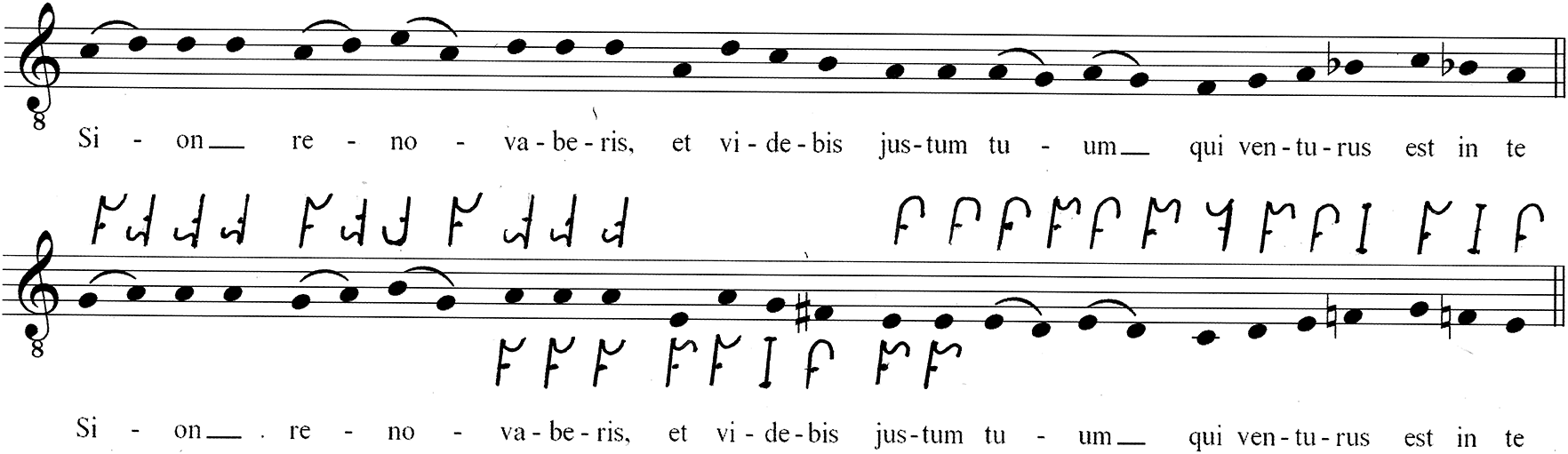
Sion renovaberis as notated, transposed to a (Antiphonale monasticum, 201).

The ductus of Et respicientes in Example 1 makes what I would call a ‘diatonic modulation’. It begins with a melodic formula typical of chants in the third mode, as one can see by comparing Examples 1 and 2, but its final cadence on G, approached from a minor third below, marks it as tetrardus plagal, the eighth mode. Turning to Example 3: the first three phrases of Sion renovaberis are clearly in tetrardus autentus, the seventh mode, but the phrase qui venturus est introduces B flats that convert it into a transposed deuterus plagis, the fourth mode. Untransposed, the chant would have an F sharp as well as an F natural above the final, E. In this case the modulation takes place via systemic transposition brought about by chromatic alteration.
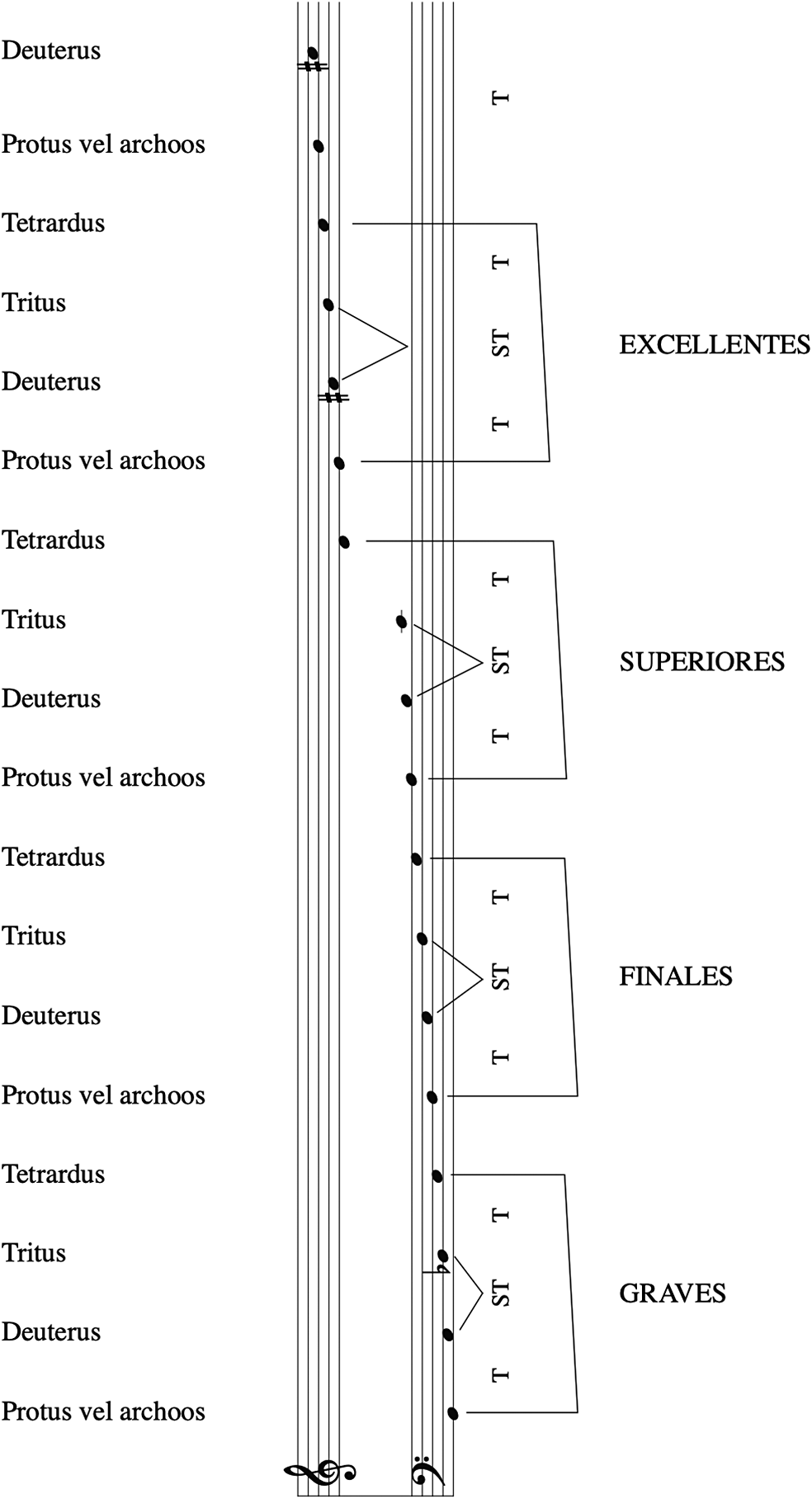
A rationale for both types of modulation in the West is offered by the Musica and Scolica enchiriadis, dating to the third quarter of the ninth century, whose tone-system appears in Example 4.Footnote 3
Tone-system of the Musica and Scolica enchiriadis (from Charles M. Atkinson, The Critical Nexus: Tone-System, Mode and Notation in the Early Middle Ages (New York: Oxford University Press, 2009), 122). Used with permission.
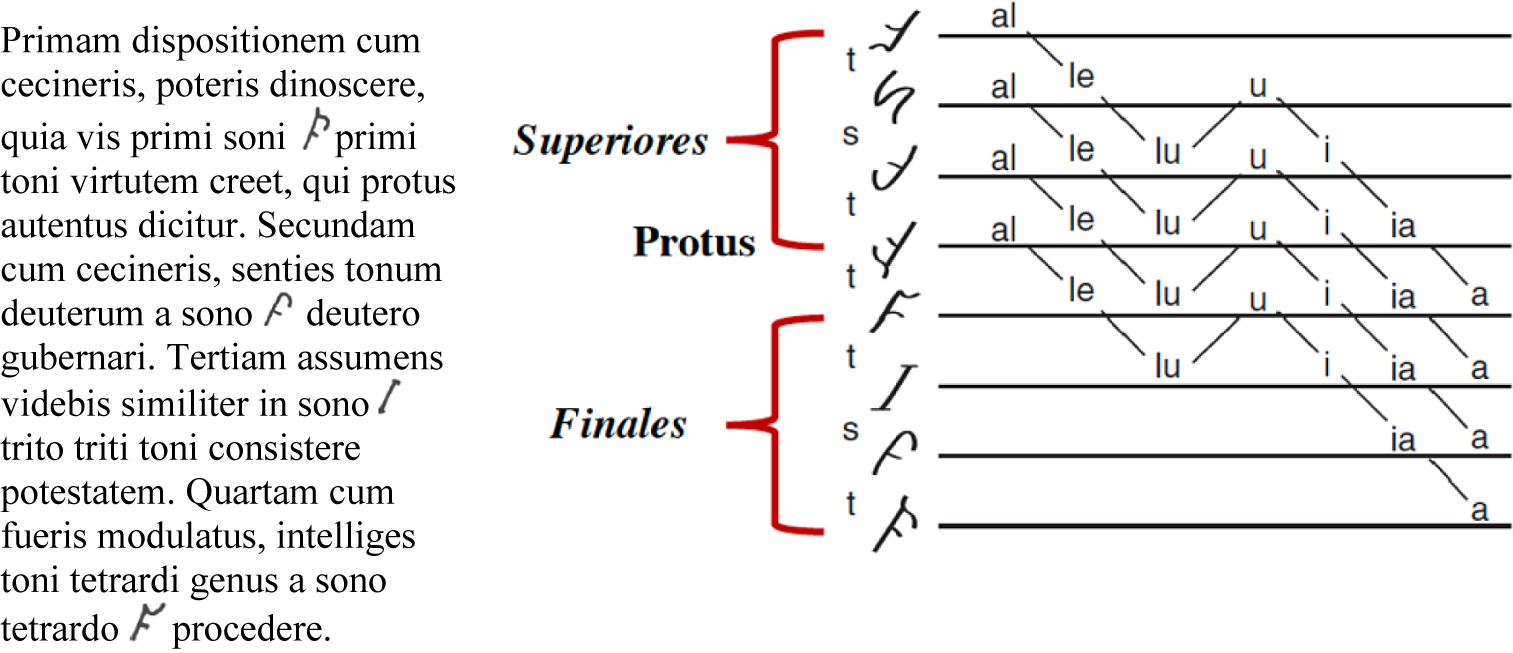
After setting out this scale, which consists of disjunct tetrachords structured tone–semitone–tone, the author provides an explication of diatonic modulation (Example 5).
When you have sung the first disposition, you can recognise that the vis of the first sound  creates the character of the first mode, which is called protus autentus. When you have sung the second, you will perceive the deuterus mode to be governed by the deuterus sound
 . Likewise considering the third, you will see that the potestas of the tritus mode depends on the tritus sound
 . When you have modulated the fourth, you will know that the genus of the tetrardus mode proceeds from the tetrardus sound
 .
Musica enchiriadis, cap. VIII: Quomodo ex IIIIor sonorum vi omnes toni producantur (How the 4 modes are produced from the force (vis) of the 4 sounds). Hans Schmid, ed., Musica et Scolica enchiriadis una cum aliquibus tractatibus adiuncti, Veröffentlichungen der Musikhistorischen Kommission 3 (Munich, 1981), 15–16 (diagram reprinted from Schmid with permission of the Bayerische Akademie der Wissenschaften).
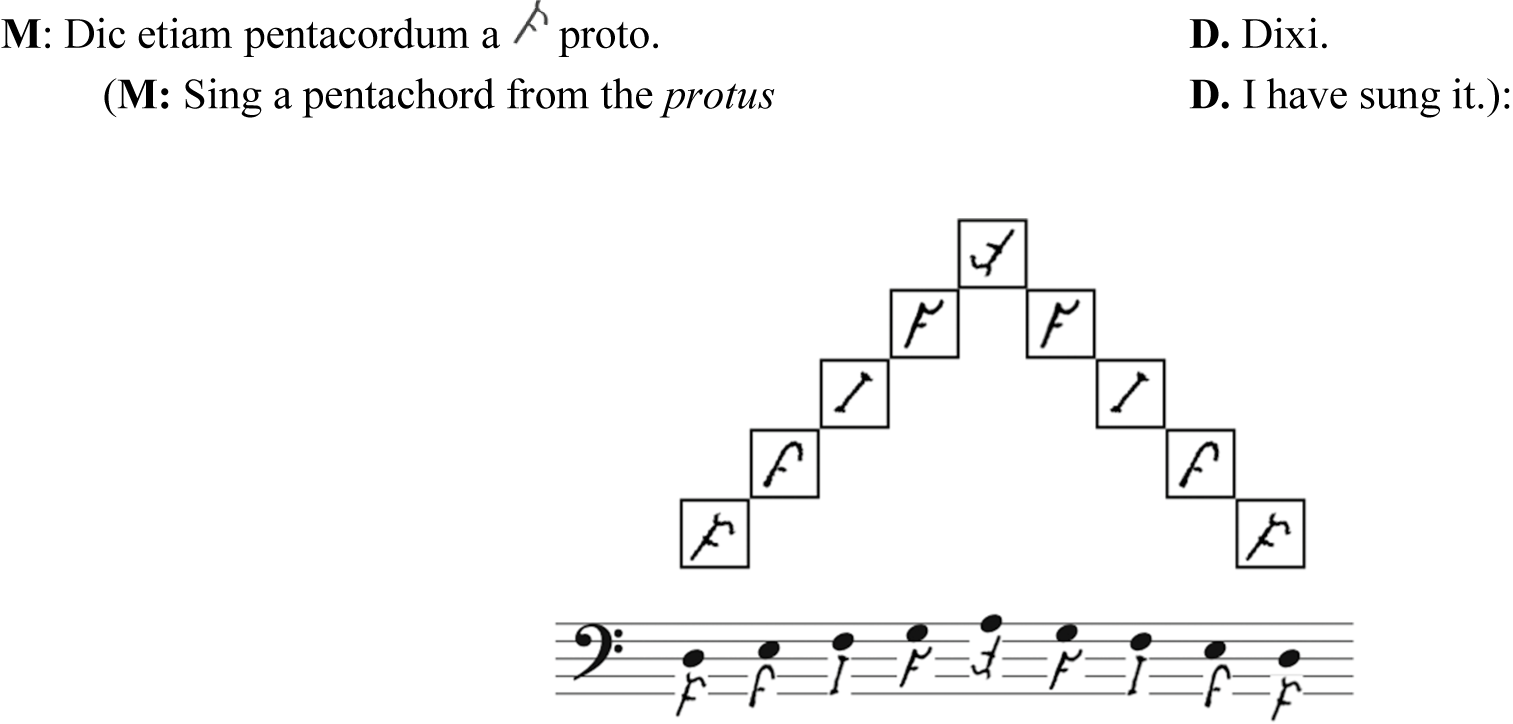
Recognising that some chants modulate via chromatic alteration, the author of the Scolica enchiriadis, cast in dialogue form, offers a theory of vitia or ‘corruptions’ to explain them. As shown in Example 6, the Master has his student sing a pentachord up and down within the enchiriadis tone-system.
Scolica enchiriadis: ‘Normal’ pentachord (ed. Schmid, 68; diagram reprinted from Schmid with permission of the Bayerische Akademie der Wissenschaften).
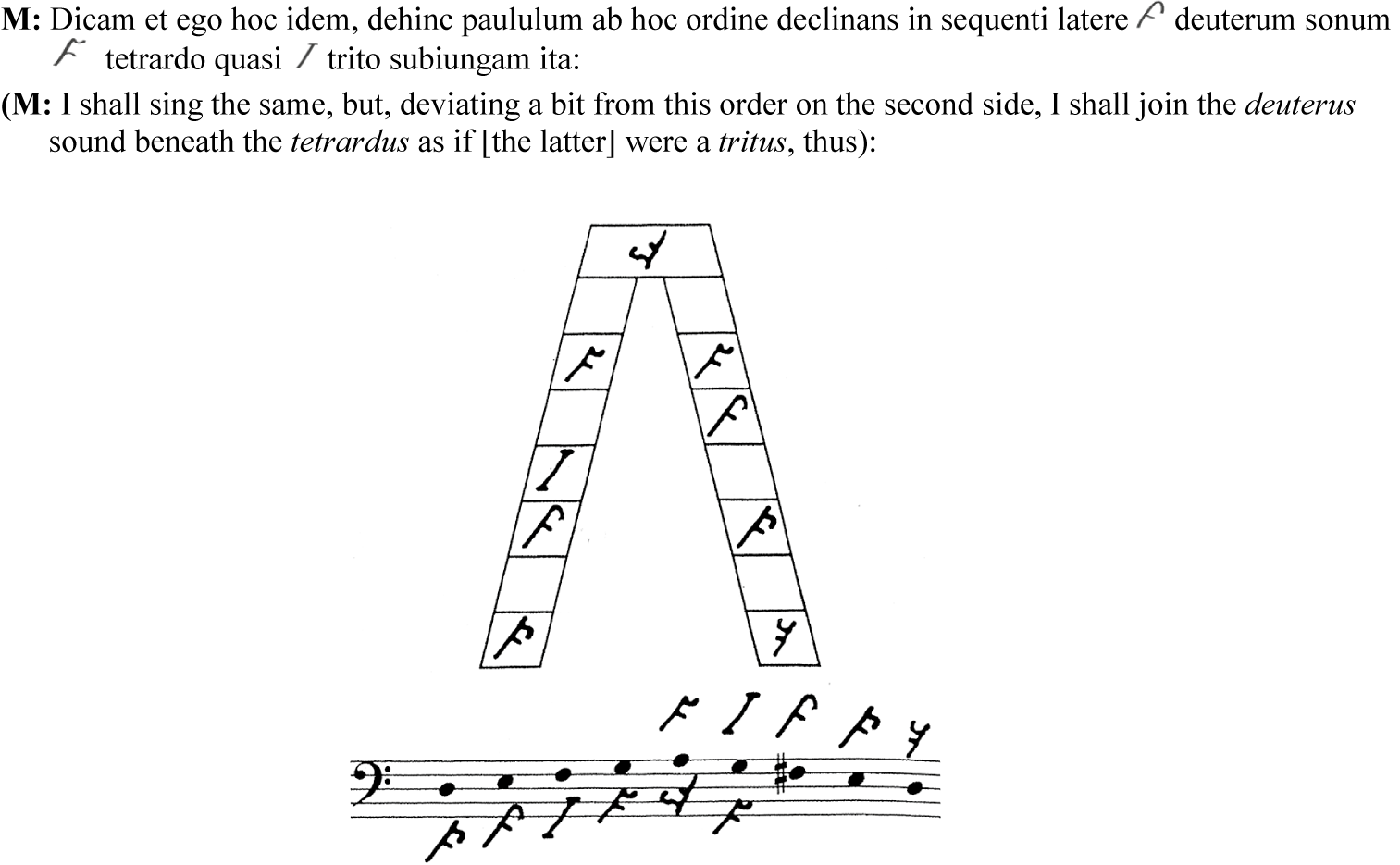
Next, in Example 7, the Master repeats the process, but changes the intervals in descent, placing a deuterus beneath the tetrardus, converting the latter into a tritus, thus yielding the equivalent of our F sharp.
An example of a vitium: Scolica enchiriadis: ‘Normal’ pentachord altered by placing the deuterus sound immediately beneath the tetrardus in descending (ed. Schmid, 68; diagram reprinted from Schmid with permission of the Bayerische Akademie der Wissenschaften).
By making use of these vitia, even chants modulating chromatically, as does Sion renovaberis, could be accommodated in their proper modal position, as one can see in Example 8.
Sion renovaberis as notated, transposed to a, from Antiphonale monasticum (upper) and at its proper pitch level, E, rationalised by vitium (lower).
Clearly, both the theory and practice of modulation were already present in the West in the ninth century, and as Gerda Wolfram has shown, both types of modulation can be documented in the East in the earliest manuscripts of Byzantine chant, namely those dating to the tenth century.Footnote 4 Indeed, the Hagiopolites, the oldest preserved Byzantine treatise on music, discusses modulation by what are called phthoraí (‘corruptions’), like the vitia in the West.Footnote 5 It says of them that ‘they were called phthoraí because they begin from their own modes, but their cadences and endings are on pitches (φθογγάς) from other modes’.Footnote 6 A chart of these phthoraí, drawn from the manuscript BAV, Barberini gr. 300 appears in Example 9.Footnote 7
The principal φθοραί (as presented in Biblioteca Apostolica Vaticana, MS. Barb. 300, fol. 3r, from Christian Troelsgård, Byzantine Neumes, Monumenta musicae Byzantinae (MMB) Subsidia IX (Copenhagen, 2011), 71, reproduced with permission).
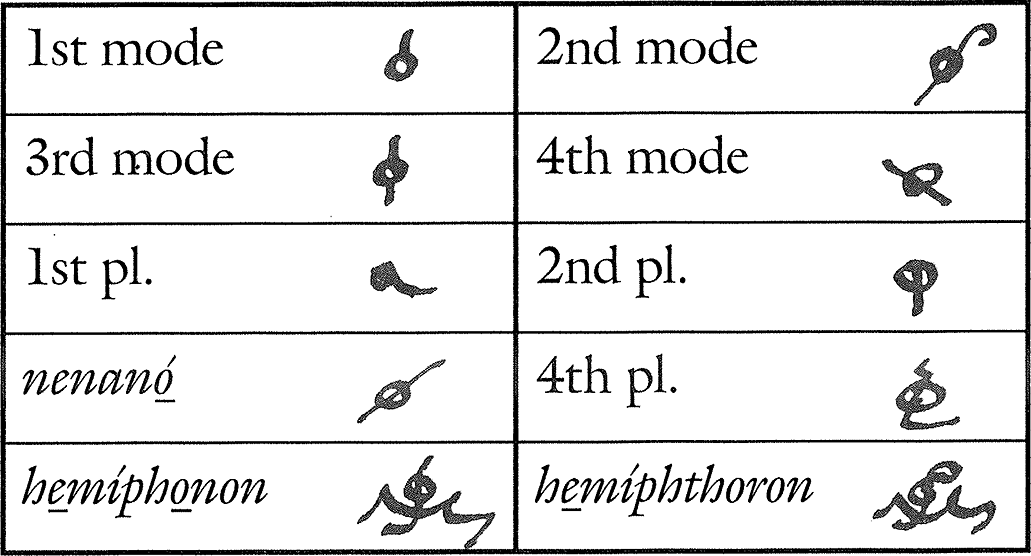
Following the Hagiopolites, at the place in a chant indicated by the phthorá, one uses the pitch indicated there as a pivot, at which point one substitutes the starting tone of another mode with its own characteristic intervals. With the reappearance of the phthorá, the original mode returns.Footnote 8
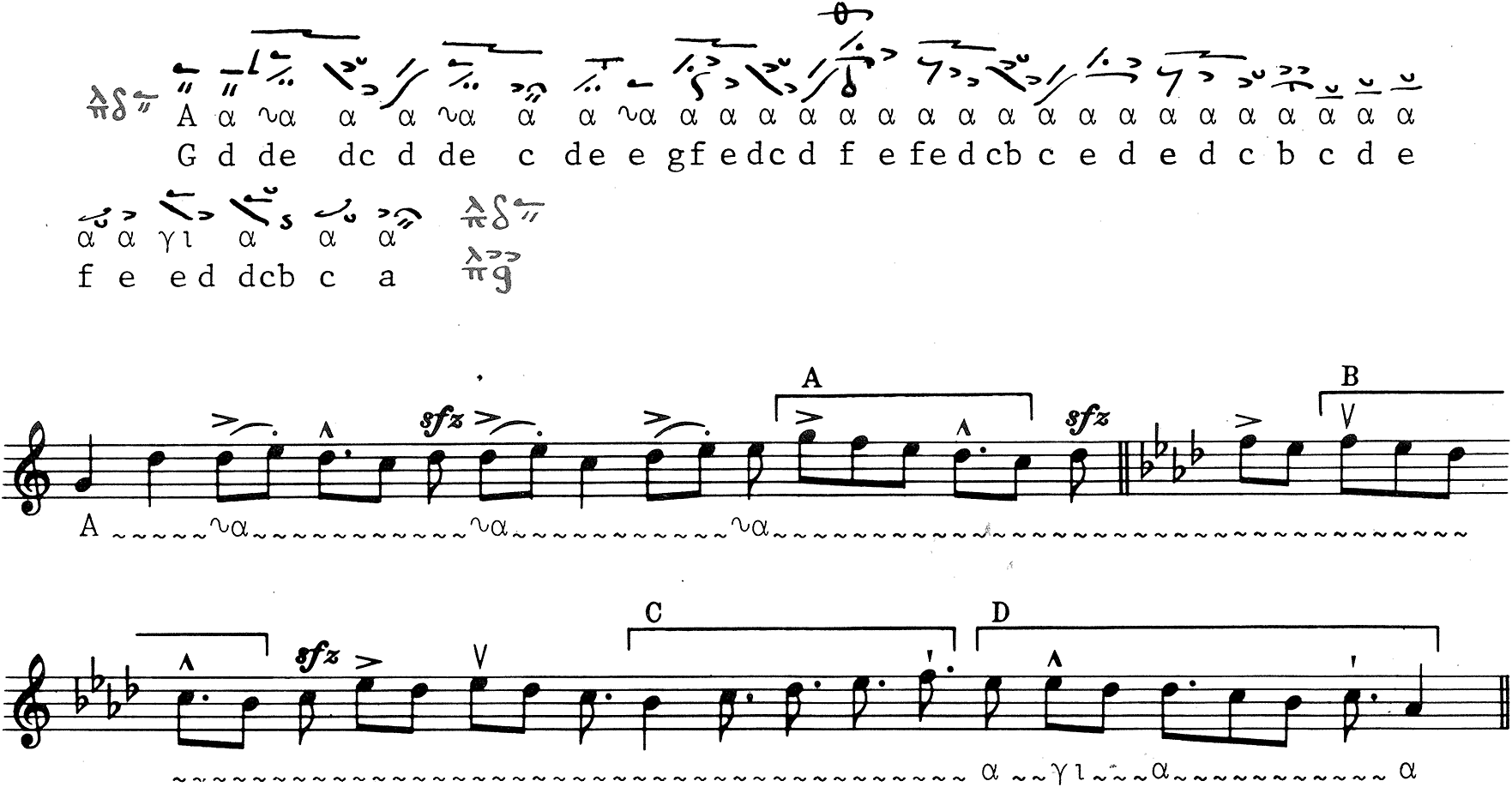
A particularly instructive example of the use of the phthorá to effect a chromatic modulation, and one that also happens to demonstrate diatonic modulation, or what was called parallagḗ in the East, is an exercise appearing in the treatise on church music by Akakios Chalkeopulos written c.1500.Footnote 9 It exhibits a phthorá of the protos mode at the midpoint of its first line in the manuscript National Library of Greece 917. A reproduction of the notation of this piece, together with its transcription, appears in Example 10.
Akakios Chalkeopoulos, μάθημα (exercise) in Athens, National Library 917, fol. 3v (reproduced from Jørgen Raasted, Intonation Formulas and Modal Signatures in Byzantine Musical Manuscripts, MMB Subsidia VII (Copenhagen, 1966), 47). Reprinted with permission of the Monumenta Musicae Byzantinae and the heirs of Jørgen Raasted.
Akakios considers this exercise to be in error. In Gerda Wolfram’s edition, he says of it:
The exercise begins in the mode plagios tetartos, and because it lacks one apostrophos, it goes on to finish in the mode plagios protos. But I, Akakios, finish the exercise in the mode plagios tetartos, hence as if it were not faulty. This happens because of the placement of a phthorá by the artist.Footnote 10
The piece actually behaves as Akakios describes it, as one can see in Jørgen Raasted’s transcription in Example 10. It begins with a section in tetartos plagios, outlining the principal interval, G to d, at the very outset. Since the phthorá applied here is that of the first mode, the pitch f over which it is placed must be reinterpreted as a, the starting pitch of the protos mode. This in turn calls for two tones, a semitone and a tone beneath the f, effectively transposing the next section into protos authentēs, as indicated by the signature that Raasted has provided.Footnote 11 After finishing the protos section with an ascent to its transposed starting pitch, bracketed as C in the example, the piece closes in the tetartos plagios, transposed up a half step to A flat – the section labelled D in the example.
Turning to the original version, without the phthorá and hence without the key signature towards the end of the first line of the transcription, the immediate repetition of figure A a step lower as motive B starts to move away from tetartos and towards a protos plagios transposed from D up to a, with the pentachord a up to e corresponding to the pentachord D to a in the untransposed mode. This is confirmed by the final cadential descent, labelled D in the example, which moves from e down to the transposed final, a.
As mentioned earlier, this kind of diatonic modulation would be called parallagḗ in the East, and is described in the singers’ manuals known as papadikaí. Footnote 12 A particularly clear one is that in the Codex Chrysander from the seventeenth century (Example 11).
From the Codex Chrysander, fol. 8v (Oskar Fleischer, Neumen-Studien: Abhandlungen über mittelalterliche Gesangs-Tonschriften, Theil III: Die spätgriechische Tonschrift (Berlin, 1904), 38; neumes from the MS. Barberini graecus 300, Biblioteca Apostolica Vaticana, fol. 9r–v, phototypically reproduced in Lorenzo Tardo, L’antica melurgia bizantina (Grottaferrata, 1938), 158).

There we read:
If you descend one sound from the protos, you will find the tetartos plagios, and if you descend one sound from the tetartos plagios you will find the tritos plagios; [if you descend] one sound from that you will find the deuteros plagios, and from the deuterus plagios one sound the protos plagios. If you ascend from the deuteros one sound you will find the tritos, and from that one sound you will find the tetartos, and from the tetartos onε sound you will find the protos again.
If this seems familiar, there is a reason: we saw the same theory in Example 5 above from the Musica enchiriadis.
To conclude: We have now seen examples of both diatonic and chromatic modulation in both Byzantium and the West and have discussed the theoretical rationale of each. Given the terminological and structural parallels between the phthoraí and the vitia, and the congruence of the Eastern and Western theories of parallagē, I believe we must now consider the probability that not just the nomenclature and intonation formulas of the Byzantine modes, but also the technique of modulating within a single chant were features shared by both Eastern and Western chant already in the earliest stages of their respective written traditions, thereby revealing to us a greater unity than ever before.
Responses to questions from the audience
In the Q&A period after the paper, Eustathios Makris asked if I could explain why the Byzantine sources treating παραλλαγή were so much later than the Western ones.Footnote 13 My reply was the following: it is not so much that the Byzantine sources are ‘later’ than the Western ones, but rather that the Western ones are ‘earlier’, and for a specific reason. There was a break in the Western tradition that took place in the mid-eighth century, namely the imposition of the Roman liturgy and its music upon the churches and monasteries in the Frankish kingdom, which had previously been following their own Gallican rite. The advent of tonaries, a practical system of notation, and theoretical works such as the Musica and Scolica enchiriadis dealing with chant is in my mind due in large part to this break. There was no corresponding ‘break’ in the Byzantine tradition.
Jean-François Goudesenne raised a question about the use of intervals smaller than a semitone in Western chant: I answered in the affirmative. In addition to the Scolica enchiridia’s mentioning of limmata, hence semitones smaller than the ‘sung’ semitone,Footnote 14 the special neumes in Montpellier H-159Footnote 15 and the instances of microtones treated by Manuel-Pedro Ferreira,Footnote 16 Ike de LoosFootnote 17 and Leo LousbergFootnote 18 likewise suggest that intervals smaller than a normal semitone were being sung in Western plainchant.


 Open access

