This article examines ethnic and religious identity politics in the Islamic Republic of Iran, using the Armenian Christian minority as a case study. Since the 1979 Revolution, the Iranian Armenian population has declined substantially through emigration, and those who remain live in virtual segregation from the Muslim majority in Tehran, a process which I have termed “re-ghettoization,” increasingly reflected in spatial and social division. In this article, I will address the question: what are the social implications for religious discrimination in the Muslim Middle East?
Iran is one of the most diverse countries in the Middle East, yet the discriminatory policies of the Islamic Republic have created marginal groups that are socially distant from their own society, and thirty-eight years of religious exclusion has led to their re-ghettoization. This research is based on fieldwork conducted in Tehran under both the Ahmadinejad and Rouhani administrations in 2010, 2014 and 2015, focusing on the continuities rather than the changes. Mahmoud Ahmadinejad provided significant financial support for the Armenian community while he was mayor of Tehran, but his presidency also worried the community due to his rhetoric, and an attempt by a parastatal religious organization to confiscate the Ararat Compound in Vanak.Footnote 1 President Rouhani has endeavored to engage the ethnic and religious minorities of Iran, appointing an advisor on minority affairs and attempting to address minority complaints; however, the nature of the Islamic Republic’s ideology has meant that these moves have failed to impact on the re-ghettoization of the minority communities.
Rather than being the forced confinement of minorities by the majority, re-ghettoization refers to voluntary separation from the society, as manifested in the growing tendency of Armenians to associate only with other Armenians. This practice is a direct reaction to the exclusionary policies of the Islamic Republic. This study will focus on the physical locations of these separations, including Armenian-only organizations (such as the Ararat Club), legislation prohibiting Muslims from entering church grounds, and the fondness for the hayashatner (singular: hayashat): so-called “Armenian neighborhoods” such as Majidieh and Nārmak.
This article is developed around data that I collected from three field trips in Iran: in 2010 (six months), 2014 (two months) and 2015 (one month). As a speaker of both Armenian and Persian, I used the ethnographic method to carry out my research through participant observation and interviews. In this article, I focus on the views of three specifically chosen participants—Sarkis, Karineh and Hakob—each of whom illustrates the key issues outlined in my argument.Footnote 2 Sarkis, a thirty-year-old engineer, was not actively involved in any Armenian organizations but held characteristic views of the place of Armenians in Iranian society. Karineh, a thirty-two-year-old consultant, was a member of the Ararat Organization’s committee and representative of younger members of the club. Hakob, an accountant and former Ararat committee member in his fifties, represents the older generation of Ararat members who contrasts the pre-revolution situation with the present era. I met with each of the participants and undertook interviews in the hayashatner of Naderi, Majidieh and Vanak, including in the Ararat Compound itself. All three come from similar social backgrounds, are university educated and are from reasonably affluent, although not wealthy, class backgrounds. Hakob came from an old Tehran Armenian family with origins in Georgia, while Sarkis and Karineh came from twentieth century “migrant” families who had come to Tehran from villages in central and northwestern Iran respectively.
This article will begin with an analysis of the notions of re-ghettoization, the ghetto mentality and the ghetto effect, in order to explain that these concepts are not limited by space or defined by stereotypes of poverty, but are informed by discrimination and marginalization. The second part of this article will deal with the specifics of discrimination against the religious minorities in Iran, with some commentary on the results of marginalization among Armenians. The article will then turn to two physical manifestations of the ghetto effect: Armenian neighborhoods and institutions. Although the Armenian community underwent a great deal of de-segregation in the Pahlavi era, they have remained attached to their old ghettos which are still marked by a visible difference from the rest of Tehran today. Finally, the article will focus on the Ararat Compound as a hidden urban ghetto which facilitates identity reinforcement among Armenians, and provides an exclusionary environment through which the community attempts to “re-create” Armenia in Tehran.
Re-Ghettoization and the Ghetto Effect
The concept of the ghetto has been extensively explored, qualitatively and quantitatively, in social geography and closely related fields. The term, derived from Venetian, is associated with poverty and oppression, and has an overwhelming connotation of coercion.Footnote 3 French sociologist Loïc Wacquant has looked at the concept in depth, focusing first on African-American ghettos in Chicago, and later developing his ideas in comparative studies that have also encompassed the banlieue of France and the favela of Brazil.Footnote 4 His original criticism of the concept was that it often sought to depict the ghetto as a space of poverty and racial segregation without looking into the structural causes of the poverty or the discrimination that leads to segregation.Footnote 5 Wacquant’s work has been absorbed by several other scholars, who have sought to use their adaptations of his framework to conceptualize ethnic and religious segregation, both urban and rural, mainly in European contexts of “migrant” groups.Footnote 6 For example, Agier placed the global experience of ghettoization, understood in Wacquant’s sense that social distance from the state creates the ghetto rather than cultural difference, arguing that various examples of sectarian segregation, migrant isolation and refugee camps fall under a broader concept he labelled the “hyper-ghetto.”Footnote 7 Another term that has emerged in the midst of these studies is re-ghettoization, which looks more specifically at the gradual movement of a specific social group into a spatially designated area. Patterson and Yoo examined re-ghettoization as a process of racial change where African-Americans settle in previously white neighborhoods, which are in turn avoided by other groups, creating a new segregated area.Footnote 8 While these concepts may prove useful in analyzing other fields, they do not apply easily to the Iranian Armenian case. Tehran’s Armenians are spatially isolated to an extent, but they do not form a majority in the neighborhoods in which they reside and their isolation is more emotional than physical. Furthermore, their situation is not linked to poverty as in most other cases in ghetto studies. However, social exclusion is the significant cause of re-ghettoization, and this links this research to the broader conceptualization of ghettoization.
A useful comparative example is the Muslim population of Mumbai.Footnote 9 Similar to the Armenian case, they have undergone a period of re-ghettoization in recent decades. Both had an immediate catalyst: for Armenians it was the 1979 Revolution while for the Muslims of Mumbai re-ghettoization was preceded by the communal riots in the early 1990s. In both cases, the neighborhoods are valued for security reasons, but also because they provide an environment that helps foster their minority identity. In the Mumbai study, the growing feeling by Muslims that were either not welcome or would be unable to buy or rent in other areas additionally contributed to their re-ghettoization,Footnote 10 though for Iranian Armenians this feeling is not so pronounced.
However, most important conceptually to this study, Gupta’s description of the “ghetto effect” as a “pervasive mentality, a disposition that structures interactions with the ‘other’, and even an aspect perhaps of the habitus of Mumbai dwellers,” holds many parallels with the Armenian community of Tehran.Footnote 11 Iranian Armenian ghettoization goes far beyond their housing patterns, as Armenians have long lived in close proximity with one another without forming a ghetto. What this article is really looking for is examinations of the ghetto effect, the shunning of outsiders which occurs both spatially but more often psychologically. These are tied to specific places, such as the Ararat Compound which will be described in detail later in the article, but it is not necessarily a matter of living near these places. Rather, Armenians are seeking an exit from the Muslim-dominated society in which they live in order to pursue a separate alternative and at times reactionary existence to the majority.
Re-ghettoization is a multifaceted phenomenon as it does not constitute the characteristic attributes associated with a ghetto. While the “ghettos” in question are given specific geographic boundaries in some instances, they actually exist in a psychological sense, symbolizing Armenian-ness culturally rather than in purely physical terms. For example, the hayashatner are no longer exclusively Armenian areas, and instead Armenians live alongside non-Armenians. However, it is a feeling of isolation, where Armenians both exclude themselves and feel excluded from mainstream Iranian society, which reinforces the place of the ghetto. In other words, the ghetto is not constituted in all aspects of the hayashatner, and places such as religious buildings, homes and shops belonging to the Muslim majority, although existing in these neighborhoods, are not considered part of them. Furthermore, the hayashat acts as a discursive device embodying all that is positive about the halcyon days of forced segregation, where Armenian quarters are imagined as “socially active organisms,”Footnote 12 centers of community, culture, rites of passage and happy memories. In other words, re-ghettoization relates to specific places but is not bounded by them; instead, the places themselves (the hayashatner) are reference points for Armenian identity.
In addition, while the Armenian ghettos are no longer places of coercion, poverty and marginalization, there is still a link drawn between their importance and social exclusion and discrimination, which is also reinforced by symbolic references to history, like the Armenian Genocide. Essentially, re-ghettoization is coming from two directions: from the Iranian government’s policies towards minorities and from the Armenian community itself. The fact that Armenians are willing to travel long distances in terrible traffic to visit these sites and undergo ghettoization is demonstrative of this effect. That is, Armenians are motivated to seek out opportunities to associate with other Armenians in a mono-ethnic environment, even if this requires significant commitments of time and energy. Furthermore, these are not spaces of marginality, as Wacquant examined, but rather places of reversal; they are for the large part hidden or disguised. Nevertheless, the city of Tehran itself is important to this story, as it gives life to these spaces and is still a preferred place of residence.
Armenian Life under the Islamic Republic
Armenians in Tehran are far from a uniform group and stratify themselves, as with many other Iranians, along various lines, such as political affiliation (Dashnak or non-Dashnak),Footnote 13 social class, degree of education, place of origin, religiosity, gender and so forth. These differences are reinforced by stereotypes that usually emerge in the form of politically incorrect jokes. A key argument I will present in this work is that Armenians of different generations do not relate to their Iranian identity in the same way. Essentially, those born after the revolution express a stronger affinity with their Armenian identity and less compatibility with their Iranian identity. Iranian identity is a complicated negotiation between an official religious ideology and pervasive tendencies towards secular nationalism, and this tension has been observed and examined in several recent works.Footnote 14 In one view, Iranian identity comprises three main segments: Iranism, an ethnic and geo-historical nationalism linking Persian language to a specific geography; Islam as a universal religion; and Shiism as the most truly Iranian form of religion.Footnote 15 Accurately describing the nature of state‒society relations in terms of identity is problematic in the Iranian case and complicated by issues of ethnicity, religion, class, region, tribal affiliation and so forth. Elling, for example, bravely dealt with the difficult question of whether or not an ethnic Persian majority exists in Iran as the term is awkward but frequently appears when minority groups define their own identity.Footnote 16 Furthermore, referring to ethnic groups that are mainly Muslim as minorities, such as Azeris and Kurds, is challenged in Iran, as the state ideology based on the ideas of Khomeini emphasizes religion over all other affiliations.Footnote 17 For this reason, the term “minority” (aqaliat) has traditionally been applied to non-Muslims, specifically the four religious minorities officially recognized in the Iranian constitutions of 1906 and 1979: the Armenian Christians, the Assyrian and Chaldean Christians, the Jews and the Zoroastrians. Other non-Muslim minorities are afforded no such recognition and some (especially Baha’is, Iranian converts to Christianity and Yarsanis) experience targeted marginalization by the state.Footnote 18 The reality is that much of this discourse, about who is and who is not a minority, has been challenged in recent years. In addition, the validity of the word “minority” has been brought into question. In the Armenian case, as a religious minority, there has never been any problem with them being labeled as such. However, under the Rouhani administration there has been a move to change the term “religious minority” to “non-Muslim Iranian,” as members of the minority communities, including the Armenians, have argued that “minority” is less inclusive.Footnote 19 The significance of the change is in the continuity; the categories applied to the minorities are always defined by the state.
However, there are strong generational differences between Armenians born before the revolution and those raised after. A perfect example of this generational attitude is found in the self-reflections of Sarkis, an engineer in his early thirties. Sarkis was born during the early days of the revolution and raised under the Islamic Republic. Very early on in our friendship I was aware that when he was referring to Iranians he did not include himself. One evening, after a game of squash at the Nassiri Stadium, I asked him why and he responded “because I am a Christian.” Sarkis himself held no religious belief, and was designated a Christian based on descent rather than actual faith. I suggested that he was an Iranian and was only different in terms of religion, but he rejected this outright; as far as he was concerned Iranians are Muslim and since he was a Christian, he obviously was not an Iranian.
Iranian Armenians have exhibited a multi-polar identity that is often expressed in a “‘purposely vague” manner. For example, the motto of the Armenian Scouts in Iran is asttsus, azgis ew hayrenik’is (for my God, my nation and my homeland), which Yaghoubian noted can be “interpreted as being applicable to Iran or Armenia or both.”Footnote 20 In my own ethnographic research, I have noted a similar dualism even among younger Armenians who on the one hand will reject being identified as Iranian while on the other express pride in some aspect of their Iranian-ness. Although there is a great deal of continuity from before the revolution, there has also been significant change which is a result of the shift in government discourse since 1979. According to the 1979 Constitution, the president must be a Shi’a Muslim,Footnote 21 and the army is designated as Islamic, effectively barring non-Muslims from taking any rank.Footnote 22 Non-Muslims are barred from ministerial posts and ambassadorships, and have experienced significant discrimination in the government and oil sectors.Footnote 23 The rights of non-Muslims are restricted in many aspects of the civil code with regard to inheritance,Footnote 24 marriageFootnote 25 and, until 2003, financial compensation.Footnote 26 Finally, the religious concept of najāsat, the impurity of non-Muslims, is especially pervasive in religious circles. It mostly impacts on the lives of non-Muslims as an occasional annoyance or as an insult, but it is also reflected in laws which require food sellers to display a sign in their shop windows indicating that their products are handled by non-Muslims.Footnote 27
These changes have led to the large-scale migration of Armenians from Iran. Since the 1979 Revolution, the number of Armenians living in Iran has decreased exponentially from about 250,000 in 1979,Footnote 28 to 35,000 in 2010,Footnote 29 to fewer than 30,000 in 2015.Footnote 30 This decline has been facilitated by the sense of exclusion that Armenians as non-Muslims feel in a society defined as an Islamic state.Footnote 31 This article is not so much concerned with the reasons, but rather with the tangible results, in the re-ghettoization, “ghetto mentality” or “ghetto effect” among the Iranian Armenian community.
The Armenian “Ghettos”
Karineh is a consultant in her early thirties who lives in Majidieh, is active in the Ararat Organization and makes the three-hour round trip to Vanak at least three times a week. She also visits Armenia at least twice a year. When I asked her if she would prefer to live in Iran or Armenia, she said without reservation that Tehran was her home. Karineh added that there was no better place for her to be an Armenian; she has the community, and she has the institutions like Ararat and the hayashatner, Armenian neighborhoods. She said that, unlike other Iranians, she could not live anywhere but Tehran, as she needed to be close to the community. The “Persians,” Karineh said, can move to Karaj (about one hour from Tehran) and still be themselves, the Armenians cannot. The Republic of Armenia is not an option either, as it is a poor country and the standard of living is much better in Iran. This reflects what other Tehran Armenians have told me about their feelings about Armenia—the most polite say it is too poor, the more upfront say their culture is too different and the older generation, who lived through the Iran‒Iraq War as adults, point to the fact that Yerevan is still technically at war with Azerbaijan. But the views of Karineh and the others are essentially the same: Tehran is the best place to be an Armenian, even if Armenians are actually a minority there.
The hayashatner mentioned by Karineh are remnants of the old ghettos in which Armenians were confined until the Pahlavi era. The Persian term used for a segregated or distinct neighborhood is mahalleh, which roughly translates to “quarter,” “district” or “ward.” Shi’a notions of the impurity of non-Muslims placed a number of restrictions on Armenians, and other non-Muslims, including the requirement that they live in separate quarters from Muslims.Footnote 32 This practice was part of a larger custom of segregation that also affected different segments of the Muslim population as well. Throughout the Qajar era (1790‒1925), urban populations were segregated into mahallāt which represented distinct religious, sectarian and ethnic communities.Footnote 33 Under the authoritarian modernism of the Pahlavi shahs (1925‒79), the boundaries that kept religious minorities in separate neighborhoods eroded and many chose to move out, though still retaining connections to the “ghetto” communities.Footnote 34 I have opted for the word “ghetto” because, with few exceptions, non-Muslims were forcefully segregated from Muslims until the early twentieth century, in part because of the belief in Shiism that non-Muslims were unclean. Restrictions also applied to non-Muslims when they ventured outside their district.Footnote 35
Armenians live throughout Tehran, but most tend towards neighborhoods that Armenians refer to as hayashat, which literally translates to “many Armenians” or “Armenians galore.” These are located in many places of original settlement. The first Armenians were brought to the Tehran area from Isfahan on the orders of Karim Khan Zand in the 1770s, and a second group, deportees from Karabagh, were resettled in the Qajar capital during the reign of Agha Mohammed Khan in the 1790s.Footnote 36 Armenians from all over Iran began arriving as free settlers in the early part of the reign of Fath-Ali Shah (1797‒1834), seeking opportunities in the newly proclaimed capital as well as wanting to be near the seat of power and the protections it offered.Footnote 37 The community continued to grow during the Pahlavi Era (1925‒79), with the greatest increase occurring in the 1950s as Armenian villagers, many of whom had initially wished to “repatriate” to Soviet Armenia, began settling in Tehran, leading to the near doubling of the population from 36,000 to 65,000 in just over ten years.Footnote 38 This migration from rural areas to Tehran continued throughout the 1960s and 1970s, and was further increased directly after the revolution of 1979.
The Armenian community was originally settled around the old city of Tehran, with their ghetto roughly corresponding to the southern edge of the Bazaar district, where the Saint Thaddeus Church is one of the few reminders. Further north of the city are two suburbs, Vanak and Darrus, which Tehran Armenians occasionally refer to as old Armenian villages. Vanak was settled in the nineteenth century by Armenian villagers from the Kharqān and Kazāz districts around Arak,Footnote 39 and was a segregated village, with Christian and Muslim sections separated by a stream.Footnote 40 Although swallowed by the metropolis in the 1970s, the Armenian presence in this area remains strong, and it is home to several Armenian businesses, an Armenian Fortress Street, the Saint Minas Church and, most notably, the Ararat Cultural Organization’s principal compound. Darrus, once described as “a suburb of Tehran with a largely Armenian community,”Footnote 41 is now an upper class neighborhood without a visible Armenian presence. By the early twentieth century Armenians were moving up into the northern center of the city in an area now referred to as Naderi (after the pre-revolution name for Jomhuri Eslāmi Street, as well as a hotel and fashionable café opened by an Armenian). Armenians lived especially around the streets of Jomhuri Eslāmi, Si-e Tir, Mirzā Kuchek Khān (Qavām ol-Saltaneh) and Lāleh-zār, and built many schools and churches. The original offices of Alik, Iran’s Armenian-language daily newspaper, are located in this neighborhood. This area was generally popular with non-Muslims, and the Jewish and Zoroastrian communities also maintain many of their institutions there today.
By the 1970s, Armenians had begun to move up to the area on the grid between Haft-e Tir Square/Farāhāni Street (Shāh Ābbās) to Mirzā-ye Shirāzi Street (Nāder Shāh), encompassing the Saint Sarkis Cathedral (colloquially known as the Villa Church, after the street where it is located). The Armenian populations of both Naderi and Nāder Shāh/Shāh Ābbās districts have declined, though many of the businesses, churches, schools and cultural institutions remain. Today the Armenian community is mainly settled in the northeastern suburbs of Majidieh and Nārmak as well as Vahidieh and Heshmatieh, an area that my interlocutors most often termed hayashat. These suburbs were originally settled in the 1950s by Armenian villagers who had intended to repatriate to Soviet Armenia but missed their opportunity and were forced to settle on the far outskirts of Tehran. Traditionally, these Armenians were looked down upon by the Armenians of Tehran proper, and even amongst themselves they were divided by village and region of origin. In the past, the division between Armenians from the Nāder Shāh district and Majidieh had strong class connotations, mirroring the traditional role of the mahalleh. In the present, this continues to an extent, although areas like Nārmak and Majidieh which were considered undesirable before are now becoming more affluent as middle-class Tehranis seek suburbs in the north of the city that are less polluted and cooler due to their proximity to the Alborz foothills. For this reason, many Armenians from the Naderi and Nāder Shāh areas are now moving to Majidieh, Nārmak and Heshmatieh, and these neighborhoods form the core of the community today. The demarcations in terms of geography are quite clear; for example, “Armenian” Majidieh is essentially a small stretch between West Golbarg Street and the Resālat Highway, particularly between Shahid Homāyi and Asnā Ashari Streets (running north to south), and therefore does not include the entire suburb, although Majidieh Armenians do not exclusively reside in these few blocks. The hayashat neighborhoods, both historic and present, are the principal sites where this research took place.
The Armenian presence in the hayashatner suburbs and their distinct cultural character as a non-Persian space is evident in even the most superficial walk around these neighborhoods. In suburbs like Majidieh, many of shops have Armenian names—usually written in both the Armenian and Persian scripts—there are Armenian schools and the Armenian language is heard both in the shops and on the street. Many of the Armenian shops also sell copies of Alik, and advertise community events in their windows. For example, in October 2014 most Armenian shops around Tehran were identifiable by a poster advertising the visit of the Patriarch of Antelias, Aram I, who is the regional administrative head of the Armenian Church. Many streets carry Armenian names. For example, Moradiān Street in Majidieh is named after Zorik Moradian Masihi,Footnote 42 an Armenian soldier killed in Pirānshahr in October 1980; Armenian Fortress Street in Vanak carries the name of the wall of the old Armenian ghetto; and Naderi includes several Armenian-named streets such as Yerevan, Alik and Khachaturian Streets. A similar situation is found in the hayashatner of other Iranian cities, such as Isfahan and Tabriz. For these reasons, it is understandable why the Armenians enjoy living in these neighborhoods as they provide useful places to reinforce identity.
The traditional physical separation of religious minorities from the majority into ghettos is no longer practiced. While the hayashatner still have strong associations with the Armenian community, the reality is that the populations of these districts are now largely Muslim and there are no areas where Armenians form a majority. This is why I argue that re-ghettoization is more of a sociological phenomenon, since, as mentioned earlier, the association between the hayashatner and Armenian-ness is brought about through the symbolism of Armenian shops, schools and institutions, as well as homes. Many of the areas that Armenians identify as hayashatner were once ghettos, though they have undergone rapid change over the past fifty years. One interlocutor, Hakob, an accountant in his fifties who had lived in the Naderi area since his childhood in the 1960s, told me how before the 1980s all of his neighbors were Armenian whereas now he could count only three Armenian families in the entire street. The same is true of Vanak, Majidieh and other neighborhoods. This shift in demographics has not removed the Armenian presence of these areas, however. Instead, the legacy of Armenian ghettos makes the local population more aware of the presence of Armenians in Tehran. Nevertheless, unlike previous generations, the Armenians of Tehran today have to maintain their identity in a situation where they are more geographically dispersed, living alongside the dominant culture of Iran. But while they live alongside other Iranians, they remain largely separate from them both through voluntary exclusion, encouraged by the community’s leadership, and a general feeling of separation from the Islamic Iranian society that is promoted by the government. Because of this, Armenians have become more reliant upon the remaining spaces that they have which are purely their own. It is within these spaces—schools, churches and, most importantly, community and social clubs—that Armenian identity can be practiced and reinforced.
There are numerous Armenian social clubs that have existed since before the revolution. These include cultural venues, sporting venues and other social facilities such as restaurants, which are for Armenians only. Very often they have a sign at their doorway which indicates that non-Armenians are not permitted entry. This is a common practice among all the religious minorities, and is not limited to the Armenian community alone.Footnote 43 In 2010, there was some relaxation of the rules regarding non-Armenians entering churches but full restrictions were back in place by 2014. For example, one evening I was standing with a few friends in the carpark at the Holy Mother of God Church in downtown Tehran (Naderi district), when an Iranian couple with their two teenage children entered and asked if they could see inside the church. One of my friends directed them to the “security” sitting in a booth nearby, while his wife said to me “parsiknerĕ argilvats en” (Persians are forbidden [to enter]). This surprised me as I had seen Muslims, very often identifiably religious due to their clothing, entering churches during services. She responded that in 2012, because so many Muslims were coming into churches, the archbishop gave a directive that Iranian Muslims were prohibited from entering church grounds at all, because it is a political issue. Another interlocutor confirmed this at a later date, saying that the community now only holds their Gregorian New Year’s liturgy in the central cathedral in order to keep Muslims out. He added the Muslims generally think this is because Armenians are a cold people but he added “it’s not because we don’t want them there, it’s because of the government.”
Cultural venues are usually locations where musical performances take place. These performances include recitations of Armenian, Persian and European songs and music, and often have women singing unaccompanied, which is technically forbidden in Iran. Sporting venues, unlike others in Tehran, allow for women to exercise without the hijab and in most cases alongside their male counterparts, something expressly forbidden to wider Iranian society. The restaurants also allow Armenians to socialize by their own cultural standards; as Sarkis described it to me, the Armenian restaurant downtown was a place that Armenians would go to for a meal where they were allowed to bring a bottle of wine (although alcohol is not sold on the premises) and women could enjoy their evening without having to adhere to the Islamic dress-code. Muslims are forbidden to enter these places and although foreigners are allowed in, the vast majority of patrons are local Armenians.
Retreating to Armenian Spaces: Ararat
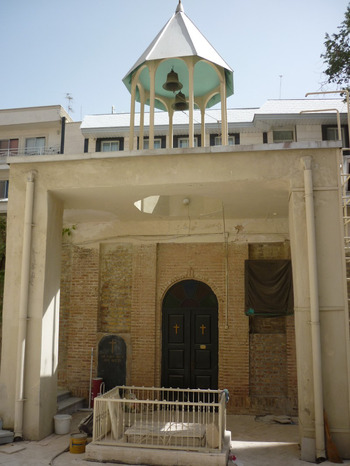
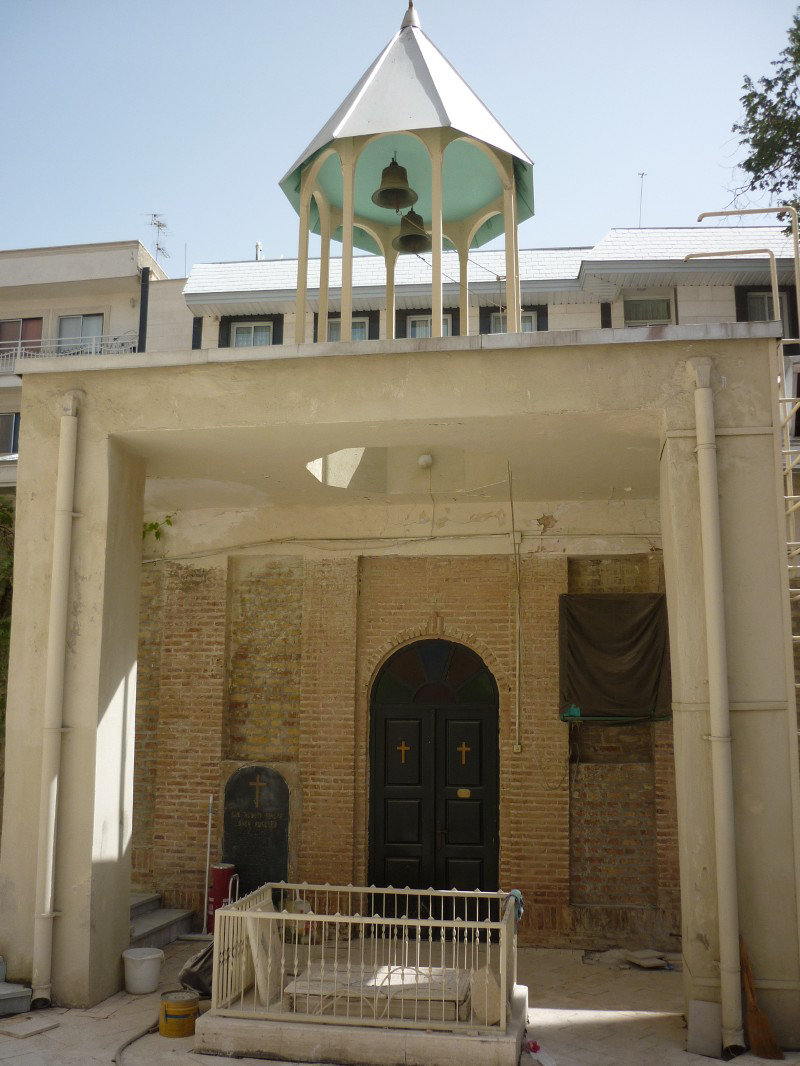
For those Armenians who have remained in Tehran, their response to discriminatory measures has been to retreat to Armenian spaces. These spaces represent a desire, to borrow from Migliorino,Footnote 44 to re-create Armenia in Tehran and are characterized by their discretion: invisible from the street and notably different on the inside. In many ways, they mirror the structures of the ghettos, such as the older churches of the city, including the nineteenth century Saint Minas Church in Vanak, which is situated at the heart of a previously segregated village. The building is flat-roofed and its foundations lie in a broad cavity carved from the ground which situates the structure below street level. Due to its height, roofing and surrounding walls, the building is not visible from the street, which is exactly how the architects intended it. A bell tower now exists but this is a far more recent addition. In short, it is the embodiment of discretion (Figure 1). Today, many community centers are the same: innocuous buildings designed so that outsiders cannot see inside, and the function of the space is obscured.
The Saint Minas Church in Vanak demonstrates a traditional style, where the church resembles a regular building (the bell tower is a later addition), is below street level, as seen from the sloping stairs, and within a walled compound
Source: The author.
The discretion of Armenian spaces allows the minority to carry out many activities otherwise forbidden in the Islamic Republic, such as socializing between unrelated unmarried men and women, no requirement for veiling, and permission to consume alcohol. Resistance and defiance of the dominant culture is often fostered behind closed doors so as not to provoke the majority. It is an important aspect of their positioning in that they are forced to adopt an identity that is private and out of the public eye, but it has allowed the Armenians to renew their identity from generation to generation. One of the ways they achieve this is through their clubs which act in much the same way as their churches traditionally have.
Even before the 1979 Revolution, Armenian life revolved around the clubs in Iran.Footnote 45 These clubs catered for young and old, and were havens for sporting and scouting activities, intellectual pursuits, cultural events and celebrations of all kinds, including of national days as well as weddings and informal parties. The cultural center at the heart of Tehran’s Armenian community is the Armenian Cultural Ararat Organization (Hay Mshakut’ayin Ararat Kazmakerput’iun), more commonly known as Ararat. The Ararat Organization acts as a purely Armenian territory for the community of Tehran in the place of the homeland. Clubs such as Ararat are common in the diaspora and are designed to establish and sustain “intimate, face-to-face associations with fellow Armenians” so as to create a sense of “we-ness” within the community.Footnote 46 The significance is in the name, shared with Mount Ararat, which lies at the symbolic heart of Historic Armenia. As Aghanian argued “Ararat remains a powerful symbol for Armenians across the world; a symbol of the homeland for a community in exile.”Footnote 47 In Tehran, Ararat is the name of a school, a daycare center, a workshop, a delicatessen and a restaurant, as well as the major sports club. The choice of name for the organization is also central in binding Armenians to hay dat—that is, the Armenian cause. Mount Ararat, though visible from the Armenian capital, now lies within the political boundaries of the Armenian nemesis, the Republic of Turkey. In this way the name alone contributes to the narrative of dispossession through genocide.
The Ararat Organization was founded in July 1944, in an atmosphere where Armenian institutions that were banned in the 1930s by Reza Shah were gradually being allowed to reopen following the shah’s forced abdication. Ararat originally formed from a merger of a variety of Armenian clubs and has evolved along these lines, catering for all types of functions—sporting, cultural or more broadly social. Ararat has a number of chapters across the country, including several buildings in Tehran and regional branches in Tabriz, Shiraz and Urmia. There is also a chapter in Isfahan, but it is a separate organization which is now independent of Tehran.
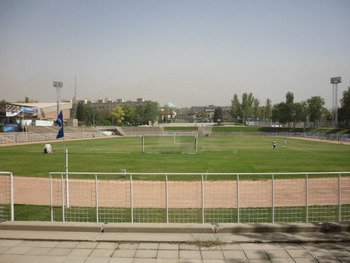
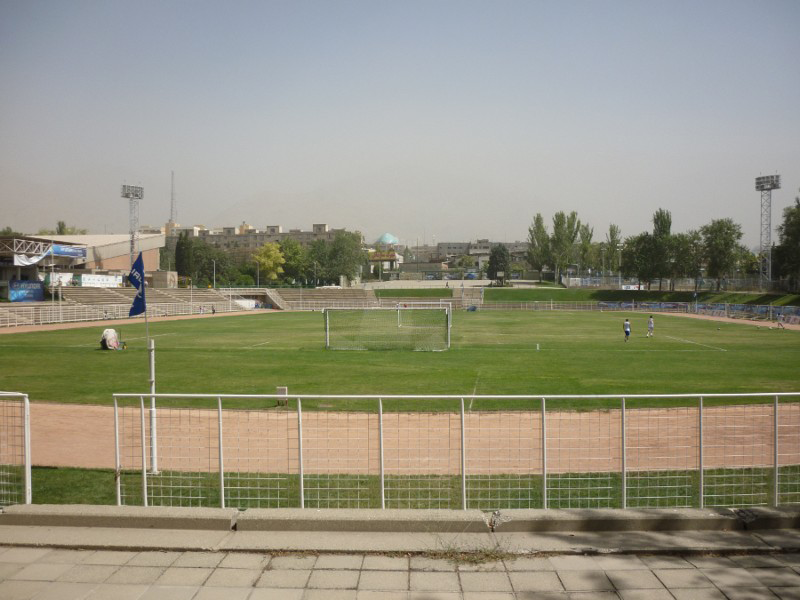
While Ararat was originally based in the center of Tehran (in a building confiscated from the Communist Party of Iran and gifted to the community by the government), the organization later moved its headquarters to a much larger compound in Vanak during the 1970s that was built on land provided to the community by the last shah, Mohammad Reza Pahlavi, which comprises roughly 80,000 square meters.Footnote 48 The compound has almost every conceivable amenity. There are sporting facilities such as basketball courts, tennis courts, indoor rock-climbing apparatus, wrestling mats and so on. There is an Olympic-sized stadium used for football matches (see Figure 2), and track and field events (including the all-Armenian games every September). There are additionally two swimming pools and a gym. The football and basketball teams compete in national competitions, and the female basketball team was the champion in 2009, meaning that a Christian team represented the Islamic Republic in the Asian Club competition.
The Ararat Stadium, one part of the compound, in Vanak, Tehran
Source: The author.
Despite attempts to confiscate the compound over the past thirty years, the government also conversely contributes to its upkeep. Interlocutors told me how the government has in the past contributed large sums of money for maintenance of the stadium and other facilities. This appears to have been a basic political maneuver, and Yaghoubian argued that the reason that most Armenians he knew voted for Mahmoud Ahmadinejad in the 2005 presidential election was because of his support of Ararat while mayor.Footnote 49 While this policy is in some ways unusual considering that the facilities are privately owned and open to use by only a small segment of Iran’s population, when seen in light of the large sums contributed to the maintenance of Armenian churches and monasteries in Iran, it can be viewed as part of a wider policy. The Islamic Republic’s policy of providing support to a small minority that does not constitute a large voting bloc is related to its promotion of an image as a tolerant country, as well as its strategic goals aimed at attracting Armenian tourists and maintaining cordial relations with the Republic of Armenia. Furthermore, while this grant to Ararat may seem inconsistent when seen in light of other policies, it is demonstrative of the ongoing positive relations that the leadership of the Armenian community (both secular and religious) fosters with various mainstream political institutions in Tehran.
In spatial terms Ararat is a noticeably Armenian, and noticeably non-Persian, space. As one Australian friend put it to me, going inside Ararat is like travelling to a different country. Just as Ariel de Vidas noted feeling “struck by the sense of crossing invisible boundaries” when moving from Mestizo neighborhoods on the outskirts of Tantoyuca in Mexico’s northeast to nearby Teenek villages (despite the lack of obvious physical differences between these settlements),Footnote 50 I too encountered a similar sensation whenever I entered the grounds of the Ararat Complex in Tehran. From the outside, it is not immediately apparent that the compound is an Armenian space. The high wall blocks any view inside and the small gate at the entrance has only a no-smoking sign written in Persian. However, once inside there are obvious physical differences between the compound and the street. Firstly, signs in Armenian outnumber those in Persian. Secondly, women do not wear hijab and manteau in a public environment, removing both immediately upon entering and only putting them on again at the very last minute before leaving. Thirdly, within the compound there is little to no gender segregation as almost all sporting facilities are mixed, and there is no prohibition on men and women sharing a tennis court or pool table. The only exception to this is the swimming pool, where there are men’s only and women’s only days. Even this is negotiable, however, and mothers are free to be present in the infant’s pool while men are using the main pool. Furthermore, women are not allowed to attend male football matches due to the laws of the Iranian Football Federation, though they are allowed to attend the male basketball matches at Ararat, albeit in segregated stands. All of this clearly shows the differing attitude that the Iranian government and the Armenian minority have towards gender.
In linguistic terms, Ararat is also distinctly Armenian. Armenian is the main language used within the compound; all advertising posters and all but a few signs are in Armenian. I have even encountered the discouragement of Persian-speaking within the compound. The centrality of language in Armenian culture is therefore expressed in the de facto official status it has within Armenian institutions in Tehran. It mirrors Smith’s arguments of ethnic election whereby a marginalized group will attempt to create an avenue through which the situation appears reversed.Footnote 51 Ethnic election refers to the practice in a select number of modern nationalisms—such as that of the Armenians—to link religious beliefs in divine election with modern notions of national destiny. In a more specific sense, Armenians use the myths of ethnic election to reaffirm their own self-esteem, and perform this through actions such as restricting the use of languages other than Armenian. In this instance, the chauvinistic attitude the state shows towards the Armenian language is reversed and Armenian becomes the sole means of communication.
While there are a number of other Armenian clubs in Tehran, including the Rāffi and Sipān clubs which are located in the hayashat neighborhood Nārmak, Ararat remains the largest and most important. For adults, Ararat is used for sports, cultural events, weddings and general socializing. Ararat is most popular during summer, when people often drop by in the evening for a meal or for coffee from one of its two restaurants. This is especially advantageous for women, who are able to socialize in the heat without wearing a hijab or chador. For this reason, I have heard some Armenians describe Ararat as an “oasis.”
As Ararat plays an important role in identity formation and reinforcing, there are many facilities for children. This includes an adventure playground, and various clubs for dancing, sports and astronomy. Many Armenians first experience Ararat as members of the Scouts, who can be seen setting up tents, parading or practicing other skills around the compound on Fridays. The value attached to Ararat is such that on several occasions I have seen smaller children throw tantrums when leaving the venue. On one instance in 2014, I saw a toddler of about two or three trying to run away from her mother when it was time to leave. She had been in the adventure playground and as her mother began to walk her towards the car park the small child seemed to sense that they were leaving and tried to run into the main building before her mother managed to pick her up and carry her out screaming. Karineh, a thirty-two-year-old consultant, who witnessed the same scene, told me that she remembered being exactly the same, crying when it was time to leave Ararat, because, she said, “Ararat is safe,” in contrast to the world outside. Karineh’s view was based on her own reminiscences and I acknowledge that a tantrum thrown by the child leaving a “fun” place is universal; however, Karineh’s description of the sense of safety that exists in Ararat is significant in its contrast to the tension found on the streets of Tehran generally. This is especially true of women who occasionally face confrontation from the authorities regarding their adherence to the Islamic dress code. This is a view reinforced by the Armenian community leadership, who seek to create a sense of protection within Armenian spaces, such as clubs and schools, among the younger generation.Footnote 52 As a more relaxed space, Ararat has a feeling of familiarity and safety.
A crucial part in the separation of Ararat as an Armenian space is the fact that, with only a few exceptions, non-Armenians are legally prohibited from entering the grounds. This prohibition emerged after the revolution as a way to appease the authorities who did not wish for Muslim Iranians to be in a mixed-gender environment where women are usually unveiled and alcohol could potentially be consumed in their presence.Footnote 53 There are occasionally events, however, where Muslims are invited along. Invariably these events will take place in one section of the compound so as not to affect others using the facilities. In these events, Armenian women are required to observe the usual Islamic dress codes. I have been at Ararat during a few “open” events. One was an academic conference, which was held under tightly controlled conditions. When the attendees entered through the front gate, they were ushered by security through a door and up a stairwell to the seminar area (a reception room and conference hall). Veiling was observed and the doors to the rest of the compound were guarded by ushers in order to prevent people from wandering into other parts of the compound. This allowed other Ararat members to use the facilities without having to alter their own rules.
The only other Muslims that enter the compound are the cleaning staff, the majority of whom are Afghans of Hazara background. Afghan cleaning staff would often work in the presence of unveiled Armenian women but they were never present in the evenings when alcohol was consumed by some patrons. Non-Armenian Iranians also work in the printing rooms of the Alik newspaper. Since they use Persian, they are immediately identifiable as Muslims. Again, they are restricted to one part of the building so that the other members of staff are free to move about unveiled. Similarly, the Vank Cathedral in Isfahan has Muslim staff, who are involved in selling tickets to the venue and are identifiable by language.
At Ararat, the ban on non-Armenians, specifically Muslims, is strictly enforced. Security staff, all of whom are Armenian, are on the lookout for non-Armenians. The reason for this, I was told by a former member of Ararat’s governing committee, is that when it becomes known that the rules have been breached, the authorities tend to “give trouble” to Ararat. In the past, the presence of an Iranian Muslim in a minority setting was often enough for the institution to be closed down, so strict segregation developed in these spaces. Ani, a homemaker in her forties, gave an example of a night when she had brought along an Assyrian friend believing that, since the woman was a Christian, her entry was within the rules. A security guard approached them and asked them why they were speaking Persian. When Ani told him that her friend was an Assyrian and did not understand Armenian, the guard asked the Assyrian woman to leave as the club was only for Armenians. Ani eventually managed to convince the guard that the Assyrian woman posed no threat, though he was still reluctant to accept this. Ararat is therefore defined not only as a non-Muslim space, but specifically as an Armenian space. The main desire is to keep it as such by remaining discreet and out of the government’s gaze.
Aspects of the government and military in particular recognize the tremendous value of the facility at Ararat and since the 1979 Revolution they have attempted to seize the compound several times. As early as 1981, the government began expressing its desire to take over Ararat.Footnote 54 Many different reasons have been given for this but Sarkis summed up the Armenian interpretation as follows: “people complain that the minorities have better facilities than what is available to them and they try to take it away from us.” However, a more straightforward interpretation lies in the strategic potential of the compound, which has been a principal factor in other properties having been confiscated from the minorities, such as the Qasr-e Firuzeh from the Zoroastrians.Footnote 55 During the height of revolutionary zeal, the authorities wanted to enforce veiling and gender segregation at Ararat on the grounds that it was a public place. The Armenians resisted this, arguing that Ararat, along with the Armenian schools and other facilities, were “homes to the Armenians” and Muslims would be excluded for this reason. Nevertheless, Ararat was raided several times during this period, resulting in the arrest of board members and the temporary closure of the compound on one occasion. Events such as these were not restricted to Ararat and other community centers suffered similar attention.Footnote 56 By 2010, events like these were unheard of, though tension between the government and the community over Ararat lingered.
As recently as 2005 there was another challenge to the ownership of Ararat. According to Hakob, in the late 1990s a document believed to be the last will and testament of Fath-Ali Shah emerged. In it he bequeathed all the land around the village of Vanak to the Imam Reza Shrine in Mashhad. Given the religious nature of the state’s ideology, the validity of the will was upheld and some of the caretakers of the shrine attempted to use it as a pretext to confiscate Ararat. Ararat’s sole ownership claim stems from a decree from the last shah who granted the land to the organization in 1973.Footnote 57 The challenge led to a prolonged legal battle which ended in a compromise; the ownership of the land was awarded to the Imam Reza Shrine while the Ararat Organization was recognized as the owner of the buildings upon that land. Ararat is allowed to stay in Armenian hands provided a rent is paid to the Imam Reza Shrine.
I spent a significant portion of my first field trip in Iran attempting to gather the knowledge that Iranian Armenians had of this incident and their responses to it. This most recent struggle for Ararat has not been recorded in any other study of which I am aware, and my findings show a continuing determination to defend Ararat. Hakob in particular summed up the salient view among Iranian Armenians regarding the protection of Ararat. Basically, my interlocutors felt that without it the community could not survive. Hakob expressed this sentiment in blunt terms: “without Ararat, there is no Armenian community.” It is very much a homeland in exile where culture can be practiced without restriction and it also provides Armenians with a place of escape from a world where at times they feel foreign.
Conclusion
The debate regarding the place of Islam in regional politics in the Muslim Middle East is ongoing, with various political groups ranging from those that wish to work with the state (such as Ennahda in Tunisia) to those who wish to destroy it (such as ISIS), all offering their own vision. However, the principal lesson that can be gauged from the Iranian experience of more than thirty-five years of an Islamic Republic is that religious politics do not accommodate religious diversity. The Armenian Christians of Iran are a case in point, as their community has experienced a staggering decline since 1979 based in part on the exclusionary policies of the Islamic Republic, which recognizes non-Muslims but assigns them a marginal position. Those who have remained have developed a means of survival based on social separation or re-ghettoization. The forces of re-ghettoization are twofold, coming both from the exclusionary laws of the Islamic Republic and from within the community leadership, which prefers Armenians to have limited contact with non-Armenians. While not restricted to their own ghettos by law as they were a century ago, Armenians in Tehran still gravitate towards those neighborhoods which they regard as Armenian, the hayashatner. These areas have a visible Armenian presence and although the population is mixed between Armenians and Iranian Muslims, the Armenians express a degree of ownership over these suburbs by the congregation of their institutions. The ultimate Armenian institution in Tehran, Ararat, most closely resembles a ghetto in the older sense, in that it is gated, hidden and non-Armenians are forbidden entry; however, it is not a place of forced isolation or poverty. The value ascribed to this institution is such that community members believe that if it were lost, and there have been several attempts by government and religious organizations to seize it, then the Armenian population of Tehran would disappear.
There are a number of other areas of study which have not been covered in this article that relate to re-ghettoization. The first is the re-emergence of the Armenian accent among the younger generation. Although this accent declined following the ending of segregation during Pahlavi rule, it has re-emerged among the post-revolution generation who, despite being raised in a Persian-speaking environment, speak Persian with a strong accent. This is a direct result of re-ghettoization and the legal discrimination against Armenians vis-à-vis the majority. There have been concerted efforts by successive administrations to deal with the marginalization of non-Muslims, and President Hassan Rouhani has prioritized it in his domestic policies, but the underlying ideology of the Islamic Republic makes it difficult to fully integrate these minorities. Recently, this exclusion has been further complicated by the emergence of ISIS, which in many cases has reinforced Armenian views of Islam as a persecuting religion, and continues to contribute to the declining religious diversity of Iran. This exemplifies the overwhelming social implication of religious politics: they foster an environment that encourages religious homogeneity and inhibits pluralistic diversity.