Introduction
Understanding the factors that influence the spatial distribution of species in the present time is a key challenge of ecological biogeography (Monge-Nájera Reference Monge-Nájera2008; Leavitt & Lumbsch Reference Leavitt and Lumbsch2016). A prominent biogeographical pattern is linked to the Mediterranean-type climate, 80% of which is located in the Mediterranean Basin, one of the world’s biodiversity hotspots with a rich biota and high proportion of endemic species (Myers et al. Reference Myers, Mittermeier, Mittermeier, da Fonseca and Kent2000; Fady-Welterlen Reference Fady-Welterlen2005; Nieto Feliner Reference Nieto Feliner2014). Previous studies have explored species-climate relationships for a wide variety of organisms in this area (e.g. Petit et al. Reference Petit, Hampe and Cheddadi2005; Youssef et al. Reference Youssef, Baumel, Véla, Juin, Dumas, Affre and Tatoni2011; Planas et al. Reference Planas, Saupe, Lima-Ribeiro, Peterson and Ribera2014; Santiso et al. Reference Santiso, Lopez, Retuerto and Barreiro2016), as well as the ecological specialization of Mediterranean elements (Thompson et al. Reference Thompson, Lavergne, Affre, Gaudeul and Debussche2005). The Mediterranean biogeographical pattern is also one of the 16 major patterns identified in lichens (Galloway Reference Galloway2008). Many lichens favour the Mediterranean climate (mild rainy winters and hot dry summers, with nocturnal hydration by dew or fog during the drier seasons), but a Mediterranean element analogous to steno- or eurymediterranean vascular plants has been difficult to define among lichens (Incerti & Nimis Reference Incerti and Nimis2006). According to current knowledge, examples of lichen species restricted to this geographical area are Physconia servitii, P. petraea and P. venusta (Otte et al. Reference Otte, Esslinger and Litterski2002). Although in lichen genera with widely distributed species we may find some taxa with a strong affinity for the Mediterranean climate (e.g. Leptogium ferax, Guttová & Lőkös (Reference Guttová and Lőkös2011); Squamarina concrescens, Poelt & Krüger (Reference Poelt and Krüger1970)), little is known about closely related lichens (e.g. members of the same genus) and their ecological variation along climatic gradients within the Mediterranean area.
An increasing number of studies of lichenized fungi have included the use of climatic niche modelling techniques to understand their biogeographical patterns (e.g. Ellis et al. Reference Ellis, Coppins, Dawson and Seaward2007; Wiersma & Skinner Reference Wiersma and Skinner2011; Bendiksby et al. Reference Bendiksby, Mazzoni, Jørgensen, Halvorsen and Holien2014). However, it has been highlighted that there is a need to extend ecological biogeographical studies to include a wider spectrum of lichen diversity (Leavitt & Lumbsch Reference Leavitt and Lumbsch2016). The lichen genus Solenopsora A. Massal. (Leprocaulaceae, cf. Lendemer & Hodkinson Reference Lendemer and Hodkinson2013; Miadlikowska et al. Reference Miadlikowska, Kauff, Högnabba, Oliver, Molnár, Fraker, Gaya, Hafellner, Hofstetter and Gueidan2014) currently includes up to 25 species, mostly occurring in temperate and subtropical regions except for South America (Ryan & Timdal Reference Ryan and Timdal2002; Gilbert et al. Reference Gilbert, Purvis and James2009). So far, species have been reported from three of the five Mediterranean-type ecosystems: the Mediterranean Basin (e.g. S. grisea, S. olivacea subsp. olbiensis, S. olivacea subsp. olivacea, S. marina; Guttová et al. Reference Guttová, Zozomová-Lihová, Timdal, Kučera, Slovák, Piknová and Paoli2014; Nimis & Martellos Reference Nimis and Martellos2017), California (e.g. S. chihuahuana, S. cladonioides, S. crenata and S. cyathiformis; Ryan & Timdal Reference Ryan and Timdal2002) and Australia (S. holophaea, S. vulturiensis; Sammy Reference Sammy1989; Cranfield Reference Cranfield2004; Elix Reference Elix2009; McCarthy Reference McCarthy2013; McCarthy & Elix Reference McCarthy and Elix2017). In view of this, eight species and two subspecies of the genus Solenopsora concentrated in the Mediterranean Basin were selected for study, for ecological as well as taxonomic reasons.
The distribution of the majority of European taxa of the genus Solenopsora is restricted to the Mediterranean Basin. Some of these species have wider biogeographical amplitudes, extending to European areas with a more continental or Atlantic climate (Guttová et al. Reference Guttová, Zozomová-Lihová, Timdal, Kučera, Slovák, Piknová and Paoli2014; Fačkovcová et al. Reference Fačkovcová, Senko, Svitok and Guttová2017). They mostly inhabit substrata with fewer competitive interactions (rocks) in extreme or azonal habitats, unsuitable for cultivation, such as barely accessible gorges, cliffs and steep slopes, which are thus relatively stable with regard to vegetation succession or human-induced landscape modification. Here, environmental constraints limit the above-ground competition, and constrain succession. Some taxa grow in more sheltered, humid situations in woodlands (e.g. S. olivacea subsp. olbiensis), while others are able to tolerate direct sun in open habitats (e.g. S. holophaea).
Distribution models, when combined with morphological, chemical or molecular data, have been used to investigate taxonomic or evolutionary questions (Martellos et al. Reference Martellos, Attore, Farcomeni, Francesconi, Pittao and Tretiach2014; Mered’a et al. Reference Mered’a, Kučera, Marhold, Senko, Slovák, Svitok, Šingliarová and Hodálová2016). The two closely-related intraspecific taxa, with different modes of reproduction, within S. olivacea feature peculiar ecological preferences: S. olivacea subsp. olivacea (forming apothecia) grows on rock faces in shaded and open habitats; whereas S. olivacea subsp. olbiensis (forming soredia) is an obligate chasmophyte, occurring in humid and shaded forests, growing on perpendicular rock faces (Guttová et al. Reference Guttová, Zozomová-Lihová, Timdal, Kučera, Slovák, Piknová and Paoli2014).
In this study, we aimed to investigate whether the species responses to environmental factors are taxon-specific and can clarify the differentiation between closely related entities of the two major lineages within the genus Solenopsora under the current generic concept (see Guttová et al. Reference Guttová, Zozomová-Lihová, Timdal, Kučera, Slovák, Piknová and Paoli2014). Employing a modelling approach, we used occurrence data of members of Solenopsora from the Apennine Peninsula to: 1) identify the environmental factors that shape the species’ ecological niches; 2) understand the flexibility of multiple Solenopsora taxa that enables them to inhabit different geographical and bioclimatic spaces; 3) depict the degree of overlap/differentiation of ecological niches between the studied species, with a special focus on two subspecies of S. olivacea with different reproductive strategies.
Materials and Methods
Study area
The Apennine Peninsula is a well-structured landscape of the Mediterranean Basin. Compared to the Iberian and Balkan Peninsulas, it features the fewest bioclimatic variants (cf. Rivas-Martínez et al. Reference Rivas-Martínez, Rivas Sáenz and Penas2011): 1) Mediterranean pluviseasonal oceanic; 2) temperate continental; 3) temperate oceanic sub-Mediterranean; 4) temperate oceanic. It had a limited contribution to the postglacial colonization of Central and North Europe due to stronger geographical barriers, such as the Alps (Nieto Feliner Reference Nieto Feliner2014). The study area includes the Apennine Peninsula with the southern Prealps (Prealpi Bresciane e Gardesane, Prealpi Bergamasche, Prealpi Venete, Alpi and Prealpi Giulie) and islands (Sicily and adjacent islands of Sardinia and Elba). The area hosts all of the Solenopsora taxa known from the Mediterranean Basin and adjacent areas, such as North Africa, continental and Atlantic Europe, and Asia Minor. Furthermore, more occurrence data are available from this area than from the Iberian and Balkan Peninsulas (Guttová et al. Reference Guttová, Zozomová-Lihová, Timdal, Kučera, Slovák, Piknová and Paoli2014; Fačkovcová et al. Reference Fačkovcová, Senko, Svitok and Guttová2017; see Supplementary Material S1 & S2, available online), permitting a more reliable use of modelling algorithms.
Study species and occurrence records
We focused on nine Solenopsora taxa reported so far from the Apennine Peninsula (Nimis Reference Nimis2016): S. candicans (Dicks.) J. Steiner, S. cesatii (A. Massal.) Zahlbr., S. grisea (Bagl.) Kotlov, S. holophaea (Mont.) Samp., S. liparina (Nyl.) Zahlbr., S. marina (Zahlbr.) Zahlbr., S. olivacea subsp. olbiensis (Nyl.) Clauzade & Cl. Roux, S. olivacea (Fr.) H. Kilias subsp. olivacea and S. vulturiensis A. Massal.
In order to gather data on the occurrence of the taxa in the study area (Supplementary Material S1), and to explore their geographical ranges (Supplementary Material S2), we revised specimens archived in the following collections: BC, BM, BP, BR, BRA, BRNU, CANB, CLU, FH, FI, G, GZU, H, LISU, O, PRA, PRC, PRM, SAV, TO, TSB, VBI, VER, W, ZA, herbaria of H. Komposch, I. Pišút, J. Vondrák and Linda in Arcadia. The revision of older material was necessary to prevent misidentifications, the most common of which are for Solenopsora cesatii (as S. liparina), S. grisea (as S. cesatii), Lecanora pruinosa Chaub. (as S. candicans) and Lecania spadicea (Flot.) Zahlbr (as S. cesatii var. grisea or S. grisea). Revisions of archived specimens, as well as recent records from field surveys conducted between 1999 and 2016, were also used (Komposch & Breuss Reference Komposch and Breuss2013; Guttová et al. Reference Guttová, Zozomová-Lihová, Timdal, Kučera, Slovák, Piknová and Paoli2014, Reference Guttová, Vondrák, Schultz and El Mokni2015; Fačkovcová et al. Reference Fačkovcová, Senko, Svitok and Guttová2017). Occurrences were georeferenced using QGIS (QGIS Development Team 2016). Geographical biases (cf. Boakes et al. Reference Boakes, McGowan, Fuller, Chang-qing, Clark, O’Connor and Mace2010), involving uneven spatial cover of the Apennine Peninsula area and a focus on only certain areas (e.g. Liguria, Friuli-Venezia Giulia, Sicilia), were often present both in historical and recent collections. To avoid spatial autocorrelation, we excluded repetitions from our dataset: in the computational step, occurrences that fell in the same cell (duplicate records) were automatically counted as one. The final dataset for the study area contained 94 records of S. candicans, 34 of S. cesatii, 23 of S. grisea, 12 of S. holophaea, 8 of S. liparina, 8 of S. olivacea subsp. olbiensis, 29 of S. olivacea subsp. olivacea and 12 of S. vulturiensis. Since only a single record is known for S. marina, this taxon was excluded from further analyses.
Environmental variables and their contribution to characterization of Principal Component Analysis space
Nineteen bioclimatic variables (see Supplementary Material S3, available online) at 30 s spatial resolution (c. 1 km) were obtained from WorldClim (http://www.worldclim.org/; Hijmans et al. Reference Hijmans, Cameron, Parra, Jones and Jarvis2005). The variables are derived from measurements of monthly precipitation and temperature. Spearman correlation tests were used to exclude the most correlated variables from further analyses, hence reducing background noise (“Hmisc” R package; Harrell et al. Reference Harrell2016; R Core Team 2016), and targeting those that were expected to be significant for the biology of the species (Supplementary Material S4). Eight climatic variables remained for analyses in the dataset: BIO2, mean diurnal temperature range (mean of monthly (max. temp. – min. temp.)); BIO5, maximum temperature of the warmest month; BIO6, minimum temperature of the coldest month; BIO8, mean temperature of the wettest quarter; BIO13, precipitation of the wettest month; BIO14, precipitation of the driest month; BIO15, precipitation seasonality; BIO19, precipitation of the coldest quarter. Furthermore, the variables altitude and geological substratum were added as categorical predictors (Supplementary Material S5). The raster was created from the Geological Map of Italy at a scale of 1:1000000 provided by Servizio Geologico d’Italia (OneGeology Portal, ISPRA). Units were selected within the main lithological types, including: conglomerate (number 1), dolomite (number 2) and limestone (number 3), which are suitable substrata for S. candicans, S. cesatii, S. grisea, S. olivacea subsp. olbiensis and S. olivacea subsp. olivacea; mica-schists (number 4), phyllite (number 6) and sandstone (number 7), which are suitable for S. vulturiensis and S. holophaea; and peridotite (number 5, including ophiolites – serpentinites, gabbros and ophiolitic breccias) for S. liparina. These were converted into a raster with suitable categories numbered from 1 to 7 in alphabetical order, and another one including all “other substrata” (number 8). The rasters of predictors were at the same resolution of 30 s, processed and cropped to the study area using the “raster” R package (Hijmans & van Etten Reference Hijmans and van Etten2012) and QGIS (QGIS Development Team 2016).
As well as evaluating geology as a categorical predictor, we also tested the alternative of using this parameter as an environmental filter. After the ensemble modelling process, the climatic suitability maps were filtered for appropriate geological substratum units covering three groups, calcareous, ultramafic and siliceous substrata, hence masking and narrowing the suitability range. Out of the complete list of 101 units acquired from the Geological Map of Italy (scale 1:1000000) provided by Servizio Geologico d’Italia (OneGeology Portal, ISPRA) (Supplementary Material S6 & S7), we selected only the relevant units for analyzing Solenopsora taxa with respect to their suitable substrata, converted into rasters using QGIS (QGIS Development Team 2016).
Habitat suitability maps in geographical space and niche overlap calculation
Models at 30 s spatial resolution were produced by using three algorithms: Random Forest (a regression method which uses classification trees; Cutler et al. Reference Cutler, Edwards, Beard, Cutler, Hess, Gibson and Lawler2007; Barbet-Massin et al. Reference Barbet-Massin, Jiguet, Albert and Thuiller2012; Attorre et al. Reference Attorre, De Sanctis, Farcomeni, Guillet, Scepi, Vitale, Pella and Fasola2013), MaxEnt (a machine-learning method based on the principle of maximum entropy; Phillips et al. Reference Phillips, Anderson and Schapire2006), and GLM (Generalized Linear Model; Elith et al. Reference Elith, Graham, Anderson, Dudik, Ferrier, Guisan, Hijmans, Huettmann, Leathwick and Lehmann2006; Guisan et al. Reference Guisan, Broennimann, Engler, Vust, Yoccoz, Lehmann and Zimmermann2006; Thuiller et al. Reference Thuiller, Lafourcade, Engler and Araùjo2009; Williams et al. Reference Williams, Seo, Thorne, Nelson, Erwin, O’Brien and Schwartz2009; Serra-Diaz et al. Reference Serra-Diaz, Ninyerola and Lloret2012). Models were merged following an ensemble approach (Araújo & New Reference Araújo and New2007; Merow et al. Reference Merow, Smith and Silander2013) and using the “Biomod2” package in R (van der Wal et al. Reference van der Wal, Falconi, Januchowski, Shoo and Storlie2014; R Core Team 2016; Thuiller et al. Reference Thuiller, Georges, Engler and Breiner2016). The ensemble approach allowed the use of different algorithms for training initial models, eventually merging them into an averaged model weighted on their performance score. There was a performance threshold for building the ensemble, below which models were not considered. The performance of the models was assessed using the True Skill Statistic (TSS, Allouche et al. Reference Allouche, Tsoar and Kadmon2006), a validation metric based on the measures of sensitivity (proportion of correctly predicted presences) and specificity (proportion of correctly predicted absences) of the model. The TSS value practically measures the ability of the prediction to discriminate between an event that happened and one that did not. A model is considered good when TSS >0·6; thus the threshold for building the ensemble was set at 0·7. In order to overcome sampling bias, we chose to sample pseudo-absences randomly from the study area, with a proportion of presence/pseudo-absences of 1:10, as suggested by Barbet-Massin et al. (Reference Barbet-Massin, Jiguet, Albert and Thuiller2012). Parameters were set as follows: 80% of presence data were used for training and 20% for testing; 10 replication runs; Beta multiplier adjusted to 2. Other parameters were set to default values.
A principal component analysis (PCA) was performed to assess the relationship between presence data and bioclimatic features, and how the taxa are distributed in the bioclimatic space by means of the “FactoMineR” (Lê et al. Reference Lê, Josse and Husson2008) and “Factoextra” (Kassambara & Mundt Reference Kassambara and Mundt2017) packages developed for R software (R Core Team 2016).
Sympatric occurrence of the taxa confined to calcareous habitats was occasionally recorded (e.g. one site in Basilicata hosting S. candicans, S. cesatii, S. marina, S. olivacea subsp. olbiensis and S. olivacea subsp. olivacea; several sites along the peninsula hosting S. candicans with S. grisea, S. candicans with S. olivacea subsp. olbiensis, and S. candicans with S. cesatii), therefore overlap of their niches in the geographical space was further investigated. Niche overlap was assessed with an I similarity statistic, which was chosen for its simplicity, comparability and good performance (Warren et al. Reference Warren, Glor and Turelli2008; Rödder & Engler Reference Rödder and Engler2011). The I statistic is derived from the traditional D overlap index (Schoener Reference Schoener1968) integrated with the Hellinger distance measure (I), used to measure the difference between two probability distributions. The I statistic measures the overall match between two species occupancies across all cells in the gridded environmental space, and ranges from 0 (no overlap) to 1 (complete overlap) (Warren et al. Reference Warren, Glor and Turelli2008). We calculated the I statistic using the modelled species probability grids.
Results
Key environmental factors shaping ecological niches
The PCA analysis depicted the pattern of variation of the ten selected environmental variables (Supplementary Material S8A), and the position of the environmental niches of the taxa in PCA space (Supplementary Material S8B). The first two principal components (PCs) explain 65·9% of the variation in the data (Supplementary Material S8A & S9). The variability along PC1 was mainly correlated with maximum temperature of the warmest month, precipitation in the driest month, altitude and precipitation in the wettest month, explaining 48·7% of the total variation (Supplementary Material S8A, S9–S11). PC2 was correlated with precipitation seasonality, precipitation in the coldest quarter, minimum temperature of the coldest month and mean temperature of the wettest quarter, explaining 17·2% of the variation (Supplementary Material S8A, S9, S10 & S12). The environmental range of the taxa in the study area as inferred by PCA is mostly placed along PC2 (Supplementary Material S8A, available online). Comparable results were also obtained by an alternative model approach with geological filtering (Supplementary Material S13).
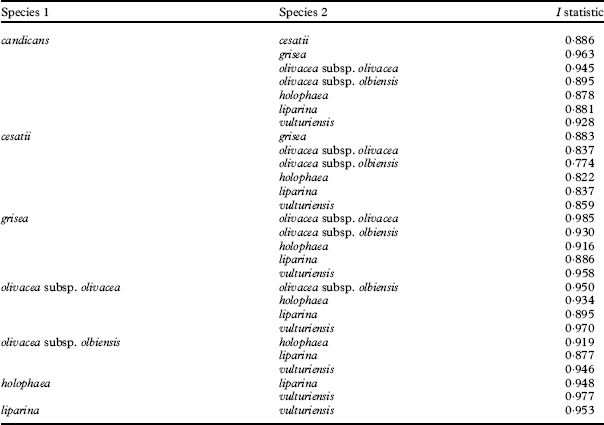
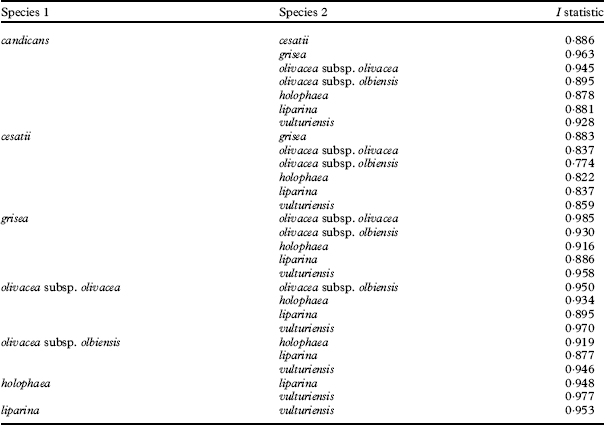
The results of the climatic niche overlap tests (Table 1) showed very high I values (i.e. >0·77), demonstrating low variability in the climatic space of the studied taxa. Scarce co-occurrence of species confined to one of the three categories of geological substratum suggests that the level of niche differentiation is on a very fine, microhabitat level. In the study area representing the climatic optimum for Solenopsora species, different parts of rock formations (e.g. open or shaded perpendicular faces or fissures of outcrops, cliffs and walls) facilitate the presence of more congeners.
Assessment of climatic niche overlap between Solenopsora taxa from this study based on I similarity statistic (Warren et al. Reference Warren, Glor and Turelli2008; Rödder & Engler Reference Rödder and Engler2011). The I statistic ranges from 0 (no overlap) to 1 (complete overlap)
Potentially inhabited geographical space in the study area
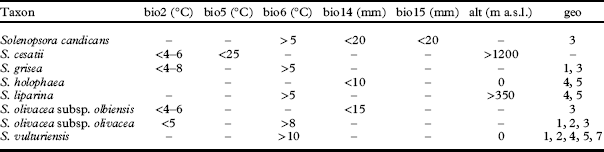
The modelled individualistic occurrences of Solenopsora taxa were shaped by their responses to the environment (Table 2, Supplementary Material S5 & S14). Geological substratum generally constrained the probability of occurrence of all the taxa (Supplementary Material S6) and best explained the probability of occurrence of seven of them: S. candicans, S. grisea, S. holophaea, S. liparina, S. olivacea subsp. olbiensis, S. olivacea subsp. olivacea, and S. vulturiensis (Table 2, Supplementary Material S5 & S14). In addition to geology, one of the three most important drivers for the occurrence of S. cesatii, S. grisea, S. olivacea subsp. olbiensis and S. olivacea subsp. olivacea was mean diurnal temperature range, which quantified the day-to-night variation over a given year, based on the mean of the monthly temperature ranges. Maximum day-to-night variation in temperature of highly suitable habitats for these species (probability occurrence higher than 0·8) was between 4–8 °C (Table 2, Supplementary Material S14 & S15). A minimum temperature of the coldest month below 5 °C decreased the probability of occurrence of S. candicans, S. grisea, S. liparina, S. olivacea subsp. olivacea and S. vulturiensis (Table 2, Supplementary Material S14 & S15).
Key environmental factors which best explain the habitat suitability maps of Solenopsora taxa used in this study
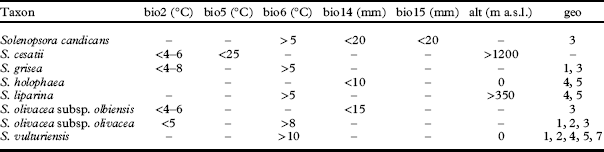
Key: bio2, mean diurnal temp. range; bio5, maximum temp. of the warmest month; bio6, minimum temp. of the coldest month; bio8, mean temp. of the wettest quarter; bio14, precipitation of the driest month; bio15, precipitation seasonality; alt, altitude; m a.s.l., metres above sea level; geo, geological substratum. Geological substratum categories: 1, conglomerate; 2, dolomite; 3, limestone; 4, mica-schist; 5, peridotite; 6, phyllite; 7, sandstone; 8, other substrata.
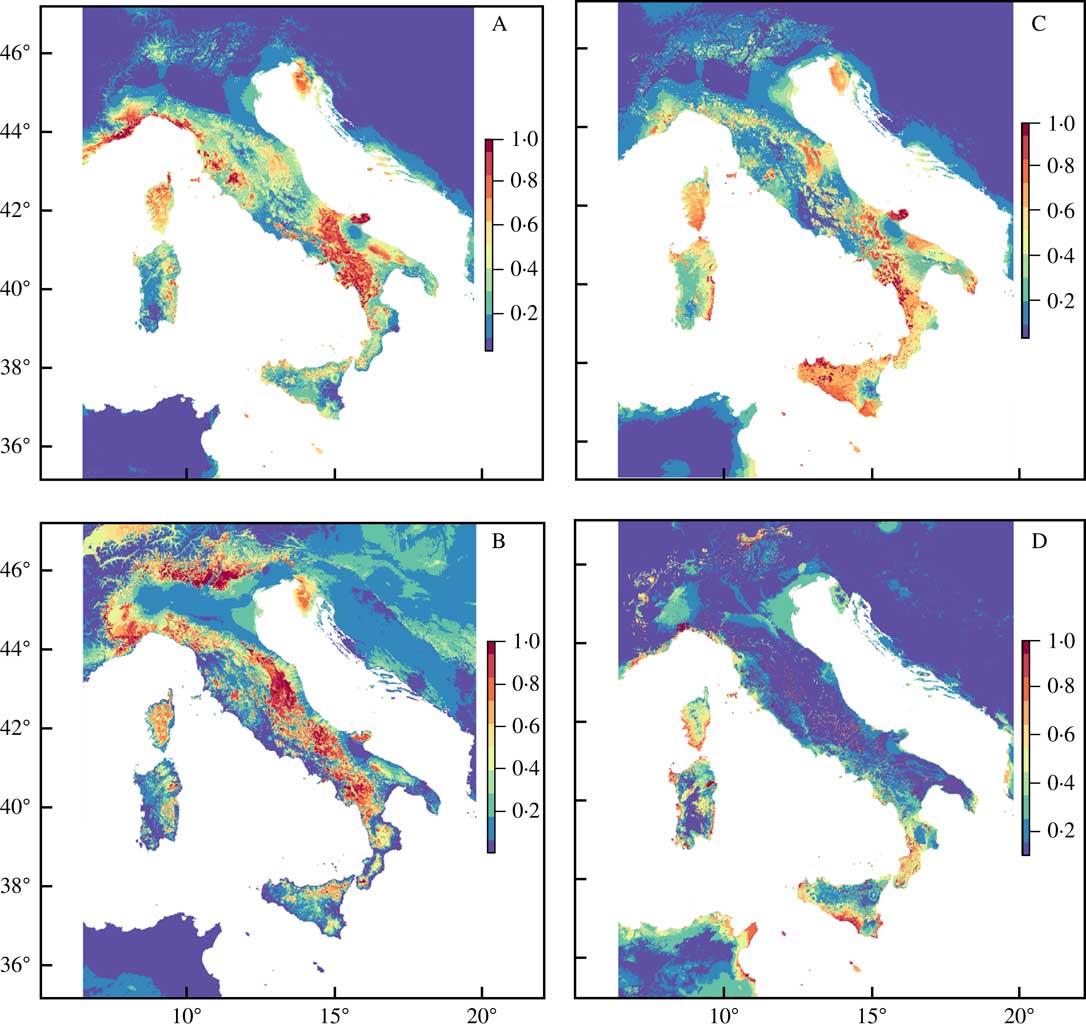
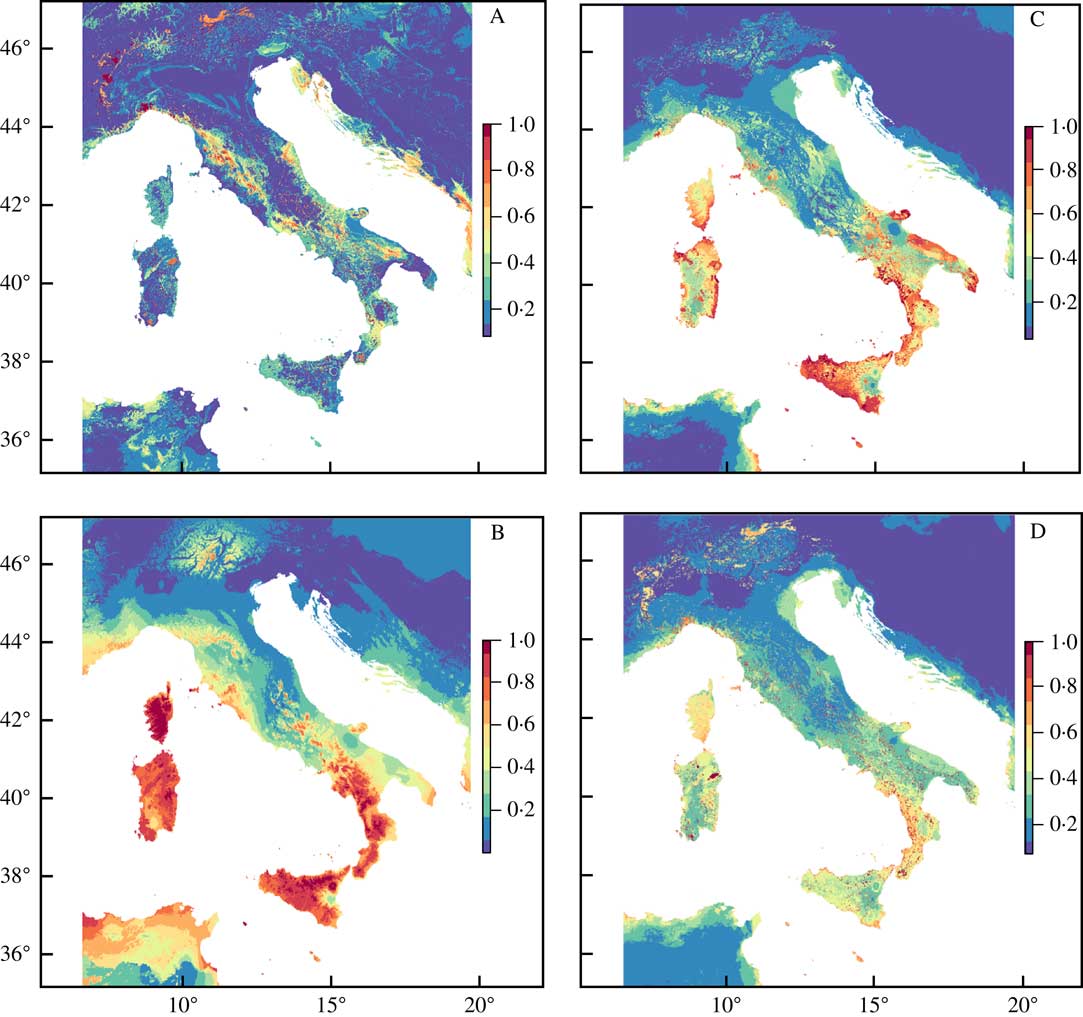
To explore the extent of the flexibility of Solenopsora taxa to colonize different geographical spaces within the Apennine Peninsula, environmental niche models were developed using an ensemble approach (Figs 1 & 2). The models, which take into account the areas with probability scores of occurrence higher than 0·7, suggested that within the group of taxa growing on calcareous substrata we can recognize two types of geographical distribution corresponding to habitats of high environmental suitability. The first type included areas at mid-altitudes across the peninsula along the western coasts, coastal Molise and the Gargano promontory (S. candicans, Fig. 1A), including pre-Alpine territories in the north and the mountains of Umbria, Campania, Basilicata and Abruzzo at higher altitudes up to 900–1500 m a.s.l. (in the case of S. cesatii, Fig. 1B). The second type shifted towards the southern part of the peninsula, such as the extreme south of Apulia, southern Campania and Sicily (S. grisea, S. olivacea subsp. olbiensis, S. olivacea subsp. olivacea; Figs 1C, 2B & 2C); in the case of S. olivacea subsp. olbiensis this included Sardinia (Fig. 2B). Alternative models based on climate (Supplementary Material S16A–C, F & G) with subsequent geological filtering (Supplementary Material S17A–C, F & G) confirmed these trends and the narrow suitability of habitats.
Habitat suitability maps (HSMs) of Solenopsora taxa along the Apennine Peninsula, predicting suitable areas under current climatic and geological conditions from 0 (blue) – not suitable, to 1 (red) – high habitat suitability. The scale refers to the probability distribution scores. A, S. candicans; B, S. cesatii; C, S. grisea; D, S. holophaea.

Habitat suitability maps (HSMs) of Solenopsora taxa along the Apennine Peninsula, predicting suitable areas under current climatic and geological conditions from 0 (blue) – not suitable, to 1 (red) – high habitat suitability. The scale refers to the probability distribution scores. A, S. liparina; B, S. olivacea subsp. olbiensis; C, S. olivacea subsp. olivacea; D, S. vulturiensis.
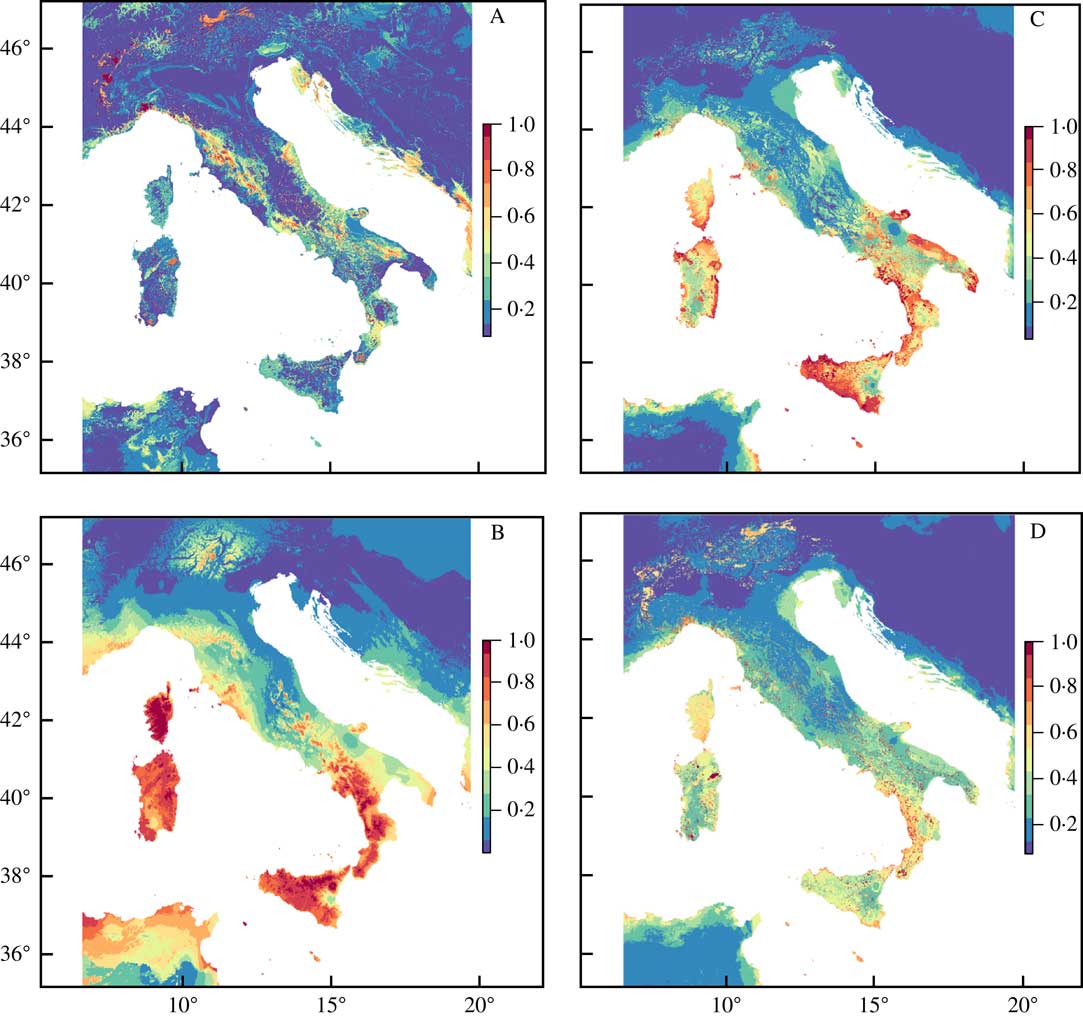
The centres of high suitability for S. holophaea and S. vulturiensis, two species confined to siliceous habitats, were situated at lower altitudes along the Tyrrhenian coastline, Sicily and to the extreme south of Apulia (Figs 1D & 2D). The presence of serpentine and other types of ultramafic outcrops limited the occurrence of S. liparina (Fig. 2C), which is so far restricted to the Tyrrhenian coast, Tuscany and Calabria. The results of alternative approaches with suitable climate (Supplementary Material S16D, E & H) but filtered geological requirements (Supplementary Material S17D, E & H) again supported this trend.
Ecological specialization of Solenopsora olivacea subspecies with differing reproductive strategies
Regularly fertile, apothecia-forming S. olivacea subsp. olivacea was more frequent in our dataset (34 specimens; see Supplementary Material S1) and is known to occur in nine administrative regions in the study area. Nine specimens of the obligately sorediate S. olivacea subsp. olbiensis were recorded from four administrative regions. Their environmental niches greatly overlap (Table 1). The subspecies share two key environmental variables that best explain habitat suitability (Table 2, Supplementary Material S5, S14 & S15), mean diurnal range and geology, though the occurrence of S. olivacea subsp. olivacea is supported by a wider spectrum of suitable geological substrata (Table 2). The third most important variable for S. olivacea subsp. olbiensis was precipitation in the driest month, whereas for S. olivacea subsp. olivacea it was minimum temperature of the coldest month. Both modelling approaches, including the alternative based on geology filtering, showed that S. olivacea subsp. olivacea tended to occupy warmer coastal areas (Fig. 2C, Supplementary Material S16G & S17G), whereas S. olivacea subsp. olbiensis preferentially occurred in temperate areas in hilly and mountainous zones of the peninsula (Fig. 2B, Supplementary Material S16F & S17F).
Distribution of the treated taxa within the study area and their overall geographical range
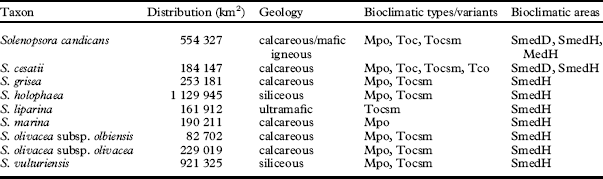
New regional records (cf. Nimis Reference Nimis2016; Fačkovcová et al. Reference Fačkovcová, Senko, Svitok and Guttová2017) are reported for Abruzzo (S. grisea), Calabria (S. vulturiensis), Friuli (S. grisea), Marche (S. cesatii, S. olivacea subsp. olivacea) and Trentino-Alto Adige (S. cesatii) (Supplementary Material S1). First occurrence records are also reported for S. cesatii in Serbia and Ukraine, and S. liparina in Serbia (Supplementary Material S2). Based on the revised specimens, maps showing the extent of geographical ranges were developed (cf. Gaston Reference Gaston1996) in which the area within a polygon depicted the limits to the occurrence of taxa (Supplementary Material S18). Solenopsora holophaea, S. vulturiensis and S. candicans had the widest geographical ranges respectively. Based on current knowledge, S. olivacea subsp. olbiensis is the taxon with the smallest geographical range (Table 3). The following distribution patterns could be distinguished: 1) the Mediterranean Basin (S. marina, S. olivacea subsp. olbiensis and S. olivacea subsp. olivacea); 2) the Mediterranean Basin plus the Atlantic in the west and the Black Sea region in the east (S. candicans, S. holophaea and S. vulturiensis); 3) the Mediterranean Basin and outposts on the Black Sea coast (S. grisea); 4) the Mediterranean Basin and foothills of European high mountain ranges (S. cesatii); 5) the Mediterranean Basin and Atlantic, the Hercynian massif in Central Europe and south-central Turkey (S. liparina).
Extent of geographical ranges (cf. Gaston Reference Gaston1996) of Solenopsora taxa studied. Distributional area estimated from polygons depicted in Supplementary Material S18 and their link to bioclimatic types or variants
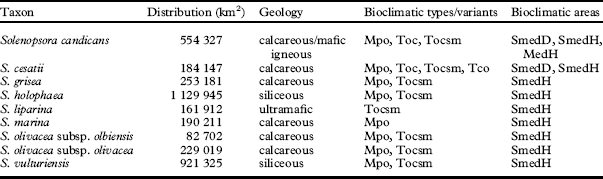
Bioclimatic types and variants (Rivas-Martínez et al. Reference Rivas-Martínez, Rivas Sáenz and Penas2011): Mpo, Mediterranean pluviseasonal oceanic; Tco, temperate continental; Toc, temperate oceanic; Tocsm, temperate oceanic sub-Mediterranean. Bioclimatic areas (Nimis Reference Nimis2016): MedH, humid Mediterranean; SmedD, dry sub-Mediterranean; SmedH, humid sub-Mediterranean.
Discussion
Ecological factors, such as geology and climate, have a strong influence on biodiversity patterns (Planas et al. Reference Planas, Saupe, Lima-Ribeiro, Peterson and Ribera2014). In the present study, using a modelling approach, we aimed to explore the drivers shaping the ecological niches and distribution of European taxa of the lichen genus Solenopsora with a strong link to Mediterranean-type climates. As is evident in several genera encompassing rock-dwelling species (e.g. Acarospora, Caloplaca, Lecanora), the studied members of the genus Solenopsora were confined to a wide range of rock types which can be assigned to one of the three groups: calcareous, siliceous and ultramafic. Preference for a particular geological substratum is one of the key environmental predictors for species/taxon occurrence. Solenopsora liparina is noteworthy as an example of an ecological vicariant specific to ultramafic substrata (serpentinised ultramafites) across its known distribution range. However, having accounted for geology, another important driver shaping the predictive distribution of S. liparina in ultramafic areas is climate of the geographical area, which is in line with the observations of Favero-Longo et al. (Reference Favero-Longo, Matteucci, Giordani, Paukov and Rajakaruna2018). Of the available localities in central Europe (the Hercynian mountains, the Western Carpathians) that represent sub-Mediterranean or sub-Atlantic conditions, only one, Raškov in the Bohemian-Moravian Highlands, yielded a record of this species (Guttová et al. Reference Guttová, Zozomová-Lihová, Timdal, Kučera, Slovák, Piknová and Paoli2014).
In the study area, the climatic optima of Solenopsora taxa ranged from cooler and drier to warmer and more humid conditions, as follows: temperate climate (S. candicans, S. holophaea and S. liparina), temperate warm climate (S. grisea), warm continental climate (S. cesatii), Mediterranean climate (S. olivacea subsp. olbiensis, S. vulturiensis), and hot Mediterranean climate (S. olivacea subsp. olivacea). Warm winters are important for S. candicans, S. grisea, S. liparina, S. olivacea subsp. olivacea and S. vulturiensis. Cooler summers were not limiting for S. cesatii, and environmental suitability for its occurrence has shifted to a temperate continental bioclimate.
The habitats of Solenopsora taxa are thus structured around three major ecological gradients, mainly determined by geology, temperature and precipitation. Considering climatic variables, one of the key factors that appeared to be structuring the study taxa is mean diurnal temperature range. This parameter, highly sensitive to small changes in maximum and minimum temperatures, is greatly affected by climate change (Braganza et al. Reference Braganza, Karoly and Arblaster2004). Recent studies show that, over the past decades, a large global trend has been observed of large increases in minimum rather than maximum temperatures (Braganza et al. Reference Braganza, Karoly and Arblaster2004; Qu et al. Reference Qu, Wan and Hao2014). In contrast, exceptional increases in diurnal temperature range due to decreased precipitation, fewer clouds and land degradation, as in the case of Italy, have also been demonstrated (Peralta-Hernandez et al. Reference Peralta-Hernandez, Balling and Barba-Martinez2009). Under certain future scenarios, Mediterranean Basin ecosystems sensitive to warming and water availability may undergo changes never yet experienced in the Holocene (Guiot & Cramer Reference Guiot and Cramer2016). In this respect, the occurrence of Solenopsora taxa confined to Mediterranean bioclimatic types (i.e. S. grisea, S. marina, S. olivacea subsp. olbiensis and S. olivacea subsp. olivacea) may represent indicators of climatic stability. Furthermore, Rubio-Salcedo et al. (Reference Rubio-Salcedo, Psomas, Prieto, Zimmermann and Martínez2017) compared distribution variability under current and future conditions of S. holophaea (with a Mediterranean Atlantic distribution) in the Iberian Peninsula. They found that climate change could have a positive effect on the bioclimatic range of this taxon, with a considerable gain expected in projected potential area. However, these results were based on a different set of climatic variables, and none of them corresponded to the first three best explanatory variables in our study (for both approaches, with geology included among climatic variables and as a filter). In our study we show that the distribution of S. holophaea is best explained by precipitation in the driest month, and in the case of an alternative model, by mean diurnal temperature range, precipitation in the wettest month and precipitation in the driest month.
The Solenopsora taxa studied have climatic niches which significantly overlap. The biggest difference in occupied climatic niche space is between S. cesatii, which has a niche shifted to temperate continental bioclimatic types and higher altitudes, and the three ancestral, strictly Mediterranean taxa S. grisea, S. olivacea subsp. olbiensis and S. olivacea subsp. olivacea. Despite occurrence records that are generally spread along the Apennine Peninsula, predicted suitable habitats for S. grisea, S. holophaea, S. olivacea subsp. olbiensis, S. olivacea subsp. olivacea and S. vulturiensis are restricted to smaller areas. When the two closely related species S. candicans and S. cesatii were analyzed using a dataset from the centre and margin of their distribution range in the Western Carpathians and Pannonia, tests of niche equivalency and similarity revealed that they colonize similar habitats in both (Fačkovcová et al. Reference Fačkovcová, Senko, Svitok and Guttová2017). However, it is worth emphasizing that a strong limiting factor is geology, which splits the taxa of the genus into three groups: those growing on calcareous, siliceous and ultramafic substrata.
The role of ecology in speciation is not yet fully understood. Ecological speciation may be relatively more important in organisms with a sessile nature, which may be more sensitive to fine-scale environmental heterogeneity (Anacker & Strauss Reference Anacker and Strauss2014). Testing explicit predictions originating from the hypothesis of ecological specialization connects biogeography, evolutionary and functional ecology (Devictor et al. Reference Devictor, Clavel, Julliard, Lavergne, Mouillot, Thuiller, Venail, Villéger and Mouquet2010). Martellos et al. (Reference Martellos, Attore, Farcomeni, Francesconi, Pittao and Tretiach2014) investigated differences in the distribution of two intraspecific taxa within Squamarina cartilaginea (With.) P. James. They showed that spatial distribution models of those taxa are determined by similar climatic variables and they underlined the value of a modelling approach for the delimitation of taxonomic entities. Solenopsora taxa have evolved different reproductive strategies, through sexual (ascospores produced either commonly, e.g. S. candicans, S. cesatii, S. holophaea, S. marina and S. olivacea subsp. olivacea; or rarely, e.g. S. grisea and S. vulturiensis) and vegetative propagules (soredia, e.g. S. olivacea subsp. olbiensis, or blastidia, e.g. S. grisea and S. vulturiensis). In our study, we focused on the distribution of two subspecies of S. olivacea; the more frequently recorded S. olivacea subsp. olivacea (Supplementary Information S1, S2, S18H; Guttová et al. Reference Guttová, Zozomová-Lihová, Timdal, Kučera, Slovák, Piknová and Paoli2014) reproduces sexually while S. olivacea subsp. olbiensis reproduces through soredia. Although their ecological niches do overlap, the subspecies which disperses vegetatively occurs predominantly in habitats with a higher variation in temperature during the day, and more precipitation in the driest month. The subspecies which reproduces sexually tends to occur in slightly warmer and drier areas. Leavitt & Lumbsch (Reference Leavitt and Lumbsch2016) postulated that species with a vegetative reproductive strategy often have a larger distribution range than their fertile counterparts. In our distribution models, a larger distribution range is predicted for S. olivacea subsp. olbiensis (compare Figs 2D & 3A). Regarding range overlap in sister species, it will be interesting to focus, in future, on species pairs with significantly different overall range sizes (Table 3), such as S. grisea (not yet confirmed from the Western Mediterranean, absent from the Atlantic) and S. vulturiensis (extending to the Atlantic up to Iceland). Solenopsora vulturiensis occurs in different biomes and its ecological niche is much wider than that of its sister species.
An important factor determining the distribution of taxa in any group is the distribution of their common ancestor, since it often represents inherited constraints (Heads Reference Heads2015). According to current knowledge, S. holophaea is considered as the ancestor (Guttová et al. Reference Guttová, Zozomová-Lihová, Timdal, Kučera, Slovák, Piknová and Paoli2014), and displays the largest extent of the geographical range in this group (Table 3, Supplementary Material S17D). After colonization of new environments, the ancestral group split and descendants underwent morphological and anatomical adaptation in response to site-specific conditions, resulting in their current ranges (shifts and/or contractions with respect to the ancestor) and ecological requirements.
The present study was of lichen congeners strongly linked to a Mediterranean-type climate in their ecological optima within the Apennine Peninsula. The reconstruction of ecological requirements, and the modelling of habitat suitabilities showed that six of the eight taxa studied respond to geology as a key environmental factor. Climate, represented mainly by maximum temperature of the warmest month, mean diurnal temperature range, precipitation in the driest month, minimum temperature of the coldest month and precipitation seasonality, additionally contributes to the distribution of the studied Solenopsora species (Table 2). A good example of specificity in response to the above-mentioned environmental factors is exemplified by S. liparina, which is confined to ultramafic rocks (Table 3). The ecological niches of the species strongly overlap in the study area. Solenopsora cesatii shifted towards higher precipitation seasonality and higher values of precipitation in the coldest quarter, and minimum temperature of the coldest month. The environmental space of S. vulturiensis forms a narrower subset relative to its sister species S. grisea. Apart from sharing a common trait position with respect to minimum temperature of the coldest month, they differ in their requirements for geological substrata. The overall ranges of the taxa suggest that they differ in tolerance to sub-optimal conditions. We conclude that the flexibility of the studied Solenopsora taxa to inhabit different geographical and bioclimatic spaces is limited to sub-Mediterranean bioclimates and some of the taxa can be considered indicators of climatic stability.
This work was supported by the projects VEGA 2/0032/17 “Unraveling processes responsible for the contemporary geographic range of symbiotic organisms with Mediterranean distribution”, APVV-15-0210 “Distribution potential of different fungal trophic groups in Europe”, and bilateral mobility APVV project SK-PT-2015-0027 “Disentangling evolutionary relationships across morphologically and ecologically diverse lichen genus Solenopsora”. We thank Dr Christopher Ellis and anonymous reviewers for comments that improved the manuscript. We are indebted to the curators of the cited collections for their kind help and assistance. Dušan Senko is acknowledged for explanation of the distribution maps (see Supplementary Material S18) and calculation of range areas. Dr Lucy Sheppard is acknowledged for language revision.
Supplementary Material
For supplementary material accompanying this paper visit https://doi.org/10.1017/S0024282918000543