Implications
Correlation coefficients between boar taint detection methods are generally weak. Therefore, the results of one detection method cannot be generalised and the choice of method deserves great consideration (single v. preferably multiple detection methods). Inclusion of indole in laboratory analysis might be relevant because of its sensory impact when skatole levels are low. The hot iron method seems promising as a fast and reliable detection method for fat samples. The axillary odour method needs further research to evaluate its value. Possible points of improvement for the consumer evaluation of boar taint are presented and also need further investigation.
Introduction
In spite of heavy social pressure to ban surgical castration without anaesthesia, this procedure is still the most common measure to prevent boar taint. The main contributors to this unpleasant odour are skatole (3-methylindole; Babol and Squires, Reference Babol and Squires1995) and androstenone (5α-androst-ene-3-one; Patterson, Reference Patterson1968). The odour of skatole has been described as faecal-like, naphthalene, sweet, warm and fruity. Androstenone is described as a urine-like or sweaty odour (Haugen et al., Reference Haugen, Zamaratskaia, Lundström, Chen, Squires, Lou and Whittington2008). Nearly everyone can perceive skatole, but a percentage of people are anosmic to androstenone (Wysocki and Beauchamp, Reference Wysocki and Beauchamp1984). Females are found to be more sensitive than males, but also other factors such as age and geographic origin may influence androstenone sensitivity (Furnols et al., Reference Furnols, Gispert, Diestre and Oliver2003; Bekaert et al., Reference Bekaert, Tuyttens, Duchateau, De Brabander, Aluwé, Millet, Vandendriessche and Vanhaecke2011b). Although the production of entire male pigs would be more ethically sustainable, this will only become feasible if the prevalence of boar taint is low and boar taint detection is possible in the slaughterhouse. However, research is hampered by the lack of a gold standard for measuring boar taint (European Food Safety Authority (EFSA), 2004; Haugen et al., Reference Haugen, Zamaratskaia, Lundström, Chen, Squires, Lou and Whittington2008).
Various detection methods are currently used to evaluate boar taint. Laboratory analysis can be used to reveal the concentration of skatole, indole and androstenone in fat. A variety of methodologies has been developed for this purpose, for example, methods based on HPLC, GC and LC-MS, as well as immunological and colorimetric methods (Zamaratskaia, Reference Zamaratskaia2004; Lundström et al., Reference Lundström, Matthews and Haugen2009; Haugen et al., Reference Haugen, Brunius and Zamaratskaia2012). Concentrations of skatole and androstenone are also, but less frequently, analysed in matrices other than fat, such as serum or plasma. Correlation coefficient between fat and plasma levels were found to be up to 0.90 for skatole and 0.69 for androstenone, respectively (Zamaratskaia et al., Reference Zamaratskaia, Babol, Andersson and Lundström2004). No official reference method for the analysis of the boar taint compounds is available at this time. Haugen et al. (Reference Haugen, Brunius and Zamaratskaia2012) remarks that comparison between laboratory analysis results is difficult, owing in part to differences between method protocols, storage and sampling location.
Consumer or expert panels are other commonly used methods for evaluating boar taint. Members of expert panels are selected on the basis of their ability to perceive androstenone and skatole and are trained to score androstenone and skatole intensity in meat and/or fat samples. In contrast, members of consumer panels are randomly selected from the general public. Members of expert panels are informed of the goal of the test, whereas members of consumer panels are usually not. Literature indicates that informed consumers are more critical (Malmfors and Lundström, Reference Malmfors and Lundström1983). Matthews et al. (Reference Matthews, Homer, Punter, Beague, Gispert, Kempster, Agerhem, Claudi-Magnussen, Fischer, Siret, Leask, Furnols and Bonneau2000) showed that consumers are less able to differentiate between pork from entire male pigs and gilts or barrows compared with expert panels and that high levels of both androstenone and skatole only had a small negative effect on consumer acceptance. Consumers are better able to differentiate in odour than in flavour. Odour is more strongly linked with skatole (r = 0.52) than with androstenone (r = 0.33), whereas flavour correlates equally (r = 0.42) with skatole and androstenone (Malmfors and Lundström, Reference Malmfors and Lundström1983; Matthews et al., Reference Matthews, Homer, Punter, Beague, Gispert, Kempster, Agerhem, Claudi-Magnussen, Fischer, Siret, Leask, Furnols and Bonneau2000). The assessment of boar taint odour and flavour in fat and meat by experts is better correlated with androstenone (r = 0.40 to 0.84) than with skatole concentration (r = 36 to 0.54; Bonneau et al., Reference Bonneau, Ledenmat, Vaudelet, Nunes, Mortensen and Mortensen1992; Babol et al., Reference Babol, Squires and Bonneau1996; Furnols et al., Reference Furnols, Gonzalez, Gispert, Oliver, Hortos, Perez, Suarez and Guerrero2009; Pauly et al., Reference Pauly, Spring, O'Doherty, Kragten and Bee2009). The combination of the concentration of skatole and androstenone could explain 66% of the variation (Rius et al., Reference Rius, Hortos and Garcia-Regueiro2005). As skatole and androstenone are not able to completely explain sensory boar taint evaluation, it is expected that other compounds are also involved in the boar taint problem. Indole, androstenone, 4-phenyl-3-buten-2-one and short chain fatty acids have been suggested (Bonneau et al., Reference Bonneau, Ledenmat, Vaudelet, Nunes, Mortensen and Mortensen1992; Rius et al., Reference Rius, Hortos and Garcia-Regueiro2005).
Both expert and consumer panels share several important characteristics, namely (1) variation in boar taint sensitivity between people, (2) the sensory properties of skatole and androstenone and (3) the effect of cooking temperature, cooking procedure, cultural habits and meat processing on boar taint perception (Lundström et al., Reference Lundström, Matthews and Haugen2009). Liking or disliking of androstenone odour was found to be even more important than androstenone sensitivity in consumers’ acceptance (Furnols et al., Reference Furnols, Gispert, Diestre and Oliver2003). Another important aspect of expert panels is the standardisation of the selection method of panel members on the basis of their androstenone sensitivity (Lunde et al., Reference Lunde, Skuterud, Egelandsdal, Furnols, Nute, Bejerholm, Nilsen, Stenstrom and Hersleth2010) and the method used to train the experts. Differences in these characteristics may lead to variation between expert and consumer panels (Annor-Frempong et al., Reference Annor-Frempong, Nute, Whittington and Wood1997a and Reference Annor-Frempong, Nute, Wood, Whittington and West1998; Dijksterhuis et al., Reference Dijksterhuis, Engel, Walstra, Furnols, Agerhem, Fischer, Oliver, Claudi-Magnussen, Siret, Beague, Homer and Bonneau2000).
The hot iron method (Jarmoluk et al., Reference Jarmoluk, Martin and Fredeen1970), in which neck fat is heated with a hot iron and the resulting odour is scored by a trained person, is a widely used expert detection method. One main advantage of the hot iron method is its possible application in the slaughterhouse. This method has the disadvantage of relying on the score assigned by one trained person, which leads to possible problems with subjectivity and reliability. Recently, efforts have been made to improve this methodology through investigation of the inter- and intra-evaluator reliability, the carry-over effect of high boar taint carcasses and the variation of boar taint in the carcass (Bekaert et al., Reference Bekaert, Tuyttens, De Brabander, Vandendriessche, Duchateau and Vanhaecke2011a).
Boar taint detection methods vary in specific characteristics and reported correlation coefficients between these detection methods vary widely. Several studies have evaluated the correlation coefficient between the concentration of the boar taint compounds and the results of an expert panel. To our knowledge, no large-scale studies have yet been reported that evaluate boar taint with laboratory analysis of indole, skatole and androstenone in fat, the hot iron method in fat samples, an expert panel on fat and meat samples and a consumer sensory panel on meat samples.
The present paper addresses this need by evaluating the correspondence between the various boar taint detection methods. In addition, we evaluated axillary odour after we noticed a strong off-odour in the axillary region of some entire boars whose carcasses tested strongly positive for boar taint according to the hot iron method. Potential points of improvement for boar taint detection are identified and need further investigation.
Material and methods
Animals and management
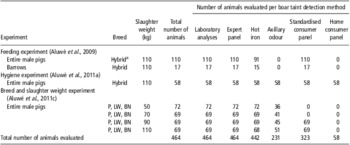
This study is based on a compilation of data from several trials that have been set up to influence the prevalence of boar taint: a feeding experiment (Aluwé et al., Reference Aluwé, Millet, Nijs, Tuyttens, Verheyden, De Brabander, De Brabander and Van Oeckel2009), a hygiene experiment (Aluwé et al., Reference Aluwé, Bekaert, Tuyttens, Vanhaecke, De Smet, De Brabander, De Brabander and Millet2011a) and a breed and slaughter weight experiment (Aluwé et al., Reference Aluwé, Millet, Tuyttens, Vanhaecke, De Smet and De Brabander2011c). A total of 448 entire male pigs and 17 barrows were included in this study. The number of animals evaluated per trial, breed and slaughter weight and per boar taint detection method are presented in Table 1.
Overview of the breed, slaughter weight and number of animals involved in this study per experiment and per boar taint detection method

P = Piétrain; LW = Large White; BN = Belgian Landrace stress negative.
aHybrid: Piétrain × Rattlerow Seghers crossbred sows.
Longissimus thoracis et lumborum samples with backfat layer (30 cm around the 13th rib) were taken at the slaughterhouse 24 h after slaughter. The samples were trimmed of visible fat and cut into slices of 2.5 cm thickness. Backfat was cut into pieces. Each piece was vacuum-packed and stored at −20°C until tests with consumer and expert panels were performed. Samples were thawed overnight at 4°C. For laboratory analyses of boar taint compounds, the fat samples were vacuum-packed and stored at −80°C until analysis.
Boar taint detection
Boar taint was detected using the following methods: (1) laboratory analysis of the concentration of the main boar taint compounds in fat samples (skatole, androstenone and indole), (2) an expert panel trained to evaluate the sensory quality of fat and meat samples, (3) the hot iron method, (4) the axillary odour score, (5) a standardised consumer panel and (6) a home consumer panel to evaluate the sensory quality of the meat.
Concentration of indole, skatole and androstenone in backfat was simultaneously determined by a liquid-chromatographic-multiple-mass-spectrometry (LC-MSn; Verheyden et al., Reference Verheyden, Noppe, Aluwé, Millet, Vanden Bussche and De Brabander2007).
For the expert panel, 11 experts were recruited from Institute for Agricultural and Fisheries Research (ILVO) staff on the basis of their ability to detect the odour of androstenone and skatole. Twelve fat or nine meat samples were evaluated successively during each separate session.
The hot iron method is a fast sensory assessment at the slaughterhouse consisting of an expert's evaluation of the odour when heating neck fat with a hot iron. This detection method was performed immediately after slaughter in the cooling area of the slaughterhouse.
Axillary odour was also assessed for a number of entire male pigs (n = 232) after noticing a strong off-odour in the axillary area in the carcasses of some entire male pigs that tested strongly positive for strong boar taint according to the hot iron method. This score was given on the same scale as the hot iron method and by the same evaluator(s).
A standardised consumer panel was performed in all our trials for all entire male pigs with a slaughter weight of 90 or 110 kg. Additionally, a home consumer panel was set up in the hygiene experiment to compare the results of both types of consumer panels (Aluwé et al., Reference Aluwé, Bekaert, Tuyttens, Vanhaecke, De Smet, De Brabander, De Brabander and Millet2011a). The standardised panel was performed at a test location and samples were prepared using a standardised method: 3 min on a grill at 1800 W at maximum power to an internal temperature of 74°C. For the home consumer panel, 116 households were recruited from the staff of ILVO and Ghent University. No instructions were given about the preparation of the samples besides to prepare samples from each treatment group separately.
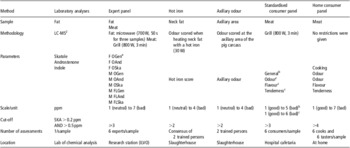
Table 2 gives an overview of the main characteristics of all the detection methods. Protocols are described in more detail in Aluwé et al. (Reference Aluwé, Millet, Nijs, Tuyttens, Verheyden, De Brabander, De Brabander and Van Oeckel2009) and in Aluwé et al. (Reference Aluwé, Bekaert, Tuyttens, Vanhaecke, De Smet, De Brabander, De Brabander and Millet2011a).
Boar taint detection overview

LC-MS2 = liquid chromatography–tandem mass spectrometry; SKA = skatole; AND = androstenone; ILVO = Institute for Agricultural and Fisheries Research.
aF OGen = general odour of fat; F OAnd = androstenone odour of fat; F OSka = skatole odour of fat; M OGen = general odour of meat; M OAnd = androstenone odour of meat; M OSka = skatole odour of meat; M FLGen = general flavour of meat; M FLAnd = androstenone flavour of meat; M FLSka = skatole flavour of meat.
bGeneral appreciation was scored on a scale from 1 (good) to 5 (bad).
cOdour, flavour and tenderness were scored on a scale from 1 (good) to 6 (bad).
Cut-off values for the hot iron method and the expert and consumer panels were taken at the corresponding value of a neutral or negative evaluation of the sample (Table 2). Cut-off concentrations were set at 0.20 ppm for skatole (Babol and Squires, Reference Babol and Squires1995) and 0.5 ppm (Desmoulin et al., Reference Desmoulin, Bonneau, Frouin and Bidard1982) and 1.0 ppm (Brooks and Pearson, Reference Brooks and Pearson1989) for androstenone. These cut-offs allowed calculation of the prevalence (%) of animals displaying off-odour or off-taste per detection method.
Statistical analysis
Level of boar taint and boar taint prevalence was determined for the entire male pigs slaughtered at 110 kg. The exact number of animals per detection method is presented in Table 2.
Principal Component Analysis (PCA), based on correlation scaling, was performed on the basis of all evaluated animals to determine the interrelationship between variables of the various detection methods. The involved parameters were: the hot iron score (HI), the expert panel evaluations of fat samples (F OGen: general odour of fat, F OAnd: androstenone odour of fat, F OSka: skatole odour of fat) and meat samples (M OGen: general odour of meat, M OAnd: androstenone odour of meat, M OSka: skatole odour of meat, M FLGen: general flavour of meat, M FAnd: androstenone flavour of meat, M FSka: skatole flavour of meat) and the standardised consumer panel evaluation of meat samples (odour and flavour).
Correlation coefficients (Pearson correlation) were calculated among the parameters of the various boar taint detection methods. Results were considered significant if P < 0.05. Correlation coefficients with P < 0.10 are reported between brackets. All pigs were included in this analysis.
All statistics were performed with Statistica 8.0 (Statsoft, Tulsa, USA).
Results
Boar taint evaluation
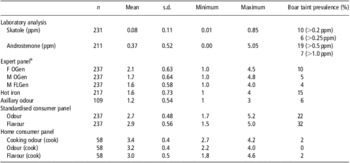
Evaluation of boar taint level and prevalence is based on all entire male pigs slaughtered at 110 kg live weight. Mean levels of boar taint compounds were 0.04 ± 0.06 ppm for indole, 0.08 ± 0.11 ppm for skatole and 0.37 ± 0.52 ppm for androstenone.
The various detection methods resulted in different estimates for the prevalence of boar taint, ranging from 0% to 32% (Table 3). For the boar taint compounds, 7% of the entire male pigs had levels higher than 1.00 ppm for androstenone; 10% higher than 0.20 ppm for skatole. The prevalence of boar taint according to the expert panel was higher in fat samples (10%) than in meat samples (4% to 5%). Sensory evaluation of fat samples with the hot iron method in the slaughterhouse resulted in 15% boar taint prevalence. In the standardised consumer panel, a high proportion of samples was disliked for odour (22%) as well as for flavour (32%). In the home consumer panel, samples were evaluated more positively. Only 2% were identified as unacceptable for cooking odour and flavour according to the cooks, whereas the tasters reported no problems for odour or flavour at all.
Boar taint scores (mean, standard deviation (s.d.), minimum and maximum) and prevalence (%) according to the different boar taint detection methods for all entire male pigs slaughtered at 110 kg live weight

aF OGen = general odour of fat; M OGen = general odour of meat; M FLGen = general flavour of meat.
For the barrows (n = 17), boar taint prevalence was 0% according to the laboratory analysis of the boar taint compounds, the expert panel and the hot iron method. For the standardised consumer panel, percentage of dislike was 6% for odour and 0% for flavour. So, the corrected prevalence of off-odour according to the standardised consumer panel for entire male pigs should be 26% (32% to 6%).
Link between the different boar taint detection methods
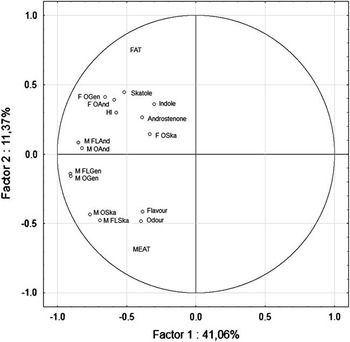
PCA was carried out to elucidate the relationship between the variables of the main detection methods, that is, the laboratory analysis of indole, skatole and androstenone, the expert panel for fat and meat samples, the hot iron method and the standardised consumer panel (Figure 1).
Principal Component Analysis (PCA) loading plots for the variables of the various detection methods: hot iron method (HI); laboratory analysis (indole, skatole, androstenone); expert panel evaluations of fat samples (F OGen = general odour of fat, F OAnd = androstenone odour of fat, F OSka = skatole odour of fat) and meat samples (M OGen = general odour of meat, M OAnd = androstenone odour of meat, M OSka = skatole odour of meat, M FLGen = general flavour of meat, M FLAnd = androstenone flavour of meat, M FLSka = skatole flavour of meat) and the standardised consumer panel evaluation of meat samples (odour and flavour).

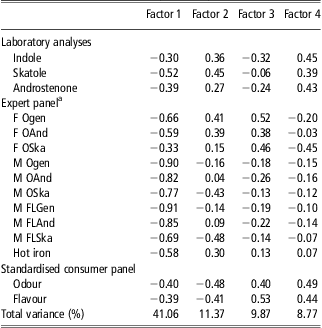
The first factor explained 41% of the variance and is strongly correlated with the expert panel evaluation of the meat samples (r = −0.91 to −0.69; Table 4). All the other variables were also negatively correlated with this factor, correlation coefficient was at least −0.30. The second, third and fourth factor also had an eigen value above 1 and explained 11%, 10% and 9% of the variance, respectively. These factors were mainly determined by the consumer evaluation for the second factor, the expert evaluation of fat samples and the consumer panel for the third factor and the laboratory analysis of skatole and indole as well as the consumer panel for the fourth factor. Although the detection methods performed on fat were mostly situated in the upper-left quadrant, the detection methods performed on meat were situated in the lower-left quadrant (Figure 1).
Factor coordinates of the variables on the factor plane
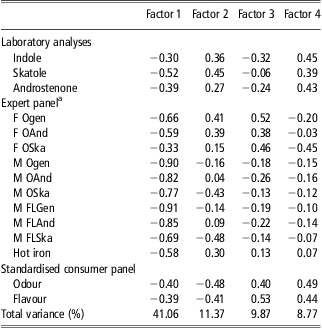
aF OGen = general odour of fat; F OAnd = androstenone odour of fat; F OSka = skatole odour of fat; M OGen = general odour of meat; M OAnd = androstenone odour of meat; M OSka = skatole odour of meat; M FLGen = general flavour of meat; M FLAnd = androstenone flavour of meat; M FLSka = skatole flavour of meat.
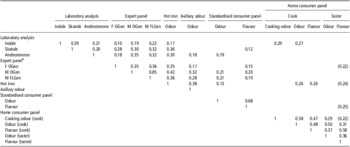
The Pearson correlation coefficients between the various detection methods are given in Table 5. Correlation coefficients between the hot iron method and skatole (r = 0.36) and androstenone (r = 0.30) concentration and the experts’ evaluation of fat (r = 0.35) and meat samples (r = 0.36 to 0.42) were moderate. The hot iron method was only weakly correlated with the standardised consumer panel for odour (r = 0.13), while it was moderately correlated with the scores given during the home consumer panel for odour and flavour (r = 0.26) as scored by the cook. When the correlation coefficients between the home consumer panel and the other detection methods were evaluated, only indole was found to be correlated significantly with cooking odour and odour as scored by the cook (r = 0.27 to 0.29). Correlation coefficient of the flavour score of the taster with the expert evaluation of general odour of fat (r = 0.22) and with the flavour score of the standardised consumer panel (r = 0.25) was not significant (P < 0.10).
Correlation coefficients (r) among the various detection methods with P < 0.05, or P < 0.10 if correlation coefficients are given between brackets based on all animals evaluated

aF OGen = general odour of fat; M OGen = general odour of meat; M FLGen = general flavour of meat.
The expert evaluation of fat and meat samples were moderately correlated with the concentration of skatole and androstenone (r = 0.28 to 0.35). Only the correlation coefficient between the expert evaluation of odour in fat and the androstenone level was lower (r = 0.18). When the comparison was made between the standardised consumer panel and the laboratory analysis of the boar taint compounds, flavour was better correlated with skatole than with androstenone (r: Ska = 0.12, And = 0.02), whereas the opposite was observed for odour (r: Ska = 0.07, And = 0.19).
The standardised consumer panel score (odour/flavour) correlated better with the experts’ evaluation in meat of skatole odour/flavour (r = 0.25) than for androstenone odour/flavour (r = 0.10; data not presented in Table 5). The opposite was found for the fat samples; consumers’ and experts’ evaluation correlated slightly better for androstenone odour/flavour (r = 0.15) than for skatole odour/flavour (r = 0.07).
Discussion
On the basis of the 237 entire male pigs (±110 kg) tested in this study, the corrected prevalence of boar taint varied from 0% to 26% depending on the method and matrix used for testing. We have also shown that the correlation coefficients between different boar taint detection methods varied and were generally low (r ⩽ 0.38).
The results from the PCA as well as the Pearson correlation coefficients indicate, however, that different variables from a particular detection method are more strongly linked. A wide range of correlation coefficients were described in literature, for example, between androstenone level and boar taint odour as scored by experts in meat samples (r = 0.28 to 0.84) and in fat samples (r = 0.15 to 0.60) and between skatole level and boar taint odour in meat samples (r = 0.23 and 0.64) and in fat samples (r = 0.23 and 0.67; Hansson et al., Reference Hansson, Lundström, Fjelknermodig and Persson1980; Bonneau et al., Reference Bonneau, Ledenmat, Vaudelet, Nunes, Mortensen and Mortensen1992; Babol et al., Reference Babol, Squires and Bonneau1996; Annor-Frempong et al., Reference Annor-Frempong, Nute, Whittington and Wood1997c; Gibis et al., Reference Gibis, Hilmes and Fischer1998; Rius et al., Reference Rius, Hortos and Garcia-Regueiro2005; Furnols et al., Reference Furnols, Gonzalez, Gispert, Oliver, Hortos, Perez, Suarez and Guerrero2009; Pauly et al., Reference Pauly, Spring, O'Doherty, Kragten and Bee2009 and Reference Pauly, Spring-Staehli, O'Doherty, Kragten, Dubois, Messadene and Bee2010; Prusa et al., Reference Prusa, Nederveld, Runnels, Li, King and Crane2011; Whittington et al., Reference Whittington, Zammerini, Nute, Baker, Hughes and Wood2011). The correlation coefficients found in our study are in the range found in literature, although our values are on the low end.
However, in most other studies comparing detection methods with boar taint compounds in the fat, a preselection of samples is performed to yield four groups combining low or high skatole levels with low or high androstenone levels (Bonneau et al., Reference Bonneau, Kempster, Claus, Claudi-Magnussen, Diestre, Tornberg, Walstra, Chevillon, Weiler and Cook2000; de Kock et al., Reference de Kock, van Heerden, Heinze, Dijksterhuis and Minnaar2001; Whittington et al., Reference Whittington, Zammerini, Nute, Baker, Hughes and Wood2011). This was not the case in this experiment, because our set-up reflects the actual distribution of boar taint. This difference in experimental set-up combined with the rather low levels of indole, skatole and androstenone might explain why our correlation coefficients are generally lower compared with the results found in literature.
Most published studies focus on the correlation coefficient between the evaluation by the expert panel and the concentration of the boar taint compounds. Some studies indicate that the assessment of boar taint flavour in meat correlated better with androstenone (r = 0.40 to 0.84) than with skatole concentration (r = 0.36 to 0.54; Babol et al., Reference Babol, Squires and Bonneau1996; Pauly et al., Reference Pauly, Spring-Staehli, O'Doherty, Kragten, Dubois, Messadene and Bee2010). Dijksterhuis et al. (Reference Dijksterhuis, Engel, Walstra, Furnols, Agerhem, Fischer, Oliver, Claudi-Magnussen, Siret, Beague, Homer and Bonneau2000) and Hansson et al. (Reference Hansson, Lundström, Fjelknermodig and Persson1980) found that it was more difficult, even for an androstenone sensitive expert, to recognise androstenone than skatole. In the present study, both skatole and androstenone in the fat were equally correlated with flavour (r = 0.32).
The influence of indole concentration on boar taint perception has not been evaluated as extensively as the other two compounds. Annor-Frempong et al. (Reference Annor-Frempong, Nute, Whittington and Wood1997b) stated that experts were not able to distinguish between indole and skatole solutions. Reported correlation coefficients between indole and boar taint odour vary up to r = 0.34 (Hansson et al., Reference Hansson, Lundström, Fjelknermodig and Persson1980; Annor-Frempong et al., Reference Annor-Frempong, Nute, Whittington and Wood1997c; Gibis et al., Reference Gibis, Hilmes and Fischer1998). In fat samples with low skatole levels, an even higher correlation coefficient (r = 0.45) between abnormal odour rating and indole concentration was found. Therefore, the importance of indole may rise when skatole levels are low. We found a slightly stronger correlation coefficient with indole for the expert evaluation of meat samples (r = 0.19 to 0.22) compared with the fat samples (r = 0.10). Surprisingly, only indole, and not skatole or androstenone, was significantly correlated with the (cooking) odour assessment by the home consumer panel. A similar result was also found in a recently performed study, which included a home consumer panel with 400 households: only indole concentration was correlated with the odour assessment made by the cook (r = 0.19; Aluwé et al., Reference Aluwé2012). These results indicate that it can be relevant to include indole in the laboratory analysis of the boar taint compounds.
Correlation coefficients between the hot iron method and the other boar taint detection methods are comparable to the correlation coefficient of 0.38, found by Jarmoluk et al. (Reference Jarmoluk, Martin and Fredeen1970) between the hot iron method and a taste panel. Compared with the expert panel evaluation of fat samples, correlation coefficient of the hot iron method was lower for the standardised consumer panel scores, but better for the home consumer panel. Correlation coefficient of the hot iron method was also better for the boar taint compounds. This was especially true for androstenone. The difference between the correlation coefficients of the expert panel evaluation of fat samples and the hot iron method may be due to the way of scoring, the difference in sensitivity between the assessors and the difference in heating method. The score of the hot iron method is based on one score, while results of six experts were averaged for the expert panel evaluation. Annor-Frempong et al. (Reference Annor-Frempong, Nute, Whittington and Wood1997c) showed a significant effect of assessor on androstenone score. This was not the case for skatole. They stated that differentiation between samples tends to be poorer for androstenone than for skatole when results from different assessors are averaged. Whittington et al. (Reference Whittington, Zammerini, Nute, Baker, Hughes and Wood2011) also underlined the differences in the experts’ responses to boar taint.
Heating method, test location and day of evaluation also differed between the hot iron method and the expert panel. Whittington et al. (Reference Whittington, Zammerini, Nute, Baker, Hughes and Wood2011) compared both the hot iron method and the microwave method to discriminate high- and low-boar taint samples. Both methods were found to be appropriate. Similar to the study of Whittington et al. (Reference Whittington, Zammerini, Nute, Baker, Hughes and Wood2011), we also experienced a difference in background odour between these two heating methods. Our experts perceived the background odour of the hot iron method as less strong and therefore easier to work with. The situation in which the assessment was performed also differed. The hot iron method was performed on the carcass in the cooling area of the slaughterhouse on the day of slaughter. The samples for the expert panel were vacuum-packed, stored frozen and odour was evaluated after heating the fat samples with a microwave. This evaluation was performed at room temperature. In a recently performed study (Aluwé et al., submitted), we collected neck fat samples at the slaughter line and evaluated them later that day with the hot iron method under room temperature conditions. Correlation coefficients with fat indole and androstenone concentration were remarkably higher (r = 0.50 and r = 0.57, respectively). The improved correlation coefficients in that study may be due to the difference in testing condition and temperature. Therefore, it is relevant to further investigate the effect of testing conditions to optimise the results and reliability of the hot iron method. The hot iron method may be then be used to detect tainted animals or it could be used to preselect possible tainted animals, which are further tested with another detection method.
The axillary odour method might be a fast and easy alternative for the hot iron method, as there is no need to heat the fat or meat. It is also an easier matrix to evaluate: when several samples have to be scored subsequently, there is lower risk for carry-over effect when boar taint is present in one of the samples. Correlation coefficient between the hot iron method and the axillary region method is 0.38, which is comparable to the correlation coefficient between the hot iron method and the concentration of the boar taint compounds or the expert panel. The axillary odour method was not significantly correlated with the consumer panels, but we did find a correlation coefficient for the axillary region method with flavour as scored by the taster in the home panel of 0.17 (P = 0.184). A more extensive study is needed to further explore the possibilities of this new detection method.
To simulate the evaluation of boar taint in the consumers’ home situation, a home consumer study was set up in addition to the standardised consumer panel. This also made it possible to compare the efficacy of both methods in identifying the problem of boar taint according to the consumer. The cooking odour of entire male pigs with boar taint may be evaluated more negatively by androstenone sensitive people (Furnols et al., Reference Furnols, Gispert, Diestre and Oliver2003). Most cooks are female (Aluwé et al., Reference Aluwé, Millet, Langendries, Bekaert, Tuyttens and De Brabander2011b) who are up to six times more sensitive to androstenone than men (Bremner et al., Reference Bremner, Mainland, Khan and Sobel2003). A cook is therefore more likely to detect boar taint than an average consumer. For these reasons, we expected to see more problems due to boar taint/androstenone identified in the home consumer panel, especially for the cook, as compared with the standardised consumer panel. However, this was not confirmed in our results. Although the standardised consumer panel did indicate more off-odour and off-flavour in entire male pigs compared with barrows, the level of dislike for cooking odour, odour or flavour was remarkably low (0% to 2%). It was seen that in both the standardised as well as in the home consumer panel, consumers mainly focused on the lack of tenderness. Sixty-seven percent of the samples of the entire male pigs were scored as being too tough. For the barrows (n = 17), the percentage of dislikes was 35% for toughness (Aluwé et al., Reference Aluwé, Millet, Nijs, Tuyttens, Verheyden, De Brabander, De Brabander and Van Oeckel2009). Also in the home consumer panel, toughness was indicated as being more problematic, than odour or flavour, as 14% of the samples were too tough according to the cooks as well as the tasters (unpublished data). In both consumer trials, consumers were not specifically asked to detect boar taint. The lack of tenderness of the meat from the entire male pigs may have greatly influenced the general evaluation of the meat. This may be the case in the standardised consumer panel especially, because the samples were served without seasoning or sauce. By including pork from gilts or barrows as a control group, scores can be corrected for general pork appreciation. Gilt meat might be more preferable for this purpose as the intramuscular fat content is more comparable to that of entire male pigs and would therefore reduce the difference in meat tenderness. During performance of this type of tests, blind testing must be ensured. Also, by including gilts or barrows as a control group, one can consider informing the consumers about the aim of the study. In this way, cooks and tasters may be more critical. Correctness of their criticism can be evaluated by comparing the results with the control group of gilts or barrows. The identified points of improvement for the consumer study should be further investigated to evaluate their potential.
Conclusion
Corrected boar taint prevalence varied between 0% and 26% according to the detection method used. As correlation coefficients were generally weak, the choice of a single detection method, or preferably several methods, should be chosen in accordance with the aim of the study. The protocol for consumer evaluation may be improved by including a blind home consumer panel. Informing the consumers of the possible presence of boar taint may sharpen their sensory perception. Adding gilts as a control group may enable the evaluation of tenderness and the correctness of boar taint scoring. In laboratory analysis, indole level should be tested, especially when skatole levels are low. The axillary odour method may be a fast and easy alternative to the hot iron method, but needs further investigation. The hot iron method is an easy and fast detection method, which yields comparable or better results than an expert panel. Efforts should be made to further optimise this method by evaluating the effect of testing conditions. Further research is needed to optimise and standardise boar taint detection.
Acknowledgements
This study was funded by the Federal Public Service of Health, Food Chain Safety and Environment (contract R-boar taint). The authors thank M. Audenaert, B. De Bock, E. De Graeve, K. Dierkens, R. Limpens, J. Staels, H. Uitterhaeghen and P. Van Laere for all practical support. They also thank P. Knap for his statistical guidance through the data.