The question “What is political science?” is nearly as old as the discipline
itself. Political science continually self-examines the discipline to
evaluate who we are and how we have changed (Baer et al.
1991; Crick 1959; Dryzek and Leonard 1988; Easton, Gunnell, and
Stein 1995; Easton, Gunnell, and Graziano
1991; Farr and Seidelman 1993; Finifter 1983; 1993; Haddow 1939; Katznelson and
Milner 2002; Lepawsky 1964; Merriam 1926; Ricci 1984;
Somit and Tanenhaus 1982; Storing 1962; and Weisberg 1986).1
Gunnell (2004)
provides a well-written comprehensive historiography in his
appendix, “Telling the Story of Political Science.”
In
addition, there are numerous studies of groups within political science,
including political science in the U.S. South (
Vaughan
1989) and women in political science (
Flammang
1997;
Hopkins 1993). There are also
reviews of the development and state of subfields, e.g., urban politics
(
Danielson and Lewis 1996), international
relations (
Waever 1998), comparative politics
(
Hull 1999), and political theory (
Gunnell 1981;
1986;
1988;
1993). Each of these
histories provides an image of what political science is or what it should
be. These self-reviews provide images of the discipline that shape our
identities as political scientists and advance the progress of political
science (
Almond 1988;
Dryzek
and Leonard 1988). Even if the images do not affect future
directions in political science, they are “an important dimension of
identity and critical reflection on the theory and practice of political
science” (
Gunnell 2004, 274). Developing and
critiquing these images are important academic exercises.
I examine the dominant image of political science in this literature. This
model presents the major classification of political science falling along a
methodological dimension. According to this model political scientists vary
primarily in their use of “hard” scientific methods and approaches to
politics and “soft” or traditional means of understanding politics found in
the humanities. At issue is whether this image of political science is
accurate. This image is often not the result of systematic
analysis—quantitative or qualitative—but of self-reflection, personal
experience, and unsystematic observation. What is needed is a model of the
discipline grounded in systematically gathered empirical observations.
Establishing such a model is the goal of this article.
The Image: Hard vs. Soft
Discussion of a division between “hard” and “soft” approaches to politics
is pervasive within the discipline. It is also the primary focus of the
literature on the discipline. Almond (1988)
explicitly presents a discipline which can be mapped along two
dimensions: a methodological dimension, a hard-soft dimension, and an
ideological dimension, a right-left dimension. At the extremes exist
four “tables” that are “brightly lit and visible”: the soft left (e.g.,
critical theorists), hard left (e.g., socialist and dependency
theorists), soft right (e.g., Straussian theorists), and hard right
(e.g., rational choice theorists and/or quantitative researchers). Most
political scientists are not part of these four tables, but they remain
the main means of dividing the discipline. Of these two dimensions, the
methodological dimension is the one on which much of our divisions
emerge:
There is a long-standing polemic in political science between
those who view the discipline as a hard science—formal,
mathematical, statistical, experimental—dedicated to
accumulation of tested “covering laws,” and those who are less
sanguine and more eclectic, who view all scholarly methods, the
scientific ones as well as the softer historical, philosophical,
and legal ones, as appropriate and useful. (Almond 1990, 7)
The image of political science that emerges from Almond's work is one
with those using hard science on one end and those that prefer (or at
least appreciate) softer approaches to politics at the other.
Almond's (1988) thesis was a catalyst for a
renewed discussion on the state of political science. Part of this
discussion included a panel at the APSA Annual Meeting and subsequent
series of essays in PS (Monroe et al.
1990). The general response was to accept with some caveats
Almond's diagnosis and move on to his prescription for a cure—to
identify, if possible, a core that will reunite the disparate sects
within political science. Almond, as part of the roundtable discussion
of his original work, states that this core should be political theory,
which “ought to codify the history of the discipline, the development of
central ideas, concepts, and theories” (1988,
35). Theory does not function in this way because it “has, with few
exceptions, been traumatized by the diffusion of scientific aspirations
and methods into political science, and seduced by simplistic
temptations of 1960s and 1970s thinking” (1988, 35). Overall, the members of this roundtable found
Almond's diagnosis of the discipline accurate but disagreed over whether
what, if anything, should be done to (re)unite the discipline.
The hard-soft model is also implicit in earlier histories of the field.
Lepawsky (1964) examined the pre-professional
era of political science (prior to the creation of APSA) and presents a
distinction between scientific and traditional, context-specific
approaches to the study of politics. Somit and Tanenhaus ([1967] 1982) recount the move from a
pre-scientific study of politics toward a new, more scientific paradigm.
Ricci (1984) likewise focuses on the rise of a
science of politics that pulled political science from its philosophical
roots. These and other histories present an image of the discipline that
is divided between the hard, scientific and the softer, more ecumenical
approaches.
More recent work continues to present the discipline as divided along a
hard-soft dimension. Pye finds that “neither content nor method provides
an ‘essential core’ for the discipline as a whole” (1990, 4). The reason for this is the division between what
he labels “scientific” and “humanistic” approaches to the study of
politics:
Some of the subfields—some of us—are convinced that true
knowledge can be found only in the rigorous search for
invariances, for the regularities we expect to find in nature.
In this spirit we like to think of man and society as having
lawlike qualities we associate with the physical universe. For
other subfields—others of us—knowledge is the search
for meaning, for understanding and interpretation, that is, for
what is human in the blending of mind and spirit.
Lowi (1992) similarly describes the discipline
as including, if not defined by, “the three hegemonic subdisciplines of
our time—public opinion, public policy, and public choice” (1).
Together, these subdisciplines are very similar to the groups Almond
identifies as the hard right. Each of these political scientists locates
the hard-soft dimension as the primary division within political
science.
Empirical verification of this image of the discipline is rare, but in an
innovative study of political scientists' views of the discipline's
academic journals, Garand and Giles (2003)
find two divisions within political science. One is the hard-soft
division. Analyzing the mean evaluations of 16 well-recognized journals,
Garand and Giles find statistically significant differences between
qualitative, quantitative, and mixed-approach scholars for 11 of these
journals. They also find, however, differences between scholars in
different subfields. There are significant differences between scholars
of American politics, comparative politics, international relations, and
political theory for seven of the journals. These findings support the
claim that there is a hard-soft division in political science, but they
also suggest that a subfield division may also exist.
Overall, the hard-soft image is widely accepted but rarely empirically
verified in the literature on political science. Such verification is
critical. As the dominant image presented in the literature, the
hard-soft model categorizes political science by method rather than by
subject. If this is an adequate description of the discipline, then
political scientists who make choices about how to organize editorial
boards, departments, and curriculum need to be sensitive to the
representation of both hard and soft approaches to political science if
they are to represent the discipline well. But what if this hard-soft
model does not reflect the actual organization of the discipline?2
That is, is it more incorrect than an
alternative model as all models are by definition incorrect to
some degree?
If the hard-soft model is incorrect, then
political scientists need to reconsider how they tell the history of the
discipline, how they organize their departments, how they select members
for editorial boards, and how they choose to construct curriculum.
Organization of Political Science
Before modeling political science, one should define what political
science is. The hard-soft model has defined political science
ontologically and historically. Both have an appropriate place in the
literature, but we must differentiate between an ontology of political
science and a sociology of political science, what Holden (2000) refers to as the “intellectual realm” and
the “organizational realm.” The former is what sociologists of science
might refer to as a system of ideas: our theories, models, concepts, and
scholarship. The latter is our social system; it is how we organize our
departments, associations, curriculum, and publications (King 1980).3
It
may be incorrect to make such a clear distinction between the
two. As Kuhn (1970) shows, the
sociology of science has an important impact on the creation and
progress of its theories (King 1980).
Or, as Holden (2000) states: “the
intellectual realm is largely the expression of what people in
the organizational realm do” (1).
A sociological
definition of political science is consistent with the definition
proposed by Joseph Cropsey: “political science is what political
scientists do” (
Monroe et al. 1990, 42). This
understanding of the discipline moves the discussion away from the
ontology of political science to its sociology. We may continue to
debate the ontology of political science, but we should be able to agree
that there is such a thing as political science, and one way to
understand it is to study how it is organized.
This sociological view of political science provides the starting place
for an empirical model of the discipline. Such a model should 1) include
within the discipline anyone who identifies as a political scientist,
and 2) count political science research as anything that these people do
as scholarly activities.
Modeling political science should include, first, a description of how
political scientists organize their scholarly activities. The dominant
way that this is done is by forming associations that are open to anyone
who wishes to identify themselves as a political scientist. The largest
and most inclusive of these associations is the APSA, which currently
has over 15,000 members drawn from over 80 countries. Within APSA,
organized sections bring together scholars who have similar professional
goals (c.f. Losco 1998). These organized
sections may be formed around any topic or grouping so long as they meet
a threshold number of members. Members are not required to join
organized sections, but a majority joins at least one. One way, then, of
modeling political science is to examine the pattern of membership in
these organized sections.
A second approach is to model political science scholarly activity. This
could be done by examining published work by political scientists, but
this proves very difficult to do because it requires that the researcher
choose a priori what political science should be. Questions of
which books and journals to include within political science are
impossible to answer unless the researcher imposes his or her definition
of the discipline on the literature. For example, the Library of
Congress lists 483 political science periodicals. To evaluate which of
these journals is political science would require a paring down of this
list, as was done by Baum et al. (1976) and
Young (1995). Such a list could be reduced to
only those that political scientists are familiar with, use, or admire.
Yet, such a list would include publications that are in a distinct
discipline such as the American Sociological Review and
publications that are not peer-reviewed such as Foreign Affairs
(Garand 1990). Moreover, it would exclude
those scholars who choose books as the primary means of publishing their
scholarly work, which would bias the selection against theory and
qualitative research.
An alternative approach is to move away from publications and examine
current scholarly activity as presented and discussed at the APSA Annual
Meeting. This has three advantages over other approaches. First, it
would include all material selected by the membership of APSA (through
its division chairs). As already discussed, APSA is the best
representation of what political scientists are; thus, the scholarly
work presented at the APSA Annual Meeting is by political scientists for
the benefit of other political scientists. Second, it allows minority
approaches to political science to be represented even if they are
excluded from mainstream (and possibly hegemonic) publications. Finally,
the allocation of panels is distributed among divisions that, like
organized sections, represent groups created by political scientists
themselves, not groups classified by a researcher. By examining the
pattern of research presented at APSA Annual Meetings, one can provide
an empirical description of what political scientists do that is
difficult, if not impossible, to provide using other methods.
Modeling Political Science
The hard-soft model of political science implies a geographic
representation of the discipline. It uses terms like dimensions,
continuums, and location to describe political science. Keeping with
this tradition, I estimate a statistical model of political science that
allows us to see the differences between political scientists and their
scholarly work. This is done using multidimensional scaling (MDS), which
provides a graphical representation of the dissimilarities between
objects (Rabinowitz 1975). That is, it maps
objects onto a two-dimensional space so that objects that have a great
deal in common are positioned close to one another and those that have
little in common are located at a greater distance from each other. MDS
graphs provides a very useful way of understanding otherwise complex
relationships.
This method provides a means of empirically testing the hard-soft model.
If political science is separated along methodological lines, then we
should see (literally) groups with similar approaches to politics
located close together; groups that have different approaches to
political science should be farther apart. MDS is also useful because it
is a barefoot empirical approach to modeling political science. The only
data used are those on the membership in APSA's organized sections (as
of February 2004) and the number of joint panels at the 2003 Annual
Meeting in Philadelphia. Any patterns that are created are based on the
similarity of membership between sections or the similarity in subjects
discussed at the Annual Meeting. No other data or measures are used.4
I use an alternating least squares
scaling (ALSCAL) to estimate the MDS (Takane,
Young, and De Leeuw 1977). The organized section
membership is listed in a k × k symmetric matrix. Both the rows
and columns represent each organized section. The cells then
represent the joint membership of any two organized sections.
Thus, the diagonal would be the total number of members in each
section. The divisions' matrix is a similar k × k symmetric
matrix but the rows and columns represent the number of panels
sponsored or cosponsored by each division at the 2003 Annual
Meeting. Because the number of members varies greatly by
section, as does the number of panels per division, it is
appropriate to calculate the phi coefficient instead of the
chi-square. Otherwise, MDS would likely use the number of
members (or panels) as the primary difference between the
sections (or divisions). The phi coefficient eliminates this
problem. I adjust the model to decipher between ties.
Two mappings of political science result—one of the organized sections
based on membership and one of the APSA Annual Meeting divisions based
on joint panels.
The Organizational Realm
MDS provides a graphic representation of the differences and similarities
between groups of political science and their scholarship. The mapping
appears to be a reasonable image of political science organization.5
Diagnostics indicate that they are best
represented by two or less dimensions. For the organized section
model, the estimation of a second dimension adds substantial
increase in variance explained, but a third dimension adds
little. For the divisions model, one dimension is possibly
sufficient since it explains nearly 90% of the variance of the
differences and the additional dimensions do not improve this
much. This is likely due to the lower variation in the
divisions' panel compared to the organized section data. The
decision for how many dimensions to include in a model is not
based solely on this statistical analysis; it also depends
heavily on whether the dimensions are consistent with the
reasonableness of the mapping.
One indication of this
is that both scalings are similar despite being based on different data.
The organized section scaling and panel divisions scaling appear to be
mapping political science along the same dimensions. One way to know
this is to examine the location of the organized sections and their
corresponding divisions on both maps. The correlation between the
location of the organized sections on the two mappings is 0.70
(
p < 0.01). On the second dimension the correlation is
lower, in part because the second dimension is not as meaningful for the
divisions scaling. The correlation between the locations on the second
dimension of both scalings is 0.47 (
p < 0.01). Thus,
whatever the dimensions represent, both scalings produce a model of
political science that is similar for both the organization of political
scientists and their scholarly work.
What is this first dimension? An ocular examination of the pattern on the
first dimension rejects the hard-soft model that dominates the
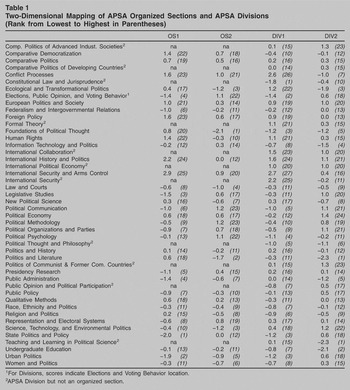
literature. As shown in Table 1, political
scientists and their research are primarily organized around common
subjects of inquiry, not approach to politics or methodology. At one end
of the organized section mapping are local American politics: state
politics and policy, urban politics, legislative studies, public
administration, and presidency research. At the other end are
international security and arms control, international history and
politics, conflict processes, and human rights. The same pattern is seen
for the divisions mapping, where panels on constitutional law and on
elections and voting behavior are at one end of the first dimension and
panels on international security and arms control and on conflict
processes are on the other. In the middle are subjects such as
comparative politics and interdisciplinary studies that bridge local
domestic politics and international state-level politics.
Two-Dimensional Mapping of APSA Organized Sections and APSA
Divisions (Rank from Lowest to Highest in Parentheses)
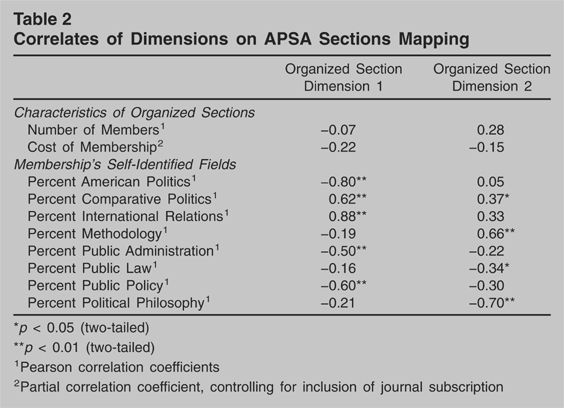
Further evidence of this interpretation is presented in Table 2, which presents the correlation between
the location of each organized section and some of its characteristics
that were not used in estimating these locations. I include two sets of
characteristics. The first measures some of the organizational features
of the sections: the number of members and the cost of joining each
section. Neither is related to location of the organized section on this
first dimension. The second set of characteristics is based on the
self-identified subdiscipline of the membership. This information is
gathered from members when they join APSA (members can choose two
subdisciplines and can change their selection at any time). The location
of an organized section has the highest correlation with the proportion
of the section's membership that studies American politics and the
proportion that studies international relations. The more Americanists
that a section includes, the more to the left/lower the section is
located. The more that a section is made up of IR scholars, the more to
the right/higher the section is located. Also related is the percentage
that study comparative politics (more toward IR end of dimension) and
those that study either public administration or public policy (more
toward American end of dimension). Unrelated to this first dimension are
the proportions that study political philosophy or the proportion that
study methodology. These correlations support the interpretation that
this dimension is not hard-soft, but based on the subject of
inquiry.
Correlates of Dimensions on APSA Sections Mapping
These results raise doubts about the validity of the hard-soft model.
Political science is a diverse discipline that covers topics ranging
from the rise of empires to the timing of answers in public opinion
surveys. Political scientists may study several subjects, but the link
between them is not a common methodology but a connection between the
political phenomena studied. Methodology is important, but it is a
secondary dimension. This second dimension improves our understanding of
the relationship between organized sections and research panels. Unlike
the first dimension on which groups had common subjects, the second
dimension separates hard, scientific approaches to politics from soft,
interpretative approaches. Organized sections that are “soft” include
foundations of political thought, politics and literature, ecological
and transformational politics, and law and courts. At the hard end of
the dimension are political methodology, political communication,
political psychology, conflict processes, and elections, public opinion,
and voting behavior. This hard-soft dimension is not simply a
qualitative-quantitative dimension, as the qualitative methods organized
section is in the middle of the dimension. Moreover, there are other
groups such as comparative politics and presidency research that often
use qualitative (but still empirical and scientific) methods.
This interpretation is also supported by the correlations between the
location on this second dimension and the membership characteristics of
the organized section. The highest correlation with this second
dimension is between the proportion that identify themselves as
methodologists and the proportion that identify themselves as political
philosophers. The more methodologists in an organized section, the more
“hard” their location; the more philosophers in a section, the more
“soft” their location. There is a division between hard science and soft
studies of politics, but it is a secondary division in political
science.
The model presented in this article offers a new image of political
science. Political science is diverse and the first dimension represents
the differences in the type of political phenomena studied. Political
scientists and their research are connected by a common subject of
inquiry, not approach to understanding or discussing politics. The
hard-soft dimension is less important but does constitute the second
dimension, with humanistic approaches to politics at one end and
scientific approaches at the other.
Mapping Political Science
The coordinates listed in Table 1 provide the
location of each organized section and division, but since these groups
are not of equal size a simple mapping of their location is insufficient
if one wants to model political science. One needs a way of viewing the
concentration of political scientists and their scholarship. Fabrikant
and Buttenfield (2001) show that this can be
done by using cartography to show the density of objects mapped onto a
space similarly mapped using MDS. I follow a similar technique by using
the location of the sections and divisions and their size to show the
concentration of political scientists and their scholarship. The result
is a topographic mapping of these concentrations, where darker shading
indicates a greater concentration and lighter shading indicates less
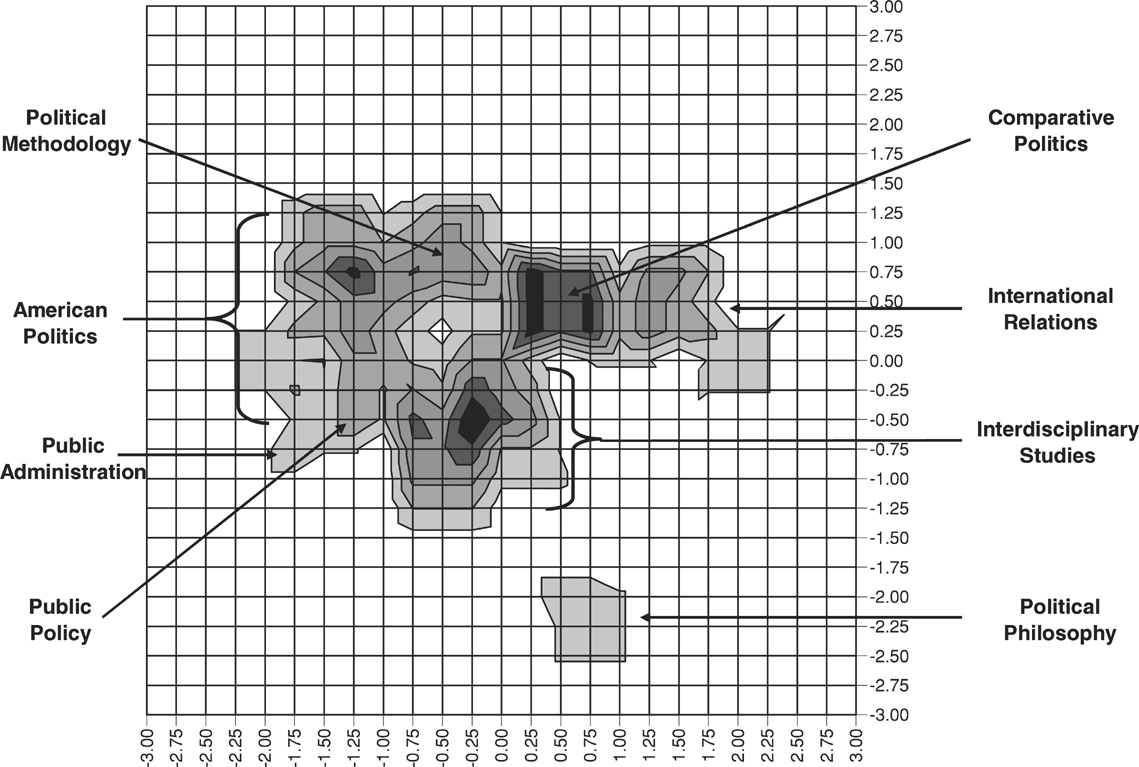
concentration. Figure 1 is the topographic map
of the concentration of political scientists using the organized section
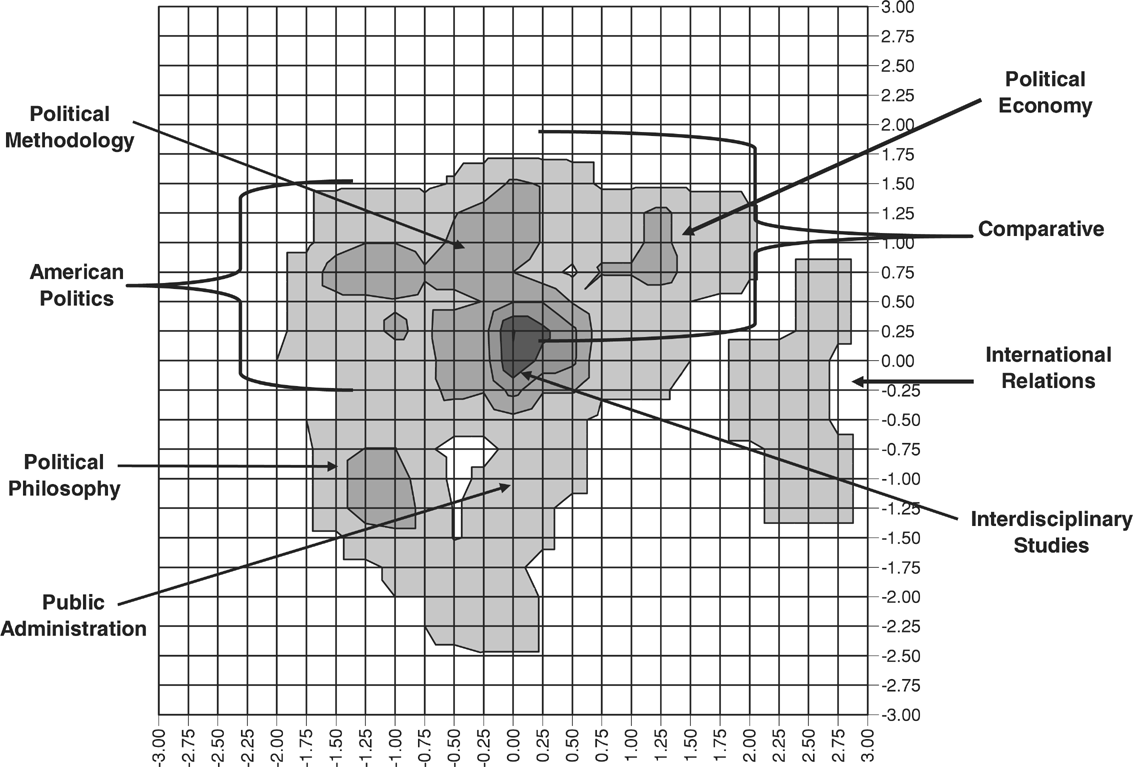
data. Figure 2 is the map of the concentration
of political science scholarship using data on the APSA Annual Meeting
division panels. Together these panels provide a view of the
concentration of political science.
Concentration of Political Scientists (MDS of APSA Organized
Sections)
Concentration of Political Science Research (MDS of APSA Division
Panels)
Both figures provide similar maps of the concentration of political
scientists and their scholarship, respectively. In the organized section
map the horizon is dominated by three areas of concentration. The first
and largest is the concentration of comparative politics scholars. The
second is a collection of interdisciplinary scholars, what some might
call the “… and Politics” groups: religion and politics, women and
politics, history and politics, and others. Finally, there is a third
peak in the area covered by American politics scholars. This peak is in
the largest region in terms of area. Unlike comparative politics
scholars who are organized together, there is not an “American politics”
organized section that concentrates American politics scholars. Instead,
the American politics area covers a wider area that is linked to public
policy and public administration at one end and wraps “up” and “around”
to political methodology. On the other side of comparative politics is
international relations, which is more disconnected from the other
subfields. Finally, political theorists inhabit an island separated from
the larger continent of political science. It is closer to the
interdisciplinary subfields but remains distinct and disconnected.
The map of the scholarship of political scientists is very similar,
though there are some interesting differences because there are more
divisions representing more subfields, particularly other studies
connected to traditional theory such as normative theory and
constitutional law. In this map there is a greater concentration of
political philosophy connected to the rest of scholarship, though still
far from being the core that some advocate. If there is a core, it is
the combination of comparative and interdisciplinary subjects that make
up the center of the map. This map also differs because there is a small
but united concentration of political economy research that lies between
comparative politics and international relations. Interestingly, the
international studies subfield is separated from the rest of political
science scholarship.
In both maps, the concentration of political science is in the scientific
or hard section. The sections and divisions that are dominated by
humanistic or soft scholarship are distant and less concentrated than
the mass of political science. Such a distinction has been noted by
many, including Monroe et al. (1990) who
discusses this using the metaphor of geography and topography:
With the emigration of political theory to its own intellectual
and professional archipelago, from which it makes only
occasional visits to its now alien homeland, and largely only as
a location for discussing its own internal affairs, political
science lost a large measure of its critical self-awareness. And
political theory lost its connection to the principal piece of
institutional reality that tied it, however indirectly, to
politics. (37)
Theory may be an island, but political science is a discipline whose
major division appears to be organized around common questions, not
common methods or approaches to the study of politics.
How is political science organized? The model of political science
estimated in this analysis and mapped in Figures 1 and 2 provide two possible
answers. First, there is a hard-soft dimension to political science, but
it is secondary to the primary dimension—the type of politics that is
studied. Political scientists have organized themselves so that they are
more related to other political scientists who study similar events and
concepts, not to those who study politics in similar ways. Second, most
political scientists and political science scholarship approach politics
as scientists, not humanities scholars. Scholars who study traditional
theory represent a smaller and largely disconnected area of political
science.
Discussion
Political science has a long history of self-reflection. This article is
a continuation of that tradition. But it differs from much of what has
been written in that it offers an empirical model of how political
science is organized. This analysis depends on only two assumptions:
APSA represents political scientists (or at least better than any other
group) and the APSA Annual Meeting represents political science
scholarship (or at least better than any other source). The results of
this analysis indicate that while the hard-soft division in political
science is real and important, it is not dominant.
Given the wide-spread acceptance of the hard-soft model in the
literature, it is prudent to question whether the new model in this
article is accurate: How could so many highly respected and successful
political scientists be wrong about the nature of the discipline? There
are likely many reasons. First, other than rigorous historical accounts,
the presentation of the discipline has not been based on systematic and
empirical research. They are personal accounts based on experience,
often by scholars in our elite institutions that may not represent the
divisions within the discipline as a whole.
Second, the hard-soft model has been presented primarily from those on
the softer side of the discipline. To use the island metaphor, those on
the island of political philosophy will view the discipline as made up
of two masses—the island and the continent. The analysis presented in
this article, to stretch the metaphor, is a satellite image. I find that
hard and soft approaches are different and important, but there is
greater diversity on the larger continent than previously
recognized.
Third, it is likely that the fight between the hard and soft approaches
within each subfield appears to be more important only because we rarely
take a larger view of the discipline. International relations scholars
modeling dyadic conflict are likely to interact with scholars discussing
the right interpretation of Thucydides. Legislative scholars reflecting
on the meaning of representation interact with scholars who prefer
formal models of the legislator-constituent relationship. The student of
W. E. B. Dubois' writings is likely to communicate with a researcher on
African-American attitudes toward affirmative action. A student of
Central Asian politics will exchange research findings with other
Central Asian scholars regardless of their approach to politics. Our
parochialism may blind us to our larger differences. As political
scientists, we have more in common with scholars interested in the same
type of politics (that is the same type of political phenomena) than we
have in common with those that share our epistemology. This is the major
conclusion of this article.
Finally, the conclusions presented in this article are based on the
organization of the discipline. This ignores other types of cleavages
that are cultural or psychological. In other words, the organizational
structure may lag behind changes in the way that political scientists
view themselves. Younger scholars may find the existing organized
sections wanting, but creating a new section takes significant time and
organizational skills. Also, political scientists may find ways to work
within the existing organization of the discipline while holding to an
image of the discipline of “hard” vs. “soft.” There are, of course,
other ways to examine the discipline. Future work must examine other
ways that the discipline is put together in order to provide a
comprehensive view of political science.
This conclusion is neither rhetoric nor a policy proposal. Readers are
welcome to interpret the conclusion optimistically as an indication that
we are more unified than previously thought, pessimistically as evidence
that we lack a theoretical core, or somewhere in-between. The only
charge that I make is that the image presented in the discipline appears
to overemphasize the hard-soft distinction and that as a result we
should reconsider our identity and history through further research on
the discipline of political science.
It is certainly possible that this new image of political science is not
accurate and that other empirical models are more appropriate. Indeed,
we need models of other facets of political science. We need more
research on what we are as a discipline. What we do not need are
commentaries based on personal experience alone. We deserve models that
are empirical, though not necessarily quantitative. Indeed, we need new
histories of the discipline that can refocus on events other than the
hard-soft divide. This article provides a new image of political science
based on systematically gathered empirical data. Future work should do
the same if we are to increase our understanding of who we are and what
we do.