Introduction
Between March 1854 and September 1869 officials running the Southwell Poor Law Union workhouse in rural Nottinghamshire recorded seven instances of disorderly behaviour by the inmate Henry Stanley.Footnote 1 During these years Stanley variously neglected his allocated work, damaged union property and frequently absconded from the workhouse. The punishments for those acts ranged from his being held in the refractory ward, through reductions in diet, to short periods of imprisonment with hard labour. Sometimes they ran concurrently: when confined to the refractory ward for neglecting his work on 8th March 1854, Stanley retaliated by breaking the ward door, thus damaging union property and incurring further punishment. On this occasion he was passed to local magistrates, who sentenced him to seven days’ hard labour.
This short inventory of Stanley’s transgressions and chastisements has resonance with a welfare literature that broadly considers workhouses as venues of confinement, discipline and social control.Footnote 2 The same literature has (following the intentions of the architects of the New Poor Law itself)Footnote 3 often portrayed workhouse staff as agents of social discipline and of state systems that sought to contain the activities and threats of the population at risk of falling into dependence over their life cycle.Footnote 4 Through this work we have become attuned to the sense that controls on local power were a function and outcome of responses to violent unrest and scandal, or the intervention of workhouse visiting committees and the central authority itself.Footnote 5 Individual pauper agency and the low-level interactions, actions, inactions and negotiations that underpinned it have figured only lightly in the picture.Footnote 6 Our article thus focuses on these everyday contacts between workhouse staff and inmates, viewed through the lens of decisions over what sort of resistance or disruption should accrue punishment and over which subgroup of pauper inmates should be punished. We are particularly interested in how far staff and guardians were able to exercise their notional powers of control and containment, and in what the practical restrictions on the operation of such powers tell us about how those inside the workhouse experienced that institution. The article focuses specifically on the Southwell Union that spanned central Nottinghamshire.Footnote 7 Southwell retained its essentially rural character, even though as a whole Nottinghamshire was becoming rapidly industrialised and urbanised. The 1851 census shows that the Nottingham and Radford unions had very little male employment in agriculture, with only 2.7 per cent and 5.2 per cent of males aged twenty years and upwards employed in agricultural occupations. Elsewhere in the county unions fell somewhere on the spectrum between Basford (19.6 per cent), and East Retford (49.1 per cent). Only in the Southwell and Bingham poor law unions, though, did employment in agricultural occupations exceed 50 per cent with 53.8 per cent and 57.7 per cent returned respectively.Footnote 8 Even as late as 1881, the census return for the Southwell workhouse shows that adult agricultural workers were the single most numerous occupational category.Footnote 9 At the broadest level, a study of Southwell may hold lessons for the way that we should think about questions of power, punishment and agency in rural unions, particularly those in counties (such as Lancashire, Staffordshire or Warwickshire), which were becoming more industrial in character. Set against a literature on the New Poor Law that remains dominated by perspectives from urban unions, this will be a significant advance.
The timeframe for our study covers the thirty-five years between the inception of the union (April 1836) and the end of the Poor Law Board (PLB) in mid-1871. The latter date reflects the fact that significant changes in the nature of administration under the post-1871 LGB fundamentally changed the dynamics of power, control and containment under the New Poor Law.Footnote 10 Moreover, and as Kim Price has suggested, by the 1870s the nature of pauper agency had begun to shift, with a new focus on confronting the poor law through challenges to the authority and practice of the totemic figure of the workhouse medical officer.Footnote 11 Ours was also the period immediately before a revitalised workhouse visiting movement began to have significant consequences for the autonomy of workhouse staff after the early 1870s.Footnote 12 To explore this period we fuse local sources (punishment books, newspapers, etc.) and those held centrally, particularly the reports of poor law inspectors and the extensive correspondence between centre and locality held in the TNA series MH12.Footnote 13 Only by taking this holistic approach can we understand the intricate matrix of practices, expectations and limitations that shaped how power and punishment could be deployed and how far those coming into contact with the workhouse had a form of agency. This is not, however, a study of all paupers in the Southwell workhouse. We consciously focus on adult and young adult inmates because (as Samantha Shave has persuasively argued) children were punished in ways, with a frequency and at sites that often went unrecorded or at least imperfectly recorded. Moreover, in terms of the deployment of power by workhouse staff their punishment had a rather different meaning to that of adults. Children often found themselves punished by schoolmasters, chaplains, workhouse matrons, and (surprisingly often) by other paupers, and not because they challenged the basic order of the workhouse or the power of staff but merely because in an era that accepted chastisement, they were children.Footnote 14 The excessive punishment of children could and did mushroom into wider disputes between guardians, officers and paupers in which agency was exercised and power challenged, but children in this sense were often merely a catalyst for the crystallisation of a wider and more ingrained set of grievances. Nor is the article centrally concerned with the intimate detail of punishments themselves – duration, location, form, or broadly conceived ‘harshness’. While our sources can provide this perspective (though punishments are sometimes missing or vaguely specified), our discussion of power, agency and workhouse experience hinges much more on the question of what acts were punished, whether all acts of dissent or destruction attracted punishment, and whether certain subgroups of paupers were more likely to attract punishment than others.
The next section thus considers current historiographical representations of the nature of punishment and control under the New Poor Law. In section three we explain how the central authorities expected power to be exercised in the workhouses of the early New Poor Law, and trace the evolution of their thinking from the 1840s. This is in some respects a familiar narrative, but the need for precision over what the rules were and what was ‘knowable’ by officials and paupers is important. Section four brings us back to the micro-context of Southwell, and we reconstruct the range and level of staffing in the workhouse and trends in workhouse numbers as a way of locating the framework conditions within which acts of punishment, resistance and agency took place. Our fifth and most substantial section employs a blending of cohort-level analysis and individual case studies to focus down onto the key questions of what and who was punished and what this can tell us about the ability of officials and guardians to exercise the discretionary powers that they notionally held even at the end of the period considered here.
A background of social discipline
The New Poor Law reshaped the institutional landscape of England and Wales. Between 1834 and 1883 a total of 554 authorisations for workhouse buildings were made with the majority (341) pertaining to the period before 1840.Footnote 15 Even if we accept that outdoor relief remained throughout the New Poor Law the representative form of welfare, the poor knew very well that over a life cycle their chances of spending time in the workhouse (whether a positive decision or one enforced by restrictions on other forms of relief) were significant.Footnote 16 What happened there – how the workhouse was experienced and control and containment exerted – mattered to the poor even if they or their relatives or friends had never entered the gate. It was thus significant for popular perceptions that (reflecting the need to ensure classification, segregation and supervision) the new workhouses often took on an oppressive and prison-like appearance. Buildings abounded with locks, doors and walls. The Times newspaper declared in May 1834 that ‘Such a [workhouse] system amounts to a declaration that every pauper is a criminal, and that, under the name of workhouses, prisons shall be erected throughout the land for their safe custody and punishment.’Footnote 17 The buildings and regimes also had similarities with asylums, increasingly so as the number of workhouse inmates with mental impairments surged over the Victorian period.Footnote 18 Of course, workhouse inmates could and did leave, either formally or (as with Henry Stanley) by absconding. Yet the image of the new general workhouse was still meant to bear down upon paupers and the communities from which they came.Footnote 19 Thus, in a well-known and well-worn quote, Sir Francis Head (one of the early assistant poor law commissioners) claimed that:
The very sight of a well-built efficient establishment would give confidence to the Board of Guardians; the sight and weekly assemblage of all servants of their Union would make them proud of their office; the appointment of a chaplain would give dignity to the whole arrangement, while the pauper would feel it was utterly impossible to contend against it.Footnote 20
A workhouse pauper was not, some contemporaries felt, a member of the local community, but rather marked apart as ‘other’, styled not only as a pauper but also an ‘inmate’.Footnote 21
Early opposition to the New Poor Law in general and the workhouse in particular was geographically extensive.Footnote 22 It did not take long for scandals over the unfeeling, immoral and illegal treatment of paupers, workhouse inmates in particular, to emerge as the full logic of the New Poor Law was put into place, thereby confirming the worst fears of its opponents. There were tales that guardians had the power to refuse all relief to paupers and their families, that bread given in kind was poisoned, that the authorities recommended and promoted pauper infanticide, and that within the workhouse regular punishments included floggings and starvation.Footnote 23 In Crediton (Devon), there were reports that two paupers were locked in an outhouse during mid-winter. Taking too long to die, it was alleged that they were pulled naked to the courtyard pump where they were washed with a wet mop in the freezing weather.Footnote 24 More sensationally, stories in Kent suggested that workhouse children were killed to provide the fillings for pies, while the matter from dead bodies was used on the guardians’ fields as fertiliser.Footnote 25 It is thus unsurprising that contemporaries and many modern historians have tended to view the conduct of officials, the sentiment of the New Poor Law and the experiences of paupers through the lens of individual and collective scandal.Footnote 26 Some years ago David Roberts questioned the veracity of the evidence underpinning this approach, suggesting that many of the horror stories, specifically those published in The Times, were either untrue or an exaggeration of partial accounts. Indeed, the worst instances were not in fact the result of the Poor Law Commission’s policies, but rather of local officials acting against the instructions of the new central authority. The Poor Law Commissioners, he argued, ‘were not ruthless’, their regulations were ‘not so very harsh’ and their rules ‘showed a benevolent concern for the welfare of the paupers’.Footnote 27 Indeed he contended that on the whole the 1834 Act cannot be considered cruel and that although workhouses may have taken on a prison-like appearance ‘no one ever had to stay in them’.Footnote 28
This view was and is controversial. Ursula Henriques later gently took Roberts to task. She agreed that he was ‘no doubt right to contradict the legend that the Poor Law Commissioners were cruel monsters who encouraged beating and starvation’, but stressed that the New Poor Law was oppressive in other ‘less sensational’ ways. After all, she asked, how could the workhouse be an asylum or refuge for the aged, infirm and the genuinely destitute, while at the same time hold the necessary fear and loathing to persuade working people to save for their old age or periods of unemployment, precisely to avoid their becoming a workhouse inmate?Footnote 29 Perhaps more to the point how could workhouse masters and matrons, often working with inadequate staffing, constrained budgets and (we know from recent studies) unruly paupers, maintain control of the institutional environment unless there was a culture of fear and control?Footnote 30 Part of the answer to both of Henriques’s questions lies in the development of regulatory codes. These are well summarised in David Englander’s synthesis of nineteenth-century poor law reform and included inter alia: separation of families; the introduction of uniforms and the control over appearance; the removal of any provision for keeping small personal possessions that may have allowed some opportunity for the maintenance of individual identity; and the granting of drinks (other than water) and certain foods as a privilege. Until 1842 the act of eating was regimented and meals were to be taken in silence. The routine associated with communal meals, the lining up and marching to a meal hall, waiting in line while the food was measured or weighed, meant that hot food was often consumed cold. Even work, Englander argued, was made to be ‘a source of deterrence rather than self-respect’.Footnote 31
Such processes speak to the fears of those who originally opposed the implementation of the New Poor Law, but in practice disciplinary regimes were continually tested by workhouse inmates. Such testing might take the form of persistent or episodic low-level dissent and misbehaviour of the sort conducted by Henry Stanley. Or it might be larger-scale and collectively executed. Thus, David Green has written persuasively on the resistance of workhouse inmates to the supervisory and containment powers of local officials.Footnote 32 Taking up Englander’s contention that paupers are too often presented as ‘helpless, hapless and hopeless sorts who on entering the workhouse relinquished their independence to become the victim rather than the makers of history’, Green shows that core motivations behind workhouse riots included opportunism, individual frustration and an aspiration to circumvent the more routine aspects of the workhouse.Footnote 33 Moreover, he emphasises pauper agency, suggesting that misbehaviour and trouble-making could be a sign that paupers were asserting notions of how they felt they should be treated when their experiences in the workhouse did not live up to their expectations of social justice, dignity and self-esteem. The authorities in their turn reacted strongly to actions that were informed by a strategic intent.Footnote 34
Basing his analysis on parliamentary papers, contemporary newspaper reports and poor law union archives, Green makes a compelling case.Footnote 35 Even so, large-scale collective protest was at best highly episodic. In practice the day-to-day contestation of workhouse regimes on the one hand and the preservation of broad workhouse order by officials on the other were intricately tied up with the existence and operation of workhouse punishment regimes. In this sense it is odd that one of the least researched (or at least published) facets of the New Poor Law is the nature, extent and meaning of punishments. Anne Crowther dedicated a chapter to discipline in her foundational text on the workhouse, a single section of which honed in on inmate behaviour and listed the (surprisingly small) number of offences against workhouse rules that went to the summary courts.Footnote 36 Samantha Shave has, as we have already seen, focused recently on the way that child punishment scandals could drive national policy changes, while Jeff James’s study of the Ampthill workhouse has suggested that the motivations of those who misbehaved and those who punished them can only be reconstructed from a synthesis of local and central records.Footnote 37
The light presence of work on the nature and meaning of workhouse punishment regimes and related questions of the nature and extent of agency and control in the institutions of the Victorian provinces is surprising given both the survival of punishment record books in some unions, and extensive correspondence about punishment between paupers, unions and the central authorities.Footnote 38 In turn, our understanding of the role, purpose and practice of poor relief under the New Poor Law on the one hand, and the perceptions of the New Poor Law by those who experienced it on the other, remains imperfect until this gap is filled. Thus, it matters whether punishment was extensive or targeted, of short or long duration, punitive or disciplinary. More than this, it matters whether punishment was experienced by everyone who committed the same offence, or just a small and predictable subset of workhouse inmates. The selective application of mechanisms of control, discipline and punishment that theoretically lay at the heart of workhouse regimes, would equate seamlessly to the selective acknowledgement of pauper status and agency by officials. Through the exploration of these themes lies a sense of how ordinary people viewed the everyday status of the workhouse outside of times of local scandal.
In this context, our article shifts the focus of the discussion of punishment, control and agency from the urban environment explored by Green and Englander, to the rural setting of Southwell. The archival part of our research shifts from the parliamentary papers, newspapers and guardian minutes used by Green and Englander to the local punishment books and the specific annual returns and correspondence held centrally. We will be particularly concerned with questions such as what rule infringements led to formal punishments; who was punished; and what these variables tell us about the experience of workhouse life, the relationships between the union officers and pauper inmates and the scope and limits of pauper agency. We turn first, however, to the question of how the disciplinary and punishment functions of the New Poor Law were supposed to operate.
The workhouse: an intended place of punishment
From the very beginning, the Poor Law Commission (PLC) was conscious that there would be a need for the systematic disciplining of paupers within the workhouse and that the local workhouse authorities must have the right to inflict punishment upon inmates who broke those rules designed for good governance. In the first of their annual reports, the Commissioners set out a host of rules under the general title of ‘Discipline and Diet’, the breaking of any of which would signify the pauper as ‘disorderly’. Such rules included making a noise when silence was ordered, using obscene or profane language or insulting a fellow inmate. The classification of disorderly might result in the pauper being ‘placed in apartments provided for such offenders, or shall otherwise be distinguished in dress, and placed upon such diet as the board of guardians shall prescribe’. Any pauper who then repeated, within a week, an act that would have deemed them as disorderly, or who committed two disorderly acts, or who insulted the master or matron, or who was drunk or acted indecently, would be classed as ‘refractory’. The refractory pauper could expect a greater period of confinement and greater alteration to their diets than that of the disorderly pauper. However, the confinement was limited to twenty-four hours or such time when the individual could be taken before a magistrate to be dealt with under the criminal justice system should their transgression warrant.Footnote 39
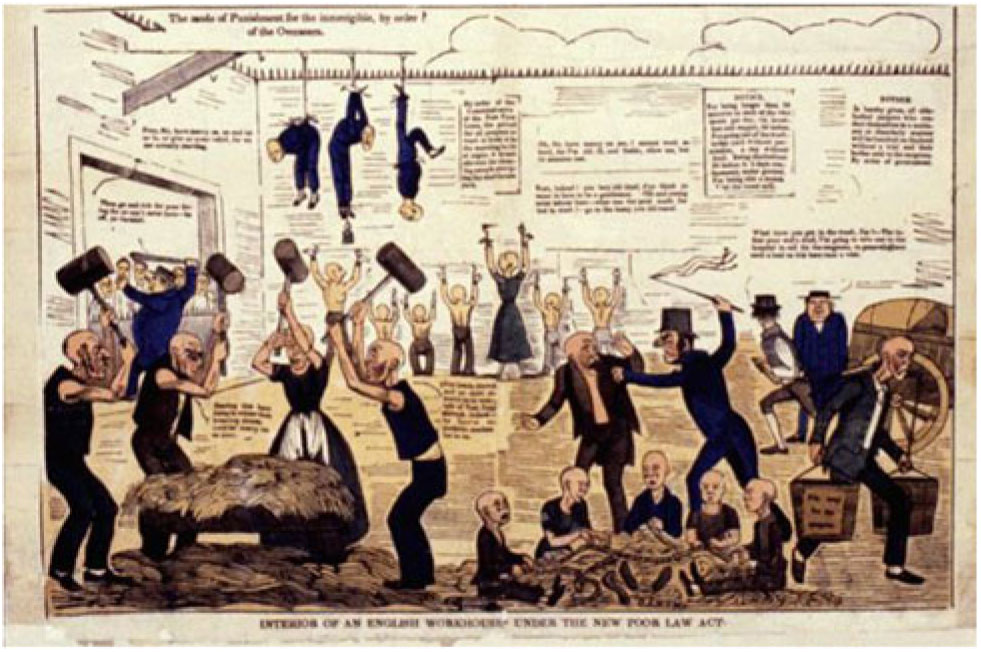
The contemporary poster represented in Figure 1 illustrates what was taken to be the wide variety of fears held by working-class people regarding these aspects of the New Poor Law.Footnote 40 In the bottom left a group of paupers contemplate their fate and note that the physical labour required during the long hours they are engaged in beating hemp within the workhouse is worse than breaking stones. They complain that the workhouse authorities have ordered heads be shaved and that they are not to wear shirts, concluding by comparing their lot to the slaves of the West Indies. Above them are three paupers, bound and hanging from hooks, while below them five more are manacled to the wall. Next to them is a note that ‘By order of the Commissioners of the New Poor Laws’ all paupers are to work from 4 am to 10 pm. To the right is a further notice listing the punishments for the various transgressions of lateness, disobedience and idleness: to be whipped with the lash, denied food, confined underground, or to be set on the treadmill. In the centre of the picture, an elderly pauper asks for mercy and cries that he ‘cannot work so hard, for I’m old, ill and feeble, allow me but 10 minutes rest’. Characterising the supposed relentless harshness of the new system to come, the workhouse officer scoffs: ‘Rest, indeed! You lazy old thief, d’ye think ye came in here to be a gentleman. Old and young must labour here – what was the poor made for but to work? – go to the hemp you old rascal.’ Playing to the fear of death is the character standing on the right of the picture. When asked what he has on the cart he explains: ‘The infant poor wot’s died, I’m going to take one to the hospital to sell for the surgeons, we generally have such a load as this here once a week.’ Notwithstanding the suffering of the paupers seen in the workhouse, the doorway is full with applicants being beaten back as they cry: ‘have mercy on us and let us in, or give us some relief, for we are actually starving’. The master responds that they should ‘go and rob for your living for ye can’t enter here – be off, ye varmint’.
Anti-poor law poster, c. 1834–5.

This is a complex source capable of many readings. One is that it shows the complex matrix of fear, fantasy and policy that may have shaped the poor’s perception of the workhouse. The PLC did not advocate hanging paupers from hooks or work from 4 am to 10 pm. However, paupers were to be punished and to suffer confinement and reduced diets if rules were transgressed, and the unclaimed bodies of dead paupers were to be made available to surgeons.Footnote 41 Moreover, real individual acts of neglect, oppression and cruelty occurred, and continued to occur, under the New Poor Law even though condemned by the PLC, the PLB and later the LGB.Footnote 42 In this matrix, then, the workhouse and notions of punishment (real and imagined) were welded together at the very beginning of the New Poor Law for middle-class commentators and the poor and their advocates.
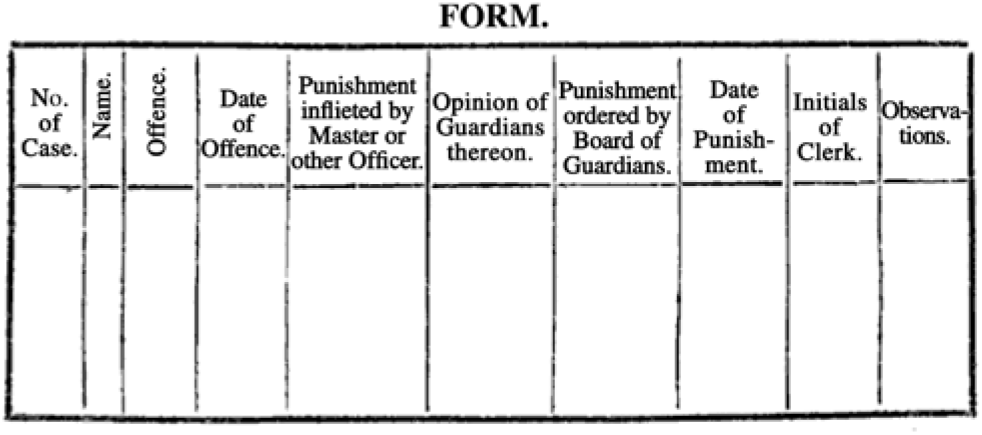
The reality, both of actual punishment and its perception by the central authorities, staff and inmates was, however, more fluid and nuanced. Paupers who felt that they had been unjustly treated could approach the guardians, Visiting Committees, or invoke their rights to enter into correspondence with the central authorities, much as they would have approached parochial officers, vestrymen and advocates under the Old Poor Law. Moreover, central guidance was by no means static. An important administrative change was published in the seventh annual report of the Poor Law Commission in 1841, when it was claimed that amendments to practice were needed: ‘In consequence of recent instances of excessive or improper punishments inflicted by masters of workhouses upon some of the pauper inmates.’ This justification speaks to the sensitivity of the central poor law authorities to local publicity and also to the flow of such information upwards.Footnote 43 From 1841 the master of the workhouse was to keep a book in which all cases of refractory or disorderly paupers (children or adults) reported to the guardians for their decision, or cases punished without the direction of the guardians, with their respective offences and punishments, would be inserted as per the format shown in Figure 2.
Format of punishment data to be collected.

These punishment books were to be present at the guardian’s meetings, and new cases entered as they occurred. Illegal punishments brought to the attention of the guardians by paupers, advocates, newspapers and even workhouse staff themselves, were to be forwarded to the PLC. Paupers reported as refractory or disorderly since the previous board meeting were to be brought into the board room to complain of any undue punishments or unjust charge.Footnote 44 This change, appearing as it did barely seven years into the New Poor Law and while the process of union formation and workhouse building was still ongoing in some places, suggests that the power of guardians and officials to control and restrict the lives of the inmate poor and to punish those who actively resisted or sought to exercise agency in other ways was never meant to be untrammelled. The rules were repeated and clarified by the PLC in their General Consolidated Order, issued in July 1847.Footnote 45 Where the resulting punishment books were kept well and continuously they provide a unique window onto the mechanisms by which power and control were exercised and resisted in the workhouse context. Where they were kept more episodically, or only for a subset of punishments and paupers, or completely ignored (and one or more of these positions was the case for most unions in the period), we can also read important lessons for the nature and sentiment of paupers and staff in workhouses.
Southwell: the discipliners
If a matrix of rules and associated punishments for their breach underpinned efforts to maintain day-to-day control of workhouse populations, it was the number, quality and attitude of staff that were central to the way such rules were interpreted and the spirit with which they were invoked. The story of workhouse punishment is thus intimately entwined with a perennial bugbear of the central authorities: the professionalisation of workhouse staff.Footnote 46 That the New Poor Law had by the 1840s witnessed and driven the professionalisation of union administration, the assessment and dispensing of outdoor relief, and some aspects of workhouse staffing, is not in doubt. Even by the 1860s, however, many unions lagged behind and the explosion of investigative journalism at this time revealed a woeful catalogue of poor quality staff, high turnover and systemic understaffing in the urban unions that were generally the focus of such journalistic endeavours.Footnote 47 In addition to these broad issues, staff such as the clerk, chaplain, relieving officers, collectors, and medical officers would all live outside of the workhouse and could offer nothing for the day-to-day supervision, containment, or discipline of workhouse inmates. Thus, the Southwell workhouse census returns for 1841–71 show only three or four members of staff living onsite for each respective year.Footnote 48 Union staffing policies could exacerbate this situation. In early 1867, the poor law inspector, H. A. Farnall, commented on the lack of a paid nurse at Southwell in his report to the PLB.Footnote 49 In the late nineteenth century the Southwell matron was paid an additional sum for acting as head nurse, and the additional posts of nurse and assistant nurse were added to the establishment figures only in 1873 and 1911, respectively.Footnote 50 This employment of an individual responsible for multiple roles was common. In 1873 John Townend, previously a ‘singing man’ at the Collegiate Church (Southwell Minster) was employed as master and also made responsible for the industrial training of the boys, there being no schoolmaster.Footnote 51 The post of workhouse porter was a paid latecomer at Southwell compared to urban unions where this role was almost universal. The Board of Guardians discussed the matter as early as 1845 when they informed the PLC that such a post was (only) being considered.Footnote 52 However, the following year, appointment to the post was postponed and the salary for the master was increased, with this role absorbing the additional duties of porter.Footnote 53 By 1859 it was reported that a pauper was undertaking the porter’s role, and the first paid individual at Southwell only arrived in February 1896.Footnote 54 Decisions like these undoubtedly reduced the establishment costs, but they also ensured that only a small staff complement would be on hand to manage any disorderly or refractory behaviour, both on a day-to-day basis and if large-scale disorder bubbled up.
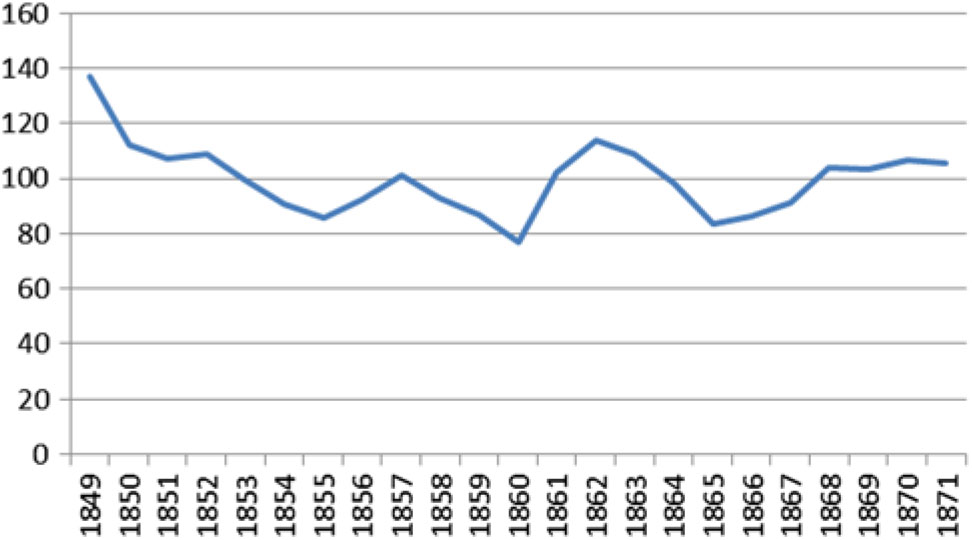
What this meant for the use of punishment and the ability of staff to control the workhouse on the one hand, and the potential for pauper agency on the other, is centrally dependent upon the scale and turnover of the workhouse population. A time series of Southwell inmates is difficult to establish as the local archival record is relatively bare. Figure 3, however, uses inferred totals based upon reporting in the Nottinghamshire Guardian newspaper.Footnote 55 Average annual numbers for Southwell in the early 1850s were between 100 and 112. In the mid-to-late 1840s the total was perhaps somewhat larger with figures reaching 143 in the Christmas quarter of 1846 and 155 in the midsummer of 1847.Footnote 56 Indeed in 1844 numbers were such that the PLC approved out-relief and clothing to some inmates so that they could leave the workhouse and reduce overcrowding.Footnote 57 With only a master, matron, and schoolmaster or schoolmistress in regular attendance at Southwell we can imply a staff-pauper ratio of around 1:38 in 1841, 1:27 in 1851, 1:34 in 1861 and 1:26 in 1871. However, numbers fluctuated between census years, so that, for instance, we find peaks of 1:52 in 1847 and 1:41 in 1862.Footnote 58 Comparing this to Bingham, the other rural union in Nottinghamshire, we find more favourable and improving ratios of 1:27, 1:26, 1:17 and 1:11, respectively.Footnote 59 In both unions a small change in staffing could generate peak ratios given the low staffing base on which these calculations are based. For the Nottingham Union the ratios are very different at 1:118, 1:53, 1:67 and 1:33, respectively. The consistent decline in ratios over the period reflected a sustained increase in workhouse staffing, rising from four in 1841 to nine in 1851, 13 in 1861 and 19 in 1871.Footnote 60 This tendency for urban unions to progressively increase both the number and range of paid residential staffing (voluntarily or in relation to scandals and central instructions) irrespective of the changes to the core inmate population has also been observed by King, and stands in distinction to many rural unions like Southwell where staffing numbers remained fragile and volatile.Footnote 61
Inmates at the Southwell workhouse as reconstructed from the Nottinghamshire Guardian.

If the paupers were a pliable group then staffing ratios of the order set out above may have been sufficient to contain disputes and problematic behaviour on most days and in most weeks. Empirical work on pauper agency suggests this would be an optimistic interpretation for the urban context. Here, the strongly coercive and disciplinary powers notionally given to guardians and workhouse staff were heavily circumscribed by the sheer numbers and noisiness of inmates, even given rising staff numbers.Footnote 62 The situation in a rural union such as Southwell with its limited workhouse population should, on the face of it, have been easier to deal with, notwithstanding the presence of people like Henry Stanley. But we know little about agency and discipline in such rural contexts and about the wider processes through which workhouse staff sought to manage and contain the day-to-day tensions that are a familiar part of institutional life. The treatment of Henry Stanley might be symbolic of a strongly controlled workhouse environment in which dissent was contained and discouraged through active use of punishment; or it might signify that a tiny absolute number of staff struggled (and failed) to manage their pauper clients. It is to the broad questions of who was punished and how we should read punishment actions in Southwell that the article now turns.
Southwell: the punished
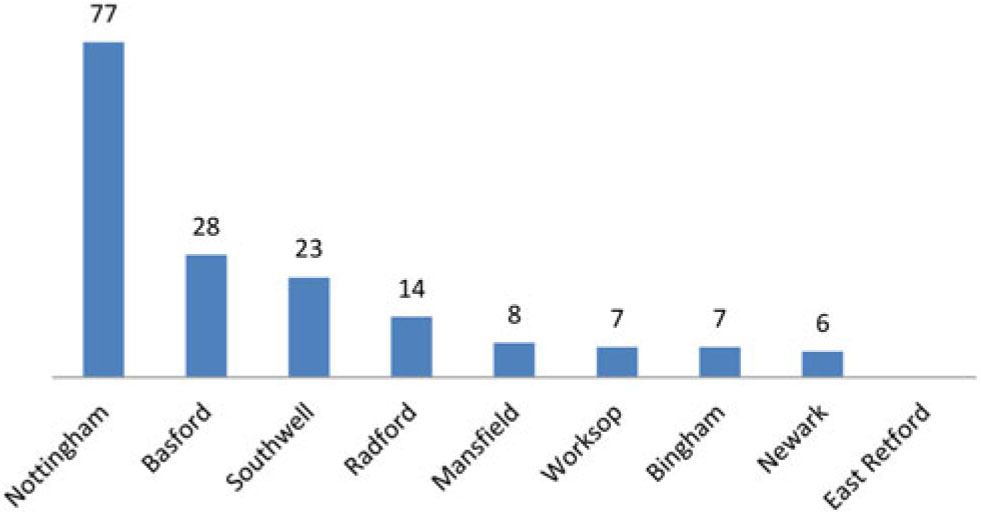
We noted above the patchy survival of punishment books, but one for Southwell is particularly rich and begins in 1852. If a similar book had been compiled prior to this, as per the 1841 order, it does not survive.Footnote 63 To understand the meaning of cases like that of Henry Stanley prior to this date, we are thus thrown back on more patchy archival records.Footnote 64 The 1843 parliamentary returns of the number of persons committed to prison for offences in workhouses covers the period 1837–42, and for that period the Southwell workhouse made a significant contribution to the judicial bench. In Nottinghamshire (Figure 4), only the urban Nottingham and Basford unions committed more paupers for criminal proceedings.Footnote 65 There is little detail on the nature of such cases prior to 1852. However, we do know that in June 1837 the master was directed to apprehend Elizabeth Williamson by warrant for absconding from the workhouse and leaving her bastard child chargeable to the parish of Rollestone.Footnote 66 We also know that in January 1840 George Musson absconded from the workhouse, leaving his wife and four children chargeable. He took clothes belonging to the workhouse, thus prompting the master to procure a warrant to apprehend him. At the same guardian’s meeting it was recorded that Mary Fisher had absconded leaving her child behind and taking a pauper uniform, again resulting in a warrant.Footnote 67 In February 1849, William Allen and John Green were convicted at the Southwell Petty Sessions for destroying their own clothes in the workhouse and sentenced to twelve and ten days respectively in the house of correction.Footnote 68
Number of persons committed from union workhouses (1837–42).

These cases tell us something about pauper agency. Leaving a child chargeable was an instrumental act that allowed single mothers to re-enter the workforce. Absconding without leave and in stolen workhouse clothing might be regarded as a strategic rejection of the oppressive workhouse routine, in ways envisaged by Englander and Green. Both actions have resonance with similar practices – abandoning children and selling parochial clothing – under the Old Poor Law, signalling continuity in this important area. But these prosecutions also signal a workhouse regime in the first decades of the New Poor Law in which control was not easy to maintain. There are plenty of other early examples of this, and of the agency with which a small number of workhouse staff had to contend. Thus, in late 1844 it was reported that vagrants had sought to break the handmill that was constructed, so as to perform no useful work and thus act as a punishment.Footnote 69 One pauper who refused the work was taken before a local magistrate, who promptly declared the mill illegal as it served no practical function; a view confirmed by the PLC.Footnote 70 We also know that between November 1847 and January 1848, twelve paupers were imprisoned for destroying their clothes. Yet surprisingly little of the disorder and resistance that we can trace (pre- and post-1852) resulted in formal prosecution. Thus, in January 1848 four paupers had set fire to bedding while another four damaged parts of their clothing by burning and were punished with reduced diet. Several others destroyed a ‘portion’ of their clothing in winter 1847, ‘but as it was very filthy, were allowed to go away [unpunished] being supplied with other clothing’. Another group of paupers, described as ‘one body of 18’, had ‘pulled up the Wooden bedsteads to pieces altho strongly secured by Iron clamps + burned them, notwithstanding they had been supplied with a fire and with warm gruel as well as bread on account of the severity of the weather’.Footnote 71 Compared to the situation in London, these incidents would be regarded as relatively minor.Footnote 72 Yet the twelve paupers committed by a magistrate in a single instance and the concentrated series of events in 1847–48 do point to a rural union with a distinct discipline problem in the decade before we first encounter Henry Stanley. The internal power dynamics between staff and paupers were fluid, ultimately having to be buttressed in favour of staff through recourse to the law for some cases. These instances might also be read as signalling a workhouse life that was less controlled and controllable than Crowther and other early commentators suggested.Footnote 73 The fact that some of these incidents seem to have attracted no punishment at all is important for the argument that follows.
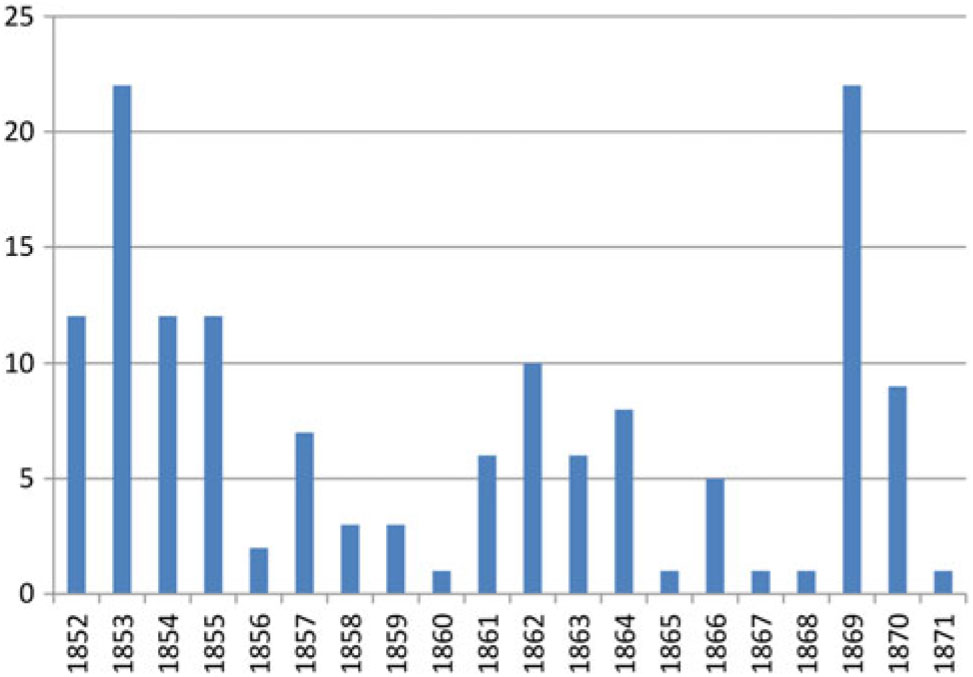
The punishment book reveals more about the nature of power, control and containment, recording 174 pauper offences, or just over nine per year (Figure 5).Footnote 74 Not all entries record a punishment, though the fact of their appearance in the book suggests one was likely to have been enacted. Two observations should shape our reading of the graph: First, cases were not evenly distributed and peaks in the early 1850s, early 1860s and the late 1860s have some correlation with the peaks in inmate numbers identified above. The sample here is too small to be definite but it seems that when the staff-to-inmate ratio was stretched there were either more offences or staff were more likely to turn to formal punishments as a response to an existing ‘norm’ of disciplinary offences.Footnote 75 Secondly, if we remove these peak numbers from the mean figure across the whole period, then just four punishable offences per year ostensibly took place. It seems unlikely from the past history of disruption in Southwell workhouse noted above, growing empirical record of workhouse scandals nationally, the existence of pauper letters of complaint, and the lessons of investigative journalism, that all of the everyday instances of disobedience, violence, and interpersonal enmities that could have been punished are encompassed in these figures. The punishment of children (as Shave has shown) and the day-to-day physical chastisement and hardships practiced on vagrants, almost certainly escape attention. Changes to the rules on what punishments could be meted out to which gender and age of pauper in 1841 and 1847 may also have led to actions such as substitution of diet escaping recording.Footnote 76
Number of Southwell workhouse punishment book cases (1852–71).

There is, however, an alternative reading of the punishment books, which is that they do in fact record most instances of actual punishment but not the wide variety of punishable offences, such that workhouse staff might have actively chosen which disruption, challenges to the rules and pauper agency was worthy of punishment and which not. Such a reading would be supported by James’s recent work on the nature of agency in the Ampthill (Bedfordshire) workhouse in a similar period to the one studied here.Footnote 77 It is also notable in the particular case of Southwell that we do not discover, as it were by accident, unrecorded punishments through the correspondence between paupers or their advocates and the central authorities. In this reading, on most days in most years officials were unable or unwilling to confront any or most of the behaviour that could have resulted in paupers being labelled disorderly or refractory under the strict intent of the New Poor Law. It thus matters very much for our understanding of the experience of workhouse life, the perception of the workhouse by ordinary people and the character and role of the New Poor Law itself, which behaviours by which paupers got recorded and punished.
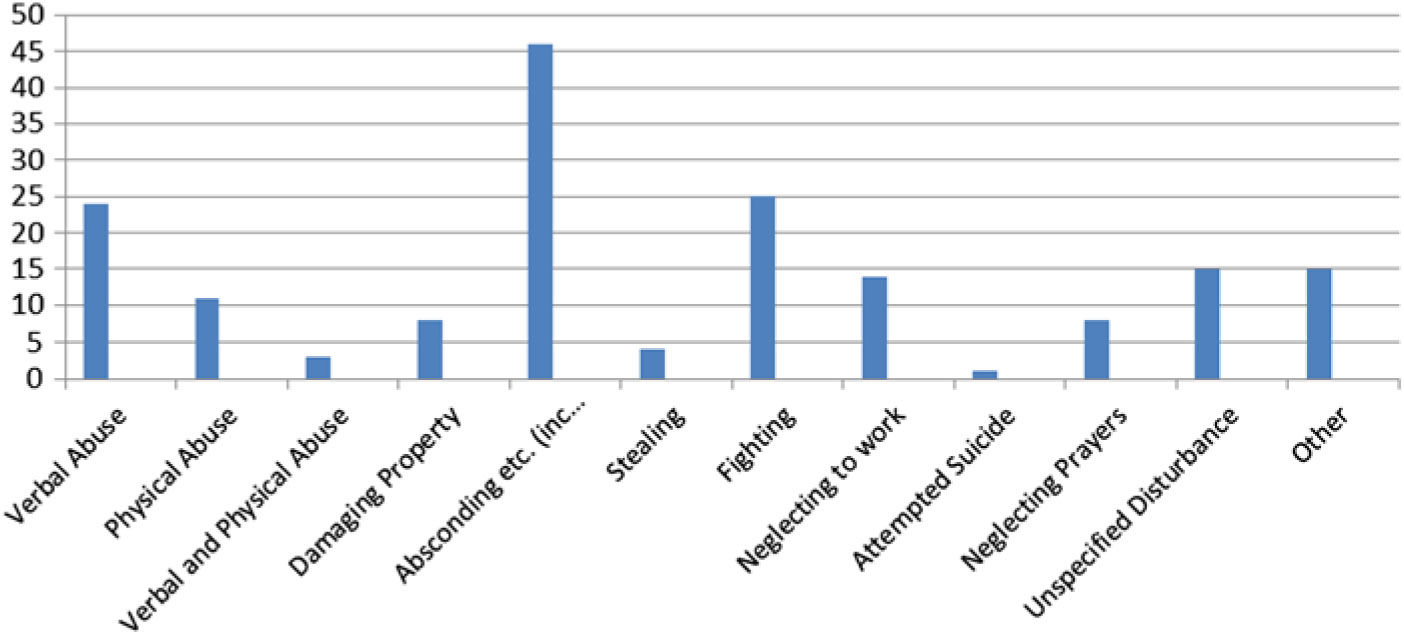
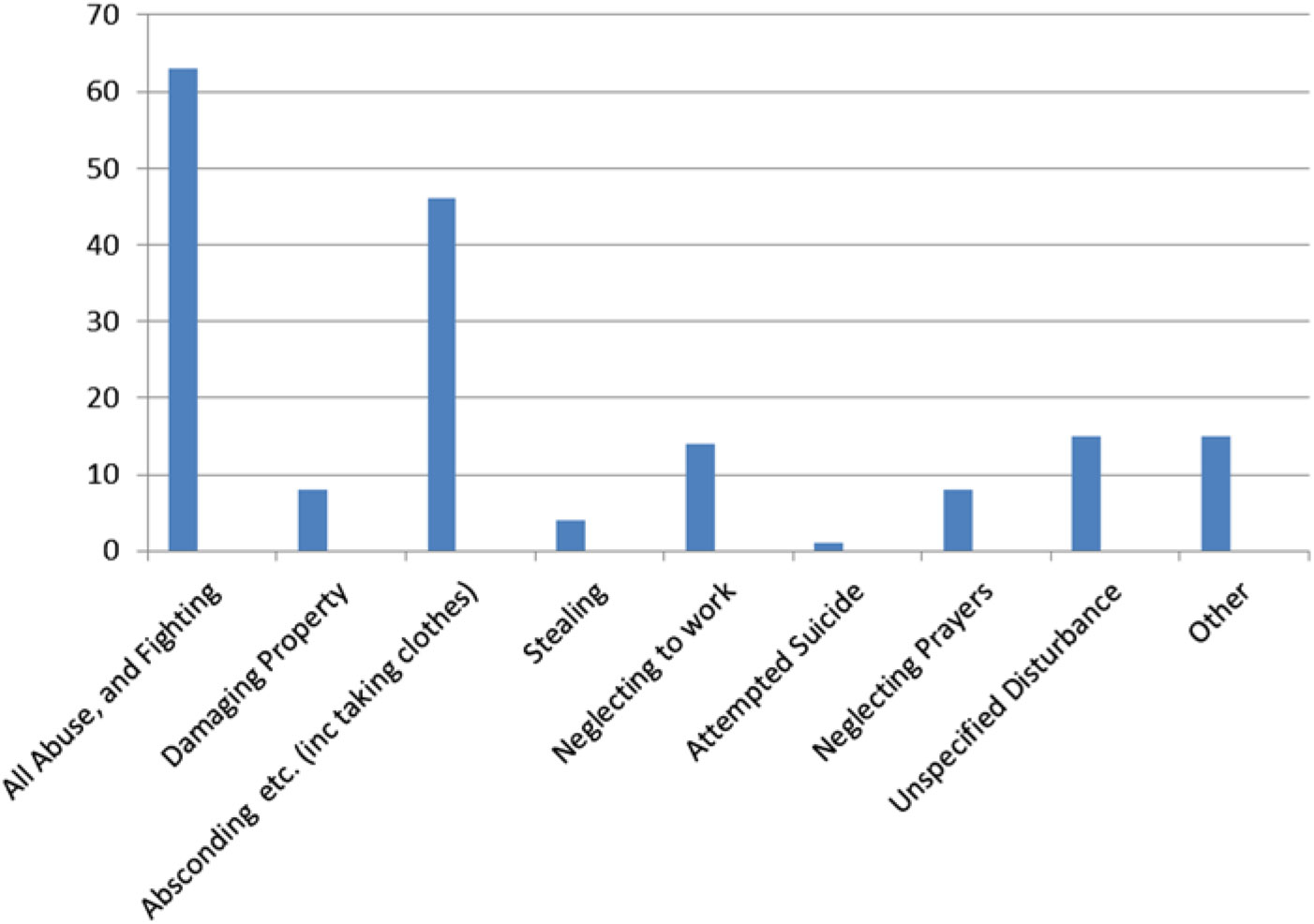
Figure 6 groups together similar types of offences as recorded in the punishment books. The largest single category of activity was absconding from the workhouse. This was closely followed (in order) by fighting, verbal abuse, unspecified disturbance and ‘other’.Footnote 78 If we take together all cases that signal face-to-face conflict (verbal abuse, physical abuse, and fighting; see Figure 7), and which we might expect to have been particularly problematic for workhouse staff, then ‘personal violence’ comprised 36 per cent of all recorded cases. This figure is probably an understatement. A further fifteen instances were counted as ‘unspecified disturbances’, including: ‘Willfully disturbing the inmates at prayers’, ‘creating a noise while under confinement’ or ‘Quarreling [with another inmate] and persisting in making a great noise when ordered to be quiet by the master.’Footnote 79 It was not clear to us if these were some other forms of verbal abuse or threats, hence their categorisation as ‘unspecified’.
Pauper offences (1852–71).

Recategorised pauper offences (1852–71).

Yet, not even all instances of physical or verbal abuse were either punished or accounted for. When Mary Ann Cox was confined in the refractory ward for three hours in the latter part of 1864 it was for striking one of her fellow inmates. Never appearing in the punishment book before, it was however noted that this was the sixth such episode in ten days.Footnote 80 Similarly, Sarah Watkins was recorded as quarrelling with a fellow inmate and making a great noise when ordered by the workhouse master to be quiet. Although never previously referred to in regard to misbehaviour or punishments she was noted to have a fractious history and she and Ann Warriner (her quarrelsome partner) were regarded as ‘two very disagreeable women’.Footnote 81 In short, a number of personal violence episodes were never recorded, either because they were not fully known to the workhouse authorities or because they were, to differing degrees, purposefully overlooked at the time. It must be the case, then, that other forms of disruptive or irritating behaviour also went unpunished given only four punishments in an average year.
This reading of the evidence might reflect a breakdown of administrative routines and practices, with the peaks of punishment noted earlier evidence either of attempted ‘catchup’ or the fact that disorder reached a background level that could not be simply ignored, particularly when staffing levels were low. Yet there is little local evidence that Southwell was a badly run union in an administrative sense, even at its most overcrowded. In any case the central authorities became increasingly sensitive to administrative problems in the provinces given their potential to erupt into national scandal.Footnote 82 Thus, in 1852, the poor law inspector John Manwaring considered John Taylor, workhouse master, a person of irregular habits and of a ‘violent temper’. In addition when Taylor had previously worked as a relieving officer for the union he had frequently been taken home ‘in a helpless state of intoxication’.Footnote 83 Eighteen months later Manwaring tellingly wrote in the punishment book itself that he recommended ‘the Master before punishing Any Pauper Inmate to Carefully read over the Articles in the Consolidated Order relating to his power to punish them to guard against the danger of exceeding his authority to punish’.Footnote 84 Writing in 1859, John Lambert, another poor law inspector, heard of a female inmate’s complaint that the schoolmistress had slapped her child hard enough to leave marks on the child’s back. He noted that the mistress’s ‘temper is somewhat quick’, but that on informing her that her actions in this case were not justified she had promised him she would not repeat the offence in the future.Footnote 85 Such instances do not, however, add up to evidence of administrative chaos and lack of control.
It is likely, then, that the relatively small number and relatively concentrated range of offences officially punished in any year reflected a deliberate policy. Turning again to Figures 6 and 7 against this backdrop suggests that staff focused on the punishment of offences that either deliberately challenged the concept of control and power (for example, absconding), or which had the potential to spill over into wider conflicts, such as personal violence or verbal abuse.Footnote 86 More than this, however, the vast majority of those actually punished for verbal and physical confrontation were longer-term inmates rather than sojourners.Footnote 87 Cases include John Fox who swore at and kicked George Rhodes; Elizabeth Richardson who assaulted an unnamed inmate with a plate causing a head wound; Rebecca Robinson who used ‘obscene language’ against Ann Ford; and John Maltby, who assaulted both George Adcock and John Fox.Footnote 88 Such events sowed seeds of discontent that could build into major disputes. While officers could choose to overlook individual instances of conflict and wider rule-breaking such as absconding or disruptive behaviour, cumulative acts by long-term inmates required punishment, both as a good in its own right and a symbolic action for the stable core of the workhouse population. Control was maintained not by comprehensive application of conduct rules but their selective and symbolic implementation. It was through this selectivity that paupers could understand the limits of agency.
Even so, it seems very unlikely from the mean number of instances recorded in the punishment book that all long-term paupers who committed offences had those offences recorded and punished. There may in other words have been a second level of selective imposition of power and control, one that emerges when we meld together union-level and central sources. The punishment records encompass individual offences: against the workhouse community (that is, other inmates), staff, the rules and regulations of the workhouse as set out nationally and locally, and against the criminal law. Such, for instance, was Rachel Revill who was punished with ‘8 hours in the Lock up and [given] 1lb of Potatoes in lieu of Pudding for dinner’, in April 1852.Footnote 89 Revill was obviously a minor irritant as she was punished by being kept in the refractory ward for five hours in September of the same year for screaming and ‘disturbing all the women’ in the workhouse at night. In August 1853 we find that again she spent time in the refractory ward, this time for eight hours, for swearing and annoying other inmates.Footnote 90 In 1860, William Crossley was caught after running away in the ‘House Clothes’, and was taken before a magistrate where he was ordered to go to prison for seven days. Henry Stanley (with whose story we started this article) absconded in 1862 only for the police to find him and return him to the workhouse. Like Crossley, Stanley was taken before local magistrates and received seven days’ hard labour.Footnote 91 In September 1854 Matilda Mellors struck Martha Hind and blacked both her eyes for which she was kept in the refractory ward for two hours.Footnote 92 Ann Warriner and Sarah Slater were both taken before the guardians for fighting in May 1864; Warriner came off worst and sustained two ‘very’ black eyes.’ Both women were held in confinement for six hours and their dinners were stopped.Footnote 93 The ‘careers’ of these inmates are full of colour and (because of frequent re-offending) they deliver a very real sense of the day-to-day struggle that a limited number of workhouse staff must have had with certain paupers.
Yet it is only when these local details cross-referenced to archival sources held centrally for the period (the punishment book being silent on the backgrounds of offenders) that we find that a significant number of recorded cases involved people suffering from some form of widely conceived mental health problem.Footnote 94 At least 29 per cent of individual paupers and 46 per cent of the individual punishments relate to one or more inmates of unsound mind.Footnote 95 Rachel Revill, William Crossley, Henry Stanley, John Fox, George Black, Matilda Mellors and Mary Ann Cox were all variously signalled as ‘idiot’, ‘insane’ or ‘weak-minded’, ‘lunatic’ or some other phrase designating their mental condition. The potential realised by this synthesis of local and central sources can be exemplified by returning to the case of Henry Stanley. In July 1854, John Manwaring wrote to the PLB and explained that a short time earlier Stanley had been under notice to be sent to a lunatic asylum. However, although regarded as suicidal (he had attempted to hang himself in June 1854) the medical officer refused to sign Stanley as insane, ensuring he remained in the workhouse. Following another visit Manwaring reported that by direction of the guardians Stanley was to be placed under the supervision of another inmate. This was William Pearson, a sixty-five-year-old former agricultural labourer from Perlethorpe in the north of the union, who ‘managed’ Stanley by beating him around the head and toes with a stick.Footnote 96 Undoubtedly Stanley’s life was wretched and Manwaring instructed that a letter be sent to Southwell asking what steps had been taken ‘for the poor creature’s safety’. Thomas Marriott, the Southwell Union clerk, responded that Stanley had been described as being an ‘imbecile’ from birth and that his mental health had not deteriorated, he was no worse than before and he was not dangerous. This account was backed up by the Southwell surgeon who stated that Stanley was unlikely to benefit from residence in an asylum. Moreover, it was claimed by the local authorities that the beatings referred to were trivial, as there were no bruises detectable. Unimpressed with the local guardians, Manwaring pressed for a definitive answer regarding Stanley’s mental state. Ultimately, and following several attempts by Manwaring to pressure the guardians to have Stanley removed from the workhouse, we find that he was unsuccessful.Footnote 97 The surviving annual ‘Lunatic Returns’ between early 1851 and 1861 show Stanley continued to live as an inmate in the Southwell workhouse.Footnote 98 This sort of workhouse confinement for pauper lunatics was, Ed Miller argues, increasingly the norm as the Victorian period progressed because the number of people labelled as lunatic increased sharply, and lunatic asylums became hopelessly overcrowded and ever more expensive.Footnote 99
To some extent, of course, this sort of focus on the punishment of the insane was a reflection of administrative process. By setting down rules around talking or making a noise when silence was ordered, or swearing, or insulting other inmates or acting ‘indecently’, the poor law authorities set up thresholds that people with mental health problems would only too easily breach. An agitated female pauper ‘idiot’ who misbehaved during prayers, or two young frustrated male paupers who ended up fighting each other would quickly fall into the categories of disorderly or refractory. Yet there is also something more. Particularly at times of overcrowding or low staff-pauper ratios, the potential for the disruptive activities of the poor with mental impairments to mushroom into wider conflict or to lay the seeds for ongoing and repetitive enmities, caused guardians and staff to wield power and use mechanisms of control which, for much of the time and for most paupers, they tended to keep in check. In this sense, it is telling that Henry Stanley was ‘amenable to as much punishment as if he were perfectly sane, and a willing offender against the laws and regulations of the place’.Footnote 100 The train of punishments for Stanley that we traced at the outset of this article were enacted precisely because the workhouse staff needed, and needed to be seen by the other inmates to have tried, to prevent a wider set of disputes arising out of his actions.
The Lunacy Commission were well aware of the liminal position of workhouse paupers with mental impairments.Footnote 101 They stressed that pauper lunatics needed greater care than the workhouse could offer requiring better nursing, clothing, bedding, healthy exercise and more ‘tender care and vigilant supervision’, contrasting to the deterrent object of the workhouse. There was also a persistent worry that financial constraints would lead to the ‘curtailment of the comforts and of the wants of the insane inmate’, who might in turn become ‘a prisoner for life’, unable to specify his or her wants nor perhaps able to articulate a claim for specific rights.Footnote 102 The extent of their disruptive presence in the workhouse, and the extent to which they in turn became a focus for the control and containment powers of unions only really emerge from a synthesis of punishment books and central records. Whether long-term resident lunatics posed more of a challenge to the administration of the workhouse in rural areas is unclear. Indoor relief in general was more prevalent in large urban unions and some workhouses in these communities had very considerable lunatic populations. On the other hand, urban unions were often ‘early’ in their building of specialist lunatic accommodation and they tended on average to have more attendants per head of the lunatic population than their rural counterparts, and certainly Southwell.Footnote 103
Conclusion
Punishment in the name of order was a feature of nineteenth-century institutions, and the workhouse was no exception. In the first decades of the New Poor Law, it is clear that weak central controls and a fragile administrative reach at the local level led to instances of egregious, not to say brutal, treatment of some paupers. Codification (and watering down) of the centrally directed punishment framework from the 1840s stifled systematic physical chastisement and concentrated on the removal of privileges as a means of confronting disorder, but it was still a punishment framework. The punishment record books that gave substance to this framework were kept in much greater numbers than their patchy survival might suggest, and for the rural Southwell union they provide an intriguing picture of one-off instances interwoven with the repeat punishment of ‘career’ paupers like Henry Stanley. Yet they are also an imperfect record, and we have suggested that relatively few of the daily infractions of the rules of the Southwell workhouse are likely to have been recorded here or punished. Indeed, it could hardly be otherwise given that a small handful of on-site staff were required to deal with the huge bundle of daily, weekly, monthly and yearly activities that comprised the maintenance of a New Poor Law workhouse.
In this sense, the choices made by officials of whom and what to punish reveal much about workhouse life, the nature of pauper agency and the way that the poor may have constructed the workhouse in their own minds. A tendency to focus disciplinary activities both on long-term inmates and those with mental health conditions might be read as suggesting that such officials were particularly worried about activities which, should they become cumulative, would pose a threat both to the immediate order of the workhouse and the long-term stability of workhouse culture. For people episodically or perennially caught up in generating these particular situations, workhouse life could be harsh and overbearing, and it was possible to lose a voice and any real sense of self or autonomy, as was the case with Henry Stanley. The presence of the mentally ill here is not perhaps a surprise. The New Poor Law was not planned with such people in mind and the very ad hocery of their care and containment could create opportunities for further conflict.Footnote 104 But the punishment of this and other groups also had an element of symbolism, acting as a vehicle to communicate the thresholds of acceptable agency and disruption in the institutional context. For a rural union like Southwell, it seems that this was a wide canvas and that most inmates most of the time could be assured that acts of resistance, disputation and agency (both reactionary and strategic) would meet a degree of toleration.
Selective punishment also has important implications for the way that the inmate poor understood and experienced workhouse life and how those at risk of workhouse admission viewed the institution. While incidents of disruption might have been common, their confrontation and punishment was much less frequent. There were of course instances where injustices were done, and we have traced some of those for Southwell as recorded by inspectors. The fact is, however, that injustices were often confronted by paupers, inspectors and newspaper commentators.Footnote 105 At most times in rural unions like Southwell, those inside the workhouse would have seen, and those outside it would have heard about, the escapades and subsequent punishment of the ‘usual suspects’. It is not a great imaginative leap from this observation to a shared understanding between paupers, staff, guardians and relatives that ‘it is just X pauper. Again.’ Those with power could easily have found more offences and more paupers to punish. The fact that they did not signals their acceptance of bubbling levels of resistance or minor behavioural infractions in order to avert the creation of long-term resentments and enmities that would turn into a wider contestation of the power and control structures of the workhouse. Indeed, in rural unions with limited staffing it had to be this way. This situation could not have been lost on inmates and those outside at risk of confinement, who did not by and large riot, burn down workhouses or conduct extensive assaults on staff.