1 Introduction
During uvular approximation, the tongue dorsum moves toward the uvula. Constriction of the styloglossus and other muscles shrinks the oropharyngeal isthmus (OPI), which is the open space above the tongue dorsum, drawing together the tongue body, soft palate, and uvula. This gesture plays a role not only in the articulation of uvular consonants, but also occurs during the production of those sounds in which a uvular gesture accompanies other articulations. Uvular secondary articulations, such as those found in the ‘emphatic’ consonants of some Arabic dialects, are often of a longer duration than the conditioning segment, e.g. for Jordanian Arabic, see Al-Tamimi & Heselwood (Reference Al-Tamimi and Heselwood2011), Heselwood & Al-Tamimi (Reference Heselwood and Al-Tamimi2011), Zawaydeh & de Jong (Reference Zawaydeh and de Jong2011). Because uvularization accompanies a primary articulation at some location other than the uvula, the acoustic effect and the exact gesture of uvularization may be expected to differ from what occurs during a primarily uvular articulation.
Unequivocal evidence for phonemic vowel uvularization in other languages is elusive. Uvularized consonants are attested in Jordanian and Palestinian Arabic, St’át’imcets, Ju|’hoan, etc. In these languages, articulation of consonantal uvularization extends into neighboring vowels. Uvularized sounds in Ju|’hoan include the pulmonic plosives /t χ ʧχ d χ ʣχ ʤχ/ and the uvularized clicks /ǀχ ǃχ ǂχ ǁχ ɡǀχ ɡǃχ ɡǂχ ɡǁχ/ (Miller-Ockhuizen Reference Miller-Ockhuizen2003, Miller Reference Miller2007). Ju|’hoan uvularization involves contact between the tongue and the uvular area, as evidenced by the ‘uvular frication’ of the release of the uvularized consonant. Uvularization in this language elevates F1 and increases the spectral slope, which Miller defines as the difference in amplitude between the first two harmonics (H1-H2). That is, for the part of the vowel that is affected by uvularization, the amplitude of lower frequencies is boosted relative to higher frequencies. On the other hand, glottalized and epiglottalized consonants show a decrease in spectral slope. All ‘guttural’ (laryngeal and pharyngeal) sounds in this language have a low harmonics-to-noise ratio (HNR), which indicates a noisy signal, such as a hoarse voice (Yumoto, Gould & Baer Reference Yumoto, Gould and Baer1982). After release of the uvularized consonant, the acoustic effect of uvularization on the vowel tapers off, e.g. there is a ‘gradual F1 transition, lasting over the first half of the vowel’ (Miller-Ockhuizen Reference Miller-Ockhuizen2003: 31). Miller-Ockhuizen's study only measured non-high vowels, because for high vowels, F1 was too close to f0 to investigate. Uvularization in Ju|’hoan is treated as a subset of pharyngealization (Miller-Ockhuizen Reference Miller-Ockhuizen2003: 119). In this language, pharyngeal sounds, including those that are uvularized, are defined as having a constriction (not just an approximation) in the pharyngeal region, as is reflected in their noisy characteristics.
Shahin (Reference Shahin2002) reports on acoustic properties of uvularization and pharyngealization in Palestinian Arabic and St’át’imcets. Based on the modeling of Stevens & House (Reference Stevens and House1955), Shahin (Reference Shahin2002: 37) summarizes the expected acoustic effect of pharyngealization as a medium to large rise in F1 (depending on the place of the primary constriction) and a medium drop in F2. The effect of uvularization is predicted to be a small rise in F1 and a medium drop in F2. The empirical studies she cites are in basic agreement with this prediction. Nevertheless, Shahin reminds the reader that one cannot reason backward from acoustic measurements to articulation, as ‘a given set of formant frequencies will not in general correspond to a unique vocal tract configuration’ (Shahin Reference Shahin2002: 39).
Articulatory investigations of Palestinian Arabic and St’át’imcets show that uvular articulations, also referred to as upper pharyngeal approximations, are accompanied by lower pharyngeal approximation as well. That is, retraction and raising of the tongue dorsum is complemented by retraction of the tongue root (Ghazeli Reference Ghazeli1977, Namdaran Reference Namdaran2006). This trend could account for the controversy over whether Jordanian Arabic emphatics are uvularized or pharyngealized (Zawaydeh Reference Zawaydeh1999, Al-Tamimi & Heselwood Reference Al-Tamimi and Heselwood2011, Heselwood & Al-Tamimi Reference Heselwood and Al-Tamimi2011, Zawaydeh & de Jong Reference Zawaydeh and de Jong2011). In addition, cinefluorographic images of Swedish and Greenlandic Inuit primary uvular consonants also show contraction in the upper pharyngeal region (Wood Reference Wood, Slifka, Manuel and Matthies2004). Furthermore, in both languages, tongue retraction for consonants causes tongue retraction on preceding and following vowels. Although Ju|’hoan uvularization is accompanied by a noisy release of uvular closure, Arabic and St’át’imcets tongue retraction appears to involve tongue approximation, rather than complete closure.
In addition to the above-mentioned linguistically distinctive uvularization, a similar phonetic effect is noted in certain speech disorders, in which the diacritic [ʶ] is used to indicate uvular secondary articulation (Howard Reference Howard2007: 24). The Voice Quality System (VoQS) of Ball, Esling & Dickson (Reference Ball, Esling and Dickson1995) proposes the use of [Vʶ] for ‘uvularized voice’. This system indicates voice quality that extends across segments, setting it apart with curly braces and voice quality indicators: [‘ðɪs i z ‘nɔ˞məɫ ‘vɔɪs {Vʶ ‘ðɪs i z ‘j u v j u lə˞a i z d ‘vɔɪs Vʶ}]. Although it was not created for the purpose of specifying the articulation of individual segments, in this study we apply the symbol [ʶ] to mark uvularized segments.
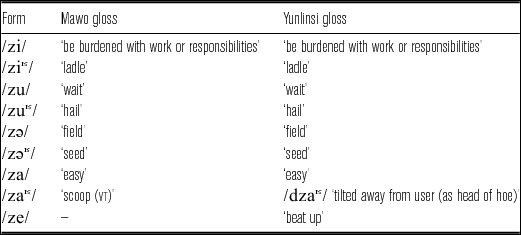
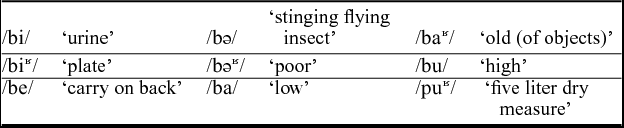
The present study documents the existence of distinctive vowel uvularization in two varieties of Northwestern Qiang that are spoken in Heishui County, Sichuan, China. The argumentation proceeds as follows. Minimal sets reveal the phonemic status of each of the vowels (Table 1). Acoustic mapping shows that uvularized vowels are acoustically retracted (lower F2 and higher F3-F2) compared to their plain counterparts (Section 2). Articulatory studies based on ultrasound video imaging show that the tongue gesture in question is in fact directed toward the uvula (Section 3, supplementary materials online, along with the electronic version of this paper, at http://journals.cambridge.org/IPA). Ultrasound images that are time-aligned with spectrograms show the influence of tongue gestures on the acoustic signal.
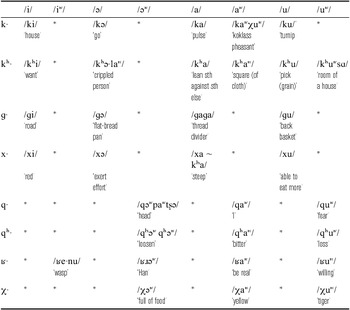
Plain and uvularized vowels of Mawo and Yunlinsi Qiang.

Other languages of Southwest China have been described as having tense/lax vowels. In these cases (Bai, Yi, Jingpho, Wa, Hani, etc.), the description refers to glottal states on the breathy–modal–creaky continuum (Maddieson & Ladefoged Reference Maddieson and Ladefoged1985, Bao & Zhou Reference Bao and Zhou1990, Esling & Edmondson Reference Esling, Edmondson, Braun and Masthoff2002, Edmondson & Esling Reference Edmondson and Esling2006, Kuang Reference Kuang2011). However, unlike what is found in these languages, in Northwestern Qiang both uvularized and plain vowels have modal voicing.
Phonological evidence of uvularization in Qiang comes from phonotactic constraints, which show that vowels fall into two natural classes, only one of which (uvularized) can follow a uvular simple (not cluster) initial consonant, while only the other class (plain) follows velar simple initials. Both plain and uvularized vowels occur with labial and coronal initial consonants. Vowel harmony patterns yield a definitive pairing of corresponding plain and uvularized vowels (Section 4).
Although the discovery of uvularized vowels in these varieties has been documented (J. Sun & Evans Reference Sun, Evans, Feng and Gang2013, Evans & J. Sun Reference Evans, Sun, Sybesma, Huang, Behr and Handelin press), the present work is the first to thoroughly explore the phonetic and phonological properties of vowel uvularization in Qiang, and the first to present articulatory imaging evidence that the feature in question does indeed involve a tongue gesture toward the uvula.
1.1 Overview of language and phenomenon
Qiang, also known as Rma from the autonym of its speakers, is a Sino-Tibetan language group spoken by more than 100,000 ethnic Qiangs and Tibetans in five counties of the Aba Tibetan-Qiang Autonomous Prefecture of Sichuan Province, China (ISO codes cng, qxs; H. Sun Reference Sun1981, Liu Reference Liu1998). The present study investigates the Mawo and Luhua dialects of Northwestern Qiang, which is the principal indigenous language of Heishui County. The Mawo dialect is spoken in certain villages of Mawo Township; the analysis in this paper is based on the speech of Miao’erwo Hamlet in Zhaku Village. Across Heishui County, Mawo is considered a prestige dialect. The Luhua dialect is represented in this study by the Yunlinsi variety spoken in Yunlinsi Village of Hongyan Township, which lies just to the west of Mawo Township.
Mawo and Yunlinsi each have four distinctive plain vowels, which we transcribe /a ə i u/, and four uvularized vowels /aʶ əʶ iʶ uʶ/. In addition, Yunlinsi has /e/, which lacks a uvularized counterpart. Table 1 presents minimal sets exemplifying the distinctive vowels of these two dialects (there are no diphthongs in native monomorphemes); sound files are in the supplementary materials online.
2 Acoustic characteristics of uvularization
An acoustic study of the properties of uvularization was performed in order to quantify differences between the sound signals of plain and uvularized vowels.
2.1 Method
For the acoustic analysis, CV sequences containing the alveolar initials /t d s n l/ from both dialects were recorded in the phonetics laboratory at the Institute of Linguistics, Academia Sinica. The Mawo speaker was a 67-year-old male, while Yunlinsi words were pronounced by a 66-year-old male. All of the words used are native Qiang words, except for a few ancient borrowings from Tibetan, which were needed to fill out the matrix of contrasts (e.g. /s t aɹa/ ‘ax’). The sequence of words was practiced, in order to reduce communication in Chinese during elicitation. Phonemic forms are given in Appendix A. After reviewing the words in question, each speaker said each word three times in isolation, as naturally as possible. The Yunlinsi subject has slight chronic hoarseness, which had a minor adverse affect on the sound quality of his recordings, although they showed clear formant structure. The digitally recorded files were transferred to a standard desktop computer, and were analyzed with Praat software (Boersma & Weenink Reference Boersma and Weenink2013). The vowel was deemed to be that part of the waveform which contained obvious periodicity, and where the wave tracing was distinct, rather than noisy. The frequencies of the first three formants were obtained utilizing Praat's formant tracking, with the maximum frequency set to 5500 Hz. Within this range, the software was set to identify five or six formants, a number that was adjusted according to the vowel, as neither setting yielded adequate results for all vowels. For example, analysis of [u uʶ] required that Praat identify six formants below 5500 Hz, due to the low F1 and F2 of these vowels. Other settings were set to their standard values. Formant values were obtained at intervals of about 6 ms, according to the default settings of Praat. The first and last formant measurements were discarded to reduce unwanted edge effects.
Obvious formant miscalculations were fixed by interpolation. For each utterance, the median values of the first three vowel formants were obtained, and then the mean of the three medians was calculated, and taken as the summary statistic for the vowel of a given CV combination.
2.2 Results: Vowel formant values
Based on previous findings, we expected to find higher F1, lower F2, and higher F3-F2 for the uvularized vowels than for their plain counterparts. Hassan & Esling (Reference Hassan and Esling2007) found that in vowels adjacent to Iraqi Arabic emphatics, F1 and F2 are closer together than in non-emphatic environments. This value was also explored in our data.
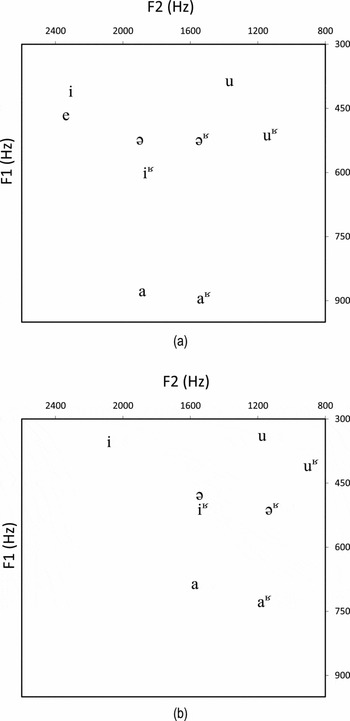
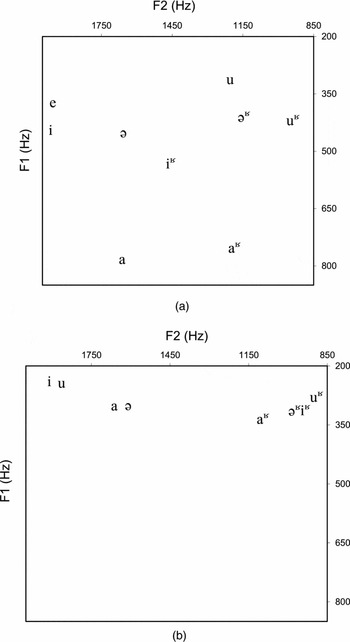
Summary values for each CV combination are given in Appendix A (Table A1). F1 vs. F2 plots for the two speakers are given in Figure 1.
First two formants of (a) Yunlinsi and (b) Mawo vowels, following coronal initial consonants.

Members of uvularized–plain vowel pairs can be perceptually distant, as evidenced by their visual separation in F1 × F2 vowel space. This fact lies in contradistinction to perceptual similarity of paired vowels in other systems, such as tense/lax vowels in English and Dutch.
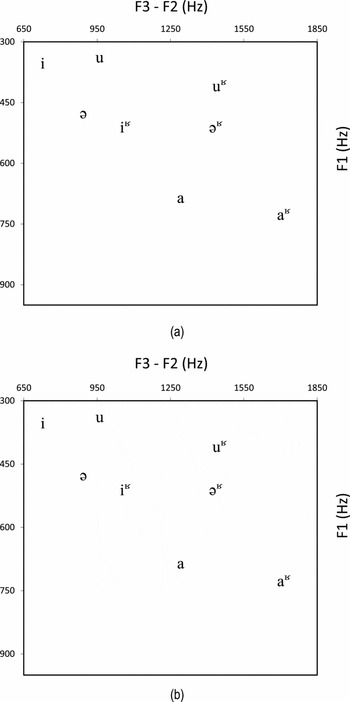
Kent & Read (Reference Kent and Read2002) claim that higher values of the difference F3-F2 correspond to increased tongue backness. Figure 2 plots F1 vs. F3-F2, and shows a clear increase in the latter dimension for uvularized vowels, with the exception of the Yunlinsi pair /i iʶ/. While this calculation is reminiscent of F2 prime (Kiefte, Nearey & Assmann Reference Kiefte, Nearey, Assmann, Ball and Gibbon2013: 166–168), we make no claims about a role for F3-F2 in perception. The dimension F3-F2 also separates /ə iʶ/ more clearly than does F2 alone (Figure 1).
F1 vs. F3-F2 for (a) Yunlinsi and (b) Mawo vowels, following coronal initial consonants.

As suggested by the distribution within F1 × F2 acoustic space, some vowels are perceptually similar, e.g. Yunlinsi /ə iʶ əʶ/ and Mawo /ə iʶ/. In both dialects, /a aʶ/ sound similar to [æ ɑ], while the /u uʶ/ pair resemble [ʉ o]. Yunlinsi /e/ occurs as [j e] after labials and dental/alveolars, and as [e] elsewhere. Yunlinsi forms containing /e/ are often cognate to /i/ in Mawo and /j-/ plus front vowel in other dialects: Yunlinsi /p e/, Mawo/Zhimulin /p i/, Luoduo /p jæ/, Qugu /p j e/ ‘pig’; Yunlinsi /l e/, Mawo/Zhimulin /l i/, Luoduo /l jæ/, Qugu /l j e/ ‘thick (board)’. This Yunlinsi vowel is treated as a monophthong for several phonological reasons. First, Yunlinsi has no contrast between [e j e], unlike Qugu (/p e/ ‘snow’; /p j e/ ‘pig’). Second, we do not propose /i e/, as it would be the only native diphthong in the language. Finally, we do not propose /jV/ because it is not clear what vowel would be chosen.
The choice of vowel symbols in our transcription reflects both phonetic and phonological considerations. Thus, although /u/ sounds rather like Swedish [ʉ], we chose the orthographically simpler transcription, due to a lack of contrast between [ʉ u]. Distinctive consonants and consonant clusters are presented in Appendix B (Tables B1–B3).
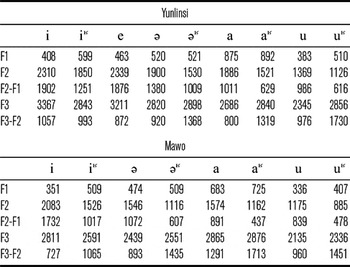
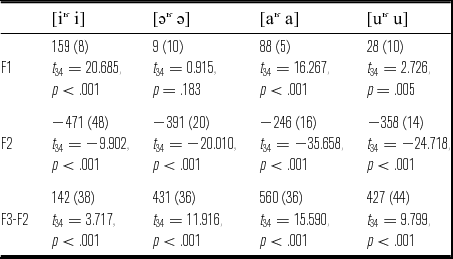
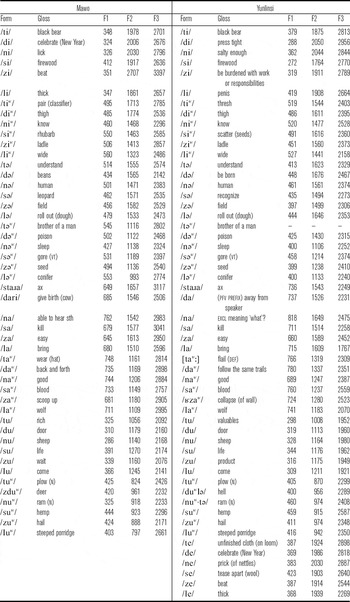
The first analysis performed on the data was a calculation of formant differences between uvularized and plain vowels. Table 2 gives the summary values (means of the median measurements) for both Yunlinsi and Mawo formants following alveolar initials.
Summary formant values (in Hz) for Yunlinsi and Mawo vowels.

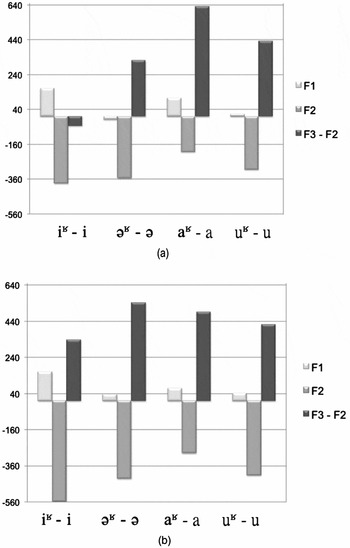
The study performed a repeated measure ANOVA with two within-trial factors, namely formants (F1, F2, and F3-F2) and formant shifts within each of the uvularized and plain vowel pairs ([iʶ i], [əʶ ə], [aʶ a], and [uʶ u]), given that the shifts were nested within the formants. In the ANOVA, we additionally assumed that trials within each participant (18 trials each) were independent, which was deemed justified because the wordlists had been practiced, and the list of words was not long. In order to take into account possible differences between the two speakers, the two participants were taken as a covariate in the ANOVA; that is, all the main and interaction effects were statistically evaluated by holding the participant effect constant. Because the homogeneity-of-variance assumption was violated (Mauchly's test on sphericity was rejected for the main and interaction effects), we applied the Greenhouse–Geisser correction on degrees of freedom in the ANOVA for all within-trial comparisons. The ANOVA results suggested that both the formant effect (F(1.164,39.56) = 438.793, p < .001) and the shift effect (F(2.162,73.521) = 59.994, p < .001) were statistically significant. Furthermore, the interaction between formant and shift was also significant (F(2.187,74.354) = 15.817, p < .001), verifying that formants differ in their shift sizes and directions. The post-hoc evaluation of each mean shift between uvularized and plain vowels within each pair and for each formant is given in Table 3. The plots of mean shifts are given in Figure 3.
Results of post-hoc tests on the mean shifts (in Hz) for individual formants and uvularized–plain vowel pairs.

The mean shifts in Hz of (a) the Yunlinsi speaker and (b) the Mawo speaker for each formant and each uvularized–plain vowel pair.

Table 3 shows that consistent and significant formant shifts are found in F2 (from –246 to –471 Hz) and in F3-F2 (from 142 to 560 Hz), both corresponding to acoustic backing of uvularized vowels. Positive shifts in F1 are consistent and significant for the non-schwa vowels. Thus, as in the pharyngealized vowels investigated in Hassan & Esling (Reference Hassan and Esling2007), F2 and F1 are closer together (smaller value for F2-F1) for uvularized vowels than for their plain counterparts (see Table 2 above). To be more precise, F2-F1 for plain vowels averages more than 350 Hz higher than F2-F1 for corresponding uvularized vowels. Although this result was expected due to the established shifts in F1 and F2, we include it here to facilitate comparison with other studies. F3 and F2-F1 were not tested in the ANOVA because F1, F2, and F3-F2 already take into account the relevant formants as explanatory variables.
2.3 Results: Formant values during initial /l/
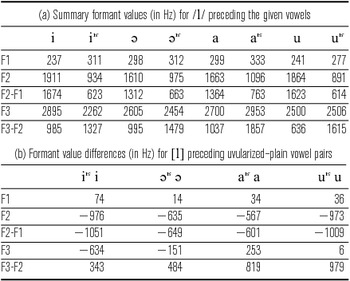
Because the ultrasound video of the uvularized vowels shows a sequence of two tongue gestures (Section 3 below), we investigated whether there was a formant shift during the vowel articulation. The first and last third of the trimmed vowel duration was taken, and the medians of the first three formants of the two vowel portions were compared. The degree and directions of acoustic movement were similar for both uvularized and plain vowels, suggesting that there is no consistent tongue motion toward or away from the uvula during vowel articulation, at least in careful speech for these two speakers. The lack of prominent formant shift during vowel articulation suggested that acoustic correlates of uvularization might be found during articulation of the initial consonant. To investigate this possibility, formant values of the voiced lateral initial consonant [l] were sampled before each of the vowels, using the technique described earlier (Figure 4). Compared to vowel space (Figure 1 above), [l] shows a lower top-end range for F2, and, in Mawo, a very small F1 range. Although both speakers show acoustic retraction (lower F2) for uvularized vowels relative to their plain counterparts, the Mawo speaker shows a more consistent overall acoustic retraction effect. The dimension F2 was chosen over F3-F2, due to better acoustic separation for vowels following [l].
First two formants during initial [l] in (a) Yunlinsi and (b) Mawo.

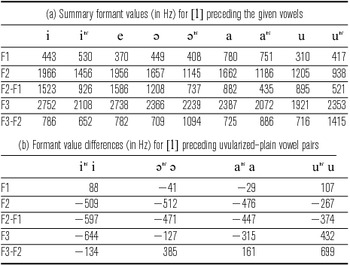
Tables 4 and 5 show F1, F2, F3, and F3-F2 for [l] preceding each of the vowels, along with the formant differences for Yunlinsi and Mawo respectively. Because there are only three /l/-initial samples for each vowel, formal statistical tests were not applied.
Yunlinsi formant values.

Mawo formant values.

For the Yunlinsi speaker, lowering of F2 and shrinking of the difference F2-F1 before a uvularized vowel are the only consistent shifts among the formants of [l]. In this context, F2 is lowered by between –270 and –510 Hz, a shift that is slightly larger than the F2 shift observed on the vowels themselves (see Table 4). An acoustic retraction of this magnitude is consistent with ultrasound imaging that shows that the uvular gesture starts before the vowel is articulated. The differences in the F1 measurements of [l] before high vowels also reflect the shift in F1 frequencies for the high vowels themselves (see Tables 2, 3), further corroborating the hypothesis of anticipatory uvularization.
Although the Mawo speaker's F1 range is much smaller than the Yunlinsi speaker's (Figure 4), consistent shifts were observed in F1, F2, and F3-F2 (Table 5).
Comparing Table 5b with Table 2, it may be noted that the shift in Mawo F2 is larger during the [l] than during the subsequent vowel. This leads to a larger shift in F2-F1 as well, a value which is smaller for uvularized vowels, as expected. The shift in F3-F2 during [l] ranges from about the same size as during the vowel for [iʶ i], [əʶ ə], to much larger for [l] during [aʶ a], [uʶ u]. The lowering of F2 and the raising of F3-F2 are consistent with an anticipatory retraction of the tongue during [l] before uvularized vowels. The large magnitude of F2 differences during initial [l], relative to these differences during vowel articulation, is consistent with the ultrasound images that show formation of the uvularization gesture during articulation of the initial consonant for the Yunlinsi speaker (Section 3).
3 Articulatory characteristics of uvularization
Ultrasound imaging has emerged as a safe noninvasive way to image tongue movements in linguistic research. In this study, ultrasound videography, time-aligned with the acoustic channel, shows movement toward the uvula for uvularized vowels (ultrasound videos are included in the supplementary materials).
3.1 Method
3.1.1 Participant
The male native speaker of Yunlinsi Qiang mentioned above was recruited for the ultrasound session. The consultant had normal speech and hearing, albeit with slight hoarseness. The collection session was accomplished in the Institute of Linguistics, Academia Sinica. Human research ethics approval for this study was obtained before ultrasound data collection commenced (#AS-IRB02–101031), and the speaker willingly consented to participate in the data collection.
3.1.2 Apparatus
An Aloka SSD-5000 ultrasound machine was used to collect tongue images with a UST-9118 endo-vaginal 180° electronic curved array probe under the consultant's chin. The transducer was stabilized on a fixed arm in order to minimize transducer movement. The ultrasound machine was connected to a Canopus ADVC-110 advanced digital video recorder. The images of the tongue surface were collected using simultaneous B-mode ultrasound aligned with the acoustic signal. The images of the midsagittal plane were captured at 30 frames per second. A high fidelity microphone was mounted on a microphone stand and placed in front of the consultant's mouth at a distance of approximately 30 cm. The microphone was plugged into a USB pre-amplifier and output to the Canopus card so that the ultrasound images and the audio are time-aligned. Speech output was sampled at 44.1 kHz.
3.1.3 Materials
Three Yunlinsi wordlists were created with target words filling out a matrix of CV combinations. The consonant for the target word was one of [b/p s l], matched with either a plain vowel (hereafter CV) or a uvularized vowel (hereafter CVR). All plain–uvularized pairs were investigated. The vowels under investigation include [i iʶ ə əʶ a aʶ u uʶ]; forms uttered are found in Appendix A (Tables A1 and A2).
3.1.4 Procedure
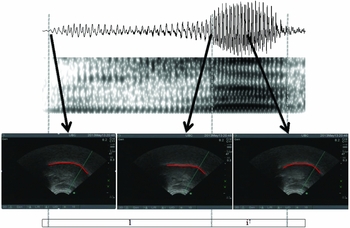
The consultant was asked to sit still with no head movements throughout the recording. The first author watched the angle and the position of the transducer during the recording session. Prior to data collection, the consultant produced a few tokens of [q aʶ] ‘I’, allowing the third author to locate the uvular contact with a fixed line on the ultrasound image. The line is preserved in Figure 5. Re-calibration was conducted before recording each wordlist.
Ultrasound images grabbed at three different instances in the example of [l iʶ]: the onset of the consonant (the leftmost), the onset of the vowel (the center), and the midpoint of the vowel (the rightmost). A green cursor line slanting upward toward the right identifies the direction of the uvular place of articulation. Tongue surface was automatically indicated by EdgeTrak (red curves). The tongue tip is on the left side of the image and the tongue root is on the right.

The second author interacted with the consultant during the data collection. The experimenter pronounced a target word in Mandarin Chinese and the consultant was probed to give the Qiang equivalent. Each target word was repeated three times by the consultant.
The ultrasound images were recorded as video clips by the third author. Simultaneously, participants’ acoustic production was recorded concurrently with ultrasound images. Syllable boundaries and segments of the consonants and vowels were first labeled using Praat, and then loaded and aligned with videos using ELAN. Based on inspection of the audio and video files, images at three time points were grabbed from the videos: (i) the onset of the initial consonant, (ii) the onset of the vowel, and (iii) the center of the vowel (see Figure 5).
Grabbed images were imported to EdgeTrak (Li, Kambhamettu & Stone Reference Li, Kambhamettu and Stone2005) for tongue surface tracing. The coordinates of each image were spatially aligned. The tongue surface was automatically traced with the optimal fit (red curves in Figure 5). The coordinates of the tracing were logged for future figures.
3.2 Results
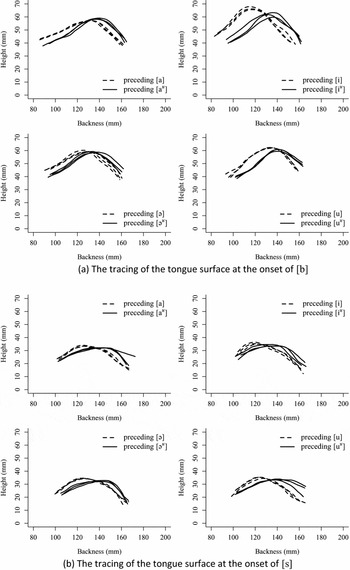
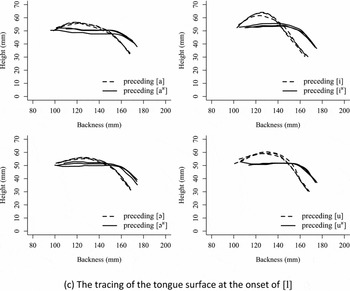
Figure 6 plots the tongue surface tracing across the three word lists. Figures 6a, b, and c show the tongue position at the onset of [b], [s], and [l], respectively. As shown in the figure, the tongue posture is more retracted for the consonants preceding a uvularized vowel (i.e. solid lines in Figure 6) than when preceding a plain vowel (i.e. dashed lines in Figure 6). At the onset of [b], since no specific tongue posture is required, the tongue is anticipatorily prepared for the posture of the following vowel. In Figure 6a, it is observed that the tongue posture at the onset of CV corresponds to the vowel position of the following vowel (e.g. high-front position for [b] in [b i]). In a CVR context, the tongue height is relatively unchanged, but the tongue is overall retracted. Similarly, anticipatory articulation was observed for [s] and [l] tokens in CV contexts (Figure 6b, c). However, the tongue body at the onset of [l] was flattened when it is followed by a uvularized vowel (i.e. CVR context). When a uvularized vowel is anticipated, the tongue body is retracted and raised towards the uvular area even before the onset of the vowel. Meanwhile, in order to maintain the lateral constriction for the consonant [l], the tongue tip was held in contact with the alveolar ridge, consequently the upper tongue surface appears flat.
The tracing of the tongue surface at the onset of the consonant. Tongue postures of consonants preceding a plain vowel (CV context) are dashed lines whereas tongue postures of consonants preceding a uvularized vowel (CVR context) are outlined as solid lines. The x-axis marks the distance (in millimeters) from the tongue tip to the tongue root (i.e. the backness of the tongue), with the tongue tip on the left. The y-axis labels the height of the tongue in millimeters.


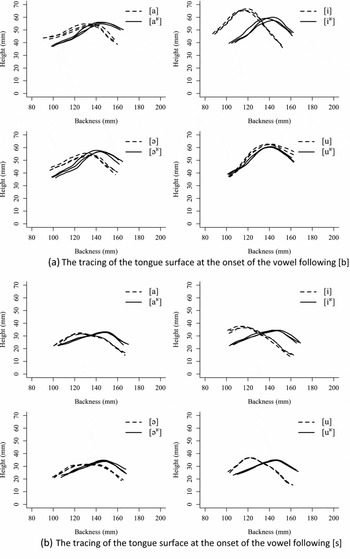
The tongue postures at the onset of the vowel were also traced using EdgeTrak. As predicted, the tongue in CVR contexts is retracted and raised towards the uvular area (see Figure 7). Such retraction movements are observed at the onset of the vowel. The retraction is a high and back movement of the tongue when it is preceded by [b] (Figure 7a) or [s] (Figure 7b) whereas the retraction only involves a backward movement of the tongue when it is preceded by lateral consonant [l] (Figure 7c).
The tracing of the tongue surface at the onset of the vowel. The tongue postures of plain vowels are dashed lines (CV context) whereas the tongue postures of uvularized vowels (CVR context) are outlined as solid lines. The x-axis ticks the distance (in millimeters) from the tongue tip to the tongue root (i.e. the backness of the tongue), with the tongue tip on the left. The y-axis labels the height of the tongue in millimeters.


These motions contrast with the directions of tongue movement seen in retracted tongue root (RTR), which is a constriction of the lower pharynx. Gick (Reference Gick2002) shows that in Kinande and Nuu-chah-nulth, RTR vowels have a tongue body that is lower or flatter than the corresponding non-RTR vowels. The highest point of the tongue has about the same degree of backness in both RTR and non RTR vowels. In addition, in RTR vowels, the back of the tongue indicates retraction via a flatter slope upward from the back of the tongue toward the highest place of the tongue body. However, in uvularized Qiang vowels, there is a tendency for the highest point of the vowel to shift toward the back of the mouth, relative to the highest point of plain vowels. In Figure 7 this tendency is most clear following [s b]. Given the flatter shape of uvularized vowels following [l], it is possible that articulation of uvularized vowels in this context does involve some pharyngealization.
It is noted that the tongue is not retracted further for [p uʶ] than for [b u] (Figure 7a). The exact reasons for this await further experimentation. However, we note that articulation of bilabial stops involves total closure of the mouth, which may allow less tolerance for tongue dorsum positioning than during articulations with less closure (e.g. coronal). If that is the case, then during preparation for articulating [u] during bilabial closure, the tongue dorsum might press against the velum area, limiting space for further retraction or raising under conditions of uvularization.
Thus, when following labials, the tongue posture at the onset of the vowel is therefore expected to be the posture of the vowel at its maximum constriction. When the vowel [u] is raised and retracted toward the back of the mouth, there remains limited space for the tongue to move any higher or further back. An alternative retraction would have been a downward retraction (i.e. pharyngealization). When the target word was probed, the production of the vowel shows a high, back retraction, rather than a low, back retraction. This therefore disfavors the proposal of pharyngealization as the main secondary articulation. Similar robust high-back retractions were also observed for uvularized vowels following alveolar fricative [s] (Figure 7b).
Figure 7c shows the tongue posture at the onset of the vowel following the lateral [l]. Similarly to the tongue posture at the onset of the consonant, the tongue remains in a flat posture in CVR contexts. The tongue position is further back than its counterpart in CV contexts (see solid lines in Figure 7c). The fact that there was no obvious upward movement for the uvularized vowel may be due to a coarticulatory effect between the preceding consonant [l] and the uvularized vowel. Comparing Figures 6c and 7c, it has been observed that the tongue postures at the onset of the consonant and the onset of the uvularized vowel were comparable, suggesting that the lateral constriction of [l] may dominate the overall tongue posture and forces the tongue to maintain a certain height. When a retraction occurs, the tongue is moved backward and only limited tongue raising was observed.
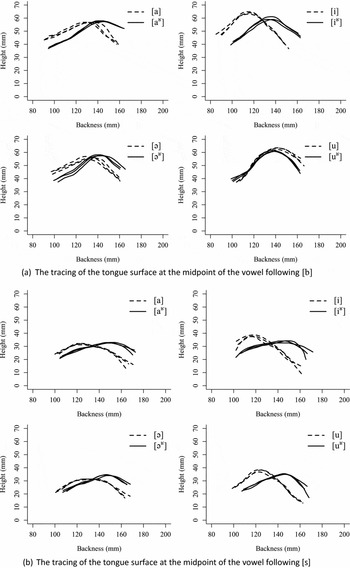
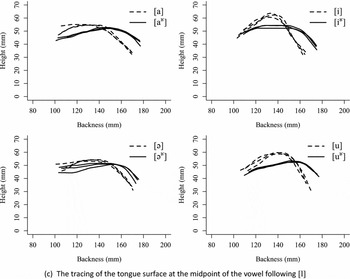
Tracing of the tongue surface grabbed at the midpoint of the vowel is illustrated in Appendix C (Figure C1). This figure shows that the upward retraction that marks uvularization continues from the onset to the midpoint of the vowel; thus the tongue surface images in Figures 7 and C1 are similar.
For all images of [a aʶ], the tongue appears to be at a fairly high position, as opposed to the traditionally defined low position. There are two probable reasons for this. The first is that we did not control for opening of the jaw, such that at a constant distance from the probe, there could be a range of distances between the tongue surface and the roof of the mouth. Expansion of the oral cavity to produce the acoustic properties of [a aʶ] was complemented by jaw lowering and (possibly) the raising of the maxilla. Thus, while we believe that the tongue shape and front-back positioning are accurate, the surface of the tongue during [a aʶ] was probably lower than it appears to be in the images.
Second, obtaining clear sagittal images requires pressing the ultrasound transducer firmly into the soft tissue behind the chin. It may be that this position pressed firmly on the tongue and consequently limited the lowering of the tongue body during the production of [a aʶ].
4 Phonological properties of plain and uvularized vowels
Vowel uvularization plays an important role in Northwestern Qiang phonology. In particular, uvularized vowels are typically restricted in their occurrence after velar consonants, while plain vowels tend not to occur after uvular consonants. The two sets of vowels contrast in other environments, as seen in Table 1 above. Vowels distinguished by the feature [±uvularized] can be acoustically distant from one another; vowel harmony patterns aid in the identification of plain–uvularized pairs. Finally, the phonological properties of uvularization help to demonstrate that it is primarily a property of vowels, rather than of consonants or syllables. Phonotactics, vowel harmony, and the suprasegmental status of uvularization are covered in the present discussion.
4.1 Phonotactics of uvularized vs. plain vowels
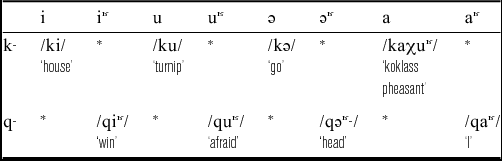
Mawo consonant–vowel phonotactics demonstrate the division of vowels into two equal classes. The plain class of vowels does not occur with uvular initials, while the uvularized class does not occur with velar initials (Table 6).
Phonotactics of plain and uvularized vowels (Mawo).

The observation holds for all velar/uvular simple (non-cluster) initials in Mawo. One possible interpretation of the data in Table 6 is that the velar and uvular consonants are not phonemically distinct. However, velar and uvular initials do contrast in cluster onsets before plain vowels, although (near-)minimal pairs like the following are rare:
-
(1)


For a few clusters, both plain and uvularized vowels can follow a uvular initial, further verifying the phonemic status of uvular consonants and the plain–uvularized vowel distinction:
-
(2)

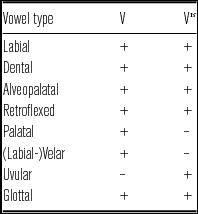
The overall distribution of plain versus uvularized vowels in Mawo is as presented in Table 7 (Yunlinsi monosyllabic alveopalatal–uvularized combinations are rare).
Distribution of plain and uvularized vowels in Mawo.

Yunlinsi CV patterns are very similar to those in Table 7, differing only in having weaker constraints on velar and uvular initials. Although Yunlinsi distribution patterns are more nuanced than those of Mawo, they still suggest a distinguishing feature of uvularization. The phonotactic properties of initial velar and uvular consonants and clusters are summarized in Tables 8, 9, and 10. Yunlinsi's ninth vowel, /e/, is not phonotactically restricted, being the only vowel that occurs with each velar and uvular simple initial. For the purpose of clarity, /e/ is left out of these three tables.
Phonotactics of plain velar and uvular initials in Yunlinsi.

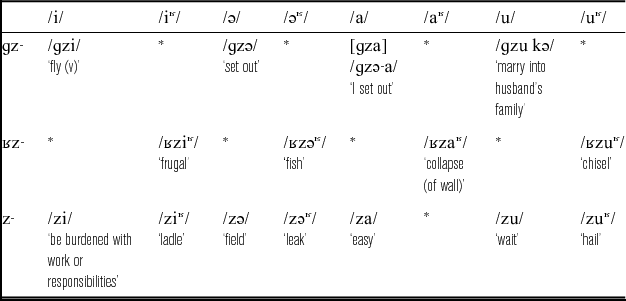
Phonotactics of Yunlinsi /ɡz- ʁz- z-/.

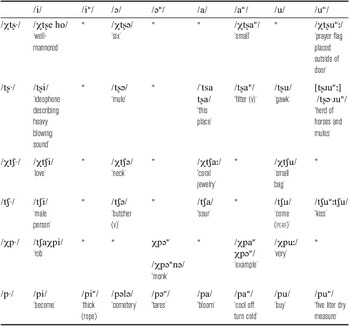
Distribution of Yunlinsi /χtʂ- χtʃ- χp-/ versus simple /tʂ- tʃ- p-/.

Table 8 shows that simple (non-cluster) uvular initial consonants occur freely with uvularized vowels, but only occur with plain vowels when the content is specialized (onomatopoeia or a grammatical morpheme). No one vowel occurs with all of the velar and uvular initials, with the strongest restriction on /iʶ əʶ/, which only occur with uvular initials. Velar initial consonant /x-/ only occurs with plain vowels, although /k- kʰ- ɡ-/ are less restricted.
The phonotactics between cluster initials and vowels is slightly more complex. For those syllables with an initial consonant cluster in which C1 is velar or uvular, and C2 is not an oral stop or affricate, the nucleus agrees in uvularity with C1. Table 9 shows that vowels following /ɡz- ʁz-/ agree in uvularity with the initial consonant, while simple /z-/ co-occurs with both plain and uvularized vowels.
For syllables with an initial cluster in which C1 is uvular and C2 is an oral stop or affricate, both plain and uvularized vowels can occur in the nucleus (Table 10). That is, these clusters occur with a subset of the vowels that occur with only C2.
The phonotactic properties of vowels with velar and uvular consonant initials reveal that the vowels form two sets: one set (uvularized vowels) is more compatible with uvular onsets than with velar onsets, while the opposite is true for the other set (plain vowels). Competing analyses for this distinguishing feature (e.g. velarization, pharyngealization) would be challenged to account for the occurrence of one set of vowels with uvular initials and the other set with velar initials.
4.2 Vowel harmony
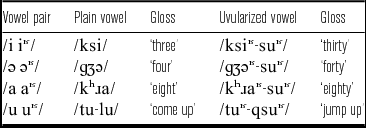
Evidence from vowel harmony reveals that uvularized vowels are united by a feature that can migrate across syllable boundaries, assimilating vowels in neighboring syllables. Vowel harmony also provides the evidence required to associate plain and uvularized vowels in pairs. This step is a necessary part of the analysis, because members of plain–uvularized vowel pairs can be acoustically divergent, as shown in Figures 1 and 2 above. Likewise, vowels that are acoustically similar, such as /ə iʶ/, often belong to different plain–uvularized pairs. In these two varieties, usually uvularization harmonizes leftward, as seen in Table 11.
Yunlinsi plain–uvularized vowel pairs in harmony.

In this study we have analyzed uvularization in Northwestern Qiang as a vowel property. Two alternate proposals are that uvularization is a consonantal feature, like most analyses of Arabic emphatics, or that it is specified at the syllabic or morphemic level, like analyses of tone in many languages. There are two main reasons why we did not posit uvularization as a consonantal feature. First, this analysis would nearly double the number of distinctive consonants in the inventory. For example, in the case of Yunlinsi, 63 consonant phonemes would be required to account for the contrasts, instead of the current 35. Furthermore, a system of consonantal harmony would need to be proposed, in which uvularization would be the only feature that harmonized. This consonantal harmony system would function alongside a vowel harmony system which spreads height, roundness, etc. onto prefix vowels.
We do not propose uvularity as a syllable- or morpheme-based feature, because such an analysis would not account for the fact that uvularized vowels do in some cases occur with velar initials, e.g. Yunlinsi /k a/ ‘pulse’, /k aʶχo/ ‘koklass pheasant’. Likewise, under vowel harmony conditions, vowels can uvularize, but velar consonants do not become uvular, e.g. /k s i/ ‘three’, [k s iʶ-s uʶ] ‘thirty’ (Yunlinsi). Although examples are less numerous in Mawo, uvularized and plain vowels can contrast after a uvular-initial consonant cluster, e.g. /χl i/ ‘fall through opening’, /χl iʶ/ ‘shady side of mountain’.
5 Summary
Heishui County Qiang vowels occur in plain–uvularized pairs, e.g. Mawo /s i/ ‘firewood’, /s iʶ/ ‘rhubarb’. Ultrasound imaging shows that the highest point of the tongue is retracted during a uvularized vowel, relative to the corresponding plain vowel. Imaging data also show that the target of this gesture is the uvular region. These vowels show less lowering of the tongue body and dorsum relative to pharyngealized vowels in other languages. Shahin (Reference Shahin, van Oostendorp, Ewen, Hume and Rice2011: 618) claims that uvularization is always accompanied by some upper pharyngeal approximation. The portion of the tongue that is visible in mid-sagittal ultrasound imaging does not include the most posterior portions of the tongue. Hence, it is impossible to rule out accompanying pharyngeal approximation. Although uvularization is phonologically integrated into the vowels, uvular approximation can begin at the onset of the initial consonant.
Acoustic measurements differ systematically between plain and uvularized vowels. The latter tend to have lower values for F2 and higher values for F3-F2, both of which are indicators of acoustic backness. Uvularized vowels also tend to have higher F1 than their plain counterparts. Although the uvularized vowel does not always display higher F1 than its corresponding plain vowel, the difference F2-F1 is consistently smaller for uvularized than plain vowels; that is, the first two formants are closer together.
Acoustic and articulatory effects of Qiang vowel uvularization differ from similar phenomena that have been documented elsewhere. Nuu-chah-nulth and Kinande RTR involve retraction and lowering; however, there is no evidence for a consistent tongue lowering effect in Qiang vowel uvularization. In the fellow Sino-Tibetan languages Yi and Bai, RTR causes tense voice, whereas there is no obvious phonation difference between Qiang plain and uvularized vowels. In Ju|hoan, uvularization involves contact of the tongue dorsum followed by a fricated release of the consonant, with noise of uvular frication. However, Qiang uvularization comprises approximation of the articulators, rather than occlusion leading to frication. There may be some similarity between Qiang uvularization and emphasis in Jordanian and Palestinian Arabic, as well as tongue root phenomena in St’át’imcets. However, for Arabic and St’át’imcets, uvularization is conditioned by consonants rather than by vowels.
The nearest linguistic relatives to the Qiang languages are the Rgyalrongic languages that lie to the west of the Qiang-speaking area. In each of the three branches of the Rgyalrongic branch, a contrast between plain and ‘velarized’ vowels has been attested (J. Sun Reference Sun2000, Reference Sun, Lin, Hsu, Lee, Sun, Yang and Ho2004, Reference Sun2005; Lin, J. Sun & Chen Reference Lin, Sun and Chen2012). In Rgyalrongic the proposed tentative label ‘velarization’ was motivated by auditory analysis, and by the kinesthetic impression of the position of the tongue in articulating the marked vowels in question. Furthermore, in Puxi Horpa, lowered F2 has been identified as a consistent acoustic correlate (Lin et al. Reference Lin, Sun and Chen2012). A projected follow-up articulation imaging study will hopefully ascertain whether the Rgyalrongic marked vowels also turn out to involve uvularization rather than velarization, as the question cannot be decisively settled with acoustic analysis alone.
Phonological properties of uvularization include vowel harmony, which aids in the identification of plain/uvularized vowel pairs. Moreover, plain vowels in preceding syllables may assimilate this articulatory feature and turn into their uvularized counterparts. Phonotactic constraints argue for uvularization as an integral property of vowels in this language, given that uvularized vowels do not freely occur with velar initial consonants (e.g. Yunlinsi /xə/ ‘exert effort’, */xəʶ/). Likewise, uvular initials do not freely occur with plain vowels (e.g. Yunlinsi /χəʶ/ ‘full of food’, */χə/).
To aid in the discussion of uvularized sounds across the world's languages, we propose that uvular approximation be marked with /ʶ/, much as in the Voice Quality System (VoQS) of Ball et al. (Reference Ball, Esling and Dickson1995). Secondary uvular frication could be marked with /χ/, as in Miller-Ockhuizen (Reference Miller-Ockhuizen2003) and Miller (Reference Miller2007). Specifying uvularization as a secondary articulation is also important for dialectal comparisons of Arabic, as some dialects (e.g. Jordanian & Palestinian) utilize uvularization in the pronunciation of ‘emphatic’ consonants, while other dialects favor pharyngealization or velarization as the distinguishing articulatory feature.
Acknowledgements
The authors wish to thank audiences at the 45th International Conference on Sino-Tibetan Languages and Linguistics, the University of Michigan (Ann Arbor) Department of Linguistics, and the Institute of Linguistics, Academia Sinica (Taipei). We also would like to acknowledge three anonymous reviewers, Ministry of Science and Technology (Grant #97-2410-H-001-067-MY3), the University of British Columbia (loan of ultrasound equipment), and Ewa Jaworska and Grant Kao (manuscript preparation). A pilot ultrasound study was performed with the generous assistance of Dr. Yuh-Chyun Eugene Chiang and Dr. Ching-Zong Wu at the College of Oral Medicine, Taipei Medical University. Any remaining errors are the authors’.
Appendix A. Forms elicited for acoustic and articulatory analyses
The values presented in Table A1 were used in the acoustic analysis for this paper. The median formant values of each of three utterances were averaged to produce the summary statistics. Forms containing initial /s l/ were also pronounced for the ultrasound imaging.
Coronal CV forms and formant values.

The Yunlinsi forms in Table A2, not listed above, were also used in the ultrasound imaging. Note that /b e/ is not included in the analysis, but is given here for the sake of completeness.
Yunlinsi labial-initial forms uttered for ultrasound imaging.

Appendix B. Distinctive consonant phonemes and clusters
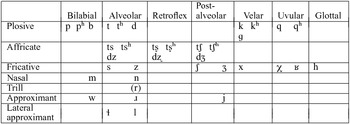
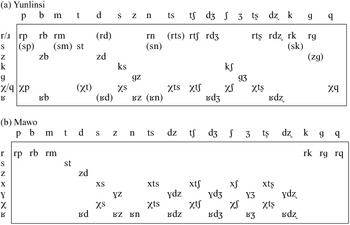
Yunlinsi and Mawo simple consonant phonemes are presented in Table B1. Yunlinsi and Mawo initial consonant clusters that do not include a glide component are presented in Table B2.
In these tables, marginal phonemes and those attested only in loanwords are put in parentheses. The sound [r] occurs initially in words borrowed from Tibetan (/rəkə/ ‘mystic wisdom’ (both dialects)), and as an invervocalic variant of the phoneme /dʐ/: [aʶr uʶ] < /a-dʐuʶ/ ‘one bundle of (grain, firewood, etc.)’. However, as seen in the tables, both dialects have initial consonant clusters that begin with [r].
Yunlinsi and Mawo consonant phonemes.

Initial consonant clusters without glides.

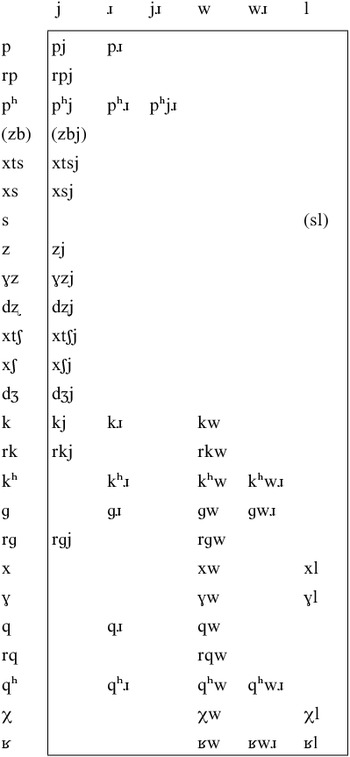
Yunlinsi and Mawo also have clusters with glides /j w ɹ/. The inventories are similar; to avoid redundancy, in Table B3, we give the Mawo inventory.
Mawo consonant clusters with glides /j w ɹ l/.

Appendix C. Ultrasound tracings of tongue surface at vowel midpoint
The tracing of the tongue surface at the midpoint of the vowel. The tongue postures of plain vowels are shown as dashed lines (CV context) whereas the tongue postures of uvularized vowels (CVR context) are outlined in solid lines. The x-axis ticks the distance (in millimeters) from the tongue tip to the tongue root (i.e. the backness of the tongue), with the tongue tip on the left. The y-axis labels the height of the tongue in millimeters.