Introduction
Substantial variability exists in childhood dual language learning (DLL) with children showing varying trajectories when acquiring multiple languages (Birdsong, Reference Birdsong2018; Butler, Reference Butler and Bhatia2013; Hammer et al., Reference Hammer, Hoff, Uchikoshi, Gillanders, Castro and Sandilos2014). Emphasis has previously been placed on the age of acquisition as the central factor in explaining variability in success of bilingual development (Muñoz & Singleton, Reference Muñoz and Singleton2011). However, although an early age of exposure to a second language seems to be beneficial for its attainment, it represents a simplistic view of the complex factors at play and hence it is not surprising that it does not guarantee favorable developmental trajectories and maintenance of language skills (Hyltenstam & Abrahamsson, Reference Hyltenstam and Abrahamsson2000; Montrul, Reference Montrul2008; Paradis, Tulpar & Arppe, Reference Paradis, Tulpar and Arppe2016; Unsworth, Reference Unsworth2016a).
Indeed, considering the large number of children growing up with more than one language, it is pivotal to know which factors contribute to childhood DLL, particularly given the major role that proficiency plays in the majority language of a given society in later school success and academic achievement (Ardasheva, Tretter & Kinny, Reference Ardasheva, Tretter and Kinny2012; Cunningham & Stanovich, Reference Cunningham and Stanovich1997; Sénéchal, Ouellette & Rodney, Reference Sénéchal, Ouellette, Rodney, Dickinson and Neuman2006). Understanding of these factors is, however, only beginning to emerge, with debate centering on child-internal cognitive and child-external environmental factors, in particular phonological short-term memory (PSTM) as an internal and the languages spoken at home as an external factor (Paradis, Reference Paradis2011; Paradis & Jia, Reference Paradis and Jia2016; Parra, Hoff & Core, Reference Parra, Hoff and Core2011; Sun, Yin, Amsah & O'Brien, Reference Sun, Yin, Amsah and O'Brien2017). More concurrent and longitudinal work is called for investigating how internal and external factors relate to different language outcomes. The purpose of the current study is to investigate how language experience and PSTM are related to key majority language skills – namely, vocabulary and phonological awareness – in DLL both concurrently and longitudinally.
The role of vocabulary and phonological awareness in language learning and academic achievement
Essential components of language are phonemes, morphemes, and lexemes, which in language are arranged systematically according to rules (i.e., syntax), and embedded in a certain context (i.e., pragmatics) (Moats, Reference Moats2003). Because of the pragmatic ease of operationalizing vocabulary and phonological development, and their significance in language acquisition and initial academic achievement (National Reading Panel, 2000), the current study focuses on these skills. For instance, vocabulary plays a central role in both native language development and second and foreign language learning – children have to acquire words in order to attain further knowledge about them and to embed them in meaningful utterances and sentences (Nation & Cocksey, Reference Nation and Cocksey2009). As a result, both receptive and expressive vocabulary are important bedrocks of language, being powerful predictors of later reading and academic success, underscoring their importance in children's language acquisition (Cromley & Azevedo, Reference Cromley and Azevedo2007; Roth, Speece & Cooper Reference Roth, Speece and Cooper2002; Sénéchal et al., Reference Sénéchal, Ouellette, Rodney, Dickinson and Neuman2006; Suggate, Reese, Lenhard & Schneider, Reference Suggate, Reese, Lenhard and Schneider2014).
Phonological awareness is one aspect of phonology and specifies a phonological processing ability that refers to the ability to identify, discriminate, and manipulate sounds in oral language (Anthony & Francis, Reference Anthony and Francis2005). It can be characterized as a metalinguistic phonological skill (Bialystok, Reference Bialystok and Bhatia2013) and is a significant component of children's language development during preschool years. Phonological awareness is also strongly connected to literacy development (National Reading Panel, 2000; Storch & Whitehurst, Reference Storch and Whitehurst2002).
Dual language learning (DLL)
Turning to DLL, a wealth of terms and definitions are used to describe multilingual language development, such as bilingual, heritage speaker, second language learner (Hammer et al., Reference Hammer, Hoff, Uchikoshi, Gillanders, Castro and Sandilos2014). Furthermore, the question of who is considered bilingual and who is not is still debated controversially (Baker, Reference Baker2011; Butler, Reference Butler and Bhatia2013). This lack of consensus in definitions presents a challenge in research on bilingualism. It is important to note that DLL is not a categorical variable but rather a multifaceted phenomenon that can be described according to different facets (e.g., proficiency, sequence of acquisition, sociocultural aspects) (Butler, Reference Butler and Bhatia2013). Thus, every definition is essentially an over-simplification of the phenomenon and detailed descriptions of the sample at hand are needed (De Houwer, Reference De Houwer, Miller, Bayram, Rothman and Serratrice2018).
In Germany, immigrants from a variety of countries constitute the majority of bilinguals (Federal Bureau of Statistics, 2018a). Accordingly, bilingual children in Germany have vastly different language backgrounds, with different language biographies, and speaking a multitude of different languages. To account for this broad range of multilingual situations, we use the definition that DLL refers to children who are repeatedly and systematically exposed to more than one language before school entry (Barac, Bialystok, Castro & Sanchez, Reference Barac, Bialystok, Castro and Sanchez2014; Hammer et al., Reference Hammer, Hoff, Uchikoshi, Gillanders, Castro and Sandilos2014). In contrast to foreign language learning, the children are learning an additional language in a naturalistic setting rather than through direct instruction.
Recent years have seen a rising interest in how child-internal (e.g., phonological memory) and child-external factors (e.g., language exposure) compare in strength of association with language outcomes in DLL (Paradis, Reference Paradis2011; Paradis et al., Reference Paradis, Tulpar and Arppe2016; Paradis & Jia, Reference Paradis and Jia2016; Sun et al., Reference Sun, Yin, Amsah and O'Brien2017). Previous findings differ on the relative contribution of internal and external factors to dual language development. Paradis (Reference Paradis2011) found that internal factors explained more variance in children's L2 outcomes than external factors. Sun and colleagues (Reference Sun, Yin, Amsah and O'Brien2017) found a similar pattern for English in Singaporean children, whereas external factors explained more variance in ethnic language knowledge. In a longitudinal design following a subsample of the children from Paradis’ 2011 study (Paradis & Jia, Reference Paradis and Jia2016), internal factors did not appear in the final models at all. More research, particularly with longitudinal designs, is needed on child-internal and child-external factors in order to understand how they relate to each other in explaining different language domains in DLL.
The role of language experience in DLL
Research has recently focused on the great variability of both monolingual and multilingual language experiences and how these experiences shape language development. In monolingual development, language environments show large variance on a number of dimensions, including literacy activities in the home (Burgess, Hecht & Lonigan, Reference Burgess, Hecht and Lonigan2002; Sénéchal & LeFevre, Reference Sénéchal and LeFevre2002), the number of words heard daily (Hart & Risley, Reference Hart and Risley1995), and the quality of speech children are exposed to (Hoff, Reference Hoff2003; Huttenlocher, Waterfall, Vasilyeva, Vevea & Hedges, Reference Huttenlocher, Waterfall, Vasilyeva, Vevea and Hedges2010). In bi- or multilingual environments, this variability may be greater still (Unsworth, Reference Unsworth, Nicoladis and Montanari2016b) – for example, in the sequence as well as the frequency children are exposed to languages, the number of communication partners in these languages, and the linguistic proximity of their languages to one another (De Houwer, Reference De Houwer and Li2011, Reference De Houwer, Miller, Bayram, Rothman and Serratrice2018; Gathercole, Reference Gathercole, Nicoladis and Montanari2016; Hammer et al., Reference Hammer, Hoff, Uchikoshi, Gillanders, Castro and Sandilos2014; Paradis & Grüter, Reference Paradis, Grüter, Grüter and Paradis2014).
Language exposure and language development
In terms of the relationship between language experience and language development, ‘the more the better’ has been found to apply. Specifically, the more children are exposed to and use their multiple languages, the better they learn these (De Houwer, Reference De Houwer and Li2011; Hammer et al., Reference Hammer, Hoff, Uchikoshi, Gillanders, Castro and Sandilos2014; Hoff, Core, Place, Rumiche, Senor & Parra, Reference Hoff, Core, Place, Rumiche, Senor and Parra2012). In DLL, this is the case for both current exposure and the length of exposure, meaning that the more children are currently exposed to their respective languages (Pearson, Fernandez, Lewedeg & Oller, Reference Pearson, Fernandez, Lewedeg and Oller1997; Place & Hoff, Reference Place and Hoff2011; Unsworth, Reference Unsworth2013, Reference Unsworth2016a), and the longer they have been exposed to them (Paradis, Reference Paradis2011; Roesch & Chondrogianni, Reference Roesch and Chondrogianni2016; Unsworth, Reference Unsworth2013), the higher the chance that their languages develop well.
Current language exposure
Turning specifically to language domains, research has shown vocabulary size to be susceptible to exposure effects during infancy (Cattani et al., Reference Cattani, Abbot-Smith, Farag, Krott, Arreckx, Dennis and Floccia2014; Hammer et al., Reference Hammer, Hoff, Uchikoshi, Gillanders, Castro and Sandilos2014; Marchman, Martínez, Hurtado, Grüter & Fernald, Reference Marchman, Martínez, Hurtado, Grüter and Fernald2017; Pearson et al., Reference Pearson, Fernandez, Lewedeg and Oller1997; Thordardottir, Reference Thordardottir2011). Some studies have shown that DLL children's vocabularies are proportionate to the current relative exposure in their two languages (Hoff et al., Reference Hoff, Core, Place, Rumiche, Senor and Parra2012; Pearson et al., Reference Pearson, Fernandez, Lewedeg and Oller1997; Quiroz, Snow & Zhao, Reference Quiroz, Snow and Zhao2010). However, more exposure does not always seem to result in greater proficiency and this relationship is apparently not always direct or linear. First, in some studies, parental use of the majority language did not explain additional variance in children's language skills (Duursma et al., Reference Duursma, Romero-Conteras, Suber, Proctor, Snow, August and Caldéron2007; Golberg, Paradis & Crago, Reference Golberg, Paradis and Crago2008; Gutiérrez-Clellen & Kreiter, Reference Gutiérrez-Clellen and Kreiter2003; Hammer, Davison, Lawrence & Miccio, Reference Hammer, Davison, Lawrence and Miccio2009; Klassert & Gagarina, Reference Klassert and Gagarina2010). In some research, the relationship depends on parental proficiency in the majority language and the amount of exposure received outside of the home (Hammer et al., Reference Hammer, Davison, Lawrence and Miccio2009; Place & Hoff, Reference Place and Hoff2011). Additionally, other studies have shown that DLL are able to reach monolingual norms in receptive vocabulary despite the fact that their language input is divided between two languages – with 50% (Thordardottir, Reference Thordardottir2011) or 60% (Cattani et al., Reference Cattani, Abbot-Smith, Farag, Krott, Arreckx, Dennis and Floccia2014) input in the majority language.
Expressive vocabulary appears to be more susceptible to exposure effects, with DLLs showing a larger gap between receptive and expressive vocabulary skills than their monolingual peers do – some reach monolingual norms in receptive vocabulary but lag behind in expressive vocabulary (Gibson, Oller, Jarmulowicz & Ethington, Reference Gibson, Oller, Jarmulowicz and Ethington2012; Keller, Troesch & Grob, Reference Keller, Troesch and Grob2015; Thordardottir, Reference Thordardottir2011). Moreover, this discrepancy appears to be larger when children have less exposure (Gibson, Peña & Bedore, Reference Gibson, Peña and Bedore2014). In light of these partly contradictory findings – some showing a linear relationship of language exposure and language development, others not – more work is called for to understand the relationship between language experience and both receptive and expressive vocabulary. Moreover, with much previous research concentrating on Spanish-English DLLs, studies in other language groups are needed to investigate the generalizability of effects of exposure in various languages (Hammer et al., Reference Hammer, Hoff, Uchikoshi, Gillanders, Castro and Sandilos2014).
Compared to the development of vocabulary, less is known about how language experience is connected to the development of phonological awareness in DLL (Bialystok, Reference Bialystok and Bhatia2013; Hammer et al., Reference Hammer, Hoff, Uchikoshi, Gillanders, Castro and Sandilos2014). Phonological awareness has been demonstrated to be associated with oral language skills, such as vocabulary, in monolinguals (Cooper, Roth, Speece & Schatschneider, Reference Cooper, Roth, Speece and Schatschneider2002; Dickinson, McCabe, Anastasopoulos, Peisner-Feinberg & Poe, Reference Dickinson, McCabe, Anastasopoulos, Peisner-Feinberg and Poe2003) and in DLL (Anthony et al., Reference Anthony, Solari, Williams, Schoger, Zhang, Branum-Martin and Francis2009; Scarpino, Lawrence, Davison & Hammer, Reference Scarpino, Lawrence, Davison and Hammer2011). The existence of a direct link between language experience and phonological awareness has received little empirical attention. Some studies on monolinguals have shown that children's phonological awareness skills differ depending on the language they have been exposed to (Caravolas & Bruck, Reference Caravolas and Bruck1993; Cheung, Chen, Lai, Wong & Hills, Reference Cheung, Chen, Lai, Wong and Hills2001). Furthermore, Kim (Reference Kim2009) found that Korean–English bilingual children's performance on Korean phonological awareness tasks differed depending on the extent of exposure to English. These findings suggest that specific phonological awareness skills seem to be influenced by characteristics of exposed languages. More research is however needed to understand how quantitative exposure factors that play a role in vocabulary are linked to phonological awareness skills in DLL.
Length of exposure
De Houwer (Reference De Houwer and Li2011) suggested that length of exposure is essential regardless of the domain, particularly for young children. This should not be surprising, considering that for children still early in their language development, a difference of, for instance, one year in length of exposure can be expected to lead to major differences in children's language outcomes. Findings on length of exposure are somewhat mixed. There are findings showing that the length of exposure is a predictor of language outcomes in DLL (Blom & Bosma, Reference Blom and Bosma2016; De Carli, Dessi, Mariani, Girtler, Greco, Rodriguez, Salmon & Morelli, Reference De Carli, Dessi, Mariani, Girtler, Greco, Rodriguez, Salmon and Morelli2015; Kovelman, Baker & Petitto, Reference Kovelman, Baker and Petitto2008; Paradis, Reference Paradis2011). However, length of exposure also interacts with age, and older children show faster rates of language acquisition (Blom & Bosma, Reference Blom and Bosma2016; Golberg et al., Reference Golberg, Paradis and Crago2008; Jia & Fuse, Reference Jia and Fuse2007; Muñoz & Singleton, Reference Muñoz and Singleton2011), which could potentially mitigate positive effects of length of exposure. Unsworth (Reference Unsworth2016a), for example, found that only current exposure, not length of exposure, explained outcomes in L2 verb morphology, verb placement, and vocabulary. In Unsworth (Reference Unsworth2013), both current and cumulative exposure were associated with the acquisition of grammatical gender. Considering these differing findings, more work is needed to better understand how length of exposure plays a role in different language outcomes at different stages of development.
PSTM as a predictor of language development
In the search for predictors of early DLL, in addition to factors in the environment, research has turned to child-internal factors. In foreign-language learning, there is a substantial body of research on internal predictors of its success, often termed language aptitude. Aptitude is a relatively stable, inherent language learning ability thought to consist of different components ranging from associative memory to verbal memory skills (Li, Reference Li2015). In early childhood dual language development, such child-internal predictors have been given less attention (Paradis, Reference Paradis2011). A child-internal factor that has been found to be associated with both monolingual and dual language development is the phonological short-term memory (PSTM). According to Baddeley (Reference Baddeley2003), the phonological loop manipulates and stores phonological information and is thought to play a central role in learning the phonological structure of a language. PSTM is typically operationalized with a digit span task or a nonword repetition task (NWR), where children are asked to repeat nonwords. Thus, in NWR tasks, much like when learning new words, the participant has to create an acoustic representation of an unfamiliar sequence of sounds (Coady & Evans, Reference Coady and Evans2008), whereas in digit span tasks the items are familiar. Although both tasks can be expected to tap phonological working memory capacity, NWR tasks mirror new-word learning more closely than digit span.
PSTM has indeed been shown to predict vocabulary development in DLL both concurrently and longitudinally (Engel de Abreu, Gathercole & Martin, Reference Engel de Abreu, Gathercole and Martin2011; Farnia & Geva, Reference Farnia and Geva2011; Nicolay & Poncelet, Reference Nicolay and Poncelet2013; Parra et al., Reference Parra, Hoff and Core2011). In DLL, PSTM appears to primarily play a role in the beginning of learning a language and its contribution decreases in later stages (Baddeley, Reference Baddeley2003). PSTM has been shown to be closely linked to phonological awareness (Alloway, Gathercole, Willis & Adams, Reference Alloway, Gathercole, Willis and Adams2004; Knoop-van Campen, Segers & Verhoeven, Reference Knoop-van Campen, Segers and Verhoeven2018; Michalczyk, Krajewski, Preβler & Hasselhorn, Reference Michalczyk, Krajewski, Preβler and Hasselhorn2013), with some research even suggesting a single underlying phonological processing construct (Dufva, Niemi & Voeten, Reference Dufva, Niemi and Voeten2001; Wagner, Torgesen, Laughon, Simmons & Rashotte, Reference Wagner, Torgesen, Laughon, Simmons and Rashotte1993, cf. Alloway et al., Reference Alloway, Gathercole, Willis and Adams2004; Engel de Abreu & Gathercole, Reference Engel de Abreu and Gathercole2012). PSTM and phonological awareness have also been shown to be correlated in DLL (Bialystok, Majumder & Martin, Reference Bialystok, Majumder and Martin2003; Gorman, Reference Gorman2012); there is, however, a paucity in research on the contribution of PSTM to the development of phonological awareness in DLL.
Nonword repetition tasks have mostly been language-specific measures, whereby the nonwords follow the phonotactics of a certain language (e.g., “English-like” stimuli). An issue with these kinds of tasks is that performance on them is confounded with experience in the respective language because the listener is more practiced in discriminating and producing phonemes in that language (Chiat, Reference Chiat, Armon-Lotem, de Jong and Meir2015; Coady & Evans, Reference Coady and Evans2008; Farnia & Geva, Reference Farnia and Geva2011). Some studies report correlations between performance on NWR and the cumulative (Summers, Bohman, Gillam, Peña & Bedore, Reference Summers, Bohman, Gillam, Peña and Bedore2010) or relative exposure (Parra et al., Reference Parra, Hoff and Core2011) to the respective languages. Language-specific tasks could therefore potentially overestimate the relationship between PSTM and language outcomes. Thus, NWR tasks not built on the phonotactics of the target language should be less confounded by previous experience and represent cleaner measures of phonological short-term memory. Applying language-universal NWR tasks could therefore be informative to investigate the individual contribution of PSTM and language experience to vocabulary and phonological awareness.
Current study
Previous studies have identified relative language experience and phonological short-term memory to be linked to vocabulary development in DLL (Farnia & Geva, Reference Farnia and Geva2011; Hammer et al., Reference Hammer, Hoff, Uchikoshi, Gillanders, Castro and Sandilos2014; Paradis, Reference Paradis2011; Paradis & Jia, Reference Paradis and Jia2016; Sun et al., Reference Sun, Yin, Amsah and O'Brien2017). However, little is known how these factors predict phonological awareness, an important aspect in the development of literacy (Bialystok, Reference Bialystok and Bhatia2013). Furthermore, the relationship between PSTM and language development needs to be re-examined with language-universal NWR tasks due to the way language-specific NWR tasks are confounded by experience in the respective language (Chiat, Reference Chiat, Armon-Lotem, de Jong and Meir2015; Farnia & Geva, Reference Farnia and Geva2011; Summers et al., Reference Summers, Bohman, Gillam, Peña and Bedore2010; Parra et al., Reference Parra, Hoff and Core2011). In addition, longitudinal studies involving these factors are needed to investigate how they predict different language outcomes at different time points.
Accordingly, the goal of this study was to investigate how children's language exposure and phonological short-term memory predict development in the majority language in DLL: in this case in German, both concurrently and across a five-month period. Examining relations longitudinally enables estimation of how changes in exposure over time uniquely relate to changes in vocabulary and phonemic awareness in a manner not possible in cross-sectional designs (Tarling, Reference Tarling2009). More specifically, we wanted to examine how the frequency of children's exposure in their languages, length of exposure to German, and phonological short-term memory, measured with a language-universal NWR task, relate to the development of both receptive and expressive vocabulary and phonological awareness skills.
To achieve these aims, the parents of DLL reported children's language experience with a diary-style questionnaire. The children were measured on receptive and expressive vocabulary, phonological awareness, as well as their phonological short-term memory using both a German-like and a language-universal NWR task. Accordingly, we hope to extend previous findings by investigating the contribution of both dual language experience and phonological short-term memory on vocabulary as well as phonological awareness using a language-universal NWR task. Because parental majority language proficiency has been shown to be associated with children's outcomes in that language (Hammer et al., Reference Hammer, Davison, Lawrence and Miccio2009; Place & Hoff, Reference Place and Hoff2011), this was included in the analyses as a covariate. On a broader level, we hope to add to the discussion of how child-internal and child-external factors play a role in language development when children learn more than one language in childhood and to extend previous findings (Farnia & Geva, Reference Farnia and Geva2011; Hammer et al., Reference Hammer, Hoff, Uchikoshi, Gillanders, Castro and Sandilos2014; Paradis, Reference Paradis2011; Paradis & Jia, Reference Paradis and Jia2016; Sun et al., Reference Sun, Yin, Amsah and O'Brien2017) to the development of phonological awareness. We set out to answer the following research questions:
1. Is exposure to DLL children's languages differentially associated with German proficiency on receptive and expressive vocabulary and phonological awareness?
2. Do universal and language-specific NWR tasks differ regarding the prediction of language outcomes? Does NWR predict vocabulary and phonological awareness differentially in DLL majority language?
We hypothesized, based on previous research, that with intensity and duration of German language exposure, scores on German vocabulary and phonological awareness tasks increase. Because expressive vocabulary appears to require more exposure to reach monolingual norms than receptive vocabulary, we expected the association of exposure and expressive vocabulary to be the strongest. Based on previous findings, we expected NWR to be associated with outcomes in both vocabulary and phonological awareness. Because of the close proximity of the constructs PSTM and phonological awareness, we expected NWR to be associated more strongly with phonological awareness than with vocabulary. We furthermore hypothesized that if the German-like NWR is confounded by experience in German, especially in pronouncing German words, the relation to vocabulary and phonological awareness in German could be stronger than to the language-universal NWR task.
Method
Participants
The participants were selected from a larger study on preschoolFootnote 1 children's story telling with a total of 316 participants in two cities in the south of Germany. Parents who reported the use of an additional language at home on a short parental demographic and language questionnaire were given an extended language experience questionnaire, resulting in a sample of 72 children with a DLL background. Seven children had to be excluded because the questionnaire showed no current daily exposure to or use of an additional language, resulting in a final sample of 65 children with parental written, informed consent to participate. The resulting sample was from a total of 13 preschools and 30 preschool classes.
Of the 65 children, 44 were female and 28 male, and mean age at time-point 1 was 5.33 years (SD = 9 months), ranging from four to six and a half years. The children had been enrolled in preschool for an average of two years (SD = 11 months), ranging from four months to four years. Children spent an average of seven hours (SD = 1.02) each day at preschool, ranging from four to ten hours. Of the parents, 86% were born outside of Germany and 32% of mothers and 35% of fathers had obtained a university degree. The parents in the sample thus had a higher educational attainment than the general German population (17%) (Federal Bureau of Statistics, 2018b) but were comparable to the group aged 30 to 34 years (Federal Bureau of Statistics, 2018c). The families spoke, across the homes, 24 different languages, in addition to German, with Russian being the most frequent, followed by Arabic and English. The majority of children, 49 (63%), was exposed to one additional language at home and, in eight families, German was not spoken at all at home. Sixteen (25%) of the children were exposed to two additional languages at home, of which three reported to not use German at home. The project was approved by the university human ethics committee.
Measures and procedure
All tests were administered individually by trained student assistants. Outcome language measures were administered twice, with approximately five months between measurements. The language questionnaire was filled out by parents between the two measurement points. Due to time constraints in testing and concerns of overtaxing children and because we did not expect significant changes in PSTM across the period of five months, German-like phonological NWR was measured at time-point 1, language-universal NWR at time-point 2. All measures were in German.
Predictor variables
The following measures were used to assess the predictor variables for the regression models.
Language exposure
To do justice to the complexity of bilingual and multilingual environments, previous studies have employed extensive questionnaires (Cattani et al., Reference Cattani, Abbot-Smith, Farag, Krott, Arreckx, Dennis and Floccia2014; Gutiérrez-Clellen & Kreiter, Reference Gutiérrez-Clellen and Kreiter2003) and diaries (Place & Hoff, Reference Place and Hoff2011; Parra et al., Reference Parra, Hoff and Core2011). Language diaries provide detailed accounts of language experience but are also notably laborious for parents, which can cause a low return rate, a common issue that is often faced with questionnaires alike. To ensure a high return rate while maintaining as much detail as possible, the current language exposure – that is, the duration of children's daily activities and the languages that are spoken – was assessed in the current study with a diary-style questionnaire.
Parents indicated how long their child spends doing typical activities throughout a typical day (e.g., meals, playing, hobbies), with whom he/she does these activities, which language the other person typically speaks in these situations, and which language the child speaks in these situations (1 – only German to 5 – only in the other languages(s)). From these questions, we calculated how many hours children were spoken to in German and in their other language(s) during a typical day. The hours of current language exposure to German and to the other language(s) correlated substantially (r = .63, p <.001 and r = -.39, p = .002, respectively) with a scale on language experience included in the parental questionnaire (Cronbach's α = .88). Parents also indicated at which age children were first exposed to German, which languages the child was addressed in, and rated their own oral proficiency in German and in their other language(s) on a five-point Likert scale. Length of exposure to German was calculated by subtracting the age of first exposure from chronological age. Accordingly, the variables from this questionnaire that were included in the analyses were the length of exposure to German, maternal German proficiency, hours of current daily language exposure to German, and hours of current daily exposure to the other language(s).
German-like phonological short-term memory (NWR-G)
Children's phonological short-term memory performance was measured using the subtest Phonological Working Memory for Non-Words from the language-assessment battery Speech Development Test for Three- to Five-Year-Old Children (Grimm, Aktas & Frevert, Reference Grimm, Aktas and Frevert2010). This test consists of 18 nonwords of increasing length that follow German phonotactics and thus sound like German words (e.g., maluk). Items are presented orally, and the child's task is to repeat them. Responses were coded directly by the experimenter as one or zero and scores thus ranged between zero and 18. Internal consistency was good, α = .83.
Universal phonological short-term memory (NWR-U)
Children's phonological short-term memory was also measured using the Quasi-Universal Nonword Repetition Task (Chiat, Reference Chiat, Armon-Lotem, de Jong and Meir2015), consisting of 16 nonwords of different length. This task is designed to be as language universal as possible – the phonology and the syllable structure are as simple as possible (e.g., tula). The prosody is quasi-neutral, meaning that syllables are stressed evenly but experimenters are instructed to follow the pronunciation of the target language: here, the pronunciation thus followed German prosody. Items are presented orally, and the child's task is to repeat them. Responses were coded directly by the experimenter as one or zero and scores thus ranged between zero and 16. Internal consistency was acceptable, α = .72.
Language outcome variables
The following measures were used to assess the language outcome variables for the regression models.
Receptive vocabulary
Children's receptive vocabulary was assessed using the German adaptation of the PPVT-IV (A. Lenhard, Lenhard, Segerer & Suggate, Reference Lenhard, Lenhard, Segerer and Suggate2015). Here, children are presented sets of four pictures and their task is to indicate the picture corresponding to the word spoken by the experimenter. Items increase in difficulty and the test continues until eight or more errors in a set of 12 are made or the entire test is completed. Split-half reliability (odd-even split of administered items) was r = .96 both at time-point 1 and time-point 2. Analyses were conducted with raw sum scores.
Expressive vocabulary
Children's expressive vocabulary was measured using a self-constructed German adaption of the Expressive Vocabulary Test-2 (EVT-2) (Williams, Reference Williams2007). Here, the experimenter presents single pictures to the child and asks a question, for example “What do you see here?”, “What does she do here?”, or “Can you tell me a different word for rock?”. The child is asked to respond with only one word, which is scored as either one or zero. Items increase in difficulty and the test continues until five errors are made or the entire test is completed. Due to concerns regarding over-testing children, an author-generated short version of the EVT-2, comprising 40 items, was used at time-point 1. We closely translated the stimuli of the original EVT-2 into the German language and used word frequency measures to select words in case of polysemy. The complete translation was piloted in 75 regular school students in order to rank the stimuli, estimate item parameters and add missing correct alternatives to the answers. We deleted items with low discrimination and obtained a scale with a homogeneity of α = .79 in the piloting sample. Finally, we selected a subset of 40 items for the application at time point 1, covering the relevant range of aptitudes for the targeted age. At time-point 2, the complete German adaption of the original version with 183 items was used. Split-half reliability was r = .84 at time-point 1 and r = .97 at time-point 2. For the analysis we used standardized z-scores of both tests.
Phonological awareness
Children's phonological awareness performance was measured using the subtests phoneme isolation, phoneme blending, phoneme segmentation, syllable identification, and rhyme oddity task from the Würzburger Vorschultest (WVT) (Endlich et al., Reference Endlich, Berger, Küspert, Lenhard, Marx, Weber and Schneider2017), an assessment battery for school readiness. Internal consistency across all items was excellent both at time-point 1, α = .92, and at time-point 2, α = .95. The subtests were summarized to create an overall raw sum score.
Data analysis
Missing data
Of a total of 845 data points, 30 (3.6%) were missing. Data was missing at random, due to children being sick or on family vacation during the testing period. Multiple imputation was used to handle missing data via predictive mean matching (pmm), using the package mice (Van Buuren & Groothuis-Oudshoorn, Reference Van Buuren and Groothuis-Oudshoorn2011) in R (R Core Team, 2018). The number of imputations (m) was set to 5 and the number of iterations (maxit) to 50. All analyses were conducted with the imputed data.
Analyses
To test the association of language exposure and PSTM on receptive and expressive vocabulary and phonological awareness, these were analyzed with Mixed Linear Models, using the package lme4 (Bates, Mächler, Bolker & Walker, Reference Bates, Mächler, Bolker and Walker2015, (version 1.1.17) in R. The significance of individual regression coefficients was assessed with the package lmertest (Kuznetsova, Brockhoff & Christensen, Reference Kuznetsova, Brockhoff and Christensen2017, version 2.0.36). Explained variance of each model was calculated using the package MuMIn (Barton, Reference Barton2018, version 1.42.1). We used dummy coding in all analyses with the first time-point as reference category (coded 0). Subject as well as preschool class were entered in all models as random effects. The regression coefficients depicting simple effects reflect the relationship between predictor and language outcome at first time-point and interaction terms reflect the difference in relationship between predictor and language outcome from the first to the second time-point (Cohen, Cohen, West & Aiken, Reference Cohen, Cohen, West and Aiken2003).
Since parental education and parental German proficiency were not associated with language outcomes, only maternal German proficiency was included in the analyses. Each outcome was investigated as a function of time (TIME), age at time-point 1 (AGE), length of exposure to German (LOE), maternal oral German proficiency (MOTHGER) current daily exposure to German (EXPGER) and the other language(s) (EXPOTH), German-like nonword repetition (NWR-G), and universal nonword repetition (NWR-U). To assess how current language exposure and NWR predict change in outcomes across the five-month period, the interactions of exposure to German and other language(s) and both NWR tasks with time were also added to the models. To investigate how each NWR task predicts the measured outcomes, German-like and universal NWR were analyzed in separate models (models 1 and 2). To further assess whether the one explains variance over and above the other, both were additionally added into a third model (model 3).
Results
Descriptives and preliminary analyses
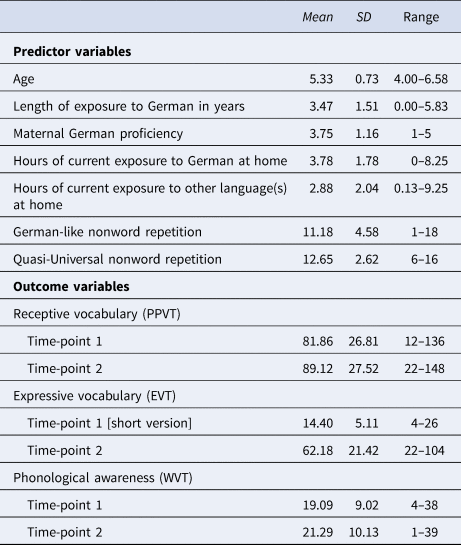
For descriptives of predictor variables and outcome measures, see Table 1. On average, children currently received more exposure to German than to their other language(s), with a large range in the exposure to the other language(s), t(64) = 17.17, p < .001. Mean age of first exposure to German was at one year and 10 months (SD = 1;5 years) and 33 of the children (51%) had first been exposed to German at an age of one year or younger.
Descriptives of Predictor and Outcome Variables

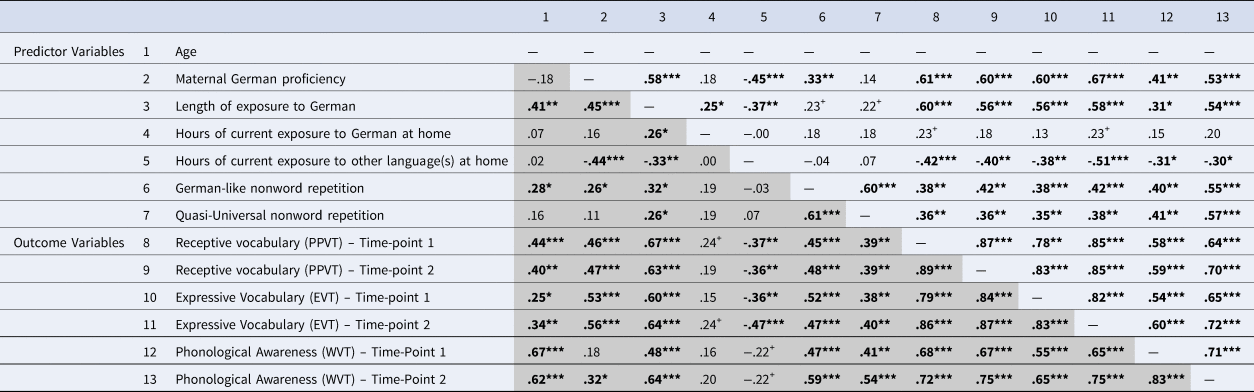
The predictor variables were only moderately correlated except for NWR-G and NWR-U, which were correlated at r = .61, p < .001 (see Table 2). A collinearity analysis showed that the variance inflation factor (VIF) of predictor variables varied from 1.13 (EXPGER) to 2.39 (MOTHGER), indicating no collinearity (Urban & Mayerl, Reference Urban and Mayerl2008). All predictor variables were subsequently used in the analyses.
Zero-order and Partial Non-parametric Correlations of Predictor and Outcome Variables at Time-Point 2

Note. All correlations are nonparametric Spearman's rho coefficients. Correlations below the diagonal represent zero-order correlations. Above the diagonal are correlations with age at time-point 1 partialed out.
+p < .10, * p < .05, ** p < .01, *** p < .001 (two-tailed).
Receptive vocabulary
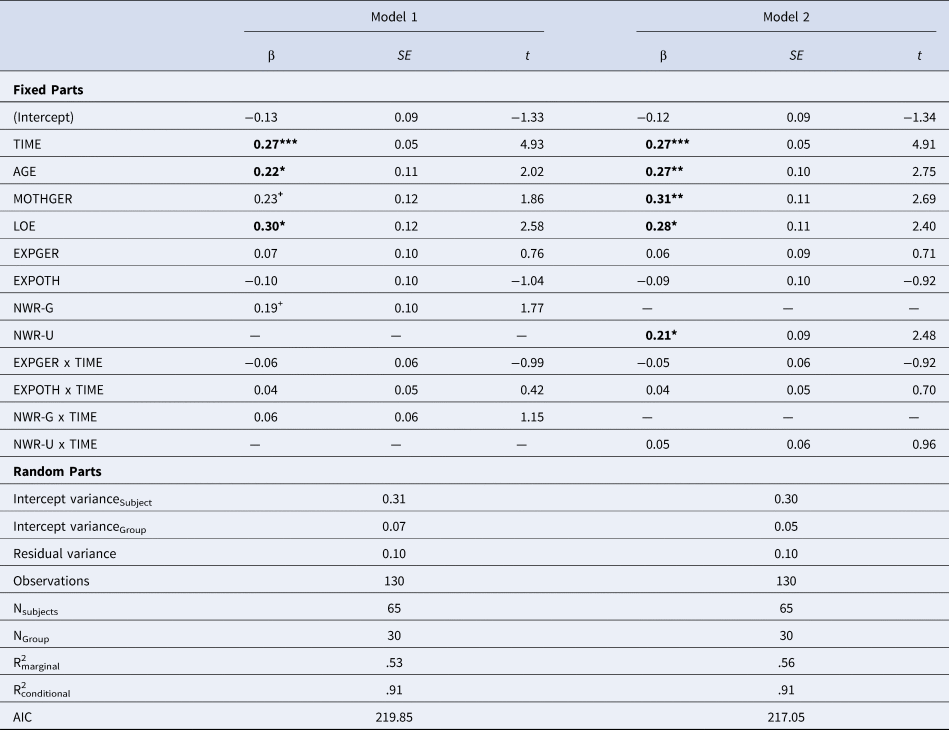
Results show time to be a significant predictor for receptive vocabulary, with higher scores on the PPVT-IV at time-point 2 compared to time-point 1. After entering age, maternal German proficiency, length of exposure to German and current exposure, NWR-U significantly predicted receptive vocabulary; NWR-G, however, did not. In Models 1 and 2, length of exposure predicted receptive vocabulary significantly; current exposure to German and the other language(s), however, did not. Age was significant in both models, maternal German proficiency only in Model 2. No interactions were significant (see Table 3). To address the question whether one NWR task explains variance over the other, both were entered into model 3. This did not improve model 1 (AICModel 3 = 220.11, χ2 (2) = 3.74, p = .154) or model 2 (χ2 (2) = 0.94, p = .626) and it was found that none of the NWR tasks were significant in this model. The other effects were similar to model 2.
Mixed Model Results for Receptive Vocabulary

Note. The models were fitted with the lmer-function of the lme4 package in R. Each model comprised a random intercept for subject and for preschool class.. The factor Time was dummy coded (time-point 1 = 0). R2marginal represents the R2 value associated with fixed effects; R2conditional represents the R2 value associated with fixed and random effects combined. TIME = change in scores from time-point 1 to time-point 2; AGE = chronological age at time-point 1 in years; MOTHGER = maternal oral proficiency in German; LOE = Length of exposure to German in years; EXPGER = current exposure to German at home; EXPOTH = current exposure to other language(s) at home; NWR-G = German-like nonword repetition task; NWR-U = Quasi-universal nonword repetition task
+p < .10, * p < .05, ** p < .01, *** p < .001
Expressive vocabulary
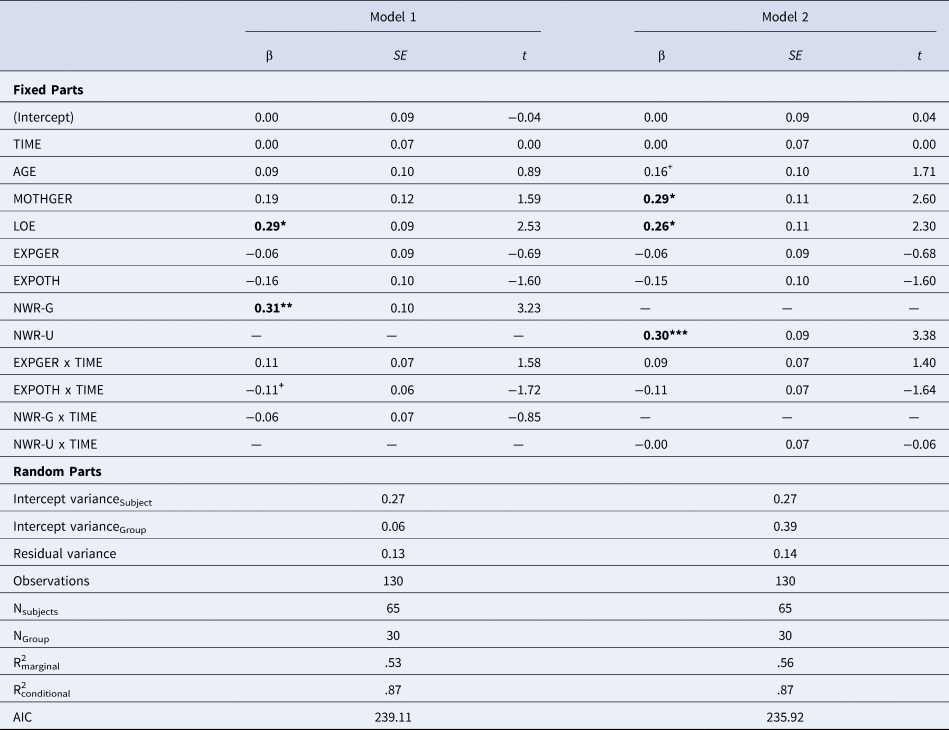
Due to z-standardization, time was not a significant predictor. Models 1 and 2 show that when adding NWR-G and NWR-U separately into the models, after age, maternal German proficiency, length of exposure to German and current exposure, both were significant positive predictors of expressive vocabulary. In both models, length of exposure to German was a positive predictor; current language exposure however was not. Maternal German proficiency predicted expressive vocabulary in model 2 but not in model 1. Contrary to receptive vocabulary, age was not a significant predictor in any of the models. No interactions were significant (see Table 4). Adding both NWR tasks into one model did not improve model 1 (AICModel 3 = 238.58, χ2 (2) = 4.53, p = .104) or model 2 (χ2 (2) = 1.34, p = .512), and neither NWR-G nor NWR-U was significant. The only significant coefficients in Model 3 were maternal German proficiency and length of exposure to German.
Mixed Model Results for Expressive Vocabulary

Note. The models were fitted with the lmer-function of the lme4 package in R. Each model comprised a random intercept for subject and for preschool class. The factor Time was dummy coded (time-point 1 = 0). R2marginal represents the R2 value associated with fixed effects; R2conditional represents the R2 value associated with fixed and random effects combined. TIME = change in scores from time-point 1 to time-point 2; AGE = chronological age at time-point 1 in years; MOTHGER = maternal oral proficiency in German; LOE = Length of exposure to German in years; EXPGER = current exposure to German at home; EXPOTH = current exposure to other language(s) at home; NWR-G = German-like nonword repetition task; NWR-U = Quasi-universal nonword repetition task.
+p < .10, * p < .05, ** p < .01, *** p < .001
Phonological awareness
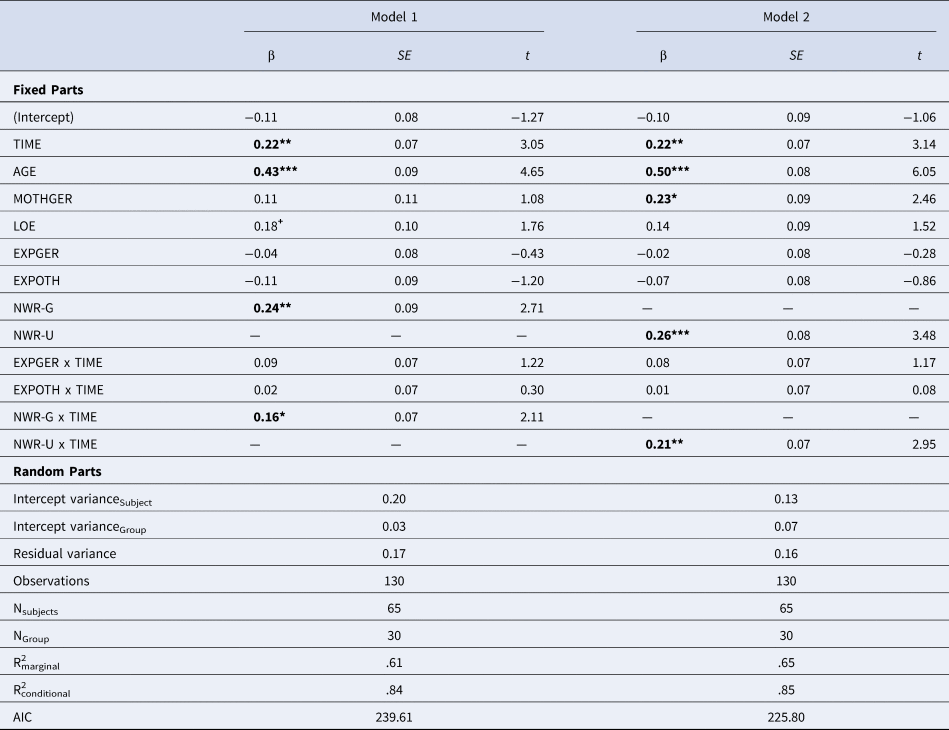
Results show time to be a significant predictor, meaning that children scored higher on phonological awareness at time-point 2 than at time-point 1. Models 1 and 2 show that when adding NWR-G and NWR-U separately into the models, after age, maternal German proficiency, length of exposure to German and current exposure, both were significant positive predictors of phonological awareness at time-point 1. As indicated by significant interactions with time, NRW-G and NRW-U also positively predicted the development of phonological awareness across the 5-months-span from time-point 1 to time-point 2. In both models, chronological age was a significant predictor. Maternal German proficiency was a significant predictor in model 2 but not model 1. No exposure factors or their interactions with time were significant in either model (see Table 5). To assess whether one NWR task explained variance over the other, both were entered into model 3. This improved model 1 significantly (AICModel 3 = 228.53, χ2 (2) = 15.08, p = .001) but not model 2 (χ2 (2) = 1.27, p = .530). It was found that with both NWR tasks entered into the model, NWR-U and its interaction with time remained significant; NWR-G did not. Apart from time and age, no other coefficients were significant in this model.
Mixed Model Results for Phonological Awareness

Note. The models were fitted with the lmer-function of the lme4 package in R. Each model comprised a random intercept for subject and for preschool class.. The factor Time was dummy coded (time-point 1 = 0). R2marginal represents the R2 value associated with fixed effects; R2conditional represents the R2 value associated with fixed and random effects combined. TIME = change in scores from time-point 1 to time-point 2; AGE = chronological age at time-point 1 in years; MOTHGER = maternal oral proficiency in German; LOE = Length of exposure to German in years; EXPGER = current exposure to German at home; EXPOTH = current exposure to other language(s) at home; NWR-G = German-like nonword repetition task; NWR-U = Quasi-universal nonword repetition task
+p < .10, * p < .05, ** p < .01, *** p < .001
Discussion
The goal of this study was to investigate how DLL experience and phonological short-term memory relate to majority language development of preschool children. More specifically, we tested how three factors – (a) length of exposure to German, (b) current daily exposure to German and their other language(s) outside of preschool, and (c) a German-like and (quasi-)language-universal nonword repetition task – predicted the receptive and expressive vocabulary and phonological awareness in German concurrently and across a five-month period. For all outcomes, we also accounted for maternal German proficiency and age at time-point 1. The results showed that length of exposure to German was a significant concurrent positive predictor of both expressive and receptive vocabulary but not of phonological awareness. Contrary to our hypothesis, current exposure to German outside of preschool was not a significant concurrent predictor in any of the models, and neither was current exposure to the other language(s). When entered separately, the German-like and universal NWR task both significantly predicted all language outcomes concurrently, with the exception of German-like NWR and receptive vocabulary, which was only marginally significant (p = .059). However, only for phonological awareness were both nonword recognition tasks associated with growth during the 5-month-span from time-point 1 to time-point 2. The findings confirm the connection of length of exposure and majority language development as well as the association of PSTM and language development found in previous research. Furthermore, as discussed later, the results suggest that the development of phonological awareness during preschool is driven more by PSTM and less by language exposure.
Language experience
Length of exposure to German
The positive effect of length of exposure to German vocabulary confirms previous findings on its independent contribution to language outcomes (Blom & Bosma, Reference Blom and Bosma2016; De Carli et al., Reference De Carli, Dessi, Mariani, Girtler, Greco, Rodriguez, Salmon and Morelli2015; Kovelman et al., Reference Kovelman, Baker and Petitto2008; Muñoz & Singleton, Reference Muñoz and Singleton2011). Similar to our findings, Blom and Bosma (Reference Blom and Bosma2016) found age of first exposure to be more strongly connected to vocabulary outcomes than current exposure in a comparable sample. Our findings, however, are in contrast to Unsworth (Reference Unsworth, Nicoladis and Montanari2016b), where current exposure was the only predictor of language scores and length of exposure was not. The children in her sample were, however, considerably older (average age of seven to nine years in the two groups), which could possibly have led to differences in findings. As argued above, in a young sample as in our study, where children are still early in their language development, differences in length of exposure are expected to lead to differences in language outcomes (De Houwer, Reference De Houwer and Li2011). Length of exposure was, however, not associated with outcomes in phonological awareness, suggesting that this could be driven less directly by language exposure than vocabulary is. This difference in how exposure affects vocabulary versus phonological awareness could also reflect the fact that vocabulary is a virtually unconstrained skill that requires a long time to develop and accumulate, whereas languages have a finite set of phonemes (e.g., Paris, Reference Paris2005). Thus, after reaching a certain threshold of exposure, phonological awareness could be less susceptible to cumulative exposure.
Importantly, in considering exposure effects three factors –length of exposure, age of acquisition, and to some degree also chronological age – are conceptually linearly dependent, and hence highly correlated, making it difficult to disentangle the specific effects each exerts (Stevens, Reference Stevens2006). This was also evident in our sample, where length of exposure and age of first exposure correlated at r = -.87, such that the latter could not be included in the analyses. Consequently, length of exposure is possibly not a pure exposure factor and some of its influence may additionally stem from an age of acquisition effect – assuming that there is a true age of acquisition effect in the sense of a sensitive period (see Muñoz & Singleton, Reference Muñoz and Singleton2011 for a critical review).
Current language exposure
Contrary to our expectation, current German language exposure outside of preschool was not a significant predictor in any of the models. This finding is consistent with other research showing a threshold of beneficial language exposure (Cattani et al., Reference Cattani, Abbot-Smith, Farag, Krott, Arreckx, Dennis and Floccia2014; Thordardottir, Reference Thordardottir2011, Reference Thordardottir2015), which contradicts a simplistic view of “the more the better” (Hammer et al., Reference Hammer, Hoff, Uchikoshi, Gillanders, Castro and Sandilos2014; Hoff et al., Reference Hoff, Core, Place, Rumiche, Senor and Parra2012). All children in this study attended German preschool or kindergarten daily, at an average of seven hours per day, where they used German both with preschool teachers and other children. Thus, they probably received sufficient exposure to German, coupled with the chance to use it, so that the additional use at home did not further benefit their German development. This would confirm previous findings where the additional use of L2 at home did not improve L2 outcomes (Duursma et al., Reference Duursma, Romero-Conteras, Suber, Proctor, Snow, August and Caldéron2007; Gutiérrez-Clellen, Reference Gutiérrez-Clellen2002; Hammer et al., Reference Hammer, Davison, Lawrence and Miccio2009; Klassert & Gagarina, Reference Klassert and Gagarina2010). In Germany, prominent politicians have called for parents to speak German with their preschool children: however, the current study suggests that this brings little additional benefit. Because our study did not include recordings of the speech children were exposed to, we were unable to investigate the quality of input. One possible reason for the missing effect of German exposure is that, irrespective of maternal German proficiency, the quality of input at home was low in the sense of linguistic complexity and did thus not have a positive effect above the exposure outside of home.
Exposure to the other language(s) was also not associated with language outcomes, which could support the notion that, with sufficient exposure to L2 outside of the home, the use of L1 in the home does not threaten L2 development, as found in previous research (Hammer et al., Reference Hammer, Davison, Lawrence and Miccio2009; Mancilla-Martinez & Lesaux, Reference Mancilla-Martinez and Lesaux2011). However, for expressive vocabulary in model 1, the interaction of exposure to other language(s) and time was approaching significance, indicating that, with more participants, this would potentially have reached significance; and use of other language(s) would thus have negatively predicted growth in expressive vocabulary. This could reflect that expressive vocabulary appears to be more susceptible to exposure effects than receptive vocabulary: Thordardottir (Reference Thordardottir2011) showed that more exposure was needed for scores on expressive vocabulary to be comparable to monolinguals’ than for receptive vocabulary.
In some studies, parental competence in the majority language has been reported as the mediating factor between majority language exposure at home and children's language outcomes (Hammer et al., Reference Hammer, Davison, Lawrence and Miccio2009; Place & Hoff, Reference Place and Hoff2011). In our study, maternal German proficiency was not correlated with exposure to German, but did link negatively to exposure to the other language(s). To test this in a post-hoc analysis, exposure and maternal proficiency were entered in an exploratory analysis in a stepwise manner into the models. When both variables of current exposure were entered into the models first, current exposure to German positively predicted receptive vocabulary and exposure to other language(s) predicted expressive vocabulary and phonological awareness negatively. These effects disappeared when entering maternal German proficiency into the model. This could suggest that if the primary caretaker has enough proficiency in L2, this mitigates any suppressive effects of L1 use at home on L2.
Phonological short-term memory
The finding that both the German-like NWR task and the quasi-universal NWR task predicted all language-outcomes significantly when entered into separate models – with the exception of German-like NWR that was only a marginally significant predictor of receptive vocabulary – confirms previous findings that PSTM is connected to the early stages of vocabulary development and to phonological awareness (Farnia & Geva, Reference Farnia and Geva2011; Knoop-van Campen et al., Reference Knoop-van Campen, Segers and Verhoeven2018; Michalczyk et al., Reference Michalczyk, Krajewski, Preβler and Hasselhorn2013; Nicolay & Poncelet, Reference Nicolay and Poncelet2013; Parra et al., Reference Parra, Hoff and Core2011; Verhagen & Leseman, Reference Verhagen and Leseman2016) – even when measured with a NWR task that does not follow the phonotactics of the target language. Contrary to our expectation that the relation of German-like NWR with language outcomes could be stronger than of language-universal NWR, both tasks were similarly associated with outcomes. However, because NWR-U was only measured at time-point 2, the directionality cannot be determined. Although it is unlikely that the PSTM of the participants developed substantially in the short period of five months, it is possible that the time-point of measurement confounded the relation of outcomes and NWR-U. Regarding NWR and maternal German proficiency, an interesting pattern emerged. For all outcomes, maternal German proficiency was not a significant predictor when entered with German-like NWR (Model 1) but was significant when entered with universal NWR (Model 2). On closer examination, NWR-G and maternal German proficiency correlated significantly at rp = .33 (see Table 2), whereas maternal German proficiency and NWR-U did not. This would be consistent with the assumption that NWR tasks built on the phonotactics of a given language are confounded by experience in that language, and that (quasi-)universal NWR tasks could be a “purer” measure of PSTM (Chiat, Reference Chiat, Armon-Lotem, de Jong and Meir2015; Farnia & Geva, Reference Farnia and Geva2011). Together, these findings confirm the role PSTM plays in language development, even when measured with a task that is less influenced by experience in the respective language.
An interesting finding was that in contrast to receptive and expressive vocabulary, both NWR tasks were associated with the change in phonological awareness from time-point 1 to time-point 2. Furthermore, when entering both NWR tasks into the model, NWR-U explained variance over and above NWR-G, which was not the case for vocabulary. These findings could suggest that the development of phonological awareness at this stage is more driven by PSTM than vocabulary, which we had hypothesized based on previous research showing that PSTM and phonological awareness are close constructs or even part of one latent construct (Alloway et al., Reference Alloway, Gathercole, Willis and Adams2004; Dufva et al., Reference Dufva, Niemi and Voeten2001; Engel de Abreu & Gathercole, Reference Engel de Abreu and Gathercole2012). Another possible explanation for the close association of PSTM and phonological awareness is that many phonological awareness tasks put a load on PSTM (Gathercole, Reference Gathercole2006). Although the task used here works with pictures for most items, thus reducing the strain on short-term memory, it is still possible that it taxed short-term memory also. More research is needed to determine whether PSTM drives the development of phonological awareness or whether this relationship is potentially driven by a third variable such as the underlying structure of lexical representations (Metsala, Reference Metsala1999), or reflects a latent phonological processing ability (Dufva et al., Reference Dufva, Niemi and Voeten2001; Wagner et al., Reference Wagner, Torgesen, Laughon, Simmons and Rashotte1993).
Internal versus external factors
Finally, it is interesting to consider the current findings within the framework of internal versus external factors and DLL. Emergentist theories of language and language acquisition (O'Grady, Reference O'Grady2008), posit as their central idea that language develops from experience with language, as an interaction of input and perceptual and cognitive mechanisms. The results of the current study, whereby both child-internal and child-external factors played a role in DLL, are in agreement with this usage-based core idea (see also Paradis, Reference Paradis2011; Paradis & Jia., Reference Paradis and Jia2016; Sun et al., Reference Sun, Yin, Amsah and O'Brien2017). The finding that language outcomes were also predicted by a language-universal NWR task underlines the significance of cognitive factors postulated in emergentist theories. Contrary to our findings, in Paradis and Jia (Reference Paradis and Jia2016), only external factors predicted development of vocabulary, grammar, and global comprehension across a two-year-period from age eight to ten. As the children were considerably older than in our sample, this difference to our findings would be in line with previous research showing that PSTM exerts a larger influence in earlier than later stages of language development (Baddeley, Reference Baddeley2003).
Some differential effects were found regarding the language outcomes. Receptive and expressive vocabulary were predicted by both PSTM and length of exposure as well as maternal German proficiency, whereas the only external factor that predicted phonological awareness was maternal German proficiency. Furthermore, PSTM predicted phonological awareness both concurrently and longitudinally, vocabulary only concurrently. Sun et al. (Reference Sun, Yin, Amsah and O'Brien2017) explained their findings in light of the critical mass hypothesis (Marchman & Bates, Reference Marchman and Bates1994), postulating that internal factors exert their influence only after a certain threshold of input is reached. Applied to our findings, it is possible that phonological awareness had a lower critical mass of input than vocabulary and internal factor: that is, PSTM exerted a greater influence on phonological awareness than on vocabulary. Age, also a child-internal factor, was the largest predictor of phonological awareness, which could point to an effect of cognitive maturation on the one hand (Rutter, Reference Rutter2016). On the other hand, children receive phonological awareness instruction in preschool and/or kindergarten, which could potentially amplify the effect of age, because age is confounded with length of preschool/kindergarten attendance.
Limitations and outlook
Turning to limitations, testing for changes in language skill as a function of exposure and PSTM over only a five-month period was a conservative test of predictors of DLL. An investigation over a longer time period would likely have led to more variance and hence more power to detect even small effects, perhaps explaining why some predictors were only marginally significant. Further, findings of greater educational significance would be obtained by following children's language development into their primary school years. Additionally, due to the difficulty in recruiting children with a DLL background, the sample size was somewhat small, which restricted the number of predictors that could be investigated. Even though we did not expect the PSTM to change significantly in five months, both NWR tasks should have ideally been measured at time-point 1 in order to be surer about the directionality of the association. Some children in our sample were exposed to three languages but these could not be analyzed separately due to the sample size. Future research should, however, investigate whether findings specifically generalize to multilingual learning. Moreover, given larger sub-samples of specific languages, it would be interesting to investigate how these factors differ as a function of children's home language, such as how the different phoneme inventories and phonotactics of different languages influence performance on the universal PSTM task.
Capturing the language experience of dual language learners in all its complexity is notoriously challenging, such that measurements can hope to, at best, provide a mere approximation (Marchman et al., Reference Marchman, Martínez, Hurtado, Grüter and Fernald2017). A recent study showed that children with the same proportion of input could have very different amounts of absolute exposure (Orena, Byers-Heinlein & Polka, Reference Orena, Byers-Heinlein and Polka2020). With the questionnaire applied in this study, we attempted to measure DLL children's both languages as opposed to only reporting language exposure proportionally. Questionnaires can, however, only be rough approximations to the actual experience. Recording of language allows the analysis of speech on token level and delivers information on the actual amount and quality of exposure; it is, however, laborious and is rarely feasible for larger samples. Systems such as LENA (Language Environment Analysis; Xu, Yapanel & Gray, Reference Xu, Yapanel and Gray2009) are promising tools and future research should strive to use such systems coupled with extensive questionnaire on the language biography when investigating how language experience shapes DLL.
Conclusion
The current findings suggest that the links between language exposure, PSTM, and language development depend on the aspect of language in question – phonological awareness seems to be less driven by exposure effects and more by PSTM than receptive and expressive vocabulary. Our results also confirm the association of PSTM and language outcomes, even when measured with a language-universal NWR task that is less confounded by language experience than a language-specific. The finding that German-like NWR shared variance with maternal German proficiency shows the difficulty of teasing apart “pure” internal and external factors, which calls for caution in interpreting their independent contribution to DLL. In summary, we hope that this study adds to the ongoing discourse on what factors contribute to successful DLL.
Acknowledgements
We would like to thank all participating preschools, children, and parents who made this research possible, as well as the anonymous reviewers whose helpful comments greatly improved the manuscript. This work was supported by the German Research Foundation (Deutsche Forschungsgemeinschaft; DFG) under Grant LE 2680/4-1.