INTRODUCTION
Ophiuroids are the most speciose group of echinoderms. Their diversity in the eastern Pacific is relatively low but endemism is high (Stöhr et al., Reference Stöhr, O'Hara and Thuy2012). Ecuador possesses 282 species of echinoderms, with 83 and 242 species recorded on the continental shelf of Ecuador, and the Galápagos Islands, respectively (Sonnenholzner et al., Reference Sonnenholzner, Brandt, Francisco, Hearn, Luzuriaga, Guarderas, Navarro, Alvarado and Solís-Marín2013). The ophiuroid fauna is richer in the Galápagos (82 species) than in the Ecuadorian continental shelf (2 species). In the tropical eastern Pacific (TEP) the ophiuroid family Gorgonocephalidae is represented by only four species (Maluf, Reference Maluf1988). None has been objectively reported from mainland Ecuador, but at least one is supposed to occur, Astrodictyum panamense (Verrill, Reference Verrill1867), as it is known both from northern Peru and from Colombia north to Mexico, including the oceanic islands (Maluf, Reference Maluf and Matthew1991; Cohen-Rengifo et al., Reference Cohen-Rengifo, Bessudo and Soler2009; Ayala-Bocos et al., Reference Ayala-Bocos, Reyes-Bonilla, Herrero-Pérezrul, Walther-Mendoza and Castañeda-Fernández de Lara2011). Astrodendrum galapagensis Clark, Reference Clark1916 is an endemic deep-water (718 m) species from Galápagos (Maluf, Reference Maluf and Matthew1991). Gorgonocephalus diomedeae Lütken & Mortensen, Reference Lütken and Mortensen1899 is also a deep-water (1271 m) species only known from off Panama.
This paper represents the first published record of Astrocaneum spinosum (Lyman, Reference Lyman1875) from the Gulf of Guayaquil, southern Ecuador.
MATERIALS AND METHODS
Many specimens were observed on the silty sea-floor at a depth of 40 m while performing a SCUBA diving survey around a natural gas platform off Ecuador's south coast at 3°16′11″S–80°28′21″W (Figure 1). Water temperature at the bottom was 17°C.
Map of the area showing the capture location of Astrocaneum spinosum.

The two specimens were collected by hand on 7 October 2012. They were first preserved in 96% ethanol and then passed into 75% ethanol. The specimens (Figure 2) are now deposited in the Echinoderm Collection of the Muséum national d'histoire naturelle (MNHN) under the Catalog Number MNHN-IE-2013-1596.
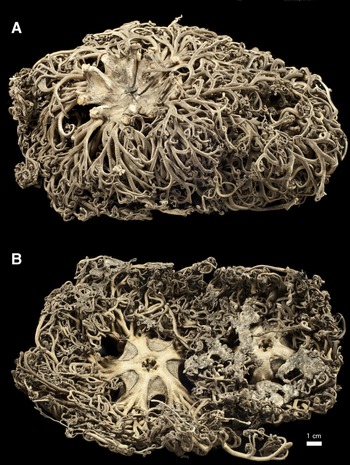
Astrocaneum spinosum: two entangled specimens (MNHN-IE-2013–1596): (A) dorsal view; (B) ventral view (photograph by Claude Ferrara).

A third specimen was collected, photographed and then released (Figure 3).
Astrocaneum spinosum: freshly caught specimen showing the live coloration, dorsal view (photograph by Jean-Thomas Bujard).

RESULTS
The specimens collected were identified as spiny basket sea star: Astrocaneum spinosum (Figure 2). The genus was determined following the key established by Fell (Reference Fell1960) and the specimens agree well with the original description by Lyman (Reference Lyman1875). The species may be recognized by the following combination of characters: five branched arms; branching pattern changing from dichotomous near the disc to alternate towards the tips of the arms; less than 20 arm-joints before the first fork; primary plates inconspicuous; radial shields elongate, bar-like; five madreporites of similar size; hooklets with no secondary teeth; lateral arm spines lacking before the fourth fork; and dorsal surface of disc and arms with transverse rows of spines.
The live colour of the body (Figure 3) is orange-yellow with a brown granular line dorsally, pale uniform yellow ventrally. The two specimens collected are closely entangled (Figure 2B).
DISCUSSION
The known depth range of Astrocaneum spinosum is 4–183 m (Maluf, Reference Maluf1988), and the species has been found over a variety of substrates: gorgonians, shells, sand and mud (Maluf, Reference Maluf1988). The specimens observed in the Gulf of Guayaquil at a depth of 40 m were free on the bottom substrate or clinging to gorgonians, data that coincide well with the literature. Many specimens (several dozens) were observed, with an estimated density of 1.5 individuals/m2.
The previous known distribution of A. spinosum was from Mexico to Panama in the TEP (Maluf, Reference Maluf1988; Kerstitch, Reference Kerstitch1989). Its range is here extended to southern Ecuador, some 1200 km south of the Pearl Islands in Panama. This record from the Gulf of Guayaquil might be expected since Maluf (Reference Maluf1988) mentions the north of Peru as the southern limit of the distribution of a large number of tropical species of echinoderms in the TEP. The rather high density of individuals on this spot off Machala suggests that a population of basket stars is permanently established there and probably breeding. However, no juveniles have been observed.