Introduction
Securing a tracheostomy tube around a patient's neck after major head and neck surgery can pose its own challenges, both to the patient and the surgeon. Head and neck procedures that involve the insertion of a free flap require meticulous care of the neck to maintain the patency of the feeding vessels of the graft.
We describe a previously unreported technique of securing a tracheostomy tube, which reduces the pressure on the neck and feeding vessels of a free flap.
Technique
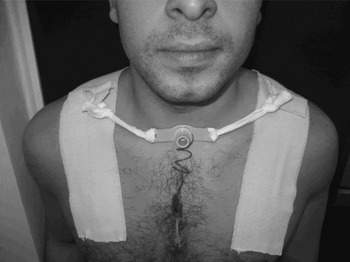
Before any tape is applied, the area over the shoulders must be clean, dry and free of body hair. A generous length of 10-cm Tensoplast, heavy duty tape is applied, starting anterior to the pectoralis area, above the areola, with extension over the shoulder to the level of the spine of the scapula. Over the clavicular area, a loop of tape is pinched up and then flattened onto itself (Figure 1). For further security, both anterior and posterior ends can be further secured with transverse pieces of tape.
Heavy duty tape forms an ‘epaulette’ anchor tag for a ribbon gauze tie.

A small opening is made at each tag base to allow ribbon gauze to be passed through. These ribbons are then attached to the flange of the tracheostomy (Figure 2).
Ribbon gauze is passed through a small opening in each tag base and then attached to the flange of the tracheostomy, providing safe and easy secondary security without pressure around the neck.

This technique provides a safer alternative to tracheostomy tapes that encircle the neck, and is less likely to jeopardise flap perfusion.
Discussion
The use of free flaps in head and neck reconstruction raises the question of how to adequately fix a tracheostomy tube without causing local pressure to the vascular anastomosis.
We conducted a PubMed literature search for articles describing similar methods of securing a tracheostomy tube in patients with head and neck free flaps. We found no previously published descriptions of our ‘epaulette’ technique for securing a tracheostomy tube in patients with free flaps.
The most commonly used recipient vessels for a free flap in the neck include the superior thyroid and carotid arteries, with the internal jugular vein for drainage.Reference Nahabedian, Singh, Deune, Silverman and Tufaro1, Reference Ross, Ang, Rik, Golger, Lannon and Addison2
The fact that the anastomotic vascular loop of the free flap is relatively superficial and lies on the lateral aspect of the anterior neck puts it at increased risk of compression, with the danger of consequent flap ischaemia and failure due to a local pressure effect.Reference Frick, Baumeister, Menger, Vollmar, Wohllaib and Wiebecke3 Flap failure is associated with kinking or compression of the donor or recipient vessels, and this should be avoided.Reference de Weerd, Mercer and Setsa4 Tracheostomy tapes can contribute to this problem, which means that securing the tube safely is difficult without endangering flap perfusion.
Even though suturing of the flanges to the skin is the primary method of securing a tracheostomy tube, a back-up is required to reduce the likelihood of extubation, a serious complication. In our experience, use of the epaulette method has not resulted in any compromised flaps or unplanned extubations.
We believe the epaulette technique to be an easy and safe method of securing a tracheostomy tube in the immediate and early post-operative period, whilst simultaneously avoiding any local pressure effect on the free flap vessels and anastomosis.