Introduction
There has been a broad intellectual movement in the past three or four decades that has taken many historians of South Asia in the direction of an engagement with larger geographical questions, while still retaining a firm foothold in their initial South Asian domain. Such a turn to ‘global history’, equally visible among those working on East Asia (but to a lesser extent among historians of West Asia), has involved two somewhat distinct strategies. For some, this movement has meant, above all, an engagement with broad theoretical and social-scientific debates, such as those in relation to the long history of capitalism, or the notional ‘Great Divergence’ between the economies of various parts of the world. One aspect of the oeuvre of David Washbrook, which began in the 1960s with a close consideration of the political economy of colonial South India in the late nineteenth and early twentieth centuries, has grappled over the years with these sorts of questions, particularly in his telling critique of ‘world-systems theory’.Footnote 1 In so doing, he has been obliged to come to terms with the substantial and growing secondary literature on the history of trade and commercial capitalism in the Indian Ocean before 1800. The long-accepted way of dealing with this commerce was through European archival and narrative sources, notably those of the Portuguese Estado da Índia and the chartered East India companies; this was the approach taken by a series of important historians in the 1960s and 1970s such as, first, Holden Furber and Charles Boxer and, then, K. N. Chaudhuri and Ashin Das Gupta.Footnote 2 But it is now increasingly clear that there are also other possibilities, which open up new perspectives as well as fresh and innovative ways of combining commercial, political, and cultural history.
This takes us in turn to the second strategy that may be used to link South Asian history with larger questions of global history, namely through a systematic diversification of sources and archives to take fuller account of not only European but non-European materials.Footnote 3 This is not merely a question of the fetishizing of diversity for its own sake, but because the Indian Ocean was a complex arena inhabited by a variety of groups and interests, with varying motivations, perspectives, and even conceptual frameworks regarding trade and its relationship to politics. In turn, it implies that the serious global historian cannot haughtily dismiss the value of a humanistic history, one that is based on a serious investment in philology and its allied disciplines.Footnote 4 Rather, it means taking very seriously the possibility of confronting, comparing, and, at times, reconciling the materials in Portuguese, French or Dutch with those, say, in Arabic, Persian, Armenian or Gujarati, with attention paid not merely to the ‘data’ they contain but also to the subtleties of language and other such cultural niceties.Footnote 5 The historian does not thus move effortlessly from being an area specialist to a globalist; instead it is by patiently building up and accumulating bodies of specialist knowledge that a convincing larger picture emerges.
Recent years have seen a marked revival of interest in commercial and political relations between western India and the Arab-speaking world in the period running from the eleventh to the fifteenth centuries—what is usually referred to as the later medieval epoch. This revival corresponds to the consolidation of the use of several sets of historical sources. In the first place, the project begun long decades ago by S. D. Goitein, on the Judeo-Arabic commercial materials of the Cairo Geniza relating to the Indian Ocean, has now matured with the posthumous publication of his so-called ‘India Book’ in 2008.Footnote 6 These materials largely relate to the period between the late eleventh and early thirteenth centuries, and they involve ports and political centres both in northwestern India such as Bharuch, Khambayat, and Nahrwala (Anhilwada-Patan), and in Kerala and Karnataka like Kollam, Pantalayini, Dharmapattanam, Valapattanam, Mangalore, and Barkanur. They can also be usefully supplemented by a smaller cache of Arabic materials deriving from the port of al-Qusayr on the western shores of the Red Sea, largely from the thirteenth century.Footnote 7 To these we can further add significant bodies of Arabic narrative materials from both the Yemen and Egypt, for example, the chronicles of the Mamluks, Rasulids, and other significant dynasties in the area. Such narrative sources continued to be produced in the Yemen even after the Rasulids were replaced by the relatively short-lived Tahirid dynasty who ruled between the mid-fifteenth and the early sixteenth centuries; the best-known of the Tahirid chronicles are texts like the Qilādat al-nahr fī wafīyyāt a‘yān al-dahr and the Tārīkh thaghr ‘Adan, both written by Ba (or Abu) Makhrama (1465–1540).Footnote 8
Some recent analytical works have also contributed significantly to filling out our understanding of the Red Sea and its trade in the fourteenth and fifteenth centuries, thus helping to correct a somewhat distorted picture that had emerged from an excessive dependence on and backward reading of the Portuguese sources of the sixteenth century. A major achievement is Éric Vallet's L'Arabie marchande, which deals with the state and commerce under the Rasulid sultans of Yemen between about 1229 and 1454.Footnote 9 Vallet painstakingly demonstrates how the Rasulids set about building and then maintaining a commercial system in the course of the later thirteenth and fourteenth centuries, which extended its tentacles beyond the Red Sea and well into the Indian Ocean. By combining the control of the coastal plains with that of the interior mountains of Yemen, the Rasulids managed to become central actors ‘in a world where Islam, trade, and the state had indissolubly linked their destinies’.Footnote 10 Their system, centred on the port city of Aden, but with a complex articulation, was eventually challenged in part by traders from southwest India who decided to bypass the port and proceed instead directly to Jiddah in the 1420s. Aden did not entirely fall into ruin as a consequence, but its prosperity was challenged, even as that of Jiddah grew over the course of the middle decades of the fifteenth century.
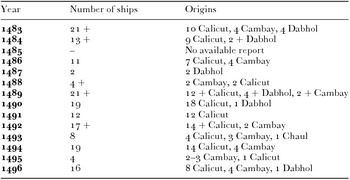
Another recent work then complements and extends Vallet's analysis: this is John Meloy's examination of the relations between both the Mamluk sultans and the sharifs of Mecca, and trade and traders from the late fourteenth to the early sixteenth centuries. The focus here is far more on the complex of Mecca and Jiddah than on the ports and territories further south in the Arabian peninsula, and the central sources used are once again narrative materials in Arabic. Like the earlier historian, Richard Mortel, Meloy notes that he has drawn extensively on writings ‘composed in Mecca during the fifteenth century by three generations of the Banu Fahd family’, as well as their predecessor Taqi al-Fasi.Footnote 11 Using these writings, he is able to track useful data, for example, on arrivals and departures of ships in the Red Sea from India between about 1471 and 1537, notably from Calicut, Cambay, and Dabhol.Footnote 12 In particular, he makes extensive use of the text Bulūgh al-qirā fī zayl ithāf al-warā by the Mecca-based chronicler, ‘Izz al-Din ‘Abd al-‘Aziz ibn al-Najm ibn Fahd al-Makki, which was completed around the time of the Ottoman conquest of the Hijaz in 1516–17 (see Table 1).Footnote 13
Indian ships arriving at Jiddah, 1483–96

Source: Meloy, Imperial Power and Maritime Trade, pp. 249–51.
Notes: (+) here indicates that the actual arrivals exceeded that number.
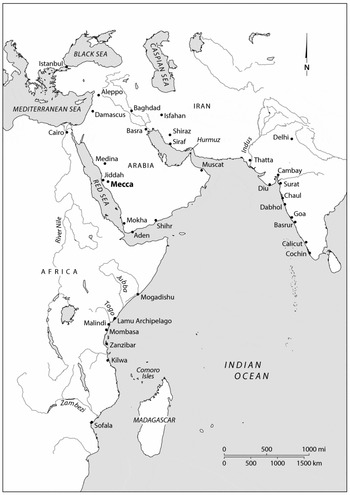
The use of such sources risks bringing the historian face-to-face once again with an old quarrel, between those who use narrative texts and those who use archives. Are these chronicles, which are obviously stylized narratives written within specific literary conventions, as ‘reliable’ as the fragmented merchant letters of the Cairo Geniza or al-Qusayr?Footnote 14 How are we to evaluate their truth, and the conditions of their production? This article will not claim to produce a full resolution to this quarrel. Rather, it will argue that the genre of the ‘chronicle’ itself is rather capacious, and that in some instances such texts actually come rather close to archival documents themselves. This is, above all, the case when the chronicle (or annalistic text) is not meant for wide circulation, and thus has not undergone the process of polishing and rhetorical transformation that one normally expects within the genre. Importantly, we will also try to show what the chronicles in question bring to an old subject that has been dealt with by a number of earlier authors, namely the relations between the region of Gujarat, in western India, on the one hand, and the Red Sea and the Hijaz, on the other, in the fifteenth and sixteenth centuries.Footnote 15 These relations have been hitherto dealt with by using materials from Gujarat in Persian (and, to a limited extent, Arabic), together with sixteenth-century Portuguese chronicles and archival documents, and even Ottoman chronicles. What has so far been lacking for the sixteenth century, however, is a ‘view from Mecca’. It is this gap that our article makes a claim to fill. At the same time, since our analysis is largely focused on a single text, it is important to begin by addressing the matter of its authorship, and the subjective position of its author (see Map 1).
Mecca and its trading networks, 1500–1550.

An author and his contexts
The year 2000 saw the publication of an important text in Arabic, the existence of which had long been known to savants, but which had been barely explored by historians. This was the work by Jarullah ibn Fahd al-Makki entitled Kitāb Nayl al-munā bi-zayl bulūgh al-qirā li-takmilat Ithāf al-warā.Footnote 16 Weighing in at over a thousand pages in print, and in two volumes, the publication hardly created a stir in the field of Indian Ocean history, many of whose modern practitioners seldom seem to pay attention to what appears in languages other than English. We had ourselves been alerted in the 1990s to the existence of this text, then in manuscript form, by the great French historian and orientalist, Jean Aubin, who was attempting at the time to reconstruct the vicissitudes of the pepper and spice trade in the Red Sea in the early sixteenth century using Portuguese, Italian, and Arabic sources.Footnote 17 As it happens, only one manuscript of the Nayl al-munā has been found so far, and that in a damaged form. However, we do know a fair amount about its author, Jarullah (d. 954 Hijri (H.)/ 1547 CE), as well as his larger social and intellectual context. He may be inserted into a line of historians going back to the celebrated Taqi al-Fasi (d. 832 H./ 1429), followed in turn by Jarullah's own grandfather and father, Najm ibn Fahd (d. 885 H./ 1480), and ‘Izz al-Din ibn Fahd (d. 922 H./ 1517), briefly mentioned above. Jarullah's own notional successor as a chronicler, though he was not a relative, was the well-known Indo-Meccan intellectual, Qutb al-Din Muhammad Nahrawali (d. 990 H./ 1582), on whom more below.Footnote 18
The intellectual tone had already been set, however, in the late fourteenth and early fifteenth centuries by Taqi al-Fasi. A prolific author, he is known to have written over 30 works of history, above all focused on Mecca and its principal personalities.Footnote 19 These works were organized, for the most part, on three patterns: first, the history of the holy cities of Medina and Mecca, their particularities, and religious, social, intellectual and cultural features; in this category the best examples are the Shifā al-gharām bi akhbār al-balad al-Harām, the Tahsil al-marām, the Tuhfat al-Kirām, the Zuhūr al-Muqtatifah, and the Tarwīh al-sudūr bi ikhtasār al-zuhūr as well as its summary. Finally, a work that is worth singling out for mention is the ‘Ujālat al-qurā li al-rāghib fī tārīkh Umm al-qurā. These works tend to resemble each other a fair deal and overlap in considerable measure. The second pattern emphasizes the biographies of scholars and other eminent citizens of Mecca, corresponding broadly to the tazkira genre; the text entitled ‘Iqd al-Thamīn fī tārīkh al-balad al-amīn is a prominent example of this. A third type of work focuses more on the rulers (hukkām) and officials of Mecca in different periods: the most important of these is Wulāt-u Makka fī al-Jāhiliya wa al-Islām, of which the author himself then prepared a summary entitled Tajrīd-u Wulāt Makka.
Taqi al-Fasi's most significant disciple was Najm al-Din ‘Umar ibn Muhammad ibn Fahd al-Makki al-Hashimi, who surpassed him at least quantitatively (if not in reputation and influence) by writing over 40 works on history and related subjects. As with his master, the best of these are related to Mecca and the lives of Meccans. The first of his books that is known is entitled Ithāf al-warā bi akhbār Umm al-qurā, a kind of annals.Footnote 20 This work is based stylistically on such classical authors as Tabari, Ibn al-Athir, Al-Zahbi, and Ibn al-Qasir, and it was Najm al-Din's endeavour to join the history of Mecca to that of the Islamic world in general. He begins in the very first year of the Hijri calendar and takes his chronology through to 885 Hijri (H.). Besides this, Najm al-Din also wrote a tarājim (that is to say, a form of tazkira) of the principal people of Mecca, entitled al-Durr al-kamīn bi-zayl al-‘Iqd al-Thamīn fī tārīkh al-balad al-amīn. We might see this too as a continuation of his master's work, even though he added a number of subjects and persons that Taqi had either missed, or who came after his life. Najm al-Din also wrote on the history on the great families (awā’il) of Mecca, some five books in all. These great families included his own, the Banu Fahd, the al-Tubur (from which the great chronicler Tabari hailed), the al-Nuwayra, the al-Qustulani, and the Banu Zuhayra. He also commenced a text entitled Bughyat al-marām, which was completed with a commentary by his son, ‘Izz al-Din, under the title Ghāyat al-marām. In the next generation, ‘Izz al-Din ibn Fahd appears to have inherited a love for the history of Mecca from his father. He compiled a continuation (or zayl) of his father's annals, which began chronologically where Najm al-Din had left matters, and took them up to the year of his own death. This text, as we have noted above, was entitled Bulūgh al-qirā bi zayl ithāf al-warā bi akhbār Umm al-qurā, and ran from the month of Ramazan 885 H. to Rabi‘ II 922 H. (1517 CE), just before the author's death.Footnote 21 In this work, we find numerous details of politics, society, economy, institutional administration, and so on, largely focused on the Haram Sharif and those linked to it, as well as the hajj pilgrimage. Like his father, ‘Izz al-Din also wrote extensively in a biographical (or semi-hagiographic) mode on the great shaykhs of the time.
This then was the rather unique intellectual heritage of Jarullah ibn Fahd, from the third generation of a substantial and established lineage of chroniclers. He too produced a further continuation, which he added to his father's work, calling it Nayl al-munā, with the full title translating broadly as ‘The Realization of the Desire to Attain the Destination; Notes for the Completion of a Gift to Mankind with the Annals of the Mother of Cities [Mecca]’. This text, containing many details of Mecca's day-to-day life, begins in the month of Zi-Hijja 923 H. and ends in Jumada II 949 H. Jarullah was of course fully aware that he was from a particularly important Meccan family, with a genealogical chain ostensibly extending to Muhammad ibn Hanafiyya. Of high status, albeit not Sayyids, the family had long been settled in Asfun in Upper Egypt, known for its extensive Shi‘ite population. They appeared to have moved to Mecca in the eighth century Hijri or thereabouts, and a few members find mention in at least one of Taqi al-Fasi's books, such as Abu'l Khayr ibn Fahd (d. 735 H.) and Jamal al-Din ibn Fahd (also d. 735 H.). Besides history, the Banu Fahd family was quite diverse in its intellectual interests, in areas like hadīth and adab; four of them (including Jarullah himself) were known as hāfiz in the matter of hadīth, which meant they had memorized thousands of traditions of the Prophet and their chains of transmission (isnād). Other prominent Meccan families regularly accepted marriage alliances with them, and several of them also attained significant administrative positions in the Hijaz. Their prominence as a Meccan intellectual dynasty seems to have lasted about three centuries, and one of their last eminent members was ‘Abd al-Rahman ibn ‘Abd al-Qadir ibn al-‘Izz ibn Fahd (d. 995 H), in the second half of the sixteenth century, possibly a nephew of Jarullah himself. We are thus dealing with a self-conscious set of intellectuals, aware of their own status and imbued with some sense of importance; we know that two generations before Jarullah, Najm al-Din had already written a family history, entitled Bazl al-jahd (‘The Profitable Use of Effort’). In his turn, Jarullah too wrote a sort of family history, which he called Hifz al-masāq wa al-‘ahd fī mada'ih Banī Fahd, as well as another work on their family's residence and stay in Mecca, entitled Hifz al-‘uhūd alā hukm waqf dār al-fuhūd; these works had a posterity, and ‘Umar al-Shamma‘ later composed a commentary on several of the books written by this family.Footnote 22
Turning in more detail to the figure of Jarullah ibn Fahd, a number of basic elements of his biography are accessible to us. He was born in Mecca on 20 Rajab 891 H. (or 23 July 1486). His mother was also of the Banu Fahd, her name being Kamaliyya bint Muhibb Abu Bakr Ahmad ibn Muhammad ibn Fahd. It is reported that his father ‘Izz al-Din took great care to educate him, and had already begun to send him to formal classes at the age of four. Jarullah quickly memorized the Qur'an, and was also introduced into the hadīth by his father, who obviously was a great influence on him intellectually. But a decision was then taken to widen his horizons somewhat. Jarullah was thus sent off in his early twenties (in 913 H.) to Cairo in order to learn hadīth; after that he went on to Syria and various Ottoman cities. The very next year, in Rabi‘ I 914 H., we find him in Yemen, where he stayed for some four months in order to study with the historian, ‘Abd al-Rahman Diba‘ in Zabid, who was sufficiently impressed to mention this disciple in one of his works. Some years later, in 922 H, we are aware that he was in Damascus and Aleppo, and it was during this period that his father passed away.Footnote 23 This was also broadly the moment of the Ottoman conquest of Egypt, Syria, and the Hijaz, and in later years Jarullah undertook several visits to the Ottoman heartland of Anatolia, in order to discuss matters with prominent scholars there, but also to build up his personal library of manuscripts. It was while visiting Bursa and Istanbul in 928 H. that he wrote a work entitled Jawāhir al-Hassān fi manāqib al-Sultān Sulaymān ibn ‘Uthmān, in praise of the Ottoman ruler of the time. From Jarullah's own scattered writings as well as those of others, both contemporary and later, we have a fairly good sense of his chief teachers. These included his own father, Shams al-Din Muhammad ibn ‘Abd al-Rahman al-Sakhawi, Zakariyya ibn Muhammad al-Ansari (from whom he learned fiqh), as well as several others in other disciplines. Interestingly, they also included two women: Umm Salima bint Muhammad al-Tabari al-Makki and Fatima bint Kamal ibn Sirin (a prominent figure in the matter of the interpretation of dreams).
Like his father and grandfather, Jarullah was a highly prolific scholar. The modern editor of the Nayl al-munā, Muhammad Habib al-Hila, lists some 49 works by him on a variety of subjects, from the history of the Hijaz, to hadīth, akhlāq, and related issues.Footnote 24 Known titles of texts, many of which do not actually survive, suggest that these were some of the subjects he dealt with:
-
• imams of the four schools of jurisprudence
-
• towns and urbanism
-
• a treatise on the entry of plague (ta‘ūn) into Mecca and Medina (this text is unfortunately lost)
-
• several first-person travel-accounts, which are referred to by other contemporaries, but which again do not seem to have survived
-
• a text on coffee: Qama‘ al-shahwāt fi radd-i kizb-i nāzim al-qahwāt (‘The Uprooting of Sexual Desire: A Refutation of the Untruths of the Coffee-administrators’)Footnote 25
-
• Mu‘jam al-Shu‘ara’, an account of poets of his time from whom he had heard verses
-
• Manhal al-zarāfa bi zayl maurid al-latāfa fi man walla al-saltana wa'l khilāfa: a humorous account regarding those who were involved with rulership (saltanat and khilāfat); this exists at least in a partial manuscript
-
• finally, a somewhat controversial text entitled Nukat al-Zirāf, or ‘Laughter-inducing Points’, which we know led Jarullah to be involved in some fierce debates and controversies regarding his tendency to mock others for their ‘disabilities’.Footnote 26
Jarullah ibn Fahd died in the early morning of Tuesday, 15 Jumada I 954 H. (that is, 3 July 1547). He was fondly remembered by a certain number of his contemporary writers, among whom we can mention ‘Abd al-Rahman al-Sakhawi and the chronicler, Ibn Tulun, who refers to him on more than one occasion in his Mufākahat. Besides being remembered by his disciples for the quality of his teaching, he cast a significant shadow on later generations, as we see from a later text such as ‘Aydarusi's Nūr al-Sāfir.Footnote 27
The text and its problems
As has been mentioned above, a sole manuscript of the Nayl al-munā has survived, thus rendering it more like an archival document than most other texts of these dimensions. This manuscript carries the title of the text on its first page in the hand of none other than Qutb al-Din Muhammad Nahrawali.Footnote 28 It is made up of 198 folios of middle size, with 31 lines per page, not written in a particularly distinguished script, and there are two sets of notations on it.Footnote 29 The manuscript seems to have been produced fairly close to the author's lifetime, though it is certainly not autograph. (It is also evidently posthumous, since it refers to Jarullah himself as having passed on.) Since many of the additional notations are from the hand of Nahrawali, we can date it to within the latter's lifetime (he died in 990 H. or 1582). The manuscript then seems to have passed through various other hands, with one of the owners being ‘Abd al-‘Aziz and then his children. From this family, it passed on to Hajji Mustafa, a former qāzī of the port of Tripoli in Syria in 1094 H., and eventually to Wajih al-Din ibn Ibrahim. The anonymous scribe claims, incidentally, that he copied the text from an autograph manuscript, but that the latter was itself difficult and defective, with things that had been frequently crossed out and changed. It would appear that Nahrawali then corrected this scribal copy, and made changes that are often rather useful and important, since the scribe had frequently introduced grammatical and lexicographic errors.
The Nayl al-munā was begun in Zi-Hijja 923 H. (the end of 1517), very soon after its predecessor, Bulūgh al-qirā, ended, although there is a gap between the two, probably owing to Jarullah's absence from Mecca at the time of his father's death. It clearly has a certain secretive quality to it, for reasons that will become evident. It seems clear that Jarullah himself was not interested in widely divulging this work, unlike many of his others, probably because it expressed critiques of various aspects of his time.Footnote 30 To begin with, there are a number of quite forceful critiques here of the new Ottoman dispensation. This was natural enough, since the Mamluk-Ottoman transition was obviously not a smooth one, even on sectarian grounds, between a Shafi‘i administration (the Mamluks) and a Hanafi one (the Ottomans). As for Jarullah himself, it is clear that he was of the Shafi‘i persuasion, as were most of his family members. He also appears to have seen the transition as exacerbating tensions between Turks and Arabs, with the Turks even preferring the so-called ‘Ajamis to the Arabs. An example of this was in the administration of the port of Jiddah, which came under a nā’ib by the name of Qasim Sherwani.Footnote 31 Jarullah also made it a point to describe how at the moment of the conquest of Mecca, the occupying Ottoman army misbehaved; more generally, he takes every opportunity to denounce Ottoman corruption, notably in the matter of the management of inheritance.
Jarullah also frequently underlined the ignorance of the faqīhs and qāzīs under the new dispensation. He went so far as to claim that people who did not even know how to read the Qur'an correctly had begun to lead the prayers, while the khutba in the Haram Sharif was regularly read by incompetents. Again, the alms (sadaqāt) were misused and misappropriated, while newly appointed officials poked their noses into where these alms came from. These were not generalized accusations, for Jarullah even gives individual names in this context, calling them liars, takers of false oaths, quarrelsome, and so on. But this is not some simple nostalgia for the pre-1517 dispensation either. While apparently praising the sharifs of Mecca, we find that Jarullah does not, in fact, always like their policies either: their habit of taking one-third of some of the alms donated from afar, for example. Still, all in all, he thought the Ottomans were unjust in their treatment of the sharifs. These forceful and even violent criticisms, and claims that the sharī‘a itself was being violated by the Ottomans (along with local traditions and social mores), made the Nayl al-munā a highly problematic text, and we can thus understand why Jarullah did not publicize this work, never referred to it in his other works, or even bothered to revise it and produce a clean manuscript copy. He did, however, show it to some friends and intimates. These included ‘Abd al-Qadir al-Jaziri, who in his Durar al-Farā’id, refers several times to Jarullah's text, without giving its title.Footnote 32 Again, Qutb al-Din Muhammad Nahrawali in the well-known chronicle, al-Barq al-Yamānī, summarizes some passages from the Nayl, also without citing its title.Footnote 33 The text apparently even finds echoes in some later historians such as ‘Ali al-Sanjari's Manā’ih al-Karam and Muhammad al-Tabari's Ithāf-i fuzalā’ al-zamān.
With regard to Jarullah's methods and coverage as an annalist, it would seem that he followed closely in the footsteps of his grandfather and father. Chronologically, Jarullah's own coverage runs from the month of Zi-Hijja 923 H. (end 1517) to Rajab 946 H. (roughly November 1539), more or less 23 years, with some gaps when he was absent from Mecca. The chronological order is fairly well maintained through the text, and each year has a proper heading, as does each month. In the month of Zi-Hijja, he always gives a fair number of details regarding the hajj of that particular year. In a similar fashion, he also gives some details of the ‘umra (or secondary pilgrimage) in Ramazan, including the end of the month and its celebrations. A third month he regularly emphasizes is Rabi‘ I, the birth-month of the Prophet. However, in three years—namely 939, 940, and 941 H.—there seems to be some disorder in the text, which may be because Jarullah was somewhat away from Mecca in these years (but also perhaps for other personal reasons). Further, there is an enigmatic gap of almost eight years between the end of the work and his death. Either some pages have been lost, or Jarullah stopped writing the annals in his last years.
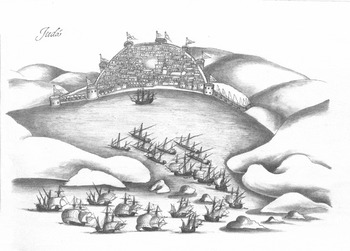
All in all, the text of the Nayl al-munā is marked by its author's talent for pithy description and evocation. Despite his sympathies, which have been noted above, he is very clear in his analysis of the strengths and weaknesses of both the sharifs and their subordinates. Besides the transition to Ottoman rule, which is carefully described, notable attention is devoted to the officials in charge of the hajj and their relationship both with the sharifs and the Meccans themselves. As regards the outside world, Mecca's relationship with Egypt is well set out, as are the dealings with both Yemen and—more to the point of our discussion—India. Jarullah takes a particular interest in the goings and comings of ‘ulamā’ and traders, as well as envoys (qāsidūn) of various sorts. In so far as economic questions go, the functioning of the sūqs and trade regularly retain his attention. Jarullah also quite meticulously notes the arrival of ships in Jiddah (see Figure 1).Footnote 34 From a more ethical perspective, the hoarding of goods by traders, and the dispensation's concern with checking this, is also one of his preoccupations. Jarullah tracks the prices of foodstuffs, such as wheat, millet, oil, honey, meats, fruits, and vegetables, noting in particular when prices go up or down dramatically. Social stratification in Meccan society, and a sense of the changing situation of the rich and poor, is a subsidiary theme in the Nayl al-munā. At the level of sociocultural observation, the text notes collective occasions and religious festivals, and the hajj, as significant objects of interest, as well as the sighting of the moon in relation to ‘Ids. In the matter of urban space, the changes to the rest-houses and religious buildings in Mecca are noted by him, as well as the significant alms and charitable donations by the Ottoman state. The deaths of principal persons are carefully chronicled with the name of the deceased, date and time of death, the type of prayers, and the place of burial. Similarly, Jarullah makes it a point to note the births of members of important families. In the case of some marriages, he goes into great detail, including who was present from the two sides. From the viewpoint of the historian of food, the text also gives us plenty of information on the kinds of foodstuffs and drinks consumed on special occasions: the stews, rice preparations, meats, sweets, and other things. It turns out that even coffee (qahwa) was sometimes offered on these occasions, despite its dubious moral status.Footnote 35
Port of Jiddah in the Red Sea in 1517. Source: Gaspar Correia, Lendas da Índia (circa 1560).

The Hijaz and Gujarat
As can be seen, the Nayl al-munā is a text of considerable potential in regard to quite a variety of subjects. In this article, we have chosen to focus on a single question, namely, the references therein to relations between Mecca and the Red Sea, on the one hand, and Gujarat, on the other. Scholars of sixteenth-century commercial and imperial history in the region have dealt with this subject already, in a variety of ways and using a diversity of source materials. Among Ottomanist historians, the chief works of the past decades include those of Salih Özbaran with regard to the Ottomans in the Indian Ocean, Suraiya Faroqhi on the Ottoman administration of the holy cities, Jean-Louis Bacqué-Grammont on military and diplomatic questions, and, most recently, the ambitious synthesis proposed by Giancarlo Casale, using both Ottoman and Portuguese records.Footnote 36 From an Indian perspective, the work of Naimur Rahman Farooqi on Mughal-Ottoman diplomatic relations attempts to cross materials from the two great Sunni-oriented empires of the period.Footnote 37 A number of authors since E. Denison Ross in the 1920s have equally approached the question of Portuguese intervention in the area, among whom the work of Vitorino Magalhães Godinho is notable.Footnote 38 In the early 1960s, Robert Serjeant published an important selection of translated Hadrami sources in Arabic regarding the Portuguese, including materials from the Tārīkh al-Shihr (or al-Shahar) of Ba Faqih.Footnote 39 We have ourselves written several articles and chapters with regard both to the western Indian Ocean in the first half of the sixteenth century, and Ottoman-Gujarati relations at the time, and to the Mughals and the hajj after the conquest of Gujarat in 1572–73.Footnote 40 In so doing, we have taken considerable inspiration from the work of the late Jean Aubin on this subject, much of which appeared posthumously, and which drew on a whole panoply of materials in Portuguese, Italian, Ottoman, Arabic, and Persian.Footnote 41 Like Aubin, we have proceeded on the understanding that Portuguese sources can only give us a partial picture, and that they need constant and careful contextualization.
At the time the Nayl al-munā begins, the sultan of Gujarat was Muzaffar Shah (r. 1511–25), while another powerful figure was the governor of the port of Diu, Malik Ayaz.
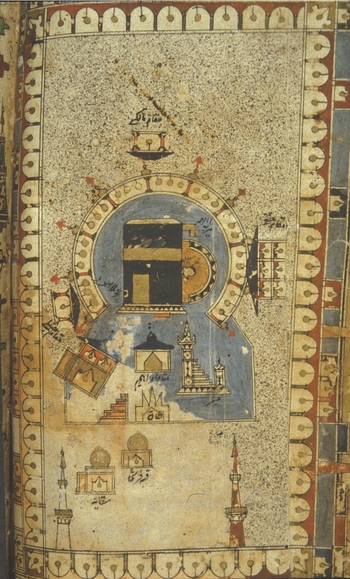
In one of the first mentions of Gujarat in his text, Jarullah thus reports the arrival of large sums of money at Mecca from Muzaffar Shah, a feature which he notes had been usual from about 922 H. These sums, he further remarks, were received by Khwaja Taj al-Din Jokdar Lari, an Iranian who held the position of the amīn of the Gujarat charities in the holy city. He also reports the decision taken on 12 Safar 924 H. (February 1518) that the amount was to be divided half and half between Mecca and Medina (Nayl, I, p. 53). A few months later, in May of the same year, it is reported that Yusuf Zanji, a prominent figure, had arrived from Diu to Jiddah, carrying supplies and other things. At much the same time, another ship, this one a royal vessel, arrived from Cambay on account of Muzaffar Shah himself (Nayl, I, p. 72). Such royal vessels were apparently quite a regular presence in the Red Sea from Gujarat, for we note again in March 1519 (Rabi‘ I 925 H.) that a messenger came to Mecca with news that a royal Indian ship from Cambay has arrived off Jiddah, in the company of three others, all under the direction of Khwaja Muhammad ibn Shaykh ‘Ali Gilani. This small fleet apparently carried a number of Meccan residents, who had visited India on trips, and were now returning (Nayl, I, p. 130). There were further arrivals in May, and among the things that were brought for Mecca was a very large Qur'an written in the hand of Muzaffar Shah himself, which he offered as a gift. The money accompanying this gift was a further 16,000 dīnārs, but there were also rich cloths, lac, indigo, and other goods (Nayl, I, pp. 138, 140–41). Jarullah notes that a great ceremony was held in public for the reception of Gujarat sultan's Qur'an and its proper installation. It also turned out that Muzaffar Shah had expressed his interest in buying some land for the construction of a madrasa. The land that was eventually acquired belonged to a Syrian trader, who had been in India and even met the sultan personally. But there was some untoward delay in the transaction—the sultan became annoyed, and pressed his agents to complete the purchase quickly. He was told that permission had to be obtained from the nā’ib of Egypt and from the Ottoman sultan, Selim himself, but this delicate task was eventually accomplished through the intercession of the sharifs. Not long after, by the month of Ramazan 925 H., it was reported that the Muzaffari madrasa was now up and running; ten men had been appointed to it at varying salaries and additional stipends, most of them significant Hanafite ‘ulamā but also the odd Shafi‘is (two out of the ten) (Nayl, I, p. 165) (see Figure 2).
Representation of the Ka‘aba in Mecca, from Muhyi al-Din Lari, Futūh al-haramayn. Source: National Museum, New Delhi.

The image that directly emerges even from these first mentions is of Gujarat as a highly prosperous region, with a devout ruler and a vibrant network of mercantile and religious activity, involving a number of ethnicities: East Africans, Iranians, Syrians, and so on. This is further confirmed in a notice from the month of Sha‘ban 925 H. (August 1519), which reports the arrival of a number of ships from India, including three of royal origin (shāhī al-muzaffarī), with a great many merchants on board who were natives of Rum, Syria, ‘Ajam, and Aleppo, as well as India. Among the prominent shipowners was a native of Aleppo named Barakat Halabi. Jarullah suggests that there had been an earlier depression in trade, but that there was now a visible improvement. This meant in turn that the Meccan intellectuals could think of the Gujarat court as a regular source of support and patronage. When these ships return to India, Jarullah declares that he intends to send two books which he had lately been working on: one for Sultan Muzaffar entitled Husn al-sulūk fī fazl al-mulūk (containing hadīth and other religious traditions), the other for the Gujarat wazīr Khudawand Khan, with the title Tuhfat al-masnad al-‘alī bi nukhbat al-asānīd al-‘āwālī. He further notes that many other Meccan scholars had begun to send their qasīdas and other works for the favour of the Gujarat sultan, while still others were now intending to go to India from Mecca in search of livelihood (al-rizq). The latter group included such men as Shaykh Muhammad ibn Abi al-Khayr al-Hariri, Shaykh Nur al-Din ‘Ali ibn ‘Abd al-Ra‘uf ibn Zahira (a relative of the qāzī of Jiddah), ‘Abd al-Wahhab al-Ahmadi (a noted singer), and his friend, Muhammad al-Badri, as well as Shaykh Nasir al-Muhaddith. Indeed, there were so many of these potential savant-migrants that the traders on the ships felt they were becoming something of a nuisance. So it was only with some difficulty that Shaykh Nasir, for example, finally found a passage on Barakat Halabi's ship (Nayl, I, pp. 158–59).
The text now begins to mention the Portuguese (or Franks) and their threatening activities with increasing frequency, in relation to both Gujarat and India more generally. In the month of Jumada II 926 H. (May 1520), rumours spread that some Franks who were headed from Dahlak to Hind had tried unsuccessfully to attack a Gujarati royal ship bringing gifts and alms for Mecca while it was off Aden (Nayl, I, p. 255).Footnote 42 Not long after, in January 1521 (Safar 927 H.), some traders arrived in Mecca from Aden with papers and disturbing news. It was reported that a ship belonging to the Syrian trader, Sajur al-Shami had been captured by the Franks near Hind. All those on board had been imprisoned after a fight and the ship itself burned down, with many casualties. Another ship on its way to India from Aden was also sunk, while two other ships that had left Jiddah, one carrying Malik Muhammad Gilani (the wakīl of the Muzaffari charities), were also attacked. It was rumoured more broadly that in their headquarters at Goa, the infidel Franks were getting ready to mount a major attack on Sultan Muzaffar Shah (Nayl, I, p. 311). By March that year, further news came in to Mecca from Jiddah, sent by the Indians who had just arrived there. They stated that the Franks who lived in Hurmuz had attacked Muzaffar Shah in Cambay, but that he had defeated them, despite the fact that they were 20,000 strong (and some even claimed they were as many as 100,000). The Franks had attempted to land in some towns in Gujarat and, even though they had been defeated, they continued to fight, so that Muzaffar Shah then asked the Lodi sultan of Delhi for aid (it is noted that he was given promises, but no concrete help) (Nayl, I, p. 323). The same season brought news of the arrival of two ships in Jiddah from India, one of which was from Bharuch (‘Barvaj’ in the text), carrying alms and donations from a prominent amīr of that port called Khayr al-Din, as well as from Malik Iyas (or Ayaz), described as Sultan Muzaffar's deputy (nā’ib). As for the other ship, it came from Diu and belonged to the same Barakat Halabi whom we encountered above. The nākhudā of this ship sent some papers to Mecca from Jiddah, with distressing news to the effect that when the royal ships for that year had come out from the port of Cambay, they had been attacked by Frankish ships; some had managed to get away but others had not.Footnote 43 However, Jarullah sounds a sceptical note here, noting that some people believed that this was a false rumour that was being spread in order to raise the price of the Indian goods on those ships that had in fact arrived (Nayl, I, pp. 325–26). Even so, it is clear from these mentions that the Portuguese were a growing concern for the traders of the Red Sea and Mecca.
There is now an interval of some years in terms of mentions of Gujarat. However, we know from Ottoman sources that these were the very years when they were beginning to make concrete plans to attack the Portuguese positions in India. In 1525, Captain Salman Re'is prepared a report for the Sublime Porte describing the military resources and supplies that the Ottomans had at Jiddah and elsewhere, laying out the possessions of the Portuguese in India, and the situation in Yemen. In this text, he stated: ‘It is said that the accursed Portuguese hold the above-mentioned ports with [only] two thousand men. Therefore, when our ships are ready, and, God willing, move against them, their total destruction will be inevitable, for one fortress is unable to support another and they are not able to put up united opposition.’Footnote 44 As we know, however, Salman was not the most discreet of tacticians, boasting of his plans to the Venetian bailo in Istanbul, who duly reported his claims back to his superiors in December 1525:
Suliman Rays has spoken to him of the matters of India, on coming [there] from Cairo, and he said he had been named captain of the fleet of the Soldan Gauri [Qansuh al-Ghauri] against the Portuguese, so as to chase the said Portuguese from India, saying that the Signor [Süleyman] wishes to prepare a fleet for India, and send him for that enterprise; and he has ordered the making in Alexandria of two great galleys and one supply ship with munitions for this end, in which there will be some 2,000 men for this purpose; and he said that in Alziden [Jiddah] there would be 30 galleys in order, and some galliots.Footnote 45
Jarullah, ever with his ear to the ground, also caught wind of some of these rumours. In the month of Zi-Qa‘da 932 H. (August 1526), he noted that a large sum of money had been accumulated in Jiddah for the Ottoman sultan by the nā’ib there, ‘Ali Rumi, amounting to about 280,000 dīnārs. But the sultan had now sent orders that this money should be set aside for the force that was being prepared by Captain Salman against the Franks in India (li-yusraf ‘ala al-‘askar al-mujahhazīn lil-Faranj fī jihat al-Hind al-qabtān Salmān). The sultan had also written a letter to the sharif of Mecca explaining his intentions in the matter and ordered the nā’ib of Jiddah to implement his command. But some misunderstandings had then arisen between the sharif (at this time Muhammad Abu Numayy) and Salman, since the former felt his revenues were increasingly being encroached upon. The people of Mecca also felt that the preparation of this force in Jiddah was a nuisance. Eventually, the nā’ib of Jiddah had to come to Mecca to placate the sharif, whom he reassured by saying that the Ottomans were not like the Egyptian Mamluks, who often made promises they did not keep. All of this was a temporary measure to raise revenues and increase the strength of the Ottomans, he declared. Rumours also now spread that when Captain Salman had reached Jiddah, he had fortified it because he feared that the sharif would attack him, and that the Arabs and Ottomans were headed for an imminent conflict. Fortunately, Jarullah reports, matters calmed down in the end (Nayl, I, pp. 369–70).
One can see clear traces here of Jarullah's scepticism regarding the Ottomans and their policies. Yet, at the same time, he is also clearly admiring of their military prowess in these very years. In the month of Rabi‘ I 933 H., when news arrived rather belatedly in Mecca via Egypt regarding the sultan's victory over the Europeans near Belgrade in the course of his jihād there, Jarullah rejoiced in the superiority of the sultan's tactics in the siege and the extent of his victory, which apparently involved the taking of 15 other forts.Footnote 46 Jarullah's elation is such at this great victory that he claims the Ottomans have managed to extend Muslim power to places where it has never been before (Nayl, I, p. 392). On the eastern front too, it would seem that they stand as a bulwark against the ambitions of the Franks, not only on the sea but on land. Thus, in the month of Muharram 933 H. he notes the arrival in Mecca of a large overland caravan via Yemen, bringing Shaykh Rashid ibn Mughamis ibn Saqar ibn Muhammad ibn Fazl, who had been the ruler of Basra and Qatif, and came accompanied by an entourage of 5,000 people. That whole area had sunk into chaos, because the chief there, Shaykh Muqrin ibn Zamil al-Jabri, had been killed not long before by the Franks and a succession struggle had followed. It is implied that a strong external hand had been needed to set this house in order (Nayl, I, p. 421).
The narrative of the eventual failure of Salman Re'is's expeditionary force and his own assassination is known to us from other sources, both Ottoman and Portuguese. As for Jarullah, he notes that in Jumada I 936 H. disturbances had been reported in Yemen against the Ottomans. One of Salman's former lieutenants, his nephew Amir Mustafa Bayram Rumi, who was now governor of Zabid, had been attacked and one of his forts taken by people from Aden. What made the matter particularly complicated was that Bayram had heard that while the Arabs were planning a rebellion against him, a Portuguese fleet was also approaching Aden. So he had at one and the same time to act against the Arabs and send ships out against the Portuguese. This proved too much for him to manage, and the Ottomans in Mecca were greatly disturbed at this news (Nayl, I, p. 503). So great were the tensions at this time that wild rumours began to gain currency. Thus, in the month of Sha‘ban 936 H., news arrived in Mecca that the Indian ships which had been coming to Jiddah that year had been attacked by the Franks near the Bab-al-Mandeb. It was claimed that the prow of Yusuf Turki's ship was damaged and the ship itself was looted. A small panic set in and prices of Indian goods rose in Mecca. But the ship eventually appeared in Jiddah, as did two others, and the rumour of the attack turned out to be false (Nayl, I, p. 513). Still, on other occasions, the rumours of attacks by the Portuguese did have a real basis. This was the case in Zi-Qa‘da 938 H. (July 1532), when some people came in from the south Arabian port of Shihr with news that some Franks had invaded their town, captured their ships, and seized their goods (Nayl, I, pp. 541–42).Footnote 47
Eventually, later that year, the word was that the Ottoman court had been stirred into action in the face of all this turbulence, and that the sultan had appointed a group in Suez to prepare for the fight against the Franks in India (Nayl, I, p. 545). At the same time, the Portuguese too began to make increasingly aggressive moves. In early 939 H. (September 1532), it was reported in Mecca that a ghurāb with Franks had come to Kamaran Island in the Yemen, to gather information on the Muslim forces there. This growing menace apparently caused consternation in Mecca. The Portuguese seemed to be spreading their tentacles everywhere, for a few months later, Jarullah received news from a friend in Shihr, Ahmad ibn Muhammad al-Harawi al-Makki, with more details about them. In this message it was noted that on 3 Jumada I 939 H., a Frankish ghurāb had menacingly approached al-Shihr, forcing another vessel to come towards the town. A rather unscrupulous man named Khwaja ‘Abdullah al-‘Ajami al-Aqta had seized the assets from this ship, dragged it on shore and broken it up, sharing the proceeds with some other people from among the ‘Umayra, who came and took what was left. Jarullah's friend was particularly dismayed that these people (some of whom he seems to suggest are Bedouins) were colluding with the Franks and shared the proceeds of looting with them. It was also rumoured that year that the many ships that were heading towards Jiddah from India were now under severe threat. One particularly active Portuguese captain had been making a menace of himself near Shihr and had already plundered several ships, including a Turkish vessel heading to India from Jiddah.Footnote 48
Jarullah's correspondent further informed him of news regarding Gujarat which had been received in Shihr via a small ship that had arrived there, carrying the son of Yusuf Khatuni. He reported that when they were in the vicinity of Diu, they had been surrounded by 38 Frankish ships, which were followed by an even larger fleet of 150 vessels that intended to capture Diu fort.Footnote 49 The Franks had run rampant that year, capturing as many as 20 Muslim passenger ships belonging to Yemen, Aden, and al-Mahra. They had also had some vigorous combats with ships from Jiddah, among which was one owned by Muhammad ‘Ali. A ship's captain (here, nākhūza) by the name of Muhammad Malu had fought bravely against them, but was eventually overpowered, even though he managed to drive a Portuguese ghurāb on land. Many passengers had jumped from their ships out of fear, and been carried off by the waves. In all of this, it was said that approximately 200 people died, like sacrificial goats before the Portuguese butchers. They included some prominent people: the son of Khwaja Qadir al-Din, who was the son-in-law of Khwaja Barakat Halabi; the son of Khwaja Zayn al-Din al-‘Ajami, formerly nāzir in Jiddah; and many others, especially among the so-called ‘Ajamis.Footnote 50
It was reported that when news of these depredations reached the Gujarat court, the ruler, Bahadur Shah, was furious. Among the ships that survived the first wave of attacks was one belonging to the so-called Rumi sanjakdār (perhaps the Ottoman governor at Jiddah), which had made its way first to a port generically termed ‘Fattan’ (possibly Somnath), and then eventually to Diu. Here its luck ran out, for it was again attacked by the Franks, driven on land, and set on fire. A few other ships did manage to flee to Somnath in safety, but once again the Franks caught up with them, burned them mercilessly, and captured the people on board. In India and many other coastal towns, there was great consternation as a result. Rice had become scarce and prices had risen fourfold in many places, with only hay and feed still easily available. In Indian markets, Syrian goods had become very dear, while Indian goods were seven times their normal price to the west. Meanwhile, Bahadur Shah—of whom much was expected in the fight against the Portuguese—had gone off instead to fight the infidels (kuffār) in Chitor. He had told the inhabitants of the Gujarat ports not to set out overseas, especially from Diu, as he wanted those places to be well defended. So the poor inhabitants of the Gujarat coast had no hope left, but had to wait for the arrival of the fleet of the Ottoman ruler ( Khunkār). There was naturally great disappointment when it did not turn up that year (Nayl, II, pp. 552–54). But Jarullah equally notes that in that year, Jiddah was starved of Indian goods and the traders were all plunged into a state of despondency.
The affairs of Bahadur
Unfortunately, things did not take a turn for the better. Rather, Jarullah reports the arrival on a Friday of the month of Jumada I 942 H. of six ships at Jiddah from India (bilād al-Hind).Footnote 51 This was a very unusual occurrence in terms of season (it being October 1535).Footnote 52 The local merchants were therefore rather surprised, and it was soon learned that the sultan of Cambay (Sultān Kanbāyat), referred to here as Bahadur Shah ibn Muzaffar Shah ibn Mahmud Shah, had recently lost a big part of his territory to Muhammad Humayun, the Mughal sultan, the son of Babur and the lord of Delhi. It was even said, noted Jarullah in passing, that this Humayun was the descendant of that ‘great tyrant’, Timur (the epithet probably being a reflection of Ottoman influence on our author).Footnote 53 After a number of reverses one after the other, Bahadur had eventually retreated to his capital (takht-i mamlikat) called Champaner,Footnote 54 and then fled in the direction of Diu. He had gathered together extensive gifts of jewels and cash, got hold of some ships in the area, and sent off his brother, his wife, and a group made up of his family as well as some special associates—some 2,000 people in all, including some excellent scholars (al-fuzalā’ al-mu‘tabarīn)—led by ‘Abd al-‘Aziz ibn Hamid al-Mulk, titled Asaf Khan, in the direction of the Red Sea.Footnote 55 These were the ships that had arrived in the royal docks (al-farza al-sultāniya) in Jiddah. Among their number, there were apparently two special ships carrying gifts for the great Khunkār, the sultan of ‘Arab and ‘Ajam, Süleyman ibn ‘Othman. One of these contained the goods of Mustafa Rumi, who was in Hind and an intimate of Bahadur Shah. This Mustafa had betrayed Bahadur and gone over to this enemy, the Mughal sultan, along with his supporters, and so his goods had been seized.Footnote 56 The remaining ships carried Bahadur Shah's family and the goods of his family and army. It was said that there were some 350 boxes of goods and diverse presents, including gold coins (thalātha mi'at wa khamsīn sandūqan min al-tuhaf wa al-naqd al-zahb al-mazrūb waghayrahu). When some of them were opened, they contained 7,000 or 10,000 dīnārs, intended for charity for the men of three of the important mosques, as well as some others (Nayl, II, pp. 602–09).
This unexpected arrival apparently caused much consternation. Jarullah reports that the governor (nā’ib) of Jiddah, who was a Rumi, kept these assets in his custody for a while in order to assess them. He also gave out that he was waiting for a response from the Ottoman sultan in Istanbul or the governor of Egypt. He did this because the sum of money was very significant and this sort of unsavoury behaviour was anyway his habit. The boxes contained studded dishes, destined for the sultan, as well as a precious sword for the governor of Egypt. Other gifts were meant for notables in Mecca and elsewhere. But the Jiddah governor seized everything except for some household effects. Jarullah clearly and strongly disapproves of these actions, though he notes that his report is based largely on hearsay. He also comments that the helpless Indian party did not resist the governor too much and only requested a few things back.
Apparently, Jarullah was not far off the mark here. This we can conclude from a confidential report sent by the incoming Ottoman governor of Egypt, Hadim Süleyman Pasha, to the sultan not long after the events. The report runs as follows:
What follows is that which is represented to the Exalted Court, Refuge of Felicity (āsitān-i sa‘ādet), would that God—may He be exalted—preserve it and aid it till the End of Time.
Earlier, when the treasure and the effects of Bahadur Khan arrived in prosperous Jiddah, and when Hüsrev Pasha came to know of it, he wrote a letter to the emīn of Jiddah and had all the goods and effects [of Bahadur] seized. Now [the emīn’s men] have sent a letter to Hüsrev Pasha saying: ‘Act quickly and present a request to the Sublime Porte, because some of these goods are meant as votive gifts (nezir), and some are for our expenses, and there is nothing else besides these.’ [Hüsrev Pasha] as for him, had represented to the Sublime Porte that these were votive gifts, and having issued an exception to the sacred order, sent it with [the caravan of] the pilgrims through the mediation of its superintendent (ketkhüdā) called Ferhad. When this person arrived there, at Mecca the venerated, he took away on behalf of Hüsrev Pasha—besides muslin, aloes-wood (‘ūd), raw amber and other gifts—some thirty thousand mithqāls of gold. As for the superintendent, the above-mentioned Ferhad, he took [for himself] six thousand mithqāls of gold, which makes a total of thirty-six thousand mithqāls of gold. Each mithqāl consists of 80 akçe, so that this makes 2,880,000 akçe, which in terms of kise units represents 57 kise and 30,000 akçe.Footnote 57
But, in reality, not everything was by way of votive gifts as had been reported by him to the Exalted Court. One part would have been gifts, and the rest would have been his [Bahadur's] treasure (khazine).
Here is a frank admission then of the unscrupulous and grasping practices of local Ottoman officials at Jiddah, in the face of what was a rather vast sum of liquid wealth. The report then concludes as follows:
As for the above-mentioned Bahadur Khan, until now there is no news of him. It is not known if he is dead or alive. If God wills, when the season (mevsim) comes and news of him arrives, they will be presented in detail and in a truthful manner to the foot of the Exalted Throne. But, since there is no news of him until the present, it is not certain that he is still alive. So that, when the season comes, if news of his death arrives, all of his treasure will become beyt-ul-māl, and will be seized on account of the Royal Treasury (mīrī), for he has neither children nor relatives. He only has one wife. As for the treasure that they have brought, it is beyond measure. According to their own declarations, besides other effects, they have brought in cash 350 bedre of gold coins, each bedre consisting of 7,000 gold coins, which in all makes up 2,450,000 gold coins.Footnote 58
What has happened is thus presented through this humble [written] page to the foot of the Exalted Throne. As for the rest, it is for the Exalted Court to issue an order (fermān).
[From] this poor servant (bende-yi faqīr), the humble Süleyman.Footnote 59
Having been plucked of a good part of their valuable resources, some members of the Indian party then made their way to Mecca; they included the important noble, ‘Imad al-Mulk, and the nurse of Sultan Bahadur's family as well as a larger group of women accompanied by soldiers (Nayl, II, p. 604).Footnote 60 Their obvious refuge was the madrasa constructed by Sultan Muzaffar Shah and it was here that they took up residence at the Bab al-Safa, near the Haram Sharif itself. The presence of this royal party, with rumours of its enormous wealth, caused a major disturbance in the town, if Jarullah may be believed. They were regularly approached by various supplicants and pensioners, and their arrival immediately caused prices to rise dramatically as the price of coined metal fell sharply. Among the goods on which there was a run were butter, meat, and other basic items of household consumption, for it seems that the fragile Meccan market of the off-season could not resist these big spenders.Footnote 61 Soon after, the Gujarat wazīr, Asaf Khan, also arrived with some slaves and the remaining soldiers of his party, and they camped at another spot, not in the madrasa itself. But since their numbers were large, they had eventually to rent other houses. Jarullah gives us a certain number of minute details of the negotiations on these matters, which eventually led to a house being found which belonged to a Shafi‘i qāzī, who was also a charitable trustee (mutawallī). But what Jarullah and other Meccan residents found particularly dismaying was that the Indian party was always throwing its money around, offering huge rents, so that the families who rented out to them made very sizeable windfalls. The Indian party also received some gifts from the local officials and beneficiaries (arbāb al-wazā’if) and gave generously in exchange. Jarullah makes it clear that all this caused quite a buzz and there was much activity around them in the town. But he also makes it clear that it was not all for the best and makes several hostile comments regarding this Gujarati-inspired inflation.
On the other hand, the Gujarati party also had its virtues. It is noted that ‘Imad al-Mulk—portrayed here as a pleasant and virtuous man—regularly gave out presents to local teachers and dervishes. As for Asaf Khan, he also continued to give gifts to the muezzins and others in need of financial aid. But once again quarrels arose around this charitable activity. The Hanafite imam, Muhammad ibn Ahmad Bukhari, was accused of controlling the distribution of funds to the detriment of others. The newly appointed Shafi‘i qāzī became increasingly annoyed with Asaf Khan as a result, feeling that he was wholly under the thumb of the Hanafites. Eventually, ‘Imad al-Mulk left Mecca for a time on a visit to Medina, along with Shaykh Mahmud Rumi (who held the title of Shaykh al-Haram al-Nabawi) and several other notables and leading qāzīs. Despite the flaring up of petty conflicts and jealousies between the sharif and Mahmud Rumi, matters were eventually settled.
As time went by, it became clear that the affairs of the Gujaratis were not about to be resolved rapidly. For one thing, the Ottoman court was too preoccupied elsewhere; it was around this time that a messenger arrived in Mecca from Cairo with news of Sultan Süleyman's recent and comprehensive victory over the Safavids (Nayl, II, p. 606).Footnote 62 It was learned that the monarch had left a deputy in charge of the new conquests and returned to Istanbul; in several of the empire's cities such as Cairo and Jiddah, there were major celebrations on the occasion. Early in the month of Rajab 942 H., Asaf Khan decided to organize a discussion at his house on Muhammad al-Bukhari's hadīth collection. He expressed a wish to invite all the communities in Mecca, and he asked Jarullah to supply some commentaries on the text, especially the Shafi‘i theologian Ibn al-Hajar ‘Asqalani's Fath al-bārī. At the same time Asaf Khan continued to receive worrying news from India, so that he asked that every morning the Sura al-An‘ām chapter of the Qur'an should be read for the spiritual benefit of Sultan Bahadur, who he knew was in difficult straits, in the Hanafi part (maqām al-hanafiyya) of the Masjid al-Haram. Some 50 ‘ulamā, from both ‘Arab and ‘Ajam, were asked to participate in this, including Jarullah himself. But the same Hanafite ‘ālim, Sayyid Muhammad ibn Ahmad Bukhari, was placed in charge of this, so that the Shafi‘i qāzī, ‘Abd al-Latif al-Zayni, felt quite aggrieved. Since he was the chief nāzir of the Masjid al-Haram, and a powerful man, he wrote to the Ottoman nā’ib at Jiddah complaining and asking for the cancellation of the reading. To render matters more piquant still, Jarullah also claims that the Mughals from India had sent their agents to influence people with secret payments, in order to prevent this from happening. The claim was further made that the very same Sura had been read over the past two months—but in order to ensure the victory of Sultan Süleyman over the Iranians—and that the new practice would interrupt that reading. The nā’ib then intervened, saying that the prayers for Süleyman should be resumed, as they were the real priority. It was also decreed that public celebrations be produced in honour of his victory and that the houses of even the traders from ‘Ajam should be decorated. Naturally, this caused a certain amount of resentment among those who had Safavid sympathies which led to quite a stir and dispute, with each side claiming it had been insulted.
In Jarullah's view, the root cause of all this commotion was the huge influx of money from India, and also ‘Abd al-Latif al-Zayni's desire to control it. Later in the month of Rajab, Asaf Khan personally went to the Ka‘aba and, accompanied by the Maliki qāzī and some other senior people, distributed more alms all around. He thus tried to mollify people by showing that he was not favouring the Hanafites alone (Nayl, II, p. 609). Over the next few months, he continued to show great generosity, distributing presents and money to various people, including Jarullah himself, sometimes amounting to as much as 100 ashrafīs a head (Nayl, II, pp. 613, 623). In late March 1536, at the end of the holy month of Ramazan, Asaf Khan again publicly distributed substantial gifts and money after nightly prayers. In the following month of Shawwal, there was quite a stir with the arrival of some 20 ships from ‘Hind’ (here meaning both India proper and Southeast Asia) in Jiddah. Jarullah clarifies that five were from the lands ‘below the winds (taht al-rīh)’, five from Calicut, and the rest from Cambay and Diu. The maternal uncle of Sultan Bahadur was on one of these, as was Asaf Khan's brother, Hamid al-Mulk; there was also Shams Khan, and Khwaja Khalil Gilani, who was a close confidant in charge of Sultan Bahadur's affairs (Nayl, II, p. 625).Footnote 63 Once again, the party brought a substantial quantity of gifts and money, though this time the merchants—wise after the previous year—advised them to hide the extent of their resources from the Rumis (or Ottoman officials). Even so, with their arrival, prices began to rise sharply in Jiddah and Mecca, a matter Jarullah found rather regrettable and unfortunate. As for political news from India, the party that had arrived put out that the Mughal sultan Muhammad Humayun had won some victories and had given over many powers to one of his brothers (meaning Mirza ‘Askari). Thereafter, his armies had begun to rebel, so that Sultan Bahadur had begun to hope he could return to his own lands.
But the new party brought fresh practical issues that had to be resolved. Some of the Gujarati nobles in the party decided to leave Jiddah for Mecca, where Asaf Khan had to make additional arrangements for them. He himself took on a larger house, so that he and his brother could reside together. Eventually, Khwaja Khalil Gilani also came to Mecca with his ailing father, who died soon afterwards, in the course of the month of Shawwal. Asaf Khan now asked the Maliki qāzī, Taji ‘Abd al-Wahhab ibn Ya‘qub, who had emerged as the chief intermediary of the Gujaratis, to arrange a formal meeting and meal with the sharif, so as to discuss some outstanding matters. On this occasion, some gifts were given by the Gujaratis to the sharif, including various presents placed in large Chinese jars (presumably made of porcelain). As a consequence, Jarullah reports, the sharif came to be better and better disposed to Asaf Khan, towards whom he had been somewhat hostile at the outset. Early in the month of Zi-Qa‘da 942 H., he even paid the Gujarat wazīr a formal visit at home and was offered sherbets, betel-leaf (tambūl), camphor, and other things according to the Indian custom. A very substantial cash gift was offered to him at this time through one of his intimates, Sayyid Nur al-Din Ahmad Iji, but the sharif only took half of what was offered, saying that he had come to honour the wazīr and not to take his money. In this atmosphere of growing bonhomie, Asaf Khan and the sharif began to visit each other regularly and the wazīr was even permitted to use a fālkī, a carriage drawn by two horses, in order to get around (Nayl, II, p. 627).
It eventually turned out that Asaf Khan was a rather more able diplomat than had been suspected. On Friday 18 Zi-Qa‘da, an official with the rather odd name of al-Kikhia al-Rumi arrived in Mecca from Istanbul along with Asaf Khan's own envoy, Yafi‘i, and came to the Gujarat wazīr’s house. He had brought a message from Süleyman's court, saying that the goods of the Gujaratis that had been sequestered so far in Jiddah should be released. Further, a gift of 10,000 ashrafīs had been sent from the court for Asaf Khan, as well as 300 loads of rice, wheat, sugar, and other goods—the wazīr was naturally overjoyed. The Ottoman envoy did the rounds of Mecca and paid a series of ceremonial visits, possibly to ensure that the royal orders were followed properly (Nayl, II, p. 629). A newly confident Asaf Khan thus profited from the next month of Zi-Hijja, when the hajj took place. He sought out members of the Istanbul hajj party and gave them a substantial gift from Bahadur Shah for Sultan Süleyman: this included a waistband (nitāq) studded with jewels and stones as well as other precious objects and gold coins. Asaf Khan also resolved to send some of the members of his own party along with the returning Ottomans to Istanbul; these included the young Qutb al-Din Muhammad Nahrawali, whose father Jarullah notes was also a well-known Hanafite scholar. Qutb al-Din and Abu Sa‘ud ibn Shaykh ‘Abd al-Baqi were officially deputed to accompany ‘Imad al-Mulk al-Banani (also called ‘Umdat al-Mulk) on his journey (Nayl, II, p. 635), carrying a letter from Asaf Khan to the Ottoman ruler.Footnote 64
In light of their growing friendship, Asaf Khan decided at this point to give over the responsibility of handling all the money and alms coming from India to Sharif Abu Numayy. But this was soon shown to be a major error of judgement. The sharif began to claim a third of these sums for himself, as a levy; in absolute terms, this was reckoned to be a very large amount of money, as it included quantities of unminted gold (Nayl, II, p. 641). The sharif placed the rest of the money in the charge of a number of other people, including Khwaja Khalil Gilani who had arrived from Gujarat. It was then distributed to a large number of beneficiaries, including the eternal grumbler, al-Zayni. Jarullah implies that too much of this money went to go-betweens rather than to the people of Mecca, who remained somewhat deprived (mahrūm). He implies too that in these Ottoman times, it would ever be the fate of the Arabs to be short-changed in this way. Interestingly, Jarullah chooses to reproduce in his text the paper certificate (wasl or wasliyya) that he himself received along with some money, as his part of the alms that were distributed by the Gujaratis. The certificate was from Khwaja Khalil through his financial superintendent, Miyan ‘Umar, and is dated 16 Muharram 943 H. (Nahrawali, in his marginal comments on the manuscript, comments sarcastically that the gold in general thus disappeared into the belly of beasts, though he managed to get a little bit himself) (Nayl, II, p. 643).
The party from Gujarat was at this time in rather good humour, especially in view of the news of Bahadur Shah's continued victories over Humayun and the latter's retreat from Gujarat. Some of this news was brought by an envoy called Khojki Muhammad Sherwani, who arrived unexpectedly from India in a ghurāb, having been sent by Rumi Khan (Nayl, II, p. 664). Asaf Khan was so overjoyed at his arrival that he organized a special celebration. Meanwhile, Jarullah himself received a letter from his friend, Ahmad ibn Muhammad in Diu, which had been written in the middle of Rajab 943 H. (late December 1536). He reported that prices had been high in India, especially of rice and other foodstuff, but that they had come down slightly of late. Sultan Bahadur was so busy fighting the infidel Rajputs that he had not had time to stay long in his capital city. It turned out that even the infidels in his own kingdom had betrayed him in his earlier battles and engagements. The sultan had no good advisers left on hand, nor any virtuous and reputed wazīr, so that tyranny was generally on the rise. On the other hand, the Franks had seized the opportunity, and some of them had made such a large fort on the Ras al-Khor (in Diu) that none of the sultan's people actually had the courage to enter it. The Franks had also made it clear that they would allow no one in their fortress, and that if anyone entered it, they would not let him out again (Nayl, II, p. 665). A couple of months later, in Ramazan 943 H., Jarullah reported the fresh arrival in Jiddah of five ships from India. On them was a Turkish wazīr from the Deccan called Harsah Khan, who was closely linked to Mustafa Khan. Rumi Khan's ship had also arrived from Gujarat, and with it news came of a major victory of Sultan Bahadur over Humayun some months earlier, in Muharram 943 H.Footnote 65 Asaf Khan, ever the big spender, was so overjoyed at this that he poured hundreds of ashrafīs into public celebrations (Nayl, II, p. 666). It also began to appear that the Ottomans were prepared at last to take action on the affairs of India. From some envoys who arrived in Mecca via Jiddah from Egypt on 17 Ramazan, it was now bruited about that ‘Umdat ul-Mulk (who had been sent months earlier by Asaf Khan to Istanbul) had finally succeeded in obtaining an imperial hukm-nāma for the nā’ib-i Misr Süleyman Pasha, in Egypt, instructing him to have Amir Janim al-Hamzawi prepare a force to move against India. Apparently, Janim had sent his son, Mahmud, to the Red Sea with these envoys, and plans had been made for over two months in Egypt—since the month of Rajab—to go to the aid of Sultan Bahadur Shah (Nayl, II, pp. 667–68).
But the shocking news from India changed all this. First it appeared as a rumour, and then by the month of Zi-Qa‘da 943 H. increasingly as confirmed fact: Bahadur Shah had died at the hands of the Franks in an ambush. Here is how Jarullah puts matters in his text:
Some Indians arrived, met the wazīr, and confirmed the news of the killing of the Sultan on 3 Ramazan at the hands of the accursed Franks in Diu. The Sultan had gone in a boat to meet them in the company of about ten of his close companions, and he approached the ship of the [Frankish] captain. He saluted him, and disembarked nearby to go to his quarters. The captain asked him [Bahadur] to approach so that he could give him details about the fort. But he refused to advance. Thereupon, members of the [Frankish] group said in a foreign language to seize him [Bahadur]. He divined their intention, and drew his sword. He killed the chief of those who advanced. The others then overpowered him. They were numerous and he [Bahadur] had few helpers. So they killed him in cold blood (bāridan), as well as the other Muslims who were with him. Thus, it was a great blow to the Faith (Nayl, II, pp. 673–74).
The Franks were clearly blamed here for the sultan's death, though whether it was a premeditated act or a plan to seize him that had gone awry, remained unclear. Jarullah reports that Asaf Khan was now in a state of consternation, but had initially decided to keep the news secret. But on the very next day after the arrival of the Indian traders, on 13 Zi-Qa‘da, the nā’ib of Jiddah, Süleyman Rumi, himself arrived in Mecca, ostensibly to condole with Asaf Khan. At this point, the rumours could no longer be contained. The nā’ib then stated that he wished to seal and sequester the goods of Bahadur Shah; the wazīr tried to resist this act, and insults and harsh words were exchanged. Eventually, some of the goods were taken away on camel-back to the nā’ib’s residence, amounting to some 250 boxes or even more. The wazīr continued to ask for a proper legal document (or mahzar), confirming that these boxes had been seized, and Jarullah reports that the nā’ib eventually, and somewhat reluctantly, gave it to him. It was said that this seizure was enormous in dimensions, amounting to some 700,000 ashrafīs, including both very old coins and gold bars. The Gujarati party decided that the matter should be referred to the sultan in Istanbul, and the dispute continued for several months (until at least Safar 944 H.), leading to a delay in the return of the Indian ships in that season. When they did manage to leave, it was at an inappropriate moment, and it is reported that one of them sank near Jiddah with considerable losses (Nayl, II, p. 701).
The aftermath
The death of Bahadur Shah in the waters off Diu in February 1537 clearly transformed the role, whether real or imagined, of the Gujarati party that had disembarked on the shores of the Red Sea two years earlier. Faced with this new and unexpected situation, and the seizure of the sultan's effects, Asaf Khan initially decided to send ‘Umdat ul-Mulk once more to Istanbul; the latter showed his lack of enthusiasm by stating that he would make this an elaborate pilgrimage and only return via the Bayt al-Quds (or Jerusalem) to Mecca (Nayl, II, p. 675). By May 1537, Asaf Khan had expressed his intention to go himself to Istanbul with the returning hajj caravan from Egypt (Nayl, II, pp. 684, 687). For a time hostilities between the Gujaratis and the Ottomans were now barely concealed.Footnote 66 Towards the end of the month of Safar 944 H. (early August 1537), some of the ships at last set out for Gujarat from Jiddah; earlier, the nā’ib of Jiddah had stopped the vessels from Cambay and Diu from leaving at the normal time (corresponding to Nauroz, or late March), stating that since Diu had been taken by the Franks who had also killed the sultan, they had better remain in Jiddah (Nayl, II, pp. 700–01). In contrast, the Calicut ships were allowed to leave at their appointed time. But by the time (that is, late July or August) that the Gujarati ships were given leave to depart, the proper sailing season was over. So the ships tried to make a fast and desperate run across. The consequences were not happy: as noted above, one ship sank near Jiddah at Sha‘b al-Mahram and many traders and goods were lost, perhaps as much as three-quarters of the cargo. Among the fortunate survivors was ‘Arif ‘Ajami, as well as Shaykh ‘Abd al-Haqq, who was linked to the Mughals in India.
Asaf Khan's visit to Istanbul did indeed take place, as we learn from Jarullah. Already in the middle of the month of Rabi‘ I 944 H. (or late August 1537), word had arrived at Mecca from Cairo, to the effect that Asaf Khan had been given a warm welcome in Egypt and had then set out from Iskandariyya for Istanbul (Nayl, II, p. 704). Not long after, the confiscated effects of Sultan Bahadur were largely returned to the Gujarati party in Mecca (Nayl, II, p. 710). It appeared that the Ottoman court was in a triumphant mood, and that Sultan Süleyman, after winning what was described as a major ‘victory over the Franks’ on the western front, had recently returned to his capital (in fact, he returned on 22 November) (Nayl, II, p. 720).Footnote 67 By May 1538, as the time of the next hajj came around, Syrians from the newly arrived Damascus caravan informed Jarullah that Asaf Khan was on his way back from Istanbul via Jerusalem and the tomb of Abraham at al-Khalil (Hebron). He was apparently accompanied by Muhammad ibn Ahmad Bukhari and other important Hanafi divines, some of whom were in fact relatives of Jarullah (Nayl, II, p. 737). But Asaf Khan's extended absence from Mecca meant that the Indians there had become quarrelsome and obstreperous; on one occasion, two Indians fought so violently that one of them died later of his wounds. The problematic status of these visitors who had somewhat overstayed their welcome became the centre of a big debate in Mecca (Nayl, II, p. 743). So it is with some relief that Jarullah reports in Safar 945 H. (July 1538) that Asaf Khan has returned at last to Mecca, and was again organizing important and elaborate celebrations (Nayl, II, pp. 745, 752–53).
Whether or not on account of Asaf Khan's visit to Istanbul and his intervention at the court, we learn that later in the same month the long-delayed project of sending an Ottoman fleet to India had become a concrete plan. The Meccans received several pieces of news about this fleet, which was ostensibly being sent in order to fight a holy war ( ghazw) against the Franks, who were regarded as the enemies of Allah and the Muslims (a‘da’ al-Allāh wa al-Muslimīn). This news was followed by the arrival of an envoy to the sharif from the nā’ib of Egypt, Süleyman Pasha al-Khassi (the eunuch), who stated that in keeping with an imperial order which the latter had received dated 10 Muharram (early June 1538), ships and men for the Indian expedition had been sent from Egypt to Jiddah. This fleet would go to the island of Kamaran and await orders. The pasha himself was first coming to Mecca for ziyārat and would pray there for victory over the enemies. (Nayl, II, pp. 746–47).
Portuguese espionage networks had already got wind of a version of this plan almost a year earlier, as we see from the following letter written by Pedro de Sousa de Távora in Rome to King D. João III, dated 19 July 1537. Here is how Távora saw matters:
After I wrote to Your Highness with the general news from these parts, a most particular case arose of which I should inform you, and it is that a certain Álvaro Madeira, a native of Sousel, arrived here and told me that he came from India, and he recounts that his coming was in this manner. That he was made prisoner along with one Manuel de Meneses in Xael [Shihr]; and the king of Xael sent him with thirty-four other Portuguese to the Grand Turk as a present, and they were taken by a Turk who came from Diu with permission from Nuno da Cunha in a ship, who handed them over to the captain of Cayro. And this captain informed himself of which of these Portuguese were the most experienced in India, and amongst them he chose this Álvaro Madeira and one Diego Martins, a New Christian, and he sent them to the Grand Turk by the [rapid] postal route (pellas postas) to Constantinople, where the Grand Turk informed himself extensively on the matters of India through this Diego Martins, since he was told he was a pilot. And thereafter they were handed over to one Joham Francisco Justiniano, a Venetian, who had already been in Portugal, and on whom the Grand Turk relies a great deal for India affairs.Footnote 68
The events that are referred to here date to 1536, around the time when first Asad Khan's envoy Yafi‘i, and then the larger delegation headed by ‘Imad-ul-Mulk, had appeared at the Porte. Távora then continues as follows:
And then very quickly, around the 25th of last October [1536], the Turk sent Solymam Bassa to make ready the fleet that they have in Suez, in order to go against Your Majesty. Which fleet is made up of seventy galleys, and seven or eight galleons which had been sent to him by the king of Cambay after Diu had been taken: along with these galleons, an ambassador came from the same King of Cambay, and he brought a great tribute (serviço) of money for the Grand Turk, which it has been heard would have amounted to four millions in gold, and this in order that the Grand Turk should help him against Your Highness with that fleet and with people, along with which he asked for 30,000 men, saying that the agreement that he had made with Your Majesty's people regarding Diu was to make them more unguarded on believing that since they held Diu, they had secured India, and by this means the Grand Turk could make his fleet ready along with those people whom he was asking for; and that he would give him the port of Çurrate [Surat] or Cambaiete [Khambayat], where they could shelter without Your Majesty's people knowing of it; and that after the Turks had gone there, he would give them Diu as well as the Portuguese who were there; and he also sent him Moorish pilots. The Turk rejoiced greatly on account of that embassy, believing that in that way he would be able to conquer India; and so he at once ordered the fleet and people to be made ready, and he also ordered that all the ships that might come from India to Jiddah and Mecca should be detained, so that they could carry people and supplies for this fleet.
However, it turned out that as late as March 1537, the Ottomans were proving indecisive. An initial decision was apparently made by the sultan to send ‘as the Captain-General of this enterprise one of his brothers-in-law, the brother of one of his wives’, accompanied by a specialist mariner who was captain of the Alexandria galleys, and the renegade, Gian Francesco Giustiniano, ‘as superintendent and adviser, and as pilot-major’. But the first part of this decision was clearly rescinded thereafter. Távora, whose information we have noted came from Álvaro Madeira (who had somehow managed to escape the Ottomans and flee to Rome), was only able to glean that ‘the purpose of the Turk's people is to attack Ormuz first, and from there to pass on to Cambay’, but also that ‘according to the monsoons and the time they need to get ready, they cannot leave the straits of Mecca before the coming February [1538]’.Footnote 69
This was actually an optimistic timetable. According to Jarullah, Süleyman Pasha only arrived in Jiddah in mid-July 1538 (14 Safar 945 H.). The nervous sharif quickly sent someone out to greet him, with gifts and supplies. This envoy met Jamal Muhammad ibn Ahmad al-Marisi in Jiddah and was informed by him that the pasha had come there with a substantial fleet of about 60 vessels, but that an altercation had broken out, and that the pasha had had Amir Janim al-Hamzawi killed.Footnote 70 Since Janim Bey was a person of some prominence, the matter was now the subject of an investigation. The sharif was highly distressed on hearing this news. He decided to make his own enquiries, and sent his own eldest son, Sayyid Ahmad, and a group of Meccans to Jiddah to meet the pasha. The pasha welcomed them, but also let them know that Hamzawi had been killed not on his own initiative but on imperial orders (annahu lamyaqtul al-Hamzāwī illa bi-‘amr-i Khunkār). He then handed out robes of honour to various people and sent them back to Mecca. During all this, the ever-arrogant pasha did not even descend from his vessel, but simply asked for wood and water for his fleet. Meanwhile, the sharif had begun to prepare a proper reception in Mecca itself, bringing back 30 camel-loads that he had sent to the Dakna Wadi in anticipation of the pasha's arrival.
There now follows a somewhat opaque passage in Jarullah's text, concerning Süleyman Pasha's meeting with Khwaja al-Hayjarī, who is described as the ‘son-in-law of the Frankish captain (sihr-i kaptān al-Faranj)’. He was apparently interrogated concerning this Portuguese official, and the territories under his control, and gave a full account of their power. Wild rumours spread that the Khwaja had been killed following his interrogation, but it turned out in fact that he had been released (Nayl, II, p. 748). The pasha then decided at last to depart from Jiddah. By now, his accumulated fleet numbered about 90 ships, though some people claimed the total to be over a hundred. On the morning of 18 Safar, after a short five-day stay, he set sail from Jiddah and went southwards at a rapid pace. The sharif's elaborate preparations to receive him were all in vain, though it was said that the pasha took away 600,000 ashrafīs from him. However, as Jarullah notes, these were all contradictory rumours, seemingly based on little more than the pasha's rather unsavoury reputation (Nayl, II, p. 749). Further, we learn from him that the Turks in Mecca had held a recitation of the Sura al-An‘ām in the Hatim Sharif of the Ka‘aba, praying for the eunuch Süleyman Pasha's victory against the Franks in India. Jarullah gives some details of all those who participated in the event, but also notes that the Arabs resented being excluded from the affair (Nayl, II, p. 750).
Some seven months after his departure, in the middle of the month of Ramazan 945 H. (early February 1539), an envoy of the pasha arrived in Mecca from the direction of Yemen. He brought news that the fleet had returned from India to Kamaran Island and was planning to come to Yemen. To facilitate his further movements, the pasha asked for 200 horses from the sharif. The sharif then headed out from the city and went to Jiddah, along with the envoy. Jarullah reports that the current news regarding the pasha's expedition remained rather confused, as it was not clear what exactly had happened in Diu with the Franks. Had he fought them and won in Diu, or had the Franks simply fled? Did the pasha enter Diu itself, or did he only make it to the ports around there? It was then eventually recounted that when the Ottoman fleet had arrived in India, the chief (muqaddam) of Diu, Amir Safar al-Rumi, had met the pasha and exchanged robes of honour, and that the pasha had given him orders to ensure the security of the country. He had then stated he would return to Yemen to pacify and settle it, make the hajj pilgrimage that year (in April–May 1539), and only then come back to India to fight the Franks.Footnote 71 He also had made it his priority to ensure the protection of the Bab-al-Mandeb. The pasha had also sent word to the sultan in Istanbul asking for more armies and more supplies. In the Red Sea area itself, he had then sent a nākhudā Ahmad to the town of Zabid to ask its lord to meet him (Nayl, II, pp. 758–59).Footnote 72
Further details of the anti-climactic expedition then emerged in the months that followed. As had been announced, in the month of Zi-Hijja, Süleyman Pasha duly appeared in Mecca to perform the hajj, and formally participated in the ceremony of clothing the Ka‘aba. For his part the sharif treated him with extraordinary respect and caution.Footnote 73 But it was also put about that the sultan had sent him an angry written message (marāsīm) regarding his poor behaviour in India and Yemen, and the fact that in place of fighting the Franks, he had simply quarrelled with other Muslims.Footnote 74 The sultan had apparently told him in no uncertain terms that he had not done what he was meant to do, and instead done what was not required. In due course the pasha left Mecca to perform the other parts of the hajj pilgrimage (Nayl, II, p. 778). The next month of Muharram 946 H. (May–June 1539) brought the usual contingent of ships from Calicut, Southeast Asia (‘the land below the winds’), and Diu. Two were apparently a special gift for Süleyman Pasha from Safar al-Rumi, the nā’ib of Diu. It was said that Safar had annoyed the pasha by broadly hinting he was hastily leaving India for the Arab lands for fear of the Franks, and so this was his belated effort at an olive branch. The pasha took his agent's goods and sent him back summarily. It turned out that the Gujaratis intended nevertheless to continue their struggle against the Portuguese. Jarullah reports that word had arrived in Mecca that Mahmud Shah, nephew of Bahadur Shah, had succeeded to the throne and had ordered the destruction of Diu in order to counter the dominance of the Franks. But this had so far proved of little avail. The young Gujarat sultan had also requested the return of Sultan Bahadur's family members to Mecca. It was therefore left to Asaf Khan to arrange for their departure from Jiddah, carrying at least a good part of their remaining wealth (especially in the form of jewels) (Nayl, II, p. 785).
As for Asaf Khan, Jarullah reports that he continued to try and ingratiate himself with the sharif of Mecca (Nayl, II, pp. 782–83). In the month of Safar 946 H. (late June 1539), he lost one of his companions, Shams Khan, who died even as he was headed back to India. A proper burial was performed for him in Mecca, with the man in charge of the ceremony being Shaykh ‘Ala al-Din Nahrawali, one of the regular residents at the time in the Muzaffari madrasa. The last mention of Asaf Khan in Jarullah's text is in the month of Jumada I 946 H. (September 1539), which describes a ceremony for Asaf Khan's son, Qutb Khan, in the former's house in Mecca. Jarullah still seems to have retained a fondness for him, and continued to praise his good qualities. But by this time Sultan Bahadur's family had left for home, and the great and wealthy Gujarati amīr was hardly the man of considerable substance he had once been (Nayl, II, p. 800). He would eventually return to India only in 1548, after an extended absence of 12 years, when he once again play a key role in the Sultanate's politics for a time before being assassinated (along with his later master, Sultan Mahmud) in 1554.Footnote 75
Concluding remarks
The purposes of this article have been several, with the central one being to draw scholarly attention to a neglected and important source from the sixteenth century written in the crucial centre of Mecca, the spiritual—but also, in some crucial respects, the informational—heart of the Islamic world.Footnote 76 In our exploration of this source— Jarullah's annalistic work entitled Nayl al-munā—we have chosen furthermore to focus on a particular set of aspects, namely those having to do with the Red Sea and the Hijaz in relation to Gujarat. We have attempted to demonstrate that a strong and quite regular political, commercial, and intellectual link existed between the Gujarat sultanate and Mecca, and that mercantile traffic between the Red Sea and the Gujarat ports (Cambay and Diu) was kept alive between the 1510s and 1530s by a number of participants both from South and West Asia, ranging from smaller individual entrepreneurs to the Gujarat sultans themselves. Future historians of trade may wish to look further into the careers of men such as Khwaja Muhammad Gilani, Yusuf Turki, and especially the interesting figure of Barakat Halabi (besides the various ‘Ajami traders mentioned periodically in Jarullah's text). A systematic reading of the text may also yield further data not only on trade with Gujarat, but also between Jiddah and the ports of Kerala, as well as Southeast Asia (which has been mentioned periodically in our text as ‘the land below the winds’).
Some two decades ago, Jean Aubin indicated to us (in the course of conversations) his intuition that it was necessary to go beyond the usual Portuguese and Italian sources, in order to understand how the spice trade through the Red Sea actually functioned in the first decades of the sixteenth century. As he was later to note, there were ‘statistics regarding the quantities [of spices] taken by the muda galleys at Alexandra and Beirut. Magalhães Godinho has set them out. [But] these numbers have no explanatory value.’Footnote 77 This eventually led him to a close examination of the narrative sources in Arabic, notably the works of Ibn Tulun and ‘Izz al-Din ibn Fahd. From these, as well as a reading of other Mamluk and Italian sources, Aubin then came to the following startling conclusion for the period 1501–04: ‘It was not in the Indian Ocean, but from Djedda that everything was blocked. The accumulated delays show, in the sequence of their chronological detail, that the paralysis that struck the Islamic spice route was due to the internal troubles of the Mamluk regime.’Footnote 78 As a view, this was in keeping with a far more complex (and less Eurocentric) conception of Indian Ocean and Red Sea trade, in which not everything was played out in the game between Venice, Lisbon, and Antwerp. Fresh or neglected sources thus allow us regularly to transform our old schematizations and models in political economy. In sum, social scientific model-makers still have much to gain from the work of humanistic historians.
But what may also eventually be at stake is an issue in intellectual history, namely the question of how to gain a better and more balanced understanding of sixteenth-century historiographical production as a whole, in the context of imperial and intellectual competition in areas such as the Indian Ocean.Footnote 79 The past few decades have seen important works on the most significant Ottoman chroniclers of the sixteenth century, such as Celalzade Mustafa and Mustafa ‘Ali, which can be set alongside the shelves of books that have long existed on Paolo Giovio and Francesco Guicciardini, or the smaller bodies of works on João de Barros, Gonzalo Fernández de Oviedo, or Antonio de Herrera y Tordesillas. Paradoxically, the Arabic historiography of the period has received short shrift in comparison to these other works, and also in comparison to the attention devoted to earlier moments in the Arabic historiographical tradition, whether of the ‘Abbasids or of the chroniclers of Andalusia.Footnote 80 An example of this neglect is the figure of Qutb al-Din Muhammad Nahrawali, who still awaits a proper monographic study. As Richard Blackburn has written, ‘Indian by birth, Meccan by adoption, Arab in culture, and Ottoman in political adherence, Shaykh or, as the Ottomans referred to him, Mevlā Qutb al-Din al-Makki was recognized among later writers for his depth and breadth of learning and for his skills in Arabic, particularly in poetry and epistolary composition.’Footnote 81 This allowed him to write works such as al-Barq al-Yamānī, an important chronicle of the Ottoman conquest of Yemen produced at the command of the wazīr, Koca Sinan Pasha. Of this text, Jane Hathaway avers, ‘The Meccan judge Qutb al-Din Muhammad Nahrawali's (1511–82) sprawling chronicle of Yemen, the Holy Cities and the Red Sea region is virtually unique in its trans-provincial purview; in an example of bilingual cross-fertilization similar to that provided by the circulation of Ibn Zunbul's chronicle, it was translated into Ottoman Turkish and continued by an Anatolian military commander posted to Yemen.’Footnote 82 Nahrawali also produced a work on the holy city of Mecca, I‘lām bi a‘lām, with biographical notices and other materials, which has long been recognized as a valuable source.Footnote 83 To be sure, while frequently being abrasive and boastful, it has also been noted of Nahrawali that ‘his advocacy of the [Ottoman] sultans did not cause him to withhold criticism of Ottoman officials or policy when he judged these to be deserving of it’.Footnote 84
Though Jarullah ibn Fahd stands in a genealogical relationship of some sort with Nahrawali, on account of being a direct source for the latter (as well as a personal acquaintance), it would be hard to place him in the same category as an intellectual. Indeed, recent scholars have mostly portrayed him as a somewhat marginal and cantankerous figure, known more for his back-biting and fondness for slander ( ghība) than for any other qualities. We thus learn in one recent work that he was ‘a Meccan historian who wrote a book that controversially exposed some of his contemporaries as being bald under their turbans (. . .). His work so angered these men that they seized the book from his home and washed the pages at the local mosque, dissolving the ink. He attempted to undo their shame (and his own) through public debates with the Meccan theologian Ibn Hajar al-Haytamī (d. 974/1567), who had been named in the book as bald, about the lawlessness of revealing others’ physical blights and by ultimately rewriting the work, omitting the names of these bald men.’Footnote 85 Jarullah's defence, when he was morally admonished and physically attacked (his house being stormed in November 1541), was primarily to claim that he was writing for entertainment and admonition (rather than in a purely satirical vein), but he also remarked (perhaps tongue-in-cheek) that he himself had openly admitted to having a ‘receding hairline’.
In any event, whatever moral difficulties he may have had with his censorious Meccan contemporaries, it should be evident to us that Jarullah ibn Fahd remains a very close observer of his times and circumstances. While he was no grand sixteenth-century theorist of history in the sense of an Ibn Khaldun, a Mustafa ‘Ali, or an Abu'l Fazl, his work was the more humble one of an annalist, but one with an ever-critical and even caustic eye that he deployed to observe the doings of the powers of the day. Such texts as his remain crucial for the writing of a histoire événementielle of the Hijaz in the period, as well as for the diplomatic and commercial history of the Indian Ocean at the time. However, we cannot neglect the copious light that a work such as his sheds on the tensions within the Sunni Muslim community of the Hijaz (and eastern Ottoman domains) in the aftermath of the Ottoman conquest, which may in turn help us to understand why it eventually proved so difficult to offer a more sustained and directed resistance to Portuguese ambitions.Footnote 86 The view from Mecca that he provides is one that remains rather ambivalent in regard to the rising Sunni power of the period, the Ottoman empire. There was no simple religious glue that held the Sunni Muslim merchant communities of the Indian Ocean together, even in the face of an important threat from the Portuguese.
Glossary
-
amīn = administrator
-
ashrafī = gold coin
-
bailo = Venetian diplomatic agent
-
faqīh = jurist
-
g hurāb = small ship
-
hukm-nāma = order, royal order
-
k hutba = Friday sermon
-
k hwāja = high status person, important merchant
-
muda = allotted time for trade-galleys
-
nā’ib = deputy, governor
-
nākhudā = ship's captain
-
qasīda = praise-poem
-
sanjakdār = Ottoman governor
-
sikka = silver coin
-
tazkira = biographical dictionary, memoir
-
tanka = silver coin
-
wakīl = agent
-
wazīr = vizier, minister
-
ziyārat = regular pilgrimage (as distinct from hajj and ‘umra)