On June 26, 2012, the South Ch'ungch’ŏng (Chungcheong) provincial government hosted the Silver Light Festival (Ŭnbit p'esŭt'ibal) in Ch’ŏnan (Cheonan), a small city located fifty-seven miles south of Seoul. Held in the Ch’ŏnan Municipal Center, the festival began with music and dance performances by the Pyŏngyang Minsok Yesultan (Pyŏngyang Folkarts Troupe), a troupe of North Korean migrants based in Seoul. While the latter part of the festival consisted of a series of dance performances presented by senior leisure groups from local community centers, nurseries, and cultural activity organizations, Pyŏngyang Minsok Yesultan was a featured part of the opening events, performing for about forty-five minutes.Footnote 1
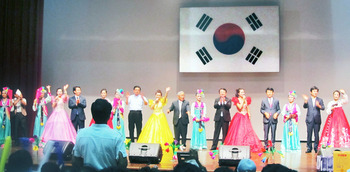
The major patrons of the festival were the provincial and municipal governments. Another major supporter was the Korea Freedom Federation (Han'guk chayu ch'ongyŏnmaeng), a well-known anti-communist, right-wing organization, established in 1954, a year after the armistice of the Korean War. Government officials, including the deputy mayor of Ch’ŏnan and local politicians, were present to celebrate the event, sitting in the front rows together with the leader of Pyŏngyang Minsok Yesultan and the deputy head of the Korea Freedom Federation (see figure 1). After the introduction of VIPs and a speech by the deputy mayor, the emcee, herself a member of Pyŏngyang Minsok Yesultan, greeted the audience in a high-pitched voice with a noticeable North Korean accent, and a number of singers entered the stage, singing the song “Nice to Meet You” (Pan'gapssŭmnida), a well-known North Korean tune introduced at the Inter-Korean Summit held in Seoul in 2000.
Pyŏngyang Minsok Yesultan at the Silver Light Festival in Ch’ŏnan, South Korea. Photograph by the author.

With its all-female cast, Pyŏngyang Minsok Yesultan presented a repertoire that included North Korean dances, Korean folksongs, an early twentieth-century children's song, North and South Korean popular songs, solo guitar works, and a group dance choreographed to a song by the K-pop girl group, Miss A. Its last number was another North Korean song, “Until We Meet Again” (Tasi mannapsida), which is also widely known among South Koreans, as it marked the close of the summit and the reunion of separated families. Throughout the forty-five-minute show, the audience of hundreds, the majority of whom were elderly men and women, seemed to enjoy the event, applauding loudly at the end of each piece as they casually conversed, changed seats, or clapped and sang along to the songs presented by the North Korean performers. The entire program was light, speedy, and dynamic, and held the attention of the audience from beginning to end.
Without a clear introduction of the troupe, however, some audience members wondered if the group had actually come from Pyŏngyang (Pyongyang) or elsewhere in North Korea. The audience may have been perplexed, since the appearance and presentation of the troupe were noticeably hybridized and implied a pro–South Korea stance. Since the enactment of the National Security Law in 1948, pro–North Korean activities in the South have been illegal. Although South Korea had embraced numerous inter-Korea refugees (p'inanmin), political defectors, and war prisoners as a result of the armistice, former residents of the North could not maintain contact with or access home for any reason as legal subjects of South Korea. Their sentiments and longing as separated families and displaced people were to be kept to themselves and grieved at a personal level. Throughout the second half of the last century, it was uncommon for lay South Koreans to encounter the North in their everyday lives. Until recently, the majority of South Koreans' exposure to the North had been secondary, through the public and popular mass media, or via school education, all of which tend to highlight the difference and conflict between the North and South. In the meantime, the rare official meetings as well as occasional family reunions have taken place under the close surveillance of both governments, through the intercession of international NGOs like the Red Cross. Those officially arranged meetings have been ephemeral and their effects temporary, rather than galvanizing new relationships, yet the drama of the events have evoked (or have been portrayed as evoking) the collective sentiments of the divided Korea regarding partition and the unpromising future of the peninsula.
If this has been the experience of the majority of South Koreans concerning North Korea, what distinguishes the performance at the Silver Light Festival from those officially arranged diplomatic cultural events or family reunion meetings, mediated by international organizations? What are the inferences, semantics, and enactment of the featured North Korean performance troupe presenting selected music and dances practiced in the North and South, respectively? While all musicians and dancers on stage were North Korean, the performers obviously entertained the South Korean audience—including its elderly members, most of whom had first-hand experience with the Korean War or the post-armistice turmoil, during which the communist North was vilified in order to legitimize the democratic South.
The semiotics and performativity in this vignette draw attention to the complexity of intersecting nations and citizenship in contemporary South Korea, where Koreans with different cultural and social backgrounds encounter one another as a result of migration and border-crossing. The troupe itself and the performance culture created by North Koreans demonstrate how transnational agents transcend, alter, and negotiate the traditional boundaries of the North and South, the nation and the state, as they become citizens of South Korea. While the definitions of nation have been variously contested and revised, out of either conceptual slippage or a constructive nature, one of its most widely known characteristics attaining stable academic currency over the last several decades has been the creation of “imagined community,” based on the myths of sharing the same culture, a system of ideas, tools for communication, and behaviors among its members as a co-nation (Anderson Reference Anderson1983; Gellner Reference Gellner2006). Despite the permeability and ambiguity of a nation in terms of its constituents and the semantics of each criterion, “imagining” and “being-imagined” are powerful aspects of bringing the nation together, often granting it a longer life than that of the state (Reyes Reference Reyes [Schramm]2014).Footnote 2 The nation is perpetuated through subjective and voluntary membership among the people who believe in their connection to a set of symbols or cultural markers that stand for a nation and that simultaneously ensure one's belonging to that national entity. As cultural representations, music and dance have played effective roles in marking, reinforcing, and constructing a nation or national identity, especially by powerfully invoking the memory and experiences of the people who had lived together in a particular place and time as members of the same society (Turino Reference Turino2008).
Citizenship, on the other hand, has been generally understood to signify one's official belonging to a state, with the presumption of members' allegiance with and commitment to the state laws. However, such a view of citizenship has been revisited since it largely overlooks the dialectics of social formation, as an interactive process between the system and individuals. In the study of migration or diaspora in particular, citizenship is viewed as more than a merely institutional or governmental stipulation that directs the transformation of social minorities or ethnic migrants according to the cultural norms and practices imposed by hegemonic groups. Instead, it is both a culturally shaping process and a process shaped by cultures, through which social agents make themselves over and are made “within webs of power linked to the nation-state and civil society” (Ong Reference Ong1996, 737–38). As argued by Aihwa Ong (Reference Ong1996) with her delineation of “cultural citizenship,” becoming a citizen involves both state “governmentality” and individual subjectivity.Footnote 3 Depending on who they are and how they are constituted as cultural and social individuals, whether they are minorities or migrants, people make their own input to the process of transforming themselves or being transformed as citizens of a society.
By combining ethnographic study with performance analysis of the troupe Pyŏngyang Minsok Yesultan (PMY), this study illuminates how North Korean migrants are transformed and are transforming themselves as citizens of South Korea. The performance of the troupe is both a productive context and a complex representation that shapes and enacts the new migrant identity of North Koreans out of the intersecting national cultures of old and new states. Instead of negating their connection with the North entirely, performers reconfigure their former state identity to fit into and embed in the South to which they have migrated. The performance embodies the juncture and reconciliation of migrants experiencing two polarized Koreas. In this sense, the North Korean performance troupe functions as a form of civil institution and an example of a social group, both of which play significant roles in the process of citizen-making in liberal societies. As Ong (Reference Ong1996, 738) states, “Indeed, it is precisely in liberal democracies like the United States that the governmentality of state agencies is often discontinuous, even fragmentary, and the work of instilling proper normative behaviour and identity in newcomers must also be taken up by institutions in civil society.”
Nevertheless, the illumination of small groups' agency and their impact on the larger scheme of social dialectics might be seen as an over-generalization of the multitude of experiences that numerous North Koreans have had in the South, whose power structure and capitalist logics have significantly constrained the lives of these newcomers. As Sherry Ortner (Reference Ortner2006, 151) states, “some people get to ‘have’ it and other not; some people get to have more and others less. In the first instance it thus appears largely as a quality invested in individuals.” Given that distribution and degrees of agency are never even or equal among social actors, this case study of North Korean performers inevitably centers the stories of people who have more agency than their fellow migrants, since the performers came to the South with artistic training, professional experiences, or even having the physical and gender capacity of representing North Korea to South Korean viewers.
North Korean Migration to South Korea
North Koreans arriving in South Korea over the last two decades have been widely labeled as “defectors” in English and “t’albukja” (people who left North Korea) in Korean. Although numerous individual accounts tell of various life-threatening situations that led thousands of North Koreans to leave their native state, the terms by which the emigrants are identified after crossing the North Korean border nuance their renouncement of North Korea, where they were often pushed or forced into exile. Reflecting the consternation of the South Korean government at receiving a growing number of North Koreans, competing names have been assigned to these former North Korea residents. Different periods and regimes have introduced a variety of new names, such as “kwisunja” (people who joined or returned to South Korea) from 1962 to 1993; “t’albukja” (people who left North Korea) in 1994; “saet’ŏmin” (people of the new settlement) in 2005; and “pukhan it’alchumin” (residents who left North Korea), first introduced in 1997, but less commonly used than “t’albukja” or “saet’ŏmin” until 2008, when it replaced the other terms and became the official designation for North Koreans in the South (see Ministry of Unification, n.d.). Among the migrants themselves, on the other hand, “chayu ichumin” (free or voluntary migrants) is the most preferred of the wealth of other Korean and English names for them (No Reference No2001). Reflecting the subjectivity of North Koreans, in this study, I refer to them in English as North Korean “migrants” rather than “defectors,” “refugees,” or “border crossers,” all of which have been used more frequently in academic as well as mass media articles (see, e.g., Bell Reference Bell2013; Green and Epstein Reference Green and Epstein2013; Ko, Chung, and Oh Reference Ko, Chung and Oh2004; Lankov Reference Lankov2004, Reference Lankov2006). The use of such a name also reflects my intention to frame this study from the perspectives of diaspora and migration studies, since I consider North Korean migration, especially for those who moved to the South, to have the dual or in-between characteristics of “forced” and “voluntary” migration.
In Egon F. Kunz's distinction between types of migrants, “refugees” or “forced migrants” respond to pushing pressures from their home country, whereas “voluntary migrants” respond to pulling forces from receiving countries (Kunz Reference Kunz1973, 128; quoted in Reyes Reference Reyes [Schramm]1986, 92). According to definitions by both Kunz and the United Nations High Commissioner for Refugees (UNHCR), North Koreans are forced migrants, responding to life-threatening difficulties that “pushed” them to leave home, and thus deserve international protection outside the North.Footnote 4 However, in choosing migration to the South, they are also “pulled” by South Korea as a co-nation-state that promises them better financial assistance and social aid programs than any other destination. Many North Koreans left the North headed specifically for the South or chose South Korea as their goal during their layover in third countries. Although South Korea has never proactively encouraged North Korean migration to the South, it obviously appeals to North Koreans as a host country with degrees of pull, including psychological comfort and practical benefits the migrants could initially assume, although some leave the South to immigrate to another country after actual negative experiences. The status of migrants is much more complex than the binary distinction of forced or voluntary. It often changes along the journey of migration as people move multiple times, from one place to another. One-time refugees can later become voluntary migrants or vice versa (Reyes Reference Reyes [Schramm]2014). In the case of North Korean newcomers in South Korea, the status of migration becomes even more obscure since their movement traversed essentially two different states, yet those two used to be the same nation. Given this political reality, North Koreans' move to the South inevitably necessitates international detours and intervention.
Until the early 1990s, migration between the North and South was low in number. When the collapse of the socialist bloc had its serious impact on the North Korean economy and social systems, an increasing number of North Koreans crossed the Sino–North Korean border, beginning in the mid-1990s, in order to find food or seek help from their Chinese Korean relatives residing in northeast China.Footnote 5 By 1998, approximately 140,000 to 200,000 North Koreans had already crossed the border and were widespread in remote places throughout China and Southeast Asia, avoiding detection by the Chinese and North Korean police (Chung Reference Chung2009, 8–9). The South Korean Ministry of Unification states that about 28,795 North Koreans had made their way to South Korea as of 2015 (Ministry of Unification, n.d.).Footnote 6 Most of these people took the long route over the so-called “Underground Railway to Seoul,” making multiple stops along the way from China to Mongolia, or to Thailand and Cambodia (Chung Reference Chung2009, 9–10). Often, their migration was assisted by Christian ministers or missionary brokers (Jung Reference Jung2013). The most recent seven-year record of North Korean arrivals in Seoul shows that more than 70 percent of each year's North Korean immigrants were female; more than 60 percent came with some family; and approximately 20 percent were children or adolescents (Chung Reference Chung2009, 10). As mentioned earlier, many North Korean refugees choose South Korea as their preferred destination for practical reasons: they have the right to claim citizenship as Korean nationals and receive benefits as returning expatriates.
While the majority of pre-1990 North Korean border crossers arrived with relatively high levels of education, professional credentials, or prestigious family backgrounds, over 50 percent of recent migrants had never worked before coming to South Korea (Choo Reference Choo2006; Lankov Reference Lankov2004). Upon their arrival in the South, each North Korean migrant receives the equivalent of approximately US$36,000 in settlement money from the South Korean government, and each family is allocated a full-size, government-subsidized apartment after completing a twelve-week resettlement education program in the Hanawon facility, intended to assist with the North Koreans' introduction and adjustment to capitalist South Korea (Chung Reference Chung2009, 10). After the twelve-week course, the immigrants are technically free to live on their own, although besides the introductory program at Hanawon, the Ministry of Unification has implemented various educational and practical training programs to help the North Koreans acquire useful licenses or technical training in order to be self-supporting (Chung Reference Chung2009, 10). However, largely due to their inexperience with working as full-time employees and difficulty understanding the capitalist social system, fewer actual success stories have been reported than merely encouraging accounts. Scholars such as Chung Byung-Ho (Reference Chung2009) and Choo Hae-Yeon (Reference Choo2006) have similar accounts of how North Korean migrants are culturally and socially challenged as subjects of the South Korean citizen-making process, which is highly inculcated with ideals and criteria for modern citizenship. According to Choo (Reference Choo2006, 576), throughout their time in the settlement programs offered by the South Korean government, North Koreans are urged to assimilate into South Korea and retain the fewest possible markers of their former cultural and state identities.
On the migrants' side, Yoon In-Jin and Ch'ae Chŏng-Min (Reference In-Jin and Chong-Min2010) highlight the North Koreans' strong will to assimilate and their voluntary self-transformation into South Koreans, in order to positively establish themselves in the South, despite the ongoing difficulties that they face as social marginals. Yoon and Ch'ae also acknowledge the inevitable problems that North Koreans confront due to cultural foreignness and the difficulty of finding jobs—in particular, ones that can serve as stepping stones for entrance into the South Korean labor market or that facilitate integration into mainstream society. Moreover, North Koreans rarely find jobs that correspond to their aptitude and training backgrounds from the North (Yoon and Ch'ae Reference In-Jin and Chong-Min2010, 139–40).
Like the aforementioned studies, a number of social science researchers on North Korean migration and migrants in the South have focused on the process and prospects of North Korean adjustment to South Korea, their will to quick assimilation, the difficulties and challenges that they face, and/or their identity negotiation and conceptual transformation as the subjects of the citizen-making and being-made process. However, hardly any research has illuminated how these people view themselves as part of, or in relation to, South Koreans, nor has there been much discussion of their individual reconciliation between their home country and South Korean citizenship, or the performative politics of their citizenship and cultural identity. If the majority of North Koreans are guided to quickly assimilate themselves into the South with minimal markers of North Korean identity, how can we interpret the performances of North Korean music and dance by the migrant troupes, which vividly stage their pre-migratory “national” culture before largely South Korean audiences? What do they intend to state or enact by presenting their distinctive music and dance?
North Korean Migration in the Context of Music
Over the last three decades, a number of ethnomusicologists have studied the significance of the performing arts in the context of social and cultural displacement. Some have illuminated the function and role of the arts as markers of cultural or ethnic identity, especially in multicultural or multinational states; others have featured music and dance as a constructive context in which collective or individual identities are shaped and articulated (e.g., Koo Reference Koo2007; Lau Reference Lau2001; Lee Reference Lee2009; Stokes Reference Stokes1994; Turino Reference Turino2000; Zheng Reference Zheng1994). Some ethnomusicologists have even dealt specifically with the role of music in the context of forced or involuntary migration, as in refugee camps or exile communities. These studies unequivocally point out how significantly the type of migration, its psychological challenges, and the social contexts experienced by the migrants before and after migration affect the musical lives of migrants or migrant communities (Baily Reference Baily2005; Reyes Reference Reyes [Schramm]1986, Reference Reyes [Schramm]1989, Reference Reyes [Schramm]1999a, Reference Reyes [Schramm]1999b).
Influenced by the aforementioned ethnomusicological findings, this study focuses on post-migration identity construction and how migrants reconcile and negotiate their former state music and dance with the new cultures they experience as they migrate to a new society. My work on North Korean performing arts in the South considers the political complications and particular positionality that North Koreans face as a result of displacement and traversing the two polarized societies. Previous ethnomusicological studies have shown that when music or performance culture is used as a marker of ethnic, cultural, or national identity in the context of migration and/or as a vehicle to connect to home, it also embodies the experiences of migration as the migrants move, settle down, and shape their new relationships in the context of their relocation. Reyes terms this phase of movement “migrancy” rather than “migration,” and says that if migration largely means “the movement of people, their goods and their ideas,” migrancy is “a state that grows out of and develops both as consequence of and as part of that movement.… [M]igrancy directs the observer's attention not just to where migrants have gone and where migrants have been but, perhaps more importantly, to the emotional, psychological, and creative behaviors that are the products of those moves” (Reyes Reference Reyes [Schramm]1999a, 206; emphasis added). Reyes's conceptualization of and emphasis on “migrancy” suggest several important aspects that performance cultures such as music and dance can contribute to the study of migration. As creative art, performance becomes a window to the minds and behaviors of the migrants, and perhaps more importantly, it conveys meanings, explicitly or implicitly, that are shaped within and in response to a specific experience of migration (Reyes Reference Reyes [Schramm]1999a). In the following section, I illuminate the PMY as both a civil and performance organization, and illustrate how creative behaviors seen in its management, membership, performance delivery, and repertoire articulate the process of these Koreans' reconciliation and cultural citizenship, shuttling between the old and new home and experiencing both North and South Korea.
Pyŏngyang Minsok Yesultan
Management
PMY was established in 2002 and has since been headed by Chu Myŏng-Sin, who taught music at a teacher's college in Wŏnsan, a large city on the east coast of the Democratic People's Republic of Korea, before his leaving in 1997. Despite some organizational difficulties at its start, the troupe has gradually expanded the size of its membership while enjoying growing recognition for its performances, especially as they have been featured on popular South Korean public and cable television programs over the last several years. In general, the employment and professional career situation of North Koreans in South Korea reflect the findings of the number of studies mentioned earlier (Choo Reference Choo2006; Chung Reference Chung2009; Lankov Reference Lankov2006; Yoon and Ch'ae Reference In-Jin and Chong-Min2010), and are characterized by difficulty adjusting to the South Korean professional work environment, fear of marginalization in contexts predominated by South Korean peers, and underemployment of individual aptitudes in job assignments. However, the North Korean performance troupe presents a contrasting case, since the members of the troupe work among North Korean migrants, maintain and even promote North Korean cultural identity, and specialize in performance that corresponds, at least to some degree, to their aptitude and interest in the performing arts. As one of the early North Korean migrants to South Korea in the late 1990s, Chu Myŏng-Sin established PMY to utilize his experience as a former instructor in North Korean music and dance. He emphasizes that practical considerations about creating jobs for North Korean migrants were among his primary motivations for founding PMY.Footnote 7 Chu states that North Korean migrants feel more comfortable when they work together with North Korean peers. In that sense, he is confident that his troupe creates a conducive workspace where North Korean musicians and dancers work together; are explicit about their former state background and cultural identity; and develop their profession, relying on their skills acquired in the North. Moreover, the troupe has been a source of revenue for these performers, which Chu views as a significant foundation in a capitalist society that conditions the positive settlement experiences of North Koreans in South Korea.Footnote 8
Although the troupe first began with five to seven members, largely sponsored by Christian churches in which its performances accompanied services, the growth of the troupe into a larger enterprise became possible as it began to raise funds proactively by approaching private or institutional donors and applying for government funds. Since 2007, the South Korean government has maintained a fund to support “social enterprises,” such as companies and organizations that employ socially marginal individuals. Crediting good intentions rather than actual profits made, the government, together with successful South Korean corporations, began to sponsor these marginally profitable companies. PMY meets the criteria for a social enterprise, since it employs North Koreans who are considered to be a socially marginal group from the South Korean perspective, and thus it has been financially supported by the Seoul Municipal Government, as well as the Ministry of Culture, Sports and Tourism.Footnote 9 As employees of a social enterprise, troupe members receive government-subsidized salaries, while the payments they receive for performances are used to manage the troupe, with surpluses divided among the membership. PMY's promotion of the troupe as a social enterprise illustrates its understanding and adaptation of South Korean ways of self-support, sustaining itself as a small-profit enterprise.
Although the troupe has been receiving government subsidies in the meantime, PMY hopes to grow into a self-sufficient independent company in the near future. Such a vision is well demonstrated in the number of divergent performance venues that the troupe accommodates as both a cultural and entertainment group. From January through October 2012, PMY performed in various venues at least ninety-two times—a large increase from the thirteen times that the troupe performed in 2003, the year after its establishment in December 2002. During September and October 2012 alone, the troupe performed at least thirty-four times; on some occasions, the performers had to be split into separate groups in order to accommodate multiple performances scheduled for the same day. While a great number of its performance venues seem to be related to and sponsored by rightist political organizations, such as the National Unification Advisory Council (Minju p'yŏngwat'ongil chamunhoeŭi) or the Korean Freedom Federation (Han'guk chayu ch'ongyŏnmaeng),Footnote 10 cultural or holiday festivals for rural and regional audiences as well as church events were also prominent on its schedule.Footnote 11
Since 2004, the troupe has also been featured on over-the-air television broadcast networks at least twenty-five times, or about forty times, if cable television appearances are included. While a range of documentary, social issue, and entertainment programs have featured PMY, either alone or as one of a number of guest performing groups, when the troupe or selected members are invited to appear on entertainment programs, the shows often project them as exotic or sexualized others with focus on the troupe's most eye-catching presentations (Green and Epstein Reference Green and Epstein2013). Programs such as SBS's Star King (Sŭt'ak'ing) and cable television Channel A's Go to Meet Now (Iche mannarŏ kamnida) are vivid examples that introduced a group of PMY members performing a specialty dance named “Season [or Magic] Dance” (Kyechŏl ch'um), during which the performers change into several costumes in seconds. If these programs aim at the observers' amusement at watching spectacular shows presented by North Korean musicians and dancers, such a focus itself demonstrates how North Koreans, and particularly North Korean women, have been perceived and stereotyped in South Korea.Footnote 12
The interest of such entertainment programs and popular media stem from South Korea's mythology and popular discourse, “South Man, North Woman” (namnam pungnyŏ), which has fetishized North Korean women as beautiful and the ideal match for South Korean men.Footnote 13 Although the circulation of that discourse far predates even the nation's partition, the South Korean television media tend to exoticize and objectify North Korean women as having “a traditional, wholesome beauty lost by their Southern counterparts” (Green and Epstein Reference Green and Epstein2013).Footnote 14 Interestingly, PMY plays to such a South Korean mass gaze by itself creating a female-only performance troupe and emphasizing the physical beauty of its cast, in keeping with many other cases in the South Korean entertainment industry blatantly commoditizing sexuality.
In recruiting novice performers, PMY values their physical appearance, besides their potential performing ability.Footnote 15 While many aspects of the North Korean performing arts have been gendered and sexualized in their own native contexts, as demonstrated by the famous Poch’ŏnbo Orchestra (Poch’ŏnpo kyohyang aktan) and the Wangchaesan Dance Troupe (Wangchaesan muyongdan) in the North (Howard Reference Howard and Howard2006), the commodification of North Korean women by PMY seems to be a rather direct reaction to and reflection of their perception of South Korea's market demand and audience interest. In my interviews with both the troupe's administrative and performance production staff, I noticed that they innocently express pride that they have created a high-quality troupe equipped with artistic ability as well as the members' physical beauty, youth, and attractiveness. The troupe certainly commoditizes North Korean gender and national background, as they view South Korean interest in North Korean women positively. While the sexualizing of North Korean women, particularly by South Korean television and popular media, deserves critical attention in relation to its larger social ramifications, the interesting subversion enacted by PMY is the troupe's handling and converting such a gaze and mass interest for the members and troupe to gain wider recognition in South Korea, as it sees the frequent invitations from public and cable television channels as indicative of the success and popularity of a performance troupe in the South.
In contrast to the troupe's interest and engagement in popular media as well as its impression as running a commercially driven show business, PMY reserves a certain number of its shows yearly as community service performances for socially marginal audiences. Among North Koreans, social service voluntarism is one of the least-familiar concepts and one that they have a hard time reconciling with the capitalist South Korean system (Chung Reference Chung2009). The head of the troupe, however, states, “I feel that PMY has some degree of obligation to pay back society since it has received government subsidies. Providing a social service is a way to perform our obligation as a social enterprise. Moreover, it makes us look good and feel proud since we offer and perform acts as good citizens.”Footnote 16
As described above, the establishment and management of PMY reflects the troupe's comprehension of the logistics of performance and commercial cultures, and of creating itself as a competent organization or enterprise in the South. Under the prominent leadership of Chu Myŏng-Sin, PMY has grown into one of the largest and most active North Korean troupes in South Korea. Clearly, its national background, gender, and cultural identity have enabled the troupe to secure government support as well as gain media and audience attention. However, without the troupe's proactive adaptation and application of the market economy to its management, PMY would not have been as prominent as it is today. Both the management and direction of the troupe reflect the North Korean migrants' understanding and accumulation of the various forms of capital that underpin the market and enterprise industry in South Korea. Considering that the majority of the PMY members were government employees working for the state-sponsored troupes in the North, their self-promotion and proactive advertisement as independent artists or as members of a private enterprise must have been a new and great challenge for them. Nevertheless, the endurance and growing recognition of the troupe today are evidence of its performance of creativity in artistic as well as social realms in South Korea. PMY has effectively fused cultural elements that characterize both South and North Korea, respectively, although it raises some concerns of potential ramifications regarding whether PMY is feeding and reinforcing the stereotypes and exoticization of North Korean women.
Membership
PMY consists of around twenty-five female dancers and musicians, plus three male administrative and technical staff. As mentioned earlier, the troupe's gender imbalance is part of its deliberate creation of a female-only performance group, while it also seems to reflect the overall demographics of North Korean refugees as well as those in South Korea, where more women are found than men. Also, it is worthwhile to note that some Korean performance cultures, especially in the field of dance, have been dominated by females in both North and South Korea, throughout history and today. Except for one male South Korean staff member, all troupe members are North Koreans who arrived in South Korea at various times since 2000. While the male staff focuses on management and support of the troupe, dividing up among themselves the roles of troupe representative, secretary, photographer, website manager, audio-visual technician, and even bus driver, the female members concentrate on work more directly related to the performance in its visual, material, and artistic aspects.
More than half of the PMY members worked as professional performing artists prior to their escape from North Korea. Pak Mi-Kyŏng, the director of PMY, was formerly a member of a North Korean propaganda troupe, in which she sang and danced. The deputy director, Kim Ok-In, also worked as a professional dancer, as a member of the Chagang Province Arts Troupe, based in Kanggye, the provincial capital . -According to Kim, she began her training in North Korean music and dance as a grade-school student after being recognized as a talented child in the performing arts. In North Korea, children who are identified as having special talent in music and dance are trained with government support through daily after-school activities (sojo hwaltong).Footnote 17 Almost all professional musicians and dancers in the North begin their training when assigned to the yesul sojo (art group). Even if North Korean students do not ultimately become professional musicians or dancers, a large number of them become familiar with the state-mandated arts and performance cultures through participating in the yesul sojo hwaltong (art group activities). Like Pak and Kim, PMY's stage manager, dance choreographer, instrumental and vocal instructors, and a number of other members had been affiliated with municipal, regional, or national performance troupes, all of which were run by the North Korean government, and/or specialized in North Korean music and dance through their sojo hwaltong.
These members, who received advanced training in the performing arts, are today responsible for teaching younger members who join the troupe as novices. The troupe office members worked together to come up with a new repertoire by watching television shows and DVDs/VCDs, and considering the makeup of audiences for whom they would perform.Footnote 18 Despite their years of training in North Korean performing arts, PMY members' foremost challenge is to transcend their former experience as government performing artists who used to present the state-mandated repertoires, and instead create their own out of their observation of the market, interaction with South Korean television program producers, and self-study based on audience reactions. If their performance experiences in the North tended toward reproduction and representation of state-mandated sound and choreography, PMY members have developed their own unique program as a North Korean migrant troupe, just as other South Korean musicians and dancers would do in programming their performances.
Among PMY members, not everyone views their affiliation with the troupe as permanent or long-term. In particular, some young musicians and dancers are interested in the practical opportunity that the troupe provides, rather than seeing it as their lifelong career. Accordionist Yi Sŏ-Yŏn, who joined the troupe several years ago shortly after her move to the South as a teenager, began learning to play the accordion through sojo hwaltong in the North starting in grade school. With her fine skill on the instrument, she is a featured accordionist for PMY, and also performs as a dancer with other young members of the troupe. Recently, she began her study for a BA degree, enrolling as a distance-learning student at Korean National Open University with the intention to transfer to a regular university in the near future. Yi says that she is interested in the field of psychology and hopes to pursue a career as an academic as she studies further.Footnote 19 As the recipient of a government scholarship specifically allocated to North Korean students, she visited Canada for a year to study English as a second language. Having noticed that English proficiency is in high demand among young professionals in the South, she saw the importance of learning the language, which she did not previously learn as a student in North Korea. In Yi's case, being a North Korean musician and dancer in the South is her immediate career, which she can use as support for her longer-term career goals that require more time, effort, and financial investment.
Another PMY performer, Sin Ŭn-Ha, earned fame through being affiliated with the troupe and working as a North Korean performer. Sin has been the most popular and most-often spotlighted performer in the troupe. Unlike Yi, Sin joined the troupe without extensive prior training in North Korean music or dance, having majored in nursing at a South Korean university. She joined PMY while waiting for the start of her appointment as a nurse at the university hospital of her alma mater (Channel A 2012). Although she initially joined the troupe out of interest in the money that her temporary work would bring her family, her physical appearance captured mass media attention when she performed for a television program as a member of PMY. Since then, she has become a featured member of the troupe, appearing numerous times on South Korean television programs, which present Sin as a spectacle of North Korean beauty and sexuality. At present, she remains a PMY performer and receives frequent contact from public and cable television programs, although she might return to her nursing career in the future. Though not identically, both Sin Ŭn-Ha and Yi Sŏ-Yŏn have positively fashioned their settlement in the South by capitalizing on their North Korean cultural or national backgrounds as members of PMY. For them, PMY is a cultural and social platform from which they can prepare for or link themselves to a larger community that presents a new variety of experiences that they can explore as emergent members of South Korean society.
A closer look at the PMY membership reveals an apparent discrepancy among the members' relationships to the North Korean performing arts and also a variety of meanings that PMY holds for them. Both specialized and limited levels of knowledge and experience in the North Korean performing arts have proven to be cultural capital in establishing the members in South Korea. More importantly, PMY has been a significant context, both as a creative and practical space in which formerly state-controlled artists shift into lives as new liberal individuals with artistic autonomy and creativity while young North Korean migrants find practical assistance that they can use to prepare themselves to be socially competent modern professionals in the South.
The Semantics of PMY's Performance
Almost all PMY performances begin and end with the songs “Nice to Meet You” and “Until We Meet Again,” respectively. Both songs have become thoroughly familiar to South Korean audiences since the Inter-Korean Summit of 2000 and with subsequent performance exchanges, either separately or as part of family reunion meetings. As illustrated by their titles and lyrics, both songs capture the partitioned reality of the two Koreas. While “Nice to Meet You” could be a general greeting on most occasions, when North and South Koreans meet, the words are particularly poignant, signaling the encounter of people who became inaccessible to each other following partition. Similarly, the ending song, “Until We Meet Again,” is a farewell with no certainty of a next meeting, although the lyrics express the desire for and promise of a next time. These two songs almost always turn up in PMY and other North Korean troupe performances, framing them as emotionally charged events through evoking the nation's partition reality.Footnote 20
As described in the vignette of the PMY performance at the beginning of this article, within the frame of the encounter and parting of the two Koreas, PMY presents a series of North Korean dances and songs, South Korean popular songs and dances, early twentieth-century Korean folksongs and children's songs, and some instrumental works on guitar or accordion. Although the program at each venue varies slightly, the selections and choreography were similar across most performances that I observed in South Korea, and in media and website documents. Some North Korean songs that are performed frequently include “Whistle” (Whip'aram), “Women Are Flowers” (Yŏsŏng ŭn kkotch'irane), and “Man in the Heart” (Kasŭm e namŭm saram). These songs are relatively well-known to South Korean audiences through television and radio programs featuring North Korean music. Interestingly, the majority of the North Korean songs recycled as PMY repertoire are rather dated, as they were introduced in North Korea in the early to mid-1990s on film soundtracks or as hit songs by famous singers of the time.
Given that more recent and a broader range of North Korean songs have been sung in their native context and are accessible outside of North Korea, via YouTube clips or commercial recordings sold in China, PMY seems to deliberately restrict the vintage and range of their North Korean repertoire. The troupe considers both the intimacy and political aspect of North Korean songs, since many of them convey propaganda messages and implicitly or explicitly praise the government, the Chairmans Kim, and worker identity. Reusing North Korean songs that were already widely known to South Korean audiences not only reduces potential controversy over the troupe's political stance but also attracts the lay audiences that may enjoy hearing songs that are already popular.Footnote 21 In presenting North Korean music and dance, PMY pays careful attention to the original titles and lyrics, which often include terms such as inmin (people), suryŏngnim (great leader), or abŏji (father/chairman).Footnote 22 While such textual negotiation is inevitable, the troupe's singers closely maintain the North Korean singing style known as chuch'e ch'angbŏp (self-reliance singing method), characterized by a silky and high-range voice, which has been promoted in the North as a “national voice” since the 1970s (Koo Reference Koo2014).Footnote 23 In the North, not only contemporary songs but also Korean folksongs and children's songs have been sung in this voice. The thrust of this style of singing for all North Korean songs culminated during the time of Kim Jong-Il [Chŏng-Il], who stated, “The melodies should be gently flattened removing any intense up and down vocalizations” (Kim Jong-Il Reference Kim Jong-Il1992, 26; translated by and quoted in Jeong Reference Jeong2015, 126).
Singing in chuch'e ch'angbŏp, PMY also presents a selection of Korean folksongs and old popular and children's songs as part of their repertoire. The majority of these were introduced during the early part of the twentieth century when Korea was one unified nation, even though it was then under the jurisdiction of the Japanese colonial government. Some examples are popular Korean folksongs such as “Arirang” and “Toraji” (Bell flower), old popular songs such as “Arirang nangnang” and “Tchillekkot” (Wild [brier] rose), and children's songs such as “Kohayang ŭi pom” (Hometown spring), all of which were introduced and popular before 1950. PMY's incorporation of early twentieth-century songs that are widely familiar to Koreans strategically programs its performance with sonic signifiers that evoke nostalgia and memory, particularly related to Korea's pre-partition era. The songs presented on stage no longer merely represent North Korean culture and the troupe's identity as a group composed of former North Koreans, but also signify a multitude of meanings in relation to what Korea and Koreans experienced throughout the last century. Specifically, the songs invoke at least three nations: the North, by way of stylizing the singing; pre-partition Korea, in terms of the origin of the songs; and the South, as a place in which the songs are also popularly heard and practiced.
PMY's inclination toward a vintage repertoire is also observed in the types of North Korean dances it showcases. The majority of dance pieces are choreographed with traditional Korean themes, such as “Multongi ch'um” (Water Basket Dance), “Kunmu” or “K'alch'um” (Military or Sword Dance), “Inhyŏng ch'um” (Puppet Dance), and “Pukch'um” (Drum Dance). In their contents and visual aspects, these dances are built upon ancient Korean folklore. Regarding the troupe's dance choreographies, Chu Myŏng-Sin states that North Korean folk dances have been much influenced by Ch'oe Sŭng-Hŭi, an internationally recognized Korean dancer during the Japanese colonial period.Footnote 24 Although Ch'oe was a national and international celebrity, and her dance influenced the development of modern Korean dance in both North and South Korea (Van Zile Reference Van Zile2001; Reference Van Zile2013, 125), she moved to what became North Korea in late 1945, and lived there until her death. As early as 1946, Ch'oe established her own dance school, the Ch'oe Sŭng-Hŭi Studio, in the North. This school was later merged with the Dance Department of the State Art Academy to become the State Dance School (Han Reference Han1957, 18; quoted in Armstrong Reference Armstrong2003, 77).Footnote 25 Incorporating the influence of her Japanese teacher, Ishii Baku, Ch'oe's dance has been characterized by its fusion of modern and traditional dance elements (Van Zile Reference Van Zile2001, 186–87). While details of her life in the North have remained inaccessible, Ch'oe's artistic ideology obviously aligned well with the socialist ideal that North Korea promulgated, that is, combining modern progressive cultures with ethnically distinctive traditional materials (Li Reference Li1954). In the PMY performance, however, Ch'oe's dance functions again as at least a dual signifier, recalling North Korean culture and Korean folklore identity in general, since the dance performances are programmed with and incorporate folkloric materials that have also been commonly found in South Korea.
Given the wider range of dances currently performed in North Korea, especially by North Korean troupes such as the aforementioned Poch’ŏnbo Orchestra and the Wangchaesan Dance Troupe,Footnote 26 the predominance of Ch'oe Sŭng-Hŭi–style dances reflects PMY's decision to highlight folk or traditional Korean culture. According to the PMY head, even the name of the troupe—Pyŏngyang Minsok Yesultan (Pyŏngyang Folkarts Troupe)—was deliberately chosen with the consideration that its folkloric identity would reduce the distance that “Pyŏngyang” might imply. Originally, the troupe was named “Pyŏngyang Minjok Yesultan” (Pyŏngyang National [Ethnic] Troupe). However, in order to avoid possible misperception of the troupe's North Korean associations, as well as ethnic separatism, its name was changed, and in so doing, the troupe hoped to be seen as a cultural group whose specialties embrace a range of Korean performing arts, including North Korean music and dance, rather than a group from political others.Footnote 27 Like the troupe's incorporation of vintage songs from the early twentieth century, the enactment of common ethnic roots and shared history between the cultures of North and South are thoroughly woven into the overall programs of the PMY.
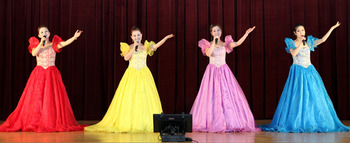
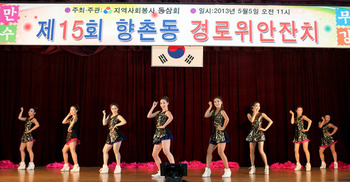
In contrast, another dance program that PMY uses to demonstrate its idiosyncrasy as a North Korean migrant troupe is a group dance choreographed to K-pop girl group songs, such as Miss A's “Bad Girl, Good Girl.” At least one of these is included in each of their performances, showcasing the troupe's flexibility and adaptation of South Korean culture as a performing group of North Korean migrants. Although contrasting stylistically with PMY's entire North Korean dance repertoire in its rave movements and dress styles, these numbers somewhat similarly conjure ethnic proximity, by way of showing the North Korean performers' adoption of dances that represent South Korean culture. Like most K-pop girl groups, PMY dancers wear chest-length tops and short pants or skirts, exposing quite a bit of skin when they dance to K-pop songs. The PMY members identify such body exposure to be a marker of the capitalist culture of the South, remarking that the body is seldom revealed for public view in North Korea.Footnote 28 In conformity with their statement, PMY members usually wear conservatively styled outfits—for example, long, colorful evening dresses with puff sleeves covering the shoulders; traditional Korean dresses; or short, knee-length day dresses (see figure 2)—when presenting North Korean songs and dance, whereas they wear small, light, and hip dresses in presenting South Korean music and dance (see figure 3). While the performers' material shift reinforces the stylistic contrast between their performance of North and South Korean cultures, the meaning that the troupe members hope to convey is more significant than mere imitation of a South Korean K-pop girl group; Director Pak states that they hope to show that North Korean girls are no different from any young South Korean.Footnote 29
PMY members sing North Korean songs. Photo courtesy of Pyŏngyang Minsok Yesultan.

PMY members dance to K-pop songs. Photo courtesy of Pyŏngyang Minsok Yesultan.

While PMY's newest dance moves are inspired by those of South Korean girl groups, the South Korean popular songs sung in their program are trot (tŭrotŭ) music, which is considered to be an old-fashioned or retrogressive style. The inclusion of trot songs rather than any other type of Korean popular music resonates with the overall vintage repertoire and reinforces the folk identity that the troupe highlights. It exemplifies the ways in which the troupe shapes itself with consideration of the market and audience types. The major venues of its live performances are in small towns and rural or suburban cities. Thus, the type of crowd that PMY attracts and expects at its performances are senior or slightly mature audiences, or the rural or suburban masses who look for low-cost or free entertainment or spectacles, as described at the beginning of this article. Considering that, the trot songs seem to be a wise choice of repertoire, since they are associated with older audiences from working class and rural backgrounds. In addition, trot singing shares some stylistic and musical similarities with the popular Korean folksongs (sinminyo) that have been part of North Korean song repertoires: both melodically render pentatonic scales and use note-bending or vibrato in stylizing their singing. While North Korean singers were hardly familiar with the trendy and modern popular songs of the South or from elsewhere, trot songs are perhaps easier for them to sing due to their familiarity with Korean folksongs also retained in North Korea.
On the other hand, in terms of musical timbre, the overall characteristic sound of South Korean trot contrasts quite sharply with North Korean songs sung in the “self-reliance voice.” South Korean trot singers frequently add note bending, project a rough or coarse voice, and stylize singing with a characteristic vibrato. Despite apparent aesthetic differences innate in stylizing South Korean trot songs and North Korean popular songs, the PMY members insist that in their singing South Korean trot songs, their unique self-reliance voice is maintained.Footnote 30 However, in my listening to the PMY trot songs, I sensed that the singers lowered the range and changed the timbre of their usual voices, with the addition of thicker vibratos, similar to the practice of many South Korean trot singers. When I shared my observations with some PMY members, they responded that even if I had observed changes to the PMY singers' self-reliance voice when singing trot songs, that shift was never intentional, but was a result of lowering the range to correspond to the prerecorded accompaniment. They reiterated that they make their trot unique by singing it in the North Korean way. Considering the innate performativity of expressive cultures, the PMY singers' shift in singing styles is obviously interesting, yet not a startling or debatable issue. What does deserve notice is the PMY members' robust reaction that affirmatively articulates their ideas regarding what cultural elements are maintained and negotiated in the construction and performance of a North Korean migrant troupe in the South.
If ethnic proximity has been one of the major threads woven into PMY's performances, the maintenance of a distinctive North Korean identity is another strong aspect of PMY's performances; the troupe members' competent citizenship is highlighted by the troupe's management system and reenactment of South Korean popular music genres. Obviously, PMY holds strong views on how to shape its performance culture in the South, and it has intentionally and strategically hybridized selective aspects of North and South Korean cultures. By so doing, PMY establishes itself as a distinctive performing group in the South, and it allows the troupe and its members to be self-assertive in shaping their citizenship while proclaiming their significances through relating their performance to multiple signs that stand for both North and South Korea, as well as the time when the two were the same nation.
Conclusion
This study has discussed the lives and performance culture of North Koreans in South Korea, with a focus on their construction of identities as cultural and emergent citizens. The major salience of PMY and its performance has been that the troupe and its work have provided a space for the migrants to create and recognize their belonging, as they pursue their work in South Korea by maintaining, negotiating, and rewriting their cultural identity. As David A. McDonald (Reference McDonald2013, 24) has pointed out in his study of the performances and performativities of Palestinian artists, “belonging is a performative achievement accomplished through the ritualized citation of ‘national’ in performance.” PMY's performance becomes a semantic ground on which the North Korean migrants enact their belonging through the ritualized citation of both nation and citizenship. However, the nation cited in their performance is neither about the North nor about the South. It is instead a uniquely hybridized one, where two polarized Koreas come together, contemplating the glory of one people. Indeed, the reunion of the two Koreas at the Festival in Ch’ŏnan was not a tear-drenched event or an ephemeral meeting with no future promise. It was a call for creative reunion and a suggestion of beginning a new nation wherein the contradictory and diverse cultural and political backgrounds of the newcomers and older residents alike are embraced and conflated in the prospective South Korea.
Sin Ŭn-Ha, in a documentary film on her life as one of the most popular PMY performers, wonders what it would be like if she had been trained in the chabonchuŭi ch'um, the dance of capitalist society, which she characterizes with the words “liberal” and “unique expression” (Channel A 2012). Although she presents sexy movements on stage, choreographed to a K-pop song, wearing a short tank-top and mini skirt, she herself may not realize how her performance has evolved into a unique hybrid, reflecting her migration from North to South Korea via the “Underground Railway to Seoul.” Her performance put together with PMY comrades is no longer the art of state propaganda or a mandate of their absolutist government. Instead, it has been transformed into a unique expression of North Korean migration and new citizenship, as it manifests both the awe and consternation of North Korean migrants who ironically maintain, negate, and commoditize their former state identity in transforming and demarcating themselves as neoliberal capitalist subjects.
Acknowledgments
I am very grateful to the two editors—Professors Jeff Wasserstrom and Jennifer Munger of the Journal of Asian Studies—and the two anonymous reviewers whose professionalism and scholarship contributed much to the development of this article. This article expands on material from two conference papers: “Music and the Shaping of Refugee Experience: Performing North Korean Folk Arts in South Korea,” presented in 2013 at the 72nd Annual Meeting of the Association for Asian Studies, San Diego, California; and “Politics of Identity and Cultural Negotiation by North Korean Performing Artists in South Korea,” presented at the 57th Annual Meeting of the Society for Ethnomusicology, New Orleans, Louisiana, in 2012. I am grateful to Professors Emerita Adelaida Reyes, Barbara Smith, and Tong Soon Lee for their feedback on earlier versions of this work. My special thanks goes to the members of Pyŏngyang Minsok Yesultan, both performers and administrative staff, without whose support this research would not have been possible. Dr. Pae Chong-Chŏl, Dr. Pak Sun-Young, and Professor Chung Byung-Ho also deserve my sincere gratitude for sharing their insights into North Korean migrant communities in South Korea. I want to acknowledge my friend Wendell Ishii's valuable contribution to this work, as he reads and edits my writing. In completing this article, I was supported by an Academy of Korean Studies Grant funded by the Korean Government (MEST AKS-2012-BAA-2101) and the University of Auckland, Faculty of Arts' Emerging Research Excellence Fellowship.