Hausman defends the thesis that preferences in economics are total subjective comparative evaluations and moreover that economists are right to employ this concept of preference (Reference Hausman2012, 1–2, 7). In Hausman’s terminology, a subjective comparative evaluation is a subjective judgment to the effect that one alternative x is better than another one y. A partial subjective comparative evaluation is a subjective judgment to the effect that x is better than y in some particular respect, whereas a total subjective comparative evaluation is a subjective judgment to the effect that x is better than y taking into account every relevant consideration. If you judge that one kind of coffee K is better than another kind of coffee K* with respect to price, while K* is better than K with respect to flavor, you are making two partial subjective comparative evaluations. If you take flavor to be more important than price and therefore judge K* better than K all things considered, you are making a total subjective comparative evaluation and consequently have a preference for K* over K.
Preferences in this analysis have a number of noteworthy features (cf. Hausman Reference Hausman2013, 219–20). Unlike desires, preferences are inherently comparative: having a preference requires preferring one thing to another (Hausman Reference Hausman2012, x). A preference is a subjective judgment: a subjective state that combines with beliefs to cause overt behavior (32).Footnote 1 There is no requirement that the judgment be explicit, although it may be. The fact that preferences are total comparative judgments means that they take into account everything the agent treats as relevant to the choice between competing alternatives (34). Since the relationship between preferences and objectively observed choices is one of cause and effect, it would be a mistake to identify the two (33). The fact that preferences and beliefs jointly cause action means that from a third-person perspective preferences can help explain and predict behavior; from a first-person perspective they (again, jointly with beliefs) constitute reason for action, which means that they can also help justify behavior (5–6).
Economists routinely assume that preferences satisfy the axioms of transitivity and completeness.Footnote 2 The “only plausible way” for agents to come up with total comparative evaluations satisfying such axioms, in Hausman’s view, is for the agent “to adjudicate between competing considerations”—including partial comparative evaluations (Reference Hausman2012, 17–18). A preference ordering satisfying the axioms therefore “must be the outcome of an unmodeled process of exhaustive comparative evaluation” (18). In this way economists are—and also should be, if they want preferences to be transitive and complete—committed to a particular theory of preference formation and change, in which preferences result from a series of cognitive operations on, among other things, the relevant partial evaluations (117). In sum, economists correctly conceive of preferences as subjective judgments of a certain kind, which if rational result from a possibly exhaustive cognitive process of reflection on what there is reason to do, all things told (6; see fig. 1 for an illustration of the process). Hausman defends his conception of preference by arguing that it “fits the bill,” in the sense that it captures what economists in fact mean—and also what they should mean—when they talk about preferences (34).
In Hausman’s theory of preference formation, possibly myriad partial evaluations (alongside other considerations) are cognitively processed into one total evaluation, which then combines with belief to cause action.

The current article argues against both parts of Hausman’s thesis. In my view, economists are not well understood as thinking of preferences in terms of total comparative evaluations, and it would be a mistake for economists to adopt such a conception. I make the case on the basis of (1) the structure of standard economic theory, (2) the history of economic thought, (3) contemporary economic practice, (4) empirical findings from cognitive science buttressed by evolutionary considerations, and (5) current economic theories of preference formation and change. The failure of Hausman’s account of preferences, I continue, reflects a deeper problem, which is that theoretical terms in economics and elsewhere do not need explicit definitions of the kind that he seeks. Following a long and respectable tradition in philosophy of science, I argue that the concept of preference in economics is adequately (although implicitly) defined by the postulates of the theory. Instead of seeking explicit definitions, as Hausman does, in my view philosophers of science are better employed studying, for example, the correspondence rules that link theoretical terms and scientific observations. Even so, Hausman’s labors were not in vain. His accomplishment, I maintain, is that he has articulated a useful model of the theory, which can serve a range of scientifically valuable cognitive purposes.
* * *
Let us begin by exploring the first part of Hausman’s thesis: the notion that economists in fact conceive of preferences as total comparative evaluations. One might naively think that the question can be settled simply by consulting a representative sample of economists, but this is not so. In normal science—as Kuhn (Reference Kuhn2012, 5) called it—scientists are largely satisfied that they know what the world is like and how best to study it, and consequently they have little reason to reflect on fundamental philosophical commitments. The result is that answers from practicing economists can be expected to be insufficiently thoughtful.Footnote 3 Instead, I explore multiple other lines of evidence. I argue that none offers much support for Hausman’s view and that some speak against it. Although no one line of evidence may be sufficient to show that Hausman is mistaken, the cumulative weight of the evidence is strong.
A good place to start is to look at the structure of economists’ theories. Here, we can do no better than to review the standard textbook used in quality economics graduate programs across the English-speaking world: Mas-Colell et al. (Reference Mas-Colell, Whinston and Green1995). Hausman (Reference Hausman2012, 8 n. 3) describes it as “authoritative.” But the text offers little support for his account:
(1) The structure of standard economic theory gives us little reason to think preferences are total comparative evaluations or that they are constructed from possibly myriad partial comparative evaluations.
Mas-Colell et al. treat the concept of preference as a primitive, not in need of further analysis. It is introduced in section 1.B simply as a binary relation, denoted ≽ and pronounced “is at least as good as” (Mas-Colell et al. Reference Mas-Colell, Whinston and Green1995, 6). Thus, the formal theory says nothing about preferences being subjective judgments and reveals no trace of them resulting from cognitive processing of possibly myriad partial comparative evaluations. Mas-Colell et al. offer introspective evidence for the idea that developing a complete set of preferences can be hard work, but they add that the theory simply assumes that all the work has already been done—without saying anything about how. Hence, the informal discussion (like the formal theory) fails to support Hausman’s account. Many textbooks cover standard economic theory in the same way—including the one by yours truly (Angner Reference Angner2016, sec. 2.2).
There are exceptions. As Hausman (Reference Hausman2012, sec. 4.6) notes, Lancaster (Reference Lancaster1966) proposed what he called “a new approach to consumer theory,” which treats each good as a bundle of properties or characteristics. In Lancaster’s words: “The chief technical novelty lies in breaking away from the traditional approach that goods are the direct objects of utility and, instead, supposing that it is the properties or characteristics of the goods from which utility is derived” (133). The Lancaster approach is helpful in explaining preferences over goods in terms of agents’ assessments of the underlying characteristics, which gives it a certain similarity to Hausman’s proposal. Similarly, “multi-attribute utility theory” (e.g., Keeney and Raiffa Reference Keeney and Raiffa1993, 45; cited in Hausman Reference Hausman2012, 45) deals with cases in which the decision maker has to make trade-offs between multiple and conflicting objectives. My own textbook uses a related approach when explaining “decoy effects,” which occur when the introduction of a third irrelevant alternative—the “decoy”—reverses a person’s preferences (Angner Reference Angner2016, sec. 3.4). Yet this kind of approach remains relatively rare, as Hausman (Reference Hausman2012, 46) concedes. And the mere fact that it exists fails to show that “total subjective comparative evaluation is for the most part the notion of preference economists and decision theorists employ” (35).
The fact that the structure of standard economic theory offers little support for Hausman’s analysis not only fails to support his account but arguably undermines it. If he were right about economists’ conception of preference, you would expect it to be more clearly visible in their theories. And Hausman offers no convincing explanation of the fact that it is not. He does say that “it is difficult to capture desiderative structure formally and to derive testable implications” (Hausman Reference Hausman2012, 46), which suggests that the absence of partial comparative judgments, and so on, is due to the difficulties involved in modeling them. But the works cited in the previous paragraph reveal that it is quite straightforward to model preferences as resulting from evaluations of features of the alternatives, as some economists have for more than half a century. Nonetheless, it is possible that economists have collectively developed a set of theories that for some reason fail to reflect their conception of preferences. So, let us review other lines of evidence.
A second source of evidence is the history of economics. Although scientists during periods of normal science give little thought to fundamental questions of a more philosophical nature, things are different during the periods of radical and often rapid change Kuhn (Reference Kuhn2012, 6) called “scientific revolutions.” It is interesting, therefore, to look back to what happened during the first half of the twentieth century, when what is now standard economics—the postwar neoclassical synthesis—was established in a kind of scientific revolution (Mandler Reference Mandler1999, chap. 4). Even a brief review of the relevant history shows that the absence of partial comparative evaluations, and so on, in contemporary theory is no coincidence:
(2) The economists responsible for the postwar neoclassical synthesis treated preferences as primitives, explicitly and adamantly rejecting every effort to explain their origin and relationship to subjective phenomena.
Postwar neoclassical economics emerged in reaction to early neoclassical economics, which was based on a foundation of hedonic psychology, that is, an account of human behavior according to which people always and everywhere seek to maximize pleasure and minimize pain.Footnote 4 One advantage of this approach is that it allows the economist to explain a number of features of preferences, including completeness and transitivity. Yet, critics were disappointed in the poor predictive power of the theories. Inspired by contemporaneous intellectual trends including logical positivism in philosophy, behaviorism in psychology, and operationalism in physics, they came to believe that the problem could be solved by cutting all ties with psychology and by eliminating to the extent possible any reference to unobservable cognitive and affective states.
The solution was to start with the assumption that people have preferences, which were thought to be more or less directly observable through people’s choices. As Robbins wrote in an influential treatise, “all that is assumed … is that different goods have different uses and that these different uses have different significances for action such that in a given situation one use will be preferred before another and one good before another” (Reference Robbins1932, 86). Thus, the starting point for standard economic theorizing is a person’s preference ordering, which just represents his or her ranking of whatever options are available—nothing more, nothing less.
It is important to note that postwar neoclassical economists did not deny that people have feelings or make judgments or even that feelings and judgments underlie preferences. As Robbins’s contemporary Wicksteed expressed it: “By a man’s ‘scale of preferences’ or ‘relative scale,’ then, we must henceforth understand the whole register of the terms on which (wisely or foolishly, consistently or inconsistently, deliberately, impulsively or by inertia, to his future satisfaction or to his future regret) he will, if he gets the chance, accept or reject this or that alternative” (Reference Wicksteed1933, 36). The idea was that economics as a science can be independent of any claims about the origins of preferences and their relationship to subjective phenomena. Instead of developing a theory that explains the completeness and transitivity of preferences in terms of feelings, judgments, and the like, postwar economists just postulated that people have preferences that satisfy the relevant axioms and get on with it. As Robbins wrote, neoclassical economic theory would henceforth have no “essential connection with psychological hedonism, or for that matter with any other brand of Fach-Psychologie” (Reference Robbins1932, 85–86). What economists in the tradition of Mas-Colell do is very much in the tradition of Robbins and Wicksteed: having introduced the preference relation, they affirm that it is rational and complete, and that is that (Mas-Colell et al. Reference Mas-Colell, Whinston and Green1995, 6).
My point is that the economists responsible for articulating what is now standard economics treated preferences as primitives, explicitly and adamantly rejecting the notion that economics should explain how preferences are formed or why they have features such as transitivity and completeness. Postwar economists did not deny the possibility that preferences were subjective judgments or that they resulted from comparative evaluations or any other set of affective or cognitive states. Rather, the economists wished to remain agnostic about the matter, insisting that questions about cognitive and affective states as well as the origin of preferences fall outside of the scope of economics. Now, Hausman acknowledges that his interpretation of economics is at variance with that of the economists themselves, but he urges that we trust their practice rather than their preaching (Reference Hausman2012, 48). In his words: “My quarrels are less with how economists employ the concept of preferences than with how economists have described what they are doing” (7). Let us talk, then, about how the concept is employed in actual practice.
Hausman’s (Reference Hausman2012) treatment of economic practice is thoughtful and enlightening. Having spent the better part of his career exploring economic theory and practice (as he points out on p. xiii), it is no coincidence that he has become one of the philosophers of economics with the highest name recognition among practicing economists. As it happens, I have few quarrels with Hausman’s characterization of economic practice. The problem, by my lights, is that his observations about economic practice fail to support the central thesis:
(3) Actual economic practice reveals little evidence of preferences being total comparative evaluations or being formed in a process of exhaustive comparative evaluation.
It would be impossible to review all of Hausman’s observations in this space, so I focus on some of the central ones. Consider, for example, his discussion of the axioms of ordinal utility theory in chapter 2. Hausman (Reference Hausman2012, sec. 2.1) points out, correctly, that the preference relation in the standard treatment defines a ranking of alternatives that is complete, transitive, context independent (meaning stable across contexts), and choice determining (meaning that whatever the person chooses will sit at the top of the ranking). Thus, an agent’s preferences must capture everything that matters to her: there cannot be any concerns that express themselves in her choices that do not appear in her preference ranking (cf. Lehtinen Reference Lehtinen2013, 206).
Throughout the book, Hausman emphasizes how forming preferences is a cognitively laborious process. In the introduction to the chapter titled “Constructing Preferences,” he states categorically: “Preferences are the end of a complicated and largely untold story with a great deal of cognitive structure. It is hard to construct a total comparative evaluation. To do so, agents need to identify the alternatives and their properties and to weigh the considerations that count in favor of alternatives or against them. Agents must explore the causal pathways from actions to outcomes and determine the probabilities and the values of the consequences” (Hausman Reference Hausman2012, 117). Elsewhere, he restricts his claim to preferences that are complete and transitive. So, for example, he writes that “a complete and transitive preference ranking … must be the outcome of an unmodeled process of exhaustive comparative evaluation” because “the only plausible way” to have such a ranking “is to adjudicate among competing considerations” (18). He asserts that forming a preference can be “cognitively demanding” (19) and may “require extensive deliberation” (3) and that the axioms “place enormous cognitive demands on agents” (17). This is particularly true since there is no theoretical upper limit to the number of relevant partial evaluations and since underlying evaluations may themselves be “cognitively sophisticated”—as in the case of moral judgments (3). In a subsequent book symposium, he insists: “Because preferences are total comparisons, they are cognitively demanding. Indeed the standard axioms of completeness and transitivity impose extravagant cognitive demands” (Hausman Reference Hausman2013, 219).
Yet, economists are not in fact committed to the view that preferences are cognitively demanding, even when they are assumed to be complete and transitive. First, economists are happy to model the behavior of small children and animals who do not have the cognitive capacity to process possibly myriad partial comparative evaluations into a total comparative evaluation. For example, economists Kagel, Battalio, and Green (Reference Kagel, Battalio and Green1995) apply a wide range of economic models to rats and pigeons. In the authors’ view, the predictive power of economic theory in these experiments provides “rather striking support for the theory” and shows its applicability even when “behavior is guided by nonrational considerations” (2). Others use economic theory to explore the behavior of fish (Boulier and Goldfarb Reference Boulier and Goldfarb1991), honeybees (List, Elsholtz, and Seeley Reference List, Elsholtz and Seeley2009), and ants (Franks et al. Reference Franks, Dechaume-Moncharmont, Hanmore and Reynolds2009).Footnote 5 Of course, none of these analyses assume that the animals in question are capable of going through the process of exhaustive comparative evaluation—or anything at all about what goes on in their heads. We should be skeptical of any attempt to attribute to economists a view according to which the axioms place enormous cognitive demands on agents.
Second, economists have in fact tried to explain the genesis of total, context-independent, and choice-determining preference rankings without committing themselves to the view that preferences are cognitively demanding. After noting that the pigeons in Kagel et al.’s experiments conformed more closely to the theory than humans do, Binmore writes: “Who knows what goes on in the mind of a pigeon? Who knows what goes on in the minds of stockbrokers for that matter? But we don’t need to assume that pigeons or stockbrokers are thinking rationally because we see them behaving rationally. We can appeal to the ultimate explanations offered by evolutionary theory” (Reference Binmore2009, 13). That is, economists’ idea that people and pigeons act so as to satisfy a consistent preference ordering does not presuppose the thought that preferences are cognitively laborious or that they are formed in a cognitive process of integrating a plethora of partial comparative evaluations into a total comparative evaluation. Instead, the idea is that pigeons and stockbrokers who did not behave consistently were eliminated by forces of social or economic evolution (13). There are other mechanisms too that could generate similar results without assuming that preferences are cognitively demanding, including mechanisms that involve learning through conditioning. The point is that Hausman has failed to identify “the only plausible way” for people (and pigeons) to develop context-independent and choice-determining preference orderings.
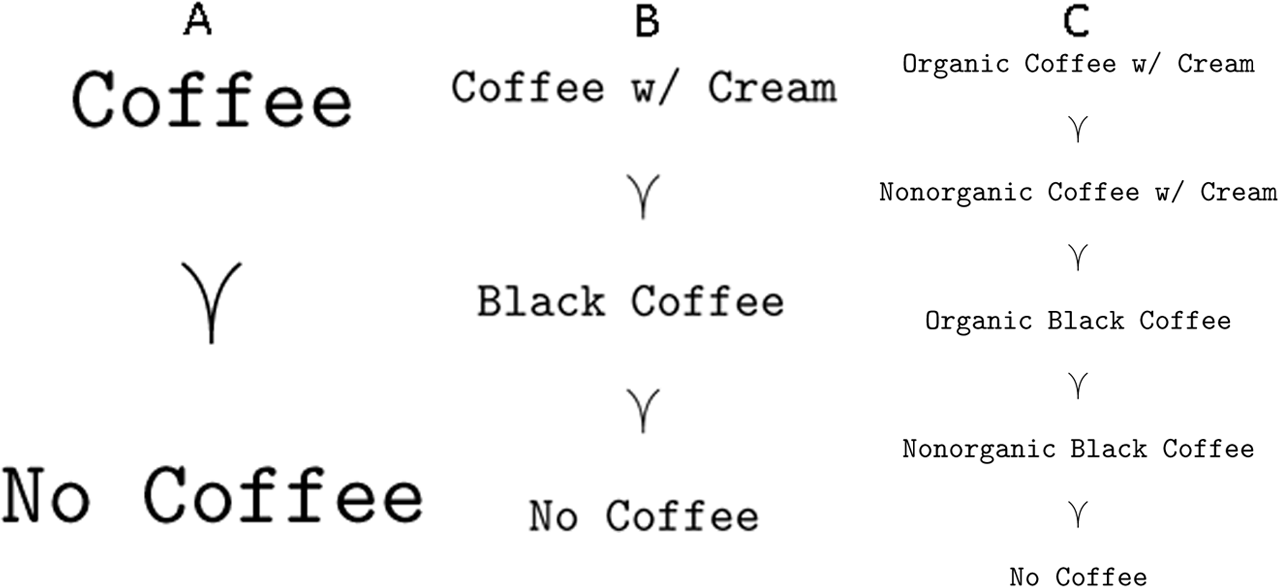
Third, economists can (if they wish) legitimately and innocuously use the language of evaluations even when treating preferences as primitive. Consider figure 2, which represents the context-independent and choice-determining preference orderings of three coffee drinkers. Person A always prefers whatever alternative satisfies the description “coffee” to what does not. He can be described as having only one concern: Is it coffee? Person B has a more sophisticated ordering. She can be described as caring not only about whether it is coffee but whether it has cream in it. Thus, the preference ordering tells us she evaluates bundles along two dimensions. The fact that she prefers black coffee to no coffee also tells us that her concern with coffee takes precedence over her concern with cream. People like C have an even more sophisticated ordering. They can be described as caring not only about whether it is coffee and whether there is cream in it but also about whether it is organic. The preference ordering tells us that they evaluate bundles along three dimensions. The fact that they prefer nonorganic coffee with cream to organic black coffee also tells us that they care more about the cream than about whether it is organic. The point is that we can read off people’s total and partial comparative evaluations from their preference orderings, even if we treat preferences as primitive. That is, we can use the language of comparative evaluation without assuming that preferences—even when complete and transitive—are cognitively demanding total comparative evaluations. (The fact that so much information is contained in one of these orderings, by the way, helps explain why economists find them such a useful representation.)
Preference orderings of three coffee drinkers. The symbol ≻ is pronounced “is (strictly) preferred to.”

The rest of chapter 2, like chapter 3, argues against other conceptions of preference. Section 2.4 argues that economists should not be understood as defining preferences in terms of expected advantage, that is, what the agent thinks will be good for her. Hausman correctly points out that the mere possibility that people form preferences based on considerations other than well-being shows the conception is misguided (Reference Hausman2012, 22). The notion that preferences should not be understood as resulting from judgments about well-being is also consistent with Robbins’s description of economic science as silent on matters of preference formation. Chapter 3 proceeds to criticize revealed-preference theory: broadly speaking the view that talk about preferences can be reduced to talk about choices. Hausman points out, first, that revealed-preference theory makes it impossible to talk about a person’s preferences over options between which she cannot choose and also that revealed-preference theory short-circuits the role of beliefs in determining choices (sec. 3.2). He concludes that preferences must be understood as influencing choices via beliefs, which makes preferences “subjective states that, jointly with beliefs, cause and justify behavior” (33). Hausman’s critique is compelling, but it does not entail that preferences must be total comparative evaluations, that they must be cognitively demanding, or that when rational they have to be formed by adjudicating between partial comparative evaluations.
Chapters 4 and 5 build on the insights from chapter 3 to make the case for what Hausman calls the “standard model of choice”—the notion that beliefs and preferences in conjunction with constraints determine choices (Reference Hausman2012, 36–37). The upshot is that economics “requires a distinction between those preferences it takes as given and those preferences it undertakes to explain and to predict” (43). The example in chapter 4 is expected-utility theory, which Hausman interprets as a formalization of standard means–end reasoning, in which preferences over basic outcomes combine with beliefs over various possibilities to explain and justify final preferences over lotteries. Hausman (sec. 4.3) refers to the independence axiom, which says that you prefer outcome L to L′ just in case you prefer a lottery that gives you L with probability p (and some outcome L″ otherwise) to a lottery that gives you L′ with the same probability p (and L″ otherwise). Save for a minor substitution, here is the axiom as stated in Mas-Colell et al. (Reference Mas-Colell, Whinston and Green1995, 171):

The axiom says that you prefer coffee to tea just in case you prefer coffee if a coin comes up heads (and a pat on the head otherwise) to tea if the coin comes up heads (and a pat on the head otherwise). Hausman interprets the axiom as saying that the basic preference (over basic alternatives) on the left explains and predicts the final preference (over lotteries) on the right.Footnote 6 In chapter 5 the examples are drawn from game theory, where in the default case players’ preferences over strategies can be derived from and explained by preferences over outcomes (Hausman Reference Hausman2012, 50–51). So, in the prisoner’s dilemma, the fact that each player prefers to defect is explained and predicted by the fact that defecting is a dominant strategy, meaning that the result of defecting is better no matter what the other player does (Mas-Colell et al. Reference Mas-Colell, Whinston and Green1995, 236–37). All these examples are supposed to show that even in the standard treatment, at least in a wide variety of scenarios, basic preferences are used to explain, predict, and even justify final preferences and that economists therefore rely at least implicitly on a theory of preference formation. At best, however, Hausman shows that some preferences are treated as determined by other preferences, not that they are total comparative evaluations or that (when rational) they are formed from myriad partial comparative evaluations. Again, the discussion fails to support his thesis.
In short, Hausman’s observations about the theory and practice of modern economics, for all their virtues, offer no more support for his central thesis than the structure of economic theory and the history of economic thought. There is little reason to think that economists conceive of preferences as total comparative evaluations—or that those preferences are formed in a cognitive process of reflection on possibly myriad partial comparative evaluations—and there is some reason to think that they do not. Moreover, I am not the only one who thinks Hausman is misreading the economists. In his review of Hausman’s book, historian of economics Ivan Moscati agrees (see also Guala Reference Guala2017, sec. 7). The author of Measuring Utility: From the Marginal Revolution to Neuroeconomics (Reference Moscati2018), Moscati specializes in the history of utility theory. He writes: “In their practice, or so it seems to me, economists seem to be closer to the Humean conception of preferences,” where the Humean conception paints nonderived preferences “as primitive, barely changeable, and possibly unreasonable” (Moscati Reference Moscati2012, 127, 125). This amounts to saying that preferences on the Humean conception are exogenously determined, stable, and immune from criticism. In all these respects, Moscati’s interpretation differs from Hausman’s. A critic might be tempted at various points to object that the economists are wrong, but this is beside the point: our discussion so far has only concerned what economists think, not whether they are right or wrong in doing so.
* * *
Let us now move on to the second part of Hausman’s thesis: the notion that economists should employ his conception of preferences as total comparative evaluations. If we want to know what economists should believe, the first thing to ask is what the evidence says. For, economists are above all engaged in the project of developing a positive, descriptive science—“the science which studies human behaviour as a relationship between ends and scarce means which have alternative uses,” in Robbins’s memorable and influential formulation (Reference Robbins1932, 15). Unfortunately for Hausman, his account is seriously undermined by the available empirical evidence:
(4) The notion that preferences are cognitively demanding total comparative evaluations has been fairly conclusively refuted by cognitive science buttressed by evolutionary considerations.
Zajonc’s citation classic “Feeling and Thinking: Preferences Need No Inferences” targets the view that preferences are “based on a prior cognitive process in which a variety of content discriminations are made and features are identified, examined for their value, and weighted for their contributions” (Reference Zajonc1980, 151). According to Zajonc, the “traditional view” has been dominant since the nineteenth century. And it is remarkably similar—if not identical—to Hausman’s: “According to this traditional view, if we wish to know why a given individual prefers one brand of cigarettes to another, we need only know how much he likes each of its features and how important these features are in contributing to the overall evaluation. We may examine such features as tar content, length, taste, smell, price, and so forth” (Zajonc and Markus Reference Zajonc and Markus1982, 124). Curiously, even the language of “evaluation” appears in this description of the traditional view. Zajonc and Markus acknowledge that some preferences are preceded by a great deal of cognitive activity, as when you read a review in a reputable publication about a novel and unfamiliar restaurant (124). But evidence from a variety of sources suggests that preferences are surprisingly independent of cognitive judgments and often precede them in time. The most dramatic (but by no means the only) evidence cited comes from research on the mere exposure effect, in which individual preferences over stimuli change merely as a result of being exposed to them (Zajonc Reference Zajonc1968)—a phenomenon advertisers know well.
For what it is worth, the empirical evidence is buttressed by evolutionary theory. Zajonc (Reference Zajonc1980) ends his article by pointing out that the notion that preference is postcognitive is hard to square with plausible evolutionary considerations: “The evolutionary origins of affective reactions that point to their survival value, their distinctive freedom from attentive control, their speed, the importance of affective discriminations for the individual, the extreme forms of action that affect can recruit—all of these suggest something special about affect. People do not get married or divorced, commit murder or suicide, or lay down their lives for freedom upon a detailed cognitive analysis of the pros and cons of their actions” (172). Taken together, these considerations strongly suggest preferences revealed in observed behavior are not in general formed in a process of reflection on what there is reason to do all things told, cannot be cognitively demanding, and indeed are best not construed as subjective judgments at all. If they were, they would not fulfill their function of driving biologically adaptive behavior.
At this point Hausman might object that his conception of preferences is logically distinct from his theory of preference formation and that the empirical evidence undermines only the latter, not the former. And yet, as we saw in the previous section, Hausman repeatedly throughout the book describes not only the process of preference formation but the preferences themselves (especially when rational) as cognitively demanding. This would make preferences postcognitive (in Zajonc’s terms) and Hausman’s conception vulnerable to the empirical challenge. Perhaps Hausman could interject that these passages were a mistake and that only the process of preference formation should have been described as cognitively laborious. But he also claims repeatedly that the only way to develop rational, complete preferences in the sense of total comparative evaluations is to go through a cognitively laborious process of exhaustive comparative evaluation. If we take this claim seriously, Hausman’s thesis that economists should adopt his conception of preference enjoins them to adopt a disconfirmed theory of preference formation as well. In this way, the empirical evidence undermines not only Hausman’s theory of preference formation but his conception of preference too.
In light of the recent “replication crisis,” it can also be asked whether the empirical results will hold up. Zajonc’s research has its critics, as reviewed, for example, in the recent textbook by Fiske and Taylor (Reference Fiske and Taylor2017, chap. 14). Yet, Fiske and Taylor note that Zajonc’s conclusions are relatively plausible for preferences—as opposed to moods and emotions—and nothing they say supports reverting to the “traditional view” as a general account of preferences, moods, or emotions (419). (Note that everybody, including Zajonc and his coauthors, acknowledges that some preferences are formed following extensive cognitive processing; the controversy concerns whether all preferences are formed in that manner.) Hausman might also respond that Zajonc’s research is irrelevant, since many psychologists and cognitive scientists use the word “preference” differently (cf. Hausman Reference Hausman2012, xi). And yet, this reply should leave us cold, given the far-reaching similarities between Hausman’s and Zajonc’s accounts.
A critic could point out that scientists sometimes deliberately rely on false assumptions in order to make scientific progress. Hausman himself describes his treatment of preferences as a “strong idealization” (Reference Hausman2012, 63). Noting this, the critic might be tempted to defend Hausman’s conception of preference as an idealization of some kind. As Weisberg (Reference Weisberg2007) describes it, for example, idealization involves intentionally introducing distortion into scientific theory in order to make theories more tractable (Galilean idealization), eliminating the causal factors that do not make a difference to the phenomenon of interest (minimalist idealization), or generating a sequence of incompatible models that make different claims about the factors responsible for the phenomenon (multiple-models idealization). Yet, Hausman’s conception of preference does not fit neatly into any one of the three boxes, as it makes the theory less (not more) tractable, eliminates the noncognitive factors that evidence suggests make most of the difference, and does not result in a sequence of incompatible theories.
Be that as it may, idealization in science is ultimately justified by its usefulness in attaining core scientific goals. And judging by their practice, contemporary economists do not in fact find the conception useful. To see what economists find useful, let us turn to current economic models of preference formation and change. Hausman spends surprisingly little time and ink on such models, but they certainly exist. Here, I rely on the review of models of preference formation and change in Loewenstein and Angner (Reference Loewenstein, Angner, Loewenstein, Read and Baumeister2003, 354–67). As we will see, none of them involve Hausman-style evaluations, and many dispense with cognitive judgments altogether:
(5) The models of preference formation and change that are favored by practicing economists do not involve cognitive operations on a plethora of partial evaluations.
Loewenstein and Angner classify models of preference change into models of habit formation, satiation, and refinement; appetites, emotions, and other visceral factors; conditioning; maturation; social influence; motivated taste change; and temporal proximity. Here, I take a closer look at the first category: models of habit formation. The main conceptual innovation in such models is that your utility function has two arguments: a variable ct representing your consumption at t and a state variable st representing your habit stock at t. The habit stock reflects past consumption. Thus, the innovation captures the fact that how much utility you will derive from a unit of (say) coffee reflects how much you have indulged in the past. The theorist can add meat to this bare-bones theory by imposing various assumptions on the functional forms. In habit formation, it is normally assumed that the marginal utility of consumption—how much utility you derive from the last unit consumed—goes up when the habit stock goes up, as shown on the left-hand side of the following expression:

Within models of habit formation, as shown on the right-hand side, it is possible to distinguish negative from positive habits. A negative habit is one for which your enjoyment goes down when the habit stock goes up, as with addictive substances like heroin. A positive habit is one for which your enjoyment goes up when the habit stock goes up, as with the enjoyment of the fine arts. The basic model can be modified in many different ways, but it is evident already at this level of analysis that the model does not describe preferences as resulting from myriad partial comparative evaluations.
In current theorizing, evidently, economists do not find a story about partial and total evaluations very helpful. In my view, theorists judge that incorporating what Hausman calls desiderative structure—perhaps in the manner of Lancaster—is possible but undesirable, since the loss of simplicity is not outweighed by any sizable gain in empirical adequacy, fecundity, or other relevant cognitive virtue. It may be proposed that there are important noncognitive virtues that favor Hausman’s model—the ability to encourage democratic deliberation or critical reflection, perhaps.Footnote 7 And yet, as long as empirical adequacy gets assigned some weight, as it should, Hausman’s account will face an uphill struggle. Again, it can be argued that reflection on current theorizing only undermines Hausman’s theory of preference formation and change and not his philosophical conception of preference. But if we take seriously Hausman’s comments that his conception of preference commits economists to a theory of preference formation very much like the one he defends, any argument against the latter is also ipso facto an argument against the former.
In all, empirical evidence and modern theorizing offer no reason to think that economists should adopt Hausman’s account and some evidence to think that they should not. He is effectively defending a nineteenth-century account—Zajonc’s “traditional account”—that was part of a class of theories that were completely abandoned by economists during the first half of the twentieth century and widely considered refuted by cognitive science buttressed by evolutionary considerations during the second half. Although it may occasionally be justified to upcycle ideas from the dustbin of the history of science, we should only do so if we have really good reason. And in my view, Hausman has failed to provide us with one. I conclude that economists are doing the right thing in not adopting Hausman’s conception of preferences.
* * *
As it happens, then, Hausman and I agree that economists are doing the right thing. We disagree about what it is that they do. While Hausman holds it is a good thing that economists conceive of preferences as total comparative judgments, I have argued that it is a good thing that they do not. There are caveats. First, I do not claim that every single economist rejects Hausman’s conception of preference. The community of economists is heterogeneous and consists of different schools of thought with different methodological and philosophical commitments. It is possible, and perhaps even likely, that there are individual economists who agree with him. My target here is Hausman’s claim that total comparative evaluation is the conception economists employ. Second, I have not explored every possible line of argument in favor of Hausman’s thesis. My aim was to review the strongest arguments offered in Hausman’s book. It is conceivable that there are other arguments that are more compelling, although I obviously doubt it. Third, my argument is only intended to apply to the concept of preference in economics—positive and normative—and not the concept as it appears, for example, in the context of normative ethics. That said, to the extent that other forms of discourse depend on the assumption that preferences exist, there is reason to turn to social science for empirical evidence relevant to that assumption (cf., Angner Reference Angner2013).
If my argument is sound, Hausman joins a long series of prominent philosophers and economists who have failed in their efforts to provide a philosophical account of the concept of preference in economics.Footnote 8 In my view, these failures reflect a deeper problem, which is that theoretical terms in economics and elsewhere do not need explicit definitions of the kind that Hausman seeks. There is a respectable tradition in the philosophy of science that maintains that theoretical terms—such as “force,” “energy,” and “preference”—derive their meaning from the axioms of the theory of which they are part, thereby obviating the need for specifically philosophical accounts of such things (Andreas Reference Andreas and Zalta2017, sec. 1.2). Nagel offers a classic statement of this view: “[The] fundamental assumptions of a theory constitute a set of abstract or uninterpreted postulates, whose constituent nonlogical terms have no meanings other than those accruing to them by virtue of their place in the postulates, so that the basic terms of the theory are ‘implicitly defined’ by the postulates of the theory” (Reference Nagel1961, 91). This contextual theory of meaning helps explain the fact that scientists can grasp the meaning of a term such as “gravitational force” even in the absence of an explicit philosophical conception (Andreas Reference Andreas and Zalta2017, sec. 1.2). Nagel does not deny that terms such as “force,” “energy,” and “preference” have pretheoretic connotations, which may give the impression that we can grasp their meaning independently of the postulates of the theory. Yet, he insists that “such connotations are irrelevant … and are best ignored” (Nagel Reference Nagel1961, 91–92).
If Nagel is right, the entire project of developing a philosophical analysis of the concept of preference is misguided. It is true that the term has connotations that are independent of its role in modern economic theory. Such connotations may trick us into thinking that we can grasp the theoretical term without understanding the theory or into advancing false folk theories on nonempirical grounds. Yet, what it is to be a preference in economics is determined by the axioms of the theory, and the only way to ascertain the nature of preferences is by closely examining those axioms (Nagel Reference Nagel1961, 92). The question “What are preferences in economics?” therefore admits a particularly straightforward answer: they are whatever the postulates say they are. Notice, however, that on this account there is no one concept of preference in economics. Every economic theory implicitly defines its own concept since changing the postulates of theory amounts to changing the implicit definitions (102). Nagel’s view derives a great deal of plausibility from the failure of so many serious attempts to provide an explicit definition. It is also supported by a form of the open-question argument.Footnote 9 It is an open question whether Hausman is right and preferences in economics are total comparative judgments. By contrast, it is not an open question whether preferences in economics satisfy the postulates of economic theory.
In order to explain and predict, however, scientists need more than a free-floating abstract calculus. They also need the resources to link the calculus to empirical observations made, for example, in the context of scientific experimentation (Nagel Reference Nagel1961, 93). The link is provided by rules of correspondence, which determine how the terms defined implicitly by the theory map onto observations made in the field or the laboratory (93, 95). Without rules of correspondence, the abstract calculus would be useless for purposes of explaining or predicting observations made in the real world (105). Unlike explicit definitions, correspondence rules need not have the form of a biconditional, although they may (94, 100–101). Unlike the axioms and theorems of an abstract calculus, rules of correspondence can often only be articulated loosely and imprecisely, the reason being that they inherit the imprecision inherent in empirical observations (99–100). For this reason, correspondence rules will resist formalization (100). Because different experimental setups normally require different rules of correspondence, each theoretical notion can appear in an indefinitely large number of correspondence rules (99). And some theoretical terms need not figure in any rules of correspondence at all (101).
In the case of economics, correspondence rules will tell us how the concept of preference defined by the abstract calculus relates to the empirical observations made in the context of economic experiments and field studies. Without correspondence rules, economists would have no way to bring the abstract theory to bear on things like real-life individuals and markets. As it happens, Hausman offers an excellent example of a correspondence rule. Consider the principle he calls “the central claim of actual revealed-preference theory,” that is, the claim that a person A prefers x to y if and only if A never chooses y from any set that includes x (Hausman Reference Hausman2012, 25). Historically, this principle has been understood as a definition of preference, which for reasons Hausman explores in chapter 3 is not tenable. The principle is however straightforwardly interpretable as a correspondence rule, since it links a theoretical claim about preference, “A prefers x to y,” to an observational outcome of an experimental procedure, “A is never observed choosing y when x is available.”Footnote 10 The example shows how the correspondence rule permits us to use economic theory to explain and predict observable phenomena. Suppose that in laboratory experiments A is never observed choosing y when x is available or z when y is available. The correspondence rule applied twice then permits us to infer that A prefers x to y and y to z. Using the theoretical postulate to the effect that the preference relation is transitive, we can deduce that A prefers x to z. Applying the correspondence rule once more yields that z will never be chosen when x is available, which is an observational claim that can be tested in the field or the laboratory. To the extent that Nagel’s account helps us shed light on the epistemological status of widely used economic principles, by the way, this is another argument in its favor.
Even if I am right that Hausman’s project fails, however, his labors were not in vain. His accomplishment can be understood in terms of what Nagel calls the third component in a theory—after the abstract calculus and the set of correspondence rules—that is, the scientific model. Roughly speaking, a model of a given theory is an entity such that all the postulates of the theory are true of it (Nagel Reference Nagel1961, 95–96; cf. Frigg and Hartmann Reference Frigg, Hartmann and Zalta2017, sec. 1.3). In Nagel’s words, a scientific model “supplies some flesh for the skeletal structure in terms of more or less familiar conceptual or visualizable materials”—like the Bohr model of the atom does (Nagel Reference Nagel1961, 90, 111–15). The main benefit of a model as compared to an abstract calculus is that the model is easier to visualize and to understand (95). As a result, models serve a range of purposes, including suggesting novel lines of inquiry, new theories, and new applications of old theories that would not have occurred to us otherwise (96). That said, models can be deceptive. First, there is a danger of confusing easily visualizable but incidental features of the model with some indispensable feature of the theory; second, there is a danger of confusing the model with the theory itself (96, 115).
To my mind, Hausman’s accomplishment is precisely that he has articulated a useful model of the theory. The agent that he describes—who forms preferences by processing a wide range of partial evaluations into one total comparative evaluation and acts accordingly—is an entity of which the postulates of economic theory are true. The agent is easier to visualize than the set of abstract theoretical postulates, such as the axioms of transitivity and completeness. And Hausman’s model can indeed serve a range of scientifically valuable pedagogical, heuristic, and other purposes. For instance, it can help us visualize how a person might come to behave in accordance with standard economic theory. But Hausman’s work also illustrates the dangers Nagel articulated. Where Hausman went wrong was with confusing incidental features of his model—above all the notion that preferences are total comparative evaluations—with essential features of the theory, which demands no such thing, and indeed with confusing the model (helpful as it may be) with the theory in question.
In summary, the analysis developed here yields a very different picture not just of Hausman’s contribution but of the role of philosophy of science. In my view, philosophers of science should not be in the business of providing explicit definitions of theoretical terms. Carnap has a memorable passage on the topic:
[The] question: “Exactly what is an electron?” … is the kind that philosophers are always asking scientists. They want the physicist to tell them just what he means by “electricity,” “magnetism,” “gravity,” “a molecule.” If the physicist explains them in theoretical terms, the philosopher may be disappointed. “That is not what I meant at all,” he will say. “I want you to tell me, in ordinary language, what those terms mean.” Sometimes the philosopher writes a book in which he talks about the great mysteries of nature. “No one,” he writes, “has been able so far, and perhaps no one ever will be able, to give us a straight-forward answer to the question.”
(Carnap Reference Carnap and Gardner1966/1995, 234)Similarly, philosophers might complain that economists’ unwillingness to produce a philosophical account of preference means that it remains a mystery what a preference is and, perhaps, that economics is scientifically immature and economists intellectually or morally deficient. But, Carnap goes on: “There is no special mystery here. There is only an improperly phrased question” (234). Importantly, none of this entails that there is no work for philosophers to do. Instead of trying to supplant the implicit definition of “preference” provided by the axiomatic structure by an explicit definition, this analysis suggests philosophers of economics are better employed exploring and articulating the correspondence rules and models used in actual economic practice.
The failure of Hausman’s conception of preference is not, therefore, a failure for either philosophy or economics but rather points the way to more interesting work involving philosophers and economists. Because correspondence rules are often complex and may differ from one context to another, the task of articulating them and their uses is challenging and will require close attention to the nitty-gritty of actual economic practice. A critic could point out that Nagel and Carnap did not have the last word in philosophy of science, and she would be right. In my impression, however, they state as clearly as anyone a view that remains common at least among philosophers of natural science—and for good reason—although perhaps less so among philosophers of social science (cf., Andreas Reference Andreas and Zalta2017). At any rate, the only way to find out if the account of abstract calculi, correspondence rules, and scientific models that I have sketched is correct is to engage in the sort of fine-grained studies of actual scientific practice that I have recommended. The result could not fail to shed light on the nature of economic science and just might help economists guide their actual practice of trying to understand human behavior as a relationship between ends and scarce means with alternative uses.