Introduction
Defined as the inability to experience pleasure from normally rewarding stimuli, anhedonia is one of the two main diagnostic criteria for depression. Studies examining the effects of the current antidepressant treatments, selective serotonin reuptake inhibitors (SSRIs), have found that the symptom of anhedonia is not effectively treated, which in turn predicts a longer time to recovery and fewer depression-free days (Shelton & Tomarken, Reference Shelton and Tomarken2001; Spijker et al. Reference Spijker, Bijl, de Graaf and Nolen2001). Further, there are reports that SSRIs can in fact contribute to emotional blunting in patients, where experiences, both positive and negative, are flattened (Price et al. Reference Price, Cole and Goodwin2009). It has therefore been suggested that different pharmacological targets might be needed to adequately treat anhedonia and apathy in depression (Dunlop & Nemeroff, Reference Dunlop and Nemeroff2007; Nutt et al. Reference Nutt, Demyttenaere, Janka, Aarre, Bourin, Canonico, Carrasco and Stahl2007; McCabe et al. Reference McCabe, Cowen and Harmer2009).
Anhedonia is multi-dimensional, with the anticipatory (appetitive/wanting) and consummatory (hedonic/liking) dimensions being the most widely examined in depression (Nutt et al. Reference Nutt, Demyttenaere, Janka, Aarre, Bourin, Canonico, Carrasco and Stahl2007; McCabe, Reference McCabe and Ritsner2014; Frey et al. Reference Frey, Malinowska, Harley, Salhi, Iqbal, Sharma and McCabe2015). Affective neuroscience studies of reward ‘wanting’ and ‘liking’ have suggested that these psychological processes map onto distinct brain reward systems. For example, studies of pleasure identify hedonic impact in the ventral pallidum, nucleus accumbens and orbitofrontal cortex (OFC) (Peciña & Berridge, Reference Peciña and Berridge2005; Smith & Berridge, Reference Smith and Berridge2005; Peciña et al. Reference Peciña, Smith and Berridge2006; Wheeler & Carelli, Reference Wheeler and Carelli2006; Berridge & Kringelbach, Reference Berridge and Kringelbach2008; Peciña, Reference Peciña2008), whereas ‘wanting’ or incentive salience is mediated by neural systems that include mesolimbic dopamine projections from the ventral tegmental area to the ventral striatum (Berridge, Reference Berridge2007; Berridge et al. Reference Berridge, Robinson and Aldridge2009). Further, dopamine has been shown to be involved in learning about rewards in prefrontal cortical regions, such as the anterior cingulate cortex and the OFC (Dayan & Balleine, Reference Dayan and Balleine2002).
Examining the neural correlates of anhedonia in depression, studies have found reduced anticipatory and consummatory responses to reward in the ventral and dorsal striatum and the anterior cingulate (Epstein et al. Reference Epstein, Pan, Kocsis, Yang, Butler, Chusid, Hochberg, Murrough, Strohmayer, Stern and Silbersweig2006; Forbes et al. Reference Forbes, Hariri, Martin, Silk, Moyles, Fisher, Brown, Ryan, Birmaher, Axelson and Dahl2009; Pizzagalli et al. Reference Pizzagalli, Holmes, Dillon, Goetz, Birk, Bogdan, Dougherty, Iosifescu, Rauch and Fava2009; Smoski et al. Reference Smoski, Felder, Bizzell, Green, Ernst, Lynch and Dichter2009; Zhang et al. Reference Zhang, Chang, Guo, Zhang and Wang2013; Ubl et al. Reference Ubl, Kuehner, Kirsch, Ruttorf, Diener and Flor2015), with increased activity to the anticipation of gains in the anterior cingulate (Knutson et al. Reference Knutson, Bhanji, Cooney, Atlas and Gotlib2008). Unfortunately, few studies investigate the separate dimensions of anhedonia within the same task, which may account for overlapping regions activated across studies in depression (Treadway & Zald, Reference Treadway and Zald2011; Zhang et al. Reference Zhang, Chang, Guo, Zhang and Wang2013). Recent behavioural evidence suggests impairments in the amount of effort expended for rewards in depressed patients (Sherdell et al. Reference Sherdell, Waugh and Gotlib2012; Treadway et al. Reference Treadway, Bossaller, Shelton and Zald2012; Yang et al. Reference Yang, Huang, Zhu, Wang, Cheung, Chan and Xie2014), suggesting another possible conceptual dimension of anhedonia needing further investigation. How effort expenditure might map onto neural processes in depression is as yet unclear.
Studies examining the neural response to aversive stimuli in depression are less consistent, with some finding increased responses in regions such as the amygdala (Sheline et al. Reference Sheline, Barch, Donnelly, Ollinger, Snyder and Mintun2001; Surguladze et al. Reference Surguladze, Young, Senior, Brebion, Travis and Phillips2004; Knutson & Greer, Reference Knutson and Greer2008), while others find reduced/blunted responses in the amygdala and lateral OFC (Bylsma et al. Reference Bylsma, Morris and Rottenberg2008; McCabe et al. Reference McCabe, Cowen and Harmer2009; Luking et al. Reference Luking, Neiman, Luby and Barch2015). However, blunted responses to both reward and aversion fits with the theory of Emotion Context Insensitivity in depression, whereby patients exhibit reduced reactivity to all emotional stimuli (Rottenberg et al. Reference Rottenberg, Gross and Gotlib2005; Rottenberg, Reference Rottenberg2007).
To assess the neural response to both reward and aversion, we have developed an experimental model that utilizes pleasant and unpleasant sights and tastes. We have previously shown that the SSRI citalopram reduced the neural response to the anticipation of reward in the ventral striatum, medial OFC and ventral medial prefrontal cortex (vmPFC) and in the ventral striatum to the taste of the reward (consummatory) (McCabe et al. Reference McCabe, Mishor, Cowen and Harmer2010). Citalopram also reduced the neural activation to the anticipation of aversion in the insula and lateral OFC and to the aversive taste in the insula (consummatory) (McCabe et al. Reference McCabe, Mishor, Cowen and Harmer2010). We suggested that this general inhibitory effect might underlie the emotional dampening associated with SSRIs and their alleged inability to effectively treat reward-related deficits in depression (Shelton & Tomarken, Reference Shelton and Tomarken2001; Opbroek et al. Reference Opbroek, Delgado, Laukes, McGahuey, Katsanis, Moreno and Manber2002; Kumar et al. Reference Kumar, Waiter, Ahearn, Milders, Reid and Steele2008; Price et al. Reference Price, Cole and Goodwin2009).
It has been suggested, however, that catecholamine antidepressants like bupropion (dopamine and noradrenaline reuptake inhibitor, DNRI) (Stahl et al. Reference Stahl, Pradko, Haight, Modell, Rockett and Learned-Coughlin2004; Dwoskin et al. Reference Dwoskin, Rauhut, King-Pospisil and Bardo2006) might be more efficacious at improving reward-related deficits and apathy in depression and less likely to cause the negative side-effects of sexual dysfunction seen with SSRIs (Shelton & Tomarken, Reference Shelton and Tomarken2001; Nutt et al. Reference Nutt, Demyttenaere, Janka, Aarre, Bourin, Canonico, Carrasco and Stahl2007; Argyropoulos & Nutt, Reference Argyropoulos and Nutt2013; Pereira et al. Reference Pereira, Arias-Carrión, Machado, Nardi and Silva2014). In fact a recent study examining the human response to erotic images found increased activity in the posterior midcingulate cortex, mediodorsal thalamus, and extended amygdala under bupropion (Abler et al. Reference Abler, Seeringer, Hartmann, Gron, Metzger, Walter and Stingl2011). However, how the separate dimensions of neural reward and aversion processing (anticipation, effort and consummation) might be affected by bupropion is unknown and is therefore the aim of the current study. To do this we included in our task an anticipatory phase (pleasant or unpleasant cue), an effort phase (button presses to achieve a pleasant taste or to avoid an unpleasant taste) and a consummatory phase (pleasant or unpleasant tastes). We hypothesized that, unlike our previous results with citalopram, bupropion would increase neural responses during anticipation in areas such as the striatum and anterior cingulate cortex. Further, we expected that during the effort phase bupropion would increase the neural activation in regions such as the striatum and prefrontal cortex, as these regions have recently been shown to be activated when working for rewards and avoiding aversion (Delgado et al. Reference Delgado, Jou, Ledoux and Phelps2009; Wiers et al. Reference Wiers, Stelzel, Park, Gawron, Ludwig, Gutwinski, Heinz, Lindenmeyer, Wiers and Walter2014). Additionally, we hypothesized that bupropion would increase neural responses in the striatum and medial OFC during the consummatory phase, given their involvement in hedonic processing. Finally, as with our previous work on the effects of 7-day treatments with antidepressants in healthy volunteers, we expected to find no observable behavioural effects on effort or subjective ratings for each of the stimuli (Harmer et al. Reference Harmer, Goodwin and Cowen2009; McCabe et al. Reference McCabe, Mishor, Cowen and Harmer2010).
Materials and methods
Participants
Seventeen healthy right-handed and Caucasian volunteers (mean age 24 years, nine female), were randomized to receive 7 days oral treatment with bupropion (150 mg/day) and 7 days oral treatment with placebo separated by a 2-week washout phase in a double-blind between-groups design. Our previous functional magnetic resonance imaging (fMRI) study indicated an effect size of d = 0.4 with a mean standard deviation of 0.25 (McCabe et al. Reference McCabe, Cowen and Harmer2009), demonstrating that a sample size of 15 would be required to achieve 80% power at an alpha level of 5% for the neural data. The study was located at the Centre for Neuroscience and Neurodynamics (CINN) in the Department of Psychology at the University of Reading. Volunteers were recruited via advertisement and, after reading study information, provided written consent prior to screening. Ethical approval was obtained from the University of Reading.
Exclusion criteria included current/previous psychiatric disorder (including alcohol or drug dependency) using the DSM-IV Structured Clinical Interview (SCID; Spitzer et al. Reference Spitzer, Williams, Gibbon and First1992), pregnancy and any contraindications to MRI and bupropion (including family history of bipolar disorder and seizures/epilepsy). Volunteers were medication-free for the past 3 months (excluding the contraceptive pill) before starting the study and underwent a physical examination. Volunteers had a healthy body mass index and their liking and craving for chocolate was measured using a questionnaire (Rolls & McCabe, Reference Rolls and McCabe2007). Eleven volunteers were non-smokers, four smoked <1 cigarette a week, one smoked 5 cigarettes per week and one smoked 1–2 cigarettes a day on average. Baseline measures of mood and anhedonia were taken using the Beck Depression Inventory (Beck et al. Reference Beck, Ward, Mendelson, Mock and Erbaugh1961), Snaith–Hamilton Pleasure Scale (Snaith et al. Reference Snaith, Hamilton, Morley, Humayan, Hargreaves and Trigwell1995), Fawcett–Clarke Pleasure Capacity Scale (Fawcett et al. Reference Fawcett, Clark, Scheftner and Gibbons1983), Temporal Experience of Positive Mood (Gard et al. Reference Gard, Kring, Gard, Horan and Green2007) and Behavioural Inhibition/Activation scales (Carver & White, Reference Carver and White1994). Given that we use taste stimuli, including chocolate, volunteers also completed the Eating Attitudes Questionnaire (Garner et al. Reference Garner, Olmsted, Bohr and Garfinkel1982) to assess eating attitudes.
Experimental design
The study used a double-blind, within-subjects, counterbalanced, crossover design. Volunteers received 7 days (one tablet each morning) bupropion treatment (150 mg/day) and 7 days placebo treatment, separated by a 2-week washout phase. Treatment order was randomized, with nine volunteers receiving bupropion first and eight receiving placebo first. Volunteers underwent a fMRI scan on day 7 of each treatment at ~3 h after last dose. One volunteer had a scan after 6 days treatment (drug) due to experiencing adverse side-effects. Medication was provided by the Oxford Health NHS Foundation Trust and the Royal Free London NHS Foundation Trust. Participants were asked to not consume chocolate for 24 h prior to scanning and were allowed only one caffeinated drink on the scan morning. Before scans, volunteers completed the Patient Rated Inventory of Side Effects (PRISE: Sequenced Treatment Alternatives to Relieve Depression) to record any adverse side-effects. Mood was measured before and after scans using the Befindlichkeit Scale (BFS) of mood and energy (Von Zerssen et al. Reference Von Zerssen, Strian and Schwarz1974) and a mood visual analogue scale (VAS).
The task was adapted from McCabe et al. (Reference McCabe, Mishor, Cowen and Harmer2010) to include an effort phase (Supplementary Fig. S1). The task (40 trials) had four conditions based on the trial type (reward/aversive) and its level of difficulty (easy/hard). Trial type was cued by a visual stimulus (chocolate picture or a picture of a mouldy drink, 2 s, anticipatory phase), which indicated either to work to win the chocolate taste or to avoid the unpleasant taste. Difficulty was determined by the amount of effort required to complete the effort phase (easy = 24, hard = 45 button presses). The effort phase, required volunteers to press a button as fast as possible (<6 s) to move a bar towards the pleasant chocolate picture (reward) and away from the unpleasant mouldy picture (aversive), allowing enough time to complete easy trials but not hard. A taste was then delivered (consummatory phase) based on performance. If on reward trials volunteers were successful they received the taste (5 s delivery and 2 s swallow cue) of chocolate and if not they received the tasteless solution. If on aversive trials volunteers were successful they received the tasteless solution and if not they received the unpleasant taste. A grey image (2 s) followed by a tasteless rinse was presented at the end of each trial. Each condition was repeated 10 times, chosen by random permutation. Jitters were used for both inter-stimulus intervals and inter-trial intervals. To sustain effort, four trials (two reward/two aversive) were longer at 9 s each. Volunteers also rated ‘wanting’, ‘pleasantness’ (+2 to –2) and ‘intensity’ (0 to +4) on a VAS on each trial (Supplementary Fig. S1).
Stimuli
We used a picture of liquid chocolate (reward), a mouldy drink (aversive) and a grey image (control). The rewarding taste was a Belgian chocolate drink and the aversive taste was a combination of the chocolate drink mixed with beetroot juice, providing a similar texture. The tasteless solution (25 × 10−3 mol/l KCl and 2.5 × 10⁻³ mol/l NaHCO3 in distilled H2O) was also used as a rinse between trials. This was subtracted from the effects of the other taste stimuli to allow somatosensory and mouth movement effects to be removed (O'Doherty et al. Reference O'Doherty, Rolls, Francis, Bowtell and McGlone2001; De Araujo et al. Reference De Araujo, Kringelbach, Rolls and Hobden2003). Solutions were delivered through three Teflon tubes held together by a plastic mouthpiece and connected by a one-way syringe-activated check valve (model 14044-5, World Precision Instruments Inc., USA), allowing 0.5 ml solution to be manually delivered.
fMRI scan
The experimental protocol consisted of an event-related interleaved design. A Siemens Magnetom Trio 3T whole-body MRI scanner and a 32-channel head coil were used. Multi-band accelerated pulse sequencing (version no. RO12, Center for Magnetic Resonance Research, University of Minnesota, USA, EPI 2D BOLD/SE/DIFF Sequence) was used with an acceleration factor of 6. T2*-weighted echo planner imaging slices were obtained every 0.7 s (TR). Imaging parameters were chosen to reduce distortion artefact in the OFC (Wilson et al. Reference Wilson, Jenkinson, de Araujo, Kringelbach, Rolls and Jezzard2002). Fifty-four axial slices with in-plane resolution of 2.4 × 2.4 mm and between-plane spacing of 2.4 mm were attained. The matrix size was 96 × 96 and the field of view was 230 × 230 mm. Acquisition was performed during task performance, yielding ~3500 volumes. An anatomical T1 volume with sagittal plane slice thickness 1 mm and in-plane resolution of 1.0 × 1.0 mm was also acquired.
fMRI analysis
Statistical Parametric Mapping (SPM8: http://www.fil.ion.ucl.ac.uk/spm/software/spm8/) was used to analyse the imaging data. The data was pre-processed using realignment, normalization to the Montreal Neurological Institute (MNI) coordinate system and spatial smoothing with a 6-mm full-width-at-half-maximum Gaussian kernel and global scaling (Collins et al. Reference Collins, Neelin, Peters and Evans1994). The time-series at each voxel was low-pass-filtered with a haemodynamic response kernel. Time-series non-sphericity at each voxel was estimated and corrected for (Friston et al. Reference Friston, Glaser, Henson, Kiebel, Phillips and Ashburner2002), and a high-pass filter with a cut-off period of 128 s was applied.
In the single-event design, a general linear model was then applied to the time-course of activation in which stimulus onsets were modelled as single impulse response functions and then convolved with the canonical haemodynamic response function (Friston et al. Reference Friston, Worsley, Frackowiak, Mazziotta and Evans1994). Linear contrasts were defined to test specific effects. Time derivatives were included in the basis functions set. Following smoothness estimation (Worsley et al. Reference Worsley, Marrett, Neelin, Friston and Evans1996), linear contrasts of parameter estimates were defined to test the specific effects of each condition (pleasant/unpleasant cue – grey image and pleasant/unpleasant taste – rinse) with each individual dataset. Voxel values for each contrast resulted in a statistical parametric map of the corresponding t statistic, which was then transformed into the unit normal distribution (SPM z). Movement parameters for each person were added as additional regressors in the first-level analyses.
Second-level fMRI analyses first examined simple main effects of task with one-sample t tests for all scans (Supplementary Table S1). These results were thresholded at p = 0.05 uncorrected and whole-brain cluster corrected [p < 0.05 family-wise error (FWE) for multiple comparisons]. To examine the effect of bupropion, the one-way ANOVA within-participants design implemented in SPM8 was used and all data were reported thresholded at p = 0.05 uncorrected and whole-brain cluster corrected (p < 0.05 FWE for multiple comparisons). Regions of interest, for which we had a priori hypotheses based our previous studies using a similar paradigm in healthy controls, were; ventral striatum (10, 12, −6; −6, 12, −4; McCabe et al. Reference McCabe, Mishor, Cowen and Harmer2010), caudate (−10, 12, 0; −10, 14, 0; McCabe et al. Reference McCabe, Mishor, Cowen and Harmer2010), medial OFC (2, 32, −24; McCabe et al. Reference McCabe, Mishor, Cowen and Harmer2010), vmPFC (8, 56, −12; 2, 44, −14; McCabe et al. Reference McCabe, Cowen and Harmer2009, Reference McCabe, Mishor, Cowen and Harmer2010) and lateral OFC (46, 34, −6; McCabe et al. Reference McCabe, Mishor, Cowen and Harmer2010). Peaks within 15 mm of these locations and with a cluster threshold of at least 30 contiguous voxels had small volume corrections for multiple comparisons applied (FWE, p < 0.05). Plots of contrast estimates were extracted with plots tool in SPM8, and WFU Pick Atlas (http://www.fmri.wfubmc.edu/cms/software) was used to display neural activation, with error bars representing the standard error of the mean. Activation coordinates are listed in the stereotactic space of the MNI ICBM 152 brain (Table 2).
Behavioural data
Data were analysed using repeated-measures ANOVA and employed the Bonferroni correction for multiple comparisons. Where sphericity was violated, the Greenhouse–Geisser correction was utilized. Not-normally distributed data was transformed and re-analysed. The re-analysed data did not differ from raw data analysis and thus results are reported using the original data. Caution, however, might be paid to interpretation of the VAS analysis, because a proportion of the data was not normally distributed.
Ethical standards
The authors assert that all procedures contributing to this work comply with the ethical standards of the relevant national and institutional committees on human experimentation and with the Helsinki Declaration of 1975, as revised in 2008.
Results
Demographic details and mood ratings
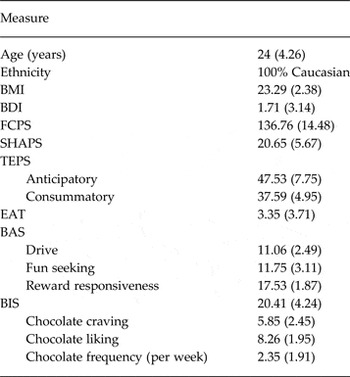
Demographic data (Table 1) indicated that participants had low depression and anhedonia scores, as measured on range of mood and anhedonia questionnaires. Volunteers also scored low on the Eating Attitudes Test and reported a strong liking of chocolate. A repeated-measures ANOVA was performed to examine the effect of treatment (bupropion/placebo) and time (pre-/post-scan) on mood and affect, as measured by the BFS and VAS (Supplementary Table S2). Results revealed that there was no significant effect of treatment (F 1,16 = 0.483, p = 0.497), time (F 1,16 = 0.822, p = 0.378), treatment × time (F 1,16 = 1.922, p = 0.185), treatment × VAS (F 1,16 = 2.472, p = 0.084) or treatment × time × VAS (F 1,16 = 0.689, p = 0.545) interactions. There was also no significant effect of treatment (F 1,14 = 1.61, p = 0.225) or treatment × time (F 1,14 = 2.176, p = 0.162) interaction on total BFS scores. However, there was a significant main effect of time on overall BFS score (F 1,14 = 5.879, p = 0.029).
Group demographic and psychosocial measures

BMI, Body mass index; BDI, Beck Depression Inventory (min-max, 0–40); FCPS, Fawcett–Clarke Pleasure Scale (min-max, 36–180); SHAPS, Snaith–Hamilton Pleasure Scale (min-max, 14–56); TEPS, Temporal Experience of Pleasure Scale (min-max: anticipatory, 10–60; consummatory, 8–48); EAT, Eating Attitudes Test (min-max, 0–78); BAS, Behavioural Activation Scale (min-max: drive, 4–16; fun seeking, 4–16; reward responsiveness, 5–20); BIS, Behavioural Inhibition Scale (min-max, 7–28).
Data are means (s.d.) except for ethnicity, which is percentage.
Adverse effects
Supplementary Table S3 reports the number of adverse effects experienced on each treatment, as measured on the PRISE. The most commonly reported adverse effects across both treatment phases were headache (n = 5 per treatment), difficulty sleeping (n = 3 per treatment) and fatigue (n = 3 placebo, n = 5 bupropion). Dizziness (n = 4) was the most commonly reported adverse effect in the bupropion condition that was not reported in the placebo condition.
Subjective ratings of stimuli
Volunteers rated the chocolate cue and taste as pleasant and the unpleasant picture and taste as unpleasant (Supplementary Fig. S3). Using repeated-measures ANOVA with Ratings as the first factor with three levels (wanting, pleasantness, intensity), Treatment as the second factor with two levels (bupropion, placebo) and Condition as the third factor with two levels (rewarding, aversive), there was no significant main effect of treatment (F 1,16 = 0.867, p = 0.366), treatment × condition (F 1,16 = 2.558, p = 0.129), treatment × rating (F 1,16 = 0.109, p = 0.802) or treatment × rating × condition (F 1,16 = 0.701, p = 0.479) interactions.
Behavioural responses
To examine whether there was an effect of treatment on the amount of effort invested into each condition (reward/aversion), repeated-measures ANOVAs were conducted on the average number of button presses made and the average amount of time it took to complete the effort stage (Supplementary Fig. S4). With Treatment (bupropion and placebo) and Condition (reward and aversion) included as factors, it was revealed that volunteers made significantly more button presses on aversive trials (mean = 37.69, s.e. = 0.33) compared to reward trials (mean = 37.37, s.e. = 0.34) (F 1,16 = 5.736, p = 0.029). This was independent of treatment, since there was no main effect of treatment (F 1,16 = 0.028, p = 0.869) or treatment × condition (F 1,16 = 0.063, p = 0.804) interactions. Furthermore, although volunteers completed aversive trials (mean = 5519.33 ms, s.e. = 46.43) quicker than reward trials (mean = 5546.57 ms, s.e. = 45.11), this was not significant (F 1,16 = 2.106, p = 0.166), nor was there a main effect of treatment (F 1,16 = 0.023, p = 0.881) or treatment × condition (F 1,16 = 1.654, p = 0.217) interactions.
fMRI responses
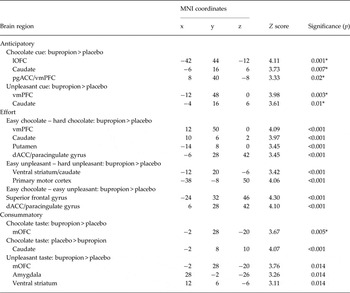
Supplementary Table S1 in the Supplementary material provides a summary of the results for each contrast across all volunteers to indicate the main effect of task. Table 2 provides a summary of the results of the interaction with Treatment.
Regions showing significant effect of treatment on each condition

MNI, Montreal Neurological Institute; lOFC, lateral orbitofrontal cortex; pgACC, pregenual anterior cingulate cortex; vmPFC, ventromedial prefrontal cortex; dACC, dorsal anterior cingulate; mOFC, medial orbitofrontal cortex.
Data thresholded at p = 0.05 uncorrected.
p values: Family-wise error whole brain fully corrected or *family-wise error small volume correction p < 0.05.
Main effect of task
As expected, the chocolate stimuli activated reward-related areas, such as the ventral striatum, the anterior cingulate and the OFC, whereas the unpleasant stimuli activated regions including the amygdala and lateral OFC. Both the chocolate taste and unpleasant tastes activated the insula (i.e. the primary taste cortex).
Anticipatory phase
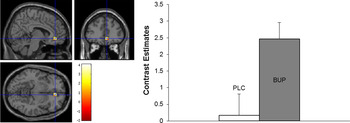
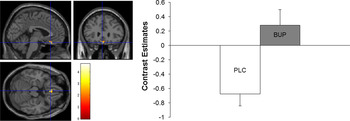
Relative to the placebo condition, the bupropion condition showed increased blood oxygen level dependent (BOLD) activity in the caudate in response to both pleasant and unpleasant cues. To the pleasant cue, the bupropion condition showed more activity in the pregenual anterior cingulate cortex/vmPFC (Fig. 1) and lateral OFC, in comparison to placebo. To the unpleasant cue, the bupropion condition showed more BOLD activity in the vmPFC, relative to placebo.
Pleasant cue: left panel, axial, sagittal and coronal image of pregenual anterior cingulate cortex/ventromedial prefrontal cortex activation compared to placebo (Z = 3.33, p = 0.02 family-wise error small volume correction for multiple comparisons); right panel, contrast estimates for pgACC centred at 8, 40, −8. Error bars represent the standard error of the mean. PLC, Placebo; BUP, bupropion.

Effort phase
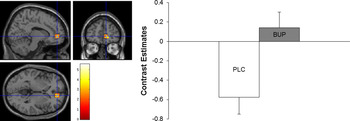
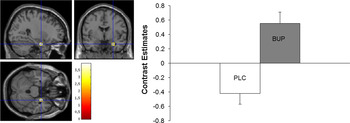
For bupropion there was increased BOLD activity in the caudate, vmPFC (Fig. 2), dorsal anterior cingulate cortex (dACC)/paracingulate gyrus and putamen for the easy chocolate trials compared to hard chocolate trials, in comparison to placebo. Bupropion also increased BOLD activity in the primary motor cortex and ventral striatum/caudate for the easy unpleasant trials compared to hard unpleasant trials. Bupropion increased BOLD activity in the dACC/paracingulate gyrus and the superior frontal gyrus for the easy chocolate trials compared to the easy aversive trials, relative to placebo.
Easy effort chocolate – hard effort chocolate: left panel, axial, sagittal and coronal image of ventromedial prefrontal cortex (vmPFC) activation compared to placebo (Z = 4.09, p < 0.001 family-wise error whole brain cluster corrected for multiple comparisons); right panel, contrast estimates for vmPFC centred at 12, 50, 0. Error bars represent the standard error of the mean. PLC, Placebo; BUP, bupropion.

Consummatory phase
Bupropion increased BOLD activity in the medial OFC (mOFC) to both the pleasant (Fig. 3) and unpleasant tastes. Bupropion increased BOLD activity in the amygdala (Fig. 4) and ventral striatum for the unpleasant taste relative to the placebo condition. Bupropion also reduced BOLD activity for the pleasant taste in the caudate, relative to the placebo condition.
Chocolate taste: left panel, axial, sagittal and coronal image of medial orbitofrontal cortex (mOFC) activation compared to placebo (Z = 3.67, p = 0.005 family-wise error small volume correction for multiple comparisons); right panel, contrast estimates for mOFC centred at 45, −2, 28. Error bars represent the standard error of the mean. PLC, Placebo; BUP, bupropion.

Unpleasant taste: left panel, axial, sagittal and coronal image of amygdala activation compared to placebo (Z = 3.26, p = 0.014 family-wise error whole brain cluster corrected for multiple comparisons); right panel, contrast estimates for amygdala centred at 28, −2, −26. Error bars represent the standard error of the mean. PLC, Placebo; BUP, bupropion.

Discussion
The aim of this study was to examine the effects of 7 days treatment with bupropion on the neural response to three phases of reward and aversion processing (anticipation, effort, consummation) in healthy volunteers. We found that bupropion increased neural responses during the anticipation, effort to achieve/avoid and the consummation of rewarding and aversive tastes. The effects on reward are consistent with the proposal that bupropion may significantly improve outcomes for depressed patients with predominant symptoms of decreased pleasure, interest and energy (Corcoran et al. Reference Corcoran, Wong and O'Keane2004; Nutt et al. Reference Nutt, Demyttenaere, Janka, Aarre, Bourin, Canonico, Carrasco and Stahl2007). Further, bupropion's ability to increase neural activity during anticipation, avoidance and consummation of aversive stimuli may be additionally beneficial for patients experiencing blunted affect in depression whereby reduced reactivity to positive and negative stimuli is predominant (Rottenberg et al. Reference Rottenberg, Gross and Gotlib2005; Rottenberg, Reference Rottenberg2007).
Specifically we found that bupropion increased activity during the anticipation phase (pleasant and unpleasant cues) in the vmPFC and the caudate, with increased lateral OFC to the pleasant cue. These regions are recruited during anticipation of reward (Kim et al. Reference Kim, Shimojo and O'Doherty2011; Sescousse et al. Reference Sescousse, Caldú, Segura and Dreher2013) and found blunted to the anticipation of reward in patients with depression (McCabe et al. Reference McCabe, Cowen and Harmer2009; Price & Drevets, Reference Price and Drevets2009). We also found that the caudate was increased during the anticipation phase (pleasant and unpleasant cues) in the bupropion group compared to placebo. The caudate, which has been previously shown to be activated during the anticipation of pleasant and unpleasant stimuli in healthy volunteers (Gerdes et al. Reference Gerdes, Wieser, Mühlberger, Weyers, Alpers, Plichta, Breuer and Pauli2010) has been found hypoactive during the anticipation of reward in people with depression (Forbes et al. Reference Forbes, Hariri, Martin, Silk, Moyles, Fisher, Brown, Ryan, Birmaher, Axelson and Dahl2009; Smoski et al. Reference Smoski, Felder, Bizzell, Green, Ernst, Lynch and Dichter2009; Zhang et al. Reference Zhang, Chang, Guo, Zhang and Wang2013). Thus, bupropion's ability to modulate activation in these regions during anticipation of reward and aversion might be a mechanism by which catecholaminergic medications are less likely to cause emotional blunting in depression compared to SSRI medications (Shelton & Tomarken, Reference Shelton and Tomarken2001; Zisook et al. Reference Zisook, Rush, Haight, Clines and Rockett2006; Nutt et al. Reference Nutt, Demyttenaere, Janka, Aarre, Bourin, Canonico, Carrasco and Stahl2007; Bylsma et al. Reference Bylsma, Morris and Rottenberg2008; Argyropoulos & Nutt, Reference Argyropoulos and Nutt2013).
During the effort phase, we found that there was more neural activity under hard trials than easy trials in the placebo group (Supplementary Fig. S2). We found that the activity under easy trials was potentiated by bupropion, in the striatum, vmPFC (Fig. 2) and the dACC/motor areas, relative to placebo. Given the previous work showing that these regions are implicated in various processes involved in reward processing including motor performance (Liljeholm & O'Doherty, Reference Liljeholm and O'Doherty2012; Scholl et al. Reference Scholl, Kolling, Nelissen, Wittmann, Harmer and Rushworth2015) and in the avoidance of aversion (Kerr et al. Reference Kerr, McLaren, Mathy and Nitschke2012), its perhaps not surprising that bupropion enhanced this neural activity during effort expenditure to achieve reward and avoid aversion.
During the consummatory phase we found that bupropion, compared to placebo, increased neural activity for both pleasant and unpleasant tastes in the mOFC. Our results are consistent with the literature indicating the involvement of the mOFC in hedonic experiences in humans and animals (Scott et al. Reference Scott, Edwards, Smith, Hilgert, Schwartz and Pritchard2005; Kringelbach & Berridge, Reference Kringelbach and Berridge2010; Peters & Buchel, Reference Peters and Buchel2010). Further, our previous study in those recovered from depression found reduced activity to the taste of chocolate (possible trait marker) in a similar subgenual/mOFC region to that enhanced by bupropion in this current study (McCabe et al. Reference McCabe, Cowen and Harmer2009). Of note, a study by Pizzaggalli et al. (2008) found reduced activation in depressed patients to both positive and negative outcomes in the striatum (Pizzagalli et al. Reference Pizzagalli, Holmes, Dillon, Goetz, Birk, Bogdan, Dougherty, Iosifescu, Rauch and Fava2009) which is of interest given that we found increased striatal activation to the unpleasant taste under bupropion in our task. Taken together our results suggest that bupropion may be beneficial at increasing the neural activity to both positive and negative consummatory stimuli in depressed patients who report blunted affect. Interestingly in our previous study with 7 days citalopram in healthy volunteers using a similar task we found reduced activity to reward and aversion in the drug v. placebo group. Although we are unable to directly compare the results as the tasks are slightly different [one is passive, the current one is active (effort)] it suggests at least that drugs with different neurotransmitter targets interact with reward and aversion differently, as would be hypothesized.
As expected, there were no significant treatment effects on the amount of effort invested in the task or on the subjective reports of pleasantness, wanting and intensity for each of the stimuli. This could be due to not having enough power in the study to detect subjective changes; however, as this is also similar to our previous studies with acute pharmacological challenges in healthy volunteers, we suggest that increased neural activity to reward/aversion after 7 days’ treatment does not necessarily become the subject of conscious awareness, although it could still presumably influence behaviour (Horder et al. Reference Horder, Harmer, Cowen and McCabe2010; McCabe et al. Reference McCabe, Mishor, Cowen and Harmer2010; Tudge et al. Reference Tudge, Williams, Cowen and McCabe2015). Perhaps there is also a ceiling effect as volunteers are all healthy and do not have low mood, or deficits in their ability to complete the effort component or to experience the tastes. However, how bupropion might affect these processes in studies with larger sample sizes and in depressed patients, over a longer period of time, remains to be elucidated.
To conclude, we suggest a potential mechanism of beneficial antidepressant drug action of bupropion that consists of enhancing the neural activation to reward and aversion during anticipation, effort and consummation. This profile of activity in turn could promote reward-seeking and aversive-avoidant behaviours in patients with depression, whereby a lack of drive to actively seek and experience rewards is coupled with a lack of drive to actively avoid negative experiences. Our results also support the notion that non-serotonergic antidepressants may play an important role specifically for patients that have a blunted emotional affect and this fits with the Emotion Context Insensitivity theory of depression (Rottenberg et al. Reference Rottenberg, Gross and Gotlib2005). Future research on the effects of bupropion on anticipation, effort and consummation of reward and aversion in depressed patients are encouraged to explore further how the neural effects described here relate to changes in mood and subjective experience over time.
Supplementary material
The supplementary material for this article can be found at http://dx.doi.org/10.1017/S003329171600088X.
Acknowledgements
We thank Dr Mark Parry, MRCPsych consultant psychiatrist and college tutor at Prospect Park Hospital, NHS Berkshire Trust, Reading, UK for his clinical collaboration. This study was supported by the University of Reading start-up fund for Dr C McCabe.
Declaration of Interest
Dr McCabe has acted as a consultant to P1Vital, Givaudan, GWpharma, the British Broadcasting Company (BBC) and Channel 4. Zola Dean, Dr Stefanie Horndasch and Dr Panagiotis Giannopoulos report no biomedical financial interests or potential conflicts of interest.