INTRODUCTION
The trachichthyid fish, grouped in eight genera (Aulotrachichthys Fowler, Reference Fowler1938, Gephyroberyx Boulenger, Reference Boulenger1902, Hoplostethus Cuvier, Reference Cuvier and Valenciennes1829, Optivus Whitley, Reference Whitley1947, Paratrachichthys Waite, Reference Waite1899, Parinoberyx Kotlyar, Reference Kotlyar1984, Sorosichthys Whitley, Reference Whitley1945, and Trachichthys Shaw, Reference Shaw1799) and about forty-eight valid species (Eschmeyer & Fong, Reference Eschmeyer and Fong2014), are distributed worldwide in the seas except in the polar regions (Kotlyar, Reference Kotlyar1996; Nelson, Reference Nelson2006).
In eastern Pacific waters five species of trachichthyid fish have been formally recorded. Hoplostethus atlanticus Collett, Reference Collett1889 and H. fragilis (de Buen, Reference de Buen1959), known from Chile; H. mento (Garman, Reference Garman1899), known from the Gulf of Panama to Chile; H. pacificus Garman, Reference Garman1899, known from Ecuador to Peru including the Galapagos Islands; and Paratrachichthys fernandezianus (Günther, Reference Günther1887), known from the Juan Fernández and San Felix Islands (de Buen, Reference de Buen1959; Kotlyar, Reference Kotlyar1986, Reference Kotlyar1996; Pequeño, Reference Pequeño1989; Iwasaki, Reference Iwasaki, Nakaya, Yabe, Imamura, Romero and Yoshida2009; Eschmeyer, Reference Eschmeyer and Fong2014).
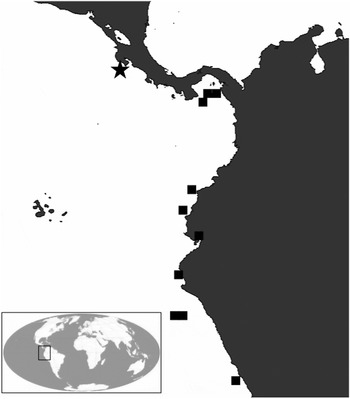
In this paper, the Slimy head Hoplostethus mento is reported for the first time from Costa Rican waters on the basis of a single specimen (99.0 mm in standard length). This specimen, captured on 7 April 2000 in front of Playa Coyote, Península de Nicoya, Province of Guanacaste, Pacific coast (9°40′50.02″N 85°28′4.81″W), at a depth of 650–700 m, represents a north-west range extension of about 600 km on the known distribution of the species. The north-westernmost documented record for this species in eastern Pacific waters was, as noted above, on the Gulf of Panama (7°31′11.99″N 79°13′48.01″W) (Garman, Reference Garman1899; Iwasaki, Reference Iwasaki, Nakaya, Yabe, Imamura, Romero and Yoshida2009; Froese & Pauly, Reference Froese and Pauly2013; Eschmeyer, Reference Eschmeyer and Fong2014). A brief description of the specimen as well as comparative morphometric data and distributional information are provided.
MATERIALS AND METHODS
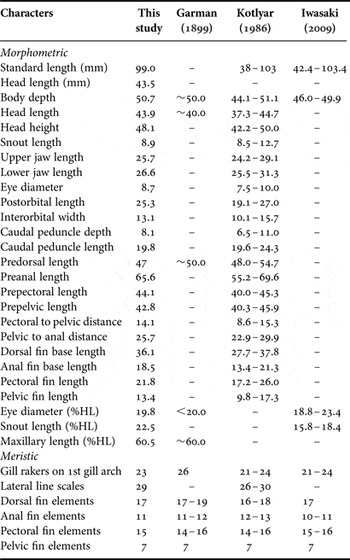
Specimen examined was deposited at the fish collection of the Museo de Zoología of the Universidad de Costa Rica (UCR 2611–002). Counts and measurements (Table 1) were taken on the left side of the specimen and follow the criteria of Garman (Reference Garman1899) and Kotlyar (Reference Kotlyar1986). Measurements were made using caliper to the nearest tenth millimetre (mm). Comparative information was obtained from Garman (Reference Garman1899), de Buen (Reference de Buen1959), Heemstra (Reference Heemstra, Smith and Heemstra1986), Kotlyar (Reference Kotlyar1986, Reference Kotlyar1996) and Iwasaki (Reference Iwasaki, Nakaya, Yabe, Imamura, Romero and Yoshida2009).
Morphometric and meristic data of Hoplostethus mento from Costa Rica (UCR 2611–002) and comparative material, data from Garman (Reference Garman1899), Kotlyar (Reference Kotlyar1986) and Iwasaki (Reference Iwasaki, Nakaya, Yabe, Imamura, Romero and Yoshida2009). Morphometric data expressed as percentages of standard length, except when noted as percentages of head length (%HL). Measurements unavailable are represented with an En dash (–).

RESULTS
SYSTEMATICS
Order BERYCIFORMES
Family TRACHICHTHYIDAE
Genus Hoplostethus Cuvier, Reference Cuvier and Valenciennes1829
Hoplostethus mento (Garman, Reference Garman1899)
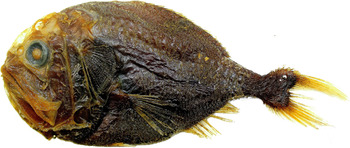
(Figures 1 and 2)
Hoplostethus mento 99.0 mm standard length (UCR 2611–002): caught off Costa Rica (9°40′50.02″N 85°28′4.81″W).

Records of Hoplostethus mento in lower Central America and South America, star indicates the present record (UCR 2611–002), squares indicate previous literature and museum records. Adapted from http://www.gbif.org/

DESCRIPTION
Morphometric and meristic data of the examined specimen (Figure 1) are given in Table 1. The body of the specimen is oval—its depth about 2.4 times in its length—and compressed. The head is relatively large—its length subequal to its height—and nearly semicircular from the isthmus to the nape. The bones of the skull are fragile, deeply excavated for the vessels of the lateral system. The snout is blunt and larger than the orbit—about 4.9 times in head length. The mouth is relatively large, oblique, with the posterior end of the upper jaw reaching below posterior margin of the orbit. The teeth are relatively small and villiform; arranged in bands on the jaws, in a small group on the vomer, and in narrow series on the palatines. The eyes are relatively small—about 5.0 times in head length. The scales are mostly small, irregular, and rough, with small spines; the lateral line scales are enlarged and deeply notched on the middle of the hinder edges. The dorsal fin base is relatively long—twice as long as the anal fin base length. The caudal peduncle is slender—its depth about 2.4 times its length. The caudal fin is deeply notched.
The body of the specimen kept in 70% solution of ethyl alcohol is dark brown, darker on ventral margin, paler in the cephalic region. The bones of the skull and jaws are in appearance nearly transparent or light yellow. The pectoral, pelvic, anal and caudal fins rays also are light yellow. The branchiobuccal cavity is dark.
COMPARATIVE REMARKS
Hoplostethus mento can be distinguished from its other eastern Pacific congeners by a combination of morphological and coloration differences:
-
(1) Hoplostethus mento differs from H. atlanticus in having a lower number of dorsal fin elements (16–19 vs 19–25), a lower number of pectoral fin elements (14–16 vs 16–20), a lower number of anal fin elements (10–13 vs 13–15), by the absence of a ventral keel of scutes (usually present in the last species and composed by 13–25 small scutes), and in the coloration pattern (rose-silvery with more or less of purple on the scaly portions, and the mouth and gill cavity black vs bright brick-red with the mouth and gill cavity bluish black).
-
(2) Hoplostethus mento differs from H. fragilis in having a shorter eye diameter (about 18–24% of the head length vs 26–32% of the head length), a lower number of dorsal fin elements (17–19 vs 20–22), a lower number of pectoral fin elements (14–16 vs 19–20), and a lower number of anal fin elements (10–12 vs 14), among other characters.
-
(3) Hoplostethus mento differs from H. pacificus in having a deeper head (head length subequal to head height vs head length and head height equal), a lower number of pectoral fin elements (14–16 vs 19), by the absence of a ventral keel of scutes (present in the last species and composed of 15–19 large scutes), and in the coloration pattern (rose-silvery with more or less of purple on the scaly portions vs bright brick-red with the head yellowish), among other characters.
DISCUSSION
The data from the specimen of Hoplostethus mento herein described are in agreement with the size, body proportions and counts reported by other authors who systematically described this species (e.g. Garman, Reference Garman1899; Kotlyar, Reference Kotlyar1986; Iwasaki, Reference Iwasaki, Nakaya, Yabe, Imamura, Romero and Yoshida2009). The only anatomical feature that differs significantly from Kotlyar (Reference Kotlyar1986), the more comprehensive description, is the number of anal fin elements (11 vs 12 or 13). Garman (Reference Garman1899) and Iwasaki (Reference Iwasaki, Nakaya, Yabe, Imamura, Romero and Yoshida2009), however, report a total of 10–12 anal fin elements from this species, consistent with what was observed in the specimen herein described. On the other hand, Kotlyar (Reference Kotlyar1996), in their revision of the Beryciform fish of the world ocean, also provide a comprehensive description for this species, however, morphometric and meristic data are not significantly different from the data presented in Kotlyar (Reference Kotlyar1986); given this, these data are not herein considered.
In the eastern Pacific region Hoplostethus mento has been previously reported in the Gulf of Panama (Garman, Reference Garman1899; Kotlyar, Reference Kotlyar1986), Peru (Kotlyar, Reference Kotlyar1986; Iwasaki, Reference Iwasaki, Nakaya, Yabe, Imamura, Romero and Yoshida2009) and central Chile (Kotlyar, Reference Kotlyar1986; Pequeño, Reference Pequeño1989) (see Figure 2). Since surveys off the west coast of the USA, Mexico and southern Chile, the slopes of which have been relatively well sampled, have not reported any occurrences of this species, it seems likely that their distribution is confined to equatorial waters (from about 20°N to 30°S). In this regard, similar distribution patterns have been previously reported in other pelagic and benthic deep-sea fish (see de Buen, Reference de Buen1959; Sulak, Reference Sulak1977; Pequeño, Reference Pequeño1989; Castellanos-Galindo et al., Reference Castellanos-Galindo, Rubio Rincon, Beltrán-Léon and Baldwin2006). The most important factors explaining these latitudinal limits could be the surface isotherm (see Sulak, Reference Sulak1977; Beer, Reference Beer1996 for an overview) and the existence of oxygen minimum zones located near oceanic islands, seamounts and continental margins (see White, Reference White1987; Craig-Curtis & Bush-Brown, Reference Craig-Curtis and Bush-Brown2003).
Being collected at relatively great depths (300–1350 m), the biology of Hoplostethus mento is poorly known, due almost certainly to the relatively low number of captures. At the present time, according to FishBase (Froese & Pauly, Reference Froese and Pauly2013), the Global Biodiversity Information Facility (GBIF: http://www.gbif.org/) and the FishNet2 (http://fishnet2.net/) databases, a relatively small number of caught specimens of this species are known (about 180 specimens); most of them collected in Panamanian and Peruvian waters. In the last years, an important number of fish species have been recorded for the first time in Costa Rican waters, mainly on the Pacific coast (see Bussing & López, Reference Bussing and López2011; Cortés et al., Reference Cortés, Sánchez-Jimenez, Rodriguez-Arrieta, Quirós-Barrantes, González and Blum2012; López-Garro et al., Reference López-Garro, Zanella, Golfín-Duarte and Pérez-Montero2012; Starr et al., Reference Starr, Green and Sala2012; Angulo, Reference Angulo2014). Although some of these species are probably residents in these areas that might have remained undetected due to intrinsic rarity or difficulty of access to their specific habitats, as in this case, some others can be considered ‘vagrant’ (i.e. they have arrived from the other areas). The presence of these previously unrecorded species indicates that the Costa Rican marine ichthyofauna is considerably richer and an estimation of number, composition and distribution of species is still far from being obtained.
The expansion of fisheries into deeper waters and the development of new fisheries for new deep water target species in the area (see Wehrtmann & Nielsen-Muñoz (Reference Wehrtmann and Nielsen-Muñoz2009) for an overview), will likely bring with them new captures of unexpected species, such as the one reported here. As a result of it, some fish currently considered as rare, might be common or abundant at certain depths or habitats previously unexplored.
ACKNOWLEDGEMENTS
The author is grateful to William A. Bussing, Myrna I. López, Ana Rosa Ramírez and the authorities of the Museo de Zoología of the Universidad de Costa Rica for encouragement and facilities; to Marcela Vittola for donating the specimen; and to Alexander Kotlyar for helpful comments and for providing pdf copies of their publications.