INTRODUCTION
Abundance and distribution of cetaceans have been associated with ecological and environmental features such as prey population dynamics, water temperature, depth, salinity, ecosystem productivity, and recently with boat traffic and fisheries (Fiedler & Reilly, Reference Fiedler and Reilly1994; Novacek et al., Reference Novacek, Wells and Solow2001; Lusseau, Reference Lusseau2004; Hernández, Reference Hernández2009). Even though cetaceans can modify their behaviour and avoid human presence (Bearzi, Reference Bearzi and Notarbartolo di Sciara2002), evidence supports the hypothesis that dolphins increasingly interact with commercial fishing fleets to feed upon discards or netted prey (Fertl & Leatherwood, Reference Fertl and Leatherwood1997; Bearzi, Reference Bearzi and Notarbartolo di Sciara2002; Chilvers et al., Reference Chilvers, Corkeron and Puotinen2003; Lauriano et al., Reference Lauriano, Fortuna, Moltedo and Notarbartolo di Sciara2004; Rocklin et al., Reference Rocklin, Santoni, Culioli, Tomasini, Pelletier and Mouillot2009). Bottlenose dolphins (Tursiops truncatus Montagu, 1821) interact with virtually all types of fishing gear and compete with fishers, commonly resulting injured or dead (Perrin et al., Reference Perrin, Donovan and Barlow1994). However, only few studies have addressed the reciprocal effects of such interactions, providing key evidence for the development of conservation and management practices aimed at reducing the impact of human activities on wildlife (Chilvers & Corkeron, Reference Chilvers and Corkeron2001; Chilvers et al., Reference Chilvers, Corkeron and Puotinen2003; Read et al., Reference Read, Urian, Wilson and Waples2003; Lauriano et al., Reference Lauriano, Fortuna, Moltedo and Notarbartolo di Sciara2004; Rocklin et al., Reference Rocklin, Santoni, Culioli, Tomasini, Pelletier and Mouillot2009).
The coastal waters off Alvarado sustain a fairly large and stable population of bottlenose dolphins, where 232 individuals have been photo-identified since 2002 (Del Castillo, 2010; E. Morteo, unpublished results). Due to the intensive fishing pressure in the area, these animals are well known to actively interact with local fisheries (García, 1995; Del Castillo, 2010). Interviews with the local fishing community revealed that they see dolphins as vermin, and some people may be willing to harm them if they feel their catches are threatened (E. Morteo, personal observations). At least 17% of dolphins photographed in this area show physical evidence of encounters with vessels or fishing gear (García & Morteo, Reference García and Morteo2008). If interactions are as frequent and intense as described by local fishers, then dolphin abundance and distribution would be expected to be highly correlated to fishing activities. Consequently, resident dolphins would be more likely to be involved in the encounters. In this study, we analyse the spatial and temporal variations in the abundance and distribution of dolphins, vessels and static fishing gear, to test these hypotheses, particularly focusing on the types of interactions, the potential for such events, the proportion of dolphins involved, and how resident animals have coped with human activities in the area.
MATERIALS AND METHODS
Sampling area
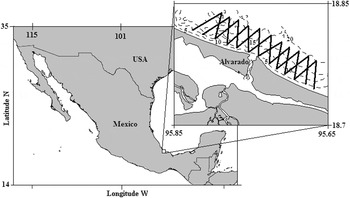
The productive Alvarado coastal region is shallow (<20 m depth) and strongly influenced by river discharges (Figure 1). It features the third largest coastal lagoon system in Mexico, and the most important shrimp fishing ground in the State of Veracruz; its major threat is habitat modification (Ortega, Reference Ortega2002). Around 2000 fishers are active in the area, most of which (75–85%) operate in the lagoon and the rest fish in open waters. No official data are available on marine traffic or fishing effort, even though, according to the National Institute of Fisheries (INAPESCA), fishing operations take place year-round, and the coastal artisanal fishery is one of the prevalent economic activities of the local community. Since port facilities are dedicated to fishing, there is no alternative commercial seagoing activity.
Study area and survey trajectories (in bold). Dashed lines show depth contours every 5 m.

Data collection
Transect boat-based surveys were conducted twice a month between May 2006 and April 2008 covering 9 km on both sides of the entrance of the Alvarado lagoon. Two zigzag trajectories (18 km wide, 4 km offshore, 3 km vertex separation) were navigated to count target objects (dolphins, vessels and fishing gear), covering the 20 m depth contour, based on dolphin distribution data (García, 1995; Del Castillo, 2010). Both trajectories were designed so that the maximum separation between adjacent legs was 1.5 km (Figure 1).
A 7 m outboard motor (40/60 HP) boat (known as ‘panga’) was used to navigate at constant speed (15–18 km h−1) to collect data under sea state Beaufort 3 or lower (wind speed <15 km h−1). Surveys involved two operation modes: ‘passing’ and ‘approach’ (Morteo & Hernández, Reference Morteo, Hernández, Granados-Barba, Abarca-Arenas and Vargas2007). During passing mode, the boat navigated the pre-established trajectory in search of target objects, which were identified, quantified and geo-referenced (GPS Garmin, eTrex Legend). Geographical coordinates for every object were estimated relative to the location of the research vessel (global positioning system (GPS)), using the navigation bearing, angle of approach (towards the bow), distance to object and pre-established landmarks (Morteo & Hernández, Reference Morteo, Hernández, Granados-Barba, Abarca-Arenas and Vargas2007). Vessels were classified as either: (1) fishing (attempts were made to identify gear type); (2) moving; (3) trawling; (4) harbour manoeuvering; or (5) unknown. Fishing gear was classified as: (1) gillnets; (2) shrimp nets; (3) hook lines; or (4) unknown.
Whenever dolphins were sighted, the survey switched to ‘approach mode’ and search effort for other objects was temporarily suspended. A school consisted of all dolphins sighted simultaneously during an event (Morteo et al., Reference Morteo, Heckel, Defran and Schramm2004), and its behaviour was classified as either feeding or not (Allen & Read, Reference Allen and Read2000). Dolphins were followed at low speed minimizing any disturbance to the best of our efforts (Morteo et al., Reference Morteo, Heckel, Defran and Schramm2004) while attempts were made to digitally photograph the dorsal fins of all animals (Canon Rebel XT and Nikon D50 both with 70–300 mm zoom lenses). When photographic effort was completed, the survey resumed passing mode from the position where it was interrupted until the end of the transect. All field data were entered into a GIS (ArcGIS 9.2).
Statistical analyses
RELATIVE ABUNDANCE
Conspicuous vessels and fishing gear were all assumed to be observed and counted. Dolphin detectability, however, was determined using the effective band width as calculated with the software Distance 4.1.2. Since the effective band was larger (>1.6 km) than the maximum separation between adjacent survey legs (1.5 km), it was assumed that all dolphins were also observed and counted.
Counts were used to compute relative abundance (RA) by standardizing daily counts per hour of survey search time. Temporal differences in RA were assessed through non-parametric tests (Kruskal–Wallis (K-W) or Mann–Whitney (M-W)).
ANALYSES OF INTERACTIONS
Interactions were defined as the simultaneous occurrence of dolphins and human activities within a fixed radius (adapted from Lauriano et al., Reference Lauriano, Fortuna, Moltedo and Notarbartolo di Sciara2004). This radius was determined from the instantaneous distances from dolphin groups to the closest vessel or fishing gear. The radius was defined as the smallest modal distance in the frequency distribution. Competitive interactions involved dolphins feeding around either fishing gear or fishing vessels, and non-competitive ones included any other dolphin activities around vessels or fishing gear (Lauriano et al., Reference Lauriano, Fortuna, Moltedo and Notarbartolo di Sciara2004).
Determination of shared space
Target densities were obtained by counting objects in a grid with the highest possible resolution (0.01 degrees per side) and the lowest number of empty cells (limit was 10%: Ingram & Rogan, Reference Ingram and Rogan2002; Lusseau & Higham, Reference Lusseau and Higham2004). Object counts within cells were later transformed to proportions of total annual counts. Then, a neighbour joining algorithm was applied to construct density contours for each variable; clustering and autocorrelation were assessed with Moran's index (I) using ArcGIS tools. The resulting annual density contours of each target were superimposed to identify overlapping regions, which were expressed as proportions of the study area. Distances between annual core areas were also calculated and compared.
Areas of potential interaction
These areas were defined as those where the targets were more likely to co-occur according to their spatial probabilities, based on annual object counts. Probabilities of spatial occurrence (p o) were computed for each variable using density functions, through the concept of utilization distribution (Jennrich & Turner, Reference Jennrich and Turner1969; Van Winkle, Reference Van Winkle1975). Briefly, since densities for each variable were already expressed as fractions of annual counts in each grid cell, these were assumed to represent p o. Therefore, probabilities of potential co-occurrence for all variables (p co) were computed as the product of target p o assuming spatial independence from each other. Spatial probabilities of potential interactions for dolphins and fisheries overall were computed as:
 $$\eqalign{&p_{co\lpar {\rm x}\comma {\rm y}\rpar }\lsqb \hbox{D}\comma \; \lpar {\rm {V or F}}\rpar \rsqb = p_{o\lpar {\rm x}\comma {\rm y}\rpar }\lpar \hbox{D}\rpar \,{\ast}\, \lsqb p_{o\lpar {\rm x}\comma {\rm y}\rpar }\lpar \hbox{V}\rpar \cr &\quad + p_{o\lpar {\rm x}\comma {\rm y}\rpar }\lpar \hbox{F}\rpar - p_{o\lpar {\rm x}\comma {\rm y}\rpar }\lpar \hbox{V}\rpar \,{\ast}\, p_{o\lpar {\rm x}\comma {\rm y}\rpar }\lpar \hbox{F}\rpar \rsqb}$$
where, x and y are row and column indices for p o matrices, and D, V, F are annual probabilities of spatial occurrence (p o) for dolphins, vessels, and fishing gear, respectively.
The maximum probability of annual co-occurrence for all three targets (p co-max) was used as a reference to test the significance of p co in each cell. For this, target counts were first recalculated using a lower grid resolution (0.04 and 0.06 degrees per side, for each year) with no empty cells allowed, and transformed to proportions of total annual counts. Then annual reference values (p co-max) were obtained by multiplying the new p o maximized estimates of the corresponding cells using Equation 1 and then averaging over all cells.
Annual p co cell estimates were classified according to their interaction potential by comparing them to the corresponding reference values (p co-max), and using the following criteria: (1) potentially intentional interaction zones, when p co were not significantly different from p co-max; (2) potentially random interaction zones, where values were significantly lower than p co-max, but different from zero; and (3) zones with no potential interaction, where values were not significantly different from zero. The latter was achieved by normalizing the annual p co-max statistical distributions. The Z values of p co in each cell were computed, and then they were tested for significant differences with respect to the annual p co-max or zero (α = 0.05). Annual cell classifications were mapped along with the coordinates of actual interaction events using dolphin school positions as visual aids.
INDIVIDUAL INTERACTIONS
Each animal was individually identified by its dorsal fin natural markings according to the Sarasota Dolphin Research Program (2006) protocol. Animals were classified as residents if they were photographed on at least half of the annual surveys. The exposure of each dolphin to fisheries (EF) was computed as the fraction of sightings that involved such interactions; and animals with only five or more recaptures were used on calculations. Another reference value was calculated as the maximum probability of interaction (p i-max) using the annual average of encounter rates (ER) for all variables:
 $$p_{i - \max} = \hbox{ER} \lpar \hbox{D} \rpar \ast \hbox{ER} \lpar \hbox{V}\rpar \ast \hbox{ER}\lpar \hbox{F}\rpar \comma$$
where D = dolphins, V = vessels and F = fishing gear.
Individual EFs were classified analogous to the previous section into: (1) animals prone to interactions (EF = p i-max); (2) animals with random interactions (0 < EP < p i-max); and (3) animals that eluded interactions (EP = 0). Finally, EFs for resident animals were compared to the rest (M-W test), to determine their particular behaviour towards interactions with fisheries.
RESULTS
Sampling effort and target counts
A total of 41 surveys (167.05 hours) were carried out covering the entire study area (73.24 km2) on all occasions in both years, and bottlenose dolphins were the only marine mammal encountered during the surveys. A total of 90 dolphin schools (928 individuals) and 980 vessels (98.6% classified) were sighted. The latter included mostly small (6–9 m) outboard (40 to 75 HP) ‘pangas’, either fishing (74.6%) or in transit (22.8%). During the first sampling year (May 2006–April 2007, 2006–2007 henceforth), most fishing vessels used shrimp nets (71.6%), followed by hook lines (19.6%) and gillnets (6.7%). However, during the second year (May 2007–April 2008, 2007–2008 henceforth) the number of vessels in transit doubled whereas fishing activities decreased by 43%. Static fishing gear counts resulted in 320 for the duration of the study (96.9% classified), and shrimp nets were the most common (71.6%), followed by hook lines (18.4%) and gillnets (9.7%). During the first year most targeted shrimp (81.2%), but during the second year these decreased to 22.6%, whereas hook lines increased from 9.5 to 62.0%.
Temporal variation of relative abundance
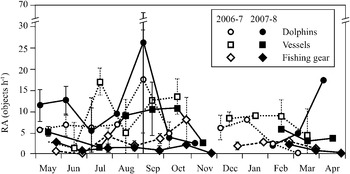
Total RA was the same for dolphins and vessels (7.5 h−1) and lower for fishing gear (2.5 h−1). Except for a significant decrease in fishing gear during the second year (M-W, P < 0.05), no monthly (K-W, P > 0.05), seasonal (K-W, P > 0.05) or inter-annual (M-W, P > 0.05) differences on daily RA averages (dolphins = 9.0 ± 10.6 SD, vessels = 7.8 ± 5.9 SD, fishing gear = 2.4 ± 2.6 SD h−1) of target items were found (Figure 2).
Monthly averages (±SD) of relative abundance of dolphins, vessels, and fishing gear in the study area.

Dolphin–fisheries interactions
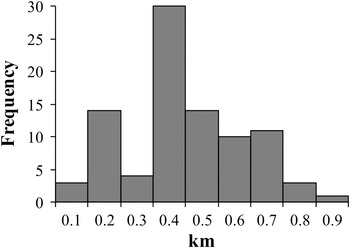
Daily distances between dolphins and all vessels averaged 2.25 km and showed no temporal variation (t-test, P > 0.05), as neither did daily average distances between dolphins and all fishing gear types (1.6 km, t-test, P > 0.05). In both years, dolphins were found significantly (t-test, P < 0.05) closer to fishing gears than to vessels. On the other hand, the average distance between dolphin groups and the closest fishery-related target (vessel or fishing gear) was 0.50 km (±0.18 SD) and most dolphin groups were observed at or beyond 0.4 km from any human activity. A first mode in the distribution of human–dolphin distances was detected at 0.2 km (Figure 3), which was used to define the radius of interactions (200 m). Only 14.4% of dolphin schools were observed feeding; also 18.9% interacted with fisheries and these involved exclusively gillnet operations (28.6% of all vessels and 22.6% of fishing gear), where 25% of these involved competitive interactions and only occurred during the first year.
Histogram of distances separating dolphin groups and the closest fishery-related target (vessel or fishing gear). The radius to determine interactions was fixed at 200 m.

Shared space
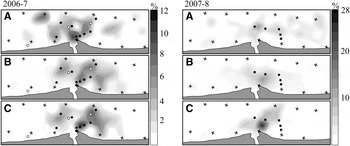
Spatial analyses revealed significantly contagious distributions for all targets (I > 0.52, P < 0.04 in all cases) (Figure 4). Vessels occupied 32.8–45.6% of the study area, followed by fishing gear (13.7–26.4%), and dolphins (19.0–22.2%). Only one core area was found for each variable, and they were all located close to the entrance of the lagoon.
Annual density contours for (A) dolphins, (B) vessels and (C) fishing gear. Lateral scale indicates proportional counts for each target. Crosses denote vertices along the wider survey trajectory, and black dots indicate interactions (competitive interactions are indicated as white dots).

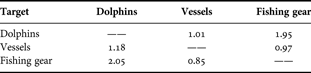
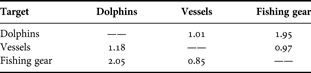
Superimposing spatial distribution maps revealed co-distribution patterns between pairs of target objects, in which dolphins shared 90.5–93.7% of their distribution with vessels but only 64.0–67.2% with fishing gear. Inter-annual variation in overlap areas was less than 4% and non-significant. Except for fishing gear counts in 2007–2008 (χ2 test, P < 0.05), there were no significant inter-annual differences (χ2 test, P > 0.05) within the shared space (Table 1). On the other hand, distances among core areas contradicted the expected trend, where dolphins and vessels were closer, compared to fishing gear (Table 2).
Percentage of observations of each target object in shared areas. Total number of observations is in parentheses.

Distances (km) between target core areas of annual density contours (2006–2007 above, 2007–2008 below the diagonal).
Potential interaction areas
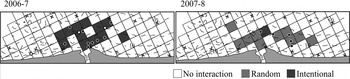
There was a marked inter-annual difference in the area involving potential interactions. In the first year 12.1% of cells were classified as intentional interaction zones and the rest had random or no potential interaction. In contrast, in the second year only 1% of cells featured intentional interactions, 10% random, and the rest had no interaction (Figure 5). These were computed using the annual maximum probabilities of co-occurrence (p co-max) which were 0.27 (SD = 0.38) in 2006–2007 and 0.54 (SD = 0.35) in 2007–2008. Annual average cell co-occurrence probabilities were 0.037 (SD = 0.052) for dolphins and vessels and 0.036 (SD = 0.056) for dolphins and fishing gear with local maxima of 0.247 and 0.368, respectively. Mean spatial probabilities of occurrence for each target (p o) and the spatial probabilities of co-ocurrence (p co) of target pairs are presented as Supplemental Electronic Material.
Potential interaction areas for dolphins and fishing operations. Crosses denote vertices along the wider survey trajectory, and black dots indicate interactions (competitive interactions are indicated as white dots).

Individual interactions
A total of 172 dolphins were photo-identified (111 in 2006–2007 and 138 in 2007–2008); the fraction that interacted with fisheries in both years (0.448) was significantly smaller (t-test, P < 0.05) than the maximum probability of interaction (p i = 0.734), suggesting that individual dolphins are not prone to interact with fisheries. The same was true for the individual EF, which averaged 30.4% (SD = 14.4) for all animals and was also significantly lower (t-test, P < 0.05) than the calculated maximum (p i = 0.734), suggesting that encounters were non-recurrent. A total of 23 animals were residents in the study area, of which 60.9% (12 and 15, each year) interacted with fisheries. However, they did so significantly (M-W, P < 0.05) less frequently ( = 16.1%, SD = 4.8) than the rest ( = 34.7%, SD = 13.5). Finally, of the 77 dolphins that did interact with fisheries, 22.1% did so intentionally, whereas 29.9% were involved in random encounters, and 48.1% eluded such encounters. In contrast, among the 23 of resident dolphins 13.0% intentionally interacted with fisheries, whereas 30.4% did so randomly, and 56.5% avoided them.
DISCUSSION
Temporal changes in fishing effort
The number of dolphins and the survey effort involved in this study are comparable to those of similar studies carried out in the western Gulf of Mexico (Heckel, 1992; Schramm, 1993; García, 1995; Ramírez et al., Reference Ramírez, Morteo and Portilla2005; Del Castillo, 2010), which have found continuous presence of dolphins, and suggested suitable habitats for these animals and their activities. However, these studies do not address the types and levels of human activities in their region, thus fisheries occurrence and their interactions with dolphins are mentioned sporadically as casual observations. Our abundance estimates of vessels and fishing gear provided the first quantitative field data confirming the intensive fishing effort around the Alvarado lagoon, which involved mainly small-scale shrimp fishing activities. On the other hand, maritime traffic is much less diverse than elsewhere where it may involve industrial, commercial, recreational, and military activities among others (Texeira, 2005; Hernández, Reference Hernández2009; La Manna et al., Reference La Manna, Cló, Papale and Sará2010). Annual variation in fishing activities was likely the result of changes in navigability, where 2007–2008 featured markedly worse weather conditions. The significant decrease in fishing effort and the switch in the preferred gears during the second year influenced dolphin–fisheries interactions, which were 58.3% less frequent and lacked competitive encounters.
Relative abundance, residency and habitat suitability
The RA of bottlenose dolphins in Alvarado is higher than in other regions of the Gulf of Mexico (Heckel, 1992; Schramm, 1993; García, 1995; Delgado, Reference Delgado2002; López, Reference López2002; Hernández, Reference Hernández2009), suggesting that the Alvarado area provides a more suitable and preferred habitat for the species. Direct evidence favouring this hypothesis comes from a concurrent and methodologically comparable study carried out at the Veracruz Reef System (VRS) 100 km north-east of Alvarado (Hernández, Reference Hernández2009). The VRS shows five times less abundance of bottlenose dolphins than Alvarado (Hernández, Reference Hernández2009; Del Castillo, 2010), and no current evidence of residency. Since RA of vessels and fishing gear were similar in both regions (Hernández, Reference Hernández2009), differences in dolphin abundance and levels of residency more likely resulted from habitat differences not associated with fishing effort. On the other hand, in spite of being a marine protected area, other non-fishery related maritime operations may be at play in the VRS, for instance La Manna et al. (Reference La Manna, Cló, Papale and Sará2010) have reported lower dolphin abundance in the Mediterranean Sea, possibly due to a higher level and more diversified maritime human activities.
Real and perceived dolphin–fisheries interactions
The radius for defining interactions with fisheries was smaller than the seemingly arbitrary 400 m used by Lauriano et al. (Reference Lauriano, Fortuna, Moltedo and Notarbartolo di Sciara2004), and although this variation may be attributed to differences in geographical scale (480 km2 compared to 73 km2 in this study) and geographical resolution (i.e. high resolution in this study involving GPS and geographically fixed landmarks as described by Morteo & Hernández, Reference Morteo, Hernández, Granados-Barba, Abarca-Arenas and Vargas2007), we avoided an arbitrary and subjective definition by using the observed distances between dolphins and human-related targets to establish the radius. These distances revealed that dolphin schools were found closer to fishing gear than to vessels. On the other hand, annually integrated core areas showed the opposite trend. This suggests that dolphins and vessels navigate towards the same areas in general, but tend to avoid each other on a daily basis, as indicated by reciprocal evasions recorded during field observations. In dolphins, this behaviour may be elicited by historical aggressions from fishers. On the other hand, dolphins have shown to avoid areas with irregular or unpredictable traffic (Wells, Reference Wells, Roat, Ciciccolella, Smith and Tomoasko1993; Allen & Read, Reference Allen and Read2000), but may remain in such areas if there are other factors favouring their presence (e.g. abundant prey) (Lusseau, Reference Lusseau2004; Teixeira, Reference Teixeira2005). In this study, dolphins interacted competitively only with fixed unattended gillnets, which caught dolphins' natural preys and precluded the presence of fishers. Thus, dolphins around Alvarado lagoon forage partially on a specific fishery, and their interaction levels are not different from other sites around the world (López, 1997; Chilvers et al., Reference Chilvers, Corkeron and Puotinen2003; Lauriano et al., Reference Lauriano, Fortuna, Moltedo and Notarbartolo di Sciara2004; Teixera, 2005; Rocklin et al., Reference Rocklin, Santoni, Culioli, Tomasini, Pelletier and Mouillot2009).
The low frequency of dolphin–fisheries interactions found in this study suggests that fishing operations provide only a part of the dolphins' energetic requirements (Brotons et al., Reference Brotons, Grau and Rendell2007), therefore the apparent chronic problem caused by dolphins to fisheries, as reflected in fishers interviews may be overstated as implied by Díaz (Reference Díaz2006). Admittedly, the studied area represents only part of the commercial fishing grounds around Alvarado and we cannot discard that interactions may be more frequent elsewhere, where gillnets are the most commonly used fishing gear.
Shared space
Spatial distribution of vessels, fishing gear and dolphins showed their highest density cores close to the entrance of the lagoon (Figure 5). Consequently, this is where most of the interactions took place. This pattern may reflect to some extent the confluence of vessel traffic in and out of the lagoon, however, the prevalence of set fishing gear and dolphins do not. Since the distribution of both of these target objects responds more to resource abundance, it is likely that the pattern is also a reflection of the latter. Dolphins and humans are well known to exploit the highly productive estuarine coastal lagoon systems characterized by high levels of primary and secondary production and tidal currents carrying prey items in and out of the lagoons (Heckel, 1992; Schramm, 1993; Wilson et al., Reference Wilson, Thompson and Hammond1997).
Potential interaction areas
Annual concurrence probabilities (p co) revealed that potentially intentional encounters were spatially restricted (0–12.1%) and so were potentially random interactions (7.1–16.2%) (Figure 5), reflecting a trend of general avoidance between humans and dolphins. Only at the entrance of the lagoon both co-occurred and interacted. We posit that this is because the lagoon entrance is the place where the trade-off between risk and benefit may be favourable to both fishers and dolphins given the likely higher abundance of prey items. Other studies have estimated potential densities, occurrence probabilities and encounter rates for cetaceans and other species using algorithms based on ecological features through multivariate analyses and geographical information systems (Fiedler & Reilly, Reference Fiedler and Reilly1994; Hastie et al., Reference Hastie, Swift, Slesser, Thompson and Turrell2005; Ferguson et al., Reference Ferguson, Barlow, Fiedler, Reilly and Gerrodette2006; Cañadas & Hammond, Reference Cañadas and Hammond2008). However, no other research has reported joint probabilities of occurrence to determine the likelihood of potential interaction sites between dolphins and fisheries based on quantitative observations. Studies reporting densities (or probabilities) based on simulations have included habitat availability (or quality) mostly for oceanic cetaceans (Fiedler & Reilly, Reference Fiedler and Reilly1994; Hastie et al., Reference Hastie, Swift, Slesser, Thompson and Turrell2005; Ferguson et al., Reference Ferguson, Barlow, Fiedler, Reilly and Gerrodette2006), thus direct comparisons may not be feasible.
Individual interactions
The fraction of photo-identified individuals that interacted with fisheries is higher than comparable studies in other areas (López, 1997; Teixera, 2005). However, our results indicate that most of them occur by chance, and only a small fraction was estimated as potentially intentional. As expected, most of the resident dolphins interacted with fisheries; however, they did so less frequently than the other animals, and only a few (13%) showed potential intentionality. There is evidence suggesting that some dolphins may prefer feeding at fishing sites where they have successfully scavenged discarded prey items or actual catches (Chilvers et al., Reference Chilvers, Corkeron and Puotinen2003; Brotons et al., Reference Brotons, Grau and Rendell2007; Rocklin et al., Reference Rocklin, Santoni, Culioli, Tomasini, Pelletier and Mouillot2009) and the risk of being injured or killed is relatively low. Fishers in the Alvarado area are known to aggressively divert dolphins away from their gear sometimes using unlawful lethal force (García, 1995; Del Castillo, 2010; E. Morteo, personal observations). Accordingly, the lower level of interaction found among resident dolphins may result from a history of threatening experiences eliciting negative reinforcement. Over the course of this research, nine dead animals (not previously photographed) were unexpectedly recorded showing injuries from fisheries (entangled gear, stab wounds and/or severed appendages) and there is evidence to suggest that the numbers may be higher (E. Morteo, unpublished results). Even though this apparently fishery-induced mortality may be smaller than in other regions such as the Sea of Cortez (Guzón, Reference Guzón2006), immediate actions are warranted to mitigate incidental or intentional killings in this area (Brotons et al., Reference Brotons, Grau and Rendell2007).
ACKNOWLEDGEMENTS
We thank Anselmo Estandía and Armando Fernández from Acuario de Veracruz, A.C. for their help in overcoming logistic and funding issues. Tim Gerrodette provided insight into spatial probability analyses, and comments from Richard H. Defran and anonymous referees helped improve the paper. We gratefully acknowledge Dr Ann Pulsford for her editorial assistance. Alfonso Medellín and Esther Jiménez helped with GIS technical support. Jorge Montano, Marah García, Isabel Hernández and Verónica Del Castillo were involved in surveys and data collection. Field work was carried out with authorization from SEMARNAT permits SGPA/DGVS/00351/06 (Eduardo Morteo) and SGPA/DGVS/00870/07, 02788/07, 01344/08 and 01649/08 (Carmen Bazúa). This research is part of the lead author's doctoral thesis at the Universidad Veracruzana, Mexico, where he benefited from a doctoral fellowship from CONACYT. This work was supported by the following grants: PROMEP (E.M., grant Apoyo a Nuevo PTC), (E.M., and Horacio Pérez-España, grants issued through CAMyCRA), CONACyT (Enriqueta Velarde, grant 45468), (Carmen Bazúa, grant FOMIX CAMP-2003-C01-9102) and the Marine Mammal Laboratory of Universidad Veracruzana and Acuario de Veracruz, A.C.
Supplementary materials and methods
The supplementary material referred to in this article can be found online at journals.cambridge.org/mbi