Racial discrimination is a prevalent, pernicious, and persistent stressor in the lives of African American adolescents (e.g., Berkel et al., Reference Berkel, Murry, Hurt, Chen, Brody and Simons2009; Gaertner & Dovidio, Reference Gaertner and Dovidio1986; García Coll et al., Reference García Coll, Lamberty, Jenkins, McAdoo, Crnic and Wasik1996) that leads to profound, multidimensional negative outcomes for these youth. Recent studies have identified links between racial discrimination and psychological distress (Sellers, Caldwell, Schmeelk-Cone, & Zimmerman, Reference Sellers, Caldwell, Schmeelk-Cone and Zimmerman2004), depression (Greene, Way, & Pahl, Reference Greene, Way and Pahl2006), anxiety (Gaylord-Harden & Cunningham, Reference Gaylord-Harden and Cunningham2009), diminished self-esteem (Greene et al., Reference Greene, Way and Pahl2006), hopelessness (Nyborg & Curry, Reference Nyborg and Curry2003), impaired cognitive functioning (Salvatore & Shelton, Reference Salvatore and Shelton2007), and negative academic outcomes (Eccles, Wong, & Peck, Reference Eccles, Wong and Peck2006). It also has been linked to violent behavior (Caldwell, Kohn-Wood, Schmeelk-Cone, Chavous, & Zimmerman, Reference Caldwell, Kohn-Wood, Scmeelk-Cone, Chavous and Zimmerman2004), substance use (Gibbons, Gerrard, Cleveland, Wills, & Brody, Reference Gibbons, Gerrard, Cleveland, Wills and Brody2004), and a myriad of physiological deficits (e.g., Chen & Matthews, Reference Chen and Matthews2001; Clark & Gochett, Reference Clark and Gochett2006).
As a result of these wide-ranging effects, researchers have stressed the importance of understanding the influence of racial discrimination across childhood and adolescence (Brown & Bigler, Reference Brown and Bigler2005). However, very little is known about the course of racial discrimination across this time period, including whether and how experiences of racial discrimination change over time. In addition, there is not an understanding of variation across individuals, although there is evidence of heterogeneity of experiences of racial discrimination within the African American adolescent population (e.g., Sellers et al., Reference Sellers, Caldwell, Schmeelk-Cone and Zimmerman2004). In order to address these gaps in the literature and provide a foundation for future inquiry into the nature, course, and consequences of racial discrimination exposure for youth, the present study examined longitudinal developmental patterns of African American adolescents’ experiences with racial discrimination.
This study is grounded in an integration of García Coll et al.’s (1996) integrative model for the study of development in minority children, Brown and Bigler's (Reference Brown and Bigler2005) developmental model of the perception of discrimination, and Clark, Anderson, Clark, and Williams' (Reference Clark, Anderson, Clark and Williams1999) biopsychosocial model of racism as a stressor. García Coll et al.’s (1996) integrative model for the study of development in minority children highlights the importance of racial discrimination for a comprehensive understanding of African American children's developmental outcomes. Brown and Bigler (Reference Brown and Bigler2005) propose that African American youth's experiences with racial discrimination generally increase with age, with this pattern varying according to individual and situational factors. Clark et al. (Reference Clark, Anderson, Clark and Williams1999) suggest that differential exposure to racial discrimination accounts for within-group heterogeneity in African American's psychological adjustment. Together, these theories highlight the importance of studying variation in longitudinal trajectories of racial discrimination and mental health symptoms associated with the trajectories.
The Significance of Racial Discrimination for African American Youth
We define racial discrimination as the behavioral manifestation of underlying prejudiced beliefs about African Americans (Jones, Reference Jones1997), and a component of the broader societal, macrolevel construct of racism. In this way, racial discrimination consists of behavioral practices that operate systematically to maintain a social caste system based on racial group membership. Although all ethnic minorities are considered inferior to White Americans within this caste system, African Americans have historically been at the bottom (Harrell, Reference Harrell2000; Jones, Reference Jones1997). This definition of racial discrimination corresponds with those proposed by the framing models for this study (i.e., Brown & Bigler, Reference Brown and Bigler2005; Clark et al., Reference Clark, Anderson, Clark and Williams1999; García Coll et al., Reference García Coll, Lamberty, Jenkins, McAdoo, Crnic and Wasik1996). In this study, we examine adolescents’ reports of racial discrimination based on the assumption that racism is a stressor that affects a target's psychological outcomes via their perception and reaction to the events (Clark et al., Reference Clark, Anderson, Clark and Williams1999; Lazarus & Folkman, Reference Lazarus and Folkman1984).
Consideration of the developmental significance of racial discrimination is important because racial discrimination undermines positive development and impacts psychological and physical health (Cooper, McLoyd, Wood, & Hardaway, Reference Cooper, McLoyd, Wood, Hardaway, Quintana and McKown2008). From a risk and resilience perspective, racial discrimination is a nonspecific risk factor linked with an array of negative developmental outcomes. During adolescence, young people are engaged in the process of forming identities. African American children must engage in this process in the context of pervasive negative racial stereotypes of African Americans embedded in the American cultural landscape (McKown, Reference McKown2004; McKown & Weinstein, Reference McKown and Weinstein2003). In the presence of such stereotypes, it can be difficult for youth to distinguish between stereotypes and their authentic identities. Moreover, from a structural standpoint, institutionalized racism has a cascading impact on African American children through residential segregation, school and neighborhood quality, and quality of family life, which in turn, impacts developmental competencies (García Coll et al., Reference García Coll, Lamberty, Jenkins, McAdoo, Crnic and Wasik1996).
Longitudinal Change in the Experience of Racial Discrimination
There is evidence that race becomes more salient in the daily lives of ethnic minority adolescents as they age (French, Seidman, Allen, & Aber, Reference French, Seidman, Allen and Aber2006). During adolescence, children acquire the cognitive skills necessary to recognize discriminatory treatment based on contextual cues (Brown & Bigler, Reference Brown and Bigler2005; Sanders-Phillips, Reference Sanders-Phillips2009; Seaton, Reference Seaton2010). Brown and Bigler (Reference Brown and Bigler2005) present a developmental model describing factors that affect the detection of racial discrimination for minority youth. They posit that as children develop cognitively, they gain a greater understanding of others’ cognitions, group classifications, and social comparison. These age-related changes in cognitive skills increase their awareness of racial discrimination directed toward themselves and others and, in turn, their ability to report racial discrimination when it occurs. Thus, Brown and Bigler (Reference Brown and Bigler2005) suggest that African American youth will tend to detect and report more racial discrimination as they age. In line with this reasoning, Pachter, Bernstein, Szalacha, and Coll (Reference Pachter, Bernstein, Szalacha and Coll2010) found that adolescent respondents reported more experiences with discrimination than did preadolescent children. Other research suggests that older adolescents report more frequent experiences with racial discrimination than did younger adolescents (Seaton, Caldwell, Sellers, & Jackson, Reference Seaton, Caldwell, Sellers and Jackson2008). Greene et al. (Reference Greene, Way and Pahl2006) examined trajectories of perceived discrimination among a sample of ethnically diverse adolescents. They found that African American adolescents’ perceptions of discrimination by adults grew more rapidly over a 4-year period than their Asian and Latino American peers’ perceptions of adult discrimination. Brody, Chen, Murry, Ge, and Simons (Reference Brody, Chen, Murry, Ge and Simons2006) also reported increases in perceived racial discrimination over the course of their three-wave study of African American adolescents. This longitudinal research suggests that African American adolescents may be vulnerable to greater discrimination experiences as they age.
In addition to describing a general longitudinal pattern of minority youth's reporting of racial discrimination, Brown and Bigler (Reference Brown and Bigler2005) propose that children's experiences with racial discrimination likely vary over time based individual differences in (a) cognitive classification skills and moral reasoning and (b) awareness of race, racial stereotypes, and differential treatment based on race. For example, individual differences in knowledge of racial discrimination, attitudes about being a member of a stigmatized group, and egalitarian group attitudes may affect the frequency with which children report experienced racial discrimination. As a function of variation among these factors, we propose that youth will report different frequencies of racial discrimination exposure over time. Moreover, we also propose that youths with similarities across the aforementioned factors will report similar frequencies of racial discrimination.
Although the developmental model suggests variation in African American youth's experience of racial discrimination over time, neither this model nor theories describing the significance of racial discrimination (e.g., Clark et al., Reference Clark, Anderson, Clark and Williams1999; García Coll et al., Reference García Coll, Lamberty, Jenkins, McAdoo, Crnic and Wasik1996) suggest specific longitudinal patterns of change in African American adolescents’ experiences with racial discrimination. However, the available research examining racial discrimination suggests that it is reasonable to expect particular types of within-group variation in experiences with racial discrimination over time for African American adolescents. The present study explores these possible patterns of change.
Evidence of Variation in the Experience of Racial Discrimination
Prior research has produced a modicum of evidence suggesting that perceptions of racial discrimination vary longitudinally. Specifically, the available literature suggests that youth's experiences of racial discrimination may increase or remain stable during adolescence. As suggested by Brown and Bigler (Reference Brown and Bigler2005), adolescents’ perception of racial discrimination might increase over adolescence given increased cognitive capacity and social awareness necessary to recognize discriminatory events. An increase in perceptions of racial discrimination over time might be particularly evident for African American male adolescents, who are likely to be perceived as threatening as they mature; therefore, they may report a greater increase in experiences with discrimination than do girls as they age (Greene et al., Reference Greene, Way and Pahl2006).
In contrast, perceptions of racial discrimination might stay consistently high or low for some groups of adolescents across time. For instance, given the psychological costs associated with perceiving oneself as the victim of discrimination, some youth may minimize experiences with discrimination as a means of protecting their self-esteem and psychological well-being (Crosby, Reference Crosby1984). According to the personal group discrimination discrepancy (Taylor, Wright, & Porter, Reference Taylor, Wright, Porter, Zanna and Olson1993), individuals may be more likely to recognize and report discrimination happening to others than to themselves. If this phenomenon is at work, adolescents would report stable and low racial discrimination over time. Recent quantitative results seem to support this because they have found African American adolescents report few perceptions of racial discrimination on commonly used measures of racial discrimination (Chavous, Rivas-Drake, Smalls, Griffin, & Cogburn, Reference Chavous, Rivas-Drake, Smalls, Griffin and Cogburn2008; Fisher, Wallace, & Fenton, Reference Fisher, Wallace and Fenton2000; Prelow, Danoff-Burg, Swenson, & Pulgiano, Reference Prelow, Danoff-Burg, Swenson and Pulgiano2004; Seaton et al., Reference Seaton, Caldwell, Sellers and Jackson2008). Perceptions of racial discrimination may also be high and stable across time for some adolescents. Past studies indicate that children can understand race and discrimination as young as 7 years old, enabling them to identify instances of racial discrimination (Dulin-Keita, Hannon, Fernandez, & Cockerham, Reference Dulin-Keita, Hannon Iii, Fernandez and Cockerham2011). Thus, high perceptions of racial discrimination may start early during this period and remain relatively high across time. One possible explanation for this stable trend is that children who develop a nationalist racial identity consistently perceive more racial discrimination than do their peers (Sellers & Shelton, Reference Sellers and Shelton2003).
In addition to stable and increasing trajectories, it is possible that some African American youth may report less racial discrimination over time. It is possible that over time African American adolescents cope with racial discrimination by avoiding common sources of racial discrimination or may become less attentive to the stressor because of the psychological impact of labeling it as pertaining to race, thus showing a decreasing trajectory of perceived racial discrimination. As a result, some African American adolescents might be less likely to report racial discrimination as they age. In sum, the research to date suggests that African American adolescents’ experiences of racial discrimination may change over time, with the amount and type of change varying for particular groups of African American adolescents. However, the limited available research provides little guidance about the possible heterogeneity in African American adolescents’ perceptions of racial discrimination over time. An examination of heterogeneity in the longitudinal course of African American adolescents’ racial discrimination experiences is necessary to begin to document sociocultural stressors that are important for understanding normative and problematic adjustment for African American youth.
Racial Discrimination and Trajectories of Psychological Adjustment
The nature of stability and change in mental health problems is important for understanding adjustment during the adolescent period as well as into adulthood (Copeland, Shanahan, Costello, & Angold, Reference Copeland, Shanahan, Costello and Angold2009; Dekker et al., Reference Dekker, Ferdinand, Van Lang, Bongers, Van Der Ende and Verhulst2007). Recent studies indicate that there is considerable heterogeneity in the onset and course of adolescent depressive symptoms during adolescence (e.g., Brendgen, Wanner, Morin, & Vitaro, Reference Brendgen, Wanner, Morin and Vitaro2005; Costello, Swendsen, Rose, & Dierker, Reference Costello, Swendsen, Rose and Dierker2008; Frye & Liem, Reference Frye and Liem2011; Rodriguez, Moss, & Audrain-McGovern, Reference Rodriguez, Moss and Audrain-McGovern2005; Stoolmiller, Kim, & Capaldi, Reference Stoolmiller, Kim and Capaldi2005). Several studies have identified different developmental trajectories of externalizing symptoms from early to late adolescence (e.g., Bongers, Koot, Van Der Ende, & Verhulst, Reference Bongers, Koot, Van Der Ende and Verhulst2004; Nagin & Tremblay, Reference Nagin and Tremblay1999). Given evidence that trajectories of increasing or persistently high mental health symptoms interfere with adaptive development and forecast continued mental health problems and other difficulties, there is growing interest in understanding factors that distinguish developmental trajectories of mental health symptoms. Exposure to stressful events, both acute and chronic, has been identified as one factor that can differentiate trajectories (e.g., Stoolmiller et al., Reference Stoolmiller, Kim and Capaldi2005). For example, in a predominantly African American sample of adolescents, sex and perceived stress distinguished adolescents with consistently high depressive symptoms from adolescents with different longitudinal patterns of depressive symptoms (Repetto, Caldwell, & Zimmerman, Reference Repetto, Caldwell and Zimmerman2004). Among African American youth, there is emerging evidence suggesting that experiences with race-related stress such as racial discrimination may predict how their mental health symptoms develop over time.
Consistent with research indicating that increased stress (Deardorff, Gonzales, & Sandler, Reference Deardorff, Gonzales and Sandler2003) and negative life events (Lewinsohn, Joiner, & Rohde, Reference Lewinsohn, Joiner and Rohde2001) are associated with elevated risk for internalizing problems, studies have found associations between racial discrimination and African American children and adolescents’ depressive (Lambert, Herman, Bynum, & Ialongo, Reference Lambert, Herman, Bynum and Ialongo2009; Simons et al., Reference Simons, Murry, McLoyd, Lin, Cutrona and Conger2002) and anxious symptoms (Gaylord-Harden & Cunningham, Reference Gaylord-Harden and Cunningham2009). Reports of personal experiences with racial discrimination have been associated with greater self-reported internalizing symptoms, lower self-concept, and greater levels of hopelessness in African American boys ages 10–15 (Nyborg & Curry, Reference Nyborg and Curry2003). Short-term cross-lagged longitudinal examinations provide evidence for the directionality of this association, indicating that racial discrimination predicts later internalizing symptoms but that internalizing symptoms do not predict later racial discrimination (e.g., Brody et al., Reference Brody, Chen, Murry, Ge and Simons2006; English, Lambert, & Ialongo, Reference English, Lambert and Ialongoin press; Gibbons et al., Reference Gibbons, Gerrard, Cleveland, Wills and Brody2004).
Although examined less frequently than symptoms of distress, research also has identified associations between perceived racial discrimination and youth externalizing problems. Nyborg and Curry (Reference Nyborg and Curry2003) found that experiences with racism were linked with African American boys’ self-reported and parent-reported externalizing behaviors. Experiences with discrimination have been linked with delinquent behavior. Simons, Chen, Stewart, and Brody (Reference Simons, Chen, Stewart and Brody2003) found that discrimination was associated with subsequent delinquency in a sample of preadolescent African American children, with anger and depression mediating these effects. These findings are consistent with general strain theory (Agnew, Reference Agnew1992), which posits that aversive social circumstances, including interpersonal experiences that are perceived as undeserved or unjust, generate negative affect and consequently delinquent behaviors as a means of coping with the aversive situation or the frustration associated with the stressor (Agnew, Reference Agnew2001).
Empirical research has not examined whether experienced racial discrimination is associated with different longitudinal patterns of psychological adjustment; however, the available research indicates that the nature of change in perceptions of racial discrimination over time has important implications for trajectories of internalizing and externalizing symptoms. For example, Greene et al. (Reference Greene, Way and Pahl2006) found that growth in racial discrimination across 3 years was associated with growth in depressive symptoms and declines in self-esteem in their subsample of urban African American adolescents. Brody et al. (2006) found that increases in perceived racial discrimination over three waves were linked with the development of depressive symptoms and conduct problems in their sample of African American youth followed from late childhood through adolescence. These studies suggest that longitudinal change in psychological problems may parallel changes in perceived racial discrimination over time. Lacking from this research, however, is an examination of heterogeneity within samples, such as differing patterns of racial discrimination and varied profiles of mental health adjustment over time. As a result, our understanding of the role racial discrimination plays in the development of problematic mental health trajectories is limited. Thus, this research examines whether varied trajectories of perceived racial discrimination are associated with different longitudinal patterns of mental health symptoms as proposed in models positing that racial discrimination accounts for variation in the health outcomes of African Americans (e.g., Clark et al., Reference Clark, Anderson, Clark and Williams1999).
The Present Study
The present study examines longitudinal patterns of change in perceived racial discrimination assessed annually over a 4-year period, and how these changes are associated with patterns of change in depressive, anxious, and aggressive behaviors, among a community epidemiologically defined sample of African American adolescents. While the leading theoretical works addressing African American adolescents’ experiences with racial discrimination suggest differential exposure to racial discrimination (Brown & Bigler, Reference Brown and Bigler2005; Clark et al., Reference Clark, Anderson, Clark and Williams1999), they do not explicitly suggest specific patterns of exposure to racial discrimination.
In keeping with prior research, we expected that the majority of African American adolescents would report consistent, yet infrequent incidents of racial discrimination (Berkel et al., Reference Berkel, Murry, Hurt, Chen, Brody and Simons2009; Chavous et al., Reference Chavous, Rivas-Drake, Smalls, Griffin and Cogburn2008; Seaton et al., Reference Seaton, Caldwell, Sellers and Jackson2008). In addition, based on previous research (e.g., Greene et al., Reference Greene, Way and Pahl2006), we expected that for some youth, particularly males, perceptions of discrimination would increase steadily over time. Consistent with prior research indicating the significance of race and discrimination early in life (e.g., Dulin-Keita et al., Reference Dulin-Keita, Hannon Iii, Fernandez and Cockerham2011) and the strong effects of some racial identities (e.g., Sellers & Shelton, Reference Sellers and Shelton2003), we also expected some youth to report consistently high racial discrimination across time. Moreover, we expected that the different patterns of perceived racial discrimination would be differentially associated with adolescents’ emotional and behavioral adjustment, and that youth with increasing racial discrimination or other problematic racial discrimination trajectories would have significantly worse psychological and behavioral adjustment over time in the form of increasing anxious and depressive symptoms and aggressive behaviors compared to youth who had experienced less discrimination.
Method
Participants
The sample was drawn from a larger study that evaluated two school-based preventive interventions targeting early aggressive and disruptive behavior (Ialongo, Werthamer, & Kellam, Reference Ialongo, Werthamer and Kellam1999). Three first-grade classrooms in each of nine Baltimore City public elementary schools were randomly assigned to one of the intervention conditions or to a control condition. The interventions were provided over the first-grade year. Of the 678 children who participated in the intervention in the fall of 1993, 585 were African American. Of these 585 youth, 504 children (86.2%; N = 504; 46.6% female) had written parental consent, provided assent, and completed measures of perceived racial discrimination in Grades 7 through 10. These 504 youth comprise the sample for this study.
Participants in this study had limited economic resources. For example, 72% of the sample received free lunches or reduced lunches according to parent report at the first-grade assessment. At the seventh-grade assessment, youth ranged in age from 12.15 to 14.14 years (M = 12.75, SD = 0.35). The 504 African American students participating in this study did not differ from the 81 African American students not included in this study by gender, percentage receiving free or reduced lunches, intervention status, age at entry into the study, first-grade self-reports of anxious or depressive symptoms, or teacher ratings of first-grade externalizing problems.
Measures
Perceived racial discrimination
Perceived racial discrimination was assessed by seven items drawn from the Brief Racism Scale of the Racism and Life Experiences Scales—Revised (RaLES; Harrell, Reference Harrell1997a, Reference Harrell1997b). Based on the Multidimensional Theory of Racism-Related Stress for People of Color (Harrell, Reference Harrell2000), this measure is a condensed version of 10 scales assessing various experiences with and responses to racism. The original scale contains nine items that assess a variety of experiences and perceptions related to the impact of racism on respondents’ lives. Content areas include personal experiences with racism, the perceived impact of racism on one's family and friends, frequency of thoughts about racism, and the degree of stress that racism has caused over one's lifetime and in the past year. The modified Brief Racism Scale assesses how often youth experienced racism or negative events associated with their race (e.g., “How often have you been ignored, overlooked, or not given service in a restaurant or store?” and “How often have you been treated rudely or disrespectfully because of your race?”). Youth respond to each item using a 6-point frequency scale (1 = never, 2 = less than once a year, 3 = a few times a year, 4 = about once a month, 5 = a few times a month, and 6 = once a week or more). To address the need for an annual assessment of these events, we dropped two items assessing lifetime experience with racist incidents and modified the anchors to obtain an annual index of the frequency of the events. The RaLES were normed on ethnic minority undergraduate and graduate samples. Limited evidence of convergent validity indicates that the Brief Racism Scale showed expected relationships with measures of urban stress, racial identity, and collective self-esteem. Coefficient αs for this seven-item scale in Grades 7, 8, 9, and 10 were 0.78, 0.80, 0.84, and 0.82, respectively.
Aggressive behavior
Aggressive behavior was measured using the Teacher Observation of Classroom Adaptation—Revised (Werthamer-Larsson, Kellam, & Wheeler, Reference Werthamer-Larsson, Kellam and Wheeler1991), a measure of each child's adequacy of performance on the core tasks in the classroom as defined by the teacher. Language arts and math or science teachers rated the adequacy of each child's performance on a 6-point scale (never true to always true); in the majority of cases, information was obtained from two teachers and their ratings were averaged. A summary aggression score was created by taking the mean of the five-item aggressive/disruptive subscale. Coefficient α for the aggressive/disruptive behavior subscale ranged from 0.79 to 0.89 in Grades 7–11. In terms of predictive validity, in Grades 1–5 the aggressive/disruptive behavior subscale significantly predicted adjudication for a violent crime in adolescence and a diagnosis of antisocial personality disorder at age 19–20 in the first-generation JHU PIRC trial and follow-up (Petras, Chilcoat, Leaf, Ialongo, & Kellam, Reference Petras, Chilcoat, Leaf, Ialongo and Kellam2004; Schaeffer, Petras, Ialongo, Poduska, & Kellam, Reference Schaeffer, Petras, Ialongo, Poduska and Kellam2003).
Depressive and anxious symptoms
Depressive and anxious symptoms were assessed using the Baltimore How I Feel measure (BHIF; Ialongo, Kellam, & Poduska, Reference Ialongo, Kellam and Poduska1999), a 45-item youth self-report measure. Youth report the frequency of depressive and anxious symptoms over the last 2 weeks on a 4-point scale (1 = never, 4 = most times), recoded such that items are scored 0 to 3 and a score of 0 indicates no symptoms. The mean of the 19 depression items was computed to yield a depression subscale score; the mean of the remaining 26 items constituted an anxiety subscale score. The BHIF was designed as a first-stage measure in a two-stage epidemiologic investigation of the prevalence of child and adolescent mental disorders as defined in DSM-IV (American Psychiatric Association, 1994). Items were generated directly from DSM-IV criteria or drawn from existing child self-report measures, including the Children's Depression Inventory (Kovacs, Reference Kovacs1983), the Depression Self-Rating Scale (Asarnow & Carlson, Reference Asarnow and Carlson1985), the Revised Children's Manifest Anxiety Scale (Reynolds & Richmond, Reference Reynolds and Richmond1985), and the Spence Children's Anxiety Scale (Spence, Reference Spence1997). In middle school, the BHIF depression subscale was significantly associated with a diagnosis of major depressive disorder on the Diagnostic Interview Schedule for Children IV (Shaffer, Fisher, Lucas, Dulcan, & Schwab-Stone, Reference Shaffer, Fisher, Lucas, Dulcan and Schwab-Stone2000); middle school BHIF anxiety subscale scores were significantly associated with a diagnosis of generalized anxiety disorder on the Diagnostic Interview Schedule for Children IV. Chronbach α for the depression and anxiety subscales ranged from 0.82 to 0.89 in Grades 7–11.
Assessment design
Data for this study were obtained in the spring of Grade 7 and the 3 subsequent years. A face-to-face interview was used to gather data from youth at each grade. Perceptions of racial discrimination and depressive and anxious symptoms were assessed via youth self-report in Grades 7–10. Teachers reported about youth aggressive behavior in Grades 7–10.
Analytic plan
Our analyses involved two stages. In the first stage, we identified the optimal number of trajectory groups for perceived racial discrimination and for each outcome (anxious and depressive symptoms as well as aggressive behavior). Specifically, this stage included latent growth curve modeling (LCGM) and general growth mixture modeling (GGMM) of perceived discrimination and the outcomes to identify the patterns of development of these processes. In the second stage, we used parallel process modeling of the perceived discrimination mixture model with the mixture model for each outcome to determine the joint probabilities of membership trajectories of discrimination and trajectories of each outcome. The parallel process growth mixture models, also referred to as joint trajectory models (Nagin & Tremblay, Reference Nagin and Tremblay2001), were used to examine whether patterns of change in depressive, anxious, or aggressive behaviors occurred in concert with changes in adolescents’ experiences with racial discrimination. Of primary interest were conditional probabilities of membership in the outcome trajectories given membership in particular discrimination trajectories.
LCGM and GGMM
LCGM was used to characterize the overall pattern of growth in perceptions of racial discrimination, anxious and depressive symptoms, and aggressive behavior in Grades 7 to 10. Because LCGM is performed using structural equation modeling methodology, it shares many of its strengths, including the ability to test the adequacy of the hypothesized growth form, to correct the variables of interest for measurement error and to incorporate covariates as predictors, mediators, and/or moderators of growth (Muthén & Curran, Reference Muthén and Curran1997). In LCGM, repeated measurements are used as indicators of latent constructs representing initial status (i.e., intercept) of the measured variable and rate of change or growth (i.e., slope) of the measured variable. We fit a series of nested latent growth curve models to determine the form of the growth models for perceived discrimination, and the three outcomes (i.e., depressive and anxious symptoms as well as aggressive behavior) in 7th–10th grades. Specifically, an intercept-only model (model representing initial status and no growth over time) and models including linear and nonlinear growth functions were estimated to determine which model best fit the underlying growth process. The difference in the likelihood value between any two of these nested models is approximately distributed as a chi-square; thus, chi-square difference tests were used to determine whether differences in fit between the models were significantly different. Selection of the best fitting model was based on the likelihood ratio test.
GGMM (Muthén, Reference Muthén and Kaplan2004; Muthén & Shedden, Reference Muthén and Shedden1999) using the Mplus Version 6 statistical package (Muthén & Muthén, Reference Muthén and Muthén1998–2010) was employed to identify patterns of perceived racial discrimination in Grades 7 through 10, and patterns of depressive and anxious symptoms and aggressive behavior. Like traditional growth modeling techniques, GGMM estimates growth parameters associated with latent variables manifested by repeated measures of a univariate outcome over time. GGMM attempts to capture sample heterogeneity by representing the population distribution by two or more distinct developmental trajectories. Evidence for different trajectories exists when models involving two or more latent classes of growth provide a better fit than a traditional growth model.
Because models with different numbers of latent classes are not nested, we used a range of fit indices to compare models. The Bayesian information criterion (BIC; Schwartz, Reference Schwartz1978), the sample-size adjusted BIC (SSABIC; Sclove, Reference Sclove1987), and the Akaike information criterion were used for comparing these models, with lower scores representing better fitting models (Akaike, Reference Akaike1987; Schwartz, Reference Schwartz1978; Sclove, Reference Sclove1987). In addition, the Lo–Mendell–Rubin (LMR) likelihood ratio test of model fit and an adjusted version were used to compare the estimated and an alternative model with one fewer class (Lo, Mendell, & Rubin, Reference Lo, Mendell and Rubin2001). The obtained p value indicates the probability that the null hypothesis (no difference in the fit of the estimated and alternative models) is true. A low p value indicates that the estimated model is preferable to a model with one fewer class (Nylund, Asparouhov, & Muthén, Reference Nylund, Asparouhov and Muthén2007).
Perceived racial discrimination, anxious and depressive symptoms, and aggressive behavior were measured at four time points, each spring term during Grades 7, 8, 9, and 10. Time was treated as a fixed parameter in the LGCM and GGMM models. The time points were fixed incrementally based on the spacing between assessment sessions. All analyses used automated multiple starting values in the optimization to reduce the risk that solutions represent local rather than global optima.
Parallel process models
The second stage of the analyses was the examination of the association between the mixture model for perceived discrimination and the mixture model for each of the three outcomes (i.e., depressive and anxious symptoms as well as aggressive behavior). The parallel process models examined only two processes at a time (i.e., mixture models of perceived discrimination with one other process at a time). Parallel process models estimate the probability that an individual is in a class for each of the two growth processes; specifically, these models provide a cross-classification of membership in two growth mixtures. For example, parallel process models can estimate the likelihood that individuals in a class characterized by increasing depressive symptoms are in a class with increasing discrimination experiences. In addition, these models provide conditional probabilities, the likelihood of membership in a trajectory for Process 2 given membership in a trajectory for Process 1. For example, these models could reveal the probability of being in the high depression trajectory given membership in the high perceived racial discrimination trajectory.
Missing data
The Mplus software uses a full information maximum likelihood estimation under the assumption that the data are missing at random (Arbuckle, Reference Arbuckle, Marcoulides and Schumacker1996; Little, Reference Little1995), which is a widely accepted way of handling missing data (Muthén & Shedden, Reference Muthén and Shedden1999; Schafer & Graham, Reference Schafer and Graham2002). Overall, 91% of the participants reported perceptions of discrimination for three or more of the four assessment time points from Grades 7 to 10. The minimum coverage recommended for reliable model convergence is 0.10 (Muthén & Muthén, Reference Muthén and Muthén1998–2008). In this study, coverage ranged from 0.82 to 0.94.
Results
Descriptive information
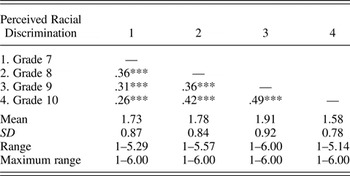
Means, standard deviations, and correlations for perceptions of racial discrimination in Grades 7–10 are presented in Table 1. In each grade, mean reports of racial discrimination were at the lower end (i.e., between 1 and 2) of the possible range (1 to 6). Perceptions of racial discrimination were significantly and positively associated at all assessments.
Descriptive statistics for racial discrimination from 7th to 10th grades

***p < . 001.
Growth models and trajectory classes
As described above, as a first step in examining the trajectories of each process (i.e., perceived racial discrimination, depressive symptoms, anxious symptoms, and aggressive behavior), we used LCGM to characterize the overall pattern of each process in Grades 7 through 10. In addition to considering differences in likelihood values for nested models, these models were evaluated using multiple indicators of model fit provided by Mplus: the comparative fit index (CFI), the Tucker–Lewis index (TLI), and the root mean square of approximation (RMSEA). CFI and TLI values greater than 0.90 and RMSEA values less than 0.05 suggest good fit. RMSEA values greater than 0.05 but less than 0.08 suggest “acceptable” fit (McDonald & Ho, Reference McDonald and Ho2002). We used the best fitting model from the LCGM as the base model in the GGMM analyses to determine the optimal number of trajectory groups. Using methods consistent with Muthén (Reference Muthén2003), information criteria were obtained for one-, two-, three-, four-, and five-class solutions for general growth mixture models. The optimal number of trajectory classes was indicated when none of the fit indices showed further improvement and the number of classes met substantive considerations.
Perceived racial discrimination
Likelihood ratio tests indicated that the linear slope model provided a significantly better fit to the data than the intercept-only model, Δχ2 (3) = 24.30, p < .001. Addition of a quadratic term to the model resulted in a significantly improved fit, Δχ2 (4) = 35.98, p < .001, and additional fit indices for this model were adequate (CFI = 0.966, TLI = 0.949, RMSEA = 0.071). Therefore, this model was used as the base model in the subsequent analyses.
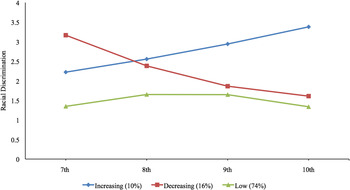
Examination of the information criteria for the GGMM models for perceived racial discrimination revealed BIC and SSABIC values decreasing from the single trajectory model to the model with five trajectories. However, the LMR and adjusted LRT p values were not significant for the four- and five-trajectory models, suggesting that the three-trajectory model was the best fit. In terms of substantive considerations, the four- and five-trajectory models each included small trajectory classes that seemed to have splintered off from larger groups in the three-class model. Therefore, a three-trajectory model was selected (Muthén, Reference Muthén and Kaplan2004). A graphical depiction of the three-trajectory solution is presented in Figure 1.
(Color online) The trajectories of perceived racial discrimination in Grades 7–10.

We labeled the three distinct trajectories of perceived discrimination as increasing, decreasing, and stable low. The increasing trajectory consisted of adolescents whose perception of racial discrimination began at a moderate level and increased from Grades 7 to 10 (10% of sample). The decreasing trajectory consisted of adolescents whose perception of racial discrimination began at a moderate level and decreased from Grade 7 to Grade 10 (16% of sample). The stable low trajectory included adolescents who perceived relatively low levels of racial discrimination in Grades 7 through 10 (74% of sample). Intervention status and lunch status were not associated with trajectory class membership. Boys were more likely to be in the increasing trajectory class than in the low trajectory class.
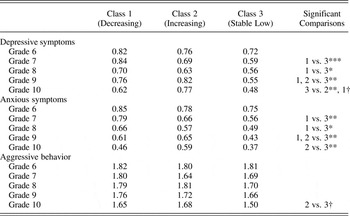
Comparisons of means for anxious, depressive, and aggressive behavior for the three trajectory classes are presented in Table 2. As shown in Table 2, Grade 6 depressive, anxious, and aggressive symptoms were not associated with trajectory class membership. In Grades 9 and 10, adolescents in the increasing trajectory reported significantly more anxious and depressive symptoms than did adolescents in the stable low trajectory. In Grades 7, 8, and 9, adolescents in the decreasing trajectory reported significantly more anxious and depressive symptoms than did adolescents in the low trajectory; this was evident at the trend level for depressive symptoms in Grade 10. Teacher reports of aggressive behavior in Grade 10 were marginally higher for adolescents in the increasing trajectory compared to adolescents in the low trajectory.
Mean scores on depressive and anxious symptoms and aggressive behavior by class

†p < .10. *p < .05. **p < .01. ***p < .001.
Anxious symptoms
For anxious symptoms, likelihood ratio tests indicated that the linear slope model provided a significantly better fit to the data than the intercept-only model, Δχ2 (3) = 109.31, p < .001. Addition of a quadratic term to the model resulted in a significantly improved fit, Δχ2 (4) = 12.09, p < .05, and additional fit indices for this model were adequate (CFI = 0.997, TLI = 0.980, RMSEA = 0.061). Therefore, this model was used as the base model in the GGMM.
Examination of the information criteria for the GGMM models for anxious symptoms revealed BIC and SSABIC values decreasing from the single trajectory model to the model with five trajectories. However, the LMR and adjusted LRT p values were not significant for the two-, three-, or five-class models; while significant for the four-trajectory model, this model included a very small trajectory class that seemed to have splintered off from a larger group in the three-class model. Thus, a single trajectory model was selected as the best fitting model.
Depressive symptoms
For depressive symptoms, likelihood ratio tests indicated that the linear slope model provided a significantly better fit to the data than the intercept-only model, Δχ2 (3) = 28.75, p < .001. Addition of a quadratic term to the model appeared to significantly improve fit, Δχ2 (4) = 20.07, p < .001, and this model had adequate fit (CFI = 0.987, TLI = 0.923). Examination of the parameter estimates indicated no variance in the quadratic slope. A model modification of setting this variance to zero resulted in improved model fit (CFI = 0.963, TLI = 0.945), and this revised quadratic model was used as the base model in the GGMM.
Examination of the information criteria for the GGMM models for depressive symptoms revealed BIC and SSABIC values decreasing from the single trajectory model to the model with five trajectories. However, the LMR and adjusted LRT p values were not significant for the three-, four-, or five-trajectory class models, suggesting that the two-trajectory model was the best fit. The two distinct trajectories of depressive symptoms were a trajectory with depressive symptoms increasing from Grades 7 to 10 (increasing depression trajectory; 11%) and a trajectory with depressive symptoms remaining low in Grades 7 to 10 (stable low depression trajectory; 89%).
Aggressive behavior
For aggressive behavior, likelihood ratio tests indicated that the linear slope model provided a significantly better fit to the data than the intercept-only model, Δχ2 (3) = 29.27, p < .001. Addition of a quadratic term to the model significantly improved fit, Δχ2 (4) = 32.24, p < .001. Examination of the parameter estimates indicated no variance in the quadratic slope. A model modification of setting this variance to zero resulted in good model fit (CFI = 0.985, TLI = 0.977), and this revised quadratic model was used as the base model in the GGMM.
Examination of the information criteria for the GGMM models for aggressive behavior revealed BIC and SSABIC values decreasing from the single-trajectory model to the model with five trajectories. However, the LMR and adjusted LRT p values were not significant for the four- or five-trajectory class models, suggesting that the three-trajectory model was the best fit. The three distinct trajectories of teacher-reported aggressive behavior were a trajectory with relatively high aggression scores that increased slightly from Grade 7 to Grade 10 (high aggression trajectory; 7.9%); a trajectory with aggression scores increasing from Grade 7 to Grade 8, then steadily decreasing from Grade 8 to Grade 10 (decreasing aggression trajectory; 8.5%); and a trajectory with low aggression scores from Grade 7 to Grade 10 (stable low aggression trajectory; 83.6%).
Parallel process models
As described above, the best fitting GGMM model for perceived discrimination and each outcome were used for the parallel process models. For these models, our primary interest was examining how membership in a problem trajectory (i.e., high depressive symptoms or increasing aggression) related to membership in the perceived discrimination trajectories; therefore, anxiety symptoms were not eligible for the parallel process growth mixture models because GGMM analyses indicated that a single trajectory model best represented anxious symptoms. For the parallel process growth mixture models, the best GGMM for perceived discrimination and an outcome (depressive symptoms or aggressive behavior) were estimated simultaneously. Membership in the latent class representing the outcome was regressed on the latent class representing perceived discrimination. This yielded information about the likelihood of membership in an outcome trajectory given membership in a perceived discrimination trajectory. Because prior research has suggested that the associations between discrimination and mental health adjustment may vary by gender (e.g., Greene et al., Reference Greene, Way and Pahl2006), we also considered the potential moderating role of gender in the parallel process analyses to determine whether the associations between trajectories of perceived discrimination and trajectories of depressive symptoms or aggressive behavior varied by gender.
Perceived discrimination and depressive symptoms
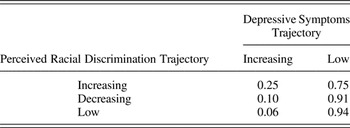
Consistent with predictions, regression of the latent depressive symptoms trajectory class variable on the latent perceived discrimination trajectory class variable revealed significant positive associations between membership in the increasing depression trajectory and membership in the increasing and decreasing discrimination trajectories. The likelihood of being in the increasing depression trajectory was significantly greater for youth in the increasing discrimination trajectory than for youth in the low discrimination trajectory (logit = 1.67, p < .01). Examination of the conditional probabilities of being in the increasing depressive symptoms trajectory given membership in the perceived discrimination trajectories revealed that the probability of being in the increasing depression trajectory was 4 times greater (.253/.060) for youth in the increasing discrimination trajectory than for those in the low discrimination trajectory (see Table 3).
Conditional probabilities of depressive symptoms trajectory given perceived discrimination trajectory

The probability of being in the increasing depression trajectory was approximately 2.5 times greater (.253/.095) for youth in the increasing discrimination trajectory than for those in the decreasing discrimination trajectory; however, the regression was only marginally significant (logit = 1.17, p < .10). The probability of being in the increasing depression trajectory was 1.58 times greater (.095/.060) for youth in the decreasing discrimination trajectory compared to youth in the low discrimination trajectory; however, the regression was not significant (logit = 0.50, ns). In addition, gender did not moderate the association between the discrimination trajectories and the depressive symptom trajectories.
Perceived discrimination and aggressive behavior
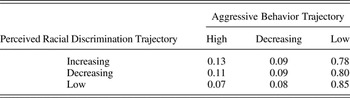
Examination of the conditional probabilities of being in the high aggressive behavior trajectory given membership in the perceived discrimination trajectories revealed that the probability of being in the high aggression trajectory was nearly two times greater (.13/.07) for youth in the increasing discrimination trajectory than for those in the low discrimination trajectory (see Table 4); the regression of high aggression trajectory on the increasing discrimination trajectory was not significant (logit = 0.73, ns). There was no difference in probability of being in the high aggression trajectory for youth in the increasing discrimination trajectory versus the decreasing discrimination trajectory, nor did the increasing and decreasing racial discrimination trajectory differ in probability of being in the high aggression trajectory. Similar to the results for depressive symptoms, gender did not moderate the association between the discrimination trajectories and the aggressive behavior trajectories.
Conditional probabilities of aggressive behavior trajectory given perceived discrimination trajectory

Discussion
This study examined whether different longitudinal patterns of perceived racial discrimination could be identified and how these longitudinal patterns of racial discrimination were associated with patterns of change in depressive symptoms, anxious symptoms, and aggressive behaviors. Consistent with predictions, our results revealed significant variation in African American adolescents’ reports of discrimination over time. We found evidence for three distinct patterns in exposure to racial discrimination across four time points: a stable low exposure group, an increasing exposure group, and a decreasing exposure group. Consistent with predictions, the results revealed that adolescents who reported increasing racial discrimination over time relative to their counterparts were more likely to be in an increasing depressive symptoms trajectory and a high aggressive behavior trajectory than were youth who experienced low levels of discrimination over time. These results support past theoretical literature that posits developmental variation in perceived racial discrimination both within and across children (e.g., Brown & Bigler, Reference Brown and Bigler2005) and studies that model a link between racial discrimination and health outcomes for African American adolescents (e.g., Clark et al., Reference Clark, Anderson, Clark and Williams1999; García Coll et al., Reference García Coll, Lamberty, Jenkins, McAdoo, Crnic and Wasik1996).
Patterns of perceived racial discrimination
The results indicate that the majority of African American adolescents reported some experiences with racial discrimination during middle and high school. Most adolescents were in the low exposure group, meaning they reported few incidents per year on average across the 4 years of the study. This finding is consistent with previous studies that found low levels of reported racial discrimination by African American adolescents (Chavous et al., Reference Chavous, Rivas-Drake, Smalls, Griffin and Cogburn2008; Fisher et al., Reference Fisher, Wallace and Fenton2000; Prelow et al., Reference Prelow, Danoff-Burg, Swenson and Pulgiano2004; Seaton et al., Reference Seaton, Caldwell, Sellers and Jackson2008). Recent mixed-methods studies indicate that these low reports likely have to do with deficiencies in measurement, because common self-report instruments do not assess ecologically valid and developmentally specific experiences of racial discrimination common in qualitative reports of African American adolescents (Berkel et al., Reference Berkel, Murry, Hurt, Chen, Brody and Simons2009; Rosenbloom & Way, Reference Rosenbloom and Way2004).
These findings also may reflect the predominantly African American, urban ecological context in which the youths resided, because adolescents in predominantly African American community contexts tend to report less personally directed discrimination than do adolescents in racially heterogeneous settings or settings in which they are in the minority (Berkel et al., Reference Berkel, Murry, Hurt, Chen, Brody and Simons2009). Experiences with institutional racism notwithstanding (Jones, Reference Jones1997), residents in such communities likely experience fewer cross-racial interpersonal encounters with racial discrimination as measured in this study. In contrast, Brody et al. (Reference Brody, Chen, Murry, Ge and Simons2006) and Greene et al. (Reference Greene, Way and Pahl2006) found that, on average, youth in their samples reported greater racial discrimination over time. However, the samples from these two studies were characterized by considerable heterogeneity with respect to neighborhood racial composition, socioeconomic status, and urbanicity, and thus, the results likely do not generalize to the predominantly African American, racially homogenous communities of our study (Social Science Data Analysis Network, 2011). Regardless of the reason for low reports of racial discrimination, it is important to note that even relatively infrequent experiences of racial discrimination, comparable to the levels measured in this study, can have adverse and long-lasting consequences for African American adolescents (e.g., Brody et al., Reference Brody, Chen, Murry, Ge and Simons2006; Clark & Gochett, Reference Clark and Gochett2006; Dotterer, McHale, & Crouter, Reference Dotterer, McHale and Crouter2009; Neblett, Philip, Cogburn, & Sellers, Reference Neblett, Philip, Cogburn and Sellers2006).
The increasing exposure group reported escalations in experiences with racial discrimination over time. This group exhibited the pattern predicted by Brown and Bigler (Reference Brown and Bigler2005), namely, that children report increased exposure to racial discrimination with age as a function of developmentally dependent increases in social awareness and cognitive functioning. In addition, this was the only group in which a gender imbalance was found, with boys more likely to be in this group than girls. This result is consistent with findings by Greene et al. (Reference Greene, Way and Pahl2006) showing that African American boys experience increases in racial discrimination as they age. It also is in line with previous theoretical research (Clark et al., Reference Clark, Anderson, Clark and Williams1999; Harrell, Reference Harrell2000) that stresses the importance of gender in the experience of racial discrimination and quantitative research that indicates African American males experience racial discrimination more frequently than do African American females (e.g., Borrell, Kiefe, Williams, Diez-Roux, & Gordon-Larsen, Reference Borrell, Kiefe, Williams, Diez-Roux and Gordon-Larsen2006; Carter, Reference Carter2007; Sellers & Shelton, Reference Sellers and Shelton2003).
The role of gender in racial discrimination experiences
This finding also supports intersectionality theory (Collins, Reference Collins1998; Crenshaw, Reference Crenshaw1989, Reference Crenshaw1991; Weber & Parra-Medina Reference Weber and Parra-Medina2003), which states that social identities such as gender and race are interdependent and mutually constructive rather than separate, independent, or mutually exclusive entities (Bowleg, Reference Bowleg2008). For instance, African American males are faced with unique stereotypes that characterize them as violent and delinquent, potentially leading to more encounters with racial discrimination than females (Williams & Mohammed, Reference Williams and Mohammed2009). In addition, the interplay among gender, pubertal development, and skin color bias also can create a different risk profile for African Americans of certain phenotypes (García Coll et al., Reference García Coll, Lamberty, Jenkins, McAdoo, Crnic and Wasik1996). For example, African American boys who mature earlier and who have darker skin may be more vulnerable than on-time or late maturers of the same or differing phenotype because these youth look more like the stereotypical violent “young Black male” (Burton, Bonilla-Silva, Ray, Buckelew, & Freeman, Reference Burton, Bonilla-Silva, Ray, Buckelew and Freeman2010; Harrison & Thomas, Reference Harrison and Thomas2009; Rome, Reference Rome2004). Thus, the present results suggest that the experience of racial discrimination may be qualitatively different for African American males and African American females as they age into young adulthood, with their race and gender interacting to create disparate social experiences.
Longitudinal declines in racial discrimination
Adolescents in the decreasing racial discrimination group reported declines in experiences with racial discrimination over time. Declines in reported racial discrimination might occur for adolescents who cope with racial discrimination by spending less time in settings in which they are exposed to the stressor. Another possible reason for declines in experienced racial discrimination is that labeling an event as racial discrimination has a greater psychological cost than attributing the event differently. Attributing the event to something other than a racial discrimination directed at oneself might result in less psychological distress and fewer feelings of powerlessness. Thus, declines in the perception that one is the target of racial discrimination may be self-protective. Decreases in perceived racial discrimination also may reflect other factors involved in shaping experiences of discrimination that were not measured in this study that were subject to developmental change, such as exposure to racial socialization (Hughes et al., Reference Hughes, Rodriguez, Smith, Johnson, Stevenson and Spicer2006) and the development of racial–ethnic identity (Phinney, Reference Phinney1992; Seaton, Scottham, & Sellers, Reference Seaton, Scottham and Sellers2006). For instance, research has illustrated that African American young adults with different racial identity attitudes vary in their sensitivity to environmental cues that signal the presence of racial discrimination (Sellers et al., Reference Sellers, Caldwell, Schmeelk-Cone and Zimmerman2004; Shelton & Sellers, Reference Sellers and Shelton2003).
Racial discrimination and psychological adjustment
The results from this study revealed important longitudinal associations between longitudinal trajectories of racial discrimination and trajectories of mental health adjustment. While the findings do not confirm that particular trajectories of racial discrimination predict trajectories of mental health adjustment, the results demonstrate how racial discrimination and problematic adjustment outcomes may develop in concert. These results are in line with the model of the biopsychosocial effects of racial discrimination on African Americans (Clark et al., Reference Clark, Anderson, Clark and Williams1999). Moreover, these results extend longitudinal research that racial discrimination predicts increases in negative psychological outcomes (e.g., Brody et al., Reference Brody, Chen, Murry, Ge and Simons2006; Gibbons et al., Reference Gibbons, Gerrard, Cleveland, Wills and Brody2004; Greene et al., Reference Greene, Way and Pahl2006). The increasing racial discrimination group was associated with increases in depressive symptoms. This result confirms and extends cross-sectional (e.g., Bynum, Best, Barnes, & Burton, Reference Bynum, Best, Barnes and Burton2008) and short-term longitudinal studies (Gibbons et al., Reference Gibbons, Gerrard, Cleveland, Wills and Brody2004) in which experiences of racial discrimination have been associated with depressive symptoms. Moreover, these findings suggest that experienced racial discrimination may contribute to the etiology of depressive symptoms in African American adolescents across adolescence. In combination with adult racial discrimination research (e.g., Williams & Mohammed, Reference Williams and Mohammed2009), the present result indicates that the link between racial discrimination and depressive symptoms is persistent and pernicious across the lifespan of African Americans starting in early adolescence.
Depressive symptoms and gender
The gender imbalance in the increasing racial discrimination trajectory suggests boys exposed to more racial discrimination may have increased vulnerability to depression as they age. While few studies have tested this association, a recent study suggests that some male gender roles exacerbate the link between experiences with racial discrimination and depressive symptoms for African American males (e.g., Hammond, Reference Hammond2012). In addition, evidence suggests racism-specific coping strategies vary across gender, thereby attenuating the stress process and health outcomes associated with racial discrimination exposure (Utsey, Ponterotto, Reynolds, & Cancelli, Reference Utsey, Ponterotto, Reynolds and Cancelli2000).
Racial discrimination and aggressive behavior
Our results indicated that adolescents exposed to increasing racial discrimination over time showed higher levels of teacher-reported aggression than youth who experienced low levels, although the difference was not statistically significant. In contrast, other studies have identified linkages between racial discrimination and constructs related to aggressive behavior such as violent behavior (Caldwell et al., Reference Caldwell, Kohn-Wood, Scmeelk-Cone, Chavous and Zimmerman2004), externalizing behavior (Nyborg & Curry, Reference Nyborg and Curry2003), conduct disorder (Simons et al., Reference Simons, Chen, Stewart and Brody2003), and delinquency (Whitbeck, Hoyt, McMorris, Chen, & Stubben, Reference Whitbeck, Hoyt, McMorris, Chen and Stubben2001). Our finding may differ from prior research focused on racial discrimination and externalizing behaviors for a number of reasons. Externalizing problems such as conduct disorder and delinquency may include aggressive behaviors, but aggressive behavior is only one aspect of these externalizing behaviors and may be low relative to other behaviors indicative of conduct problems and delinquency. In addition, some prior research identifying associations between racial discrimination and externalizing behaviors have focused on select samples (e.g., boys; Nyborg & Curry, Reference Nyborg and Curry2003).
Our finding may be a function of the teacher-report measure used in this study; teachers typically only have knowledge of aggressive behaviors occurring at school, and consideration of aggression in other settings might reveal stronger associations with racial discrimination. Finally, for African American adolescents, anger may be more relevant to racial discrimination than aggressive behavior. For example, Nyborg and Curry (Reference Nyborg and Curry2003) found that trait anger mediated the association between perceptions of racial discrimination and internalizing and externalizing problems in their sample of African American boys. Overall, evidence for associations between African American youths’ experiences with racial discrimination and aggressive behavior, specifically, is limited in comparison to internalizing problems. Additional research is necessary to understand how racial discrimination and aggression are associated.
Of note, adolescents in the decreasing racial discrimination trajectory did not differ significantly from adolescents in the stable low racial discrimination trajectory in terms of their depressive symptoms and aggressive behavior. Prior research examining concurrent or short-term associations between experiences with racial discrimination and mental health adjustment indicates worse psychological and behavioral adjustment for youth who experience discrimination (Nyborg & Curry, Reference Nyborg and Curry2003; Sanders-Phillips, Reference Sanders-Phillips2009); however, a different process of adjustment may appear over time than is observed in cross-sectional and short-term longitudinal designs. In contrast, it may be that chronicity or worsening of discriminatory encounters over time is most problematic for youth adjustment. These possibilities have not been examined in prior research because racial discrimination measures typically assess frequency of racial discrimination experiences within a particular study period, but not the chronicity of discriminatory encounters that requires by multiple assessments over time. Our results suggest that youth with similar reports of racial discrimination at one assessment may differ in their later experiences, explaining different patterns of adjustment.
The meaning of a decreasing trajectory of racial discrimination
The results for the decreasing racial discrimination trajectory might suggest that, over time, youth who become less sensitized to experiences of discrimination respond to it in other ways than depressive and aggressive problems. Raver and Nichii (Reference Raver and Nishii2010) have applied adaptation level theory (Helson, Reference Helson1964) in the context of adults’ experiences with harassment, including racial harassment, and propose that individuals may develop a particular style of adaptation after initial exposures to an aversive stimulus (harassment) but show little strain response after subsequent exposures. They coined the term inurement effect to describe this process of becoming accustomed to undesirable harassment stimuli. In a similar fashion, African American adolescents may inure themselves to the experience of racial discrimination (Clark et al., Reference Clark, Anderson, Clark and Williams1999). For example, research suggests that African American young adults whose race is central to their identity habituate to the stressor, and such habituation may be protective against the expression of adverse psychological outcomes associated with racial discrimination (e.g., Sellers & Shelton, Reference Sellers and Shelton2003). Future research should evaluate whether racial centrality plays a similar role in African American adolescents to clarify their perceptions of diminishing racial discrimination over time.
Strengths and limitations
A significant strength of this research is the prospective longitudinal design and repeated measurement of perceived racial discrimination. Using a longitudinal design offers advantages over prior research, including the ability to describe stability and change in African American adolescents’ experiences of racial discrimination over time. Prior longitudinal studies examining the course of racial discrimination over time highlight mean trajectories of discrimination experiences that characterize their samples but have not considered heterogeneity in the African American adolescents’ experience of racial discrimination (Brody et al., Reference Brody, Chen, Murry, Ge and Simons2006; Greene et al., Reference Greene, Way and Pahl2006). Our research extends this literature by providing a detailed longitudinal portrait of experiences with racial discrimination for African American adolescents in a predominantly African American urban ecological context. Our results demonstrate the importance of obtaining multiple assessments of youth experiences with racial discrimination and examining variation in experiences with racial discrimination over time. Had we only classified perceptions of racial discrimination at the initial time point (Grade 7), we may have inaccurately assumed that youth in the decreasing class who reported the highest initial level of racial discrimination would have the poorest outcomes. Thus, this research demonstrates that the timing, chronicity, and nature of change in youth experiences with racial discrimination varies across adolescents and these longitudinal patterns are important for understanding adolescent adjustment.
A discussion of our results would be incomplete without a review of the limitations. This study relied on adolescent self-report of several constructs. Although it is recognized that adolescents are better equipped than others to report about internal experiences such as depression (Grant, Compas, Thurm, McMahon, & Gipson, Reference Grant, Compas, Thurm, McMahon and Gipson2004), this research could have benefited from another reporter of adolescent depression and anxiety. There is evidence of the validity of teacher reports of aggression with adolescent samples (e.g., Henry, Miller-Johnson, Simon, Schoeny, & the Multi-Site Violence Prevention Project, Reference Henry, Miller-Johnson, Simon and Schoeny2006), but self- and other reports of aggression can yield different information about aggressive behaviors that may be related to adolescents’ experience of racial discrimination. In addition, some would challenge self-report measures of racial discrimination. We believe that the subjective experience of racial discrimination is psychologically meaningful (Lazarus & Folkman, Reference Lazarus and Folkman1984); however, we acknowledge that individuals can vary in their perception of the same experience. In addition, the high numbers of adolescents in the low exposure group may reflect our measurement of perceived discrimination, because we used a modified shortened version of the RaLES-B, which might have limited our capacity to assess the full range of experiences. Thus, our results may underestimate the discriminatory experiences in our sample.
Because our sample consisted of adolescents residing in predominantly African American, urban, low-income communities (Social Science Data Analysis Network, 2011), these results generalize only to adolescents from similar economic and residential backgrounds. It is possible that our study would have yielded different racial discrimination trajectories if data were collected in communities that were more heterogeneous with respect to race and socioeconomic status. For example, studies have shown that more affluent African Americans are more likely to have contact with Whites and thus may have more opportunities for discriminatory encounters (Gibbons et al., Reference Gibbons, Gerrard, Cleveland, Wills and Brody2004; Hughes & Johnson, Reference Hughes and Johnson2001; Jackson & Stewart, Reference Jackson and Stewart2003). In such communities, it is possible that a larger percentage of adolescents would have reported increasing or chronically high levels of racial discrimination over time.
Conclusion and future directions
Racial discrimination is a significant reality for African American adolescents (Berkel et al., Reference Berkel, Murry, Hurt, Chen, Brody and Simons2009; Greene et al., Reference Greene, Way and Pahl2006). Adequate descriptions of its role in youth psychological adjustment and quality of life are sorely needed. Taken together, these study results suggest that a subset of African American adolescents, particularly males, living in predominantly African American urban environments, are vulnerable to experiencing greater racial discrimination over time. The results also suggests that increasing exposure to racial discrimination over time co-occurs with greater psychological distress in the form of depressive symptoms (Bynum et al., Reference Bynum, Best, Barnes and Burton2008; Sanders-Phillips, Reference Sanders-Phillips2009; Seaton et al., Reference Seaton, Caldwell, Sellers and Jackson2008) and worsening aggressive behavior over time, although to a lesser extent. However, although informed by leading theories focused on the experience of racial discrimination, these findings should be considered exploratory because prior theory and research only recently has started to consider the development and course of racial discrimination experiences. As well, few have empirically examined heterogeneity in African American adolescents’ experience of racial discrimination. To our knowledge, this study is among the first to identify longitudinal variation in experiences of racial discrimination among urban African American adolescents and examine how such variation evolves alongside psychological symptoms. Given the novelty of these findings, the reader is encouraged to view these results with caution.
Our findings provide some support for prominent theories of racial discrimination for African Americans. García Coll et al.’s (1996) integrative model suggests that social position variables such as race and social stratification according to these variables are necessary preconditions for the occurrence of racial discrimination and therefore set a context for the development of African American youth. Although this research did not measure social stratification, participants’ reports of experiencing racial discrimination indicate that it is a reality for African American youth. That perceptions of racial discrimination were associated with depressive symptoms is in line with both the integrative model and the biopsychosocial model's propositions that racial discrimination and youth adjustment are linked, although the specific pattern of associations revealed in this study have not been specified prior. These findings also partially support Brown and Bigler's (Reference Brown and Bigler2005) propositions about developmental change in perceptions of racial discrimination. We observed increasing perceptions of racial discrimination over time, but only for a small subset of participants, most of whom were boys. We believe that this finding is one example of the individual and situational characteristics Brown and Bigler suggest shape the changes in perceptions of racial discrimination. In particular, this finding highlights the significance of the intersection of race and gender for understanding perceptions of racial discrimination, indicating the importance of social and societal factors specific to African American males and their experiences with racial discrimination.
The results of this study present several opportunities for future research. Future research should attempt to replicate these findings and include culturally relevant variables and developmentally relevant factors to further detail heterogeneity in African American adolescents’ experiences with racial discrimination and validate the trajectories identified in this study. For example, attention should be devoted to specifying the role of gender (Greene et al., Reference Greene, Way and Pahl2006), cognitive maturity (e.g., Seaton, Reference Seaton2010), and culturally relevant variables such as racial identity and racial socialization to assess their role in these processes (e.g., Bynum et al., Reference Bynum, Best, Barnes and Burton2008; Sellers, Copeland-Linder, Martin, & Lewis, Reference Sellers, Copeland-Linder, Martin and Lewis2006). Future research also should replicate and extend this study to adolescents of different socioeconomic and regional backgrounds to gain a complete portrait of the normative developmental experience of racial discrimination in this population. Such research should include detailed measures of experiences with racial discrimination and psychological adjustment of adolescents residing in communities that vary in racial composition.
To better understand variation in African American adolescents’ experience of racial discrimination over time, future research should consider types of racial discrimination as well as individual and environmental factors that help determine whether and the degree to which African American adolescents’ experiences with racial discrimination are linked with negative developmental outcomes. Future research also should consider potential differences in the frequency and impact of experiences with racial discrimination from peers versus adults, given the findings that the frequency of discrimination varies with the source of the discrimination (Greene et al., Reference Greene, Way and Pahl2006). Finally, it will be important for future research to examine similar issues in adolescents of other racial and ethnic backgrounds, given our increasingly diverse nation and schools. This research will be essential to elucidating the degree to which racial discrimination affects negative outcomes in African Americans and contributes to racial health disparities for African Americans across the lifespan. In particular, research such as the present study that identifies factors associated with trajectories of racial discrimination exposure and associated health outcomes will help to inform the timing and nature of preventive interventions aimed at reducing the destructive effects of racial discrimination exposure.