INTRODUCTION
D'Orbigny (Reference D'Orbigny1834–1843) described a small octopus from Chile and Peru as Octopus fontanianus d'Orbigny, 1834. The description was brief, and lacks necessary detail for modern systematic needs (Thore, Reference Thore1959). Robson (Reference Robson1929) created the genus Joubinia to unite O. fontanianus and O. campbelli Smith, 1902. Adam (Reference Adam1938) replaced the genus Joubinia with Robsonella because the name was preoccupied by Joubinia Burger, 1904, a genus of Nemertea. Adam (Reference Adam1938) recognized two species within the genus: R. fontaniana and R. campbelli and extended the geographical distribution of R. fontaniana to Peru, Chile, Patagonia and Tierra del Fuego. Nevertheless, Robson (Reference Robson1929) differentiated and discussed a subspecies from Natal (Africa) and treated it as the subspecies africana.
Pickford (Reference Pickford1955) re-examined specimens of R. fontaniana in the collections of the British Museum, and compared them with R. campbelli, which is considered a synonym of Robsonella australis (Hoyle, 1885) and R. huttoni (Benham, Reference Benham1943), which had been described by Benham (Reference Benham1943) in the genus Octopus Cuvier, 1797. Pickford (Reference Pickford1955) differentiated the species (fontaniana, campbelli and huttoni) based on number of gills lamellae, and doubted the validity of the genus Robsonella. Thore (Reference Thore1959), in the Lund Expedition, examined seven specimens from southern Chile, which he identified as O. fontanianus, implying he did not accept the generic designation of Adam (Reference Adam1938).
In his revision of New Zealand's octopuses, O'Shea (Reference O'Shea1999) reviewed specimens of R. campbelli and R. huttoni. He proposed that these species should be re-assigned to Octopus, and considered Robsonella to be synonymous with Pinnoctopus d'Orbigny, 1845. Previously, Sweeney & Roper (Reference Sweeney and Roper1998) had also classified R. campbelli in Octopus, but maintained the placement of R. fontaniana and R. huttoni.
Nevertheless, all the descriptions of R. fontaniana (i.e. Robson, Reference Robson1929; Adam, Reference Adam1938; Pickford, Reference Pickford1955; Thore, Reference Thore1959; Nesis, Reference Nesis1987; Ré, Reference Ré and Boschi1998) were based only on male morphological characters (e.g. ligula, terminal organ diverticulum and enlarged suckers), because the females have been poorly described.
Due to little information about the genus, poor description of the species and little knowledge about its biology and systematics, the aim of this work is to diagnose the genus Robsonella, to redescribe the species R. fontaniana from male and female specimens, and to describe the morphological variation between the sexes.
MATERIALS AND METHODS
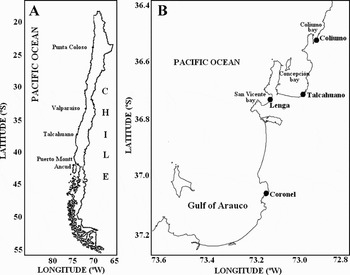
A total of 47 fresh and fixed specimens (27 males and 20 females) were used in this study. Thirty-three specimens (21 males and 12 females) of R. fontaniana were collected in intertidal pools and in the subtidal pools up to approximately 10 m depth at San Vicente Bay (36°31′S, 72°56′W) and Coliumo Bay (36°44′S, 73°10′W), in the central-south of Chile during 2003 and 2004 (Figure 1); eleven specimens (four males and seven females) obtained from the Zoological Museum of Hamburg (ZMH), Germany, were included as additional material; and three specimens (two males and one female from San Vicente Bay) were used for descriptions and then deposited in the Zoological Museum of the Universidad de Concepción (MZUC), Chile. In addition, two males were collected in Ancud (January 2000) and studied. These specimens were deposited in the Zoology Laboratory collection of the Universidad Católica de la Santísima de Concepción (LZUC), Chile. The syntype deposited in the Muséum National d'Historie Naturelle (MNHN), Paris, France, a female (MNHN 1055) was also obtained to verify the identification of the material. Comparative material was examined from the National Museum of Natural History (MNHN), Santiago, Chile.
(A) Map showing the Chilean localities where Robsonella fontaniana specimens were collected; and (B) enlarged map showing the localities where the fresh specimens were collected.

In order to describe and compare the specimens, morphometric analyses with fresh and frozen (−20°C) specimens were conducted. The morphometric indices of Roper & Voss (Reference Roper and Voss1983) were used. The abbreviations used for each variable are as follow: TL, total length; TW, total weight; AL, maximum arm length; AL1–4, arm length; AW, arm base width (the more width); HW, head width; HL, head length; MW, mantle width; DML, dorsal mantle length; VML, ventral mantle length; PA, pallial aperture; ED, eye diameter; SDn, sucker diameter (in the mid of the arms); SDe, enlarged sucker diameter; HcA, hectocotylized arm; HcASC, hectocotylized arm sucker count; OA, opposite arm length; LL, ligule length; CaL, calamus length; FuL, funnel length; FFuL, free funnel length; GiLC, gill lamellae count; WDA–E, web depth; ASC1–4, arm sucker count (all arms); SEM, scanning electron microscopy. Spermatophores (N = 4) were removed for study in a mature male (LZUC 0016).
DIAGNOSIS
Small sized octopuses: mantle saccular. Rough skin with supraocular papilla. Arms with biserial row of suckers. Third right arm hectocotylized in males. Terminal organ with a large second diverticulum. Enlarged suckers in males. Funnel organ W-shaped. Ink sac present. Anal flaps present. Radula with seven teeth per transverse row; marginal plates present. Rachidian multicuspid; first lateral teeth crescent-shaped (inverted U-shaped); marginal tooth unicuspid.
TYPE SPECIES
SYNONYMY
INCLUDED SPECIES
Syntype MNHN 1055. Type locality: Valparaiso, Chile by original designation (Figure 1).
SYNONYMY
Octopus fontanianus d'Orbigny, 1834: 28; 1840: 49; Tryon, 1879: 123 (Robson, Reference Robson1929); Rochebrune & Mabille, 1889: 6 (Robson, Reference Robson1929); Joubin, 1898: 23 (Robson, Reference Robson1929); Lönnberg, 1898, 2(4): 49; Joubin, 1906: 1 (Robson, Reference Robson1929); Lönnberg, 1907: 49 (Robson, Reference Robson1929); ?Octopus fontanianus Winckworth, 1926: 325 (Robson, Reference Robson1929). Polypus fontanianus Joubin, 1905 (Massy, 1916); Polypus fontani(e)anus Dall, 1909: 181 (Robson, Reference Robson1929); Massy, 1925: 224 (Robson, Reference Robson1929); Berry, 1914a: 299 (Robson, Reference Robson1929); Polypus fontanianus Robson, 1921: 437; Robson, 1925: 104 (Robson, Reference Robson1929). Joubinia fontaniana Robson, Reference Robson1929: 187; 1929a (10) 3: 607. Robsonella fontaniana (Adam, Reference Adam1938; 121: 223). Robsonella fontainianus, Castellanos, 1967, 8: 177. Joubinia fontainiana, Castellanos & Meni, 1969, 1(2): 214. Robsonella fontanianus Norman & Hochberg, Reference Norman and Hochberg2005: 136.
MATERIAL EXAMINED
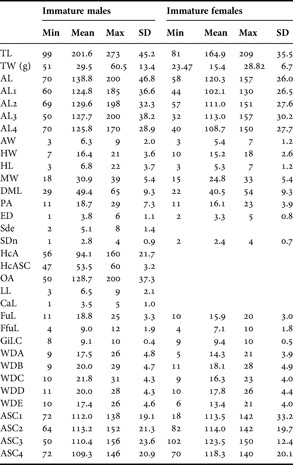
Syntype: female DML 31 mm (Valparaiso, Chile) [MNHN 1055]; unknown date and collector. Three males and eight females from Chile. Immature female DML 32 mm [ZMH 11103], Valparaiso (33°40′S, 71°40′W); coll. Piening, 1927. Immature female DML 67 mm [ZMH 11104], Punta Coloso; coll. Paessler, December 1906. Immature male DML 31 mm, [ZMH 11105], Talcahuano; coll. Paessler, January 1930. Immature female DML 20 mm [ZMH 11106], Valparaiso; coll. Scheiding, 1903. Mature female DML 35 mm [ZMH 11107], Puerto Montt; coll. L. Fritz, 1900. Two females DML 30 and 20 mm, and one immature male DML 30 mm [ZMH 11108], Coronel; coll. Paessler, January 1920. Immature female DML 33 mm [ZMH 11109], West Coast South America; coll. Krause, 1903. Immature female DML 30 mm and one immature male DML 26 mm [ZMH 11110], Coronel; coll. Paessler, 1897. Four males and one female from Chile. Mature male DML 39 mm [MZUC 30800], Lenga (36°45′S, 73°10′W), colls. C.M. Ibáñez and R.D. Sepúlveda, February 2003 in 5 m depth. Immature male DML 25 mm [MZUC 30799], Lenga (36°45′S, 73°10′W), colls. C.M. Ibáñez and R.D. Sepúlveda, February 2003 in 3 m depth. Immature female DML 23 mm [MZUC 30801], Lenga (36°45′S, 73°10′W), colls. C.M. Ibáñez and R.D. Sepúlveda, January 2004 in 5 m depth. Mature male DML 41 mm [LZUC 0015], Ancud (41°47′S, 74°28′W), coll. J. Chong, January 2000 in 10 m depth. Mature male DML 45 mm [LZUC 0016], Ancud (41°47′S, 74°28′W), coll. J. Chong during January 2000 in 10 m depth. Additional fresh material from Lenga and Coliumo, central-south of Chile, consisting of 21 males and 12 females collected by C.M. Ibáñez and R.D. Sepúlveda during January 2003 between 2–5 m depth, are summarized in the Table 1.
Robsonella fontaniana: mean morphometric (mm) and meristic data of 21 immature males and 12 immature females.

Min, minimum; Max, maximum; SD, standard deviation. For all other abbreviations, see Materials and Methods section.
COMPARATIVE MATERIAL EXAMINED
Octopus mimus Gould, 1852. One mature female DML 135 mm [MNHN 5802], Northern Chile; coll. C. Reyes, May 2001.
Octopus tehuelchus d'Orbigny, 1834. One male DML 51 mm [MNHN 300130], Blue Bay, Magellan Strait; unknown collector, June 2000. One female DML 42 mm [MNHN 300131], Blue Bay, Magellan Strait; unknown collector, June 2000.
Enteroctopus megalocyathus (Gould, 1852). One female DML 80 mm [MNHN 300046], Ancud (41°47′S, 74°28′W); coll. C.M. Ibáñez, January 2000. One male DML 103 mm [MNHN 5809], Tuamapu Channel (43°59′S, 74°00′W); coll. C. Osorio, July 2002.
DIAGNOSIS
Small sized octopuses: rough skin with simple supraocular papilla; arms of similar length; web shallow of similar length; ink sac present. Third right arm hectocotylized in males and shorter than in females; with 47–60 suckers, ligula markedly enrolled sides and wide cheeks, with seven copulatory ridges. Terminal organ with a large second diverticulum. Enlarged suckers in males on arms II and III. 8–11 gill lamellae per demibranch. Radula with first lateral teeth crescent-shaped (inverted U-shaped). Rachidean multicuspid.
DESCRIPTION
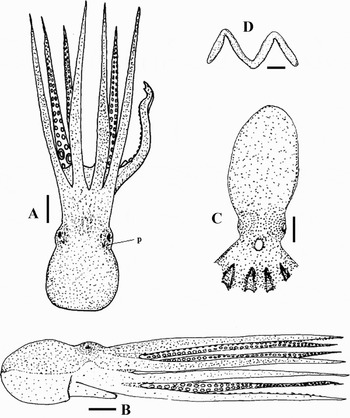
Animals small, with maximum total length of 273 mm. Mantle firm, oval, DML up to 69 mm in females (Ré, Reference Ré and Boschi1998), 65 mm in males (MWI = 72–115). Mantle separated from head by wide neck (Figure 2A). Head narrower than mantle (HWI = 53–90), eyes small, protuberant, with fleshy wart on each eye. Ocular diameter 1–6 mm. Funnel short, tubular, projecting from base of mantle aperture (FuLI = 55–75); free funnel 57–75% of funnel total length (Figure 2B). Funnel organ W-shaped (Figure 2D). Mantle aperture broad and partially closed.
Robsonella fontaniana: (A) male dorsal view (ZMH 11110). p, papillae; (B) female lateral view (ZMH 11107); (C) detail of the dorsal web white spot (MZUC 30800); and (D) funnel organ. Scale bars: a–c 10 mm; d, 1 mm.

Arms of similar length, long (70% TL), moderately narrow (AWI = 12). Third pair of arms in males sometimes shorter (Table 1). Biserial suckers along entire arm, of greater size in proximal first third. Three suckers enlarged on second, third male arms (suckers 7–9) (Figure 5D; Table 1). Interbrachial membrane shallow (18 to 23% DML), extended along dorsal arm of each sector. Gill with 8 to 10 lamellae per demibranch (Figure 5E).
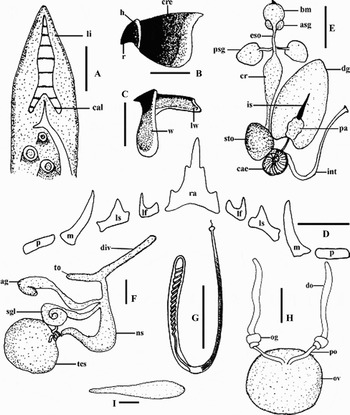
Third right arm hectocotylized, with 47–60 suckers; hectocotylus groove without pigmentation, without fold from interbrachial membrane to beginning of calamus; ligula small (4–10% AL3r), longitudinal groove, rounded tip; calamus big (50% LL). Seven copulatory lamellae (Figures 3A & 5F).
Robsonella fontaniana: (A) Hectocotylized arm; li, ligule; cal, calamus; (B) upper beak; r, rostrum; h; hood; cre, crest; (C) lower beak; lw, lateral wing; w, wing; (D) radula; p, plate; m, marginal tooth; ls, second lateral tooth; lf, first lateral tooth; ra, rachidian teeth; (E) digestive tract; asg, anterior salivary glands; eso, oesophagus; cr, crop; is, ink sac; sto, stomach; cae, caecum; bm, buccal mass; psg, posterior salivary glands; dg, digestive gland; pa, pancreas; int, intestine; (F) male reproductive system; div, diverticulum; ag, accessory gland; sgl, spermatic gland; tes, testis; ns, Needham's sac; to, terminal organ; (G) spermatophore; (H) female reproductive system; do, distal oviduct; og, oviductal gland; po, proximal oviduct; ov, ovary; and (I) egg from immature ovarian. Scale bars: a–c and h, 5 mm; d, 0.3 mm; e and f, 10 mm; g and i, 1 mm.

Digestive tract
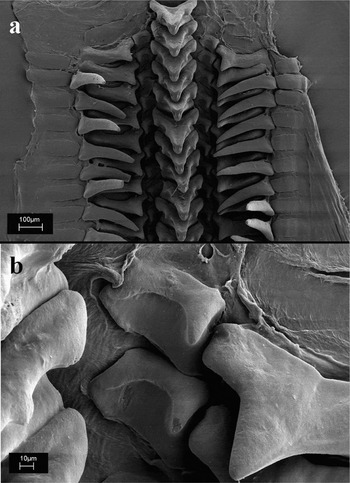
Beak dark with almost transparent edges. Upper beak short, rostrum curved, broad wings, slightly concave posterior edge (Figure 3B). Lower beak, rostrum short forming an acute angle with a sharp tip; wings narrow, long; crest long straight (Figure 3C). Radula with seven radular teeth, one marginal tooth per row: rachidian pentacuspid, first lateral crescent-shaped (U-shape) with elongated posterior tip, second lateral unicuspid with wide base, marginal curved and long, marginal plates short (Figures 3D & 4A, B).
Robsonella fontaniana: radulae scanning electron microscopy photographs. (A) Radula; and (B) detail of second lateral.

Buccal mass spherical, anterior salivary glands small, posterior salivary glands almost as large as buccal mass. Crop elongated without diverticulum, stomach short with enrolled caecum, building a coil. Oval digestive gland of dark colour, ink sac present on gland. Intestine short without modifications (Figure 3E).
Male reproductive tract
Testes oval. Vas deferens short with several turns. Spermatophoric gland with posterior part twisted. Accessory gland broad, Needham's sac large, elongated. Terminal organ short with long diverticulum, ampoule on base (Figure 3F). Spermatophore extremely long, slender (average length 49.8 mm), sperm reservoir coiled with 14–17 coils, sac with very fine striations occupying about one-third of total spermatophore length (Figure 3G).
Female reproductive tract
Ovary spherical, ivory colour. Proximal oviducts moderately long, oviductal gland small, distal oviducts long (Figure 3H). Eggs long, club shaped (Figure 3I).
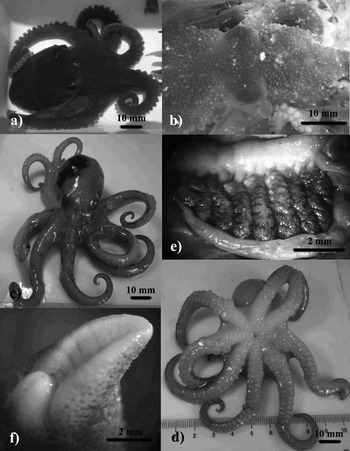
Skin colour brown-reddish to grey covered by tiny warts, coloration variable with mode of preservation (Figure 5A, B, C & D). Dorsal white spot located anterior to head (Figure 2C & 5B), more visible in fresh, live specimens than in preserved ones.
Robsonella fontaniana: photographs of male specimens of Robsonella fontaniana. (A) and (B) live adult; (C) fresh adult specimen; (D) fresh adult, with enlarged suckers on arms II and III; (E) demibranch; and (F) hectocotylus.

REMARKS
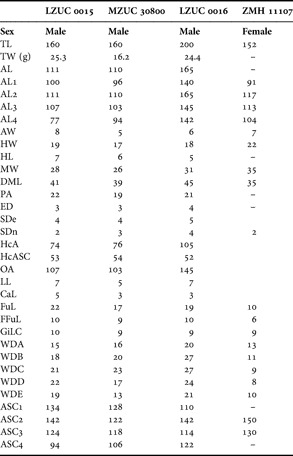
The syntype [MNHN 1055] of the species is an immature female in moderate preservation state. The head is perforated so that one eye is badly damaged, and part of the digestive tract is partly ruptured. The posterior salivary gland is clearly visible. The funnel organ is not recognizable. Arms are complete. Arms IV are shorter than the others. Sucker counts were only possible on one arm; on the other arms suckers are missing. After more than 178 y in alcohol no pigmentation is preserved. Only one female and three males were mature specimens in the studied material (Table 2).
Robsonella fontaniana: morphometric (mm) and meristic data of three mature males and one mature female.

For abbreviations, see Materials and Methods section.
DISTRIBUTION AND HABITAT
Robsonella fontaniana is a benthic species from cold waters which is distributed in almost all the south coast of South America: the species has been reported from the north of Peru in the Pacific Ocean and from Puerto Madryn (Argentina) in the Atlantic Ocean (41°S) to the Cape Horn in Chile (56°S) (d'Orbigny, Reference D'Orbigny1834–1843; Nesis, Reference Nesis1987; Rocha, Reference Rocha1997; Ré, Reference Ré and Boschi1998). The bathymetric range extends from the intertidal to 90 m depth along the coast of Argentina (Ré, Reference Ré and Boschi1998). At Chile, R. fontaniana has been found in the rocky intertidal to 55–70 m depth (Osorio et al., Reference Osorio, Atria and Mann1979, Reference Osorio, Peña, Ramajo and Garcelon2006). Thore (Reference Thore1959) recorded a female from 225 m near Puerto Montt, Chile (~40°S), and Osorio (personal communication, 2007) found two females (13 and 11 mm DML) to 210 m from Corcovado Gulf (~43°S) and other two females (15 and 17 mm DML) to 141 m from Desertores Island (~42°S). The species can be found occasionally in intertidal pools and rocky places on the shallow subtidal where it generally takes refuge beneath rocks, though it can also bury itself in the sand. Apparently, the abundance of R. fontaniana is correlated with the abundance of small crustaceans, which constitute the main food source (Sepúlveda et al., Reference Sepúlveda, Sanhueza, Ruiz, Ibáñez and Chong2004).
ETYMOLOGY
This species was named in honour of M. Fontaine.
DISCUSSION
The indicated morphological characters described clearly distinguish this genus from Octopus. The ligula has no fold from the interbrachial membrane to the beginning of the calamus, whereas Octopus frequently possesses this fold. The rachidian tooth of the radula in O. mimus is tricuspid while in R. fontaniana, O. tehuelchus and E. megalocyathus it is multicuspid (Ré, Reference Ré and Boschi1998; Guerra et al., Reference Guerra, Cortez and Rocha1999). In R. fontaniana, the first lateral tooth is crescent-shaped; in O. mimus, O. tehuelchus and E. megalocyathus the first lateral tooth is unicuspid with the tip on the central area (Ré, Reference Ré and Boschi1998; Guerra et al., Reference Guerra, Cortez and Rocha1999). The second lateral teeth are very similar in many octopod species (Nixon, Reference Nixon1998), but the third lateral teeth are sabre-like in R. fontaniana and O. mimus, whereas they are hook-like in O. tehuelchus and E. megalocyathus (Ré, Reference Ré and Boschi1998; Guerra et al., Reference Guerra, Cortez and Rocha1999). Thore (Reference Thore1959) used the degree of robustness of the hectocotylus to separate Octopus from Robsonella. We consider that it is not a very useful character at a generic level to differentiate Robsonella from other genera, because hectocotylus shape has intra/inter-specific variability and is strongly affected by preservation. Likewise, the terminal organ diverticulum can be a useful character in the differentiation between Octopus and Robsonella. Octopus has a small diverticulum and Robsonella has a large one, although Pickford (Reference Pickford1955) suggested the opposite. The first lateral tooth of the radula is a very important character for the genus Robsonella, which in turn permits its identification independent of sex. Thore (Reference Thore1959) mentions that the systematic value of the radula was little known at that time. Nevertheless, Adam (Reference Adam1938) indicated that the lateral tooth of the radula had two tips. Nowadays, it is well known that this organ is of great systematic value at the generic and specific levels (Nixon, Reference Nixon1998). The teeth patterns in the Octopus species are similar, and the variability is high, but subtle differences are apparent (Nixon, Reference Nixon1998). For this reason the comparison of radulae from congeneric octopods has been used for to separate species (Adam, Reference Adam1983; Nixon, Reference Nixon1998; Ibáñez et al., Reference Ibáñez, Sepúlveda and Chong2006). Consequently, a few meristic characters such as the number of branchial lamellae, the number of suckers and the copulatory lamellae of the hectocotylus are also being currently used, with the two latter often being more reliable (Toll, Reference Toll1988; Muus, Reference Muus2002). We found that the spermatophore of R. fontaniana is as long as the mantle confirming the observations from Pickford (Reference Pickford1955) and Thore (Reference Thore1959).
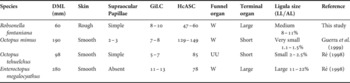
Robsonella fontaniana can be distinguished from other sympatric octopus species from the southern tip of South America by the presence of a dorsal white spot anterior to the head in fresh and live specimens, the number of suckers on the hectocotylized arm, the number of branchial lamellae, and the cheeks of the ligula. Moreover, R. fontaniana is different in other morphometric and meristic characters (Table 3). By examining the meristic and morphometric measurements of the female specimen captured at San Vicente Bay and identified by Thore (Reference Thore1959) as Octopus vulgaris Cuvier, 1797 (=Octopus mimus Gould, 1852; Guerra et al., Reference Guerra, Cortez and Rocha1999), we identified the specimen as R. fontaniana. The number of branchial lamellae of 10 to 11 distinguishes it from O. mimus, which has 7 to 8 branchial lamellae. Although it is a juvenile specimen (DML 18 mm), it is not an O. mimus (more details in Guerra et al., Reference Guerra, Cortez and Rocha1999: 53).
Morphological, morphometric and meristic comparison of sympatric octopuses from southern tip of South America based on literature and examined individuals (see comparative material examined).

Toll (Reference Toll1998) suggests R. fontaniana africana should be designated as nomen dubium, because the little information available (one female) is insufficient to determine the identity of this subspecies. O'Shea (Reference O'Shea1999) stated that the specimen is a small immature female related more to Octopus vulgaris Lamarck, 1798. At the moment this species has an ‘unresolved’ status (Norman & Hochberg, Reference Norman and Hochberg2005). A careful revision of the Natal Museum specimen and the collection of additional material of this species from the Kwa Zulu-Natal area are essentials for resolving the status of this subspecies. A description of the specimen's radula would help to clarify its systematic placement.
Sweeney & Roper (Reference Sweeney and Roper1998) and Sweeney (Reference Sweeney2001) classified R. campbelli in Octopus, but maintained the placement of R. fontaniana and R. huttoni. In a recent work, Norman & Hochberg (Reference Norman and Hochberg2005) proposed that both campbelli and huttoni are valid in an ‘unplaced’ genus.
Finally, we think that morphological and molecular phylogenetic analyses are required to clarify the origin, spatial and temporal diversification of the species of the genus Robsonella and its allied species.
ACKNOWLEDGEMENTS
Thanks are due to Dr Bernhard Hausdorf and Ramona Timon for their help and support with the collection material form the ZMH, to Sergio Letelier for their help in examining specimens from the MNHN (Chile), to Renate Walter for the SEM photographs, to M. Cecilia Pardo for the photographs of live and fresh octopuses, to Virgine Héros from MNHN Paris, for the loan of the syntype of Robsonella fontaniana, to Dr Eric Hochberg for the comments on the manuscript and to J.F. Ruiz, R. Calderón and A. Navarrete for their help in collection of specimens from San Vicente Bay and Coliumo Bay. C.M. Ibáñez and R.D. Sepúlveda were supported by CONICYT-CHILE Doctoral Fellowships.