Implications
Feather eating has been found to be associated with feather pecking in experimental studies. Knowledge on feather eating is limited and studies of feather eating in commercial flocks of laying hens have not been performed previously. Increasing the knowledge on feather eating may potentially reduce the prevalence, and hence the welfare problems and economic consequences, of feather pecking. It was confirmed that feather eating occurs in commercial flocks of laying hens, but feather eating was only found to be positively correlated to the number of floor feathers with pecking damage and not as expected to the prevalence of plumage damage.
Introduction
Feather pecking continues to pose economic and welfare problems in the egg production. Feather pecking has been associated with increased levels of fear (Vestergaard et al., Reference Vestergaard, Kruijt and Hogan1993; Jones et al., Reference Jones, Blokhuis and Beuving1995) and with pain caused by the plucking and pulling of feathers (Gentle and Hunter, Reference Gentle and Hunter1990). Moreover, feather pecking may develop into cannibalism (Schaible et al., Reference Schaible, Davidson and Bandemer1947; Savory and Mann, Reference Savory and Mann1997a). Increased mortality may therefore be the consequence of feather pecking, causing economic loss to the producers. In addition, feather pecking increases the production cost, as hens with damaged plumage have a greater heat loss, and therefore require an increased feed intake to maintain body temperature (Leeson and Morrison, Reference Leeson and Morrison1978; Tauson and Svensson, Reference Tauson and Svensson1980).
Feather pecking has been associated with feather eating, that is, ingestion of feathers or parts of feathers (McKeegan and Savory, Reference McKeegan and Savory1999; Harlander-Matauschek and Feise, Reference Harlander-Matauschek and Feise2009). McKeegan and Savory (Reference McKeegan and Savory1999) found a positive correlation between level of plumage damage and number of droppings containing feathers on group level. Plumage damage is most likely to be caused by feather pecking (Hughes and Michie, Reference Hughes and Michie1982), which is why plumage damage for many years has been used as an indicator of feather pecking. On individual level, the propensity to eat feathers is known to be highly associated with the amount of feather pecking performed (McKeegan and Savory, Reference McKeegan and Savory2001; Harlander-Matauschek and Bessei, Reference Harlander-Matauschek and Bessei2005). The feathers eaten may be picked from the floor litter, plucked directly from other hens or dislodged during preening of own feathers (McKeegan and Savory, Reference McKeegan and Savory1999).
Feathers are composed of keratin, which is highly resistant to degradation in the digestive tract (Newell and Elvehjem, Reference Newell and Elvehjem1947). Consistent with this, a positive correlation between the number of feathers eaten and feather findings in the droppings exists (Bogelein et al., Reference Bogelein, Harlander-Matauschek, Egerer, Neumann, Bessei and Amselgruber2010). It has been suggested that feather eating may be stimulated by preen oil, which is abundant on the feathers around the uropygial gland (McKeegan and Savory, Reference McKeegan and Savory1999). In addition, feathers in this area are accessible, easily plucked and of a preferred size. Indeed, the area around the preen gland has been reported as typically being the first area to become denuded due to feather pecking (Savory and Mann, Reference Savory and Mann1997b; Bilcik and Keeling, Reference Bilcik and Keeling1999).
To our knowledge, on-farm studies of feather eating in commercial flocks of laying hens have not been performed previously. It is known that the genotype affects the likelihood of feather eating (e.g. Harlander-Matauschek et al., Reference Harlander-Matauschek, Benda, Lavetti, Djukic and Bessei2007a) and most work on feather eating has been done on strains that are not used commercially (Harlander-Matauschek and Bessei, Reference Harlander-Matauschek and Bessei2005; Harlander-Matauschek et al., Reference Harlander-Matauschek, Baes and Bessei2006a, Reference Harlander-Matauschek, Piepho and Bessei2006b, Reference Harlander-Matauschek, Benda, Lavetti, Djukic and Bessei2007a, Reference Harlander-Matauschek, Häusler and Bessei2007b and Reference Harlander-Matauschek, Wassermann, Zentek and Bessei2008; Harlander-Matauschek and Feise, Reference Harlander-Matauschek and Feise2009; Harlander-Matauschek and Häusler, Reference Harlander-Matauschek and Häusler2009; Matauschek et al., Reference Matauschek, Beck and Rodenburg2010; Harlander-Matauschek and Rodenburg, Reference Harlander-Matauschek and Rodenburg2011). Therefore, the main objective of this study was to investigate the prevalence of feather eating and its association with plumage damage and floor feather characteristics in commercial flocks of layers in barn and organic production systems. We predicted that a positive correlation would exist between the amount of droppings with feather content and the degree of plumage damage on flock level.
Material and methods
Animals and housing
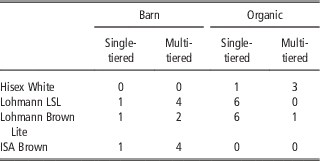
A cross-sectional study was performed from January 2013 to October 2014 in 34 commercial flocks of layers in Denmark; 15 flocks of barn layers and 19 flocks of organic layers. All producers were recruited based on voluntary participation by approaching all organic egg producers registered in the Danish Central Husbandry Register by letter and phone calls. Each producer participated with one flock. Nine organic producers, who participated in another research project and owned hens with a suitable age for this project, were invited to participate; all agreed to participate. All the producers that expressed interest in the project were included in the study under the condition that the hens were 32 weeks of age no later than by March 2014 in order to finalise data collection during 2014. Each producer participated with one flock. Four flocks (two organic and two barn) were excluded from the study due to incomplete data collection. Thus, the data presented originate from 13 flocks of barn layers and 17 flocks of organic layers (Table 1).
Number of flocks according to production system, housing system and hybrid

Barn hens were beak trimmed and housed at a stocking density of 9 hens/m2. In contrast, organic hens had intact beaks and were housed at 6 hens/m2. Only organic hens had outdoor access and were supplied daily with roughage. In the barn system flock sizes ranged between 2000 and 14 000 (mean 7002, median 6000), whereas the organic flocks all consisted of 3000 hens, except two flocks with 4500 and 2200 hens, respectively. Hens in both the barn and organic production systems were housed according to the EU regulations (Council Directive 1999/74/EC, 1999; Commission Regulation 2008/889/EC, 2008).
Data collection
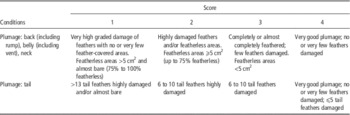
Each flock was visited twice; the first visit at around 32 weeks of age (range 30 to 40, mean 33, median 32) and the second visit at around 62 weeks of age (range 58 to 66, mean 62, median 62). During both visits, a total of 100 hens were caught in different areas of the compartment, and their plumage condition was assessed individually by trained observers. A sample size of 100 individuals from each flock was chosen based on the recommendations of the Welfare Quality® protocol (Welfare Quality Consortium, 2009). The scoring protocol used was developed by participants from eight European countries in the CORE Organic HealthyHens Project (Table 2; CORE Organic HealthyHens Project, 2014). It is based on the method described by Tauson et al. (Reference Tauson, Kjaer, Maria, Cepero and Holm2005), but expanded with a written description of the different scores. A four-point scale is used (1 to 4 with 4 being the best condition) for five body parts (neck, back, tail, belly and wing). A summed plumage score for five body parts ⩽10 is regarded as a poor plumage condition, a score between 11 to 14 as a moderate plumage condition and a score ⩾15 as a good plumage condition (Tauson, Reference Tauson2005).
Description of the scores used for plumage condition

Modified from the HealthyHens scoring protocol.
In addition, the number of feathers on top of the litter at 10 randomly selected areas (each 1 m2) of the house was counted (data are missing for three organic flocks at 32 weeks of age). The areas were randomly selected by walking 15 steps in a straight line (where possible) in different directions between areas. Following the last step a frame (1×1 m) was gently thrown and feathers within the frame were counted. During the visit at age of 62 weeks, feathers (n=3169) from these 10 areas were collected for later examination. At the visit at 62 weeks of age, droppings (n=100/flock) were collected from different areas in the house, and in the case of the organic flocks also from the range area. Both feathers and droppings were stored at −18°C until later examination. The droppings were examined according to the method described by McKeegan and Savory (Reference McKeegan and Savory1999); the droppings were thawed and dried at ambient temperature for 4 to 5 days. After that, the droppings were cracked and visually examined for presence of feathers or pieces of feathers. Typically, only small pieces of feathers were found in the droppings and the colour (yellow/brown) was distinct from feathers attached to droppings or feathers collected on the floor. For each dropping, feather material was registered as either present or not. Broken floor feathers (n=230) were discarded due to uncertainty of time (before/after collection) and cause of the breakage. The remaining floor feathers were examined as described by McKeegan and Savory (Reference McKeegan and Savory1999). The floor feather characteristics recorded were length of each individual feather and whether the feather was (a) downy (>75% of the length being downy) and/or (b) damaged from feather pecking. Feather pecking damage is quite distinct from other types of damages. It consists of one or more large areas missing along the vane/quill of the feather, with the edge of the missing area being rough and uneven. Examination of droppings and feathers on the floor was performed by an observer unaware of the origin of the materials.
Statistical analysis
All statistical analyses were conducted in R version 3.1.2 (R Development Core Team, Reference Ramadan and von Borell2014). Effects of production system (barn or organic), housing system (single- or multi-tiered) and hybrid (Hisex White, ISA Brown, Lohmann Brown Lite and Lohmann LSL) were investigated on (a) the percentage of droppings with feather content at 62 weeks, (b) density of floor feathers at 32 and 62 weeks, (c) floor feather characteristics (length and damage due to feather pecking) at 62 weeks and (d) plumage condition at 32 and 62 weeks. Data on feather length and density of floor feathers were log-transformed and analysed using a linear regression model, whereas the remaining variables were analysed using a logistic regression model. All regression models contained flock as random effect and included the interaction between housing system and hybrid. The analyses were conducted using the glmer function from the R package lme4 and car (Fox and Weisberg, Reference Fox and Weisberg2011; Bates et al., Reference Bates, Maechler, Bolker and Walker2014). The effect of age (32 v. 62 weeks) on plumage condition and density of floor feathers at flock level were analysed using Student’s t test (paired) separately for the two production systems.
The correlations between the variables at flock level collected at 62 weeks of age, that is, percentage of droppings with feather content, floor feather characteristics, density of floor feathers and prevalence of poor plumage condition, were investigated using Spearman’s rank correlation coefficient test. The same test was used to examine for correlations within variables measured at both 32 and 62 weeks of age, that is, prevalence of hens with poor plumage condition and density of floor feathers. With a confidence level of 95% and a sample size of 30, the statistical power of the Spearman’s rank correlations to detect a correlation of 0.5 is 90%. The three flocks, where data on density of floor feathers at 32 weeks were missing, were excluded from the correlation analysis using these data specifically.
Results
Prevalence
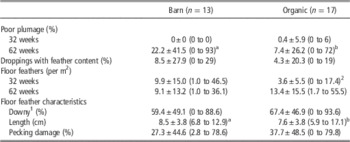
The prevalence of droppings with feather content did not differ between the two production systems (Table 3; χ 2=0.0008, DF=1, P=0.99) or the four hybrids (χ 2=3.4, DF=3, P=0.33), but it was higher in flocks housed in multi-tiered systems (10.0±30.0%) compared with single-tiered systems (2.7±16.0%; χ 2=8.4, DF=2, P=0.004). The prevalence of hens with poor plumage condition increased from 32 to 62 weeks of age in the barn production system (Table 3; t=2.4, DF=12, P=0.03), but not in the organic production system (Table 3; t=1.6, DF=16, P=0.12). At 62 weeks of age, a higher prevalence of hens with poor plumage condition was found in barn compared with organic production systems (Table 3; χ 2=11.9, DF=1, P<0.001), whereas no difference was found between the four hybrids (χ 2=5.9, DF=3, P=0.12). A tendency was found for flocks housed in multi-tiered systems (16.9±37.5%) to have a higher prevalence of poor plumage condition than flocks housed in single-tiered systems (11.0±31.3%) at 62 weeks of age (χ 2=3.4, DF=1, P=0.07).
Mean, SD and range between flocks (in brackets) of the variables collected in barn and organic production systems; percentages of droppings with feather content, floor feather characteristics (downy, length, pecking damage), density of floor feathers at 32 and 62 weeks and prevalence of poor plumage condition at 32 and 62 weeks

a,bColumns with different superscripts are significantly different at α=0.05.
1 No statistical analysis conducted as downiness was strongly dependent on feather length.
2 Data originate from 14 flocks.
A total of 807 and 2132 floor feathers were collected from the barn and organic production systems, respectively. The density of floor feathers increased from 32 to 62 weeks of age in the organic systems (Table 3; t=3.4, DF=13, P=0.005), but not in the barn systems (t=0.6, DF=12, P=0.53). The density of floor feathers did not differ between the two production systems (32 weeks: F 1,18=0.02, P=0.90; 62 weeks: F 1,21=3.32, P=0.08), the four hybrids (32 weeks: F 3,18=0.90, P=0.46; 62 weeks: F 3,21=0.42, P=0.74) or the two housing systems at 32 weeks (F 1,18=2.72, P=0.12). However, at 62 weeks of age the density of floor feathers was higher in multi-tiered systems (14.5±18.2 feathers/m2) compared with single-tiered systems (9.0±9.9 feathers/m2; F 1,21=4.90, P=0.04). The prevalence of floor feathers with pecking damage and the floor feather length did not differ between the two housing system (damaged feathers: χ 2=0.46, DF=1, P=0.50; feather length: F 1,20=1.4, P=0.25) or the four hybrids (damaged feathers: χ 2=5.2, DF=3, P=0.16; feather length: F 3,20=0.3, P=0.85). The prevalence of floor feathers with pecking damage did not differ between the two production systems (Table 3; χ 2=2.8, DF=1, P=0.09), but floor feathers were on average longer in barn compared with organic production systems (Table 3; F 1,20=8.3, P=0.009).
Associations
Correlations between the data collected at 62 weeks of age on the different floor feather characteristics, density of floor feathers, prevalence of droppings with feather content and prevalence of poor plumage are shown in Table 4. There was no significant correlation between the prevalence of poor plumage condition and the prevalence of droppings with feather content. In addition, no correlation was found between the density of floor feathers and the prevalence of droppings with feather content or between the density of floor feathers and the prevalence of feathers with pecking damage.
Spearman’s rank correlations between the variables at flock level (n=30) collected at 62 weeks of age, that is, different floor feather characteristics, prevalence of droppings with feather content, density of floor feathers and prevalence of poor plumage condition scored by trained observers

*P<0.05, **P<0.01, ***P<0.001.
A number of other correlations were found to be significant: poor plumage condition was negatively correlated with the density of floor feathers, that is, at higher occurrences of poor plumage condition lower densities of floor feathers were found. Prevalence of floor feathers with pecking damage was correlated negatively with percentage of downy floor feathers and positively correlated with prevalence of droppings with feather content and poor plumage condition. Thus, downy floor feathers were less likely to have pecking damage, and the more floor feathers with pecking damage, the higher the prevalence of both droppings with feather content and poor plumage condition. Percentage of downy floor feathers was highly negatively correlated with poor plumage condition and the length of floor feathers, meaning that there were fewer downy floor feathers at higher prevalence of poor plumage condition and that downy floor feathers were shorter than the other floor feathers. In addition, the percentage of downy floor feathers was positively correlated with the density of floor feathers, that is, downy floor feathers were more abundant at higher densities of floor feathers. No correlation was found within variables measured at both 32 and 62 weeks of age, that is, prevalence of hens with poor plumage condition (r 2=0.28, P=0.13) and density of floor feathers (r 2=0.31, P=0.11).
Discussion
The present study showed that feather eating does occur at a significant level in commercial flocks of laying hens and that the level of feather eating did not differ between barn and organic production systems. Occurrences of droppings with feather content have been reported from experimental studies of pullets. Savory and Mann (Reference Savory and Mann1999) found that 3.9% to 7.2% of the droppings included feather material in 11-week-old pullets, which is similar to the prevalence found in the present study. McKeegan and Savory (Reference McKeegan and Savory1999) found a higher prevalence; 23.7% of the droppings contained feather material in 14-week-old pullets. Studies with non-commercial used strains have reported differences in the level of feather eating between strains selected for high and low feather pecking (Harlander-Matauschek et al., Reference Harlander-Matauschek, Benda, Lavetti, Djukic and Bessei2007a), and studies have shown different levels of feather pecking among genotypes (Kjaer and Sørensen, Reference Kjaer2002). However, the four commercial hybrids used in the present on-farm study neither showed different levels of feather eating, nor differences in plumage condition.
The prevalence of droppings with feather content in the present study was higher in multi-tiered systems compared with single-tiered systems. This could be suggested to be connected to the tendency of an increased likelihood of poor plumage condition in multi-tiered systems compared with single-tiered systems. Although the plumage condition was found to be poor due to feather pecking in relatively many of the flocks at 62 weeks of age, no correlation was, however, found between plumage condition and prevalence of droppings with feather content. Thus, our hypothesis about a positive correlation between the amount of feather eating and the degree of plumage damage on flock level was not supported, indicating that feather pecking is not necessarily followed by feather eating. In addition, the feathers eaten may not be picked directly from hens, but may be feathers lost due to moulting that are later picked up and swallowed by feather-eating individuals. McKeegan and Savory (Reference McKeegan and Savory1999) observed 77 feather-eating events and only 19% of the feathers were plucked directly from other hens. Similar to our results, Savory and Mann (Reference Savory and Mann1999) did not find a correlation between feather material in droppings and plumage damage in an experimental study of pullets, whereas McKeegan and Savory (Reference McKeegan and Savory1999) in an experimental study of pullets found higher prevalence of droppings with feather content, when the level of plumage damage was high.
Interestingly, high prevalence of droppings with feather content was correlated to increased prevalence of floor feathers with pecking damage, indicating a direct association between feather pecking and feather eating. Supporting this possible association is the finding that the prevalence of floor feathers with pecking damage also increased with increasing prevalence of poor plumage condition. The prevalence of floor feathers with pecking damage was higher than observed among pullets (mean 11.6%; McKeegan and Savory, Reference McKeegan and Savory1999), supporting previous findings stating that plumage damage due to severe feather pecking increases with increasing age (Drake et al., Reference Drake, Donnelly and Dawkins2010; Gilani et al., Reference Gilani, Knowles and Nicol2012). The type of pecking damage to feathers registered were unlikely to occur after the feathers had been dropped from the hens, as pulling of pieces along the vane/quill of the feather requires some resistance, that is, the feather needs to be attached to its owner. Breakage of feathers, on the other hand, may happen during manipulation of floor feathers, which was one of the reasons why broken feathers were not included in the data analyses.
At higher occurrences of poor plumage condition, lower densities of floor feathers were found. In addition, the feathers found were longer and there were fewer downy feathers. This is similar to the findings by McKeegan and Savory (Reference McKeegan and Savory1999), who found increased plumage damage to be correlated to a depletion of feathers on pen floors and fewer downy floor feathers. Thus, the plucked feathers, especially the short downy feathers, somehow disappeared from the floor at high levels of plumage damage, but unlike the study of McKeegan and Savory (Reference McKeegan and Savory1999) they were not found in the droppings and could, therefore, not be assumed to have been eaten. Therefore, we speculate whether the activity level is somewhat higher in the flocks with high levels of feather pecking causing the plucked feathers to be covered by litter more quickly or to accumulate in specific areas of the hen house, which is especially likely to occur with the light downy feathers. The studies by Kjaer (Reference Kjaer and Sørensen2009) and Kjaer et al. (Reference Kjaer, Würbel and Schrader2015) support these speculations. They found that lines selected for high levels of feather pecking have a higher general activity level than low feather pecking lines and control lines with the latter being intermediate. A higher foraging activity may cause newly dropped feathers to become buried more quickly in the litter. Furthermore, a positive correlation between fear and feather pecking has been shown (Hughes and Duncan, Reference Hughes and Duncan1972; Vestergaard et al., Reference Vestergaard, Kruijt and Hogan1993; Bolhuis et al., Reference Bolhuis, Ellen, Van Reenen, De Groot, Ten Napel, Koopmanschap, De Vries Reilingh, Uitdehaag, Kemp and Rodenburg2009). Therefore, sudden movements, such as escape attempts released due to elevated fear levels, are likely to occur in flocks exposed to high levels of severe feather pecking and this may cause feathers to accumulate in specific areas, for example corners, along walls or structures, manure belt or pit, etc.
It has been suggested that the presence of loose feathers on the floor during rear may trigger development of feather pecking. Ramadan and von Borell (2008) found in an experimental study that laying hens, where access to loose feathers on the floor had been reduced during rear, exhibited less severe feather pecking and plumage damage in the laying period. Similarly, Forkman (Reference Forkman2003) found a lower occurrence of severe feather pecking in 19-week-old hens reared with limited access to floor feathers. McKeegan and Savory (Reference McKeegan and Savory1999) proposed that birds learn to eat feathers on the floor as part of foraging behaviour. During the first 6 months of life, layers moult three times, with an annual moult thereafter (Appleby et al., Reference Appleby, Hughes and Elson1992). Thus, if feather eating has become established during the first 6 months, feathers on the floor may become depleted in the laying period, causing redirected foraging behaviour in terms of pecking and eating of feathers from other birds (McKeegan and Savory, Reference McKeegan and Savory1999). This theory is in accordance with our finding that higher occurrences of poor plumage condition during the laying period were correlated with lower densities of floor feathers.
On the other hand, no correlation was found between the prevalence of droppings with feather content and the density of floor feathers. In addition, there was no correlation between the density of floor feathers and the prevalence of feathers with pecking damage. Thus, feather eating also seems to occur independently of the amount of feathers freely available on the floor, although floor feathers are a source of feathers for eating (McKeegan and Savory, Reference McKeegan and Savory1999). The number of floor feathers may, therefore, not be a useful indicator of the level of feather eating on commercial farms. Previous studies have reported that pullets prefer to eat short feathers (<10 cm) compared with longer feathers (McKeegan and Savory, Reference McKeegan and Savory1999). We found no correlation between the length of the floor feathers and the prevalence of droppings with feather content. This may be explained by the average length found which was <10 cm. Therefore, most of the floor feathers had a length that was acceptable for eating. The shorter the feather, the higher the likelihood was for being a downy feather. Downy feathers were less likely to have feather pecking damage which could indicate that downy feathers are easier to pull out.
Some studies have found that plumage condition during lay is associated with plumage condition during rear (Bestman et al., Reference Bestman, Koene and Wagenaar2009; Drake et al., Reference Drake, Donnelly and Dawkins2010; Gilani et al., Reference Gilani, Knowles and Nicol2013, de Haas et al., Reference de Haas, Bolhuis, de Jong, Kemp, Janczak and Rodenburg2014). We did not find a correlation between the peak of lay and the end of lay in flocks defined as having a poor plumage condition, which is most likely due to the lack of flocks at 32 weeks of age assessed as having a poor plumage condition.
Conclusion
Feather eating was found to occur at a significant level in commercial flocks of laying hens. Our hypothesis about a positive correlation between feather eating and plumage damage was not supported, as no correlation was found between the prevalence of poor plumage condition and the prevalence of droppings with feather content. However, the result showing a positive correlation between droppings with feather content and floor feathers with pecking damage suggests a possible link between feather eating and feather pecking. More research is though needed into the sources from where feathers are selected for ingestion.
Acknowledgements
The authors thank the producers for participating in the project. The project was funded by Aarhus University, the Fund for Organic Farming and the Poultry Production Levy Fund.