The recognition that antimicrobial resistance is a threat to human health is not new.Reference Finland1 Currently, the global expansion of multidrug-resistant organisms (MDROs) is felt by many to have reached crisis proportions.Reference Martens2 Implicit in our perception of the problem is the assumption that it is getting inexorably worse.Reference Slayton, Toth and Lee3 Hospitals are seen as overcrowded, unsanitary facilities full of vulnerable patients and contaminated equipment where intense antimicrobial exposure drives the evolution of resistance.Reference Blanco, O’Hara and Harris4 Periodic updates catalog the various organisms that threaten our pharmaceutical armamentarium for any given year.5 What is sometimes missing from the literature are longitudinal data that can shed light on whether or not our myriad interventions, at times created without solid evidence, are effective.
Twenty years ago, we developed a metric to efficiently capture the occurrence of a group of MDROs in our academic medical center. The same investigators have continued to collect these data, using the same methodology, to the present. We are now able to describe the occurrence of selected hospital onset MDROs in our facility over a significant period during which new prevention strategies have been introduced. Here, we describe a simple surveillance metric and demonstrate how it could support the efforts of our infection prevention and antimicrobial stewardship programs.
Methods
Setting
The University of Vermont Medical Center is a 500-bed, tertiary-care, academic medical center affiliated with the University of Vermont Larner College of Medicine in Burlington, Vermont. Currently, this facility has 6 infection prevention practitioners, 2 hospital epidemiologists, and an active antibiotic stewardship program managed by an infectious disease specialist and an infectious disease pharmacist.
Surveillance method
The resistance index (RI) has been described previously.Reference Ahern and Alston6,Reference Alston and Ahern7 It was developed in 2001 as a tool for quantifying nosocomial infection and colonization with organisms of epidemiological importance. The RI is a rate that is calculated monthly; the numerator is the number of positive cultures, or nucleic acid amplification tests, for 6 different organisms: (1) methicillin-resistant Staphylococcus aureus (MRSA), (2) vancomycin-resistant Enterococcus (VRE), (3) Clostridioides difficile, (4) fluoroquinolone-resistant Pseudomonas aeruginosa, (5) ceftazidime-resistant gram-negative bacilli, and (6) Stenotrophomonas maltophilia. Only those positive during an inpatient stay, collected >48 hours after admission, are included. Polymerase chain reaction (PCR) testing for C. difficile began in 2009, which is more sensitive than the prior toxin enzyme immunoassay. Patients in intensive care were screened on admission and weekly for MRSA; new positive results >48 hours after admission were counted in the RI. Routine screening for VRE was not performed. Rehabilitation, psychiatry, and pediatric floors are excluded, as are isolates recovered from patients with cystic fibrosis. A single patient may be infected or colonized with >1 type of organism, but each type of organism is counted only once per patient. The denominator is hospital-wide patient days. The RI is expressed as the rate of positive isolates per 1,000 patient-days. This laboratory-based metric was designed to minimize bias; thus, cultures reflecting both colonization and infection were included. The RI can also be calculated for any individual ward using unit-specific patient-days. The medical center was the target of a massive cyberattack in October 2020 that rendered surveillance data for the final quarter of the year unavailable.Reference Barry and Perlroth8 Therefore, the hospital-wide RI is presented for the period January 2001 through September 2020. Stata version 15.1 software (StataCorp, College Station, TX) was used for statistical analysis.
Results
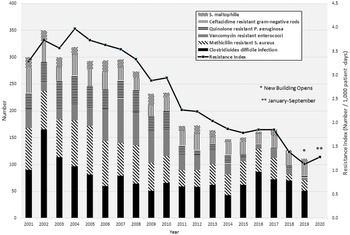
For the 20-year period, the hospital-wide RI ranged between a high of 4.0 in 2004 and a low of 1.1 in 2019. The total number of cases that serve as the numerator for this rate ranged between a high of 350 in 2002 and 111 in 2019. Figure 1 illustrates the trend in the RI over the 20-year period. A nonparametric test for the trend in the RI across years was significant (P < .01). Because of the cyberattack, data for the last quarter of 2020 are missing; the RI was calculated with 9 months of data, but the number of isolates cannot be compared. For the raw number of the 6 individual MDROs in 2001 compared to 2019, MRSA decreased from 78 to 20, VRE fell from 36 to 4, C. difficile decreased from 90 to 51, fluoroquinolone-resistant Pseudomonas decreased from 29 to 4, ceftazidime-resistant gram-negative bacilli decreased from 47 to 23, and Stenotrophomonas decreased from 20 to 9. Using simple linear regression, year predicted not only the hospital-wide RI (decreased .15 per year, 95% confidence interval −.17 to −.13; P < .01) but also the count of all 6 organisms individually (all P values < .02). The RI was designed before extended-spectrum β-lactamases or carbapenem resistance were commonly encountered. No significant increase in these MDROs was seen during the study period.
Hospital–wide resistance index, 2001–2020.

Discussion
We describe a novel surveillance metric that has allowed us to recognize a significant reduction in 6 MDROs over a 20-year period at an academic medical center. There were many overlapping interventions over 20 years, often implemented simultaneously, and it is impossible to identify which of them had the greatest impact on the RI. Longitudinal data such as these may illuminate important trends not appreciated by monthly reports. Infection prevention programs may learn valuable lessons by reviewing their archived data, when available, and comparing it to data from the present day. By examining where we have been, we can better assess the success or failure of our programs.
Acknowledgments
The authors thank the Infection Prevention staff at the University of Vermont Medical Center.
Financial support
No financial support was provided relevant to this article.
Conflicts of interest
All authors report no conflicts of interest relevant to this article.