Implications
We addressed two strategies, suckling environment and zinc oxide (ZnO) supplementation, to minimize the consequences of post-weaning colibacillosis, the most important challenge to the performance and health of weaned pigs. Although the experiment reinforced the efficacy of ZnO to promote weaned pig's well-being, it also showed that piglet pre-weaning rearing environment has a significant impact on its success following weaning. The most beneficial strategy in terms of performance was the combination of ZnO supplementation and rearing of piglets outdoors. The findings would allow for a more effective way of dealing with post-weaning collibacilossis, especially when input from other, non-ZnO antimicrobial growth promotants is minimized.
Introduction
Changes in the physical and social environment of pigs at weaning expose them to a number of stressors that affect performance. Among these is a transient reduction in feed intake that results in a period of nutritional inadequacy and changes in the bacterial colonization of the small intestine, which may allow the onset of post-weaning colibacillosis (Kelly and King, Reference Kelly and King2001; Vente-Spreeuwenberg and Beynen, Reference Vente-Spreeuwenberg and Beynen2003). This disorder is characterized by diarrhoea, dehydration and reductions in growth, and is most commonly associated with proliferation and establishment of enterotoxigenic Escherichia coli (ETEC) in the small intestine (Madec et al., Reference Madec, Bridoux, Bounaix, Cariolet, Duval-Iflah, Hampson and Jestin2000). Historically, the health and welfare of pigs has been supported during the transition from suckled to weaned state by the inclusion of antimicrobial growth promoters in their diet. However, the European Union (EU) ban on the prophylactic use of antibiotics came into effect in 2006 (Regulations (EC) numbers 1831/2003 and 1334/2003), thereby necessitating identification of alternative strategies for support of weaned pig health.
Zinc oxide (ZnO) is still permitted for dietary inclusion by the EU legislation; it has been shown to stimulate small intestine mucosal growth (Li et al., Reference Li, Yin, Li, Chen, Zang and Zhou2006) and reduce the incidence of diarrhoea (Mavromichalis et al., Reference Mavromichalis, Peter, Parr, Ganessunker and Baker2000; Case and Carlson, Reference Case and Carlson2002) when added to weaner pig diets. Positive effects of ZnO on feed intake and growth rate have also been reported (Hahn and Baker, Reference Hahn and Baker1993; Carlson et al., Reference Carlson, Poulsen and Vestergaard2004; Ragland et al., Reference Ragland, Schneider, Amas and Hill2006), indicating that ZnO accelerates re-alimentation and return of normal intestinal function. Similarly, the pre-weaning environment of the pig has also been reported to influence subsequent performance, with outdoor-reared animals exhibiting superior pre-weaning growth (Wulbers-Mindermann et al., Reference Wulbers-Mindermann, Algers, Berg, Lundeheim and Sigvardsson2002) and better adaptation to weaning than indoor-reared contemporaries (Gentry et al., Reference Gentry, McGlone, Miller and Blanton2002). In addition, previous study by our group has shown that outdoor-reared pigs have reduced incidence of diarrhoea post-weaning (Miller et al., Reference Miller, Toplis and Slade2009).
Here we investigated the interactive effects of rearing environment and dietary ZnO content on the responses of weaned pigs given a subclinical challenge of ETEC. Experimental infection was used to ensure that all pigs experienced a level of challenge post-weaning. We hypothesized that ZnO supplementation would be beneficial to ETEC-challenged weaned pigs and would reduce the severity of post-weaning diarrhoea. Likewise, we hypothesized that outdoor-reared pigs would show greater resilience to ETEC than indoor-reared pigs and hence would demonstrate better performance post-weaning and reduced severity of diarrhoea. As a consequence of the anticipated better performance of Out pigs, we further hypothesized that ZnO supplementation would provide greater benefit to indoor-reared pigs than to outdoor-reared pigs.
Material and methods
The experimental design and all procedures were approved by the Ethical Review Committee of the University of Leeds. The experiment consisted of a 2 × 2 factorial combination of rearing environment (indoors (In) v. outdoors (Out)) and two levels of dietary ZnO supplementation post-weaning (0 and 3100 mg/kg of diet; (−Zn) and (+Zn), respectively). Treatments were thus In − Zn, Out − Zn, In + Zn and Out + Zn.
Pigs (Large White × Landrace) were sourced from the same farm that operated both In and Out pre-weaning rearing conditions. One week before farrowing, 14 indoor-housed dry sows were either moved into individual outdoor farrowing paddocks measuring 12 m × 10 m, with each containing an outdoor metal farrowing arc or were transferred into conventional indoor farrowing crates contained within individual pens measuring 1.4 m × 3.0 m. Groups of sows were balanced for number (n = 7 per pre-weaning rearing condition) and previous performance history (e.g. number of piglets born, weaned, etc.). All piglets were given access to a common creep feed without antimicrobial growth promoters or ZnO from 14 days pre-weaning.
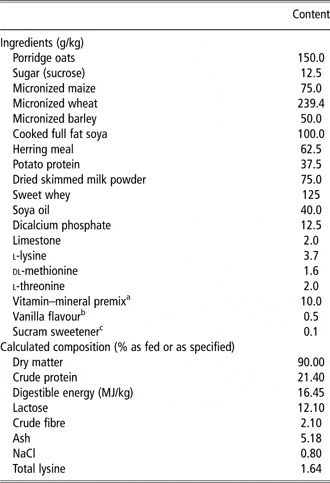
On weaning at 4 weeks of age (day 0) pigs were allocated to one of the four treatments. A total of 32 pigs were randomly selected from the seven indoor-reared litters and a further 32 pigs selected from the seven contemporary outdoor-reared litters. Selected piglets were weaned, sexed, tagged and weighed. Pigs from both Out and In environments were allocated to one of 16 fully slatted pens in the same conventional pig rearing house in groups of four, such that treatment groups were balanced for litter within rearing environment, weaning weight and sex. Thus each of the four treatments contained four pens of four pigs each, that is, a total of 16 pigs. Each fully slatted, 80 cm wide by 120 cm long, pen contained a multi-spaced feed hopper to the front wall and a mounted nipple drinker to the rear. The basal experimental post-weaning diet was formulated to provide 210 g CP, 16.5 MJ DE and 16.4 g total lysine/kg. For the +Zn diet, ZnO (PigZin: DSM Nutritional Products, Heanor, Derbyshire, UK) was added to the basal diet at the legally prescribed rate of 3100 mg/kg. The composition of the basal diet is shown in Table 1. Pigs were given ad libitum access to their allocated experimental diet from the day of weaning to completion of the experiment 10 days later; water was freely available throughout.
Ingredients and calculated nutrient composition of the basal diet (as fed basis)

aProvided per kilogram of complete diet: 12 500 IU of vitamin A, 2250 IU of vitamin D3, 250 mg of vitamin E, 5 mg of vitamin K3, 4.2 mg of vitamin B1, 5.7 mg of vitamin B2, 5.2 mg of vitamin B6, 42 mg of vitamin B12, 42 mg of nicotinic acid, 21 mg of pantothenic acid, 1.1 mg of folic acid, 150 mg of biotin, 250 mg of choline chloride, 199 mg FE (as FeSO4.H2O), 20 mg of Cu (as CuSO4), 65 mg Mn (as MnO), 0.5 mg Co (CoCO3), 10 mg Zn (as ZnO), 2.2 mg I (as Ca(IO3)2), 0.3 mg Se (as NaSEO4).
bClaremont Ingredients, Newcastle-under-Lyme, UK.
cPancosma SA, Geneva, Switzerland.
Three days post-weaning (day 3), all pigs were challenged per os with 109 CFU ETEC (E. coli O149) using the method, dose and pathogen strain described by Wellock et al. (Reference Wellock, Fortomaris, Houdijk and Kyriazakis2008a). The pathogens that were derived from clinical cases of post-weaning colibacillosis (Veterinary Laboratories Agency, Surrey, UK), were characterized as having key virulence factors to initiate colibacillosis (adhesion factors K91, K88 (F4)) and have been used in other challenge studies with pigs (e.g. Wellock et al., Reference Wellock, Fortomaris, Houdijk and Kyriazakis2008a). The methodology ensured that all piglets were challenged with a subclinical dose of E. coli, rather than relying only on natural infection.
Trough weight and feed wastage were recorded daily for each pen and the mean feed intake per pig in each pen was calculated accordingly; piglet live weight was also recorded daily. During the 24 h, following ETEC challenge, faecal scores were recorded for individual pigs. Faecal score was assessed on a pen basis using a subjective 4-point scale (Wellock et al., Reference Wellock, Fortomaris, Houdijk and Kyriazakis2008b), where 1 = firm and 4 = watery, and was recorded daily. Rectal swabs were taken from all pigs at weaning, immediately before ETEC challenge and daily for 5 days post-challenge for determination of faecal ETEC and lactic acid bacteria (LAB) enumeration according to the methodology of Wellock et al. (Reference Wellock, Fortomaris, Houdijk and Kyriazakis2008b) and Heo et al. (Reference Heo, Kim, Hansen, Mullan, Hampson and Pluske2009). Briefly, samples were serially diluted and 100 μl aliquots were plated for enumeration on either sheep blood agar (E&O Laboratories Ltd, UK) for ETEC (β-haemolytic colonies with characteristic E. coli morphology), MacConkey agar (E&O Laboratories Ltd, UK) for coliforms (red/pink colonies) or de Man, Rogosa, Sharpe agar (E&O Laboratories Ltd, UK) for LAB. Incubations were done at 37°C (ETEC) or 39°C (LAB and coliforms) for 24 h (ETEC and coliforms) or 48 h (LAB) under aerobic (ETEC and coliforms) or anaerobic (LAB) conditions (Wellock et al., Reference Wellock, Fortomaris, Houdijk and Kyriazakis2006 and Reference Wellock, Fortomaris, Houdijk and Kyriazakis2008a).
All pigs were euthanized 7 days after the day of infection (day 10 post-weaning). Samples were collected for determination of faecal dry matter and digesta were collected from the distal ileum and proximal colon for assessment of LAB-to-coliform ratio as described by Wellock et al. (Reference Wellock, Fortomaris, Houdijk and Kyriazakis2006). The pH of digesta was measured at different sites throughout the tract. The weight of intestines and associated organs were recorded. Small intestine tissue samples, taken from sites proportionately 0.25, 0.50 and 0.75 proximal to distal along the small intestine, were fixed in 10% formal saline and retained for measurement of morphology using the methods of Ilsley et al. (Reference Ilsley, Miller and Kamel2005). Briefly, fixed tissues were sampled, dehydrated, embedded in paraffin wax and sectioned at 5 μm. Prepared tissues were stained using periodic acid Schiff solution and counterstained with Mayer's haemotoxylin. Morphological measurements and goblet cell numbers were determined on six well-oriented crypt–villi structures using a calibrated eyepiece graticule (Knight Optical, Kent, UK). Goblet cell numbers per unit length of the crypt and villi structure were also determined. Mucins secreted from these cells have been shown to contain receptors specific for E. coli K88 fimbriae similar to those expressed on the surface of small intestine enterocytes.
Data were analysed as a 2 × 2 factorial design (rearing environment and ZnO content) using the GLM procedure of Minitab 12.2 (Minitab Ltd, Coventry, UK). Data were checked for normal distribution using the Anderson-Darling normality test of Minitab 12.2. Bacteriological counts (LAB, ETEC and coliform) were log10 transformed before analysis and presentation. Faecal score data and performance were analysed on a pen basis with the pen being the experimental unit in the model. Live weight at weaning was balanced across treatment pens and was thus not used as a covariate in the analysis of pen data. However, weaning weight was included as a covariate in the analysis of post-mortem tissue measurements where the individual pig was the experimental unit. All individual measurements, such as faecal score on the day of infection, faecal counts and post-mortem data were analysed with the same model, but in this case individual pigs were nested within a pen, which was again the experimental unit.
Results
General
Pigs were weaned from indoor- and outdoor-rearing environments at 28.0 and 27.0 ± 0.24 (±s.e.m.) days of age and 7.4 and 7.3 ± 0.16 kg live weight, respectively. One indoor-reared pig lost weight consistently over the 3 days from weaning to the day of challenge and was removed from the experiment before ETEC challenge. Of the remaining 63 pigs, three developed clinical symptoms of post-weaning colibacillosis and had to be euthanized; one 3 days following ETEC challenge (treatment In − Zn) and the other two pigs 4 days post-challenge (treatments In − Zn and Out + Zn). A further pig, noted to be pale but not to have severe diarrhoea, died 6 days following ETEC challenge (treatment Out − Zn). All five pigs originated from two litters, one indoor and one outdoor reared and were treated as missing values in the statistical analysis.
Performance
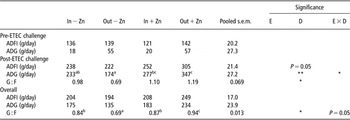
The performance of Out pigs did not differ from that of In contemporaries before or following ETEC challenge (Table 2). Similarly, there were no performance differences due to diet from weaning to day 3. However, subsequent to ETEC challenge, pigs fed diets supplemented with ZnO ate more (278 v. 230 g/day, P = 0.05), grew faster (312 v. 203 g/day, P < 0.01) and had improved gain-to-feed ratio (G : F) (1.15 v. 0.81, P < 0.05) than those offered the basal diet. Despite the lack of treatment differences in average daily feed intake (ADFI) during the entire period of the experiment, average daily gain (ADG) over this period tended to increase in response to ZnO (P < 0.10) and overall G : F was significantly improved (P < 0.05). There were treatment interactions for post-infection ADFI and ADG (P < 0.10 and P < 0.05, respectively), and overall (i.e. from weaning to day 10) ADG and G : F (P < 0.10 and P < 0.05, respectively): the performance of Out pigs supplemented with ZnO was the best, whereas that of unsupplemented Out pigs was the worst amongst the four treatments. There were no significant treatment interactions for G : F following ETEC challenge (P = 0.129).
Effect of In v. Out rearing environment and zinc oxide supplementation (−Zn or +Zn) on ADFI, ADG and G : F of weaned pigs before and after ETEC challenge; pre-challenge is from weaning to infection, post-challenge from infection to euthanasia (7 days later) and overall from weaning to euthanasia (10 days)

In = indoor; Out = outdoor; ADFI = average daily feed intake; ADG = average daily gain; G : F = gain-to-feed ratio; ETEC = enterotoxigenic Escherichia coli; E = environment; D = diet; E × D = environment by diet interaction.
a,b,cMeans without a common superscript differ significantly (P < 0.05).
*P < 0.05; **P < 0.01.
ETEC excretion and faecal scores
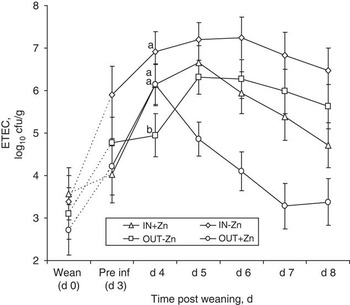
At weaning, faecal ETEC counts indicated that 81% and 72% of the 32 pigs for each of In and Out pigs, respectively, were already excreting some ETEC in their faeces. Levels of ETEC excretion in these pigs ranged from 2.5 to 8.4 log10 CFU/g faeces for In and from 2.7 to 6.2 log10 CFU/g for Out. However, mean weaning ETEC counts did not differ significantly between rearing environments and this was the case up to the point of challenge (day 3; Figure 1). Regardless of rearing environment, there was a tendency for reduced excretion of ETEC before challenge among pigs fed the ZnO supplemented diets (4.1 v. 5.3 log10 CFU/g respectively, P < 0.10). Across the four experimental treatments pen faecal scores from weaning (day 0) to the day of challenge (day 3) did not differ.
Effect of indoor (In) v. outdoor (Out) rearing environment and zinc oxide (ZnO) supplementation (−Zn or +Zn) on enterotoxigenic Escherichia coli (ETEC) excretion in weaned pig faeces pre- and post-ETEC challenge. ETEC challenge took place on day 3 post-weaning. Wean (day 0) = no significant main effects or interaction. Pre-infection (pre-inf.; day 3) = ZnO supplementation tended to reduce ETEC excretion (P < 0.1). No significant effect of rearing environment or interaction. Day 4 = a significant interaction between rearing environment and ZnO supplementation (P < 0.05). With ZnO supplementation, rearing environment had no affect on ETEC excretion, whereas in the absence of ZnO, outdoor rearing reduced ETEC excretion. abMeans without a common superscript differ significantly (P < 0.05). Day 5 = ZnO supplementation reduced ETEC excretion (P < 0.05). Outdoor rearing reduced ETEC excretion (P < 0.01). No significant interaction. Day 6 = both ZnO supplementation and outdoor rearing reduced ETEC excretion (P < 0.01). No significant interaction. Day 7 = ZnO supplementation (P < 0.001) and outdoor rearing (P < 0.05) reduced ETEC excretion. No significant interaction. Day 8 = ZnO supplementation reduced ETEC excretion (P < 0.01), whereas outdoor rearing tended to reduce ETEC excretion (P < 0.1). No significant interaction.

The level of ETEC excretion at weaning and immediately pre-infection (day 3) did not influence post-challenge ETEC excretion rates. ETEC excretion increased rapidly across all treatments following challenge on day 3 post-weaning, although this appeared delayed by 24 h in Out − Zn pigs (day 4 interaction between rearing environment and ZnO inclusion was P < 0.05) and persisted the least in Out + Zn pigs. Outdoor rearing and ZnO inclusion in the diet reduced the level of post-challenge ETEC excretion. Mean faecal ETEC counts for the 7 days post-challenge period were 6.2 and 5.2 (±0.27) log10 CFU/g for In and Out pigs, respectively (P < 0.01) and 6.3 and 5.1 (±0.27) log10 CFU/g for the basal and ZnO supplemented diets (P < 0.01). There was no interaction between rearing environment and ZnO inclusion for this measurement. Faecal ETEC counts on day 5 post-challenge tended to be lower for Out than for In pigs (4.5 v. 5.6 log10 CFU/g, respectively, P ⩽ 0.05) and were significantly reduced for +Zn compared with −Zn pigs (4.0 v. 6.0 log10 CFU/g, respectively, P < 0.01).
Increasing the level of dietary ZnO also significantly improved faecal score over the initial 24 h following ETEC challenge (2.4 v. 2.8, P < 0.05; data not shown), the effect being greatest during the initial 6 h (2.0 v. 3.0, P < 0.05). Early post-challenge faecal score tended to be lower for Out than for In pigs (2.5 v. 2.7, P < 0.10). From 24 h to 7 days post-challenge there were no differences in faecal score between treatments other than a trend for reduction in faecal score on day 5 in response to ZnO supplementation (2.0 v. 2.7, P < 0.10). There were no interactive effects of rearing environment and ZnO inclusion on faecal score.
Post-mortem measurements
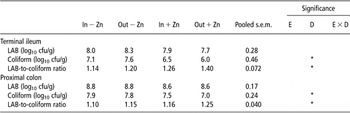
The effects of experimental treatment on LAB and coliform counts in terminal ileum and proximal colon digest are presented in Table 3. Lactic acid bacterial numbers at both sites were unaffected by treatment. Supplementing the diet with ZnO reduced coliform numbers significantly in both regions of the tract (P < 0.05) resulting in a higher LAB-to-coliform ratio (P < 0.05). Reductions in coliform numbers in the proximal colon of outdoor-reared pigs were not significant, but tended to result in a more favourable LAB-to-coliform ratio (P < 0.10).
Effect of In v. Out rearing environment and level of dietary zinc oxide (−Zn or +Zn) on LAB and coliform numbers in the terminal ileum and proximal colon of weaned pigs euthanized 7 days following ETEC challenge

In = indoor; Out = outdoor; LAB = lactic acid bacteria; ETEC = enterotoxigenic Escherichia coli; E = environment; D = diet; E × D = environment by diet interaction.
*P < 0.05.
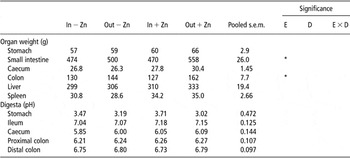
Corrected for weaning weight, there was no effect of diet or environment on liver and empty stomach weight (Table 4). Small intestine and colon weight was significantly greater in outdoor- than in indoor-reared pigs (P < 0.05 and P < 0.01, respectively). With the exception of a tendency for increased caecum and spleen weight in ZnO pigs (P < 0.10), tissue weight was unaffected by inclusion of ZnO. Faecal dry matter tended to increase in response to ZnO supplementation (P < 0.10; data not shown). However, across all treatments, faecal water content was less than the 80% threshold defined by Hampson (Reference Hampson1986) as indicating diarrhoea. There were no differences among treatments in the pH of stomach, ileum, caecum or colon contents.
Effect of In v. outdoor Out rearing environment and zinc oxide supplementation (−Zn or +Zn) on organ weight and digesta pH of weaned pigs euthanized 7 days following ETEC challenge

In = indoor; Out = outdoor; ETEC = enterotoxigenic Escherichia coli; E = environment; D = diet; E × D = environment by diet interaction.
*P < 0.05.
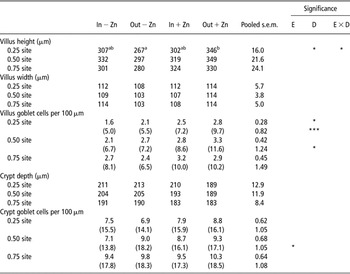
The effects of experimental treatments on small intestine morphology are presented in Table 5. ZnO supplementation had the most dramatic effects on these measurements. Villus height in the upper small intestine (0.25 site) was markedly improved by ZnO supplementation of the diet (P < 0.05). This effect was primarily driven by the opposing responses of Out pigs to diet, and concealed the absence of any ZnO effect on In pig upper small intestine villus height (interaction P < 0.05). Medial (0.50 site) villus width was subject to a similar, though less significant, treatment interaction (P < 0.10).
Effect of In v. Out rearing environment and zinc oxide supplementation (−Zn or +Zn) on small intestine morphology (sites proportionately 0.25, 0.50 and 0.75 proximal to distal) of weaned pigs euthanized 7 days following ETEC challenge. The goblet cell numbers are presented corrected per unit of villus height or crypt depth and as absolute values in parenthesis

In = indoor; Out = outdoor; E = environment; D = diet; E × D = environment by diet interaction.
Absolute values are given in parenthesis.
a,bMeans without a common superscript differ significantly (P < 0.05).
*P < 0.05; ***P < 0.001.
Only villous goblet cell numbers in the upper small intestine (cells/100 μm) were significantly increased in response to ZnO supplementation (P < 0.05). However, corrected for villus height, the ZnO effect on villus goblet cell numbers was more pronounced and widespread with increasing evidence in the upper (P < 0.001), medial (P < 0.05) and lower (0.75 site) (P < 0.10) regions of the tract. Absolute villus goblet cell numbers also tended to be higher in the upper small intestine of Out pigs (interaction P < 0.10). Similarly, ZnO tended to have a positive effect on upper small intestine crypt goblet cell numbers (cells/100 μm; P < 0.10) but this effect was not apparent when data was corrected for crypt depth. There was a tendency (P < 0.10) toward increased crypt goblet cell numbers (cells/100 μm) in the upper small intestine in response to ZnO inclusion, and a significant effect of rearing environment on the corrected number of crypt goblet cells in the medial small intestine (P < 0.05).
Discussion
We investigated the interactive effects of rearing environment and dietary ZnO content on the responses of weaned pigs given a subclinical challenge of ETEC. We have shown that the addition of 3100 mg/kg ZnO to the post-weaning diet reduces ETEC shedding by E. coli challenged piglets and improves their growth performance. The effects of ZnO supplementation on ETEC shedding are relatively well established. Owusu-Asiedu et al. (Reference Owusu-Asiedu, Nyachoti and Marquardt2003) showed that 2880 mg/kg Zn reduced the percentage of weaned pigs shedding E. coli (K88) by 48 h after E. coli (K88) challenge. In vitro study by Roselli et al. (Reference Roselli, Finamore, Garaguso, Britti and Mengheri2003) has shown that ZnO treatment of intestinal cells at 0.05 to 1.0 mM reduced ETEC K88 adhesion and thus could negate ETEC infection in vivo. Furthermore, Crane et al. (Reference Crane, Naeher, Shulgina, Zhu and Boedeker2007) showed that zinc reduces both the expression of protein virulence factors and cell adherence by enteropathogenic E. coli.
Wellock et al. (Reference Wellock, Fortomaris, Houdijk and Kyriazakis2008b) reported that in 4-week weaned, individually housed pigs, challenged with ETEC, faecal shedding returned to 0 over a period of 11 days following infection. In contrast, in an experiment by Van Dijk et al. (Reference Van Dijk, Enthoven, Van den Hoven, Van Laarhoven, Niewold, Nabuurs and Benyen2002), ETEC excretion in group-housed pigs increased following infection and remained relatively constant to the point of slaughter 8 days later. Although the differences observed between studies could be due to the different ETEC strains used, it would also seem reasonable to suggest that group housing may increase the duration of ETEC infection in the newly weaned pig. In the current group-housed experiment, ETEC excretion increased for all treatments immediately following infection. Thereafter, however, faecal ETEC counts in pigs fed the ZnO supplemented diet reduced such that by the fifth day following infection, rates of shedding were comparable with those measured at weaning. It is logical to assume that the reductions in ETEC shedding in response to ZnO addition to the diet would lessen cross-infection within the group resulting in the self-generating improvement of ETEC status.
Li et al. (Reference Li, Van Kessel, Caine, Huang and Kirkwood2001) reported that the addition of 3000 mg/kg ZnO to the diet of weaned pigs had no effect on performance, but did increase villus height. These authors speculated that ZnO-generated performance benefits reported by other workers might not necessarily be preceded by improvements in intestinal morphology observed in their own experiment. The respective effects of feed intake and ZnO supplementation on the morphological development of the small intestine were elegantly demonstrated by Li et al. (Reference Li, Yin, Li, Chen, Zang and Zhou2006) who pair-fed weaned pigs a common diet with or without 3000 mg/kg ZnO for 14 days and reported villus height in the upper small intestine to be increased only in pigs fed the ZnO supplemented diet. Furthermore, the improvements in villus structure were associated with enhanced growth rate and feed efficiency. It is therefore reasonable to surmise that the ZnO-generated improvements in upper small intestine villus height in the current experiment would contribute to, rather than be caused by, improvements in feed intake.
In agreement with numerous other studies (e.g. Hahn and Baker, Reference Hahn and Baker1993; Hill et al., Reference Hill, Mahan, Carter, Cromwell, Ewan, Harrold, Lewis, Miller, Shurson and Veum2001; Carlson et al., Reference Carlson, Poulsen and Vestergaard2004) pigs fed diets with the addition of ZnO tended to grow faster and with significantly improved efficiency. Implicit from this is that the efficiency of nutrient utilization and the morphological development of the small intestine are positively related and that this relationship may be mediated to some extent by the level of ZnO in the diet. ZnO responsive increases in the mucosal expression of IGF-1 and IGF-1 receptor genes are independent of feed intake level (Li et al., Reference Li, Yin, Li, Chen, Zang and Zhou2006) and supports data suggesting a direct role of ZnO in regulation of IGF-1 expression (Tarnow et al., Reference Tarnow, Argen, Steenfos and Jansson1994) and also serum IGF-1 concentrations (Carlson et al., Reference Carlson, Poulsen and Vestergaard2004). Thus ZnO may directly promote changes in intestinal morphology that result in the increased efficiency of nutrient utilization for growth.
The mucus overlying the epithelial cells of the pig small intestine contains protein and glycolipid receptors, similar to those found on the surface of enterocytes that are specific for the K88 fimbriae of E. coli (Blomberg et al., Reference Blomberg, Krivan, Cohen and Conway1993). In vitro studies have demonstrated that growth of E. coli K88 is supported by pig ileal mucus resulting in stationary phase populations of 108 cells per ml (from 104 cells per ml at inoculation) following 6 h of incubation (Blomberg et al., Reference Blomberg, Gustafsson, Cohen, Conway and Blomberg1995). In this experiment, the marked increase in numbers of goblet cells in pigs fed ZnO supplemented diets might be assumed to have increased susceptibility to ETEC infection. However, there is evidence to suggest that the binding of ETEC to mucins prevents their attachment to underlying enterocyte receptors (Dean-Nystrom and Samuel, Reference Dean-Nystrom and Samuel1994) and higher dietary ZnO concentrations have been associated with increased areas of mucins in the intestine (Hedemann et al., Reference Hedemann, Jensen and Poulsen2006). Spatial isolation of mucin-bound ETEC from epithelial enterocytes may act to reduce the pathological consequences of infection. Reducing ETEC trauma to the intestinal epithelium would help to maintain enterocyte function and small intestine morphology (Miller et al., Reference Miller, Newby, Stokes and Bourne1984), and promote improved performance (Madec et al., Reference Madec, Bridoux, Bounaix, Cariolet, Duval-Iflah, Hampson and Jestin2000). In turn, increased feed intake would accelerate the peristaltic clearance of mucin-bound ETEC from the intestinal tract.
In this experiment no differences in lactic acid bacterial numbers or digesta pH were detected among treatments. Nonetheless, a reduction in coliform numbers in the distal ileum and proximal colon of pigs fed ZnO supplemented diets did result in improvement in the LAB-to-coliform ratio at both sites and the production of organic acids by lactic acid bacteria is inhibitory to E. coli K88 growth (Jin et al., Reference Jin, Marquardt and Baidoo2000). It is not possible to speculate as to whether this effect contributed to, or resulted from, the overall improvement in pig health and performance in response to ZnO. Both Katouli et al. (Reference Katouli, Melin, Jensen-Waern, Wallgren and Mollby1999) and Hojberg et al. (Reference Hojberg, Canibe, Poulsen, Hedemann and Jensen2005) have reported that feeding a pharmacological concentration of ZnO to weaned piglets affects the composition of the intestinal microbiota. Moreover, it is recognized that the gut microbiota, and its specific composition, affect intestinal development (Kelly et al., Reference Kelly, Begbie and King1992) and food intake (Kyriazakis and Houdijk, Reference Kyriazakis and Houdijk2007). Thus, the observed benefits of ZnO could be mediated either directly through effects on the host or pathogen or indirectly through effects on the gut contents/environment and their interaction with the host and/or the physiology (Carlson et al., Reference Carlson, Poulsen and Vestergaard2004) of the host.
Surprisingly, we observed no post-weaning performance benefit from outdoor-rearing pre-weaning (Miller et al., Reference Miller, Toplis and Slade2009). We are unaware of any other study investigating the post-weaning growth performance of outdoor-reared piglets in conjunction with a pathogen challenge. Excretion of ETEC was, however, reduced throughout the experiment in outdoor-reared pigs suggesting a conditioning effect of the rearing environment that inhibited ETEC colonization of the intestinal tract. The similarity in small intestine morphology between indoor- and outdoor-reared pigs at slaughter 10 days post-weaning does not preclude the possibility of significant differences existing at weaning. However, previous study by this group suggests this is not the case (Miller et al., Reference Miller, Carroll, Reynolds and Slade2007). Alternatively, it is conceivable that diverse rearing environments would generate qualitative differences in the gut microflora between In and Out pigs at weaning that would result in altered susceptibility to ETEC infection (Mulder et al., Reference Mulder, Schmidt, Stokes, Lewis, Bailey, Aminov, Prosser, Gill, Pluske, Mayer, Musk and Kelly2009).
We expected interactive effects between ZnO supplementation and rearing environment on the performance and the other responses of weaned pigs subjected to an E. coli challenge, with pigs that were reared in an In environment benefitting more from ZnO supplementation than those reared outdoors. This was based on literature evidence where these two strategies have improved weaned pig performance when applied independently (e.g. Hahn and Baker, Reference Hahn and Baker1993; Miller et al., Reference Miller, Toplis and Slade2009). Although pig performance was subject to treatment interactions (see below), outdoor rearing of pigs or the addition of 3100 mg/kg ZnO to the post-weaning diet both effectively reduced the level of ETEC shed by pigs following E. coli challenge and there were no interactions between the two. Thus the results of the current experiment provide clear evidence that the beneficial effects of ZnO on pig health and performance are complex and cannot be reproduced by strategies that act only to reduce ETEC load. The effects of outdoor rearing and addition of ZnO to the diet on ETEC excretion were additive and may indicate differences in the mechanisms through which outdoor rearing and ZnO supplementation act to reduce ETEC infection. Nonetheless, despite comparable reductions in ETEC excretion for Out − Zn and In + Zn pigs, there were marked differences in diet and rearing environment effects on tissue measurements and pig performance.
The performance data suggest that the observed treatment interactions on pig performance were not in accordance with our hypothesis. When faced with an ETEC challenge, pigs weaned from outdoor rearing were strongly disadvantaged unless provided with a ZnO supplemented diet. Following ETEC infection the ADFI of Out pigs was increased in response to ZnO, a change for the better that was paralleled by an increase in upper small intestine villus height and an improvement in ADG. The causal relationship between feed intake and morphological development of the small intestine cannot be determined from the current experiment.
In summary, pigs weaned from Out suckling environments or those fed diets supplemented with ZnO at the rate of 3100 mg/kg showed reduced faecal shedding of ETEC. These effects were additive indicating different, yet complementary, mechanisms of ETEC inhibition. In contrast to outdoor rearing, ZnO addition to the diet improved small intestine morphology, increased villus goblet cell numbers and generated favourable changes in lactic acid bacteria-to-coliform ratio that were associated with increased rates of feed intake and growth. However, the widespread responses to ZnO supplementation of the diet and mitigation of the consequences of ETEC infection were most pronounced in outdoor-reared pigs in terms of performance; this was contrary to our original hypothesis. While this experiment reinforces the efficacy of dietary ZnO to promote weaned pig's well-being, it also shows that the pre-weaning rearing environment of the pig have significant impact on its success following weaning.
Acknowledgements
This research was financially supported by ABN Ltd, Frank Wright Ltd, Home-Grown Cereals Authority, Meat and Livestock Commission/British Pig Executive, Primary Diets Ltd and Provimi Ltd with match funding from DEFRA (UK Department for Environmental, Food and Rural Affairs) through the Sustainable Livestock Production LINK programme. We would like to thank Kevin White for his invaluable assistance with the care and management of the pigs.