INTRODUCTION
Heterosis is one of the major genetic tools used to increase yield potential in rice. Intra-sub-specific indica hybrid rice has been reported to show 15–20% better grain yield over conventional inbred varieties (Yang & Liu Reference Yang and Liu1991; Virmani et al. Reference Virmani, Siddiq and Muralidharan1994; Virmani Reference Virmani, Coors and Pandey1999). In the last decade, efforts have been made in the exploitation of distance heterosis and notable achievements have resulted from inter-sub-specific hybrids between Oryza sativa ssp indica and japonica, which showed a 20–30% increase in grain yield over control (Yuan et al. Reference Yuan, Yang, Yang and Virmani1994; Virmani Reference Virmani1994; Shen & Xue Reference Shen and Xue1996; Ma et al. Reference Ma, Xu, Wang, Yu, Jin, Ouyang and Zhu2007). More distant inter-specific heterosis has been recognized as a promising new way to further increase yield potential in rice. For example, yield potential was increased in hybrid rice with introgression of wild rice (Oryza rufipogon) genes into common rice (O. sativa) (Luo et al. Reference Luo, Wu, Tian, Xin, Zha, Dong, Fu, Wang, Yang and Sun2011). The present authors have reported the existence of inter-specific heterosis on grain yield components in partial inter-specific hybrids (PIHs) between indica male sterile lines and introgression lines (ILs) carrying Oryza glaberrima genes (Adedze et al. Reference Adedze, Efisue, Zhang, Samoura, Huang, He, Xie and Jin2012). Heterosis was evaluated as relative heterosis (mid-parent heterosis), heterobeltiosis (heterosis over the best parent) and standard heterosis (heterosis over the control rice variety) (Virmani Reference Virmani1994). Heterosis was repeatedly reported to be affected negatively by the hybrid sterility problem in distant crosses (Heuer & Miezan Reference Heuer and Miezan2003; Koide et al. Reference Koide, Onishi, Nishimoto, Baruah, Kanazawa and Sano2008; Moehring Reference Moehring2011; Adedze et al. Reference Adedze, Efisue, Zhang, Samoura, Huang, He, Xie and Jin2012).
Genetic diversity and performance of progenies derived from inter-specific crosses between O. glaberrima and O. sativa have been reported in rice (Dingkuhn et al. Reference Dingkuhn, Jones, Johnson and Sow1998; Barry et al. Reference Barry, Pham, Noyer, Billot, Courtois and Ahmadi2007; Bimpong et al. Reference Bimpong, Rachid, Joong, Evelyn, Jose and Merlyn2011a ).; in addition, O. glaberrima species has been indicated as a good gene pool source for the improvement of O. sativa (Sarla & Swamy Reference Sarla and Swamy2005; Ikeda et al. Reference Ikeda, Yoshimi and Inoussa2009). Recombinant inbred line, ILs and chromosome substituted segment lines (CSSLs) have been developed for the genetic improvement of rice via transfer of useful traits from O. glaberrima into O. sativa (Aluko Reference Aluko2003; Semagn et al. Reference Semagn, Ndjiondjop, Lorieux, Cissoko, Jones and McCouch2007; Efisue et al. Reference Efisue, Tongoona, Derera and Ubi2009a , Reference Efisue, Tongoona, Derera, Ubi and Oselebe b ; He et al. Reference He, Zheng, Hao, Wang, Gao, Hua, Zhai, Xu, Xu, Zhu and Li2010; Bimpong et al. Reference Bimpong, Carpena, Mendioro, Fernandez, Ramos, Reversat and Brar2010; Ndjiondjop et al. Reference Ndjiondjop, Futakuchi, Seck, Cisse, Bocco and Fatondji2012). Quantitative trait loci (QTLs) resistant to biotic or abiotic stresses from O. glaberrima have been identified for the genetic improvement of rice (Jones et al. Reference Jones, Dingkuhn, Aluko and Semon1997, Reference Jones, Dingkuhn, Johnson and Sow1998; Haefele et al. Reference Haefele, Johnson and Bodj2004). Also, a new restorer gene from O. glaberrima has been introduced into the genomic background of O. sativa for pyramiding different restorer genes to breed superior restorer lines for three-line hybrid rice (Huang et al. Reference Huang, Fu, Xie, He, Adedze and Jin2013). Studies have been made on the correlation between genetic diversity of parental lines and heterosis of hybrids (Luo et al. Reference Luo, Mei, Yu, Wang, Zhong, Ying, Li and Paterson1999; Jiang et al. Reference Jiang, Li, Sun and Wang2002; Xu et al. Reference Xu, Virmani, Hernandez and Sebastian2002; Wang & Lu Reference Wang and Lu2006; Ahmadikhah et al. Reference Ahmadikhah, Nasrollanejad and Alishah2008; Zhang et al. Reference Zhang, Wang, Jiang, Hua, Zhang and Dutt2010) and significant correlations between genetic diversity and heterosis have been reported in rice (Jaikishan et al. Reference Jaikishan, Rajendrakumar, Ramesha, Viraktamath, Balachandran, Neeraja, Sujatha, Srinivasa, Natarajkumar, Hari, Sakthivel, Ramaprasad and Sundaram2010; Jagoz Reference Jagoz2011). However, to date little is known about the correlation between genetic diversity and grain yield heterosis in inter-specific crosses of the two cultivated rice species.
To analyse the genetic diversity and inter-specific yield heterosis, ILs carrying different genomic fragments of O. glaberrima were crossed to three indica male sterile lines. Since the parental ILs carried different O. glaberrima genome proportions in the genetic background of O. sativa, the hybrids resulted from the ILs and the indica male sterile lines were designated as PIHs. The present paper is focused on the proportion of the O. glaberrima genome in ILs and its correlation to genetic distance (GD) of the parents and yield heterosis of PIHs. This may provide useful information for the rational exploitation of inter-specific heterosis and development of high-yielding PIH rice.
MATERIALS AND METHODS
Development of introgression lines and the production of partial inter-specific hybrid rice
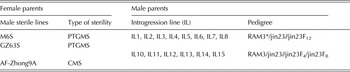
Fourteen ILs were derived from the crosses using an O. glaberrima accession RAM3, a native variety from West Africa in the Casama region of Senegal (Mali) as the donor parent and an O. sativa ssp. indica variety Jin23 as the recurrent parent. The accession RAM3 was chosen due to its genetics and breeding values such as a typical, genetically representative accession of O. glaberrima (Bimpong et al. Reference Bimpong, Chin, Ramos and Koh2011b ), drought tolerance ability (Bimpong et al. Reference Bimpong, Rachid, Joong, Evelyn, Jose and Merlyn2011a ) and a cytoplasm donor for cytoplasmic male sterility (CMS) (Huang et al. Reference Huang, Fu, Xie, He, Adedze and Jin2013). Jin23 was an elite parental line widely used for indica hybrid rice in China. The 14 ILs were selected from BC1 F 12 and BC2 F 8 progenies of the crosses between the two parents, respectively. These ILs were inter-crossed with three indica male sterile lines including one CMS line and two photo/thermo-sensitive genetic male sterile (P/TGMS) lines (Table 1) to produce 42 PIHs. The crosses were made at the Hainan Experimental Station of Huazhong Agricultural University (3°30′–20°10′ N, 108° 15′–120° 15′ E) in March 2010.
Female and male parents used in this study

P/TGMS, Photo/thermo-sensitive genetic male sterility; CMS, cytoplasmic male sterility.
* RAM3, an accession of African Rice from Mali.
Field trials and agronomic trait evaluation
All the hybrids and ILs were grown in Wuhan, Hzau, in the summer season of 2011. A randomized complete block design with three replications was used; each plot contained 36 plants in three rows with 15 × 20 cm spacing. The middle five plants of each row were sampled to evaluate agronomic traits. Twelve agro-morphological characters including yield components were evaluated. These traits consisted of days to flowering (DF), flag leaf length (FL), plant height (PH), tiller number per plant (TN), panicle length (PL), panicle number per plant (PN), spikelet number per panicle (SN), fertile grain number per panicle (FG), fertile grain percentage (FGP), thousand grain weight (TGW) and yield per plant (YP). Panicle, spikelet and fertile grain number per plant were evaluated as an average value of the total panicles, spikelets and fertile grains of the five representative plants randomly selected from each PIH population, respectively. Only full grains were counted as fertile grains.
Fertile grain percentage was calculated following this formula
 $${\rm FGP (}\% {\rm )} = ({\rm FG}/{\rm SN}) \times {\rm 1}00$$
where FG is fertile grain number and SN is spikelet number of five representative plants.
DNA Extraction
About 0·2 g of young leaves collected from 30-day-old seedlings were washed in sterilized water and ground in 1600 μl of cetyltrimethyl ammonium bromide (CTAB) buffer using a pestle and mortar. The mixture was transferred into Eppendorf tubes and incubated at 65° for 30 min. Further, 1300 μl of chloroform: isoamyl alcohol (24 : 1) was added to the DNA solution and the mixture was shaken for 30 min. The mixture was centrifuged at 8000 rpm for 8 min and c. 800 μl of supernatant was transferred into a new 1·5 ml tube. Subsequently, 1600 μl cooled alcohol (95%) was added to the supernatant and after mixing well, the DNA solution was incubated at –20 °C for DNA precipitation before being centrifuged at 12000 rpm for 10 min and the supernatant solution poured off. The DNA pellet was washed gently for about 1 min in 800 μl of alcohol (75%), and then dried at room temperature overnight. Finally, the pellet DNA was dissolved into 400–500 μl sterilized, deionized water for 1 day.
Simple sequence repeats primer design
A total of 124 simple sequence repeat (SSR) primers were used in the present study. Sixty out of the 124 markers, designed according to their position on the genetic map as described by Temnykh et al. (Reference Temnykh, Declerck, Lukashova, Lipovich, Cartinhou and Mccouch2001), have been reported to show polymorphism in a cross between O. glaberrima and O. sativa (Ndjiondjop et al. Reference Ndjiondjop, Semagn, Sie, Cissoko, Fatondji and Jones2008). The other 64 SSR markers were selected from the gramene website: http://www.gramene.org (accessed January 2015; McCouch et al. Reference McCouch, Declerck, Teytelman, Xu, Lobos, Walton, Fu, Maghirang, Li, Xing, Zhang, Kono, Yano, Schneider, Cartinhour, Ware and Stein2002).
Polymerase chain reaction conditions
Each polymerase chain reaction (PCR) micro-tube contained 25 μl of PCR reaction solution, which included 2 μl DNA, 2·5 μl PCR buffer [100 mM tris (pH 8·3), 500 mM potassium chloride (KCl), 15 mM magnesium chloride (MgCl2)], 2 μl deoxyribose nucleoside triphosphate, 2 μl primer pairs, 0·5 μl Taq polymerase and 16 μl double distilled water. The thermo-cycler profile for PCR amplification was programmed as follows: initial preheating 10 min at 94 °C; 30 cycles including denaturing 1 min at 94 °C; annealing 45 s at 55, 60 and 63 °C following the different primers used; extension of 1 min at 72 °C. Final extension was done at 72 °C for 10 min and 12 °C for 5 min. The PCR amplification products were resolved on 6% polyacrylamide gels and visualized by Silver Staining.
Polymorphism detection of simple sequence repeats markers
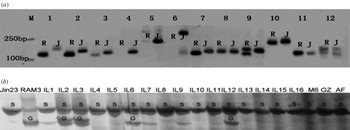
In order to detect the GD between two cultivated rice species (O. sativa and O. glaberrima), 124 pairs of SSR primers were selected to perform PCR analysis and 75 SSR markers showed polymorphism between the two initial parents RAM3 and Jin23 (Fig. 1a ). The number of polymorphic markers per chromosome varied from 1 on chromosome 12 to 19 on chromosome 1. There was an overall average of 6·25 polymorphic markers per chromosome. Comparison was made between the genetic band patterns derived from the two initial parents and the three indica female parents, leading to identification of 16 SSR markers that amplified specific alleles designated as O. glaberrima specific alleles.
Genetic band patterns amplified from African rice (RAM3), Asian rice (jin23), indica male sterile lines (M6S, GZ63S, AF-Zhong9A) and introgression lines (IL1–IL16). (a) Polymorphism analysis between the two initial parents of the ILs used, R = genetic band patterns of the African rice accession RAM3 and J = genetic band patterns of Asian rice Jin23. M = Marker, 1 = RM247, 2 = RM224, 3 = RM11, 4 = RM25, 5 = RM433, 6 = RM474, 7 = RM215, 8 = RM257, 9 = RM501, 10 = RM404, 11 = RM239, 12 = RM294. (b) Detection of O. glaberrima specific alleles in African rice accession RAM3 and 4 ILs carrying African rice genomic genes as revealed by simple sequence repeat (SSR) marker RM474. G = O. glaberrima specific alleles observed in initial parent RAM3 and ILs IL2, IL3, IL6, and IL12. S = O. sativa alleles found in initial parent Jin23, indica female lines M6S, GZ63S, AF-Zhong9A, and all the ILs used. Note that all the amplified genetic bands ranged between 250 and 100 bp.

Data analysis and simple sequence repeats marker scoring
Statistical analysis was carried out using Statistic 8·1 (StatSoft, USA) software. One- way analysis of variance (ANOVA) was done by F test with significance of mean squares. Duncan's test was performed to calculate p -values and make the comparison between the means of the different groups in the present study. Least significant difference at P < 0·05 and P < 0·01 was used to compare all means. The genetic dissimilarity analysis and Dendrogam construction was performed by SPSS software.
Heterobeltiosis (Hb) was evaluated following this formula
 $${\rm Hb(}\% {\rm )} = (F_{\rm 1} -{\rm MP})/{\rm MP} \times {\rm 1}00$$
where F 1 is the average performance of each of the crosses, and MP is the average performance of the male parent (the better parent for yield traits, because the female parent is male sterile).
The SSR marker was scored as follows: G = O. glaberrima specific allele, S = O. sativa allele, G + S = heterozygous allele between O. glaberrima and O. sativa, R = RAM3 parent allele, J = Jin23 parent allele, N = non-parental allele and n = null allele.
The proportion of O. glaberrima genome of the ILs (Gp) was calculated following this formula:
 $${\rm Gp} = G/N$$
where G = number of bands amplified by using O. glaberrima specific markers and N = total number of amplified bands. The proportion of O. glaberrima genome present ranged from 0·03 to 0·41: to study the impact of proportion of O. glaberrima genome in ILs and PIHs, the 14 ILs were divided into three groups for establishing minimum (<0·15), medium (0·15–0·30) and maximum (>0·30) introgression of O. glaberrima genes. The groups contained five, five and four ILs, respectively.
Genetic distance was calculated according to the Nei notations in (Nei Reference Nei1971, Reference Nei1972) following this formula:
 $$GD = 1/2\sum\limits_i {(Px,\,i - Py{\rm,} \,i)^2} $$
where Px is the frequency of the specific allele in the IL for marker i, and Py is the frequency of the specific allele in the female parent for marker i, i = number of markers used.
RESULTS
Agronomic traits and heterosis of the partial inter-specific hybrids
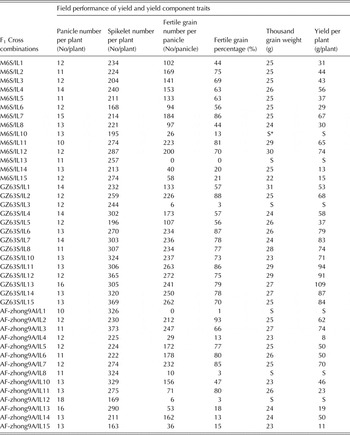
Sterility occurred in a few PIHs, which severely affected the performance of certain agronomic traits such as FG and FGP. Nevertheless, more than half of the PIHs were fertile or partially fertile. Among the 42 crosses, 23 hybrids had FGP of >60%. Eighteen PIHs including 11, 3 and 4 hybrids obtained using GZ63S, M6S and AF-Zhong9A as female parents, respectively, had FGP of >70%. Sixteen out of the 42 PIHs had yield/plant value above the overall mean (60 g/plant). Most PIHs had relatively good yield traits such as panicle number (⩾10 panicles/plant) and spikelet number (⩾150 spikelets/panicle) while the value of FGP in different PIHs varied greatly, ranging from 0 to 93% depending on cross-combinations (Table 2).
Field performance of yield and yield component of the hybrids

* S, data unavailable because of hybrid sterility.
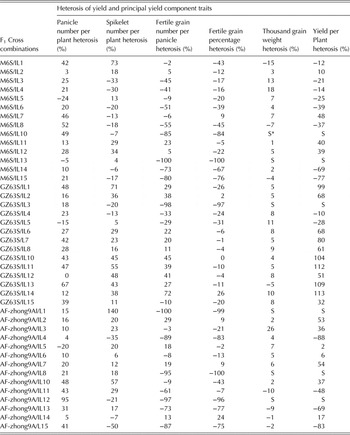
Some PIHs showed strong heterosis in agronomic traits. Twenty-two PIHs scored positive heterobeltiosis for yield/plant (up to 113%), including 11, 7 and 4 derived from female parents GZ63S, AF-Zhong9A and M6S, respectively. More crosses showed positive heterobeltiosis in yield component traits such as panicle number/plant (up to 95%), spikelet number/panicle (up to 140%) and TGW (up to 26%) (Table 3).
Heterobeltiosis of yield and yield component traits of the hybrids

* S, data unavailable because of hybrid sterility.
Variation of agronomic traits and source of variation
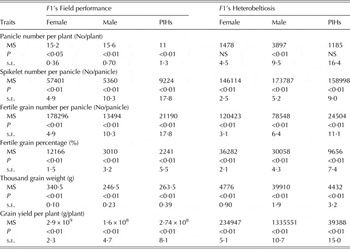
Significant variations (P ⩽ 0·01 and/or P ⩽ 0·05) were found in the field performance and heterobeltiosis of all the traits evaluated in the PIHs (Table 4). Notably, field performance of grain yield/plant, heterobeltiosis of spikelet number/panicle, fertile grain number/panicle and yield/plant showed large variations. Grain yield ranged from 8 g/plant (AF-Zhong9A/IL4) to 109 g/plant (GZ63S/IL12), while grain yield heterosis varied from –88% (AF-Zhong9A/IL4) to 113% (GZ63S/IL13) among the hybrids (Tables 2 and 3). The value of the completely and highly sterile (FGP < 15%) hybrids was discarded from the data analysis. Negative heterobeltiosis was scored for FGP, TGW and YP in some PIHs.
Mean square (MS) of sources of variation for field performance and heterobeltiosis of partial inter-specific hybrids (PIHs) F1

s.e., standard error; NS, not significant.
Significant differences (P ⩽ 0·01 and/ or P ⩽ 0·05) could be found in the source of variance analysis for the agronomic traits (Table 4). The variance of certain agronomic traits such as fertile grain number/panicle, yield/plant and spikelet number/panicle could be attributed more to the female parent. However, both parents contributed to variance of the other agronomic traits. Male parents constituted a particularly important source of variation for heterobeltiosis of panicle number/plant, spikelet number/panicle, TGW and yield/plant.
Oryza glaberrima-specific alleles detected in the introgression lines
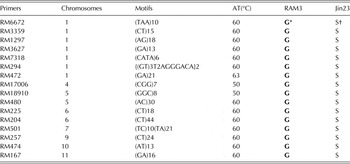
Sixteen SSR markers were found to amplify the O. glaberrima-specific allele from the 14 ILs. These SSR markers were designated as informative markers. Among the 16 SSR markers, seven were located on chromosome 1, two each on chromosomes 5 and 6, and one each on chromosomes 4, 7, 9, 10 and 11 (Table 5). For example, the SSR marker RM474 amplified a specific band which was present in O. glaberrima cultivar RAM3 and the ILs IL2, IL3, IL6 and IL12 but is absent in the O. sativa cultivar Jin23 and three indica female lines (Fig. 1b ). The introgression percentage of O. glaberrima genome fragment(s) in the ILs varied from 6·25% for markers RM3627, RM480, RM501 and RM167 to 100% for RM294.
Informative simple sequence repeat (SSR) markers with polymorphism between O. glaberrima and O. sativa

* G, O. glaberrima specific band patterns.
† S, O. sativa band patterns.
The 14 ILs have an average O. glaberrima genome proportion (Gp) of 0·22, which varied from 0·03 to 0·41% (Table 6). These ILs were classified into three groups according to the proportion of O. glaberrima genome they contained: Group I (<0·15), including IL5, IL6, IL7, IL11 and IL1; Group II (0·15–0·30), including IL2, IL3, IL12, IL13 and IL14; and Group III (>0·30), including IL1, IL4, IL8 and IL10 (Tables 7 and 8).
Correlations between O. glaberrima genome contents of introgression lines (ILs) and genetic distance (GD) between the parental lines of the crosses

IL, introgression line; Gp, O. glaberrima genome proportion Gp in ILs; GD, genetic distance.
* r, (Gp and GD), Correlation coefficients between Gp and GD.
Grain yield and yield components of the partial inter-specific hybrids (PIHs) of three groups of introgression lines (ILs) carrying different proportions of the O. glaberrima genome

s.e., standard error.
* ns, difference not significant at P < 0·05.
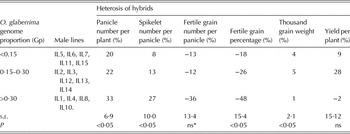
Heterosis of grain yield and yield components of the partial inter-specific hybrids(PIHs) of three groups of introgression lines (ILs) carrying different proportions of the O. glaberrima genome

s.e., standard error.
* ns, difference not significant at P < 0·05.
Genetic distance between different parental lines
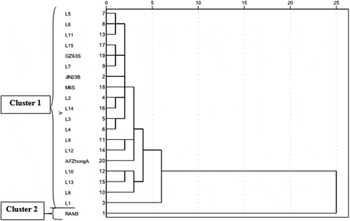
Seventy five polymorphic SSR markers were used in a cluster analysis to evaluate GD between parental lines. Genetic distance varied from 1·73% (GZ63S and IL5) to 4·24% (AF-Zhong9A and IL1) between the parental lines of different crosses. All the parental lines were ranked in Cluster 1 except for RAM3, which belonged to Cluster 2. A GD of 25% was identified between the clusters. As expected, Cluster 1 included all the ILs, male sterile lines and Jin23 belonging to O. sativa, while RAM3 in Cluster 2 belonged to O. glaberrima (Fig. 2).
Dendrogram constructed based on the genetic distance between the parental lines used. Introgression lines IL1-14; RAM3, O. glaberrima accession; and Jin23, M6S, GZ63S and AF-Zhong9A O. sativa varieties. Vertical annotation from 1 to 20 constitutes the numbers of the total plant materials used in the present study. Horizontal annotation from 5 to 25 constitutes the genetic dissimilarity between the plants materials used. Cluster1, ILs and O. sativa varieties; Cluster2, O. glaberrima accession RAM3.

Correlation between Oryza glaberrima genome proportion in the introgression lines and genetic distance of parental lines
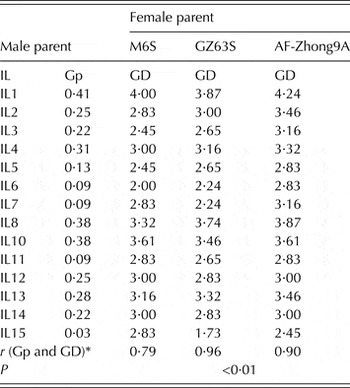
The proportion of O. glaberrima genome found in ILs varied from 0·03 (IL15) to 0·41 (IL1). The GD of parental lines ranged from 2·00% (M6S/IL6) to 4·00% (M6S/IL1) for the crosses derived from M6S and from 1·73% (GZ63S/IL15) to 3·87% (GZ63S/IL1) for the crosses derived from GZ63S. Furthermore, GD of the crosses derived from AF-Zhong9A were between 2·45% (AF-Zhong9A/IL15) and 4·24% (AF-Zhong9A/IL1). Significant positive coefficients (r = 0·79, P < 0·01, r = 0·96, P < 0·01 and r = 0·90, P < 0·01) were found between the proportion of O. glaberrima genome in ILs and the GD of parental lines in crosses between the ILs and three different female parents GZ63S, M6S and AF-zhong9A, respectively, (Table 6).
Proportion of Oryza glaberrima genome in introgression lines and its impact on the partial inter-specific hybrids
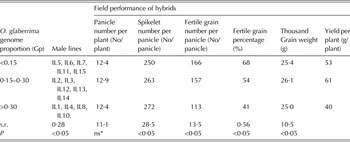
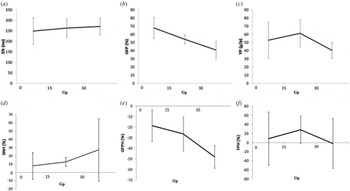
Significant differences (P < 0·05) in most yield traits, including yield/plant, were detected between the mean values of PIHs derived from three groups of ILs with different proportions of O. glaberrima genome (Table 7). A positive relationship was observed between spikelet number of the PIHs and the proportion of O. glaberrima genome in their parental ILs (Fig. 3a ). However, the average FGP of the hybrids was negatively proportional to the proportion of O. glaberrima genome in parental ILs (Fig. 3b ). Relatively higher average yield was obtained in the PIHs involving parental ILs with proportions of O. glaberrima genome between 0·15 and 0·30. However, the PIHs derived from ILs of either group with O. glaberrima genome content <0·15 or >0·30 produced relatively lower average grain yield (Fig. 3c ).
Variation tendency of field performance of spikelet number per panicle (SN), fertile grain (FGP), grain yield per plant (YP), and their related heterobeltiosis values SNH, GFPH and YPH, respectively, in partial inter-specific hybrids (PIHs) v. the O. glaberrima genome proportion of the ILs (Gp). (a) Variation of spikelet number with Gp. (b) Variation of fertile grain percentage (FGP) with Gp. (c) Variation of YP with Gp. (d) Variation of heterosis of spikelet number with Gp. (e) Variation of heterosis of FGP with Gp, and (f) Variation of heterosis of YP with Gp.

Similarly, significant difference (P < 0·05) in heterosis of yield traits such as panicle number/plant, spikelet number/panicle, FGP and TGW was detected between the mean values of PIHs derived from three groups of ILs containing different proportions of the O. glaberrima genome (Table 8). Spikelet number heterosis tended to be positively proportional to the O. glaberrima Gp (Fig. 3d ), indicating that the increase of O. glaberrima genes in ILs could enhance heterosis of spikelet number/panicle in the hybrids. However, heterosis of FGP was negatively proportional to the proportion of the O. glaberrima genome (Fig. 3e ), indicating that the increase of the O. glaberrima genes in ILs might cause sterility in the hybrids. As expected, the relatively higher average heterosis of yield/plant was also observed in the PIHs with O. glaberrima genome content between 0·15 and 0·30 (Fig. 3f ).
The long error bars in Fig. 3 indicate large variations of yield traits and their heterosis within the PIHs of ILs in the same group of O. glaberrima genome introgression. The PIHs resulting from the same IL but different female lines could have large differences in yield performance due to the genetic difference of female lines. Also, different ILs with similar proportions of O. glaberrima genome may contain different foreign genes. Nevertheless, the lines of average values could reveal the impact of the foreign genes on the average performance, heterosis of yield and yield traits of the PIHs involving different proportions of the O. glaberrima genome.
Promising introgression lines and high-yielding heterotic partial inter-specific hybrids
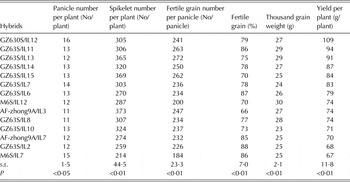
While the grain yield of 14 ILs ranged from 10 to 67 g/plant, the 14 higher-yielding PIHs were found to produce 67 g/plant (M6S/IL7)–109 g/plant (GZ63S/IL12), indicating grain yield heterosis expression in these hybrids (Table 9). All five ILs (IL2, 3, 12, 13 and 14) belonging to group II with 0·15–0·30 of the genome from O. glaberrima produced the PIHs with higher grain yields, including the highest of all. However, four ILs (IL6, 7, 11 and 15) out of the five ILs of group I (<0·15 O. glaberrima genome) and two ILs (IL8 and 10) out of the four ILs of group III (>0·30 O. glaberrima genome) also produced some higher-yielding PIHs.
Partial inter-specific hybrids (PIHs) with relatively higher grain yield and yield components

s.e., standard error.
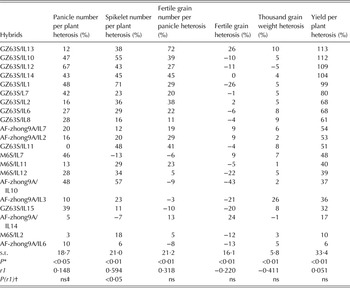
Twenty-one hybrids with positive yield per plant heterosis ranging from 6% (AF-zhong9A/IL6) to 113% (GZ63S/IL13) were selected as heterotic PIHs (Table 10). Significant correlations were found between O. glaberrima Gp and heterosis of spikelet number/panicle of these heterotic PIHs (r = 0·59, P < 0·05). The five ILs (IL2, 3, 12, 13 and 14) of group II produced nine heterotic PIHs, including the highest one, while four ILs (IL6, 7, 11 and 15) from group I and three ILs (IL1, 8 and 10) from group III produced eight and four heterotic PIHs, respectively.
Heterotic partial inter-specific hybrids (PIHs) with higher heterobeltiosis of grain yield per plant

* P, significant difference for the yield and yield components of the heterotic PIHs.
† P(r1), probabilities level of correlation coefficients between O. glaberrima genome proportion Gp in the introgression lines (ILs) and yield components traits of the heterotic PIHs.
‡ ns, difference not significant at P < 0·05.
DISCUSSION
Hybrid sterility is a major obstacle for exploiting distant heterosis in rice
The reproductive barrier constitutes a bottleneck for exploiting heterosis in distant crosses between different species and sub-species in rice. Sterility gene S5 (Ikehashi & Araki Reference Ikehashi and Araki1986), S24 and S35 have been identified as causing inter-sub-specific hybrid sterility between indica and japonica rice (Qiu et al. Reference Qiu, Liu, Jiang, Song, Xu, Li and Zhang2005). The existence of more sterility genes explained why the wide compatibility S5 n gene could not completely overcome the reproductive barrier between the two sub-species of rice. Rice breeders in China have used a more effective method to overcome the reproductive barrier by producing partial inter-sub-specific hybrids. For example, a super indica high-yielding hybrid Xieyou 9308 carried 0·13 of the japonica genome that came from its male parent R9308 (Cheng et al. Reference Cheng, Li, Jie, Shen, Xiao, Ye, De and Shao2007). Newly released inter-sub-specific hybrids such as Yongyou6 and Yongyou12 derived from japonica CMS lines and restorer lines carrying up to 0·49 of indica genes further increased their yield potential (Liu Reference Liu2012; Lu et al. Reference Lu, Ma, Wang, Li, Zhou, Zhang and Hua2007). Testing crosses were also made between indica cultivars and CSSL carrying japonica genes in the genetic background of indica for improving hybrid rice (Wang et al. Reference Wang, Yu, Liu, Liu, Yin, Liu, Lei, Jiang, Yang, Chen, Zhai and Wan2012). So far, the most successful inter-sub-species hybrid cultivars developed in China are partial inter-sub-specific hybrids rather than 0·50 indica/0·50 japonica inter-sub-specific hybrids containing wide compatibility genes.
Inter-specific crossing between the two cultivated rice species O. sativa and O. glaberrima is difficult and inter-specific F1 hybrids are almost completely sterile. The major genes responsible for the hybrid sterility between the two species have been detected in O. glaberrima, such as S1 (Heuer & Miezan Reference Heuer and Miezan2003; Koide et al. Reference Koide, Onishi, Nishimoto, Baruah, Kanazawa and Sano2008), S29 (Hu et al. Reference Hu, Xu, Deng, Zhou, Li and Tao2006) and S36 (t) (Li et al. Reference Li, Liu, Morinaga and Zhao2011). The sterility problem between O. sativa and O. glaberrima was caused mainly by an arrest of pollen development at the microspore stage (Bimpong et al. Reference Bimpong, Chin, Ramos and Koh2011b ). However, S1 could induce abortion of both male and female gametes possessing its allelic alternative (Koide et al. Reference Koide, Onishi, Nishimoto, Baruah, Kanazawa and Sano2008). Heterozygote loci which might cause sterility problem have been a major concern for the exploitation of inter-specific hybrid heterosis between O. sativa and O. glaberrima (Moehring Reference Moehring2011). So far no wide compatibility gene has been reported to overcome the inter-specific reproductive isolation. Fortunately, Nerica varieties derived from the inter-specific crosses between the two cultivated rice species via embryo rescue and another culture techniques proved the possibility of producing fertile inbred lines carrying O. glaberrima genes in the genetic background of O. sativa (WARDA 2006).
In the present study, distant crosses and backcrosses followed by pedigree selection were performed to develop fertile ILs carrying different fragments of O. glaberrima genes. These ILs were then test-crossed with indica male sterile lines to produce PIHs. Though the ILs carried major or minor sterility genes resulting in sterile or partially sterile PIHs, respectively, fertile PIHs could be derived from the ILs without sterile genes. Therefore, selection of ILs devoid of interspecies sterility genes would be essential to produce fertile heterotic PIHs.
Genomic composition of introgression lines and yield heterosis of partial inter-specific hybrids
Recently, heterosis in yield traits including spikelet number and grain weight were reported in fertile PIHs between indica male sterile lines and ILs carrying O. glaberrima genes (Adedze et al. Reference Adedze, Efisue, Zhang, Samoura, Huang, He, Xie and Jin2012). The present paper provides more information regarding the yield heterosis of PIHs in relation to the genomic composition of parental ILs. Sixteen informative markers might contribute to the evaluation of genomic divergence between O. sativa and O. glaberrima. The loci adjacent to these markers may be related to the hybrid sterility and heterosis of PIHs. Similarly, Bimpong et al. (Reference Bimpong, Chin, Ramos and Koh2011b ) studied 29 O. glaberrima accessions and 12 O. sativa varieties and found only ten reference markers which contribute to the genetic diversification between O. sativa and O. glaberrima. More informative markers are desired to evaluate more accurately the O. glaberrima Gp in the ILs.
It is a general belief that the genetic diversity of a species can be broadened by introducing foreign genes from distant germplasm. A correlation was established between GD and proportion of O. glaberrima content as a preliminary test for this hypothesis. Significant positive correlations obtained between the GD and proportion of O. glaberrima genome displays the feasibility of increasing the GD of the rice parental lines via introgression of O. glaberrima genome fragments into O. sativa.
Previous research has indicated that the strongest heterosis might result from parents with an intermediate GD (Luo et al. Reference Luo, Mei, Yu, Wang, Zhong, Ying, Li and Paterson1999; Krishnamurthy et al. Reference Krishnamurthy, Mohan, Madhavi, Ramesh, Hittalmani and Rao2013). The present study showed that ILs whose genome comprised 0·15–0·30 material from O. glaberrima produced fertile PIHs with high average heterosis of yield/plant, while the PIHs derived from ILs with genomes comprising <0·15 of O. glaberrima genome had lower heterosis of grain yield due to the relatively narrow GD between parents. On the other hand, the PIHs derived from ILs with >0·30 of O. glaberrima genome also exhibited limited grain yield heterosis because of hybrid sterility. Therefore, the highest-yielding PIHs were produced by parents with an intermediate genetic distance.
The introgression of O. glaberrima genes could broaden the genetic diversity of parental lines and facilitate inter-specific heterosis expression in the yield of hybrids. However, the O. glaberrima accession may contain inter-specific sterility genes and other inferior genes. The probability of incorporating sterility genes and/or inferior genes in ILs may increase as higher proportions of the O. glaberrima genome are incorporated. A medium proportion of the O. glaberrima genome in ILs is essential to optimize the effects of favourable genes and minimize those of unfavourable ones in the PIHs. A similar relationship between the parental divergence and hybrid heterosis was reported in chilli (Capsicum annuum) (Krishnamurthy et al. Reference Krishnamurthy, Mohan, Madhavi, Ramesh, Hittalmani and Rao2013).
It was found in the present study that different ILs with similar proportions of the genome coming from O. glaberrima produced PIHs with large differences in heterosis and sterility. The different phenotypes of the hybrids indicated that these ILs might contain different foreign genes. However, the nature of the foreign genes was not studied. Besides, only one accession, RAM3, was used as a genetically representative accession of O. glaberrima in the present study. Subsequent study could be focused on the identification of inter-specific heterotic QTL loci and both superior genes and inferior genes including sterility genes in more O. glaberrima accessions. Marker-assisted selection may greatly improve the efficiency of optimizing the genome composition of ILs and PIHs.
CONCLUSION
The development of ILs and PIHs is reported as a promising approach to mitigate the reproductive barrier and exploit inter-specific heterosis between O. glaberrima and O. sativa, which is of great value in heterotic hybrid rice breeding. ILs carrying 0·15–0·30 O. glaberrima genes were indicated as an appropriate genome composition. A moderate introgression of O. glaberrima genes into ILs was considered to be favourable for producing high-yielding PIHs. Further improvement of the genomic composition of ILs and the yield performance of the PIHs could be achieved via marker assisted selection for pyramiding heterotic QTL loci and eliminating sterility genes.
This study was funded by the Natural Science Foundation of China (NSFC: 30871703), the National High Technology Research and Development Programme (863 Programme) of China (grant no. 2012AA101101), the Natural Science Foundation of Hubei province (grant no. 2010CBB01901) and the Fundamental Research Funds for the Central Universities (grant no. 2009PY025).