

GRIME’S GRAVES
The Grime’s Graves flint mines lie in Weeting-with-Broomhill parish, Norfolk, England (52° 28′ 50″ N, 0° 40′ 25″ E, NGR TL 81758 89781; Fig. 1). They were among the first flint mines to be excavated in Britain, Canon Greenwell being a notable protagonist. The history of the site’s antiquarian recognition and subsequent investigation in the 19th and 20th centuries is summarised by Mercer (Reference Mercer1981, 1–7); Barber et al. (Reference Barber, Field and Topping1999, 4–16); and Longworth et al. (Reference Longworth, Varndell and Lech2012, 13–15). It is bound up with that of the Prehistoric Society, whose parent body, the Prehistoric Society of East Anglia, undertook significant excavations in 1914 (Clarke Reference Clarke1915). The inter-war period saw continued excavations, mainly by A.L. (Leslie) Armstrong, published in the Proceedings of the Prehistoric Society of East Anglia (eg, Armstrong Reference Armstrong1923; Reference Armstrong1924; Reference Armstrong1927). Work resumed in the 1970s, when a deep shaft and its surrounding surface area were excavated by Roger Mercer (Reference Mercer1981) for the Department of the Environment in 1971–72; and a major research project led by Ian Longworth and Gale Sieveking for the British Museum was conducted in 1972–76, its interim results being published in this journal (Sieveking et al. Reference Sieveking, de, Longworth, Hughes, Clark and Millet1973).
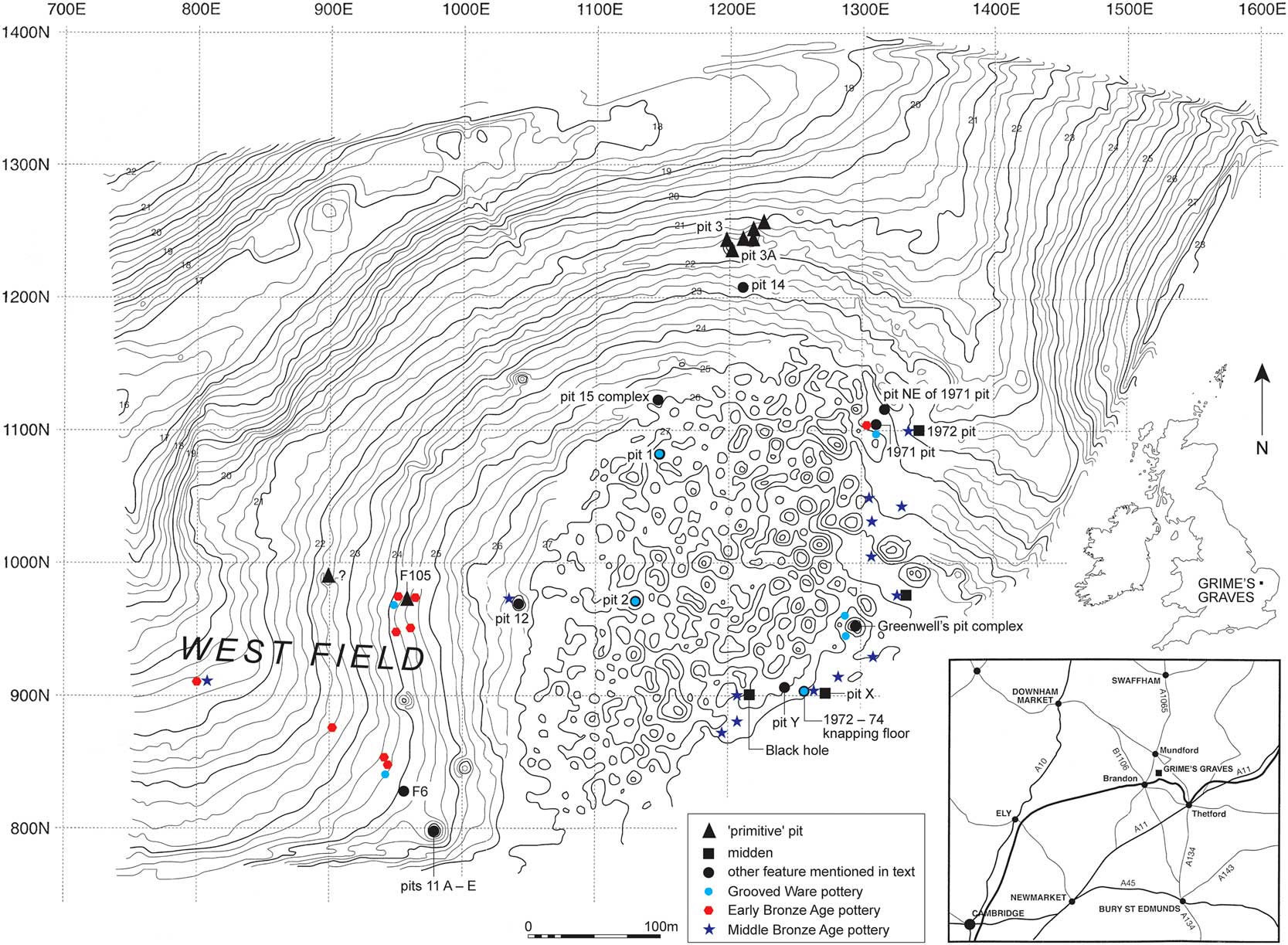
Plan of Grime’s Graves showing features mentioned in the text, ‘primitive’ pits, middens, & the distribution of major pottery styles. Based on Longworth et al. (Reference Longworth, Varndell and Lech2012, fig. 1). © Trustees of the British Museum

Views of the site’s chronology varied with the intellectual climate of the times. Canon Greenwell (Reference Greenwell1870) straightforwardly saw the shaft which he had excavated as a Neolithic flint mine. By the early 20th century there was a groundswell of opinion to the effect that flint mines at Grime’s Graves and elsewhere were Palaeolithic rather than Neolithic, a view voiced forcefully by Reginald Smith (Reference Smith1912), based on the similarity of the primary, ‘industrial’ stages of flint working at the site to some aspects of Palaeolithic industries. This gathered force, notwithstanding the presence in the already excavated flint mines of the remains of Holocene domesticates, pottery (in Sussex) and a ground stone axehead (in Canon Greenwell’s pit at Grime’s Graves). Smith (Reference Smith1915) maintained this view in his report on the struck flint from the Prehistoric Society of East Anglia’s excavations at Grime’s Graves. In the inter-war period, Armstrong developed a sequence in which mining started in Mousterian times and continued into the Neolithic, finishing before a Bronze Age occupation took place. At the start of this scenario were ‘primitive’ pits: ‘These pits, and the tools used in sinking them are of a type not previously recorded and undoubtedly mark an early phase in the evolution of mining ... The waste material of both the chipping floors and the pits is rougher and differs in general facies from the familiar Grime’s Graves waste’ (Armstrong Reference Armstrong1927, 101–3). It was not until the 1930s that Grahame Clark and Stuart Piggott (Reference Clark and Piggott1933), founder members of the Prehistoric Society, reviewed the dating evidence (artefactual, faunal, and stratigraphic) from the British flint mines, concluding ‘... in our view all the evidence points to a Neolithic date for the main flint-mining activity in Britain, no earlier phase having been satisfactorily demonstrated. Its inception seems indeed to be linked with the Windmill Hill culture’ (ibid., 182).
Topography and geology
Unlike most of the known English flint mines, which lie on the Chalk downland of Sussex and Hampshire (Barber et al. Reference Barber, Field and Topping1999, fig. 1.1), Grime’s Graves occupies part of the Breckland, a distinctive area of south-west Norfolk and north-west Suffolk, where, while the Chalk lies close to the surface, the gently rolling topography is unlike that of the southern Chalk because of the area’s geomorphological history. During the Pleistocene, while the southern English Chalk underwent periglacial, rather than glacial, modification, the East Anglian Chalk was planed-off, at least by the Anglian (OIS 12) ice sheet, if not also by later ones. By the end of the Pleistocene, the East Anglian Chalk, where it was still close to the surface, was covered by diverse sands, gravels, and tills – mainly sands in the Breckland. Ice-sheets stopped short of the region during the cold episodes of the last glaciation (OIS 4 and 2); it may have been at this time that cryoturbation mixed the top of the chalk and the lower part of the sands, forming a chalk-sand deposit which remains below the overlying sand and topsoil. Periglacial activity also gave rise to stripes and other forms of patterned ground.
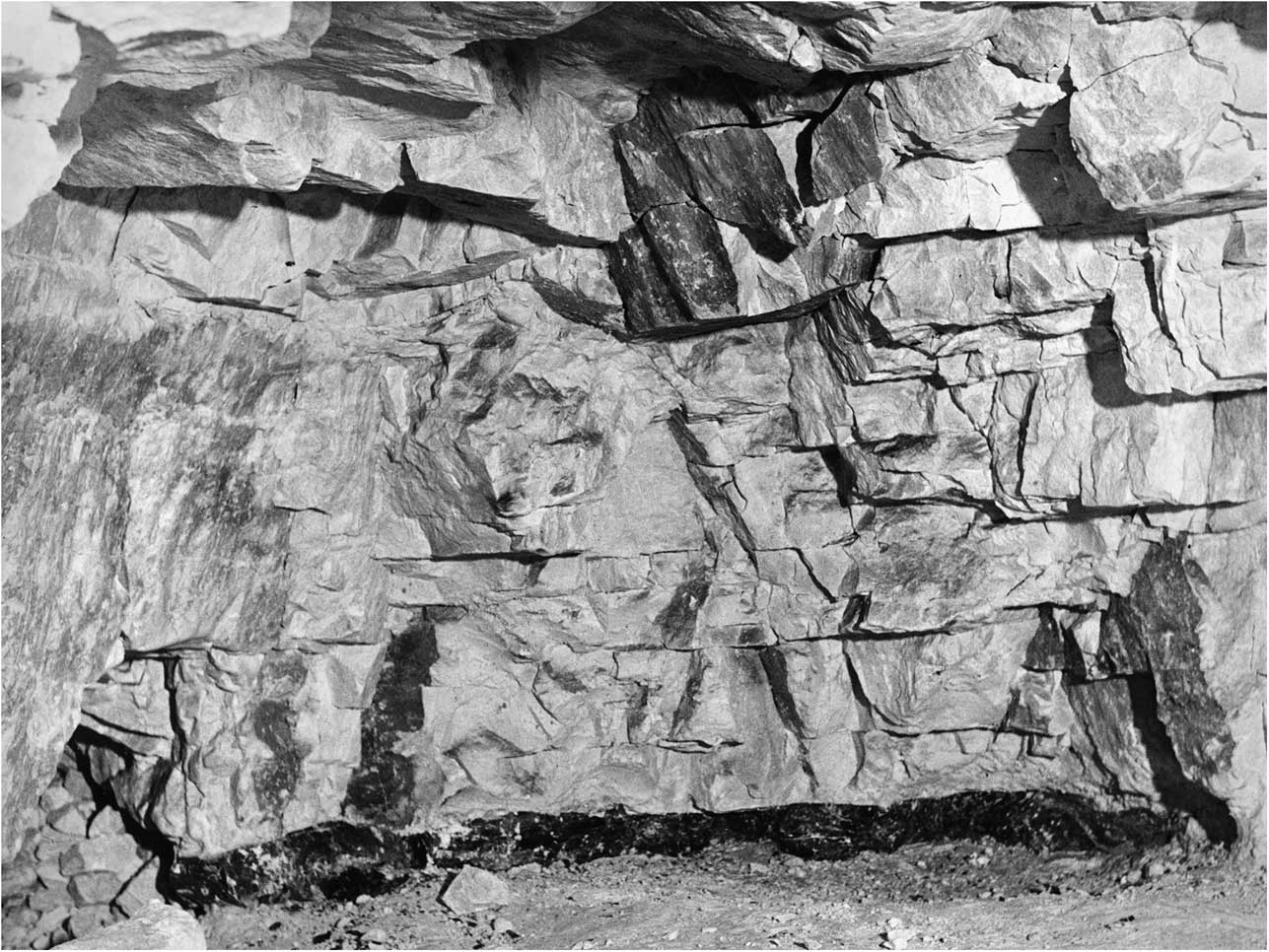
The Chalks exposed in this part of East Anglia are of the Turonian stage. Within this, the Brandon Flint Series, quarried at Grime’s Graves, comprises up to 15 m of relatively massively bedded Chalks with marl seams and widely separated courses of giant (0.2 to over 0.4 m) tabular and nodular flints (Mortimore & Wood Reference Mortimore and Wood1986; Bristow Reference Bristow1990, 16–29). The flint mined at Grime’s Graves in prehistory occurs in three main seams, commonly known by the names given them by the recent gunflint miners of Brandon, Suffolk, which lies 5 km to the south-west. They are effectively described by Saville (Reference Saville1981, 1–2): the topstone, close to the surface of the Chalk, ranges from small pebbles to large nodules, often with convoluted extremities, with a thin grey cortex; the floorstone, which was favoured by the Late Neolithic miners, is semi-tabular, occurring in large, smooth nodules with flat surfaces and convex undersides, covered with a thick, creamy cortex (Fig. 2). The wallstone, stratified between these two, has some of the characteristics of both. Where cortex and nodule form no longer survive, the black flint from all three seams is difficult to distinguish. Flint also occurs in the Chalk between the seams and, in derived form, in superficial deposits.
Floorstone in situ in pit 1. Photo: Hallam Ashley © Historic England Archive

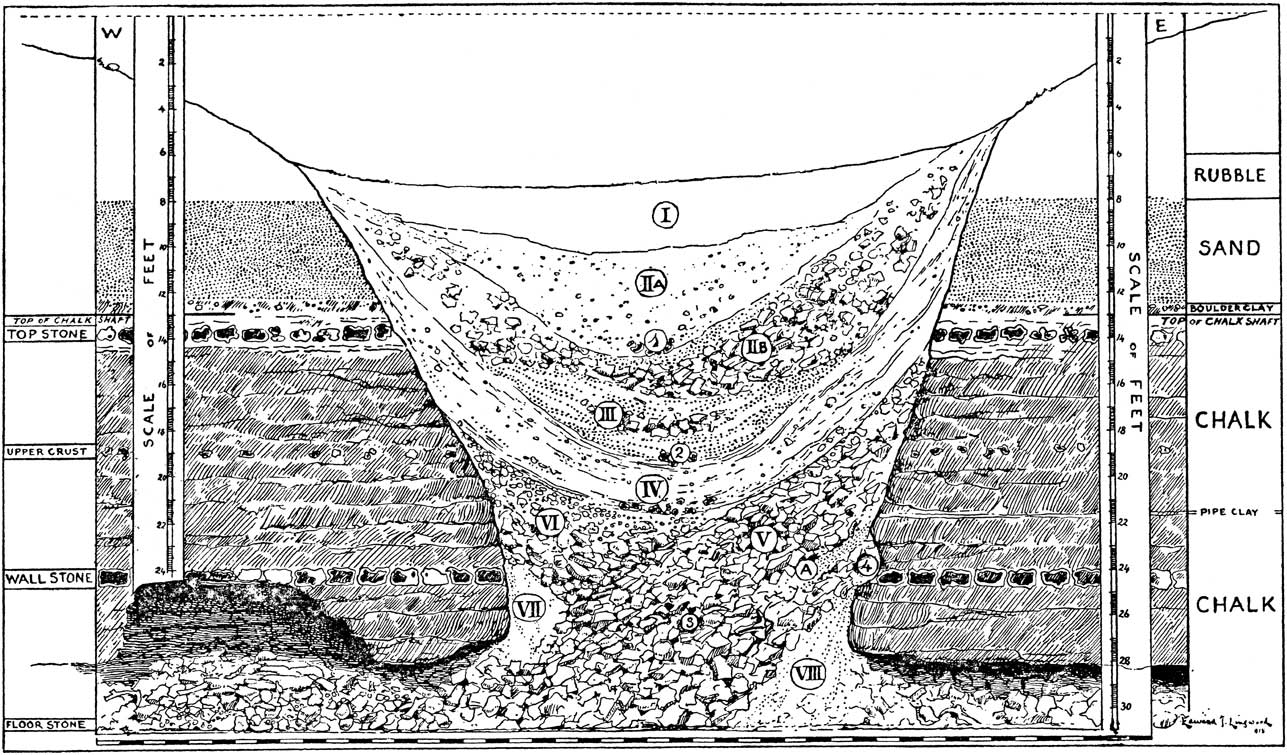
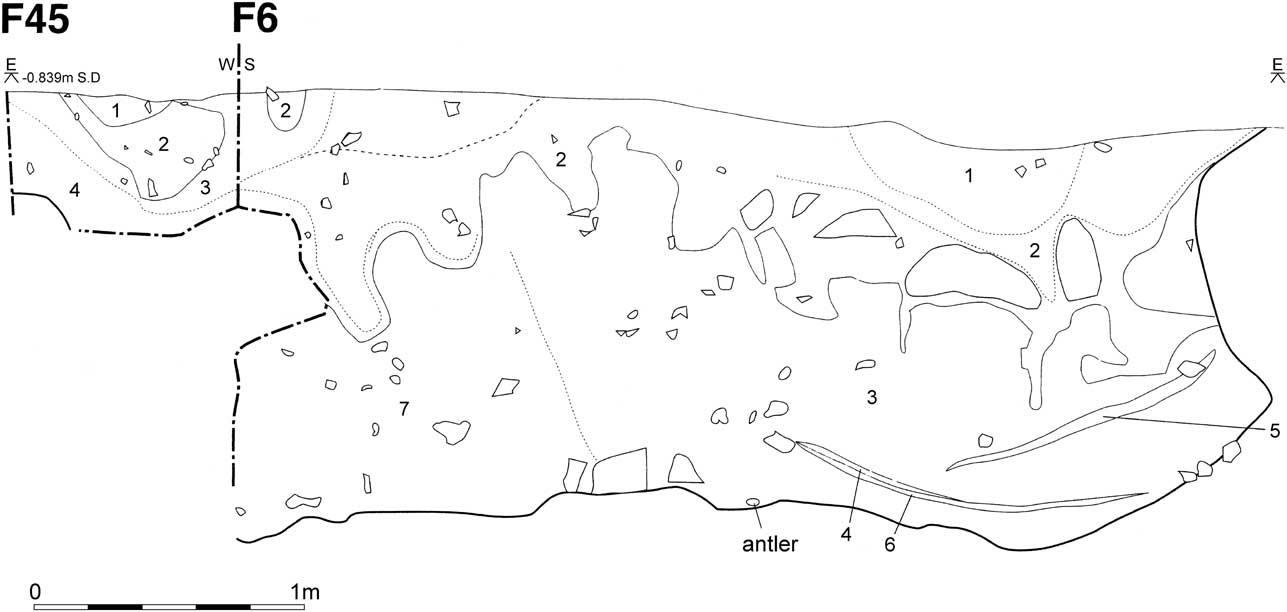
At the end of a century of excavation, the broad lineaments of the complex could be defined as follows. The highest part of the site forms a slight ovoid spur rising to 29 m OD (Fig. 1). Here, below the zone of cryoturbated sand and chalk, the Chalk and its seams of flint are undisturbed. This is the area of deep, systematically worked mine shafts sunk through the higher flint seams to the level of the floorstone, which was exploited by means of radiating tunnel-like galleries (Fig. 3). Since the Chalk strata locally gently shelve downward from north-west to south-east, the flint seams are deepest in the eastern part of the spur, where shafts can be up to 12 m deep, and shallowest in the west, where they can be as little as 5 m deep. To the north and west of this spur, on lower ground, the flint seams and the upper part of the Chalk are closer to the surface and underwent considerable disruption during the Pleistocene, leading to multifarious mixing and rafting of superficial deposits. These were areas of simpler, unstandardised quarrying in relatively shallow pits between 1.5 m and 4 m deep, most of them around 2 m (Fig. 4). The most fully investigated of these areas is known as the West Field (Fig. 1). Armstrong’s ‘primitive’ pits (1923; 1924) constitute a separate, distinctive class of features among other less standardised ones in these lower-lying areas. They are not more than 4 m deep, characterised by the use of bone rather than antler picks; by undercuts at the base where they were sunk to the floorstone; and by additional undercuts about half way down, made to extract flint from the glacially contorted deposits that overlay the solid chalk (Fig. 5). Rich, midden-like deposits of Middle Bronze occupation material around the east and south-east of the spur (Fig. 6) were first identified in 1914.
A shaft with galleries radiating from the base at the level of the floorstone: E.T. Lingwood’s published section of pit 2 (Peake Reference Peake1915, fig. 7)

A simple pit on the West Field (F6 in cutting 950/820; Longworth et al. Reference Longworth, Varndell and Lech2012, fig. 33) © Trustees of the British Museum

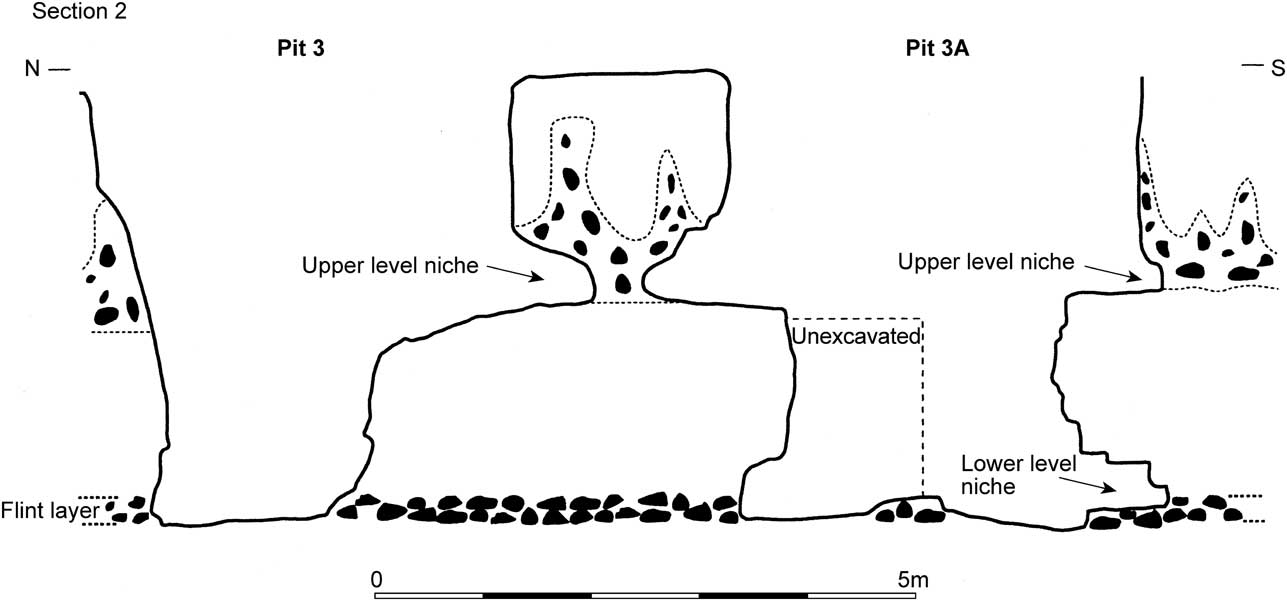
Profiles of ‘primitive’ pits 3 and 3A, showing two tiers of niches, the first bottoming on the surface of the in situ chalk, the second at floorstone level (Longworth & Varndell Reference Longworth and Varndell1996, fig. 32 (part)) © Trustees of the British Museum

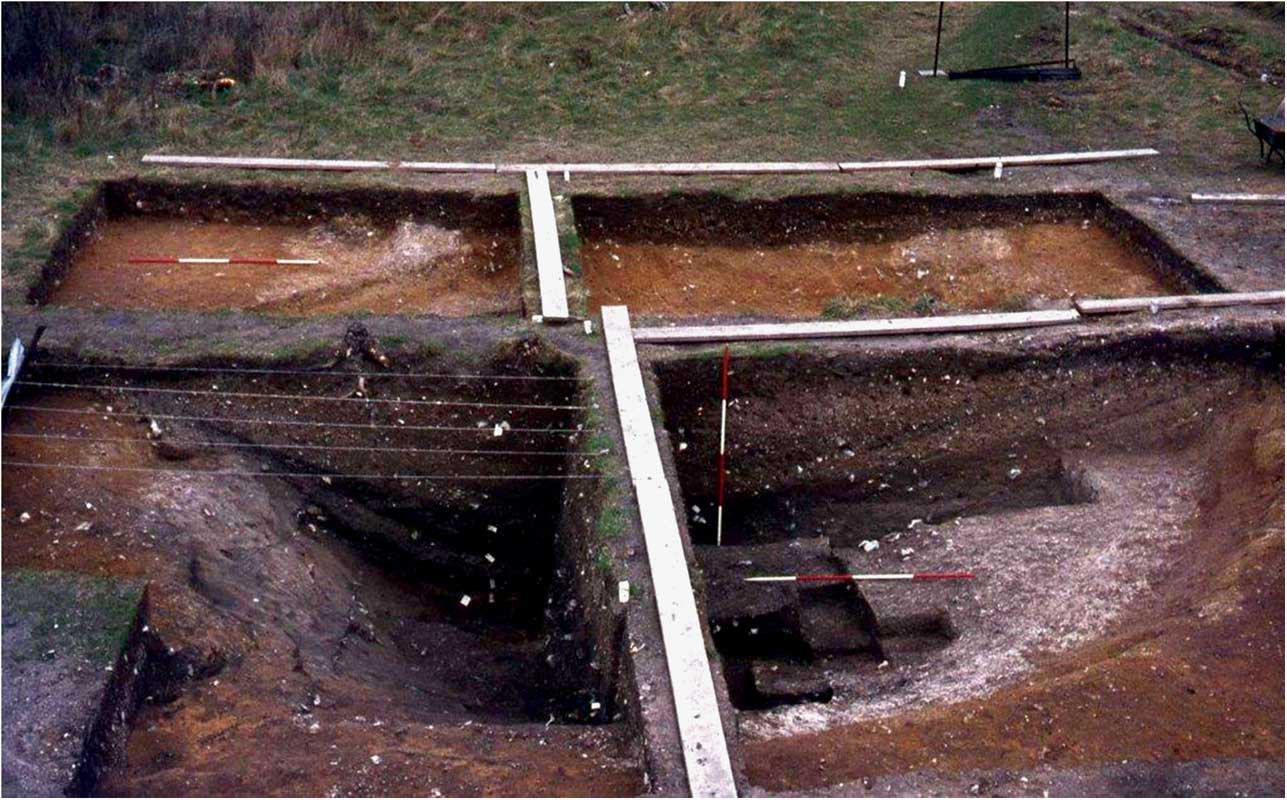
The top of the 1972 pit, showing intercalated dark midden deposits & soil layers © Roger Mercer

The deeper mines and their related knapping floors preferentially exploited the floorstone; in the shallower workings, flint of variable character and quality was extracted and worked more indiscriminately, from both in situ and derived deposits (Lech Reference Lech2012). The mining-period industries were generalised, multiproduct ones, producing axeheads, discoidal knives, oblique arrowheads, scrapers, and other small flake tools; flint was also removed from the site at earlier stages of the reduction sequence (Saville Reference Saville1981; Lech Reference Lech2012). Trace element analysis has correspondingly assigned flakes, scrapers, bifaces, and other forms from the surrounding area to Grime’s Graves (Craddock et al. Reference Craddock, Cowell and Hughes2012). The expedient Middle Bronze Age industries were made on flint scavenged from pre-existing spoil heaps (Saville Reference Saville1981; Herne Reference Herne1991).
The extent of the mined and quarried area remains unclear. The visible earthworks cover 7.6 ha and consist of 433 pits. Previous excavations have shown that flint was also extracted to the north and west of these, a picture enhanced by geophysical surveys which indicate further pits to the north and west of the visible examples (Favard & Dabas Reference Favard and Dabas2007; Linford et al. Reference Linford, Martin and Holmes2009). Some 200–400 m to the south-west of the area shown in Figure 1, test pitting following tree-felling has revealed probable quarry pits and dense areas of primary knapping debris, suggesting that the kind of extraction and flint working practised on the West Field may have extended this far (Bishop Reference Bishop2012, 223–9).
Previous radiocarbon dating
In the 1960s a small number of antler implements from Grime’s Graves and other flint mines was radiocarbon dated by the British Museum Research Laboratory. Within its limitations, the exercise indicated that, while the Sussex sites may have had their origins as early as the turn of the 5th and 4th millennia cal bc, Grime’s Graves showed no sign of activity before the turn of the 4th and 3rd millennia (Barker & Mackey Reference Barker and Mackey1961; Reference Barker and Mackey1963; Barker et al. Reference Barker, Burleigh and Meeks1969). The two projects undertaken in the 1970s both generated more numerous radiocarbon measurements, made intermittently over the following decades, and extended the coverage beyond the deep mines. These were collected and reviewed by the late Janet Ambers, of the British Museum’s Department of Conservation and Scientific Research, who spelt out the problems of working with them, stemming from questions of the identification, suitability, and contexts of the samples, and of the accuracy and precision of the measurements (Ambers Reference Ambers1996, 100; 1998, 591; 2012, 158). She began to redress these deficiencies by undertaking a selective programme of dating 13 further samples, using only those of high intrinsic and contextual integrity, modern measurement techniques, and high standard of quality control, and applying Bayesian analysis to the results (Ambers Reference Ambers1998; Reference Ambers2012).
By the end of the 20th century, there were 145 radiocarbon measurements from the site. Janet Ambers had shown that it was possible to achieve a high level of accuracy and precision. The overall picture, however, remained much as it was when sketched by Burleigh and colleauges (Burleigh et al. Reference Burleigh, Hewson, Meeks, Sieveking and Longworth1979): mining and quarrying began in the mid-3rd millennium cal bc; the galleried shafts went out of use by the end of the third quarter of that millennium; shallower quarries elsewhere on the site continuing into the early 2nd millennium; and there may have been some intermittent activity on the site between this and the later 2nd millennium Middle Bronze Age occupation.
THE 2008–2014 DATING PROGRAMME
The project
Renewed interest in Grime’s Graves, and in the English flint mines in general, grew from a national programme of research into flint mines in England by the former Royal Commission on the Historical Monuments of England (Barber et al. Reference Barber, Field and Topping1999). This led to plans by English Heritage to understand the site more fully and present it more effectively. The increasingly frequent and successful application of Bayesian statistical analysis to series of radiocarbon dates on stringently selected samples (Bayliss Reference Bayliss2009) offered a means of better defining the chronology of the site, and AMS (Accelerator Mass Spectrometry) provided the means of dating smaller samples of a wider range of specimens than had been feasible during the British Museum’s dating programme. This gave rise to a dating programme, funded by English Heritage (now Historic England), the main aims of which included the clarification of the overall timespan of flint mining at the site; of any differences in periods of use between the deeper and shallower workings; of the period of use of the almost undated northern area; and of the relation of the mining and quarrying to the contemporary society.
This dating programme was based on existing collections and records, without further fieldwork. One hundred and sixty-two further radiocarbon measurements were obtained in the course of this project, extending the coverage to new features and areas and checking measurements from already-dated contexts. Methods and results, including the structures of the models employed, as well as individual measurements and sample descriptions, are published in detail in an English Heritage Research Report (Healy et al. Reference Healy, Marshall, Bayliss, Cook, Bronk Ramsey, van der Plicht and Dunbar2014). Calibration and Bayesian chronological modelling of radiocarbon dates were undertaken using the program OxCal v4.2 (Bronk Ramsey Reference Bronk Ramsey2009; Bronk Ramsey et al. Reference Bronk Ramsey, Dee, Lee, Nakagawa and Staff2010; Bronk Ramsey & Lee Reference Bronk Ramsey and Lee2013) and the internationally agreed calibration curve for terrestrial samples from the northern hemisphere (IntCal13; Reimer et al. Reference Reimer, Bard, Bayliss, Beck, Blackwell, Bronk Ramsey, Buck, Cheng, Edwards, Friedrich, Grootes, Guilderson, Haflidason, Hajdas, Hatté, Heaton, Hoffmann, Hogg, Hughen, Kaiser, Kromer, Manning, Niu, Reimer, Richards, Scott, Southon, Staff, Turney and van der Plicht2013). The underlying principles and details of the modelling method are fully explained elsewhere (eg, Bayliss Reference Bayliss2009; Bronk Ramsey Reference Bronk Ramsey2009; Buck & Juarez Reference Buck and Juarez2017).
Pre-existing dates were rigorously assessed to determine how they should be included in the models or whether they should be included at all. It emerged that some measurements on bulk charcoal samples made in the 1970s are more recent than results for antler or for subsequently measured charcoal samples from the same contexts, possibly due to the incomplete removal of humic acid during pre-treatment (Healy et al. Reference Healy, Marshall, Bayliss, Cook, Bronk Ramsey, van der Plicht and Dunbar2014, 10–11). All these bulk charcoal dates are therefore excluded from the models. This does not apply to charcoal samples dated in the 1980s and subsequently. Antler and bone samples dated at this time could also have suffered incomplete humic acid removal. This seems, however, less probable because, of 11 antler samples dated both in the 1970s and subsequently, ten yielded results statistically consistent with the original measurements (Healy et al. Reference Healy, Marshall, Bayliss, Cook, Bronk Ramsey, van der Plicht and Dunbar2014, table 3). Samples newly selected for dating were predominantly antler or, less frequently, bone mining tools which would have been used in the extraction process and which were abundant, especially in the galleried shafts. Antlers, in particular, are ideal samples in that each is 1 year’s growth, since they are shed annually by red deer stags (now in late February/early March – Legge Reference Legge1981, 100). The large numbers recovered indicate that they were rapidly exhausted and discarded. It is furthermore probable that fresh, springy, resilient antlers would be preferred for digging. Thus, provided that an antler implement was recovered from where it was originally discarded by its user, it should be very close in age to its context. This superficially straightforward choice was sometimes problematic, in that apparently well-stratified antler picks may not always have been contemporary with their contexts. Chalk rubble dislodged when cutting the galleries at the base of the deep mines was generally managed by moving spoil from a gallery currently being excavated into an empty, exhausted one, rather than by the far more laborious process of transporting it to the surface (Longworth & Varndell Reference Longworth and Varndell1996, fig. 6). Picks discarded during the cutting of a later gallery could thus be incorporated into the rubble filling an earlier one. An additional complication was introduced by the common occurrence of new galleries cutting into those driven from previously excavated pits, already containing rubble and picks that might be displaced into new contexts. Furthermore, since exhausted pits were often deliberately backfilled and the spoil heaps surrounding adjacent pits on the surface were often contiguous or overlapping, there is the possibility that spoil and picks from an older pit could be backfilled into a later one. The most reliable antler samples were thus those found on the bases of pits or galleries, preferably grouped together as if deliberately placed.
Results
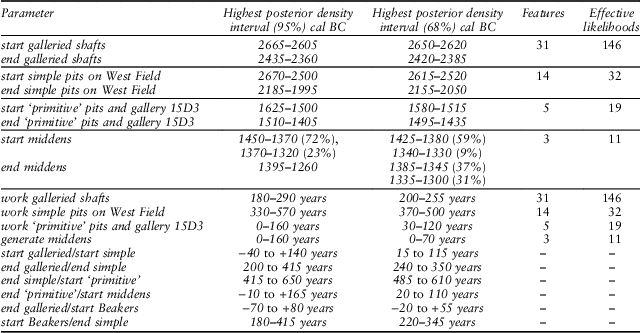
The results summarised here (Figs 7, 9, 10, Table 1) are from the preferred model for the galleried shafts (Healy et al. Reference Healy, Marshall, Bayliss, Cook, Bronk Ramsey, van der Plicht and Dunbar2014, 21–40, figs 15–41; alternatives are explored in the original report) and from separate models for other aspects of the site (Healy et al. Reference Healy, Marshall, Bayliss, Cook, Bronk Ramsey, van der Plicht and Dunbar2014, 42–53, figs 45, 47, 49–51, 57–9).
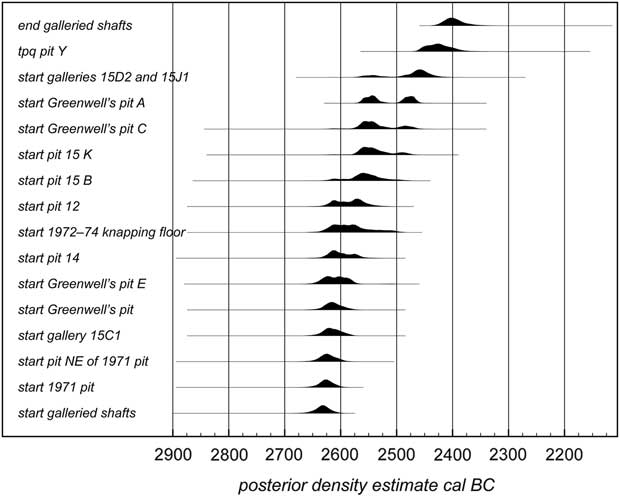
Estimates for the start & end of the working of galleried shafts & for the initial working of those galleried shafts for which individual estimates have been made, & of the 1972–1974 knapping floor which was overlain by upcast from pit Y

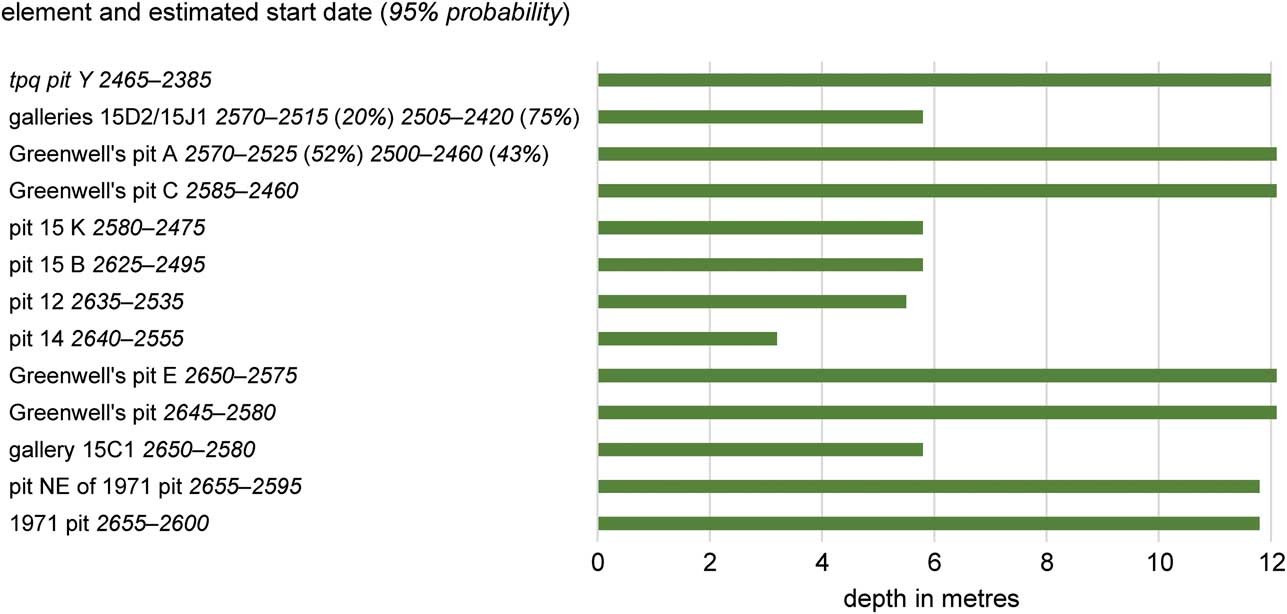
Start estimates for the galleried shafts shown in Fig. 7, in approximate chronological order from bottom to top, together with their approximate depths. The estimated depth for pit Y is that for Greenwell’s pit nearby

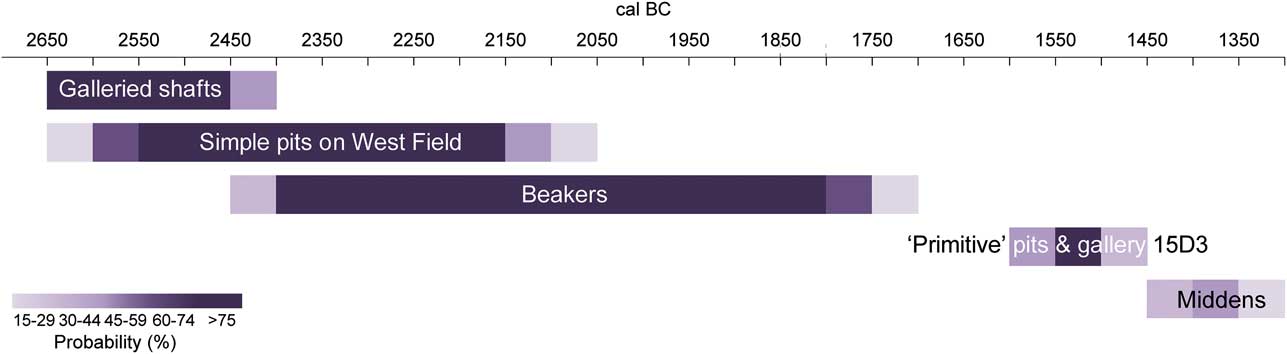
Schematic diagram showing the periods of use of the main episodes at Grime’s Graves, together with the currency of Beaker pottery in Britain (Parker Pearson et al. forthcoming, fig. 2.1). The date estimates for Grime’s Graves are listed in Table 1

Durations and intervals (Table 1)

selected highest posterior density intervals

Effective likelihoods are dates, or weighted means of dates, which are not excluded from the models.
According to the preferred model, the galleried shafts began to be worked in the second half of the 27th century cal bc and were abandoned in the late 25th or early 24th century cal bc, having been worked for between two and two and a half centuries (Table 1; Fig. 7: start galleried shafts, end galleried shafts; Fig. 10: work galleried shafts). The most recent estimate for an individual shaft is a terminus post quem for the sinking of an unexcavated shaft, pit Y, provided by the estimated end date of 2465–2385 cal bc (95% probability), probably 2455–2405 cal bc (68% probability; Fig. 7: tpq pit Y) for a long-lived, dense, and extensive knapping floor which was overlain by the spoil upcast from this shaft (Longworth et al. Reference Longworth, Herne, Varndell and Needham1991, figs 3–4; Reference Longworth, Varndell and Lech2012, 86–9, pls 5–6). It must be remembered, however, that only a small proportion of the more than 430 shafts still visible as earthworks has been excavated, let alone dated, and that these investigated features are unevenly distributed (Fig. 1). The dated examples may thus not be entirely representative.
There may be a hint of later mining in one of five galleries driven from the base of an unexcavated shaft, pit 15 D, which were explored by the Prehistoric Flintmines Working Group of the Dutch Geological Society, Limburg Section (Longworth & Varndell Reference Longworth and Varndell1996, figs 43–4). Three antlers were in situ, arranged compactly and symmetrically against a wall of gallery 15D1, in undisturbed fill (Felder Reference Felder1976, fig. V-V-II-10: antlers 108, 109, 110). Two of these were dated in the 1970s: statistically consistent replicate measurements on one have a weighted mean of 2290–2150 cal bc (2σ; BM-1056a, 3838±42 bp; BM-1056b, 3740±48 bp), the date for the other is 2270–2030 cal bc (2σ; BM-980, 3736±58 bp). The measurements for both antlers are in turn statistically consistent (T’=0.8; T’(5%)=3.8; ν=1; Ward & Wilson Reference Ward and Wilson1978). Their tight grouping in the gallery and the consistency of the measurements indicate that they were not accidental intrusions. Their 23rd to 21st century cal bc dates are, however, so much later than the 100-odd other dates from the galleried shafts, including 26th–24th century cal bc dates from galleries 15D2 and 15D4 attributed to the same pit (Healy et al. Reference Healy, Marshall, Bayliss, Cook, Bronk Ramsey, van der Plicht and Dunbar2014, fig. 37: BM-978, -1011, -1057, -1260), that they throw the model into poor overall agreement if included in it. Either these dates are inaccurately recent, or pit 15 D seems to have been re-opened and gallery 15D1 worked towards the end of the 3rd millennium cal bc. This is plausible on two counts: the pit, at less than 6 m deep, is one of the shallower galleried shafts and hence relatively accessible; and simple pits were still being worked in the west of the site at this time. Pit 15 D was certainly reopened and further worked in the mid-2nd millennium cal bc, as described below.
Individual start and end dates were calculated for 14 features which had yielded four or more dates other than those excluded from the model. These features were sometimes entire shafts, sometimes single galleries or groups of galleries when these are the only investigated parts of a particular shaft. Among these, the earliest were some of the deepest, with deeper and shallower pits worked throughout the period (Figs 7, 8). There is no hint of any simple progression across the area. Instead, several locations were returned to after extended intervals. For example, while Greenwell’s original pit and the adjacent Greenwell’s pit E were among the first galleried pits to be opened, nearby Greenwell’s pits A and C were among the last, pits of various depths having been sunk in various parts of the field in the interim (Fig. 8). A possible interpretation is that each part of the field was worked by a different social group, who periodically returned to it. This finds some support in the record of pits 11 A to 11 H, a cluster of relatively shallow pits linked by galleries (Longworth & Varndell Reference Longworth and Varndell1996, 45–9), all worked within the timespan of the galleried pits, although there were insufficient measurements to make estimates for individual pits (Healy et al. Reference Healy, Marshall, Bayliss, Cook, Bronk Ramsey, van der Plicht and Dunbar2014, fig. 28). A number of antlers from these pits have common features which suggest that they had been shed by a single stag over a number of years (Clutton-Brock Reference Clutton-Brock1984, 38–9). It is not clear from this account precisely which antlers all of these were, or from which pits they all came, but the markings legible in a photograph of three of them (ibid., pl. 6) show that the smallest came from pit 11 A and two larger ones from pit 11 D. It is as if a single group of people, gathering antler from a single herd, returned in successive years to the same small area of the mines.
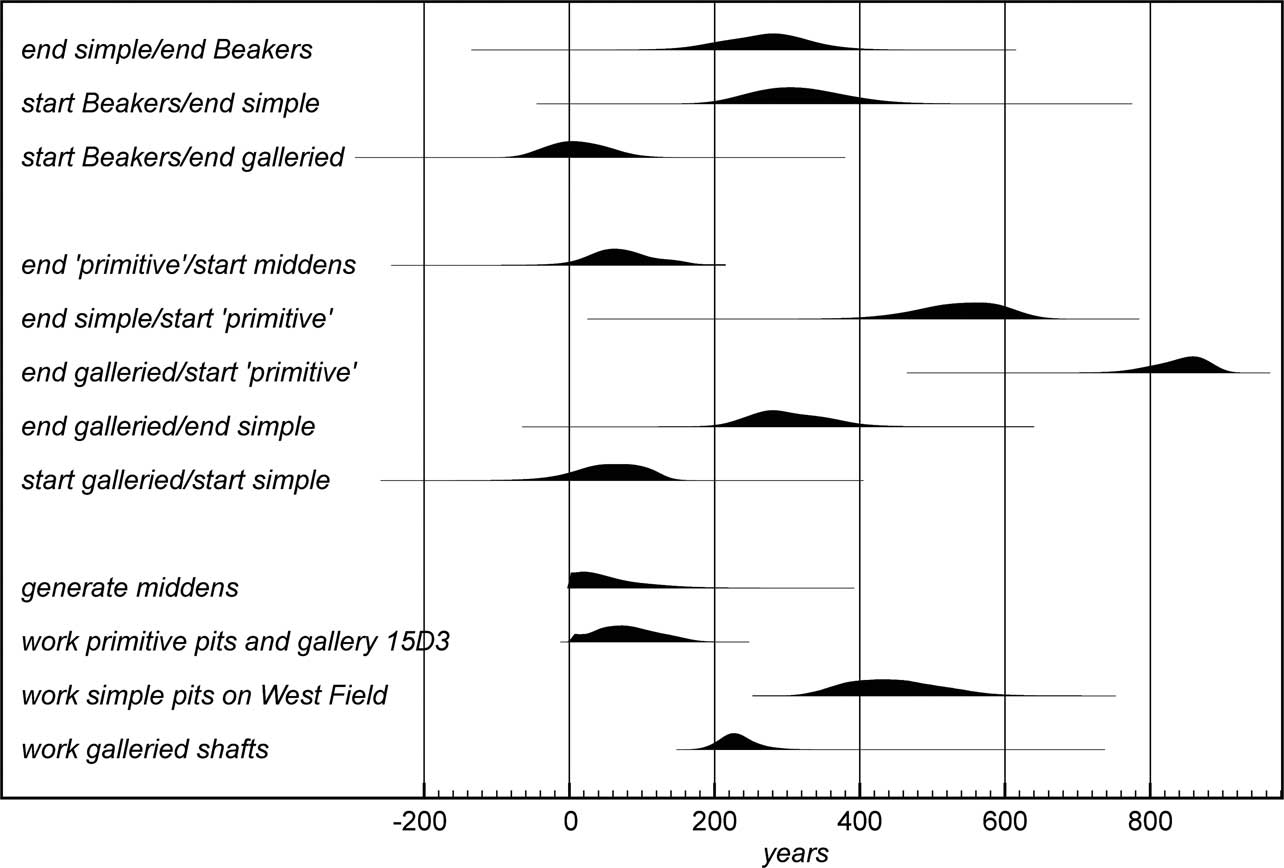
Far fewer suitable samples were available from simple extraction pits on the West Field (Table 1) and date estimates are consequently less precise. They began to be worked in the later 27th or the 26th century cal bc and continued to be exploited until the 22nd or 21st century cal bc (Fig. 9). Despite the imprecision of the estimated start date, it is 88% probable that these pits began to be worked after the galleried shafts, the interval being −40 to +140 years (95% probability), probably 15 to 115 years (68% probability; Fig. 10: start galleried/start simple). Their exploitation, however, outlasted that of the galleried shafts by 2 to 4 centuries (Fig. 10: end galleried/end simple), with a total span of as much as five centuries (Fig. 10: work simple pits on West Field). Even if galleried pit 15 D saw limited fresh working in the late 3rd millennium cal bc, as noted above, the interval would be −10 to +290 years (95% probability), probably 55 to 205 years (68% probability; dig 15D1/end West Field, distribution not shown).
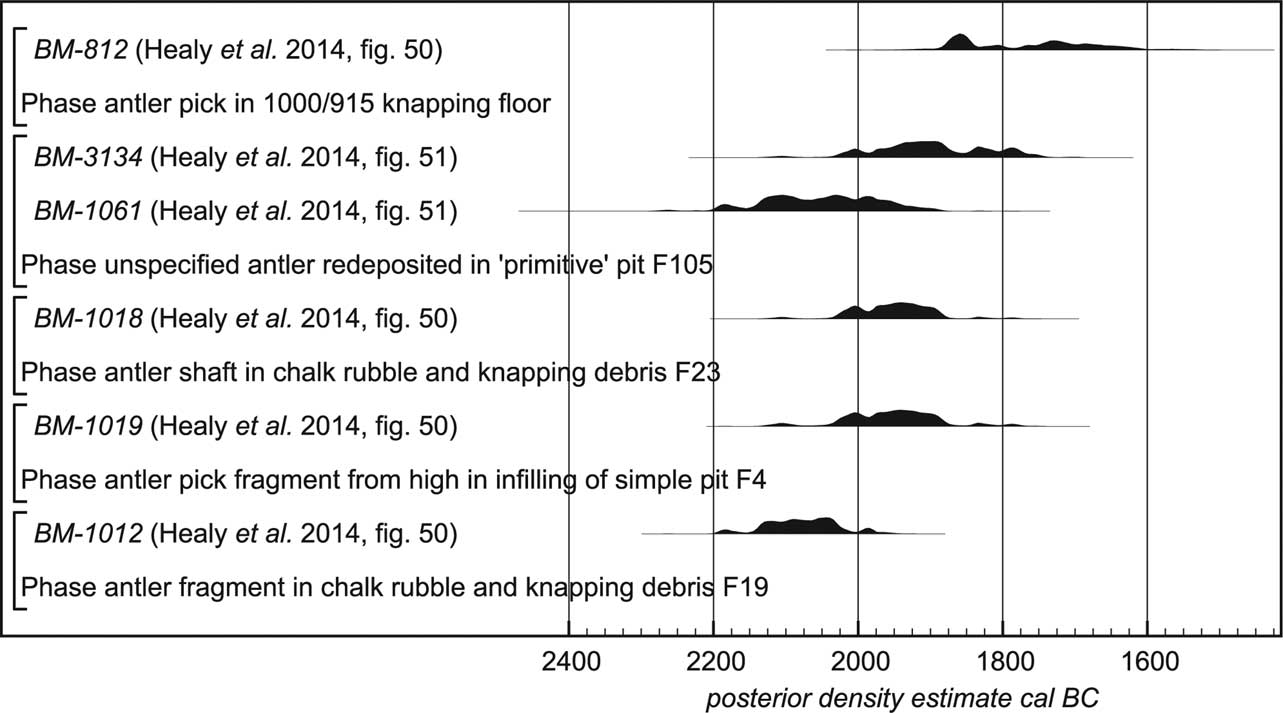
There is only a handful of reliable dates for episodes of knapping, transient occupation, and other activity on the West Field which are not demonstrably linked to extraction. This aspect of the site has been particularly affected by the exclusion, on the grounds of possible inaccuracy, of pre-existing dates measured on bulk charcoal samples, as noted above. Those for antler samples are shown, with their contexts, in Figure 11. They indicate that antler implements were used – whether to scavenge flint from pre-existing spoil heaps or to work freshly-dug pits – and flint was worked on the West Field into the 20th and 19th centuries, possibly into the 18th century, cal bc, beyond the estimated abandonment of simple pits there. The West Field clearly continued in use; it remains to be seen whether so far undated or unexcavated pits were sunk and quarried in the same centuries. They quite possibly were. It must be remembered that the simple pits on the West Field are much less extensively and thoroughly dated than the galleried shafts, principally because there were far fewer suitable samples (Table 1). The present state of uncertainty is summed up by an antler pick, the subject of a 19th–18th century cal bc radiocarbon date (Fig. 11: BM-812-), lying at the edge of a knapping floor close to two unexcavated pits infilled with chalk rubble (Sieveking et al. Reference Sieveking, de, Longworth, Hughes, Clark and Millet1973, 200, 207, fig. 12:b, pl. xxii).
Posterior density estimates for dates for antler samples from surface knapping areas & the post-mining infilling of pits on the West Field, exported from models in Healy et al. (Reference Healy, Marshall, Bayliss, Cook, Bronk Ramsey, van der Plicht and Dunbar2014)

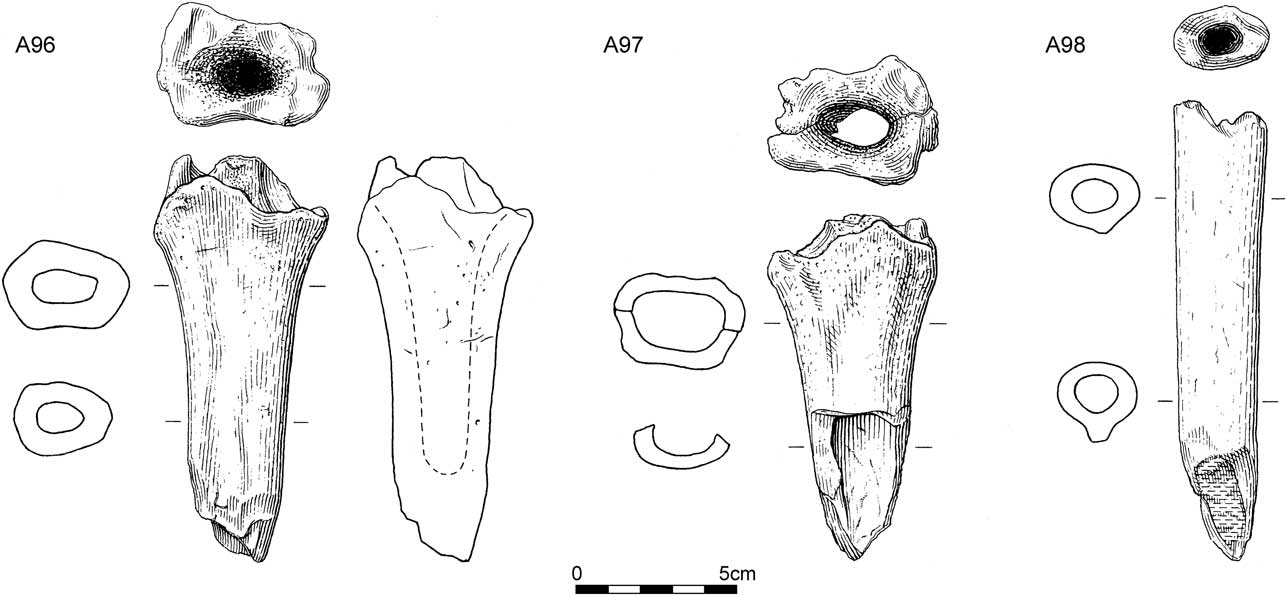
Bone picks from ‘primitive’ pit 3 (Legge Reference Legge1992, fig. 33). The example on the right (A98) is made from a human femur shaft. The other two are made from the distal ends of cattle tibiae. The example on the left (A 96) is dated to 1530–1430 cal bc (2σ; 3220±28 bp; OxA-22528) © Trustees of the British Museum

The ‘primitive’ pits were dated by means of the bone picks which characterise them (Fig. 12). These implements, some of them described by Legge (Reference Legge1992, 69–71) and Boyd (Reference Boyd1996), were generally made on cattle longbones, predominantly radii or tibiae, with the midshaft cut obliquely to form a point and the remaining articulation retained. They were indubitably mining tools: some had chalk rammed into their hollow distal ends; others had split longitudinally under pressure. Twelve such implements from five ‘primitive’ pits all dated to the mid-3rd millennium cal bc, as did a further two bone picks from gallery 15D3 in the pit 15 complex. On this basis, mining with bone picks was carried out between the 17th and 15th centuries cal bc (Fig. 9) over a period of 5–160 years (95% probability), probably 35–120 years (68% probability; Fig. 10: work ‘primitive’ pits and gallery 15D3). This episode of mining would have taken place at least seven and a half centuries, probably more, after the abandonment of the galleried shafts (Fig. 10: end galleried/start ‘primitive’) and at least four centuries, probably more, after the dated simple pits on the West Field had ceased to be worked (Fig. 10: end simple/start ‘primitive’).
An important question here is whether the ‘primitive’ pits were first sunk in the mid-2nd millennium. The answer is ‘yes’. Seven of the dated bone picks came from niches at the bases of the pits, and two more were from at or near the bases. Five antler implements with 3rd millennium cal bc dates from two of these pits are all from upper fills and seem to have been backfilled into the features from pre-existing spoil. In the case of pit 15 D, there is no question of initiation in the 2nd millennium, since antler picks from galleries 15D2 and 15D4, all apparently in situ, are of mid-3rd millennium cal bc date, and the dated examples are only four among many (Longworth & Varndell Reference Longworth and Varndell1996, fig. 44). The dated bone picks are two out of at least six recovered from the pit, five of them from galleries 15D1, 15D3, and 15D5. Their distribution is consistent with the reopening of the shaft a millennium after its original excavation, followed by at least partial exploration of its galleries. In these circumstances, marks in gallery 15D2, interpreted as those made by a polished flint or stone axe (Longworth & Varndell Reference Longworth and Varndell1996, 59) may have been made by bone picks. As with the late 2nd millennium cal bc antlers in gallery 15D1, the pit’s depth of 5–6 m would have made its reopening less of a challenge than that of the 12 m deep pits at the other side of the field.
Activity contemporary with the working of these pits is almost certainly represented by the small tally of Early Bronze Age pottery from the site. This is concentrated on the West Field (Fig. 1), most of it in the same excavated area as F105, one of the dated ‘primitive’ pits (Longworth et al. Reference Longworth, Ellison and Rigby1988, 23–4; 2012, 184). Conspicuous here is F108, a shallow depression containing most of the pottery, with struck flint and other occupation material (Longworth et al. Reference Longworth, Varndell and Lech2012, 78–9). A slighter Early Bronze Age presence, this time entailing scavenging, is evidenced in the east of the site by a compact deposit of knapping debris including a sherd probably of Food Vessel or Collared Urn (Longworth Reference Longworth1981, 39) in a pit-like depression in the top of the infilled 1971 pit, a deep galleried shaft worked in the second quarter of the 3rd millennium cal bc (Mercer Reference Mercer1981, 19–20; Saville Reference Saville1981, 13–15).
An interval of around a century (Fig. 10: end ‘primitive’/start middens) probably elapsed before Middle Bronze midden material began to build up on the site. There is no hint that mining continued during this phase. On the evidence of two massive assemblages – 490 kg of struck flint from midden contexts in the 1972 pit and 606 kg from midden contexts in pit X – the Middle Bronze Age users of the site scavenged already-mined flint from earlier spoil heaps and knapping floors, without engaging in mining (Saville Reference Saville1981, 2, 18; Herne Reference Herne1991, 23, 29–30). The midden deposits are occupation debris by any standards. The quantity of Middle Bronze Age pottery from the site, over 8000 sherds in total in contrast to approximately 500 sherds from all periods of the Neolithic and Early Bronze Age, expresses the difference between this episode and previous activity (Longworth Reference Longworth1981; Longworth et al. Reference Longworth, Ellison and Rigby1988 12–25; 2012, 184). The flint and pottery were accompanied by correspondingly large quantities of animal bone and burnt or calcined flint, as well as by bone, antler, and bronze tools, and the debris of bronze-working, typically in a dark, often almost black, organic matrix. There are other comparable accumulations in addition to the shaft-tops from which samples have been dated (Peake Reference Peake1915, 115–8; Smith Reference Smith1915, 212–3; Longworth et al. Reference Longworth, Ellison and Rigby1988, 36, fig. 14). They are strongly concentrated in an arc around the east and south-east of the visible pits (Fig. 1).
Suitable samples, most of them carbonised residues on the interior surfaces of Middle Bronze Age pots, the remainder articulating animal bone, were identified from three locations: the Black Hole (Armstrong Reference Armstrong1924, 192–3; 1927, 107–9; Longworth et al. Reference Longworth, Ellison and Rigby1988, 27–31, 51–64, 105–9; 1991, 94–5, 108–21, 176); the top of the 1972 pit (Mercer Reference Mercer1981, 36–8); and the top of shaft X (Longworth et al. Reference Longworth, Ellison and Rigby1988, 31–5; 1991, 13–20). Measurements for all 11 newly dated samples are statistically consistent (T′=13.8; T′(5%)=18.3; ν=10), irrespective of location and of their stratigraphic position in the 1972 pit and pit X sequences. This accords with the homogeneity of the pottery assemblages; and with evidence for effectively single-episode deposition in the dispersal of sherds of the same vessel through the depth of the Black Hole; and the even distribution of morphological traits through the deposits in pit X (Ellison Reference Ellison1988). The material would have been deposited between the later 15th and the earlier 13th centuries cal bc (Fig. 9) over a period of at most a century and a half, probably much less (Fig 10: generate middens).
DISCUSSION
The 27th–24th centuries cal bc
There is no evidence for any chronological progression from shallow pits sunk to relatively accessible flint to deeper pits sunk with considerable skill and difficulty to far less accessible material. Not only did the galleried pits begin to be worked before the shallower pits on the West Field (Fig. 10: start galleried/start simple), but, among those galleried pits, the earliest were some of the deepest (Fig. 8). It is as if those who worked the first galleried pits were already skilled and experienced. If so, this raises the question of where those skills and experience were gained. The minutiae of the methods by which the deep shafts were worked (Longworth & Varndell Reference Longworth and Varndell1996) matched those practiced on the South Downs (Barber et al. Reference Barber, Field and Topping1999, 38–40) over a thousand years before, and, before that, in adjacent parts of the continent (Whittle et al. Reference Whittle, Healy and Bayliss2011, 255–6, 789, fig. 14.129). It is difficult to see how these standardised methods and skills could have been preserved and passed on over the intervening centuries. Barber (Reference Barber2005) concludes that, while there is ample evidence for activity at the Sussex mines in the 3rd and early 2nd millennia cal bc, when large quantities of mined flint were used for knapping and for monument building, there is as yet no conclusive evidence that fresh pits or shafts were dug in this period, although others have argued the case (eg, Russell Reference Russell2001, 246–8). One possible exception is the undated mines at Stoke Down. Here, on the basis of a fairly brief inspection (Healy Reference Healy2011), the debitage is of quite different character to much of that of the other Sussex flint mines, and could suggest a Late Neolithic date. The pits excavated at Stoke Down, however, were no more than 5 m deep, with slight undercuts in a couple of cases, but no galleries (Wade Reference Wade1924; Barber & Dyer Reference Barber and Dyer2005). Even if they are Late Neolithic they do not perpetuate the mining technology of the deep, galleried 4th millennium shafts. The same is true of simple, relatively shallow pits sunk into secondary flint deposits in Aberdeenshire, probably around the turn of the 4th and 3rd millennia cal bc (Saville Reference Saville2008). Did one or a few skilled miners come from the continent? The mines at Spiennes in Belgium, for example, continued to be worked into the early 3rd millennium cal bc (Collet Reference Collet, with Collin, Court-Picon, Gofette, Salavert and Thienpont2014, 17–19). At an interval of more than a century, this echoes Peake’s (Reference Peake1916, 318) assertion, expressed in the language of his time, that ‘As this [mining] was carried out at the Graves it is not a first attempt, but the work of skilled men far advanced in the art ... The Grime’s Graves miner came from some other district where he learned his methods’.
Contrasts between the galleried shafts and the West Field go beyond depth, skill, methods, and the flint seams exploited. Lech (Reference Lech2012, 119–21) sees the deep mines and extensive knapping floors like that excavated in 1972–74 as worked by highly skilled specialists who were meshed into a long-distance exchange system in which symbolic significance attached to the mines and their floorstone products, while the simpler, more superficial workings served to meet local needs. Carved chalk objects were more frequent in the galleried shafts than in the simple pits. Mercer (Reference Mercer1981, 60–4) and Varndell (Reference Varndell1991) record chalk artefacts, including balls, ‘cups’, and a phallus, from several definitely 3rd millennium cal bc contexts in and among the galleried shafts. There were furthermore in situ chalk carvings on the walls of one (Peake Reference Peake1915, 73–5, figs 5–6, 8, pls xii–xiii; Barber et al. Reference Barber, Field and Topping1999, 65, fig. 5.10). Yet the only such object from an indubitably 3rd millennium cal bc context on the West Field is a single chalk ball from the lowest layer of a dated simple pit (Varndell Reference Varndell1991, 100, 115: C156).
Grooved Ware pottery is also rare on the West Field (Fig. 1): there are just four sherds from two contexts, in which they were probably redeposited because Early Bronze Age pottery was also present (Longworth et al. Reference Longworth, Varndell and Lech2012, 57, 78, 184). From the galleried shafts and a knapping floor related to them, however, there are almost 600 sherds, including at least six semi-complete pots (Longworth Reference Longworth1981, 39, figs 22–3; Longworth et al. Reference Longworth, Ellison and Rigby1988, 13–14, figs 4–6). All the pots are bowls, a form present in other Grooved Ware assemblages but always as a minority element beside more frequent jars. Five of the semi-complete bowls were found in galleries or on or close to pit bases. They show every sign of deliberate placement. It would, indeed, be difficult to think of a practical reason for taking a semi-complete pot down a flint mine. This is particularly clear at the base of the 1971 pit, where, on the surface of a platform built of large flint blocks, there were a small area of charcoal and two larger areas of dark, apparently organic, material, one containing small flint fragments from the breaking-up of nodules, the other substantial parts of two elaborately decorated Grooved Ware bowls (Mercer Reference Mercer1981, 23, figs 11, 13). Other formal placements are detailed by Varndell and colleagues (Varndell et al. forthcoming), not least the large quantities of antler implements often purposefully grouped in galleries and on shaft bases (eg, Peake Reference Peake1915, figs 3, 8; Mercer Reference Mercer1981, fig. 13; Longworth & Varndell Reference Longworth and Varndell1996, figs 5, 17, 18, 44). These groupings echo the placement of antlers in the ditches of Late Neolithic monuments on the Wessex Chalk, notably that of a pile of 57 antler picks on the floor of a terminal flanking the south-eastern entrance of Durrington Walls in Wiltshire (Wainwright & Longworth Reference Wainwright and Longworth1971, 22). The much scarcer antler implements from shallower pits tend to have been incorporated in infilling (this is one reason why the shallower pits have proved more difficult to date). Formal placements of all kinds are confined to the deeper mines; those where they are most marked, the 1971 pit and the pits of the Greenwell complex, are among the deepest excavated so far.
The extra-functional aspects of mining and quarrying have been well rehearsed (eg, Barber et al. Reference Barber, Field and Topping1999, 61–7, 73; Topping Reference Topping1997; Reference Topping2004; Reference Topping2005; Reference Topping2010; Topping & Lynott Reference Topping and Lynott2005b; Edmonds Reference Edmonds1995, 59–66). A mid-3rd millennium emphasis on fine flint and stone artefacts (Edmonds Reference Edmonds1995, 100–14) and a weak local tradition of constructing large communal monuments, seen in the successive scarcity of causewayed enclosures and henges, may together have contributed to the development of a consciously archaising, symbolically-charged practice conducted by skilled specialists. In some ways, the site could even have been an equivalent to the great Late Neolithic monuments of some other regions, in the sense of forming a focus where people would gather and meet, away from their usual contacts and localities, engaging in activities peculiar to the place, in the distinctive, developing man-made setting of old mineshafts and masses of chalk and flint (Bishop Reference Bishop2012, 330–1).
The ‘monumental’ aspects of the site seem to have diminished when the galleried pits ceased to be worked. This was the end of formal placements and the end of the exercise of standardised, highly developed mining skills. In Lech’s terms, the work of highly skilled specialists linked to long-distance exchange networks ended, while simpler, less skilled extraction for local needs continued. It may be pertinent that this took place around the turn of the 25th and 24th centuries cal bc (Fig. 9). In other words, it coincides with the introduction to Britain of Beaker pottery, in 2460–2330 cal bc (95% probability), probably 2410–2345 cal bc (68% probability; Parker Pearson et al. forthcoming: start_start_beakers). It is, indeed, impossible to estimate which was the earlier, the interval between them being −70 to +80 years (95% probability), probably −20 to +55 years (68% probability; Fig. 10: end galleried/start Beakers). Beaker pottery is virtually absent from the site, despite the working of simple pits to the end of the 3rd millennium cal bc. The total is two rusticated sherds, both from superficial contexts (Longworth et al. Reference Longworth, Ellison and Rigby1988, 15–16, fig. 3: N12, N13), and one further possibly Beaker sherd (Longworth et al. Reference Longworth, Varndell and Lech2012, 78). One interpretation of this extreme scarcity lies in the association of the ceramic with the introduction to Britain of metallurgy and a gamut of other new practices and beliefs, apparently by an incoming population (Olalde et al. Reference Olalde2018). The end of the galleried pits could reflect the transformation of indigenous networks of exchange, communication, and influence.
There is also continuity. The working of simple pits on the West Field up to the turn of the 3rd and 2nd millennia cal bc remained within the insular Late Neolithic tradition. Lech (Reference Lech2012, 116–18) concludes that, despite differences in raw material quality and knapping skill, a sample from a knapping floor where floorstone from the surrounding galleried shafts was worked and a sample from knapping deposit from the West Field show the same approach to flint working, with similar multiple products. Across the West Field, although no other deposits have been analysed in detail, the production of discoidal knives and axeheads was widespread, as it was across the site as a whole (Lech Reference Lech2012, 121–41). Forms often associated with Beaker pottery, such as barbed and tanged arrowheads, are universally rare (Lech Reference Lech2012, 143–4), although frequent in the surrounding area (Green Reference Green1980, fig 47), as is Beaker pottery itself (Cleal Reference Cleal1984, figs 9.6–9.7; Garrow Reference Garrow2006, fig. 3.7; Healy et al. Reference Healy, Marshall, Bayliss, Cook, Bronk Ramsey, van der Plicht and Dunbar2014, 60–1, 67). Those who continued to work simple pits on the West Field at Grime’s Graves to the end of the 3rd millennium cal bc may have been a population who asserted traditional ways and values, including the manufacture of fine objects in flint rather than in metal, in the face of innovations that may have been unwelcome and threatening.
Lech’s (Reference Lech2012, 119–21) view of the simpler, more superficial workings at Grime’s Graves serving to meet local needs meshes with Bishop’s (Reference Bishop2012, 325) characterisation of Grime’s Graves as one end of a spectrum of extraction, collection, and knapping in a wider Breckland flint procurement zone. The West Field pits and the mixed raw material, mixed skill level, and ‘industrial’ character of the knapping there correspond to what Bishop (Reference Bishop2012, chap. 9) has documented in the surrounding area, especially to the south and south-west. Looking farther afield, the shallow, haphazard working of largely non-floorstone flint on the West Field, merging into the overall character of flint exploitation in the Breckland, conforms to a recurrent pattern of later Neolithic flint procurement. This tended to take the form of an ‘industrial’ facies to occupation in the areas of more readily accessible flint deposits, with or without shallow quarries, whether on the Suffolk and Cambridgeshire Chalk (Bishop Reference Bishop2012, 154–68), the Clay-with-flints of Cranborne Chase or the South Downs (Gardiner Reference Gardiner1990; Reference Gardiner1991; Reference Gardiner2008), the dry valleys of Salisbury Plain (Richards Reference Richards1990, 158–71), or the tills of Flamborough Head (Durden Reference Durden1995). This also accords with wider developments. Gauvry (Reference Gauvry2008, 146, 150) makes the point that, in the later 3rd millennium cal bc in northern Europe, ‘modest, opencast and shallow pit-mining was common’, with some exploitation sites linked to the production of fine, highly crafted non-functional artefacts. In this period, the galleried shafts are exceptional on a European as well as on a British scale. The summed radiocarbon probability densities of Kerig et al. (Reference Kerig, Edimborough, Downey and Shennan2015, figs 2–3) and the radiocarbon dates assembled by them similarly indicate the exceptional lateness of Grime’s Graves.
The later 3rd and early 2nd millennia cal bc
The last centuries during which the simple pits on the West Field were worked coincided not only with the earlier part of the currency of Beaker pottery, but with the start of an upsurge in settlement on the margin of the Fenland some 15 km to the west. Here, a slightly lowered watertable, the end of marine conditions in the centre of the basin, and the renewed growth of freshwater peat (Waller Reference Waller1994, 153–4) seem to have combined to make the south-eastern fen margin more attractive than it had been in the earlier part of the 3rd millennium. Occupation sites in this zone are characteristically preserved on natural hillocks subsequently covered by peat. The pottery from them is predominantly Beaker and Early Bronze Age (Food Vessel Urn, Collared Urn, Biconical Urn), the majority of the Beaker being stylistically late, with features of Needham’s (Reference Needham2005; Reference Needham2012) Long-Necked group.
The dating of this period on the south-east fen edge is poor, an accident of the timing and manner of the excavation of the sites. A proxy for its earlier part is provided by Beaker-associated burnt mounds in the zone, which are dated to the last quarter of the 3rd millennium cal bc (Bates & Wiltshire Reference Bates and Wiltshire2000; Bayliss et al. Reference Bayliss, Bronk Ramsey, Crowson and McCormac2004). The chronology of the Early Bronze Age aspect of the occupation depends almost entirely on termini post quos measured on bulk charcoal samples and the resulting tentative estimates are very imprecise (Healy et al. Reference Healy, Marshall, Bayliss, Cook, Bronk Ramsey, van der Plicht and Dunbar2014, 61). National chronologies would place the English currencies of Food Vessel and Food Vessel Urn in the 22nd to 19th centuries cal bc (Wilkin Reference Wilkin2014, 39–41, 70, 388–9). On the southern edge of the Fenland basin, Bayesian modelling of dates almost all measured on calcined bone from Collared Urns in a single barrow cemetery at Over, Cambridgeshire, places their local funerary use in the 20th–18th centuries cal bc (Garrow et al. Reference Garrow, Meadows, Evans and Tabor2014, fig. 18). Biconical Urn, sometimes present in substantial quantities on the south-eastern fen edge settlement sites, as at Mildenhall Fen (Clark Reference Clark1936, figs 5–8) and some locations in Hockwold-cum-Wilton (Healy Reference Healy1996, figs 73–6, 82–7) is very poorly dated. It is tentatively placed towards the end of the Early Bronze Age by its associations, such as gold foil-covered beads accompanying a cremation deposit at Great Bircham, Norfolk (Tomalin Reference Tomalin1986; Lukis Reference Lukis1843) or faience beads accompanying another at Semer, Suffolk (Smedley & Owles Reference Smedley and Owles1964, 192–3). The best-dated assemblage comes from a pit at Yarnton, Oxfordshire, which would have been filled in the second quarter of the 2nd millennium cal bc (Hey et al. Reference Hey, Bell, Dennis and Robinson2016, 107, 290–3, 652). Middle Bronze Age pottery is absent from the zone, where occupation seems to have ceased by the mid-2nd millennium cal bc, as conditions became progressively wetter (Waller Reference Waller1994, 154–5), while already ongoing deposition of metalwork in the basin increased (Healy Reference Healy1996, figs 23–5).
The flint assemblages from these sites are almost entirely from formerly peat-covered palaeosols, which can and do contain material of various ages, so that associations are broad ones. While most flint brought to the fen edge from the Breckland in the late 3rd and the 2nd millennium cal bc was from heterogeneous, often superficial, sources on the Chalk, such as was worked within the Breckland itself, a minority has the macroscopic characteristics of Grime’s Graves floorstone and might have come from there, especially when it retains a characteristic thick, creamy cortex (Healy Reference Healy1998). It occurs primarily as debitage, less frequently in a variety of flake tools, especially scrapers (Healy Reference Healy1991, 126). Macroscopic identification, however tentative, of flint from other seams at Grime’s Graves is not possible, so that larger quantities from the West Field may have been dispersed from the site. Despite the apparently ‘indigenous’ character of artefact production on the West Field at Grime’s Graves, it is possible that raw material that left the site as, for example, cores or blanks was further worked by its (culturally distinct?) consumers.
Alongside this ‘everyday’ use, there is also the possibility of more specialised products, manufactured away from the site and perhaps distributed well beyond it. One artefact type of the early part of this period which calls for large blanks of high quality flint is the flint dagger, quintessentially associated with the Beaker pottery which is practically absent from Grime’s Graves (Frieman Reference Frieman2014, 47–50). British examples were generally made on flakes (Frieman Reference Frieman2014, 42), which would have had to be large, since some finished daggers reach 190 mm in length (ibid., supplementary material). They were made from various materials from various sources (ibid., 41–2), but the need for large flakes of high quality flint, combined with a concentration of finished daggers in East Anglia, especially the area around Grime’s Graves (ibid., fig. 1), could point to a Breckland source, if not to the site itself. Frieman’s description of several examples as of black or blackish flint (ibid., supplementary material) would be compatible with their manufacture from Grime’s Graves flint. The notion of raw material from a quarry site, whether mined or not, being used for fine, perhaps specialist-made, objects at a time of specialist craftsmanship in metal is appealing. Indeed, it could reflect similar concepts to the selection of a particular facies of the Great Langdale tuff for bracer manufacture in the late 3rd millennium cal bc (Woodward et al. Reference Woodward, Hunter, with Bukach, Roe, Webb, Ixer, Watson and Potts2011, 29, 86–7). Here the selection of particular outcrops, with distinctive working properties and visual qualities (ibid., 29, 119), could suggest extraction at source.
As well as everyday items, a minority of the flake tools possibly of Grime’s Graves flint from the fen edge settlement sites include barbed and tanged arrowheads and plano-convex and other scale-flaked knives. These are among the most recent finely-worked flint artefacts in Britain. Barbed and tanged arrowheads are found in both Beaker and Early Bronze Age associations (Green Reference Green1980, 129–30, 243–52; Longworth Reference Longworth1984, 69–70). They continued to be made during the working of the ‘primitive’ pits, as exemplified by two rough examples from a pit at Wootton, Northampton, two short-life charcoal samples from which yielded statistically consistent radiocarbon dates in the 16th–15th centuries cal bc (Chapman & Carlyle Reference Chapman and Carlyle2012). A few may have been produced in the Middle Bronze Age, like a burnt example from a cremation deposit in a truncated Middle Bronze Age urn excavated at the Camp Ground, Colne Fen, Earith, Cambridgeshire (Evans Reference Evans, with Brudenell, Patten and Regan2013, 73–7, 79, figs 3.12:1, 6.1:2). The Food Vessel and Collared Urn associations of some plano-convex and related knives are long established (Longworth Reference Longworth1984, 66–8; Saville Reference Saville1985, 129–30).
Some of the settlements on the fen edge yield fragments of flint saddle querns, sometimes reworked as knapping material. Such querns are a peculiarity of a region poor in suitably large slabs of abrasive stone, and are made by dressing the surface of a slab of flint with a hammerstone, as in a Biconical Urn-associated assemblage from Mildenhall Fen, Suffolk (Clark Reference Clark1936, 44–5). Complete examples tend to occur as stray finds (Healy Reference Healy1996, 62, 74, fig. 43). Where fragments occur in surface or excavated collections, these tend to be of predominantly Bronze Age rather than Beaker technology (Healy Reference Healy1991, 124). The form and size of floorstone nodules would be ideal for quern manufacture.
The 16th–15th centuries cal bc
Given that scavenging or superficial working on the West Field helped fill the general need for flint raw material on the fen edge to the west through the early centuries of the 2nd millennium cal bc, it is surprising that deeper mining should have resumed, with new, standardised practices, in the 16th century cal bc. This last demonstrable episode of mining at Grime’s Graves is clearly distinguished by its methods and bone tools, a distinctiveness already expressed in Armstrong’s description of his ‘primitive’ pits. These features have so far been identified in the north and west of the site (Fig. 1). Why this form of flint mining emerged is a fascinating question. This episode falls towards the end of dense Early Bronze Age occupation on the fen edge to the west and towards the end of the manufacture of the last finely made flint implements like those noted above.
Armstrong’s identification of a pick from pit 3 (Fig. 12: A98) as made on a human femur (1923, 121) has been confirmed by Legge (Reference Legge1992, 69). Other implements from pit 3A, tentatively also identified as human by Boyd (Reference Boyd1996, 94), proved not to be so in the course of examination prior to sample selection for this project (Sharon Clough pers. comm.). Even a single implement of human bone, however, brings a symbolic dimension to this phase of mining. It suggests a link to the wider Early Bronze working, use, and wearing of human bone, exemplified by a pointed tool with some polish on the tip made on a human tibia which accompanied a burial in a barrow on Garton Slack, Yorkshire (Mortimer Reference Mortimer1905, 213; Woodward & Hunter Reference Woodward, Hunter, with Bukach, Needham and Sheridan2015, 126, fig. 4.12.2: ID 639). The same study of Early Bronze Age grave goods identified six further objects certainly or possibly of human bone comprising three belt hooks, two pendants, and a tube (Woodward & Hunter Reference Woodward, Hunter, with Bukach, Needham and Sheridan2015, 114, 128–9, 195, 555–7, table 13.1).
The Grime's Graves bone implements themselves (eg, Fig. 12: A96, A97) find their readiest and most frequent parallels among those used in the rare 2nd millennium cal bc copper mines where bone survives, notably Great Orme, Gwynedd (Dutton & Fasham Reference Dutton and Fasham1994, 275–9, figs 12–13) and Ecton Hill, Staffordshire (Timberlake Reference Timberlake2014, fig. 16), and where antler implements were also used. Great Orme was worked from the start of the 2nd millennium cal bc (Timberlake Reference Timberlake2014, fig. 25: start_great_orme). At Ecton Hill, where most dates were measured on bone implements, one mine was modelled as having been worked from 1840–1695 cal bc to 1760–1650 cal bc (95% probability; Timberlake Reference Timberlake2014, fig. 20: start_the_Lumb, end_the_Lumb); and another from 1920–1740 cal bc to 1870–1635 cal bc (95% probability; Timberlake Reference Timberlake2014, fig. 20: start_SQM, end_SQM). These relatively late dates form part of a progression in the start of copper mining from the last quarter of the 3rd millennium cal bc in mid-Wales, subsequently spreading to north Wales and then to north-west England, probably springing from the earlier introduction of copper mining to south-west Ireland (Timberlake & Marshall Reference Timberlake and Marshall2013).
The 16th–15th century cal bc estimate for the working of the ‘primitive’ pits at Grime’s Graves is later than the Ecton Hill estimates and falls towards the end of the estimated span of early copper mining in Wales and north-west England (Timberlake Reference Timberlake2014, fig. 25). It may be that, paradoxically, copper mining in the west and north-west may have lent fresh significance to the extraction of materials from the ground and hence prompted a renewal of systematic flint extraction at a long-significant site in the east, adopting the toolkit of already established copper miners.
One possible product of this period is the flint saddle quern, noted above. These continued to be made and used into the Middle Bronze Age, as evidenced by fragments among the massive industry from the top of shaft X at Grime’s Graves (Herne Reference Herne1991, fig. 31). It is difficult to find other instances of mid-2nd millennium cal bc flint or stone quarrying in Britain or in neighbouring countries, although it may yet prove to have taken place at the Sussex mines. Second, even 1st millennium, cal bc flint mining took place in the Czech Republic, where the products seem to have been mainly utilitarian (Oliva Reference Oliva2011), and in Poland (Herbich & Lech Reference Herbich and Lech1995, 502–4; Lech & Lech Reference Lech and Lech1995, 475–9; Lech et al. Reference Lech, Lech, Adamczak and Werra2011), where finely worked bifacial forms were produced, some of them on mined flint, into the later 2nd millennium (Migal Reference Migal2004).
The 15th and 14th centuries cal bc
The source of the Middle Bronze Age material tipped into the shaft-tops would have been immediately local. In situ contemporary features were found cut into pre-existing knapping floors in the same areas as the middens, among them floors 15, 16, 79, and 85 (Longworth et al. Reference Longworth, Ellison and Rigby1988, 25–7). Soil layers interleaved with the black, midden-like layers tend to be almost equally rich in cultural material, suggesting that this was present on the surrounding surfaces. In the case of the 1972 pit, a skin of dark occupation material occupied part of the surface between it and the 1971 pit (Mercer Reference Mercer1981, 12–3, figs 2, 4). This may have been a vestige of the actual occupation; alternatively it may indicate that the middens were originally more extensive, surviving only where protected by the hollows in the tops of infilled shafts. It may be significant that neither the Black Hole, the 1972 pit, nor pit X retained its surrounding ring of chalk upcast at the time of excavation, all having been discovered during the investigation of apparently level areas. This suggests that the spoil was removed in the course of the Middle Bronze Age activity.
The Middle Bronze Age occupation at Grime’s Graves has several exceptional aspects, notably its area, the kind of metalwork produced there, and, above all, the midden-like deposits themselves. It was extensive: the excavated Middle Bronze Age occupation material which forms an arc around the east and south-east of the site extends over more than 1 ha (Fig. 1). The results of test pit excavation at various locations in this area in the 1970s (Longworth et al. Reference Longworth, Ellison and Rigby1988, 6, fig. 9) suggest that it would be exceptional not to find Middle Bronze Age pottery when breaking the ground here. One might envisage settlement and other activity on the surface between and beyond the midden-filled shaft-tops. If the occupation was spatially continuous then the total accumulation was massive. It should be noted that the two finds shown in the west of the site in Figure 1 consist of only 29 and 22 sherds respectively (Longworth et al. Reference Longworth, Ellison and Rigby1988, 27; 2012, 184), in contrast to the thousands of sherds from the south and south-east. The stylistic homogeneity of the Middle Bronze Age pottery assemblages and the statistical consistency of the recently obtained radiocarbon determinations from three locations suggest that all derive from a single episode of activity. The contemporary vegetation is unknown, since the wooded environment indicated by mollusca from the upper fills of the 1971 pit (Evans & Jones Reference Evans and Jones1981) is now dated to the first quarter of the 1st millennium cal bc (Healy et al. Reference Healy, Marshall, Bayliss, Cook, Bronk Ramsey, van der Plicht and Dunbar2014, 53, fig. 62). The area could have been quite open in the late 2nd millennium.
The actual metalwork from the Grime’s Graves deposits is characterised by largely fragmentary ornaments, personal implements, tools, and casting debris, such as occur on other contemporary settlements. The quantity, however, is high: 42 items in contrast to a maximum of nine from any of the other dry-land settlement contexts listed by Needham (Reference Needham1991a). Truly exceptional is the presence of clay mould fragments from the casting of at least three channel-bladed, basal-looped spearheads. Their size, with minimum blade lengths of 30 cm, excluding the sockets, puts them among ‘ceremonial’ or ‘parade’ weapons. There are examples of these among the mass of metalwork recovered from the fens to the east (Needham Reference Needham1991b, 158; cf Evans Reference Evans1881, figs 406, 409; Pendleton Reference Pendleton1999, map 38, fig. 57: 256, fig. 63: 257, 259). This strongly suggests a link between the Grime’s Graves occupation and deposition in the fen.
The midden deposits themselves remain in some ways unique. The numerous middens that have been investigated in southern Britain the 40 years since the excavation of pit X (eg, Waddington Reference Waddington2008, fig 11.1) are predominantly of Late Bronze/Early Iron Age, rather than Middle Bronze Age, date (Waddington Reference Waddington2009, chap. 4). It is increasingly, if belatedly, clear that Middle Bronze Age settlements in Norfolk and Suffolk tend to consist of enclosures, field systems, and houses, like those in other regions. Such features have been convincingly dated on the east Norfolk coast (Gilmour et al. Reference Gilmour, Horlock, Mortimer and Tremlett2014), and similar cropmarks have been identified in the valleys linking the Breckland and the Fens, although most excavated examples have so far proved to be Late rather than Middle Bronze Age (Yates Reference Yates2007, 98–100), like Game Farm, Brandon, Suffolk, 4 km downstream from Grime’s Graves (Gibson et al. Reference Gibson, Last, McDonald and Murray2004, 36–41, 49–51), although some may have earlier origins. This is a still-emerging picture, but, in its present shape, it aligns the character of mid- and late 2nd millennium cal bc occupation in the region with that of the rest of lowland England and makes the Grime’s Graves middens look even more unusual.
Legge (Reference Legge1981, 96) made the point that the quantities of chalk brought to the surface during mining would have distinguished Grime’s Graves from the rest of the Breckland, making the area attractive by enriching its sandy soils and hence providing improved pasture for the largely dairy-based economy reflected in the slaughter pattern of the cattle (Legge Reference Legge1981, 86–9; 1992, 25–31). He also found that the slaughter pattern of the sheep reflected year-round occupation (Legge Reference Legge1981, 84–6; 1992, 28, 33–4). The lack of an immediate water source would have been mitigated by closeness to the Little Ouse, less than 2 km away. Bishop (Reference Bishop2012, 333–7), less prosaically, makes the point that, in the late 2nd millennium cal bc, the spoil heaps and part-filled shafts at Grime’s Graves would been far more visible and impressive than they are now, and that, apart from their practical use as improved pasture, would have carried powerful connotations of past populations and past ways at a time when more and more of the wider landscape was becoming divided and bounded. Such an old, well-known landmark might have become a focus where members of neighbouring farming communities could meet at significant times. Whether or not there was a permanent population, aggregation would provide a context for the slaughter and consumption of animals from what were primarily dairy herds, for ceremony, and for the manufacture of large, conspicuous spearheads which could have been cast into the fens some 10 km to the west. Grime’s Graves would again have filled some of the functions of a monument.
CONCLUSIONS
At any period, the Grime’s Graves flint mines were, like all flint mines, unnecessary, since local industries were predominantly made from surface flint of the surrounding Breckland (Healy Reference Healy1998). This is exemplified at Kilverstone, 6 km to the south-east, where raw material was consistently local and superficial, regardless of whether it was from Early, Middle, or Late Neolithic or Beaker contexts or from undated ones (Garrow et al. Reference Garrow, Lucy and Gibson2006, 54, 85, 89, 91). The impetus for various episodes of activity at the site would from the first have transcended practical need. The expertise needed to work deep, galleried shafts seems to have already been fully developed when deployed at the site. Its introduction there in the 27th century cal bc may have meshed with the wider development of the Breckland as an important flint source to which people may have travelled from other areas; with an increased emphasis on the production of fine, skilfully made artefacts from selected materials, as well as with the development of new forms of monumentality in other regions. All of these could impart value to the extracted material itself, a value enhanced as the site developed as a focus for aggregation and ceremony. It may be significant that the abandonment of the galleried shafts with their monumental characteristics and placed deposits more-or-less coincided with the introduction to Britain of the suite of new practices and beliefs associated with Beaker pottery. The continued significance of Grime’s Graves and its flint, perhaps bound up with a persistence and preservation of old ways, would have developed from its history and monumentality. Perceptions and uses of the site would have grown with the times. It is tempting to see an episode of mining in the 16th to 15th centuries cal bc as a reaction to copper mining in the west and north.
Acknowledgements
The project was funded by the Historic Environment Commissions section of English Heritage (now Historic England) and monitored by Barney Sloane. Within the organisation, John Meadows, formerly of the Scientific Dating Team, took a major part in sampling and was responsible for the submission and management of samples; Jan Summerfield provided access to material held in store; and Jonathan Last provided support. Access to other collections and archives was provided by Gillian Varndell, the late Janet Ambers, and their colleagues (British Museum); Richard Sabin and his colleagues (Natural History Museum); and John Davies and Alan West (Norfolk Museums Service). Fiona Brock (then of the Oxford Radiocarbon Accelerator Unit) addressed sample pre-treatment concerns; Dana Challinor identified potential charcoal samples; Kirsty Harding (Cardiff University) expertly prepared illustrations for publication; and Martyn Barber, Barry Bishop, David Field, Ian Longworth, Roger Mercer, and Peter Topping were a fund of information and encouragement. This paper is published with the aid of a grant from Historic England.