Introduction
Sexual selection theory posits that mate preference(s) should evolve if individuals of one sex vary in their quality or reproductive potential, thereby making “choosy” behaviour beneficial for improving fitness relative to a random mating strategy (reviewed by Promislow et al. Reference Promislow, Smith and Pearse1998; Kokko et al. Reference Kokko, Brooks, Jennions and Morley2003). Central to almost every sexual selection model is the idea that there are fitness benefits associated with being “choosy” (Bateson Reference Bateson1983; Kokko et al. Reference Kokko, Brooks, Jennions and Morley2003) and many studies have attempted to measure these benefits (Simmons Reference Simmons1987; Reynolds and Gross Reference Reynolds and Gross1992; Petrie Reference Petrie1994; Ryan and Altmann Reference Ryan and Altmann2001; Head et al. Reference Head, Hunt, Jennions and Brooks2005). The benefits of choosiness can be direct and involve the production of more offspring, who may gain greater parental care and/or can be indirect wherein the fitness of offspring is increased (Weatherhead and Robertson Reference Weatherhead and Robertson1981; Kokko et al. Reference Kokko, Brooks, Jennions and Morley2003). In species experiencing large phenotypic variation in quality, there may be strong selection to choose partners that will provide the greatest fitness benefits (Cotton et al. Reference Cotton, Small and Pomiankowski2006; Botero and Rubenstein Reference Botero and Rubenstein2012; Miller and Svensson Reference Miller and Svensson2014). Consistent with this prediction is the observation of a positive association between the extent of phenotypic variation and the degree of “choosiness” for mates seen in a number of species (Dodd Reference Dodd1989; Hingle et al. Reference Hingle, Fowler and Pomiankowski2001; Mazzi Reference Mazzi2004; Hunt et al. Reference Hunt, Brooks and Jennions2005; Sharon et al. Reference Sharon, Segal, Ringo, Hefetz, Zilber-Rosenberg, Rosenberg and Collier2010; Abed-Vieillard et al. Reference Abed-Vieillard, Cortot, Everaerts and Ferveur2014; Najarro et al. Reference Najarro, Sumethasorn, Lamoureux and Turner2015).
The decision with whom to mate is often based on the appearance of traits (e.g., pheromones, visual displays, and vocalisations) that are used to determine whether an individual is worth pursuing or accepting as a potential mate (Kokko et al. Reference Kokko, Brooks, Jennions and Morley2003). The expression (and perception) of these traits may be influenced by the developmental environment of an individual (Griffith et al. Reference Griffith, Owens and Burke1999; Cotton et al. Reference Cotton, Small and Pomiankowski2006; Schultzhaus et al. Reference Schultzhaus, Nixon, Duran and Carney2017), which by amplifying variation in individual quality potentially increases the strength of sexual selection operating in a population (Awmack and Leather Reference Awmack and Leather2002; Chaine and Lyon Reference Chaine and Lyon2008; Cockburn et al. Reference Cockburn, Osmond and Double2008; Gardner et al. Reference Gardner, Ozanne and Sinclair2009; Botero and Rubenstein Reference Botero and Rubenstein2012; Miller and Svensson Reference Miller and Svensson2014). In cases where such variation is common, plastic, experience-based, mate preferences may be more adaptive than limited, innate responses (Cotton et al. Reference Cotton, Small and Pomiankowski2006; Botero and Rubenstein Reference Botero and Rubenstein2012; Miller and Svensson Reference Miller and Svensson2014). In many species of insects, one environmentally sensitive trait is that of adult body size (Credland et al. Reference Credland, Dick and Wright1986; Pitnick and Garcia-Gonzalez Reference Pitnick and Garcia-Gonzalez2002; Amitin and Pitnick Reference Amitin and Pitnick2007; Chown and Gaston Reference Chown and Gaston2010), which is often positively correlated with female fecundity, mate “attractiveness,” and male competitiveness (Honek Reference Honek1993; Bonduriansky Reference Bonduriansky2001). As such, larger individuals often have higher mating frequencies and higher reproductive output compared to smaller individuals (Credland et al. Reference Credland, Dick and Wright1986; Partridge et al. Reference Partridge, Ewing and Chandler1987; Honek Reference Honek1993; Pitnick and Garcia-Gonzalez Reference Pitnick and Garcia-Gonzalez2002; Wigby et al. Reference Wigby, Perry, Kim and Sirot2015; Morimoto et al. Reference Morimoto, Pizzari and Wigby2016). Behavioural phenotypic differences can also be associated with the developmental environment. For example, Drosophila Fallén (Diptera: Drosophilidae) species raised on different media often display distinct mating patterns (Dodd Reference Dodd1989; Sharon et al. Reference Sharon, Segal, Ringo, Hefetz, Zilber-Rosenberg, Rosenberg and Collier2010; Reference Abed-Vieillard, Cortot, Everaerts and FerveurAbed-Vieillard et al. 2014; Abed-Vieillard et al. 2014; Najarro et al. Reference Najarro, Sumethasorn, Lamoureux and Turner2015; Schultzhaus et al. Reference Schultzhaus, Nixon, Duran and Carney2017). These differences may reflect condition-dependent mate choice, wherein “high-quality” individuals exhibit stronger mate preferences than those in worse condition (reviewed in Cotton et al. Reference Cotton, Small and Pomiankowski2006). For example, variation in condition in adult female Teleogryllus commodus (Walker) (Orthoptera: Gryllidae) that arises due to variation in the quality of the juvenile diet is correlated with variation in preference for males (Hunt et al. Reference Hunt, Brooks and Jennions2005). Females raised on high-quality diets are larger and have higher survival rates than females raised on low-quality diets and also display stronger directional selection for those males who produce higher frequency calls (which is indicative of higher mate quality). Alternatively, species may instead mate assortatively with others of similar environmentally induced phenotypes (that are otherwise unrelated to condition). In insects, this phenomenon has been observed insituations where there have been environmentally induced modifications to pheromone phenotypes (Ferveur Reference Ferveur2005; Etges et al. Reference Etges, Veenstra and Jackson2006; Geiselhardt et al. Reference Geiselhardt, Otte and Hilker2012) and/or microbiome profiles (Ringo et al. Reference Ringo, Sharon and Segal2011). For example, Phaedon cochleariae (Fabricius) (Coleoptera: Chrysomelidae) prefer to mate with females who were raised on the same host plant species (and whose cuticular hydrocarbon phenotype is consequently similar) than with females raised on a different host species (Geiselhardt et al. Reference Geiselhardt, Otte and Hilker2012). Differences in the protein availability in culture media can influence adult cuticular hydrocarbon profiles that may lead to patterns of assortative mating in D. melanogaster Meigen (Ringo et al. Reference Ringo, Sharon and Segal2011; but see Fedina et al. Reference Fedina, Kuo, Dreisewerd, Dierick, Yew and Pletcher2012). Thus, the juvenile environment of an individual may alter the sexual selection they experience as an adult, have important consequences for their lifetime reproductive success, fitness, and ultimately shape the evolutionary trajectory of their species.
The spotted-wing drosophila, Drosophila suzukii (Matsumura) (Diptera: Drosophilidae), is an invasive and economically important agricultural pest species that inhabits (with apparent ease) many different environments across North America, Europe, and South America (Bolda et al. Reference Bolda, Goodhue and Zalom2010; Asplen et al. Reference Asplen, Anfora, Biondi, Choi, Chu and Daane2015). It is a generalist parasite of many types of thin-skinned fruits (Bolda et al. Reference Bolda, Goodhue and Zalom2010; Heimpel et al. Reference Heimpel, Frelich, Landis, Hopper, Hoelmer and Sezen2010; Lee et al. Reference Lee, Bruck, Curry, Edwards, Haviland, Steenwyk and Yorgey2011; Walsh et al. Reference Walsh, Bolda, Goodhue, Dreves, Lee and Bruck2011; Bellamy et al. Reference Bellamy, Sisterson and Walse2013; Asplen et al. Reference Asplen, Anfora, Biondi, Choi, Chu and Daane2015). Consequently, D. suzukii larvae may develop in environments that vary dramatically in their nutritional composition and/or quality, and as a result, their populations may consist of a wide range of different adult phenotypes. As such, it is worth considering the importance of sexual selection insituations where the qualities of potential mates differ, as it is possible some success of D. suzukii as an invasive pest may be associated with its ability to choose mates that are of higher quality and increase their fitness. Environmentally induced variation on adult D. suzukii phenotypes was observed in a study by Bellamy et al. (2003) where females who developed on either a cherry (Prunus avium Linnaeus; Rosaceae) or a raspberry (Rubus Linnaeus; Rosaceae)-based media substrate were significantly larger than females who were raised on either blackberry (Rubus Linnaeus; Rosaceae), blueberry (Vaccinium Linnaeus; Ericaceae), grape (Vitis Linnaeus; Vitaceae), or peach (Prunus persica (Linnaeus) Batsch; Rosaceae) media substrates. Similarly, Young et al. (Reference Young, Buckiewicz and Long2018) observed that the ratio of protein to carbohydrates in experimental media was associated with differences in adult body mass. The developmental environment may also influence adult behaviour in this species in ways that affect individual fitness. Diepenbrock et al. (Reference Diepenbrock, Swoboda-Bhattarai and Burrack2016) found that females who developed on fruits of lower nutritional quality demonstrated behavioural plasticity in egg laying by preferring to oviposit on higher quality hosts. In terms of sexual selection, D. suzukii exhibits a number of traits commonly associated with species that exhibit strong mate preferences. For example, male D. suzukii engage in sophisticated courtship displays, involving elaborate movements with their sex-specific, single-spotted wings (Revadi et al. Reference Revadi, Lebreton, Witzgall, Anfora, Dekker and Becher2015) and the production of substrate-borne vibrations (Mazzoni et al. Reference Mazzoni, Gianfranco and Virant-Doberlet2013), which, in other Drosophila species, are used to communicate information about the reproductive quality of a male (reviewed in Ewing Reference Ewing1983). Drosophila suzukii also produce a number of different pheromones, which function as chemical cues to advertise sexual maturity and other aspects of individual quality to prospective mate, similar to what is seen in other Drosophila species (reviewed in Ferveur Reference Ferveur2005; Snellings et al. Reference Snellings, Herrera, Wildemann, Beelen, Zwarts, Wenseleers and Callaerts2018).
In this study, we set out to examine whether the qualities of juvenile nutritional developmental history affect the operation of sexual selection in adult D. suzukii. We did so using a series of “no-choice” and “choice” mate choice tests (sensu Shackleton et al. Reference Shackleton, Jennions and Hunt2005) to examine how nutritional developmental history influences mating behaviour in both sexes and the consequences for variation in individual fitness. In doing so, we hoped to gain insight into the factors that have enabled this pest to be so successful in foreign and complex environments – information that may be useful for improving control methods. For instance, knowledge of the phenotypic characters that are attractive to females can be used to improve the attractiveness of reared male Diptera for release as part of a sterile insect management programmes (Klassen and Curtis 2005), or to plant host species in configurations that will yield adult flies of low fitness, who will inflict less damage to economically important fruiting crops.
Materials and methods
Drosophila suzukii population history and culture protocols
All experimental flies originated from a large (approximately 1400 adults/generation) laboratory-reared population of Drosophila suzukii that was founded from a sample of flies that eclosed from raspberries and blackberries collected on a southern Ontario commercial farm in the summer of 2012 (Renkema et al. Reference Renkema, Wright, Buitenhuis and Hallett2016). We obtained a copy of this population in 2014 from Dr. Justin Renkema (University of Guelph, Guelph, Ontario, Canada) and cultured these D. suzukii under standardised laboratory conditions (25 °C, 60% humidity, 12:12 light:dark diurnal cycle) on Rose’s fly media (Rose Reference Rose1984). We maintain this population on a 21-day generation cycle, where on “Day 1” of the cycle all flies are mixed en masse under light CO2 anaesthesia and distributed (in sets of 20–25 D. suzukii/vial) amongst a set of new vials containing approximately 10 mL of fresh fly media. After 48 hours in these vials, we transfer the flies to a second set of vials (which serves as a “back-up” stock) before discarding the adults 48 hours later.
Experimental diets
To analyse the influence of different nutritional developmental environments on D. suzukii reproductive behaviour, we raised larvae on two types of media in which we experimentally manipulated the protein:carbohydrate ratio to create either a low protein:high carbohydrate diet (protein:carbohydrate 1:3) or a high protein:low carbohydrate (protein:carbohydrate 24:1) diet. These protein:carbohydrate ratios were chosen based on a previous study (Young et al. Reference Young, Buckiewicz and Long2018) that assessed the performance of D. suzukii larvae across a range of different diets. While these two protein:carbohydrate ratios represent two very different nutritional environments for larval development, they are likely to be similar to the nutritional environments that D. suzukii will encounter in the wild. A protein:carbohydrate ratio of approximately 1:3 is similar to the farmed and wild fresh fruit commonly parasitised by D. suzukii such as grapes (Vitis) and blackberries (Rubus) (see Young et al. Reference Young, Buckiewicz and Long2018: Table S1), while a protein:carbohydrate ratio of 24:1 is potentially similar to what is found in rotting fruits that contain protein-rich microbial communities (Janzen Reference Janzen1977). Our two types of media were prepared using the recipes described in Young et al. (Reference Young, Buckiewicz and Long2018) with food-grade red food dye added to enhance the visual contrast of the eggs.
Experimental flies
To obtain D. suzukii with different nutritional developmental histories, we raised individuals on the two experimental media. We first collected eggs by placing mated D. suzukii from our laboratory population into half-pint egg-laying chambers that had been outfitted with 35-mm petri dish lids (BD Falcon, Franklin Lakes, New Jersey, United States of America), which contained grape-agar media (Sullivan et al. Reference Sullivan, Ashburner and Hawley2000). Approximately 18 hours later, we removed D. suzukii and transferred eggs in groups of 20 into vials containing 10 mL of one of the two different media. We incubated these vials under standard conditions and beginning 14 days later, collected adult D. suzukii as they eclosed from their pupae, sorted by sex under light CO2 anaesthesia, and transferred them in groups of 10 into vials containing standard laboratory media. All assays used adult flies that were 3–5 days old posteclosion to ensure their sexually maturity (Revadi et al. Reference Revadi, Lebreton, Witzgall, Anfora, Dekker and Becher2015). We confirmed the virginity of females by the examining the holding vials for the absence of hatched eggs or larvae. Voucher specimens of D. suzukii from our laboratory culture were deposited with the Wilfrid Laurier University (Waterloo, Ontario, Canada) herbarium.
No-choice mating assays
In order to obtain baseline measurements of mating behaviour and fitness of D. suzukii from different nutritional developmental histories, we conducted a series of assays using the so-called “no-choice” mating assay design (sensu Shackleton et al. Reference Shackleton, Jennions and Hunt2005) where the choice is whether or not to mate. This type of mating assay permits the study of mate choice without the potential confounding effects of intrasexual competition. In these assays, we combined (without anaesthesia) single females and single males in vials. All four possible experimental combinations of nutritional developmental history and sex of the pairs were created, and each of these treatments consisted of 60–70 replicates each. We set up observation vials starting around 9 AM (which corresponds to the light-on phase of their diurnal cycle) and mounted the vials horizontally on a vertical board in a well-lit, quiet room. We observed the vials continuously for a maximum of six hours for the initiation and termination of copulation, which we recorded to the closest second. At the end of the assay, we lightly anaesthetised the flies and removed the males from each of the vials. We placed the vials containing the single mated females into the incubator for approximately 24 hours, removed the female (under light anaesthesia), and counted the number of eggs she laid. We placed the females into individual egg-laying chambers (polyethylene 7-mL vials 226245-10; Kartell, Binasco, Milan, Italy) whose caps contained grape-agar media. After approximately 16 hours in the incubator, we removed the female from the egg-laying chambers and immediately counted number of eggs that had been laid. In cases where there were more than five eggs laid, we placed approximately half of the eggs into a vial containing approximately 10 mL of the 1:3 protein:carbohydrate ratio media and the remainder into a second vial containing approximately 10 mL of the 24:1 protein:carbohydrate ratio media. We placed these vials in the incubator and counted the number of adult flies that successfully eclosed from each vial over the next 18 days.
Choice mating assays
To examine the impact of the operation of both intersexual and intrasexual selection, we also conducted two sets of “mate-choice” mating assays. In these assays, a single focal individual (raised on one of two different media) was placed into a chamber with two members of the opposite sex that had different nutritional developmental histories. We conducted one assay in which each of the vials contained a single focal male and two females (hereafter “male choice assay”) and a second assay in which each of the vials contained a single focal female and two males (hereafter “female choice assay”). In order to be able to identify the nutritional developmental history of the individual that mated with the focal D. suzukii during the mating assay, we dusted all nonfocal flies en masse prior to the mating assay with orange or pink nontoxic dry pigment (approximately 0.01 g/60 D. suzukii; AX-12-5 Neon Red and AX-15-N Blaze Orange; DayGlo Color, Cleveland, Ohio, United States of America), alternating the two pigments between nonfocal D. suzukii in a fully balanced manner. This marking technique is commonly used in Drosophila studies (including D. suzukii) with apparently no adverse effects on survivorship or behaviour (Crumpacker Reference Crumpacker1974; Drummond et al. Reference Drummond, Ballman and Collins2019). Once we had dusted the D. suzukii, we immediately sorted them (under light anaesthesia) into groups of two flies differing in their nutritional developmental history and dust colour and placed the pair into vials containing standard laboratory media. At the same time, focal D. suzukii were transferred singly (under light anaesthesia) into vials containing standard laboratory media. The dusting and/or transfer of D. suzukii into vials was done approximately 16 hours before the start of the mating assays to give flies enough time to remove excess pigment and to recover.
For the two different choice mating assays, we created four different combinations of flies based on the two types of focal D. suzukii nutritional developmental histories and the two possible colour/nutritional developmental history arrangements of the nonfocal D. suzukii, for a total of 55–72 replicate vials created per combination. The assays began at around 9 AM (which corresponds to the light-on phase of their diurnal cycle) on day 14–17 of the life cycle of the flies by combining the focal and nonfocal flies without anaesthesia into the same vial. These vials were mounted horizontally, and D. suzukii were observed and scored in the same manner as in the no-choice assay with the start time and end time of each mating recorded to the closest second. For each mating that was observed, we identified the nutritional developmental history of the successful nonfocal fly using a handheld ultraviolet light (ultraviolet flashlight B011LPWXV6; Vansky, Shenzhen, China), which causes the pigment to fluoresce. At the end of the female choice assay, we removed both males from the vials and retained the focal female in the vial, while at the end of the male choice assay, we removed the focal male and the unmated nonfocal female and retained the mated nonfocal female in the vial. All vials containing a mated female were then returned to the incubator, and the number of eggs they laid and the survivorship of their offspring were measured following the same protocols described above for the no-choice mating assay.
Statistical analysis
All statistical analyses were conducted using R (version 3.3.1; www.r-project.org). Mating rates were analysed using general linear models constructed with quasi-binomial error distributions. In the no-choice experiment, the nutritional developmental history background treatment of both flies and their interaction were the independent variables, and the occurrence/absence of mating was the response-dependent variable. For the two choice experiments, our model included the nutritional developmental history background treatment of the focal D. suzukii and the specific pigment colour/nutritional developmental history combination used to distinguish between the two competing nonfocal D. suzukii of the opposite sex (there were four possible combinations of nutritional developmental history treatment and pigment colour), and the interaction between these two independent factors. Comparisons of the mating rates involving the four different nutritional developmental history combinations obtained from the three experiments were also analysed using general linear models constructed with quasi-binomial error distributions. The significance of factors in all tests was determined using the analysis of variance (Anova) function in the car package (Fox and Weisberg Reference Fox and Weisberg2011) using type II sums of squares analysis of deviance tests.
As mating latencies were consistently non-normal (and could not be transformed to normality), we used the Scheirer–Ray–Hare method (Scheirer et al. Reference Scheirer, Ray and Hare1976) in our statistical analyses of this data. In these tests, the dependent variable was the latency to mating (for those flies who were seen to start mating during the observation period of the assay) and the independent variables were the same as described above for the mating rates analysed in the choice and no-choice assays. The mating latencies of the four different nutritional developmental history combinations in the three experiments were compared using Kruskal–Wallis tests (where maximum latency values were capped across the three assays so that differences between the total length of the three trials were not confounding). Post hoc tests, when necessary, were performed using the kruskalmc function in the pgirmess package (Giraudoux Reference Giraudoux2016). Copulation durations in each of the choice and no-choice assays were also analysed with the Scheirer–Raye–Hare method due to non-normal distributions and used the same methods and independent variables described above. Comparisons of median copulation durations between the trials for each of the four different nutritional developmental history combinations were also conducted using Kruskal–Wallis tests.
Total egg production (the sum of the number of eggs laid in the first approximately 24 hours in the vial and the number of eggs laid in the individual chamber over the subsequent approximate 16 hours) data were analysed using general linear models constructed with quasi-Poisson error distributions. For both the choice and no-choice mating assay models, the nutritional developmental history treatment of both the mating female D. suzukii, the mating male D. suzukii, and their interaction were the independent variables, and the total egg production was the dependent variable. Comparisons of total egg production between the choice and no-choice assays for each of the four different nutritional developmental history combinations were also analysed using general linear models with quasi-Poisson error distributions. The statistical significance in all variables was determined using the Anova function with type II sums of squares analysis of deviance tests, and Tukey honestly significant difference tests were used (when necessary) to locate the specific location of differences between group means.
Survivorship of larvae on the two different media was analysed separately using general linear models structured with quasi-binomial error distributions. For all experiments, the proportional egg-to-adult survivorship of the offspring was the dependent variable, and the independent variables were the nutritional developmental history treatment of the male, the nutritional developmental history treatment of the female, and their interaction. Comparisons of survivorship on each of the two different media between the two-choice and no-choice mating assays for each of the four nutritional developmental history combinations were also analysed using general linear models with quasi-binomial error distributions. The significance of independent variables in all tests was determined using the Anova function with type II sums of squares analysis of deviance tests, and Tukey honestly significant difference tests were used, when necessary, to locate the specific location of differences between group means. All data analysed in this manuscript are archived in Data Dryad: https://doi.org/10.5061/dryad.n8pk0p2s3.
Results
Mating rates and mate selection
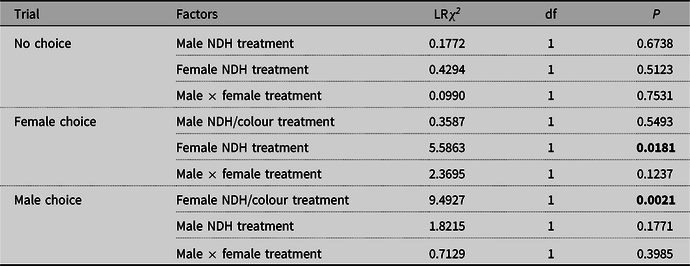
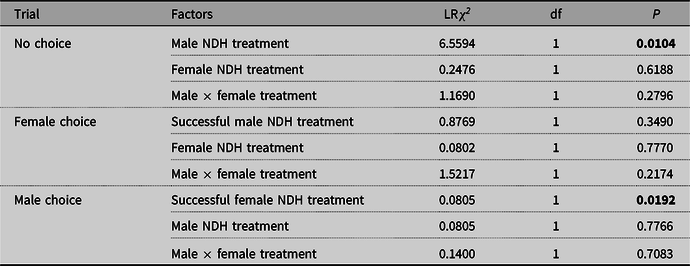
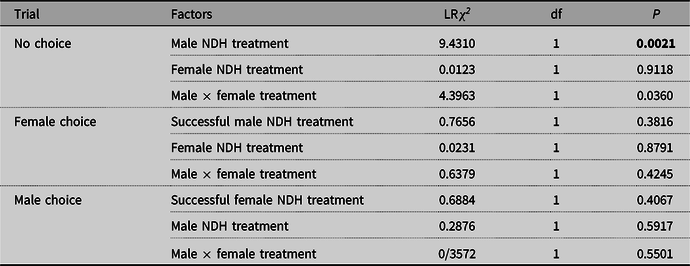
In the no-choice assay, neither the male nor the female nutritional developmental history had a significant effect on the likelihood that the two flies would mate during the observation period (Table 1). However, in the female choice experiment, we saw that females from the 1:3 nutritional developmental history treatment were more likely to mate than those from the 24:1 nutritional developmental history treatment ( $\tilde x$1:3 = 83.2% mated, $\tilde x$24:1 = 70.6% mated; Table 1). In the male choice experiment, we observed that the number of matings was higher when 1:3 reared females were dusted orange and 24:1 reared females were dusted pink compared to the scenario in which the colours were reversed ($\tilde x$1:3 orange and 24:1 pink = 51.4% mated, $\tilde x$24:1 orange and 1:3 pink = 70.1% mated; Table 1).
Results of generalised linear models examining factors potentially influencing mating rates in no-choice, female choice, and male choice trials.

Note: Statistically significant effects are bolded for clarity.
NDH, nutritional developmental history.
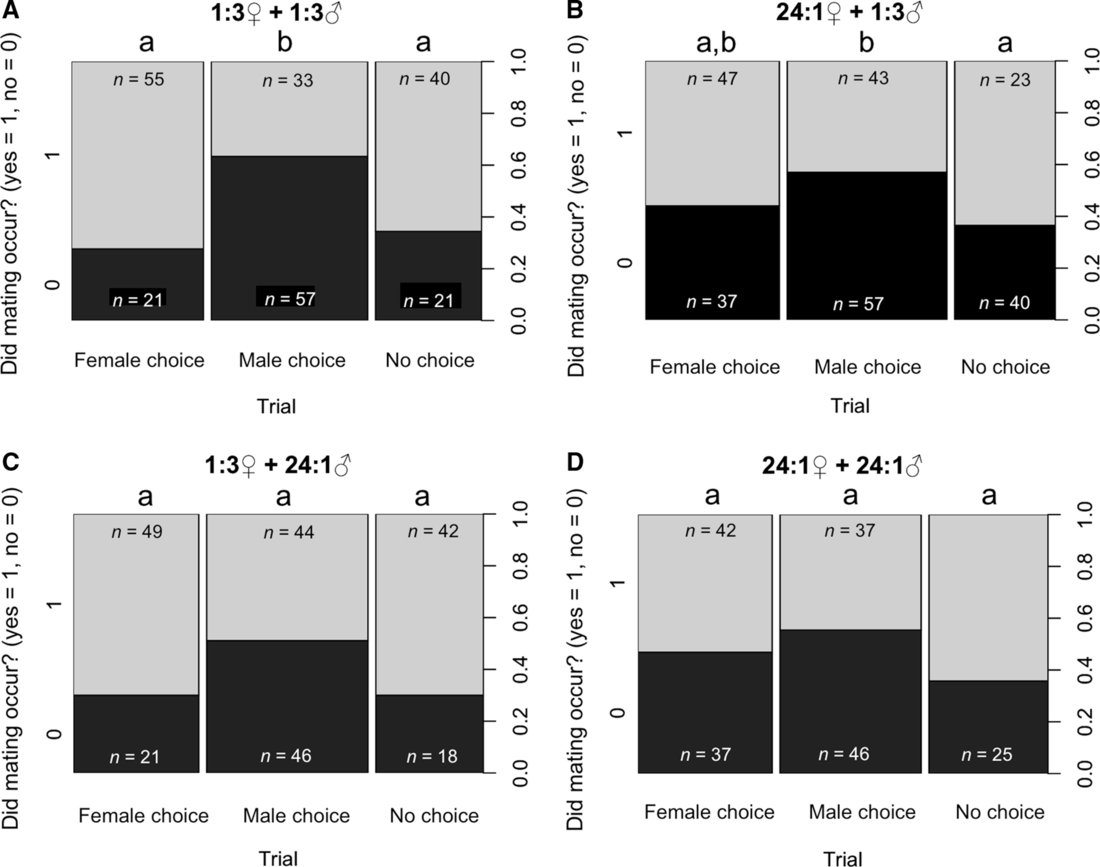
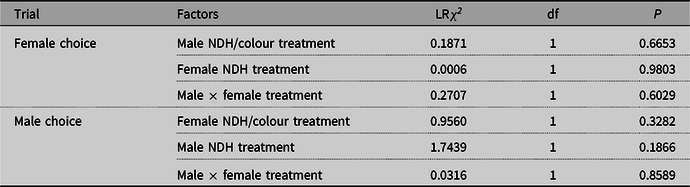
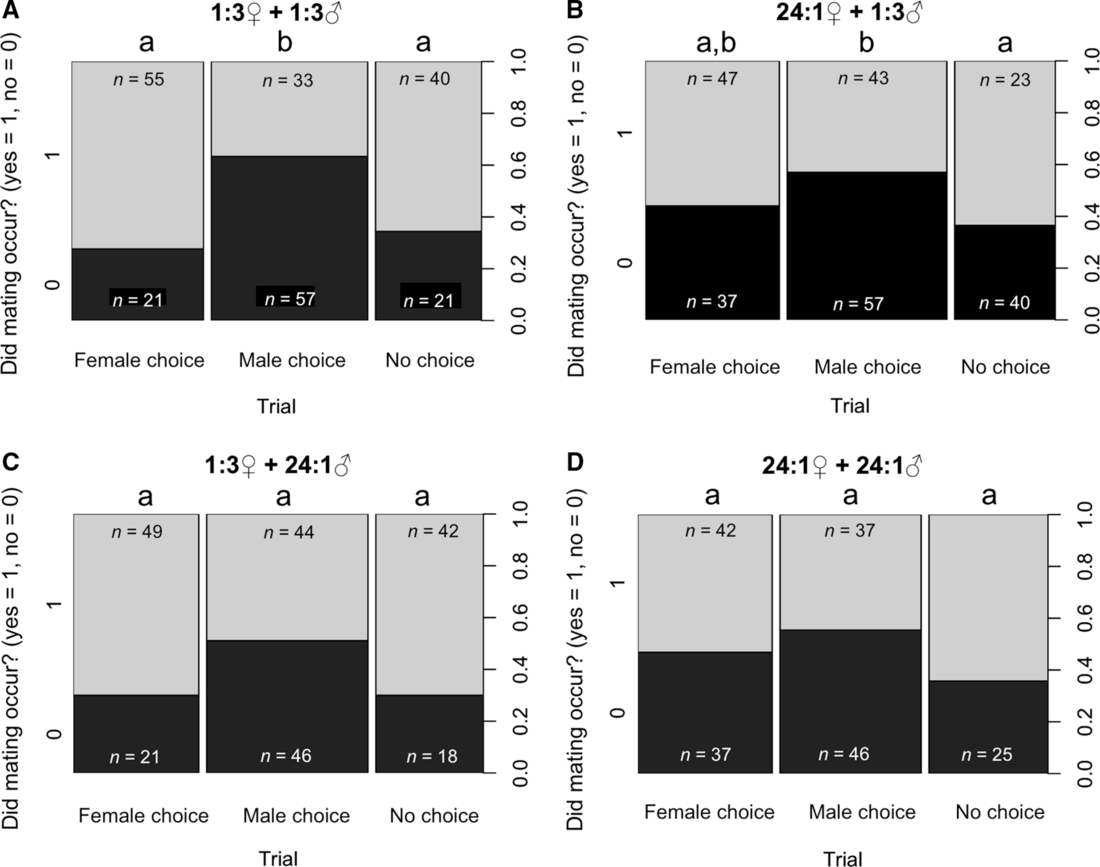
When the four potential combinations of nutritional developmental history males and females were compared across the choice and no-choice trials, we observed that when 1:3 reared females mated with 1:3 reared males, more matings occurred in the male choice than in the female choice and the no-choice assays (LRχ 2 = 24.089, df = 2, P = 5.878 × 10⁻⁶; Fig. 1A). Similarly, when 24:1 reared females mated with 1:3 reared males, slightly more matings occurred in the male choice experiment compared to the no choice experiment (LRχ 2 = 6.5359, df = 2, P = 0.0381; Fig. 1B). No significant differences in mating likelihood were found between trials for either the 1:3 reared females mated with 24:1 reared males (LRχ 2 = 7.1685, df = 2, P = 0.0278; not significant following post hoc testing; Fig. 1C) or when 24:1 reared females mated with 24:1 reared males (LRχ 2 = 3.5878, df = 2, P = 0.1663; Fig. 1D). Our analysis of the outcome of matings of focal D. suzukii in both the female and male choice experiments did not reveal any significant biases associated with the nutritional developmental history of their partner (Table 2).
Numbers and frequencies of matings of Drosophila suzukii based on the nutritional developmental history combination of flies in the three different assays. Drosophila suzukii were raised on a low-quality diet (1:3 flies) or a high-quality diet (24:1 flies) to create two different phenotypes, creating four nutritional developmental history combinations. The nutritional developmental history combinations. A, 1:3 females with 1:3 males; B, 24:1 females with 1:3 males; C, 1:3 females with 24:1 males; D, 24:1 females with 24:1 males. Letters denote significant differences. Sample sizes are indicated within the boxes.
Results of generalised linear models examining factors potentially influencing identity of successful mate in female choice and male choice trials.
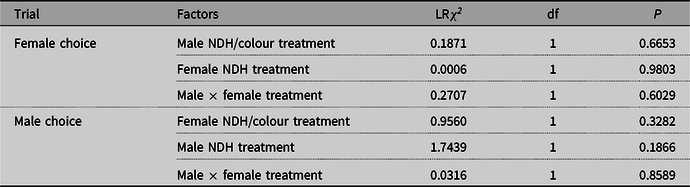
NDH, nutritional developmental history.
Mating latency
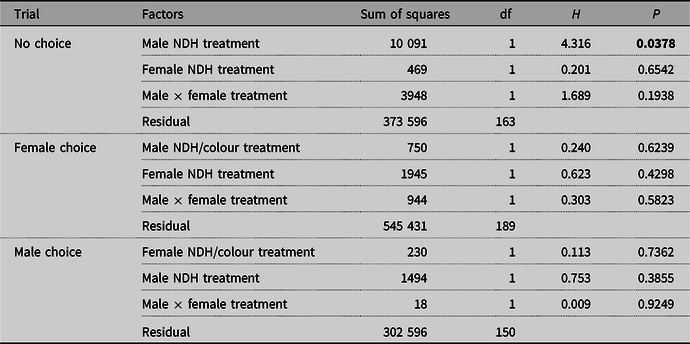
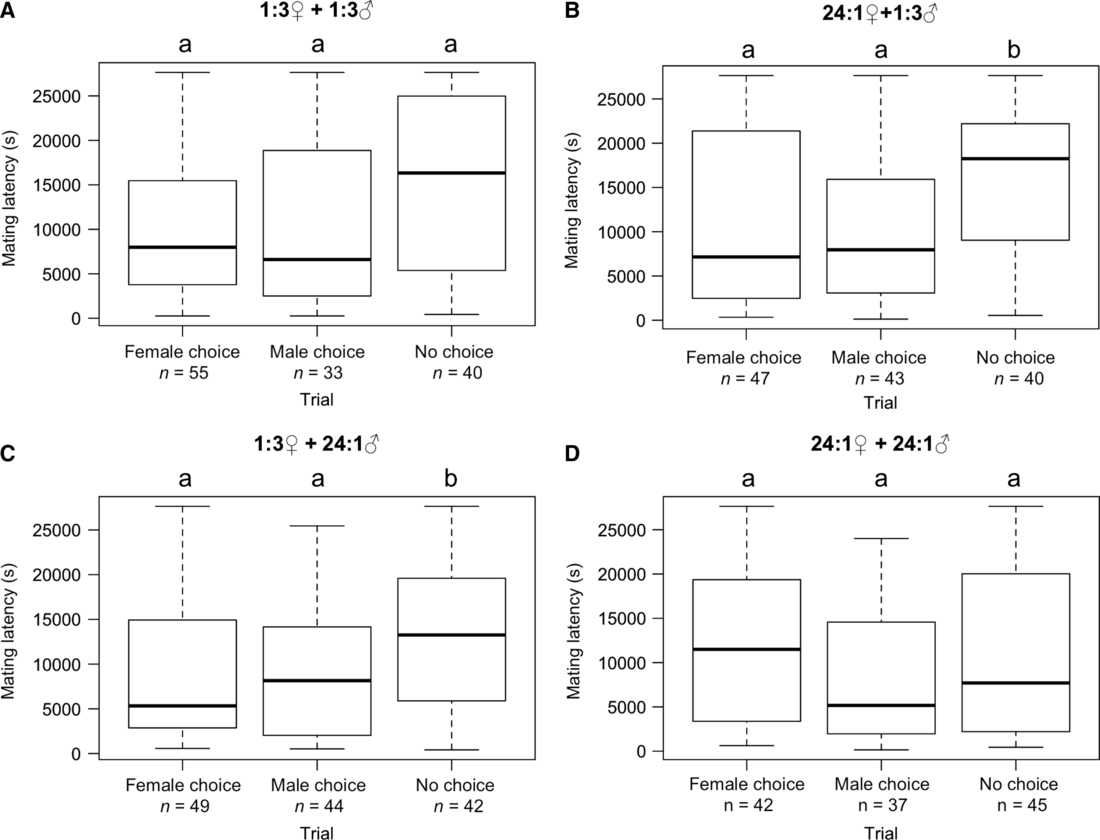
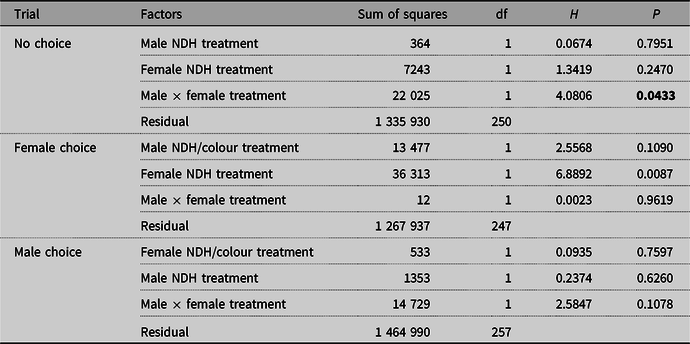
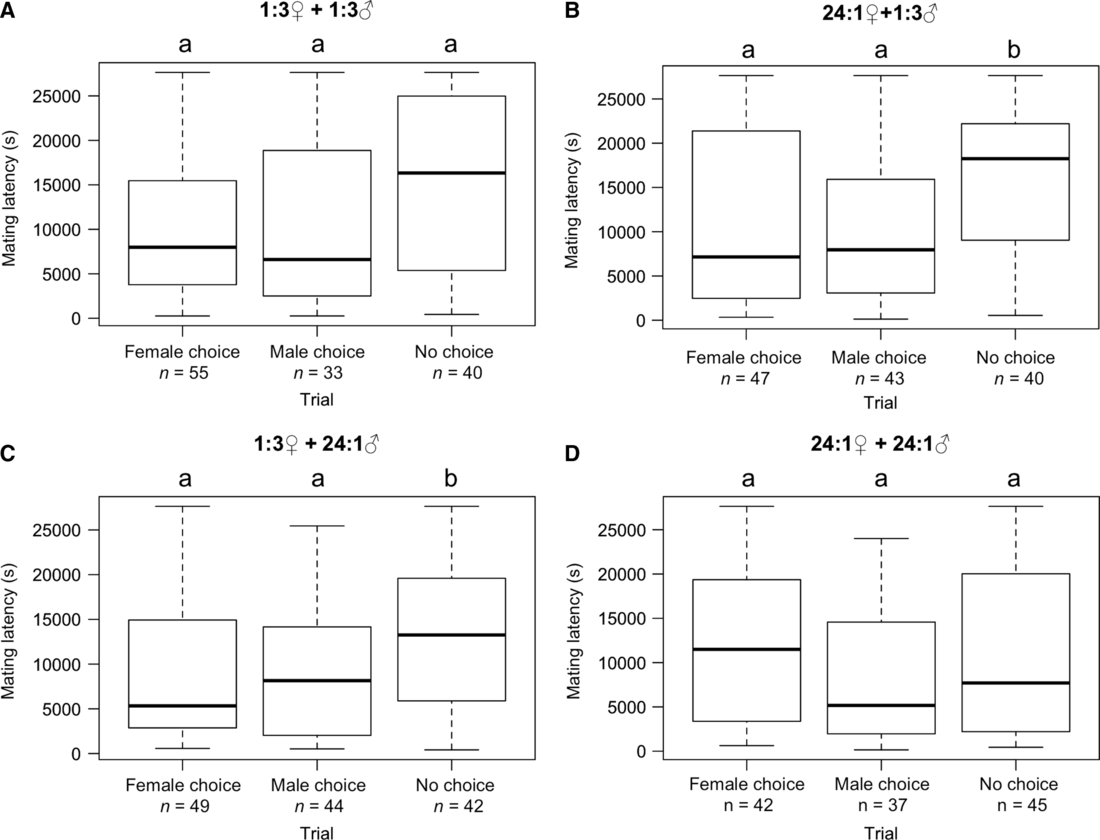
When we analysed the median time to mating for the flies that had successfully mated during the no choice assay, we observed that 1:3 reared males mated later than 24:1 reared males ($\tilde x$1:3 = 17 726 seconds, $\tilde x$24:1 = 12 215 seconds; Table 3). No significant effects of target D. suzukii nutritional developmental history treatment or nutritional developmental history/pigment colour treatment combination of nontarget D. suzukii were found in either of the choice assays (Table 3). When comparing the mating starting times of D. suzukii that were observed to have copulated, for each of the four individual nutritional developmental history combinations across the choice and no-choice trials, we found that mating latencies were significantly longer on average in the no-choice assays when the nutritional developmental history of the sexes differed (24:1 reared females and 1:3 reared males, Kruskall–Wallis χ 2 = 8.9906, df = 2, P = 0.0122, Fig. 2B; 1:3 reared females and 24:1 reared males, Kruskall–Wallis χ 2 = 9.1112, df = 2, P = 0.0105, Fig. 2C) and that there was no significant differences in latencies when the nutritional developmental history of the sexes was the same (1:3 reared females and 1:3 reared males, Kruskall–Wallis χ 2 = 3.3630, df = 2, P = 0.1861, Fig. 2A; 24:1 reared females and 24:1 reared males, Kruskall–Wallis χ 2 = 3.1759, df = 2, P = 0.2043, Fig. 2D).
Results of Scheirer–Ray–Hare test examining factors potentially influencing mating latencies in no-choice, female choice, and male choice trials.
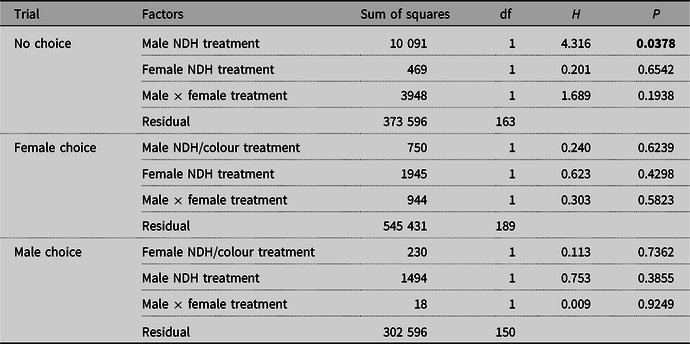
Note: Statistically significant effects are bolded for clarity.
NDH, nutritional developmental history.
Mating latencies (in seconds) of Drosophila suzukii based on the nutritional developmental history combination of flies observed to have successfully mated in the three different assays. For all assays, D. suzukii were raised on a low-quality diet (1:3 flies) or a high-quality diet (24:1 flies) to create two different phenotypes, creating four nutritional developmental history combinations. The nutritional developmental history combinations. A, 1:3 females with 1:3 males; B, 24:1 females with 1:3 males; C, 1:3 females with 24:1 males; D, 24:1 females with 24:1 males. The box encloses values between the first and third quartiles of the data (the interquartile range), whereas the horizontal bar within the box indicates the median. Whiskers extend from the box to largest/smallest values that are within ±1.5 × the interquartile range of the box. Values outside that range are outliers and are indicated by circles. Boxplots that are not sharing a letter have significantly different medians. Sample sizes are listed below the boxplots.
Copulation duration
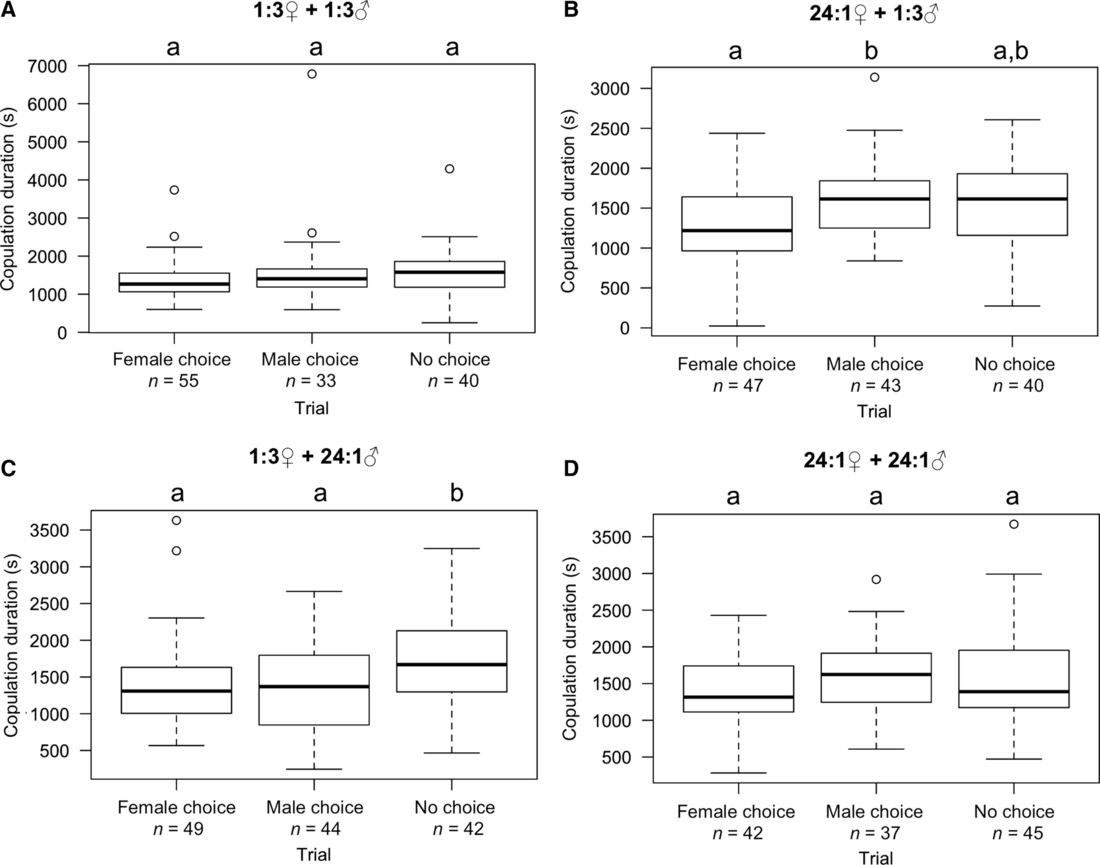
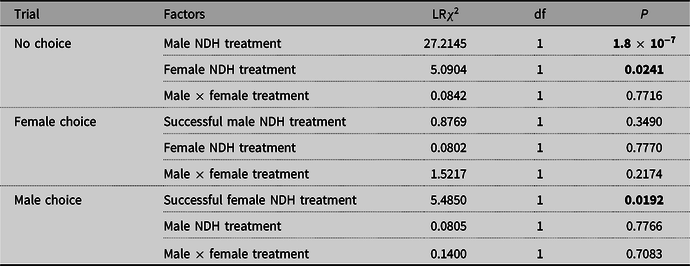
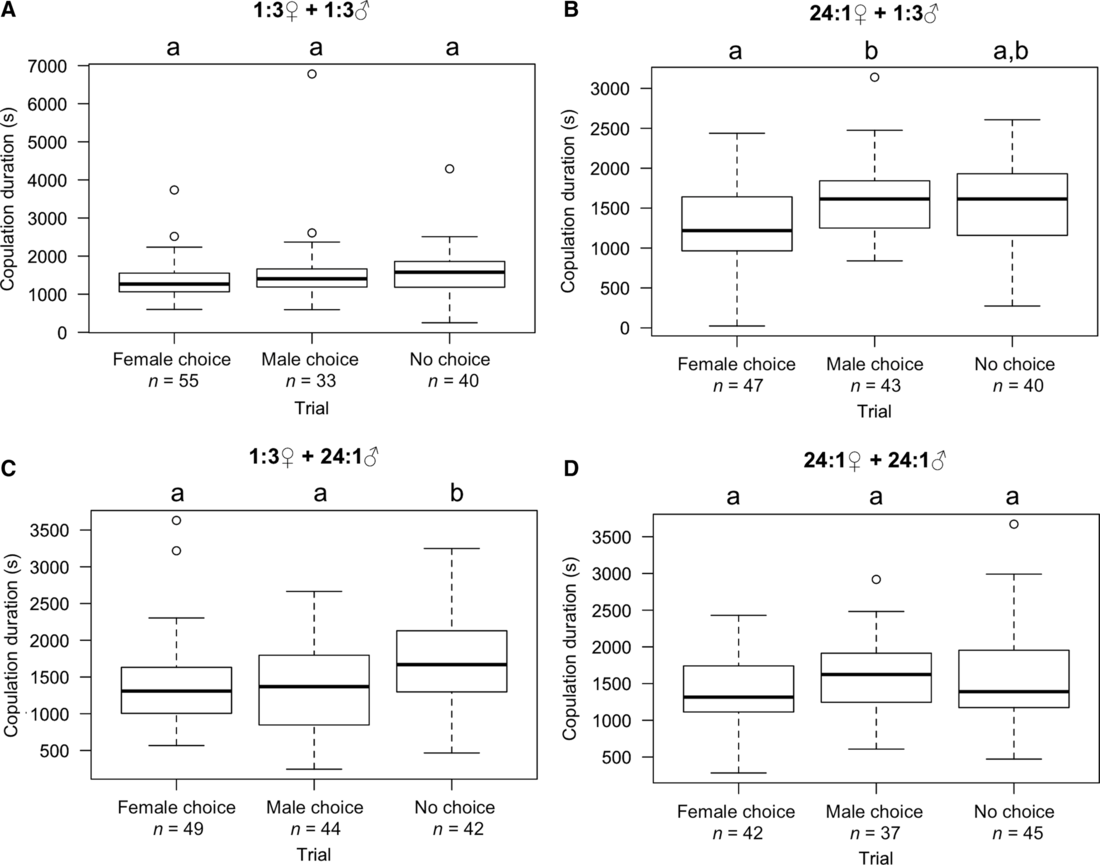
The nutritional developmental history of males and females did not significantly influence median copulation duration length in the no-choice assay. While the interaction between these factors had a P-value less than 0.05, no significant differences were detected between male/female nutritional developmental history combinations using post hoc tests (Table 4; $\tilde x$1:3 male + 1:3 female = 1557 seconds; $\tilde x$1:3 male + 24:1 female = 1668; $\tilde x$24:1 male + 1:3 female = 1614 seconds; $\tilde x$24:1 male + 24:1 female= 1390 seconds). In the female choice assay, a small but significant difference between female nutritional developmental history treatments was detected, where females reared on the 1:3 media mated for longer periods compared to females raised on 24:1 media ($\tilde x$1:3 = 1371 seconds, $\tilde x$24:1 = 1328 seconds; Table 4). In the male choice assay, neither male, nor female, nutritional developmental history treatment or their interaction were found to be significantly associated with variation in copulation duration (Table 4; $\tilde x$1:3 male + 1:3 female= 1404 seconds; $\tilde x$1:3 male + 24:1 female = 1614; $\tilde x$24:1 male + 1:3 female= 1369 seconds; $\tilde x$24:1 male + 24:1 female = 1624 seconds). The comparison of copulation durations between the choice and no-choice assays for each of the four nutritional developmental history combinations revealed a significant difference in duration between the choice and no-choice assays when the sexes differed in nutritional developmental history. In the case where 24:1 reared females mated with 1:3 reared males, those D. suzukii in the male choice assay mated for significantly longer than mating pairs in the female choice assay, but not when compared to those in the no-choice assay (Kruskall–Wallis χ 2 = 9.2333, df = 2, P = 0.0099; Fig. 3B). In the case where 1:3 reared females mated with 24:1 reared males, those D. suzukii in the no-choice assay mated significantly longer than those pairs in either of the mate choice assays (Kruskall–Wallis χ 2 = 10.7790, df = 2, P = 0.0046; Fig. 3C). There were no differences in the mean duration of copulations between trials when males and females had the same nutritional developmental history (1:3 reared females and 1:3 reared males, Kruskall–Wallis χ 2 = 4.8579, df = 2, P = 0.0881 Fig. 3A; 24:1 reared females and 24:1 reared males, Kruskall–Wallis χ 2 = 3.1526, df = 2, P = 0.2067, Fig. 3D).
Results of Scheirer–Ray–Hare test examining factors potentially influencing mating durations in no-choice, female choice, and male choice trials.

Note: Statistically significant effects are bolded for clarity.
NDH, nutritional developmental history.
Mating durations (in seconds) of Drosophila suzukii based on the nutritional developmental history combination of flies in the three different assays. In all assays, D. suzukii were raised on a low-quality diet (1:3 flies) or a high-quality diet (24:1 flies) to create two different phenotypes, creating four nutritional developmental history combinations. The nutritional developmental history combinations. A, 1:3 females with 1:3 males; B, 24:1 females with 1:3 males; C, 1:3 females with 24:1 males; D, 24:1 females with 24:1 males. Boxplot components as in Figure 2. Boxplots that are not sharing a letter have significantly different medians. Sample sizes are listed below the boxplots.
Egg production
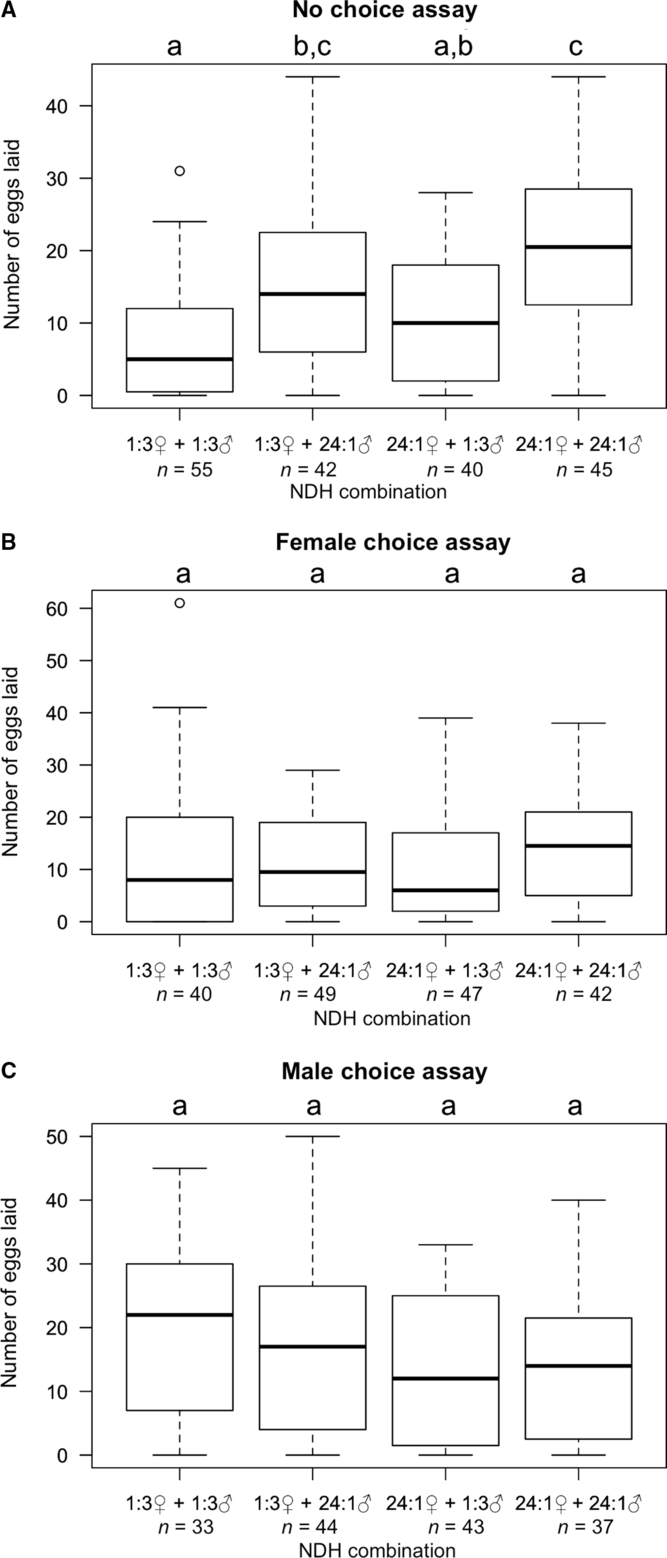
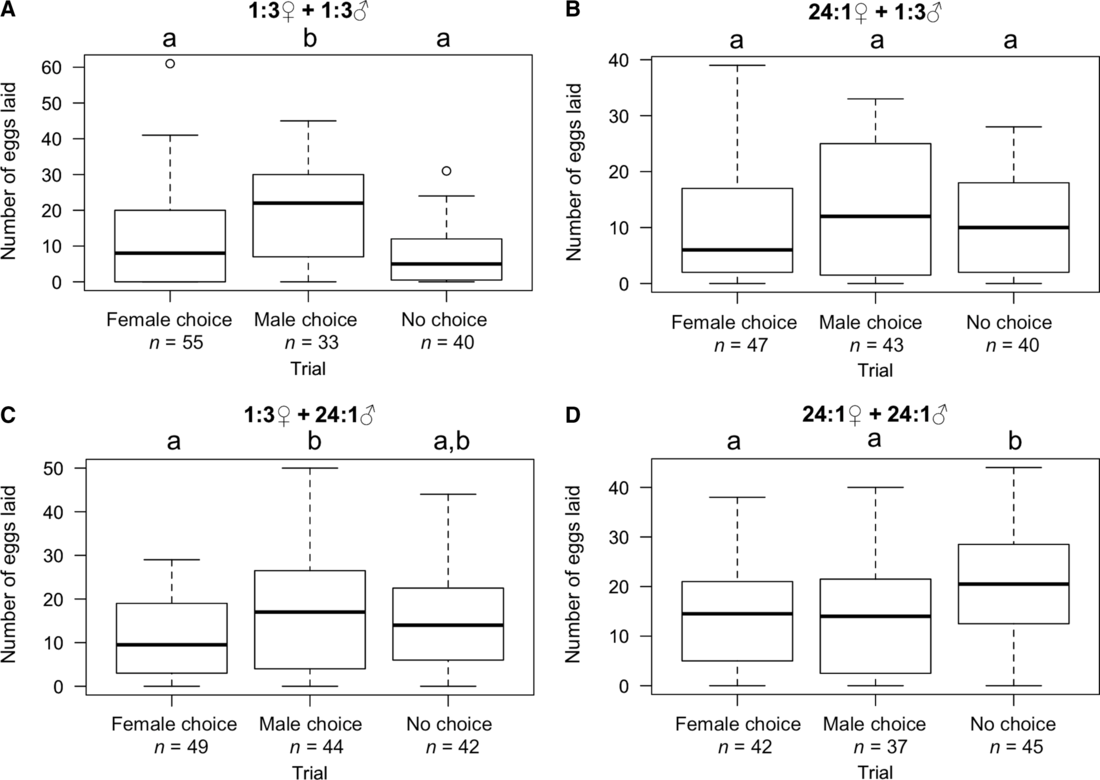
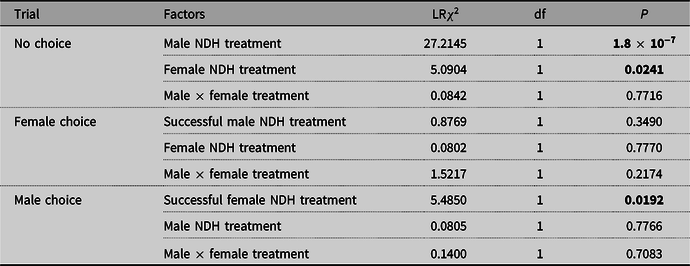
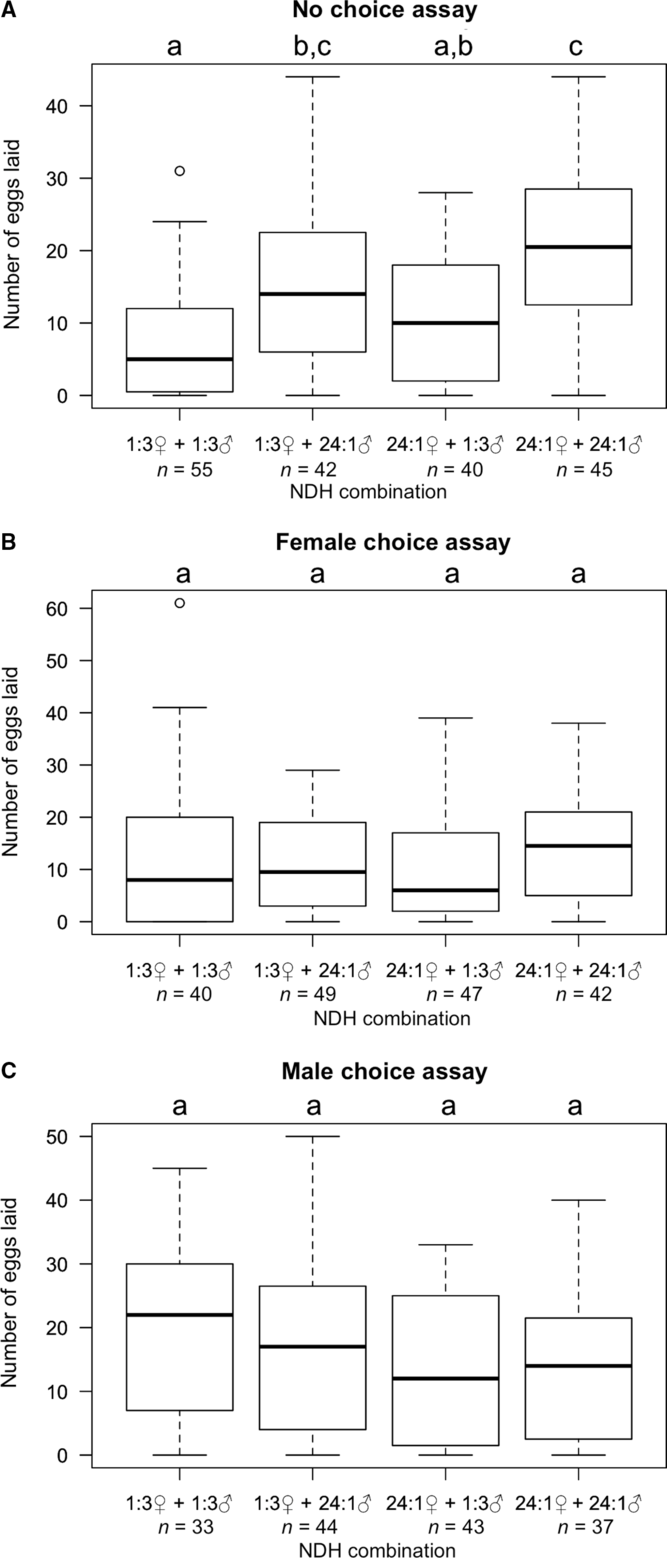
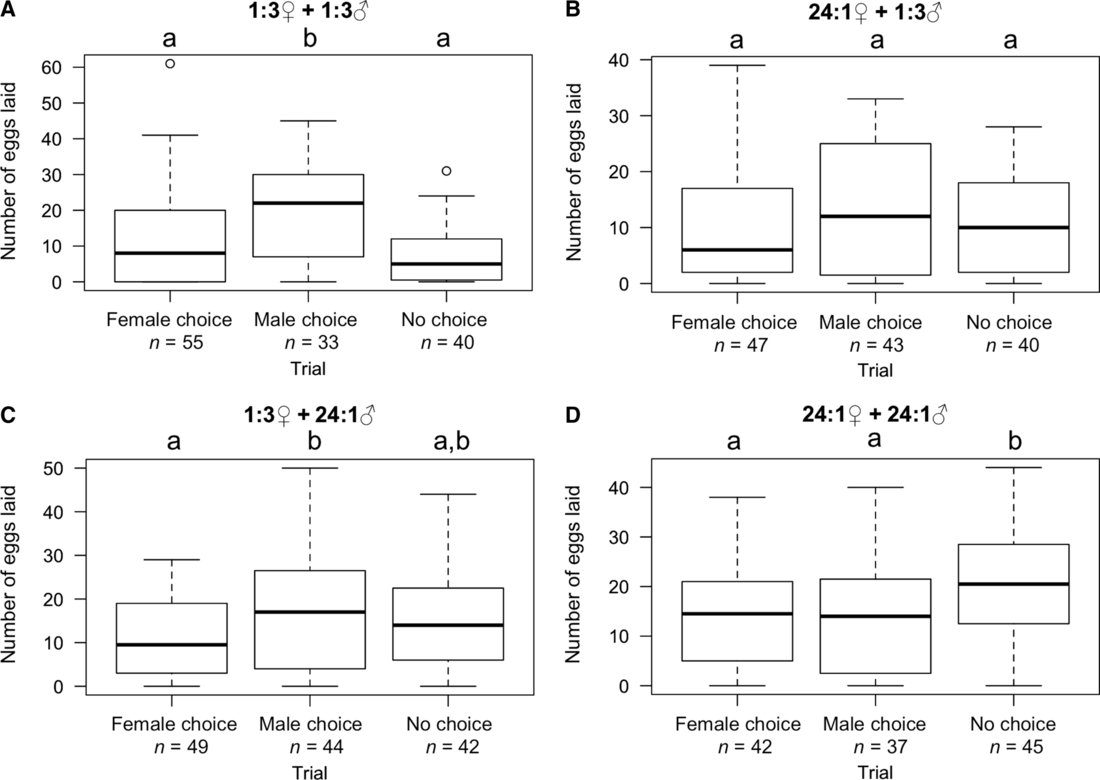
The nutritional developmental history of males and females both had significant (but not interactive) effects on total egg production in the no-choice assays (Table 5). When the male was from the 24:1 nutritional developmental history treatment, their mates produced an average of 17.67 eggs compared to the 9.16 eggs produced by the females mated to 1:3 reared males. The average number of eggs produced when the mother was reared on 24:1 media was 15.48, while 1:3 reared mothers laid on average 11.70 eggs. Together, this meant that when pairs of mates had both been raised on 24:1 media, they produced significantly more eggs than pairs where females were mated to 1:3 reared male (Fig. 4A). Focal D. suzukii nutritional developmental history treatment and nonfocal D. suzukii nutritional developmental history/colour combination were not significantly associated with variation in egg production in the female choice trials (Table 5; Fig. 4B). In the male mate choice assay, when the successful female originated from the 1:3 nutritional developmental history treatment, she produced on average 18.83 eggs, compared to the average of 13.61 eggs produced by the 24:1 females (Table 5, Fig. 4C). Three of the four nutritional developmental history combinations differed in total egg production in different ways between the choice and no-choice assays. When both mates had a 1:3 nutritional developmental history background, females in the male choice assay produced significantly more eggs than females in the other two assays (LRχ 2 = 15.566, df = 2, P = 0.0004; Fig. 5A). When both mates had a 24:1 nutritional developmental history background, females in the no-choice assays produced a greater number of eggs when compared to the other mate choice assays (LRχ 2 = 8.0933, df = 2, P = 0.0179; Fig. 5D). When 1:3 raised females mated with 24:1 raised males, females in the male choice assay produced, on average, significantly more eggs compared to those from the female choice assay (but not when compared to those in the no-choice assay; LRχ 2 = 7.500, df = 2, P = 0.0235; Fig. 5C). No significant differences in mean egg production between trials in which 24:1 raised females mated with 1:3 raised males (LRχ 2 = 2.1325, df = 2, P = 0.3443, Fig. 5B).
Results of generalised linear models examining factors potentially influencing total egg production in no-choice, female choice, and male choice trials.
Note: Statistically significant effects are bolded for clarity.
NDH, nutritional developmental history.
Egg production in Drosophila suzukii based on the nutritional developmental history (NDH) combination of flies in the three different assays. Boxplots of the number of eggs laid by females over a 26-hour period following mating. A, no-choice assay; B, female choice assay; C, male choice assay. For all assays, D. suzukii were raised on a low-quality diet (1:3 flies) or a high-quality diet (24:1 flies) to create two different phenotypes, creating four nutritional developmental history combinations. The nutritional developmental history combinations are 1:3 females with 1:3 males, 24:1 females with 1:3 males, 1:3 females with 24:1 males, and 24:1 females with 24:1 males. Boxplot components as in Figure 2. Boxplots that are not sharing a letter have significantly different means. Sample sizes are listed below the boxplots.
Egg production in Drosophila suzukii based on the nutritional developmental history combination of flies in the three different assays. Boxplots of the number of eggs laid by flies of a particular nutritional developmental history over a 26-hour period following mating. In all assays, D. suzukii were raised on a low-quality diet (1:3 flies) or a high-quality diet (24:1 flies) to create two different phenotypes, creating four nutritional developmental history combinations. A, 1:3 females with 1:3 males; B, 24:1 females with 1:3 males; C, 1:3 females with 24:1 males; D, 24:1 females with 24:1 males. Boxplot components as in Figure 2. Boxplots that are not sharing a letter have significantly different means. Sample sizes are listed below the boxplots.
Egg-to-adult offspring survivorship
On 24:1 media
In the no-choice assay, egg-to-adult survivorship on the 24:1 media was greater when the sire had also developed on the 24:1 media ($\tilde x$1:3 = 43.1% survival, $\tilde x$24:1 = 57.9% survival; Table 6). Similarly, there was a small, but statistically significant, difference in survival rates in the male choice assay when the successful female had also developed on the 24:1 media ($\tilde x$1:3 = 67.9% survival, $\tilde x$24:1 = 68.5% survival; Table 6). There was no significant effect of either independent variable, or their interaction in the female choice trial (Table 6).
Results of generalised linear models examining factors potentially influencing offspring survival on the 24:1 protein:carbohydrate media in no-choice, female choice, and male choice trials.

Statistically significant effects are bolded for clarity.
NDH, nutritional developmental history.
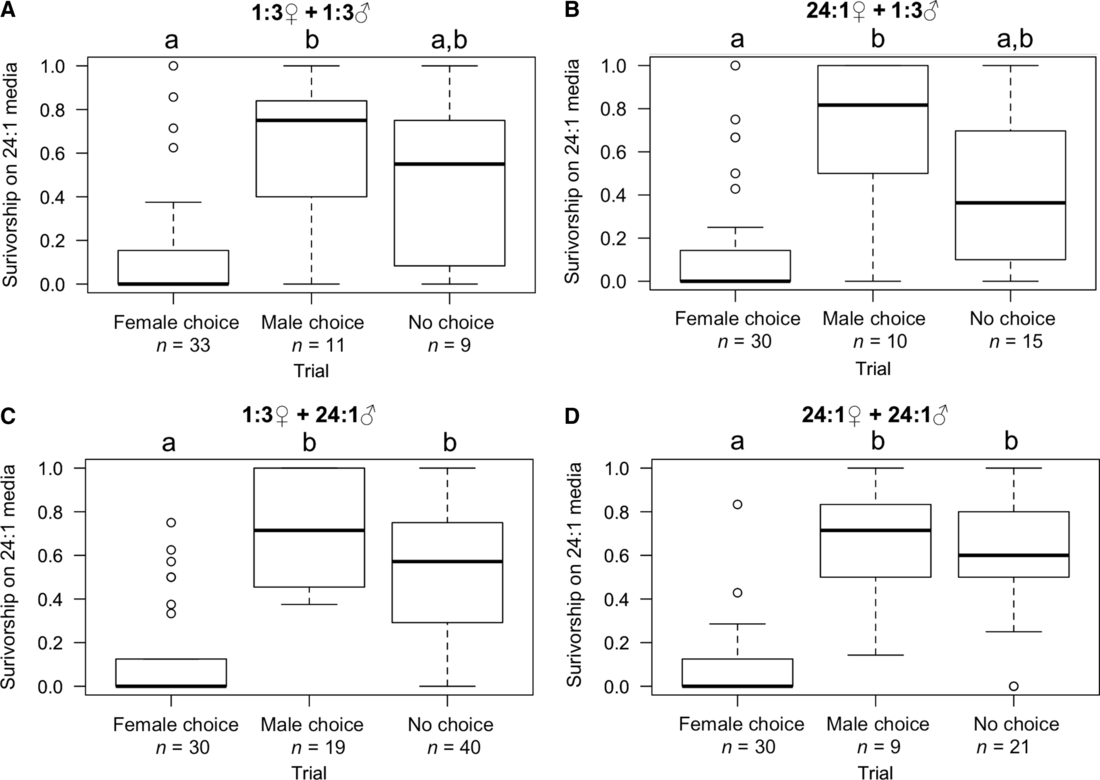
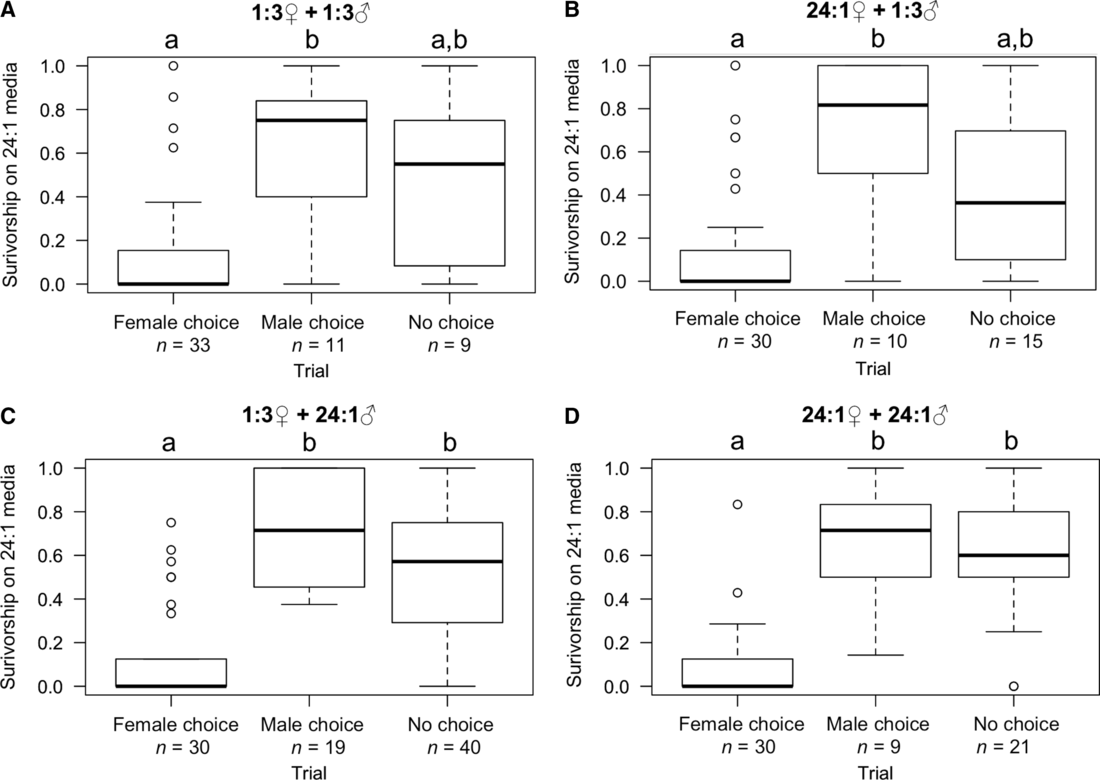
In all four nutritional developmental history combinations, comparisons between the choice assays and no-choice assays revealed significant differences between groups (Fig. 6). In the two combinations where females were mated to 1:3 reared males, a greater fraction of larvae survived to adulthood in the male choice assay than in the female choice assay (but not when compared to the no-choice assay; 1:3 reared males with 1:3 reared females, LRχ 2 = 14.864, df = 2, P = 0.0006, Fig. 6A; 1:3 reared males with 24:1 reared females, LRχ 2 = 15.828, df = 2, P = 0.0004, Fig. 6B). When females were mated to 24:1 reared males, offspring fared significantly better in both the no-choice assay and the male choice assay when compared to the female choice assay (24:1 reared males with 1:3 reared females, LRχ 2 = 41.732, df = 2, P = 8.672−10, Fig. 6C; 24:1 reared males with 24:1 reared females, LRχ 2 = 71.406, df = 2, P = 3.122×10⁻¹⁶, Fig. 6D).
Offspring survivorship on 24:1 media (high quality) in Drosophila suzukii based on the nutritional developmental history combination of flies in the three different assays. Boxplots of the number of larvae that successfully developed into adults on the media consisting of a protein:carbohydrate ratio of 24:1. In all assays, D. suzukii were raised on a low-quality diet (1:3 flies) or a high-quality diet (24:1 flies) to create two different phenotypes, creating four nutritional developmental history combinations. A, 1:3 females with 1:3 males; B, 24:1 females with 1:3 males; C, 1:3 females with 24:1 males; D, 24:1 females with 24:1 males. Boxplot components as in Figure 2. Boxplots that are not sharing a letter have significantly different means. Sample sizes are listed below the boxplots.
Survivorship on 1:3 media
There was greater egg-to-adult survivorship in the no-choice trial in vials where the male developed on the 24:1 media compared to when the male had developed on the 1:3 media ($\tilde x$1:3 = 2.2% survival, $\tilde x$24:1 = 12.1% survival; Table 7). Neither focal D. suzukii nutritional developmental history treatment, nonfocal fly combination, nor their interaction had a significant effect on egg-to-adult survivorship for larvae on the 1:3 media for either of the two mate choice assays (Table 7).
Results of generalised linear models examining factors potentially influencing offspring survival on the 1:3 protein:carbohydrate media in no-choice, female choice, and male choice trials.
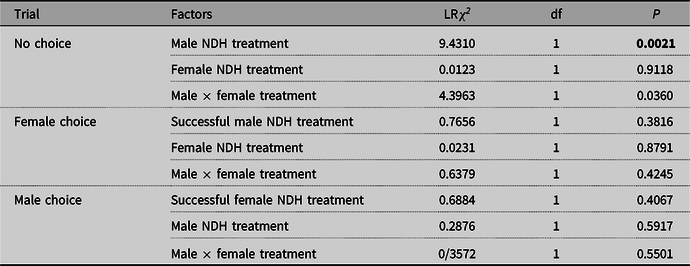
Note: Statistically significant effects are bolded for clarity.
NDH, nutritional developmental history.
There was no significant difference in the survivorship between trials of eggs developing on the 1:3 media either when both parents were from the 1:3 nutritional developmental history treatment (LRχ 2 = 1.2468, df = 2, P = 0.5361), when a 1:3 reared female was mated to a 24:1 reared male (LRχ 2 = 1.5601, df = 2, P = 0.4585), or when both parents were from the 24:1 nutritional developmental history treatment (LRχ 2 = 4.1674, df = 2, P = 1.1245). While our general linear models indicated a significant difference between trials when 24:1 reared females mated with 1:3 reared males (LRχ 2 = 17.442, df = 2, P = 0.0002), when we followed up with post hoc Tukey tests we did not identify any statistically significant difference between groups at the α = 0.05 family-wise level.
Discussion
Drosophila suzukii is a highly successful invasive pest species that threatens soft fruit crops worldwide (Bolda et al. Reference Bolda, Goodhue and Zalom2010). In this study, we investigated two understudied facets of their ecology and developmental biology. First, we explored whether nutritional developmental history influenced the expression of sexual behaviours in this species. Overall, we found that flies that developed on media with a 1:3 ratio of proteins:carbohydrates were less attractive and less choosy compared to flies that had developed on media with a 24:1 ratio of proteins:carbohydrates. This suggests that individuals in this species may assortatively mate as a result of their developmental environment, although not necessarily by design. We also found evidence that either females make suboptimal choices when selecting mates or that individuals vary their reproductive investment based on their current social circumstances. In the second part of this study, we examined the relationship between the outcome of mate choice and individual fitness variation in D. suzukii. Here, we found that individual nutritional developmental history had an impact on both egg production and offspring survival, but that this effect was highly influenced by social context, suggesting that mate choice is important to understanding variation in reproductive success in this species. Together, these results provide support that the nutritional environment experienced during the juvenile phase has important consequences for the lifetime reproductive success of individual D. suzukii males and females, which should proved useful in formulating future pest management plans.
Drosophila suzukii exhibit nutritionally induced phenotypes relevant to sexual selection and fitness
In all three of our experiments, adult D. suzukii showed differences in mean mating behaviours that were associated with their nutritional developmental history, which indicates that in this species behavioural traits are phenotypic plastic with respect to the nutrition characteristic of the developmental environment. Although the flies did not show a bias for types of mates based on their nutritional developmental history, we found evidence that suggests that males, which had developed on the (nutritionally poor) 1:3 medium, were generally less sexually attractive to females that had developed on a better quality 24:1 medium. This can be inferred from both the slower mating starting times and the shorter copulation durations in the female choice trials compared to the male choice trials where 1:3 reared males mated with 24:1 reared females. In D. melanogaster, both copulation latency (Ratterman et al. Reference Ratterman, Rosenthal, Carney and Jones2014; Tennant et al. Reference Tennant, Sonser and Long2014) and copulation duration (Bretman et al. Reference Bretman, Wetmancoat and Chapman2013) are under the joint control of both sexes, with females mating less readily and more briefly with less attractive males. The observation that the 1:3 reared males are apparently less attractive to 24:1 females is not too surprising considering that both Silva-Soares et al. (Reference Silva-Soares, Nogueira-Alves, Beldade and Mirth2017) and Young et al. (Reference Young, Buckiewicz and Long2018) observed longer egg-to-adult developmental times and/or smaller adult weights when flies developed in poorer quality (low protein) environments. In insects, it is well documented that diet can have important consequences for development (Carrel and Tanner Reference Carrel and Tanner2002; Raubenheimer and Simpson Reference Raubenheimer and Simpson2003; Maklakov et al. Reference Maklakov, Simpson, Zajitschek, Hall, Dessmann and Clissold2008; May et al. Reference May, Doroszuk and Zwaan2015; Lihoreau et al. Reference Lihoreau, Poissonnier, Isabel and Dussutour2016; Morimoto and Wigby Reference Morimoto and Wigby2016; Rodrigues et al. Reference Rodrigues, Martins, Balance, Broom, Dias and Fernandes2016) and can directly influence traits associated with reproductive success. Slower developmental times and smaller average adult sizes in insects are often the result of developing on a lower quality diet and are correlated with lower reproductive potential (Credland et al. Reference Credland, Dick and Wright1986; Bonduriansky Reference Bonduriansky2001; Pitnick and Garcia-Gonzalez Reference Pitnick and Garcia-Gonzalez2002; Amitin and Pitnick Reference Amitin and Pitnick2007). In the no-choice assay, we observed that egg production differed between nutritional developmental history treatments: when females mated with a 1:3 reared male, they experienced reduced total egg production. However, these differences were not observed when males and females had the ability to choose between two potential mates. We hypothesise that egg production was lower in the no-choice versus the choice mating assays because the social context either has a large influence on (a) the reproductive investment between certain phenotypes or (b) the reproductive potential between certain phenotypes (discussed below). No significant differences were observed in offspring survivorship in terms of the nutritional developmental history combination of the mated pairs in any of the three assays. The results on survivorship, however, should be treated with some caution as each replicate (individual female) was represented by a very small number of surviving offspring (average of 0.86 surviving offspring per female or approximately 13% survival), which was much lower than what was expected based on the 50% mortality on the low-quality diet that we had previously observed (Young et al. Reference Young, Buckiewicz and Long2018). One possible reason for the low larval survivorship in our experiments could be that the low numbers of larvae in the vials (on average 3.45 eggs/vial) hindered the process of larval “working” or softening the hard agar-based media and access to the essential nutrients therein (reviewed by Ashburner et al. Reference Ashburner, Golic and Hawley2005). In addition to differences in attractiveness and/or vigour, we also observed a difference in the degree of choosiness exhibited by flies based on their nutritional developmental history. Flies from the 1:3 nutritional developmental history tended to be less “choosy” than flies of a 24:1 nutritional developmental history. This trend was particularly obvious in the female choice assay, where, in comparison to the 24:1 reared females, 1:3 reared females mated significantly sooner and in greater numbers, suggesting that 1:3 females are more willing to mate as well as possibly forgoing a more thorough assessment of male quality before deciding to mate. A decrease in choosiness among 1:3 reared flies could also be seen in the earlier start times in the no-choice assay between 1:3 reared males and 1:3 reared females in comparison to 1:3 reared flies that mated with 24:1 reared flies. If 1:3 reared flies are in a relatively poor physiological state, a condition-dependent choosiness strategy could provide a number of fitness advantages. If the process of discriminating between potential mates is costly (e.g., time spent sampling takes away from time spent foraging and ovipositing; energy needed to perceive and interpret cues from prospective mates, etc.), then D. suzukii in worse condition may not be able to pay the costs of being choosy and may instead adopt a more indiscriminate mating strategy (Cotton et al. Reference Cotton, Small and Pomiankowski2006). As seen in our fecundity analysis, it appears that in D. suzukii, choosiness may be context dependent, as 1:3 reared D. suzukii appeared to incur fitness losses more when they did not have a choice of mates. We discuss this point and its potential implications for the management of this species below.
Potential for assortative mating amongst low-quality individuals in Drosophila suzukii
While we did not observe assortative mating based on nutritional developmental history in the three different mate choice assays, the combination of males being both less attractive and females being less choosy when developing on the protein poor 1:3 media could potentially result in these D. suzukii assortatively mating. Furthermore, since 1:3 reared males mated more with 1:3 reared females in the male choice assay, they may also prefer females from the same nutritional developmental history, thus increasing the likelihood of assortative mating arising in certain situations (e.g., in social environments where males are less common than females). The other (not exclusive) possibility for why 1:3 reared males mated more frequently with 1:3 reared females could be because 1:3 reared females were also less choosy in who they mated with compared to the 24:1 females. Assortative mating is a relatively common phenomenon in sexually reproducing species and has the potential to result in enhanced rates of local adaptation (Bateson Reference Bateson1983). From our fecundity and larval survival analyses, this does not appear to be the case for the 1:3 reared D. suzukii, at least in the no-choice assay, as the total number of eggs produced from matings between 1:3 reared males and females was significantly lower than the number of eggs produced from matings between 1:3 reared D. suzukii and 24:1 reared D. suzukii. However, it is possible that any indirect benefit gained from assortatively mating may have been offset by the direct costs of being of lower quality. Although we did not observe statistically significant evidence of assortative mating between the 24:1 D. suzukii, it does appear, at least in the no-choice assay, that their mating yielded mutual benefits to their offspring production.
Females appear to make poor mate choices and/or flies vary their reproductive investment based on their social context
Our analysis of fecundity and offspring survival in relation to the nutritional developmental history combination revealed that D. suzukii females experienced a reduction in total fecundity and offspring survival when they had a choice of mates. One possible explanation for this could be that, simply put, female D. suzukii make poor mate choices. Nonoptimal mate choice is not uncommon among insects and particularly among Drosophila species (Parker 1979; Gowaty Reference Gowaty and Gowaty1997; Gowaty and Buschhaus Reference Gowaty and Buschhaus1998; Holland and Rice Reference Holland and Rice1998; Gavrilets et al. Reference Gavrilets, Arnqvist and Friberg2001). Rather than provide an honest signal of quality, male ornaments may actually manipulate or coerce females into choosing them at the advantage of the fitness of the male but to the detriment of the fitness of the female (Arnqvist Reference Arnqvist2006). Sperm are relatively less costly to produce compared to eggs, and thus, a sexual conflict may arise when males gain more benefit from mating with many individuals instead of a few high-quality individuals, with males evolving dishonest strategies to accomplish this (Kokko et al. Reference Kokko, Brooks, Jennions and Morley2003). It should be noted, however, that females may gain fitness benefits in other ways not measured in our experiments (e.g., indirect fitness benefits manifested as offspring with superior reproductive success), which requires further investigation in future studies. Alternatively, another possibility for lower egg numbers and reduced offspring survival when females choose mates is that females may allocate their reproductive investments differently based on their current social context. In the female choice trial, for example, females did not have to compete for male attention and also had more than one male available to sire her offspring. As such, females may not experience a competitive pressure to invest into producing lots of offspring sired by one male and instead adopt a strategy of producing moderate numbers of offspring with different sires. The benefits of a mixed paternity are potentially numerous, and where precopulatory mate choice cues are unreliable or absent, polyandry in females may even be favoured by selection (reviewed in Jennions and Petrie Reference Jennions and Petrie2000). Interestingly, we did find some potential (and admittedly highly speculative) evidence that females in the choice experiment may have been intending to “share” their brood with the two males present and invest less per mating (so-called “bet-hedging,” see Garcia-Gonzalez et al. Reference Garcia-Gonzalez, Yasui and Evans2015). Specifically, we observed that 24:1 reared females mated for significantly shorter periods of time with males in the female choice assays than with the males in the male choice assay. This was somewhat surprising as in D. melanogaster there is strong pattern of longer copulation durations when multiple males are present (Friberg Reference Friberg2006; Bretman et al. Reference Bretman, Fricke, Hetherington, Stone and Chapman2010) presumably in response to the greater risk of sperm competition. This may reflect female D. suzukii taking an active role in early termination of copulations (see Bretman et al. Reference Bretman, Wetmancoat and Chapman2013). Although no significant difference in egg production was observed in the 24:1 females between the female and male choice trials, survival of the offspring was significantly worse on the 24:1 media when females had a choice of more than one mate. Furthermore, 1:3 females laid more eggs in total when they did not have a choice of mates with more of those offspring surviving on the 24:1 media. Similarly, males may also be bet-hedging by attempting to mate with multiple females rather than “place all of their eggs into the same basket,” so to speak (e.g., in the male choice assay; see Pitnick and Markow Reference Pitnick and Markow1994). We did not find evidence of this in our experimental results, but this may be due to the fact that males do not need to reduce copulation durations between females in order to provide an equal “share” of sperm (at least in our experimental context). Although we did not deliberately set out to measure if flies mated with both flies in the vial or not, we did observe approximately 19–30% of the males mating with the second female during the course of the male choice trial. Alternatively, it is also possible that, instead of females allocating fewer progeny to each mate (in the female choice assay), females may instead be allocating more progeny to the one available male sire (in the male choice assay). The occurrence of female–female competition has been found to influence the intensity of sexual selection in many species (Kvarnemo and Ahnesjo Reference Kvarnemo and Ahnesjo1996), which may also influence parental investment. This may also be the case for the males (Kvarnemo and Ahnesjo Reference Kvarnemo and Ahnesjo1996).
Opportunity for mate choice and its consequences for Drosophila suzukii mating and fitness
In our studies with D. suzukii, we found that the ability to choose mates resulted in differences between treatments in both their mating behaviour and their individual reproductive success. When females chose to mate with a (low-quality) 1:3 reared male, the total number of eggs females produced, on average, was significantly greater compared to when females were “forced” (in the no-choice environment) to mate with a 1:3 reared male. Whether this was because females were (a) able to avoid deleterious fitness consequences from mating with a poor-quality male in the choice environment or because (b) females simply invested less into egg production due to lower levels of male stimulation in the no-choice assay is a question that remains unanswered. Either way, this suggests that social circumstances influence the fitness of individual D. suzukii when the mate has a low-quality phenotype. Mate choice often has fitness benefits (see Reference Jennions and PetrieJennions and Petrie 2000; Kokko et al. Reference Kokko, Brooks, Jennions and Morley2003). For instance, larvae exhibit better competitive success when they came from parents who were given the opportunity to choose their mates (Partridge Reference Partridge1980; Long et al. Reference Long, Agrawal and Rowe2012). Females have also been documented to invest in offspring in accordance to the perceived attractiveness of their mate, with greater attractiveness of mates receiving greater parental investment (Bateson Reference Bateson1983; Horváthová et al. Reference Horváthová, Nakagawa and Uller2012). We found that, in mate choice situations, females appear to make poor mating decisions and/or D. suzukii invest reproductive efforts differently based on their social context. This was demonstrated by the fewer total number of eggs that were laid and the lower survivorship of offspring in the female choice trials compared to the no-choice trials. Our experiments also reveal that the social context is associated with differences in offspring production. When we compared total progeny among the apparently choosier, more attractive, higher quality 24:1 phenotypes, assortative pairs of mated surprisingly produced fewer total progeny in both the female and male choice assays compared to the no-choice assay. This potentially suggests that higher quality individuals may either adjust their reproductive efforts in choice situations where there are more potential mating opportunities or make poor mate choices (e.g., with a higher chance of being attracted to dishonest cues about mate quality) and is an interesting subject for future research.
Consequences of Drosophila suzukii mate choice and fitness: an interaction between phenotype and social context
The differences in D. suzukii mating behaviour and fitness, among and within the three different experimental assays, suggest that population growth rate in this species will depend on the specific interaction between the types of adult phenotypes present (high or low quality) and their social environment (no-choice, male choice, and female choice). This has implications for the management of this pest as populations in different habitats may experience different growth rates. If we consider populations consisting of both low- and high-quality phenotypes (due to differences in nutritional developmental history) and in which potential mates and competitors are scarce (e.g., as in initially small populations), the nutritional developmental history of the D. suzukii is likely to have the greatest impact on total egg production, with females mating with low-quality males experiencing the greatest fecundity losses. Thus, in populations consisting of only one phenotype, those consisting of all high-quality individuals would be most likely to produce more offspring and grow faster. In the situations where there are mixed phenotypes of differing quality and potential mates and competitors are both abundant (e.g., as in a large population), nutritional developmental history may become less of a factor in terms of fitness variation and, instead, female choice may play a more important role in determining population growth rates. In the case of populations where females have the opportunity to choose their mates, growth rates may be low, as we found females made poor mate choices and/or invested less into the number and/or quality of their offspring. However, the effect of female competition on reproductive investment should still be considered in these populations as it could counteract the reduced egg production from poor female choice/mating investment. Ultimately more research is needed to fully understand how D. suzukii females and males behave in multi-female multi-male social environments. In situations where males can exhibit mate choice, populations may experience relatively greater growth rates, as males appear to make more adaptive mating decisions, and/or females in such social contexts investing more generously in the number and quality of offspring they produce. Finally, a population of mixed phenotypes that is highly male-biased may experience a relatively moderate increase in offspring numbers based on the fact that while males may be making fitness-enhancing mate choices, these benefits may be offset by females modifying their investment as part of a strategy to increase mixed paternity.
There are a couple of important lessons that can be drawn from the results of our assays when considering future plans for the control of this pest species. First of all, the fact that D. suzukii exhibits phenotypic plasticity with consequences for sexual selection and fitness implies that population growth rate varies between habitat types. For example, areas where crops and/or surrounding hosts (e.g., wild fruits) that are high in carbohydrates and low in protein (Young et al. Reference Young, Buckiewicz and Long2018) may experience lower population growth rates due to reduced fecundity. Furthermore, the promotion of mixing “low quality” D. suzukii with high-quality D. suzukii could help reduce population growth rates. Overall, our results bode well for the use of the sterile insect technique (see Klassen and Curtis 2005) as releasing large number of sterile males in the environment could cause females to adopt the “mixed-paternity strategy” described earlier, which would result in a reduction in egg production both due to mating with infertile D. suzukii and through females moderating their reproductive output.
Conclusions
The results of our study provide preliminary evidence of nutritionally associated phenotypic plasticity in D. suzukii and that the phenotypes of adults developing on protein-poor/carbohydrate-rich diets tend to be less reproductively successful as adult individuals. Male D. suzukii that develop on lower quality media were not only less attractive to potential mates but they also imparted negative fitness consequences to the females that mated with them in no-choice environments. Females raised on lower quality media were also less choosy when it came to choosing mates, potentially indicative of a “condition-dependent” mating strategy, which could also result in “inadvertent” assortative mating between male and female low-quality D. suzukii. Assortative mating could have negative implications to female fitness insituations where a choice of males is not typical. Integrating these trends suggests that mate choice in D. suzukii depends on the combination of the phenotypes and the social construct within the local vicinity at any given time. Furthermore, the choice of mates, in itself, has important fitness consequences that can be both beneficial and deleterious depending on the phenotype combination of mating pairs. If we wish to obtain a more thorough depiction of mating behaviour in this species, future research will also need to look at behaviours and fitness of individuals in multi-female multi-male contexts and through the measurement of other potential indirect and direct benefits not measured here.
Acknowledgements
We would like to thank the members of the Long Laboratory for their assistance with fly-pushing and larvae wrangling. Dr. Scott Ramsay, Dr. Jennifer Baltzer, and Natasha Gallo are thanked for their helpful feedback. T.A.F.L. was funded with a Natural Sciences and Engineering Research Council Discovery grant. This work was conducted at Wilfrid Laurier University, which exists on the traditional territory of the Neutral, Anishnawbe, and Haudenosaunee peoples.
Competing interests
The authors declare no competing interests.
Ethics
This study did not require approval from an ethics committee.
Supporting Data
All data analysed in this manuscript is archived in Data Dryad https://doi.org/10.5061/dryad.n8pk0p2s3.