Introduction
Hydatidosis is a condition of livestock and humans that arises from eating infective eggs of the cestode Echinococcus granulosus. Dogs are the primary definitive hosts for this parasite, with livestock acting as intermediate hosts and humans as aberrant intermediate hosts. Distribution of hydatidosis is considered to be worldwide but is higher in developing countries, especially in rural communities where there is close contact between dogs and various domestic animals (Eckert & Deplazes, Reference Eckert and Deplazes2004). There are several reports from countries of the Middle East, including Iran, which found cattle, sheep and goats infected with hydatid cysts (Ansari-Lari, Reference Ansari-Lari2005; Ahmadi & Meshkehkar, Reference Ahmadi and Meshkehkar2010). However, there are few available data at international level concerning the infection rate in livestock from Khorasan province (Borji & Parandeh, Reference Borji and Parandeh2010). This study was undertaken to estimate the prevalence and possible trends of hydatidosis in livestock of Mashhad, using abattoir data.
Materials and methods
This study was based on a retrospective survey covering data collected over a 6-year period (20 March 2004 to 19 March 2010) from Mashhad abattoir in Khorasan province, in north-eastern Iran. Meat-inspection records from Mashhad abattoir were used as the source of data from which prevalence of liver and lung condemnations due to hydatidosis were extracted on a monthly basis.
Data were analysed using the SPSS software package, version 16 (SPSS Inc., Chicago, Illinois, USA). A 6-year-period trend was analysed using the chi-square test and the odds ratio was calculated (odds of condemnation due to hydatidosis in successive years). The seasonal pattern was investigated with the chi-square test. P values ≤ 0.05 were considered significant.
Results
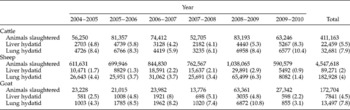
Over the 6-year study period, 5,131,485 animals (411,163 cattle; 4,547,618 sheep; 172,704 goats) were slaughtered in the surveyed abattoirs and 388,399 (7.5%) livers and 1,139,529 (22.2%) lungs were condemned. Hydatidosis was responsible for 4% and 6.5% of total livers and lungs inspected, respectively. Of the cattle livers and lungs inspected over the survey period, 5.5% and 7.9% were condemned due to hydatid cyst, respectively. The corresponding values for sheep livers and lungs were 2% and 4%, and for goat livers and lungs 4.5% and 7.8%, respectively (table 1). The annual prevalence of liver condemnations due to hydatidosis was increased from 4.8% in 2004–2005 to 8.3% in 2009–2010 in cattle, while in sheep and goats prevalence decreased from 1.7% and 2.5% in 2004–2005 to 0.9% and 2.2% in 2009–2010, respectively. The corresponding figures for lung condemnation due to hydatidosis were relatively higher than liver, increasing from 8.4% to 10.4% in cattle but declining from 4.4% and 4.3% in 2004–2005 to 1.4% and 3.1% in 2009–2010 in sheep and goats, respectively (table 1).
The total number of animals slaughtered and livers and lungs condemned (%) due to hydatid disease during the period 20 March 2004 to 19 March 2010.

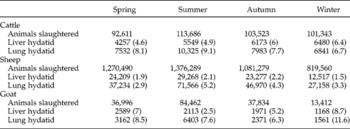
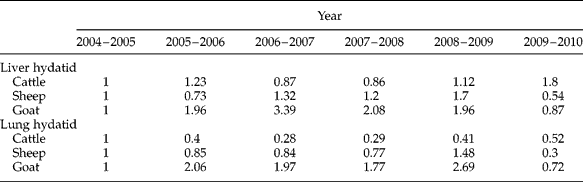
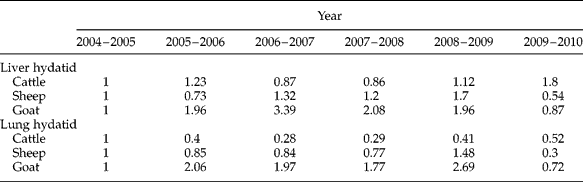
As shown in table 2, hydatidosis as a reason for cattle and sheep liver condemnation was more prevalent in winter and autumn, respectively, whereas lung condemnations were higher in summer. Liver and lung condemnations were higher in winter for goats. According to the odds ratio, it seems that prevalence of liver hydatidosis in cattle was increased in 2005–2006, 2008–2009 and 2009–2010 as compared with 2006–2007 and 2007–2008, while in sheep it was increased in 2006–2007, 2007–2008 and 2008–2009, and in goats it was increased during all years except in 2009–2010. In cattle and sheep, lung hydatidosis decreased during all years except in 2008–2009 for sheep, but increased for goats during all years except in 2009–2010 (table 3).
Seasonal prevalence rate (%) of hydatidosis in animals slaughtered during the period 20 March 2004 to 19 March 2010.

Adjusted odds ratios (ORs) for number of liver and lung condemnations due to hydatidosis, after controlling for seasonal variation, during the period 20 March 2004 to 19 March 2010.
Discussion
Hydatidosis is an important issue from public health and economic perspectives worldwide due to its zoonotic nature (Eckert & Deplazes, Reference Eckert and Deplazes2004). Therefore, it is justifiable to find reliable data to monitor epidemiologic aspects of hydatidosis and prepare baseline data for future comparison.
In the present study, the prevalence of E. granulosus infection in the slaughtered livestock was 6.7% in cattle, 3% in sheep and 6.1% in goats. These amounts, in general, are lower than values reported from other west Asian countries, such as Saudi Arabia (Ibrahim, Reference Ibrahim2010), Iraq (Saeed et al., Reference Saeed, Kapela, Saidaa, Willinghama and Nansena2000) and Jordan (Kamhawi et al., Reference Kamhawi, Hijjawi, Abu-Gazaleh and Abbass1995). Infection rates were also lower than previously reported from other regions of Iran (Oryan et al., Reference Oryan, Moghaddar and Gaur1994; Daryani et al., Reference Daryani, Alaei, Arab, Sharif, Dehghan and Ziaei2007), but higher than we previously reported in the north of Khorasan province (Borji & Parandeh, Reference Borji and Parandeh2010). There are also some other reports, indicating lower infection rates (Ansari-Lari, Reference Ansari-Lari2005; Arbabi & Hooshyar, Reference Arbabi and Hooshyar2006; Ahmadi & Meshkehkar, Reference Ahmadi and Meshkehkar2010).
These differences in the prevalence of hydatidosis are not very clear, but may be due to the fact that Mashhad is a tourist area with a high demand for meat, therefore slaughtered animals are from different locations within and outside the district, while animals slaughtered in other reported areas were from within the locality. Other factors, such as differences in environmental conditions that are conducive for the perpetuation of the parasite, abundance of infected definitive hosts, livestock husbandry, stocking rates, nature of the pasture and grazing patterns of animals may contribute to this variation.
Unfortunately, although prevalence of echinococcosis is known to be highly dependent on the age of the potential host (Torgerson et al., Reference Torgerson, Williams and Abo-Shehada1998), the abattoir records analysed in the present survey had no data about age of the animals at slaughter. Old animals always have the highest prevalence and abundance of hydatid cysts, but are often not presented for slaughter at the abattoir as they may be purchased for a very low price and hence are slaughtered for home consumption.
Present data showed significant seasonal variation for prevalence of liver and lung condemnation due to hydatidosis (table 2). It should be noted that differences could be confounded by age as, for example, in sheep there is a distinct breeding season and consequently young animals for meat may be presented at abattoirs at certain times of the year. Seasonal differences in prevalence may be the reason for seasonal differences in the age profile of animals presented for slaughter, rather than any differences in transmission patterns, especially since echinococcosis is a chronic infection, with sheep remaining infected for the rest of their lives. Therefore, it is difficult to detect any real trend of seasonal effects.
Interestingly, over the 6-year study period, E. granulosus infection appeared to become higher in goats brought to slaughter as compared to sheep. This is unusual because sheep normally have a higher prevalence. This is due to the fact that sheep are grazing animals and have a higher infection rate than goats who are browsers (eggs are more likely to be found at lower levels in the foliage). This is analysed and discussed by Torgerson et al. (Reference Torgerson, Williams and Abo-Shehada1998). In our data, on average, goats were older than sheep when presented for slaughter to the abattoir, and this could explain the difference between these two species. Alternatively, there may be different genotypes of echinococcus circulating. The G1 genotype (sheep strain) is usually found in sheep. However, a report from Greece suggested that the G6/7 genotypes are more likely found in goats (Varcasia et al., Reference Varcasia, Canu, Kogkos, Pipia, Scala and Garippa2007). Present genetic evidence suggests that these genotypes may actually be two different species of echinococcosis, which may well explain the differences in transmission pattern. However, to the present time, studies of the genotypes in Iran have isolated only the G1 strain in both sheep and goats (Rostami Nejad et al., Reference Rostami Nejad, Nazemalhosseini Mojarad, Nochi, Fasihi Harandi, Cheraghipour and Mowlavi2008). Similarly, only the G1 genotype has been isolated in humans in Iran (Kia et al., Reference Kia, Rahimi, Sharbatkhori, Talebi, Fasihi Harandi and Mirhendi2010). Further investigations are needed to identify the genotype of echinococcosis in goats in this region.
In conclusion, in the present study, using abattoir-based data, we found that hydatidosis is prevalent in animals slaughtered at Mashhad abattoir. This survey has helped to illustrate the usefulness of meat inspection records in monitoring disease situations and demonstrating possible secular trends. However, it must be remembered that the actual prevalence of the disease in slaughtered animals may be underestimated due to inadequate meat inspector manning levels, fast slaughter rates and substandard training. The present survey provides preliminary baseline data for the future monitoring of these potentially important parasitic diseases.
Acknowledgements
This study was supported by Ferdowsi University of Mashhad.