Introduction
The studies of gamete preservation combined with the development of assisted reproductive techniques (ARTs) are powerful conservation tools for endangered wild felids (Wildt et al., Reference Wildt, Comizzoli, Pukazhenthi and Songsasen2010). Although ejaculated spermatozoa from live animal are normally used for ARTs in felid species (Zambelli & Cunto, Reference Zambelli and Cunto2006), preservation and use of testicular tissue are sometimes the only option in cases of unexpected death or castration for medical reasons. The spermatozoa are finally extracted from testicular tissues for intracytoplasmic sperm injection (ICSI). However, excessive spermatozoa are normally discarded after ICSI. Therefore, further preservation of these spermatozoa would be beneficial.
Cold storage (~4°C) is preferred for short-term preservation in several species including human (Zavos et al., Reference Zavos, Goodpasture, Zaneveld and Cohen1980; Dondero et al., Reference Dondero, Rossi, Delfino, Imbrogno, Cannistra and Mazzilli2006), dog (England & Ponzio, Reference England and Ponzio1996) and cat (Siemieniuch & Dubiel, Reference Siemieniuch and Dubiel2007) spermatozoa because cold storage maintains a better sperm quality, such as DNA integrity (Riel et al., Reference Riel, Yamauchi, Huang, Grove and Ward2011) when compared with cryopreservation. Cat spermatozoa can be refrigerated within intact testes for up to 1 week without significant effects on DNA integrity while plasma membrane integrity decreased over time (Buarpung et al., Reference Buarpung, Tharasanit, Comizzoli and Techakumphu2012). To maintain sperm functionality, testicular spermatozoa should be preserved within medium that has protective effects on sperm structure and functions including sperm plasma membrane and DNA integrity. Although membrane integrity is not an essential sperm parameter for ICSI, an intact sperm membrane would protect the spermatozoa against DNA deterioration from prolonged exposure to the extracellular environment (Tateno et al., Reference Tateno, Kimura and Yanagimachi2000).
Egg yolk-based extender, widely used for semen freezing, has been applied for cold storage of cat ejaculated and epididymal spermatozoa, to protect spermatozoa from cold shock injury (Hermansson & Axnér, Reference Hermansson and Axnér2007; Siemieniuch & Dubiel, Reference Siemieniuch and Dubiel2007; Gañán et al., Reference Gañán, Gomendio and Roldan2009). However, egg yolk-related components have been variable from batch to batch and are well accepted as important sources of infections such as virus and bacteria contamination. To overcome these problems, several compounds such as bovine serum albumin (BSA) (Matsuoka et al., Reference Matsuoka, Imai, Kohno and Fukui2006), skimmed milk (Abe et al., Reference Abe, Lee, Sano, Akiyama, Yanagimoto-Ueta, Asano, Suwa and Suzuki2008) and soybean lecithin (Aires et al., Reference Aires, Hinsch, Mueller-Schloesser, Bogner, Mueller-Schloesser and Hinsch2003; Vick et al., Reference Vick, Bateman, Lambo and Swanson2012) have been used to preserve sperm quality during preservation. In addition to egg yolk-derived freezing extender, basic media, such as potassium simplex optimization medium with amino acids (KSOMaa), HEPES-CZB, K+-rich nuclear isolation medium (NIM) and phosphate-buffered saline (PBS) supplemented with BSA have been successfully used for cold storage of mouse spermatozoa, in terms of sperm viability and fertilizing ability (Van Thuan et al., Reference Van Thuan, Wakayama, Kishigami and Wakayama2005; Li et al., Reference Li, Mizutani, Ono, Terashita, Jia, Shi and Wakayama2011). From previous studies, testicular cells have been well preserved in Dulbecco's phosphate-buffered saline (DPBS, balanced salt solution) and complex culture media such as medium 199 (M199), Dulbecco's modified Eagle's medium (DMEM), Leibovitz L15 (L15), Ham's F12 and HypoThermosol solution-FRS (HTS) with varying degrees of success (Jahnukainen et al., Reference Jahnukainen, Ehmcke, Hergenrother and Schlatt2007; Zeng et al., Reference Zeng, Snedaker, Megee, Rathi, Chen, Honaramooz and Dobrinski2009; Yang & Honaramooz, Reference Yang and Honaramooz2010; Yang et al., Reference Yang, Steeg and Honaramooz2010). However, the effects of these media in preserving testicular spermatozoa have not been studied. The advantages of BSA in protecting sperm membrane integrity have been reported in dog (Risopatron et al., Reference Risopatron, Catalan, Miska, Schill and Sanchez2002), mouse (Van Thuan et al., Reference Van Thuan, Wakayama, Kishigami and Wakayama2005; Li et al., Reference Li, Mizutani, Ono, Terashita, Jia, Shi and Wakayama2011), bull (Nang et al., Reference Nang, Osman, Budin, Ismail, Jaffar, Mohamad and Ibrahiml2012) and ram (Matsuoka et al., Reference Matsuoka, Imai, Kohno and Fukui2006). A study also found that development of ICSI embryos could be improved when mouse spermatozoa was preserved in medium supplemented with BSA (Li et al., Reference Li, Mizutani, Ono, Terashita, Jia, Shi and Wakayama2011).
The objective of this study was therefore to examine the influence of the preservation media as well as different BSA concentrations during 7 days of cold storage on sperm membrane integrity, DNA integrity, and developmental potential after ICSI.
Materials and methods
All chemicals used in the experiments were purchased from Sigma Aldrich (St. Louis, MO, USA) unless otherwise specified.
Testis and ovary collection
Testes and ovaries were obtained from adult mixed-breed domestic cats submitted for routine castration and ovariohysterectomy (OVH) at the Veterinary Public Health Division of the Bangkok Metropolitan Administration, Bangkok, Thailand. They were maintained in 0.9% (w/v) saline (NaCl) solution supplemented with antibiotics (100 IU/ml penicillin and 100 μg/ml streptomycin) and transported to the laboratory within 3 h at ambient temperature.
Testicular sperm extraction and cold storage
Upon arrival, external tissues were removed from the testes. The testes then were washed in saline solution, decapsulated and mechanically minced with sharp-ended scissors either in Dulbecco's phosphate-buffered saline without Ca2+ and Mg2+ (DPBS; Gibco®) or in HEPES-M199 medium (HM; osmolarity = 287 mOsm/kg) consisting of medium 199 (M199; M3769) buffered with 25 mM HEPES (H4034), 2 mM l-glutamine, 1 mM sodium pyruvate, 100 IU/ml penicillin and 100 μg/ml streptomycin. Depending on the experiments, HM was further supplemented with BSA (96–99% bovine serum albumin, A3311, embryo culture tested) at the different concentrations (4, 8 or 16 mg/ml). This BSA addition did not significantly change the medium osmolarity (ranged from 288–292 mOsm/kg). Spermatozoa were further extracted from minced tissue by gentle pipetting. The sperm suspension was finally filtered through a 40-μm cell strainer (BD Falcon, Bedford, MA, USA). Next, 1-ml aliquots of sperm suspension (approximately 15 × 106 spermatozoa/ml) were stored in 1.5-ml tubes at 4°C.
Oocyte collection and in vitro maturation
Cumulus–oocyte complexes (COCs) were recovered after mincing of cat ovaries in HM supplemented with 0.1% (w/v) BSA (embryo tested grade). Only oocytes that were completely surrounded with more than five layers of compacted cumulus cells and containing homogeneous dark ooplasm were used. In vitro maturation was performed as previously described by Sananmuang et al. (Reference Sananmuang, Techakumphu and Tharasanit2010) and Buarpung et al. (Reference Buarpung, Tharasanit, Comizzoli and Techakumphu2012). In brief, COCs were matured in vitro maturation medium containing NaHCO3-buffered M199 supplemented with 1 mM sodium pyruvate, 2 mM l-glutamine, 100 IU/ml penicillin, 4 mg/ml BSA, 0.05 IU/ml recombinant human follicle stimulating hormone (rhFSH, Organon, The Netherlands) at 38.5ºC in a humidified condition of 5% CO2 in air for 18–24 h.
Evaluation of sperm membrane integrity
Sperm suspension was incubated with 2 μM ethidium homodimer-1 (EthD-1: Invitrogen, Oregon, USA) and 3.5 μg/ml Hoechst-33342 (Invitrogen, Oregon, USA) at room temperature for 10 min. The fluorescently labelled testicular spermatozoa were smeared onto a glass slide and examined under an epifluorescence microscope (BX51; Olympus, Tokyo, Japan) as described by Buarpung et al. (Reference Buarpung, Tharasanit, Comizzoli and Techakumphu2012). Hoechst-33342 counterstaining presented as bright blue at sperm heads under the excitation and barrier filters BP330–385 and BA420, respectively. EthD-1 is a membrane impermeable DNA stain. It penetrates only disrupted plasma membrane and exhibited bright red at the sperm head under the excitation and barrier filters BP510–550 and BA590, respectively. The EthD-1 positive spermatozoa were categorized as dead spermatozoa, while spermatozoa stained with Hoechst-33342 alone were classified as viable spermatozoa.
Evaluation of sperm DNA integrity
Terminal deoxynucleotidyl transferase (TdT)-mediated dUTP nick end labelling (TUNEL) assay (In Situ Cell Death Detection Kit; Roche, Mannheim, Germany) was used for evaluation of DNA integrity as described by Buarpung et al. (Reference Buarpung, Tharasanit, Comizzoli and Techakumphu2012), except that the percentage of DNA fragmented spermatozoa was calculated in relation to the total number of spermatozoa.
Sperm preparation and intracytoplasmic sperm injection (ICSI)
Testicular spermatozoa were first extracted and then preserved in HM containing 16 mg/ml BSA for 0–7 days. The preserving medium was then removed by centrifugation at 400 g for 5 min. Sperm samples were washed twice and placed in HEPES-buffered synthetic oviductal fluid (HEPES-SOF). The sperm suspension was then mixed with 10% (w/v) polyvinylpyrrolidone (PVP; MediCult a/s, Jyllinge, Denmark). Microinjection was performed using an inverted microscope (IX70, Olympus, Tokyo, Japan) equipped with a Narishige micromanipulator (Model No. MMO-202D; Narishige Instrument Co., Tokyo, Japan) as described by Buarpung et al. (Reference Buarpung, Tharasanit, Comizzoli and Techakumphu2013). Two days after ICSI, non-cleaved oocytes were fixed in 4% (w/v) paraformaldehyde (PF) and then stained with 4’,6-diamidino-2-phenylindole (DAPI). The nuclear status was identified using an epifluorescence microscope. Only cleaved embryos were selected for further culture in SOF containing 10% (v/v) fetal bovine serum (J.R. Scientific, Woodland, USA). The medium was changed every 2 days. Cleavage, morula and blastocyst percentages (relation to the total number of injected oocytes) were determined on days 2, 5 and 7 after ICSI, respectively. All day-7 embryos were fixed in 4% (w/v) PF and stained with DAPI to determine the cell numbers in blastocysts.
Experimental design
Experiment 1
To examine the effect of preservation medium (DPBS and HM) on membrane integrity of extracted testicular spermatozoa after cold storage, 10 testes were used in this study (10 replicates). Each testis was cut into two equal pieces and the spermatozoa were then extracted in either DPBS or HM. The sperm suspensions were stored at 4°C for 1 week. Sperm membrane integrity was examined daily. Testicular spermatozoa extracted on the day of castration served as a control group.
Experiment 2
To examine the effect of BSA concentrations on membrane integrity of extracted testicular spermatozoa after cold storage, 10 testes were used in this study (10 replicates). Each testis was divided into four equal parts. Testicular spermatozoa were extracted from each fragment and then maintained at 4°C in HM supplemented with different concentrations of BSA (4, 8 or 16 mg/ml). Sperm membrane integrity was examined daily for 7 days. Testicular spermatozoa stored in HM without BSA served as a control group.
Experiment 3
HM supplemented with 16 mg/ml BSA was used as a preserving medium in this experiment because the membrane integrity of testicular spermatozoa was best preserved compared with other BSA concentrations. To examine the sperm DNA integrity after 7-day cold storage, testicular spermatozoa were first extracted from individual testis and then cold-stored at 4°C for 7 days (eight replicates). The DNA fragmentation was assessed by TUNEL assay on days 0, 1, 3, 5 and 7 of cold storage. To further examine the fertilizing ability of cold-stored spermatozoa, spermatozoa were separately extracted from another six testes and stored for 7 days. In total, 206 MII oocytes were injected (six replicates) with testicular spermatozoa, and the developmental competence of ICSI oocytes was evaluated. The cleavage, morula and blastocyst formation rates were assessed on days 2, 5 and 7 of in vitro embryo culture (day 0 = ICSI), respectively. ICSI with fresh testicular spermatozoa (n = 155) and sham ICSI (injection without spermatozoa, n = 82) served as controls. The embryos with more than 30 cells were classified as morulae, and the embryos containing a blastocoelic cavity with 50 cells or more were categorized as blastocysts.
Statistical analysis
Statistical analysis was performed using the Statistical Analysis Systems software package (Version 9.0, SAS Institute Inc., 1996, N.C., USA). The statistical differences of sperm qualities among the experimental groups and the days of storage were evaluated by one-way analysis of variance (ANOVA) and Duncan’s post-hoc test. The chi-squared and Fisher's exact tests were used to compare the differences in embryo development among the experimental groups. The total cell numbers of blastocysts were analyzed by one-way ANOVA. In all cases, differences were considered significant when P < 0.05.
Results
The effect of preservation medium (DPBS and HM) on membrane integrity of extracted testicular spermatozoa after cold storage
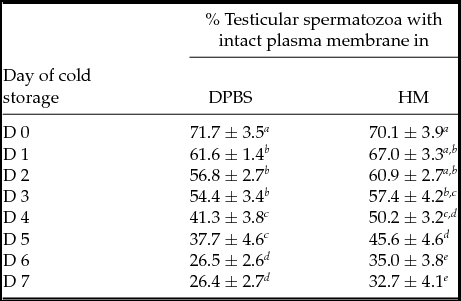
In general, sperm membrane integrity gradually decreased during 7 days of cold storage (Table 1). HEPES-buffered M199 maintained sperm membrane integrity at higher percentages than DPBS throughout the storage periods, although the results obtained did not significantly differ between the two media (P > 0.05) at all time points. Spermatozoa stored within HM preserved the membrane integrity comparable to fresh spermatozoa up to day 2 of storage and decreased gradually during 5 days of storage. In contrast, this membrane integrity decreased significantly (P < 0.05) after 1 day of storage in DPBS. After 1 week of cold storage, the number of spermatozoa with intact plasma membrane remained up to approximately 26% and 33% for DPBS and HM, respectively.
The percentage of testicular spermatozoa with intact plasma membrane (mean ± SEM) during cold storage in two different media (DPBS and HEPES-buffered M199 (HM)) for 7 days
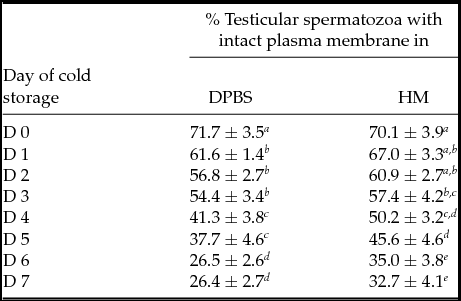
Within a column, different superscript letters denote significantly difference between the day of preservation (P < 0.05).
The effect of BSA concentrations on membrane integrity of extracted testicular spermatozoa after cold storage
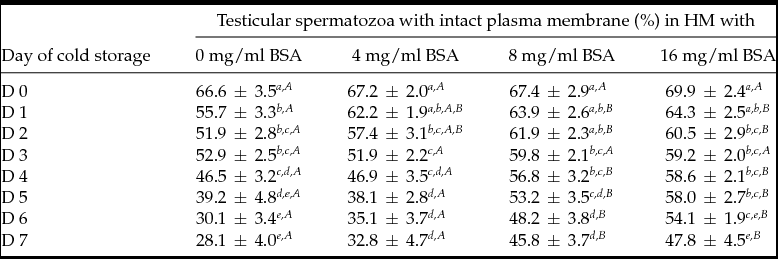
As Experiment 1 indicated that HM provided better membrane integrity than DPBS, HM was therefore used as a preserving medium in this experiment to examine whether addition of BSA would improve sperm quality after cold storage. We found that the percentages of testicular spermatozoa with intact plasma membrane decreased with storage time, irrespective of BSA concentrations (Table 2), although this proportion in HM with 4 mg/ml BSA decreased faster than those of 8 or 16 mg/ml BSA. Overall, the percentage of intact plasma membrane spermatozoa stored in HM plus 4 mg/ml BSA was less than those observed in HM containing 8 or 16 mg/ml BSA. However, it did not significantly differ among groups during the first 3 days (P > 0.05). After 1 week, medium containing 16 mg/ml BSA maintained the highest proportion of membrane integrity (47.8%). However, sperm membrane integrity was not different between the 8 and 16 mg/ml BSA groups.
The percentage of testicular spermatozoa with intact plasma membrane (Mean ± SEM) during cold storage in HM supplemented with different concentrations of BSA

Within a column, different lower case letters denote significantly difference between the duration of cold storage.
Within a row, different upper case letters denote significantly difference between BSA concentrations. (P < 0.05).
DNA integrity of testicular spermatozoa after cold storage in HM supplemented with 16 mg/ml BSA and embryo development after ICSI
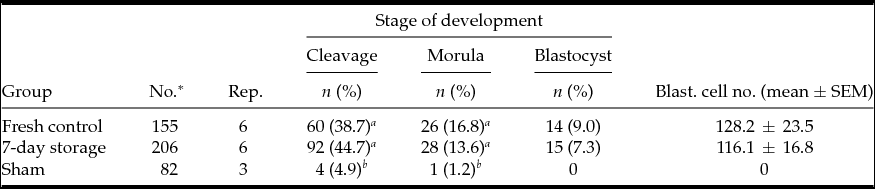
The percentage of freshly prepared testicular spermatozoa with DNA fragmentation was approximately 0.8 ± 0.2%. This proportion increased after cold storage but did not significantly differ during 5 days of storage, although it significantly increased to 6.21 ± 1.6 after 7-day cold storage (P < 0.05; Fig. 1). ICSI with 7-day cold-stored testicular spermatozoa yielded cleavage, morula and blastocyst rates similar to that of the fresh control (Table 3). Average cell numbers of blastocysts were comparable between the two groups. Small numbers of sham injections (4 of 82: 4.9%) were cleaved, and 25% of the sham-cleaved embryos reached to morula stage. However, they did not develop further to blastocysts.
Developmental competence of feline embryos produced by ICSI with testicular spermatozoa cold-stored in HM containing 16 mg/ml BSA for 7 days
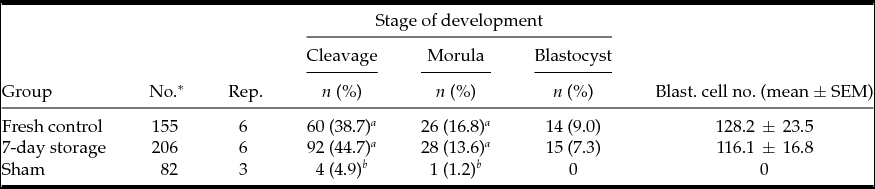
a,bWithin a column, different superscripts denote values that differ significantly (P < 0.05).
* = total number of injected oocytes. SEM, standard error of the mean.
The percentages of spermatozoa with DNA fragmentation after cold storage in HM containing 16 mg/ml BSA for 0, 1, 3, 5 or 7 days. Values are presented as mean ± SEM. During the storage time, different superscripts denote values that differ significantly (P < 0.05).
A large proportion of non-cleaved oocytes (day 2 of culture) was arrested at metaphase II (MII) stage (Table 4). The ICSI with refrigerated spermatozoa had significantly higher rates of MII arrest with intact sperm head and lower rate of MII arrest with decondensing sperm head when compared with ICSI with fresh testicular spermatozoa (P < 0.05). However, degenerate oocytes or MII arrest oocytes with degenerate spermatozoa, two or three pronuclei and premature chromosome condensation (PCC) could also be observed at the comparable rates.
The nuclear status of non-cleaved oocytes after ICSI and 2-day culture

Within a column, different superscripts denote values that differ significantly (P < 0.05).
Abbreviations: DSH = decondensing sperm head, FT = frozen–thawed, ICSI = intracytoplasmic sperm injection, ISH = intact sperm head, MII = metaphase II, no SH = without sperm head (in sham group), PCC = premature chromosome condensation, PN = pronucleus/pronuclei.
* = total number of injected oocytes.
** = total number of degenerate oocytes/spermatozoa.
Discussion
Our study demonstrated that isolated testicular spermatozoa could be stored for up to 7 days without freezing. Membrane integrity was improved when the spermatozoa were maintained in more complex culture medium supplemented with BSA. Furthermore, the testicular spermatozoa also retained their fertilizing ability after cold storage for 7 days similar to that of fresh testicular spermatozoa.
In this study, we examined sperm plasma membrane integrity during cold storage because an impaired plasma membrane may allow prolonged direct contact between sperm chromatin and the surrounding medium, resulting in DNA damage (Tateno et al., Reference Tateno, Kimura and Yanagimachi2000). This DNA damage could negatively affect the developmental competence of ICSI-derived embryos and also ICSI outcomes as shown in previous reports in humans (Nasr-Esfahani et al., Reference Nasr-Esfahani, Salehi, Razavi, Anjomshoa, Rozbahani, Moulavi and Mardani2005; Avendano et al., Reference Avendano, Franchi, Duran and Oehninger2010; Jiang et al., Reference Jiang, He, Wang and Zhu2011). We intended to simplify the preservation method for isolated testicular spermatozoa by using basic media, which can be easily prepared in the laboratory. The finding that DPBS could maintain sperm membrane integrity as well as HEPES-M199 medium would be beneficial in cases in which the complex medium is not available. Our study showed that HM provided a higher protective effect on membrane integrity of testicular spermatozoa throughout the preservation period than did DPBS. Although a previous study in mouse revealed that HEPES did not improve sperm survival (Sato & Ishikawa, Reference Sato and Ishikawa2004), this result may be caused by the other components in HM, for example, the cryoprotective effect of l-glutamine in HM on spermatozoa (Al Ahmad et al., Reference Al Ahmad, Chatagnon, Amirat-Briand, Moussa, Tainturier, Anton and Fieni2008; de Mercado et al., Reference de Mercado, Hernandez, Sanz, Rodriguez, Gomez, Vazquez, Martinez and Roca2009) or spermatozoa stored in HM might acquire an energy supply from pyruvate, which is a substrate for adenosine triphosphate (ATP) production within the spermatozoa (Hereng et al., Reference Hereng, Elgstøen, Cederkvist, Eide, Jahnsen, Skålhegg and Rosendal2011). In addition, antioxidant properties of pyruvate might protect plasma membrane from oxidative stress injury during cold storage (Bilodeau et al., Reference Bilodeau, Blanchette, Cormier and Sirard2002; Bruemmert et al., Reference Bruemmert, Coy, Squires and Graham2002). However, the exact reason for improvement of sperm membrane integrity by HM is still unknown as they are commercially prepared by several components.
Bovine serum albumin, a multifunctional protein, is routinely used as an additive in culture medium to support oocyte maturation (Wood et al., Reference Wood, Byers, Jennette and Wildt1995), fertilization (Eckert & Niemann, Reference Eckert and Niemann1995) and embryo development (Russler-Long et al., Reference Russler-Long, Dickey, Richardson and Ivey1991; Varga et al., Reference Varga, Diez, Fernández, Alvarez, Katchicualula, Hidalgo, Tamargo and Carbajo2011). Our study demonstrated that increase of BSA concentrations from 4 to 16 mg/ml significantly improved membrane integrity of testicular spermatozoa. The protective properties of BSA on sperm plasma membrane were also reported in dog (Risopatron et al., Reference Risopatron, Catalan, Miska, Schill and Sanchez2002), mouse (Van Thuan et al., Reference Van Thuan, Wakayama, Kishigami and Wakayama2005) and bull (Nang et al., Reference Nang, Osman, Budin, Ismail, Jaffar, Mohamad and Ibrahiml2012). It is possible that BSA increased the stability of membrane structure (Blank et al., Reference Blank, Soo and Butten1976) or acted as an antioxidant to protect spermatozoa from destruction by free radicals produced by oxidative stress during preservation (Uysal & Bucak, Reference Uysal and Bucak2007). In contrast, the beneficial effect of BSA in protecting spermatozoa against cold shock and sperm membrane integrity was not observed in ram (Colás et al., Reference Colás, Junquera, Pérez-Pé, Cebrián-Pérez and Muiño-Blanco2009) and extremely high BSA concentrations (more than 8 mg/ml) could negatively affect bovine spermatozoa by osmotic stress (Nang et al., Reference Nang, Osman, Budin, Ismail, Jaffar, Mohamad and Ibrahiml2012; Osman et al., Reference Osman, Nang, Ibrahim, Budin, Jaffar and Wahab2012). The different results may reflect that sperm susceptibility to osmotic shock and the specific requirements of proteins in maintaining sperm membrane integrity and function maybe variable among the species studied and also the types of spermatozoa (i.e. testicular versus epididymal versus ejaculated spermatozoa).
Our results also demonstrated that the percentage of DNA fragmented spermatozoa significantly increased after 7-day cold storage. However, these spermatozoa had similar fertilizing ability following ICSI when compared with fresh testicular spermatozoa and led to the comparable in vitro embryo development. It is possible that the oocytes can repair sperm DNA if the damage does not reach a critical level (Ahmadi & Ng, Reference Ahmadi and Ng1999). Nevertheless, ICSI using spermatozoa with damaged DNA beyond that level may lead to low developmental competence of embryos.
In summary, isolated spermatozoa could be cold-stored in simple medium, such as DPBS and HEPES-M199 medium, for up to 7 days. Plasma membrane integrity of cold-stored spermatozoa could be improved by BSA supplementation. Although DNA integrity of testicular spermatozoa stored in HM supplemented with 16 mg/ml BSA significantly declined after cold storage for 7 days, these preserved spermatozoa could fertilize cat oocytes by ICSI and resulted in comparable in vitro fertilization to fresh testicular spermatozoa. This study provides basic knowledge that can be utilized for rare species conservation. However, further evaluation of in vivo development is necessary to confirm the potential of this technology.
Acknowledgements
This study was supported financially by the 90th Anniversary of Chulalongkorn University Fund (Ratchadaphiseksomphot Endowment Fund) and the Thailand Research Foundation (TRF) Research Career Development Grant (RSA5680028). Sirirak Buarpung is a PhD student who received a grant from the Joint Funding of Chulalongkorn University and the Royal Golden Jubilee PhD program (grant number PHD/0189/2550). Ovaries and testes were kindly provided by the Veterinary Public Health Division of the Bangkok Metropolitan Administration, Bangkok, Thailand. We would like to thank P. Chanapiwat for help with statistical analysis.
Conflicts of interest
None of the authors has any conflicts of interest to declare.
Author contributions
All authors contributed extensively to the work presented in this paper.